



Abstract
Grounded in affective futurity, this article examines the often-invisible forms of rejection that shape the ordinary body. In this light, rejection becomes a form of academic slow death, prompting some to imagine no futures for their lives within the academy. Rather than swallow indignation, I embrace the margins as a site of meaning-making, navigating an institution with little room to falter. Through creative-relational methodologies, I invite Professor Nick Hopwood to reexamine his “Rejection Wall,” as a provocation that exposes both the faint possibility of transformation and the inequities sustained by power and institutional norms—ordering who may belong and who must remain peripheral. The article urges readers to resist using institutional systems to justify further exclusion and instead to imagine futures otherwise: forms of affective futurity where agency, dignity, and difference are foundational. It responds to Zembylas’s call for methodologies attuned to the affective futurities of higher education.
Keywords
Who Has the Right to Express Frustration?
I wish there were a pill to erase certain memories. The kind that linger. The kind that bruise… 1
When I was a rejected PhD candidate, I stumbled upon Nick Hopwood's (2017b) “Wall of Rejection,” a public gesture meant to normalize academic failure by displaying his own rejected submissions. 2
Yet, from where I stood—outside this academic gate, knocking again and again (Yan, 2025a)—the wall of rejection felt less like comfort and more like a quiet violence. A gentle reminder that even the well-intentioned can forget those at the margins—where rejection is not a character-building exercise but a permanent condition, less a lesson than a slow bruise. 3
A series of invisible rejections accumulates into a form of “slow death”—what Berlant (2011) describes as the ordinary attrition of life, an activity that marks “the historical present by casting it as crisis” (p. 18). This slow death is shaped by a critical awareness that perceived futurelessness recalibrates social relations, determining how others engage with the rejected subject.
As a seemingly successful PhD candidate, it has taken me decades to find the courage to speak into that space (Yan, 2025d)—the uneasy interval between rejection and redemption.
Writing about rejection becomes a liminal threshold—a space suspended between loss and recognition—where a self, marked by invisible pain yet still standing, begins to imagine repair and, bruised yet unbroken, begins to imagine transformation.
As Srinivasan (2018) observes, this is a situation in which those who find themselves wounded must navigate the normative conflict between the emotions that arise unbidden and the emotions they are told, all things considered, would be best to feel.
It is within this space that I, becoming an “academic other” (Yan & Poole, 2024), pose a reflexive set of moral difficult questions:
who is permitted
to voice their frustration, and
who must swallow it quietly
for fear of appearing out of place?
Affective Futurity in the Context of Higher Education
This article is grounded in Zembylas's (2025d) notion of affective futurity, and it returns to the wound of repeated rejection in its various forms to ask what futures might still be possible in its wake. For Zembylas, affective futurity captures how feelings, emotions, and embodied experiences orient people toward imagined futures and the possibilities for transformation they hold (Yan & Poole, 2025).
To articulate a feeling of “futurelessness” among those who never made it in academia, we turn to creative-relational inquiry (Wyatt, 2019), a dialogic and metaphorical space where the marginal self—I (who is the “I”)—edges toward the seemingly privileged other—you (who are you?)—negotiating the fragile boundary between vulnerability and voice. 4 This collaborative work may also offer Prof. Nick Hopwood, or any reader, a renewed opportunity to reconsider their own place within this relationship.
Here ambiguity is crucial: who speaks and who listens no longer matters as much as the meaning that emerges through this dialogic play. 5 By articulating what Green and Little (2013) called “academic migration” 6 —the movement from repeated rejection to eventual acceptance as a PhD candidate—this kind of inquiry positions affective futurity as a relational lens for understanding how power operates affectively across intersecting positionalities in higher education.
Together, we—you and I—create a dialogic space where our differing vantage points can meet without collapsing into sameness (Yan et al., 2023). In this unsettled space, your experiences and mine—both individual and collective—seem to meet in a way that is neither grand nor easily named. They come together at the meso level of the higher education sector, holding their shape just long enough to resist dissolving into the broad, abstracted notion of higher education at the macro level. It is here, in this smaller and more fragile place, that something of our shared uncertainty begins to take form. As Zembylas (2025d) reminds us, it is not enough to consider how the future of higher education is conceptually framed; it is equally necessary to attend to how that future is felt.
By bringing into conversation various individuals unevenly positioned within the academy, this article traces the asymmetries of structural marginalization that shape how rejection is experienced, narrated, and endured. It responds to Zembylas's (2025d) call for methodologies equipped to study the affective futurities of higher education.
Through creative-relational practice, we show how rejection fuels broader patterns of burnout and exclusion, particularly for those who live at the edges of academic life or who have never been permitted entry into it. In tracing the other’s perspective as an international student, an immigrant, a schoolteacher, and a doctoral applicant—positions that mark a movement from the classroom toward the uneasy periphery of the academy—this article examines how these intersecting experiences shape the affective dynamics of academic becoming. Over the years, I have looked at the grand wall of rejection, spoken to it, and tried, in my own way, to dismantle it. Yet the wall remains, standing with a kind of quiet indifference, as if waiting for me to decide what it is the “I” seeks from it.
By examining the affective futurities of higher education through the lens of academic migration, we explore the conceptual, methodological, and political implications of these dynamics, highlighting how power circulates through affect, discourse, and materiality (Zembylas, 2021). Attending to these dynamics calls for a shift beyond familiar narratives of personal resilience, urging instead a reckoning with the systemic forces and institutional actors that produce and sustain cultural precarity in neoliberal universities. In doing so, the article advances efforts to imagine more inclusive academic futures—futures in which agency, dignity, and difference are not merely tolerated but actively cultivated.
Tracing the Lines of the Rejection Wall
This inquiry situates rejection—and the “rejection wall”—within the wider landscape of the contemporary neoliberal university. Neoliberalism has become the quiet architecture of public institutions, universities included, shaping their priorities almost by default (Azzarello, 2025; Morley, 2024).
As Vostal (2025) observes, we inhabit an era governed by an ever-tightening regime of performance management and metricization. Under the banner of new public management, the university is recast in corporatist form: a place where efficiency is prized, and value is distilled into numbers, rankings, and other calculable proofs of worth (Connell, 2013; Giroux, 2011). Watermeyer et al. (2024) capture this shift with stark clarity: Today, many academics draw their self-concept – and license to participate – relative primarily to their acquisition of research publications; research citations; research income; research partners; doctoral students; social media followers; public and policy stakeholders; patents and other such tangible quantitative representations of productive output and its influences (p. 448).
Within this machinery of worth and worthiness, rejection is not an isolated event, but a thread woven tightly into the fabric of neoliberal academic life. This extends to what Gershon (2011) describes as the neoliberal domestication of affect, where emotions are disciplined into forms that serve institutional logics. Prestige, as Watermeyer et al. (2024) argue, becomes a kind of false economy, built upon fragile assumptions about what constitutes academic quality.
Macfarlane (2020) further suggests that performativity, prestige, and self-presentation operate as a fulcrum of values, shaping scholarly behavior and offering a sense of agency even as they quietly circumscribe it. For this economy does not merely enable; it also constrains. It reinforces hierarchies, deepens inequalities, and encourages practices that insulate rather than connect. Frustration and indignation are not seen as indexing faults or injustices in the system, but rather as failures of the person who feels them—“which brought that anger into being” (Lorde, 1984, p. 127).
Within this high-performance, selective, and competitive regime, individuals are expected to adjust themselves to the systems around them, quietly absorbing responsibility for both their futures and their failures. Being negatively affected means to be insufficiently oriented to the required adaptation (Grove, 2018). We—individuals involved—learn, implicitly or explicitly, to manage such “undesirable” emotions and to cultivate those that align more neatly with productive labor and institutional expectations (Jackson, 2022).
On the surface, the Wall of Rejection, as Hopwood displayed it, appears to offer a kind of counter-narrative—an attempt, however modest, to signal the absence of positions capable of challenging the moral and affective authority that neoliberalism exerts across academic spaces. It stands there quietly, as if aware of both its defiance and its limits (Figure 1). The rejection wall of Nick Hopwood's (2017b)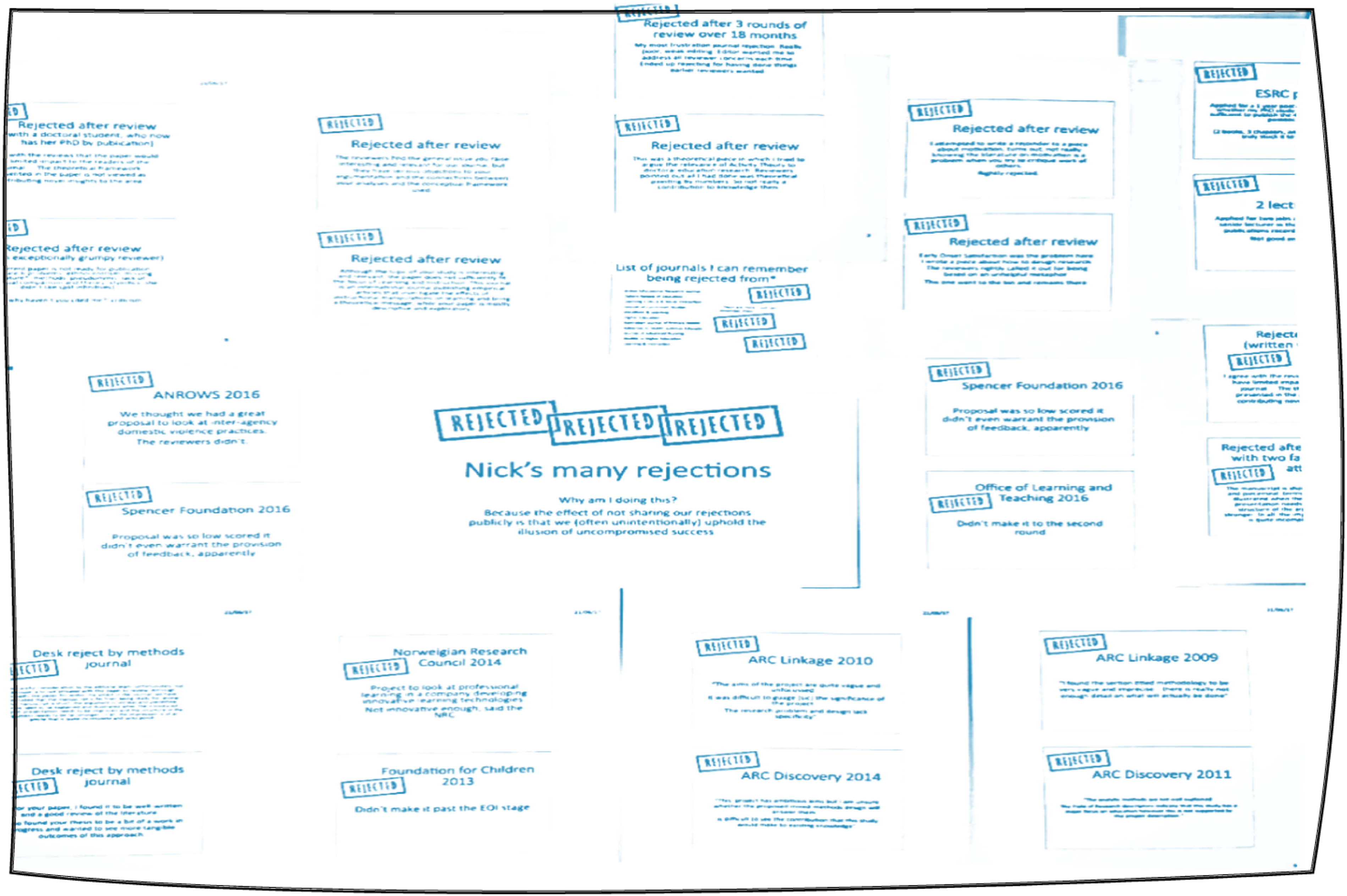
This wall is meant to normalize rejection from academic journals and funding bodies. The gesture has gained traction for its promise of transparency, yet it also legitimizes anger, affirms vulnerability over heroism, and depersonalizes failure by casting rejection as an institutional norm. In “(Be)coming, (be)longing,” Koehne (2006) cautions that academic discourses construct subject positions for those who are often compelled to script “imagined lives” that do not speak to their lived realities. In this context, I argue that Hopwood’s reflection diminishes the fact that academic rejection is unevenly experienced, shaped by structural inequalities that make it far more consequential for those in precarious or marginalized roles (Firth, 2024; Morley, 2024).
Much of the existing scholarship likewise centers on the frequency of manuscript and grant rejections and their effects on individual academics (Conn et al., 2016; Day, 2011; Jaremka et al., 2020; Walker, 2019), a perspective echoed in Hopwood’s wall. Much of this work reflects the experiences of those positioned within academia—Nick Hopwood included—and in doing so narrows what “rejection” can signify and whose rejections are permitted to surface, ultimately reproducing an institutionally sanctioned and restrictive understanding of rejection.
What I find myself questioning in Hopwood’s suggestion—and in the work of other academic scholars—is the assumption that normalizing rejection, dismantling illusions of unfettered success, and cultivating a mindset to cope with rejection are inherently valuable (Conn et al., 2016; Day, 2011; Jaremka et al., 2020). Such a stance overlooks the asymmetries of academic life and fails to account for what rejection means to those whose futures were foreclosed before they began. This inquiry intends to advance a more radical reading of the framing—one that interprets rejection as a form of academic slow death, a condition we will theorize in greater depth later.
In neoliberal higher education, cross-border individuals frequently encounter rejection when their epistemologies and identities fall outside dominant paradigms (Albaos, 2025; Deuel, 2023; Halliwell & Limpus, 2025; Smithers et al., 2025). Responding to this context, this inquiry cultivates a dialogical space that interrogates whether the “rejection wall” adequately confronts the deeper inequities shaping rejection in academia, and how those inequities, in turn, configure affective futurity for both those already inside—and those still struggling to enter—the academic world.
To put it simply, I argue that Hopwood’s “rejection wall” constitutes a limited—and perhaps quietly harmful—position, as it risks collapsing the emotional and structural gravity of rejection into a narrative of individual resilience, particularly for those whose futures and imagined lives hinge on acceptance.
Creative-Relational Inquiry
This research is situated within Wyatt’s (2019) articulation of creative-relational inquiry. It explores rejection as a shared, yet uneven experience shaped by power/knowledge dynamics and embodied subjectivities. By extending discussions of rejection beyond the narrow frames set by established scholars, this inquiry brings into view the voices of those who never made it through the gates.
From the borders where an ordinary body becomes an academic migrant, we trace a life that has long remained unseen—still pushing, quietly yet persistently, toward a more equitable space of becoming. In doing so, it cultivates difference in thinking as a site of critical engagement (Cribb & Gewirtz, 2025) and offers a more nuanced account of the emotional and epistemic consequences of rejection (Settles et al., 2024).
This research design is grounded in relational ontologies (Salomão Filho & Kamp, 2019) and a creative poetics of living and sense-making on the margins. We are motivated by a counter-praxis (Yan, Bright, et al., 2025a) that explores a dialectical, ethically and politically grounded alternatives to neoliberal framings of rejection in higher education—one in which our ways of being, knowing, doing and feeling actively shape the world and our orientation to the future (Hopwood, 2024b).
Informed by Zembylas, (2025c), we resist the binaries of researcher versus researched and privileged versus less privileged. By re-imagining the future, this research moves beyond the status quo (Stetsenko, 2014), showing how creative-relational inquiry can render our positions productively ambiguous, unsettling entrenched norms and opening new methodological horizons (Gale & Wyatt, 2017).
Our research practice advocates for ethical, collaborative engagement aimed at transforming these power relations. We contend that this relational and political understanding (Zembylas, 2019)—of rejection—makes an important contribution to how we theorize academic migration, revealing the structural forces that shape who is permitted to belong and who is pushed to the margins.
Taking the form of a dialogic exchange, we enter this relational space as a terrain where creativity and politics meet in plain sight (Gale & Wyatt, 2017). Here, the possibilities of collaborative writing reveal themselves not as grand declarations but as small, insistent disruptions—radical in their quiet refusal of established methods, productive in the way they unsettle what scholarship is supposed to look like.
Our discussion, reflection, and writing with theory contribute to a shared “cultural sense of being and understanding” (Willis et al., 2023, p. 607), enabling those positioned at the margins to speak back to their lived experiences of rejection. From this vantage point, rejection appears not as an isolated wound but as part of a wider network of power–knowledge relations, falling most heavily on those whose identities and ways of knowing have long been kept at the margins.
Through an act of leaning on one another to make sense of how we think and narrate hope and resistance in neoliberal times, we come together to think, feel, commune, and write (Diversi et al., 2021). In doing so, we use hybrid texts to move beyond a duo-voiced position, generating multiple voices that imagine possibilities for resistance and trace paths toward a kinder, more just future.
By embracing a relational, theory-informed lens (Wyatt, 2019) that understands rejection as something lived in the body and between bodies, we show the affects, hopes, and imagined futures of those who aspire—often against the odds—to enter academic life. Doing so, diverse subjectivities lead us to different experiences and interpretations of institutional contexts (Bilgen et al., 2021).
Through this relational lens, I hope to invite those less peripheral—perhaps Nick, nearly a decade later—to revisit their assumed positionalities and to understand rejection differently. In what follows, as collaboration, subjectivity, and performance become dialogue (Gale, 2018), we are prompted to confront what has been overlooked yet remains crucial to a deeper account of the affects of rejection—its entanglement with neoliberal hegemony and its potential uptake as a basis for resistance.
To foreground conversation, voice, and relational movement, we use a playscript form to make the inquiry visible, attending to unevenness, vulnerability, relational tensions, and shifting positions (Gale & Wyatt, 2009). In doing so, we move beyond the binary of “you” and “I”, inviting the multiple others involved to help advance this creative-relational inquiry rather than merely understand it conceptually.
By articulating epistemic injustice as a phenomenon of (mis)recognition (García-Álvarez, 2025), we position our analysis within a broader critique of how knowledge, legitimacy, and belonging are unevenly distributed. To do so, we engage critically with the rejection wall to correct the narrative it presents and to use this intervention as a basis for a wider political critique of the neoliberal university and the affective futurities it enables and forecloses.
The multi-vocal text, with voices writing from markedly different “I” positions and backgrounds, traces a life of being oneself and becoming the other, presented in a single act (Yan et al., 2023). Addressing rejection from these positions invites readers into a situated and relational understanding. This fragmented writing style reflects a fragmented existence, mirroring the stops, starts, and interruptions that shape how life is actually lived and remembered.
My co-author—Nick—keeps asking when, exactly, we should tell readers who the “we” is. Can’t the reader work it out themselves? I wondered about it, but I kept quiet because I was worried he might end the collaboration at any point. And does it really matter to pin down who, exactly, is writing which sentence when the ‘we’ is already more crowded than it appears?
Even with just the two of us, there is already “quite a crowd,” as Deleuze and Guattari (1987, p. 3) caution: the aim is not to reach the point where one no longer says “I”, but the point at which it no longer matters whether one says “I”. At that point, “we are no longer ourselves… we have been aided, inspired, multiplied.” In this context, by allowing the boundaries of “us” to remain ambiguous, both the individual and the collective expand—readers become interlocutors, and theorists become participants in the unfolding performance.
A Chorus of One, Waiting: Provocation From Outside
PYNCHØN: an immigrant schoolteacher, an “academic migrant.” NICK: a professor, well-meaning, occasionally oblivious. AHMED: Sara Ahmed, appearing as a sharp, incisive presence. ZEMBYLAS: quiet, reflective, intervening only when necessary. YAN: A closeted feminist thinker, unknowingly driven by a quiet, simmering rage. HOPWOOD: a voice from The Wall of Rejection.
There is no curtain. Nothing shields us. The truth is laid bare. PYNCHØN stands near a desk cluttered with books. NICK lounges in a chair, watching. The others remain invisible.
To maintain transparency, yes, I’m getting a PhD soon. All the experiences I’m talking about – every last one – happened before 2022. Back when I wasn’t… this. Whatever this is.
Oh? And why drag them out now?
Because it’s the only way I get to speak back to you in this space. A little late, maybe. But still – my turn.
You make it sound like a performance, “a liminal event that marks a crisis in the university’s history” (Denzin, 2003, p. 19).
Isn’t it? When I started, I wasn’t even planning to graduate. I just wanted the skills and resources I needed – the language, the codes, the choreography – so I could stand here and say something that might actually land. You do know that “The revolution will not be televised” (Scott-Heron, 1971).
And now?
PYNCHØN: Now I’m finally saying it… (pause) to YOU. Hopwood (2017a) tells me the surest way to grow is to reach toward the finest minds and read what brings you alive. A beautiful idea. Almost true. But belief, I’ve learned, doesn’t always open the door.
Okay, you’re quoting a blog I wrote when I was younger and first starting to see myself as a scholar. Now I see… you’ve already been moving through the academic world as a successful PhD candidate for a long while now – long before the finish line comes into view.
I see myself as an immigrant schoolteacher, living in Australia – though that label barely grazes the surface. But I didn’t just tumble off the plane and stroll into a classroom. (cogitating) No, I’m more the “academic migrant” (Green & Little, 2013): the repeatedly rejected PhD candidate – rejected once, rejected again, rejected yet again – whose movement is not merely across national borders but across intellectual boundaries. My academic migration names more than an individual struggle to move; it names the struggle to cross epistemic thresholds and gain entry into circles of knowledge, legitimacy, and recognition that remain selectively permeable.
…until I finally seemed to make it. And yet here I am, still lingering at the edges of a world that hasn’t quite decided where to file me. I don’t have a PhD to brandish, but apparently, I’m educated enough to keep being mistaken for an academic.
Misrecognition is not a misunderstanding. It is a structure – a system of sorting bodies into those who count and those who are merely counted.
I spent years in classrooms – watching, listening, gathering what Clandinin (2019) calls “personal practical knowledge.” But in academia, that knowledge becomes raw material. Data. Something to be mined, not heard. That’s why I approached academics in the spirit of what Cribb and Gewirtz (2025) describe as “academic mentoring,” so that schoolteachers can amplify their own voices and share their perspectives on certain issues. (pause) But I suppose I’m “not their type” – the same response I get on Grindr, frankly. The academic circle has its own implicit rules about who gets invited into collaboration.
Is that so? Is that the rejection you found yourself facing? I don’t think it’s their intention to ignore you…
Intent is not the measure. The door can be closed politely yet still carry the “affective quality of being mean” (p. 42).
And it was – again and again. I knocked at their door, but it never opened, a lesson in how my knowledge was valued. I learned that sincerity was never the currency. to be heard, I had to speak the right language, think their thoughts, wear their shoes – even though they were never made for me.
Affective futurity is shaped by who is allowed to imagine a future at all.
Yes. Still, I reached out. Not in surrender – in hope. I read your work. Sometimes all of it. I wrote careful emails, shaped to your contours. And then I waited (Yan, 2026b) – a wait that became its own kind of labour.
Rejection is part of the journey; it should not be taken personally. We all learn, over time, to grow a little thicker skin.
Only for those who get to stay on the path.
When email responses came, they were polite, distant – the kind of civility that closes more doors than it opens. Most didn’t respond at all. Collaboration, it seemed, was a performance for conferences, not a practice for schoolteachers who dared to write back. Is this what it means to sustain the slow labour of repair on which a common world rests? (cf. Prosser, 2026)
I didn’t realise… I openly acknowledge that, as a male professor with a secure position and as a graduate of Oxford, I carry significant privilege.
That is the point – “how a complaint is heard as intensity, an emphasis, a sharp point, a sore point, a raising of the voice, a shrieking, a shattering” (p. 18).
Even so… here in 2025, I’m already running into my own version of “When the neoliberal university doesn’t want you anymore” (Jones, 2025) – Neoliberalism comes to bite me on the arse when my institution threatened to make me redundant...
I read academics calling for collaboration between practitioners and researchers. I thought they meant me. But the silence was not absence; it was rejection – quiet, relentless, creeping into the corners of my life until I could no longer dress it up as anything else (Yan, 2026a).
Rejection shapes the futures we are allowed to imagine.
There’s a silence no one bothered to inscribe on that wall – the kind of rejection that strikes before you ever get close enough to be rejected. The wall speaks as if we are all insiders, licking our wounds together, but it never asks about those still outside the door: knocking, waiting, turned away without even a note to pin up. I see… (pauses, deep in thought) Over time, the silence revealed itself. It was not absence. Was it the sound of silence (cf. Zembylas & Michaelides, 2004)? Or wilful ignorance (Zembylas, 2017)? No – it was rejection: quiet, cumulative, disabling, until you could no longer pretend it was anything else. A silence of voices that fail to resonate in academia, because we have excluded them.
The contradiction reveals itself: we are pressed, endlessly, to prove our work matters in the real world, yearning for others to listen, to engage – yet we so often meet them with silence. (turning to PYNCHØN) I now see you as a public intellectual against the neoliberal university (Giroux, 2014).
No. I stand against you – all of you. I don’t want your niceness anymore. [V.O.] His behaviour could be read as madness – fractured, erratic, driven by impulses he can barely contain (Yan, 2024b). Yet beneath that surface there is the unsettling possibility of deliberateness, a mind working with sharp, almost unnerving intention. He appears at once unhinged and hyper-aware, as if his apparent instability might itself be a strategy, a mask, or a form of resistance. It is “madness” as breakthrough – movement, sensation – sparking creative exchanges within each “intimate partnership” and, within the vivid play, the pulse of life reveals itself (Gale, 2018, p. 77).
Can classroom practitioners talk about their practice in academia? [V.O.] No one listens and no one cares. For everyone else, it’s business as usual – rejection is only tragic when it happens to you in silence.
Being rejected from journals or denied funding assumes you’re already inside the club. The wall never spoke for those whose rejection keeps them outside altogether. You’re right to question the gospel of “normalising rejection.” The wall – well intentioned, sure – just parroted the neoliberal mantra: adapt or die. Stripped bare, its message was simple: take your rejections and keep moving, or you’ll have no publications, no grants, no future. Prestige machinery, same old grind, just as Watermeyer et al. (2024) warned. And then Pynchøn – he smashes the wall, forcing me to face what I hadn’t: affective futurity. For the secure, rejection is a bump in the road. For the marginal, it’s the end of the road. A minor inconvenience for one, a closed future for another (Yan, Bright, et al., 2025b). The wall never accounted for that silence.
And in that silence, I rewrote myself a thousand times. I turned to self-citation as a way of making myself present, if only to myself, a small act of making presence against erasure (Yan, 2024a). Nearly a decade has passed before I could stand here – not because I lacked intelligence or drive. You tell me it is because of the system. Dare I say it is you – the ones who guard and participate in it – who have perfected the art of rejection. You wrap it in rationales, baptise it as rigor, parade it as competitiveness. And some days, truthfully, there is nothing left to give. For those who are rejected in invisible ways I cannot even name, this is a “slow death” – “there is no way out, no living as if one were not already in relation to death, which is inscribed in all the potential losses that precede it” (Berlant, 2011, p. 41). The irony, however, is that some among us celebrate this condition as the validation of neoliberal prestige accrual, mistaking attrition for personal success.
AUDIENCE 1: We proclaim diversity, yet the boundaries – epistemic, institutional, intersectional – remain intact. Some are invited in only to discover the welcome was never meant to be warm. These stories carry weight, but they are easily dismissed. And what strikes me is this: he has finally entered the academic kingdom he fought so hard to reach, yet he circles back to the same feelings, repeating them, insisting on them. I don’t think it does him no favors, at least not in career terms. It recalls Native Speaker – Chang Rae Lee’s (1995) portrait of a man whose identity serves the system, while his voice is kept outside the door. The rules apply, but belonging never arrives.
AUDIENCE 2: Some will say Pynchøn exaggerates, that he is bitter, that the suffocation was imagined, the sting self-inflicted. Watching this so-called play, I don’t even know where this pain comes from. I understand – as Coetzee (1980, p. 5) reminds us – that “pain is truth; all else is subject to doubt.” He may have formal access now, but the exclusions cling to him like a second skin. So, when he names these experiences, when he dares to theorize them aloud, it is not reflection – it is resistance. Olson (1995) called it “narrative authority.” And that is what he wields here: the authority to expose how inclusion is performed, while exclusion is preserved.
AUDIENCE 3: I have to say, they are too harsh on our colleagues. We face a flood of inquiries every week – no one can answer every email, let alone collaborate with everyone who reaches out. That is not always indifference; sometimes it is simply the weight of our workloads. And honestly, I’m not convinced this piece really engages with education in any meaningful way. It feels more like a backdrop, a stage set for the author’s own negative experiences rather than a contribution to the field. …
Audience ∞: It is critical to recognize the cultural and political dimensions of science – even when its authority is secured at the expense of those “struggling for credibility,” contingent on what is at stake, who the audience is, and which institutional arena is involved (Gieryn, 1999, p. xi). Scientific credibility is often maintained by dismissing or discrediting others – typically those with less institutional power, fewer resources, or non-dominant ways of knowing. These are the people “struggling for credibility.”
Audience ∞ is infinite, embodying an ever-expanding constellation of readers, interpreters, and witnesses. Even the truth is not written here; it resides with the audience, who themselves disclose multiple interpretations and reject certain beliefs. This is precisely what Brecht (1964/2019) described as the “epic style”: meaning is not fixed on the page but produced in the encounter between text and reader, a dynamic that can draw both actors and audience “into a kind of trance” (p. 46).
So what kind of rejection is being discussed. Part of this remains unclarified—for the person who finally makes it through, the memory becomes blurred: a slow bruise, a loss that never quite transforms into recognition. In the performance text, the “I” becomes unstable. It refuses to settle into a single, fixed identity, and because of that instability, the text does not speak to one audience—it speaks through several at once.
Reflexivity and Positionality
Through a creative-relational space of dialogue, Nick and I—we—show that a single act is never only personal. It becomes theorization, it becomes a political gesture, and it refuses the quiet normalization of rejection and the toll it exacts (Conn et al., 2016; Jaremka et al., 2020). In the form of a playscript, this creative-relational inquiry brings into view the lived reality of becoming an academic migrant (Poole & Yan, 2025)—narratives usually absent from research but vital for imagining more just political representation (Kirchgasler, 2021).
The stage is set not with applause but before invisible audiences: the migrant character enters and speaks, accompanied by various characters. This invisibility plays out not only in physical encounters but also in spaces beyond the physical—emails left unanswered, platforms that flatten presence, institutional interactions that quietly signal who is welcome and who is not.
The literature tells us that academics’ struggles belong to the machinery of institutions, the weight of power, the architecture of networks (Macfarlane, 2021; Warren, 2017; Yin & Mu, 2023). But this act reveals something more unsettling: that rejection is not only structural, it is perhaps enacted by academics themselves. It is subtle, but it is real—directed at those deemed “less scholarly,” the migrants of the academy, whose legitimacy and access do not align with the comfort of hegemonic positions (Burford et al., 2021).
And here lies the truth that exclusion is not an accident of the system, it is the system performed through us (cf. Black et al., 2019). On a personal level, I, Pynchøn, feel conflicted about “coming out” as an academic migrant—moving from rejected outsider to high-performing PhD scholar-to-be (Yan, 2025b). White Australians, like Nick, do not often narrate their migration stories, just as the socially enabled are rarely required to account for their enablement (Reeders, 2022).
In some ways, the privilege of not having to explain becomes its own kind of silence—one that speaks volumes about who is assumed to belong. In Silence, I remember Endō’s (1969/1980, p. 59) words: “It is easy enough to die for the good and beautiful; the hard thing is to die for the miserable and corrupt.” That realization came home to me acutely at the time, for it is to be trampled on by you that I am here.
Yet, I speak anyway, knowing the act of speaking may be mistaken for indulgence. Years of rejection, silence, and the slow erosion of worth gave way to the sudden recognition of being (conditioned as) a successful PhD candidate. To some extent, I hold to Hopwood's (2017a) reminder of nurturing our own thinking and reading what feels good. But I add this: write whatever makes you feel breathable.
My constant rejection is not a flaw to conceal; it is a truth to be revealed through art. I do not ignore the hurt, because it is real. I let it soften me instead of hardening me, open me instead of closing me, guide me toward those who will accept me rather than drive me into hiding. Gieryn (1999, p. xi) reminds us that science secures its authority not through fixed methods but through boundary-work—cultural, political, rhetorical—often at the expense of those still “struggling for credibility.”
Through creative-relational inquiry, this collaborative work is revealed not as concession but as agency, a way of navigating and softening boundaries that were built to exclude. Attending to positionality makes clear that bringing rejection into view strips away the illusion that prestige protects against vulnerability. Even those rewarded by neoliberalism can be rejected; we simply rarely see it.
In writing this article, we challenge the assumption that psychological support alone—such as seeking help from counselors or therapists—can adequately address the deeper, systemic dimensions of academic exclusion (Jaremka et al., 2020). As Zembylas (2018) cautions, mental states are never purely individual or psychological; they are shaped by wider social, political, and historical conditions.
Within this relational space, vulnerability is not evenly shared. To take positionality seriously, we must move beyond what can be described on the surface. Some of us are cushioned by privilege, by the security of futurity, or perhaps, by the unspoken expectation that we need not explain ourselves. Others emerge from the position of the outsider clawing to enter, only to find themselves exiled even after arrival (Yan, 2025b).
Hopwood’s rejection wall affirmed the neoliberal game of prestige accrual; my poetics of rejection refuse that game entirely. The rejection wall said: even “serious” academics get rejected. But creative-relational inquiry into the wall reveals something sharper—that constant rejection makes it difficult to take myself seriously at all. That is the deeper wound, the vulnerability, the counter-narrative.
Enacting creative-relational inquiry, it is not simply a matter of being heard, but of writing in difference, of allowing the silence itself to speak (Ahmed, 2021). Now I envision what was intended to silence becomes, strangely, the ground of resistance. The future I once imagined may already have slipped away.
From the margins of a continuing position, I have come to see that futurity is not answered by asking, What research instead
What was cast aside as marginal becomes the very place from which new futures, tentative and fragile, are spoken into being. Through this collaborative work, we wonder whether rejection itself might be reimagined as a form of writing affective futurity—a mode of resistance that speaks against the systemic production of “an oppressed and marginalised academic workforce” (Badley, 2025, p. 508).
Theorizing Academic Slow Death
By practicing an ethic of discomfort as an ethic of care, we explore educational development among those living on the margins, revealing how higher education institutions perpetuate affective injustice (Zembylas, 2025a). What unfolds is not a single act of dismissal, but a slow erosion of recognition—a gradual wearing down of belonging.
Thinking with Berlant’s (2011) notion of slow death, we contend that rejection in academia is not merely episodic; it accumulates through everyday exclusions, subtle silences, and institutional neglect. It manifests in micro-gestures—being overlooked in meetings, ignored in collaborations, or rendered invisible in corridors of power (Rudert et al., 2019; Williams & Nida, 2017). These small acts of marginalization, repeated over time, enact a chronic diminishment of vitality.
Within the creative-relational space, the academic migrant emerges as a figure of affective futurity—someone who endures not because the system sustains them, but because it slowly wears them down. Survival becomes less a promise than a habit, carried out in a world that offers recognition only as it withdraws it. Yet, rejection is not merely destabilizing; it is shaped by power, precarity, and exclusion.
For academic migrants, overt rejection can escalate into ostracism—defined as being ignored or excluded even without physical separation (Ren et al., 2017). In such moments, they become psychologically invisible, rendered inaudible to the broader community (Butera & Levine, 2009). Invisibility is never neutral. It works as a quiet discipline, producing what Williams (2007) calls the “kiss of social death”: the voice erased, the agency removed, the body left in place only to be ignored. This death creates a sense of futurelessness.
Engaging with Zembylas's (2025d) account of affective futurity in higher education, we theorize this sense of minor feeling as a form of academic slow death—a moment when one’s imagined future contracts and the social world recalibrates around that loss. As Berlant (2011) reminds us, slow death emerges when “something you desire is actually an obstacle to your flourishing” (p. 1). In academic settings, these contractions are especially pronounced, as exclusion shapes individuals’ thoughts, emotions, and behaviors (Inzlicht et al., 2009). When experienced chronically, such rejection fosters alienation, helplessness, depression, and a profound sense of existential meaninglessness (Riva et al., 2017).
Zembylas (2008) cautions against sentimental responses to trauma narratives, urging instead an interrogation of the affective politics that make rejection possible. In this creative-relational inquiry, rejection is not treated as a wound to be healed but as a structural fact. It exposes how academia sorts bodies and voices, deciding who may speak and who must be set aside, producing an affective futurity marked by slow death.
The academic migrant’s narrative becomes a testimony to slow death: a death enacted through continued presence, kept alive only so the audience may doubt it. This slow death is no accident; it is the predictable outcome of systems that elevate certain knowledges while relegating others to the margins (Yan, Bright, et al., 2025b). Through a lens of academic slow death, these effects are not sudden collapses but the ordinary attritions of life under neoliberal education.
Rewriting this narrative from an embodied perspective, this work invites the reader to see slow death not as an isolated failure but as a foundation on which academic life is built. This slow death is quiet, almost trivial, without drama—yet it draws the line between those permitted to speak in scholarly communities and those rendered symbolically executed. It is both an interpersonal experience and a structural condition. It begins as a subjective sense of being ignored, even when exclusion arrives as explicit rejection (Wesselmann et al., 2019).
Discussion and Conclusion
This article responds to Zembylas's (2025d) call for methodologies yet to be developed to study the affective futurities of higher education. Through creative-relational inquiry, we carve out liminal spaces that recast invisible forms of rejection and cultivate the margins as sites of creative world-making, enabling “fractal, multifractal, or pluriversal” ways of interpreting rejection as eventful and situated (Demuro & Gurney, 2021, p. 2).
This critical-relational methodology (Wyatt, 2019) invites us to know and unknow, to disrupt, learn, and unlearn the emotional dimensions of power, position, privilege, and relationship. It also allows us to practice how listening to dissonance can inspire affective pedagogies—pedagogies that make constructive use of emotional disruption and discomfort as each of us is permitted to speak (Staunæs & Vertelyté, 2025).
Within this creative-relational space, we argue that vulnerability and precarity must be read through the lens of affective futurity (Zembylas, 2025d), attending not only to imagined futures but to how those futures are felt. When rejection is normalized without scrutiny, it narrows the emotional horizon—especially for those whose identities and ways of knowing already sit at the margins. For individuals in precarious positions—immigrant, racialized, or queer—public vulnerability is rarely liberating. It is risky, and the consequences are real.
Recognizing and valuing difference in educational spaces is therefore essential. This leads to a simple but unsettling question: does the wall acknowledge how rejection is lived across race, gender, class, and migration status? If it does not, it reduces rejection to a universal condition, erasing the intersectional realities of exclusion and ignoring how vulnerability and recognition are unevenly distributed. The deeper question remains: who, in this system, has the institutional safety to be vulnerable?
Personal voices, when allowed to surface, perform small acts of remembering and reclaiming. They press against the “boundaries of academic language” (Livholts, 2012, p. 141), opening fissures through which other forms of expression and knowledge can breathe. From these fissures, new ways of being, knowing, and doing in higher education begin to take shape (Shahjahan, 2014), suggesting an academy that might 1 day nurture rather than deplete.
Yet, the scene is never neutral. Neoliberal subjectivities, as Zembylas (2024b) reminds us, organize what can be said and who may say it.
Making rejection visible, then, demands care. For some, displaying failure offers relief. For others, it produces a quiet pressure to perform vulnerability against cultural norms, emotional limits, or professional expectations. This tension exposes a deeper question: who is granted the space to be vulnerable, and whose vulnerability is legible or valued in academic life. Writing about rejection may function as pedagogy, but without critical engagement, it risks becoming symbolic rather than transformative.
Without collective care and an ethics of support, we risk turning writing about rejection into a coping mechanism for affective injustice rather than confronting the structures that produce it. In this light, we may inadvertently reproduce our own forms of precarity, reinforcing exclusionary atmospheres within educational spaces (Zembylas, 2025b).
Within this creative-relational space, pluriversal dialogues do more than diversify epistemologies (Yan, Prosser, et al., 2026)—they expose the minor knowledges that survive in the margins, unnoticed but persistent. When we situate academic migration within affective futurity, these minor knowledges reveal rejection as a minor feeling, a kind of academic slow death: a condition that marks the present with its quiet attrition and gestures toward a future that is already slipping away.
Charged with what Hopwood (2024a, p. 956) calls a “transgressive spirit,” this article advances an epistemologically plural foundation for thinking differently in the ongoing struggle for more equitable and just futures. It offers empirical and performative insight into how affect and discourse become entangled within our collaborative encounters (Dahlman, 2024).
Significantly, we maintain that creative-relational spaces help alleviate the affective burdens of epistemic injustice—what Álvarez (2021, p. 502) describes as the “epistemic-affective” dimensions of cognition. This work addresses the injustices faced by individuals in their capacity as knowers, including testimonial injustice, where their credibility is questioned or dismissed within academic and educational contexts.
As we consider the possibilities for change that emerge through moments of disruption, the arrival of new actors, and competing visions of the future (Zembylas, 2025d), we must recognize that affective futurity is shaped by the ways individuals are cast out. his occurs not only through how their knowledge is treated, as in epistemic injustice, but also through how their emotions, moods, and affective expressions are received, dismissed, or devalued (Archer & Matheson, 2023).
Perhaps this tepid optimism stems from my apparent success as a PhD candidate, but this is no simple triumph-over-adversity story. Affects of rejection linger, persist, and multiply within neoliberal institutions, and who gets to name them, claim them, feel them, theorize them—or, more poignantly, ignore and silence them—is also a matter of slow violence, or what we call “the art of rejection.” 8 In short, normalizing rejection without accounting for its unequal consequences risks reinforcing privilege rather than dismantling it.
Footnotes

Funding
The authors received no financial support for the research, authorship, and/or publication of this article.
Declaration of Conflicting Interests
The authors declared no potential conflicts of interest with respect to the research, authorship, and/or publication of this article.