




Abstract
Debates on election reforms and the use of convenience voting methods revived after the COVID-19 election postponements. In parallel, digitalization has made it necessary to revisit what we understand by convenience voting. While the term suggests that convenience voting methods inherently reduce participation costs, recent research demonstrates that such voting methods are not always perceived as convenient, nor do they necessarily make voting cheaper, easier, or more accessible. They may be introduced for reasons unrelated to participation, such as administrative efficiency, resource constraints, or even manipulation. Definitions of convenience voting methods often vary significantly across countries and contexts. This article revisits the concept of convenience voting through a meta-synthesis of 106 studies. Specifically, we (1) map existing types and definitions of convenience voting; (2) classify convenience voting methods into six archetypes; and (3) propose a revised definition of convenience voting that incorporates recent innovations in voting. This revised definition addresses the newest debate that the existing conceptualization of convenience voting might appear normativist and value-laden. The proposed conceptual clarification allows for a more empirical and positivist discussion of electoral reforms across different contexts.
Keywords
INTRODUCTION
George J Nathan, an American editor, once said that “bad officials are elected by good citizens who do not vote,” highlighting the political impact of nonparticipation for representative democracies. Aiming to keep election turnout high by facilitating voters’ participation, governments around the globe have drawn upon very different forms of voting, recently linked to the use of digital technologies. These voting methods often fall under the umbrella of convenience voting and are traditionally related to changing the moment and place of voting, although, as highlighted in the current article, also affect other dimensions that the main definitions of convenience voting fail to include. The use of convenience voting remains important because its lack can disenfranchise certain groups of citizens who, while willing to exercise the right to vote, lack the capacity to do so (Miller and Powell, 2016; The Independent Commission on Alternative Voting Methods, 2002). Convenience voting connects its design to broader democratic goals, including not only increasing turnout by offering varied time and place options but also ensuring that voters can easily complete a valid ballot. This approach opens the door to multiple conceptions of what convenience is, rooted in different countries, contexts, and electoral purposes pursued, such as legitimacy and inclusivity (Barrat et al., 2023). For example, the recent COVID-19 pandemic brought back discussions on voting methods by impeding or forcing the postponement of an unprecedented number of elections 1 and saw governments respond through considering the adoption of convenience voting methods (James and Alihodzic, 2020; Krimmer, Duenas-Cid and Krivonosova, 2021a; Plescia, Sevi and Blais, 2021).
To date, literature about convenience voting has not created a systematic conceptual framework of the term. The reason for it is that the studies on convenience voting are largely country-specific, focusing on a few countries at most (Alvarez, Levin and Sinclair, 2012; Gronke et al., 2008; Miller and Powell, 2016). The lack of a global perspective results, for example, in some voting methods having different names depending on where they are implemented, while in other cases, voting methods that are different might be assigned the same name. This even reaches the very conception of convenience voting, being names in occasions as “special voting arrangements,” “alternative voting measures,” “alternative voting methods,” “alternative voting channels” (Barrat et al., 2023, p. 30). This makes the comparison of data or cases difficult and arguably affects the quality of the research conducted in the field. One of the main common grounds in the field so far has been the definition of convenience voting, understood as “any mode of balloting” that makes voting “more convenient (less costly) by allowing voters to cast a ballot at a place and time other than the precinct polling place on Election Day” (Gronke et al., 2008, p. 438). This definition highlights two dimensions where the voting process can be altered to increase convenience for prospective voters: time (“other than on Election Day”) and place (“other than the precinct polling place”). The generalized acceptance of this definition brought the research community focus on aspects connected to the impact on turnout (Germann and Serdült, 2017), costs (Abdala, 2024; Krimmer, Duenas-Cid and Krivonosova, 2018, 2021b) or management of convenience voting (Gimpel, Dyck, Shaw, 2006; Krivonosova, 2021). In this article, we posit that, despite the importance of this definition, the development of voting technologies and practices worldwide trespassed its limits, and some voting methods that are generally included under the convenience voting umbrella do not fully match the definition, suggesting that a renewed definition should consider other dimensions than time and place as determinants of convenience.
This effort to renew the definition should go hand in hand with a systematic analysis of existing convenience voting methods to group them according to their features, and avoid contextual factors that create confusion about the understanding. The ultimate goal is not to rename convenience voting methods from their locally accepted names but to use this systematization effort to compare them and achieve a better understanding. To address these issues, this article asks the following research questions:
How can the current definition of convenience voting be enlarged to encompass recent innovations in voting? How can convenience voting methods be grouped under a less country-specific taxonomy?
These two questions are not isolated from each other: the definition of convenience should represent a solid ground for any voting method that fits the typology of convenience voting methods. To answer these questions, we conduct a qualitative meta-synthesis of 106 articles on convenience voting. In doing so, we (1) map the existing types and definitions of convenience voting, (2) devise a taxonomy of six convenience voting archetypes, and (3) propose a redefined definition of convenience voting that updates the previous based on the outcomes of the review:
Convenience voting methods represent the universe of voting methods which modify either the place of voting, and/or the time of voting, and/or the voting medium, and/or who is allowed to cast a vote on a voter’s behalf.
The article proceeds as follows. It starts with the state of the art in convenience voting research. Then, it proceeds to the methodology, followed by findings, discussion, and conclusion.
STATE OF THE ART
Existing definitions of convenience voting
We begin our overview with one of the first definitions of convenience voting, developed by Gronke, Galanes-Rosenbaum, and Miller (2007), describing it as “relaxed administrative rules and procedures by which citizens can cast a ballot at a time and place other than the precinct on Election Day” (p. 639). This definition brings the changing nature of the voting place and time into consideration. Notably, the authors use the concept of convenience voting interchangeably with early voting. In the same year, Keshk and Abdul-Kader (2007, p. 235) state that convenience voting refers to a voting method that enables a voter “to cast votes quickly with minimal equipment or skills.” In this definition, the focus is on the overall experience of a voter in the voting process, irrespective of the voting casting method. Around the same time, Gronke et al. (2008) offered a more comprehensive definition of convenience voting as “any channel making voting more convenient (less costly) by allowing voters to cast a ballot at a place and time other than the precinct polling place on Election Day,” which adds the importance of the overall voter satisfaction with voting process “more convenient, less costly” (Abdala, 2024). A similar definition is echoed in the later works of Orr (2014), McAllister and Muller (2018). The definitions by McDonald, Shino, and Smith (2015) emphasize the legal changes needed for expanding access to the ballot, as well as enlarging the understanding of convenience voting from ways of voting to ways of registering voters. In their definition of convenience, Goerres and Rabuza (2014) focus on the impact of convenience on costs of voting and subsequently turnout, defining convenience voting methods as a “big family of policies” which differ from “inflexible precinct-level voting act” (p. 15).
As we can summarize from these definitions, the critical dimensions of understanding convenience voting relate to making the voting process easy for the voters by changing the legal restrictions and allowing different methods of ballot casting concerning the time and place when/where a vote is cast. In line with the above, the two main goals of convenience voting are to (1) make voting easier, particularly for groups that have previously not participated, and (2) to address declining voter turnout by improving participation conditions for those already engaged, with the assumption that making voting easier will help maintain or increase their electoral involvement. Both goals are logically interconnected and can be viewed as expanding solutions, originally designed for traditionally excluded groups, to the entire electorate.
Recent research, though, has demonstrated that convenience voting methods are not always perceived as convenient, at least by parts of the population (Cortina and Rottinghaus, 2023). Furthermore, research confirms that some implementations of convenience voting do not in practice make the voting process cheaper, easier, or more accessible (Cortina and Rottinghaus, 2023). Moreover, convenience voting methods may also be introduced for purposes other than increasing a voter’s chance to cast a ballot, including such reasons as cost containment (Krimmer et al., 2021b), shortages of election personnel, or even aspirations for electoral manipulation (Krivonosova, 2020). Taken together, this highlights a paradox at the core of the concept of convenience voting. On the one hand, the current definition is underpinned by a normativist assumption that convenience voting will always decrease the cost of voting. On the other hand, both research and practice demonstrate that convenience voting frequently fails to deliver actual convenience.
Existing types of convenience voting
Initial efforts to engage new voters were focused on expanding the electorate through electoral reforms. Early reforms aimed to open up participation to large segments of the population, such as adult male suffrage and adult female suffrage, as well as historically marginalized communities, including Indigenous peoples and African Americans (Rokkan, 1961). In the United States, electoral reform led to the development of some forms of convenience voting, including absentee voting and early in-person voting, initially available to overseas and military voters in certain states. Over time, these methods expanded to a broader electorate, with some states moving toward no-excuse convenience voting (Gronke, Galanes-Rosenbaum, Miller, 2007). Further, new voting locations such as satellite locations or the county election office were introduced (Biggers and Hanmer, 2015). Among the most recent ones, the Help America Vote Act in the U.S. brought about massive voting reform efforts, requiring, among others, special voting methods for people with disabilities, provisional ballots for persons not on official lists of eligible voters, and easier voter identification.
Europe has also experienced multiple experiments with diverse convenience voting methods. For instance, countries like Belgium, France, the Netherlands, and the UK provided the option of proxy voting, meaning that a voter could authorize another person to cast a ballot on her behalf, in the absence of the voter. Most recently, some of the well-established democracies in Europe started abandoning compulsory voting (Blais, 2006), and turnout began declining. Even if there was a general increase in voter turnout after the collapse of the Soviet Union and democratization of post-Soviet republics, numbers soon started dropping again (Solijonov, 2016) and democracies face a potential crisis of legitimacy (Lutz and Marsh, 2007) due to, among other things, a more significant cultural transformation (Blais, Gidengil, and Nevitte, 2004; Blais and Rubenson, 2013).
Convenience measures are often viewed, then, as elements oriented to facilitate the participation of voters. Other democratic regimes introduced convenience voting methods to facilitate participation in compulsory voting systems, such as in Brazil or Australia (Avgerou, 2013; McAllister and Muller, 2018). This notion to increase convenience has often resulted in the creation of multiple parallel voting methods where voters are invited to choose among a menu of options to cast their vote. This delivered diverse impacts; while, that is, we can see how the number of voters casting their votes before Election Day has increased [see, e.g., voter distribution in the United States (Gronke et al., 2008; McDonald, Shino, and Smith, 2015) or Estonia (Solvak and Vassil, 2016)], it also increases the complexity of delivery and administration of elections (Krivonosova, 2022). To deal with such complexity, many countries employ technologies to support the electoral process at different stages, “from campaigning to complaining” (Duenas-Cid et al, 2024; Krivonosova and Serrano-Iova, 2021, p. 377).
The evolution of voting methods made the time/place duality insufficient to cover different types of existing convenience voting systems. For example, the spread of electronic and internet voting systems changes the medium of votes, since article is no longer the only form of ballot. But beyond that, the fragmented development of convenience voting methods created a very different set of terminology for describing them. Research in this field has been only partial, primarily focusing on individual voting systems, producing isolated and country- or region-specific findings. As a result, even the names of similar voting methods differ in the literature. To demonstrate this, Gronke et al. (2008) point out that postal voting is referred to as voting by mail in the United States or as absentee voting, whereas in Sweden, postal voting is used to describe in-person voting at the post office. In some localities in the USA, absentee voting can be carried out in person, often referred to as early voting. Thus, this resulted in many localities not distinguishing between the two when reporting absentee ballot figures—arguably affecting the quality of research in this field. As defined by Miragliotta, Laing and Thornton-Smith (2018), absent voting refers to a voting method where the voter casts their vote on Election Day at a voting center outside the electorate for which they are registered. This can easily be confused with absentee voting. Gronke et al. (2008) mention that in Oregon, a particular computer program provided to persons with disabilities to fill out a paper ballot is referred to as e-voting. By contrast, Keshk and Abdul-Kader define e-voting as “an election system that uses electronic ballots that would allow voters to transmit their voted ballot to election officials over the internet” (2007, p. 235). Moreover, what is described by Keshk and Abdul-Kader (2007) as e-voting is referred to as i-voting or online voting by Germann and Serdült (2017). What Gronke et al. (2008) refer to as convenience voting (postal and internet voting) is referred to as special voting by Arseneau and Roberts (2019).
This overview highlights the need to update the existing definition of convenience voting and provide a comprehensive taxonomy of convenience voting methods. The goal is not to alter the terminology used for each individual voting method, but to provide a framework that unifies the diverse voting methods into meaningful categories, grounded in a contemporary definition.
METHODOLOGY
This article applies a qualitative meta-synthesis, which aims to “bring together qualitative studies in a related area enables the nuances, taken-for-granted assumptions, and textured milieu of varying accounts to be exposed, described and explained in ways that bring fresh insights” (Walsh and Downe, 2005, p. 205). Qualitative meta-syntheses differ from systematic literature reviews due to “the emphasis on analyzing and interpreting findings across studies” (Erwin, Brotherson, and Summers, 2011, p. 189). Our meta-synthesis aims to simplify the results of prior research (Edwards and Kaimal, 2016) and unveil patterns and threads (Erwin, Brotherson, and Summers, 2011). Given that the current literature on convenience voting lacks a synchronistic blend of findings, a meta-synthesis approach allows for deeper insight into convenience voting by identifying common themes, comparing, and contrasting different findings from past research.
To build a comprehensive sample of literature on convenience voting, we start with defining the list of keywords to be searched in the databases. We included the terms that were used in the literature, which we consider in the state of the art (see Table 1). Such a strategy might have its limitations, in particular, excluding papers focusing on a very particular convenience voting method, without ever using the term of convenient/convenience. Still, the advantage of this list is that it is grounded in the key literature on convenience voting, and it is quite comprehensive, even though not exhaustive. Then, we searched a set of keywords in Scopus, Web of Science, and Google Scholar 2 with a few basic criteria for inclusion (see Table 1). We opened the search to different publication formats (journal articles, books, book chapters) under the assumption that diversity of publications increases the strength of the resulting selection (Tranfield, Denyer, and Smart, 2003). For conducting a qualitative meta-synthesis, we were supported by START software (Hernandes et al., 2012), for data analysis, we used NVivo (Leech and Onwuegbuzie, 2011), and for overall development of the research, we were guided by the six-step method proposed by Erwin, Brotherson and Summers (2011). In short, the method goes as follows: (1) formulate a clear research problem and question, (2) conduct a comprehensive search of literature, (3) conduct a careful appraisal of research studies for possible inclusion, (4) select and conduct meta-synthesis techniques to integrate and analyze qualitative research findings, (5) present synthesis of findings across studies, and (6) reflect on the process. Since the research questions and problem (Step 1) have been elaborated on above, in the following we will focus on Steps 2–4, while the following sections of the article will present Steps 5–6.
Methodology
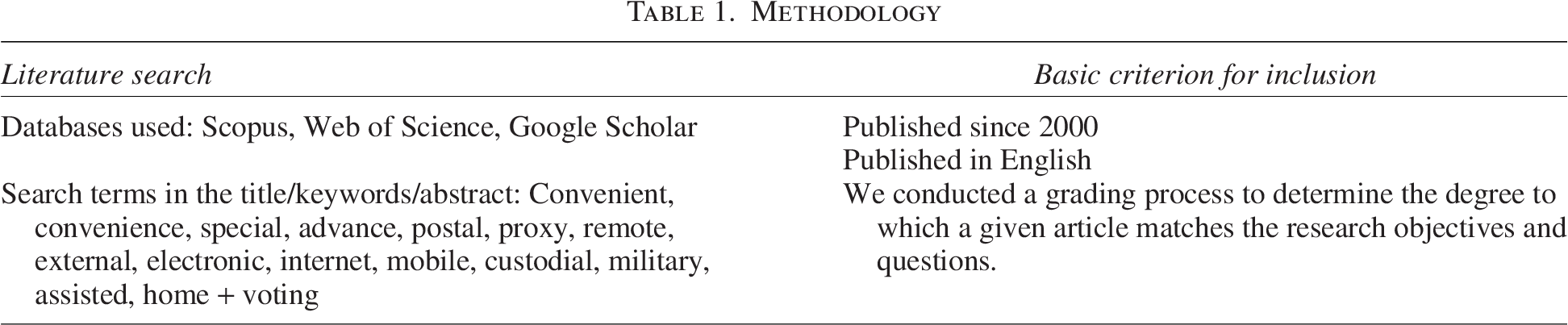
Literature identification and sorting
Our search yielded 1,967 articles (see Figure 1.). Of these, 1,789 articles were excluded based on unrelated topics and duplicates, leaving 151 papers. From this pool, we identified the most relevant articles by reviewing the abstracts and keywords. Consequently, 30 articles were excluded due to content not aligned with the aims of the study. Six articles were collected through snowballing while searching for other documents. The following filtering step involved scanning the full text to determine relevance. Of this, 106 documents were found to fulfill our requirements to be part of the final meta-synthesis (see the complete list in the Supplementary Appendix). To manage the data collection and article reduction process, we used a specific software to analyze the state of the art of a given topic: START. 3 We distributed articles equally among members of the research team, to decide on the adequacy of the articles for our research after agreeing on the basic parameters.
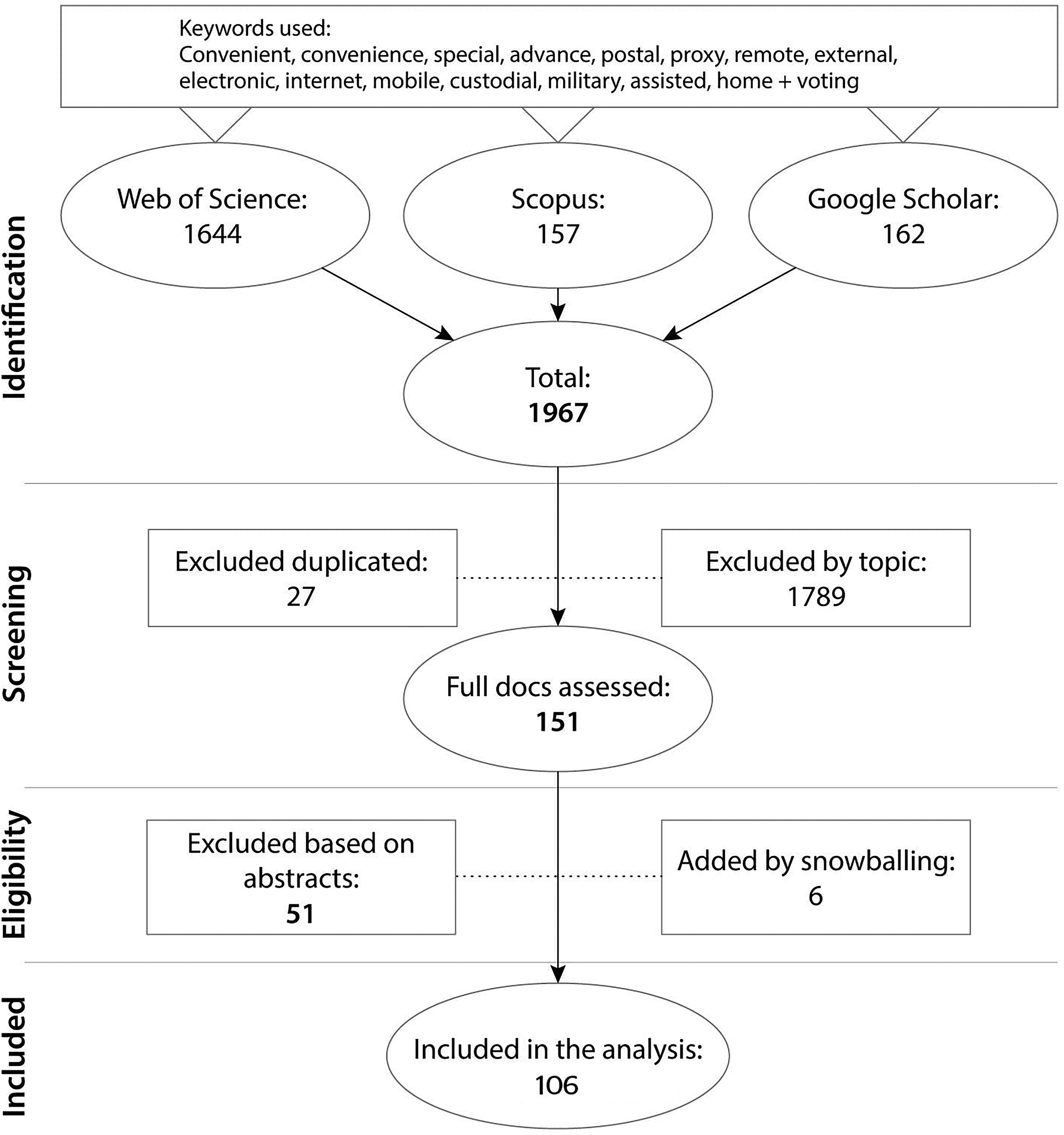
Selection of texts for analysis.
To ensure consistency of the selection process, we ran an internal test among the authors to check the possible dispersion in the use of criteria. We chose 20 random papers and asked every author to decide whether they should be included in our roster. After running a Pearson correlation analysis, the results show a significant correlation between the decisions of the four authors (see Table 2). The discrepancies were discussed to ensure a common understanding of the selection criteria.
Internal Correlation Test

Correlation is significant at the 0.01 level (two-tailed).
Coding
For fulfilling the Steps 4 and 5 of Erwin’s method (Erwin, Brotherson and Summers, 2011), we started with an open coding process aiming at categorizing the principal foci of the literature, based on information included in the abstracts, in particular in relation to the (1) definitions provided and (2) the voting method described. A second iteration of the codes included a full-text analysis of a selected number of publications and the addition of new categories and subcategories, which eventually totaled 119 (including subcategories). We then coded the 106 articles using the list of categories already created. A total of 41 codes were used for the development of this research.
The coding process was conducted iteratively in sets of 10 articles, with weekly meetings to discuss progress and execute axial coding analysis to identify linkages between and among codes. This process involved reducing the initial codes into major superordinate and ordinate coding categories. This synthesizing process aims to refine meanings and include possible new concepts (Walsh and Downe, 2005).
Finally, the last step emphasizes the need for self-reflection at each stage (Erwin, Brotherson, and Summers, 2011). To tackle this issue, we used the weekly meetings to reduce the risk of deviating from the initial plan, to discuss any possible doubts appearing in the process, and to rethink the use of codes or their meanings.
FINDINGS
The qualitative meta-synthesis findings can be grouped along two different dimensions: the definition of convenience voting and different types of convenience voting. The analysis of both dimensions is done separately, and both topics are merged again in the discussion of the results, where they will recombine when proposing an iteration of the definition of convenience voting.
Definitions of convenience voting
Through literature coding, we identified 20 articles from our sample (19%) that define convenience voting (see Table 3). It is important to note that several other articles discussed individual voting methods typically included within the scope of convenience voting. However, these papers made only peripheral contributions to the broader definition of convenience voting. This situation reflects the unique nature of the field: Research has generally been fragmented, focusing on specific aspects of the convenience voting family and/or the impacts of their implementation, while there has been limited research taking a comprehensive, generalist approach to the topic.
Definition of Convenience Voting
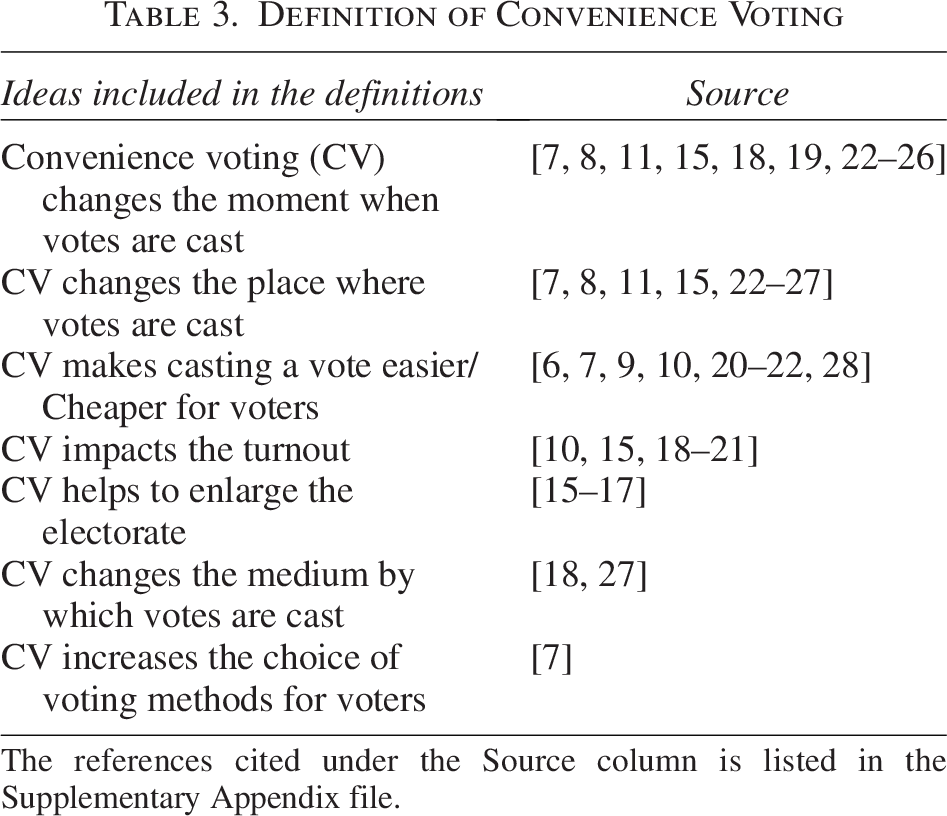
The references cited under the Source column is listed in the Supplementary Appendix file.
As stated in the previous pages, research by Gronke et al. (2008); Gronke, Galanes-Rosenbaum, and Miller (2007); Gronke and Toffey (2008); and Gronke, Galanes-Rosenbaum, and Miller (2008) provided the most widely accepted definition and tackled most of the ideas that our review detected (see Table 3). We observed two main tendencies when authors approach the definition of convenience voting: they either focus on the idea that convenience voting changes the time and place of vote casting or concentrate on the ease and simplicity of convenience voting, and its impact on turnout. A smaller number of publications refer to the potential of convenience voting to enlarge the electorate or increase the number of voting methods. Finally, two other elements that, in our estimation, should be included in the understanding of what convenience voting is, are almost neglected: the idea that convenience voting can imply a change in the medium or the person casting a vote.
Existing types of convenience voting
By coding the literature, we identified 16 voting methods (see Table 4). For each of them, we collected the name, alternative names, the definition(s), and the source(s) mentioning this voting method. For 16 identified voting methods, 35 alternative names have been coded in the literature. The voting methods with higher naming disparity are postal voting (11 alternative names), in-person early voting at a special polling station (six alternative names), and internet voting (five alternative names). The diversity of names of convenience voting methods reinforces the idea that the electoral field lacks a global perspective and gives the impression of parallel and detached development of convenience voting methods.
Convenience Voting Methods
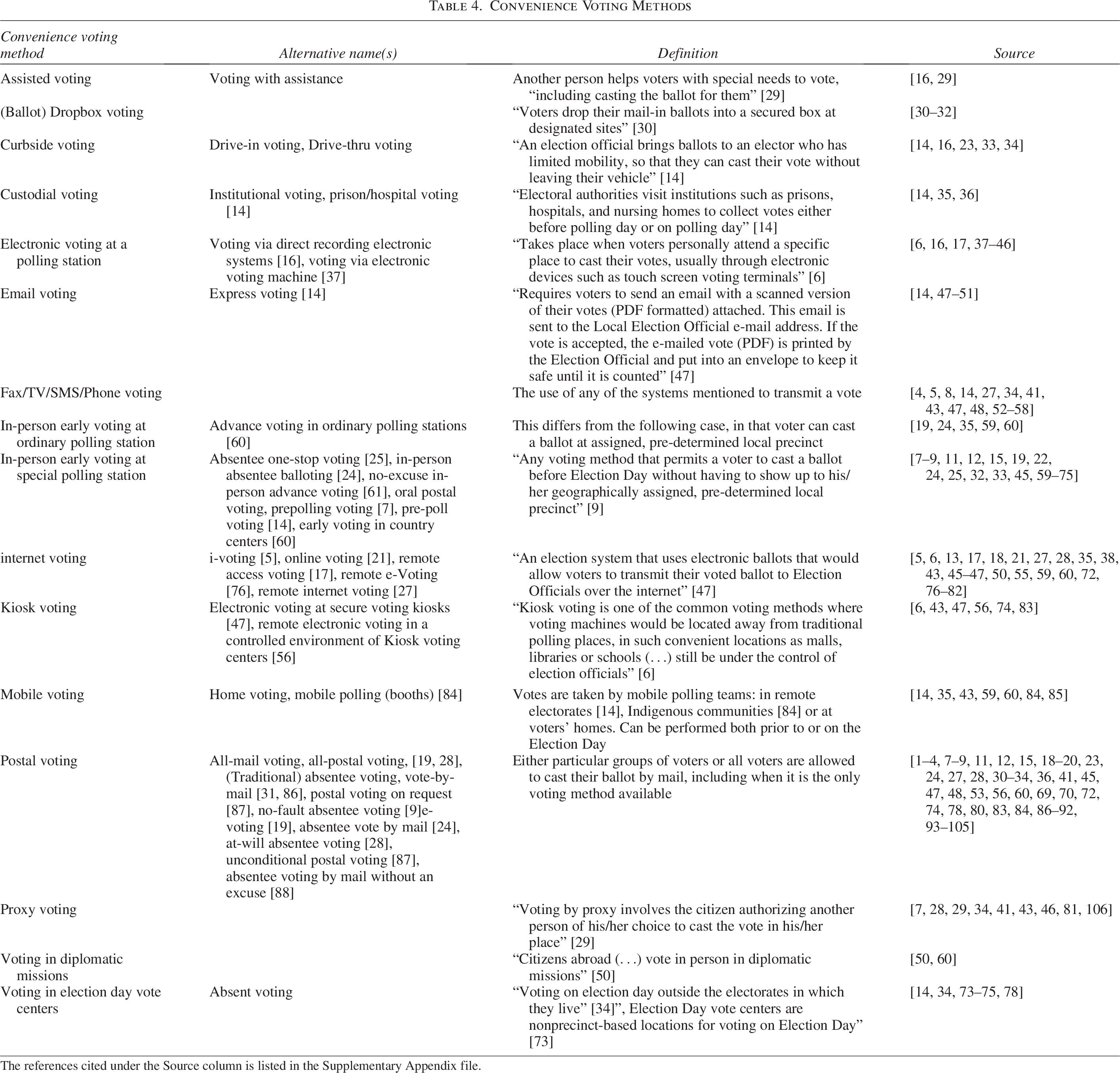
The references cited under the Source column is listed in the Supplementary Appendix file.
DISCUSSION
The findings of the meta-synthesis show that a small percentage of analyzed studies define convenience voting; rather, the studies define specific convenience voting methods applicable to the study, and then extrapolate the definition of particular convenience voting methods to the definition of convenience voting. This situation reflects the unique nature of the field: Research has generally been fragmented, focusing on specific convenience voting methods, while there has been limited research taking a comprehensive, generalist approach to the category of convenience voting. This leads to a fragmented and limited understanding of the bigger category of convenience voting, potentially limiting the universe of convenience voting methods to the ones described in the concrete study.
The studies that define convenience voting tend to emphasize the normativist nature of convenience voting: defining convenience voting as “relaxing the rules” and making the voting process “easier” or “cheaper” for voters.
Furthermore, the most established definition of convenience voting (Gronke et al., 2008) highlights only two dimensions of change—place and time. When approaching the definitions of individual convenience voting methods, it becomes evident that some of them involve changing more than the time and place of voting or neither time nor place, but rather other aspects: Convenience voting methods can change who is casting the ballot and how/by what means the voter casts a ballot. Controlling for these two additional dimensions of change, we identified absolutely necessary dimension(s) of change for each of the 16 identified voting methods (see Table 5). By absolutely necessary dimension(s) of change, we mean the change that defines this convenience method. On the example of mobile voting, the absolutely necessary change that this voting method invokes is the place of voting. When implemented in a real-life context, the additional changes might be layered on it: for instance, mobile voting as implemented in Australia is limited to specific days before the Election Day, thus also changing the time of voting. However, the change of time is not essential for the definition of this convenience voting method; it is its implementation characteristic, rather than a defining feature, and therefore, does not need to be reflected in a generalist definition. Therefore, the Table 5 presents only absolutely necessary changes, without excluding that individual implementations of convenience voting methods might include additional changes, besides “absolutely necessary.” By focusing on only absolutely necessary changes, we try to depart from the country- and implementation-specific definitions of convenience voting methods to more general ones, which can hold true across the contexts and particularities of implementations.
Changes Involving the Use of a Particular Convenience Voting Method
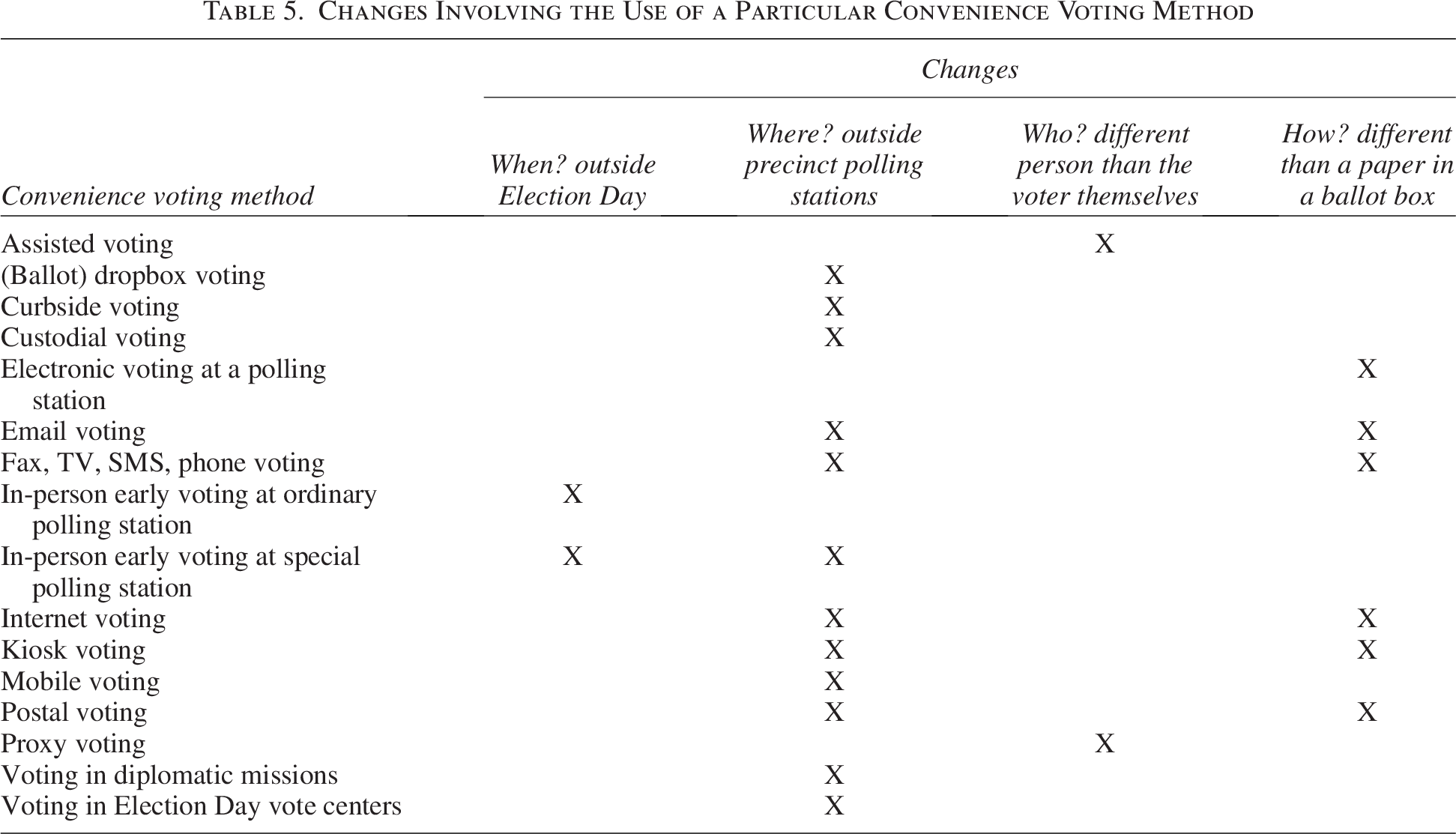
Such classification allows us to differentiate convenience voting methods from the ones involving the least number of changes (like Voting in diplomatic missions) to the ones involving the largest number of changes (like internet voting), thus, potentially more complex for implementation and acceptance by society. This classification shows that place and medium (where and how) are the elements that most commonly change when searching for convenience: 13 out of 16 identified convenience voting methods involve a change of place and/or medium. The change in time of voting and in who is casting the vote (when and who) appear less often (in 4 out of 16 identified convenience voting methods). This confirms the need for an updated definition of convenience voting, given that the classical definition of convenience voting, focusing on the change of place and time (Gronke et al., 2008), does not cover all change dimensions.
For the question of how votes are cast, technology clearly is the changemaker: most of the convenience voting methods that invoke the change of how a ballot is cast have to do with new technological opportunities which opened a door to new methods of convenience voting (such as electronic voting at a polling station, email voting, fax, TV, SMS, phone voting, internet voting, or Kiosk voting). On the other hand, there are only two convenience voting methods invoking the change of who is casting the vote (assisted voting and proxy voting). While these two voting methods serve different groups of voters, they share a feature in that a different person is casting the vote on behalf of a voter.
Our research shows how rich and diverse the distribution of voting methods is and how many dimensions should be included in a comprehensive understanding of convenience voting. Our efforts at displaying the inherent complexity of such diversity in a visual way is finalized in the proposal for a decision-making tree including the 16 voting methods described in a single chart and grouping them according to the framing questions that we jut presented and that they belong to, from simple lineal “Election Day voting” to complex convenience voting systems including multiple change dimensions (see Figure 2).
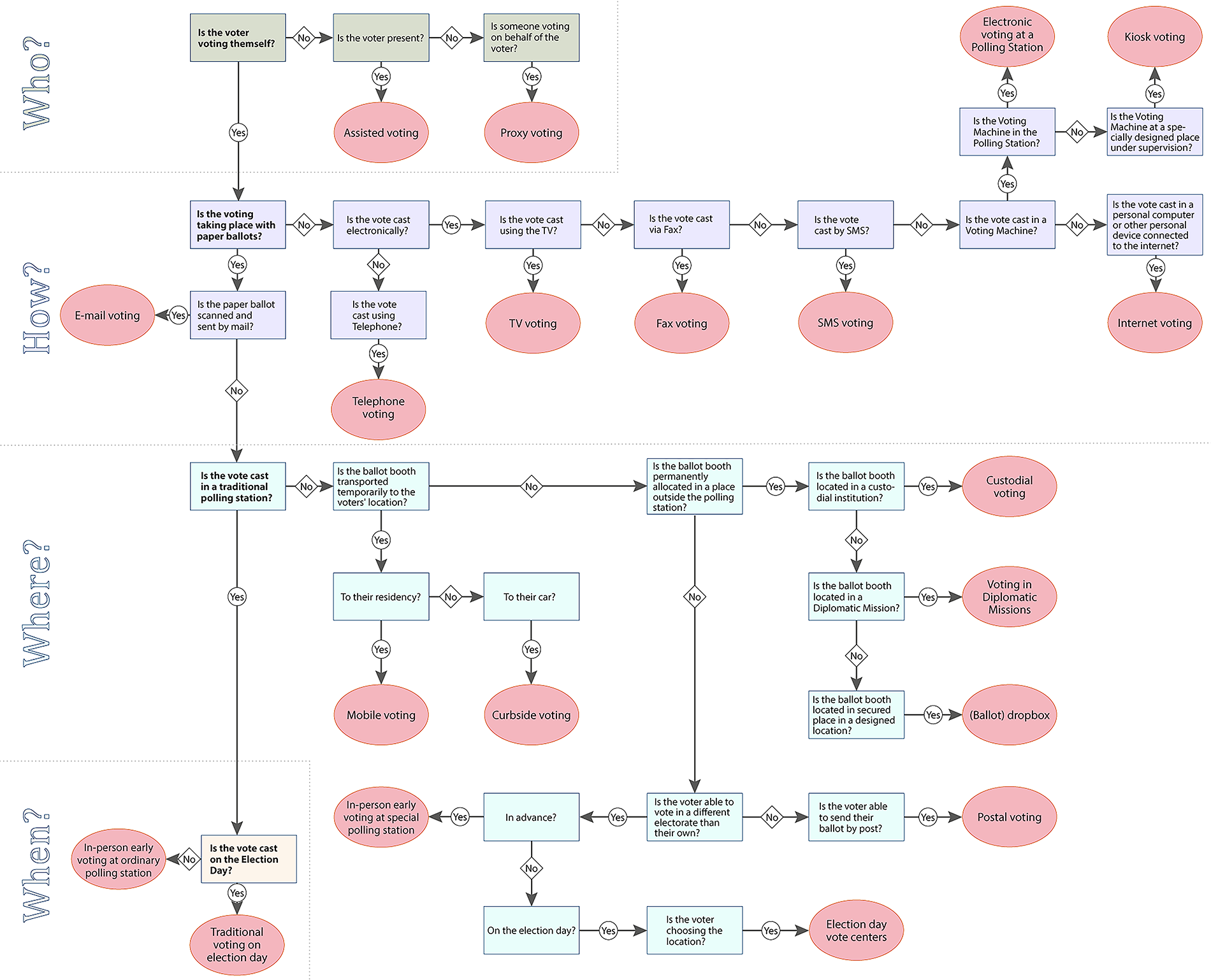
Convenience voting decision-making map.
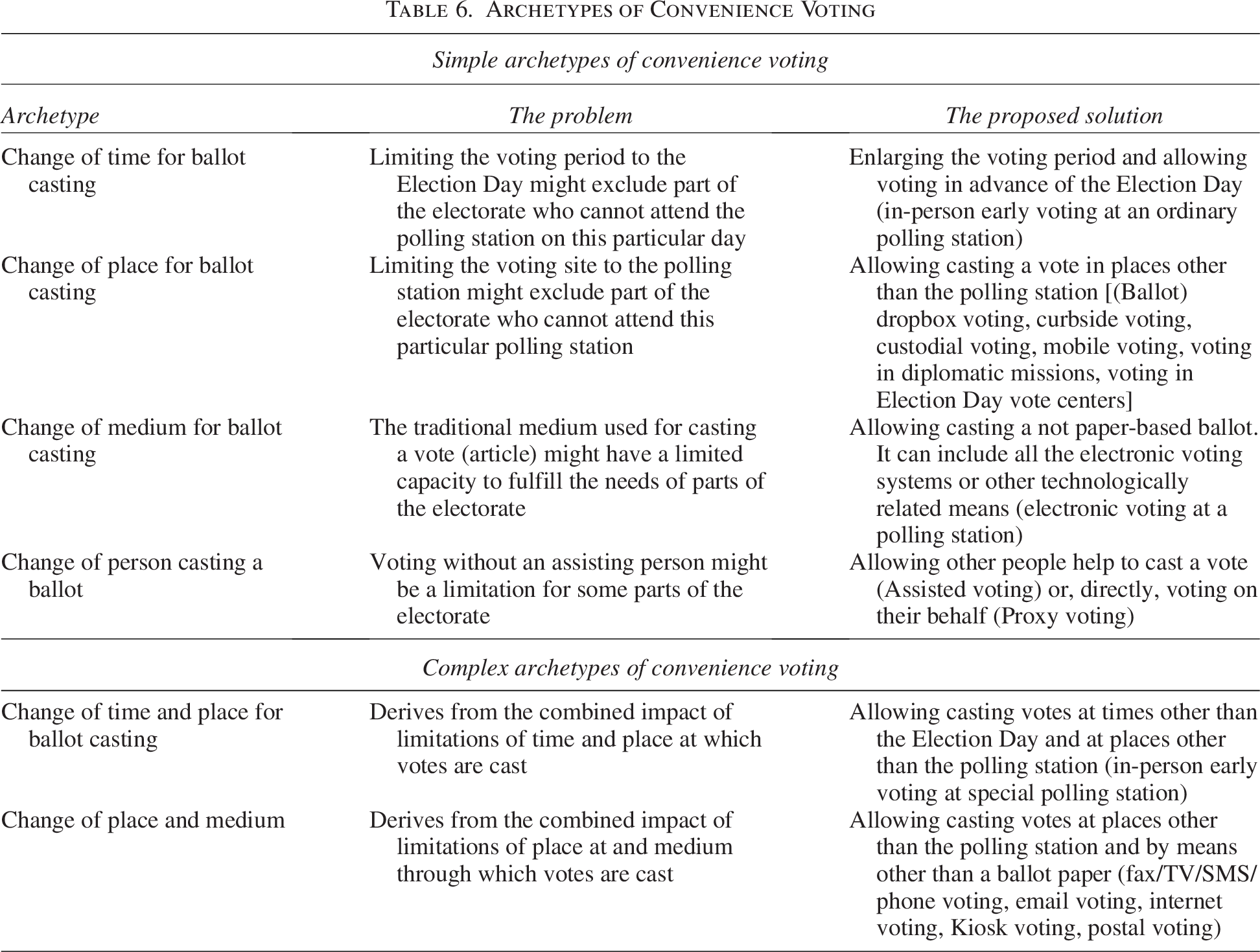
But more than that, the data collected allows us to enrich the literature on elections by providing a set of archetypes of convenience voting. We developed the archetypes by following Gamma et al. (1994), in particular, defining: the archetype’s name, the problem, and the solution. 4 We structure the archetypes into two categories: four simple and two complex ones (see Table 6). Simple archetypes relate to the solutions based on the introduction of one single change in the manner of voting, while complex ones include a multiple change solution. Among the 16 voting methods considered in this article, ten voting methods represent the solutions with one single change and six—with multiple changes. The review of these elements allows the creation of six archetypes of convenience voting methods.
Archetypes of Convenience Voting
CONCLUSION
In this article, we sought to continue the discussion initiated by Gronke et al. (2008) by incorporating more recent developments in the evolution of convenience voting. As an outcome of the meta-synthesis, we propose an updated definition of the concept. From the original definition of convenience voting (Gronke et al., 2008), we keep the focus on the change that a new voting method brings to the “usual way” of casting a vote in person, on article, at a polling station on Election Day. Furthermore, we expand this understanding of change from two to four dimensions: beyond time and place, to also include the medium, the person, and their possible combinations.
Convenience voting methods represent the universe of voting methods which modify either the place of voting, and/or the time of voting, and/or the voting medium, and/or who is allowed to cast a vote on a voter’s behalf.
This definition covers all 16 convenience voting methods identified in our meta-synthesis. But more than this, the data collected allows us to take one step forward in the literature on elections by providing a set of six archetypes of convenience voting methods divided into simple and complex archetypes. The four simple archetypes encompass those families of convenience voting solutions that involve changing one of the dimensions we detected: time, place, medium, and person casting the vote. The two complex archetypes gather convenience voting methods that change the voting process in more than one of the previous dimensions: changing time and place or place and medium. The existing convenience voting methods do not extinguish the number of potential combinations of elements for the creation of complex archetypes. The use of these archetypes allows overcoming the limitations stemming from the current complexity in identifying convenience voting methods, where similar voting methods are differently named in different parts of the world, while other different voting methods share the same name depending on where they are implemented.
Our proposed definition provides a point of departure for further analysis, for example, exploring the impacts, drivers, or barriers of different convenience voting methods or archetypes. It does so by providing a comparative frame stemming from the types of convenience voting methods previously presented (see Table 4), overcoming traditional naming differences. Also, the process of creating convenience voting archetypes following the literature on design patterns opens an interesting future research line, consisting of the analysis of the consequences of implementing convenience voting methods, using their archetype classified as a comparative element. The research on the impact of single convenience voting methods is rich and diverse, but a wider comparative perspective could provide very fruitful insights to continue delving into the electoral arena. Furthermore, this research serves as a stepping stone for understanding how different types of elections and electoral systems (e.g., two-round, presidential, or local elections) might approach convenience. Finally, the proposed renewed definition addresses the concerns that the concept of convenience voting might be underpinned by a normativist assumption that convenience voting methods are always introduced with the aim of increasing a voter’s chance to cast a ballot. Convenience voting methods are rooted in different countries and contexts, and therefore, might be introduced to pursue diverse electoral purposes, not necessarily democratic ones. Recent research demonstrates that convenience voting methods are not always perceived as convenient (Cortina and Rottinghaus, 2023), and do not necessarily make voting cheaper, easier, or more accessible (Cortina and Rottinghaus, 2023). For these reasons, the proposed definition does not include any normativist element of evaluating the impact of convenience voting, but rather registers the change that convenience voting brings. The aim of this article and the meta-synthesis was to develop a definition that could be applied across contexts, allowing for a more empirical and positivist discussion of electoral reforms across different contexts.
Our research has important implications for the field of Political Science, since it updates the existing knowledge with a revised understanding of convenience voting. The pioneering use of the meta-synthesis research method allows overcoming a traditional gap in the literature, allowing the identification of common threads on existing alternative voting methods that, previously, were presented isolated and in an unstructured manner, not allowing for their comparison. This research has also implications for practitioners. The lack of comparative research in the field left unattended the needs of election managers who often lack reference materials for exploring possibilities of electoral innovation. This article adds to the existing literature on convenience voting and should be a useful asset for rethinking how citizens can vote and what to expect from every voting system by providing cases and types of convenience voting in use in different parts of the globe, as well as a decision-making map including the different types of alternative voting present in the analyzed literature. This article also unveils the practical implications of convenience voting methods for voters, improving the capacity of foreseeing the organizational needs for governments and electoral management bodies in case they consider its implementation.
Footnotes
ACKNOWLEDGMENTS
The authors would like to thank heartfully the editor and the anonymous reviewers. The authors would like to thank the opinions of Nicole Goodman, Tomasz Janowski and Mila Gascó, who read and provided valuable comments in previous iterations of this article. Finally, we would like to thank heartfully Elis Vollmer for the support with the graphs.
FUNDING INFORMATION
This study was supported by the European Union’s Horizon 2020 research and innovation program (grant #857622); the European Union’s Horizon 2020 MSCA program (grant # 101038055); and the Polish National Research Center, and the Polish National Research Center (grant # OPUS-20-2020/39/B/HS5/01661).
Supplemental Material
References
Supplementary Material
Please find the following supplemental material available below.
For Open Access articles published under a Creative Commons License, all supplemental material carries the same license as the article it is associated with.
For non-Open Access articles published, all supplemental material carries a non-exclusive license, and permission requests for re-use of supplemental material or any part of supplemental material shall be sent directly to the copyright owner as specified in the copyright notice associated with the article.
