




Abstract
Within team research, there is no shortage of literature classifying teams. However, the team taxonomic literature suffers from a few limitations. First, many taxonomies claim to classify teams into mutually exclusive classes, yet when examined closely, are not. Second, some of the most well-known taxonomies are descriptive of various tasks teams engage in, but not of the holistic team-level properties that define different types of teams. A clear understanding of both is necessary if human resource development (HRD) professionals are to develop and train different teams effectively. Therefore, the purpose of the current article is twofold: to present an integrative taxonomy of task types and a set of team-level characteristics that have been carefully synthesized from the prior literature and to explain how these tools can be used in conjunction to inform team-oriented HRD research and practice.
An examination of any organization would, most commonly, reveal the increased use of team-based work structures for achieving organizational goals. Work teams allow organizations to tackle complex tasks and have been shown to be more effective for knowledge production than individuals (e.g., Wutchy, Jones, & Uzzi, 2007). Consequently, some of the focus of human resource development (HRD) has recently shifted toward the enhancement of team outcomes in organizations (e.g., Gilly, Morris, Waite, Coates, & Veliquette, 2010; Knapp, 2010; Silberstang & London, 2009). However, as Ilgen, Hollenbeck, Johnson, and Jundt’s (2005) input-mediator-outcome-input (IMOI) model indicates, team outcomes are dependent on various inputs (antecedents that influence team interaction), processes (the interaction), and cognitive and affective emergent states that arise out of the interaction (e.g., collective affect, psychological safety; Mathieu, Maynard, Rapp, & Gilson, 2008). Therefore, not all work teams are created equally. Work teams, defined as two or more individuals interacting adaptively, interdependently, and dynamically toward a common and valued goal (Salas, Burke, & Cannon-Bowers, 2000), differ on a number of attributes such as size (Horwitz, 2005), composition (Harvey, Fisher, McPhail, & Moeller, 2009), and structure (Zheng, Khoury, & Grobmeier, 2010).
Researchers have suggested that these differences in teams will moderate important relationships with team performance (e.g., Horwitz, 2005). Stewart and Barrick (2000) examined team task type as a moderator in a study of team performance and found significant differences between teams engaged in conceptual and behavioral tasks. Abbott, Boyd, and Miles (2006) found differences across teams categorized as being either consultative or substantive. Other studies have also found differences between other types of teams (e.g., DeChurch, 2009; DeChurch & Mesmer-Magnus, 2010; English, Griffith, & Steelman, 2004). As the successful development and management of work teams is facilitated by a thorough understanding of their nature and the type of work being accomplished, formal team type taxonomies are important conceptual and practical tools for HRD professionals. To this end, many researchers have attempted to reduce and organize the complexity of teams by developing formal classification schemes (e.g., Cohen & Bailey, 1997; Devine, 2002; McGrath, 1984). Devine (2002) defines classification as the “ordering of entities into categories or classes that are mutually exclusive and exhaustive” (p. 292). The primary purpose of classification taxonomies is to reduce the complexity of the natural world to manageable levels by describing or explaining the structure of objects.
However, while team research has grown in size and scope, scholars have recently argued that disorganization within the literature has created a disjointed account of team research, such as within the realm of team learning (Knapp, 2010). While existing team taxonomies are powerful tools for organizing teams, the literature as a whole suffers from several limitations. First, many taxonomies aim to classify teams into mutually exclusive and exhaustive classes, yet when examined closely, are not adequately doing either. In addition, research and theory on team types has been extremely disparate, with different researchers utilizing completely different taxonomies, as the previously cited research illustrates. Second, a large portion of team taxonomies are descriptive of the various tasks that teams can execute but are not descriptive of the team-level structural properties that come together to differentiate team types. Therefore, the primary purpose of this article is to begin to address these issues by critically synthesizing and organizing published formal team classification systems into two conceptual tools meant to separate these two distinct team-related topics: an integrative taxonomy of task types and a set of core team-level characteristics.
The presented conceptual tools encourage several changes in the current team classification research paradigm. First, the integrated set of task types combines existing taxonomies in a more granular and comprehensive way than previous research, suggesting that researchers examining the influence of task type may have missed critical differences between particular categories in the past. For example, to our knowledge, very little research has examined the moderating influence of task type when considering ill-defined and defined problem solving as distinct task types. Second, by combining the task type taxonomy with the core set of team-level properties while keeping the two concepts separate, researchers can begin to untangle the complex relationships between task and team structure rather than confound them. For example, are certain patterns of team characteristics more or less effective for performing certain task types? If so, how can HRD professionals develop teams that can adapt their characteristics (e.g., leadership structure, role structure) as needed to fit the changing nature of their task? The conceptual tools presented can also be used by HRD professionals in practice to more quickly and accurately identify the critical characteristics of organizational teams to improve the development and management of their performance. Our integrated classification system of task types and core team characteristics serves to unify the science of team classification into a more coherent picture.
The article is divided into three primary sections. First, we describe the methods used to review and identify relevant literature and provide a brief summary of key team taxonomic works. Second, we synthesize this literature into an integrated set of task types that teams often engage in, emphasizing the distinction between tasks performed by teams and the characteristics that define teams as social work entities. Along those lines, we present a set of six holistic team attributes derived from our review of the literature that describe the unique higher level defining attributes of teams. Finally, we provide direction regarding how these theoretical tools can be used to improve the development and management of teams in organizations and conclude with several recommendations for future research.
Method
It should be noted that although there are many worthwhile team reviews that provide a valuable, broad understanding of the team literature as a whole (e.g., DeMatteo, Eby, & Sundstrom, 1998; Guzzo & Dickson, 1996; Kozlowski & Ilgen, 2006), for the purposes of the current effort we reviewed only formal classification systems that aim to differentiate between types of teams or organizations based on some set of underlying dimensions. The list of taxonomic dimensions used to create our integrated set of team-level characteristics and task types was derived from a systematic review of multidisciplinary scientific team classification literature. Specifically, the review focused on pulling relevant team attributes and types from prior efforts aimed at developing classification systems, taxonomies, or typologies of teams. Literature searches were conducted using a computerized search of the EBSCOhost databases (i.e., Academic Search Premier, Business Source Premier, ERIC, Human Resources Abstracts, PsycINFO, Regional Business News) and Google Scholar using team taxonomy relevant keywords (e.g., group OR team AND taxonomy, typology, type, model, framework, characteristics, classification) as well as more general team-related keywords (e.g., group OR team AND process, effectiveness, theory, review). This two-pronged search approach was used to ensure that any theoretical efforts not clearly labeled as taxonomies, but still conceptually taxonomic in nature, could be identified and considered for inclusion in the present effort.
The initial scan of the literature resulted in 40 articles that in some way referred to the classification, description, or organization of teams or organizations into types. These 40 articles were reviewed for relevance to team classification. To be included in the final synthesis, articles had to differentiate between types of teams or organizations based on some set of underlying dimensions. Therefore, articles that studied or described team or team-relevant characteristics (e.g., composition, size, or climate) but did not use these characteristics to classify teams were excluded. Empirical studies were also excluded unless they explicitly focused on validating a conceptual taxonomy. Meta-analyses were also excluded from the final list. Several articles examining organizations were included because they were determined to be directly applicable to describing the higher-level characteristics that define teams. This resulted in a final count of 17 team-relevant taxonomic efforts included in the current review.
Summary of Team Classification Literature
The 17 efforts identified as team relevant are summarized in Table 1, taking into account both the underlying dimensions used to classify teams as well as any named taxonomic categories established. Team classification efforts have been occurring for at least the past half-century. In 1950, Carter, Haythorn, and Howell examined performance across six team work tasks including reasoning, intellectual construction, clerical, discussion, motor cooperation, and mechanical assembly tasks. While this work was not specifically focused on the development of taxonomic categories, it was one of the first works to make clear distinctions between types of work teams and was therefore included. In a related early taxonomic effort, Pugh, Hickson, and Hinings (1969) categorized organizational structures using three dimensions: structuring of activities, concentration of authority, and line of control of workflow.
Summary of Included Taxonomic Literature

In 1984, McGrath created one of the most well-known team typologies, including seven task types, by considering three underlying dimensions: conflict-cooperation, conceptual-behavioral, and choose-execute. Driskell, Salas, and Hogan (1987) proposed a similar task typology focused specifically on Navy teams. Six core personality dimensions were examined to describe the following team task types: mechanical/technical, intellectual/analytical, imaginative/aesthetic, social, manipulative/persuasive, and logical/precision. Also in 1987, Schopler classified groups using the two underlying dimensions of group origin and the degree of externally imposed structure, which subsequently created four taxonomic categories: Type I (mandated group with high external structuring), Type II (mandated group with low external structuring), Type III (voluntary group with high external structuring), and Type IV (voluntary group with low external structuring).
Hackman (1990) developed a classification system in which teams were categorized into seven types based on task type, including top management teams, task forces, professional support groups, performing groups, human service teams, customer service teams, and production teams. Using three dimensions of interdependence, Saavedra, Earley, and van Dyne (1993) categorized groups into four types identified as pooled, sequential, reciprocal, and team. Cohen and Bailey (1997) classified teams by task into four types including, work, parallel, project, and management teams. Matteson, Mumford, and Sintay (1999), beginning with task type, interdependence, life span, autonomy, managerial responsibility, and leadership responsibility as underlying dimensions, developed a typology of team structures consisting of nonteam, externally managed team, parallel suggestion team, problem solving team, autonomous team, self-managed team, and self-led team.
To classify international research and development (R&D) organizations, Gassman and von Zedtwitz (1999) proposed a classification system based on the dispersion of activities and the degree of cooperation, defining the following categories: ethnocentric centralized, geocentric centralized, polycentric decentralized, R&D hub, and integrated R&D network organizations. Sundstrom, McIntryre, Halfhill, and Richards (2000) revised a previous taxonomy to include six categories based on task type: production, service, management, project, action and performing, and advisory. Bell and Kozlowski (2002) started with a theoretical model for classifying virtual teams by distinguishing among four key characteristics (temporal distribution, boundary spanning, lifecycle, and member roles). A specific set of taxonomic categories was not defined, but rather a continuum was created in which virtual teams are placed based on task complexity.
In summarizing an array of previous team classification literature, Devine (2002) started with seven contextual dimensions (fundamental work cycle, physical ability requirements, temporal duration, task structure, active resistance, hardware dependence, and health risk), and developed a taxonomy of 14 team types (executive, command, negotiation, commission, design, advisory, service, production, performance, medical, response, military, transportation, and sports). In 2005, Thylefors, Persson, and Hellstrom classified Swedish medical teams by using six dimensions of team functioning, including role specialization, task interdependence, co-coordination, task specialization, leadership, and role interdependence.
Both Clark (2007) and Keyton and Beck (2008) recently approached the design of teams by using group features or characteristics as underlying dimensions. Clark established type of coordination, workplace, interdependence, leadership style, job enrichment, work pace, work method, grouping of tasks, degree of seclusion, and cycle time as dimensions. On the other hand, Keyton and Beck identified group size, interdependence, identity, goal, and structure as underlying dimensions. Finally, in 2009, Ostergaard and Summers proposed a taxonomy of collaborative teams consisting of six primary attributes (team composition, communication, distribution, design approach, information, and nature of the problem), in which their interactions are used to explain collaborative design situations.
One of the most prominent trends that emerged was that many team taxonomies focus heavily on the type of task that various teams perform as a way to classify team types. Overall, six of the 17 works reviewed explicitly focused on differentiating teams based on the type of taskwork performed. This trend calls to attention an important issue to consider regarding the team taxonomic literature as a whole. While we fully acknowledge that task type is an important moderator of relationships within teams (e.g., Stewart, 2006; Webber & Donahue, 2001) and should absolutely be included in team research to account for differences across task types, we argue that task type doesn’t describe the unique elements of teams. Tasks are needs that organizations can (and do) address through team-based work structures. In fact, nearly every task type mentioned in the team taxonomic literature could be just as feasibly completed by an individual. Consider this statement taken from the Devine (2002) review: “Knowledge work involves thinking as a core task, mental skills, a nonlinear work process, the derivation of new knowledge, and information as the primary work outcome.” (p. 296). When seen out of context, this statement could just as easily describe an individual’s task within an organization rather than a team’s.
Accordingly, we suggest that to truly describe teams and the work that such teams are often formed to address, that task type and team type must be kept conceptually separate. Therefore, we present two distinct but complementary tools distilled from the reviewed literature: an integrated taxonomy of task types that are often discussed in the team literature, and a set of six holistic team characteristics that can be used individually or in combination to classify teams into mutually exclusive and exhaustive categories based on their defining underlying attributes.
Integrated Taxonomy of Task Types
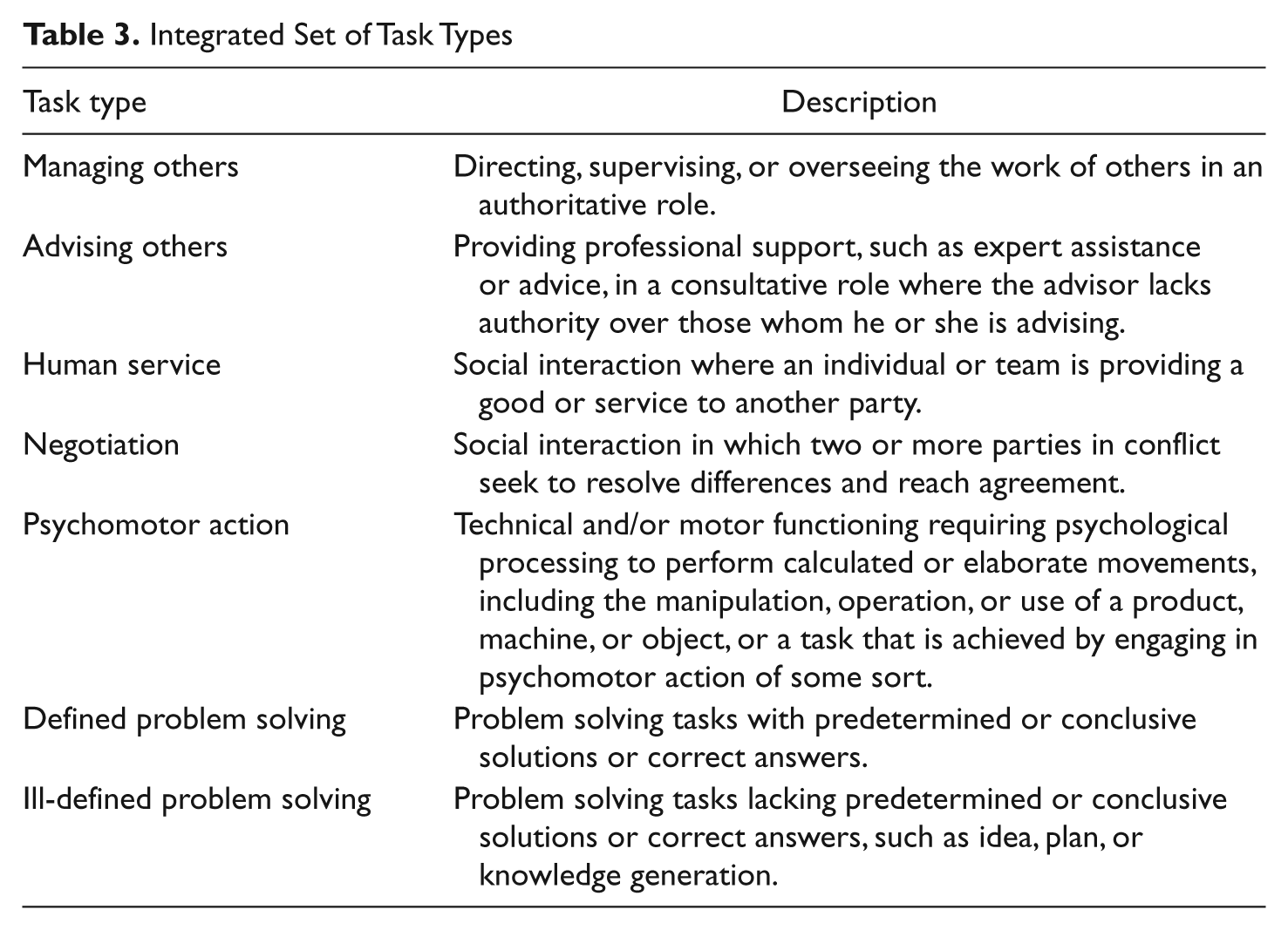
To create the task type taxonomy, the works that categorized teams based on task type were entered into a comparative table and the task categories were conceptually matched (Table 2). Based on the definitional overlap between the various taxonomies, a set of superordinate categories were synthesized that represent different types of work tasks that teams (or individuals) can engage in (Table 3). These task types were specifically distilled to represent mutually exclusive and exhaustive categories of work that can be done in teams. It is critical to note these task types are not intended to describe or classify entire teams as “types” because teams almost invariably engage in multiple tasks simultaneously or over time to achieve their mission or goals. Instead, these task types are most appropriately used to describe the multiple types of mutually exclusive work any given team can be designed to achieve and what set of tasks any given team is engaged in at a particular point in time. Furthermore, the task types are intended to describe categories of work-related activities that individuals or teams engage in as a fundamental aspect of their role within an organization without confounding the conditions surrounding that work (e.g., environmental setting). Therefore, these task types can be used to describe the basic tasks performed by teams across a variety of military, government, and civilian settings.
Comparison of Task Types Across Taxonomic Literature

Integrated Set of Task Types
Managing Others
Management has been recognized in many of the existing task-type taxonomies reviewed (e.g., executive, Devine, 2002; top management, Hackman, 1990), and these task types have been synthesized into our managing others category. According to the taxonomic literature, management teams are generally involved in identifying problems and determining appropriate solutions, overseeing the implementation of new operational standards, and maintaining regular business operations. We contend that managing others is a separate type of task from managing processes, and it encompasses interpersonal behaviors relating to directing, supervising, or overseeing the work and actions of others. Process and/or strategic management instead involves generating ideas, strategizing, and/or planning, and would therefore be more appropriately classified as a type of problem solving, which will be discussed separately.
It is critical to keep these two types of tasks conceptually separate due to the fact that entirely different skills are necessary for each. For example, managing of others would likely require distinctly interpersonal competencies such as leadership skills and social competence, while the generation of ideas for strategic management purposes would not depend on these interpersonally focused competencies. Furthermore, problem solving tasks undertaken by strategic managers are tasks also undertaken by people in other non-management roles and therefore should not be confounded with the label of “management.” It should be noted, however, that strategic managers likely engage in delivering guidance to subordinates to carry out plans and, as such, in this capacity they do engage in the management of others.
Those individuals or teams who manage others are engaging in an authoritative or leadership role working directly with subordinates, which is inherently more social in nature than strategic planning. This, however, does not make managing others a purely social task. Driskell and colleagues (1987) included a social classification in their taxonomy, which pertains to providing customer or human service. Managers are not providing a service to their subordinates in the same way that a customer service representative’s primary purpose is to satisfy the needs of a client or customer. As such, while managing others requires similar interpersonal skills to service-related tasks, there is a fundamental difference in the purpose of the interpersonal interactions. The task of managing others is intended to increase the productivity of subordinates, while the task of human service is aimed at bringing satisfaction to the client or customer.
Advising Others
Similar in nature to managing others, the advising others task type includes behaviors such as providing professional support, providing expert assistance or advice (Hackman, 1990), as well as advisory tasks (Sundstrom et al., 2000). This task type differs from the managing others task in that advising others is an advisory or consultative task in which the advisory team lacks formal authority over those whom they are advising. Caldwell (2003) distinguished management from consultancy change agents, describing consultants as “external or internal consultants who [are] . . . providing advice, expertise, project management, change programme coordination, or process skills in facilitating change” (p. 140). It should be noted that what are referred to as advisory teams or consulting teams are actually engaging in multiple tasks as defined by our taxonomy. First, they engage in defined or ill-defined problem solving to create or choose a solution or plan and then engage in advising others when delivering their recommendations.
Human Service
The human service category is comprised of tasks involving direct social interaction where an individual or team is providing a good or service to another party (i.e., human or customer service) and the primary goal of that interpersonal interaction is the satisfaction of the client or customer. Waitstaff, nurses, salespeople, and training teams, to name a few, are all examples of workers that likely provide human/customer service of some sort. Many of the previous works have recognized social or service-related tasks (e.g., service, Devine, 2002; social, Driskell et al., 1987), which have been integrated into our human service category. Hackman (1990) included separate human service and customer service categories. In keeping with our efforts to create a comprehensive yet parsimonious taxonomy, we have combined customer and human services into one integrative service category as we feel the fundamental interpersonal task being performed is the same.
Negotiation
Negotiation tasks refer to social interactions in which two or more parties in conflict seek a better outcome through joint action than they could realize by acting independently (Lax & Sebenius, 1986). This includes competitive tasks such as producing agreements, bargaining for individual or collective advantage, or resolving conflicts of interest within or between parties. In other words, negotiation tasks always involve resolving differences to reach an acceptable agreement between the parties involved.
As such, negotiation differs from problem solving in that problem solving in a team context is a collaborative effort to obtain a common goal or objective, while parties involved in negotiation are by definition in opposition. Negotiation also should not be confused with managing others. While subordinates may engage in negotiation to some degree with their superiors in situations in which they are directly resolving an area of conflicting interests, managing others involves overseeing and advising and, fundamentally, managers and subordinates are not on opposing sides of a conflict or agreement but rather working together toward some common goal.
Devine (2002), Driskell and colleagues (1987), and McGrath (1984) each recognized elements of negotiation in their taxonomies, but each is narrowly defined, indicating that previous taxonomies have not been exhaustive. Devine (2002) provides the most inclusive definition of negotiation, describing it as work teams engaging in “competitive intellectual tasks in which group members represent the interests of larger entities” (p. 301). Driskell and colleagues’ (1987) persuasive category, however, is described as persuading other people, which falls short of a full definition of negotiation and could technically be categorized as managing others or negotiation depending on whether or not the involved parties are being persuaded for the purposes of working together or in opposition. Likewise, McGrath’s similar category is resolving conflicts of interest. While not exhaustive in themselves, negotiation (Devine, 2002), persuasive (Driskell et al., 1987), and resolving conflicts of interest (McGrath, 1984) task types are subsumed under our negotiation category.
Psychomotor Action
Psychomotor action tasks are tasks that demand technical and/or fine motor functioning to achieve an outcome. Examples include military combat teams using weaponry or dancers performing for an audience. While the commonality between these two examples may not be immediately evident, in both instances the task involves the ability to perform calculated or elaborate movements to perform a motor task. Previous works have recognized technical motor tasks such as rolling a ball or using weaponry (Carter et al., 1950; Driskell et al., 1987), or performance motor tasks such as actors performing a screenplay or musicians playing an instrumental composition (Devine, 2002; Hackman, 1990; Sundstrom et al., 2000). Furthermore, nearly every task-focused article reviewed includes a production-related task type (Carter et al., 1950; Devine, 2002; Driskell et al., 1987; Hackman, 1990; McGrath, 1984; Sundstrom et al., 2000). Production tasks generally refer to continuous, standardized production or assembly of goods and typically involve the use of machinery or tools to accomplish the task (e.g., an assembly line of workers in an automotive factory), therefore requiring primarily psychomotor skills.
We have integrated motor cooperation tasks (Carter et al., 1950), technical (Driskell et al., 1987), mechanical assembly (Carter et al., 1950), mechanical (Driskell et al., 1987), performance (Devine, 2002), production (Devine, 2002; Hackman, 1990; McGrath, 1984; Sundstrom et al., 2000), performing (Hackman, 1990), executing performance tasks (McGrath, 1984), action/performing (Sundstrom et al., 2000), and the physical coordination aspects of Carter et al.’s (1950) clerical (e.g., filing, sorting, stuffing envelopes) task types into our psychomotor action classification. Each of these tasks primarily involves the use of motor skills, and therefore we suggest they should be integrated into one clearly identifiable, overarching category. We argue that previous works have failed to create intuitive labels for these types of tasks. The term “performance,” for example, is prevalent throughout the literature as pertaining to the level of accomplishment or ability to accomplish a given task and therefore does little to explain the nature of a task involving motor functioning. Thus, we believe psychomotor action is the most intuitive label for this integrated task categorization.
Defined Problem Solving
Defined problem solving refers to tasks in which the team members must reach a demonstrably correct answer or choose between finite decision options. The most recent taxonomic efforts (Devine, 2002; Hackman, 1990; Sundstrom et al., 2000) each included problem solving within their taxonomies, but neglected to differentiate between defined and ill-defined problem solving, which is one contribution of the current effort. The presence of a verifiably correct answer or solution (i.e., solution demonstrability) and/or the presence of several defined decision options (e.g., yes/no problems; choosing between paths A, B, or C) is the major distinguisher between defined problem solving and ill-defined problem solving, which we will discuss shortly. It should be noted that many of the previous taxonomic efforts distinguished decision making as a task type (e.g., Carter et al., 1950; Devine, 2002; Driskell et al., 1987; McGrath, 1984). However, we argue that decision making is a part of problem solving and is a mechanism for making choices at each step of the process. Decision making is but one aspect of the larger task of problem solving. Therefore, decision making task types from previous taxonomies have been subsumed under our problem solving tasks.
Defined problem solving differs from ill-defined problem solving tasks in that it involves choosing between two or more comparable options or alternatives rather than generating a new, unique solution to a given problem. Several of the previous taxonomic efforts did include task types characteristic of defined problem solving, such as reasoning and intellectual construction (Carter et al., 1950), logical/precision (Driskell et al., 1987), solving problems with correct answers (McGrath, 1984), and aspects of Carter et al.’s (1950) clerical task that require attention to detail to arrive at a predetermined correct end state (e.g., checking an online database against a paper copy and correcting errors). Finally, discussion tasks are among Carter and colleagues’ task types, where the group must discuss a topic to either accept or reject some question. Interestingly, the Devine (2002), Hackman (1990), and Sundstrom et al. (2000) taxonomies do not include a comparable or related category, despite the prevalence of this type of task in the literature.
Ill-Defined Problem Solving
More creative and innovative in nature than defined problem solving, ill-defined problem solving refers to problem solving tasks lacking predetermined or demonstrably correct answers or solutions. Examples include brainstorming the design of a new product or generating ideas for a marketing campaign. These tasks are creative and innovative in nature and are fundamental to the growth, development, and adaptation of organizations.
Each of the task types from previous works that we have integrated into our ill-defined problem solving category differ to some degree. However, previous works have largely recognized creative and innovative problem solving tasks as a core task-type, and thus we were able to incorporate a task type from nearly all of the previous taxonomies into our integrated ill-defined problem solving category, including design (Devine, 2002), imaginative/aesthetic (Driskell et al., 1987), task forces (Hackman, 1990), generating ideas (McGrath, 1984), and project (Sundstrom et al., 2000) tasks. Moreover, Driskell and colleagues’ (1987) intellectual/analytical task type is described as the “generation, exploration, and verification of new knowledge” (p. 24) and McGrath (1984) includes generating plans as a discrete task type. All of these task types can be considered to be specific examples of the basic cognitive task of ill-defined problem solving.
Summary of Task Types
The presented set of integrated task types addresses a number of limitations found in the previous team taxonomic literature. First, it avoids the inclusion of what can be described as “catchall” categories. For example, Cohen and Bailey (1997) included work teams, described as teams responsible for producing goods or providing services, as one type of team in their taxonomy, along with parallel, project, and management teams. In terms of providing clear distinctions between different types of organizational teams, the work team category is insufficient. Nearly every organizational team or group studied by social scientists could be described as producing a good or providing a service of some kind, including teams that are often labeled management or project teams. In contrast, our set of task types draws distinctions between the various types of tasks that teams can engage in by clearly describing the distinctions between them in terms of defining features and required competencies.
Second, compared to the number of team type categories included in the most recent team classification review (i.e., Devine, 2002) we have provided a smaller, more parsimonious list of task types while capturing the basic nature of the 14 categories represented in the Devine taxonomy. For example, medical teams, a type of team included in the Devine review, are broadly defined as teams that provide diagnosis and treatment to patients. These teams as described by our conceptualization of task types can be more clearly described as engaging in a set of tasks including defined and ill-defined problem solving (medical diagnosis and developing a plan of care), advising (providing patient with options or advice without being able to require them to comply), human services (bedside manner), and psychomotor action (performing any technical procedures such as surgery or treatment).
Each of these tasks requires different knowledge, skills, and abilities. In essence, describing the work done by medical teams in these more specific terms allows for the skills and abilities necessary for effective performance to be more clearly identified by HRD professionals and therefore more effectively developed. In another example drawn from the Devine review, transportation tasks could be considered to be engaging in psychomotor manipulation since they require the operation of vehicles, but they would also be engaging in ill-defined problem solving when issues arise (e.g., mechanical breakdowns, navigation difficulties), and possibly some basic human service (e.g., flight attendant teams). Therefore, the presented task categories are more comprehensive and descriptive of the wide range of activities that teams engage in while still being more parsimonious than previous works.
Third, our conceptualization of task types moves beyond the paradigm set by many of the previous taxonomic efforts by explicitly emphasizing that most, if not all, teams engage in multiple types of tasks to achieve their missions and therefore should not be labeled or named based on task. For example, a team of executive assistants might engage in managing subordinate assistants or receptionists, advising superiors on the most useful software suite, providing human service when talking to customers on the phone or in person, negotiating pricing with vendors, psychomotor action when stuffing and stamping envelopes, defined problem solving when calculating invoices, and ill-defined problem solving when devising a marketing plan for a product or service. By clearly delineating between each of these basic work processes, our set of task types is more theoretically and practically useful than previous taxonomic efforts.
Higher Level Attributes of Work Teams
Kozlowski and Klein’s (2000) multilevel theory suggests that macro phenomena such as team cognition and affect emerge only through the interaction of lower level elements (i.e., individual team members) within the larger entity, and to truly understand teams as higher level social units, the focus must be on higher level attributes that only exist at the team level. These team-level attributes can also be referred to as “holistic” attributes in that they describe the team as a whole (Cooke, Kiekel, & Helm, 2001). Therefore, the higher level attributes that exist only at the team level such as leadership structure, task interdependence, or role structure are the characteristics that should be used to categorize teams since they describe higher level properties that make teams unique. An individual cannot be described as having a certain level of interdependence, but a team can.
Fortunately, many of the non-task-focused taxonomic works indeed categorized teams on a variety of unique higher level properties, and several of these dimensions appeared across multiple works. However, there were also many non-team-specific dimensions included that actually were descriptive of work in general (e.g., work pace, Clark, 2007; active resistance, Devine, 2002). Therefore, to build on, yet refine, the strong foundation provided by these taxonomies, several specific inclusion criteria were used to narrow down the set of characteristics to a small enough set to be useful yet still descriptive. Specifically, to be included in the final set of core team characteristics, the dimensions were required to
Be unique holistic properties of a team and not of an individual or task (e.g., health risk is the property of a task or a context, not a team, whereas leadership structure is a property/pattern that only exists at the team level and was therefore included).
Be represented in two or more of the previous published taxonomies to ensure that it is building on relatively accepted theory.
Allow for the categorization of teams into discrete/mutually exclusive categories at any single “snapshot” in time (e.g., a team’s role structure cannot be simultaneously functional and divisional, but it should be noted these structures can shift over time).
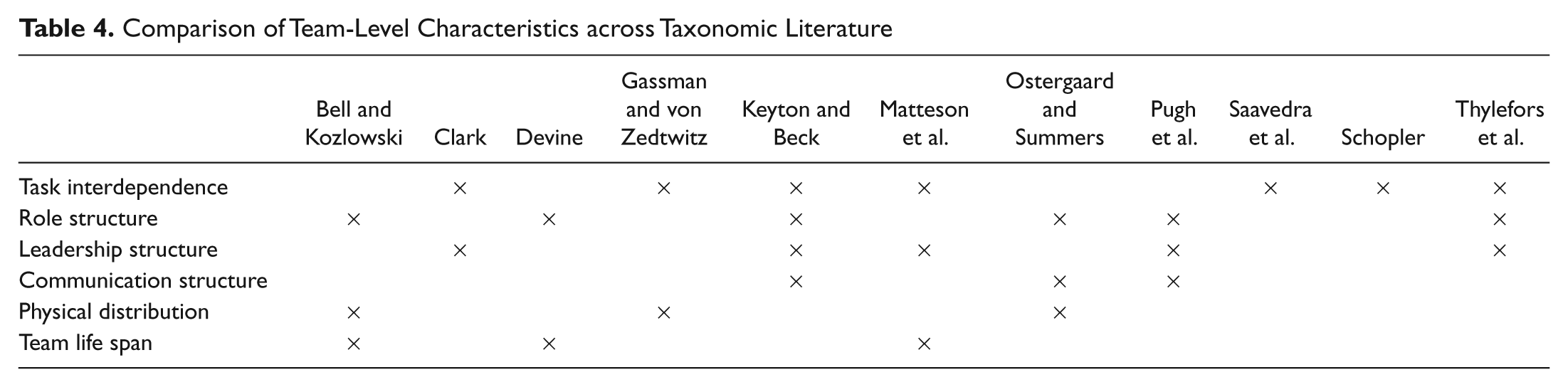
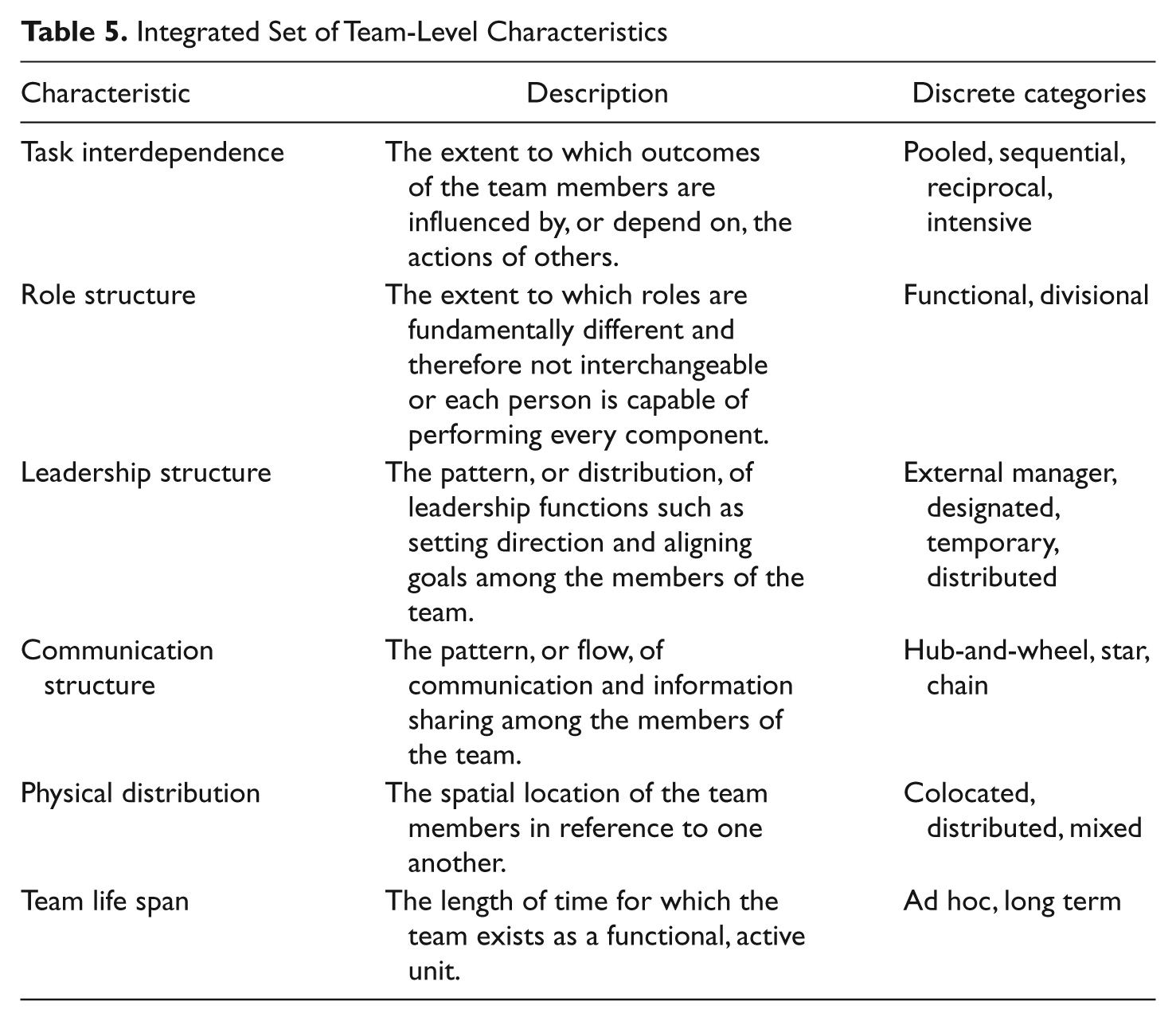
This pruning resulted in a final list of six core team characteristics: task interdependence, role structure, leadership structure, communication structure, distribution, and team life span (see Table 4). These six characteristics represent the holistic team-level attributes most commonly used in the literature to categorize teams into mutually exclusive categories (Table 5).
Comparison of Team-Level Characteristics across Taxonomic Literature
Integrated Set of Team-Level Characteristics
Task Interdependence
The concept of task interdependence has been included across a number of existing team taxonomies (e.g., Bell & Kozlowski, 2002; Cohen & Bailey, 1997; Matteson et al., 1999) and was therefore included as one of the core team characteristics that serves as an underlying dimension in our taxonomy. Interdependence describes the nature, or structure, of the dependencies and interconnections between members of the team. Task interdependence is the extent to which the outcomes of team members are influenced by the actions of others. Saavedra and colleagues (1993) developed the most widely referenced taxonomy of task interdependence in teams comprised of four discrete levels. In pooled task interdependence, each team member makes their contribution to the outcome without the need for interaction with any other group members. In sequential, one team member must act before another can act, as in an assembly line. Reciprocal task interdependence is characterized by a back-and-forth style of interaction between team members in a one-on-one format but not between multiple members at once. Last, intensive task interdependence occurs when the entire team interacts as a unit, jointly collaborating to complete the team task. This is the most interactive level of task interdependence.
At any given snapshot in time, teams can be distinguished from one another by the form or structure of their task interdependence. Task interdependence has been shown to moderate a variety of relationships with team performance and is therefore a critical underlying dimension on which to classify teams. DeChurch and Mesmer-Magnus (2010) found that levels of team interdependence moderated the relationship between team cognition (i.e., shared mental models, transactive memory) and team performance such that team cognition was more predictive of performance in teams with high interdependence. Stajkovic, Lee, and Nyberg (2009) used task interdependence as a moderator and found that the relationship between collective efficacy and group performance was stronger in groups with higher interdependence as well. Furthermore, HRD researchers have suggested that task interdependence moderates the relationship between team diversity and team performance (Horwitz, 2005) and team beliefs in interdependence play a crucial role in team learning (Knapp, 2010). Classifying teams into discrete descriptive categories based on task interdependence will not only improve the usefulness of meta-analytical team research but also improve the application of these and other research findings to the development of teams in organizational settings.
Role Structure
Another higher level characteristic of teams that was mentioned in several of the prior taxonomies is the way in which teams divide work among team members. Thylefors and colleagues (2005) label this characteristic role specialization, which is defined as the extent to which team roles are specialized or interchangeable. Restated, teams can be structured so that work is divided in a functional or a divisional manner (Harris & Raviv, 2002). If members of a team perform fundamentally different roles and are not interchangeable due to their level of expertise specialization, this is considered functional role structure. Divisional role structure, on the other hand, means that each team member performs a particular component of the overall task at any given time, but all team members are capable of performing each component; therefore, team members are interchangeable between roles.
For example, in a student project team, each student may be equally trained and qualified to perform all aspects of the paper writing project, but the team chooses to divide the tasks (e.g., literature search, introduction writing, data collection, etc.) among members. In the event that any one team member fails to do his or her part, every other team member is capable of taking over that piece of the project, making the team divisional in nature. However, in a multidisciplinary research team for example, the computer scientist will not have the skill to develop the theory behind a simulation-based training program, and the social scientist will not have the skill to program and build the training system, requiring a functional structure.
Role structure is an important team-level characteristic for consideration when studying or managing teams. In regard to designing team training, it dictates whether team members should be cross-trained in all potential team member roles or only trained in their specialized individual roles. Similarly to task interdependence, role structure could also be a potential moderator of the relationship between various team emergent states (e.g., shared mental models, transactive memory systems, trust) and team effectiveness. For example, understanding the location of expertise (i.e., transactive memory) in a team might be much more important than having a shared mental model in a team with a functional role structure.
Leadership Structure
Several of the prior works aimed at classifying teams based on underlying characteristics in some capacity mention leadership as an important property to consider. These works focus on aspects of leadership such as leadership style (Clark, 2007), leadership structure (Keyton & Beck, 2008), level of leadership or managerial responsibility (Matteson et al., 1999), and concentration of authority (Pugh et al., 1969). However, these prior works do not explicitly define mutually exclusive categories of leadership based on these aspects and, therefore, we pull from the shared leadership literature to supplement the existing focus on leadership in the team taxonomic literature.
A review of the shared leadership literature reveals that there are four basic configurations for leadership structure in teams: external manager, designated leader, temporary leader, and distributed team leadership. In an external manager leadership structure, someone outside the team performs the leadership roles (e.g., Morgeson, 2005). If there is a designated team leader, one member of the team performs virtually all of the leadership functions, and this member remains the leader across time and tasks. The other two structures can be considered forms of shared leadership (e.g., Barry, 1991) as the leadership functions are distributed across multiple team members in some way. A temporary leadership structure, also known as rotated leadership (Erez, LePine, & Elms, 2002), means that the leadership role rotates among team members across time or tasks, such that one member may be the leader at one point in time and a different member is the leader later when another task is being performed. In distributed leadership (Gronn, 2002), the leadership functions are divided out among different members of the team. This structure differs from temporary leadership in that multiple team members are acting in a leadership role simultaneously.
Leadership structure is important for team selection and training in that depending on distribution or pattern of leadership functions within a team, training may be necessary for anywhere ranging from one specific team member to all team members. For example, if a team displays a distributed leadership structure, each team member may only need to be trained in certain leadership functions that they are responsible for, but a team with a task-based leadership structure may need to have all of the team members trained on all aspects of leadership since they rotate full authority from person to person based on the task. In addition, understanding the structure or distribution of leadership behaviors in a team is critical for understanding how leadership influences team process and performance, and how leadership should be managed or improved. Team building is an effective HRD intervention for encouraging the development of leadership skills in team members (Gilley et al., 2010).
Communication Structure
Communication has also been included in several prior works as a potentially critical structural property of teams. The taxonomic literature mentions communication as an emergent property that can take on various patterns or structures in teams, but it does not explicitly define the exclusive and exhaustive categories into which teams can be categorized, and therefore we turn to the general team communication structure literature to supplement existing knowledge. Communication structure refers to patterns of both verbal and nonverbal communication within the team (Dyer, 1984). Three core communication patterns can occur within teams: hub-and-wheel, star, and chain. In a hub-and-wheel communication structure, communication passes through one central team member (i.e., hub) that is often, but not necessarily, the team leader and is then disseminated to all other team members through this hub. In a chain structure, communication is passed “up and down the line” based on a hierarchical structure of some sort (i.e., rank or leadership position in the team). For example, the leader may give important information to his or her second in command, who, in turn, tells the next highest ranking individual, and so on. Last, in a star structure, information is passed freely to and from all team members with no central point of contact or hierarchical structure. This is the most free-flowing type of communication structure as all team members communicate freely with one another.
Understanding the communication structure in a team can be most helpful to team researchers and practitioners who are interested in training and improving team process and performance. By understanding who should be communicating with whom at what time, breakdowns in communication can be identified and remedied. Knowledge of a team’s communication structure can assist training developers in creating event-based simulations in which critical pieces of communication are passed to or withheld from certain members to assess and improve a team’s ability to engage in appropriate communication processes. Finally, as with all of the other core holistic characteristics, communication structure could be a potential moderator of team effectiveness relationships and should be considered when doing empirical or meta-analytic studies.
Physical Distribution
Distribution is another critical dimension to consider when classifying teams (Bell & Kozlowski, 2002; Gassman, & von Zedtwitz, 1999; Ostergaard & Summers, 2009); so much so that Bell and Kozlowski (2002) developed an entire classification system devoted specifically to virtual, or distributed, teams. With the increased use of collaborative technologies, team members are often separated across time and space, both of which can have an impact on team process and performance. Physical distribution refers to the spatial location of the team members to each other. Bell and Kozlowski (2002) categorize teams based on the extent of their spatial or physical distribution as well as the extent to which their work occurs face-to-face versus technologically mediated, with virtual teams being those that are spatially separate and communicate via computer-mediated tools, and conventional teams being spatially proximal and meeting face-to-face. However, we posit that teams can also consist of some spatially proximal members and some spatially distant members. Therefore, in terms of physical distribution, teams can be fully colocated, fully distributed, or mixed. Colocated teams are close enough in physical location that team members can easily communicate in face-to-face meetings. In distributed teams, members are far enough from each other in physical location that most of the communication must occur via some sort of computer-mediated medium such as e-mail, telephone, or video conferencing. Teams can also have a mixture of these two distributions, with a subset of the team members being colocated and others distributed. In fact, this mixed level of physical distribution is likely the most representative of how most teams actually function.
The distribution of team members is one of the most widely studied moderating variables in the team literature. For example, researchers have found that the extent to which teams are distributed moderates the relationships between information sharing and team performance (Mesmer-Magnus, DeChurch, Jimenez-Rodriguez, Wildman, & Shuffler, 2011) and between relationship conflict and trust in new product development teams (Bierly, Stark, & Kessler, 2009). Clearly, it is critical to understand the extent to which a given team is distributed if team researchers and practitioners are going to generalize research findings to organizational settings and design training or management interventions to improve team effectiveness.
Team Life Span
The final higher level team characteristic that appeared in more than one of the prior team classification efforts is team life span. Team life span refers to the length of time for which the team exists as a functional unit (Devine, 2002). It is important to keep this separate from episode duration, which refers to the length of time necessary for the team to complete one cycle of their primary task or mission. Team life span refers to the existence of the team as a functional unit, not the length of time for which the team performs, and is therefore considered a higher level property of the team. Teams can generally be classified as either ad hoc or long term. For example, an emergency response team may be brought together to address a catastrophic event, exist for one week, and then disband. This team would be considered an ad hoc team, while a top management team in an organization that exists for the life of a company would be considered a long-term team. Restated, an organization may create a top management team as soon as they are established as an organization and that team will exist for the duration of the company’s life regardless of the fact that team members change over time and the team only meets for several hours a week.
The life span of the team is important to understand because certain performance management and training interventions will only be useful and worthwhile investments for long-term teams, while more short-term teams may need very different interventions to reach their optimal level of success. For example, team building exercises are a common intervention used to improve role clarification and cohesion within teams. However, these exercises are often costly and time consuming and would not be suitable for more short-term, temporary teams. Instead, ad hoc teams may benefit more from teamwork training that is given to the individual members of the team prior to their ever being selected as part of the team. This would help to develop transportable teamwork skills that team members could put to use immediately on the formation of a temporary team.
Summary of Core Team Characteristics
Devine (2002) argued that is it problematic for team classification when “focal attributes that are independent of team function/mission are allowed to creep into category labels (e.g., cross-functional, self-managing)” (p. 296). We argue the exact opposite: it is problematic for the practical usefulness of team classification when the focus is kept solely on “team function/mission” given that the team’s task, or function, does not describe the unique higher level properties that make teams distinct social entities. Using task type to categorize teams is parallel to taxonomically categorizing animals based on the purposes they serve for humans (e.g., carrying supplies, being pets, pulling farm equipment, being a food source). Biology taxonomists categorize animals by their shared inherent traits such as reproductive systems and physiological features; similarly, the classification of teams should also be built around the defining higher level traits that describe teams as social entities.
This idea is akin to the distinction between “what” teams do and “how” they do it. The core team characteristics go beyond what teams do either individually or together (i.e., task type) to explain how they operate as a whole. In other words, what teams do says little about the manner in which they interact as a single social entity, but how they interact provides a deeper understanding of the higher order traits that make teams unique. Furthermore, as a testament to the importance of these holistic characteristics, most accepted definitions of teams (e.g., Salas et al., 2000; Kozlowski & Ilgen, 2006) focus on the higher order characteristics of teams (e.g., interdependent, shared common goal, roles and responsibilities) and say little or nothing about specific task types because alone task types provide little insight into the underlying reasons for differential relationships with various antecedents and outcomes. For instance, in a recent meta-analytic effort, level of interdependence was found to have implications for group performance across task type (Stajkovic et al., 2009), therefore illustrating the importance of considering core team characteristics in conjunction with task type. One of the primary advantages of our revised set of core team characteristics compared to previous classification systems is that each of the included dimensions are team-level characteristics that are descriptive of teams as collective social phenomena rather than descriptive of tasks or of individuals.
Delineating the nature of teams based on the six holistic team attributes allows HRD researchers and practitioners to create a mutually exclusive combination of traits (e.g., a team may be categorized as an ad hoc, colocated, reciprocal, functional team that is using distributed leadership and star-patterned communication) that can help them more accurately understand what “type” of team they are working with and therefore what developmental practices from research can be generalized to that particular team. For instance, action learning teams are developed for the purpose of (a) accomplishing some goal such as developing an organizational strategy (action) and (b) development of the members and the organization (learning). Therefore, these teams are typically highly interdependent ad hoc teams with shared leadership and a star communication structure (Marquardt, Seng, & Goodson, 2010). Research on action learning teams with this pattern of characteristics could be generalized to similarly structured teams, and vice versa.
It should be noted that our taxonomic efforts are purposefully restricted to providing a set of underlying dimensions rather than attempting to delineate and name an exhaustive list of team types. We posit it is more practical and useful for individual HRD researchers or practitioners to create their own combination of dimensions to describe their unique team type as described above. This approach also avoids the issue of potentially confusing and nondescriptive misnomers that can occur when trying to provide a single term to describe a complex set of underlying dimensions (e.g., work teams referring to stable, full-time, well-defined work units responsible for producing goods or services that often are directed by supervisors but sometimes are self-managing; Cohen & Bailey, 1997). Furthermore, we do not suggest that these six characteristics are only useful when used in combination; but rather suggest that depending on the purpose of the taxonomic description, these six characteristics represent some of the most important attributes of teams for HRD professional to understand and use individually or in combination.
Application of the Tools to HRD Practice
The two provided taxonomic tools are useful for HRD professionals that are hoping to improve the selection, design, assessment, development, and management of teams in their organizations. The task type taxonomy, for example, can be used to improve team task analysis in organizations. This provides a more comprehensive yet parsimonious set of potential tasks that an individual or team can engage in and therefore is a useful tool for managers that are trying to identify the key task requirements of a particular job. To illustrate, imagine a military organization wanted to improve the effectiveness of its combat teams. A task analysis organized around the integrated set of task types might reveal that these teams are engaging in three core tasks: psychomotor action to operate vehicles and weaponry, defined problem solving when executing search and rescue missions, and human service when engaging with civilians during these activities.
This task analysis information could then feed into the design of selection and performance appraisal systems. By more accurately identifying the type of tasks required for a given job such as a military combat team, the competencies needed by team members (Gilley et al., 2010) can be identified and used to create a more predictive selection system. For example, based on the above example, it could be discerned that effective combat teams will be composed of team members who have strong fine psychomotor action skills, strong problem solving skills, and strong interpersonal skills. It is possible that if a more general taxonomy were used by HRD professionals to organize the task analysis information, some aspects of the combat team’s work may be omitted from the description and the selection of team members may be deficient. Therefore, the provided set of integrated task types ensures a more thorough understanding of any given team’s tasks.
The set of core team-level properties can also be used to improve the selection and design of teams within organizations. For example, if a certain team is categorized as having high levels of task interdependence (e.g., intensive interdependence) and very open, frequent communication (e.g., star communication structure), the level of trait collective orientation (i.e., a person’s tendency to prefer working closely with others) of the team members may be a more important predictor of performance for that type of team than for less interdependent teams. In other words, it may be advantageous for HRD professionals to select potential team members who are high in collective orientation for this particular type of team because they work and communicate together very closely. Understanding the core task requirements and team characteristics could also be used to design more precise and accurate performance appraisal systems that capture and evaluate an individual or team’s performance for each type of task.
The set of core holistic properties could also be used to assist HRD professionals with work redesign and training design. Each of the higher level characteristics included are basic aspects of team design that are within direct influence of the organization. In essence, the characteristics can be used to guide exploratory investigations of existing teams to identify their key features. For example, does the team in question have pooled task interdependence, or sequential? Is the communication star or hub-and-wheel? This feature mapping can be used to feed detailed task analyses, work redesign, or the development of other sociotechnical interventions designed to improve performance.
To illustrate, using interview or observational methods that tap the set of characteristics outlined here, a work redesign team could build an understanding of how the team is structured to meet its task in terms of leadership, communication, workflow interdependence, and other factors. Based on organizational needs, this understanding could be used to identify possible areas for improvement such as making the communication structure more open to facilitate faster decision making or the distribution of leadership to balance workload within the team. HRD professionals can use the set of core team characteristics as an easily referenced heuristic to quickly determine the most influential structural aspects of a team, such as the leadership structure or communication structure, to change for optimal effectiveness. Team training could then be designed that is aimed at improving the rotation or distribution of leadership in a team, or to improve the accuracy and speed of communication based on the preexisting pattern drawn from this list of characteristics.
The set of core team characteristics can also help team HRD researchers and practitioners understand how findings in the literature may generalize to a specific team setting. For example, when assessing whether or not a specific piece of research will be useful for informing team design or management in a given situation, a practitioner can use the set of core team characteristics as a framework regarding the most critical aspects of the team to understand. For example, a manager of product development teams at a particular organization may use this list of dimensions to determine that his or her teams are, for instance, engaging in ill-defined problem solving tasks, are fully distributed, and have functional role division. This team-specific information will help the manager narrow down available research findings to only those focused on teams with similar qualities.
Future Research Directions
As we emphasized previously, our integrative set of task types and core holistic characteristics draw attention to the possibility that previous research may have missed critical differences between particular task categories and ideal team characteristics for carrying out particular tasks. For instance, to our knowledge, very little team research has examined the moderating influence of task type and team structure when considering ill-defined and defined problem solving as distinct from one another. Given the fundamental differences between problem solving that requires making a choice between two or more existing options and problem solving that requires the creation of brand new knowledge or ideas, there are likely differences in the ideal structure for teams doing these two types of problem solving. A team engaged in ill-defined problem solving may be more effective when structured in ways that encourage high levels of creativity and openness and bring in multiple diverse perspectives (e.g., distributed leadership, functional role structure) whereas that same team when engaged in defined problem solving may need more structured direction (e.g., designated leadership).
Furthermore, our emphasis on the multitask and dynamic nature of team performance suggests that the effective development of any work team requires a clear understanding of the many tasks they engage in to accomplish their goals and the distinct knowledge, skills, and abilities necessary for those various tasks. “Real world” teams often do not engage in the same tasks or maintain the same characteristics across time. In real-world teams, the same team performs multiple tasks in one given performance episode, or shifts the combinations of tasks, structures, and processes across different performance episodes. A military combat unit may plan their strategy in an upcoming battle situation, maintain and operate complex equipment required for the battle, and actually engage in combat as well. In addition, teams adapt over time. For example, a given team may have a hub-and-wheel communication structure at first, but as the team develops trust and cohesion, the communication structure shifts to a more open star structure. Future research could use the revised, integrative task type taxonomy in combination with the set of core team characteristics as a starting point for the examination of complex changes in tasks over time. Perhaps as teams move from one type of task to another, there is an accompanying shift in leadership structure or task interdependence. How do these simultaneous shifts in task type and team characteristics over time correspond to different team effectiveness interventions and management strategies? This is just one of many avenues regarding the dynamic nature of teams that could be explored in future research.
In addition, from the perspective of facilitating the accumulation of scientific knowledge in a systematic way, the set of core team characteristics in many ways outline what is called the inference space in generalizability theory (DeShon, 2002). That is, they provide a map of the dimensionality of teams which can, over time, help to identify what types of interventions and other variables are related to team performance for different types of teams. In other words, team researchers can use this list of higher level characteristics when making experimental or research decisions regarding what factors to manipulate, control, or measure. Researchers may design a series of experiments to examine the moderating influence of task types or team characteristics on team effectiveness. The presented list of characteristics could serve as a strong point of departure in terms of enumerating the variables to be manipulated across studies without having to search the entire volume of team literature.
Future research should also examine the moderating impact of task types and team characteristics on various team effectiveness relationships (e.g., Horwitz, 2005). As we have illustrated, all of the core characteristics we have discussed have already been used as moderators in various empirical and meta-analytical endeavors. Much is known regarding the moderating influence of individual team characteristics on team effectiveness relationships. However, very little research has examined the complex interactions between the various combinations of core characteristics and how those interactions also influence various team effectiveness relationships. The next most influential step for team research would be to examine the two- or three-way interactions that occur between these characteristics and team effectiveness relationships. Future research should also examine the combined moderating impact of various task types and holistic team characteristics on team effectiveness relationships. It is our hope that the presented taxonomic tools will be used to improve the depth and complexity of future team research.
Finally, to better inform HRD practice, future research should begin to uncover the connection between team task types and the various core characteristics of teams in terms of increasing the effectiveness of teams. It is likely that certain patterns of team characteristics are more or less effective for certain team task types. Research has already demonstrated that compositional cognition (i.e., team cognition that is formed from individual-level cognition similar in form and function, such as shared mental models) is more predictive of team process in action teams than decision-making teams (DeChurch & Mesmer-Magnus, 2010). This finding suggests that being “on the same page” cognitively is more important for teams that are performing primarily action tasks than for teams that are performing primarily decision-making tasks. Therefore, it may be that using a star-patterned communication structure along with distributed leadership would encourage higher levels of shared cognition between team members and, therefore, be more beneficial for teams when engaged in psychomotor action tasks, while a chain or hub-and-wheel communication structure combined with designated or temporary leadership may be more ideal for cognitive tasks. If so, HRD researchers could begin to examine what developmental interventions (e.g., individual team, team training) can improve a team’s ability to adapt their characteristics (e.g., leadership structure, role structure) as needed to fit the changing nature of their tasks over time.
Conclusion
This work brings together disparate team classification systems into two comprehensive yet parsimonious taxonomic tools that distinguish between task types and core team characteristics, and provides direction and guidance for HRD professionals hoping to enhance the effectiveness of work teams. The task type taxonomy integrates some of the most prominent thinking from the literature regarding the type of work teams do and pares it down to a smaller, more manageable set of superordinate task types that describe all possible tasks a team can perform to achieve their goals. The set of core team characteristics represents a designable, trainable, and therefore useful set of critical holistic properties of teams that can be used to improve the effectiveness of team performance. Our hope is that this work improves our understanding regarding common tasks that teams perform and the most critical characteristics of teams to study and develop.
Footnotes
At the time of this work, Jessica L. Wildman was affiliated with the Department of Psychology and the Institute for Simulation and Training at the University of Central Florida. She is currently an Assistant Professor in the College of Psychology and Liberal Arts at Florida Institute of Technology. We would like to thank Jessica Neff for her help on earlier drafts of this paper.
The authors declared no potential conflicts of interest with respect to the research, authorship, and/or publication of this article.
The authors disclosed the receipt of the following financial support for the research, authorship and/or publication of this article: The article was funded by the Navy Personnel Research, Studies and Technology Department and the Bureau of Naval Personnel (Selection & Classification Office) under the auspices of the U.S. Army Research Office Scientific Services Program administered by Battelle (Delivery Order 08129, Contract No. DAAD19-02-D-0001).