




Abstract
The scale and reach of the recent global financial has created a fresh wave of interest in exploring more sustainable forms of management. A central thrust behind this trend in the practice of management development and education has been the accentuation of reflexivity. There are many variations in how reflexivity is understood, and this article aims to explore the various philosophical roots and contemporary understandings of reflexive management learning (which we refer to in this article as RML). Rather than assuming that RML is “one thing,” we attempt to integrate disparate understandings of it in classical and contemporary theory and propose a conceptual typology of the various forms of RML as it is studied and practiced. We conclude by reviewing some of the problematic aspects of RML and signpost further avenues of research in the field.
Introduction
Within the field of human resource development, the subfield of management development is arguably the most prone to periods of ethical reevaluation. Concerns about the development of overly “economized” forms of amoral managers (Bennis & O’Toole, 2005; Ghoshal, 2005; Mintzberg, 2004) have recently been superseded by calls for greater levels of reflexivity in the aftermath of the global financial crisis (Martin, 2010; Newman, 2010). The problem with introducing reflective forms of learning to management development practice, however, is that there appear to be multiple understandings of what reflexive learning is and of how it might be done in practice. The rationale for this article is introducing clarity to this issue by untangling the various theoretical approaches which have been proposed to assist both HRD practitioners and researchers working in the field.
As there is a huge volume of well-established theory in the broader field of reflexive learning outside the organizational context, this article endeavors to focus on the smaller but significant HRD subfield of management development (Cullen & Turnbull, 2005). The fact that management development is a particularly challenging area within HRD has been commented on by Anderson (2010) who identifies it as a particularly “‘messy’ and ‘fuzzy’” (p. 285) activity for HRD practitioners. Despite this, HRD retains a central role in the development of managers at all levels in organizations (Plakhotnik, Rocco, & Roberts, 2011).
Cullen and Turnbull (2005) defined the field of management development as a pluralistic
metafield that emerged from a range of disciplines (primarily, though not exclusively psychology, social science, and management studies), which either attempts to frame the reality of management, or influences how the reality experienced by managers is reframes, with the aim of contributing to the personal resource base of managers, and/or the intellectual capital of organizations. (p. 337)
The key division within the management development oeuvre suggested by Cullen and Turnbull is between management development and management learning. Research on management development
refers to management development programs of events that are external to the context on which they intervene. Studies on management learning emphasize the “internal life” of the organization and seek to uncover ways in which learning processes can be facilitated within the organization. (p. 351)
One of the central reasons why this article focuses on management learning is that, as an area of research and practice, it is experiencing a “radical paradigm transition” moving it beyond a narrow concern with content provision toward a greater focus on the scholarship and practice of teaching and learning (Delbecq, 2009). As such, it may be representative of concerns presenting in the broader HRD community, and it is hoped that the typology proposed might have broader applications outside management learning.
Reflexive stances are becoming more commonplace in the field of management learning research and practice domains (Boud, Cressey, & Docherty, 2006; Hoyrup, 2004; Rigg & Trehan, 2008; Fenwick, 2008; Van Woerkom, 2004). However, there remains much definitional confusion and conceptual diversity about reflexive learning which has contributed to making the term open to subjective understandings and confusion. Reflexivity as conceived within the domain of management learning has a multilayered natureand various claims are made as to its meaning and value (Cunliffe, 2009b).
To overcome the disorientation which may result when considering the diverse ways in which “reflection” and “reflexivity” are used in relation to management learning, this article uses the meta-phrase reflexive management learning (hereafter RML) as a useful umbrella term. RML is used here to cover all conceptual and practical expressions of formal management learning, education, and development which endorse and include both reflective and/or reflexive elements situated within a variety of pedagogical settings. Reflection and reflexivity are interrelated contexts but they do have some distinctive components. Cunliffe (2004) views “reflective learning” as a practice which involves reflecting on our actions or self-concept through an objective lens. “Reflexive learning” takes this a step further where the learner develops a working theory about how the various realities that they engage with are socially constructed, in order that these realities might, in turn, be changed. Reflection is, then, a vital stepping stone toward becoming reflexive.
The article also aims to help navigate a path through theories which initiate from differing political and ethical vectors. By using an encompassing term such as RML, the article does not aspire to oversimplify what is a rich and diverse field of study. Rather, it aims to do justice to the elaborate tapestry of thought which currently exists by highlighting distinctions, elucidating contrasts, and unpacking substantive differences between conceptual perspectives of RML on their own terms as they are met during the review.
The following section outlines the methodology which was used to develop the RML typology proposed in this article and to explain how the categories were developed. The review begins with an examination of the key theories of educational theorists on reflexive learning, before turning to explore the literature on RML. Following this, the article suggests five categories of RML which emerge from the literature and explain their main assumptions, tactics, and orientations to assist in the clarification of what can become a contradictory and confusing area. The article then assesses some of the problematic areas suggested by the literature review and concludes by recommending avenues for future research on the topic and the potential implications for HRD practitioners.
Method
The approach adopted in this article is based on the second form of integrative review identified by Torraco (2005) which
addresses new or emerging topics that would benefit from a holistic conceptualization and synthesis of the literature to date. Because these topics are relatively new and have not yet undergone a comprehensive review of the literature, the review is more likely to lead to an initial or preliminary conceptualization of the topic (i.e., a new model or framework) rather than a re-conceptualization of previous models. (p. 357)
The output of such reviews might be typologies or classifications which aid researchers to understand “classic” and contemporary developments in, and contributions to, a particular field or research and practice.
The need for a typology presented when the authors noticed dissimilar conceptualizations of reflection and reflexivity in the recent management literature and deigned to conduct a more rigorous analysis of the same. The first stage of this process involved collecting and identifying the literature for analysis. At the inception of the research, searches were conducted on the Business Source Complete, Social Science Citation Index, and Web of Science databases under the subject headings “Reflection,” “Reflexive,” and “Reflexivity” in combination with “Management Learning” and “Organizational Learning.”
Key journals (such as Human Resource Development Review, Human Resource Development International, Management Learning, Advances in Developing Human Resources, Academy of Management Learning & Education, Journal of Management Education, and HRD Quarterly) were additionally examined to ensure that the most complete data set possible was obtained.
When we had assembled the literature, all abstracts were read and reviewed to isolate items which did not meet the criteria for inclusion which are outlined below. Although particular attention was paid to work which had been extensively cited in the journals mentioned above in an effort to identify and isolate the key “conversations” within the RML literature (Huff, 1999), it is important to state that uncited or less cited papers were not automatically discounted as this would have resulted in the exclusion of more recent contributions.
A small number of items which did not substantially add to the development of theory (particularly those which made cursory references to concepts without commenting, critiquing, or expanding on them) were excluded. For example, a small amount of articles outside both the HRD and general management literature which had the words reflexive or reflexivity as a title or key word proved to be critical condemnations of concepts deemed as emerging from an “unreflexive” processes of investigation. As we were concerned with examining different understandings of RML, we formulated the following four questions of the literature we studied and asked whether they answered at least one of these:
Does this work increase our understanding of what RML is?
Does it clarify the aims and desired outcomes of RML for individual managers and organizations?
Does it outline process for engaging managers in RML?
Does it say “something different” about RML than other works in the area?
When this literature was identified, we both read each article in an attempt to identify the often subtle ways in which reflexivity was variously understood by the authors. At an early stage in our reading, when approximately 25% of the articles had been perused in a search for key messages, the authors discussed their observations on how these various categories had emerged. Although there were occasional amounts of overlap, five general categories of RML were suggested by our review of the literature, which variously emphasized the following components: (a) space/time, (b) communication, (c) liberation, (d) confession, and (e) ethics to different degrees. The results demonstrated that, although there is an established body of work on reflexive learning, that only since the turn of the millennium has the topic received serious attention in the field of management studies, and this volume has increased substantially each year since.
The utilization of RML constitutes a different way of thinking about reflexivity in the context of management learning and HRD, but it is important to highlight that many contributors to this literature make extensive reference to learning theorists and philosophers. Care was taken to identify these key antecedents of RML theory, which proved to be Dewey, Freire, and Schon. To produce a “craftsman-like” piece of research (Watson, 1994b), we present these antecedents first in the section, below, to establish the theoretical bases for RML and to demonstrate their influence on contemporary RML theorists.
Following the development of our category schema process, we set out to develop these fields by allocating articles to the categories. This was undertaken with a view not only to both organizing the literature but also to testing the validity of our nascent categories. This proved to be the most difficult part of the process as much of the literature on reflexivity, as has been stated, views it as process that individuals engage in that does not have an established telos (Brookfield, 1995; Cullen, 2011). When approaching this problem, we applied our final focal question, “Does it say ‘something different’ about RML than other works in the area?” to identify not only where the theories of RML converged but also where they diverged from each other.
Raelin (2008a), for example, advocates a process where individuals come to understand processes of how knowledge is created and management through gradually learning to distinguish themselves from their social context via public reflection. This process of public reflection assists in raising awareness of the role of groups in creating particular form of managerial selfhood but yet is different to processes which suggest that organizational frameworks should be established that acknowledge the political nature of workplaces (Coopey & Burgoyne, 2000). Cunliffe (2002) also seeks to “expose unspoken assumptions that may have an enduring effect upon agendas and power relationships in particular contexts” (p. 38) but does so through the unsettling or destabilising of basic assumptions from a sociolinguistic, as opposed to a social or political, premise. This arousive or agonistic perspective might be compared with the kenotic tone of management development which Ackers and Preston (1997) noted had begun to enter the management development discourse over the course of the 1990s. Although such RML techniques emphasize renewal, they are different from revisionist/reformist approaches which aim instead to unearth and examine the ethical relationship between theory and practice in learning contexts (Raelin, 2007).
RML, then, is not “one thing” but is a field that is simultaneously composed of practice and theory, which address the cultural creation of assumptions or givens from social, linguistic, or political premises. Some of the key theorists who have informed these perspectives are discussed in the following section.
Progenitors of Reflexive Learning
Prior to reviewing the recently RML literature, the article begins by exploring some of the central ideas of some of the key progenitors of reflexive learning (John Dewey, Paulo Freire, and Donald Schon) and on their impact on contemporary RML theorists.
John Dewey
John Dewey’s frequently cited writings form the taproot theories for general educational concepts (Rodgers, 2002) and for theories of organizational learning (Hoyrup, 2004). Due to his emphasis on reflection (Dewey, 1910), his work has been especially influential on theories of RML (Reynolds & Vince, 2004). Dewey conceived of reflective practice as the mental capacity to connect with experience to organize and ultimately to learn from it. This process unfolds as a continuous dialectical to-and-fro between a person and their environment. Reflective practice provides our experiences with meaning as we contemplate and thus discern more deeply our lived experiences in a way which “extends our practical control” (Dewey, 2010, p. 112). Emotional discord in learning proves to be “the occasion that induces reflection” (Dewey, 1980, p. 15) and the role of emotions in “qualifying” our experiences receives significant treatment in his major 1934 work on aesthetics: Art as Experience (Dewey, 1980). That emotional dissonance prompts reflection and reflexivity has been noted by RML theorists such as Chia (2009), Vince (1996, 2001, 2010), and Hoyrup (2004). The work of these theorists stem in a fundamental way from Dewey’s work and speak to his continuing relevance as an “early advocate” and anticipator of modern day RML (Siebert & Daudelin, 1999).
Paolo Freire
Radical pedagogue Paolo Freire has also made an important contribution to RML and provides the critical blueprint for many of its more subversive forms (Perriton, 2004). His influence, however, is not only limited to dissident circles (Kolb & Kolb, 2009), and some have forged a conceptual link between Freire and Dewey’s work (Feinburg & Torres, 2007). Freire (1973) believed reflection to be a distinctly human capability in which we detach ourselves from the world to locate ourselves in it. By “entering into reality to look at it objectively and apprehend it as one’s own field of action and reflection” (p. 105), we grasp the dialectic form of thought and action and see the potential for alternative futures. Reflection is empowering, and it allows agents to intersubjectively organize and experiment with new ways of being which may change both learners and the world around them (Freire, 1996). Rational agents have the ability to consciously separate themselves from reality to reflect on it collectively in shared and relational ways which may bring about positive changes to their social circumstances. Freire, however, advised against the decontextualization of his theory and stated that there was no Freireian template which may be used universally devoid of specific cultural contingencies (Gilstrap, 2008). He thought education to be a naturally potent means of “demystification” which could free educators from merely transmitting knowledge to learners in a “banking model” of pedagogy, while simultaneously emancipating learners and giving them a voice in their own education (Goulet, 1973).
Donald Schon
Another important foundational contribution to RML has been made by Donald Schon. Schon’s (1983) touchstone work The Reflective Practitioner outlined his theory of reflection-in-action and has been consistently influential within the field of RML (Swan & Bailey, 2004). Influenced by Dewey, Schon believed that reflection provided a powerful means of grasping and understanding experience which could replace techno-rational approaches to knowledge creation and learning.
This reflection had the potential to take place in the mid of action, rather than solely retrospectively, as is suggested by other theories such as Kolb (1984). Schon (1983) proposed we could reflect “on our feet” by “having conversations with the situation” (p. 242). Schon suggested an epistemology of practice where what individuals tacitly knew tacitly and unconsciously performed could be unearthed via a reflective practice where managers could to use Mumford’s phrase “make experience pay” (Mumford, 1980). For Schon, even when managers did conduct reflection-in-action they rarely then reflected on this reflection in action. Such meta-reflection could harvest both personal and institutional dividends to the mutual benefit of individuals and their institutions. A dissemination of the “art” of what a manager knows but which “. . . tends to remain private and inaccessible to others” (p. 243) could through reflection be subsequently taught to, and shared with, their fellow professionals.
Contemporary Developments in RML Theory
RML is a practical approach that engages with theory in a way which helps participants unpick the underlying assumptions of the organized contexts in which they manage and work. As such, we have prioritized our discussions of how theory and practice have been found to inform each other when developing our taxonomy. Reflexive approaches aim to help managers to “reconceptualize” their experiences (Holman, 2000; Kolb & Kolb, 2009) into potentially more effective paradigms for future action (Janssens & Steyaert, 2009). Giacalone (2004) proposes that this involves an ethical duty on the part of the educator to furnish managers with a moral identity (Eriksen, 2009) which reconnects them with the ethical aspects of their organizational experiences (Cunliffe, 2009b). RML offers space and time for managers to reflect on their experiences in “thoughtful classrooms” (Mintzberg, 2004). Mintzberg (2009) suggests that RML involves humility as managers should be willing to tolerate different perspectives and perhaps concede on rightness to go “. . . beyond sheer intelligence, to a deeper wisdom” (p. 209). RML is a time-intensive, psychologically challenging approach which may create anxiety and frustration, perhaps even leaving managers with the impression that it has created more challenges than it has resolved (Hedberg, 2009). Such themes recur in Raelin’s influential theorizing on contemporary RML. Raelin (2001) proposes that RML involves “periodically stepping back to ponder the meaning to self and to others in one’s immediate environment about what has recently transpired” (p. 11). It provides time and space for “indwelling” (Polanyi, 1974). As managers discover and interpret the underlying meaning of their experiences, informed self reconstruction where the point of reflection becomes not merely to know things but to change the self becomes possible (Raelin, 2008a). RML has the potential to facilitate humility that enables managers to embrace their “. . . indeterminacy and resist conceptual closure” (Raelin, 2009, p. 11). In this way, a fresh sense of agency may be grasped leading to new possibilities of understanding and action. Raelin (2001) advocates collective, rather than individual, reflection. As managers are normally socialized habitually to act rather than to think, public reflection helps to rebalance this. RML becomes an enabler of personal and organizational learning that can potentially produce societal benefits. Collective reflection instigates multilateral critical dialogue providing the potential to acknowledge and gather together discordant values into shared axioms.
RML seeks to break the mould of traditional, directive training approaches, and many forms of RML endeavor to engage learners in more dialogical and relational pedagogies which are perceived to be more appreciative of the challenges faced by managers in their working lives (Boud et al., 2006; Cunliffe, 2002; Mintzberg, 2004).
Raelin forwards the idea that RML can be both emancipatory and performative, clinging to all the familiar calculative and instrumental constructs of training transfer and return on investment, while simultaneously representing a form of liberating praxis. Raelin is not alone in exploring the potentially emancipatory gifts of RML but not all theorists attempt to integrate its potential with the commercial everyday demands of the workplace. Duarte (2009) perceives RML as a critical instrument operating beyond reflection and critical thinking in an effort to problematize potentially oppressive and dehumanizing organizational practices. RML, Duarte argues, may be used in a provocative fashion to “challenge particular versions of truth that are promoted and sustained through organizational practices and discourses” (p. 67). In this way, he suggests managers may grasp a more fundamental sense of their agency and perhaps be more inclined to access and make greater use of their “sociological imagination” (Mills, 2000 cited in Duarte, 2009, p. 59). Critical and collective RML factors also feature centrally in Reynolds and Vince’s (2004) influential theory of organized reflection where the importance of not treating RML as an introspective activity undertaken by the individual alone. The social is central to Vince and Reynolds RML framework. Managerial agency, freedom, and moral responsibility best emerge from reflexive interlocution with peers in public forms. Individual RML does not fully take into account how social, political, and cultural considerations influence the way in which organizational decisions are made and enacted.
Organized RML promises to foreground this by uncovering the issues which typically stymie institutional development and management learning and thus provide “an important source of information for the strategic direction of an organization” (Vince, 2002, p. 74). The raising of politics and power relationships into the public discourse of the organization is an integral feature of this RML method. According to Vince, this can be done in relatively safe and managed ways which provide a “container” for the anxieties which inevitably arise. Reflexivity itself has been called a democratic value (Rosanvallon, 2011), and, in this vein, Vince is also concerned with how its collective variation might enable more democratic forms of management in the hope of improving “corporate strategic thinking and action” (Vince, 2002, p. 75). In a democratic organization, managers can display and legitimize their authority by opening it up freely to “the critique and imagination of others” (p. 69). This does not necessarily mean that they must cede this authority but that at minimum they facilitate and engage in reflexive dialogue with others and are willing to have the values, beliefs, and assumptions on which their views are founded, debated, and challenged.
RML in Practice
Using a real-life example, Vince (2004) makes a business case for organized RML. Opening up organizational norms and assumptions to public review helps to surface and deal with the underlying emotions and politics that exist but may go unarticulated within teams and work groups. This can improve knowledge-sharing, enhance communication, and generate mutual learning which has a positive effect on business (in his example, increasing the ability of managers to win commercial contracts). Organized RML can “create and sustain opportunities for strategic learning” (p. 10). Vince makes a crucial link between organized RML and leadership. A key antecedent to achieving strategic learning, Vince believes, is the radical redefining of our current understandings of this problematic concept (Barker, 2010). Moving against the established grain which places leadership as an egocentric activity which influences from without, Vince proposes a candidate theory of leadership as an endogenous phenomenon socially derived from within a work collective as “a product of human community” (p. 145). The embedded existence of collective leadership within an organization, recursively reinforced and sustained by consistent public RML is thought unlikely to occur without high levels of managerial reflexivity (French & Vince, 1999) and would probably signal that the managers and members of an organization had a strong understanding of what reflexive practice involves (Moon, 2004).
The idea of RML as a dialogic and relational practice finds comprehensive expression in the work of Ann Cunliffe (2002, 2004, 2009a, 2009b). Her influential model of reflexive dialogical practice (Cunliffe, 2002) is a phenomenologically inspired approach which also takes its cue from postmodern and social constructionist theory (Cunliffe, 2003). Cunliffe views learning as an internally experienced, actively subjective process in which we are “struck” and thus “moved to change our ways of being, talking and acting” (p. 36). She is critical of both mainstream and critical management learning for not recognizing the importance of this and for focusing instead on issues of content rather than process. Adopting such an angle for Cunliffe means failing to take sufficient account of the tacit ways in which knowledge is achieved and the embodied nature of how learning occurs from “inside” experience.
Cunliffe’s RML encourages learners to go beyond merely discovering and understanding the assumptions they work under, to criticizing and questioning both the assumptions themselves and the higher level beliefs and values on which they in turn are invariably scaffolded. This second-order critique is performed both self-reflexively and relationally via dialogue with others (Cunliffe, 2004). Cunliffe’s mode is predominantly critical, but the overarching goal is to advance a more internally engaged way of dealing with the challenges raised by critical studies of management (Alvesson, Bridgman, & Willmott, 2009; Grey & Willmott, 2005; Parker, 2002; Tadajewski, Maclaran, Parsons, & Parker, 2011). Cunliffe does not suggest that a simple division can be drawn between critical and orthodox management learning. Cunliffe’s RML is “an approach that may be used to complement a critical pedagogy and offer a reflexive stance within conventional curricula” (p. 36, emphasis added). These conventional means of management pedagogy are not totally disregarded. Forms of management learning which aim at merely deploying content and techniques which are abstracted from external sources and provided to managers stripped from a recognition of the context within which they themselves are enmeshed as “practical authors” of their shared relational realities are thus disavowed (Cunliffe, 2001). Orthodox and critical currents alike are both in their own distinct ways guilty of failing to “offer practical ways of moving forward” in the field of management learning (p. 38).
RML is frequently said to involve psychological, even existential, hardship for those who engage with the method (Cunliffe, 2002, 2008b, 2009b; Cunliffe & Easterby-Smith, 2004). RML obliges those involved to engage with the process and to maintain this self-honesty throughout, while showing solidarity with those whom one is sharing this learning experience with. On this note, it is apposite to add here that learning of this kind also requires reciprocity and trust between educator and learner (Johns, 2004). Finally, it must be stressed that Cunliffe’s is a firmly ethical pedagogy whose central critical purpose seems to be the search for a renewed sense of shared virtue among organizational managers. It is a pedagogy which seeks to enable managers to locate and cultivate character attained through a fundamental reflexive critique both of them and of the environment they inhabit to assist help the cocreation of their daily working lives. Cunliffe’s RML writings are moored mainly at the conceptual level concentrating on developing a theoretical frame which may help to develop “. . . more responsive, creative and ethical ways of managing organizations” (Cunliffe, 2009b, p. 417). Thus, it could be suggested that her research represents the high watermark for normative conceptualizations of RML.
Based on our review, a tentative typology is suggested in Table 1 below with brief descriptive elaborations also supplied. It appears that five thematic currents are evident in the contemporary RML discourse. Structuring these currents provides two main advantages:
It facilitates the elucidation of theories from within overall conceptual domain of RML as they interrelate in oppositional or complementary forms with one other;
It permits a more lucid refinement and coherent expression of how RML theory might be advanced in the context of the achievements of research reported to date.
A Tentative Conceptual Typology of Contemporary RML
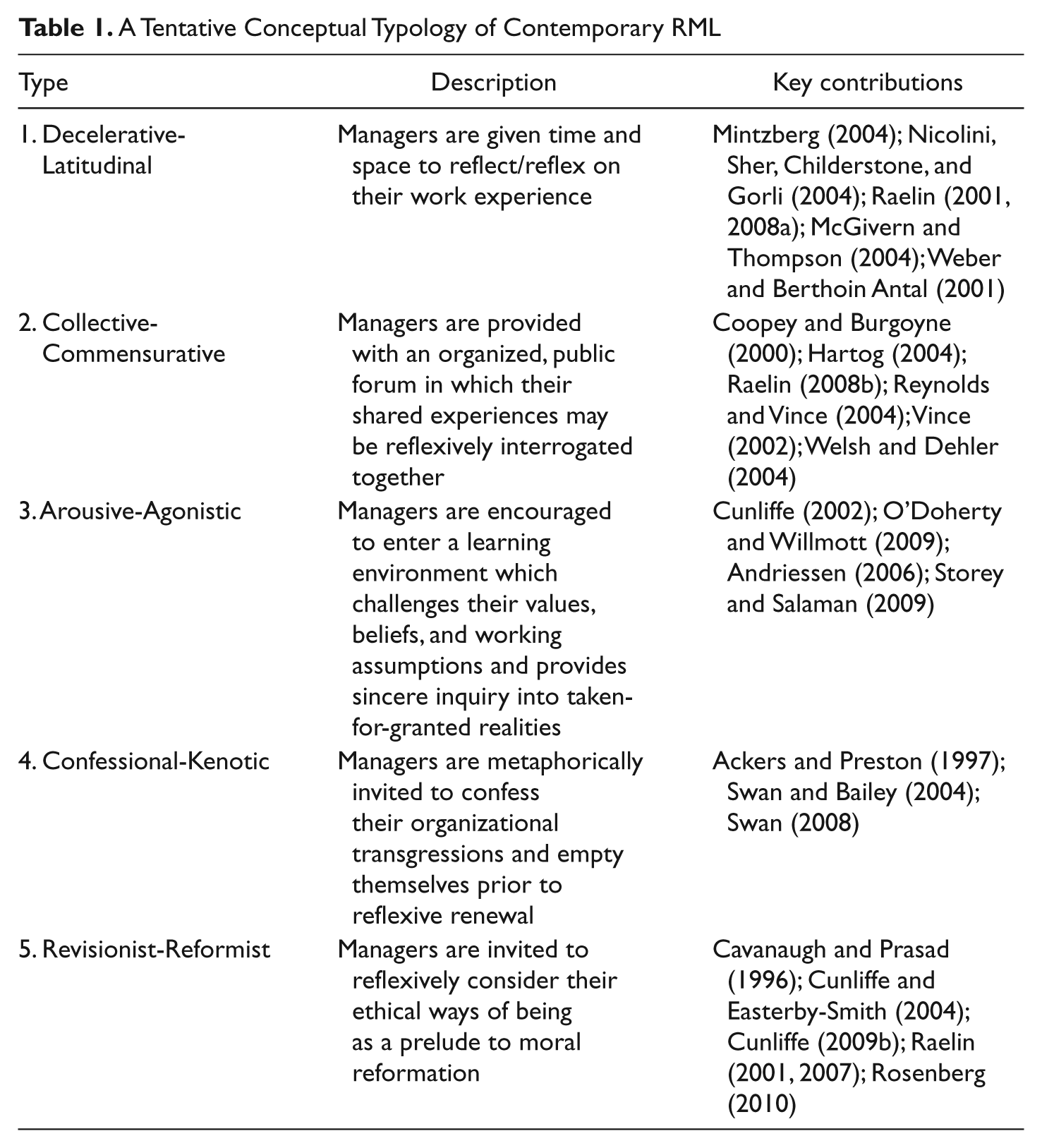
Decelerative-Latitudinal
The Decelerative-Latitudinal mode affords preeminence to the spatio-temporal qualities of learning and advises the provision of time and space to management learning. It does this in a way which specifically speaks to the deliberate attempt to slow down the time and speed of the manager’s world while simultaneously opening up the latitude needed for reflexive learning to occur. There is evidence of this decelerative-latitudinal form in virtually all of the literature reviewed but it is perhaps best exemplified in Mintzberg (2004), Nicolini et al. (2004), Raelin (2001, 2008a) and McGivern and Thompson (2004). Mumford (1995) writes that managerial effectiveness is more commonly evaluated within organizations based on results gained rather than knowledge possessed. It makes sense then, he argues, to approach management learning from an angle which focuses on “. . . helping managers to learn from actions [they have] undertaken” (p. 8) rather than teaching them either using abstracted analytical methods or cases drawn from the experience of others. Decelerative-latitudinal modes of reflexive management learning facilitate a “slowing down” of the learning process which is believed to result in an increase in quality (Weber & Berthoin Antal, 2001). These types of RML provide the room for managers collectively and individually to unfurl their experiences of the “cross-boundary issues affecting their everyday working lives” (Nicolini et al., 2004, p. 91) by providing organizational spaces which may become “havens of sense-making” (p. 91) in an otherwise complex and semantically fragmented “organizational world” (Leavitt, 1973).
Collective-Commensurative
The collective-commensurative mode of RML emphasizes organized or public forms of reflexive and reflective practice. A more social form of RML, it provide mechanisms by which pluralistic discourses may perhaps be harmonized and then activated in the service of shared organizational purposes (Coopey & Burgoyne, 2000). A democratic attempt is made to dialogically shape agreement and consensus on both organizational objectives and the paths to be taken to achieve these goals. This version of RML often seems to assume that managers only ever possess partial knowledge. Through “relational synthesis” (Mannheim, 1985), it can gather together factionalized or harmful perspectives which may block the effectiveness of management teams and/or leading to oppressive and inequitable ways of operating. This form of RML is often intended to have positive societal ramifications particularly when deployed critically (Hartog, 2004; Raelin, 2008b; Reynolds & Vince, 2004; Vince, 2002; Welsh & Dehler, 2004).
Arousive-Agonistic
The arousive-agonistic form of RML typically assumes that many managers unconsciously hold to and live by unquestioned doxa which have become concretized in unreflexive modes of conscious or unconscious behaviors which need to be surfaced and interrogated. In its critical form, this mode may appear to hint at a managerial false consciousness (Cunliffe, 2002; O’Doherty & Willmott, 2009). The phrase “taken for granted assumptions” is a recurring term across virtually all the RML literature. The purpose of this mode of RML is to agitate and pry into manager’s underlying belief patterns in a process which Brookfield (1995) refers to as “hunting assumptions.” Morgan’s (2006) assertion that “culture gives us our world. And it traps us in that world!” (p. 211) also describes the predicate on which many forms of arousive-agonistic RML proceed. This variant of RML also has correlations with “arguing-to-learn” theses (Andriessen, 2006; Andriessen, Baker, & Suthers, 2003; Cox, 1990; Muller Mirza & Perret-Clermont, 2009; Van Eemeren & Grootendorst, 2003; Veerman, Andriessen, & Kanselaar, 2002). Arguing-to-learn theses recommend a collaborative yet confrontational approach to learning, using instructional design and pedagogical models which can be seen as a synthesis of traditional perspectives combined with the fundamental propositions of argumentation theory, an interdisciplinary field of study spearheaded by the work of the philosopher Stephen Toulmin (2003). Last, if it is true that “old learning . . . limits new learning” (Storey & Salaman, 2009, p. 163), then arousive-agonistic RML seeks to jolt managers, even temporarily, out from their existing modes of thinking and being to explore new ideas and share different perspectives with their peers and colleagues within a relatively safe environment.
Revisionist-Reformist
Revisionist-reformist modes of RML target the moral edification of management. Revisionist-reformist RML confronts managers with two considerably large and important existential questions—what and how to be? (Cunliffe, 2002, 2009b). As Cavanaugh and Prasad (1996) put it, this form of RML involves an operationalized rather than an esoteric reflexivity which acts as a “localized and on-going revaluation of the formation of oneself as thinker and moral agent” (p. 83). The goal is ontological reorientation with a firmly moral motive. Through RML managers are encouraged to “move from being morally-neutral technicians to considering the morality and responsiveness of [their] practices” (Cunliffe, 2002, p. 42). Theorists and facilitators of this mode often exhort and follow “pathic principles” of pedagogy (Van Manen & Li, 2002) which prescribe patience, empathy, and understanding with learners (Cunliffe, 2002; Cunliffe & Easterby-Smith 2004; Ghaye, 2000, 2010; Mintzberg, 2004; Raelin, 2001, 2007; Rosenberg, 2010). Causal links are also typically implied or inducted between the potentially ethically recharged manager with her reflexively broadened moral vista and a greater sense of moral responsibility and accountability at the organizational level with societal benefits ensuing.
Confessional-Kenotic
Confessional and kenotic—self-emptying—aspects appear to exist latently across many forms of contemporary RML. Reflexivity is phenomenological and thus elementarily subjective. Other people’s “stream[s] of lived experience” are never fully open to us (Schutz, 1972, p. 106). This means reflexivity can be intensely individualistic. It can also mean that confessing what we find self-reflexively is a way to create ourselves as subjects for ourselves and for others and for them to reciprocate. In a reflexively induced crisis of conscience which anticipates moral renewal, managers may be tacitly encouraged to repent and become “born again” or to have “conversion experiences” (Ackers & Preston, 1997). Humility is seen as an antecedent to successful participation in an RML program (Mintzberg, 2004). The kenotic task is the humble self-emptying which must precede the reflexive task of assessing and reassembling prior beliefs, values, and assumptions to neutralize unhelpful credos in a managerial act of conscience. This points to the sometime spiritual undersong of RML noted by Swan and Bailey (2004) and by Swan (2008) who discuss the general “confessional turn” in recent management learning.
Problematizing RML
In its critical form, RML seeks to raise the political consciousness of managers through the questioning of the legitimacy of established organizational norms and values. Yet the ethical probity of this stance is itself worthy of inquiry, and managers themselves may not necessarily accord with the ends contained in such versions. In addition, a method which so encourages “the public sharing of emotions” (Swan & Bailey, 2004, p. 123) may border on the therapeutic by endorsing certain emotional ways of being while perhaps ignoring or relegating others as irrelevant. This suggests that some forms of critical RML may, ironically, be unreflexive (Cunliffe, 2002; Cunliffe, Forray, & Knights, 2002; Swan & Bailey, 2004). The indeterminate and open world, which a truly reflexive practice finds, confers authority on many perspectives and emotions including paradoxically those which may reject reflexivity itself. Reflexivity is an inherently circular and self-referential concept (Ashmore, 1989; Tsoukas, 2005), and it requires disciplining if it is not to tie the hands of those who would invoke and exercise it (Weick, 1999). Methodologically, RML may also find itself in difficulty given the natural potential reflexivity has for infinite regression. Moon (2004) raises this, commenting that it might be difficult to see where a reflexive process ends since theoretically “it can go on and on examining issues in a wider and wider context and at different points of time from the event . . . to infinity” (p. 98). This raises several questions for the practice of RML. For example, if in theory reflexive inquiry is infinitely circular, then how can and when do RML sessions conclude? The introspective character of reflection and reflexivity also makes links between RML and the practical outcomes of this activity difficult to obtain (Ghaye, 2000; Rodgers, 2002) which runs the risk of making it more difficult to convince managers of its practical applicability.
The findings of Antonacopoulou’s (2004) study of the dynamics between reflexivity, learning, and change in three financial institutions pose problems of viability for RML. Contextual factors such as power relationships and political dynamics constrain managerial agency meaning that “. . . reflexivity is not simply a matter of choice” (p. 48). Such constraints allow more amoral frames such as rational choice theory to dominate an individual’s thinking (Satz, 2010). The ethical motives of RML should thus perhaps be more tentative than anticipated. Managers who participate in organizational learning interventions invariably seek to harmonize their own priorities with those of the institutions (Antonacopoulou, 2004) and learn best when they “identify and pursue learning goals that are meaningful to them” (p. 55). A manager’s motivation to learn is seen as a pivotal antecedent to meaningful participation in any development intervention (Simon, 1997). This is a longstanding andragogical tenet (Knowles, Holton, & Swanson, 2005) which states that if the motivational ingredient is missing, individuals may passively adapt to learning processes rather than reflexively pursue and adopt their goals and methods. An a priori motivation to learn should never be simply assumed (Antoncopoulou, 2005). Although not hostile to concepts, managers are nonetheless believed to be “practical theorists” (Watson, 1994a, p. 164) and it is challenging to consider here Mumford’s (1988) observation that the manager’s “. . . prime concern is with the process of managing . . . a manager wants to be effective; he does not want to be a learner” (p. 36).
Segal (2010) states that managerial reflexivity requires not only motivation but distressed antecedent states akin to “state[s] of existential anguish” (p. 382). RML is in many ways a radically different way of conducting management learning and as such can be said to represent a form of new “institutional logic” which may not be readily accepted without negotiation (Sonpar, Handelman, & Dastmachian, 2009).
Managers may resist RML as Sinclair (2007) found during her “hellish” experience on deploying a critical form of RML as a practical method during an executive MBA program; a process during which she learned more than the managers participating, who far from engaging with the method were anxious, hostile, and sought to derail it. Perhaps this was because they disagreed with and thus resisted Sinclair’s attempt to persuade them to “relinquish every competitive, individualistic instinct they had honed in their lives and embrace a new way of being” (p. 465). Ironically, RML in practice will inevitably be prey to the very contextual barriers it is charged with interrogating such as local power relations which may impede it’s deployment and efficacy (Peters, Gregoire, & Hittleman, 2004). RML may underplay the mediating effects of context and learner scepticism (Swan, 2010). The political matrices of organizational settings with their often “fraught coalitions” (Watson, 1994a) are unearthed by the circuitries of power (Clegg, 2002), which suffuse them with meaning and signal some actions as possible and others as wise to avoid (Jackall, 1988; Moss Kanter, 1993). These power relationships are subtle (Zalenznik, 1970 cited in Nord, 1978). Reflexive honesty articulated aloud may not prove wise policy in organizational environments which may at times appear to require and even reward deception (Shulman, 2007). Organized RML (Raelin, 2008a; Reynolds & Vince, 2004; Vince, 2002) in particular, rests on a democratic principle which many organizations struggle to realize and faces significant odds when pitted against the travails and exigencies of political and power relationships (Butcher & Clarke, 2002; Varman & Chakrabarti, 2004) even in contexts where senior organizational members are supportive of such approaches (Rothschild & Allen Whitt, 1989). None of this would seem to easily align with the intrinsically complex demands of RML, which is and difficult needs to be “underpinned by the commitment to learn and driven by the willingness to change” (Antonacopoulou, 2004, p. 50). Managerial commitment to learning and change is not a “given,” and Antonacopoulou suggests that RML may not automatically be embraced by managers in practice. Rigg and Trehan’s (2008) empirical account of their attempt to introduce RML encountered similar difficulties: The commercial context of the organization stymied rather than aided managerial reflexivity. The complexity of contextual power relationships and the existence of disparate stakeholders ends led more to division and dissonance than shared learning. This coheres with Van Woerkom and Sanders’ (2010) who found that the idea of learning by disagreement (an axiom inscribed in RML) may perhaps be more romantic than realistic. The tensions which surfacing disagreement are likely to create were deemed to be anathema to knowledge sharing in a work community.
Discussion
This review has spoken to the reflexive turn in management learning (Roberts, 1996) and drawn attention to the increasing importance placed on RML as an approach which can contribute to the general evolution of management learning, education, and development. In an increasingly paradoxical commercial and organizational environment, the ability of mangers to reflect on their guiding frames of reference and be willing to revise these as necessary is deemed of no small importance (Storey & Salaman, 2009). Indeed organizational complexity may demand reflexivity on behalf of all those who share the workplace as the reconceptualization of what we take to constitute learning in this complex human arena undergoes a shift toward an emerging mutual thesis; a balancing act seeking to harmonize the performative needs of the organization and the intertwined needs of individuals to develop themselves both individually and socially in a lifelong learning engagement with the organizations they inhabit (Antonacopoulou, 2005; Boud et al., 2006; Hoyrup, 2004). This review highlights serious theoretical and practical challenges for RML when deployed as an actual learning approach.
Avenues for Further Research
It is in the interstices of the two final points above where opportunities for further research contributions exist. Many RML proponents articulate a series of claims with normative pretensions, and by and large their goals are not indiscriminate. RML theories are forwarded in the hope that they may realize a range of improvements which in some cases can even stretch to the anticipation of sustainable societal benefits. However, the literature reviewed points to a discord between the intentions of normative RML theory and the incongruent empirical results of its implementation in organizational contexts.
Research which takes stock of how organizational culture and context shapes the procession of learning initiatives has received less focus than other forms of study in the field (Cullen & Turnbull, 2005), and team-learning is a relatively neglected area of study (McCarthy & Garavan, 2008). Learning, in situated contexts, does not progress unperturbed and can often be derailed by the competing requirements of customers, technology, and production cycles (Lervik, Fahy, & Easterby-Smith, 2010) as well as suffering from “the influence of dominant logics” (Antonacopoulou, 2005, p. 11). These situated factors which interrupt the momentum of learning and thus jeopardize its success have generally been underresearched (Berthoin Antal, Lenhardt, & Rosenbrock, 2001). Additional RML theory is needed which does not ignore or downplay this, but which confronts and seeks to understand better the complexities of organizational life which may variously help or harm attempts at embedding RML ideas and practices. Unlike other settings, organizational contexts are not “benign” (Brookfield, 2010) but instead represent a “rich area of study” (Lakomski, 2009) where any change or learning initiative must contend with a host of psychodynamic factors (Vince, 2001) such as denial and organizational defensiveness (Argyris, 2008). An organization’s ability to benefit from strategic learning is believed to be reduced by grounded contextual concerns which may inculcate “habits of mind that put frenzy above reflection” (Vince, 2004, p. 29). These situational factors are not simply captured by descriptions of context as a singular and discrete phenomenon. Further research is required which will speak to how workplace learning operates against the backdrop of context understood as an construct derived from and sustained primarily by a plurality of sometimes complex relational and intersubjective bases (Billett, 2010; Ozbilgin & Tatli, 2005). Overlooking the “little things” which constitute the seemingly mundane reality of organizational life often serves to leave power relationships opaque (Nietzsche, 1967 cited in Clegg, Courpasson, & Phillips, 2006, p. 228) and an empirical rendering of the character of these “micro-political aspects” of work (Vickers & Fox, 2010) and how they interact with RML initiatives could help to counteract this troubling barrier to the method.
Such sociological concerns cannot be decoupled from learning theory when it is applied in context, and normative theories must to some extent contend with them (Lave & Wenger, 1996; Raelin, 2008a). The limits implied in any reflexive thesis warrant contextualized inquiries into how constraints operate beyond “abstract discussions” of the concept (May & Perry, 2011, p. 7). Empirical studies of RML are rare (Rigg & Trehan, 2008; Welsh & Dehler, 2004), and to date more work has been completed on conceptualizing the method rather than on researching how efforts to mobilize it fare in real-life scenarios (Gray, 2007). Specifically, research work is called for which can elucidate the “notion of learning-in-practice” (Antonacopoulou, 2005) and which will help to shed more light on how collective RML may be sustained in organizations and especially on how cultural dynamics such as power relationships, emotions, and social and political factors may variously obstruct or support its acceptance and practice (Antonacopoulou, 2004; Fenwick, 2008; Reynolds & Vince, 2004; Rigg & Trehan, 2008; Swan & Bailey, 2004). If RML is to deliver on its many promises, then arguably its theoretical domain must be widened to include descriptive guidance on how it might succeed in situated practice. This need not mean that the theory loses its critical power but rather that more rhetorical and actual care is taken to introduce it in solidarity rather than in isolation from those who would benefit from it most (O’Neill, 1972) and perhaps, more importantly, those who are best placed to deliver on its promise—managers themselves.
The vast majority of references uncovered in this literature review emerge from practitioners and researchers writing in the United Kingdom and North America, which has clear implications the conceptual development of RML. Seeing as the idea of understanding “self-in-context” permeates RML, a fertile area of research need is the question of how culturally appropriate these practices are outside Anglophone countries.
We have presented a conceptual typology of RML, but, finally, an important area for further investigation and practical development clearly stems from the question: “How applicable is the conceptual typology to other forms of organizational learning and human resource development?”
Practical Implications of the RML Typology
The practical implications fall under two headings: research and pedagogy. Further research into RML needs to be empirically grounded (Van Woerkom, 2008, 2010). Our typology aids this by separating analytically the main thematic currents in what is a conceptually diverse field (Fenwick, 2008; Van Woerkom, 2004). This could potentially facilitate future research efforts in a very practical way as our typology represents a set of “theory frames” (Rueschemeyer, 2009) which could be developed into hypotheses for use in quantitative studies of RML.
Use of the typology in this way could also become more sophisticated extending to the testing of the “interaction effects” (Dewberry, 2004) between independent variables (expressed as RML currents) against a dependent variable (expressed as a normative claim of the current). For example, do certain currents of RML work better together when deployed as part of a development intervention, and how does this interaction speak to the goals of RML? Van Woerkom and Sanders’ (2010) study found that disagreement among teams damages their cohesiveness and impairs their ability to share knowledge. Such a finding suggests that arousive-agonistic currents of RML could not live pedagogically with confessional-kenotic currents, yet both are seen as important in different ways. Framing the RML field in terms of our typology allows such problems to be explored more specifically. This could lead to refined understandings of the ways in which development professionals might overcome such difficulties in practice and create the “positive conditions” needed for RML to offer productive benefits within their organizations (Boud et al., 2006).
Pedagogically, our typology offers practical support to those designing and delivering management learning in organizations. A recent study of HR practitioners reported that workplace learning is considered to be increasingly important as incessant change and rising expectations become part of the normal operating environment (Crouse, Doyle, & Young, 2011). Such environments can no longer tolerate what Kegan and Lahey (2001) call “new year’s resolution” HRD and require more experiential, problem-based approaches which will encourage deep rather than superficial learning (Yeo, 2008). The economic pressures faced by many organizations today means that “learning-in-action” (Coghlan, Dromgoole, Joynt, & Sorensen, 2004) methods such as RML can help managers who are now regularly required to “frame and reframe” their organizational realities, a process which involves the reflexive interrogation of their knowledge-making processes and the assumptions underpinning these (Storey & Salaman, 2009). Raelin (2008b) calls RML the “basis” of workplace learning, and the act of “reframing” is clearly within its province. Our typology then can help HRD practitioners—who are being encouraged to adopt reflective practices in light of the challenges outlined above (Sadler-Smith & Smith, 2006; Woodall, 2006)—to better understand how the theory can help them in their own particular situation and therefore lead them to better use a learning method seen as increasingly appropriate for contemporary practice. Operated in context, reflexivity is bound to be a more complex and nuanced affair than some of the theories allow (Sadler-Smith & Smith, 2006). Our article honors this with a detailed analysis of the conceptual strands involved and how critiques operate within them. The typology in effect helps to explain the sometimes-difficult philosophical concepts which make up methods like RML (Ruona & Lynham, 2004) in a way which can offer operational support to practitioners who wish to deploy the method in a considered way in their own organizations.
Footnotes
The author(s) declared no potential conflicts of interest with respect to the research, authorship, and/or publication of this article.
The author(s) received no financial support for the research, authorship, and/or publication of this article.