



Abstract
This article advocates a formal language approach for human resource development (HRD) theory building. To this end, it develops a theoretical framework for comparative HRD (CHRD) within the form of a formal language system. Through a review of existing HRD literature in comparative research, We generalize the research into three axioms of CHRD expressed to offer insight for future research in comparative realms with each axiom focusing on a particular comparative facet. Combining the axioms, we formally provide a definition of CHRD. We further derive implications for future HRD research and address related challenges in existing CHRD research.
Comparison is an important approach to understanding human behaviors and related phenomena in all social science disciplines. Comparison is also an effective way to learn and create new knowledge (Jackson, 1996). However, comparative methodology has received limited attention in human resource development (HRD) research and theory-building literature (Wang, 2009; Wang & Swanson, 2008a, 2008b). Recent literature and ongoing debate on HRD national policy in transitioning economies and related theory-development methodology have pointed to an urgent need for HRD research to explicitly explore comparative method and strategies (Wang & Swanson, 2008a, 2008b).
As in HRD research, all social science disciplines tend to start their theory-building processes with natural language. Yet natural language system lacks theoretical precision and is often subject to interpretive boundary-stretching confusion. As a field matures, it becomes increasingly necessary to develop formal language-based theories (Osigweh, 1989; Teas & Palan, 1997; Wacker, 1998, 2004). HRD theory-building research is a process consisting of multiple systemic considerations. In addition to a five-phase general method of theory building proposed by Lynham (2002), other issues related to theory-building methodology, such as languages used in the theory-building research and guiding theoretical framework, have not been attended to in the HRD literature. This inquiry is an attempt to direct theory-building research to this important issue in relation to the current challenges in comparative HRD (CHRD) research.
Theory Building: Natural Versus Formal Languages
Natural language refers to the language used in our everyday life for communication purpose. For example, most part of the present writing is in the form of natural language. A formal language is an artificial language created for concise and precise communication within a defined domain and clear boundaries. It often uses a set of words, strings of letters, or symbols. Indeed, our daily work and lives involve numerous forms of formal languages. These include, but are not limited to, music notes, traffic signaling systems, process flow charts, and all computer programming languages. Commonly used formal languages in theory-building research include set theory, mathematics, charts and tables, or other symbolized artificial languages created by theorists. In theorizing practice, formal language-based theories can be found in economics, management science, psychology, sociology, and political science. Consistent use of formal languages in research have been considered an important indicator of the degree of maturity for a discipline (Teas & Palan, 1997; Wacker, 1998, 2004).
In fact, using formal language in research has been a tradition in the HRD literature although it has yet to be explicitly specified or formally articulated. The four leisurely theorems of performance improvement by Gilbert (1978) provided an exemplar of formal language-based theory. It has been considered a classic of HRD theory (Swanson & Holton, 2009). Perhaps, this is not only because of the theory’s importance in improving individual performance but also because of its enduring power with formal language-based derivation. Research in organization development (OD) has also used formal language, such as alpha, beta, and gamma changes (Cummings & Worley, 2005) and first-order, second-order, and third-order changes, to define different types of changes (Bartunek & Moch, 1987) for theoretical precision in organizational settings.
As an initial effort to resume formal language-based theory building research, this article addresses a research problem in CHRD with a formal language-based approach. In what follows, we first present the significance of the research, followed by a review of HRD literature in comparative research. Synthesizing the literature, we derive three axioms of CHRD based on a formal language approach. Integrating the three axioms, we formally define CHRD. Finally, we discuss the contribution and implications of this inquiry for HRD theory-building research.
Significance
This inquiry is significant as it directly relates to theory-development methodology and comparative approach for HRD theory-building research. First, recent scholarly debate on comparative approaches and theory-development methods has revealed that HRD as a discipline has not crossed the methodology hurdle for comparative research. Some recent writings ignored the power of comparative methodology for understanding complex HRD and related phenomena and consistently missed opportunities in advancing HRD theory (for details, see Wang, 2008; Wang & Swanson, 2008a, 2008b). This indicates that the learning curve for HRD research in theory-building and theory-development methodology is likely to be extended for a long period. Exploring theory-building methodology in CHRD research is an effective way to address the challenge in the literature.
Second, literatures in management and theory-building research have long been promoting theory building based on formal or artificial language systems (Osigweh, 1989; Teas & Palan, 1997; Wacker, 1998, 2004). The reason is that natural language is too broad for precision, often causing an intellectual inquiry to build an ill-defined theory, which in turn, gives misinformation, not to mention potential misinterpretations (Osigweh, 1989). Because of the difficulties with natural language, artificial or formal language for theorizing is needed to avoid confusion. Some even stress that theory-building research cannot be effectively achieved unless the academic field has a precise formal language (e.g., Teas & Palan, 1997). This article offers an example that explicitly adopts a formal language approach to presenting a theoretical framework for CHRD.
Third, there is an inescapable link between comparative methodology and theory building (Dogan & Pelassy, 1990). Exploring formal language-based comparative theories and methods in HRD research is to maintain existing and create new momentum for sustained HRD theory-building effort. This inquiry, through theorizing CHRD, may present HRD additional research opportunities to strengthen the role of HRD theory building in shaping the discipline of HRD.
Comparative Literature in HRD
The concept of “comparative analysis” first emerged in the HRD literature in a study by Ashton, Sung, and Turbin (2000). This study embarked HRD comparative journey with a sophisticated approach. It integrated the latest comparative methodologies in other related social sciences. Notably, the study was focused on the comparative study of HRD national policies and skill formation systems and processes for a large number of countries. Indeed, this study contributed more to the understanding and description of HRD national policies and strategies than most recent similar studies. Since then, a number of comparative inquiries has appeared in the HRD literature.
At a macro level, Ashton (2002) explored the relationship between HRD national policies, strategies, and economic development between the three Asian Tigers, namely, Singapore, South Korea, and Taiwan. Similarly, Hawley and Paek (2005) compared the return on vocational schooling in Thailand and Korea. Ardichvili and Kuchinke (2002b) comparatively analyzed leadership styles and cultural values between managers and subordinates of 10 organizations in six countries. Furthermore, comparative analyses combining national and organizational contexts were also explored in the HRD literature. For example, on the basis of the transitioning context of Chinese national HRD policy, Benson and Zhu (2002), applying a comparative case-study scheme, investigated eight enterprises in Beijing and Shanghai on HRD strategies of making versus hiring dichotomy and training mechanisms in the emerging external labor market. Similarly, Osman-Gani (2000) reported findings from a comparative analysis of five countries’ expatriate development across three continents.
At an organizational level, another study reported findings from an empirical comparative study in a U.K. hospital setting on evidence-based management and research-based HRD through professional partnerships (Hamlin, 2002). Likewise, Matlay (2002) described a comparative study on training and HRD strategies in family and nonfamily owned small businesses in the United Kingdom. At an individual level, Johnson, Aragon, Shaik, and Palma-Rivas (2000) performed a comparative analysis on learner satisfaction and learning outcome between online and face-to-face learning environment with implications for the creation, development, and delivery of online instructions.
Moreover, a number of other studies took a vertical approach and conducted comparative research within a specific national context along a defined time period at both macro and micro levels. One study compared the evolution of government HRD policies and related implementation efforts along the history of Taiwan from 1950s to 1990s (Kuo, 2002). Another recent study compared policy formation, policy structure, and the environmental contexts from a time-series perspective regarding HRD national and organizational policies and their impact on management development (MD) outcomes in China. Based on the analysis, it derived a set of propositions regarding Chinese MD policy and implementations (Wang, Rothwell, & Sun, 2009). A similar approach can also be found at a micro level. Sun and Wang (2009) conducted a survey-based analysis on MBA graduates’ career transition in a Chinese business school, comparatively examined career transition patterns and related challenges and constraints encountered by managers in the MBA program and the concurrent generations in the Chinese transitioning context before and after career transitions. In addition, a phenomenological study implicitly compared MBA graduates’ learning participation behaviors and outcomes in the transitioning Chinese context (Wang & Wang, 2006), demonstrating comparative approach was not research paradigm specific and could be equally applied to constructivism-based qualitative research.
The empirical literature showed that HRD research adopting comparative methods, while limited, have indeed been available in the literature. In general, the literature displayed the following pattern. First, explicit and conscious comparative research has been insufficient. In other words, conscious comparative effort in the literature appears to be an exception rather than a norm. Second, although comparative studies can be found in a broad scope at all levels for core HRD activities and phenomena, theory-building effort in CHRD research is falling behind and is often inadequate (Wang & Swanson, 2008a). Thus, literature has noted the importance and criticality of comparative methods in HRD research. For example, Kuchinke (2003) called for developing a conceptual framework for comparative research in HRD. Others explicitly proposed to establish CHRD (Wang, 2008, 2009; Wang & Swanson, 2008b).
Theory-building research with comparative methodology, although sparse, can be occasionally observed in the HRD literature. Generally speaking, theory building in an applied discipline, including HRD, can be categorized into two layers. The first layer is general theory-development method (Lynham, 2002; Wang & Swanson, 2008a), and the second is theory building in a particular topical area. The relationship between the two is critical in that the success of the second layer depends on the availability and variety of the approaches, as well as its theoretical rigor, on the first layer. At the same time, successful theory-building efforts also depends on the methodological consistency between the two layers. However, it is not uncommon to observe in the HRD literature that one proposes a sound theory-building process at the first layer while going astray for a particular research topic on the second layer, failing to maintain consistency between the two. Therefore, for the purpose of this inquiry, the following review and analysis of literature is focused on studies that maintain theoretical consistency.
Ardichvili and Kuchinke (2002a) belong to the first layer in comparative research. Based on a comprehensive multidisciplinary literature review, this study explored conceptually the methodological problems and potential solutions in CHRD research. Although the focus was on approaches particularly dealing with culture complexities, it advocated approaches such as cultural deconstruction and appreciative inquiry in comparative research. This was one of the first inquiries in the HRD literature explicitly advocating methods for comparative research. In an earlier study, Weinberger (1998) offered a more general and implicit comparison among 18 different HRD definitions published from 1970 to 1995 and summarized some commonly held HRD theoretical topics.
On the second layer of theory-building research, Metcalfe and Rees (2005), from an international HRD perspective and with a multidisciplinary lens, proposed a map of boundaries for international HRD (IHRD) research while considering CHRD a subset of IHRD. They further defined the boundary of CHRD as “evaluation of different countries’ HRD systems, institutional analysis, and culture analysis” (p. 456). However, from a narrowly defined perspective, they asserted that CHRD should run parallel to global HRD. Although the assertion was debatable, the framework appeared to be logically consistent. In a separate inquiry, Yorks (2004) introduced a framework of a political economy approach to exploring the role of HRD leadership in organizations and explaining the linkage between an organization’s political-economic context and HRD programs and practice. This framework provided an integrative model for comparative analysis across organizations. Along a similar line, another recent study comparatively analyzed all the definitions of “coaching” and “HRD” and found that the intended purposes and processes of both fields were virtually the same. The study raised important implications about theory building and practice for both fields (Hamlin, Ellinger, & Beattie, 2008).
Among the limited research, one study on the second layer deserves our attention (Ashton et al., 2000). It is not only because it is one of the first in CHRD research but also because it is the first in CHRD national policy research. Reviewing multidisciplinary comparative studies on HRD policy and skill formation systems since early 1980s, and through an in-depth comparative policy analysis, the study proposed a typological framework categorizing different HRD national policy structures. It conceptualized HRD national policy-making and skill-formation processes and systems. The purpose was to “facilitate comparative analysis and move beyond an examination restricted to similarities and differences toward a framework which enables us to explain the differences and similarities we observe and the trajectories along which individual societies are moving” (p. 14).
The models proposed by Ashton et al. (2000) included the following: (a) market model, covering countries such as Australia, Canada, New Zealand, the United Kingdom, and the United States; (b) corporatist model, including Austria, Denmark, Germany, the Netherlands, and Switzerland; (c) developmental state model, comprising Japan, South Korea, Singapore, and Taiwan; and (d) neo-market model, countries such as Brazil, Chile, and Mexico. It also mentioned two additional models under analysis, the transition model found in countries moving from communist to capitalist systems and the cultural model found in many of the Arab states. This study provided a rigorous and analytical example for HRD comparative policy analysis under diverse sociocultural contexts. No national HRD-policy study in the HRD literature, thus far, surpassed the complexity and comprehensiveness of this study conducted over a decade ago.
From a conceptual perspective, a research team recently reported a comparative analysis of existing research on the corporate university (CU) phenomenon (Wang, Li, Qiao, & Sun, 2010). The study conducted two layers of comparative analysis: (a) comparison among all definitions, typologies, and process models of CUs against human capital theory and HRD practices and (b) comparison between traditional universities (TUs) and CUs in terms of major processes and purposes. Based on human capital theory and through a number of comparative models specific to CUs, the study reaches conclusions contrary to those in the existing literature: (a) CUs are to build internal skill capacity for the host organizations’ immediate and future needs, regardless of the nature of the skill provision (e.g., basic vs. management skills) and the learning platforms (e.g., classroom vs. e-learning). Thus, it is irrelevant to classify CU development stage either by skill provision or by learning platform; and (b) CUs will not become a threat of TUs as repeatedly warned in the literature because the nature of skill provision and related mechanisms of the two entities are fundamentally different.
In a similar vein, another conceptual research recently examined the concept of “human resource” as a component of “HRD” in an effort to avoid concept stretching and ill-defined theory in HRD (Wang & Sun, 2009). From an interdisciplinary comparative realm and with cross-culture verification, the study applied the negation principle in theory building to clarify the boundaries of HRD. The negation principle requires that concepts must be examined by what they specifically exclude. The result of comparison reveals that neither is “human resource” the same concept used in the economics literature nor is it equivalent to human development in the sense of psychology, sociology, or lifelong learning in the sense of adult education (Wang & Sun, 2009).
In summary, existing HRD theory-building literature using explicit or implicit comparative methods has exhibited the following attributes. First, theory-building-minded scholars are aware of, and consciously pursuing, comparative approaches to dealing with complex HRD situations with diverse contextual background (Ardichvili & Kuchinke, 2002a; Ashton, 2002). Second, multiple research paradigms are applicable to CHRD studies such as those offered by Ardichvili and Kuchinke (2002a) and Wang and Wang (2006). Third, theory building with comparative approach is feasible and attainable in both empirical research (Ashton et al., 2002) and conceptual theorizing (Wang et al., 2010). Fourth, theory building in comparative method has received almost no systematic attention in the HRD literature.
Although limited in the numbers of studies, the pattern and attributes identified through the review of the HRD empirical and theory-building literatures are sufficient for a generalized theorization. The following section introduces a theoretical framework for CHRD.
A Framework for CHRD Research
Integrating the comparative approaches in the HRD literature reviewed, a generalization can be expressed in the form of a formal language. This section derives a theoretical framework for CHRD as an example of formal language-based theoretical inquiry.
Axiom 1 of CHRD
Let us consider two or more randomly chosen HRD systems or system units expressed in a matrix H, where H = H1, H2, . . . H k (k = 1, 2, . . . n; n = number of units for comparison). These systems or units may also be any subsystems, components, or other identifiable units of a system within which HRD functions, such as nations, regions, organizations, groups, or processes. By definition, H is a function of the vectors of C, P, and matrix W, with M as a vector of mediating factors similar to that of HRD operating in larger complex systems. The matrices of C, P, W, and M are defined as the following.
C j (j = 1, 2, . . . n; n = number of units for comparison) represents a set of contextual factors including, but is not limited to, national, regional, community, or organizational cultures, worldviews, or cognitive maps); P i (i = 1, 2, . . . n) is a vector of national, regional, or organizational policies that have a direct or indirect impact on the HRD system under study. W ij (i = 0, 1, 2, . . . m, j = 0, 1, 2, . . . n) is a set of the unit’s characteristics and attributes, such as the quality and quantity of human resources, gender, ethnicity, and so forth at group, organizational, community, regional, or national level. For conceptual comparison and theory-building purpose, W ij may represent typologies or classifications of methods or variables, research paradigms, research processes, and so forth, depending on the comparative unit chosen. M i (i = 0, 1, 2, . . . n) is an index or a set of factors of macroenvironment that are beyond the control of the H k system. These factors influence, in various degrees, the functions of groups, organizations, regions, or nations in which HRD plays a role. Hence M i may represent general economic conditions, technological advancement, transitioning nature, or organizational environment of the chosen units under comparison.
Thus, systems H can be expressed as follows:
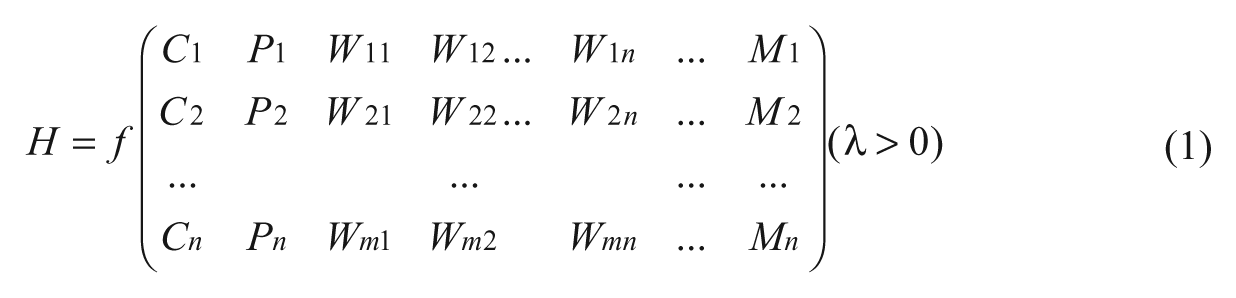
Taking the accumulated knowledge from all social sciences on human behaviors and human societies, it can be established that human behaviors and activities in the realm of HRD have at least one commonality or equivalency (Poortinga, 1997). Therefore, the characteristics of W11 as a subunit under study, must, in one way or another, resemble those corresponding to W12 . . . W mn among all H k . This leads to λ > 0 for all matrices in Hs. In other words, there exists at least one W ij that is similar or equivalent to other corresponding Ws for all H systems such that H = f (·) expressed in Equation 1 is nonzero. Even if no equivalent W ij can be identified for a chosen unit in an H system, the corresponding W ji = 0 will not affect the matrix H k ’s operation and expression. Particularly, this W ij = 0 may become an outcome of the comparison to demonstrate the system’s difference and uniqueness among all H k .
Within each individual H k system, each W ij is uniquely associated with C ij , P ij , such as historical, cultural and socioeconomic, and policy contexts. Hence, they jointly determine the H k system as represented by the functional form f in Equation 1. Therefore, they can also be uniquely identified among other comparative units chosen.
Similarly, it is not difficult to establish equivalent matrix for comparative research on conceptual process to model the complexity of systems involved. For the purpose of simplicity, such presentation is omitted.
By definition, the multiple factors and variables determining H systems, although complex, have distinctive properties and attributes, for example, culture contexts, that are sufficient enough for scholars to distinguish H
i
from H
j
. However, it is unlikely that any pair of H
i
and H
j
will be identical for each and every matrix component C
ij
, P
ij
, W
ij
, and M
i
because of the contextual vectors involved. This establishes a base for CHRD. Consequently,
Axiom 1: CHRD is to identify the regularities, similarities, and differences between two or more systems or system units within which HRD functions through systematic comparison and contrast for understanding, explaining, and generalizing HRD-related phenomena and associated systems performance. Corollary: Principle of Equivalency. CHRD defined in Axiom 1 is to focus on the equivalency of the HRD systems or system units when an exact match may not exist due to systems’ contextual differences.
The corollary on the principle of equivalency is necessary for CHRD research. It emphasizes that comparative research is to focus on the nature of HRD phenomena and activities, not on observed superficial differences. For instance, if HRD in China is termed human talent development (HTD) instead of HRD, one may simply consider that HTD is equivalent to HRD in comparative research. This way, meaningful comparative analysis can still be conducted between China and any other nation’s HRD-related phenomena.
Axiom 2 of CHRD
Consider a randomly chosen HRD system H’ that is uniquely determined by a set of cultural, historical, technological, and socioeconomic contextual variables including C t , P t , W tj , K t , R t , and I t in such a way that the attributes and characteristics of C, P, W, K, R, and I, change over time, the HRD system can be defined in Equation 2 as follows:
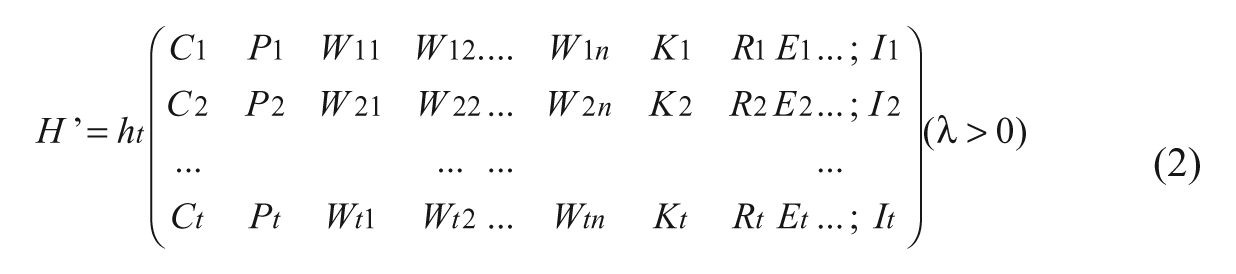
Equation 2 introduces a time dimension t(t = 1, 2, . . . k) representing different points of time for comparative analysis while other vectors and corresponding definitions in Equation 1 remain. In addition, Equation 2 embraces the following vectors: E
t
= degree of economic development; K
t
= degree of technological development; R
t
= cultural and historical context; I
t
= international or global environment. Any other factors influencing HRD may also be included in (2) as represented by “. . . .” Therefore,
Axiom 2: CHRD is to identify the regularities, similarities, and differences of a single system or system unit within which HRD functions under different contextual environment over two or more points of time, through systematic comparison and contrast for understanding, explaining, and generalizing HRD-related phenomena and associated system performance.
Axiom 3 of CHRD
According to the principle of equivalency defined in the corollary, one can always identify similar or comparable components in two or more different systems, including societies, nations, regions, and organizations. Therefore, the product of Equations 1 and 2 creates additional comparative research opportunities as defined in Equations 3 and 4.

Based on the rule of matrix operation, the product of HH’ is not necessarily equals to H’H, a derivative of Equation 3 is

Formally, we have
Axiom 3: CHRD is to identify the regularities, similarities, and differences between two or more systems or system units within which HRD functions under different contextual environment and over two or more points of time, through systematic comparison and contrast for understanding, explaining, and generalizing HRD-related phenomena and the system performance.
Apparently, Axiom 1 defines a horizontal CHRD approach that can be used for comparative analysis across any chosen units. Axiom 2 defines a vertical comparative approach that takes consideration of both historical and existing HRD system over a chosen time span. Axiom 3 is a combination of Axioms 1 and 2 and represents more complex comparative scenarios. The ultimate purpose for CHRD defined is to understand and theorize HRD systems or system units under different national or organizational contexts.
It is worth noting that the three axioms, by definition, take CHRD research at both macro and micro levels between any systems and system units. At a micro level, it allows one to conduct comparative studies in the realms of individual, group, organization, and community. At a macro level, it offers a lens for regional, national, and international comparative analysis. Different approaches may yield different findings and provide different insights in HRD research and practices. It is equally important to note that the three axioms logically include conceptual comparative analysis of HRD theories. In this case, a theory can be treated as a comparative unit or part of a theoretical system for cross comparison, or time-series comparative analysis of a single HRD theory to examine the evolution of the development of the theory.
A natural language-based description
To further illuminate the function of formal language in theory-building research, we provide a brief narrative of the comparative framework in natural language. The narrative serves for two purposes, namely, (a) to accommodate those who are less inclined to the formal language custom and, more importantly, (b) to demonstrate the differences in precision in deriving the same framework. The narrative was first introduced by Wang and Swanson (2008b).
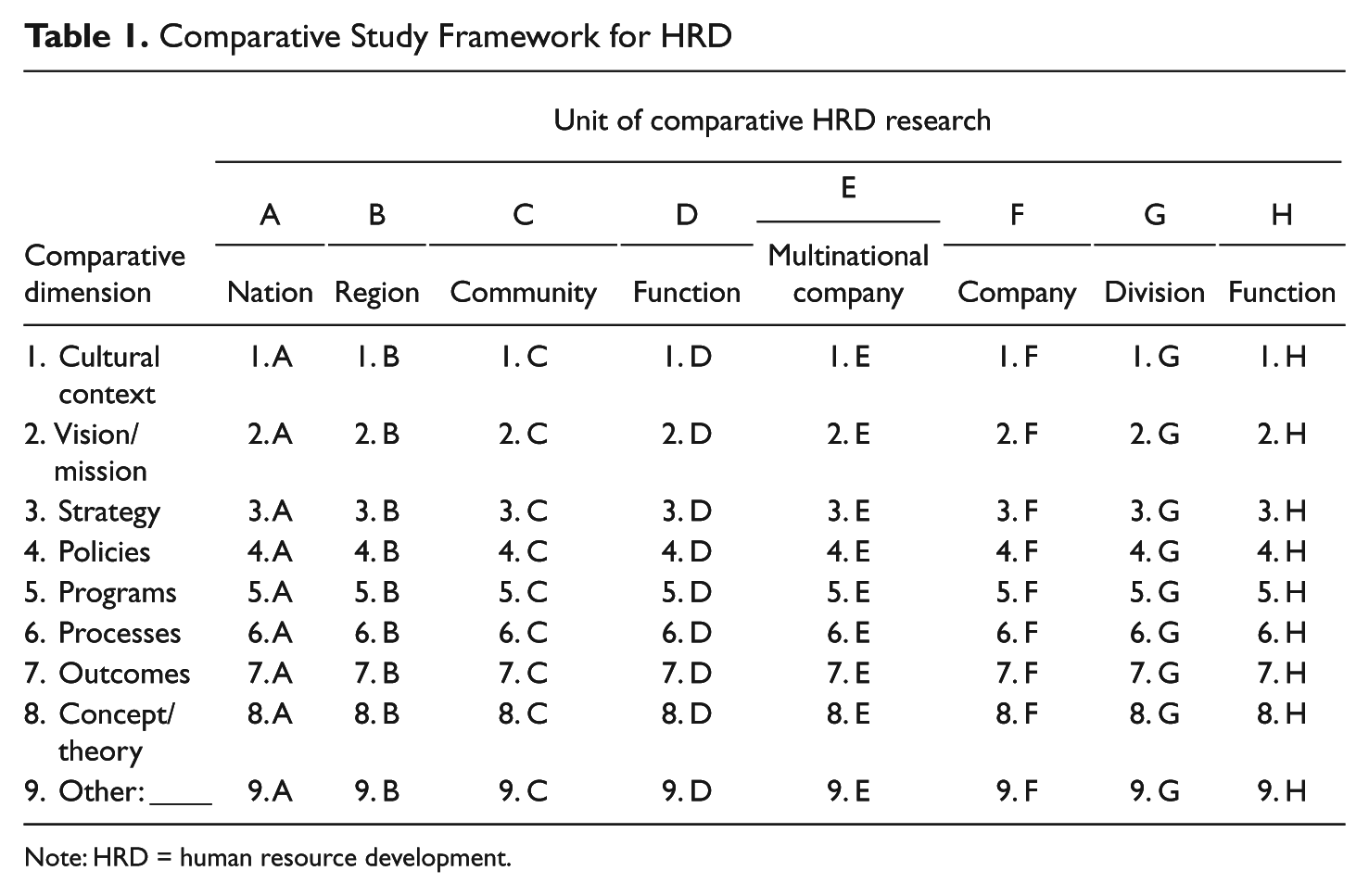
Examining any HRD-related systems under the CHRD framework starts with identifying comparative units and associated dimensions to establish boundaries for a given study as shown in Table 1. Comparisons are typically between selected, different, or parallel systems, or subsystems such as A through H in Table 1. This may include nations, regions, and communities. It may also be used to examine one corporation as compared with another. Given the need and rationale, comparing HRD process or impact in two Fortune 500 retail corporations, such as Wal-Mart and Target, could be the focus of a particular study. It is also reasonable to conduct a study comparing one system to an idealized or best practices anchor. Organizational system levels may include companies, multinational or local, company division, and functions within companies (Wang & Swanson, 2008b). Similarly, comparing HRD national policies in two or more countries under different socioeconomic and cultural contexts may also be explored regarding HRD policy formation, evolution, and outcomes. More importantly, under this framework, there is no need to define HRD differently for different countries. Comparative analysis itself will serve the purpose of identifying the uniqueness of HRD policies and practices in different national contexts.
Comparative Study Framework for HRD
Note: HRD = human resource development.
Designed studies may include all or selected comparison dimensions of HRD. Table 1 lists the following dimensions: culture context, vision/mission, strategy, policies, programs, and outcome. If the comparative units selected are theories, the dimension could be theoretical concepts, constructs, or theory development process and evolution. Additional dimensions can be added to meet the specific inquiry questions. Thus, a rigorous study gaining primary data in the nine dimensions of HRD for Target Corporation and Wal-Mart may be comparatively analyzed. Similarly, a rigorous study of selected comparison dimensions of HRD at a national level in China and the United States may also be conducted. While the proposed framework is flexible in framing a specific comparative study, scholars are compelled to incorporate and report on appropriate research methodology and its rigorous application in their study efforts.
In short, using all or partially selected comparison dimensions of HRD (1-9), comparisons are typically between selected, rival, or parallel systems or units (A-H). Such comparative analysis can often result in fruitful findings and theoretical abstraction.
Comparing the two languages, the framework in formal language provides needed rigor and theoretical abstraction with necessary precision that precludes alternative interpretations. It also offers flexibility for scholars when selecting comparative unit for consistent comparative research. In contrast, the natural language narrative may be stretched differently based on different understanding. In particular, the three axioms cannot be explicitly derived and expressed through Table 1 without a lengthy discussion. Even if one attempts, it is unlikely to be as concise and explicit as expressed in its formal language counterpart. Thus, their theoretical rigor derived from formal language is likely to be compromised.
It is important to note that in this brief narrative using natural language, we have to rely on a table, a more popular formal language, to facilitate my presentation so as to reduce the length of discussion. This further signifies the importance of formal language in HRD theory-building research.
Applicability: A definition of CHRD
To illustrate the applicability of the formal language-based comparative framework, we organized related HRD literature according to the three axioms in three research realms, macro, micro, and theory building, respectively, in Table 2. Evidently, CHRD research has been conducted in all realms from horizontal to vertical and to the combined perspectives. At the macro level, horizontal comparative studies, represented by Axiom 1, cross-nation, cross-cultural, cross-region, or cross-industrial sector comparative research is represented by Ashton et al. (2000), Ashton (2002), and Hawley and Paek (2005). Vertical CHRD within a chosen unit across a specified time period on HRD-related policies is represented by Kuo (2002). The combination of the two is covered by Wang et al. (2010). On the micro level, horizontal comparative studies are found in Benson and Zhu (2002) and Johnson et al. (2000), whereas vertical comparative analysis is observed in Wang and Wang (2006). The combination of the two is represented by Ardichvili and Kuchinke (2002b) and Osman-Gani (2000). At the level of conceptual comparative analysis for theory-building research, Ardichvili and Kuchinke (2002a) present an earlier example for horizontal comparative research whereas Hamlin et al. (2008) is a recent example with a vertical lens. However, the analyses on CUs and the boundaries of HRD may be considered following Axiom 3 (Wang et al., 2010; Wang & Sun, 2009).
CHRD Research

Note: HRD = human resource development; CHRD = comparative HRD.
While HRD research can be identified for each cell as listed in Table 2, the literature in these areas is generally insufficient and sometimes inadequate. Therefore, it is necessary to explicitly define CHRD for theory-building purpose.
Combining Axioms 1 through 3 and integrating the definition by Wang (2009), CHRD can be formally defined as the following:
Comparative HRD refers to studies that identify regularities, similarities, and differences in the workings and outcomes of HRD, including the influence of context and environment, across or within chosen systems or units for understanding, explaining, and generalizing HRD-related phenomena and system performance.
CHRD as defined, along with the three axioms, has the following important properties. First, the focal point of CHRD is on the workings, namely, formation, process, and operations, and outcomes of HRD, as well as the conceptual development of HRD theory. This is not only consistent with the HRD literature reviewed and summarized in Table 2 but also in agreement with existing boundary, definition, and outcomes of HRD (Swanson & Holton, 2009; Wang & Sun, 2009; Weinberger, 1998). Second, the definition not only covers core HRD processes, activities, and related phenomena but also includes the impact of contextual internal and external environments, such as international, national, or regional HRD-policy environments and socioeconomic, cultural, religious, or historical contexts that affect the workings and outcomes of HRD. Third, the task of CHRD research is to identify regularities, similarities, and differences among a chosen set of systems or units. Such systems or units may be of nations, regions, communities, organizations, or individuals in scope, or of theoretical perspectives of HRD, depending on the chosen comparative unit in which HRD operates or is to be conceptualized. Most importantly, the results of such comparative studies are to enhance the understanding of, and generate new knowledge about, the workings/operations and outcomes of HRD.
Discussion
This conceptual inquiry applies a formal language-based approach for CHRD research. It demonstrates at least two advantages of formal language-based research for HRD theory building.
First, formal language-based approach can provide the necessary precision and conciseness for theoretical domain, relationship between variables and constructs. This can effectively minimize potential confusion and boundary-stretching interpretations and applications. Second, with properly defined boundaries and units, theory development in formal language can identify additional relationships and research opportunity through the operation rules and the logic defined by the formal language used. Such relationships can then be easily translated back into natural language for additional research opportunities. This type of relationship derivation is often not obvious or may not be easily identified when using natural language. Axiom 3 provided an example of this advantage.
Furthermore, CHRD as defined has apparent advantages for HRD research and theory building. It offers opportunities to explore conventional and innovative comparative approaches, strategies, and methodologies for better understanding of HRD-related phenomena and activities. It can clarify existing theoretical confusions in the recent HRD literature. For example, HRD as a process and function is operating under certain given contexts and environments, such as culture, policy, and socioeconomic conditions. Therefore, differences in cultural or historical contexts provide ideal scenarios for CHRD. Attempting to define HRD differently in different countries of the same analytical units may jeopardize the credibility of HRD as a field of study and as a profession. To the same degree, CHRD can also shed light on HRD policy studies. As a discipline, HRD research is neither to study overall national or regional performance nor to create and formulate HRD policies, but to focus on how national, regional, or organizational policies promote or impede HRD’s functional roles and foci within the defined units and how HRD makes corresponding contributions within the units. In this realm, the task of HRD research is to conduct CHRD policy studies and propose policy recommendations for improving policy formation, implementation, and outcomes.
The comparative framework presented is not limited to traditional positivistic research paradigm although some existing CHRD studies may appear to be quantitative in nature. Its principles can be equally applied to alternative research paradigms such as epistemological, constructivist, appreciative inquiry, or case-based comparisons for theory-building purpose. This area of comparative analysis may be conducted from two aspects. The first is to comparatively analyze the findings of HRD topical areas. At a minimum, the comparative analysis in this area is able to derive research pattern, trend, and implications in the chosen topical areas. Weinerberg (1998) qualitative analysis of 17 different HRD definitions provided an early example in this aspect. The second aspect is comparatively analyzing theory development outcome against a particular method, logic, and criteria of research. Studies in this area can often identify research gap in theory building. Wang and Swanson (2008a, 2008b) offered a recent example toward this direction. In addition, solid comparative analysis will depend on the quality of researchers (Teagarden et al., 1995), including, but not limited to, logic consistency, breadth of knowledge in related fields, and comparative unit chosen.
A challenge, yet not necessarily a limitation, of formal language-based theorizing for HRD scholars may lie in the fact that many are not familiar with formal language and associated theorizing process. This reality may have impeded the advancement of HRD theory-building research. Embracing formal languages in theorizing has been considered an indicator of the maturity level of a discipline in social science disciplines (Teas & Palan, 1997; Wacker, 1998, 2004). In contrary, applying formal languages to organization and management research has been a norm in management science as represented by a recent exemplar of a similar formal language-based inquiry in the management literature. Reviewing existing empirical management studies on organizational configurations, Fiss (2007) applies a formal language in the form of set theory to address the problem of mismatch between theory and methods found in existing research. The set-theoretic approach has proved to be not only valuable for studying organizational configurations but also insightful in other research areas such as complementarities theory, complexity theory, and the resource-based view (Fiss, 2007). This formal language-based contribution has been well accepted by scholars not only in the management research but also in nursing science (Stordeur, D’Hoore, & the NEXT-Study Group, 2007), sociology (Wagemann & Schneider, 2010), and political science (Polly, 2011), as evidenced by 125 citations in less than 4 years. This example demonstrated that formal language-based theorizing is likely to stimulate further research inquiries and advance research in multiple fronts.
In addition, it will be a misunderstanding to assume that the framework expressed in a formal language approach is inclined to positivistic research paradigm. It can be equally applicable to all research paradigms, as has been observed in HRD theory-building research (e.g., Ardichvili & Kuchinke, 2002a). It is also worth noting that the focus of this inquiry is on HRD theory-building strategy instead of debating on pros and cons of research paradigms. Accordingly, discussion of controversial paradigmic divergence here is considered unnecessary deviation from the focus of this inquiry and is a subject of separate research. Nonetheless, recent research on different paradigms and associated research methods has showed a consensus that positivism and constructivism paradigms are complimentary, rather than rival (Cupchik, 2001; Fearon & Wendt, 2005).
Implications for HRD Research
Generally speaking, it does not make sense to compare two or more completely identical objects, such as between two identical apples, if they do exist. Neither does it make sense to compare mutually exclusive ones, such as between an apple and a lizard. Particularly, no two economic entities or social institutions, for example, individuals, nations, cultures, policies, and organizations, are identical; and any two economic entities or social institutions have something in common. It is the diversity and heterogeneity that make comparative studies of disciplined inquiries meaningful, intriguing, and contributive to the overall knowledge base, regardless of research paradigms. It has been a basic requirement for all social science disciplines to maximize the diversity and heterogeneity for the subjects under study.
This article contributes to HRD research and theory building by offering the following implications. First, it explicitly points to a new research frontier, CHRD, within accepted HRD domain. At national level, CHRD may be conducted by historical comparative analysis of a nation’s evolving HRD policies and practices and explore how national HRD policy influences organizational performance. At the international level, it may involve cross-country comparisons of HRD policies and practices or other equivalent HRD components. Meanwhile, CHRD research may be conducted at the organizational level, via historical or cross-organizational comparison, to understand regularities or differences in specific industries or cultural settings. Likewise, research at the individual level may compare intraorganizational/interorganizational individual performance and derive industry or organizational specific HRD-related commonalities or differences, such as competency models, to enhance employee performance. On the HRD practice front, the flexible comparative framework also offers insight for practitioners when conducting benchmark activities. It can be equally useful for organizational or industrial benchmarking by HRD practitioners. The benchmarking may either be single or multidimensional as discussed in Wang and Swanson (2008b).
Second, this study advances HRD theory-building research by explicitly advocating a formal language approach. This effort is to ensure precision in theory specification and derivation, thus avoiding potential meaning-stretching and boundary-stretching interpretations. Formal language applications in theory building are likely to raise the bar for HRD theory-building research and present new opportunities for HRD scholars interested in theory development. Formal language-based theorizing is likely to strengthen the credibility of HRD theory-building research and expedites the pace for the discipline to reach the parity with other mature social science disciplines.
Third, the explicitly defined boundaries of CHRD and associated framework may effectively address the inconsistencies found in HRD theory-development literature. For instance, a recent argument stated that “each country will have its own definition of . . . human resource development, and that is appropriate and necessary” (McLean, 2004, pp. 270-271). Another argument posited that “creating a typology (or synthesized summary) of the [ten] worldviews . . . is clearly not possible or useful, given this vast range of perspectives” (McLean, 2006, p. 416). The reason is that “because individual backgrounds are so diverse, we must . . . focus on understanding how this diversity affects our development of theories . . . and abandon efforts to identify a unitary theory or explanation . . .” (McLean, 2006, p. 421). A key reason for such inconsistency and other associated problems may be caused by the lack of explicitly articulated comparative approaches and comparative logic presented in this article.
A solution to the theoretical inconsistencies can be derived through the comparative structure represented by the three axioms. For example, if rigorous and relevant comparative analyses among different countries support the argument that each country should have its own definition of HRD, the effort for a grand definition of HRD should be abandoned. However, Ashton et al. (2000) and Ashton (2002), among others, have concluded that HRD policies and activities in different nations demonstrated similarities and equivalencies with notable differences caused by contextual factors. This provides sufficient evidence for scholars to theorizing HRD with appropriate scope and boundary and at a manageable level. The differences in HRD phenomena in different countries can then be explored through comparative research.
Last, but not the least, the formal language-based theorizing approach and the resulting CHRD framework may present challenges for HRD theorizing research in both the awareness and familiarity of theoretical abstraction and the required research strategy. Similar challenges have been observed by scholars in other disciplines for comparative research. For example, Teagarden and her research team (1995) have documented the complexity of comparative methodologies and processes for a research project by a multinational, multicultural, and multidisciplinary research consortium on comparative HRM. An important conclusion reached by the team is that comparative research “is more dependent on prominent researchers than is traditional research” (p. 1275). This implies that researchers’ quality and competency in handling the complexities involved in comparative analysis is critical to the success of comparative research (Teagarden et al., 1995). CHRD research is an important piece in the HRD research puzzle. It is HRD scholars’ responsibility to embrace the challenge and move the field forward to the next level through rigorous and relevant comparative research on HRD phenomena.
Conclusion
This theoretical inquiry aimed to advance HRD theory-building research in the area of CHRD through a formal language approach. Based on a review of existing HRD comparative literature in empirical and theory-building realms, we derived three axioms for CHRD research within a formal language structure. The axioms were supported by existing, although limited, HRD comparative literature. Combining the three axioms, we formally provide a definition of CHRD. It is the diversity and heterogeneity that make HRD comparative inquiries significant to contribute to the overall HRD knowledge base. Adopting a formal language system for HRD theory building, this article pointed to a new frontier for advancing HRD research. The proposed theoretical framework of CHRD may effectively reduce the logic inconsistency and theoretical confusion of existing research and improve the credibility for HRD theory building.
Footnotes
Declaration of Conflicting Interests
The author(s) declared no potential conflicts of interest with respect to the research, authorship, and/or publication of this article.
Funding
The author(s) received no financial support for the research, authorship, and/or publication of this article.