




Abstract
Adults with limited education and skills—those who lack the education and skills needed for full participation in U.S. culture and economy—are increasing in numbers. However, the knowledge base addressing this population and their educational needs is fragmented across the literature of several disciplines. A comprehensive review and critique of the literature on adults with limited education and skills have not been done. This study fills this void by reviewing literature from five streams of research that address this population and synthesizing it into a framework that offers an integrated perspective on the topic. Implications for human resource development and an agenda for further research are discussed.
Keywords
This article examines the existing literature on adults with limited education and skills. These are people older than 25 years with literacy levels (i.e., reading, writing, math) lower than eighth grade and who have limited job skills, and they are a large and diverse segment of the U.S. population (Osborne, Marks, & Turner, 2004). An estimated 41.8% of all working-age adults lack the academic preparation and job skills needed to succeed in college and the workplace. This population is more than two and one-half times larger than the number of the nation’s traditional (18- to 24-year-old) college-age youth population (Comings, Reder, & Sum, 2001). This population, lacking both academic preparation and valued job skills, is composed of Whites, Hispanics, African Americans, and Native Americans, other minorities, and many who are immigrants, single parents, high school dropouts, individuals with disabilities, prisoners, and dislocated workers from all ethnic groups in the United States. Immigrants made up almost half of limited-skilled workers and more than one-fifth of low-wage workers in the United States in 2005 (Capps, Fortuny, & Fix, 2007). Many immigrants arrive in this country with substantial skills and impressive credentials but end up in low-skilled, low-wage jobs due to language barriers or because their skills and credentials are not recognized in the United States.
Adults with limited education and skills, using eighth-grade literacy as a gauge, are those who, sadly, receive scores on standardized college placement tests that are too low to be admitted to postsecondary education or most job training programs. This population is referred to in the United States by several terms including academically underprepared adults (Torraco & Dirkx, 2008), low-skilled adults (Jobs for the Future, 2004; Women Employed Institute, 2005), and adults with limited education and skills. We use the term limited education and skills to refer to those who lack both adequate academic preparation and specific job skills. We acknowledge the problem of using skill levels to characterize this population. Rose (2004) and Kusterer (1978) both cited the inappropriate application of terms like low-skilled and unskilled to knowledgeable American workers and lamented the denigration of their work that the use of these terms implies. As Kusterer stated,
The problem with these labels is that the use of the “unskilled” label has led to a gross underestimation of the amount of working knowledge actually necessary in these jobs. There is no such thing as unskilled work. The term demeans the workers involved, and it misleads all who seek to understand the nature of their work. (p. 179)
The positive relationship between having limited skills and low-income status is, of course, the unfortunate end of the education–earnings continuum that also shows a positive correlation between high levels of education and high earnings (College Board, 2006). The relationship between socioeconomic status, education level, and limited job skills is complex but, in general, they appear to be interrelated. Without making claims about causal attribution, low-income levels, limited job skills, and low educational achievement seem to go together.
The Appleseed Foundation cited approximately 20 million adults as members of “working poor” families who earn less than $25,000 per year; they often work in multiple jobs yet remain beneath the income level needed to get ahead, 200% of the federal poverty level (Appleseed Foundation, 2009). The continued expansion of such a large and growing segment of the U.S. population relegated to working poverty has enormous social and economic implications for our society as a whole. The seeds are being sown for a future tainted by a growing economic divide between adults with and without the education and skills needed for full participation in U.S. society (Stiglitz, 2012). This is a human resource development (HRD) problem.
Purpose
Despite the value placed on education in the United States and the growing shortfall of skilled workers in this country, large numbers of adults lack the literacy and numeracy skills needed to fully participate in an increasingly competitive economy. However, the scant knowledge base addressing this population and their educational needs is fragmented across the literature of the disciplines of adult education, career and technical education, labor economics, social work and social psychology, and public human service administration. For example, the perspectives of labor economists, who address the dynamics of labor and industry needs, appear in economic literature, whereas the perspectives of social psychologists, who address individual adaptation to social milieu, appear in the psychology literature. Despite the contributions of these disciplines to the knowledge base for adults with limited education and skills, a comprehensive review and critique of the literature on this population have not been done. This study fills this void by reviewing literature from five streams of research that address adults with limited education and skills and synthesizing it into a framework that offers an integrated perspective on the topic. The study will address the following research questions:
Research Question 1: What are the characteristics of the limited education and skills adult population and what distinctive barriers to educational and career advancement do they face?
Research Question 2: What is known about factors that enable adults with limited education and skills to succeed in college and in their careers?
Theoretical Framework
Among the factors identified that can potentially shape why and how academically underprepared adults learn are cognitive and learning styles, personality type, gender, race, socioeconomic status, culture, prior educational experiences, and intellectual ability (Merriam, Caffarella, & Baumgartner, 2007). Often, factors within each of these categories of difference overlap and interact with one another. For example, individuals who are academically underprepared are often poor, they have been academically marginalized, and they are overrepresented by persons of color. Adults with limited education and skills (less than eighth-grade literacy levels) make up a large and diverse segment of the U.S. population, which includes Whites, Hispanics, African Americans, and Native Americans, other minorities, and many who are immigrants, single parents, high school dropouts, individuals with disabilities, prisoners, and dislocated workers.
Consequently, educational programs intended to help a diverse adult population develop adequate basic skills and job skills should be developed in ways that take into account individual differences in how adults learn (Merriam et al., 2007) or learning styles (Kolb, 1984). This theory is based on the premise that adults bring diverse backgrounds and experiences to the learning environment and that adults use discretion in choosing what and how they learn (Brookfield, 1986). Above all, they seek meaning and relevance (Knowles, 1990). Adults’ experiences are a rich resource for learning. Since adults rely on prior knowledge and experience, they question things before they are willing to accept them as part of their own understandings. They apply new ideas to their own situations, and if new knowledge doesn’t fit with what they already know, adults are unlikely to accept it (Zemke & Zemke, 1995). Adults are discretionary learners who continuously evaluate new ideas against their own unique experiences and knowledge (Mezirow, 2000). Since individual differences are strong determinants of why and how academically underprepared adults learn, educational programs for adults with limited education and skills should be grounded in adult learning theory.
Method
Research to date has not addressed the literature on adults with limited education and skills and their distinctive educational needs in a holistic way. Parts of the literature have been reviewed one at a time in existing studies of the characteristics of the limited-skilled adult population (Torraco & Dirkx, 2008), barriers to educational and career advancement (Lumina Foundation for Education, 2007), barriers to employment (Martinson & Holcomb, 2007), and instructional innovations to help adults with limited education and skills (Kazis & Liebowitz, 2003). However, the literature has not been addressed in an integrative way.
This problem is addressed by providing an integrative review of these related streams of literature. The integrative literature review is a form of research that reviews, critiques, and synthesizes representative literature on a topic in an integrated way such that new frameworks and perspectives on the topic are generated (Torraco, 2005). This methodology is particularly appropriate when existing research is scattered across disparate areas and has not been systematically analyzed and integrated. Such is the case with the literature on adults with limited education and skills. An integrative literature review is an appropriate method for addressing this problem because the topic would benefit from a holistic conceptualization and synthesis of the literature to date. The literature on this population will be reviewed and synthesized into a framework that offers an integrated perspective on the topic. This is consistent with the purpose of the article to examine the literature as a way of providing educators with new ways of thinking about this topic.
To review programs that help adults with limited education and skills, a literature search was conducted in several stages. First, four databases were searched (ERIC, PsycINFO, Academic Search Premier, and Google Scholar) to identify major categories of literature that address adults with limited education and skills. This involved the use of key subject terms to identify relevant literature on this population. The following key subject terms were used to identify potential literature sources: (a) limited-skilled adult, (b) academically underprepared adult, (c) low-income adult, (d) adult learner, (e) disadvantaged adult, (f) immigrant, (g) refugee, (h) displaced worker, (i) low-wage worker, (j) English language learner, and (k) unemployed adult. Each of the key subject terms then was paired to yield a total of 55 paired terms. Each individual term and each pair of terms (e.g., low-income adult and immigrant) then were used to search the literature.
The second stage of the review explored the literature that emerged from the first stage for literature on adults with limited education and skills. Three selection criteria were used to retain or discard literature for the review. First, the literature source had to address one or more subgroups of the population of adults with limited education and skills (i.e., Whites, Hispanics, African Americans, Native Americans, other minorities, immigrants, single parents, high school dropouts, individuals with disabilities, prisoners, and dislocated workers).
The second criterion for selecting literature was that the literature source had to address one of the transition points in the education system that pose barriers to the progress of adults with limited education and skills. The educational pipeline is the series of transitions from entering high school, to high school graduation, enrollment in college, returning for the 2nd year of college, completion of a postsecondary degree, and entering the workforce. Many, including an increasing number of limited-skilled adults, are lost from the educational system at each of these transitions (Ewell, Jones, & Kelly, 2003). Literature selected for the review had to address one of these transition points in the education system that pose barriers to the progress of adults with limited education and skills.
Finally, the literature had to focus on those who have at least one of the following factors that are considered defining characteristics of the limited-skilled adult population (Jobs for the Future, 2004; Torraco & Dirkx, 2008): (a) low-income, (b) newcomer to the United States (i.e., immigrant status), (c) high school dropout with no diploma or GED, (d) have dependent children, (e) Temporary Assistance for Needy Families (TANF) recipient, (f) part-time student, (g) work at least part-time, and/or (h) non-English speaking.
A majority of the literature searched was from refereed scholarly journals. Since this topic has been examined by independent research centers, private foundations, non-profit organizations, and federal agencies, the review also included research reports, technical reports, and other formal publications from these sources that provide analysis of the problem supported by empirical evidence or citations of other research. A list of 67 websites reviewed for literature relevant to this study is available from the authors upon request. Literature was examined using a staged review (i.e., abstracts, then main body of each literature source). Critical analysis of the literature deconstructed pieces of literature into their basic elements. The strengths and weaknesses of each literature source were examined. In total, 48 literature sources on adults with limited education and skills were reviewed.
Categories of the Literature Reviewed
In the final stage of the review, the literature was sorted into major categories by determining the main contribution of the literature source to what is known about adults with limited education and skills. Five categories were created to encompass the literature reviewed. The five categories and the rationale for sorting the literature into each category are discussed next.
Adults with limited education and skills—population characteristics and subgroups
The literature in this category describes the characteristics that are typically present across many of the subgroups of this population such as inadequate basic skills and low-level job skills, as well as characteristics that are specific to subgroups. Characteristics that are specific to subgroups include limited ability to speak English (e.g., Hispanics and other immigrants), low-income status (e.g., single parents and working poor families), limited job training and work experience (e.g., TANF recipients), employer aversion to hiring (e.g., ex-offenders), limited education and work experience (e.g., high school dropouts), and inadequate training for a new occupation or industry (e.g., dislocated workers).
Barriers to educational success
Literature in this category describes deficiencies in one or more basic skills (i.e., reading, writing, math), limited ability to speak English, and lack of a high school diploma or GED. Other literature sources addressed the barriers to educational access that make it difficult for adults to attend classes and that distract their attention from studying such as working at least part-time, child care and family responsibilities, low-income status, unstable housing, and poor physical and/or mental/emotional health. Another significant barrier is prevailing academic policy for community colleges that requires students to complete remedial courses as a prerequisite to beginning their college-level courses (Kazis & Liebowitz, 2003). Since the literature that addresses learning barriers and the literature that addresses barriers to educational access both examine conditions that pose barriers to the educational advancement of adults with limited education and skills, these literature streams were combined into the category “barriers to educational success.”
Barriers to employment
Some of the literature reviewed addresses the relationship between education level and employability and describes barriers to employment such as lack of educational credentials. This literature also addresses non-education employment liabilities (e.g., poor health, welfare disincentives); limited work experience; barriers associated with finding jobs such as job searching, job applications, and interviews; and, for those who have been incarcerated, employer aversion to hiring ex-offenders. The unavailability of jobs that pay family-supporting wages is another formidable employment barrier addressed in this literature (Martinson & Holcomb, 2007). Since all of these issues converge on the category of employability, the term used for the literature in this category is “barriers to employment.”
Instructional innovations to help adults with limited education and skills
Literature in this category describes instructional innovations developed for adults with limited education and skills. It discusses new developments in instruction for this population including the effects of accelerated learning on student achievement (Brancard, Baker, & Jensen, 2006); the integration of basic academic skills with job skills so that adult students learn reading, writing, and/or math in the context of acquiring skills in a specific job or occupation (Jobs for the Future, 2004); instruction focused on programs with high demand in the labor market (Roder, Clymer, & Wyckoff, 2008); the relationship of student support and academic success; and developing comprehensive programs by combining two or more of these innovative strategies. Innovative transitions from non-credit courses to college courses and modularized courses are also addressed by the literature in this category. All of these topics address “instructional innovations to help adults with limited education and skills,” so this expression was used as another category for the literature reviewed.
Research reports—multiple topics
Because there are research reports that address more than one of these categories, the category “research reports—multiple topics” was created for this literature. This literature cuts across the four categories above by addressing at least two of the four topics in one research report (i.e., limited-skilled adult characteristics, education barriers, employment barriers, and instructional innovations). Each of the research reports in this category brings together at least two of the four topics in the other categories for a more comprehensive examination of the opportunities and challenges facing this population. For example, some research reports address three of the topics by examining education barriers, employment barriers, and instructional innovations that address both of these areas (Holzer, 2009; Jenkins, Zeidenberg, & Kienzl, 2009; Perin & Hare, 2010).
Evidence From the Literature
This section presents a framework that offers an integrated perspective on the topic. The framework is the result of critical analysis of the literature in the five categories described above. Critical analysis of the literature involved deconstructing each piece of literature into its basic elements (shown in Table 1). For example, the Bridges to Careers report (Women Employed Institute, 2005) was critically analyzed and deconstructed into its main components. The Bridges to Careers report provides a comprehensive guide for developing career pathway and bridge programs for adults with limited education and skills, including guidance for designing the program, building a bridge partnership, building and sustaining employer relationships, developing a program curriculum, bridge program costs and funding, and program implementation and evaluation. The Bridges to Careers report is based on a systematic survey of 11 exemplary career pathway and bridge programs nationwide (Type of Study or Research Design) and identifies the major program components needed by workforce practitioners for comprehensive program development (Main Findings and Outcomes). Its strengths (each section of the report is based on recent research and includes templates and examples for use in program development) and weaknesses (it separates coverage of career pathways from bridge programs even though most programs combine elements of both) were examined. Each literature source was reviewed and critically analyzed in this way. The results of this analysis are shown in Table 1.
Comparison and Critical Analysis of Literature on Adults With Limited Education and Skills.

Comprehensive review and critical analysis provided a new, integrated perspective on the topic through synthesis. Two forms of synthesis were used: a comparison and critical analysis of the literature (Table 1) and a model of the barriers and instructional innovations for limited-skilled adults (Figure 1). This generated new perspectives on the topic and a significant, value-added contribution to new knowledge. The basic elements of the literature sources are shown in Table 1, which is organized by the five categories. The table compares and critiques the literature on the seven dimensions used to critically analyze the literature. These dimensions, shown as column headings in Table 1, identify the literature source, the topic addressed, the type of study or research design, the main findings or outcomes of the research, strengths and advantages, weaknesses and limitations, and the implications for workplace learning and education (see Table 1).
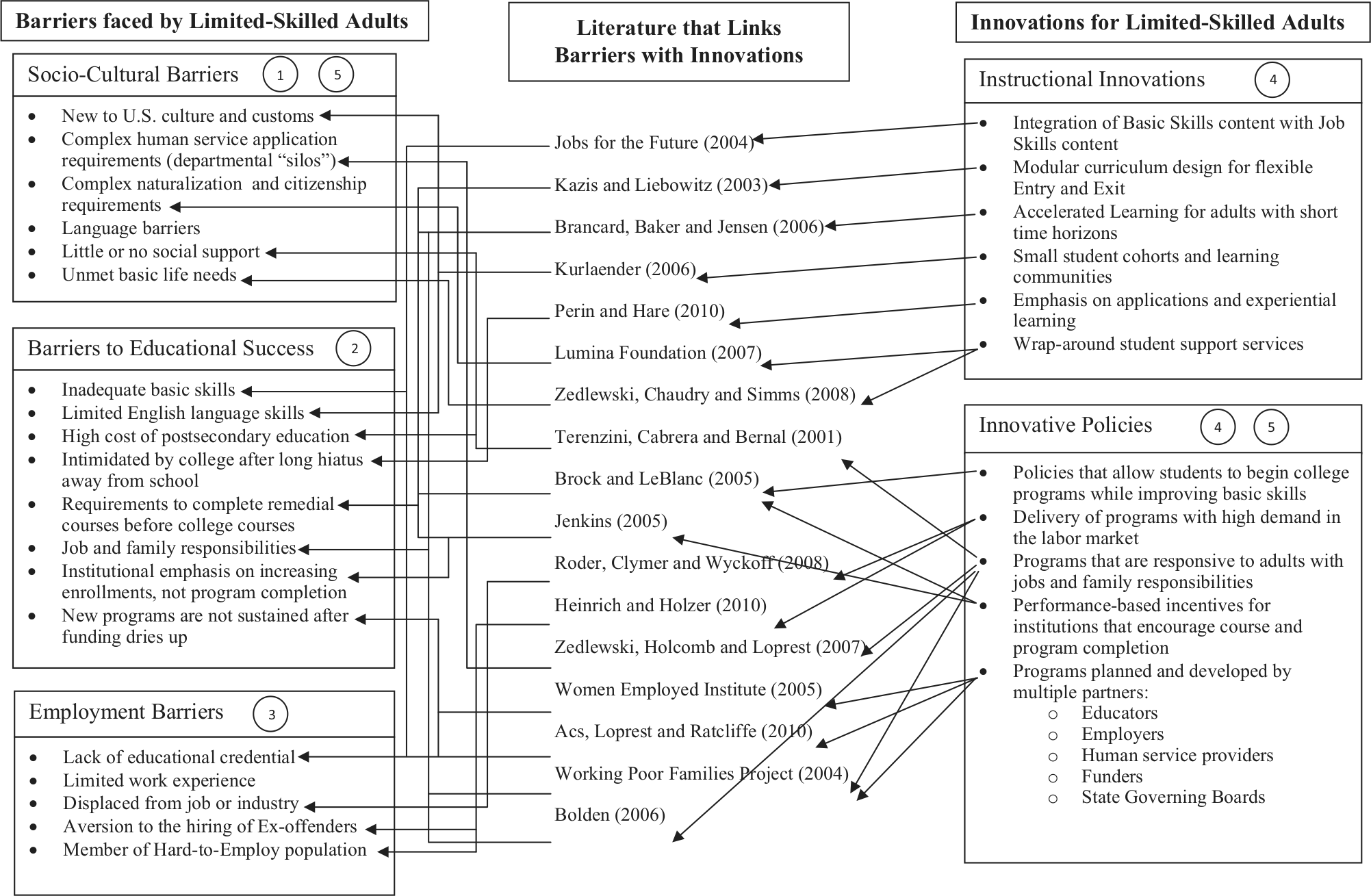
Model of Barriers and Innovations for Adults With Limited Education and Skills.
The integrated framework in Table 1 was then used as the basis for developing a new perspective on the topic. Since the critical analysis of this body of literature identified new relationships and perspectives on the topic, it raised new questions that can be expressed as an agenda for further research and a new conceptual model. The next section addresses the significance of the findings in Table 1, a synthesis of these findings, and implications for further research on the topic.
Implications of the Model for Future HRD Research and Practice
Literature has been reviewed from five streams of research on adults with limited education and skills and summarized in Table 1. This study presents a significant, value-added contribution to HRD by bringing together fragmented knowledge from various disciplines of adult education, finding patterns and commonality across these disciplines, and presenting this as a framework for further research. This section discusses the significance of the findings shown in Table 1 and their implications for future HRD research and practice. Three significant issues that emerge from this review are (a) adults with limited education and skills face multiple barriers to advancement, (b) new strategies are needed to help adults with limited education and skills, and (c) there is a need for further research and development. These issues are discussed next.
Adults with limited education and skills face multiple barriers to advancement
It is significant that the barriers identified in the literature cut across such a large and diverse population. The barriers to education and employment affect all adults with limited education and skills in some way. This means that all of the groups that constitute the limited-skilled adult population are likely to face multiple barriers to educational and career advancement.
However, whereas most adults with limited education and skills face multiple barriers including a language or learning barrier such as inadequate basic skills (Jobs for the Future, 2004) and limited ability to speak English (Kurlaender, 2006), other challenges faced by subgroups (e.g., high school dropouts, ex-offenders, low-income working adults) are distinctive and related to their unique circumstances. Consequently, there is convincing evidence from the literature that developing a better understanding of the distinctive needs of the subgroups that compose this population is needed before attempting to offer education and training programs intended to surmount the multiple barriers facing such a diverse group of adults (Comings et al., 2001; Torraco & Dirkx, 2008).
The challenges confronting adults with limited education and skills are shown graphically in Figure 1. The barriers faced by this population are shown on the left side of Figure 1 grouped into Socio-Cultural Barriers, Barriers to Educational Success, and Barriers to Employment. Instructional innovations and innovative policies described in the literature are listed on the right side of the model. Listed in the middle of the figure is literature that links innovations with the barriers they are intended to address. The circled numbers in the heading of each box indicate the group of literature from Table 1 that supports the barriers or innovations shown in the model (see Figure 1).
Figure 1 presents a graphic representation of the many barriers and challenges faced by adults with limited education and skills. It also shows the relationship of innovations recently reported in the literature to the barriers they address. Figure 1 enables us to better understand why new programs that incorporate the innovations listed on the right side of the model are becoming so comprehensive and sophisticated; it is because they must address the formidable challenges represented by the multiple barriers listed on the left side of Figure 1.
New HRD strategies are needed to help adults with limited education and skills
Previous approaches to meeting the educational needs of adults with limited education and skills have a poor track record and do not take account of their diversity (Comings et al., 2001). For example, currently, adults are forced to choose between basic literacy programs and job skills programs, even though a large majority of adults from across these diverse groups need both basic academic skills and job skills (Brock & LeBlanc, 2005). Emphasis is needed on developing basic academic skills in the context of occupational preparation so these adults can acquire the skills they need to more fully participate in U.S. culture and employment.
Human resource development is well positioned to investigate more effective ways to meet the needs of adults with limited education and skills. The HRD discipline is unique in embracing a holistic perspective of how education and work experiences can be integrated to capitalize on the reciprocal reinforcement of learning and work—content from the classroom is practiced and refined on-the-job, and experiences from the workplace enrich the meaning and relevance of additional learning in the classroom. To a greater degree than other education-based disciplines, HRD research and practice draw heavily on theoretical foundations that include human capital theory, experiential learning, situated learning theory, contextualized learning, academic–occupational integration, and social learning theory. Drawing on these theoretical foundations, research is needed to develop instructional strategies that are more responsive to the distinctive learning needs of adult students and that take advantage of their wealth of real-life experiences.
An agenda for further HRD research and development
Those working with this population regularly confront difficult problems and unanswered questions in the process of helping disadvantaged adults move toward self-sufficiency. So it should not be surprising that education and workforce development professionals readily embrace new ideas from research that offer directions for addressing these challenges. Although recent research has done much to advance our understanding of the distinctive educational needs of adults with limited education and skills, more research is needed on this topic. For example, there is little research that examines our beliefs and assumptions about who is responsible for addressing the problems of limited-skilled adults. Those with obligations in this area include public education, employers, policy makers, and the adults with limited education and skills themselves. Whose responsibility is it to address the problem of low-wage work and the increasing proportion of adults with limited education and skills and working poor families in the United States? Is the responsibility shared? If so, shared among whom? What are common misconceptions and false assumptions about low-wage work and working poor families in the United States? To what degree are limited-skilled and low-wage earners themselves responsible for their situation?
Another important area for further research is to investigate the factors into why innovative methods of instruction and student support are not being adopted on a larger scale. Research has demonstrated the beneficial effects of accelerated learning on course completion, student retention, and GPAs (Brancard et al., 2006). Contextualized learning has been shown to improve students’ abilities in reading comprehension, writing, and learning vocabulary (Perin & Hare, 2010). Programs that integrate basic skills with occupational skills have demonstrated higher levels of student engagement, persistence, and learning gains (Jenkins et al., 2009). Then, why is it that promising innovations such as accelerated learning, contextualized learning, and academic–occupational integration are not adopted on a larger scale?
Summary
Despite the value placed on education in the United States and the growing shortfall of skilled workers in this country, large numbers of adults lack the literacy and numeracy skills needed to fully participate in an increasingly competitive economy. Serving this population is as much an issue of building political will as developing new pedagogic innovations. A review of the literature on adults with limited education and skills reveals the diverse subgroups that constitute this population, their distinctive educational needs compared with traditional college-age students, and the many barriers they face to learning, educational access, and employment. Although recent research offers directions for addressing some of these challenges, more research is needed. Human resource development researchers and practitioners possess the expertise to make substantive contributions to resolving this important problem.
Footnotes
Declaration of Conflicting Interests
The author(s) declared no potential conflicts of interest with respect to the research, authorship, and/or publication of this article.
Funding
The author(s) received no financial support for the research, authorship, and/or publication of this article.