



Abstract
We explore existing perspectives of organizational alignment and employee engagement from the literature to better understand the alignment-engagement linkages to individual performance. This is an underexplored area of inquiry in human resource development (HRD). Our analysis of the alignment and engagement literatures resulted in the development of an exploratory conceptual model. The conceptual model elaborates on the organizational alignment–employee engagement linkages and their impact on individual performance. These interconnections emphasize the importance of developing internally consistent HRD interventions or programs that align individual skills and knowledge with job characteristics and organizational systems and routines. Furthermore, the model highlights the dynamic nature of the alignment-engagement linkages both as a source and context which facilitates individual performance, and influences the extent to which employees exhibit essential as well as discretionary behaviors. We elaborate on the implications for HRD theory, research, and practice.
Organizational alignment offers a multidimensional view of the intricate complexities of internal networks, processes, and connections to the external environment. For example, alignment identifies opportunities for creating synergy between different functions, processes, products, and customer groups (Powell, 1992). Alignment also highlights the importance of recognizing the existing fit between goals and objectives with individuals, work teams, departments, and the whole organization. Scholars describe alignment as fit (Porter, 1981), integration (Weill & Broadbent, 1998), bridge (Ciborra, 1997), fusion (Smaczny, 2001), and linkage (Henderson & Venkatraman, 1989). Weiser (2000) proposed alignment as “heading in the same direction” (p. 90). These perspectives emphasize linkages within the organization, and describe how different departments and individual employees work toward the achievement of shared organizational goals. The employee–department fit or employee–organization fit offers an opportunity for examining the alignment of individual roles and responsibilities, embedded workplace structures, and current work practices to the broader goals and purposes of the organization. We adopt this perspective to explore organizational alignment and its potential linkages to employee engagement.
Employee engagement has been defined in the Human Resource Development (HRD) literature as the cognitive, emotional, and behavioral energy an employee directs toward positive organizational outcomes (Shuck & Wollard, 2010). Operationalized as a positive, psychological state of motivation (Parker & Griffin, 2011), engagement is believed to operate within the three interconnected psychological facets inherent with the Shuck and Wollard (2010) definition (cognitive energies, emotional energies, and behavioral energies) and supported by the broader field of management (see, for example, Rich, LePine, & Crawford, 2010). Most distal to an understanding of engagement is the experience of the individual employee, thus positioning engagement as an individual-level variable that influences and is also influenced by external and broader forces such as organizational alignment. Although there is a general acceptance in HRD on the importance of organizational alignment and employee engagement as separate areas of inquiry, the literature is quite vague about how the two conceptual areas are linked. Moreover, almost no literature, either within HRD or outside the field, has examined these two variables in any combination or explorative way. We identify this as a critical gap in the existing literature and argue for further exploration of the organizational alignment and employee engagement linkages. Notwithstanding, we hoped to better understand the interplay between organizational alignment and employee engagement as interdependent systems of an organization state.
Statement of Purpose
The purpose of our work was to explore existing perspectives of organizational alignment and employee engagement to better understand what factors might be associated with enhancing individual performance. To do this, we integrated two bodies of literature to better understand the performance consequences of organizational alignment on employee engagement. Linking alignment and employee engagement offered a better understanding of the potential value of HRD in enhancing employee performance through training and development, organization development, and change efforts. Furthermore, the specific influence of alignment and linkage to performance at the individual level is a relatively new area of exploration in HRD.
Within both fields of HRD and management, there is a continuing body of emerging research on employee engagement. For example, several scholars have suggested engagement as a positive psychological state, rather than as trait (e.g., Macey & Schneider, 2008; Parker & Griffin, 2011) or as a specific behavioral outcome (e.g., Parker & Griffin, 2011; Shuck & Reio, 2013). Engagement has been further positioned as an active psychological state that emerges within those conditions that promote the nurturing of the experience itself (e.g., the engagement of condition; Shuck & Rose, 2013; Zigarmi, Nimon, & Shuck, 2013). This parallels other research in HRD that has explored the topic in depth (e.g., Chalofsky & Krishna, 2009; Rurkkhum & Bartlett, 2012; Song, Kolb, Lee, & Kim, 2012).
In support of this framework, several streams of work have surfaced within HRD on engagement that press the boundaries of the field. Of particular note is the special issue of Advances in Developing Human Resources on meaning and purpose (Chalofsky & Cavallaro, 2013). Within this issue, several authors explored the reframing of meaning and purpose as a lens for HRD. Following suit, Shuck and Rose (2013) explored the reframing of meaning and purpose within the construct of engagement as means to examine the boundaries, missions, and purposes of the emerging HRD field. Moreover, Shuck, Ghosh, Zigarmi, and Nimon (2013) have explored the nomological network of engagement, suggesting theoretical distinction between engagement and the work attitudes (i.e., job satisfaction, organizational commitment, and job involvement)—weighing in on the debate of engagement as old wine in a new bottle. More recently, several articles appeared in the flagship empirical journal for the HRD field, Human Resource Development Quarterly, exploring the specific challenges (Saks & Gruman, 2014) and opportunities (Sarti, 2014; Shuck, Twyford, Reio, & Shuck, 2014) in the application of engagement to the practice of HRD.
Within a limited sampling of research, it seems clear that scholarly activity on employee engagement in HRD is on the rise. Moreover, and broadly speaking, one theme within the existing literature is that engagement seems good for both organizations and individuals because it generally promotes positive performance and the broadening of employee resources such as creativity and innovation (Shuck & Reio, 2013; Song et al., 2012). Noticeably missing, however, is any research in HRD, conceptual or empirical, focused on the relation between organizational alignment and employee engagement.
Within the alignment literature, several broad themes focus on the alignment of functional strategies with the organization such as information technology (IT), manufacturing, and marketing strategies (Lawrence & Lorsch, 1967; Powell, 1992). The strategy–alignment fit is an important aspect of the organization; however, few studies examine the overarching similarities and differences that support and or hinder alignment and the resulting effect on individual performance. More importantly, the alignment literature has received scant attention from scholars in the management sciences with the exception of few scholars (e.g., Bergeron, Raymond, & Rivard, 2004; Campbell, Kay, & Avison, 2005; Kathuria, Joshi, & Porth, 2007) in the last 10 years! Thus, even though broad themes in the alignment literature advocate different perspectives on fit, the collective insights regarding alignment suggest there is much work to be done if we are to develop cumulative knowledge of how alignment can be linked to performance at the individual level. To manage the scope of the research inquiry, we sharpened our focus on the linkages of alignment and individual performance as it overlapped with employee engagement. This linkage offered an important and useful way of renewing scholarly interest in organizational alignment and updating the extant alignment literature with the relatively fresh and new findings emerging from the engagement literature.
Notwithstanding, organizational alignment has received limited interest in the HRD literature with the exception of a few seminal studies (e.g., Alagaraja, 2013b; Anderson, 2009; Sender, 1997). Consequently, there is extant value in exploring the topic for HRD. HRD focuses on individual knowledge, skills, and abilities as they relate to training and development, career development, and organization development (Swanson, 2009). Linking the two conceptual areas of organizational alignment and employee engagement will add value to HRD and enhance our current understanding of the critical organizational and individual factors that affect employee performance. As such, through the relatively new and emerging lens of engagement, we argue for increased focus on organizational alignment to better highlight the potential enablers and or barriers to performance that employees can face in organizations based on the extent of alignment of (a) their skills, knowledge, and attributes with (b) job characteristics, criteria, and responsibilities, as well as (c) organizational systems, routines, and procedure. Thus, the alignment–engagement linkages offer implications for HRD professionals and organizational decision makers in terms of developing policies and practices that can maximize individual contributions in the workplace as well as optimize performance at the level of the organization (Alagaraja, 2014).
Research Questions
Three main research questions ultimately guided our work:
From these questions, we integrate existing perspectives of organizational alignment and employee engagement from the literature and develop a conceptual framework linking alignment, individual performance, and employee engagement. This article first reviews the alignment literature, identifying different perspectives of alignment that address individual performance and are therefore, of particular relevance to HRD. We then shift focus to the employee engagement literature and elaborate on the conceptual and empirical linkages with individual performance. Finally, we explore the employee engagement–organizational alignment linkages and their consequent impact on individual performance. In what follows, we review organizational alignment literature and explore potential linkages to employee performance
Organizational Alignment
The notion of alignment as a valuable skill and scarce resource positions alignment as a dynamic capability for the organization (Powell, 1992). Alignment brings attention to both internal and external attributes of the organization (Burn, 1996) with clear performance consequences (Lawrence & Lorsch, 1967; Powell, 1992). This linkage to performance is important as it suggests alignment as a deliberate approach toward enhancing organizational outcomes. Powell’s (1992) conceptualization of alignment suggests that the “extent of alignment results from skill rather than luck” (p. 119). This perspective is especially useful for organizational leaders as it posits an institutional orientation of alignment. Furthermore, this perspective positions alignment as a resource that has a “higher order of integrative capacity” (Lawrence & Lorsch, 1967, p. 245), which characterizes high-performing organizations.
Defining Organizational Alignment
We draw from several definitions to identify the conceptual development of organizational alignment as an important area of inquiry. Alignment is defined as a process by which key organizational components—strategy, culture, processes, people, leadership, and systems are linked to best accomplish the needs of the organization (Tosti & Jackson, 2000). Alignment also emerges from the many interactions between the external environment, internal organizational processes, and structure where “countless strategic decisions cumulatively reflect the organization’s behavior, and performance at any given time” (Miles, Snow, Meyer, & Coleman, 1978; Mintzberg, 1978). According to Kathuria et al. (2007, p. 504), alignment “requires a shared understanding of organizational goals” and objectives by managers at various levels and within various units of the organizational hierarchy. Other scholars have described alignment as an adaptive dynamic capability, an integrative capacity that is a “source of sustainable competitive advantage” (Powell, 1992, p. 121) to help organizations achieve their strategic potential. We define alignment as an adaptive, dynamic resource capability achieved by developing a shared understanding of interdependent systems, practices, and routines of the organization. Organizations that take time to align their business processes (e.g., through optimization and continuous improvement) are more likely to achieve organizational goals (Gulledge & Sommer, 2002).
Organizational Alignment and Individual Performance
Several studies utilize alignment as an enabling factor for organizational performance. For example, Avison, Jones, Powell, and Wilson (2004) validated a strategic alignment model examining the integration of information technology (IT) strategy to business performance. Bergeron et al. (2004) described ideal patterns of strategic alignment and business performance. Burn and Szeto (1999) compared critical success factors for alignment. Campbell, Kay, and Avison (2005) used causal model building to analyze IT and business alignment. Through performance measurement systems, firms leverage alignment of strategy and organizational learning to achieve competitive advantage. The organizational alignment literature appears to largely focus on organizational-level performance. Whereas much of the past research on alignment has shown the impact on organizational performance (Lawrence & Lorsch, 1967; Miles et al., 1978; Powell, 1992), here we examine whether individual performance is at all influenced by organizational alignment. Specifically, we ask whether alignment affects employees’ perceptions and levels of engagement on tasks and work-related routines. This is an underexplored topic.
The organizational alignment literature recognizes different forms of alignment, which can more or less affect individual performance. For example, coordinating improvement efforts across the organization, or gaining agreement on key policies and practices within each function (Kathuria et al., 2007, p. 505) can facilitate employee performance although the exact nature of this relationship is ill defined. For example, Gratton and Truss (2003) proposed linking Human Resource Management (HRM) strategy to business strategy as a way toward developing HR policies that “consistently relate to one another” (p. 75). HRM practices act as “alignment mechanisms” that translate the strategic purpose and direction of the organization into administrative practices and operational decision making (Venkatraman, Henderson, & Oldach, 1993). Although there is general agreement that well-aligned HR policies can motivate employees across the organization (Gratton & Truss, 2003), it is not easy to determine their exact linkage to employee performance.
We turn to employees’ roles and job responsibilities and examine how the extent of their integration with departmental processes can imply greater alignment with organizational goals and business performance (Powell, 1992). On the one hand, alignment of job specifications, procedures, and criteria with individual skills and knowledge can enhance employee performance (Hale, 2007). Removal of barriers between departments can also facilitate cooperation as well as improve employee performance (Alagaraja & Egan, 2013). It is imperative that organizational systems, procedures, and routines are tightly aligned and linked with job specifications, responsibilities and criteria so as to support the optimization of employee performance (Rummler & Brache, 1995; Swanson, 1995). From a HRD perspective, we identify the importance of aligning organizational and job characteristics with individual employee behaviors and performance. From our standpoint, alignment of organizational-level systems (e.g., organizational design), procedures (e.g., reward structures), and routines (e.g., existing cultural norms) influence the design of jobs, role specifications, and performance criteria of individual employees (Alagaraja, 2013c). This is the extent to which alignment offers a contextual explanation of the different factors that impact employees’ performance or behaviors in an organization. In fact, the organizational alignment literature fails to develop explicit linkages of the organization and job-level factors with individual operating behaviors (or performance).
Attention to employee engagement can generate a better understanding of how and when alignment can positively or adversely affect employee behaviors and emotions which can facilitate increased capacity for individual performance. We also contend that when employees and managers are engaged and thus, resultantly are deeply committed toward achieving business goals, organizations are more likely to enhance overall performance. Before describing the theoretical and empirical developments of employee engagement, it is important to define how we operationalize employee performance in our context. Within our exploration, we defined employee performance as individual operating behaviors that lead to the achievement of organizational goals. In what follows, we elaborate on the conceptual development of employee engagement in both theory and research.
Employee Engagement
Several frameworks exist for examining the construct of employee engagement (Shuck, 2011). Of popular interest, Rich et al. (2010) proposed a three-dimensional model of engagement—cognitive–emotional–behavioral—that captured relevant, context sensitive cues regarding an employee’s interpretation of their organizational climate. Most recently, Shuck et al. (2014) expanded on this three-dimensional framework from an HRD context and paralleled the definitional offering of Shuck and Wollard (2010). As such, we drew from Shuck et al. (2014) to better align definitional and conceptual support for our exploration as well as to establish parallel agreement across fields of study—a common issue when exploring the experience of employee engagement. In the following, each psychological facet of the model is discussed in brief.
Cognitive Engagement
Shuck et al. (2014) suggested that cognitive engagement, the most rational level of engagement, likely jump starts the unfolding phenomenon and early psychological state of engagement. This dimension is believed to develop from an employee’s unique perspectives of their work and the context in which their work is occurring (i.e., alignment, appraisal). Grounded conceptually in Kahn’s (1990) seminal work on personal engagement, cognitive engagement is shaped by and interpreted through, the lens of work that is meaningful, safe (physically, emotionally, and psychologically), and available (access to and command of resources; Kahn, 1990; Rich et al., 2010). This process, a kind of cognitive–affective appraisal (Shuck & Reio, 2013), places a value on a given situation that is grounded in the unique interpretations of that time and place. Cognitively engaged employees share a coupled purpose with their organization, they understand that purpose, and they are willing to consider making a personal investment of the resources they have influence over.
Emotional Engagement
Emotional engagement concerns the point of investment and willingness of an employee to involve those personal resources. The emotional investment of engagement rises from the emotive bond generated when employees, on a very personal level, have made the decision to cognitively engage, share a common purpose with their organization, and are willing to give of themselves. Simply stated, when employees share, identify, and take on a common purpose with the organization’s vision and mission, they give of their knowledge, skills, and abilities. Employees at this level often identify emotionally with a particular task, goal, or project at the moment of engagement (e.g., pride, belief, and excitement). This offering of resources can involve tangible and intangible items but almost always is driven by a sense of urgency, focus, and intensity. For example, an employee willing to invest discretionary knowledge toward a task is often “engaged” with a sense of determined focus and intense concentration. This employee identifies with, and has made the personal decision to invest in productive, organizationally aligned behavior (Mathieu & Zajac, 1990); yet, this behavior is not yet overtly or behaviorally manifested. Using this framework, the appraisal (i.e., a cognition of feeling) spurs emotional investment; consequenly, emotional investment spurs intention (i.e., a pledge to act) toward behavior.
Behavioral Engagement
Behavioral engagement is the overt natural reaction to a positive cognitive appraisal (i.e., cognitive engagement) and a willingness to invest personal resources; behavioral engagement is the ultimate practice of organizational alignment in the form of an intention to act. Understood as the individual manifestation of cognitive and emotional engagement, behavioral engagement is often confused as the only form of engagement, because it is the only form that has an outcome which can be externally witnessed (i.e., performance). Powerful cognitive and emotive forces, however, precede behavioral engagement (e.g., the intention to act favorably in alignment with the organization and direct intensity and the directionality of intentionality).
Employee Engagement and Individual Performance
Employee engagement research has been focused almost exclusively toward measuring performance on specific, discrete job-related responsibilities within the domain of individual performance. As such, there are voluminous studies that link engagement to performance. For example, one of the most cited research studies on engagement by Harter, Schmidt, and Hayes (2002) provided evidence that employee engagement had a positive relation to customer satisfaction (r = .33), turnover (r = −.36), safety (r = −.32), productivity (r = .20), and profitability (r = .17). Rich et al. (2010) went further, providing estimates of the relations between engagement and two important outcomes, task performance and organizational citizenship behavior (OCB). Results suggested that engagement (defined by Rich et al. as job engagement) shared a statistically significant relation with both kinds of outcomes (β = .25, p < .05 and β = 27, p < .05, respectively). In support, recent meta-analytic work by Christian, Garza, and Slaughter (2011) echoed Rich et al. (2010) suggesting that engagement shared a statistically significant relation to task performance (Mρ = .43, N = 4,770) and contextual performance (Mρ = .34, N = 3,382). Grounded within this work, it seems plausible that employers should reasonably expect engaged employees to perform better than those employees who are not engaged.
More entangled in the jingle jangle of engagement, researchers have provided evidence of the relation between engagement and more static, mature measures of individual performance (Shuck et al., 2013). For example, empirical evidence has suggested statistically significant relations between job involvement and engagement (r = .35, Hallberg & Schaufeli, 2006; r = .30, Kühnel, Sonnentag, & Westman, 2009; r = .47, Rich et al., 2010), organizational commitment and engagement (r = .46, Hallberg & Schaufeli, 2006; r = .73, Albrecht, 2012; Mρ = .59, N = 91, Christian et al., 2011), and job satisfaction and engagement (Mρ = .53, N = 91, Christian et al., 2011; r = .52, r = .57, Saks, 2006). Thus, in addition to examining relations between the performance outcomes of engagement, we can also expect that engaged employees would also be more likely report higher levels of satisfaction, more organizational commitment, and identify more closely with their work roles. By suggesting this relation however, we are by no means suggesting redundancy in measurement but rather demonstrating the space in which engagement develops and thrives (for further details on this nomological network, see Shuck et al., 2013 and Zigarmi et al., 2013) within the conditions of alignment at the organizational level and within expected areas of job-related outcomes.
Focusing more toward leveraging the rich knowledge in our own field, Song et al. (2012) were the first to examine implicit knowledge creation as a facet of engagement within HRD. Findings from their work suggested that employees’ work engagement was a statistically significant, partially mediating construct explaining the structural paths between transformational leadership and organizational knowledge creation (ΔR2 = 0.30; comparison of path decomposition: ΔStatistical Process Control = 0.30 and chi-square differences between their two models: Δχ2 = 7.9). Moreover, Shuck, Reio, and Rocco (2011) provided evidence that affective commitment and two of Kahn’s dimensions of engagement (i.e., meaningfulness and availability), as measured by the May, Gilson, and Harter (2004) scale, were found to be predictors of intention to turnover (β = −.21, p < .001, β = −.19, p < .05). As a follow-up from this work, Shuck and Herd (2012) proposed a conceptual model of leadership and engagement that explored the theoretical relations between needs, motivation, and employee engagement. In a more HRD-centric context, Rurkkhum and Bartlett (2012) empirically examined the relation between OCB, perception of HRD practices, and employee engagement. Results revealed statistically significant relations between engagement and civic virtue (ΔR2 = .31, β = .28, p < .001), altruism (ΔR2 = .25, β = .27), conscientiousness (ΔR2 = .13, β = .37), sportsmanship (ΔR2 = .15, β = .21), and courtesy (ΔR2 = .04, β = .09).
The HRD field continues to develop a robust literature base around the connection between employee engagement and individual performance. What continues to plague the field in terms of engagement, however, is the identification of specific points of leverage that nurture the conditions under which the psychological and affective phenomenon of engagement actually emerge. Most organizations desire higher levels of engagement; few, however, have any strategy for developing such an outcome. Schaufeli (2012) lamented that understanding those conditions that nurture a culture of engagement could be a significant starting point—and presently, is woefully an underdeveloped area of study. Interestingly, those conditions that indicate such a culture of engagement, overlap with our operationalization of organizational alignment as antecedent-like settings that nurture higher levels of individual performance.
Exploring Organizational Alignment and Employee Engagement Linkages
The employee engagement literature stream has emphasized the cognitive, behavioral, and emotional schema of employees as a mechanism for interpreting the organization structure, culture, and environment. Thus, engagement can distinctly influence employee performance behaviors that ultimately affect organizational success (e.g., market share, sales or revenue per employee, customer satisfaction) as a salient outcome indicator for how alignment is appraised, experienced, and ultimately acted on within the organization.
In the context of alignment, engagement occurs when there is psychological agreement between individual and organizational goals (Macey, Schneider, Barbera, & Young, 2009; i.e., “heading in the same direction,” p. 90). This sense of engagement coupled within organizational alignment develops from the fostering of a positive organizational culture and from continuously monitoring each component of the organization’s strategy that includes both the strategy being executed and the strategy being experienced. For example, employees’ might look for indications that a process is collaborative and cooperative or, indications of command and control. Both denote expected outcomes (i.e., keep your head down, do your work, and don’t speak up—it’s not safe to do so). Culture in this sense is the lens an employee uses to make judgments about the meaningfulness and safety of the workplace (Shuck et al. 2011). Engagement occurs only when an organization’s processes and practices are aligned with their espoused goals in a meaningful and safe environment; it seems unlikely to expect any other outcome.
In full display, behaviorally engaged employees align their efforts toward identified organizational objectives that move the organization in a positive direction. The previous processes of internalizing organizational propose and goals provide dividends in the form of positive organizational outcomes. For example, researchers (Christian et al., 2011; Macey et al., 2009; Shuck et al., 2011) have suggested that behaviorally engaged employees often work harder, turnover less, are involved in fewer accidents on the job, and experience higher levels of overall well-being.
We contend that the three dimensions of employee engagement offer a directly relevant conceptualization of alignment at the individual level. We suggest that the alignment provides meaning, a sense of purpose and understanding of the organization such that the employee is able to interpret, search for, make meaning, and identify with the organization’s current and future course of actions. Thus, cognitively engaged employees understand and share a common purpose with their organization, and are therefore willing to make a personal investment. Emotionally engaged employees further identify their personal values and norms with those of the organization and are invested in productive, organizationally aligned behavior. Finally, behaviorally engaged employees align their efforts through incentive and reward structures to achieve the organization’s vision and mission.
Alignment of different internal components in the organization is more likely to impact the extent to which an individual employee performs effectively at work. For example, performance can be motivated by the alignment of strategy-structure; organizational size and strategic planning, and strategy-culture (Mintzberg, 1978). Combined together, these internal components can be described as the organizational processes, procedures, and routines that impact and affect how an individual employee perceives and reacts to work and the organization in specific ways. Thus, effective optimization of business processes, internal alignment of organizational structure, strategy, and culture and connection to the external market may influence an employee’s cognitive and psychological appraisal and interpretation of the work environment. A positive appraisal and interpretation is likely to produce performance behaviors that support the organization. Conversely, a negative framing of the work environment is likely to result in poor or ineffective performance. We propose this as an important linkage emerging from the exploration of the alignment-engagement literatures and the recognition of its effect on employee performance. We identify employee engagement as a linking pin that explicates how alignment can support and/or hinder the consequent effect on individual performance.
Conceptual Model Linking Alignment, Engagement, and Performance
Figure 1 identifies how we envisioned the prototypical-overlapping pathway for linking organizational alignment, engagement, and individual performance. In the figure, we emphasize the outcomes associated with alignment as well as the intersection of the three dimensions of focus in this work—(a) organizational systems, practices, and routines; (b) job specifications, procedures, and criteria; and (c) individual skills, knowledge, and attributes. The integration of employees’ roles as well as job responsibilities and their integration with individual departments as well as cross-functional processes strengthen alignment of organizational goals (Powell, 1992). Put in another way, removal of barriers between departments can not only enhance cooperation but also increase alignment and improve departmental and individual employee performance (Alagaraja & Egan, 2013). Furthermore, tighter alignment of job specifications, procedures, and criteria with individual skills and knowledge can enhance employee performance (Hale, 2007). Thus, it is imperative that organizational systems, procedures, and routines are aligned with job specifications, responsibilities, and criteria as an important means for optimizing employee performance. Our conceptual model highlights this important but under-examined assumptions of aligning organizational-level systems with job characteristics that translate organizational goals, values, and routines into everyday management of roles, responsibilities, and tasks both at the department/functional and the individual level. The alignment of organizational-level systems (e.g., organizational design), procedures (e.g., reward structures), and routines (e.g., existing cultural norms) influence the design of jobs, role specifications, and performance criteria of individual employees (Alagaraja, 2013a; Swanson, 2009). Thus, our conceptual model addresses the existing gap in the HRD and management literature by suggesting that the importance of alignment between different factors (organizational, departmental, job characteristics, as well as individual skills and knowledge) can affect employees’ behaviors and performance outcomes in the organization. We further posit that employee engagement specifically emphasizes the third component (c) individual skills, knowledge, and attributes as critical for individual performance. We also note that any one component is dynamic and constantly in flux (represented by the curved lines moving away from each intersection) as an employee continuously appraises their work environment and sense of alignment. See Figure 1.
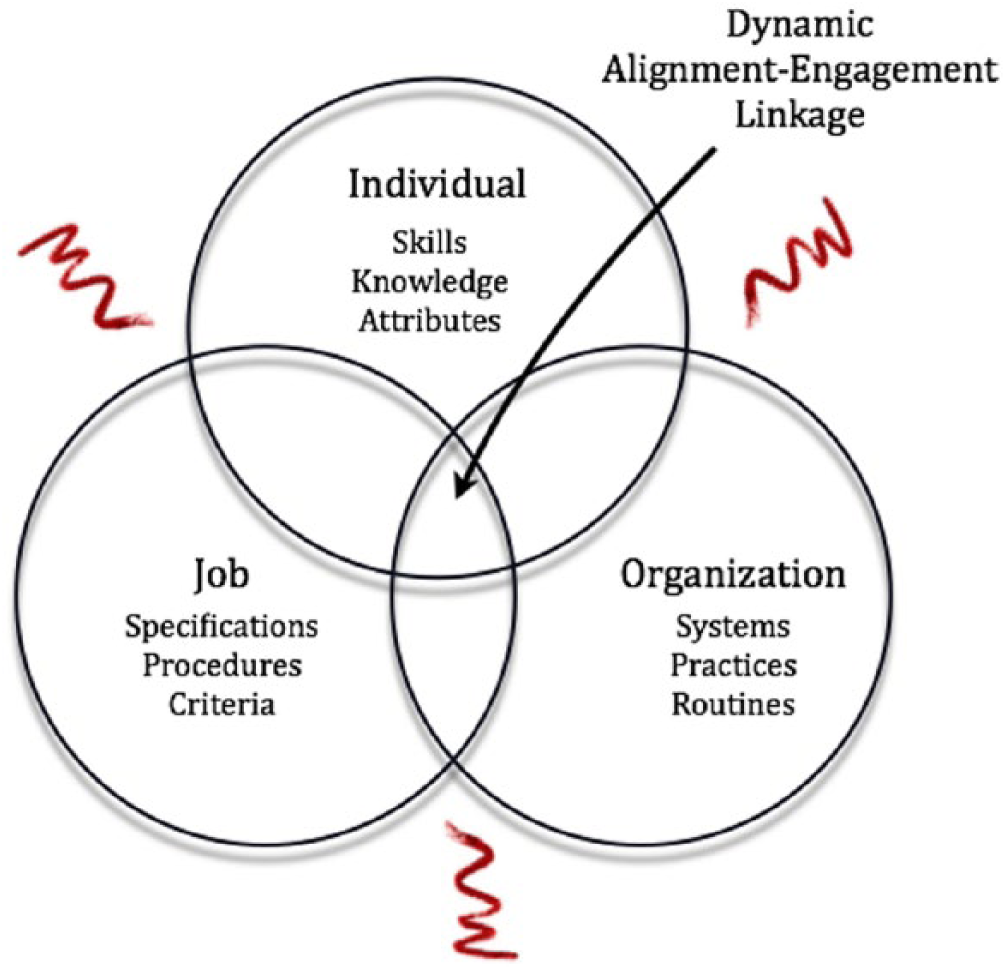
Individual performance as the dynamic outcome of alignment–engagement linkage.
Depicted within Figure 1, organizational vision and mission, strategic goals, values, and norms, reward systems, processes, and tactics reflect the workplace, as well as the job itself. This reflection is indicative of how employees understand, infer, make meaning, and create unique ways that affect their performance on the job. When there is misalignment or when organizational goals are disconnected from processes and work flow (the circles in our diagram get further apart), managers can expect misfires and miscues in performance. On the contrary, employees’ understanding of the vision and mission, developing meaning of their job and fit of skills, attributes, and knowledge spurs the idea of engagement (the circles overlap and get closer), high levels of performance are a likely outcome. Alignment is not just the organizational conditions that produce the experience of the engagement phenomena. Much more, when employees are aligned, this state allows for engagement to flourish—however, like an organizational hygiene factor, alignment does not guarantee engagement. Alignment is not a sufficient condition for engagement, although we note the conceptual linkage.
We would further suggest that it is critical to monitor alignment to nurture the positive, psychological state of engagement. We suggest that the continuous application of alignment principles remains important; those who lead organizations must develop a drive for alignment, not so much focus on practice of alignment as is the norm. For example, improving formal communications in the organization is a well-intended HRD initiative that has developing and disseminating newsletters as an outcome of alignment. However, this outcome does not necessarily drive engagement nor does it guarantee performance (Shuck, 2013).
Organizations must drive alignment by connecting the overarching goals at the individual level, such that this individual connection generates emotion, drives behavioral intention and resulting performance. The physical, mechanistic, rational aspect of alignment represents the espoused organization. The practice of alignment as we suggest in the above example in fact, reveals the potential and in times embedded tension in the different ways employees encounter the espoused organization different from the organization they experience day-to-day. The experienced organization is reflected by the states of engagement employees live, feel, think, and act on. Do not be fooled though—engagement is not what we see, but what an employee experiences and how they direct the intensity of their energies. Central to our position then, is that we propose employee engagement as a psychological state reflective of an employee’s continuous calibration of their organizational environment. This continuous calibration helps prompts employee to make decisions regarding whether to pull toward or away from their coworkers, team, department, or the entire organization. We note the potential disjointment here between job engagement (Rich et al., 2010), work engagement (Hallberg & Schaufeli, 2006), and employee engagement (Shuck & Wollard, 2010) with personal engagement (Kahn, 1990) in the context of alignment. Although this is a subjective process, unique to each individual, we suggest that a primal, logical decision-making process revolving around the interplay between cognitions and emotions drives this activity—all set within the context of an employees’ personal sense of organizational and personal well-being (i.e., alignment).
In sum, we used theoretical contributions from both HRD and management sciences to build on several aspects of seminal work in alignment, engagement, and employee performance. Instead of considering employee performance, employee engagement, and organizational alignment as mutually exclusive concepts, we theorized the importance of linking alignment with engagement and position employee performance as an outcome of the potential tension/harmony that is produced as a result of the alignment–engagement linkage. We also challenged the notion that employee performance outcomes, including turnover, retention, and productivity, should be generally conceptualized at the individual level. Instead, we argued and demonstrated that the very nature of employee performance is inherently an outcome of the embedded organizational system. In particular, we suggested that the state of engagement is realized and contingent on the ability of the organization to drive alignment at all levels. Furthermore, we contend that as an embedded system, employee engagement has the potential to affect not only the individual employee but also influence the performance of others in the organization.
Moreover, this literature review revealed a dearth in scholarly studies reviewing and connecting organizational alignment with employee engagement. Through our review, organizational alignment, and their associated outcomes where linked as critical for enhancing employee engagement. Stronger alignment implied that organizational systems, processes, procedures, culture, structure, and strategy fit well together. The integration of alignment outcomes with the three main facets of employee engagement (cognitive, emotional, and behavioral) augments linkages to employee performance. Alignment can produce, shape, or influence any one of the three types of engagement—and we note the distal power of how influential cognitive and emotional engagement can be. The level of full engagement an employee experiences as a result of alignment can have a specific, measurable impact on individual performance. We strongly recommend future research explore this area fully.
Finally, from a system’s perspective, alignment in the technology and systems of the larger organization can provide support for the optimum performance of individual employees. We trace the typical pathway for linking alignment with individual performance and identify employee engagement as a means to develop a richer understanding of overall performance. Greater harmony between various organizational alignment outcomes can strengthen the link between involvement, willingness, and engagement of the employee to perform toward the job. As an exploratory offering to advance both theory and practice in HRD, our conceptual model enhances the understanding and interpretation of dynamic aspects of individual performance that is shaped by the individual contributions of employees as much as it is influenced by job characteristics and organizational systems.
Overall, increasing overlap between the three dimensions (organizational systems, job characteristics, and individual attributes), indicate greater alignment toward the achievement of shared organizational goals as well as increased engagement of employees at work. When organizational goals, job, and task responsibilities as well as individual employees are heading in the same direction (Weiser, 2000), employees are more likely to exhibit both necessary and discretionary behaviors. Such employees are more likely to make decisions to pull toward their coworkers, team, department, and the entire organization. They generally share a coupled purpose with their organization; make personal investment of resources, willingly give of their knowledge, skills, and abilities, which facilitate individual performance.
Implications for HRD Theory, Research, and Practice
Within HRD, the concept of engagement is only beginning the processes of maturation. Consequently, little is known about the inner-related workings of the phenomenon as they are experienced in real time in our field. Thus, the application or organizational alignment theory to engagement provides ample opportunity to advance theory development in HRD. For example, one of the most salient opportunities for advancement is in progressing the three-dimensional model espoused by several scholars within a framework of context (Rich et al., 2010; Shuck & Reio, 2013; Shuck et al., 2014). For example, unattached, engagement is simply an occurring phenomenon within the psychology of the employee. Applied to a framework such as the process and relational perspectives of alignment, engagement is given context. It also seems practical that climate, in the form of alignment, is critical for understanding the application of both prevailing areas of study, advancing each literature stream. This convergence of organizational alignment and engagement extends that work specifically by naming those areas of organizational design and rewards, existing cultural norms, and performance barriers between different departments that connote the conditions of any one organization. Moreover, this work extends into the work of Brown and Leigh (1996) who grounded a model of psychological climate, which has been used extensively in research on and around engagement. Contextualizing that environment through the lens of organizational alignment gives our model directionality and sensitivity to that theoretical base (i.e., Kahn, 1990), suggesting that not only do organizations need climates of work that are psychologically safe, but they also need alignment within those environments—a nuance that is underrepresented in theoretical application of engagement at this time.
Within the areas of HRD research, we maintain that this conceptual model requires testing, and we suspect that as a result, further refinement will occur. As a way to broaden generalizability, future research might focus on a cross-section of industries, nationally and internationally, which would apply the three-dimensional framework of engagement alongside measures of organizational alignment and job specifications as a means for understanding the empirical interplay and practical significance of the two areas. We note that it is possible for engagement and alignment to both operate uniquely in differing contexts and thus, would argue for research to apply this framework across multiple settings and cultures. Likewise, because HRD can lend itself to intervention research and program evaluation using prospective and retrospective approaches (Nimon, Zigarmi, & Allen, 2011), experimental methods that couple varying alignment strategies as a means for developing higher levels of engagement might also examine the external validity of the alignment framework, method, and measures espoused in our model. Still further, as the techniques for empirical examination in HRD gain in sophistication, qualitative approaches to understanding the phenomenon of engagement within the context of alignment seem prudent. Developing a grounded understanding of how employees actually experience alignment, how they interpret the structures of alignment, and how their perceptions lead to states of heightened individual performance would be not only informative but also one of only a handful of studies that have explored engagement from a rigorous, qualitative lens.
Finally, we name three specific implications for practice. First, engagement as an outcome must be preceded by those conditions that nurture the phenomenon as mentioned. Notwithstanding, the concept of alignment offers a way to understand, contextualize, and apply those conditions. For example, the optimization of business processes in ways that create meaning and purpose (Shuck & Rose, 2013), internal alignment of organizational structure so that employee’s experience meaning and safety (Kahn, 2010), communicating strategy and culture in ways that connect to external stakeholders indicate the relative importance of work that could influence levels of engagement (Alagaraja, 2013b). Seeking engagement without organizational alignment seems a futile exercise in the shuffling of resources. Second, we highlight the interdependent nature of alignment and engagement. Practically, those organizations who seek higher levels of engagement must understand the connection between how employees experience alignment and how this alignment influences cognitive and emotional appraisal and interpretation of the work environment. If a positive appraisal of the environment within the lens of alignment is likely, than influencing those factors that influence the appraisal can be powerful for organizations—transformational at the very least. It is our experience that all engagement cascades upward from individuals, to work teams, departments and to the whole organization, and thus, alignment occurs on these levels as well. This is not to diminish the role of leaders and managers, but rather to identify the true power of engagement—which lies within the individual. Consequently, we could apply the construct of engagement within the function of alignment. That is, within each level of organizational alignment, engagement is a distal indicator of how well alignment is occurring. As such, organizations must work to intentionally create those structures that are aligned with the outcomes they seek. For example, engagement is not likely to occur in misaligned areas of work teams or with misguided one-on-one conversations with a leader. Rather, it is when these structures and relations are aligned that organizations may reap the advantageous benefits of a highly engaged employee base.
Finally, the experiences of organizational alignment and employee engagement act as silent indicators of organizational identity. Organizational alignment connotes how well embedded workplace structures and practices lend themselves to broader goals. Employee engagement connotes how well individual employees are reacting to those embedded structures and practices. The two are intertwined and neither can be demanded. But the power for both lay in different areas. For example, the ability to create and influence embedded structures and practices lies within the purview of the organization. An employee often cannot create these for himself or herself, as they are a collective experience of artifacts. Nonetheless, the power of engagement lies with the employee as a response to those embedded structures and practices. We note then, that neither can be demanded—they can only be cultivated, fostered, and developed. Leaders and managers must understand their ability to positively influence these two areas as dynamic systems and that they are, in part, a reflection of their leadership. Misalignment and disengagement do not happen by accident and they are not the fault of a few bad apples on the frontline; they are developed and cultivated within intentional systems and practices. Thus, we implore for organizations, leaders, managers, and employees to explore their levels of engagement as a function of alignment and to be willing to create those conditions of environmental success proportionate to the levels of performance they desire.
Footnotes
Declaration of Conflicting Interests
The author(s) declared no potential conflicts of interest with respect to the research, authorship, and/or publication of this article.
Funding
The author(s) received no financial support for the research, authorship, and/or publication of this article.