



Abstract
Masculinized industries encompass many work contexts described as masculine, male-dominated, and/or gendered. However, the use of any of those three latter designations hinges on the gender binary (men and women) and the inequitable distribution of power in favor of men. Describing an industry or group of industries as “masculinized” is more political, inferring the stance that male privilege applies only to certain men working in these industries. The purpose of this structured literature review was to systematically examine the literature on masculine, male-dominated, gendered, and masculinized work contexts. Findings indicated that masculinized industries create metaphorical barricades that serve to sustain long-standing traditions, customs, policies, and practices potentially detrimental to many, including gay men. Overall, this article moves the conversation about inequality in these industries beyond that of the gender binary.
Masculinized industries encompass many work contexts described as masculine, male-dominated, and/or gendered. However, the use of any of those three latter designations hinges on the gender binary (men and women) and the inequitable distribution of power in favor of men. Describing an industry or group of industries as “masculinized” is more political, inferring the stance that male privilege applies only to certain men working in these industries. This is in part because masculinized industries typically employ “men embodying heterosexual work styles” (Collins & Callahan, 2012, p. 456) and share “a common history requiring for employment—explicitly or implicitly—willingness to do physical labor or face job hazards” (Collins, 2013, p. 245). Examples of masculinized industries include law enforcement, the military, and construction. In the United States, jobs in these industries are often perceived as open to anyone capable of doing the work—a perception that is strengthened and perpetuated by the existence of such government entities as the U.S. Equal Employment Opportunity Commission (EEOC; n.d.) or the recent repeal of “Don’t Ask, Don’t Tell” in military contexts. The EEOC (n.d.) presently protects individuals on the basis of race, color, religion, familial status, veteran status, sex, national origin, disability status, age, and genetic information. Only some U.S. states provide protection based on sexual orientation (Human Rights Campaign, 2014), and even then the laws sometimes only pertain to certain jobs. Many masculinized industries have been sustained as masculine and heteronormative spaces. In these spaces, heterosexuality is presumed and opportunities are limited for many who do not align with implicit expectations for individuals’ work and ways of being—and it is often legally permissible.
For this reason, across most masculinized industries, gay men’s experiences may provide a provocative exception to male privilege and gendered rules that can be leveraged to advance more nuanced alternatives for research and practice. Gay men contend with unique problems at work in masculinized industries (Collins, 2013; Collins & Callahan, 2012) because masculinity is “equate[d] . . . with expertise” (Rolston, 2010, p. 904) and gay men are often stereotypically (and falsely) assumed and perceived to be less masculine (Manguno-Mire & Geer, 1998). This article presumes the intentionality of the privileged to keep others (i.e., gay men) out of power, as “the masculinization of industries is a negotiated and tenuous process, not a natural or inevitable one” (Smith, 2008, p. 446). Such intentionality may be seen in the instance of Exxon Mobil, the oil and gas powerhouse again scrutinized in May 2013 for alleged discrimination against gay job applicants (Crary, 2013). Other large corporations have scored well on the Human Rights Campaign’s Corporate Equality Index—which measures how friendly workplaces are to lesbian, gay, bisexual, and transgender (LGBT) people—but Exxon Mobil has consistently scored low. This serves as an example of how masculinized industries may sustain a culture of limitation, constricting the experiences of those not viewed as “normal” and even precluding them from the possibility of employment.
While male-dominated, gendered, and masculine, as well as masculinized, industries all generally share a history of favoring and privileging men over women, the exclusion of gay men in masculinized industries may occur because masculinized industries are additionally characterized by the historical and/or contemporary nature of work as physically laborious or risky (Collins, 2013). These features of the work in masculinized industries are supported by a culture that perpetuates
“hegemonic expectations for the overtly masculine embodiment of gender,”
“reliance on and trust in authority,”
and “behaviors, policies, and attitudes favoring heterosexuals over sexual minorities.” (Collins, 2013, p. 258)
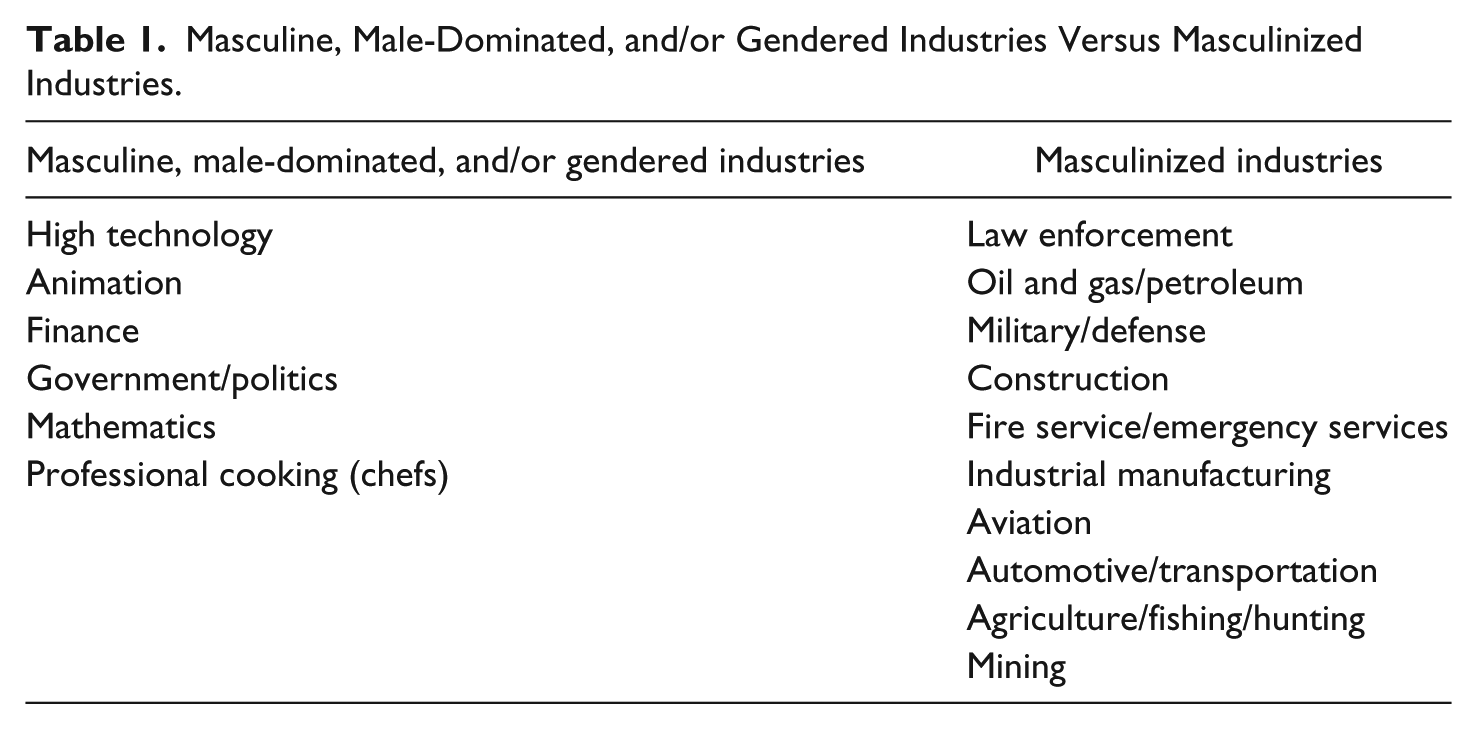
It is these work/risk-oriented, hypermasculine, and heterosexualized features of masculinized industries that distinguish them from male-dominated, gendered, or masculine industries, which generally favor men but do not necessarily adopt archetypes or standards that favor one particular sexual orientation over another. For example, in its beginnings, the oil and gas industry placed a high value on those workers who exuded a perceived masculinity that was aligned with the rugged, tough rancher prototype (Miller, 2002). Although jobs are now available in many different capacities, this attitude, which has been influenced by the industry’s history, continues and has been conflated over time with the industry’s reluctance to accept homosexuality (Collins & Callahan, 2012). Thus, the oil and gas industry might easily be described as masculinized as opposed to merely male-dominated, gendered, or masculine, though it is certainly all of those things as well. In this way, masculinized industries problematize what is often assumed to be gendered hierarchy favoring all men by highlighting the perception of gay men as less capable “others.” Table 1 presents a few examples of masculine, male-dominated, and/or gendered industries compared with a few examples of masculinized industries, to help further explain this idea. Although not to be considered comprehensive, Table 1 provides a context for understanding the types of industries examined in the remainder of this article.
Masculine, Male-Dominated, and/or Gendered Industries Versus Masculinized Industries.
The characteristics of masculinized industries, or “the structures, procedures, and routines” (Grindley & Sullivan, 1998, p. 93), influence the function of the work context as a whole, as well as the lives of individual workers. Some scholars have explored characteristics (Kissack, 2010; Maier, 1997; Swanberg, 2004) of male-dominated/gendered work contexts. Some have addressed issues in law enforcement (Rumens & Broomfield, 2012; Wells, Colbert, & Slate, 2006), aviation (Mills, 1998; Mills & Helms, 2006; Neal-Smith & Cockburn, 2009), oil and gas (Collins & Callahan, 2012; Miller, 2004), construction (Agapiou, 2002; Gale, 1994), and fire service (Tracy & Clifton, 2006). But most research on masculine, male-dominated, and/or gendered work contexts fails to move beyond the gender binary and male privilege, which is often assumed for all men. Thus, there is a need for research exploring “the masculinized industry as a binding context” (Collins, 2013, p. 262) encompassing many of the characteristics of masculine, male-dominated, and/or gendered work contexts and differentiated by hypermasculine, heteronormative ideals, and the potential experiences of gay men.
Purpose and Research Question
The purpose of this structured literature review (Rocco, Stein, & Lee, 2003) was to systematically examine the literature on masculine, male-dominated, gendered, and masculinized work contexts. In doing so, this review aimed to uncover characteristics common in masculinized industries, where there may be both formal and informal “policies for behaviors and actions that inhibit the open inclusion of gay men” (Collins, 2013, p. 263). This review was guided by the following research question:
First, the conceptual framework is presented. Then, the research design is articulated and the findings reported. Next, findings are discussed and contextualized within relevant literature. Finally, the article closes with implications and future directions for research and practice.
Hegemony, Homosexuality, and Multiplicity: Masculinity at the Crux of Social Identity
This research was guided by a conceptual understanding of hegemonic masculinity (Connell, 1987, 1995), forms of homosexuality (Herdt, 1997), and multiple masculinities (Imms, 2000) as they relate to the contemporary regulation of homosexuality in society and in organizations and industries.
Hegemony: Masculinity’s Dated Reality
Hegemonic masculinity (Connell, 1987, 1995) encompasses those norms that posit only a select few modes of interaction and ways of being a man as ideal. At the “local” level (Messerschmidt, 2012), which occurs in organizations and industries, these norms grant more social power to those men who embody that ideal than they do to those men who are perceived not to embody it. In this way, hegemonic masculinity becomes the standard when its value is assessed in relation to and is deemed greater than femininity and all other, non-hegemonic masculinities (Connell & Messerschmidt, 2005; Messerschmidt, 2012). This process is referred to as legitimation and reduces the essence of a person down to a few arbitrary traits (Messerschmidt, 2012), such as aggression and self-centeredness (Connell & Messerschmidt, 2005). It is also a “process through which men come to suppress a range of emotions, needs, and possibilities, such as nurturing, receptivity, empathy, and compassion, which are experienced as inconsistent with the power of manhood” (Kaufman, 1994, p. 148). Hegemonic masculinity exists to legitimize the “ideal” man’s power, especially sexual power, over femininity, women, and even “non-ideal” men (Connell, 1987, 1995). As noted by Collins (2013), “The focus on meeting a particular definition of manhood and masculinity seems to stem, at least in part, from the gendered assumption that men should be attracted to and in hierarchal position over women” (p. 247). Homosexuality in men is often erroneously interpreted as a lack of masculinity.
Homosexuality: “Who a Man Is” Versus “What a Man Does”
Across many different historical and contemporary cultures, Herdt (1997) discussed five prominent forms of homosexuality:
These forms are (1) age-structured relations as the basis for homoerotic relationships between older and younger males, (2) gender-transformed homoerotic roles that allow a person to take the sex/gender role of the other gender, (3) social roles that permit or require the expression of same-gender relations as a particular niche in society, (4) western homosexuality as a nineteenth-century form of sexual identity, and (5) late-twentieth-century western egalitarian relationships between persons of the same gender who are self-consciously identified as gay or lesbian for all of their lives. (pp. 22-23)
While each of the five forms mentioned by Herdt (1997) may be legitimate aspects of gay men’s identities and experiences, many common stereotypes and falsehoods influence some people’s perceptions of “what a man does” (or is assumed to do) when he is gay, specifically regarding the first three forms. Resembling the first form (age-structured), some people continue to claim that gay men are more likely to molest children and adolescent boys though this degrading fabrication has been multiple times disproved (Barret & Robinson, 1990; Berkowitz & Marsiglio, 2007; Hicks, 2006; Riggs, 2004). In alignment with the second form (gender-transformed), gay men are often stereotypically assumed to be more feminine or more like women than are heterosexual men (Blashill & Powlishta, 2009; Kite & Deaux, 1987; Rieger, Linsenmeier, Gygax, Garcia, & Bailey, 2010; Rudman, Mescher, & Moss-Racusin, 2013). Consistent with the third form (same-gender niche), gay men are in many ways a commodified resource (Kooijman, 2005) wanted and needed for the skills and attributes they contribute to society but otherwise treated as unequal and thought of as not normal. The tendency of homophobic and heterosexist norms to perpetuate these kinds of ideas undermines the validity of age-structured, gender-transformed, and same-gender niche forms of homosexuality as they exist today. For example, regarding the first form, it seems perfectly acceptable for two consenting adults of different generations to engage in relationships, and yet cross-generational gay relationships may be evaluated less favorably than cross-generational heterosexual relationships. In addition, incessant focus on what gay men “do” may lead to the reduction of dialogue about gay men to sex, disease, and difference. Alternatively, the fourth (homosexuality as sexual identity) and fifth (egalitarian relationships) forms of homosexuality (Herdt, 1997) tend to focus more on “who a man is,” or homosexuality as a valid identity. It is in these forms that gay men may find some reprieve from dated stereotypes and envision a future where being gay is not conflated with other, unrelated issues that diminish the experience and interpretation of the identity.
Multiplicity: Masculinity’s Promising Future
In many contexts, the dominant or hegemonic standard of masculinity is perceived to be at opposition with the forms of homosexuality and with being gay, despite that both gay and straight men can and do exemplify various traits labeled masculine, feminine, or even neutral (Bernard & Epstein, 1978; Pillard, 1991). This calls into question why such rigorous and unrelenting standards exist in the first place. The answer is that hegemonic masculinity exists as a means for establishing and maintaining gendered and sexualized power (Messerschmidt, 2012). A more sophisticated view of masculinity, however, promotes multiplicity. The multiple masculinities view upholds four key characteristics: (a) masculinity is not homogeneous; (b) gender roles are functions of societal norms, not birthrights; (c) gender is constructed in relation to both similar and different others; and (d) multiple masculinities offer an alternative to hegemony and power derived from it (Imms, 2000). This research supposes a multiple masculinities approach to consider the characteristics of masculinized industries that may inhibit or discourage divergence from hegemony. This research additionally supposes that hegemony influences contemporary beliefs, prejudices, and stereotypes regarding homosexuality and its perceived incongruence with work in masculinized industries.
Research Design
A structured literature review (Rocco et al., 2003) method was used to identify, select, and make meaning of the literature. The selected research design may be likened to other methodical approaches for literature reviews such as the systematic literature review (i.e., Kitchenham & Charters, 2007). Both structured and systematic literature review methods aim to classify consistent trends and issues across literature indexed in multiple electronic databases. However, Rocco et al.’s (2003) process enlists steps specifically designed for the exploration of new concepts, whereas systematic literature reviews may focus on new concepts but are often also used to assess the quality, measures, and (mostly) quantifiable results of studies (i.e., Buus & Gonge, 2009). The process used in the present research involved one analytical stage to find and investigate relevant literature. It also included a reflexive stage to help qualitatively categorize trends and issues identified. The steps involved with both stages are described in the following sections.
Analytical Stage: Identifying Emergent Trends and Issues
The first stage took place in four steps: (a) material identification, (b) publication selection, (c) data organization, and (d) thematic analysis.
Material identification
This step was important in determining search parameters and databases. In alignment with the purpose of this study, search parameters were selected to identify literature on masculine, male-dominated, gendered, or masculinized work contexts. Industry-specific (e.g., oil and gas, transportation, etc.) search parameters were not used. However, many articles within the selected search parameters focused on industry-specific topics (i.e., military, Barrett, 1996; oil and gas, Miller, 2002; industrial manufacturing, Burgess, Henderson, & Strachan, 2005) and were included in the final sample.
Publications were identified by searching nine online academic databases for the following descriptors in all available fields: (a) “male-dominated organization*” or “male-dominated industr*” or (b) “masculin* organization*” or “masculin* industr*” or (c) “gendered organization*” or “gendered industr*.” Searches were set for peer-reviewed, English language articles only. No date range was set, and searches were completed on February 26, 2013.
Databases were selected based on association with the following fields: (a) human resources, (b) psychology, (c) business, (d) sociology, (e) communication, and (f) women’s studies. A university librarian service was consulted in the process. Databases included the following:
ERIC ProQuest
PsycINFO ProQuest
EBSCO Host Business Source Premier
EBSCO Social Sciences Full Text (H. W. Wilson)
ProQuest GenderWatch
ProQuest Sociological Abstracts
EBSCO Historical Abstracts
EBSCO Education Full Text (H. W. Wilson)
ProQuest ABI/INFORM Complete
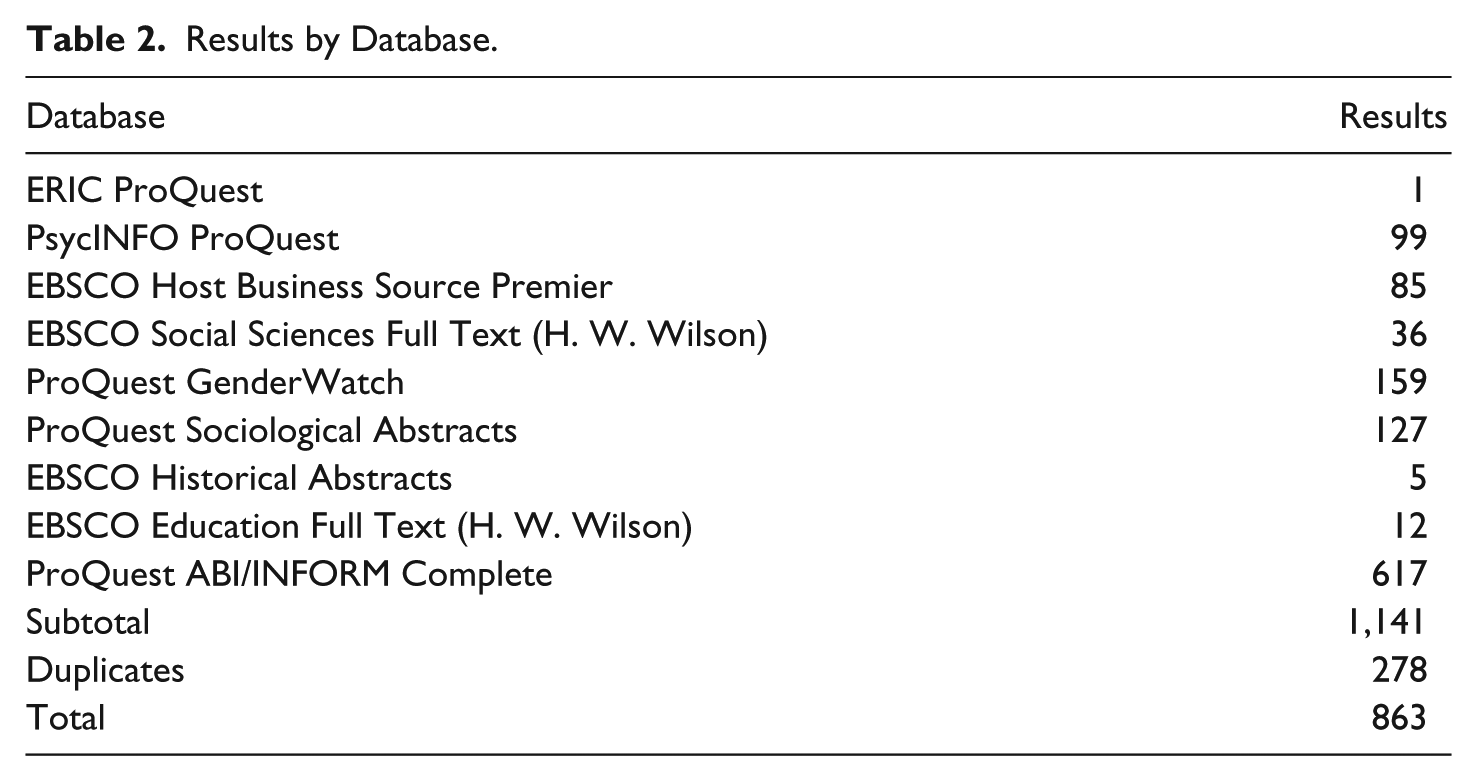
Searches returned 1,141 results. Entries were imported into EndNote and 278 duplicate publications were eliminated. The large number of duplicates suggested an appropriate breadth of databases were selected. The number of publications used in the selection process was 863. Table 2 represents the number of results for the above descriptors in each database.
Results by Database.
Publication selection
To be included in the final sample, publications needed to meet four basic criteria, enhancing the claim that the sample was more representative of the characteristics of masculinized industries (as defined previously) than of male-dominated, gendered, or masculine industries. The criteria were as follows:
Criteria 1: To enhance the claim that the works analyzed in this study were of the highest quality, publications must be peer-reviewed journal articles.
Criteria 2: To avoid the conflation of issues regarding gender, sexuality, masculinity, and/or femininity in areas where those issues may be less (or more) socially relevant, publications must discuss concepts either universally or in the specific, similar national contexts of the United States, the United Kingdom, Australia, or Canada.
Criteria 3: To support the purpose of this study, publications addressing specific industries must address industries characterized as “masculinized” in two ways: (a) the industry discussed is generally recognized as male-dominated and (b) the industry discussed must have historical and/or current strenuous physical demands for employment in some careers in the industry. Conversely, publications not addressing specific industries must be generally about work in masculinized, masculine, male-dominated, and/or gendered contexts without going into specific industries’ issues as a primary focus.
Criteria 4: To properly align with the intended outcome of this study, publications must be focused on masculinized, masculine, male-dominated, and/or gendered contexts conceptually and in design and execution.
Selection began by printing the citations and abstracts for all 863 publications. The review of Criteria 1 eliminated eight book reviews and nine editorials or special issue introductions. The review of Criteria 2 eliminated 167 publications. For example, Moore (1999) was eliminated because of its focus on the police force in Israel, but Alvesson and Billing (1992) was not eliminated because it focused generally on gender-organization relations outside of any particular national context. The review of Criteria 3 eliminated 151 publications. Examples of publications eliminated from Criteria 3 included Brierley and Gwilliam (2003), excluded for its focus on audit firms—which have no historical and/or current strenuous physical demands for employment, and Haber (2011), excluded for the same reason and because it focused on female student leaders in college—which is not generally discussed as a male-dominated domain. Finally, the review of Criteria 4 eliminated 419 publications. The large number of eliminations from Criteria 4 was primarily due to either publications’ discussion of general gendered organizational systems and customs in organizations that were not specific to masculinized, masculine, male-dominated, and/or gendered contexts or to publications’ discussion of concepts in ill-bounded work contexts, such as generalized entrepreneurship or management experiences outside a specific industry. Thus, there were 754 total eliminations, leaving a final sample of 109 articles for analysis.
Composition of sample
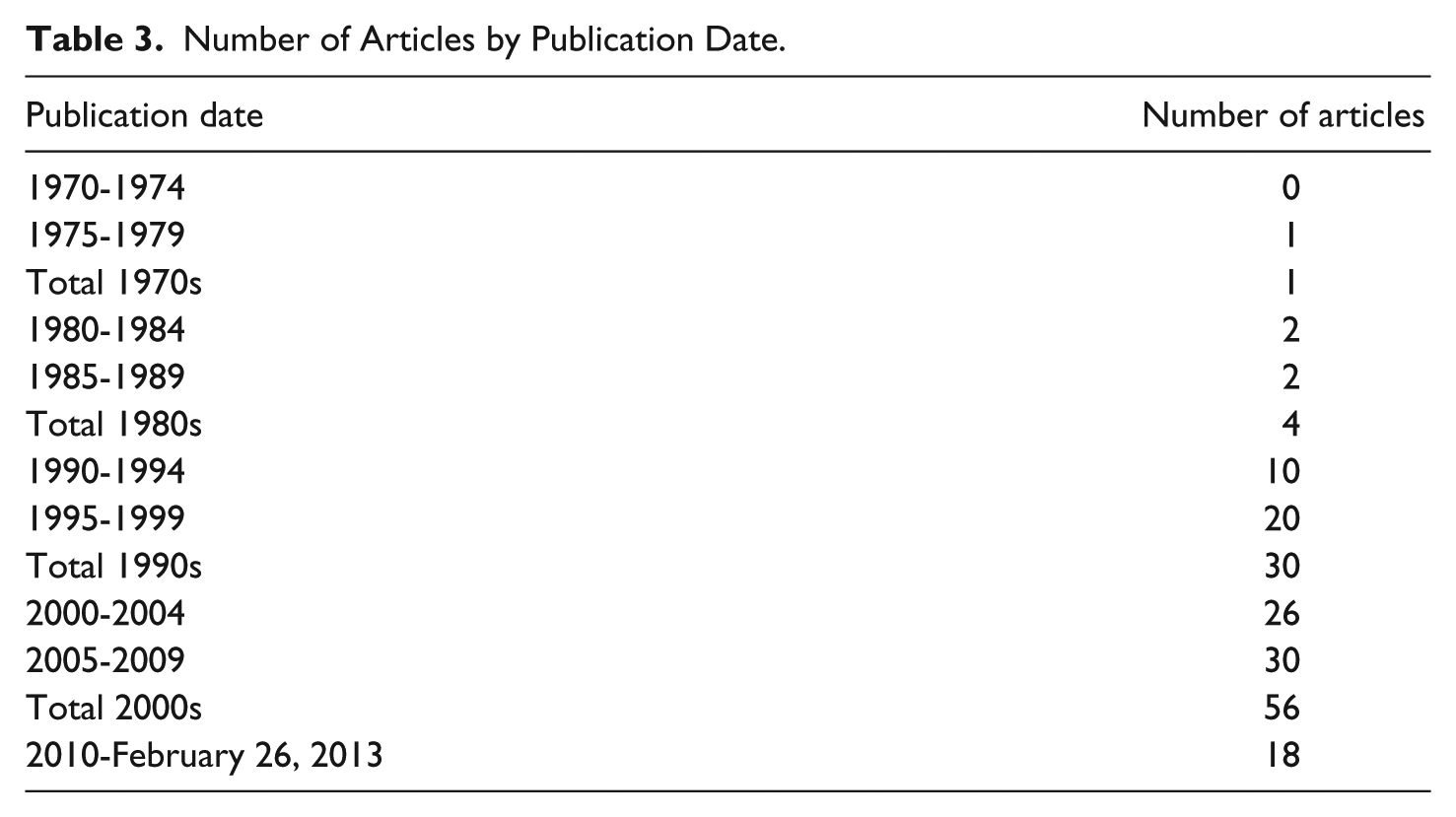
All 109 publications were released after the Equal Employment Act (EEA) was passed in 1972; the Act in part banned employment discrimination based on sex in most jobs and industries. Breaking down the number of articles by publication date (Table 3) indicates an ongoing increase of research on masculinized industries and work contexts.
Number of Articles by Publication Date.
This sample of 109 articles was published across 65 peer-reviewed journals. The vast majority of these journals (59) published one or two articles in the sample. However, 6 of the journals published 3 or more articles and represent 37 out of the 109 publications—roughly 34%. Table 4 represents the top journals in terms of number of articles in the sample. Also included in the table is the first and last year a publication in the sample was released in each journal.
Top Journals by Number of Articles.
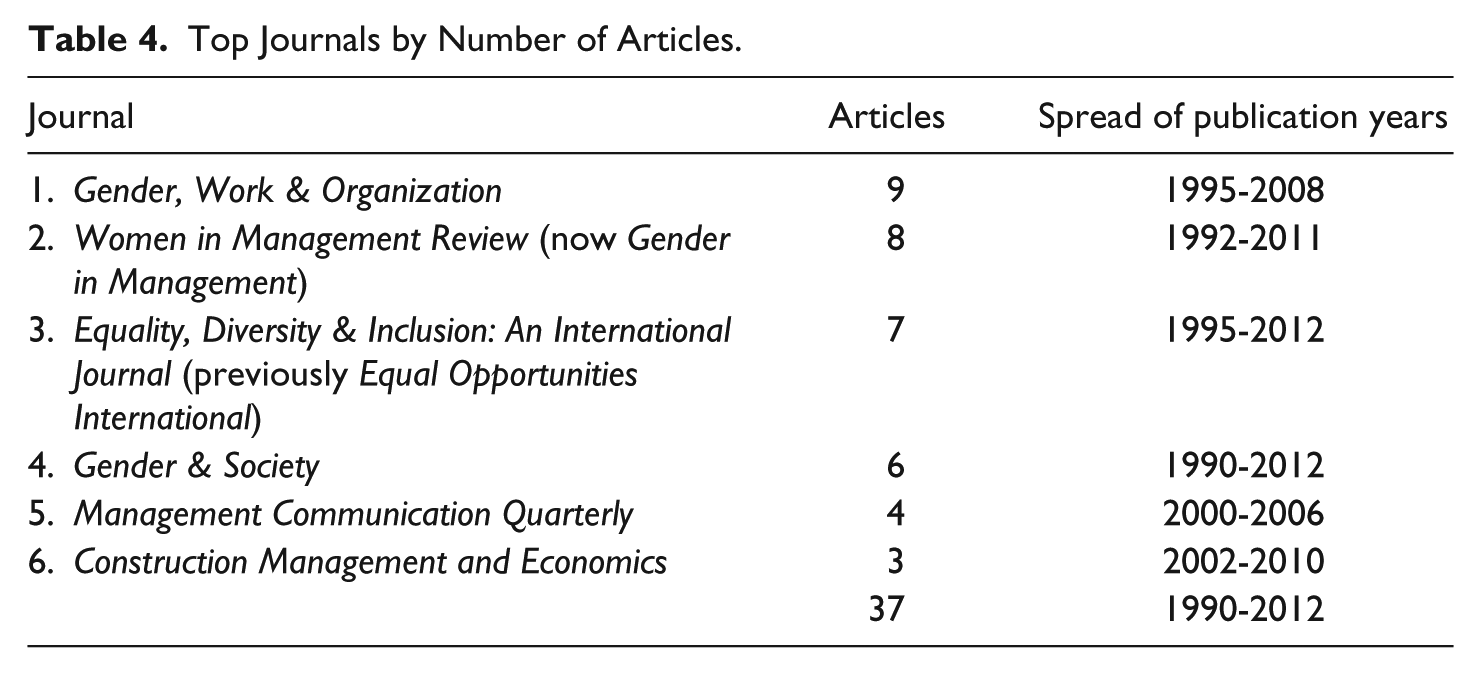
As indicated by Google Scholar on August 1, 2013, the top cited article in the sample of 109 was Acker’s (1990) seminal work at 2,980 citations. The work appeared in Gender & Society, one of the top six journals in terms of number of articles in the sample. Of the 36 other articles from the top six journals in the sample, 8 cited Acker’s work. Several of the other articles in the top six journals also cite each other. The relative interrelatedness of the articles from the top six journals in the sample serves to reinforce the assertion that the publications identified and selected for this study were representative of the literature.
Data organization
Publications were organized using EndNote features. EndNote automatically imported article citation, keyword, and abstract data for each publication. For the 109 publications, full-text, searchable PDF files were individually downloaded and imported into EndNote. During analysis, additional steps were taken to organize data in a spreadsheet database; these steps are described in the following sections.
Thematic analysis
Thematic analysis (Boyatzis, 1998) was used to provide an understanding of similarities across the different literature sets in context (Joffe & Yardley, 2003). Thematic analysis took place in three phases. The first phase involved reading each of the 109 publications fully. The purpose of this phase was to gain a sense of the material in the publications without taking notes to avoid “coding fetishism” (Richards, 2002)—or over-coding the data.
Inductive coding began during the second phase. Publications were scanned for “raw information” (Joffe & Yardley, 2003, p. 57) providing hints for the elucidation of characteristics of masculinized industries. The conceptual framework guided the coding process by informing interpretations of masculine norms and contemporary perceptions of homosexuality. The aim was to uncover characteristics as they related to the reasons these industries have remained dominated by masculine, heterosexual privilege and thus have been masculinized in an age when equity has been continuously interrogated as an issue. In reading the texts this way, findings were articulated to explain how certain accepted norms in masculinized industries might harm gay men.
For coding purposes, characteristics were conceptualized as “the structures, procedures, and routines” in organizations (Grindley & Sullivan, 1998, p. 93), affecting everything from worker rights (Schwoerer, May, & Rosen, 1995) to employment policies and practices (Jackson, Schuler, & Rivero, 1989) to work–family conflict (Nikandrou, Panayotopoulou, & Apospori, 2008) to feelings of empowerment among employees (Wilke & Speer, 2011). Organizational characteristics typically include relatively concrete things such as industry type, business strategies, and organizational structure (Jackson et al., 1989) or more abstract constructs such as risk taking (Schwoerer et al., 1995), encouragement (Nikandrou et al., 2008), leadership, and social support (Wilke & Speer, 2011). Masculinized industries may have both concrete and abstract characteristics that inhibit or discourage the participation of gay men, such as inequitable benefits policies that favor heterosexuals (concrete) or the valuation of a certain type of leadership style that is perceived to be incongruent with being gay (abstract). Both concrete and abstract characteristics were coded with equal attention, as were manifest content (explicit) and latent content (implicit; Boyatzis, 1998). Some data were coded in multiple categories if it was appropriate to do so, and both empirical and conceptual data were treated equally, as the purpose of this article was to uncover the characteristics of masculinized industries as they have been framed in the literature and advanced in academic thought. Data were logged in a spreadsheet database detailing: author(s), year, name of code, evidence of the code (either a quote or a summary), and page number of evidence (if applicable).
The third and final phase involved sorting the spreadsheet by code name and returning to publications with the existing codes to be certain pertinent evidence had been logged. This phase was intended to bolster the claim that publications were reviewed evenhandedly and the emergent codes were trustworthy (Krefting, 1991). For example, the code “innovation” did not emerge until analysis had already been completed on several manuscripts in the sample. Revisiting those manuscripts after the code emerged revealed a few instances in Davey (2008) where it had not previously been used but was appropriate. A minimal amount of evidence was acquired during this final phase, suggesting a point of relative saturation (Bowen, 2008) was met.
Reflexive Stage: Discussion of Database Categories
The reflexive stage existed to facilitate revisiting the thematic data for the purpose of editing and refining the results. The codes were sorted into clusters delineating separate characteristics of masculinized industries and articulating consistent ideas in relation to the conceptual framework. This process is often referred to as splicing (Dey, 1993) or “fusing together a set of codes under an overarching category” (Joffe & Yardley, 2003, p. 61). For example, the code “privilege,” which indicated an organizational or industry norm placing only particular people in positions of power, and the code “equal employment,” which indicated a gap in fairness between one or more working groups, were spliced into the theme “implicit in-groups.” Themes derived from spliced codes were then analyzed in relation to one another and some themes were reorganized as subthemes to a larger idea. For example, “ideal manliness” was organized as a subtheme under the theme “implicit in-groups” because the differential treatment (out-grouping) of gay men may be related to how their masculinity is perceived by others. Themes and subthemes were organized in a seventh column added to the spreadsheet.
Findings
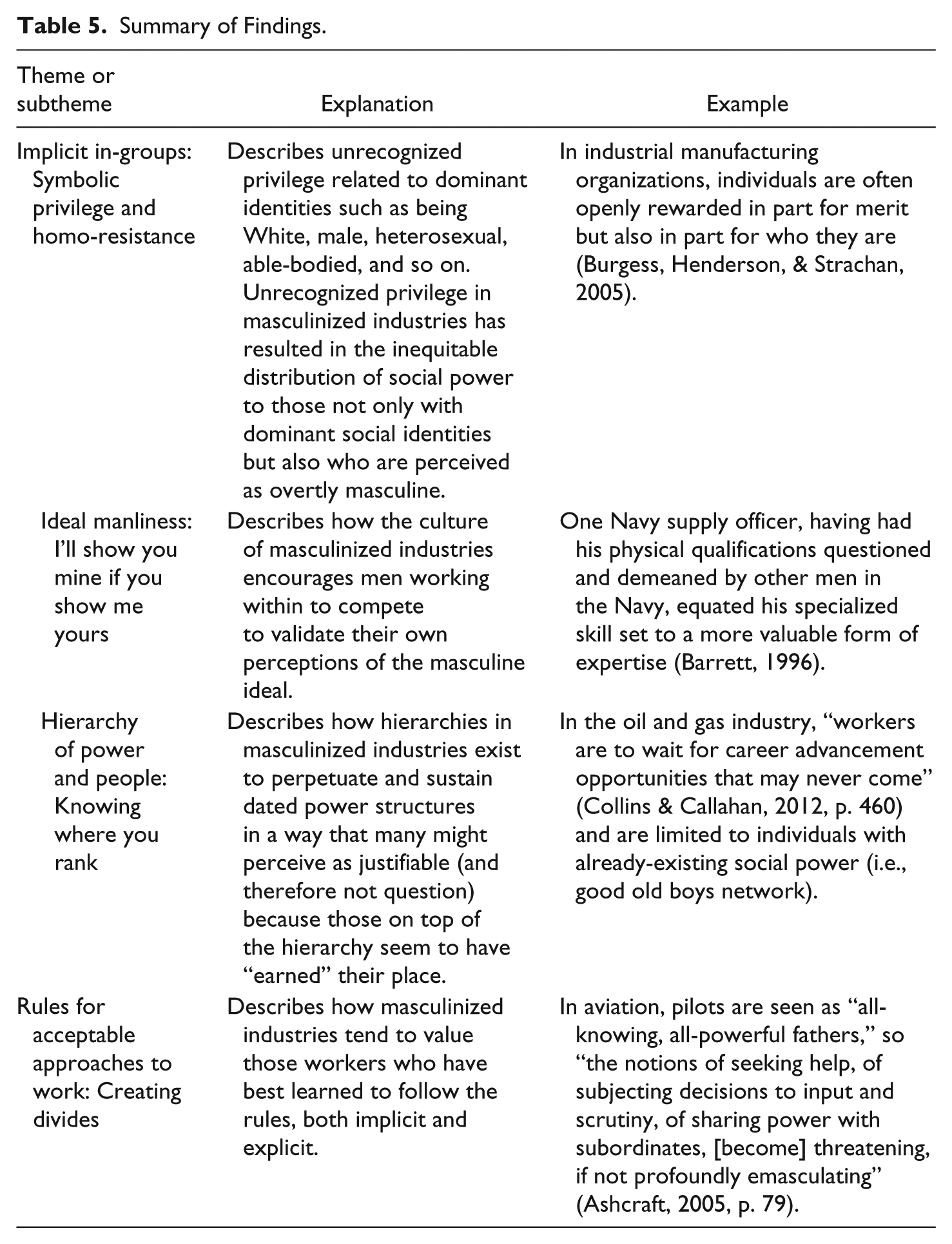
Analysis revealed two overarching characteristics of masculinized industries that help to explain how gay men may be positioned as exceptions to male privilege and gendered rules. In general, these themes indicated that masculinized industries create metaphorical barricades that serve to sustain long-standing traditions, customs, policies, and practices potentially detrimental to many, including gay men. Characteristics identified included (a) implicit in-groups and (b) rules for acceptable approaches to work. The first theme, implicit in-groups, also included two subthemes explicating specific ways in which the overarching characteristic is embodied in masculinized industries. Table 5 provides a summary of these findings, including an explanation and example of each theme and subtheme.
Summary of Findings.
Implicit In-Groups: Symbolic Privilege and Homo-Resistance
The characteristic “implicit in-groups” in masculinized industries describes the ways in which unrecognized “symbolic privilege” (Eveline & Booth, 2002, p. 575) related to maleness, whiteness, heterosexuality, and other dominant identities has led to the inequitable distribution of power, uneven perceptions of fairness, and stabilized expectations for masculinity and femininity inconsistent with sociopolitical changes (McLaughlin, Uggen, & Blackstone, 2012). These inequities have led to highly dichotomized in-groups and out-groups that preserve policies and customs that make it so “some people get some things and some people just stay at the bottom” (Burgess et al., 2005, p. 467). In-groups and out-groups are “a source of difference, if not derision” (Melgoza & Cox, 2009, p. 664) spurred by rewards given to certain people, often not only based on merit but also who they are (Burgess et al., 2005). The formation of implicit in-groups with relation to gay men working in masculinized industries may in part be due to two subtheme characteristics identified in this study: (a) persistent standards of ideal manliness and (b) hierarchy of power and people.
Ideal manliness: I’ll show you mine if you show me yours
In masculinized industries, challenges to a man’s masculinity can result in a bravado of “I’ll show you mine if you show me yours,” wherein men compete to validate their own perceptions of the masculine ideal. In the oil and gas industry, the notion of rugged masculinity—the cowboy—“[works] against the progress of out gay men, who often are perceived to be less ‘manly’ because of their orientation” (Collins & Callahan, 2012, p. 461). Similar harm can be done to women, gay men, and others in fire service, where certain rituals grant heterosexual men positive “sexualized status as a resource in performance” (Tracy & Clifton, 2006, p. 24). As resources in performance, men find ways to distinguish their “manliness,” or the extent to which they are viewed as masculine, in relation to other men. While femininity is often perceived negatively in these industries (Cheng, 1999), traits deemed masculine are valued (Greene, Ackers, & Black, 2002) and seen as signs of capability. This masculinity-as-capability model encourages aggression (Melgoza & Cox, 2009) and being “assertive, ambitious, dominant, and independent” (Berdahl, 2007, p. 428). For men working in jobs that are viscerally masculine in a traditional sense, this process is easier (Connell, 2006). These jobs might include those that require a great amount of physical labor, strength, or the acceptance of the potential for danger on the job. An example provided by a Navy supply officer in Barrett’s (1996) study demonstrates how men in jobs that are not viscerally and traditionally masculine attempt convey their own manliness as the true ideal, equating specialized skills to a form of masculinity that makes them “better” than other men:
The good suppo officer sees himself as a vital link. Okay, tomorrow you tell me how your life is without supply. They say, “You’re just a chop” [“chopping on paper” is a demeaning reference to filling out forms and doing paperwork] . . . They say [you’re a suppo officer] because you’re not physically qualified . . . I did this because it’s a good business move for after my Navy career. I get to manage people. I get to run information systems. It prepares me for the business world after—after I retire. (p. 139)
In this example, the supply officer, having had his skills diminished and physical qualifications questioned by other men in the Navy, defined his skills, and therefore seemingly his masculinity, in terms of being a “vital link,” having the opportunity to manage others, and possessing job skills valuable outside the military (Barrett, 1996). The subtext in his statement is that the men who demean him will not be as marketable in “the business world after,” positioning his capability and masculinity as more valuable despite his perceived lower status or rank among his peers.
Hierarchy of power and people: Knowing where you rank
For those who work in masculinized industries, being aware of and adhering to hierarchies, or ranking systems, is vital to survival (Evetts, 1997). Hierarchies exist to rationalize power on behalf of organizations (Collins & Callahan, 2012) and the advancement of certain people over others (Melgoza & Cox, 2009). Masculinized industries preserve the perspective that “you don’t promote somebody because you think he will succeed but you promote people because you know they will succeed” (Bergman, 2008, p. 170). In many situations, “workers are to wait for career advancement opportunities that may never come” (Collins & Callahan, 2012, p. 460) because hierarchy is reinforced by “work rules, job descriptions, pay scales, and job evaluations” (Williams, Muller, & Kilanski, 2012, p. 550) that are a part of an overall top-down structure (Hayes, 2002). For many who are not ranked highly in masculinized industries, significant time investment (hours per week) is expected but not necessarily always rewarded (Burgess et al., 2005). While expertise may sometimes be leveraged as a bargaining chip to move up, the lack of power to do so is a serious consideration for how people are permitted to approach their work.
Rules for Acceptable Approaches to Work: Creating Divides
The characteristic “rules for acceptable approaches to work” in masculinized industries describes how workers who are viewed as the most successful are those who have learned to follow the rules (Callahan, 2006). Rule following provides distraction from the issues and inequalities that surround workers on a daily basis and dominate industries like oil and gas, where Miller (2002) noted of people’s perceptions of membership in the field:
I heard about people being “members” of the [oil and gas] industry on the basis of family connections; of “old boy networks” at the top; of work groups where the male members get together informally outside of work for various activities; of the long-standing exclusion of women by particular “clubs” which attract industry members; of annual sporting activities, organized and financially supported by the industry, which have been exclusively male for many years. (p. 155)
Thus, many masculinized industries create “a hard-nosed, highly competitive approach to business and beyond” (Miller, 2002, p. 155), which is often very divisive.
Policy and procedural violations can be dangerous socially and politically (Barrett, 1996), and those who are minorities in masculinized industries sometimes cannot afford to take risks. One woman working in a male-dominated domain said of her experience with performance appraisal:
. . . a woman won’t fight . . . the man will say, “You deserve a C for that,” and she’ll say, “OK, yeah, I did because I did that a little and I didn’t do that and I did . . . ” and you’ll start justifying yourself down to what their expectation is of you, whereas you know that in fact you were a B or an A on that. (Davey, 2008, p. 661)
This woman’s experience with feeling as if she could not fight with authority parallels Germain, Herzog, and Hamilton’s (2012) finding: “18.5% of female in-training pilots admitted that ‘being too fearful’ was a major barrier” to flight training as a woman (p. 442). Both demonstrate how certain types of workers, in these cases—women, may be marginalized by industry cultures that direct them to follow rules or work toward their goals but create divides by only rewarding the efforts of some.
For example, in aviation, pilots work to create identities as “all-knowing, all-powerful father[s]” (Ashcraft, 2005, p. 79). Accordingly, “the notions of seeking help, of subjecting decisions to input and scrutiny, of sharing power with subordinates, [become] threatening, if not profoundly emasculating” (Ashcraft, 2005, p. 79). Identity as an authoritative ruler, a male “father figure,” to subordinates is not unique to the job of pilot (Evetts, 1998). This professional identity is also prevalent in construction managers (Agapiou, 2002) and military officers (Barrett, 1996) and can be used as a mechanism for rejecting and minimizing others’ experiences, like during Navy basic training where one goal is to reduce individual traits and increase group/unit unanimity (Barrett, 1996). Women and men who quit are often described as weak, further connecting those who do not quit by validating them over those who could not finish training. One officer reflected,
This is like a big boys club. It’s the varsity . . . There’s a status to being here. You know that other guys . . . passed the same tests. They’re with you. They’re your peers. It’s a boys club. It’s the elite. You earned it. (Barrett, 1996, p. 134)
These examples illustrate how the treatment of employees may be constrained by the rules of and work in masculinized industries.
Discussion
A contextualization of the findings (implicit in-groups and restrictive rules) within what is known about hegemonic masculinity (Connell, 1987, 1995) and the forms of homosexuality (Herdt, 1997) suggests disclosure (“coming out” as gay) may be an especially difficult choice for gay men in masculinized industries (Collins & Callahan, 2012). Regardless of how “out” a gay man is (or is not) at work within a masculinized industry, the context of the industries likely constrains the extent to which he will experience stereotypes and prejudice (Collins, 2013). Implicit in-groups based on perceived manliness or rank in hierarchy may dictate gay men’s disclosure choices by reducing sexual identities to stereotypes about masculinity (Connell, 1987, 1995) and what gay men “do,” as opposed to who they are (Herdt, 1997). In the same vein, both formal and informal rules at work may be related to how open gay men feel they can be about their sexuality. A multiple masculinities approach (Imms, 2000) offers some hope for a fruitful and positive discussion about issues facing gay men, namely, recognition of the ways in which normative gender and masculinity standards are often homogenously applied to all people. The following sections will explore some of the underlying meaning of the findings by discussing masculinity as expertise and the intentionality of homo-resistance in masculinized industries.
Masculinity as Expertise
The inequitable treatment of women in masculinized industries has been well researched and documented (e.g., Burgess et al., 2005; Callahan, 2006; Evetts, 1998; Germain et al., 2012), but little research exists to examine or differentiate the experiences of gay men from their straight counterparts. This is in part because it is difficult to gather information about gay men who are not out at work (Cavalier, 2011) and in part because in many of these industries, men have long been assumed to garner privilege despite other social positionalities, including sexual orientation. However, some evidence suggests across many (both masculinized and non-masculinized) industries gay men earn less when compared with straight men with similar characteristics (Arabsheibani, Marin, & Wadsworth, 2005); however, the unique nature of work in masculinized industries points to remaining in the closet as a strategy for career progression (Collins & Callahan, 2012). Because expertise is often conflated with masculinity, leveraging skills as bargaining chips for moving upward is sometimes not so simple. Men who are viscerally and overtly masculine in a hegemonic sense may move upward at the expense of others. Thus, in masculinized industries, gay men, in addition to women, may be hurt by homogeneous, socially constructed ideals for gender and masculinity—the idea that the work is a “man’s work.” Standards for ideal manliness in these industries perpetuate gay men’s risk of becoming a part of the out-group because of their sexual orientation, even if they exhibit behaviors and actions generally deemed as masculine in heterosexual men.
The formation of such out-groups happens in society and can also happen in organizations. The formation of in-groups and out-groups based even only in part on sexual orientation may cause gay men to perceive it to be in their best interest to not come out to maintain association with the heterosexual in-group. As a result, if it is perceived that the workforce of masculinized industries is homogeneous (that there are no or that there are few gays or lesbians), it seems unlikely that the leadership of these industries will take measures to protect them. Consistent with contemporary stereotypes related to the forms of homosexuality (Herdt, 1997), masculinized industries’ historical sexism (Germain et al., 2012) and heterosexism (Collins & Callahan, 2012) may help to explain homo-resistance, which posits that gay men are not a part of the in-group, in these workspaces. Masculinized industries’ standards for ideal manliness and rules for acceptable approaches to work may be related to gay men’s experiences with career development and advancement by providing one satisfactory narrative of masculinity, usually including the sexualization of women (Tracy & Clifton, 2006), which may conflict with being gay. Being openly gay or being perceived as gay could be emasculating. This is one way in which masculinized industries attribute often-unrecognized privilege to heterosexuals—because heterosexual men need not be concerned with these kinds of issues and feel free to interact with others without the fear or experience of prejudice based on sexual orientation.
The Intentionality of Homo-Resistance
Talking about something as “personal” as being gay might be perceived as inappropriate and unproductive in masculinized industries, as it runs in direct contradiction to the narratives of homo-resistance that have long been a part of organizational and industry cultures (Mor Barak, Cherin, & Berkman, 1998). For example, in the defense industry, “personal characteristics, such as being gay, were [historically] taken into account in determining clearance level . . . [causing] suspicion among employees regarding disclosing voluntary personal information” (p. 99). However, remaining closed to the idea of openly gay employees means being closed to innovation that could come as a benefit of knowledge that is unique to that of a sexual minority (Hill, 2004). As with hegemonic masculinity (Connell, 1987, 1995) in society, standards for the ideal man are strictly defined and regulated in masculinized industries (Connell, 2006). Heterosexuality is desired of employees and silence has historically been understood as an expectation in the absence of a hetero identity (Collins & Callahan, 2012). Gay men working in masculinized industries may feel as if their skill sets and ideas are not being used to the fullest potential, especially if they do not feel free enough to be out, and this could lead to feeling undervalued or underutilized as an employee. It could lead to being disengaged with work and feeling as if employment elsewhere would be better. Gay men have much to gain in overcoming the characteristics of masculinized industries: integrating into work this distinctive knowledge, conquering stereotypes, moving upward and becoming more visible, learning the ropes and how to “play the game,” demonstrating that competence knows no sexuality, and distinguishing a unique identity.
This research advocates that masculinized industries’ characteristics intersect with perceptions of and beliefs about masculinity and homosexuality to constrict gay men’s potential for success and that this has been perpetuated with at least some degree of intentionality over time. This brings to the forefront a number of potential career concerns for gay men employed in masculinized industries, including the following:
Gay men’s lower social status/power may be related to career access and skill utilization.
Past discriminatory policies may institutionalize the practices of heterosexism/homophobia.
Gay men may be marginalized by stereotypes of gay men as feminine or less masculine.
Sexual orientation may be made relevant by others, though it does not affect a person’s ability/competency.
Openly gay men may risk becoming “tokens,” or symbols leveraged by organizations/industries to demonstrate commitment to equity while awarding little actual power.
While gay men may face problems with discrimination in other industries (Griffith & Hebl, 2002), arguably many of these problems can be exacerbated by the characteristics of masculinized industries identified in this article. This raises concerns related to the upward mobility of “ideal” men and hinges on granting higher status to masculinity/manliness over femininity/being effeminate. Pervasive organizational characteristics that value masculinity could be harmful amid the stereotypical view of gay men. If it is believed that gay men are less masculine in an organization or industry, then it may be more difficult for gay men to maintain employment or to be hired at all. In a male-dominated (but not masculinized) industry such as accounting/finance, it seems less likely that being gay would have as many effects on career trajectory or progression because the industry does not have a history rooted in visceral masculinity (e.g., physically laborious or dangerous jobs). The characteristics of masculinized industries could magnify stigma related to being gay if it is perceived as difficult for gay men to move up the hierarchy or if no openly gay man has ever done so (Collins & Callahan, 2012). Other research indicates that, due to stereotypes and expectations of hypermasculinity, gay men are at a disadvantage in highly masculine contexts (Williams, Giuffre, & Dellinger, 2009). In October 2014, Tim Cook of Apple became the only openly gay CEO of a Fortune 500 company (Isidore, 2014). The last relatively prominent gay CEO of a Fortune 500 masculinized industry was Lord John Browne, who resigned from his post with formerly British Petroleum (BP) in 2007 after it became known that he was gay (Collins & Callahan, 2012). Hierarchies of power and people in masculinized industries keep employees at bay by continuing to disseminate in action the kinds of policies and practices that led to particular kinds of people (primarily heterosexual, White, college-educated men) being hired and promoted through the ranks. The experience of following the rules en route to promotion in masculinized industries is similar to experiences with hegemonic masculinity (Connell, 1987, 1995) and stereotypes surrounding the forms of homosexuality (Herdt, 1997) in that rules intentionally limit the extent to which people feel free to be as they are. In masculinized industries, there is only one—or perhaps only a few—right way(s) to be, and generally speaking these are not likely to include being gay.
Implications and Future Directions
This research advances important implications for the future of both practice and research in masculinized industries.
Practice
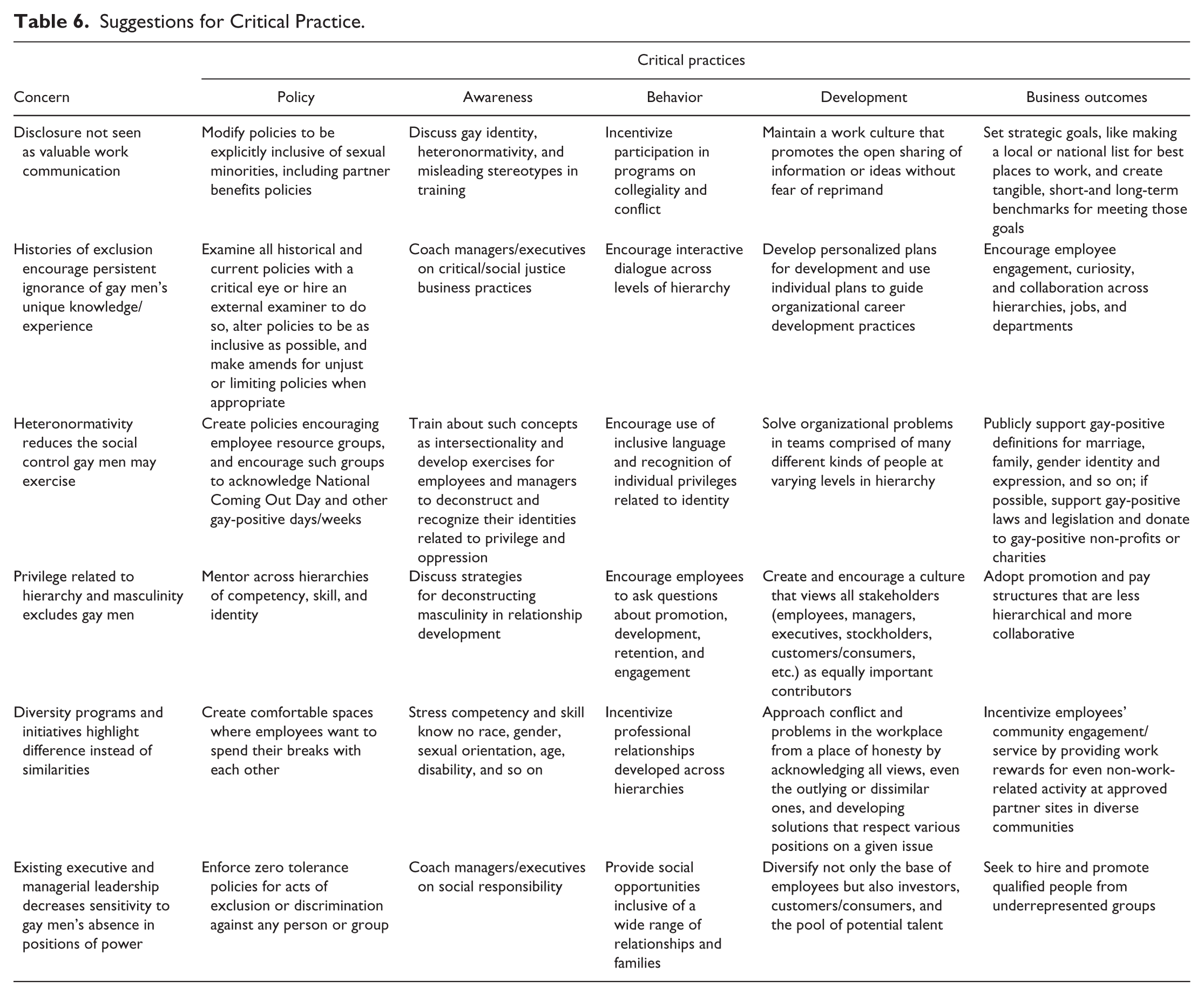
Masculinized industries represent a large and important part of the global economy. The function and purpose of these industries can range from crop and natural resource production to protecting national and international interests and freedoms through the law and military. Thus, to suggest or call for an overhaul or complete redesign of these industries is not logical or plausible. However, the characteristics identified in this study warrant a careful and critical examination of practices to improve the work lives of many different types of employees, including gay men. More than likely, these changes will take place slowly and will begin with industry leaders’ vocal support. Ultimately, the masculine, hierarchical, rule-orientated structures within these industries must be broken down. The implementation of more critical practices in the workplace could have a significant effect on stakeholders and even business outcomes such as employee engagement, productivity, and profitability. Critical practices aimed at addressing issues related to hegemonic masculinity in masculinized industries may be among the most important and influential suggestions stemming from this research, as standards for and perceptions of masculinity are salient to most of the potential issues gay men face at work in these industries. Table 6 provides some suggestions for more critical practices aimed at (a) increasing awareness, (b) changing behaviors, (c) creating and affirming a culture of development, (d) creating improved policies, and (e) promoting business outcomes.
Suggestions for Critical Practice.
Research
In providing a more comprehensive delineation of the characteristics of these industries, and in framing the term “masculinized” as more political than “masculine,” “male-dominated,” or “gendered,” this research supports the declaration that aspects of these industries remain underexplored. The use of the structured literature review (Rocco et al., 2003) to integrate these related literature sets opens up potential research into future trends and issues. For example, this research was not specific to any one masculinized industry. This provided an advantage in identifying characteristics across a variety of similarly structured contexts, but a comparable method might be used to explore issues in just one, specific industry or a select few. The theme and subtheme characteristics may be expanded upon/tested in future studies. In particular, future research on masculinized industries might explore in-grouping as a form of symbolic privilege and resistance to gay identities (homo-resistance) as a conscious and intentional act stemming in large part from arbitrary standards for the “ideal” man (hegemonic masculinity). Furthermore, qualitative explorations into what gay men have to say about hierarchy and implicit and explicit rules in masculinized rules could prove helpful in delineating the types of coping mechanisms that gay men use to find meaning and success in their work despite obstacles. Finally, inquiries into the disclosure process for gay men working in masculinized industries seems a particularly appropriate place to begin such research, as experiences with (non)disclosure for these men are likely to indicate various structures, ideals, networks, and cultural norms related to the overall experience of work.
However, the impact of this work extends beyond understanding and improving the experiences of gay men in these industries. Similar explorations might examine the characteristics presented in this study, or additional characteristics, in relation to other minority groups such as women, people of color, immigrants, and more. Furthermore, both empirical and conceptual research might aim to decipher potential differences in experience for these groups in masculinized industries, based on other factors such as geographic location, national identities, organizational demographics, and more.
Future research might also aim to expand on the present study by addressing some of the major limitations, namely, that gay men might also face similar struggles in feminized industries such as nursing (Harding, 2007) and hospitality (Guerrier & Adib, 2001). In fact, in these industries, ideals of masculinity and femininity are so the opposite of those in masculinized industries, that heterosexual men are sometimes assumed to be gay because of occupational choice (Guerrier & Adib, 2001; Harding, 2007). While feminized industries may tend to be more accepting of gay men, at times gay men in these industries report roadblocks and barriers based on sexual orientation, and straight men report being exposed to homophobia because of stereotypes (Harding, 2007). Exploring the differences in similarities between gay men’s experiences in masculinized and feminized industries might make for an exceptionally provocative line of new research. In addition, the present study limited was limited to work involving contexts in the United States, the United Kingdom, Australia, and Canada. However, it is important to acknowledge emerging work related to non-Western contexts, such as Ozturk’s (2011) analysis of sexual orientation discrimination in Turkey, which was included as a part of the initial sample of publications in this study but eventually eliminated. Excluding such work as Ozturk, while methodologically justifiable, is a serious limitation to the broad applicability of this research to additional geographic, social, and political spaces. Future research might explore the same issues in different national, international, or global contexts to address this limitation.
Researchers might aim to publish subsequent studies in journals with broader audiences than those with gender/women’s studies focuses, as taking these topics from the periphery and into the mainstream may create opportunities for change. In addition, research on masculinized industries should maintain a focus on exploring issues of power related to the more nuanced perspective of gender in these industries. While this research has focused on gay men, arguably other provocative exceptions to what we think we know about male-dominated and masculine work contexts exist.
Concluding Thoughts
This article explored the characteristics of masculinized industries by systematically examining the literature on male-dominated, masculine, gendered, and masculinized work contexts in relation to hegemonic masculinity, forms of homosexuality, and gay men’s unique positionality as provocative exceptions to male privilege and gendered rules. In doing so, several important issues were raised regarding privilege, masculinity, hierarchy, and limitation within these industries. Gay men’s work experiences in masculinized industries are likely differentiated from heterosexual men’s experiences because of outdated stereotypes regarding gay men and masculinity and industry cultures foundationalized on both heterosexist, implicit rules and discriminatory, explicit policies. Gay men’s experiences at work in masculinized industries should continue to be explored and articulated as both parallel to and divergent from the experiences of women, which have been researched and reported now for over three decades. Doing this will require moving past the gendered and sexualized binaries that influence the function of many of these industries in the first place. The characteristics of masculinized industries identified in this article direct us to think beyond such binaries to better the workplace for everyone.
Footnotes
Declaration of Conflicting Interests
The author(s) declared no potential conflicts of interest with respect to the research, authorship, and/or publication of this article.
Funding
The author(s) received no financial support for the research, authorship, and/or publication of this article.
Author Biography
References
Supplementary Material
Please find the following supplemental material available below.
For Open Access articles published under a Creative Commons License, all supplemental material carries the same license as the article it is associated with.
For non-Open Access articles published, all supplemental material carries a non-exclusive license, and permission requests for re-use of supplemental material or any part of supplemental material shall be sent directly to the copyright owner as specified in the copyright notice associated with the article.
