



Abstract
Numerous entangled definitions, words, measurements, and frameworks have been proposed when referring to employee engagement, as well as other engagement typologies. Consequently, researchers have routinely drawn atheoretical conclusions about the meaning of employee engagement, limiting the applicability of employee engagement in theory building and practice. The focal point of our work was to detail an explicit definition of employee engagement and juxtapose our definition alongside several existing frameworks and definitions. First, we detail and position an operational definition of employee engagement ground in seminal literature. Second, we systematically examine the engagement literature, highlighting both dominant types of engagement and alternative typologies. Third, we conclude by making meaning for the human resource development field, distinguishing the use of employee engagement in the literature as an outcome, psychological state, and process, and synthesize our findings through a brief discussion of implications for research and practice.
Keywords
The meaning of employee engagement remains conflated and confused. Challenges have emerged as scholars have applied a myriad of entangled definitions, words, measurements, and frameworks in their efforts around engagement, most of which developed through well-intentioned attempts at defining meaning and mapping conceptual differentiation (Shuck, 2011). While there is no established hierarchy of engagement-related terminology (e.g., job engagement, work engagement, organizational engagement, etc.), there is distinction. Scholars and practitioners have not, however, always exercised sensitivity to established terminology. As a consequence, researchers have routinely drawn atheoretical conclusions about the meaning of employee engagement (Keenoy, 2013), a construct that remains muddled despite decades of use in the literature (i.e., Saks & Gruman, 2014; Schaufeli, 2013). Consequently, employee engagement is misunderstood and, at times, misused. Misunderstanding and misuse have limited the applicability of employee engagement in theory building and practice as well as stifled the maturation of the construct in the human resource field.
The purpose of our work was to position a common meaning and refine the definition of employee engagement. We detail an explicit definition of employee engagement and juxtapose our definition alongside several existing frameworks and definitions (e.g., work engagement, job engagement, organizational engagement, intellectual social affective engagement, and collective organizational engagement). Our work unfolds in three main sections. First, we detail the long view of engagement and position an operational definition of employee engagement that builds from the literature, grounded in seminal work by Kahn (1990), Shuck and Wollard (2010), and Schaufeli, Salanova, González-Romá, and Bakker (2002). Second, using a two-staged review, we systematically examine the engagement literature, highlighting both dominant types of engagement (i.e., organizational engagement, job engagement, and work engagement) and alternative typologies (i.e., social engagement and collective organizational engagement). Throughout this review, we pair our proposed definition of employee engagement alongside each engagement type, discussing nuance and form. Third, we conclude this work by making meaning for the human resource development (HRD) field, distinguishing the use of employee engagement in the literature as an outcome, psychological state, and process, and synthesize our findings through a brief discussion of implications for research and practice. Ultimately, we take the position that employee engagement is a unique, stand-alone framework distinguishable from other engagement frameworks that, when appropriately used in the field, has the potential to be useful for both scholars and practitioners.
The Long View: Capturing the Phenomenon of Employee Engagement
Although the engagement field has a long view that is both wide and deep, few recommendations for theoretical development or practical implication consider the long-range viability of the construct, the psychological development of the experience, or its latent formation. Currently, there exists no unified definition of engagement (Schaufeli, 2013) or employee engagement (Shuck, Twyford, Reio, & Shuck, 2014). To move the long view of engagement forward—and position the meaning of employee engagement more clearly—research must distinguish the theoretical construct from its labels and measures. For example, Parker and Griffin (2011) emphasized this point when they lamented that “a measure should tap important aspects of [a] construct, but should not [come to] define the domain of research” itself (Parker & Griffin, 2011, p. 61). Following this guidance by Parker and Griffin, we focused effort toward the theoretical structure of the employee engagement construct first and second toward its measurement.
Because multiple frameworks of engagement existed, each with its own measurement and conceptual space (Shuck, 2011), choosing a definition or framework from existing literature would place inherent boundaries around our ability to explore the construct to its fullest. To avoid placing undue limitations on our exploration, we sought to propose an operational definition robust enough to cut across existing research yet wide enough to fully capture the phenomenon from various points of reference.
Establishing an Operational Perspective of Employee Engagement
Our first step in establishing an operational definition of employee engagement was (a) to examine common themes and unique theses among scholars spanning a wide range of academic literature on human behavior and (b) to collapse findings into a usable, descriptive form. Because employee engagement is a latent construct (Macey & Schneider, 2008), its theoretical formation remains dependent on developing a set of concepts and assumptions that have a common, agreed-upon meaning rooted in interpretation and observation (e.g., employees who are highly engaged are also more productive; Kerlinger & Lee, 1999). There was, however, little that was common and agreed upon in the employee engagement space; there remain many divisive perspectives. Notwithstanding these academic rifts, we believed that putting forth a common meaning through a collective interpretation would allow for accurate use in the field, both theoretically and empirically. When we noted points of division among scholars, we dug deeply into the literature to interpret the intended perspective of the scholar(s), which led us to a set of concepts and assumptions from which we could ground a common meaning. We understand that not all points we highlight will be universally agreed upon, yet we suggest that common meaning and understanding are not precluded by academic difference and curiosity. Such discourse remains essential for employee engagement to continue its natural maturing in the field.
As a starting point for common understanding, the original research on the construct of engagement is often credited to Kahn’s (1990) theory of personal engagement, so we began with his seminal study. Christian, Garza, and Slaughter (2011) noted that across engagement research, the issues of a pull toward “performance of work tasks” and “self-investment of personal resources” (p. 91) were most salient to understanding engagement when grounded in Kahn’s work. Accordingly, any operationalization of employee engagement should involve an active pull forward toward performance in proportion to that investment of personal resource (Kahn, 1990). Most definitions across the field of engagement are in general agreement with this nuance (although we note that none specifically include the term active as a descriptor but do utilize terms such as proactivity, focus, and initiative; cf. Parker & Griffin, 2011; Schaufeli, Maassen, Bakker, & Sixma, 2011). As a further point of agreement, engagement has been reliably understood as an active state, not a passive condition. The term active connotes the energy of engagement as forward moving rather than being stationary (Biggs, Brough, & Barbour, 2014).
While there is general agreement about the active nature of employee engagement, discussion about state engagement and trait engagement remains a contested matter. A handful of researchers have explored engagement as trait (Langelaan, Bakker, Van Doornen, & Schaufeli, 2006; Wildermuth, 2008), trait-related affect (Dalal, Baysinger, Brummel, & LeBreton, 2012), or specifically as a trait embedded within a state, where dispositional traits shade in-the-moment mood affect (trait-related; Macey & Schneider, 2008). Many more have ignored or chosen not to enter the discussion at all, yet this distinction is an important determinant for developing a set of concepts and assumptions for agreed-upon meaning. Defining engagement as a trait or trait-like implies stability within individuals across both time and context. This specific positioning of engagement is referred to as trait engagement (Macey & Schneider, 2008). While there exists research examining the implications of state affect versus trait affectivity (e.g., Brief & Weiss, 2002; Thoresen, Kaplan, Barsky, Warren, & de Chermont, 2003), we could locate no empirical studies looking at state engagement versus trait engagement. The term trait, however, has implications for the limits of employee engagement. For example, Wildermuth (2010) suggested that underlying personality characteristics such as neuroticism, extraversion, and conscientiousness (Five Factor Model; Judge, Heller, & Mount, 2002) could predispose some employees to be more likely to be influenced by experiences of engagement than others. Further studies by Rich (2006) and Langelaan et al. (2006) supported the possible impact of personality traits on engagement. If employee engagement is trait-based (e.g., only people with certain traits are able to experience full engagement), the experience of engagement could be framed as a matter of innate disposition. To the extent a work environment shapes perceptions of the job, we might also argue that trait engagement likely exerts at least some indirect effect on how employees interpret their surroundings and consequently take action, but not all. The extent of the amount of explained variance between personality traits and engagement is, however, highly debatable and shows insufficient empirical evidence for theoretical justification (Thoresen et al., 2003). Engagement is unlikely to be fully limited by any one trait or disposition. Taking into account our interpretation of this area of the engagement literature, we propose that employee engagement is more state-like than trait based.
Connected to the state nature of employee engagement are the concepts of stability and persistence. Based on our reading of the literature, we believed that the psychological experience of employee engagement, while flexible enough for moment-to-moment flux and variation, ultimately builds or erodes over time (e.g., a cumulative effect). Under general working conditions, the experienced phenomenon of employee engagement is not a singular interaction (in either direction) to any one circumstance (Xanthopoulou, Bakker, & Ilies, 2012). We grounded this interpretation in research demonstrating that the persistence of an individual’s state of engagement over time stems from the meaning that work or job activities have for an individual (Xanthopoulou et al., 2012). Moreover, scholars have reliably suggested that meaning naturally ebbs and flows in maintenance, intensity, and direction based on context (Bledow, Schmitt, Frese, & Kühnel, 2011; James, McKechnie, & Swanberg, 2011; Kahn, 1990). In agreement with Purcell (2014) and Newman and Harrison (2008), who cautioned that authentic forms of engagement cannot be the manifestation of overly expected and exploitive work outcomes, we maintained that employee engagement involves not heightened levels of work intensification but rather a momentary state depicted by an intensity of energy directed toward a work target within a context that an individual experiences as meaningful (Brown & Leigh, 1996; James et al., 2011; Kahn, 1990).
The latent formation of employee engagement and how the experienced construct develops is another point of discussion in the employee engagement literature. As Kahn (1990) aptly noted, employees bring a full range of cognitive, emotional, and physical energies into their work roles that combine to express the full experience of being engaged. A few researchers have noted elements of cognition and emotion that make up the general focal point of employee engagement in practice (Xanthopoulou et al., 2012), while others have focused exclusively on behavior. Few scholars, however, have examined cognitive, emotional, and physical energies as separate subconcepts, leaving an important aspect of the formation of employee engagement underdeveloped. As an example, the burnout perspective (cf. Schaufeli, Bakker, & Salanova, 2006; Schaufeli et al., 2002), one of the four major perspectives of engagement (Shuck, 2011), takes for granted the formation of work engagement by suggesting that the experience of being engaged is the antipode to burnout (Schaufeli et al., 2006). The burnout perspective used one definition—namely, burnout—to shed light on another definition—work engagement—with little regard to the formation of the experience or theoretical rationale for the interrelated subconcepts (e.g., vigor, dedication, and absorption).
In contrast, for employee engagement to be a usable and distinct concept, the interrelation of subconcepts should be examined to get at the question of formation and provide an order sequence for substantial intraconstruct relationships. To ground our interpretation in a common, agreed-upon set of concepts and assumptions, scholars have routinely suggested that the formation of employee engagement is at the individual level (Shuck, Adelson, & Reio, 2016; Shuck & Wollard, 2010) and the manifestation of employee engagement expressed cognitively, emotionally, and eventually through manifestation of behavioral intention (for detailed reviews of the latent formation of employee engagement, cf. Saks & Gruman, 2014; Shuck, Adelson, & Reio, 2016; Shuck & Reio, 2014; Shuck & Wollard, 2010; Soane et al., 2012). Relevant to the formation of employee engagement, several studies (e.g., James et al., 2011; Shuck, Reio, & Rocco, 2011) have correlated conditional antecedents to the state of engagement but have so far provided insufficient descriptions of those psychological processes. Most definitions are devoid of a descriptive reference regarding the actual psychological formation of the state of engagement or any sequencing order. When it comes to employee engagement, we aligned with Shuck, Adelson, and Reio (2016) and Shuck and Wollard (2010), who proposed that experiences of cognition and emotion were important expressions of the experience and highlighted a certain set of assumptions that seemed to be routinely overlooked. We noted that expressions of cognition and emotion are appraisals connected to both lived and future-expected experiences used in the development of schema that inform decision making about in-the-moment behavior. Appraisal is defined as an individual assessment regarding the impact of the current environment connected to future behavior (Lazarus, 1982, 1984; Nimon & Zigarmi, 2014). Tzeng (1975) suggested that appraisals about any context (e.g., work or otherwise) occur within a systems framework that considers multiple perspectives of information simultaneously. Grounded in common understanding, appraisals about engagement within a working context contain both cognitive and affective appraisals that influence a behavioral outcome. Cognitive appraisals ascribe meaning and value, whereas affective appraisals direct the maintenance, intensity, and direction of energy toward a target (Shuck, Adelson, & Reio, 2016).
Affective appraisals are in constant fluctuation, dependent on continuous monitoring of cognitive cues from context-to-context and moment-to-moment (e.g., the ebb and flow of meaningful experiences). The two are bidirectional and interdependent, each appraisal relying on the other, developing toward purposeful and intentional work behavior (Barrick, Mount, & Li, 2013; Barrick, Thurgood, Smith, & Courtright, 2015). While these two types of appraisals are interdependently informative to the behavioral aspects of employee engagement, we believed that cognitive appraisals served a primary function that influenced the target of emotion and that affective appraisals served a primary function to the eventual behavioral aspect of employee engagement. This positioning honors the interdependency as well as the in-the-moment flux of each subconcept, yet offers a sequence for how the latent function of employee engagement develops and gives clues to how the experience could be stimulated in practice (i.e., cognition → emotion → behavior). Post-behavior, the employee engagement process does not remain static; the cycle is in constant monitoring, where information regarding behavioral contexts resulting from manifestation are monitored and socioemotional and physical environmental feedback are looped into newly forming cognitive appraisals that ascribe a continuous flow of meaning and value. This process continues through a cumulative building and a reciprocal affect which guide the experience of an employee being engaged (or disengaged, nonengaged, or other synonyms that describe employees who may or may not like their work(ing) context, all of which are beyond the scope of this work). This description and sequence is in agreement with and supported by scholarship in similar domains through the theories of reciprocity (Černe, Nerstad, Dysvik, & Škerlavaj, 2014) and social exchange (O’Boyle, Forsyth, Banks, & McDaniel, 2012).
While most scholars agree that being an engaged employee includes elements of cognition and emotion (although none have advocated for an order, or a description of the formation such as the one proposed in the preceeding paragrah; cf. Rich, Lepine, & Crawford, 2010; Saks & Gruman, 2014; Schaufeli, 2013), few agree on its physical manifestation, which has contributed, in our opinion, to the fallacy of defining employee engagement explicitly as an observable outcome (e.g., organizational citizenship behaviors, discretionary effort, actual turnover, working faster; Newman, Joseph, Sparkman, & Carpenter, 2011). Within our understanding of the psychological formation of the construct, we maintain that employee engagement cannot be an observable outcome if it is a latent state (Schaufeli, 2013). Intention and behavior may co-occur but cannot co-materialize simultaneously as the same thing. Behavioral outcomes (i.e., what some scholars refer to as behavioral engagement; cf. Macey & Schneider, 2008; Saks, 2008, for detailed information) occur only after a psychologically grounded intention to act is formed (Zigarmi & Nimon, 2011). Actual, observable behavior must be distinguished from intention. Employee engagement concerns a forward moving intention of energy, but it is not the physical, observable behavior itself (Parker & Griffin, 2011).
Definition of Employee Engagement
Grounded in our reading and interpretation of common themes and our assumptions regarding the divisive issues that have plagued the construct, we operationally defined employee engagement as a positive, active, work-related psychological state operationalized by the maintenance, intensity, and direction of cognitive, emotional, and behavioral energy. This definition is well connected to the original definition of employee engagement proposed by Shuck and Wollard (2010) as well as emerging work by Nimon, Shuck, and Zigarmi (2015); Shuck, Nimon, and Zigarmi (2016); and Shuck, Adelson, and Reio (2016). Next, we turn attention to exploring those differences and similarities between employee engagement and other engagement-like frameworks noted throughout the research literature.
An Overview of the Engagement-Type Literature
Many labels have come to represent frameworks of engagement in the job, at work, or with an organization. While we have offered a definition of employee engagement, we note that scholars have used the terms organizational engagement, job engagement, and work engagement, as well as alternative types of engagement frameworks such as collective organizational engagement to contextualize an emerging understanding of what engagement is, where it should be focused, and how it should be applied. Such terms have been used interchangeably with employee engagement (both intentionally and unintentionally), and while these terms sound similar, their application has embedded subtle and important nuances that differentiate each term in both theory and practice.
To identify relevant literature for further examination, we undertook a two-staged review to classify those works that encapsulated each distinguishable area of engagement. Specifically, we focused our effort on identifying literature around organizational engagement, job engagement, and work engagement as they have represented the three dominant strands of engagement theory to date (Shuck, 2011; Shuck, Adelson, & Reio, 2016). We also captured other uses in the field, including emerging alternative engagement frameworks. To do this, first we employed a seminal works audit to identify research studies or position papers that have come to define and/or stimulate additional work in the field around either organizational engagement, job engagement, or work engagement (cf. Shuck & Wollard, 2010). Seminal papers were identified as those works that significantly influenced the scholarly community’s body of knowledge (see Table 1). Second, we applied chain-sampling methodology (Biernacki & Waldorf, 1981), a commonly used sampling technique in sociology, to identify research that had been influenced by the identified seminal works. This process allowed our team to map a construct’s continued development in the field. We started with those authors recognized in Shuck and Wollard (2010) because their work had previously identified the major seminal works and branched out from there using several databases, including PsycINFO, ABI/INFORM, ProQuest, and JSTOR. Our search was conducted in mid-2016 and was limited to peer-reviewed journals or scholarly books. 1
Historical Definitions of Engagement Types.

In the following sections, we detail the prevailing literature around the major engagement frameworks. The major frameworks we explored were organizational engagement, job engagement, and work engagement, as well as two alternative frameworks of engagement, intellectual, social, and affective (ISA) engagement and collective organizational engagement. For each, we interpret and contextualize their use in the literature using the employee engagement definition we proposed as a common, agreed-upon meaning.
Organizational Engagement
Organizational engagement was defined by Saks (2006) as “the extent to which an individual is psychologically present in a particular organizational role” (p. 604). Our review of the organizational engagement literature revealed a collage of different engagement-type labels. For example, in his original work, Saks (2006) used the term employee engagement as a primary term yet labeled employee engagement as the combination of two secondary terms—job engagement and organizational engagement—entangling the three ideas, all of which have different meanings (cf. Table 1). Saks (2006) did not define employee engagement in his early work (or his later work, including Gruman & Saks, 2011, or Saks & Gruman, 2014), offering a general definition of both job and organizational engagement as “participant’s psychological presence in their job and organization” (Saks, 2006, p. 608). This lack of definitional clarity has contributed to the early and continued confusion around the use and application of the organizational engagement and employee engagement terms.
One of the possible reasons for such entanglement under the organizational engagement framework has been the blending of research on different frames of engagement to support the development of another type (as noted previously with work engagement and burnout). For example, in our review of the literature, we found two studies that explicitly mentioned organizational engagement (cf. Esen, 2012; Mahon, Taylor, & Boyatzis, 2014). In both, literature on employee engagement and job engagement, not the development of an organizational engagement framework, were utilized as primary sources to provide support for numerous organizational engagement–focused hypotheses (Esen, 2012; Mahon et al., 2014). The use of employee engagement literature or other types of engagement literature within the organizational engagement literature is not necessarily always inappropriate, but it is confusing when scholars do not define clear boundary lines. We might expect research on similar constructs to be used for support on similarly focused ideas, and this has certainly been the case in other areas of construct development where a construct is defined as multidimensional and/or multifocused (i.e., commitment research, job attitudes, leadership, etc.). Notwithstanding, parallel to providing support for construct development, we would argue that terms should be distinctly defined and further developed when they are used in practice. The indistinguishable definitional and conceptual overlap between organizational engagement and other types of engagement (including employee engagement) shows how different engagement terms have been used improperly in scholarship. As further examples of how organizational engagement and employee engagement are used indistinguishably, we located several examples where the terms employee engagement, work engagement, and organizational engagement were presented interchangeably (cf. Juhdi, Pa’wan, & Hansaram, 2013; Mahon et al., 2014), as well as one instance where job engagement was ultimately positioned under the umbrella of organizational engagement (Esen, 2012).
The descriptions of organizational engagement provided in the studies we reviewed appeared to share overlaps with our definition of employee engagement and thus serve as another explanation for the terms’ interchangeability and confusion. As noted earlier, employee engagement is comprised of four central elements: (a) an active pull, (b) state-based, (c) increased levels of energy preceding the full state, and (d) experiences of the conditions of work that inform the maintenance, direction, and intensity of being engaged. In parallel, each of the organizational engagement studies we located described organizational engagement as a state-based framework (Esen, 2012; Juhdi et al., 2013; Mahon et al., 2014), and in two out of three studies, organizational engagement was characterized as an active pull (Esen, 2012; Juhdi et al., 2013). Consequently, in studies where the description of organizational engagement shares half of the elements that comprise our proposed definition of employee engagement, it is understandable why the terms might be confused or substituted. It is important to remember, however, that organizational engagement is focused toward an employee’s psychological presence with the organization—a decidedly narrower view of the employee engagement construct—and, thus, is not a suitable alternative (cf. Shuck, Adelson, & Reio, 2016).
Last, while there remains significant definitional confusion regarding organizational engagement, the measurement and operationalization of the framework are quite clear. All of the studies we located that used the term organizational engagement also used Saks’s (2006) Organizational Engagement Scale (or some adopted version) to measure organizational engagement (Esen, 2012; Juhdi et al., 2013; Mahon et al., 2014).
Job Engagement
Job engagement was defined as a “multi-dimensional motivational concept reflecting the simultaneous investment of an individual’s physical, cognitive, and emotional energy in active, full work performance” (Rich et al., 2010, p. 619). The unique characteristic of job engagement is, specifically, the focus of energy in active, full work performance toward the job. For example, despite the term work in the definition, in the Job Engagement Scale (JES; Rich et al., 2010) participants are asked a series of questions that require focus on the job context (i.e., I work with intensity on my job and I am excited about my job [italics added for emphasis]). Notwithstanding use in the field, no definition of job engagement indicated this narrow focus, nor was there a more general descriptor of how job engagement should be defined beyond the context of work. Rather, almost every article reviewed grounded their description of job engagement on previous research that captured some psychological experience from another form of engagement. As we read, we noticed an emergent pattern that suggested certain studies as having seminal-type influence in the understanding and application of job engagement (e.g., work engagement). For example, more than half of the studies we reviewed on job engagement (n =11) presented the Schaufeli et al. (2002) research as their definition of job engagement (Anaza & Rutherford, 2012; Bakibinga, Vinje, & Mittelmark, 2012; Gan & Gan, 2014; Jung & Yoon, 2015; Lauring & Selmer, 2015; Meng & Wu, 2015; Sardeshmukh, Sharma, & Golden, 2012; Setti & Argentero, 2011; Warr & Inceoglu, 2012; Wefald, Mills, Smith, & Downey, 2012; Yuan, Li, & Tetrick, 2015). Other studies grounded their definition of job engagement in lesser known work by Schaufeli and colleagues from 2001, 2004, 2006, and 2011 to define job engagement (Lu & Guy, 2014; Tziner & Tanami, 2013; Vinje & Mittelmark, 2007). Three of the studies reviewed (Chen, Yen, & Tsai, 2014; Hernandez, Stanley, & Miller, 2014; Inceoglu & Warr, 2011) referenced no work by Schaufeli in their attempt to describe job engagement, but cited Kahn (1990), Rich et al. (2010), Macey et al. (2009), and Bakker and Leiter (2010), instead. In short, within the last decade, 14 out of the 19 articles on job engagement we reviewed cited Schaufeli and his colleagues in an effort to provide a descriptor of job engagement. 2
To that point, we identified a wide range of methods and scales used to operationalize the job engagement framework. Many of the studies reviewed used the Schaufeli et al. Utrecht Work Engagement Scale (UWES) or some variation (Gan & Gan, 2014; Jung & Yoon, 2015; Lauring & Selmer, 2015; Lu & Guy, 2014; Meng & Wu, 2015; Setti & Argentero, 2011; Tziner & Tanami, 2013; Wefald et al., 2012; Yuan et al., 2015). Other scales that were utilized included Saks’s (2006) Organizational Engagement Scale, the Rich et al. (2010) JES, and Britt’s (1999) six-item Engagement Scale (Anaza & Rutherford, 2012; Chen et al., 2014; Sardeshmukh et al., 2012). Three studies developed specific measures of job engagement (Inceoglu & Warr, 2011; Rich et al., 2010; Warr & Inceoglu, 2012); however, two of these studies (Inceoglu & Warr, 2011; Warr & Inceoglu, 2012) based the development of their scales on work by Schaufeli and his colleagues rather than on Rich et al. In addition, two studies measured job engagement using qualitative, open-ended questions (Bakibinga et al., 2012; Vinje & Mittelmark, 2007), a unique, rare incidence of qualitative methodology applied to engagement research. Most of the studies appeared to rely on elements of work engagement in their conceptualization of job engagement. Overall, 11 of the 19 studies either directly used work engagement scales or developed scales grounded in the work engagement literature to measure job engagement. This is despite the fact that Rich et al. put forward a psychometrically robust measure of job engagement (e.g., JES) in addition to the Saks (2006) measure of job engagement.
The influence of Schaufeli and colleagues’ work on job engagement suggested that the elements of engagement developed in their original research on work engagement remained central to the foundation of the job engagement construct. Relying on the work by Schaufeli and his colleagues as a foundation for job engagement research, however, presents a serious challenge for the job engagement construct. Specifically, the engagement elements noted by Schaufeli and colleagues have been distinctly defined as work engagement, which should be, and is different from, job engagement (for empirical details of this distinction, see Nimon et al., 2015). Rich et al. (2010) parted ways early with Schaufeli and instead grounded their work in Kahn’s (1990) original conceptualization of personal engagement, a decidedly different framework altogether (Shuck, 2011).
The natural expectation following the emergence of the Rich et al. (2010) research would have been for studies conducted after 2010 to utilize such a well-grounded and sound measure. Notwithstanding, of the 11 studies reviewed post-Rich et al. that positioned job engagement as a major focus of their work, only one study (Chen et al., 2014) used the Rich et al. measure of job engagement. The remaining 10 used Saks’s (2006) organizational engagement measure or the Schaufeli et al. (2002) Work Engagement Scale (Anaza & Rutherford, 2012; Gan & Gan, 2014; Jung & Yoon, 2015; Lauring & Selmer, 2015; Lu & Guy, 2014; Meng & Wu, 2015; Setti & Argentero, 2011; Tziner & Tanami, 2013; Wefald et al., 2012; Yuan et al., 2015).
Work Engagement
Work engagement was defined as a positive, fulfilling, work-related state of mind characterized by vigor, dedication, and absorption (Schaufeli et al., 2002). The unique focus of work engagement is toward work and work-based activity. The breadth of research using work engagement as a major focus is enormous yet quite streamlined in comparison with the literature on other engagement types. While organizational engagement, job engagement, and other frames of engagement have endured conceptual muddling (Saks, 2008), work engagement has not. This is perhaps due in part to a landmark article by Bakker, Schaufeli, Leiter, and Taris (2008) that positioned work engagement as a separate framework and as appropriately measured using the UWES. In their 2008 article, Bakker et al. clarified what work engagement was and resultantly, the Schaufeli et al. (2002) original research on work engagement remained widely used in the field. In our attempt to delineate work engagement from the other engagement frameworks (a confusion that developed post-2008 due to the emergence of other engagement-like frames; see Macey & Schneider, 2008; Saks, 2006), we considered three major subfocal points of the work engagement literature in our sampling 3 : (a) definition(s) of work engagement, (b) key scholarly reference points, and (c) scales of measurement.
In our review, 15 out of 26 studies used the Schaufeli et al. (2002) definition of work engagement (Alarcon & Lyons, 2011; Bakker et al., 2008; Bargagliotti, 2012; Chaudhary, Rangnekar, & Barua, 2012; Costa, Passos, & Bakker, 2014; de Lange, De Witte, & Notelaers, 2008; Ditchburn & Hames, 2014; Extremera, Sánchez-García, Durán, & Rey, 2012; Hakanen, Schaufeli, & Ahola, 2008; Hallberg, Johansson, & Schaufelt, 2007; Hopkins & Gardner, 2012; Keyko, 2014; Mäkikangas, Feldt, Kinnunen, & Tolvanen, 2012; Poon, 2013; Shih, 2012). Seven studies (Buse & Bilimoria, 2014; Chughtai & Buckley, 2008; Garrick et al., 2014; Jacobs, Renard, & Snelgar, 2014; Moura, Orgambídez-Ramos, & Gonçalves, 2014; Munir et al., 2015; Poulsen, Poulsen, Khan, Poulsen, & Khan, 2011) presented the same definition of work engagement but referenced later work by Schaufeli and his colleagues (i.e., Schaufeli & Bakker, 2003, 2004, 2010), and three studies used Kahn’s (1990) conceptualization of engagement to describe work engagement (De Villiers & Stander, 2011; Diedericks & Rothmann, 2013; Li, 2015). Of the studies we reviewed, only one failed to provide a clear definition or conceptualization of work engagement (cf. Oude Hengel, Blatter, Joling, van der Beek, & Bongers, 2012). The review of these studies suggested that the definition of work engagement had remained consistent over the past decade. That is, work engagement was overwhelmingly characterized as vigor, dedication, and absorption as presented by Schaufeli et al. (2002).
In relation to the stability of definitions, our review suggested that the main scholarly focal points used to undergird the work engagement framework had remained steady over the past decade. By scholarly focal points, we refer to those key studies and/or research streams that appeared most frequently in citing the work engagement framework and that could be considered seminal. As evidenced through the studies reviewed, Schaufeli, Bakker, and their colleagues are represented in almost every research study on work engagement. This would imply that their original works in the early- to mid-2000s formed the accepted foundation of work engagement. By our count, Schaufeli et al. (2002) and Schaufeli and Bakker (2004) are the most cited sources specifically using the term work engagement.
The third and final subfocal point that guided our review of the work engagement literature was the identification of those scales of measurement used in work engagement research. While other engagement frameworks muddle measurement operationalization, this was not at all true for the work engagement framework. We found that the UWES developed by Schaufeli et al. (2002) was by far the most widely used scale to operationalize work engagement (Alarcon & Lyons, 2011). While other engagement frameworks suffer from a tangle of measurement application, the UWES does not. The relative consistency of measurement, scholarly reference points, and definition for work engagement appears to clearly distinguish work engagement from other frames of engagement, despite the rapid growth of engagement research.
Alternative States of Engagement Types
In addition to the aforementioned dominate engagement frameworks, two additional frameworks of engagement-focused research have developed. We label these alternative frameworks because their use in the research literature is just beginning and thus is limited to only a handful of studies across the entire spectrum of engagement-focused research. First, we detail the ISA framework of engagement followed by collective organizational engagement.
The ISA (Soane et al., 2012) framework of engagement is a condition-oriented construct, focused toward social engagement, an often overlooked and relational component of the engagement-type experience (Kahn & Heaphy, 2014). In a departure from traditional engagement-type states, Soane and colleagues proposed that engagement had a collective social aspect, that is, the ways in which employees interacted with the social environment (i.e., colleagues, peers, other stakeholders) impacted the experience of engagement in work. Grounded in the work of Jackson, Colquitt, Wesson, and Zapata-Phelan (2006), Soane et al. (2012) presented the notion that engagement was a collective experience, shared among others in the formation of that experience, a decidedly innovative application (see Soane et al., 2012, for additional details).
Barrick et al. (2015) introduced the notion of collective organizational engagement. Collective organizational engagement was defined as “shared perceptions of organizational members that members of the organization are, as a whole, physically, cognitively and emotionally invested in their work” (Barrick et al., 2015, p. 113). In their model, they integrated resource management theory (i.e., job-demands resources model) alongside developing engagement theory. This work has been applied largely in supporting empirical work using a different frame of reference (cf. Bailey, Madden, Alfes, & Fletcher, 2015; we note that they used the term employee engagement) as well as emerging empirical approaches (Barnes, Lucianetti, Bhave, & Christian, 2015). While Barrick et al. detailed their methodological approach, no study had yet adopted their framework.
Discussion and Making Meaning for HRD
The various engagement frameworks reviewed throughout this work appear to have an identity crisis. It is clear that terms associated with engagement frameworks remain clouded and misused, routinely, and this includes the employee engagement framework. Grounded in our review, we make meaning and detail two points of discussion related to employee engagement: (a) definitions used for labeling engagement frameworks and (b) the positionality of engagement in research.
Definitions Used for Labeling Engagement Frameworks
First, definitionally speaking, the misuse and offhanded interchanging of terms continues to confuse, not only the meaning of employee engagement (the focal framework of this article) but also job engagement, work engagement, and organizational engagement (and other types), and this should stop. For example, as many other scholars have done, Alarcon and Lyons (2011) presented Macey and Schneider’s (2008) conceptual model as work engagement and referred to Saks’s (2006) research as focused on work engagement (instead of job, organizational, or employee engagement) while measuring work engagement using UWES from Schaufeli et al. (2006). Other scholars have used the terms employee engagement and work engagement synonymously within the same article in addition to citing employee engagement literature such as Shuck and Wollard (2010) to provide support for work engagement claims (cf. Moura et al., 2014; Poon, 2013). In addition, there remain occurrences where work engagement research is presented using the umbrella term engagement grounded in Kahn’s (1990) conceptualization, using unfamiliar, psychometrically unproven scales of work engagement that present little or no review of seminal work engagement literature (cf. De Villiers & Stander, 2011; Diedericks & Rothmann, 2013; Li, 2015; Oude Hengel et al., 2012).
Buse and Bilimoria (2014) suggested that resultantly the discussion of engagement in academic literature is confusing and, based on our study of the aforementioned literature, we agree. Moreover, in their work, and as we have also pointed out, they noted that several definitions of engagement are often preceded with one of three modifiers—employee, work, or job—with little to no distinguishing characteristics (Buse & Bilimoria, 2014). This is evidenced repeatedly in reams of engagement research. We would add that part of the problem also has been the blatant misuse of terms and the unwillingness of researchers to use terms in the way they were intended (and developed in seminal works). For example, while scholars and practitioners claim to be confused about what engagement is, we were able to identify distinguishable literature streams that uniquely ground each framework of engagement. These streams should be used. In some cases, the confusion reported by scholars seems to be purposeful and designed to allow researchers to choose frameworks of convenience and availability without doing the hard work of adequately identifying the correct engagement framework they intend to use. It is easy to simply deny understanding and then present a new framework, but frameworks do in fact exist and should be used. If a scholar is willing to study the literature, it is possible to identify solid grounding in coherent lines of research, no matter what your chosen engagement framework may be. In other cases, this overlap and interchangeability seems idiosyncratic. Our intent has been to draw attention to this interchangeability practice and to point out how it contributes to confusion in the field. Within the engagement literature, there remains a lot of academic white noise and disconnected research that must be examined. Academic white noise is defined as that research containing overt conflation of a construct that intentionally drowns out an intended and purposeful message.
To assist researchers with easily following streams of work, we offer readers Table 1, which lays out each engagement framework, gives its definition as identified by the seminal work, and provides a root seminal citation. We offer this table as a means to provide scholars and practitioners an accessible layout of the engagement research without weeding through the mountain of literature and white noise within each. We would encourage those who choose to use a specific type of engagement framework to stay with that theoretical strand. For example, it would not be appropriate to use Schaufeli’s definition, the framework from Shuck et al. (2014), and the JES from Rich et al. (2010). Rather, if scholars choose to use the UWES as their measurement tool, they should also use Schaufeli’s definition and conceptual framework. If, however, they do not like Schaufeli’s definition and would rather use the Rich et al. job engagement definition, it would be inappropriate to then deploy the UWES. But, we contend, this happens all the time, and such misuse contributes to the confusion of engagement. Now that we have outlined and identified the prevailing literature, scholars should be encouraged to stay within the bounds of their chosen framework and play nicely.
More deeply focused toward the employee engagement framework specifically, our review would lead us to believe that employee engagement is distinct. This is due in part to the maturing of engagement as a psychological phenomenon and the vetting processes that have occurred throughout the academic literature bases. Using work engagement as an example, prior to the landmark article by Bakker et al. (2008), there remained confusion in the literature about how to conceptualize work engagement (i.e., opposite of burnout or as a separate framework on its own; Chughtai & Buckley, 2008). Moreover, it was not clear whether work engagement (and the phenomenon of engagement in general) was different from constructs such as job satisfaction and organizational commitment (Buse & Bilimoria, 2014). Both of these debates remain hotly contested today as they relate to work engagement (and employee engagement); however, empirical distinction has grown (cf. Nimon et al., 2015; Shuck, Adelson, & Reio, 2016). The explicit measurement of work engagement may not have been as immense an issue as it is for employee engagement given the popularity of the UWES, but, as we have detailed, other scales pre-Bakker et al. were often used to measure work engagement, including the Work Engagement Scale (May, Gilson, & Harter, 2004) and Burnout Inventory (Maslach, Jackson, & Leiter, 1997). Prior to Bakker et al., there was definitional and measurement muddling. Post-Bakker et al., work engagement came into focus as a separate framework that, when used properly, is measured using the UWES. Not until the eruption of engagement research a few years later did a resurgence of confusion ensue (cf. Shuck & Wollard, 2010). The boom of engagement research post-Bakker et al., starting in 2010 (e.g., Rich et al., 2010; Shuck et al., 2011), saw the introduction of different engagement frameworks that began to re-entangle the meaning and measurement of work engagement, adding considerable turbulence to the confusion.
Employee engagement appears to be in a similar space. In 2010, Shuck and Wollard introduced an emergent definition of employee engagement (see Table 1); however, no theoretical structure or measurement tool existed at that time. This was severely limiting, but scholars continued to apply the term across research strands. Pre-Shuck and Wollard (2010), no definition of employee engagement had been offered and confusion about how to conceptualize it remained problematic. Post-Shuck and Wollard, within some fields of practice (e.g., HRD), there was growing clarity in how to define employee engagement. Alongside work such as Kataria, Rastogi, and Garg (2013); Kerns (2014); Rana, Ardichvili, and Tkachenko (2014); Shuck and Reio (2011); Shuck, Shuck, and Reio (2013); Shuck et al. (2014); and Soieb, Othman, and D’Silva (2013), momentum has built toward a clearer conceptual and distinctive understanding of employee engagement.
Furthermore, we note that the contemporary emergence and conceptualization of work engagement have bled into the employee engagement space, causing recent issues. That is, scholars who are clearly using a work engagement framework and measurement perspective are simultaneously using the term employee engagement (cf. Bargagliotti, 2012). We noticed that, in later research, the conceptualization of work engagement had again resurfaced as the opposite of burnout (cf. Buse & Bilimoria, 2014; Extremera et al., 2012; Mäkikangas et al., 2012; Munir et al., 2015; Poulsen et al., 2011; Shih, 2012), and not as a framework on its own (Bakker et al., 2008), causing added confusion, particularly when labeled as employee engagement.
To be as clear as possible, in this work we have built on the work by Shuck and Wollard (2010), yet we offer a more precise contemporary definition of employee engagement in addition to proposing a set of (testable) concepts and assumptions that have a common interpretation about the latent formation of the construct, as well as details on the sequence and interrelationships of subconcepts. To this point, we cut through the white noise of engagement, by way of precision and theoretical standing, and we offer the community of scholars and practitioners a solid ground on which to stand. This distinguishes employee engagement from other engagement constructs (i.e., work engagement, job engagement, etc.) as detailed throughout our review. Our position is that this framework of employee engagement is distinct and should be defined and used as such. We believe the definition we offer can help clear up the confusion of employee engagement by explicitly defining it and providing a clear theoretical structure for use in research and practice. Beyond defining employee engagement, we have endeavored a passionate plea for scholars and practitioners to be consistent in their language, common understanding, and clear assumptions. Readers may not like, or agree with, what we have proposed; however, we have offered a definition, an explanation of how we came to conclusion about that definition, and explored the application of that definition in some context. We also note (and point interested readers to) the recent development of the Employee Engagement Scale (cf. Shuck, Adelson, & Reio, 2016), a measurement tool grounded within the definitional and conceptual positioning of employee engagement offered throughout our review.
It is possible that more conversations are needed to further clarify our position, as well as create space for the position of others. A meeting of scholars could be fruitful, but for now, there is some common understanding and set of assumptions to guide scholars and practitioners when they are studying employee engagement. To be sure, we would welcome that constructive discussion, which leads us to the issue of positionality of engagement in research.
Positionality of Engagement in Research
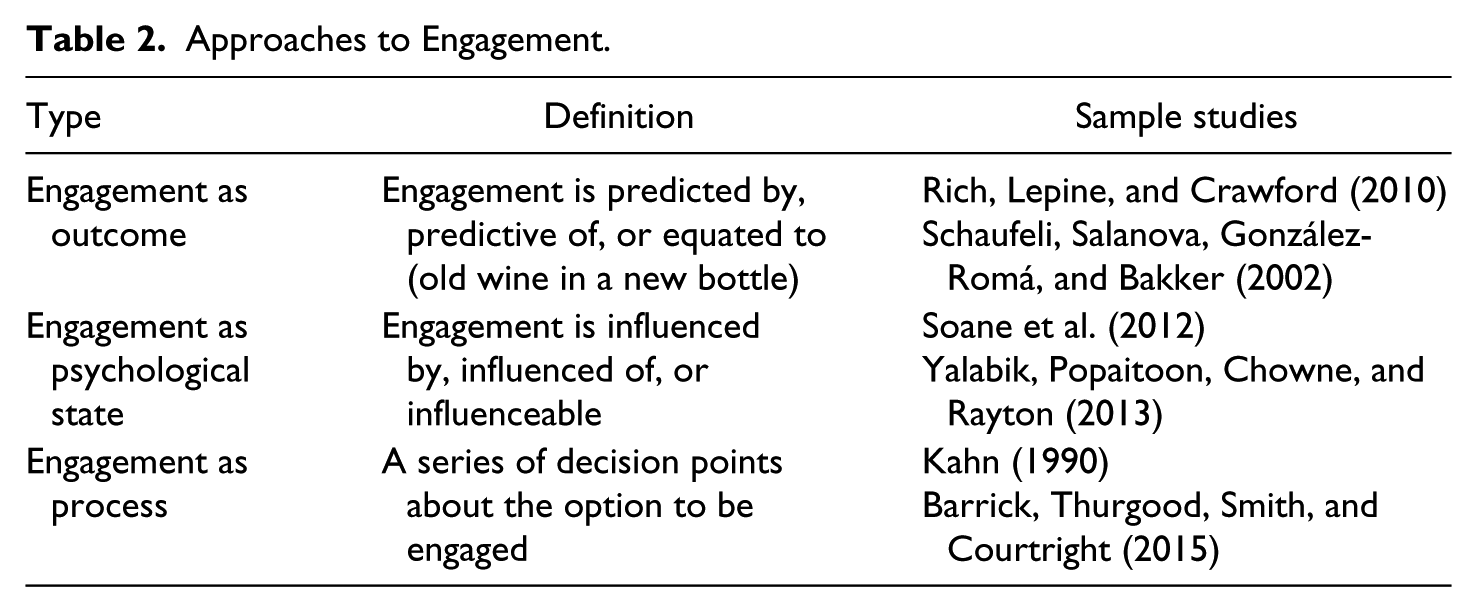
In addition to varied definitional use, we noted that conceptual and empirical application in practice has also varied. For example, at times, engagement has been applied as a psychological state that influences something, or as an outcome. We believe that gaining clarity on the positionality of engagement—in addition to the definition—can positively influence the continued development of engagement theory. In Table 2, we present three major positional approaches to established engagement frameworks: job engagement, work engagement, organizational engagement, and/or employee engagement. It is important to point out that positioning has not been dependent on definition and that definitions do not inhibit practical application. That is, the ways in which job engagement has been utilized in the field mirrors the ways in which work engagement and employee engagement have also been used. Scholars have not made distinctions in this area at this time, but clear lines of positioning are unfolding.
Approaches to Engagement.
Engagement as an outcome
One of the first ways that engagement has been positioned in the literature has been as an outcome. Grounded in the literature, we defined the positionality of engagement as an outcome as that research which utilized engagement as being predicted by, predictive of, or equated to something. An exemplar of this position is the work by Rich et al. (2010) on job engagement. In their work, engagement was positioned as being predictive of something (e.g., in their study, engagement was predictive of congruence, perceived organizational support, core self-evaluation, task performance, and organizational citizenship behavior). Other examples include most of Schaufeli and colleagues’ empirical work, Shuck et al. (2011), Shuck and Reio (2014), and a host of other scholars who have focused on the use of engagement as a predictor. From this perspective, engagement is often objectified—that is, the measurement of engagement is detached from its elements. What matters from this perspective is the utility of engagement in measurement, not the psychological processes that support its development. This has been a necessary development in the field, because the ability of engagement to demonstrate immediate applicability in practice has remained important to acceptance in the human resource and management fields. Objectification, however, has limited the growth of the construct as such narrow application has resulted in a disjointed understanding of what engagement is and consequently, the development of only one side of the construct, regularly valuing the outcome (e.g., performance) over the theoretical structure and experience.
This narrow assessment has posed serious challenges to practice and has also left gaps in the understanding of what engagement is as a construct. For example, as we have alluded, Parker and Griffin (2011) cautioned that an inordinate amount of attention has been focused on the measurement of engagement. This disproportionate focus has neglected an understanding of the state of engagement in favor of operationalizing the psychometrics of the construct, resulting in a conjoining of measurement and theoretical structure. This conjoining occurred as the measurement of engagement became synonymous to what engagement was believed to be (i.e., engagement = the UWES; Schaufeli et al., 2002). Defining any one construct—engagement or otherwise—only by its ability to be predicted by, predictive of, or equated to something with little regard to those processes that influence the phenomenon leaves the theoretical structure inadequately developed. The construct of engagement has in some cases become entangled with its measurement at the peril of ignoring those processes and context from which it forms as an experience (Jenkins & Delbridge, 2013). This presents a challenge for understanding the full range and applicability of engagement because “context can affect what types of behavior are possible and/or important” (Parker & Griffin, 2011, p. 65).
Engagement as a psychological state
Engagement research has also been positioned as a psychological state. We defined this second positional space of engagement as research that has positioned engagement as influenced by, influenced of, or as influenceable. This range of research and conceptual application is focused more toward a broad, general experience of an employee’s work experience and often lacks the specificity that exists when engagement is presented as an outcome. As an example, some researchers have called for exploring the more general, holistic experience of engagement (Truss, Shantz, Soane, Alfes, & Delbridge, 2013), as well as building “on the key advantage of [a] focus on employees, their beliefs, values, behaviors, and experiences at work in a way not seen before the mainstream” (Purcell, 2014, p. 251). These calls for understanding the psychological states of engagement and how such states influence and build toward (or detract from) engagement-related research have been the central point of this positionality.
Specifically, this positioning broadens the application of engagement beyond outcome and/or prediction. Research that utilized engagement as a psychological state has been focused on how employees make decisions about the maintenance, direction, intensity, and use of their energy.
Engagement as a process
Last, engagement has also been positioned as a process. We defined this last positionality as research exploring those decision points that an employee uses to be engaged. This positionality remains a minority in the research because only a handful of research and conceptual pieces have utilized this framework. For example, Kahn’s (1990) original work on personal engagement, in which he detailed the conditions of meaningfulness, safety, and availability, was focused on those decision points of engagement as a process rather than the use of engagement as an outcome or as an existing psychological state at which an employee arrived. In recent work, the notion of engagement as a process has reflected a critical reaction to engagements being positioned as an outcome. For example, some scholars have suggested the development of engagement as a murmuration of objects (Keenoy, 2013), regaled as political, social, academic, and consultancy objects that benefit the corporate machine at the expense of the employee (i.e., the outcome perspective). Valentin (2014) argued that engagement might not actually exist at all but rather represent corporate propaganda and deceitful discourse (e.g., the psychological state perspective). Such a perspective highlighted the belief that, for some, engagement was seen as a socially constructed, altered, skewed, and invented reality of work. For others, engagement was understood as “fabricated through discourse, staged through performance, and fictionalized through text” (Ybema et al., 2009, p. 305). Scholars have voiced their doubts about the positive perspective of engagement and expressed hesitation about the conceptualization of engagement as a quantifiable experience altogether (e.g., Griffin, Parker, & Neal, 2008; Hirschfeld & Thomas, 2008; Newman & Harrison, 2008; Newman et al., 2011; Pugh, Dietz, Brief, & Wiley, 2008; Saks, 2008). This is perhaps due in large part to the majority focus of research on the outcome perspective of engagement, which takes for granted embedded assumptions about the control and influence of engagement rather than seeing it as a psychological process or as a series of empowered decisions about the experience of both becoming and being engaged.
Guest (2013), for example, positioned the construct of engagement as the exploitation of individual agency that manipulates the reality of modern work. He went on to suggest that future research should focus on conditions, outputs, and rules, including those decision points that influence the employee toward being engaged, not engagement as a manufactured state or some outcome. The antithesis of the engagement-as-process perspective, when narrowly defined as an outcome only to be measured, engagement is experienced as oppressive and misguided.
Implications for Research and Practice
Several implications for both research and practice are highlighted by this work, including the role of clarity within the employee engagement construct by way of this work, as well as points of difference, opportunities for future research, and suggestions of collaboration across academic boundaries.
First, while terms have historically been used interchangeably without regard to nuance and terminological precision (even the primary author of this article has been guilty of such treachery), by developing a set of concepts and assumptions that have a common, agreed-upon meaning around employee engagement, we bring clarity to the employee engagement construct. Through this set of concepts and assumptions, we have started the process of clearing the air, yet to increase clarity and reduce confusion with other engagement-like constructs, main scholarly reference points, definitions, and instruments must be clearly defined for each engagement framework and then used correctly. Notwithstanding, there has been little empirical research focused on bringing terms together for proper distinction. Practically, our aim was to define and clearly articulate what we mean when we use the term employee engagement by separating out the various types of engagement frameworks, associated measurement tools, key scholarly reference points, and definitions. Future research might focus on the use of advanced analytic techniques that empirically disentangle the space of different engagement perspectives, following the lead of Nimon et al. (2015) and Shuck, Nimon, and Zigarmi (2016). Such research would continue the refinement of frameworks and their respective definitions as well as aid in theory building across a myriad of fields.
As we have covered many types of engagement words and phrases, we have explicitly noted their differences. To be precise, there are different frameworks of engagement (i.e., work engagement, job engagement, employee engagement; Shuck, 2011), each with a separate definition, theoretical structure, and measurement. While one perspective may be more widely used than the others, they are not the same and should not be used interchangeably. Work engagement is not employee engagement, is not job engagement, is not organizational engagement, and scholars should stop treating them as such. If work engagement is vigor, dedication, and absorption, then it cannot also be employee engagement, which has been operationalized as the maintenance, intensity, and direction of cognitive, emotional, and behavioral energy. We do not naively dismiss similarities between the two or three or more engagement perspectives highlighted throughout this work, but we draw boundaries that should be respected among friends (or colleagues or scholars). Perhaps, however, there is a super-engagement construct, a set of measurement operationalizations that cuts across all measures and captures overlapping variance in ways that cannot be denied or explained away. Newman, Joseph, and Hulin (2010) attempted such work, but as pointed out by Shuck, Nimon, and Zigarmi (2016), they fell decidedly short. This should not discourage others, however, from looking for the pot of gold at the end of the engagement rainbow.
To be sure that we have been as clear as possible, employee engagement is a unique framework. That is our ardent position. Conceptually speaking, it is not synonymous with anything else, nor is it empirically redundant (for initial evidence of this claim, see Nimon et al., 2015; Shuck, Nimon, & Zigarmi, 2016). In the future, scholars and practitioners who wish to study employee engagement should use the term employee engagement—which would include usage of aligned definition, theoretical structure, and measurement—and refrain from muddling similar frameworks. We now know better, and to be confused at this point or to claim conceptual misunderstanding is to not be disciplined. We take nothing from work engagement, job engagement, or organizational engagement—and we deeply honor those theoretical spaces—but we also suggest that using engagement-related terms and theoretical structures interchangeably is not helpful and more explicitly, it is wrong. Both future research and practice could focus here, establishing clean lines of inquiry that respect theoretical space yet compliment the idea of being engaged, whether that is through the more general experience of the full working context (i.e., employee engagement), work (i.e., work engagement), organization (i.e., organizational engagement), or a job (i.e., job engagement).
Finally, we look toward the future of engagement research. Scholars are the ones who differentiate ideas, but in practice we would propose that the principles of engagement remain true. That is, we suggest that the psychological, emotional, economic, and systems principles that drive work engagement are similar to the psychological, emotional, economic, and systems principles that drive employee engagement and so on (noting conceptual and definitional differences, of course). To this end, many kinds of exciting engagement-related lines of research are emerging. A few examples include student engagement, volunteer engagement, community engagement, and faculty engagement. While the emergence of these new lines of engagement research bodes well for the HRD field, their development may be bogged down by unclear distinctions. By introducing these ideals here, we are not suggesting that we take up work in these fields, but rather that we work across lines to help each other mature and refine emerging ideas with the knowledge we have gained about employee engagement. In faculty engagement literature, for example, there appears to be the challenge of establishing a unifying demarcation and categorization of the faculty engagement framework within the engagement space (Giles, 2008; Sandmann, 2008; Ward, 2003), yet this work is just beginning, and there is little in the way of distinction or overlap. This has resulted in a clarion call for the use of multiple theoretical lenses to comprehend and assess faculty engagement (this sounds strikingly familiar to early conversations about employee engagement; cf. O’Meara, Sandmann, Saltmarsh, & Giles, 2011). Accordingly, future researchers interested in studying new lines of engagement research such as faculty engagement or volunteer engagement should look more deeply into these distinctions, words, and theoretical structures, and identify commonalities as well as differences, but they should also look across the discipline line. Throughout our reading of literature in these emerging areas, we noticed that many of these emerging engagement-related frameworks measure only the behavior (or the outcome) and, thus, are missing much of the framework’s power in explaining and understanding their utility in practice, a problem we have attempted to treat regarding employee engagement by proposing demonstrable statements grounded in concepts and assumptions that have agreed-upon meaning and a precise definition.
Footnotes
Declaration of Conflicting Interests
The author(s) declared no potential conflicts of interest with respect to the research, authorship, and/or publication of this article.
Funding
The author(s) received no financial support for the research, authorship, and/or publication of this article.