



Abstract

Introduction
In her first editorial as HRDR’s Editor-in-Chief, Yonjoo Cho encouraged HRD scholars to submit “thoughtful, meaningful, critical, and high quality theoretical, conceptual, and review articles that support theory building and that provide implications for HRD research and practice for turbulent times” (Cho, 2020, p. 337). We welcome non-empirical manuscripts that stimulate further inquiry and changes in research or practice in HRD and related disciplines. The purpose of this editorial is to reflect on what constitutes the relatively short “Implications for Practice” (IFP) section in HRDR. Especially in COVID times—and hopefully beyond—how do we craft claims about the relevance of theorizing in the HRD field for “changes in practice?”
In reviewing manuscripts, the new HRDR editorial team members have reflected recently on how some submissions to the journal overlook its theory-dedicated mission while several solid theoretical papers omit a consideration of implications for practice. HRDR reviewers reject empirical papers and require non-empirical papers without IFP discussions to be resubmitted. This editorial is a reminder, therefore, that while theoretical perspectives on HRD are non-negotiable for publishing in HRDR, IFP is also an essential component. Moreover, we challenge ourselves to go beyond mere “implications” to address the growing “impact agenda” in the academy. It is helpful to include specific examples of real-world benefits to HRD policies and practices and society more broadly within the UN’s (United Nations, 2015) sustainable development goals (SDGs).
Crafting Implications of HRD Theorizing for Practice Discussions
Our interest in implications for practice is inspired by Bartunek and Rynes’ (2010) review in the Academy of Management Learning & Education of the construction and contributions of “implications for practice” in articles in five top journals. They examined articles published during the early 1990s and 2000s before and after Hambrick (1994) posed the question: “what if the academy actually mattered?” We extend Bartunek and Rynes’ (2010) insights over a decade later. We ask: “what are the key characteristics of IFP sections in HRDR articles?”
To gain insights into the characteristics of IFP sections, we analyzed discussions about implications for practice and practitioners in articles published in HRDR since 2010. A search on Google Scholar using the terms “Human Resource Development Review implications for practice” revealed 10 articles on the first page of results. Three of these were discounted as they were from other journals. Each of the seven articles chosen to inform the content analysis included a separate section on implications for practice. This is distinct from HRDR articles that conflate implications for research and practice. In the sample of seven articles where implications for practice were clearly signposted, we identified a focus on six characteristics: stakeholders, suggestions, solutions, semantics, significance, and sustainability.
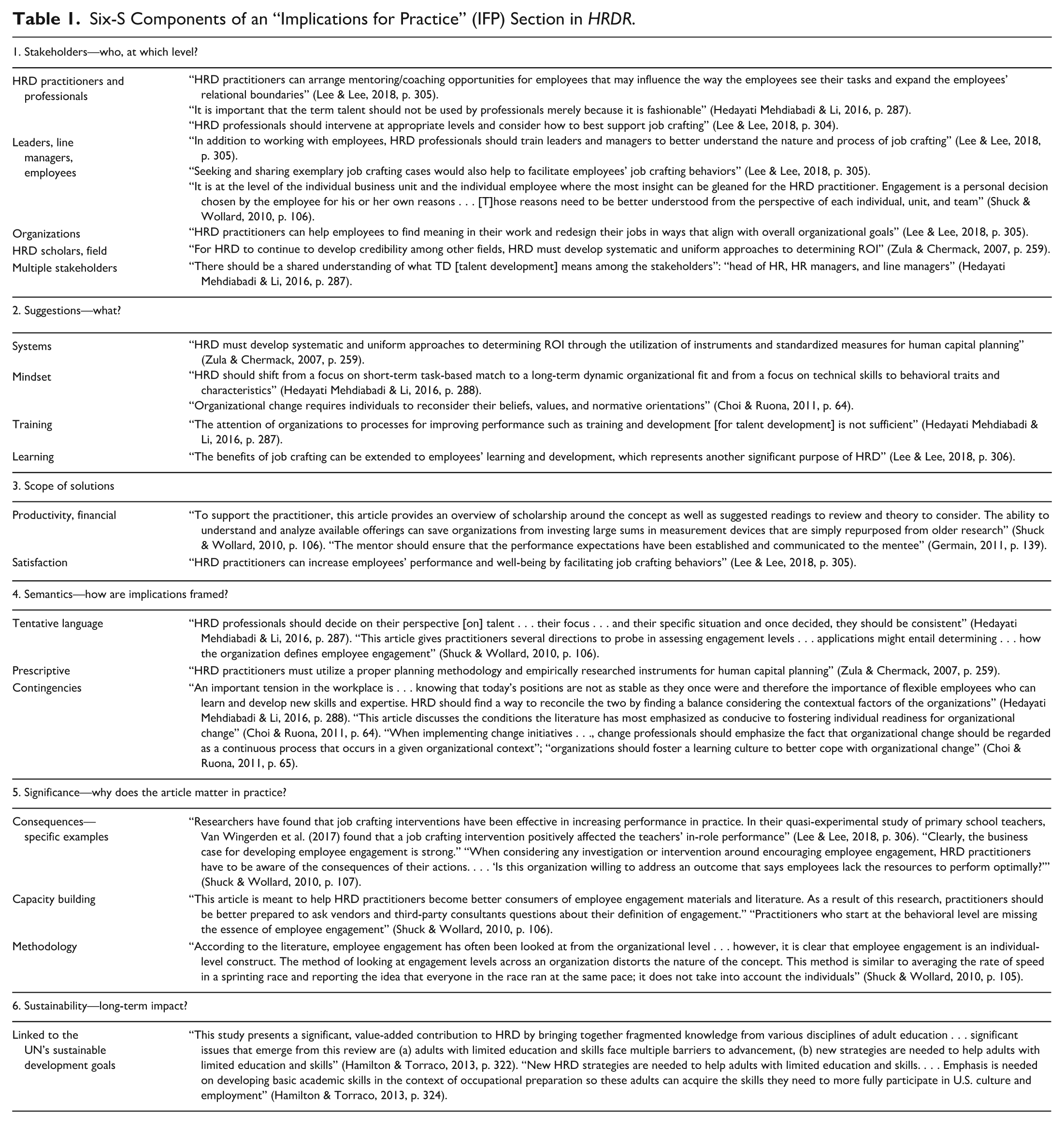
Table 1 presents our findings. We found that it is helpful to indicate practical implications for whom. Commonly, stakeholders include HRD practitioners and professionals and organizations as well as employees, leaders, and line managers. Secondly, in proposing practical solutions, authors discussed systemic levels, changes in mindsets, and implications for training and learning. The scope of implications related particularly to productivity, especially finance, and employee satisfaction. Several suggestions appeared quite tentative while others were prescriptions or emphasized contingencies. The significance of implications included specific examples of interventions, the importance of building capacity, and advising HRD practitioners to question the methodology of workplace evaluations by external providers. Finally, we found limited examples of implications that were explicitly linked to the UN’s SDGs. One exception was Hamilton and Torraco’s (2013) paper on workplace strategies to help adults with limited education and skills. This paper implied the importance of quality education, decent work and well-being, and reducing inequality.
Six-S Components of an “Implications for Practice” (IFP) Section in HRDR.
From Implications to Impact
There is a growing expectation to articulate the impact of academic research to society beyond academia and mere implications for practice. For example, the US National Science Foundation focuses on broader impacts of research that potentially benefit society. Adler and Harzing (2009) argue that the “primary role [of universities] is to support scholarship that addresses the complex questions that matter most to society” (p. 73). Although HRDR is an outlet for non-empirical papers, we welcome IFP sections that refer to impact and organizations. For example in their paper, Zula and Chermack (2007) state that “[h]uman capital planning (HCP) is a critical business process because of its transformational impact on the value the function delivers to the business” (p. 255). Such statements might be extended to consider societal, economic, and other wider forms of impact.
As new roles for HRD researchers and practitioners emerge in the current global crisis, Dirani et al. (2020) emphasize how HRD contributes strategically through sensemaking, communications, and distributed leadership. During the pandemic and beyond, the practical implications of HRD theorizing can be adopted to support employees’ use of technology, their emotional stability, continuing learning and innovation, as well as organizational financial well-being and resilience. The most relevant SDGs for HRDR scholars include those that address decent work and economic growth; industry, innovation, and infrastructure; quality education; inequality; gender equality; poverty; good health and well-being; peace, justice, and strong institutions.
We are not advocating abandoning established HRD models to focus solely on COVID-related non-empirical manuscripts. We are reminding ourselves that HRD is both an academic field and a management function (Callahan & De Dávila, 2004). Within the IFP sections of HRDR, we are encouraging authors to communicate that our theorizing is impactful as well as conceptually interesting.
Conclusion
The purpose of this editorial was to highlight the key characteristics of “implications for practice” sections in HRDR. These are challenging to craft in uncertain contexts. Practices are being severely disrupted and established theoretical models are being tested. Six key characteristics are offered here as a guide for authors writing about implications for practice in HRDR based on stakeholders, suggestions, solutions, semantics, significance, and sustainability. Moreover, there is a growing body of literature on research impact that offers rich insights for scholars into how we might more proactively communicate the benefits of our theorizing beyond mere implications to include impact on stakeholders outside the academy (e.g., Sivertsen & Meijer, 2020).
We look forward to on-going debates about the implications and impact of HRD concepts. This includes from scholars whose own research impact is under-represented (Davies et al., 2020) and from parts of the world where few authors publish in HRDR. We also welcome theorizing HRD in contexts beyond the usual suspects such as micro and social enterprises. Helping readers rediscover established theory in the context of prevailing preoccupations with rapid changes, social justice, virtual, and emerging themes in HRD will no doubt provide thought-provoking and impactful “implications for practice” insights in future HRDR articles.
Footnotes
Acknowledgements
I would like to thank Yonjoo Cho, Meera Alagaraja, and Hyung Joon Yoon for their helpful feedback on this editorial.