




Abstract
Artificial intelligence (AI) has brought rapid innovations in recent years, transforming both business and society. This paper offers a new perspective on whether, and how, AI can be employed in coaching as a key HRD tool. We provide a definition of the concept of AI coaching and differentiate it from related concepts. We also challenge the assumption that AI coaching is feasible by challenging its capability to lead through a systematic coaching process and to establish a working alliance to clients. Based on these evaluations, AI coaching seems to encounter the greatest difficulties in the clients’ problem identification and in delivering individual feedback, which may limit its effectiveness. However, AI generally appears capable of guiding clients through many steps in the coaching process and establishing working alliances. We offer specific recommendations for HRD professionals and organizations, coaches, and developers of AI coaching programs on how AI coaching can contribute to enhance coaching practice. Combined with its lower costs and wider target group, AI coaching will likely transform the coaching profession and provide a future HRD tool.
Keywords
Artificial intelligence (AI) refers to machines performing the cognitive functions typically associated with humans, including learning, interacting, problem-solving, and displaying creativity (Rai et al., 2019). Rapid-fire innovations have recently spread into the world of business, helping AI to become a central force in society (Stone et al., 2016). Technologies involving AI provide inestimable possibilities for enhancing people’s lives in a variety of areas including their employment, education, and healthcare (Stone et al., 2016). For instance, AI is expected to create value of 13 trillion USD worldwide with 267 billion USD in healthcare systems and services by 2030 (McKinsey Global Institute, 2018). The wide applicability of AI raises new questions where AI can be successfully employed. Advancing research on using AI in organizations is therefore of key importance at this particular moment in time (von Krogh, 2018).
An effective means to support people improving their satisfaction and performance in the workplace is coaching, which has become a key human resource development (HRD) tool (Beattie et al., 2014; Bozer & Delegach, 2019). Coaching describes a dyadic helping relationship between a professional coach and a client who work jointly along a systematic process of collaborative goal setting and constructing solutions (Grant & Stober, 2006). Recent meta-analyses supported that coaching fosters clients’ performance, well-being, coping, attitudes, and self-regulation (Theeboom et al., 2014) and especially affective outcomes (Jones et al., 2016). In practice, AI has already begun to make its way into the world of coaching, for instance by helping people to learn and facilitate change (e.g., PocketConfidant.com) or by strengthening leadership skills (e.g., Rocky.AI). The opportunities of AI coaching are substantial, such as anonymity, freedom when and where clients wish to use coaching, and access to coaching at a fraction of the cost when compared to traditional coaching. Organizations might wish to consider AI coaching for employees who have not been considered yet for coaching because it was too expensive. Given these opportunities that AI presents and the potential of coaching to help clients to learn and change, AI coaching may disruptively innovate employees’ professional development.
Recent AI coaching developments have been driven by practical needs rather than theory. So far, it is unclear what AI coaching actually is. The partial overlap of AI coaching with other forms of digitally delivered coaching contributes to this confusion. We therefore define the concept and distinguish it from similar concepts (Bacharach, 1989), such as online-coaching, blended coaching, and self-coaching. By doing so, we combine two previously distinct literatures: the coaching literature and the literature on AI. A clear conceptualization of AI coaching is important for the subsequent development and empirical examination of a theory on effective AI coaching, which can explain if, how, and why AI coaching works. This would also enable HRD professionals and coaching clients to understand what exactly they are going to use and why.
In general, AI has raised unrealistic expectations with little recognition of its real capabilities (Brynjolfsson & McAfee, 2014). In this paper, we shed light on the potential of AI in the realm of coaching to clarify the current confusion about its capabilities. While some forecast full usability to such a degree that AI coaching will replace human coaches for standard coaching topics (Rauen, 2018), others have suggested that AI may assist human coaches and augment their work (Greif, 2018; Oesch, 2018). We challenge the assumption that coaching can be successfully delivered by AI and break down what AI coaching can and cannot do for clients engaged in the coaching process (based on the PRACTICE model by Palmer, 2007, and AI evaluation criteria by Brynjolfsson & Mitchell, 2017). Moreover, a recent meta-analysis (Graßmann et al., 2019) showed that a high-quality working alliance between clients and coaches is consistently related to coaching outcomes. We therefore explore if and how AI coaching can deliver a working alliance to help clients attain desirable coaching outcomes.
To sum up, we contribute two key points to the HRD literature. First, we take a deeper look at how AI can spread into HRD by conceptualizing its application in coaching. Second, we contribute to a better understanding of the capabilities of AI coaching. We do so by breaking down what AI coaching is and is not capable of along a systematic coaching process and make specific recommendations on how AI coaching can enhance coaching practice. This challenges the assumption that AI coaching is feasible and shifts the attention to the process and mechanisms of how AI coaching works.
Conceptualizing AI Coaching
What is AI?
Before we introduce our definition of AI coaching, we first need to understand what AI is. Yet, we do not intend to give technical explanations of how AI operates but rather demystify to the reader what AI means in general. There are several definitions for AI that take either human performance or mathematics in the center of the definition (for a categorization see Russell & Norvig, 2016). As we are interested in defining the application of AI in the field of coaching, we focus on human performance, where AI refers to machines that can do tasks requiring intelligence when performed by humans (Kurzweil, 1990). AI displays such intelligent behavior by analyzing its environment and taking actions to achieve the goals that it is designed for, based on a set of formal rules. McCarthy, the founding father of AI, laid out its basic premise: “every aspect of learning or any other feature of intelligence can in principle be so precisely described that a machine can be made to simulate it” (McCarthy et al., 2006, p. 12). AI mainly operates via machine learning, which refers to the system’s ability for improving performance without needing humans to explain how to accomplish the specific task (Brynjolfsson & McAfee, 2014). Most of the successes in recent years were made possible with the help of supervised learning, in which the machine is given many examples of the correct answer to a problem (Brynjolfsson & McAfee, 2014).
There are two types of AI: narrow AI and general AI, which differ in the number of tasks that they can perform. Narrow AI can perform one or a few specific tasks. Narrow examples are patients’ cancer detection or judgement of customers’ creditworthiness, for instance. These narrow applications of AI have made rapid progress in the past years and some of them proved to be highly valuable (McKinsey Global Institute, 2018). Whereas the narrow applications made rapid progress, general AI, which is intended to perform most activities that humans can do, made almost no progress. There are still many open questions to build capabilities that would be needed to achieve general AI (European Commission, 2019), making it unlikely that general AI will be possible soon (Legg & Hutter, 2007). Therefore, we will concentrate on narrow AI to investigate its application in the specific field of coaching.
What AI Coaching Is
We see coaching as an egalitarian, dyadic relationship between a client and a professional coach, which involves a systematic process focusing on collaborative goal setting, constructing solutions, and fostering clients’ self-directed learning and personal growth (Grant & Stober, 2006). These goals do not cover clinical issues (Grant, 2006), but intend to improve clients’ professional performance and personal satisfaction and therefore the effectiveness of the clients’ organization (Kilburg, 1996).
In combining the definitions of AI and coaching, we can derive how AI coaching can be conceptualized. AI coaching can thus be defined as a machine-assisted, systematic process to help clients set professional goals and construct solutions to efficiently achieve them. Using the opportunities of AI learning based on data and without human guidance, AI coaching would be able to learn based on a large data set of coaching processes to get more efficient in helping clients to achieve their goals, such as by the best selection of tools and exercises or questions to ask. So, AI would not only learn from one coaching process to the next but could also adapt itself while working with the same client.
Similarities and Differences Between AI Coaching and Related Concepts
To understand the conceptual boundaries of AI coaching, we now disentangle it from related coaching concepts. For this purpose, we compare the similarities and differences between AI coaching and face-to-face coaching, online coaching, blended coaching, and self-coaching. In face-to-face coaching, clients and coaches do not use digital communication channels (Geissler et al., 2014). Face-to-face coaching represents the traditional coaching concept (Poepsel, 2011) and differs from AI coaching, because clients do not interact with a human coach during the coaching process.
Online coaching and blended coaching describe coaching concepts with human coaches and vary in their usage of digital communication channels. Coaches and clients solely rely on digital communication channels in online coaching without meeting each other face-to-face (Poepsel, 2011). In blended coaching, coaches partially incorporate digital channels into the coaching process (Geissler et al., 2014; Jones et al., 2016), such as using telephone or video chats. Whereas the digital system in online and blended coaching fulfills solely the function of enabling communication, AI coaching mainly operates without human guidance.
In self-coaching, clients work on their own on their professional development, for instance by using videotapes or self-diagnostical tools (Sue-Chan & Latham, 2004). AI coaching and self-coaching demonstrate conceptual overlap in so far that they do not incorporate human coaches during the process. Self-coaching differs from AI coaching because it does not evolve from one client to the next or in between the same coaching process. It also does not operate by using a digital system. Self-coaching could be computerized to deliver a standardized digital intervention (Fleming et al., 2018), but AI would still be able to add adaptability, efficacy, and efficiency by learning from past coaching processes.
AI coaching therefore shares some conceptual overlap with all these related concepts, particularly in the usage of digital systems. However, AI coaching differs from related coaching concepts regarding the unique combination of the use of digital systems, autonomous procedure without human guidance, and self-directed learning based on prior experiences. These experiences can be manifold, such as differences in clients’ language, emotions, eye contact, and clients’ progress during coaching. Having now established what AI coaching is, we next shift our attention toward how and to what extent it can contribute to clients’ development.
Capabilities of AI Coaching Along the Coaching Process and Recommendations for Implementation
We now delineate AI’s capability in leading clients through a systemic coaching process. We chose the PRACTICE model by Palmer (2007) as the conceptual basis. This model fits well to our coaching definition described above (a systematic process focusing on goal setting and constructing solutions). It also describes how coaching takes place with an easy-to follow structure and high specificity (see Table 1 for an overview). To determine to what extent AI can successfully guide clients through this process, we map AI evaluation criteria onto it. As our framework, we chose to use the eight criteria by Brynjolfsson and Mitchell (2017), because they help to evaluate if a task can be successfully done by AI. Before we begin with our step-by-step evaluation and recommendations, we briefly describe these evaluation criteria.
Capabilities of AI Coaching Along the Coaching Process.
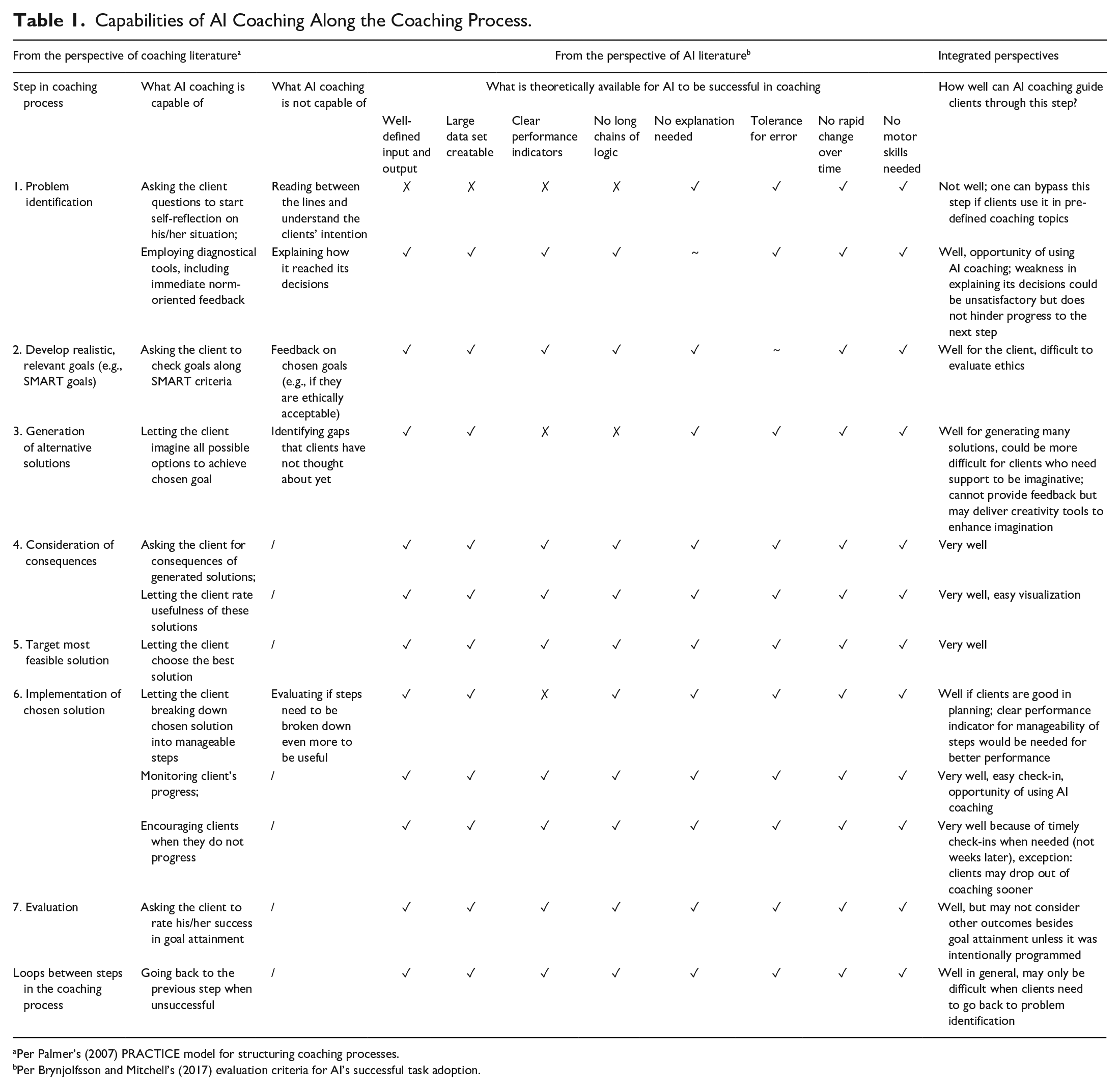
Per Palmer’s (2007) PRACTICE model for structuring coaching processes.
Per Brynjolfsson and Mitchell’s (2017) evaluation criteria for AI’s successful task adoption.
AI Evaluation Criteria
Learning a function of well-defined input and output
The input and output must be well-defined so that AI can learn how to get best from input to output (Brynjolfsson & Mitchell, 2017). For instance, input could be the clients’ goal description and the output would be specific goals that they decided to pursue during coaching.
Large data sets either exist or can be created
AI needs large data sets to learn from (Brynjolfsson & Mitchell, 2017). Transferred to the context of coaching, one should either have or be able to create large data sets of coaching processes with clients. These coaching processes should represent the heterogeneous coaching processes that exist in practice.
Clear feedback with clearly definable goals and metrics
AI works well when goals are clearly defined and when there are clear metrics to evaluate its performance in reaching these goals (Brynjolfsson & Mitchell, 2017). Transferred to coaching, one needs to know whether clients progressed successfully in a certain coaching step.
No long chains of logic
AI can be more easily employed on a simple concept without the need for common sense or long reasoning (Brynjolfsson & Mitchell, 2017). As a rule of thumb, anything a human can do with one second of thought can likely be automated by AI (Ng, 2016), for example, detection of whether a picture shows a cat or not. Therefore, AI coaching needs simple concepts to rely on, such as visualizing clients’ degree of success when they get stuck during coaching.
Error for tolerance
Decisions are reached probabilistically, and perfect accuracy is rarely possible (Brynjolfsson & Mitchell, 2017). Mistakes in coaching may happen, such as inaccurate assessment or poor selection of methods (Kilburg, 2002).
The learned function should not change rapidly over time
AI learns based on a training data set and the future data set should be similar (Brynjolfsson & Mitchell, 2017). To use AI in coaching, future coaching processes should not deviate too much from past coaching processes. When coaching processes need to be structured differently in the future, AI needs enough time to learn.
No need for physical skills or mobility
According to the criteria of Brynjolfsson and Mitchell (2017), AI is currently less likely in motoric tasks, such as moving or lifting items. Coaching processes typically rely on communication only and does not need to involve such motoric tasks.
No need for detailed explanation of how the decision was made
Current systems are not good at explaining the reasoning behind decisions (Brynjolfsson & Mitchell, 2017), for example, why it detected a patient’s cancer or why it declined a customer’s credit worthiness. So, coaching clients may not get an explanation for how AI reached its decisions on which questions to ask in evaluating goals, for instance.
Mapping AI Evaluation Criteria Onto Each Coaching Step
Having now established the criteria for evaluating if a task is likely to be done by AI, we now map them onto each coaching step in the PRACTICE model (Palmer, 2007). It outlines seven steps within the coaching process (see Table 1), which are explained in the following. Loops between different coaching steps exist in practice (Grant, 2011) and we added them in our investigation. We will also make specific recommendations for HRD professionals and organizations, coaches who want to augment their service with AI, as well as developers of AI coaching programs, on how to use AI coaching for each step of this model.
Problem identification
In the beginning of coaching, coaches and clients need to identify the clients’ core problems that are to be solved in coaching (Palmer, 2007). Like human coaches, AI can ask questions to initiate clients’ self-reflection on what may be the core problem. However, present AI chatbots do not actually think, but rather imitate and create the illusion of an intelligent conversation (Abdul-Kader & Woods, 2015; Fulmer, 2019). So, AI currently cannot understand the clients’ intention and explore what a client’s core problem could be. There are too many options that are not well-defined, and even if it were possible, AI would demand large data sets for every option. Therefore, AI does not capture what clients did not know before. AI coaching may therefore only work well if the client is already aware of the core problem and simply needs to be prompted with questions to reflect upon it. Research supports this idea by showing that self-coaching works well when the participants have the knowledge and ability to identify which behaviors to improve on in the future (Sue-Chan & Latham, 2004). Several criteria are missing from the AI perspective: a well-defined output (such as all possible problems; with large data sets for each problem), a clear performance indicator when the problem is successfully identified, and a simple concept without long chains of logic for getting toward the problem identification. This step can be complex and setting a goal too early in the coaching process is a common trap for novice coaches (Grant, 2011). Even human coaches struggle with reading between the lines of what clients report them and identifying their core problems (Schermuly, 2019), so it is plausible that AI cannot automate this step soon.
Therefore, we suggest HRD professionals who want to integrate AI coaching to bypass the difficulties of this first step. We see two possibilities for HRD professionals within organizations to do so: either by augmenting AI coaching by incorporating human coaches for meaningful problem identification or by solely using specified topics that are set in beforehand, such as stress reduction, time management, or work-life-balance. One could also specify the topics according to a prior training to facilitate learning transfer. Specified topics might not be desirable for clients and coaches, as goal-setting is iterative and oftentimes unpredictable and nonlinear (Grant, 2011). On the other side, this approach would come with an advantage. Predefined topics allow incorporating psychoeducational impulses, such as presenting a typology of stress in the case of stress management. These impulses may enhance clients’ learning experiences, though coaches traditionally give little educational or behavioral advice (Bluckert, 2005). Therefore, HRD professionals within organizations and developers of AI coaching programs could think about explicitly integrate these impulses into AI coaching to capitalize on this opportunity.
AI coaching comes with another opportunity over traditional coaching in this step: the standardized inclusion of diagnostical tools, such as personality inventories or burnout and stress psychometrics (see Möller & Kotte, 2014, for more information on diagnostics in coaching). Although human coaches can easily employ diagnostics as well, they typically do not (Möller & Kotte, 2014; Schermuly et al., 2014). We therefore suggest that HRD professionals who want to integrate or build AI coaching programs that they also implement diagnostical tools, including immediate norm-oriented feedback and visualization of these results. The inclusion of diagnostics as standard procedure would not only fuel insights into the client’s situation in a certain coaching process but would also professionalize coaching in general. One criterion from the AI perspective might not be easily met in AI coaching, which is that the task should not involve an explanation of how AI reached its decision. Especially in the case of personality diagnostics, clients may feel the urge to better understand what AI did when the results are surprising to them. Although AI alone may not be able to deliver this reasoning, it can be programed in beforehand. We therefore suggest including explanations for what and why has been measured and how it can be interpreted, as a human coach would do in practice. Alternatively, we again suggest incorporating human coaches into the AI coaching program to deliver these explanations and interpretations. Analogues to these recommendations, we suggest that coaches should capitalize on the opportunity to use diagnostical tools within AI coaching to enhance their own practice.
Develop realistic, relevant goals
After having identified their main problem, clients need to develop a specific goal that they want to attain with the help of coaching. Commonly used criteria for evaluating goal setting are the SMART criteria that demand goals to be specific, measurable, attainable, relevant, and time-based (Grant, 2011). The SMART criteria can be used as a simple, well-defined concept with clear performance indicators. AI coaching would let clients assess along the SMART criteria, for instance, if they are properly defined. In this vein, developing goals can be automated in AI coaching. We therefore recommend that HRD professionals build AI coaching programs that use the opportunity to use a specified structure to develop and define coaching goals, as this helps AI coaching to successfully guide clients through this step.
Nevertheless, clients will not receive feedback on their chosen goals, because AI cannot evaluate the content of the goal. For instance, AI might not identify potentially conflicting goals, such as when clients want to work on their work-life-balance and at the same time wish to increase their job performance. This taps the criterion of error tolerance that needs to be set when successfully employing AI (Brynjolfsson & Mitchell, 2017). However, given AI’s potential of lower costs and wide applicability, clients and their organizations might be willing to accept the consequences of these potential mistakes (such as low satisfaction with coaching) and still wish to adopt AI coaching. We therefore suggest that developers of AI coaching programs educate their clients in the beginning of what they can and cannot achieve with using it. Furthermore, coaches work within ethical boundaries (Duffy & Passmore, 2010). Coaches need to be aware of any issues that affect the lives of others negatively (International Coach Federation, 2015), such as they would decline clients wanting to develop their abusive skills as leaders. These goals would be regarded as unethical according to these guidelines and human coaches would raise concern. As AI currently cannot understand clients’ intentions (Stern, 2019), AI coaching could hardly evaluate if a chosen goal is ethical. We therefore suggest the following to bypass the problem of missing feedback: Clients can work on their own in AI coaching to specify their goals and then check in with their human coaches to discuss and reflect on them. Coaches can use AI coaching in the sense of homework for clients and focus more on reflection in their actual coaching session with their client. By doing so, AI coaching can be used to expand the learning and reflecting experiences in between the coaching sessions with human coaches. If working together with human coaches is not possible or wanted, AI coaching will still work, but potentially with lesser quality.
Generation of alternative solutions
Based on clients’ clearly specified goals, clients then generate solutions that potentially lead to achieving these goals (Palmer, 2007; see Table 1). Coaches typically let clients imagine a long list of possible alternative solutions. This is a simple and well-defined task and could be automated in AI coaching. We therefore recommend that HRD professionals use AI coaching to automate this step and that human coaches use AI coaching when their want to augment their service with AI. Clients with little imaginative skills need support in coming up with many solutions and we recommend that developers of AI coaching programs integrate creativity tools to enhance clients’ imagination. Clients would still not receive feedback, for instance on solution areas that they have not thought about yet. In order to accomplish this, AI would need short chains of logic to come up with such feedback and timely performance indicators to assess if it was helpful without needing the client to implement solutions first. Having said that, missing feedback on clients’ list of alternative solutions would probably not interrupt the coaching process itself and clients could still move on to the next step.
Consideration of consequences
After creating a list of alternative solutions, clients then consider the consequences of these solutions and rate their usefulness (Palmer, 2007). These are well-defined tasks and AI should be well-suited to guide the client through this coaching step. We therefore suggest that HRD professionals use AI coaching in this step. When coaches want to augment their service with AI coaching in this step, we recommend letting clients rate the usefulness of their solutions on their own. Coaches can then use this possibility to focus even more on discussion and reflection in their face-to-face sessions with their client. Furthermore, AI can summarize and visualize the clients’ rating of the usefulness of these solutions. This instant visualization represents an additional opportunity of AI coaching. We therefore recommend that developers of AI coaching programs build easy-to-use visualizing tools into their programs, so that clients can instantly compare their considered solutions.
Target most feasible solution
Clients pick the best solution based on their previous usefulness ratings. AI can mimic human coaches by asking clients to select the best option for attaining their coaching goals. AI is also capable of detecting when clients do not pick an appropriate solution based on their prior ratings and can provide feedback about this contradiction. HRD professionals and coaches (when augmenting their service with AI) may therefore want to use AI coaching in this step. We also recommend that developers of AI coaching programs integrate a feedback loop when clients do not pick the best solution based on their prior ratings. This does not mean that clients should not pick another solution, but the reflection of it may bear potential to discover new ways of thinking and understanding why they would like to choose one solution over the other. When augmenting their service with AI, human coaches can let clients first target their most feasible solution with AI and then discuss their selected solution and potential contradictions within their coaching session.
Implementation of chosen solution
After selecting the best solution, clients begin to implement that solution in their daily lives. Clients break down this solution into smaller steps that they can manage to implement more easily (Palmer, 2007). AI and coaches alike can ask clients to define these manageable steps (see again Table 1). So, AI can be employed in this step, especially when clients are good at planning and just need direction and space for reflection. It could be the case that the implementation steps are still too broad to be manageable, and skilled human coaches would be able to raise this concern. A clear performance indicator would be needed in AI coaching to provide feedback on the manageability of the implementation steps to better help clients implement their chosen solution.
After defining manageable steps, clients implement them in their daily lives. The opportunity of AI to be available and visualize anytime plays out very well in monitoring clients’ progress and we recommend that coaches, who are interested in augmenting their service with AI, use this instant and easy visualization in their own practice. AI might then be used as a facilitator for action learning. For example, during their working days clients can report their actions and how they helped to reach their desired goal. Clients can rate and analyze how their goal achievement progressed. Success, but also potential for improvement, can then be continuously visualized, at least based on the goal attainment evaluations of the client. Visualization may make it easier for clients to track their forthcoming and when human coaches are also involved, they can better discuss and reflect with their clients on what has happened in between their coaching sessions.
Transparent visualization and instant availability may also help to provide encouragement when challenges arise in holding on to implementing what clients learned in coaching. Clients would still be able to see their overall progress, even when progress is slow or regresses. Clients can immediately turn to AI coaching in the moment they are struggling, which is a major challenge for human coaches. We recommend that HRD professionals offer AI coaching when clients benefit more from instant support (because human coaches cannot easily provide that) or in between the sessions with their human coaches. Coaches and clients then can reflect on what helped in these moments to gain new perspectives on what their clients need.
AI coaching may though prove unhelpful when clients are severely disrupted and prevented from implementing the chosen solution in their daily lives, such as when receiving strong negative feedback from their supervisors or colleagues (Graßmann & Schermuly, 2016; Schermuly, 2018). Under these circumstances, clients tend to drop out of coaching (Schermuly, 2018). Clients would likely do that in AI coaching as well, as previous studies in psychotherapy have revealed it has comparable dropout rates to traditional face-to-face settings (Rost et al., 2017). We therefore recommend that developers of AI coaching programs integrate a feedback loop where clients can reflect on what had stopped them in implementing their chosen solution and may recommend working with a human coach to further discuss on that.
Evaluation
Having progressed in the coaching process, clients should have identified the problem, defined a specific goal that they want to achieve, thought through potential solutions, and implemented the best solution in their daily lives (see Table 1). At this point, clients experience the fruits of their labor and evaluate to what extent they have achieved their coaching goal. This is a simple step where clients rate their goal attainment and can be successfully implemented in AI coaching, as all considered criteria are met. We therefore suggest that HRD professionals and coaches utilize AI coaching in this step to track and visualize clients’ evaluations.
Goal attainment is the key outcome in coaching (Spence, 2007) but coaching provokes more outcomes than what has been intended, including unintended negative effects (see Schermuly & Graßmann, 2019). Negative effects for clients are all harmful and unintended results for clients that are caused by coaching and could also occur in successful coaching processes (Schermuly et al., 2014). Unless it has been specifically programmed, clients would not reflect on such unintended effects, which would be problematic in AI coaching. For instance, AI coaching may trigger problems that cannot be solved, for example, when it was only constructed for a single topic and cannot support clients in other topics that arise. Moreover, clients may be more likely to develop a dependency on AI coaching in situations that they normally would do without, as AI coaching is always available. This could be an ethical concern, as it could potentially harm clients. We therefore suggest that developers of AI coaching programs use goal attainment as the key outcome to be evaluated by clients, but also leave room for more potential outcomes. This specifically concerns potential unintended negative effects to secure that AI coaching is not harmful to clients.
Loops between steps in the coaching process
Every now and then, the coaching process meanders between the coaching steps described above. This relates to the experience of feeling stuck at one step in the process and can be due to having defined goals that are not important, picking a solution that does not work out in practice, or new situations and circumstances arising. Clients can also switch between steps in AI coaching. However, it is a specific problem in AI coaching when the client needs to go back to the first stage of problem identification. This is not problematic because clients cannot move back to a previous stage, but because AI coaching specifically struggles in problem identification. A loop back to this coaching step highlights this specific weakness of AI coaching. We therefore recommend that HRD professionals within organizations regularly ask employees who use AI coaching along the process in how far it is (still) helpful to them. If AI coaching may not proof useful, clients can be redirected to human coaches. Developers of AI coaching programs may want to implement the option to work with a human coach, if clients feel stuck in the process. Therefore, we recommend to program AI coaching in such a way that clients evaluate the usefulness after each usage of AI coaching. We recommend that coaches, who want to augment their service with AI, regularly check if they need to adjust AI, for instance when their clients’ goals changed within the coaching process.
Conclusions on the capabilities of AI coaching along a systematic coaching process
Concerning AI’s capabilities during each coaching step, many steps appear to be ripe for automation. This may be surprising, as coaching is understood as a service requiring creativity and empathy (McKenna & Davis, 2009), for instance. But this assumption does not necessarily hold true for the entire coaching process. However, our results also show that in the foreseeable future, AI coaching is unlikely to take over the entire coaching process, at least with respect to the quality of how it can be performed by human coaches. AI hardly ever replaces an entire job or process and most often complements human activities, making the rest of the activity more valuable for humans to do (Brynjolfsson & McAfee, 2014). More specifically, AI coaching is likely to be successfully employed after appropriate problem identification. Human coaches can hardly be imitated in the beginning of coaching, as AI cannot mimic the understanding of what clients are concerned with and challenge clients’ underlying needs and goals. The work of human coaches may therefore become more valuable in the beginning of coaching to understand the clients’ situation. AI is therefore more likely to be a partner for coaches that coaches can use to elevate the quality of their own work. This is in line with Jarrahi’s (2018) conclusions in organizational decision-making: “it is more meaningful to view AI as a tool for augmentation (extending human’s capabilities) rather than automation (replacing them). (. . .) To achieve such strategic human-machine partnerships, human intervention is arguably inevitable” (p. 9). We thus recommend that coaches and HRD professionals within organizations capitalize on the advantages of AI coaching, such as being available anytime, visualizing and monitoring, as well as incorporating diagnostic tools. Furthermore, we suggest that coaches and HRD professionals consider augmenting traditional coaching with AI to combine the benefits of both approaches.
Besides working with clients, coaches can also use AI for their own personal development, as AI will at some point acquire more coaching experience than human coaches can gather in a lifetime. However, coaches are reluctant to use digital tools in their practice and only use it when their clients demand it and not out of conviction (Barth & Bachmann, 2019). Our findings imply that coaches should take the opportunity to integrate their knowledge and experience into this new technology, so that it becomes a partner and not a threat to them. But for this to be the case, they must not leave this topic to computer scientists.
The Capability of AI to Establish a High-Quality Working Alliance
To fully explore the capabilities of AI coaching, one must also investigate whether, and how, AI can provide the factors that determine coaching success. We will next delineate how AI coaching can establish a high-quality working alliance with clients as this constitutes a meta-analytically supported predictor for coaching outcomes (see Graßmann et al., 2019). The working alliance between client and coach reflects the quality of their engagement in collaborative, purposeful work during coaching (O’Broin & Palmer, 2007). In a high-quality working alliance, clients and coaches mutually agree on the goals they want to achieve in coaching, the tasks that they choose to reach these goals, and they build an affective bond of trust, respect, and liking (Baron & Morin, 2009; Bordin, 1979; Horvath & Greenberg, 1989).
It seems counterintuitive that clients can develop a working alliance to a non-human virtual agent. This may be particularly counterintuitive for establishing an affective bond, which entails trust, respect, and liking for each other (Baron & Morin, 2009; Bordin, 1979; Horvath & Greenberg, 1989). One might think that AI cannot deliver an affective bond, but this may not be true. Surprisingly, research in AI therapy showed that clients can establish a bond toward their virtual agent (Bickmore et al., 2010). This bond also became stronger over time (Bickmore et al., 2005). Participants who used the therapy chatbot Woebot reported that the bot felt empathetic, like “a real person that showed concern” (Fitzpatrick et al., 2017, p. 7). Participants in therapy often feel resistance to self-disclosure and engage in impression management to be viewed more positively (Gratch et al., 2014). Participants who believed that they were interacting with a virtual agent reported lower resistance to self-disclosure, lower impression management and higher usability than those who believed they were interacting with a human (Gratch et al., 2014).
One major concern against the capability of AI coaching is that it cannot provide a working alliance to the client, which is one of the central predictors of coaching outcomes (Graßmann et al., 2019). Although surprising at first, these first results indicate that clients can establish working alliances with artificial agents and may not speak against the capability of AI coaching. We therefore recommend that HRD professionals and clients do not refrain from using AI coaching because they believe that clients cannot build working alliances. To the contrary, clients may be willing to try AI coaching, because it has a low threshold to be crossed. Especially younger client generations which are used to digital products and AI in other contexts might be interested to work with an AI in their coaching processes. To make it easier for clients to build coaching working alliances, we recommend that organizations and developers of AI coaching programs actively ensure data security and clients’ anonymity. This helps to harvest the potential of AI coaching, as clients can disclose without worrying about data breaches.
Future Questions for Practice and Research
Having introduced how AI coaching can guide the client through coaching, we now shift the attention to future questions regarding using AI coaching. We call for investigating the outcomes and effectiveness of AI coaching systems, shedding light onto the processes that lead to these outcomes, and exploring how AI coaching may transform the coaching profession itself.
Outcomes and effectiveness of AI coaching
Given the importance of coaching in HRD theory and practice (Beattie et al., 2014; Bozer & Delegach, 2019) and the potential of AI coaching to contribute to HRD, future research should investigate the AI coaching systems that are currently being developed. This would improve our understanding of using AI in HRD and how HRD could work in the future. Our findings imply that AI coaching will help clients to attain their goal as compared to not using AI coaching. Future research should shed more light onto which positive and negative outcomes AI coaching promotes, intended and unintended, and how effectively they are attained. While research on AI coaching is yet to come, there is already data that supports the effectiveness of AI therapy. There is ample evidence that AI therapy reduces symptoms of depression and anxiety (Fitzpatrick et al., 2017; Fulmer et al., 2018) as well as obesity (Stephens et al., 2019). Furthermore, not only primary symptoms improved, but also secondary symptoms that the program did not focus on, which speaks for its high capacity to improve patients’ health status (Andrews et al., 2010). Although these AI’s were not meant to replace trained therapists, AI was not inferior to traditional therapy (Andrews et al., 2010; Merry et al., 2012). The conclusions are sufficiently powerful as to be recommended for routine use in existing mental health services (Andrews et al., 2010). Although these results in the realm of AI therapy cannot be transferred mindlessly to AI coaching, they indicate that targeted application of AI is likely able to help people thrive. Future research should take this evidence from AI therapy as an example and investigate which outcomes AI coaching can help with and how effective it could be. This would benefit evidence-based practice regarding the usage of AI coaching.
Explaining the Processes of How AI Coaching Works
What is needed for AI coaching to be successful is a specific theory or manual, so that algorithms can be specified upon it. There are broad models on how coaching works (e.g., the PRACTICE model by Palmer, 2007, that we used here). However, some steps might not be specific enough to use it this way. For instance, the problem identification step relies on reasoning and using common sense, something that human coaches can do but AI coaching cannot. Unless there is a theory that explains how this works, there will be no opportunity to appropriately implement it. Precise coaching research can contribute to this. Furthermore, and due to our chosen coaching definition, we based our reasoning on a process model that focusses on goal setting and constructing solutions (Palmer, 2007). There are also other approaches, which see coaching more as a reflective space and a process of meaning making (Stelter & Law, 2010). These approaches may involve coaches and clients to become philosophers who reflect on “the bigger questions of life” (Stelter & Law, 2010, p. 155). These approaches appear less structured and future research may want to investigate in how far these approaches can be delivered in AI coaching. This also seems relevant for other HRD tools, where precise theories are needed to explain why and how they contribute to employees’ professional development, such as training or mentoring. AI coaching could take over the pioneering role for future HRD by highlighting how AI can be successfully used for that purpose.
We also reasoned, counterintuitively, that clients likely establish a working alliance in AI coaching. Future research should follow this contradiction and test how and why clients effectively establish one in AI coaching. Although AI seems to keep pace with this established driver of coaching success, it could be that the processes of how coaching works differs between AI coaching and traditional concepts. Future research should thus consider an extension of the factors that determine coaching success, such as clients’ acceptance of this new technology (Rost et al., 2017). This would also benefit coaching practice, as it can inform coaches on how to design their service to match the needs of the individual client.
Transforming Coaching as a Profession
Given that AI represents an innovation entering the market, some questions arise on the level of the coaching profession. AI coaching likely transforms the coaching market, because it bears strong potential: lower costs, therefore wider target groups, and constant availability. Utilizing AI likely alters the coaching market when costs are lower than before (Brynjolfsson & Mitchell, 2017) and quality is good. Future research may thus wish to investigate the consequences for the coaching market itself. Which coaches will remain in the market and what do they contribute beyond AI coaching? Which clients are going to use AI coaching, and why? Even if AI coaching works well, it is not clear that clients and their organizations will adopt it in practice. Speaking for the potential of being used in practice, research in AI therapy showed that clients adhered to AI therapy and resembled traditional clients (Fitzpatrick et al., 2017; Rost et al., 2017). Coaching is a widespread HRD tool and may be among the first where AI could be successfully employed. We therefore call for more research on how the possibility of using AI may alter how organizations utilize HRD for their employees, and the organizational and individual conditions where it works best.
Conclusions
AI is currently innovating many domains and this paper shows whether and how AI can be employed in coaching as a key tool for HRD (Beattie et al., 2014; Bozer & Delegach, 2019). We provided a definition of AI coaching and showed that it deviates from related coaching concepts. AI coaching seems to be capable of leading clients through many steps of a systematic coaching process and establishing a working alliance toward clients. It comes with the unique advantages of using diagnostics as standard procedure, easy visualization, and instant availability. On the other hand, it encounters difficulties in the identification of clients’ core problems and providing individual feedback, implying that AI coaching may work better in conjunction with human coaches or for a set of specified topics. We hope our endeavor helps scholars and practitioners “see through all the ‘hype’ and adopt an informed, prudent, and realistic approach to AI” (von Krogh, 2018, p. 408). Given the potential of AI coaching to shape HRD practice, future research should clarify the outcomes and effectiveness that come along with it.
Footnotes
Declaration of Conflicting Interests
The author(s) declared no potential conflicts of interest with respect to the research, authorship, and/or publication of this article.
Funding
The author(s) received no financial support for the research, authorship, and/or publication of this article.
