



Abstract
In celebrating HRDR’s 20 years of publication, this study aims to shed light on research trends in the journal and future research needs by examining 10 years of publications from a structural perspective. We used three complementary computational methods to find major research trends and themes including keyword network analysis, topic modeling, and bibliographic coupling. This paper presents the findings on the research themes, structural coherence, and semantic relevance based on clusters formed by normalized distance measures. Connectivity, co-appearances, and citations are important forms of scholarly communication that represent the body of knowledge in the field. Our findings indicate that research topics greatly expanded beyond the early HRD research topics of learning and development to include various topics related to diversity, critical HRD, and equity issues in organizations and society. We also examined the author-institution-keywords affiliation network and the authors-collaboration network to suggest how scholars can collaborate more in the future.
Human Resource Development Review (HRDR) began in March 2002, starting with Holton’s (2002) editorial, The Mandate for Theory in Human Resource Development. As of this writing, HRDR is one of leading journals in organizational research fields. HRDR became a Social Science Citation Index (SSCI) journal in July 2014, thanks to the tremendous efforts of the former editor, Jamie Callahan, and the groundwork laid out by her three former editors (Holton, Torraco, and Reio) and editorial board members. The recognition and prestige of the journal grew with a continual increase in the journal’s impact factor and list of indices. HRDR is promoted as a venue for “theory development for scholars and practitioners in human resource development and related disciplines” (quoted from the journal’s homepage).
In the journal’s decennial editorial, Callahan (2012) shared details about the very humble beginnings of the journal and recounted that Richard Swanson told the board of the Academy of Human Resource Development (AHRD) that to advance the field, AHRD should sponsor a fourth journal that solely focused on theory development after Human Resource Development Quarterly, Human Resource Development International, and Advances in Developing Human Resources. As a board member of the Academy at that time, Callahan wondered how the Academy of several hundred members would be able to afford a fourth journal.
Callahan’s (2012) decennial editorial concisely captured how HRDR had been very successful at solidifying the field by creating streams of research on learning, employee and organization development, workplace emotions, and identification and use of methods to build HRD theories. HRDR’s article titles on the journal’s homepage show that the topics and issues are much broader and more diverse beyond learning and workplace performance. Examples include diversity, social justice, caring, high performance systems, ethics, entrepreneurship, employee engagement, and many more. For scholars who are interested in studying people in organizational and institutional contexts, HRDR has become a very useful knowledge base and repository for relevant theoretical and conceptual research on various topics. It has also become an important venue to share scholars’ creative and innovative thoughts on theory building.
Ten years after Callahan’s (2012) decennial article, it is worthwhile to examine the landscape of theoretical and conceptual research on HRD. Are there any notable patterns or characteristics in HRD that organizational scholars need to know and leverage? How did we come to this point and how can we use that knowledge for future research? Researchers studying employee engagement or workplace learning, career or organization development, talent development or community building, diversity or leadership would be interested in finding out which core concepts or keywords other researchers have examined or not examined for their topic of interest. Researchers may also be interested in who authors have collaborated with and how they can collaborate more effectively.
Review of the Literature
Scholarly efforts to capture the trends, history, and evolution of the field are not new. Through such work, researchers can judge the fit, relevance, usefulness, and contribution of their research with more confidence. Such work also plays an important role by communicating to internal and external audiences the identity and scope of the field including well-established and innovative methods. Earlier methods include historical reviews (Alagaraja & Dooley, 2003; Callahan, 2012; Stewart & Sambrook, 2012), content analysis of HRD academic curriculum (Kuchinke, 2002; Lim et al., 2013; Zachmeier et al., 2014), and expert interviews (Cho & Zachmeier, 2015; McGuire & Cseh, 2006). For instance, McGuire and Cseh’s (2006) interviews with the AHRD board and four AHRD-sponsored journal editorial board members revealed details about critical HRD activities including organization development, employee development, training, and workplace learning and performance. Cho and Zachmeier (2015) interviewed 40 HRD educators in North America, Europe, and Asia and reported that HRD is an applied and interdisciplinary field that covers various subject areas, particularly training, adult education, evaluation, research, organization and leadership development, instructional technology, consulting, coaching and mentoring, and career development.
Recently, scholars have used a variety of computational methods, such as citation network analysis and bibliometrics to capture the scholarly communication patterns and structures in various fields including management (Koon, 2021; Köseoğlu & Parnell, 2020), industrial psychology (Aguinis et al., 2017), performance technology (Cho et al., 2011), and employee relations (Kataria et al., 2020). Various forms of network analyses have also been used in HRD including citation network (Jo et al., 2009), author collaboration network (Chae et al., 2020), and keyword network (Shirmohammadi et al., 2020; Yoo et al., 2019).
Topical Clusters of HRD Research from Previous Network Studies.
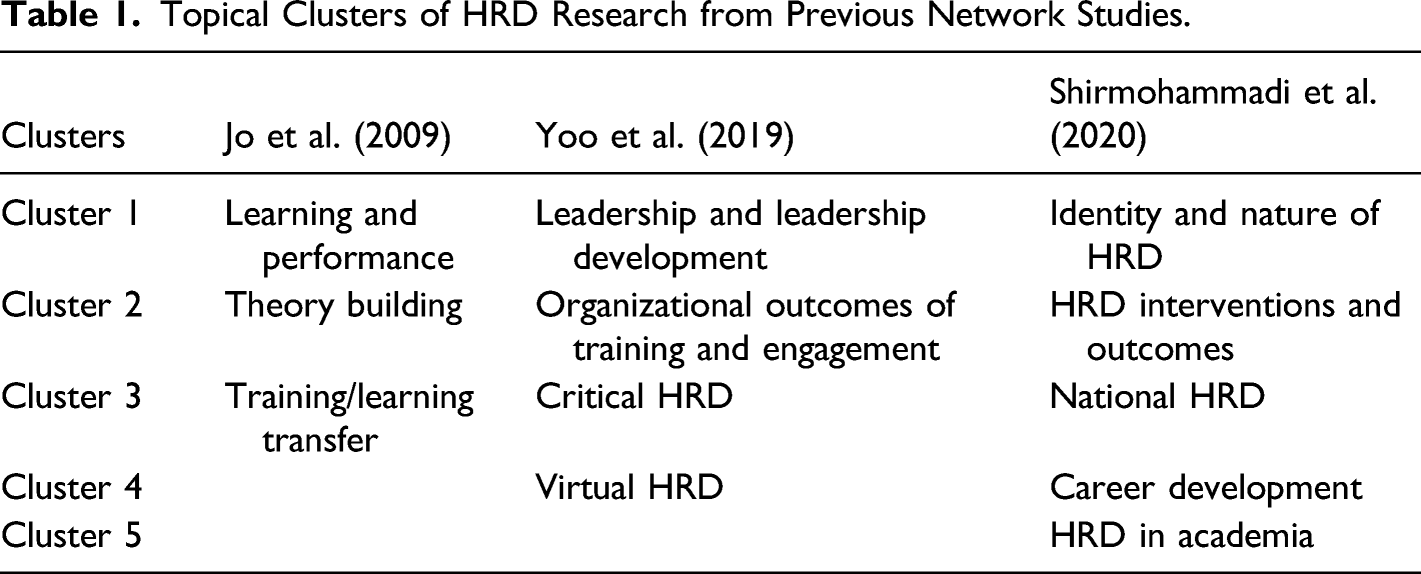
Using Google’s NGram, Han et al. (2017) identified three time periods and reported a noticeable growth pattern in the use of the term “HRD.” Based on bibliometric analysis and keyword occurrences, they reported three historical evolution phases in the field starting with (1) the legitimization of the field, (2) competition between learning and performance paradigms, and (3) divergence and expansion of the field. Although several reviews based on network analysis have been conducted by numerous authors using HRD journals, questions still remain: What topics have been studied in HRD for theory development and advancement purposes? How do we make sense of the different findings about research themes from different network research? How can scholars verify whether a topic of interest fits the scope of HRD? And how can researchers identify additional and relevant topics to further their understanding of the topic?
The call for HRDR’s 20th year anniversary special issue prompted us to capture the landscape of HRD research topics in HRDR by combining our domain knowledge as HRD scholars and our research skills in network analyses and bibliometrics.
Research Purpose and Questions
In celebrating HRDR’s 20 years of publication, we believe that many scholars who have published work in this journal, readers who study organizations and the workforce in various contexts, and researchers and scholar-practitioners who value theoretical and conceptual work will be interested in the following two research questions that are important for understanding the landscape of conceptual research in HRD and future needs: • What research topics have been published in HRDR, and how are they grouped or connected? • What authors and institutions are associated with certain research topics, and to what extent do authors collaborate cross-nationally?
Method
Summarizing a vast amount of information is difficult without the use of sound human judgment and computational methods. Data analytic approaches are relatively new to the HRD field but have been increasingly used and can present many opportunities to reveal patterns and connections hidden in a massive amount of data (Yoon, 2018, 2021). In particular, computational methods, such as machine-learning, network analysis, and text mining enable researchers to examine a variety of data sources beyond surveys and interviews and to interpret complex social phenomena. To answer the first research question, we applied three techniques: keyword network analysis, topic modeling, and bibliographic coupling. For the second question, we examined the author-institution-keyword affiliation network and created a map of country collaboration among authors who published their work onto HRDR.
The Clarivate Analytics’ Web of Science (WoS) database was used to compile the data. Two major HRD journals indexed in the WoS database include HRDR and HRDQ. The earliest indexed information in HRDR was in 2012, so our analysis is limited to articles published from 2012 to the summer issue of 2021. HRDR journal articles were searched using the search keyword “Human Resource Development Review,” with the journal category option. The results yielded 217 documents. Information from these HRDR journal articles was stored in a single file format, ISI-CE. The ISI-CE format data contains all index information from the WoS database, including title, abstract, publication type, publication year, keywords (author-provided), KeyWords PlusTM (generated through machine-learning), authors, authors’ affiliation, and funding. Data were loaded into the R programming language (R Core Team, 2021), and for each analysis, multiple R packages were used. The stm package (Roberts et al., 2019) for structural topic modeling, and the bibliometrix package (Derviş, 2019) was used for the keywords network and bibliocoupling analysis.
Data pre-processing procedures were applied. The procedure included data cleaning, data input validation, checking data point and data types, and accuracy verification. And missing information was identified and revised in the data cleaning process. After that, imported data were converted to bibliometric objects for the keyword network and bibliocoupling analysis. Keywords were extracted from the KeyWord plus column. In addition, the keywords network metrics were normalized prior to clustering to perform hierarchical clustering analysis.
As for topic modeling, text data should be gathered into a single cell. Textual data in this study included title, keywords, and abstract. Then, text data should be converted to an electronic corpus form that a computer can read to apply an algorithm for modeling. Structure Topic Modeling (STM), which is a specific name of the model that was applied in this study, provides a framework (ingest, preparation, estimation, evaluation, comprehension, visualization, and extensions) and related functions that help researchers understand and interpret the computer-generated topics (Robert et al., 2019). The ingest stage entailed reading the corpus and performing text processing. Capital letters were converted to lower case during the text processing step, and less meaningful words, (i.e., stop words), numbers, and special characters, such as white space were eliminated. The following process tokenized the words and extracted the meta-data. Topics were estimated using the processed data using a generative model, estimation, and convergence process (Robert et al., 2019). The estimated topics were then assigned a topic number and a list of keywords associated with them in order of higher probability of appearing to the topic.
For bibliographic coupling, the degree of coupling between the documents was determined using a process suggested by Derviş (2019). Along with the analysis of the keyword network, a matrix representing the degree of coupling was normalized. Hierarchical clustering analysis was also used to extract clusters of research themes. To demonstrate the modality of the themes in this study, we used centrality (the average degree centrality of the documents in clusters) and impact measures (the average local citation score of the documents in the clusters).
Our use of three analyses was intentional because each analysis still involves a lot of subjective human interpretations. Studies that integrate similar yet different methods are rare, and each technique tends to have clear advantages and limitations, but researchers can combine different techniques to better triangulate findings from each design. For instance, keyword network and bibliographic coupling are two common examples of network analyses, and topic modeling is a popular design in text mining, but it also has elements of network analysis. Although each technique is meant to algorithmically reveal the structure and connectivity of a network, findings based on a synthesis of multiple methods can be more informative than interpretations drawn from a single method.
When data are constructed for computational analysis, it requires careful construction of the corpus, considering replicability and reproducibility in view of the research purpose and questions. In the next section, we present the descriptive characteristics of the data and findings of the keyword network analysis, topic modeling, and bibliocoupling. This section will be followed by graphic representation of author-affiliation-keywords and country collaboration among authors. In presenting our findings and interpretations, we clarify the limitations and delimitations, and also introduce resources and citations for the methods we used.
Descriptive Characteristics of Ten Years of HRDR Publications
Descriptive Information of HRDR Publications 2012–2021.

There are two types of keywords in the Web of Science database, KeyWords PlusTM and author-provided keywords. KeyWords PlusTM identifies keywords based on machine-learning algorithms using the archive of all Web of Science journals, while author-provided keywords are keywords the author indicated (Garfield & Sher, 1993). The author-provided keywords are often limited because the author must select a small number of keywords from a pre-determined set of words. On the other hand, KeyWords PlusTM appears in articles without author-provided keywords or in articles that may contain important terms beyond the author-provided keywords. For that reason and seeing similarity between them, we used the KeyWords PlusTM keywords in our analysis. We identified 665 KeyWords PlusTM keywords and 587 author-provided keywords.
We identified 318 authors of the 217 documents. Of them, 56 authors contributed single-author documents, which is a relatively small proportion compared to 262 authors of multi-authored documents. There were 36 editorials, which we believe would have mostly been written by a single author. Other metrics included documents per author (0.68), authors per document (1.47), and co-authors per document (2.13). The collaboration index (CI) was 1.94. CI represents total authors divided by multi-author articles only, thus it captures the degree of collaboration more accurately.
Keyword Network Analysis
Keywords Network Analysis (KNA) is a widely used methodology in bibliometrics. Keywords are paired by the co-occurrence of keywords meta-data on the same document. Extension of the connection in keywords pair comprises the network structure. Once it is quantified and represented as a network, the structural characteristics of the network can be analyzed using graph theory. The primary assumption of this analysis is that the structure of the keyword network represents a collective intellectual asset of a research field (Zupic & Čater, 2015).
Figure 1 is a visual depiction of the keyword network in the HRDR publications over the last decade. Editorials did not include keywords so they were removed. Network analysis provides multiple ways to determine the number of clusters and detect the types of groups, such as communities, cliques, clans, and components (Borgatti et al., 2018), and no single criterion is accepted in terms of what is right or the best. However, visual inspection combined with knowledge in both the domain and methods are widely accepted as sound practice, and it is recommended that authors verify accuracy in interpretations through numerical data (Borgatti et al., 2018). After playing with different numbers for distinctiveness, differentiation, and sensibility, we selected five as a cutoff point to establish noteworthy connectivity (Silge & Robinson, 2017). That is, we mapped keywords that appeared at least five times together over the history of the journal. We also extracted seven clusters to group the 665 keywords using the Louvain clustering algorithm (De Meo et al., 2011). The node color represents the different clusters. To avoid complexity of recognition, we provide a plot with the top 50 keywords. Keywords network among HRDR publications 2012–2021.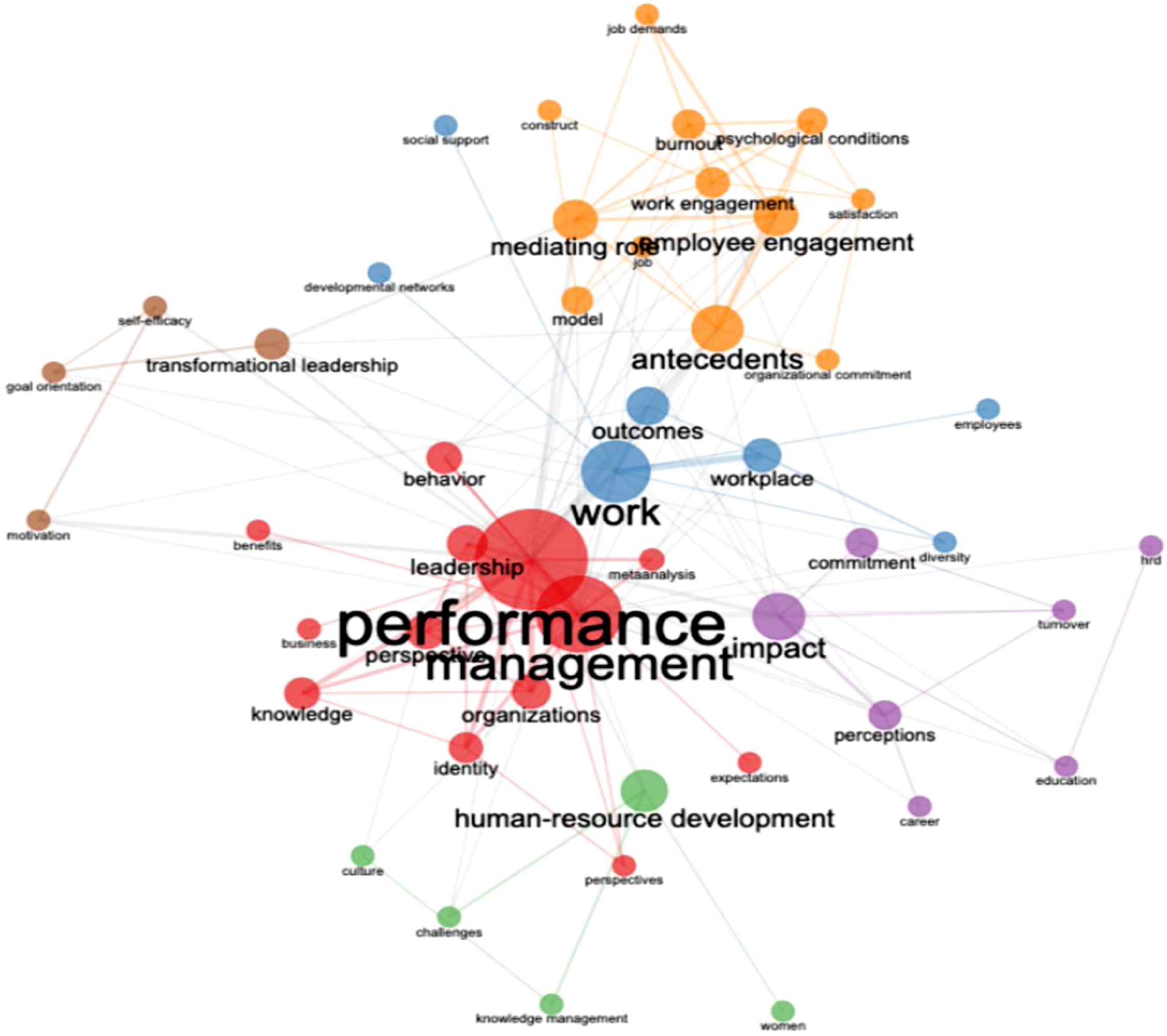
Three distinctive patterns were detected based on the results of the HRDR keyword network analysis. The most distinctive and central keyword was “performance.” Discussion about what constitutes the core identity of HRD in the articles has included (1) tension and balance between the learning and the performance paradigm (Han et al., 2017; Holton & Swanson, 2011); (2) the role of and call for more attention to development (Kuchinke, 2010); and (3) balanced success for individual-, group-, organization-, and system-level performance (Shirmohammadi et al., 2020). In our analysis, many keywords and almost all clusters appear together with the word performance, and the significant size of management in the same cluster and work from another cluster seem to indicate that scholars examined performance in both managerial and work contexts. Moving clockwise starting with the light blue node color, the first cluster represents topics of work and workplace outcomes (light blue), then commitment and perceptions related to turnover, career, and impacts (purple), issues related to HRD, culture, and gender (light green), leadership and motivation (light brown), and, finally, engagement (orange). In labeling the cluster, we used the size and connectivity of keywords in each cluster. We also excluded several small clusters in the periphery related to publication, scholarship, systems, and empiricism since too many generalizations from a graphical summary should be avoided. Visual inspection is more useful when various filters are applied to look deeper into each cluster. Thus, we created an interactive map for interested readers to check on the following webpage (https://bit.ly/31Ay6nE).
Structural Topic Modeling
To complement the visual inspection of the HRDR keyword network, we performed topic modeling to help the researchers extract and identify the research themes from a large volume of text (Roberts et al., 2014; Schmiedel et al., 2019). Topic modeling is an unsupervised approach that helps researchers determine a set of underlying or latent themes using algorithms (Blei, 2012; Roberts et al., 2014; Schmiedel et al., 2019). The estimation process is automatic, inductive, and data-driven, but it requires researcher discretion at various decision points to establish credibility (Chen et al., 2020; Lindstedt, 2019; Schmiedel et al., 2019). We used Latent Dirichlet Allocation (LDA) (Blei, 2012; Blei et al., 2003) algorithm-based structural topic modeling (Roberts et al., 2019) to investigate the semantic patterns in the bibliometric data. Document title, keywords, and abstracts were extracted from all documents excluding editorials to create a corpus. We also incorporated publication years to further examine any changes and trends of the extracted topics.
The number of topics was determined by held-out likelihood, semantic coherence, and residuals. To select the model with the best fit, we considered a strategy that maximized held-out and semantic coherence and minimized residual value. The held-out likelihood metric indicates how well each model predicted the words within the topic (Wallach et al., 2009). Higher values indicate a better model. In our analysis, the maximized held-out likelihood metric identified a five-topic model (−6.37). Semantic coherence is a statistical measure that indicates how comprehensible a subject is based on the likelihood of different words occurring together (Mimno et al., 2011). The highest semantic coherence was observed in the two-topic model (−43.53). Residuals are values that remain after the model estimation process; thus, a lower value of residuals indicates a better specified model (Taddy, 2012). The lowest residuals value was observed in the seven-topic model (1.36). The absolute size of these values does not imply the quality of the model, and researchers rarely identify a model that satisfies the best condition of all three criteria. A total of 99 maximal models starting with the two-topic model were estimated, and the model fit indicators were compared. This process informed us that the ideal topic number was in the range of a 5- to 7-topics model. By comparing the indicators and examining the context of each topic, we selected six topics as our final topic model.
Figure 2 represents the order of topics based on the expected proportion of each topic and shows six topics that are extracted and labeled: • Topic 1: Theories and practices in HRD (hrd, develop, human, practice, resource, theory, research) • Topic 2: Equitable leadership (leadership, women, develop, leader, gender, social) • Topic 3: Work and employee Engagement (work, engagement, employee, job, resource, research, relationship) • Topic 4: Learning and performance in team and organization (learn, organization, perform, develop, team, culture) • Topic 5: Diversity and critical HRD (diversity, learn, mentor, social, workplace, critics, hrd) • Topic 6: Literature review in general (research, review, literature, resource, coach). Expected topic proportions.

This analysis indicated that among the six extracted topics, keywords discussing theories and practices of HRD were the largest proportion in the corpus (23%), followed by work engagement (19%), literature review (17%), learning and development (15%), diversity and critical HRD (14%), and equitable leadership (12%). Similar to the results of the keyword network, topic modeling indicated that the strongest interest among HRD scholars was employee engagement, with authors examining antecedents and resources of engagement and related concepts. We also performed multi-dimensional scaling to further examine the degree of the associations among the extracted topics and found additional insights (Figure 3). *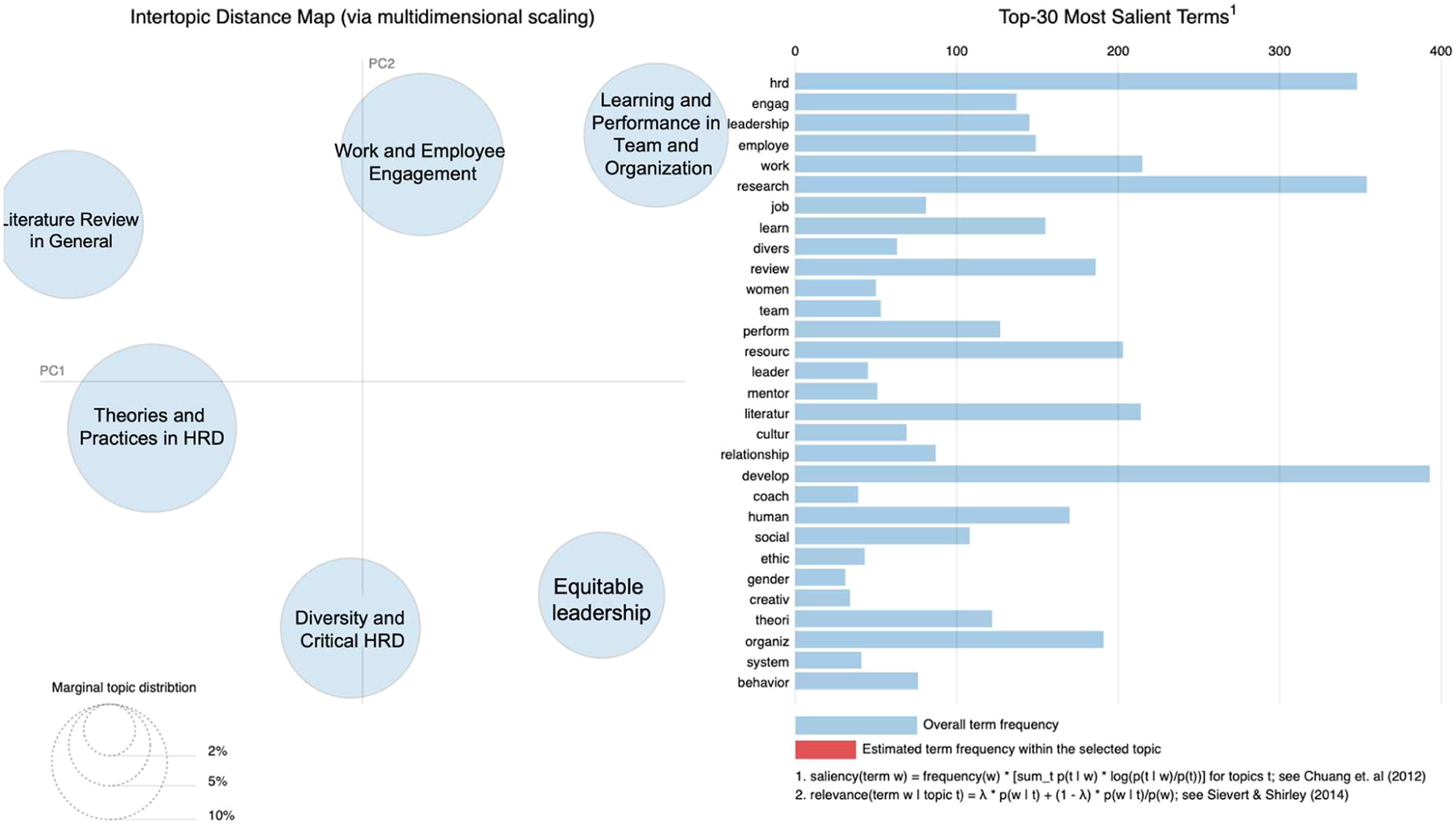
The inter-correlations among the six extracted themes, revealed negative correlations to confirm the topical distinctions. On a two-dimensional plane, “work and employee engagement” appeared to be close to “learning and performance.” Two topics, “diversity and critical HRD” and “equitable leadership” were close to each other. The relative distance can be considered a proxy for semantic relevance. Thus, when the two topical pairs are far away from each other, we can assume low semantic relevance. The topics of “theories and practice of HRD” and “literature review” comprised the first and third most frequent themes, respectively, and they were close to each other indicating high semantic relevance, and the overall distance was similar between this cluster and the other two clusters. Figure 4 illustrates the changes in the popularity of each theme as research topics based on a trend analysis. Time series change of expected topics proportion.
In Figure 4, the straight line indicates the topic trends in point estimation, and the dotted line indicates the range of the 95% confidence interval. When the expected topic proportion was compared across time, two topics, “theories and practices in HRD” and “diversity and critical HRD,” showed a continual decline, while other topics continually increased. A large decline in the proportion of the “diversity and critical HRD” theme was unexpected, particularly given HRDR’s two special issues on diversity (Williams & Marvin, 2014) and critical HRD (Bierema, 2015). When we examined the keywords in the “diversity and critical HRD” and “equitable leadership” clusters, the latter included related words, such as gender, social, and women, and the clusters were semantically close to each other. An increasing or declining slope does not imply a corresponding change in the popularity of associated keywords. It is possible that keywords associated with diversity and critical HRD could belong to the equitable leadership topic, and the proportion of those keywords in each topic can vary across different time periods; therefore, caution should be taken in drawing generalizations about the popularity of these research trends.
Bibliographic Coupling Analysis
Lastly, we performed bibliographic coupling analysis, also called as bibliocoupling (Chen & Chen, 2003; Ding et al., 2016; Kessler, 1963; Weinberg, 1974). This technique is less well known compared to co-citation or author collaboration networks, but it is a very useful technique to help identify the influence and popularity of scholarly work. Co-citation examines the relationship between articles to determine which two studies have received a citation from a third study (Small, 1973), while bibliocoupling examines which two studies cite the same third study (Weinberg, 1974). The former examines the research backend, while the latter examines the research front end. In other words, bibliocoupling indicates how different studies have studied the same topic (Vogel & Güttel, 2013).
Figure 5 is the result of bibliographic coupling for HRDR publications examining all documents in the bibliometric dataset. The coupling count was converted to distance metrics through normalization. Based on the normalized distance metrics, the documents were clustered using the hierarchical clustering method. The unit of analysis was references, and the impact was measured by a local citation score (Chung, 2007). To represent the modality of the thematic clusters, impact and popularity metrics were used to determine the location of the clusters in a two-dimensional space. Popularity was measured based on the degree centrality which measured the frequency of coupling. Based on the similarity of citations, we extracted five clusters. The size of the node indicates the number of documents associated with the cluster. For labeling, we used the five most relevant keywords and their confidence indicators. Topical clustering using bibliocoupling.
The clusters were labeled as follows: (1) work and workplace performance in management and organization (orange), (2) employee engagement and mediation role (purple), (3) gender issues and HRD in work and management (green), (4) HRD, management, and performance (light red), and (5) goal orientation and motivation for performance management and transformational leadership (light blue). Similar to the multi-dimensional scaling (MDS) results in topic modeling, the sum of the centrality of the documents in the cluster and the local citation score were mapped onto a two-dimensional plot.
In Figure 5, Cluster 1 (work and workplace performance in management and organization) showed a high degree of citation impact and structural centrality. Cluster 2 (employee engagement and mediation role) showed a high degree of structural centrality but the citation impact was lower than Cluster 1. An interesting finding is the position of Cluster 3 (gender issue and HRD in work and management). Although the degree centrality was lower than any other clusters, the impact of this thematic cluster was higher than the other two remaining clusters. Cluster 4 (management performance and impact in HRD perspective) and Cluster 5 (goal orientation and motivation for performance management and transformational leadership) were popular topics in HRDR articles over the past 10 years, but the impact of these two clusters was relatively lower than Clusters 1, 2, and 3. We discuss the implications of the three analyses separately and together in the Discussion section.
Authors, Institutions, and Collaboration
Academic graduate programs and associated faculty members are major producers of peer-refereed journal articles. Chae et al. (2020) examined four AHRD-sponsored journals including HRDR between 1990 and 2014, and reported how the co-authorship network of HRD scholars was structured from AHRD sponsored four journals (ADHR, HRDQ, HRDR, HRDI). And they revealed one giant cluster and another large cluster of more dispersed authors with low connectivity (see Chae et al., 2020, p. 17). Their analysis revealed a small-world phenomenon among HRD scholars, where a very small proportion of authors were connecting links that could be disconnected otherwise (Watts & Strogatz, 1998).
HRDR is unique in publishing non-empirical research articles (theory and conceptual work, literature reviews, research methods, and historical foundations of HRD) aiming at theory building in HRD. Thus, we examined how authors, institutions, and keywords were connected. Compared to a single relationship network or multiplex networks that examine multiple relationships, tri-partite networks can be examined more creatively by looking at how one type of node (e.g., authors, institutions, or keywords) works as an anchor that links the other two. To reveal the relationships between topics and authors and their collaborations, we asked the following questions: who and which institutions are key players in the conceptual landscape of HRD research? How are the results similar or different from those in previous studies? Are certain topics associated with or driven by particular institutions or scholars? And what are the collaboration patterns among the authors of different countries?
Before we present highlights from Figure 6, we should note that a tri-partite network like the one above should be interpreted with caution. For instance, authors often move to different institutions, but the database reflects the institutional affiliation when the work was published, not reflecting the current institution. Positioning columns and sorting rows in the column can be done in ways to highlight different aspects of the connection. For instance, we sorted the institutions and keywords in descending order but did not sort the authors in any order. Lastly, data pre-processing is extremely tenuous and often, technically, nearly impossible to resolve, especially if different words are used to represent the same concept. Author-institution-keyword affiliation network of HRDR publications 2012–2021.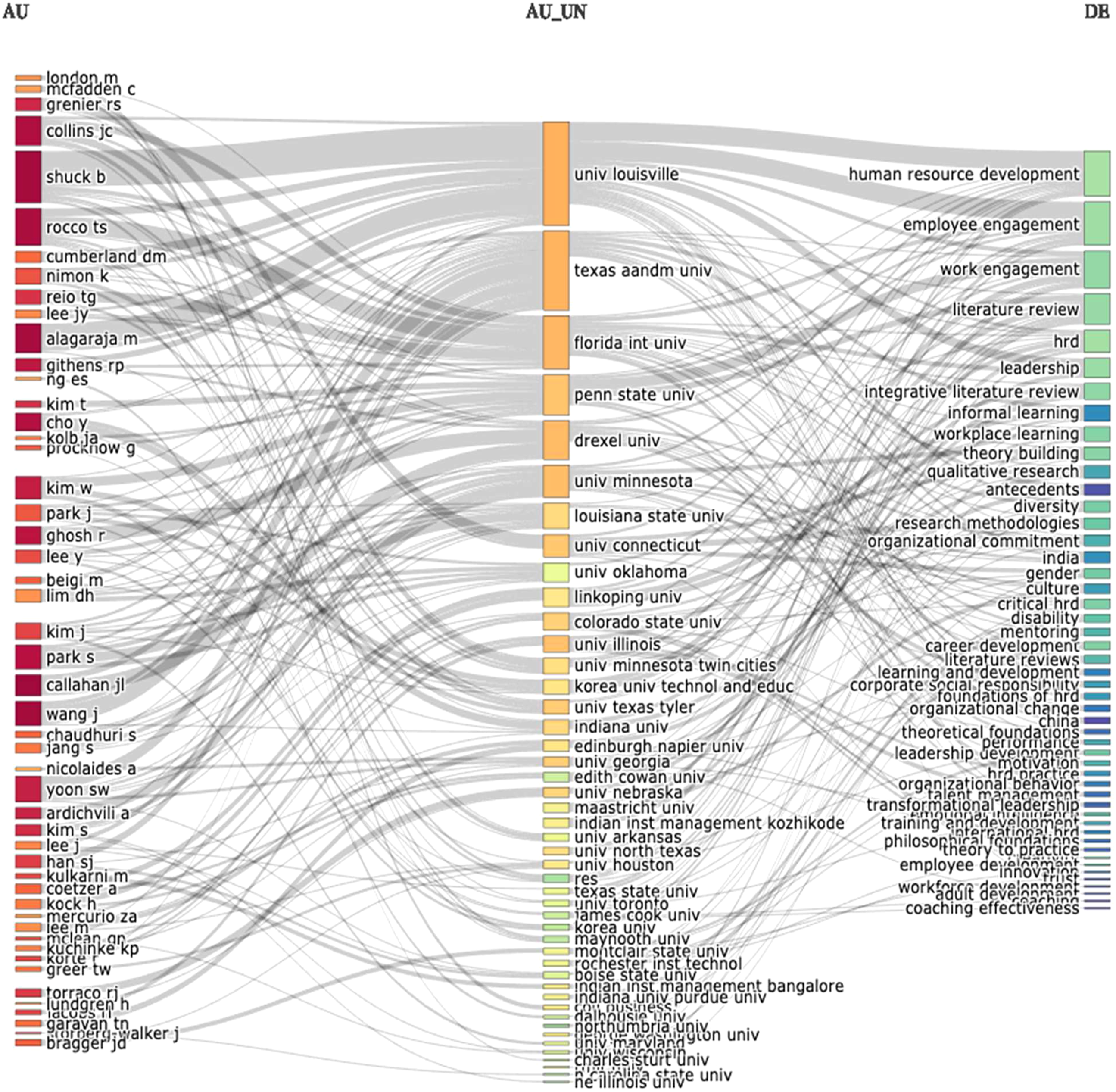
Figure 6 demonstrates that a small number of topics, particularly engagement, leadership, and learning are the most frequently examined research topics by scholars from two universities: University of Louisville and the Pennsylvania State University. Authors affiliated with these universities published the most on employee- and work-engagement, and many institutions and scholars contributed to this topic. For all other topics, the lines that emanated from the keywords and institutions were mostly thin and distributed among different actors indicating that most topics were by scholars from different institutions. Topics on equity and social justice, such as diversity, gender, and disability were strongly present, and topics that practitioners would consider main functions of HRD, such as career, mentoring and coaching, commitment, and change were the top keywords. Interestingly, technology-related topics, such as digitalization, technology, data, and analytics did not appear at all!
Investigating names of institutions and authors also revealed important information. Our knowledge on the history of the field and the journal helped us see that former and current HRDR editors seemed to have heavily influenced the presence of both the institutions and topics. U.S. universities with an academic HRD program contributed very heavily to HRDR. In addition, pockets of universities in Europe, India, South Korea, and Thailand also were represented. To indicate the magnitude of imbalance in contributions from different countries, Figure 7 represents author collaborations on a world map. Country collaboration among authors published in HRDR 2012–2021.
Our visual representation of author contributions and collaborations on a world map confirms the dominance of U.S. scholars (dark blue), lack of presence from multiple regions (Africa, northern Latin America, Middle East, and Balkan countries and Russia—gray means no representation), and very distinctive patterns of author collaboration among countries. For instance, the thick lines of red show frequent collaboration between scholars in the United States and Canada, South Korea, Island, and the United Kingdom, but no other European countries. However, there were no collaborations among these countries without authors in the U.S. Australia was the fifth most frequent country (after the U.S., South Korea, Canada, and the United Kingdom) where scholars collaborated with those in other countries, but the collaborations did not include U.S. scholars. Scholars in India, African nations, and China published work in HRDR, but with rare collaboration with scholars from other countries. Together, we believe that although international collaboration is common for advancing theory and conceptual research in HRD, there is much room for more participation from under-represented regions and for exploring ways to promote author collaboration between and among countries that are not well represented in Figure 7.
Discussion
Topic Clusters among HRDR Publications 2012–2021.
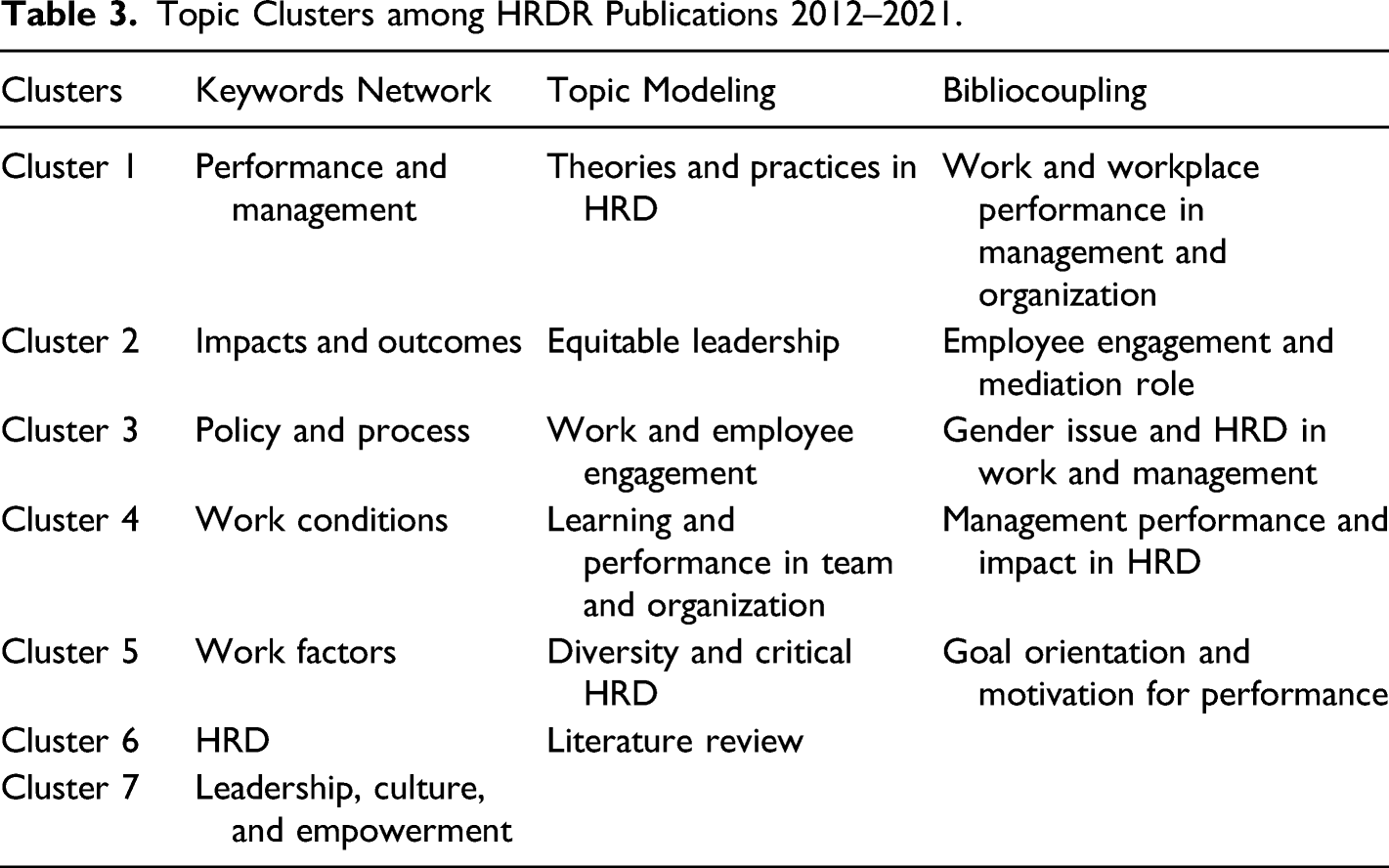
In terms of the major research themes and topics, the keyword network identified “performance” as the most frequent keyword forming the first central cluster, followed by and occurring together with the keywords of management, work, and employee engagement (Figure 1). In comparison, topic modeling identified “theories and practices of HRD” and “literature review” as a nearby pair, followed by the pair “employee engagement” and “learning/performance,” and the pair “diversity/critical HRD” and “equitable leadership” (Figure 3). Interestingly, the normalized distance measure placed the “employee engagement” and the “diversity/critical HRD” far apart from each other. That is, those two-pair sub-groups were distant from each other indicating semantic or topical irrelevance. The results from the trends analysis based on the meta-data by year in the topic modeling also informed that topics of diversity/critical HRD and equitable leadership were recently less frequent, while other topics showed increased frequency (Figure 4).
Lastly, the bibliocoupling method provided additional insights indicating that two clusters related to “performance” and “employee engagement” appeared on the high impact and the high central dimension and supported semantic irrelevance between them and other topics, especially “gender” (Figure 5). Compared to the two other methods, it was most difficult to identify distinct themes based on bibliocoupling, which means the same terms of “performance, management, and HRD” appeared in multiple clusters. Each technique is inductive and algorithmic, yet together, similar themes appear to form several major topical clusters to define and characterize the scope of HRDR publications. For instance, the theme “leadership, culture, and empowerment” in the keywords network analysis shared some commonality in semantics with the topic of “equitable leadership” in topic modeling and the theme “gender issue and HRD in work and management” from the bibliocoupling method. As our analyses indicate, synthesizing the results using complementary methods can help identify research trends and structural characteristics in greater detail.
For the second research question about author collaboration, we examined the author-institution-keywords affiliation network and the author collaboration network and found that publications on engagement seemed to be dominated by authors from two universities or collaborators who worked with them, while no institutional dominance was observed for most other topics. The author collaboration network between and among countries confirmed the dominance of collaborations within the U.S., followed by collaboration between scholars in the U.S. and those in a handful of countries (e.g., Canada, South Korea, Ireland, and the United Kingdom). However, no collaboration was found among scholars outside the U.S. National and regional comparisons also indicated a strong need for more collaboration and contributions from under-represented regions and countries.
Implications for Theory Development and Future Research
The study findings and three analysis methods provide important details about the past, present, and future of theory development and advancement in HRD and related disciplines. First, we know that earlier work on the identity of HRD has focused on the legitimization and the growth of the field through various development interventions, especially through the learning and performance paradigm (Callahan, 2012; Jo et al., 2009). Our analysis results present empirical evidence that especially in the last decade, the contexts of HRD work and research topics have greatly expanded and have become more diverse. We believe that research topics and themes based on our inductive methods related to diversity, critical HRD, and equitable leadership issues support the expansion of the research foci in HRD, given the critique on HRDR’s lack of research on the topic (Bierema, 2020) and deserve celebration of scholars’ efforts to advance important human and social values and well-beings. In addition, scholars are encouraged to further examine ways to cross-pollinate proximal and distal clusters based on the strong presence of engagement research and its proximity to topics of learning and performance, as well as the distal location between these two clusters and other clusters of topics related to diversity, critical HRD, and equitable leadership. To that end, we invite scholars to visit the URL for keyword network of HRDR articles we included earlier (https://bit.ly/31Ay6nE) and select and compare filters of interest. For instance, when we compared the topics burnout and team performance, burnout had more frequently connected keywords including satisfaction, job demands, employee engagement, while team performance had only one connection to transformational leadership. The graph also provides keywords around active connections to help researchers see how semantically close keywords can potentially be examined together.
Equally important, taking stock of the popularity of topics, their trends (as seen in the topic modeling), and the lack of keywords and topics of recent interest (e.g., digitalization, technology, analytics, and employee experiences) is worth mentioning to identify future research needs. Although our use of analytic methods relied largely on interpreting visuals and algorithmic clustering in network analyses, the techniques applied here and other data analytic methods, such as machine-learning (Tonidandel et al., 2018) and natural language processing (Kang et al., 2020) can be useful for studying a large amount and various sources of data for HRD research and practice (Yoon, 2018, 2021). This is not a push for using more computational social science methods; instead, we believe it is highly important to expand the use of diversified research methods for theory development (Reio, 2010). Data analytic approaches also can be theory builders and expanders as Seo and colleagues aptly pointed out (Seo et al., 2019). We firmly believe that theories and methods create synergy when communicating with the right tools. Promising and interesting possibilities include finding colleagues with similar interests, converging semantically relevant topics into a theoretical or conceptual framework, and exploring new ideas based on divergent thinking by connecting distal keywords.
Although these paths are not easy, we hope that the structural characteristics, patterns, and gaps we reported here help researchers understand the growth of HRD research topics and future needs. We also hope that this work invites more HRD and organizational scholars to leverage modern data analytic approaches or work with data analytics scholars to advance theory building.
Footnotes
Acknowledgments
We would like to express our sincere appreciation to HRDR’s Editor-in-Chief Dr Yonjoo Cho for inviting us to contribute to the journal’s 20 years of anniversary issue.
Declaration of Conflicting Interests
The author(s) declared no potential conflicts of interest with respect to the research, authorship, and/or publication of this article.
Funding
The author(s) received no financial support for the research, authorship, and/or publication of this article.
