




Abstract
The atherogenicity of triglyceride-rich lipoproteins (TRLs) is dependent of their particle size as it determines their metabolic fate. Since TRL possess a single apolipoprotein B (Apo B) molecule per particle, the triglyceride (TG)/Apo B ratio has been used as a convenient method to estimate TRL size. The aim of this study was to validate this approach by correlating the serum TG/Apo B ratio, and the TRL particle size measured by dynamic light scattering (DLS). Twenty-four male volunteers (12 normal-weight and 12 obese individuals) received a high-fat meal. Preprandial (0 h) and postprandial (2 and 4 h) serum samples were collected after meal ingestion, and TRLs were isolated. Serum TG and Apo B levels were quantified, and the TG/Apo B ratio was plotted against TRL particle size measured by DLS for correlation. A strong association between TRL particle size and serum TG/Apo B ratio for normal-weight subjects (P ≤ 0.001) was observed but not for obese subjects (P = 0.6116). TG/Apo B ratio correlates with particle size in healthy normal-weight males but not in obese individuals. Whether this ratio is useful to estimate TRL size in females and in other dyslipidemic patients should be subject of future investigations.
Introduction
It has become clear in the past years that postprandial lipemia, which is caused by raised levels of triglyceride-rich lipoproteins (TRLs) in the blood after a fatty meal, may be a risk factor for atherosclerosis. 1 TRL remnants can cross the endothelial barrier and enter into the vascular wall, 2 where they can interact with lipoprotein receptors on macrophages, enhancing lipid accumulation and leading to foam cell formation, one of the first steps of atherosclerosis. 3 The magnitude and duration of the postprandial triglyceride (TG) response is influenced by a number of metabolic processes, including the rate of TG secretion from the intestine and the liver, the activity of enzymes involved in the TRL processing and the rate of clearance of TRL remnants by receptor-mediated pathways. 1
These processes are mediated, among others, by changes in particle size, which is an important determinant of TRL metabolic fate. We have previously reported that TRL particles with differences in size and composition can modulate TRL clearance postprandially, which may affect TG incorporation to the tissues. 4 Moreover, Palmer et al. 5 demonstrated that the highest TG uptake by macrophages takes place when cells were incubated with TRL obtained at the time point at which the particle size is intermediate (Sf 60–400), i.e. not as large as nascent particles (Sf > 400) and not as small as small—very low-density lipoprotein (VLDL) particles (Sf 20–60). Particle size is dependent upon TG hydrolysis by lipoprotein lipase (LPL), which is believed to be the predominant mechanism for TG uptake from TRL. 6 TRL particles (chylomicrons and VLDL) share the LPL pathway, which is saturable. However, despite being present in a greater number in the postprandial state, VLDLs are much slowly cleared from plasma compared to chylomicrons, probably because large chylomicrons bind more avidly to LPL. 7 LPL activity reduces TG but not apolipoprotein B (Apo B) content of TRL. This feature has been used to calculate the ratio between serum TG and Apo B concentrations as a rapid and convenient method to indirectly measure particle size.8,9 Small TRLs are cleared from the plasma at a slower rate than large TRL, 10 increasing their opportunity to penetrate the arterial wall 11 and for the transfer of lipids from high-density lipoprotein (HDL) leading to a lowering of HDL cholesterol. 12 Therefore, the TRL particle size can be of importance for processes involved in atherogenesis at different stages. However, it is presently unknown whether the serum TG/Apo B ratio correlates with other methods for particle size measurement and if it is useful for all kind of human subjects and physiological situations. Therefore, in the present study, we aimed to correlate the serum TG/Apo B ratio and the particle size measured by dynamic light scattering (DLS) in normal-weight and obese subjects at different postprandial times.
Materials and methods
Twenty-four healthy men, aged 31.8 ± 9.7 years participated in the study and were divided into two groups (normal weight and obese) according to their body mass index (BMI). Subjects were categorized as normal weight when BMI was lower than 25 kg/cm2 and obese when BMI was higher than 30 kg/cm2. Sample size was calculated by power analysis, considering a type 1 error (α) = 0.05 and a power (1−β) = 0.9 and resulting in a minimum number of 10 individuals per group. Subjects were excluded if they suffered from any digestive or metabolic disorder, were taking dietary supplements, or were under medication of any kind. Participants gave written, informed consent to a protocol approved by the Institutional Committee on Human Research (Hospital Universitario Virgen del Rocio, Seville, Spain). All procedures were in accordance with the Institutional and National ethical standards for human experimentation and the Helsinki declaration of 1975 (revised in 2000).
Participants were asked to have a low-fat dinner the evening prior to the postprandial study and to abstain from alcohol drinking and smoking for 24 h. On arrival, after an overnight fast (12 h), a cubital vein was catheterized and a baseline blood sample was taken immediately before consumption of the test meal that consisted of three slices of bread (71 g), 200 ml of skimmed-milk (fat content was 0.3 g/100 g), 55 g of butter, and 20 g of cocoa powder.
Blood samples were also collected 2 and 4 h after the intake. During the course of the experiment, subjects were allowed to drink water and to undertake only light activities. Serum was recovered by centrifugation (1620 × g, 30 min, 4℃), and sodium azide, phenymethylsulfonyl fluoride, and aprotinin (Sigma-Aldrich, Poole, UK) were added to a final concentration of 1 mmol/L, 10 µmol/L, and 0.5 mg/L, respectively.
Postprandial TRLs were isolated from 4.5 mL of serum that was layered under 8 mL of NaCl solution (d = 1.006 kg/L), by a single ultracentrifugation spin (39,000 rpm, 16 h, 12℃), which ensures that all TRLs are collected. Ultracentrifugation was performed using a SW41Ti swinging bucket rotor in a Beckman L8-70 M preparative ultracentrifuge (Beckman Instruments, Palo Alto, USA). TRLs were rapidly frozen at −80℃ and thawed just before isolation.
Serum Apo B concentrations were quantified by a turbidimetric immunoassay method (BioSystems, Spain, coefficient of variation [CV] ranged from 18.7% to 28.9%) following manual’s instructions, and TG concentrations were measured by standard enzymatic methods (Roche Diagnostics, Basilea, Switzerland, CV ranged from 10.6% to 21.0%). TRL size was determined by DLS using a Zetasizer Nano ZS instrument (Malvern Instruments, Malvern, UK; CV ranged from 5.0% to 7.4%). Samples were well homogenized and diluted with 0.9% (w/w) NaCl to an appropriate concentration (1:40 to 1:200 times). One milliliter of diluted TRL sample was loaded on a folded capillary cell and incubated at 37℃ for 2 min before the reading. The conditions of the instrument were as follows: dispersant water, temperature 37℃, and refractive index 1.330. Results are expressed as the Z-average mean, which is the harmonic intensity of averaged particle diameter. Measurements were performed in triplicates. For the calculation of the TG/Apo B ratio, TG and Apo B values were expressed as mg/dL. Results were expressed as means ± standard error of the mean (n = 12). Data analyses were performed with the GraphPad Prism® 5 statistical package (GraphPad Software Inc., San Diego, CA). Correlations between variables were assessed using Pearson’s correlation coefficients. Differences were considered statistically significant at P < 0.05.
Results and discussion
Anthropometric and fasting serum biochemical parameters of the participants in the study
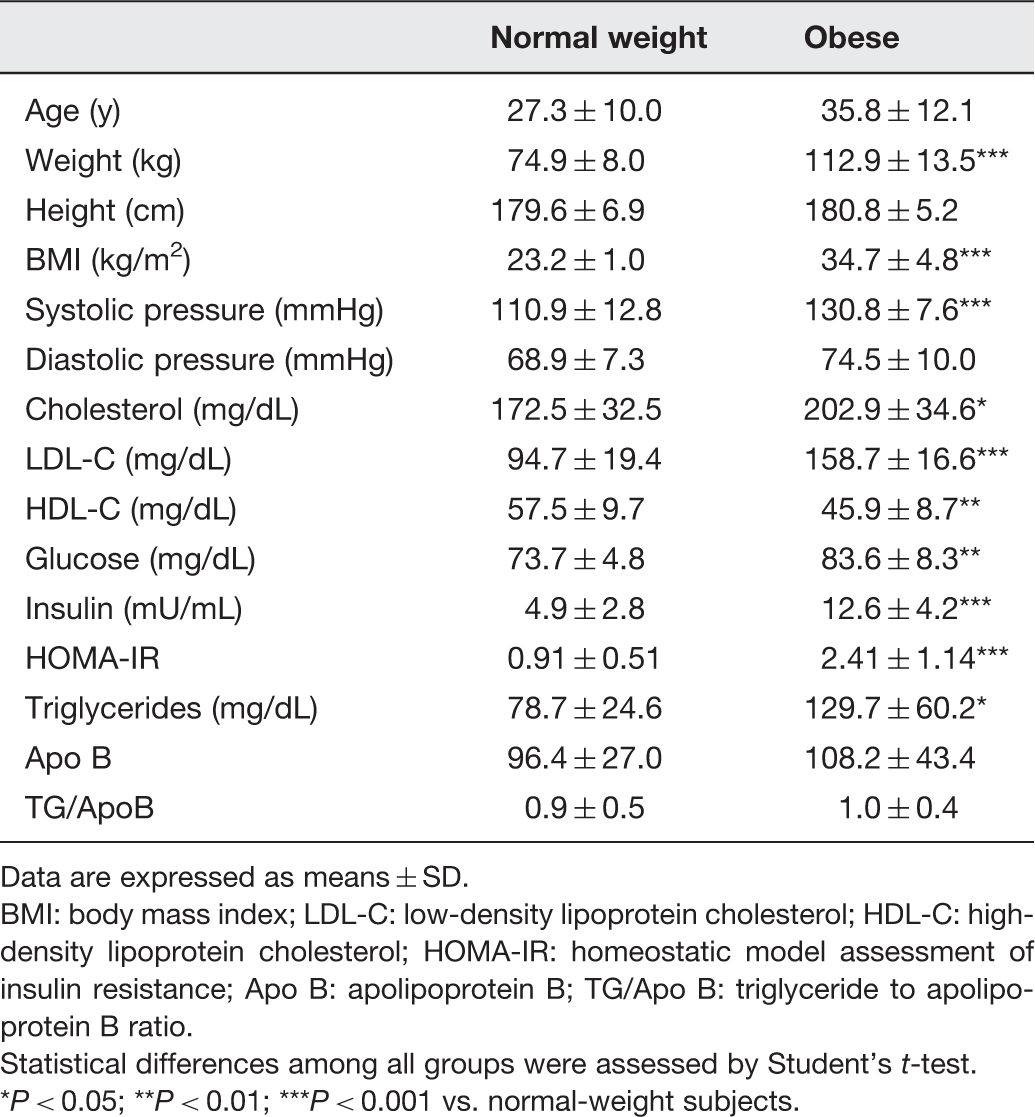
Data are expressed as means ± SD.
BMI: body mass index; LDL-C: low-density lipoprotein cholesterol; HDL-C: high-density lipoprotein cholesterol; HOMA-IR: homeostatic model assessment of insulin resistance; Apo B: apolipoprotein B; TG/Apo B: triglyceride to apolipoprotein B ratio.
Statistical differences among all groups were assessed by Student’s t-test.
P < 0.05; **P < 0.01; ***P < 0.001 vs. normal-weight subjects.
Figure 1 shows the correlation of TRL particle size, measured as DLS and serum TG/Apo B ratio in all studied subjects and in the groups of normal-weight and obese subjects at the three time points (0, 2, and 4 h). Correlation was strongly significant in normal-weight subjects (P < 0.001) but not in obese individuals (P = 0.6116). As a consequence, in the whole group of participants significance was not achieved (P = 0.0526), and the correlation coefficient was very low (r = 0.1745). Al-Shayji et al.
9
studied the effect of exercise on the TG/Apo B ratio of large VLDL in a group of overweight subjects, finding a non-significant increment that was associated with increased particle size. Our results show that the TG/Apo B ratio does not correlate in obese subjects, and these data might be different if Apo B was measured directly in VLDL or chylomicrons instead of serum. The absence of correlation in obese individuals might be related to the heterogeneity particle size in this group, showing coefficients of variation ranging from 17% at 0 h to 48% at 4 h, whereas in the normal-weight group, they ranged from 14% at 0 h to 22% at 4 h. Significant correlations were maintained when TG values were expressed as mmol/L, which is common in many laboratories. The ratio can be easily converted by applying the molecular weight (MW) of triolein (MW = 885).
Correlation of serum triglyceride to apolipoprotein B ratio and particle size of triglyceride-rich lipoproteins from all, normal-weight and obese subjects in fasting conditions (0 h) and 2 and 4 h after a fat challenge (12 individuals per group), and composite of all time points. Correlations between variables were assessed using Pearson’s correlation coefficients. Differences were considered statistically significant at P < 0.05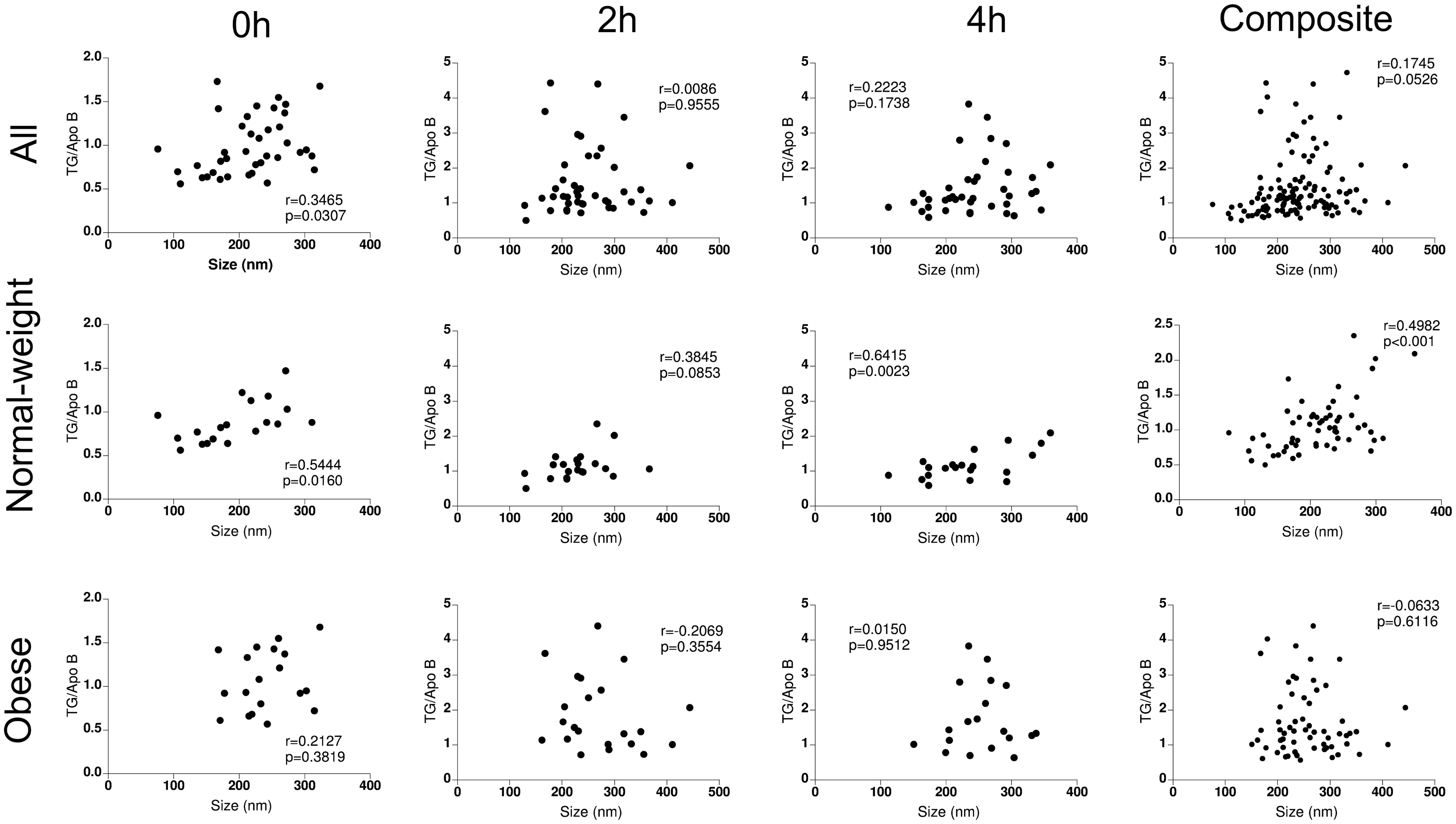
TRL particle size and serum TG/Apo B ratio did not correlate in normal-weight subjects at 2 h after the intake of the experimental meal, when nascent, large chylomicrons are predominant. In contrast, correlation was significant in fasting conditions and 4 h after the lipid challenge, time points at which the particle size is usually lower. 8 Particles obtained from obese subjects were significantly larger at all time points studied. However, although TRL size was lower at 0 h in both groups of subjects, we did not find significant differences between 2 and 4 h, regardless the method used for its measurement (Supplementary Table).
DLS has been proposed as a reliable technique to measure TRL size and to study TG hydrolysis by lipases.13,14 The technique has been validated for LDL in comparison to electrophoresis and for larger particles, 15 like TRL in comparison to gel chromatography, 16 and thus it can be used to measure lipoprotein particle size.
The study has two limitations that need to be addressed: participants were all males, and the sample size is rather low. Therefore, future investigations should include females and larger samples to confirm these results. A possible limitation was the interference of TG in the Apo B assay. However, we consider this unlikely, since the CV (%) for the Apo B assay was similar in normal-weight and obese subjects and slightly higher in fasting conditions (0 h) than in the postprandial period (2 and 4 h).
Conclusion
In conclusion, our findings show that the TG/Apo B ratio correlates with particle size measured by DLS, and can be employed to estimate particle size, in healthy normal-weight males but not in obese individuals. Whether the ratio can be safely used in females and in subjects affected by dyslipidemia requires further investigation.
Footnotes
Author contributions
JSP designed the study. JSP and EM carried out the postprandial assay. MAB and LS performed the analyses. JSP and MAB drafted the manuscript. All authors approved the final article.
Acknowledgements
This work was supported by funds from Ministry of Economy and Competitiveness (Grant AGL2011-23810 and a FPI fellowship to Laura Sinausia). The funding body did not have any other role in the design, experimental work or writing of the manuscript.
Declaration of conflicting interests
The author(s) declared no potential conflicts of interest with respect to the research, authorship, and/or publication of this article.
References
Supplementary Material
Please find the following supplemental material available below.
For Open Access articles published under a Creative Commons License, all supplemental material carries the same license as the article it is associated with.
For non-Open Access articles published, all supplemental material carries a non-exclusive license, and permission requests for re-use of supplemental material or any part of supplemental material shall be sent directly to the copyright owner as specified in the copyright notice associated with the article.
