




Abstract
This article uses the unique case of low-income renters who have participated in tenant rights education to understand how an increased understanding of their rights and responsibilities shaped tenant strategies for addressing destabilizing housing conditions. We find that tenants varied in their responses with some demanding repairs or rent reductions and others resigning themselves to their housing situations. This variation was not random: the strategies tenants adopted after rights education reflect social vulnerabilities, particularly the formality of rental arrangements and legal status to live in the United States. Tenants incorporated what they learned into their plans for next steps which helped some avoid, or at least delay, displacement in the short term and improved their capacity to advocate for repairs. However, tenants with multiple social vulnerabilities or whose situations fall in legal gray areas were resigned to their situations. They avoided displacement but that avoidance came at the cost of requesting repairs or contesting unfair rent increases. A subset of tenants felt no need to alter how they approached housing issues but planned to use the information in the future, either for themselves or others in their community. Tenant rights education influences strategizing for low-income renters in positive ways, but to truly disrupt housing precarity, rights education must be combined with ongoing legal support and policies that reduce rent burdens.
Introduction
Affordability and housing quality challenges are common for low-income tenants and can lead to unplanned moves or involuntary immobility in substandard housing (DeLuca and Jang-Trettien 2020; Desmond and Shollenberger 2015; Evans and Chapman 2024; Kang 2021; Schmidt 2024b). In an effort to disrupt housing precarity, community-based organizations have expanded eviction prevention and tenant education efforts (Abraham et al. 2023; Cohen and Noble 2020; Gilman 2023; Trekson et al. 2021), including educating tenants about their rights and the nature of legal processes (Golio et al. 2023; Nations and Martínez-Valdivia 2024). Researchers have documented the benefits of interventions for tenants (Cohen and Noble 2020; Golio et al. 2023; Nations and Martínez-Valdivia 2024; Trekson et al. 2021) and shown that efforts to organize tenants sometimes result in policy victories (Accornero 2022; Card 2024; Michener 2023; Soaita 2024). They have not yet considered the ways in which tenant education efforts influence how tenants think about and manage precarity at the individual level.
Studies that document howtenants manage precarity, such as navigating instances of serious disrepair, discrimination, rent overcharges, and eviction (DeLuca, Wood, and Rosenblatt 2019; Desmond 2016; Korver-Glenn and Locklear 2023; McKee, Soaita, and Hoolachan 2020; Schmidt 2024) describe tenants are who mostly unfamiliar with local rental housing regulations or the range of options they might pursue to improve conditions or avoid eviction. As a result, current research does not account for the ways that tenant education shapes renters’ strategies for disrupting the common experiences of displacement or disrepair.
In this article, we draw on the experiences of 64 low-income tenants in the City of San Diego, California who have completed a tenant rights education workshop and ask, (1) How does rights education shape tenant strategies to improve housing outcomes? (2) What role do social vulnerabilities (e.g., immigration status, race/ethnicity) and housing arrangements (e.g., type of rental, formality of rental contract) play in the strategies tenants adopt after rights education? And (3) Are tenants who are exposed to rights education able to preserve housing stability? The tenant rights education we observed for this study had an impact on tenants, as measured through pre- and post-surveys of knowledge gains, which we have reported previously (Nations and Martínez-Valdivia 2024). Here we document how tenants incorporated this knowledge into their plans for next steps and how likely these plans are to reduce short-term displacement and encourage repairs by landlords.
We argue that rights education does help tenants avoid, or delay, displacement and may improve their capacity to advocate for repairs. However, for tenants with multiple social vulnerabilities or whose situations fall in legal gray areas, their ability to avoid displacement comes at the cost of requesting repairs or contesting unfair rent increases. Increased understanding about the legal and regulatory apparatuses governing rental housing help some tenants make reasonable requests or openly challenge landlords with the help of organizers, but more often it discourages tenant action. In doing so, displacement is reduced because tenants have not antagonized their landlords. By not making claims on landlords, however, tenants’ living conditions do not improve.
Specifically, tenants described four distinct strategies after participating in rights workshops: defending their rights, making claims on landlords, resigning themselves to their situations, or feeling no need to adopt new strategies due to a positive rental arrangement. Seven tenants directly defended their rights by working with attorneys or tenant organizers to contest evictions, illegal rent increases, or other problematic landlord actions. Six tenants made claims on their landlord by approaching them with a formal grievance or request, albeit without signaling support from legal or community organizations. Together, these 13 tenants tended to be less vulnerable than other participants: most had legal documentation to live and work in the United States and nearly all had written, formal rental contracts. They were almost all living in units with multiple disrepair issues. In a few instances, tenants were motivated to assert their rights to delay or end active eviction threats.
Nearly half of tenants (28 of 64) were resigned to their situations. They remained in substandard living conditions or shouldered unfair (and possibly illegal) rent increases because they believed the act of claims making would expose them to housing loss, rent increases or, for undocumented tenants, deportation. Resigned tenants chose not to approach property owners, either to assert their rights when property owners acted illegally or to follow up on reasonable requests for repairs or rent overcharges. These tenants were more likely to be undocumented, renting informally, or facing problems where it was not clear whether landlord actions were illegal.
The remaining tenants in our sample (23 of 64) felt no need to change strategies after workshops because they were content with their current housing situations, were experiencing relative stability, and felt that landlords were responsive to their needs. Tenants who felt content with their rental arrangements were more likely to rent from corporate landlords with clear communications policies in place but were otherwise a diverse group. Several recognized that while their current landlords addressed housing needs and did not increase rent unfairly, they would likely encounter conditions where rights education would be useful in the future.
Our findings expand researchers’ understanding of tenant decision-making and strategizing. The tenants we interviewed were better informed than tenants in many other studies: they represent a “best case scenario” of non-activist tenants who are empowered with information about state and local housing law. Like all tenants, they are navigating the day-to-day realities of renting in a system with high potential for exploitation (Garboden 2023). However, by participating in rights education workshops, they acquired additional information that gave them a wider range of possible responses. Efforts to educate and organize tenants grew significantly during the COVID-19 pandemic (Abraham et al. 2023; Cohen and Noble 2020; Gilman 2023; Trekson et al. 2021). As a result, information about tenants’ rights has become increasingly accessible in many communities and may impact tenant planning, even in conditions where tenants can exercise little power (Lew 2026).
As we describe below, the content of rights education includes a review of tenants’ rights, but also landlord rights, and how certain types of tenant actions (e.g., withholding rent or deduct and repair) put tenants in danger of lawful evictions (Franzese, Gorin, and Guzik 2016; Sabbeth 2019). In this way, tenants learn that taking action exposes them to varied levels of risk because the legal rights of property favor property owners (Chisholm, Howden-Chapman, and Fougere 2020). Tenants weigh risks and rewards in the broader context of their housing precarity, discrimination, and even deportation, as well as affordability challenges. The result is varied strategic responses after tenant rights education that align with demographic disadvantages and reflect power imbalances between tenants and property owners (Desmond and Wilmers 2019; Garboden 2023). While the overall result for the tenants in our study was that most were able to stay in their homes, they continued to confront disrepair, overcrowding, and unaffordability. In the discussion we review ways that tenant rights education could be pursued in combination with other reforms to more meaningfully disrupt housing challenges for renters.
Strategizing to Improve Housing Outcomes and Social Vulnerability
Recent research points to the varied forms of precarity faced by low-income renters. Impoverished tenants frequently experience precarity as displacement, oftendue to their inability to pay rent, followed by substandard housing, and poor neighborhood conditions (DeLuca et al. 2019; Desmond and Shollenberger 2015; Garboden and Rosen 2019; Gromis and Desmond 2021; Kang 2021; Nelson et al. 2021). Unplanned moves force tenants to make housing decisions on short timelines, resulting in little to no improvement in their housing and the reproduction of urban poverty (Carrillo et al. 2016; DeLuca and Jang-Trettien 2020; DeLuca et al. 2019; Desmond 2016; Harvey et al. 2020). Precarity is also experienced in the form of immobility. Researchers show that many low-income renters—and even middle-income renters in high-cost markets—are immobile, or stuck in place, as high costs make moving a challenge, even when tenants desire to move due to housing quality problems (Evans and Chapman 2024; Hall and Greenman 2013; Luhr 2024; Mateyka 2015; Rosen et al. 2023; Schmidt 2024b; Shakespeare 2022). The negative health and housing consequences of this exploitation are well documented (Desmond and Kimbro 2015; Grineski and Hernández 2010; Hatch 2017; Michener 2023).
During the past decade, researchers have more closely examined how tenants manage or challenge precarity. One area of study, focused on daily decision-making among disadvantaged renters, suggests that tenants often respond to precarity with little knowledge about their rights. In this area of study, tenants find ways to resist displacement by fixing problems themselves, negotiating with landlords, or tolerating disrepair (Korver-Glenn and Locklear 2023; Power and Gillon 2022; Rosen et al. 2023; Schmidt 2024b). When tenants openly object to serious disrepair they commonly face eviction (Desmond 2016:64–79). Tenants may strategically acquiesce to poor conditions to preserve low rents and maintain existing housing (Schmidt 2024b) and report general feelings of disempowerment (McKee et al. 2020). Such strategies underscore the susceptibility of low-income renters to displacement, which reduces the likelihood they will agitate against violations of their rights (Pendall, Theodos, and Franks 2012).
Despite their precarity, some disadvantaged tenants publicly engage in organizing campaigns and legal action (Card 2024; Lew 2026; Michener 2023; Vidal 2025). Tenants in these studies are motivated by disrepair and unaffordability to join tenant unions that are challenging property owners or seeking policy change. These accounts reflect the reality that governments have underinvested in the institutions that support tenants’ efforts to defend their rights (Sabbeth 2019) and that eviction court processes disadvantage low-income renters (Fleming-Klink, McCabe, and Rosen 2023), making organizing a vital tool.
It is not clear what proportion of tenants join organizing campaigns and what proportion acquiesce to their living conditions, or what enables one type of action over another. For example, disrepair motivates tenants to join tenant organizing efforts (Card 2024; Lew 2026; Michener 2023) as well as engage in smaller acts of resistance on their own (Korver-Glenn and Locklear 2023), but can also lead to inaction (Chisholm et al. 2020; Schmidt 2024b). Current research cannot account for the range of strategies tenants might take generally or after learning about their rights.
Studies suggest that from whom tenants rent may influence their housing precarity, with possible indirect effects on strategies to improve housing outcomes. For example, informal housing arrangements, such as doubling up with family, can lead to displacement when relationships unravel under conditions of overcrowding (Carrillo et al. 2016; Kang 2021). Renting from small-scale landlords may have the opposite effect when they opt to support tenants in difficult times: when tenants can go to property owners about their problems, some respond with support (Balzarini and Boyd 2021; Shakespeare 2022). Corporate landlords file for eviction more often than non-corporate owners (Immergluck et al. 2019) and see eviction filing as a valuable tool for revenue generation in past due rents and late fees (Garboden and Rosen 2019). While it is unclear whether the formality of a rental arrangement or nature of the landlord’s operation (i.e., corporate versus “mom and pop”) matter for tenants’ efforts to improve housing outcomes, they may contribute to tenants’ sense of instability and therefore their decision-making.
The income, race, ethnicity, and family and immigration status of tenants—factors that contribute to their social vulnerability—may motivate or constrain resistance. In general, personal vulnerabilities and housing precarity overlap, with low-income and minority households more likely to be rent burdened and live in overcrowded conditions (Pendall et al. 2012). Low-income renters who belong to racial or ethnic minority groups or are recent immigrants are especially disadvantaged in housing markets (DeLuca and Jang-Trettien 2020; Immergluck et al. 2019). Race and class intersect with gender and family status in ways that put Black and Latina mothers at particular risk for housing precarity (Carrillo et al. 2016; Desmond 2012). Such heightened precarity may depress the willingness of some groups to defend their rights (Korver-Glenn and Locklear 2023; Schmidt 2024b). On the other hand, it can be a source of strength in tenant advocacy (Michener 2023), such as when the common experience of exploitation unites native-born and refugee renters (Lew 2026).
Existing research cannot answer the question of how rights education shapes tenants’ strategies to improve their housing outcomes nor explain the role of social vulnerabilities in their decision-making. Studies of tenant activism do not because the outcome of interest is how tenant activism is accomplished or affects change, rather than an assessment of the social conditions that enable tenants who learned about their rights to participate in the first place (Card 2024; Michener 2023). Studies of tenants’ daily resistance and negotiation of disrepair do not because most tenants in these studies have limited knowledge about their rights and almost uniformly oppressive living situations (Desmond 2016; Korver-Glenn and Locklear 2023; Schmidt 2024b). Current research also cannot show whether tenant education disrupts displacement by giving tenants additional options for improving housing conditions or contesting illegal actions, aside from direct organizing.
Tenant Rights Education and Rental Housing Regulations
Tenant rights education and eviction prevention efforts are not new, 1 but since 2014 many states and local governments in the United States have passed tenant protection laws and rental assistance programs (Holl, van den Dries, and Wolf 2016; Nelson et al. 2021), in part inspired by efforts like the Anti-Eviction Mapping Project and the Eviction Lab. 2 More recently, researchers have documented an increase in non-profit organizations that connect low-income renters to resources (Aurand, Emmanuel, and Threet 2020; National Low Income Housing Coalition 2021a, 2021b; Parrott and Zandi 2021), as well as growth in tenant organizing during and after the COVID-19 pandemic (Lew 2026; Michener and SoRelle 2023). Eviction moratoria, prompted by the threat of mass layoffs and sharp increase in renters’ inability to pay rent, prevented an eviction crisis during the first years of the pandemic (Hepburn et al. 2023). Local organizations and housing authorities connected people to rental support funds, information about eviction moratoria, and legal defense services (Trekson et al. 2021). Tenant rights education, one element of broader efforts to address housing instability, has successfully led to an increased understanding of relevant laws among tenants (Nations and Martínez-Valdivia 2024) and decreased risk of eviction (Golio et al. 2023; Innovation for Justice and Step Up for Justice 2020).
The need for tenant education is apparent from the high and persistent risk of housing loss faced by renters. Desmond and Shollenberger (2015) estimated that one in eight renters living in Milwaukee had been formally evicted or forced to move in the previous two years. A nationally representative sample of renters reported lower rates of forced moves (6.2 percent) but 13.6 percent moved in response to poor housing or neighborhood conditions (Gromis and Desmond 2021). These research findings suggest that providing tenants with resources for responding to poor housing and eviction threats is needed.
Studies that examine the prevalence or impact of tenant education show important wins for tenants, but do not explore tenants’ decision-making after interventions. Given that tenants’ rights remain constrained relative to property owners’ rights after programs end (Chisholm et al. 2020; McKee et al. 2020), additional insights into how tenants incorporate rights awareness into their plans for next steps is needed. This is particularly important for understanding whether tenants’ ability to prevent displacement or move away from bad rental arrangements changes.
Study Context
Hatch (2017) classified the State of California as one of 13 “protectionist” states, meaning that it has adopted policies that provide statutory protections to renters. In 2019, the state increased protections for tenants by passing a statewide just-cause tenant protection law (California State Assembly 2019) which also set rent increase limits for multi-family units at 10 percent annually or 5 percent plus the local rate of inflation, whichever was lower. This state law did not apply to the City of San Diego until June 2023 because the law was only applicable for jurisdictions that had adopted just-cause ordinances locally (San Diego Municipal Code O-21647). However, state and federal laws establishing eviction moratoriums during the pandemic did apply to San Diego renters until the state law ended in June 2022 (Senate Bill 91). Despite a pro-renter policy environment, California’s high cost of living contributes to ongoing housing precarity. For example, renters are not protected from eviction if they are considered “at fault,” such as if they fail to pay rent (Legal Aid Society of San Diego 2026).
The City of San Diego is considered a high-cost housing market for homeowners and renters alike (Joint Center for Housing Studies 2024). Rental property costs have risen rapidly in recent years in nearly all jurisdictions and neighborhoods of San Diego, putting low-income families at risk of housing displacement. Most of the participants in our study are extremely low-income by the region’s area median income standards, earning 30 percent of the area median income, or less than $28,950 per year for a single person, $41,350 for a family of four in 2023 (County of San Diego 2023). The remainder earned 50 percent or less of the region’s area median income. For extremely low-income renters, monthly rental costs should be less than $700 for a one-bedroom apartment per month to stay under the commonly accepted standard of paying less than 30 percent of their income on rent. The County of San Diego estimated an average rent price of $2,500 for a one-bedroom apartment in 2022 (County of San Diego 2026). Rental vacancies in the region were estimated to be between 1.7 and 3.5 percent in 2021 and 2022 (U.S. Census Bureau 2025). Given the high costs of housing, low vacancies, and low wages of the most impacted communities, finding new housing is challenging (Dias Mesquita and Kimberlin 2022).
The Eviction Prevention Collaborative was initiated to circulate information about the rapidly changing eviction moratoria and rental assistance programs during the COVID-19 pandemic. The Collaborative was able to secure funding from the City of San Diego, administered by the San Diego Housing Commission through the Legal Aid Society of San Diego, to create an extensive network of community-based organizations with representation in San Diego’s diverse communities who were contracted to recruit renters to learn more about their rights. As a result, the workshops reached often hard-to-reach low-income, immigrant, and refugee communities. Other participants learned about workshops from social media posts, tenant organizers canvassing neighborhoods, and internet searches that led them to the Collaborative’s website.
The structure and content of the workshops is outlined in two reports and an article by the authors (Nations and Martínez-Valdivia 2024). To summarize, each workshop was led by an instructor who provided a general overview of tenant law and how to avoid eviction in California, including: the benefits of having a rental contract, warranty of habitability, allowable rent increases, how to make repair requests, move in and move out procedures, the rights of undocumented tenants, how to respond to an eviction notice, options for what to do when landlords are unresponsive or act illegally, and state and city eviction protections. They also provided information about how to contact legal assistance and tenant organizations.
We found that workshops improved the tenants’ understanding of their rights and their knowledge of how to access local legal resources (Nations and Martínez-Valdivia 2024). Surveys and interviews showed that tenants gained knowledge of workshop topics, including eviction, limitations on rent increases, and unit repairs. Our pre- and post-survey design revealed that tenants’ confidence in answering questions about addressing disrepair with their landlord and responding to eviction notices increased as a result of the workshops to a statistically significant degree. We also found that tenants were motivated to attend workshops because someone they trusted recommended it, they were searching for answers or assistance for an ongoing issue, or because they generally wanted to be more educated about the rights of tenants for themselves or their community. The diverse reasons that motivated workshop attendance meant that only a minority of workshop participants were facing imminent eviction.
Data and Methods
Our research team interviewed renters in five neighborhoods considered high poverty by the U.S. Census (U.S. Census Bureau 2024) between July 2022 and September 2023. Participants were contacted through the Collaborative and snowball sampling. Ultimately, we completed interviews with 71 people who attended workshops and 27 with people who had not. We limit the sample for this article to the 64 individuals who attended workshops and did not have Housing Choice Vouchers (HCV), or Section 8. We exclude HCV holders from the sample because the HCV program structures relationships with property owners and has program-specific rules related to rent increases and maintenance that may reduce the tenants’ need to strategize about landlord interactions.
Tenant workshops began in late 2021 when the state and city offered special rent relief and an eviction moratorium was in place, both of which protected renters who faced eviction due to COVID-19 hardship. This information was covered in workshops with frequent updates to help tenants navigate the rapidly changing policy and program environment. Our team began observing workshops and collecting survey data in April 2022 when the eviction moratorium was still in place. However, we did not begin recruiting or interviewing tenants until July 2022, when the eviction moratorium and emergency rental assistance due to COVID-19 hardship had ended. Emergency rental assistance became available again through the American Rescue Plan Act (ARPA) but that was not unique to the period: the City of San Diego continues to provide rent relief for qualified households, with some funding still derived from ARPA. 3 The City also continues to support tenant rights education by funding the Collaborative (rebranded as the Housing Justice Collaborative San Diego) through the housing authority for the city, the San Diego Housing Commission. Thus, while the pandemic was unique in galvanizing the creation of the Collaborative and building a tenant rights education curriculum, the rent relief and eviction protection programs available when we interviewed renters were not. This suggests that our findings are not limited to a unique policy and program environment that disappeared post-pandemic.
In interviews, we focused on participants’ prior and current housing situations, what they learned in workshops, what motivated their attendance, and whether they had approached their landlord or taken any other action since the workshop. Over a period of 10 months, our team conducted one-on-one interviews over Zoom, in-person, or phone as determined by technological accessibility, health precautions, and tenant preferences. Interviews lasted 40 to 60 minutes and all interviewees received compensation for their time. We conducted interviews between 1 and 3 months after tenants participated in workshops to allow tenants time to implement what they learned during workshops.
Interviews were conducted in English or Spanish except interviews with Haitian immigrants which were done with an interpreter who spoke Haitian Creole. We audio recorded all English and Spanish language interviews and manually took notes in English for interviews conducted in Haitian Creole in accordance with participants’ wishes. Recorded interviews were transcribed.
The City of San Diego neighborhoods where our interviewees lived at the time of the study are approximately 11 percent non-Hispanic White, 13 percent Black, 19 percent Asian, and 50 percent Hispanic of any race (United States Census 2024). Among adults, over 55 percent of people in this region speak a language other than English at home and over one-quarter were born outside the United States. This linguistic, racial, and ethnic diversity are represented in our sample because the Coalition targeted these neighborhoods for tenant education initiatives.
Our sample of tenants was majority Hispanic and Black (including African American, Haitian, and African), overwhelmingly female, and highly rent burdened (see Tables 1 and 2). Tenants reported spending between 30 percent to all their income on rent, 4 with the majority spending over half of their income on rent each month. As other researchers have found, most (37 of 64) of the people in our sample had experienced housing displacement previously. We report participant race and ethnicity in a unique way to reflect important aspects of our sample (Table 1). Specifically, we highlight the number of Haitian immigrant participants, rather than including them in broader Black or Hispanic categories. Under Hispanic (any race), we include people who indicated a Hispanic or Latino/a/e ethnicity on surveys, as well as those with whom we completed interviews in Spanish and said they were born in Mexico, 5 but did not respond to the survey question about ethnicity (likely because racial and ethnic categories used in official measures are often misaligned with the racial or ethnic identities of surveyed people, see Hitlin, Brown, and Elder 2007; Leeman 2018). We use this category to organize people according to standard practice in social science research; we do not intend to misrepresent participants’ personal identities.
Demographic Information for Participants (N = 64).
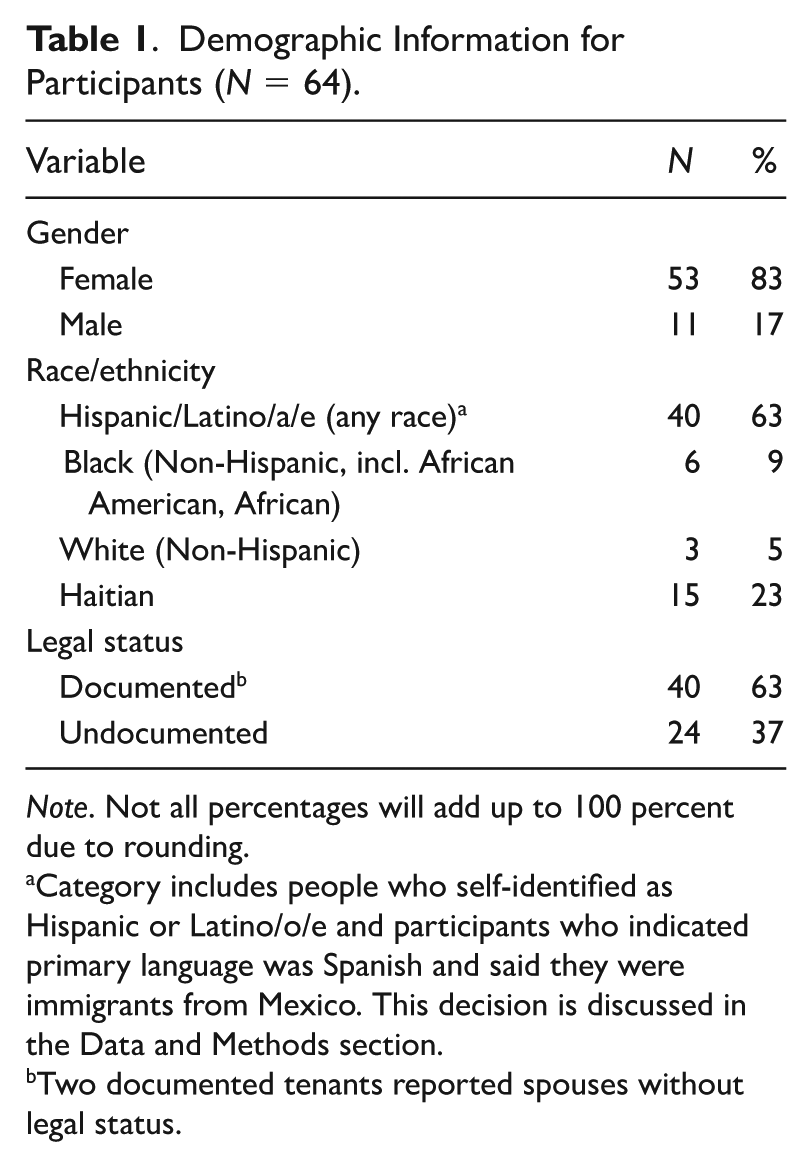
Note. Not all percentages will add up to 100 percent due to rounding.
Category includes people who self-identified as Hispanic or Latino/o/e and participants who indicated primary language was Spanish and said they were immigrants from Mexico. This decision is discussed in the Data and Methods section.
Two documented tenants reported spouses without legal status.
Income and Housing Arrangements for Participants (N = 64).
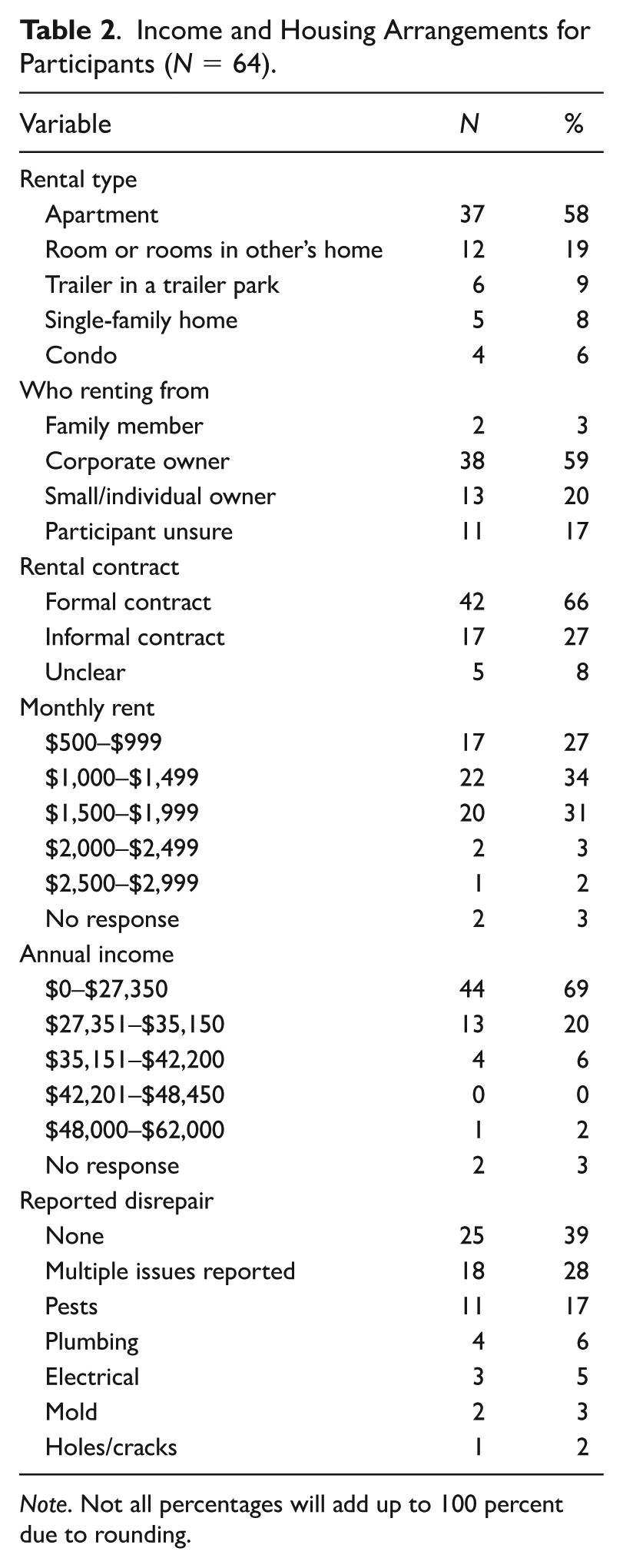
Note. Not all percentages will add up to 100 percent due to rounding.
Most participants had formal rental arrangements with property owners: 42 had written contracts, 17 had nothing in writing, and 5 were unsure or it was unclear from the interview (Table 2). Undocumented participants were more likely to have informal rental agreements: 10.5 percent of documented tenants had no contract, while 54 percent of undocumented tenants had no contract. The two mixed-status households in the sample both had formal rental contracts.
Analytic Approach
Our initial approach to coding was deductive: we used project questions about the effectiveness of the tenant workshops as an educational intervention and tenants’ descriptions of housing quality and landlord relationships to generate an initial list of code categories, which we applied using Dedoose software. Based on emerging patterns in tenant descriptions of what they did with workshop information, we initiated a second round of coding focused on tenant strategizing around whether, and how, to navigate repair requests, rent increases, and other landlord or management interactions. We identified four approaches tenants took after workshops: defense of rights, claims making, resignation, and no action reported, which we further analyzed by looking for strategy patterns based on tenant descriptors, or tenant attributes and housing arrangements. Specifically, we looked at demographic markers, from whom tenants rented, formal or informal leases, type of rental, evidence of rights violation by landlords, current housing quality, immigration status, rent costs, and household income. These are shown in Table 3.
Tenant Characteristics and Housing Arrangements by Strategies (N = 64).
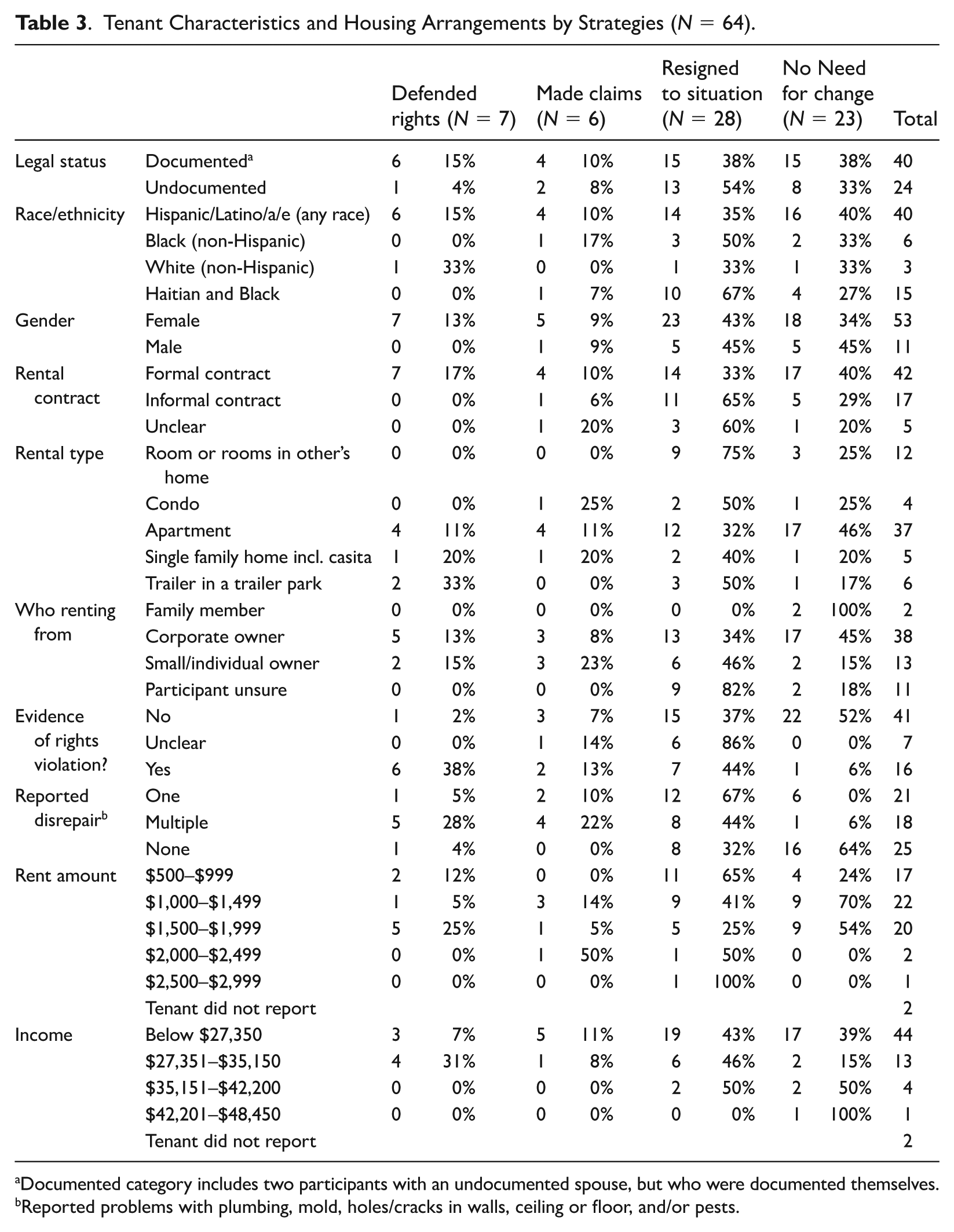
Documented category includes two participants with an undocumented spouse, but who were documented themselves.
Reported problems with plumbing, mold, holes/cracks in walls, ceiling or floor, and/or pests.
Findings
Tenant strategies after participating in rights education included openly defending their rights with the assistance of tenant unions or legal assistance, approaching landlords with formal grievances or requests on their own, or resigning themselves to their situation to avoid conflict or rent increases. A fourth group of tenants felt no need to change their strategies in relation to their housing. Tenants who defended their rights (7 of 64) or made claims on landlords (6 of 64) were mostly legally documented and/or had formal rental contracts, compared to resigned tenants who were typically more disadvantaged, which confirms that the characteristics which make some tenants more precarious influence tenant strategizing. Problems of disrepair, utility overcharges, and possibly illegal rent increases were not unique to either group, but tenants who defended or made claims had more clarity about the illegality of landlord actions. Tenants who felt no need to strategize about their current housing (23 of 64) reported few housing-related challenges and were not threatened by displacement, but planned to retain the information gleaned from workshops, believing that future rental arrangements would be less favorable. We organize this section by strategy to show the linkages between tenants’ plans, housing arrangements, and personal vulnerabilities. In the final section, we describe tenants’ short-term housing outcomes after they put plans into motion.
Table 3 shows tenant descriptors (i.e., housing characteristics and demographics) across the four categories. Percentages indicate the number of tenants in each subcategory (e.g., female or male, documented or undocumented) who engaged in a particular strategy, divided by the total number of tenants in that subcategory. For example, 40 tenants in the sample had documented legal status. Six of 40 (15%) documented tenants defended their rights, 10 percent made claims, while an equal number (15 of 40, or 38%) either resigned or felt no need to strategize. 6 These numbers can be compared to the other subcategory under legal status, undocumented tenants, to understand how this each characteristic relates to strategizing. Overall, undocumented tenants were less likely to defend their rights (1 of 24, or 4%) or make claims (2 of 24, or 8%) and more likely to be resigned (13 of 24, or 54%).
In our sample, no Black tenants defended their rights and were most likely to describe resignation to their situation (3 of 6, or 50%). Given their small representation in our sample, we do not make claims about the generalizability of findings related to race. Haitian participants—all of whom lacked legal authorization—were even more likely to be resigned and only one Haitian made any claims on landlords. Hispanic tenants had the highest proportion who described no need for strategizing in relation to their housing (16 of 40, or 40%). Tenants sub-leasing from others typically did not know who the landlord was and did not defend their rights or make claims, often because property owners did not know they lived there.
Tenant Strategies to Defend Rights
Tenants defended their rights by working with community organizations, attorneys, or by joining a tenant union to formally petition landlords. Their actions were sufficiently public that property owners knew they were not simply making a request but were demanding a change and had support to elevate the issue as needed. Defending tenants wrote formal responses to landlord rent increases or disrepair and organized neighbors with the help of a tenant union to resist disrepair or eviction. In most cases, tenants who had previously avoided property owner engagement or been resigned after a claim had gone unanswered changed their strategies after participating in rights education.
All seven of the tenants who defended their rights identified as women and all had formal rental agreements. Although tenants with formal contracts are represented in all four analytic categories (Table 3), it is significant that the seven who took public action experienced a higher level of certainty about the conditions of their housing. Otherwise, these tenants were similarly rent burdened and low-income, compared to tenants who engaged in other strategies.
Two Latinas made demands under conditions of severe disrepair. Both described feeling empowered to defend their rights after the workshops because workshops clarified property owners’ responsibilities for maintenance. For example, one woman renting a space at a trailer park had tolerated poor lighting, plumbing issues, and damaged asphalt for years due to low rent. She learned at the workshop that a near doubling of the rent implemented by new owners was legal under California law for her trailer park. 7 She and her neighbors were prepared to contest the rent increase but upon discovering it was legal they came together to hire an attorney to demand repairs. For her, the tradeoff of not complaining to keep rent low was no longer a winning strategy. Participating in the workshop provided this tenant, who had a rental contract and was a legal resident, with a new resolve to defend her rights and contact information for an attorney.
Another Latina, who rented a casita behind a single-family home, took a progressive approach. At first, she began documenting the numerous repair requests she submitted due to a leaky roof and mold. The landlord continued to be unresponsive until the tenant worked with a legal assistance organization to show the documentation and communicate that if the landlord did not respond to her requests, she would call code enforcement. Speaking of these interactions, she explained that she told the property owner: “‘If you do nothing, I now have proof with my copies and I can ask, fight, or whatever, to make it happen or make demands of you.’ I think the landlord said to herself, ‘This time she is well informed, I better fix things.’” Having a signed contract and benefiting from legal residency status supported this move while severe disrepair and an inability to move elsewhere left the tenant feeling that she had few other options.
In three cases, defensive strategies involved joining tenant advocacy organizations or resisting formal eviction efforts. Two women described actively resisting eviction threats because they felt they had no other choice. For both, considerable problems had led them to demand repairs. These were ignored. One of the two women, an older White woman who lived alone, later received an eviction notice because the property had been sold and the new owners were remodeling all units. Feeling she had no other options, she joined a tenant advocacy organization to fight the eviction. She said, “I can’t say that it’s been easy trying to turn, you know, complete despair and trauma into leadership. But I don’t have much of a choice.” The second received an eviction notice because she had withheld her rent after a hole the size of an adult foot formed in her kitchen floor. After waiting 10 days for the property owner to fix the hole, she withheld her rent and at the time of the interview was working with attorneys to remain in her unit.
One of the seven tenants who opted to work with an attorney to fight an illegal rent increase was an undocumented Mexican immigrant with dependent children. With her husband she had been renting a house from a private landlady for 11 years. Although there is no legal limit on rent increases for single-family homes, the family had recently signed a lease that included a fixed monthly rental amount. When the property owner attempted to raise the rent by $300 before the end of the lease, this participant sought out assistance and learned that the landlady could not evict her for asking that the contract terms be respected. Having the contract in place and advice from an attorney assured her of her rights. She related thinking, “We’re not going to give [the additional money] to them because we still have a contract.” She described telling the landlady, “‘The attorney told me that I shouldn’t pay more than is what is in the contract and you as landlady should know the rights of tenants. I’m not paying you.’ And that’s how we left it. After that, she understood that I now knew more.” The landlady reacted negatively at first but eventually relented. The formal rental contract, clear illegality of the rent increase, and direct advice from an attorney played a major role in her ability to defend her rights. Notably, on issues of disrepair, this same tenant was far less demanding. While she often made requests, the landlady frequently failed to make repairs. She and her husband preferred to fix problems themselves.
Tenant Strategies to Make Claims
Six tenants formalized interactions with landlords after attending workshops by contacting property owners to request repairs, questioning utility overcharges, or challenging illegal rent increases. They did not work with attorneys or organizers beyond seeking guidance for their situations. The support of these organizations sometimes led tenants to put a request in writing but did not lead to action beyond making a basic request. Like tenants who defended their rights, a greater proportion of tenants who made claims benefited from stability as compared to tenants who were resigned to their situations or felt no need to act. Most had formal rental arrangements, four of six were legal residents, and none sublet rooms. However, all six identified more than one disrepair issue in their unit, suggesting that disrepair was a motivator. All but one reported earning incomes in the lowest category for participants in our study.
A bi-racial (Native American and White) male tenant had only ever spoken to his property manager when a major problem arose in his unit. He detailed numerous problems in his apartment that he had never brought up because he “didn’t know if it was like a big deal” and was not aware that property owners were responsible for fixing problems related to normal wear and tear. After the workshop he submitted written requests to fix a broken pilot light and clogged sink, to which the landlord was responding positively. The sole Black tenant who made claims learned through the workshop that the rent increase on her condo was illegal and explained in an email to the property owner that she would not pay the new amount. This tenant felt particularly confident in her ability to make this claim after confirming that the increase violated her contract at the workshop.
A Latina tenant gained confidence through the workshops and felt assured that because they paid rent each month, they had the right to petition property owners for repairs. She did not believe she had a formal contract but learned during the workshop that although her original contract agreement had expired, her rental agreement had automatically reverted to a periodic tenancy under which tenants retain their rights, including the right to expect habitable accommodations and reasonable repairs, as long as the landlord accepts rent. 8 This tenant explained that “after you take the class, your way of seeing things as a person who is renting changes completely.” She then gave the example of asking for a repair in her unit and receiving a response from a person on the management team who said they were too busy to assist. She reported telling them, “No, I pay my rent and it is within my rights for you to come and do the maintenance that I need. I need to know if you will be able to do it, otherwise I will find a more serious person. I just need you to tell me if you’ll do it or not.” Within half an hour, they came and completed the repair. She continued, “When I realized that in reality I have rights and I can do it, it changed me in how secure I felt to ask for things.”
Confidence in one area of claims making did not translate into all areas. For a White, non-Hispanic woman renting an apartment from a small-scale landlord, putting all repair requests in writing became a standard practice after the workshop. However, she felt that formally making demands had antagonized the property owner and increased her wariness when approaching him. After two years of not raising rent, the landlord notified her of an increase above the legally allowable amount. While she was prepared to continue making repair requests and other demands, she had not yet decided whether to contest the rent increase. She expressed fear that “by complaining, by trying to get my rights respected,” she worried he would begin raising the rent annually. Similarly, the other Latina who made demands had lived in the same house for over 20 years and felt very stable in her tenancy. During the workshop she learned that she needed to document problems in her unit through photographs and to put repair requests in writing, which she began to do. She also learned that the landlady, who entered her home without warning each year to take photographs, was acting illegally. She explained that previously she had not known how to handle either situation, “. . . but after [the workshop] I began to write letters, I know now to send photos of what is broken . . . . I also don’t let them come in my house anymore.” However, since her original lease was now a periodic tenancy agreement, she learned that she could not stop the frequent rent increases because she rented a single-family home.
Tenant Strategies that Center Resignation
Resigned tenants did not plan to challenge landlords over housing quality concerns, rent increases, and other issues after learning more about their rights. Their housing arrangements tended to be more precarious: 11 of 28 had no formal contract and of those, 9 illegally sublet a room. Thirteen of 28 were undocumented, plus one person was married to an undocumented resident. Resigned tenants were not more rent burdened, on average, and fewer reported disrepair, compared to tenants who defended their rights.
The role of housing precarity or personal vulnerabilities acted as counterweights to newfound awareness of their rights for some tenants. For example, a single African American woman explained that her fears in speaking out were directly linked to race. She explained that before the workshop “I really wanted to think that I should fight them,” but since the challenge she faced (suspected improper paperwork at an affordable housing complex) required her to confront White and Hispanic building managers, she believed “I would walk that line alone.” She attributed this to persistent discrimination against Black people, particularly Black women, in housing. Several Mexican immigrants in the sample described instances of being spoken to in derogatory ways and, as a result, they expected mistreatment if they pursued issues. Although we are unable to demonstrate racial or ethnic discrimination in this study, these tenants’ perceptions of discrimination reflect ongoing evidence of discriminatory practices in rental markets.
Resignation was particularly common for undocumented tenants. As shown in Table 3, over half of undocumented tenants adopted resignation strategies in the face of poor housing quality, eviction, and rent increases. A Haitian woman who had immigrated with her husband and children explained that she was not going to contest a high water bill because, “I don’t know how to verify what they’re saying . . . What I have to do is endure it, stay quiet, plus, I don’t have papers here, I don’t want problems with anyone. I think I’ll just keep quiet.” This was true even when they reported understanding that the rights of undocumented tenants are the same in California as they are for documented tenants, reported having formal rental agreements, and/or had support from legal or community organizations. One, a single mother originally from Mexico, explained that she was comfortable learning her rights and teaching them to others, but she felt unsafe taking public action due to her legal status. Specifically, she was invited to a public event advocating for tenant rights with a community organization but declined because it felt too risky:
I have tried to be involved to see everything that we [as tenants] have to do . . . I have always told [my children], “you have to make your voice heard, you don’t have to remain silent.” Sometimes, I do not feel sure to join them, because I say, “No, immigration officers are going to get ahold of me and kick me out or something.”
Another undocumented Mexican tenant who lived with her husband and children described feeling empowered by the fact that people were organizing for tenants’ rights but believed they would lose in court and could be deported if they contested the eviction notice they were served. She decided she would not attend the eviction court hearing “because I have a lot of disadvantages.”
Not every undocumented tenant had an informal rental arrangement, but they were common: about 33 percent of undocumented interviewees reported having a written contract, compared to 85 percent of documented tenant households or mixed-status households. For resigned tenants, informal rental arrangements exacerbated their sense of resignation when property owners refused to fix problems. An undocumented Mexican immigrant explained that she and her husband decided not to speak up when their parking space was taken away: “Right now we’re going, ‘What can we do? Is it okay for them to take away our parking or can we do something?’ But we don’t have a contract.” In some cases, tenants believed landlords did not know they were living in a unit, further compounding their inability to engage over rent or repair issues or otherwise defend their rights. This was the case for most of the Haitian participants, several of whom lived doubled up with another family and kept their presence a secret from property owners. When they faced housing problems, they let the master lease holder know but could not control whether that issue was then conveyed to the landlord. Haitian participants believed tenants’ rights workshops could benefit them someday, but the information was limited in its utility due to their immigration status. A Haitian who had been in the country for three months explained, “You know the situation for our community, there’s not many ways to help us because of the situation we are in.”
This often meant taking on expenses that may not be a tenants’ responsibility. An undocumented Latina living in a multi-generational household, including dependent children, explained that they paid for a carpet replacement rather than requesting the property owner change the carpet. They did this even though the carpet problem—mold—was due to poor ventilation in the bedroom. She learned at workshops that some tenants engaged in a “repair and deduct” strategy, meaning they paid for repairs and then sent their rental payment with the expense deducted along with documentation. Workshop instructors described this method as a risky action that could be grounds for eviction. Having already requested a replacement and being told no, she and her family decided against this strategy as it could lead to displacement or a rent increase. She explained,
The way that the house is–old–and it falls apart, we try to address it so that the rent does not go up, or to bother [the property owner] too much. We take it into account on our own, if the stove broke down, then we buy one, things like that. We no longer mention anything to the owner.
The costs of this level of resignation are paid in poor living conditions, stress and other forms of emotional discomfort, and ongoing precarity (Schmidt 2024b).
Among tenants who may be thought of as less vulnerable—had formal rental agreements, were legal residents—workshops sometimes served to confirm that there was nothing they could do about a rent increase or overcharge. Two participants attended workshops after they were charged for rent twice. In both cases, they paid rent by money order but had not received a certification from the property owners and had not kept their money order receipts. The property they rented changed ownership and the new owners claimed they had not received rent. One of the people, a Latina, explained that, rather than further insist without proof, she paid again to avoid eviction. She learned in the workshop that without proof of the prior payment the new owners could evict her for nonpayment of rent.
Resigned tenants were more likely to be unsure whether landlords had violated their rights and even a small amount of doubt led some to avoid claims making or rights defense, largely because the prospect of finding a new unit they could afford was daunting. A White man who lived alone said he was “pretty sure” a rent increase exceeded the allowable limit, but he opted to pay it because he rented an inexpensive converted garage and feared eviction. His weighing of risks and rewards was apparent when he said: “Do I want to risk saving some money every month or again becoming homeless because I fight it?”
The housing quality issues tenants faced ranged widely, from deteriorating ply board cabinets that did not violate state law related to habitability (California Civil Code § 1941.1), to conditions that made daily life hazardous. Although participants learned they should request repairs for a wide range of problems, many participants opted to fix the problems themselves. An older, single Latina who lived alone explained, “Honestly, I just fix it. I never fight. I’m just grateful that they never raise my rent so I don’t bother the property owner.” A Latina renting a one-bedroom apartment explained that she, her husband, and three children tolerated housing quality issues without asking for support from the landlord because they could not afford to pay more rent elsewhere. “. . . because it’s the place where we pay less rent . . . . that is why we put up with it.” Other participants, including native-born Black and White participants similarly remarked that although they understood that much of the maintenance and upkeep of units—aside from damage caused by tenants outside of normal “wear and tear”—was the landlord’s responsibility, they opted to not request repairs.
For some tenants, understanding the next step available to them to defend their rights was discouraging. If a problem required a tenant to take a significant step like sue the property owner or call code enforcement, most tenants adopted a strategy of resignation. A Latina living with her husband explained that management did not address issues that impacted multiple building residents: a broken gate that prevented people from using their parking spaces and broken appliances in multiple units. After numerous requests for repair, she felt she had no recourse to further pressure the property owner to address these problems without having to take legal action, which she was not willing to do. Most tenants’ housing problems were bothersome and landlords’ lack of response frustrating, but they were not sure that the issues were extreme enough to merit such action.
When Strategies Felt Unnecessary
Twenty-three participants in our study expressed no pressing need to strategize based on what they learned in workshops. These tenants were renting housing where owners took care of properties without threatening significant rent increases or displacement and tenants felt safe requesting maintenance and engaging on other issues. In some cases, they described minimal interactions with landlords. A single Latina mother said “up until now I haven’t had a single problem [with the landlord] and I haven’t had any problems that need to be fixed. The apartment is in good condition and I try to keep it that way.” Tenants who expressed no need for change were diverse, which we mention to indicate variation in this subgroup, not to attribute their strategizing to their race or ethnicity. Fifteen were documented and eight undocumented, six were Haitian immigrants or African American, and 16 identified as Hispanic or Latinx or were Spanish-speaking immigrants from Mexico. Just one was White, non-Hispanic. Most (17) had formal rental contracts and rented apartments from corporate landlords.
Several tenants who reported no need for new strategies of landlord engagement tolerated housing conditions that were suboptimal. Although they felt they could safely engage with management directly for repairs, and recounted instances of when they did so, their housing remained substandard. For example, an older Latina woman living with her husband said that building management did not spray for cockroaches and at night cockroaches would come into the kitchen. She said this was fine, because by using vinegar and Fabuloso she could get them to leave. A Haitian woman who was living with two teenage daughters in one bedroom said, “. . . the space is so small but what can I do? It is not fair for my daughters to live like this. They are supposed to have their privacy at this age. I am hoping I can find another place but the prices are expensive.” For some tenants, tolerating less-than-ideal conditions stemmed from having lived in worse housing conditions or knowing that their costs could be higher elsewhere. In one case, a Latina single mother felt that the apartment she rented was fine and management responsive but faced ongoing precarity because the building was for sale.
Sixteen tenants who were not developing strategies based on the workshops had no problems with pests, mold, plumbing, electricity, carpets, or other issues. Housing affordability challenges still existed for these tenants, however. One, a Haitian refugee and mother of young children, reported that the stress of high rents was causing hair loss. Another Haitian refugee and his wife and child lived in a brand-new complex where they paid $1130 per month, using nearly all the $1259 they received each month in cash assistance. The new complex had no problems, it was just expensive given their income, but he insisted he was not stressed, saying, “I am in control of things and how I feel so I say that it’s all good.” This optimistic perspective and denial of stress masks very real affordability challenges. A Mexican immigrant and mother of dependent children reported a rash she attributed to financial stress. Another tenant, who could not work due to a disability but whose husband worked full time, reported overcrowding that she and her family had to tolerate to afford rent. She explained, “We can go without dinner, the rent is first.”
In many cases, tenants who felt no need to alter their strategies engaged regularly with property owners and reported that interactions were cordial and property owners were responsive to requests. Having a responsive landlord, many of which utilized professional management companies with clear means of written communication and responsive staff, meant that making demands led to positive outcomes. Systems of formal communication and engagement about maintenance were already in place for these tenants, so learning how to do this in the workshops did not change their interactions or plans. Those who felt positively about their current situations often explained that they appreciated having the information for use later. One Latina interviewee said that she found the workshop helpful because her next landlord might not be as fair as the current one:
. . . what if a landlord tells you to pay . . . say you already have the check and they tell you no, it is now this other amount for rent. One must understand that this is not okay. But thanks be to God, in this place where we are now, man, we have been good and we have no complaints.
Tenants who rented from small time or “mom and pop” landlords and felt no need to adopt new strategies described long-term, trusting relationships where property owners were responsive to repairs. A Latina single mother lived with her brother in a single-family home where property owners had been promptly fixing problems for five years. Another Latina described living in the same house for 20 years where she had developed a mutually beneficial relationship with the landlord regarding repairs. The landlord asked her and his other tenants in two nearby casitas to hire people cheaply to fix problems and deduct the cost from their rent. “The landlord also wants to save money,” she explained, which benefited her and her neighbors because they knew “when companies come to do any work that can be done for $60, they want to do it for you for $600.”
As tenants navigated housing challenges after workshops, some moved between strategies. Most often, tenants moved from plans to defend their rights or make claims to resignation. They recounted experiences of approaching property owners with a problem or request and being ignored or challenged. One of the tenants described above who paid rent twice when the property owner claimed they had not received her money order believed the workshop would give her courage to take the landlord to court. She shifted from working with an attorney to defend her rights to resignation after learning all the legal means landlords had for evicting tenants. She explained, “I made the decision to stop . . . I have too much to lose” because the landlord “could retaliate, perhaps not directly but through legal means.” In another instance, an undocumented woman moved from making claims to resignation. She shared that she used to turn to the manager to address housing concerns such as pest infestations or a leak in the fridge but stopped as she was often met with minimal response. She explained that she prefers her husband to address the issue, otherwise they tolerate the problem.
Housing Retention after Rights Education
All tenants, besides those who felt no need to adopt new strategies, engaged or avoided property owners with the goal of remaining housed. Many were successful in the short term. The acts of defending rights and making claims contributed to tenants’ ability to delay eviction, postpone or stop rent increases that could be destabilizing, and commit property owners to repair problems. The older White woman fighting an eviction in her apartment complex was eventually displaced, as was every tenant living in the building, but she was able to stay beyond the original eviction date which gave her time to search for new housing. A Latina who worked with neighbors and organizers to contest a rent increase in her trailer park, with the help of organizers, successfully ended the property owner’s lot rental rate increase of 5 percent every three months. A Black woman who wrote to her landlady to say she would not pay rent above the legally allowed limit in her condominium received no response and believed the owner had let the issue go. Two women who refused to pay illegal rent increases remained in their housing during the period of our study and had not been served eviction notices. One explained that she believed the landlady now understood that she could not be taken advantage of. The Latina with a hole in her floor was staying in a hotel, paid for by the property owner, and believed she would be able to move back into her unit. Although we do not know the long-term consequences of all defending or claims making tenants’ actions, most at least postponed housing loss.
Defending their rights had emotional benefits as well, despite the stress. The seven women who defended their rights expressed a sense of satisfaction and empowerment in being able to push back against clear rights violations. Tenants who made claims felt optimistic that their new approach would lead to improvements in their housing or reported reduced stress. One Latina tenant said,
I felt very stressed in some moments because I didn’t know how to ask for things the right way. I didn’t know if you could, in certain cases. After taking the workshop, I think my stress level went down because I could inform myself a bit more about all of this.
However, given that many resigned tenants had previously made claims but then changed tactics to avoid rent increases or displacement, it is possible that many of the six who made claims might later pivot to resignation if landlords react poorly.
Resigned tenants strategized to avoid displacement through eviction or rent increases which would force them to move. Stability was sometimes achieved at great personal cost, however. An African American woman with dependent children said she asked for a new carpet because her children have allergic reactions to the current one, even though she vacuums it often. After the landlord refused, she offered to pay for the replacement, but reported, “He don’t even give you a chance to talk.” As he appeared continually annoyed by her needs, she began avoiding him and tried to keep her children from lying on the floor. Financial consequences could also be extreme. For example, one of the Latinas who had to pay rent twice when new ownership said they had no proof she had paid rent described the cost of resignation as “traumatic.” She anticipated that the financial consequences of paying rent twice in one month would last for many months. In this situation, deciding against withholding rent decreased the possibility her family would be evicted for nonpayment of rent but became a major financial burden.
Workshops could disrupt precarity in indirect ways. A Haitian man who was illegally subletting lost his housing days after attending a workshop. When he found new housing he made sure to enter into a written agreement because he had learned the value of a formal contract. By the time we interviewed him he had a formal rental contract and felt stable with no need to approach the property owner about anything. Over half of the tenants who felt no need to adopt new strategies related to their housing described using workshop information to guide others. One Latina with dependent children said she shares workshop principles whenever someone tells her about a housing problem. Female participants in particular said they went to learn so they could support people in their communities. These women reported being involved in schools and community organizations where they encountered neighbors and friends in dire housing situations. In one instance, a Latina who was part of a community group that supported Spanish-speaking parents of children at a public school worked with the Collaborative to have a workshop presentation at the school. She explained, “Because we have two or three friends who were about to be evicted from their homes and in this group we always support each other . . . so we had this [tenant rights] class.” Others described seeing significant need in their communities and now feeling more informed as to how to advise their neighbors.
Discussion and Conclusion
Tenants incorporated knowledge from rights education into their strategies for approaching landlords, but they did so selectively based on their housing conditions and how vulnerable they felt in their housing situations and personal lives. Tenants who defended their rights or made claims on their landlords were among the most stable: they nearly all had formal rental agreements, none were subletting rooms, and most were legally authorized to live and work in the United States. Although they were rent burdened and experienced other forms of disadvantage, tenant education workshops supported their decisions to push back against illegal landlord actions, evictions, and disrepair. Compared to at least some tenants who felt resigned to their situations, tenants who defended their rights and made claims on landlords expressed a clarity about how and why pushing back could help more than hurt. Compared to tenants who felt no need to change how they approached their landlords, tenants who made claims and took public action were at odds with property owners who had filed eviction notices, made illegal rent increases, or were unresponsive to repair requests.
Resignation was an intentional strategy undertaken (or continued) after increased awareness of rights among some tenants, particularly undocumented tenants and tenants without formal rental agreements. Among tenants with greater stability, resignation was a strategy for keeping rent charges down or avoiding antagonizing landlords. While they understood what steps they could pursue to take action, many had previously made claims which angered landlords or elicited no response and opted to stay quiet.
Given the rise in eviction prevention efforts in many cities, tenants are likely to live in contexts where they have greater access to information and resources that may help them defend their rights, something to which future studies will need to attend. Our findings suggest that tenant education workshops achieved one of the Coalition’s primary goals: to help people avoid eviction. Class instructors spoke about certain actions such as “repair and deduct” and withholding rent as highly risky and inadvisable actions that are likely to result in eviction. We learned of only two cases where tenants did either. The Coalition would not support housing retention in conditions that are unhealthy for tenants, but this was sometimes the price tenants paid to avoid displacement.
Our research raises new questions about how tenants make decisions related to their housing and what kinds of variation in tenant actions have been overlooked in prior research. For example, in studies of tenants involved in organizing, all participants have opted into public demonstrations (Card 2024; Lew 2026; Michener 2023; Vidal 2025), so we know nothing about why tenants who are exposed to similar information about their rights, and who are given opportunities to organize, opt not to participate. Our research suggests that information and opportunity may not be enough to counteract a sense of precarity related to legal documentation, rental costs, or eviction.
The focus on oppressive living situations of tenants in other studies, imposed by landlords who do not maintain units (DeLuca et al. 2019; Desmond 2016; McKee and Harris 2025; Schmidt 2024b), mask the variation of tenant experiences in rented housing where we find that some renters have responsive landlords. The experiences of low-income renters who report sufficient housing quality and positive property owner or management relationships have rarely been documented by other researchers. Balzarini and Boyd (2021) describe how small-scale landlords work with tenants to avoid eviction and Korver-Glenn and Locklear (2023) spoke to tenants who felt fairly treated by same-race landlords or managers, but we know of no research showing positive outcomes for tenants in corporate owned housing. Of the tenants in our sample who reported renting from corporate owners, 45 percent felt no need to make claims or tolerate violations of their rights. Research by Gomory et al. (2024) show that numerous structural conditions shape the behavior of large-scale landlords, suggesting more research is needed to understand variation in how management practices affect tenants.
Our study also differs from some prior research that shows more frequent pushback and resistance on the part of tenants (DeLuca et al. 2019; Desmond 2016; Korver-Glenn and Locklear 2023). Our study affirms what studies of renters in high-cost, low-vacancy markets have found: they engage in strategies that help them to stay put. This sometimes took the form of “negotiated neglect,” through which tenants tolerated poor living conditions or made repairs themselves because they could not afford to move anywhere else (Schmidt 2024b; see also Grineski and Hernández 2010). Other times it looked like creative and selective engagement with property owners, where strategies were undertaken because tenants believed they would help them keep their rent down (Power and Gillon 2022; Shakespeare 2022). When tenants rent in markets where there are open units at similar price points, moving is a reasonable option. In contexts with high rents and low vacancy, it is more difficult. In the rental market of coastal California, the consequence of displacement is more likely to be homelessness than it is elsewhere (Colburn and Aldern 2022).
Our research points to several policy implications which we offer with important caveats. The most obvious is that programs that educate tenants about housing conditions appear to reduce precarity. While few tenants in our sample contested housing problems, rights education may help them avoid problematic situations in the future by teaching them to expect clear rental contracts and document unit conditions. This is vital since it is difficult to hold landlords accountable when they do not maintain units and only a small fraction of tenants ever report bad actors (Franzese, Gorin, and Guzik 2016). Government-funded eviction prevention efforts could support further progress.
Funding for intermediary organizations that support tenants as they navigate repair requests could reduce tenants’ need to tolerate disrepair. After requesting repairs and receiving no response, very few tenants opted to elevate issues, often due to the perceived risks of calling code enforcement, withholding rent, or suing landlords in court. In these cases, volunteer attorneys and other legal assistants were able to help tenants put repair requests in writing with photo documentation of issues. This type of mediation felt less risky for tenants. Support for such organizations could expand their reach.
Because tenants with formal contracts were more likely to defend their rights and make claims related to their housing, increased regulation of housing markets that reduce the proliferation of informal rental arrangements (e.g., renting without a contract, dividing units into smaller rentals) could benefit renters. However, informal rental arrangements remain a vital component of the housing markets in countries where uncertain legal residency, a lack of credit history, and unaffordable rents make qualification for many housing options a challenge (Schiller and Raco 2021; Schmidt 2025; Usman, Maslova, and Burgess 2021). The rent amounts paid by our interview participants bear this out: many paid well below market rates for rooms, converted garages, or apartments too small for the size of their families (Table 2). 9
Slowing rent increases through rent control policies could benefit low-income renters, particularly if rent increases are pegged to wage growth. However, the research on rent control policies shows benefits for those in controlled units, but often higher prices for non-rent-controlled units (see Rajasekaran, Treskon, and Greene 2019 for a review). Rent control also disincentivizes standard repairs and upkeep by property owners. Increasing the housing supply could bring down costs, particularly if a significant proportion of that housing is reserved for extremely low-income and low-income renters. Efforts in California point to the difficulty in doing so. State lawmakers have enacted numerous policies aimed at increasing overall housing production in the state using tax incentives and density bonuses, but most regions continue to under build sufficient units affordable for the lowest-income families (California Housing Partnership 2025). Housing developers will not build inexpensive, but adequate, housing if they cannot make a profit. State-funded housing, donated land, and other non-market interventions are necessary to support extremely low-income households (Blumenthal et al. 2016).
Ultimately, market-driven solutions to housing affordability and quality are unlikely to support the health and well-being of low-income renters. Power imbalances undermine the ability of tenant rights education to disrupt instability and extractive market relationships produce conditions where landlords will continue to be incentivized to ignore tenant needs when they do not align with landlord preferences (Chisholm et al. 2020).
We point to several promising directions for future research. Studies that leverage comparative samples—such as multi-city studies or comparisons of different types of rights education—could inform the development of effective programs with attention to regional policy contexts. Longitudinal studies with larger initial samples could determine any causal relationship between tenant rights education and housing outcomes. A more purposive sample could better compare the relationship between specific tenant characteristics, particularly household type and gender, and tenant strategies. For example, women overwhelmingly did the work of challenging landlords and attending workshops in our sample, but it is unclear how these dynamics play out at the household or community level, and whether women and men strategize to defend their rights differently as their awareness of their rights changes.
Researchers could also study the network effects of tenant rights education. Similar to how tenants’ social ties shape where and what kind of housing they find (Carrillo et al. 2016; Schmidt 2024a), many tenants in our study shared what they learned in workshops with family and friends. This suggests reverberating workshop impacts beyond what we could observe, which may help tenants avoid the most precarious rental arrangements. How people transmit such information, to whom, what information they share, and to what effect, is a promising area of study.
Finally, increases in immigration enforcement under the Trump administration are likely influencing tenants’ strategies related to their housing. Reports from a clinician and tenant advocacy group in Milwaukee suggest that many undocumented immigrants are not leaving their homes for fear of being deported (Maalimisaq 2026) but also that some property owners have provided Immigration and Customs Enforcement (ICE) with access to their properties, making staying at home a risky option as well (Home Line 2026). Researchers who are currently in the field are likely capturing these impacts, but future work could more directly sample tenants and community organizations in neighborhoods or cities where immigration enforcement has been especially intense. Housing costs and social vulnerabilities have both continued to rise since we conducted our study, making the question of tenant strategizing to retain housing and the value of tenant education of continuing importance.
Footnotes
Acknowledgements
We thank community organizers from Casa Familiar, Alliance of Californians for Community Empowerment (ACCE), the Housing Justice Collaborative San Diego, the San Diego Refugee Communities Coalition, and affiliated entities who helped us recruit participants to our study. We further thank the Housing Justice Collaborative San Diego for considering our findings as they work to improve their outreach and support for tenants. We thank the following students for their valuable contributions to data collection and analysis: Valeria Avila, Amy Garcia-Medina, Jill Liang, and Christine Martinez.

Funding
The authors disclosed receipt of the following financial support for the research, authorship, and/or publication of this article: This research was partially funded by the City Heights Community Development Corporation and San Diego Housing Commission through Legal Aid Society of San Diego, but does not necessarily represent the views of any of these agencies.
Declaration of Conflicting Interests
The authors declared no potential conflicts of interest with respect to the research, authorship, and/or publication of this article.