



Abstract
Sociologist Minjeong Kim analyzes portrayals of Asian American intimacy in television and film.
I’m on the lookout for Asian American couples in television and Hollywood cinema, but they are hard to find. Is this because Asian Americans just don’t find each other hot?
The first time I saw an Asian American main character in a relationship with another Asian American was Cashmere Mafia (2008), a short-lived prime-time dramedy costarring Lucy Liu. Liu’s character Mia is engaged to a white man Jack, but when Mia and Jack both vie for the same promotion, and Mia wins, Jack’s ego is bruised and he breaks up with Mia. Mia’s mother responds by arranging a blind date with an Asian American neurosurgeon, Jason. On their second date, Jason and Mia exchange a sweet kiss and their couplehood is sealed.
My reaction to Mia and Jack’s romantic exchange was a mixture of surprise and delight; my response also highlights how rare these scenes of Asian American desire and alliance really are.
Does the high rate of real life interracial relationships explain the near absence of Asian American couples in mainstream media?
What’s Interracial Love Got to do with it?
While the last decade or so has seen an increase in primary or secondary Asian American characters in television (Grey’s Anatomy, The Office, The Big Bang Theory, Heroes, The Good Wife, Hawaii Five-0, Glee), and while these new characters have their own romantic and familial relationships (unlike the Asian lab technicians or psychiatrists in CSI and Law & Order: SVU), most of these characters were portrayed in interracial relationships. Even in Cashmere Mafia, Mia ends up cheating on Jason and returning to a series of passionate hook-ups with white men.
The situation is not much different in films. Major studios still avoid having Asian Americans as protagonists. For example, the film 21 cast white actors to play the roles of the Asian MIT students whose stories the film was based on. And just as on TV, when Asian American characters in popular films are in relationships, they are nearly always interracial.
Some may suggest that this reflects reality. Indeed, interracial relationships have been a significant part of the history of Asian Americans. Anti-immigration laws in the late nineteenth and early twentieth centuries restricted immigration of “undesirables,” significantly limiting Asian women migrants. As a result (and despite anti-miscegenation laws), many unmarried Chinese immigrant men began forming romantic and/or sexual relationships with women across racial lines. Meanwhile, Asian American women entered interracial relationships via other historical pathways. “War brides” (from the Korean and Vietnamese wars) and international marriage migrants (pejoratively called “mail-order brides”) have widened the path for Asian women to both enter the United States and marry interracially.
These historical factors have contributed to the fact that contemporary Asian Americans have the second highest interracial marriage rate in the United States (after Native Americans). According to a 2009 article by Pyong Gap Min and Chigon Kim, about 20 percent of contemporary Asian immigrants marry non-Asians, and 55 percent of native-born Asians marry non-Asians (with rates varying from 70 percent of Japanese and 63 percent of Filipinos to 30 percent of Indians and 40 percent of Vietnamese).
So it’s clear that there is a lot of intermarriage for Asians in real life. Without casting any judgment on real-life interracial relationships or their offspring (people whose lives are far more complex than those presented on screen) it is important to ask: is the high rate of real life interracial relationships enough to explain the near absence of Asian American couples in mainstream media?
The absence of media portrayals of Asian Americans desiring each another can also be attributed to a politics of racialized heterosexual masculinity. Scholars critique the predominant portrayal of romance between white men and Asian women as upholding the status of the white male hero; meanwhile Asian men are cast as secondary characters and are disparaged as either feminine or lecherous, or both as in Kunal Nayyar’s character in the television show, The Big Bang Theory.
Mia and Jason’s big kiss on Cashmere Mafia
© 2008 American Broadcasting Companies, Inc.



When TV or film protagonists are Asian American men, the characters are still linked to non-Asian women. For example, in the Harold & Kumar film series, two Asian American men—one Korean American and one Indian American—are romantically linked to non-Asian women. Their heterosexual masculinity is achieved, but they still follow the media tradition of Asian Americans in interracial pairings.
Forever Foreigners
What are the implications of this absence of Asian American desire in mainstream television and cinema? The persistent portrayal of interracial pairing may perpetuate Asian Americans’ “forever foreigner” or “inassimilability status.” In her 1994 book, Romance and the “Yellow Peril”: Race, Sex, and Discursive Strategies in Hollywood Fiction, Gina Marchetti contends that white-Asian romance in classic films conveys the idea that Asians who are perceived as racially and sexually aberrant are “corrected” by intimate contact with a white love object. Thus, Asians experience what I call an “assimilable epiphany” through interracial relations (adopted from Robert McRuer’s 2003 concept of “heteronormative epiphany”). Almost all Hollywood romantic films have the epiphanic moment where protagonists realize their “true love,” which allows them to find a sense of wholeness previously lacking. When Asian American characters experience the romantic epiphany with partners of other races (usually white), their sense of wholeness emerges and their “foreignness” dissipates.
These portrayals reinforce the notion of Asian inability to assimilate into U.S. culture.
The portrayal of Asian Americans through interracial relationships conveys conflicting messages: on the one hand, Asian American characters provide diversity; on the other hand, they should not be paired together on screen. Given the U.S. history of anti-miscegenation, some may see interracial marriage as confirming the progress of multiculturalism. Indeed, Asian American characters in interracial relationships often appear more progressive than those who oppose these relationships. For example in Cashmere Mafia, Mia and Jason attribute their lack of intimate experiences with other Asians as resistance to parental pressure to date only people of the same ethnicity. This intergenerational conflict complicates the social imagination further by insinuating Asian cultural incompatibility or self-isolation; in comparison, young Asian Americans who date interracially appear more assimilated into mainstream society. These portrayals reinforce the notion of Asian inability to assimilate into U.S. culture.
The mixed messages in popular imagery also stall a discourse of racial politics. The illusion of diversity and inclusion projected by interracial relationships implies a post-racial space where racist jokes and stereotypes are allowed (for example, at the expense of the Korean American mother in Sullivan and Son). Although large ensemble cast shows including one or two racial minorities are on the rise, more draconian anti-immigrant policies and xenophobia are dividing this country. When Asian American coupling is both denied, and presumed to be a subject of non-discussion (by virtue of the presence of interracial portrayals), we miss opportunities to enrich representations of Asian Americans and advance dialogue on race and racism.
Toward a Vision of Asian Desire
Frequent television viewers will likely note what seem to be exceptions to this analysis: For example, the popular TV show Lost featured a Korean couple played by Yunjin Kim and Daniel Dae Kim. However, this couple is clearly marked as Asian and not Asian American; they represent “global” survivors in an “alien” location. As such, they do not raise any red flags as potential immigrants to the United States.
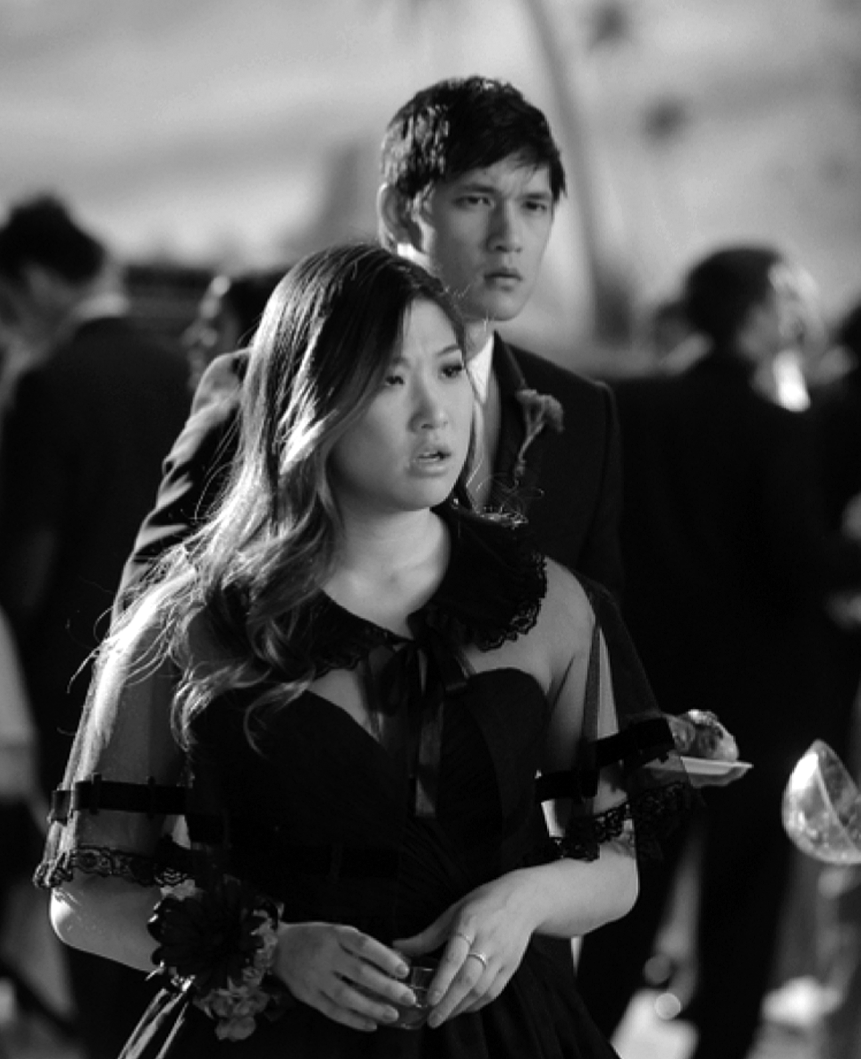
On Glee, Tina and Mike—known to fans as “Chang Squared” or “Team Asian”—lasted as a couple for a whopping two seasons.
© 2012 Fox Broadcasting Company
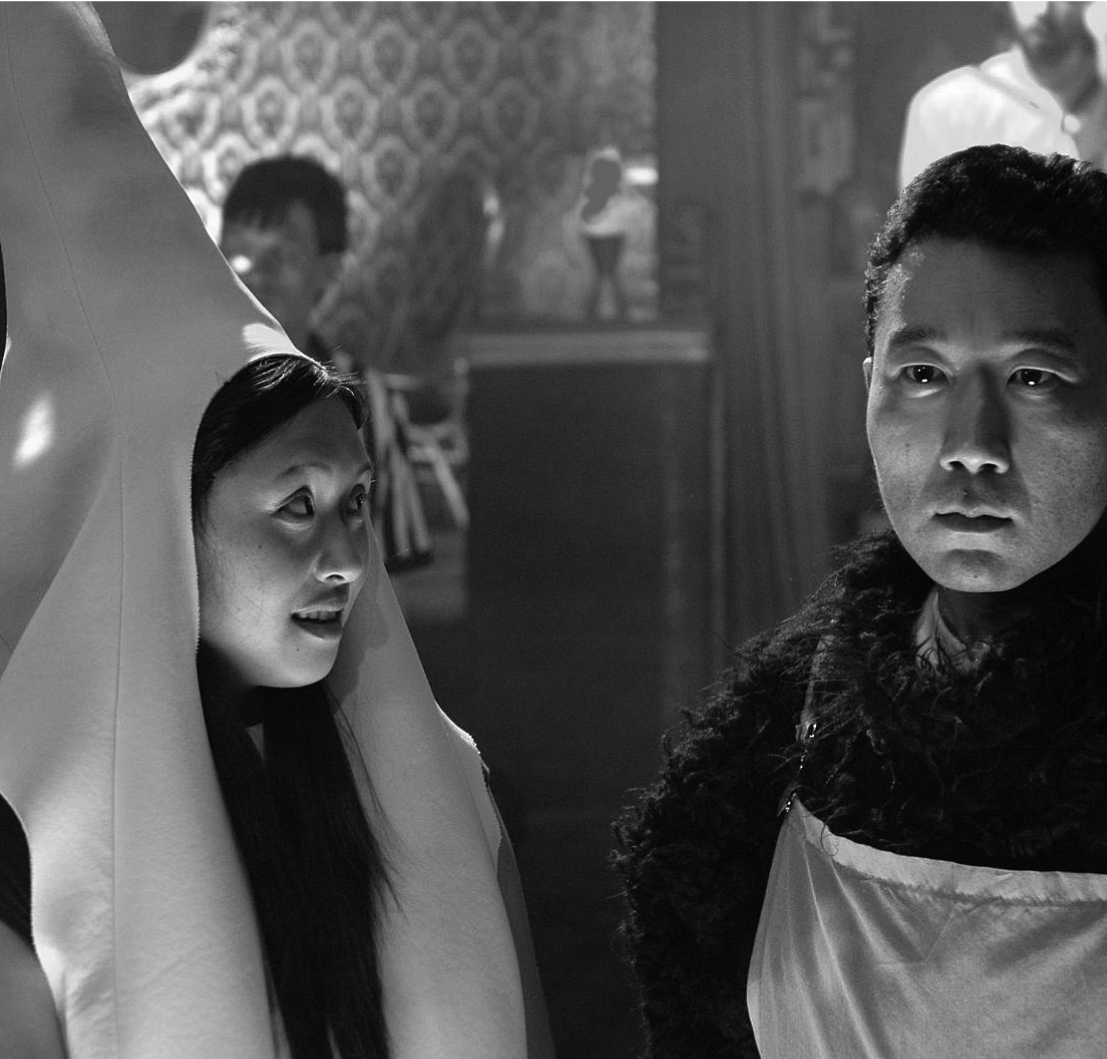
Mary and Hijame (aka “Jimmy”) on an ill-fated date in White on Rice.
Amos James
Similarly, the popular musical drama Glee offers a delightful change with an Asian American couple, Mike and Tina. However, the context in which Mike and Tina’s relationship is highlighted reflects familiar and stereotypical themes such as intergenerational conflict. In season three their relationship is foregrounded in an episode titled “Asian F,” where Mike receives an A- in chemistry. This incites conflict between Mike, who wants to go to dancing school, and his father, who wants him to stay in the “model minority” club by attending an Ivy League school. Tina helps to resolve the conflict by serving as mediator between father and son. Once Mike proves his passion, this conflict is resolved; but then, this Asian American couple once again disappears into the background.
The illusion of diversity and inclusion projected by interracial relationships implies a post-racial space.
Some independent films made by Asian Americans offer alternatives for portraying intimate desire between Asian Americans. In films such as Saving Face, White on Rice, and Long Life, Happiness & Prosperity, Asian American characters are not torn between Asianness and assimilation. Rather, their stories are situated in an amalgamation of the different cultures they inhabit. As more Asian Americans become involved in creating their own stories, perhaps there will be more media representations that go beyond “learning how Asians are different.” And maybe there will more kissing, too.