




Abstract
This study examined the history of band tournaments governed by the Michigan State Band Association (MSBA), beginning with the first competition in 1877 and ending with the disbandment of the Association and tournaments in 1884. The research focused specifically on the (a) organization, rules, and procedures of the tournaments; (b) details surrounding the individual competitions held throughout the state; and (c) influence of the tournaments on local culture, participating ensembles, and future band activities in Michigan. The first Michigan State Band Tournament met in Port Huron in June 1877. Festivities included parades, massed performances, and competitions for prizes consisting of silver cups, cash, and new instruments. To ensure equal opportunity among the ensembles, bands were divided into classifications based at first on size and instrumentation and then on ability. Officials added a solo cornet contest in 1878 and expanded this event to other instruments the following year. In 1879, bandmasters met at Lansing to organize the MSBA to standardize rules, select the location of the annual competition, and ensure fairness among participants. The Association and tournaments ended six years later, probably because of the failure of the competitions to generate a profit for the sponsors.
Several factors led to the popularity of brass bands in the United States during the 1800s. Early in the century, instrument makers in Europe developed fully chromatic brass by adding rotary and piston valves to the natural trumpet. Once Adolph Sax (1814–1894) and others had invented whole families of valved brass, it became possible to teach an entire band at one time and for players to switch from one instrument to another as needed by the ensemble. By the mid-1800s, reed bands popular in the late eighteenth century had largely disappeared in favor of all or mostly brass bands. These modern ensembles were very versatile and could perform indoors and outdoors, stationary or on the march, and at any public event from a funeral to a baseball game. They played repertoire that appealed to the masses and included dances, marches, popular airs, hymns, patriotic anthems, and orchestral transcriptions. Publishers supported bands of all sizes by offering arrangements that were playable by as few as six musicians. 1
These circumstances and the desire of Americans to elevate the culture of their society led to the rise of amateur bands in even the smallest communities.
2
Manufacturers such as C. G. Conn and Lyon and Healy, and retailers like Montgomery Ward, and Sears, Roebuck and Company bolstered the market by offering free instructional materials and discounts on multiple instruments.
3
By 1889, an estimated 10,000 bands of all types—professional, military, civic, fraternal, family, industrial, women’s, and juvenile—existed in the United States.
4
In 1915, A. A. Harding, Director of Bands at the University of Illinois, declared that
practically every small town has its band, with the name of the town proudly painted on the bass-drum. Often we hear of some “cross-roads” community, which worries along without a railroad, has no electric lights, but boasts its “silver cornet band.” It is admitted that many of them are bad—and some worse—but they all deserve encouragement.
5
In many cases, the bands were the only source of music in the community and played at almost every civic function including parades, ice cream socials, fairs, expositions, business openings, commencements, and sporting events. They also provided an outlet for amateur musicians to gather socially, practice their art, and perhaps earn a bit of extra income in the process. 6
Band Tournaments
Rivalry among bands was high and motivated groups to rehearse more, improve instrumentation, and purchase elegant uniforms. Around the mid-1800s, amateur bands in the United States began to emulate their British counterparts by competing against each other for bragging rights and sometimes cash or other prizes.
7
Band tournaments often met in conjunction with other events such as fairs, cattle shows, and conventions of volunteer firefighters, but also occurred as stand-alone attractions.
8
In August 1863, for example, seven bands competed before an audience of two thousand people at a resort on Little Mountain in Northeast Ohio. According to the Cleveland Daily Plain Dealer,
Each band marched and counter-marched in review of the Committee, so that for two hours or more the Mountain echoed and, re-echoed with such soul-stirring strains as only a Martial Band can make. . . . Speeches were made . . . [and] . . . [t]hey voted to meet again at the same place on the third Saturday of August, 1864.
9
Many tournaments also featured solo contests for cornetists and other instrumentalists. At a competition in 1878 at Barnesville, Ohio, for instance, two men competed for a silver-plated cornet with gold trim manufactured by Conn & Dupont of Elkhart, Indiana. According to the Belmont Chronicle, “Each played a solo, then drew from six, a piece of music arranged for the Cornet, and with a few brief moments of study, were required to play.” 10 Band tournaments varied in size and scope, but often lasted two days and included parades, concerts, and massed performances, in addition to the various competitive events. 11
By the 1870s, tournaments such as those held in Fremont (1867) and Akron (1876), Ohio; Franklin, Indiana (1868); and Oakland Beach, Rhode Island (1875, 1876), had become popular among audiences and bandsmen alike. 12 In addition to local competitions, bandmasters began to organize regional and state associations to sponsor and regulate tournaments on a larger scale. Early examples included the Wisconsin State Band Association (1876), the Dauphin and Cumberland County (Ohio) Band Association (circa 1877), the New England Band Association (1877), and the Michigan State Band Association (1879). 13
These associations promoted the formation and development of amateur bands, and in turn, the musical, social, and civic culture of communities throughout the United States. However, “music historians [often] have concentrated so heavily on . . . professional bands that they have lost sight of these major contributors to the band movement in nineteenth-century America.” 14 Therefore, the purpose of this study was to examine the history of tournaments governed by the Michigan State Band Association (MSBA), beginning with the first competition in 1877 and ending with the disbandment of the MSBA and their tournaments in 1884. This investigation focused specifically on the (a) organization, rules, and procedures of the tournaments, (b) details surrounding the individual competitions held throughout the state, and (c) influence of the tournaments on local culture, participating ensembles, and future band activities in Michigan.
The Michigan state band tournaments represent an early attempt to organize amateur bands on a statewide basis and might have served as a model for similar activities in the United States. Periodicals such as the American Music Journal and C. G. Conn’s Trumpet Notes published articles on the competitions for a national audience, which in turn attracted prominent conductors, instrument manufacturers, and brass soloists to participate. 15 This detailed account of band activities at the local level provides insight into similar events that occurred throughout North America during the late 1800s 16 and adds to the historical literature on amateur bands during this period.
Methods for this study involved immersion and saturation, which refers to the process of collecting and examining everything possible on the topic until the historian has a complete understanding of the historical context and the people or events under investigation. Once saturation has been reached, the historian analyzes the material, organizes the data, and composes a narrative. 17 Immersion in this study involved searching for primary source material using several online archives. I entered numerous keyword combinations within each database to locate newspaper articles, county histories, and various music periodicals. Occasionally, information within an item suggested further keywords that led to additional sources. I determined saturation when no new data resulted from these searches. All materials directly or indirectly relevant to band associations and tournaments in Michigan were downloaded and organized chronologically. I also utilized secondary sources consisting of dissertations, journal articles, and histories of band music in America to establish historical context and provide additional information.
Michigan State Band Tournament Organization
The Michigan State Band Association
Michigan bands competed in state tournaments beginning in 1877. At first, local committees planned these competitions with no oversight from an official organization. However, the success of these events led several communities to attempt their own “state” tournaments, thereby threatening the integrity of the actual event. 18 On March 4, 1879, bandmasters met at Lansing to organize the MSBA. The purpose of this body was to establish and protect the legitimacy of the state tournaments by standardizing rules, selecting host cities, and ensuring fair competition. 19
In January of 1882, the MSBA adopted a revised constitution that articulated the purpose and structure of the organization, and listed rules by which state tournaments would operate. 20 To participate in the tournament, bands had to be members of the Association in good standing and pay dues of one dollar per year. Elected officials included a president, vice president, secretary, and treasurer, as well as a special committee of three members who advised officers on tournament locations and other matters. Annual meetings took place on the first day of the state tournament, held in early June, and included two delegates from each band. 21
Although any community in the state could apply to host the tournament, the honor usually went to the city whose band won the year prior. Sponsors agreed to pay the MSBA $100 to cover expenses related to publicity or other aspects of the tournament, and provide prize money and free room and board for the visiting musicians. 22 These expenses, in addition to paying judges and renting facilities, could cost as much as $3,500. However, citizens viewed hosting a tournament as an investment in the community. The sponsoring organization—usually the local band—earned income from ticket sales while numerous visitors boosted the local economy. Railroads also profited by offering musicians and their supporters reduced fares to the host city. 23 The MSBA required full participation in daily activities and stated that “all bands, after their arrival in town, shall be under the control of the local officers of the day, shall march and play as required, and shall not leave the lines or grounds without first obtaining leave.” 24 This rule helped ensure the success of the ancillary concerts, parades, and massed performances that attracted visitors to the host event. 25
Tournament Rules and Procedures
Procedures listed in the revised MSBA constitution of 1882 reflected practices that evolved through prior tournaments. 26 According to the rules, bands were required to submit a list of members and instrumentation by May 1 prior to the June contest. Although bands could include musicians from outside their community, other competitors could file a formal protest if they felt these members were professional “ringers” who provided an unfair advantage. The band from the host city agreed not to compete in the tournament, but usually participated in the massed band and in an exhibition performance.
Bands competed for first and second prize in one of four classifications. The most developed ensembles occupied the first class and vied for the largest prizes, followed by bands in the second, third, and fourth classifications. This system provided an incentive to groups at all levels to participate. Judges only awarded both prizes if at least three bands competed in a given classification. If just two groups entered, judges could only award the first prize. Bands entering a class with no other competitors automatically earned the second prize. 27
Classification in 1877 depended on instrumentation and ensemble size. The first class consisted of bands with eighteen or more brass and woodwind instruments. Second class included all-brass groups that totaled sixteen or more. Third class consisted of bands with less than eighteen brass and woodwinds, and fourth class included ensembles with all brass and fewer than sixteen players. 28 Rule changes in subsequent years allowed bands to select their classification based on what they believed to be their best chances for winning a prize. 29 Small or inexperienced groups could still participate without competing against more developed bands, and the best ensembles could seek the highest honors regardless of their size or instrumentation. Although bands could change their classification up to the first day of the tournament, they had to attain the consent of participants in the class that they wanted to leave and the class they wished to enter. 30 These rules created a system of checks-and-balances that helped ensure fairness to bands in all classifications.
Rules required that three “unbiased men of experience in military bands . . . [not] interested in the manufacture or sale of musical instruments” serve as judges for the tournaments. 31 This rule, as stated in the 1882 constitution was probably a response to past practice that allowed heavy involvement from the music industry. Charles G. Conn, the instrument manufacturer from Indiana, for example, not only served as a judge in 1878 but also donated prizes and erected an impressive display of his newest instruments. 32
In the band tournament, adjudicators evaluated each ensemble on their performance of two self-selected compositions and awarded up to ten points on each piece for (a) selection, (b) instrumentation, (c) solos, (d) attack, (e) tempo, (f) harmony, and (g) expression. Individual judges could give up to 140 points for a possible total score of 420 points from the three-member panel. The Association also conferred prizes for marching and drum majors. The marching award depended on (a) appearance, (b) alignment, (c) solidarity bearing, (d) fancy drill, (e) variety of drill, and (f) tempo. Drum majors received evaluation on (a) soldierly appearance, (b) grace and precision of execution, (c) skill in handling the band, (d) form of drill, and (e) commands given. 33
A solo cornet contest became a popular feature of MSBA tournaments in 1878. 34 The contest developed quickly and included a trombone/baritone category in 1879 and separate professional and amateur classifications for cornet soloists beginning in 1881. 35 The professional cornet class was considered a “free for all” and welcomed competitors from anywhere in the world. All other solo contests, however, only involved amateurs from the state of Michigan. 36 The MSBA constitution allowed solo categories for other wind instruments as well. In 1883, organizers also offered prizes for solo clarinet and E-flat alto horn. 37
Solo contests convened in the evening at an indoor venue such as the local opera house. Each contestant performed two pieces with an accompaniment of their choosing. At the 1878 contest in Lansing, for example, one cornet soloist was accompanied by full band; another by piano, violin, and flute; and a third by piano and violin. 38 Judges for the band contests also evaluated the solo competitions and considered players’ (a) selection, (b) compass, (c) execution, (d) tone, (e) tempo, (f) expression, (g) tonguing, and (h) endurance. 39
The Tournaments
1877–1878: Evolution
The first state band tournament in Michigan—billed as “A Grand Band Tournament and Musical Jubilee”—met June 5–6, 1877, at Port Huron, near the US and Canadian border. The Port Huron Band, directed by F. Olnhauser, organized the event and offered awards in four classifications. First and second prizes in each class included silver cups and vases of various sizes ranging in value from $15 to $60. Conn & Dupont also donated a silver-plated, gold-trimmed, echo-bell cornet worth $125 to the winning band in the first class, a silver-trimmed cornet valued at $55 to the winning brass band in the second class, and a set of silver “elastic-faced” mouthpieces to the lowest scoring ensemble. 40
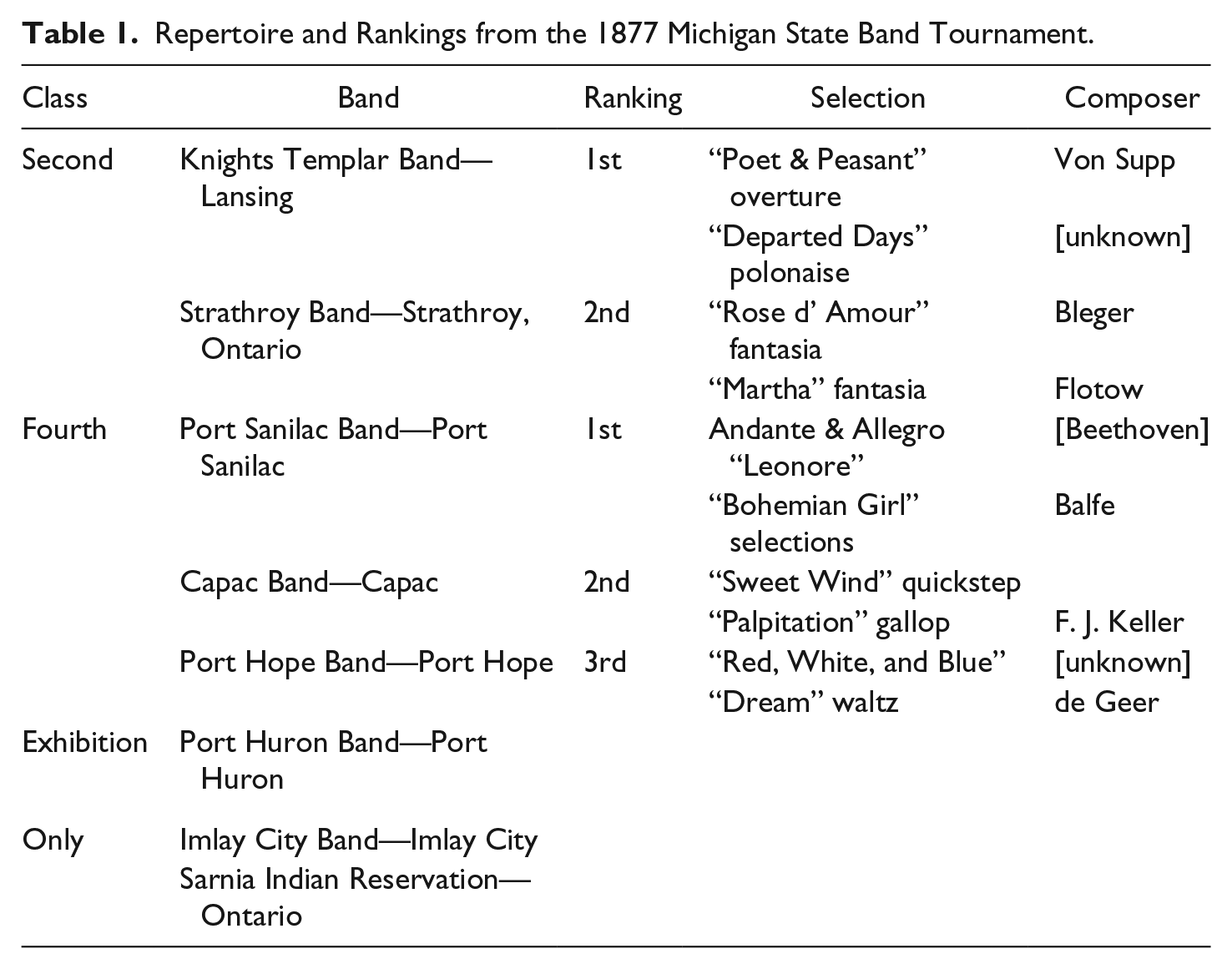
On the first day of the tournament, the eight bands in attendance paraded through the business district to the local armory where they heard a welcoming address and performed en masse. The five bands that chose to compete for prizes then passed in review before the judges for classification and an evaluation of marching. Competitors qualified only for the second and fourth classes because their instrumentation did not include woodwinds. On the second day, judges rated bands on their concert performances and awarded prizes (see Table 1). The tournament was heralded a great success and resulted in an income of $300 to the Port Huron Band. 41
Repertoire and Rankings from the 1877 Michigan State Band Tournament.
Participation increased for the second Michigan State Band Tournament, which met in Lansing on June 5 and 6, 1878. Nineteen bands with twelve to twenty-five players each competed in five classifications. Cash prizes ranged from $25 for the fifth class winner to $100 for the best band in the first class. Additional premiums awarded to the top ensemble included a silver cornet donated by Conn & Dupont, and $5 worth of band music from J. W. Pepper of Philadelphia. Conn again awarded a set of “elastic mouthpieces” to the last place finishers. 42
The tournament began Wednesday afternoon at 12:30
The second day opened with a salute fired at sunrise followed by a procession from the old state capitol to the fairgrounds. Competition began with ensembles in the fifth class and ended with those in the first class. Bands performed alternately within their classification from a platform erected for the occasion. The adjudication panel consisted of C. G. Conn from Elkhart, Indiana, W. M. Dreskell of Lansing, Michigan, and W. M. Phelps from Marshall, Minnesota. Gardner’s Flint City Band took top honors in the first class. 44 Other victors included the Central City Band of Jackson (second class), the Peninsular Commandery Band of Kalamazoo (third class), the Evart Cornet Band of Evart (fourth class), and the Union Cornet Band from Ionia (fifth class). 45
A cornet solo contest—add to the tournaments in 1878—featured five contestants who performed to a sold out crowd at the local opera house on the evening of June 6. Louis F. Boos placed first and won a cornet manufactured by Henry Distin of New York valued at $105. Anna T. Berger earned the second prize consisting of a gold badge worth $50, and C. E. Rogers of Constantine placed third even though “the Constantine people . . . [thought] their . . . cornet soloist should have fared better at the hands of the judges.” 46
Both Boos and Berger resided in Jackson and worked as professional musicians. Boos (b. 1858–d. 1935) was raised in Ohio and joined Patrick Gilmore’s Twenty-Second Regiment Band at the age of sixteen. He later played with a traveling theater company, which brought him to Jackson in 1876. Boos decided to remain in the city after the local Knights of Pythias offered him $600 per year to direct their band. In addition to this group, he conducted the Central City Band (known also as Boos First Infantry Band), and the Citizens’ Patriot Newspaper Boys’ Band. He also performed with the Berger Family Troupe, composed for cornet and band, and became a well-respected private instructor. 47
Anna Teresa Berger (b. 1853–d. 1925) started playing the cornet and performing with her siblings at ten years of age (Figure 1). After travelling with other companies, the family formed their own troupe around 1870 and began touring the United States and abroad. The act consisted of singing, bell ringing, comedy, and selections by the family orchestra and brass band. According to the Detroit Free Press, “Miss Anna Teresa Berger . . . [was] a true artiste and by assiduous labor and constant practice . . . won a foremost place in her profession.” 48 The Berger family troupe disbanded in 1880 and Anna married New York theater manager, Leigh Lynch, shortly thereafter. She continued her solo career until her death in Jackson on February 25, 1925. 49
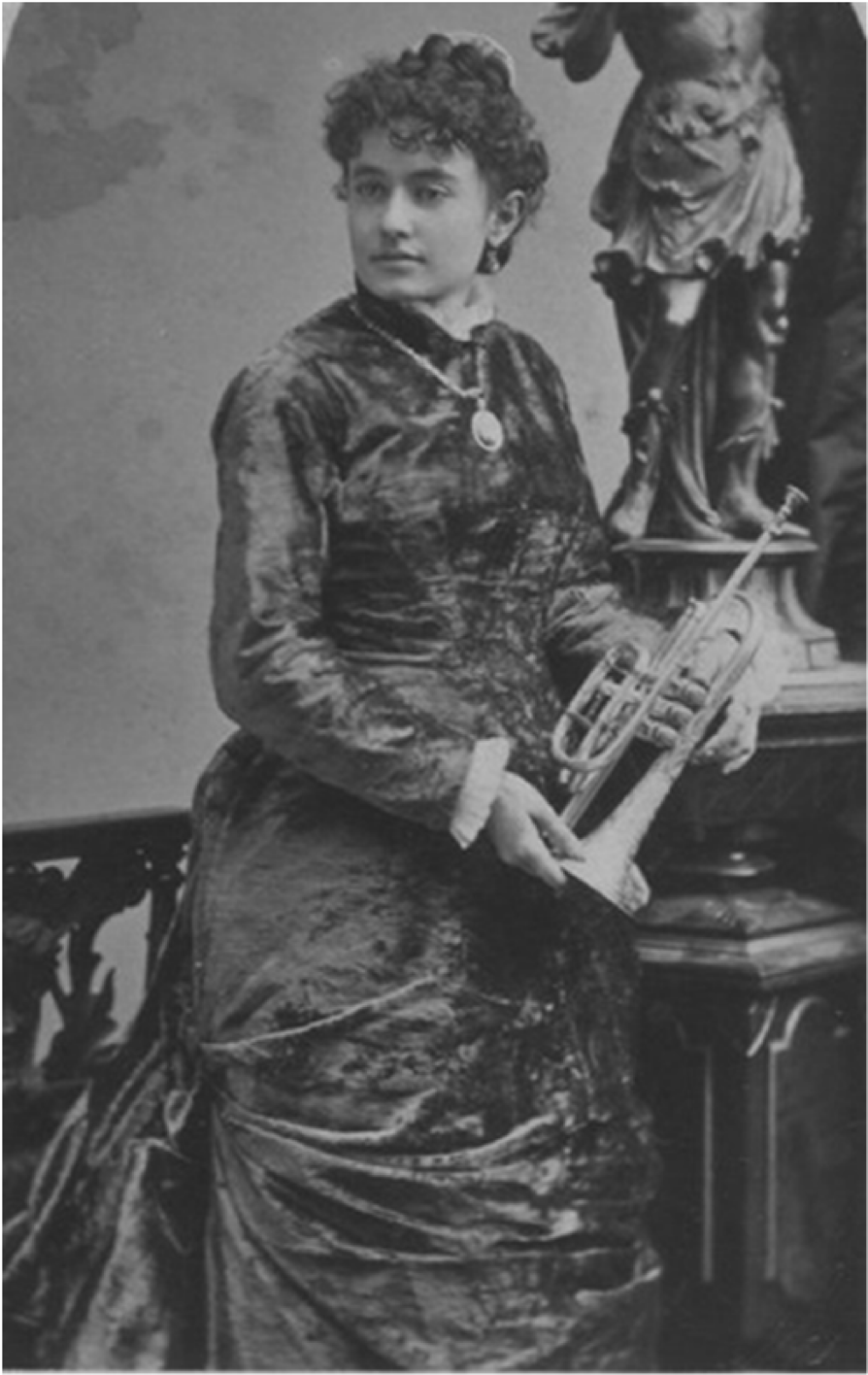
Anna Teresa Berger.
Berger’s appearance at the tournament probably attracted a great deal of attention. In addition to her youth and established reputation, Berger was likely considered an anomaly due to the common belief that playing wind instruments was unladylike and too strenuous for females. 50 A critic attempted to reconcile Berger’s ability with her gender saying, “I do not know why a lady should play the cornet . . . but her right is as valid as a man’s. Miss Berger’s double tonguing verges on the unattainable; and in keenness of blare she rivals Mr. Howard Reynolds at his loudest.” 51 Another stated that “the sight of a young woman puffing out her cheeks and inflating her bosom is not precisely attractive, but Miss Berger has certainly got plenty of talent.” 52 Regardless, she and several other women became prominent brass soloists of the nineteenth century, and others across the United States formed all-female bands that functioned similarly to their male counterparts. 53
1879–1882: Development
The tournament returned to Port Huron on June 4–6, 1879, and was the first under the auspices of the Michigan State Band Association. 54 Organizers offered four classifications for Michigan bands, a separate class for Canadian groups, a grand prize “free for all” category opened to any band regardless of classification, and solo competitions for cornet and trombone/baritone. The various contests included eleven bands from Michigan and three from Canada. Several other bands participated in the massed playing and other activities but did not compete. 55 Solo contests featured four entries on trombone/baritone and seven on cornet, including eleven-year-old H. W. Schmucher from Ionia. 56
The judging panel consisted of prominent bandsmen from across the United States: F. E. McArthur, leader of the Dansville, New York Band; Charles Baetz, director of the Great Western Band of Sandusky, Ohio; and Arthur A. Clappe, bandmaster of the Governor-General’s Foot Guard Band of Ottawa, Ontario. 57 The Lansing Knights Templar Band swept the competition and won a total of $425 for first place finishes in the free-for-all, first-class, and marching categories. Their director, William M. Dreskell, also took second place in the cornet contest behind Louis Boos, and member J. W. Christopher won second prize in the trombone/baritone contest. 58
Flint, Michigan, hosted thirteen bands at the fourth annual tournament in June 1880. 59 Lansing again claimed the first-class prize among the bands. Winners in the cornet contest included P. J. Jersey (first) from Belding, William M. Dreskell (second) of Lansing, and J. F. O. Smith, of Port Huron. Louis Boos did not participate in the solo competition and claimed that he was barred as a professional. 60
The tournament met in Lansing in 1881 and drew an estimated five thousand people to hear nineteen bands compete at the fairgrounds. 61 The solo contests also were popular, which allowed scalpers to charge up to $3 per ticket. 62 For the first time, cornetists competed in either the professional or the amateur division. Louis Boos captured the title from his rival, P. J. Jersey, in the professional class. Edward L. Boyce (first) of Grand Ledge and Miss Addie Barrett (second) from Jackson won the amateur category. 63 Barrett studied cornet with Boos, whom she married on January 11, 1883. She eventually became a professional soloist and entertainer who performed throughout the United States. 64
The Knights of Pythias Band of Jackson hosted the next state tournament on June 7–8, 1882. Although organizers hoped to attract forty to fifty bands, only ten competed for prizes in three classifications. 65 Nonetheless, the community made every effort to provide an exciting spectacle. Festivities began the first day with a “salute of six guns at sunrise” followed by a “grand procession” of the bands, civic organizations, and various dignitaries to the state fair grounds. Opening ceremonies included a welcome from the Mayor, devotional exercises, a vocal quartet, and an address by former Michigan governor and Jackson resident, Austin Blair. The massed bands then performed the “Star Spangled Banner,” “Hail Columbia,” and two marches—“Doc Munger’s Quickstep” by George Southwell and “Step Out Quickstep” by W. S. Ripley—composed especially for the occasion. The day concluded with the marching and drum major competitions, in which the Eaton Rapids Band took both awards. 66
The second day of the tournament proceeded in spite of heavy rains that “made the grounds muddy and disagreeable.” 67 The Reynder’s Family Band of Plymouth opened the third-class competition playing “A Gospel Hymn with Variations.” This group consisted only of “three young ladies with horns, a six-year old drummer-boy, and Mr. A. Reynder, the father of the flock, as leader.” Nonetheless, audiences considered them “excellent musicians” and “rapturously applauded” their performance. 68 Selections by other bands included “L’Elegante” and “Rival” overtures by William E. M. Pettee, and arrangements of “L’italiana in Algeri” by Rossini, “La sonnambula” by Bellini, “La fille du régiment” by Donizetti, “Nabucco” overture by Verdi, and “Le Réveil du lion” (Awakening of the lion) and “Caprice héroïque” Op.115 by Antoine de Kontski. To the surprise of the local crowd, Boos’ Jackson City Band (first class) took second place to Spiel’s Opera House Band of Detroit (first class). Additional winners included the Portland Band (third class) and the Germania Band of Battle Creek (second class). 69
Organizers set lofty goals for the professional cornet contest as well and had hoped to pit Louis Boos, the local champion, against his rival, P. J. Jersey, and other famous cornetists from around the country. 70 Ultimately, Boos reclaimed the championship, but only against his brother, William M. Boos, from Tiffin, Ohio, and W. C. Bowen of Chicago. 71 The trombone/baritone contest also did not go as planned. Attendance was poor and the contest started late due to an objection by Robert Foster, a contestant from Eaton Rapids, against admitting J. S. Hanna of Jackson. According to Foster, judges should have disqualified Hanna because he was a professional musician. Officials denied the objection and stated that although Hanna was a professional on the violin, he was an amateur on the baritone. In the end, Hanna took the first prize of $80 in gold, and Foster—“aside from the display of a little nervousness”—won the second award consisting of a silver Conn trombone. 72
1883–1884: Final Years
The Michigan State Band Tournament moved to Detroit in 1883. Spiel’s Opera House Band and Orchestra sponsored the event and guaranteed at least $2,000 in prize money. In addition to the standard categories, managers offered solo classifications for clarinet and E-flat alto horn, and special prizes for the top two ladies’ bands. Judges included Clappe and Batez, as well as Charles F. Boos—Louis Boos’s father—of Tiffin, Ohio. 73
Three female bands participated including the Jackson Ladies’ Band, the Fenton Ladies’ Band, and the Caro Ladies’ Band. The Jackson group was barred from competition because they had five men among their ranks. However, judges allowed the Reynder Family Band to enter this class, probably because of the size and age of the ensemble. All of these bands participated in the opening parade and massed playing, and at the competition the following day. The Fenton band placed first for their renditions of an overture and “Elmore Quickstep” by George Southwell, and the Caro band placed second for their performances of a medley of popular airs and “Fairies Moonlight Revels” fantasia by F. Goetz. In the evenings, the Jackson Ladies Band provided music between the acts of a comedy at the Detroit Opera House, and the Fenton and Caro Ladies’ Bands appeared at the Whitney Opera House in conjunction with the solo contests. 74
Nine groups competed in the first, third, and fourth classes. Winners included bands from Greenville, Ann Arbor, and East Saginaw. According to the Detroit Free Press, the Greenville City Junior Band (fourth class) of thirteen members did not arrive until noon but were “very handsomely uniformed and well disciplined in marching movements, and the audience hailed their advent with cheers.” 75 The Ann Arbor City Band (third class) consisted of twenty-one members, including several students from the University of Michigan. The Saginaw Valley Band (first class) performed advanced repertoire from popular operas including the overture to “Semiramide,” by Rossini, and selections from “Macbeth” by Verdi.
When the Saginaws marched on to the field in their brilliant scarlet uniforms, brand new and speckless, not only the spectators but the other bands gave them a rousing reception. The opinion was freely expressed that they would win the chief honors, and before they had finished their first number that opinion obviously became conviction.
76
Only two amateurs and three professionals competed in the cornet contests. Anton H. Knoll Jr. of Erie, Pennsylvania—the only competitor from out of state—captured the first prize in the professional class from A. M. Holbrook and former winner, P. J. Jersey, both from East Saginaw. Knoll’s performance of “Carnival of Venice” by John Hartmann earned 387 out of a possible 400 points and outscored the second place winner by 67 points. 77 Anton H. Knoll (see Figure 2) was born in Erie, Pennsylvania, in 1855. He first performed with the famous Knoll Band, led by his father, before joining the Boston Cadet Band in 1880, and C. A. Cappa’s Seventh Regiment Band in 1885. In 1888, he formed a partnership with Miss Marie McNeil and entertained throughout the world performing cornet duets and popular songs of the day. 78 He later managed his own concert company on the Chautauqua circuit and taught cornet lessons by mail through the US School of Music in New York. 79

Anton A. Knolls, circa 1890.
Trombonist, Frank E. Holton (b. ca. 1857–d. 1942), of Kalamazoo won first prize in the trombone/baritone category with his performance of “Facilita” air with variations by John Hartman, accompanied by the Germania Band of Battle Creek. 80 Holton was born on a farm in Allegan County where he learned to sing and play cornet. He joined the local band at fifteen and began playing trombone and baritone. By 1880, he was living in Kalamazoo and working as a musician and a blacksmith in a carriage company. Holton was a member of the Academy of Music Orchestra in Kalamazoo when he entered the State Band Tournament in 1883. During the next two decades, he played trombone with a variety of prominent bands including Ellis Brooks’s New York Concert Band, Barnum and Bailey’s Circus band, and John Philip Sousa’s band. By 1896, Holton was in Chicago working with Brooks’ Second Regiment Band. It was during this time that he opened a music shop downtown and sold second hand instruments and his specially developed trombone slide oil. Holton eventually began manufacturing his own line of brass instruments and in 1904, incorporated the business under the name Frank Holton & Company. He operated a factory on the west side of Chicago until 1918, when he moved operations to Elkhorn, Wisconsin. 81
The final tournament operated by the Michigan State Band Association occurred June 3–4, 1884, in East Saginaw. The Saginaw Valley Band acted as sponsors and their leader, Julius Reiss, served as manager. Organizers offered three prizes in each classification in addition to the usual premiums in order to attract as many bands as possible. Although seventeen bands entered the initial contest, five groups either canceled or failed to appear. The final roster consisted of only two or three bands in each classification, including ladies’ bands from Fenton and St. John. 82
Although participation fell short of expectations (see Figure 3), Reiss did all possible to schedule a full slate of events and performances. The first day included the traditional procession and opening ceremonies, followed by marching demonstrations and the ladies’ band competition. On Tuesday evening, bands from the first and second classes along with Reiss’s Saginaw Valley Band entertained about 3,500 people at open-air concerts in two local parks. However, “Everybody, the ladies in particular, was very much disappointed in not hearing the ladies bands” in these venues. Reiss, therefore, arranged exhibition performances by the female groups during competition the following day. 83 Winning bands hailed from Flint, Gaylord, Otter Lake, and Ludington. The Fenton Ladies Band earned the special prize for best group in their category. 84
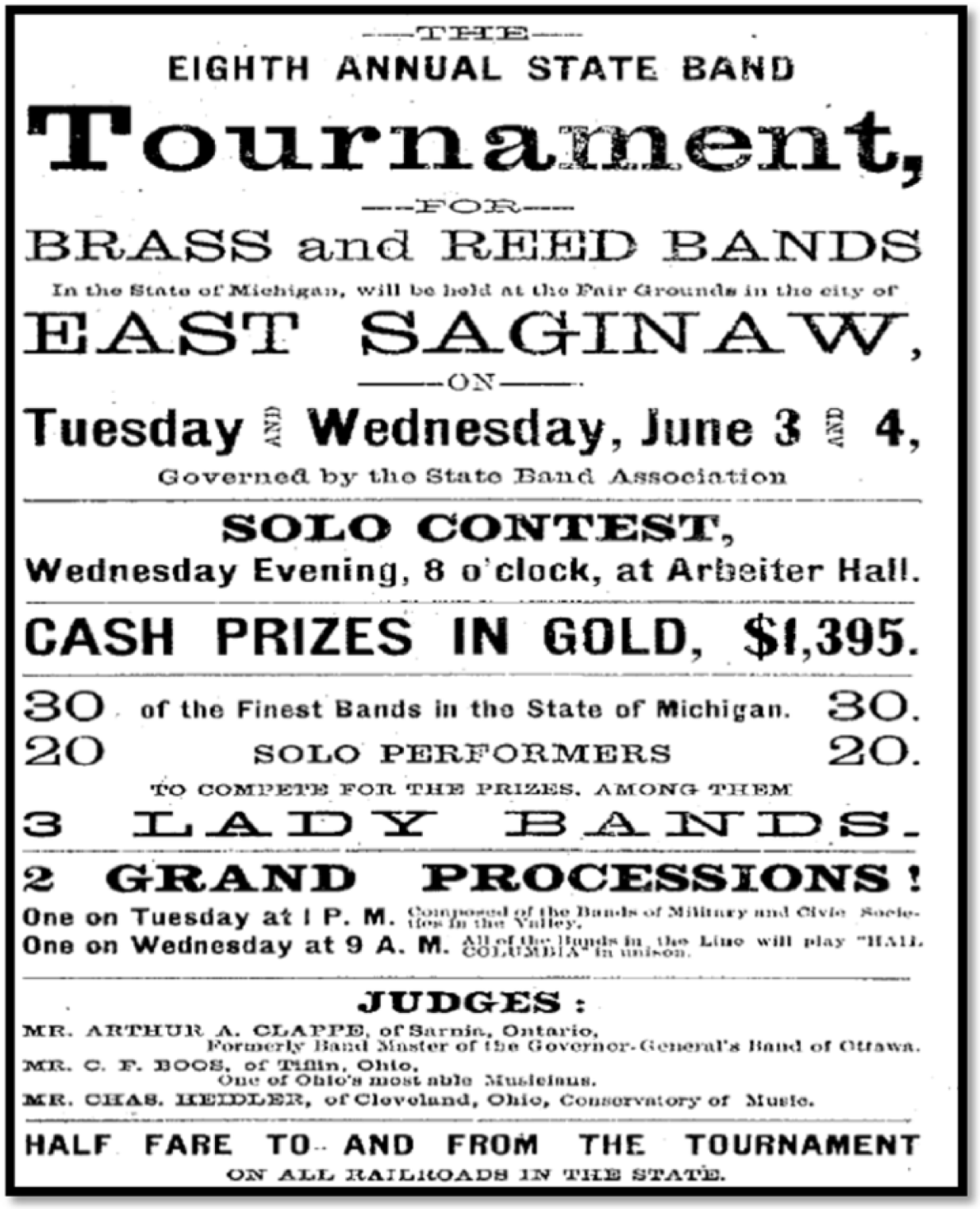
Advertisement: 1884 Michigan State Band Tournament—East Saginaw.
The tournament closed with the solo events at Arbeiter Hall on Wednesday evening. Five competitors played in the amateur cornet contest and only Louis Boos and H. Hardy of Galesburg, Illinois, entered in the professional class. Hardy, however, failed to appear, even though he was in the city earlier that day. Hardy’s reluctance might have stemmed from the fact that Boos’s father, Charles F., was one of the judges. Nonetheless, Reiss allowed Boos to perform and collect the prize money because so many people had come to hear him play. 85
Three soloists—J. S. Hanna of Homer, Robert C. Foster from Clio, and Frank Holton of Grand Rapids—participated in the trombone/baritone category. Each of these men had competed before, and Hanna and Holton were former winners. Holton entered on trombone but switched to baritone at the last minute after the other contestants protested that he was a professional on trombone. 86 Hanna reclaimed the championship with his performance of “Neapolitan Air” with variations by Narcisse Bosquet and “Rocked in the Cradle of the Deep” fantasia by T. H. Rollinson. Foster, “being taken suddenly ill,” withdrew after his rendition of “Rocked in the Cradle of the Deep” and “declined to appear a second time.” 87 Holton, therefore, claimed the second prize for his playing of “Alexis” by John Hartmann and “Webber’s Last Waltz” by William Rimmer. 88
The End of the MSBA
The MSBA elected a new slate of officers at the tournament in East Saginaw to oversee the event in 1885. 89 However, no contest organized by the Association convened that year or beyond, probably because of financial shortfalls experienced by some sponsors. Although the Knights of Pythias reported a net profit of $846.78 for the 1882 tournament in Jackson, contests the following two years operated at a loss as a result of poor weather and the failure of some entrants to appear. 90
Other factors might also have contributed to the end of the state tournaments. Some bands—especially those with little experience—might have been reluctant to compete because of the fierce competition that developed among some participants. The Kalamazoo Gazette reported that tournaments in 1878 and 1879 had “resulted in the bitterest feeling among the best bands in the state” and suggested that “the bands had better drop the tournament business—too much discord in it.” 91 Other groups coming a great distance probably realized that even if they did win a prize, the money would not cover expenses. These circumstances resulted in limited participation and prevented MSBA tournaments from becoming truly statewide events.
Influence of Michigan State Band Tournaments
Social, Cultural, and Musical Benefits
MSBA tournaments offered social, cultural, and musical benefits to everyone involved. Musicians experienced comradery with colleagues from other communities and, along with the public, enjoyed a festival atmosphere in a populated area. Host cities encouraged tourism by promoting local attractions and amenities, and sponsoring “grand balls” or other activities. 92 Free room and board for bandsmen and reduced rail fairs for both musicians and visitors encouraged a sizeable attendance. 93
The annual tournaments also added to cultural development within the state. Much of the repertoire at the tournaments consisted of marches, light classics, and arrangements of popular songs. However, bands in the first class often played operatic selections by famous European composers such as Verdi, Rossini, and Bellini. 94 These performances might have been the first and only opportunity for many people—especially those living in rural communities—to hear music of this caliber “handled in a finished and artistic manner.” 95 According to a speaker at the 1884 competition in East Saginaw, MSBA tournaments “raised the standard of music throughout the state, and . . . created a popular demand for its higher forms.” 96
Development of Participating Bands
Bands that participated in MSBA events played an important role in the life of their communities. For many towns, these organizations represented social progress, refinement, and a source of civic pride equal to its churches, schools, and industry. 97 The state tournaments encouraged the development of bands by providing a high musical standard and an incentive to improve. The Owosso Cornet Band, for example, “had its ups and downs” since organizing in 1865. However, citizens regarded the group as “highly proficient and harmonious” by 1881, when they won the second prize (second class) at the MSBA tournament in Lansing. 98 Likewise, the Eaton Rapids Band had existed just one year when they earned first prize in the third class at the 1880 tournament in Flint. The ensemble developed quickly and won both the marching contest and first-class division the following year. 99
Recognition at the tournaments also provided motivation for communities to support their bands by raising money for instruments, uniforms, and travel expenses. The Lansing Knights Templar Band acquired new silver-plated instruments manufactured by Conn and Dupont in 1879 at a cost of $1,035, and spent $830 on blue uniforms trimmed in red and gold the following year.
100
Likewise, the Saginaw News urged citizens to donate to the local band’s uniform fund prior to the 1883 tournament, saying,
Our citizens should . . . give with their usual generosity, as THE NEWS feels confident that they take a just pride in their band, and should also in their appearance. If they should attend they will undoubtedly walk off with the first prize, but they cannot go unless they get new uniforms, and the members of the band are unable to stand the expense as they are all poor men.
101
The desire for success in the tournaments encouraged bands to acquire and develop the best players possible. Some groups recruited accomplished musicians from other communities or—as the Ypsilanti Band claimed—included “only men of known ability.” 102 Other groups like the Lansing Knights Templar Band probably taught musicians within the ranks of the ensemble, as suggested by separate listings for “teachers” and “leaders” on their personnel rosters. 103 Many players also probably learned through informal study or—like several amateur cornet soloists in 1884—“without ever having had a teacher.” 104 Regardless, the Jackson Citizen Patriot spoke to the effect of MSBA tournaments on participating ensembles, saying in 1882 that, “the bands [are] educated to a point of ability far beyond that attained before.” 105
Subsequent Band Associations
Several organizations that formed after the demise of MSBA addressed concerns related to competition and travel but kept what many believed were the most enjoyable aspects of the tournaments. Directors organized the Michigan and Ohio Band Association in January 1886 and held their first meeting in Toledo, Ohio, on August 18 of that same year. 106 By 1890, the organization included groups from Indiana and became the Tri-State Band Association. Although considered a multi-state body, most participating ensembles came from southern Michigan, Northern Indiana, and Northwest Ohio. Annual meetings included the usual parades, individual band performances, and massed playing of prior tournaments. However, these events were noncompetitive and emphasized comradery among the musicians. The Tri-State Band Association held “reunions” until at least August 1899 when twenty-seven bands from the Tristate area and Ontario, met in Detroit. 107 Other regional bodies also held competitive and noncompetitive events in Michigan around the turn of the twentieth century including the Central Michigan Band Association, the Barry County Band Association, and the Eastern Michigan Band Association. 108
Adult amateur bands and their annual tournaments and conventions declined around 1917 when the public turned its attention to the automobile, phonograph, radio, moving pictures, and the distractions of World War I. However, school bands organized around this time began to take their place by furnishing music at parades and other civic events, and by competing in tournaments of their own. 109 Early school and youth band contests in Michigan occurred at the annual Boys’ Conference sponsored in Kalamazoo by the Young Men’s Christian Association in November 1915 and at the state interscholastic track meet held at the Michigan Agricultural College in East Lansing in May 1917. Although suspended for two years because of World War I, the East Lansing competition resumed in 1920 as the Michigan High School Band Contest. 110
In 1924, the state band contest became part of a system of state and national competitions sponsored by the National Bureau for the Advancement of Music and the Committee on Instrumental Affairs of Music Supervisors National Conference. 111 The Michigan Superintendent of Public Instruction’s Office of Music Education managed these events from 1924 until the office closed in June 1933. A new organization called the Southeastern Band and Orchestra Association assumed administration of the contests in 1934 and evolved into the Michigan School Band and Orchestra Association the following year. This body continues to sponsor large group, solo, and ensemble festivals in Michigan today. 112
Several similarities existed between tournaments of the nineteenth century and the first school band contests held fifty years later. Both, for example, divided groups into classifications, assigned rankings based on their performances of two selections, and often featured ancillary competitions for marching, drum majors, and soloists. 113 In addition, school band contests of the 1920s and 1930s—like MSBA tournaments—faced challenges related to the negative effects of competition, need to travel long distances, and undue influence from the music industry. However, their ability to overcome these obstacles might explain why Michigan state band tournaments lasted only eight years (1877–1884) and school music contests continue today. 114
Conclusion
The MSBA tournaments occurred long before instrumental music instruction entered the public schools. 115 For many people, the town band was probably the only opportunity to learn an instrument and—aside from the local church choir and singing school—enjoy the social and musical opportunities of an ensemble. Out-of-town recognition and success at MSBA tournaments might have been the motivation for many bands to develop their musicianship and upgrade equipment, uniforms, and personnel. However, local communities undoubtedly benefited from the higher quality of performance, repertoire, and professionalism generated by the annual competitions.
Further research is needed to examine the history of other band tournaments and associations during the nineteenth and early twentieth centuries, and to compare these entities with those serving adult and school ensembles today. This line of research will add to the literature on community music making and help identify the similarities and differences among various types of amateur band activities in the United States throughout history.
Footnotes
Declaration of Conflicting Interests
The author declared no potential conflicts of interest with respect to the research, authorship, and/or publication of this article.
Funding
The author received no financial support for the research, authorship, and/or publication of this article.
1
Margaret Hindle Hazen and Robert M. Hazen, The Music Men: An Illustrated History of Brass Bands in America, 1800-1920 (Washington, DC: Smithsonian Institution Press, 1987), chap. 1.
2
Ibid., 43–48, 67. The distinction between amateur and professional bandsmen was often a matter of degree in nineteenth-century America. Amateur bands often received a fee for their services, which allowed members to supplement their income. Likewise, many professionals accepted work outside the field to make ends meet, especially during the off-season.
3
Montgomery Ward & Co. Catalogue and Buyers’ Guide 1895, unabridged facsimile (New York: Skyhorse, 2008), 249; Sears, Roebuck and Co. Consumers Guide, Fall 1900, abridged facsimile (Northfield, IL: Digest Books, 1970), 276.
4
Leon Mead, “The Military Bands of the United States,” Harpers Weekly, September 28, 1889, 785–88.
5
A. A. Harding, “The Band as a Community Asset,” Papers and Proceedings of the Music Teachers National Association [MTNA], vol. 10 (Hartford, CT: MTNA, 1916), 189.
6
Richard K. Hansen, The Wind Band: A Cultural History (Chicago: GIA, 2005), 45; Hazen and Hazen, The Music Men, 67. For photographs and brief histories of many nineteenth- and early twentieth-century bands, see Mark S. Chalabala, Playing Favorites: The Musical Fabric of Small Towns (Brookfield, IL: Ina-Bindery Press, 2010), and C. Herbert Duncan, History of Missouri Bands: 1800 to 2000 (Minneapolis, MN: Two Harbors Press, 2012).
7
The band contest movement began in England, with the first competition held at Burton, Constable, near Hull, in 1845. Ian Jones, Brass Bands in York 1833-1924 [Borthwick Papers, no. 85] (York, UK: Borthwick, 1994), 29.
8
E.g., “The Highland County Fair,” Cincinnati Daily Gazette, October 15, 1867, 1; “The Turf. Second Day’s Racing at Uhrichsville,” Cincinnati Commercial Tribune, October 21, 1869, 1; Mark Fonder, Patrick Conway and His Famous Band (Galesville, MD: Meredith Music, 2012), 38–43.
9
“The Brass Band Tournament,” Cleveland Daily Plain Dealer, August 21, 1863, 3.
10
“Band Tournament at Barnesville,” Belmont Chronicle, October 10, 1878, 3. Conn & Dupont became C. G. Conn in 1879 when the partnership between Charles G. Conn and Eugene Victor Baptiste Dupont dissolved. Margaret Downie Banks, Elkhart’s Brass Roots: An Exhibition to Commemorate the 150th Anniversary of C. G. Conn’s Birth and the 120th Anniversary of the Conn Company (Vermillion, SD: The Shrine to Music Museum, 1994), 2.
11
See, e.g., “Music in the Air,” Saginaw News, June 4, 1884, 2.
12
“The Band Tournament,” Fremont Journal, as cited by Cleveland Daily Plain Dealer, May 18, 1867, 1; “Grand Music Festival,” Cleveland Daily Plain Dealer, May 2, 1877, 4; “Indiana,” Cincinnati Daily Gazette, August 28, 1868, 1; “Seashore Musical Jubilee,” Rhode Island Press, August 7, 1875, 1; “Music by the Sea, Band Tournament at Rocky Point, R. I.” Boston Journal, August 28, 1875, 3; “Music in the Air,” Rhode Island Press, September 2, 1876, 5; Hazen and Hazen, The Music Men, 67.
13
[no title], Milwaukee Journal of Commerce, May 27, 1879, 4; “Grand Musical Picnic,” Harrisburg Daily Patriot, August 9, 1877, 4; “The New England Band Association,” Boston Daily Advertiser, November 9, 1877, 2; “Central City Brevities,” Jackson Citizen Patriot, March 8, 1879, 4.
14
Hazen and Hazen, The Music Men, 67.
15
American Musical Journal 1 (1882), as cited by “Much Music,” Jackson Citizen Patriot, June 6, 1882, 4; Trumpet Notes, May 1, 1877, as cited by Emil Aaron Holz, “The National School Band Tournament of 1923 and its Bands” (PhD diss., University of Michigan, 1960), 47; “Constitution and By-Laws of the Michigan State Band Association (MSBA),” reprinted in Trumpet Notes, 11 (1882, March): 61–62; “Local Brevities,” Elkhart Daily Review, June 1, 1878, 3; “The Tournament,” Detroit Free Press, June 6, 1883, 6.
16
E.g., compare rules and procedures of MSBA tournaments with those of the band tournament held in Guelph, Ontario, Canada, in 1889. Programme of the Band Tournament and Firemen’s Demonstration, at the City of Guelph, Wednesday and Thursday, June 19th and 20th, 1889 (Guelph, Ontario, Canada: Jas. Hough Jr., 1889), n.p., accessed November 12, 2016,  .
.
17
Terese M. Volk, “Looking Back in Time: On Being a Music Education Historian,” Journal of Historical Research in Music Education 25, no. 1 (2003): 55; Roger P. Phelps et al, A Guide to Research in Music Education, 5th ed. (Lanham, MD: Scarecrow Press, 2005), chap. 7.
18
“The State Band Tournament,” Jackson Citizen Patriot, April 26, 1882, 4; “Band Tournament,” Detroit Free Press, March 16, 1883; 1.
19
“State News,” [Detroit] Evening News, February 14, 1879, 3; “Central City Brevities,” March 8, 1879, 4.
20
“State Band Tournament,” Jackson Citizen Patriot, January 7, 1882, 4.
21
“Constitution and By-Laws of the MSBA,” 61–62.
22
Ibid, 63.
23
24
“Constitution and By-Laws of the MSBA,” 64.
25
See, e.g., “Music in the Air,” June 4, 1884, 2.
26
Compare with procedures described in “State Band Tournament,” February 28, 1879, 4.
27
“Constitution and By-Laws of the MSBA,” 63–64.
28
Trumpet Notes, May 1, 1877, as cited by Holz, 47.
29
“The State Band Tournament,” Jackson Citizen Patriot, May 17, 1878, 4. The exact year and consistency with which classification procedures where implemented are unclear. One report of the tournament in 1878 indicated that bands selected their classification while another suggested that instrumentation was still a consideration.
30
“Constitution and By-Laws of the MSBA,” 64.
31
Ibid.
32
“Local Brevities,” June 1, 1878, 3. Other vendors, including Henri Distin of New York and J. W. Pepper of Philadelphia also were involved. “The Coming Tournament,” Jackson Citizen Patriot, May 8, 1878, 4; “State Band Tournament,” Kalamazoo Gazette, May 10, 1878, 4.
33
“Constitution and By-Laws of the MSBA,” 1882, 64.
34
“The State Band Tournament at Lansing,” Kalamazoo Gazette, May 28, 1878, 1.
35
“The State Band Tournament,” Jackson Citizen Patriot, April 25, 1879; “The Band Contest,” Jackson Citizen Patriot, June 10, 1881, 4.
36
“Constitution and By-Laws of the MSBA,” 64.
37
“A Day of Music,” Detroit Free Press, June 5, 1883, 4.
38
“Musical Memorial,” Jackson Citizen Patriot, June 7, 1878, 4.
39
“Constitution and By-Laws of the MSBA,” 64–65.
40
Holz, “The National School Band Tournament of 1923,” 47–48. Echo bell cornets had a fourth valve that diverted the sound into a closed second bell that created an echo effect similar to that produced by a modern metal Harmon mute. Elisa Koehler, A Dictionary for the Modern Trumpet Player (Lanham, MD: Scarecrow Press, 2015), 55. C. G. Conn received a patent for his “elastic face” (rubber-rimmed) mouthpieces in 1875. Charles G. Conn, “Mouthpiece for Musical Instruments,” US Patent, 160164A, filed December 5, 1874, issued February 23, 1875. One newspaper report stated that Conn also offered a trombone worth $75.00. “State News,” [Detroit] Evening News, April 25, 1877, 3. Apparently, Conn awarded only one of the cornets and the mouthpieces because of a lack of bands in the first class. “The Band Tournament—Railroad Changes—The Wood Market,” [Detroit] Evening News, June 7, 1877, 1.
41
“State News,” [Detroit] Evening News, April 16, 1877, 3; “State News,” April 25, 1877, 3; “Port Huron News,” [Detroit] Evening News, June 7, 1877, 1; Holz, 48–49.
42
“The State Band Tournament at Lansing,” May 28, 1878, 1; “The Band Tournament,” Detroit Free Press, June 7, 1878, 2.
43
“The State Band Tournament,” May 17, 1878, 4; “The Bands,” Jackson Citizen Patriot, June 6, 1878, 1; “The State Band Tournament at Lansing,” May 28, 1878, 1.
44
Gardner’s Flint City Band was named for conductor J. Henry Gardner. “Gardner’s Flint City Band,” in History of Genesee County, Michigan: With Illustrations and Biographical Sketches of Its Prominent Men and Pioneers (Genesee County, MI: Everts & Abbott, 1879), 159.
45
“The State Band Tournament,” May 17, 1878, 4; “The Bands,” June 6, 1878, 1; “The Band Tournament,” June 7, 1878, 2.
46
“Musical Memorial,” June 7, 1878, 4.
47
William F. Baker, “Boos, Louis F.,” in William H. Rehrig and Paul E. Bierley, eds., The Heritage Encyclopedia of Band Music, vol. 1 (Westerville, OH: Integrity Press, 1991), 91.
48
Detroit Free Press, September 2, 1876, as cited by “The Berger Family,” The Constitution, March 7, 1877, 2. Anna Berger also played first violin with the family orchestra. “Amusements,” Daily Alta California, November 14, 1876, 1.
49
Robyn Dewey Card, “Women as Classically-Trained Trumpet Players in the United States” (DMA diss., West Virginia University, 2009), 6–8.
50
Beth Abelson Macleod, “Whence Comes the Lady Tympanist’: Gender and Instrumental Musicians in America, 1853-1990,” Journal of Social History 27 (1993): 295–96.
51
Corno Di Bassetto, [music], London Star, May 24, 1889. Reprinted in George Bernard Shaw, London Music in 1888-89 as Heard by Corno Di Bassetto: (later Known as Bernard Shaw) with Some Further Autobiographical Particulars (London: Constable, 1937), 127. This edition includes all three volumes originally published in 1917.
52
“Progress at the Proms,” London Brighton, September 4, 1889, 3.
53
54
“Central City Brevities,” March 8, 1879, 4.
55
“Michigan, Port Huron,” Detroit Free Press, June 6, 1879, 7; “The Band Tournament,” Kalamazoo Gazette, June 8, 1879, 4.
56
“Musical Mention,” Jackson Citizen, June 10, 1879, 5. Schmucher placed seventh with 57 out of a possible 360 points.
57
“Musical Mention,” Jackson Citizen, June 9, 1879, 4.
58
“The Band Tournament,” June 8, 1879, 4; “Michigan. Port Huron,” June 6, 1879, 7; Samuel W. Durant, “Knights Templar Band,” in History of Ingham and Eaton Counties, Michigan: With Illustrations and Biographical Sketches of Their Prominent Men and Pioneers (Philadelphia, PA: D. W. Ensign, 1880), 157.
59
“Michigan. Flint.,” Detroit Free Press, June 11, 1880, 4.
60
“Personal Mention,” Jackson Citizen Patriot, May 31, 1881, 4.
61
“[The band tournament…]” Muskegon Chronicle, June 11, 1881, 1.
62
“Band Tournament: Scalpers’ Tricks-Prizes Awarded,” Detroit Free Press, June 11, 1881, 4.
63
“The Band Contest,” Jackson Citizen Patriot, June 10, 1881, 4.
64
“The Day’s Gleanings,” Saginaw Evening News, January 13, 1883, 2; “Jackson Musicians,” Jackson Citizen Patriot, November 5, 1881, 4; Baker, “Boos, Louis F.,” 1991, 91.
65
“The State Band Tournament,” Jackson Citizen Patriot, May 2, 1882, 4; “The Tournament,” Jackson Citizen Patriot, June 7, 1882, 8.
66
“The Tournament,” Jackson Citizen Patriot, May 25, 1882, 4; “The Band Tournament,” Saginaw News, June 8, 1882, 2.
67
“More Music,” Jackson Citizen Patriot, June 9, 1882, 4.
68
“The Tournament,” Jackson Citizen Patriot, June 7, 1882, 8; “The Tournament,” Jackson Citizen Patriot, June 8, 1882, 4. Family bands consisting of male and female parents and siblings were common during the late 1800s. In addition to music by the full ensemble, performances often included solos, duets, vocal selections, and dramatic elocution. A few, such as the Berger Family Troupe, were quite accomplished and traveled extensively. Others, like the Reynder Family Band, performed for local audiences. Hazen and Hazen, The Music Men, 33–35.
69
“More Music,” June 9, 1882, 4.
70
“The Band Tournament,” Jackson Citizen Patriot, January 19, 1882, 4.
71
“More Music,” June 9, 1882, 4.
72
“The Tournament,” June 8, 1882, 4.
73
“Band Tournament,” Detroit Free Press, March 16, 1883, 1; “Band Tournament,” Detroit Free Press, May 3, 1883, 8; “The Tournament,” Detroit Free Press, June 7, 1883, 4. There were no entries in the alto horn competition and only two in the clarinet contest. “The Tournament,” June 6, 1883, 6.
74
“This Week’s Tourney,” Detroit Free Press, June 3, 1883, 6; “The Tournament,” June 6, 1883, 6; “The Tournament,” June 7, 1883, 4.
75
“The Tournament,” June 7, 1883, 4.
76
Ibid.
77
“The Tournament,” June 6, 1883, 6; “The Tournament,” June 7, 1883, 4; Music Lessons in Your Own Home (New York: US School of Music, 1922), 24–25.
78
“Knoll, A. H., Jr.,” in The Heritage Encyclopedia of Band Music, vol. 1, ed. William H. Rehrig and Pau E. Bierley (Westerville, OH: Integrity Press, 1883), 1991, 413.
79
“Mr. A. H. Knoll and His Concert Company, Program,” in Traveling Culture: Circuit Chautauqua in the Twentieth Century,” University of Iowa Special Collections Digital Library, http://digital.lib.uiowa.edu/cdm/ref/collection/tc/id/25301 (accessed August 14, 2015); Music Lessons in Your Own Home, 24–25. The U.S. School of music began offering correspondence instruction in 1898 and continues to offer online education today as the U.S. School of Commercial Music. “The Original International Online Music College,” (accessed August 19, 2015).
80
“The Tournament,” June 6, 1883, 6; “The Tournament,” June 7, 1883, 4.
81
“Frank Holton & Company,” in Manufacturing and Wholesale Industries of Chicago, vol. 2 (Chicago: Thomas B. Poole Company, 1918), 112–16; Joseph L. Hubner, “People in the Industry: Frank Holton,” Journal of Musical Instrument Technology (2003): 17–21 [reprint of 1934 article]. Conn-Selmer Incorporated continues to manufacture Holton brand instruments today in Eastlake Ohio. “Holton,” Conn-Selmer, (accessed August 16, 2015).
82
“Music in the Air,” June 4, 1884, 2.
83
Ibid. Officials canceled the marching contest because of the limited number of bands.
84
“The Last Day,” Saginaw News, June 5, 1884, 2.
85
Ibid.
86
87
“The Last Day,” June 5, 1884, 2.
88
Ibid.
89
Ibid.
90
“Brevities,” Jackson Citizen Patriot, July 24, 1882, 8; “The Band Tournament,” January 31, 1884; “A Benefit,” Saginaw News, July 7, 1884, 2.
91
“State News,” Kalamazoo Gazette, June 19, 1879, 1.
92
E.g., “Music in the Air,” March 4, 1884; “Michigan. Flint.,” June 11, 1880, 4.
93
E.g., “The Band Tournament,” January 31, 1884, 2; “Music in the Air,” March 4, 1884, 2.
94
E.g., “More Music,” June 9, 1882, 4.
95
“The Band Tournament,” Saginaw News, June 8, 1883, 2.
96
“Music in the Air,” June 4, 1884, 2.
97
Hazen and Hazen, The Music Men, 43–44.
98
“Owosso’s Cornet Band and Wesner’s Orchestra,” in History of Shiawassee and Clinton Counties, Michigan (Philadelphia, PA: D. W. Ensign & Co., 1880), 155; “Band Tournament,” Detroit Free Press, June 11, 1881, 4.
99
Durant, “Village of Eaton Rapids: Band,” in History of Ingham and Eaton Counties, Michigan, 1880, 469; “The Band Tournament,” Kalamazoo Gazette, June 11, 1881, 4; “Band Tournament,” June 11, 1881; 4.
100
Durant, “Knights Templar Band,” 157.
101
“The State Band Tournament,” Saginaw News, May 4, 1883, 2. Also see “Opening of the Season,” Saginaw News, June 1, 1883, 2.
102
“The Ypsilanti City Band,” in History of Washtenaw County, Michigan (Chicago: Chas. C. Chapman & Co., 1881), 1151. Anna T. Berger (cornet) and other members of the Berger Family Troupe from Jackson, e.g., played with Gardner’s Flint City Band in 1878. “Central City Brevities,” Jackson Citizen Patriot, May 22, 1878, 4.
103
Durant, “Knights Templar Band,” 157.
104
“The Last Day,” Saginaw News, June 4, 1884, 2.
105
“State Band Tournament,” January 7, 1882, 4.
106
“A Noisy Reunion in Prospect,” Jackson Citizen Patriot, August 5, 1886, 1.
107
“Tri-State Band Association,” Ann-Arbor Daily Argus, August 17, 1899, 4.
108
“Ionia Full of Music,” Muskegon Chronicle, September 6, 1900, 2; “Band Association Organizes,” Grand Rapids Press, June 23, 1904, 5; “Peninsula Paragraphs,” Flint Journal, November 24, 1905, 5;
109
Mark and Gary, 305–6; Holz, 8–13.
110
“Boys Bands to Play for Conference Cup,” Kalamazoo Gazette, November 25, 1915, 3; “Battle Creek Band Wins Cup,” Kalamazoo Gazette, November 28, 1915, 21; “Plan Band Tourney on Prep Track Today,” Flint Journal, May 3, 1920, 21. Bands also competed at the Michigan State Music Contest at Central Michigan Normal School at Mt. Pleasant from 1920 to 1924. Kenneth James Moore, “A History of the Michigan School Band and Orchestra Association: 1959-2009” (DMA diss., Boston University, 2012), 40.
111
“Plan Band Tourney,” May 3, 1920, 21; James Edwin Moore, “The National School Band Contests from 1926-1931” (PhD diss., University of Michigan, 1968), 14.
112
Moore, “A History of the MSBOA,” 46–50.
113
“Constitution and Bylaws of the MSBA,” 1882, 63; Moore, “National School Band Contests,” 14–15; 96–98.
114
For a thorough discussion of school band contests, see Moore, “The National School Band Contests,” 1968.
115
Except for isolated instances, bands began to appear in American public schools around 1910. Michael L. Mark and Charles L. Gary, A History of American Music Education, 3rd ed. (Lanham, MD: Rowman & Littlefield, 2007), 305.