



Abstract
The purpose of this investigation was to provide a thorough documentation of the life and career of William F. Cramer. William Cramer was professor of trombone at the Florida State University for more than thirty-five years. He was a master teacher, musician, and scholar. His students remember him fondly as a grandfatherly figure whose teaching had positive impacts on their lives and careers as music educators. Cramer’s contributions to the field of music education, music performance, and scholarship are highlighted throughout this narrative. Former students, colleagues, friends, and family members served as primary sources in the gathering of information on the life and career of William F. Cramer.
Keywords
Introduction
William F. Cramer (1917–1989) was professor of trombone at Florida State University for thirty-seven years. His pragmatic pedagogical approach had a profound lifelong effect on his students and their success as teachers and performers. The memories of this respected and beloved teacher remain a fixture in their lives. He was a father figure (for some a grandfather figure) who offered sage advice to his many students. He is fondly remembered by many for his deep, booming voice, and his famous quote—“Blow freely.”
Throughout his long life, Cramer suffered some of life’s harshest tragedies. He was abandoned by his mother at an early age, survived the sinking of the USS Astoria in World War II, and survived his wife, Marguerite, who suddenly and unexpectedly died from a swift and severe infection. His life was also filled with many accomplishments. He developed a very successful trombone studio that produced fine performers and educators, was a founding member of the International Trombone Association (ITA), commissioned new works for trombone and piano, and in 1987, received the ITA distinguished career award. His treatise, The Fundamental and Essential Principals of Trombone Performance Technique: Their Teaching and Application 1 was published internationally in three different languages and is a well-respected contribution to the pedagogical literature. William Cramer was considered one of the finest pedagogues of his time and is often compared to other trombone contemporaries such as Emory Remington and Robert Marsteller. 2
The purpose of this historical narrative is to present the life and career of a music educator who is reverently remembered as a master teacher and musician by his students and colleagues, and to assess the impact that he had on their teaching and performing careers. The following research questions guided the formation of this narrative:
What is the early life history of William F. Cramer?
How did he begin his career as a music educator?
What was his pedagogical approach to teaching and how did it impact his former students’ approach in their own teaching?
What scholarly contributions did he make to the field of music pedagogy and solo literature?
In what ways did he serve his profession?
What were his contribution to music education through performing?
What were his activities after retirement?
Interviews of family, former students, and former colleagues provided information through unpublished oral statements to the author to produce this historical narrative of the life and career of William F. Cramer. Letters between family members and personal photographs were also used to provide a rich history of information, and the William F. Cramer Collection that is housed in the Warren D. Allen Music Library at Florida State University. Additional information was obtained from a recorded interview in 1988 by a former student, Paul Overly.
William F. Cramer—A Biographical Sketch
Early Life
William Franklin Cramer was born on October 23, 1917, in Akron, Ohio. He was the first child of Paul Emerson Cramer and Abigail Rosetta Geyser. Over the course of three more years, Abigail gave birth to a second son, Paul Jr., and to a daughter, Patricia. At the age of five, Cramer lost his father to a motorcycle accident, which left Abigail alone to raise the children. 3 Their father’s death came at a very difficult time, as the economy started to decline. Abigail found it too hard to care and provide for her children on her own. Before his death, Cramer’s father had been an active Freemason in the Columbus area and Abigail decided it would be best to place the children in the care of the Columbus Masonic Home for Boys and Girls. While in the care of the Masonic orphanage, Cramer began to develop a fascination with music. He began to play the violin at age six and progressed to the piano by age eight. At age nine, he began playing the alto horn in the school band and eventually settled on the trombone. All three Cramer children lived together and were educated in the Masonic home through the end of high school. 4
Upon graduating from high school in 1934, Cramer attended Wittenberg College in Springfield, Ohio, until 1936. 5 While attending Wittenberg, Cramer was initially enrolled as a pre-medical student. Soon after enrolling, he realized that a medical career was not one that he should pursue and changed his major to education. 6 After completing some coursework at Wittenberg College, Cramer applied and was admitted to the Ohio State University in 1936. He remained at OSU, completing the Bachelor of Science degree in music education under the supervision of Manley Whitcomb in 1939. 7 After graduating from Ohio State, Cramer was employed as a public-school music teacher in Westerville, Ohio, where he taught both band and orchestra to students in grades four through twelve.
Military Career, 1941–1945
In 1941, Cramer joined the United States Navy (see Figure 1) where he served as an officer until 1945. 8 He began his Naval career as an Ensign aboard the USS Astoria in the South Pacific. 9 On the night of August 9, 1942, while Cramer was on night watch duty, the USS Astoria was struck by a Japanese torpedo and was sunk during the Battle of Savo Island near Guadalcanal. 10 Cramer survived the attack and was returned back to active duty and stationed on the island of Efate, New Hebrides as a communications officer. In his many letters to his fiancé, Marguerite Winifred Furlong, whom he affectionately called “Miggie,” Cramer described life and work on the island as being very monotonous. 11

Ohio newspaper article about Cramer and his brother, Paul, serving in World War II. Date and publication information not available.
Cramer wrote of hot humid days, where work at the base communications office was very slow. He longed to hear the symphonic works of Brahms and Sibelius and often asked for Miggie to send along symphonic scores with her letters. 12 During his time on the island of Efate, Cramer explored the many beaches and swam in the ocean with his fellow officers. To keep himself musically occupied, Cramer often sang in the choir of the local Catholic Church. He found that most of the French-speaking congregation and choir members were musically inept, but he continued singing to keep himself involved with music in some way. 13
In February of 1944, Cramer was approached by Captain Skinner, an officer of the Army Special Services, who offered him the opportunity to organize a dance band. The band consisted of a group of African American enlisted men who worked on the dock of a neighboring port. 14 Unfortunately, for Cramer, this venture in organizing a band was less than successful. He was only able to recruit two trumpet players, a trombonist, a drummer, and a pianist. To his dismay, none of the musicians could read music. After a few hours of trying to rehearse the band through a few rudimentary warmups, Cramer gave the enlisted men a few words of musical encouragement and then returned to his home base frustrated with the outcome. 15
In March of 1944, Cramer was sent back to the United States where he was reunited with Miggie in San Francisco, California, and they were married on April 1, 1944 (see Figure 2). 16 Soon after their marriage, they moved to New London, Connecticut, where Cramer began his training to become a US Naval submarine officer. 17 In 1945, he was honorably discharged from the United States Navy. For the remainder of his civilian life, Cramer was active in the naval reserves, continuing his submarine training in the summers, and even serving as a naval recruiting officer. 18 One of his former students remarked that it was his military experience that influenced his teaching style: precise, concise, and with purpose. 19

Reunited after his return from the South Pacific, William Cramer and Marguerite Furlong pose together. (Date and location not available.)
Graduate Work at Ohio State University, 1945–1947
In the fall of 1945, Cramer began work on his master’s degree in music education at Ohio State University (OSU). 20 Following his enrollment at OSU, Cramer heard that the Columbus Symphony Orchestra was holding auditions for the upcoming season. Because of his involvement in the war, Cramer had not played his trombone in nearly four years. After some diligent practicing, he auditioned for the orchestra and won the position of associate principal trombone. 21 Immediately after winning the position with the symphony, Cramer was asked to serve on the music faculty at Otterbein College in Westerville, Ohio, where he taught applied brass on a part-time basis. 22
The following year, Cramer’s teaching and performing career doubled, as both Otterbein College and the Columbus Symphony extended contracts to him on a full-time basis. 23 It was during this time that he wrote his master’s thesis titled A Concept of Rhythm: Its Implications in Music Teaching Practice under the direction of M. Emmett Wilson. 24 After completing his master’s degree, Cramer continued to teach at Otterbein College and perform with the Columbus Symphony full-time until 1949. The years between 1945 and 1949 proved to be a very busy time for Cramer and Marguerite. While Cramer was completing his master’s degree, teaching at Otterbein College, and performing with the Columbus Symphony, Marguerite gave birth to three children. Their fourth child was born in 1952 after the family had moved to Tallahassee, Florida. 25
Activities at Florida State University, 1950–1987
In the summer of 1949, Cramer suddenly found himself out of a job with the Columbus Symphony Orchestra; it was folding due to the loss of financial support. 26 He continued to teach at Otterbein and considered enrolling for doctoral study at Ohio State University. 27 It was at this time that Cramer began to hear about a new doctoral program in music education at Florida State University (FSU). 28 To learn more about this new program, Cramer and the dean of the music department at Otterbein traveled to Cleveland, Ohio, for the annual meeting of the officers of the National Association of Schools of Music. It was there that Cramer met with Karl Kuersteiner and inquired about the new program at FSU. 29 Intrigued by what FSU had to offer, Cramer decided to enroll in the music education doctoral program. 30
In the summer of 1950, Cramer and his family moved to Tallahassee, Florida, where he served as a graduate teaching assistant for the low brass studio. After completing two years of doctoral coursework, he was hired as FSU’s first professor of low brass and would eventually become professor of trombone. 31 Because of his appointment as an assistant professor, Cramer did not formally complete his doctoral degree until May of 1958.
In 1956, Cramer and his children experienced a sudden and devastating loss when Marguerite unexpectedly passed away. Three years later, Cramer would marry Gracie Dorothy Boardman, affectionately known as “Dotty,” on January 24, 1959. Dorothy and all four of his children would later survive Cramer upon his death in 1989. 32
Later Years
After a long and distinguished career at FSU, Cramer partially retired in 1982 at the end of the spring semester. Although his course load would be reduced, he still directed courses in applied trombone and symphonic literature, directed dissertations, and taught wind and percussion pedagogy. He would remain in this position until his eventual full retirement in 1987. Cramer remained very active throughout his retirement and continued to travel to Europe to attend music festivals, judge trombone competitions, and continue teaching. 33 During the early years of his retirement, Cramer developed a great interest in opera and sought out opportunities to see productions whenever and wherever possible. He also used his time during retirement to continue to travel with Dottie and visit his children and grandchildren. 34
In 1989, during a routine medical examination, Cramer learned that he had prostate cancer which aggressively metastasized to his bones. Although it came as a great shock to him, Cramer continued to travel. His daughters Sharon and Melanie knew that when they took their father to the airport for another trip to Europe, it would be his last. 35 On October 2, 1989, William F. Cramer passed away in his sleep in Wiesbaden, West Germany, while serving as a judge for a solo trombone competition in Munich, Germany. A memorial service was held on October 22, 1989, and was attended by loved ones, friends, colleagues, and former students. A mass trombone choir of Cramer’s former students performed the Navy Hymn “Eternal Father, Strong to Save.” 36 In the fall 1989 issue of the International Trombone Journal, former students John Marcellus and Christian Dickenson composed a eulogy in remembrance of their teacher. 37
Professional Life
Teaching Activity and Philosophy
During his thirty-seven years at FSU, Cramer’s trombone studio consistently produced excellent performers and teachers. A consummate musician and teacher, Cramer was well respected and appreciated by his colleagues and students. A tall and slender man with a deep resonant voice, 38 Cramer was often described by students as a “gruff” person initially, but once his students understood his particular method of teaching, they found him to be quite warm and kind (see Figure 3). 39 His primary pedagogical goal was to instill the importance of solid fundamental techniques while efficiently utilizing the human body to produce a beautiful singing tone quality with ease by “blowing freely.” This phrase was Cramer’s mantra and he was known the world over for using it in every student’s lesson with him.
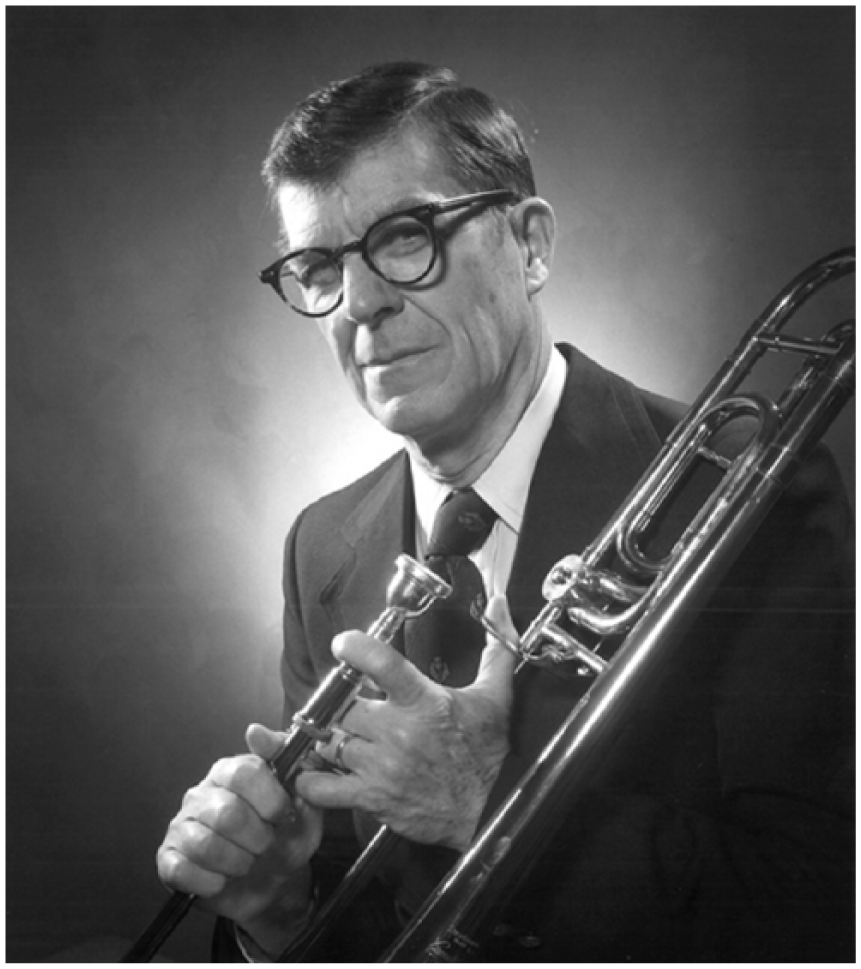
William F. Cramer (date unavailable).
Cramer’s pedagogical approach was a prime example of task analysis. It was sequential, consistent, concise, and simple. Whether he was teaching a lesson to a student on tuba, euphonium, or trombone, the task was to get the student to always start at step one so that he could ensure that the student learned the proper sequence of basic fundamentals. 40 The defining concept that Cramer instilled in his students throughout his career was the importance of basic fundamentals in their daily routine. 41 It was his belief that if the core fundamental of one’s playing could be properly achieved, then it would transfer to every other facet of the student’s musicianship.
Many of Cramer’s students have said that he was one of the most consistent teachers that they had ever had. His approach to teaching was unique in that it concerned only two things: the trombone as a resonator and the movement of the human body. 42 Cramer felt that there were six specific impediments to playing the trombone correctly: activated vocal chords, glottal stop, pharyngeal closure, tongue elevation, clenched teeth, and pursed lips. 43 He believed that if the human body was not working in harmony with the instrument, music making would thus be impeded.
William Cramer is widely considered a master teacher of the trombone and is often referenced by professional trombonists and music educators in the same vein as other prominent trombone pedagogues of the time such as Emory Remington, professor of trombone at the Eastman School of Music, and Robert Marsteller, principal trombone of the Los Angeles Philharmonic. These three master teachers had very different techniques and opinions on how to teach the trombone, yet each of them had monumental success in producing students that held prominent positions with major symphony orchestras, military bands, colleges, and public schools. Philosophically, it was important that Cramer instill in his students that they were musicians, not just low brass players. The simplicity of how he taught made understanding difficult concepts easier for the student to grasp. 44 Since it was not Cramer’s intention to produce an overly analytical student, his system of teaching did not overload the student with too many concepts at one time. The goal for the student was to be able to resonate the trombone with the very best sound. 45 While other teachers like Emory Remington and Robert Marsteller were concerned about minute details in their teaching, Cramer was focused on process and the human body. 46
Cramer’s students and colleagues recall his lessons as being quite loud. He requested that his students play very loudly in order to open up the airways and produce a tone quality that was big and resonate. He never wavered from this technique which encouraged the student to move a massive amount of air through the instrument. It was later in their course of study that the student began to learn how to incorporate finesse into their playing. 47 When the student understood the relationship between the acoustics of the instrument and the function of the human body in resonating that instrument, Cramer then transitioned to teaching reading skills and musicality that through body action transformed the notes on the page into the composer’s musical intentions. 48
Although modeling on the instrument is a primary teaching tool for many applied music instructors, Cramer modeled not only with his trombone, but also with his voice and the piano. Cramer was enamored with opera and felt that the singer is the perfect model for how one should play the trombone. 49 He encouraged his students to watch and study operas as an example of exemplary musicianship. Cramer used his naturally deep sonorous voice as an example to show his students how to resonate their trombone. 50 Although he was a very systematic teacher, this trait did not affect his ability to be a warm and caring person as evidenced by some of his students remembering him as a benevolent grandfatherly figure. One of Cramer’s favorite things to do with his students was to play trombone quartets. On occasion, Cramer would invite students to his home to read trombone quartets. After reading and rehearsing quartets, Cramer’s wife, Dottie, would offer the students ice cream. 51
Cramer’s preferred texts for teaching remained the same throughout his career. All students’ primary texts were the Vocalises of Marco Bordogni, transcribed by Johannes Rochut, the Pares Book of Scales, and the Arbans Technical Method. Although Cramer was not a masterfully skilled pianist, he often accompanied his students as they played the Bordogni Vocalises. 52 He also insisted that his students work on playing scales every day. 53 He believed that scale work was one of the single most important skill sets that a musician should master. Cramer’s students continue to pass along his ideas, influence, and approach in their own teaching as successful music educators and performers. It was the influence of Cramer’s love for teaching and music that contributed to his students’ future success. 54
Many of his former students attribute his military background as a significant influence on his style of teaching. Cramer’s students were assigned to two thirty-minute lessons a week. ITA colleague and University of North Texas trombone Professor Vern Kagarice recounts a conversation he once had with Cramer regarding his unorthodox lesson schedule. Cramer explained that his students “couldn’t stand him for more than thirty minutes at a time.” 55 Typical applied lessons for college students are scheduled in hour-long intervals. Former student David Collings recalls that Cramer was very pragmatic about the structure of his lessons: “There was very little talking and a great deal of playing and repetition of scales and etudes with minor comments.” Such little commentary left students to wonder if they were meeting Cramer’s high expectations. 56
From 1951 to 1957, Cramer traveled to Maine to attend the Monteux conducting school, L’École Monteux. It was there that Cramer studied conducting and orchestral literature and played in the seminar orchestra (see Figure 4). Cramer credits Pierre Monteux as the single most important figure and teacher in his musical education and for helping define his teaching philosophy. According to Cramer, Monteux is the only teacher that he attributes having such a profound impact on him throughout his life. Cramer took the art of conducting very seriously. Monteux’s way of teaching was, like Cramer’s, sequential and focused on basic fundamental technique. Just as he wanted his students to play with a full, resonant sound, Cramer wanted to play under a conductor who could give a clear and understandable beat pattern. 57 Monteux had great respect for Cramer, considered him a friend and colleague, and even allowed him to conduct the summer conducting school orchestra. In a photograph, Monteux wrote to Cramer: “To Bill Cramer, the most useful musician I have ever known. With my true affection, Pierre Monteux.” 58
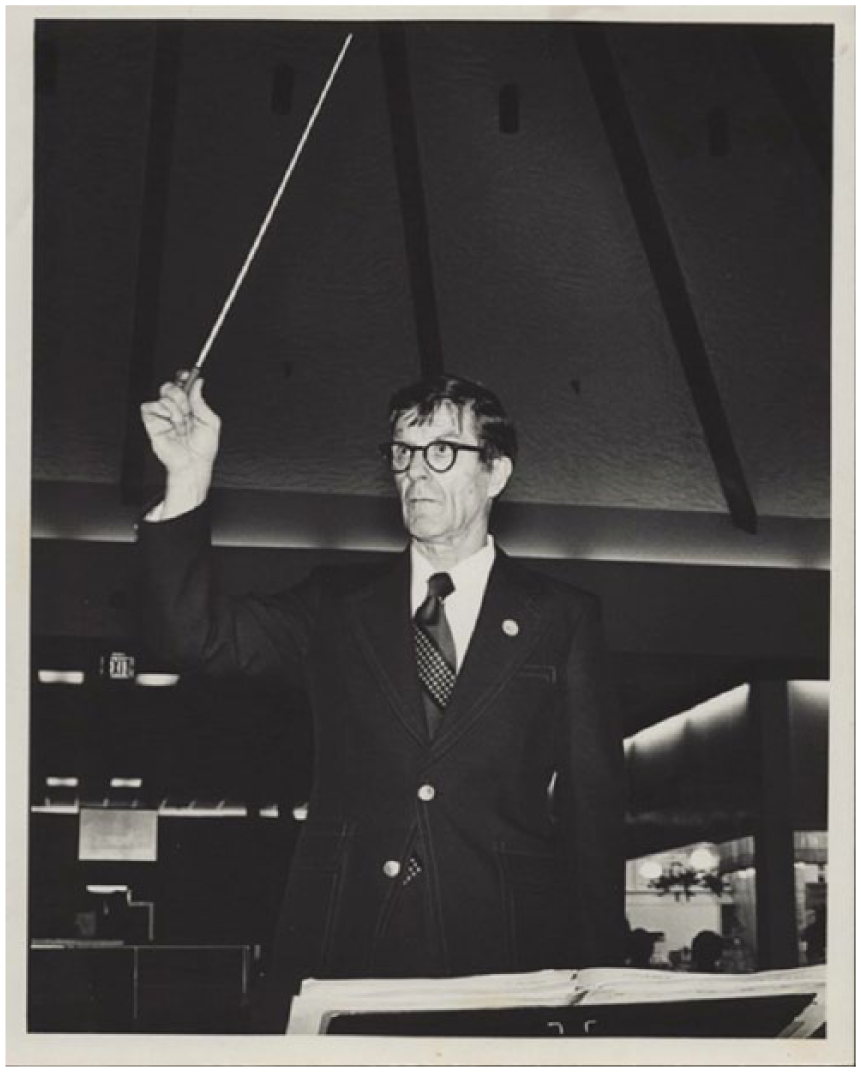
William F. Cramer conducting the FSU trombone choir.
International Trombone Association
In 1972, Cramer attended and served as a faculty member at the National Trombone workshop at Peabody College in Nashville, Tennessee. It was at this workshop that Tom Everett proposed a meeting with all the present faculty members to discuss the formation of an international association. During the meeting, Cramer nominated Thomas Everett as the ITA’s first president. 59 Over the course of his involvement with the ITA, Cramer served as chair of the Commissions Committee and as chair of the AIM (Assist an International Member) committee. 60
During his tenure as chair of these two committees, the ITA saw a great deal of growth in the trombone repertoire and in the membership of international trombonists. 61 During the Cold War, many of those behind the Iron Curtain had difficulty obtaining a membership with the ITA because of economic restrictions between the United States and Eastern Bloc countries. To assist those in socialist states with membership in the ITA, Cramer created the AIM committee. The purpose of the committee was to assist an international member in gaining membership in the ITA through sponsorship from a member in the United States. 62 In 1987, the ITA awarded Cramer for his long and distinguished service to the Association. He was featured on the front cover of the 1987 summer issue of the ITA journal (see Figure 5).
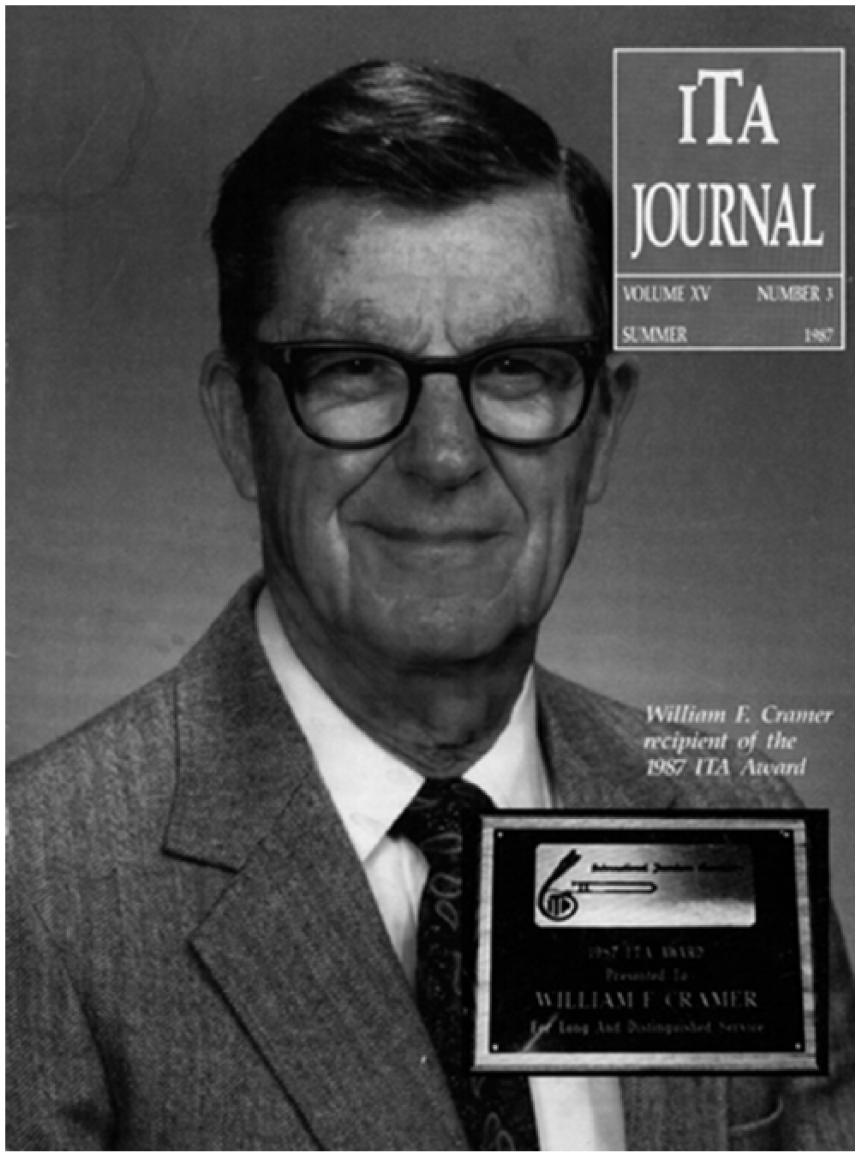
William F. Cramer on the cover of the issue of the 1987 ITA Journal.
Performing and Scholarly Activities
When Cramer joined the Florida State University School of Music faculty in 1950, he began to establish his performing career as a soloist, chamber musician, and conductor. He frequently performed as a soloist with FSU bands and performed with faculty chamber ensembles such as the faculty brass trio, quartet, and percussion ensemble. 63 Over the course of his career, Cramer conducted several instrumental ensembles at FSU. His conducting credits include the brass choir whose concerts were often shared with the FSU percussion ensemble under the direction of Ramon E. Meyer, the trombone ensemble (later named the Seminole Sackbut Society), and various guest conducting appearances with FSU concert bands. 64
Over the course of a thirty-seven-year performing and teaching career, Cramer and FSU professor of piano Robert Glotzbach presented recitals of new music for trombone and piano across the southeastern United States (see Figure 6). 65 Cramer and Glotzbach began performing recitals comprising original works for trombone and piano by mostly Eastern European composers. The Cramer/Glotzbach duo established an outstanding performing career together. They regularly performed in recital at FSU or on tour to other universities around the southeastern United States. Though Cramer had a very demanding teaching load, he found it necessary and musically worthwhile to continue to perform new music for trombone and piano. The duo’s many concerts of new and standard repertoire over the years rivaled the number of recitals given by many of their university colleagues. Cramer strived to instill in his students that the music he performed was not music for solo trombone but rather music for trombone and piano. Cramer considered his performances with Glotzbach as a musical collaboration rather than a solo trombone feature. 66
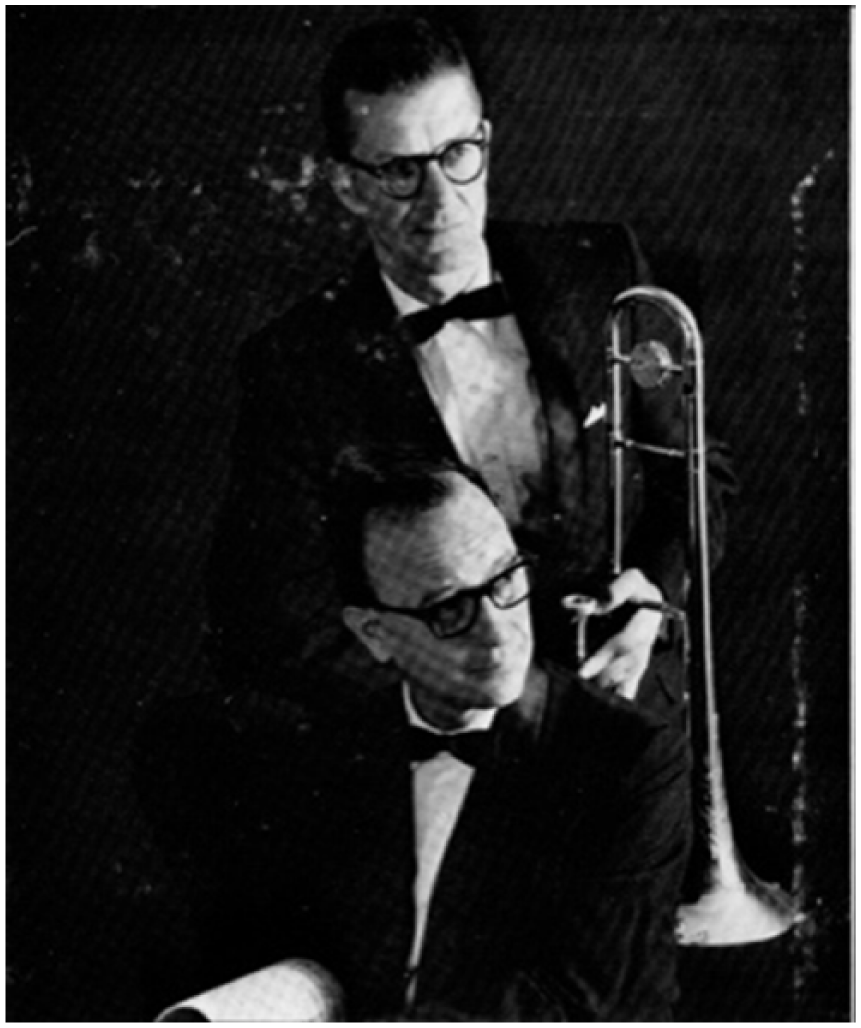
William F. Cramer and Robert Glotzbach, circa 1964.
In 1958, Cramer presented his doctoral dissertation, The Relation of Maturation and Other Factors on Achievement in Beginning Instrumental Music Performance at the Fourth through Eighth Grade Levels under the direction of Wiley L. Housewright. The goal of his research was to ascertain which factors, regardless of the grade level at which the student began instruction, determine any differences in learning a musical instrument. Cramer found that successful achievement in instrumental music performance at the fourth- through eighth-grade level is significantly influenced by the students’ motor development. The seventh-grade level is an optimum time of maturity for the student to begin learning a musical instrument. The student’s success in instrumental performance is positively correlated with intelligence, pitch and rhythmic discrimination, tonal memory, and personality. Successful performance in instrumental music is not necessarily dependent on previous playing experience. Additionally, Cramer found that physical growth did not play a part in the students’ ability to gain achievement in their progression on the instrument. 67
In 1985, Cramer published a treatise that thoroughly summarized his pedagogical ideas and techniques entitled The Fundamental and Essential Principals of Trombone Performance Technique: Their Teaching and Application. 68 Originally a paper that he first presented at the 2nd International Colloquium for Brasses in Chatenay-Malabry, France, in 1983, it was subsequently published in the Brass Bulletin in three different languages in 1985. 69 In his paper, Cramer introduces five key areas of instruction: (1) the acoustics of the trombone; (2) the function of the human body as it relates to the trombone; (3) the development of reading skills for the translation of musical symbolism into body action; (4) the development of reading skills needed for a thorough understanding of the composer’s intent, apart from actual sight-playing of the composition; and (5) the development of a value system that leads to good musicianship. This treatise is the embodiment of Cramer’s teaching philosophy.
International Travel and Commissioning of New Music for Trombone
Throughout his many years of traveling, Cramer established lifelong friendships with colleagues in Eastern Europe. His many trips to Eastern Europe were in the interest of obtaining new literature for the trombone, teaching, serving as an adjudicator in competitions, and making new acquaintances with fellow trombonists. It was through his travels that Cramer met the Hungarian trombonist Gustav Hoena. Hoena was so impressed with Cramer that he asked for special permission to leave Hungary, a socialist country at that time, in order to enroll as a graduate student at FSU to study with Cramer. This sparked a lifelong friendship and Hoena credits Cramer’s teaching as being the guiding force in his own teaching. 70
Cramer was an avid traveler, and his travels frequently took him to Eastern Bloc countries. He sought out new composers who would agree to compose a piece for trombone and piano in exchange for having the piece premiered back in the United States. At the time, it was very difficult for composers from Eastern Bloc countries to get their works performed in the west. Seeing that the repertoire for solo trombone and piano was small, Cramer began to seek out new works from composers who were willing to write for the trombone, which was rarely taken seriously as a solo instrument. 71 Commissioning new works was a labor of love for Cramer. His criteria for the new works were simple: the work must be a sonata for solo trombone and piano or, if the piece were for trombone choir, it must be written for twelve parts. Cramer was a seminal figure in the advancement of trombone literature. He was responsible for coordinating with the ITA in commissioning one of the most performed sonatas and cornerstones of the solo trombone repertoire: Stjepan Šulek’s sonata for trombone and piano “Vox Gabrieli” (The Voice of Gabriel). The piece was affectionately dedicated to Cramer in 1973. Prior to his appointment at FSU, Cramer had already begun making inquiries into acquiring new music for solo trombone while teaching at Otterbein College. Two such people that Cramer contacted while at FSU were the notable trombone soloists Davis Schuman and Stuart Dempster. Both Schuman and Dempster had been searching for new compositions for solo trombone and Cramer found them to be helpful resources in his endeavor to further the repertoire. 72
Conclusion
The purpose of this research was to provide a narrative of the life and career of a respected and celebrated music educator who contributed a great deal to the art of teaching and performing. It is an account of a life of the man who influenced so many personally and professionally through his teaching and mentorship. William Cramer’s life was filled with many difficulties as well as milestones. His philosophy that one must master and understand the importance of basic playing fundamentals before one can continue to progress has influenced his former students’ teaching in music classrooms and applied studios around the world. His contributions to the profession and to his students’ lives cannot be underestimated. When we examine the history of the contributions that have been made by our teachers, we find that their influence and ideas inform our teaching practices which will in turn inform the teaching practices of our future students. We bear an important weight on our shoulders to serve as good stewards of our teachers’ pedagogical legacy.
When one decides to become a teacher, one is answering a special calling. Society entrusts teachers with the responsibility to provide students a foundation of knowledge and skills that leads toward paths of creative inquiry, artistic expression, and social change. As music educators, our previous teachers provided us with skills that have shaped how we teach, perform, contribute to society, and live our lives. The bond between student musician and teacher is special and everlasting. It is this bond that makes teaching more than just a job; it becomes a way of life. William F. Cramer lived a life rich with music, teaching, and service. He was dedicated to a profession that gave him so much that he in return gave to his students. The lasting effect that Cramer has had on the lives and careers of his students and colleagues is a testament to his pedagogy, wisdom, and care for others.
Footnotes
Declaration of Conflicting Interests
The author declared no potential conflicts of interest with respect to the research, authorship, and/or publication of this article.
Funding
The author received no financial support for the research, authorship, and/or publication of this article.
1
William F. Cramer, “Trombone Techniques,” Brass Bulletin 49 (1985): 61–71.
2
John Dwight DeForest Colegrove, “Emory Remington (1891–1971), William Cramer (1917–1989), and Robert Marsteller (1918–1975): A description of trombone teaching techniques and a discussion of their influence upon trombone teaching methodology” (DMA, diss., University of North Carolina at Greensboro, 1999).
3
Sharon Bell and Melanie Cramer-Fuller, interview by author, November 18, 2011.
4
Ibid.
5
William F. Cramer, interview by Paul Overly, December 16, 1988. Recording.
6
Ibid.
7
Ibid
8
Ibid.
9
Ibid.
10
Ibid.
11
Cramer, William F. Cramer, transcription of Personal Letters written to Miggie, June 1942–March 1944.
12
Ibid.
13
Ibid.
14
William F. Cramer, letter to Miggie, February 18, 1944.
15
William Cramer, transcription of personal letters written to Miggie, June 1942–March 1944.
16
Bell and Cramer-Fuller, interview.
17
Melanie Cramer-Fuller, “William F. Cramer,” E-mail message to author, January 12, 2012.
18
Ibid.
19
Jeff Thomas, interview by author, November 15, 2011.
20
William F. Cramer, interview by Paul Overly, December 16, 1988. Recording.
21
Ibid.
22
Ibid.
23
Ibid.
24
Ibid.
25
Ibid.
26
Ibid.
27
Ibid.
28
Ibid.
29
Melanie Cramer-Fuller, “William F. Cramer.”
30
Ibid.
31
Paul William Overly, “An Annotated Guide to the William F. Cramer Collection of Solo Trombone Literature in the Warren D. Allen Music Library at Florida State University” (DMA diss., Florida State University, 1990).
32
Sharon Bell and Melanie Cramer-Fuller, interview by author, November 18, 2011.
33
Clifford Madsen, interview by author, January 21, 2012.
34
Bell and Cramer-Fuller, interview.
35
Christian Dickenson and John Marcellus, “William F. Cramer (1917-1989),” International Trombone Journal 17, no. 4 (1989): 27–28.
36
Ibid.
37
Ibid.
38
Madsen, interview by author.
39
John Marcellus, interview by author, November 11, 2011.
40
Madsen, interview by author.
41
Thomas, interview by author.
42
Ibid.
43
Ibid.
44
Harry Price, interview by author, November 18, 2011.
45
Brian Brink, e-mail message to author, November 21, 2011.
46
Ibid.
47
Thomas, interview by author.
48
Ibid.
49
Ibid.
50
Ibid.
51
Jeannie Little, interview by author, November 11, 2011.
52
James Kraft, interview by author, November 16, 2011.
53
Ibid.
54
Tim Douglass, interview by author, November 15, 2011.
55
Vern Kagarice, interview by author, November 15, 2011.
56
David Collings, “William F. Cramer,” e-mail message to author, November 14, 2011.
57
Cramer, interview by Overly.
58
Ibid.
59
Thomas Everett, interview by author, November 9, 2011.
60
Ibid.
61
Ibid.
62
Ibid.
63
Ibid.
64
Cramer, interview by Overly.
65
Ibid.
66
Madsen, interview by author.
67
William F. Cramer, “The Relation of Maturation and Other Factors to the Achievement in Beginning Instrumental Music Performance at the Fourth Through Eighth Grade Levels” (EdD. diss., Florida State University, 1958).
68
Cramer, “Trombone Techniques.”
69
Ibid.
70
Gustav Hoena, interview by author, January 7, 2012.
71
Dempster, Stuart. Message to author, December 23, 2011.
72
Ibid.