



Abstract
Once referred to as “the most maligned musical instrument on earth,” the harmonica holds an important historical place in music education as an instrument around which bands were formed, solo and ensemble competitions were held, and in some cases, careers were born. Much of this activity centered itself on city recreation programs as well as public schools. The instrument’s size, low price, and relative ease of sound production were appealing for these organizations. The boys and girls that lived and studied at the Hebrew Orphan Asylum of New York City were engaged participants in these contests as well as performing in radio broadcasts of harmonica band playing. This paper examines the history of this ensemble as a representative of the incredible activity in this underresearched area of music education.
The 1920s and 1930s were a time of incredible activity in music outside of the concert hall. There was a wide variety of musical entertainment available from so-called lowbrow to highbrow 1 and often the two were mixed in their public presentation, especially on the radio. An essentially democratic medium, radio was a great “equalizer” as anyone could listen to various musical presentations, obtain advice on home management, or be entertained by a comedy routine, just to list a few choices. The musical presentations ranged from orchestra performances to solo pianists, concert bands to banjo playing, and the focus of this article, harmonica playing, both solo and as a band.
Once referred to as “the most maligned musical instrument on earth,” 2 the harmonica holds an important historical place in music education as an instrument around which bands were formed, solo and ensemble competitions were held and in some cases, careers were born. Much of this activity centered itself on city recreation programs as well as public schools. The instrument’s size, low price, and relative ease of sound production were appealing for these organizations. In fact, harmonica instruction was reported to be required for playground teachers by the Cleveland Board of Recreation in 1926, presumably to support the growing interest in it as a component of recreation education. 3 Harmonica bands and solo players were an important part of the new competitive atmosphere that surrounded music education in the 1920s with the advent of National Music Week and Boys’ Week. National Music Week was a program of the National Bureau for the Advancement of Music to have nationally synchronized activities aimed at furthering the music education of people of all ages. Held first the week of May 4-10, 1924, 4 the national “observance” has continued till today. 5 Activities have historically included music memory contests and performances of community groups and harmonica-playing contests. Boys’ Week was a national effort supported by the Rotary Club that aimed to provide activities to engage the excess energies of young boys but expanding to other areas such as “citizenship, health and hygiene, and vocation.” 6 The boys and girls that lived and studied at the Hebrew Orphan Asylum of New York City were engaged participants in these contests as well as performers of radio broadcasts of harmonica band playing.
The Hebrew Orphan Asylum of New York City was, during its operational time (c. 1860–1941), the largest Jewish charity in New York and was responsible for the care of thousands of orphans and half-orphans. 7 In addition, the asylum provided elementary education as well as musical education for its residents. The boys’ concert and parade band of the orphanage was well known through its sixty-seven-year history, performing in many different venues in Manhattan and the surrounding area. 8 It was not the only musical group at the asylum as there was an orchestra, choir, and after 1924, two harmonica bands (one for boys, one for girls).
Research Questions
This research paper studies the history of the Hebrew Orphan Asylum Harmonica Band as an example of a particular niche in music education that was highly successful and yet appears to be lost to music education history. The following questions were considered:
What is the historical record of this ensemble?
What was the impact of training on what is not considered today a standard school wind instrument?
What potential did harmonica education hold for future vocations of the participants?
What was the impact of the ensemble’s directors?
What was the role of public performance for these school children?
Methodology
Unfortunately, there is minimal historical research on community music as compared with concert music and even less for that which was or is considered low- or even middlebrow. This is certainly the case for harmonica bands, which contributed much to the music education of the children trained on the instrument. However, historians are often biased against this experience in favor of more “classical” instrumental music program development, the harmonica never being able to shake the reputation of lowbrow entertainment that it carried. Despite the emergence of concert repertoire for the chromatic harmonica and the existence of harmonica virtuosos such as Larry Adler and Leo Diamond, the harmonica eventually found a home on the vaudeville stage and in jazz the 1930s, which may be part of the major reason it did not retain its place in music education.
Research for this article relied heavily on contemporary newspapers and trade journals in addition to the Hebrew Orphan Asylum student publication, The Rising Bell, and the annual reports of the institution for the time period. Biographies and memories of former members of the harmonica band contributed as well, with an understanding that memory is not always completely accurate. Sources such as these often can have some bias, and so as much corroboration as possible was done to ascertain validity. The only sources that are included are those that could be verified with another source unless noted otherwise. Histories of harmonica bands in playgrounds and schools that have been documented by reliable scholarly sources are drawn on as well.
The Harmonica Craze
A Boy Scout camp harmonica competition in 1922 is one of the likely catalysts for the keen interest in the harmonica that occupied the 1920s and found its way into the public schools and municipal parks. According to reports, more than two thousand boys in several camps located in the Palisades Interstate Park (located in Northeast New Jersey) participated in the contest, which included preliminary and final stages, of which Clifford St. Hill of Woodhaven, Long Island, took the first prize: a Hohner “Trumpet Call” No. 220 harmonica and a gold medal. 9 The appearance of articles about this event in publications such as The Music Trades Review and The Druggists’ Circular indicate the commercial advantages of this instrument. A headline in the Northwest Druggist, “Harmonica Contest: Creates Public Interest—Should Increase Sales” [italics in the original], 10 sums up one of the reasons for the broad interest in this little instrument. Contests such as this were not new to the 1920s, although that is when they seemed to be most numerous. The Hohner Harmonica Company began to hold harmonica contests as early as 1907 when William H. Burke won a contest in New York’s Madison Square Garden in October of that year. Burke was touted by The New York Clipper as already holding the “title” of “champion harmonica player of the world.” The contest was a part of a concert sponsored by Hohner, a repeat of a similar event from the previous year. 11
The so-called harmonica craze 12 began as early as 1884 and by the 1920s seems to have taken hold. The reasons for this appear in part to be the synthesis of several congruent social phenomena: (1) the inexpensive instrument meant that poorer families could see their children engaged in music making, (2) the relative ease of sound production meant that students had immediate gratification, (3) harmonica band contests were produced as part of National Music Week and Boys’ Week, and (4) radio rose as a nationally popular medium for entertainment. The Progressive Movement likely had an influence on this as it sought to better the lives of the working class. In his profiles of Dewey and Mursell, Steven Kelly states that “Mursell viewed music education as an opportunity to improve an individual’s life,” 13 and Thomas W. Miller mentions that “social reconstructionists suggested that the results of education could be measured only in a social setting.” 14 In his article, “Forty Years of Playgrounds,” Randell D. Warden, summarizes the Progressive Movement’s work on establishing playgrounds as a component of education and prominently features a photograph of the Newark Recreation Harmonica Band. 15 Certainly, the “lowly” harmonica became one of the means of making music education widely available. Soon, harmonica players began to explore arrangements of classical pieces, resulting in necessarily raising the level of the abilities of those learning to play harmonica, which is evidenced by the selections reported to have been played.
Beginning in 1920, Hohner introduced two important marketing initiatives: sending well-trained soloists to the schools to demonstrate harmonica playing 16 and the sponsorship of playing contests, first in Philadelphia, followed by New York City and others. Hohner worked with the Parks Department of New York City, 17 which lent a municipal credibility to the effort, and the trade journals lauded their efforts. 18 In addition, design improvements on the diatonic harmonica led to a chromatic instrument 19 as well as the development of instruments of different sizes, 20 thereby opening the door for more complex repertoire choices.
The 1923 Boys’ Week in Philadelphia included a harmonica contest sponsored in part by philanthropist Albert Hoxie. 21 The contest in Philadelphia was repeated in New York City that year followed by the appearance at the New York Silver Jubilee parade of a Hohner float carrying the three winners as well as the contingent of contestants in the Central Park finals of the contest. The approximately twenty-seven boys played in the float, the sides of which were emblazoned with declarations of the three winners as “Harmonica Champions of the World.” 22 In 1924, there were preliminary contests in all New York City boroughs in April with the finals at the Mall in Central Park on May 10. The winner of that contest, Leonard Russack of the Bronx, played “The Parade of the Wooden Soldiers” and was awarded, in addition to music merchandise from a local retailer, a trip to Washington, DC, Baltimore, and Philadelphia, a trip underwritten by the Mueller Spaghetti Company. While in Philadelphia, Leonard competed against that city’s first-place winner to determine the national champion. 23
Hohner was not the only organization to run such contests. The William Morris Agency introduced an arrangement with one of the stars of vaudeville at the time, harmonicist and actor Borrah Minevich, to hold a contest in several cities for a young person to perform with him at the local theatre, presumably before the main feature. 24
These contests produced an unexpected, but welcome, result: the beginning of a legitimization of the harmonica as a concert instrument. Certainly, it was not perceived as such early in its appearance in American culture. The Philadelphia Call, in 1884, posed this question from “a correspondent”: Can you inform me who it was that first introduced the harmonica craze, which is now so prevalent among the male class of juveniles? No, we can’t just at the moment. But if you want to kill him we’ll find out right away. Telegraph us.”
In 1891, the Ottawa Daily Republic of Ottawa, Kansas lamented “the guitar, banjo and harmonica craze struck Cedar street [sic] last night.” But, as a result of the aforementioned marketing and exposure by Hohner and the interests of those in the Progressive movement, by the early 1920s, music educators as prominent as Peter Dykema were calling for all types of music education to be given due respect for their potential to engage young students. Peter Dykema presented a compelling argument in favor of this ideal: The author directs attention to the many different types of music and to the many types of individuals who are influenced. Are the high-brow [sic] and the low-brow [sic] permanently different or is one an advanced development of the other? What constitutes music? Should the crooning of the mammy, the shaking of a rattle, the fife and drum corps, the moanings and groanings of savage tribes, be so classed? The author believes that we need to grow in music and makes a plea that all participate, even to playing on the simplest instruments. . . . He advocates the employment of music directors on playgrounds and the formations of bands among the boys.
25
The formation of playground harmonica bands did occur, and they were among those that competed in the citywide contests. In reporting on the May 1925 contest, The New York Times gave a particularly important assignation of credibility. The headline read: “Harmonica Winners Play Operatic Airs: Only One of Five Boys Who Get Prizes Tries Ragtime in Central Park Contest.” 26 That the harmonica could cross the divide between lowbrow and highbrow was significant, and the reporter went on to observe that the music played was unexpected in that “‘The Sidewalks of New York’ and ‘Turkey in the Straw’ and kindred tunes . . . were conspicuously [sic] absent yesterday afternoon when seventeen boys participated in the final tests for the harmonica championship of the city.” 27 Pieces performed included “Orientale” by Cesar Cui and “Spring Song” by Mendelssohn. 28
The focus of this article is on one particular school harmonica band, one that was not unique in music education; the P.S. 61 harmonica band of the Bronx has already been mentioned as well as playground bands. Harmonica playing as part of music education in and out of schools was evidently a national phenomenon as reported in the National Survey of Harmonica Bands and Classes. The survey of music teachers around the country demonstrated that a majority of states had harmonica instruction. 29 The report indicates that the harmonica appears to have served as a positive contributor to the development of school music programs. For example, in Colorado, Mr. S. S. Effinger reported that harmonica classes were a “good opening wedge to the study of music for boys and a few girls.” 30 More recently, Jere Humphreys wrote that “miscellaneous groups such as mandolin orchestras, harmonica bands, accordion groups, harp classes, and drum and bugle corps appeared and in some instances flourished in schools and colleges between the wars also.” 31 Numerous newspaper articles attest to the presence of harmonicas in the schools and playgrounds for young people.
The HOA Harmonica Band Is Formed
It was the combination of these public events that inspired Charles Snow, an alumnus of the asylum, to initiate a harmonica band at the Hebrew Orphan Asylum (HOA). Snow was discharged from the HOA in 1914 32 but seemed to have continued a relationship with the institution, at minimum at their summer camp in the Palisades Interstate Park. One can only speculate that he was a counselor of some type. According to Hymen Bogen, a former resident, Snow was an accomplished player on the harmonica and “got the idea for it at the boys’ camp that summer [1924] after noting the delighted response to his harmonica performances at campfire entertainments.” 33 It is also very likely that Snow was aware of, if not present at, the Boy Scout contests which took place in the same area as the HOA summer camp.
The band formed around November 1924 and within a year there were forty-three boys in the band. 34 The annual contest in 1925, now fully under the auspices of the Parks Department, yielded positive results for the HOA group: Louis Delinsky won fourth place and as the Manhattan borough champion, played “The National Emblem March.” 35 The judges were primarily from the entertainment industry: Arthur Levy, of the New York State Motion Picture Commission; Joseph Plunkett, director of the Strand Theatre; Johnny Hines, comedian; Helen Shipman, musical comedy actress; and harmonica virtuoso Borrah Minevich.
The HOA harmonica band enjoyed success at the 1925 contest as well, taking the second-place prize in their portion of the event. This victory resulted in performances for charitable organizations around the city. The HOA student publication, The Rising Bell, lists the following organizations as recipients of their performances in the June 1925 issue: The Home of the Destitute and Blind, The Riverdale Aged Home, and The Light House. 36 Fortunately, the boys benefited from their charity work as well: the Piccadilly Theatre donated a “treat” to the boys of the band in July 1925, presumably in thanks for playing there; the Manhattan Republican Club donated thirty harmonicas in March of that year; and the Hohner Company donated a set of trap drums. 37
Contests, the Radio, and the Emergence of Talented Players
In addition to in-person engagements, 1925 saw the beginning of a run on the radio by the harmonica band. This mirrored the achievement of the HOA concert/marching band who held a long-standing presence in that medium.
38
The Gimbel Brothers’ department store had their own station (WGBS), and the HOA harmonica band played regularly on that station, which was then broadcast widely and often featured in the “Best Features” area of the radio broadcast listings.
39
WGBS was not the only station on which they appeared; WNYC, WMCA, and WMAF broadcast the band. Their radio appearances and the commercial implications were heralded in The Music Trade Review, July 25, 1925 edition:
New York’s Hebrew Orphan Asylum, which has long been famous for its wonderful band, now has a full fledged [sic] harmonica band composed of twenty-three boys playing Hohner harmonicas. This band gave a concert last week from Gimbel Bros. radio station WGBS, which was one of the radio features of the week. It has now left to spend a few weeks at its Summer [sic] camp and upon return will be a regular broadcasting feature at New York stations. The New York World on Sunday printed a large picture of the band, which meant excellent publicity for the music dealers handling Hohner harmonicas.
40
At the same time as the boys’ harmonica band was rising in prominence both at the asylum and in the city in general, another similar band was working at the HOA. A girls’ harmonica band had formed and was quietly working in the background. 41 Girls were a feature of harmonica competitions, surprising given that concert/marching band was generally oriented toward boys, leaving girls for what might be referred to as “soft” musical activities such as chorus and orchestra. However, harmonica contests seemed to be an area open to girls as competitors, especially in Philadelphia where there were female winners between 1925 and 1929 and a winning girls’ band in 1929. 42 Girls are included in an advertisement for the harmonica contest in 1928 as pictured in Figure 1.

Girls and boys were encouraged to participate in harmonica contests, The Brooklyn Eagle (Brooklyn, NY), June 7, 1928, 14.
Not much is known about the HOA girls’ harmonica band. Only two entries in The Rising Sun, one from April 1925 where they encourage other Asylum students to come and hear them and a rather bold entry in the June 1925 edition where the author proclaims, “the boys had better not rest on their formerly won laurels, for the girls are busy at work under their own supervision, and will soon catch up with them.” 43 They did have some of their own success, including a solo third place win by Dora Wexler in a co-ed competition in 1926. The emphasis in Asylum publications seems to focus on the boys, however. The orchestra and choir, which included girls, is rarely mentioned although it was included in a list of music activities at the HOA in the President’s Report of 1926: “Music receives its due consideration in the education of the children. We have a Synagogue Choir, a Girls’ Glee Club, a Boys’ Band, a Harmonica band.” 44 One must assume that the lack of specificity of who played in the harmonica band was simply an oversight, not a suggestion that the two bands had somehow merged as all-boys bands were the norm. It is not clear if the girls’ harmonica band continued after 1926.
The 1925 contest also featured a solo competition, as had previous contests. Fifteen-year-old Louis Delinsky played “The National Emblem March” and won fourth place and the prize of a cornet. The contest of May 1926 held an additional point of interest for the attendees and participants: a contest between two area harmonica bands that had become musical rivals. The band from P.S. 61 in the Bronx was older than the HOA band and held a deserved reputation for excellence. Their director, Aaron Kiel, should be credited with establishing a presence for harmonica instruction as a school music education discipline. The “battle of the bands” opened the May contest and was won by the HOA band, which received a silver cup as their prize. The Music Trade Review made mention in its reporting on the contest that the seven-year-old Farage twin brothers, Max and David, were particularly exciting that year. Their creation of an “act” for the event, dressing in bell-boy uniforms, presages the careers of several of these boys, Max included. 45 He went on to a minor career in harmonica quartets such as the J. Walker Quartet and the Two Tunes Harmonica Quartet. 46
Lou Delinsky would go on to become a well-known harmonicist in his own right, performing in the vaudeville stages of New York and elsewhere. In Elmira, New York, he performed as part of the annual Music Week schedule. Referred to as the “Manhattan [New York] Harmonica Champion,” his success was referenced by the Executive Secretary of the Elmira Community Service, E. Nespor, in urging the formation of a youth harmonica band “to promote the love of music in children” pointing to Delinsky “to show what can be accomplished with the instrument.” 47 Following his stay at the HOA, Delinsky led a harmonica band from the James Children’s Center of New York. This band was one of many that formed out of organized playground activity. 48 A carpenter after the vaudeville era, Delinsky (who went by the name Delin) continued his harmonica playing in the retirement communities where he settled in Florida. 49 He was named the 1998 Bernie Bray Harmonica Player of the Year by the Society for the Preservation and Advancement of the Harmonica. 50 Delin passed away in 1999 in Los Angeles. 51
Delinsky’s vaudeville work was with several groups, the first of which was with Borrah Minevitch and His Harmonica Rascals. This ensemble had its start, the story goes, because of a 1925 picture of Delinsky with three boys on his shoulders. All were dressed in World War I uniforms, an image that apparently gave Minevitch, then a prominent performer appearing in the Broadway show Sunny, the idea to form a commercial harmonica group that featured young players. 52 Among these young players were members of the HOA Harmonica band, one of whom being Ben Dansky, a classmate of Lou Delinsky. Apparently, Minevitch met with Snow, Delinsky, and Dansky to present his idea of a professional troupe. 53 The result was the creation of two groups designed to be a back-up band for Minevitch’s virtuosic playing and comedic presentation: The Harmonica Rascals and the Symphonic Harmonica Ensemble. The Symphonic Harmonica Ensemble was an attempt by Minevitch to present the harmonica as a legitimate concert instrument, and he employed boys from the harmonica competitions to participate in the group. 54 An extensive profile by Herbert Sydney of Minevitch describes his gathering of the group by having “walked the streets of New York looking for boys who could play mouth organ.” 55 Supporting that HOA boys were involved was the comment that “all they know about music they have learned from a cryptic system of numbers invented by their director,” 56 most likely referring to Sam A. Perry’s tab notation. Perry’s approach situated the musical staff in a vertical orientation, with each space referring to a hole in the harmonica and a D or B to indicate to draw the air or blow. As this was not meant to substitute for musical notation, the lines were not used. Other tab systems, including those in Perry’s own books, use numbers and symbols for draw and blow (harmonica tab is not standardized). 57
According to Louis Delinsky, in 1926 Minevitch appeared on the Carnegie Hall stage as part of a benefit. After he played some selections solo, the curtain opened, and an ensemble of boys appeared and played “Deep River” with him. 58 Minevitch continued the ensemble with engagements at the Strand Theatre in Brooklyn (see Figure 2). The concert appears to have not only surprised New York audiences but received some measure of approval as Herbert Sydney referred to him as similar to the Pied Piper, following a concert at an unnamed New York concert venue, which may have been Carnegie Hall. 59 Newspaper clippings from 1926, 1928, and 1929 60 each mention an upcoming Carnegie Hall performance for the group, although there does not appear to be a concrete review, perhaps the wording in the newspapers of a “band” concert, 61 of “illegitimate music” 62 played on “outlaw” instruments 63 rendered it unwelcome for later reporting.
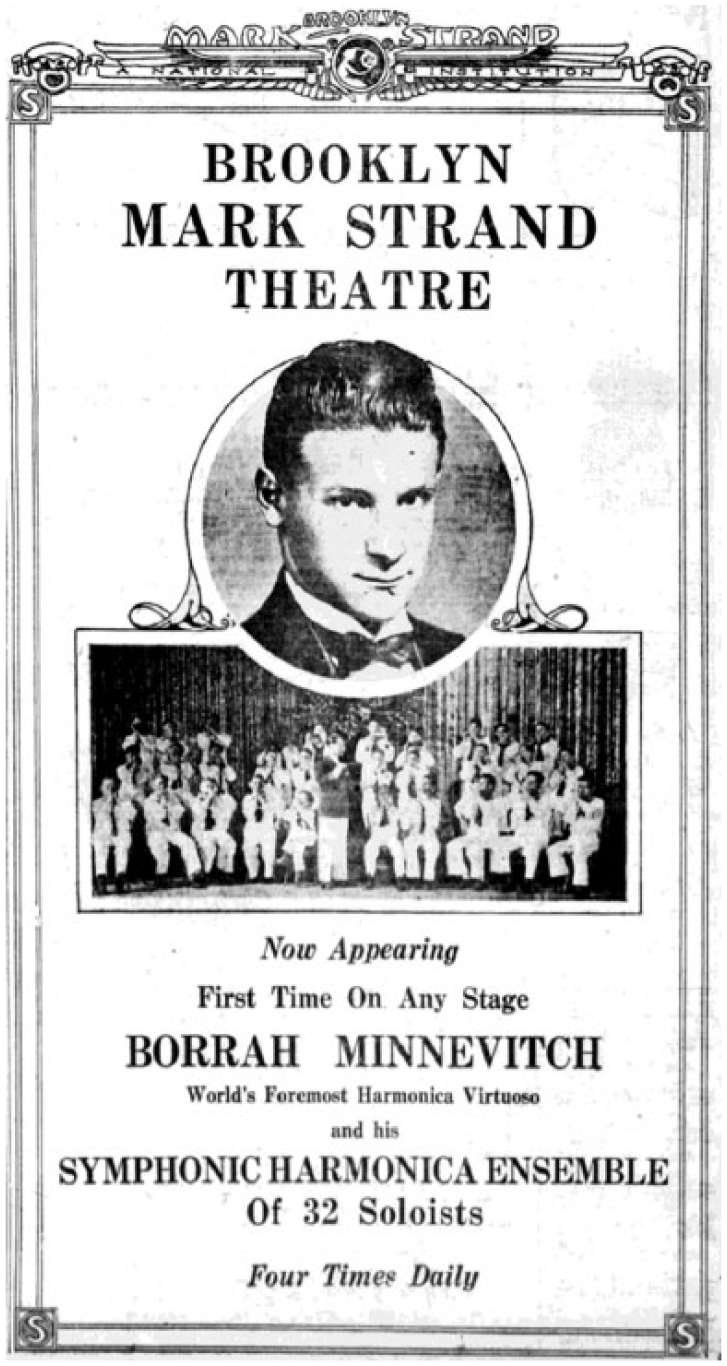
Advertisement for Minevitch’s new harmonica ensemble (last name misspelled in ad), Brooklyn Daily Eagle (Brooklyn, NY), June 30, 1926, 4.
A discussion of Borrah Minevitch and His Harmonica Rascals would constitute an article of its own. Minevitch also assembled a band of more than thirty boys, young teens who performed a comedy act that critics compared to “The Three Stooges with mouth organs.” 64 The group achieved a measure of success, 65 including several short films and musical films including One in a Million (1936) starring Sonja Henie and Where’s That Tiger (1933), a film in which a novelty band battles their noise-averse landlord. 66 A number of HOA Harmonica band members and/or alums worked with the band such as Louis Delinsky and Ben Dansky from the New York HOA 67 and Leo Diamond from the Brooklyn Hebrew Orphan Asylum. 68
A Change in Directors and Its Impact
In late 1926, Charles Snow enlisted the assistance of Sam A. Perry to direct the band. Perry was an immigrant from Odessa, Russia, where he was born in 1884. Although trained as a pianist who toured through Europe, 69 he appeared to have an inclination for harmonica performance, appearing on the radio and in the New York City area in several guises: Perry Harmonica Entertainers, Sam A. Perry’s Harmonica Ensemble, and the Hohner Harmonica Four (Perry directed from the piano). 70 Under the pseudonym Harmonica Bill, 71 Perry published three instructional manuals for the instrument: Fifty Famous Songs for the Harmonica and 10 Minute Course in Harmonica Playing, both published by Robbins Music (see Figure 3). In these books, Perry introduced a numerical tab system which he developed for harmonica notation to ease any musical literacy issues. 72 His book Modern Harmonica Method with Piano Accompaniment (1925) was a serious method book that was widely used. Called a “well-known composer” in Music Trades, 73 he produced arrangements on piano rolls 74 and original music, where the copyright lists him as “piano-conductor.” 75 Some of Perry’s original songs were recorded on the Victor label between 1921 and 1928, and he moved to Hollywood where he became a staff composer at Universal Pictures in 1929, scoring original and incidental music for films including Tarzan the Tiger (1929) and Lightning Express (1930). Perry died on November 1, 1936. 76

Cover of Sam A. Perry, Fifty Famous Songs for the Harmonica (New York: Robbins-Engel, 1926).
Perry’s presence was reason for excitement at the HOA. Referred to as a “professional music instructor,” 77 this represented an opportunity for the band to be on a par with the more renowned concert/marching band of the institution. It appears that while Charles Snow would retain a connection to the band, he was stepping away as director. The reasons are not known, but it is most likely because his vaudeville career was taking all of his time. 78 The new director’s engagement coincided with the loss of a major player in the band as Louis Delinsky left the Asylum, presumably having aged out of the eligibility for care. In January 1927, the band reported, through The Rising Bell, that Perry’s objective was to create a “model band for the Hohner Co.” 79 This reference is likely due to the Hohner Co. having a hand in recruiting Perry to the institution as is implied in the March 1927 Rising Bell. 80 The same issue acknowledged Hohner’s donation of a set of chromatic harmonicas. 81 Clearly the harmonica manufacturer had an interest in the continuation and training of the ensemble. The students did not seem to take issue with what Perry had in mind; quite the opposite, the journal reported that Perry would have no problem accomplishing his goal, proudly saying, “We assure you that he has been given no reason for disappointment.” 82
Perry appears to have had an immediately positive impact on the band. The Rising Bell of March 1927 reported that “the harmonica band has undergone a complete change in their style and technique of playing during the last few months.” 83 Contributing to this was his use of a special notation system for the chromatic harmonica published in his method book (Klassey Music Co.) in 1925. The book was lauded by The Music Trade Review as “an important folio” that was “timely” because of its appeal to those who had purchased the more than twenty-five million harmonicas over a few years. Referred to as “an important contribution . . . [which] has the further value of developing musical appreciation among the young harmonica enthusiasts which is certainly a most fertile field for propaganda.” 84 The latter comment is most likely due to its appeal as a sales item.
The rigor of Perry’s instruction, along with Charles Snow’s participation, paid off in an important way. Edwin Franko Goldman, an alumnus of the HOA as well as a continued supporter of the concert/marching band, had heard the harmonica band in earlier years and commented that “they did not play correct music.” 85 This is likely in reference to the folk-oriented repertoire traditional for the instrument. The student reporter for The Rising Bell of March 1927 felt that Goldman would now have a different attitude upon hearing the music played by the band, referring to the original music composed by Perry having come from “the greatest harmonica writer in the world.” 86 While these are obviously the words of an excited youth, given Perry’s publishing and recording success of the time, it is very likely that he was teaching the boys the same music that he was using commercially.
The City of New York Divisions of Parks, in addition to its recreation arm, had taken over management of the harmonica contests. 87 While Hohner was still deeply involved, this removed any pretense of a commercial angle and set the contests as a municipal and therefore democratic event. This notion that anyone could participate in musical activity reached beyond the music education of youngsters and spread to the general public. For instance, harmonica contests became a feature at the entertainment given before the showing of a movie. Keith’s Prospect Theater in Brooklyn held a harmonica contest on March 27, 1922, before the showing of The Vermillion Pencil 88 and Glynne’s Bay Shore (Long Island) Theatre sponsored one every Friday in February 1927 before the movie feature although it does not seem to have been repeated in the future. 89
The 1927 contest was a banner one for the HOA harmonica players. The competition included four bands and sixty-two soloists in a four-hour proceeding. The HOA band won first place and the silver trophy. Two members of the ensemble, Herbert Ryvicher and Harold Gleeman, won fourth and fifth prizes and banjo-ukuleles.
90
Any concern that young harmonica students were not learning “correct music” was clearly addressed by Thomas W. Bresnahan in Music Trade Review after the contest (June 25, 1927): Although there are still a large number of persons who associate harmonica playing with jazz and simple melodies, it is interesting to note that more serious music predominated in the programs. Most of the contestants played selections from Beethoven, Grieg, Massenet and other classical composers.
91
Repertoire choice had an impact on the decisions of the judges. In addition to intonation, musical accuracy, expression, and rhythm, 20% was weighed for the musical selection. It is not known what specific works Ryvicher and Gleeman played, but as a matter of example, their band-mates prepared works such as “The Spanish Dance,” “Harlequin Serenade,” and “Gypsy Love Song.” 92 The adjudicators were Nathaniel Shilkret of the Victor Talking Machine Company, Oscar Thompson, executive editor of Musical America, Charles C. Green, former president of the New York Advertising Club, and Philip Gordon, director of music at South Side High School in Newark, New Jersey. Apparently, John Philip Sousa was slated as a judge but could not reach New York in time. 93 According to Paul Edmund Bierley, Sousa would have just finished up his “‘1st 1927 ‘Movie Tour’” in Chicago on May 8 and would have been gearing up for the second one to start at the beginning of July in Great Neck, New York. It is unknown what occupied the bandmaster in between. 94
Playing the Harmonica Leads to a Profession for Some
The Rising Bell reported in February 1928 that Charles Snow had “recently reorganized some of our former boys into a band which played at the Paramount and other big theatres.” 95 There were two performances by Snow’s Harmonica Band at the Brooklyn Strand in July 1927, which may well have been this new group as their appearance at the Strand was as part of the movie/theatre performance in Sidewalks of New York and then Down on the Farm. 96 Despite the rather informal titles of these acts, the programs also included an orchestral performance of “Hungarian Rhapsody, No. 2” by Liszt and music from the opera, Thais by Massenet.
An ensemble that emerged out of this is quite possibly an add-on to a group that had already been working the circuit for a few years. Charles Bennington, a dancer with a wooden leg, led a harmonica group called the New York Newsboys Harmonica Band (see Figure 4). The earliest performance of this group was in 1927. 97 By June 1928, the Cincinnati Enquirer was referring to them as the “famous New York Newsboy Harmonica Band,” their coming off a one-year engagement at the Knickerbocker Theater (New York) and a show Dearest Enemy that featured the group performing “The Peg-Leg Peter Stuyvesant.” It is assumed that Bennington played the title role in their performance. 98 The Music Trade Review declared that their appearance in Canton, Ohio, in March 1929 would stimulate a good run of sales of harmonicas. 99 However, at the end of 1929, Charles Snow and His Broadway Pirates (see Figure 5) appeared on the scene advertised as performing a peg-leg pirate show with Lou Dell (presumably Louis Delinsky, whose memoir includes performing with the Broadway Pirates) as featured soloist. 100 By early 1930, the Broadway Pirates are referred to as being formerly known as the New York Newsboys Harmonica Band. 101 It does not appear, though, that the New York Newsboys Harmonica Band ceased operations as they are advertised in various cities in the East and Midwest during this time. 102 What is most likely is that Charles Snow and Charles Bennington worked together to create two vaudeville acts from the same roster of players that could market the young age of their performers but still seem new with a different name and different staged numbers. 103 According to Hyman Bogen, the Broadway Pirates went on a nationwide tour for six months, performing 104 in New York State, Pennsylvania, and Ohio.
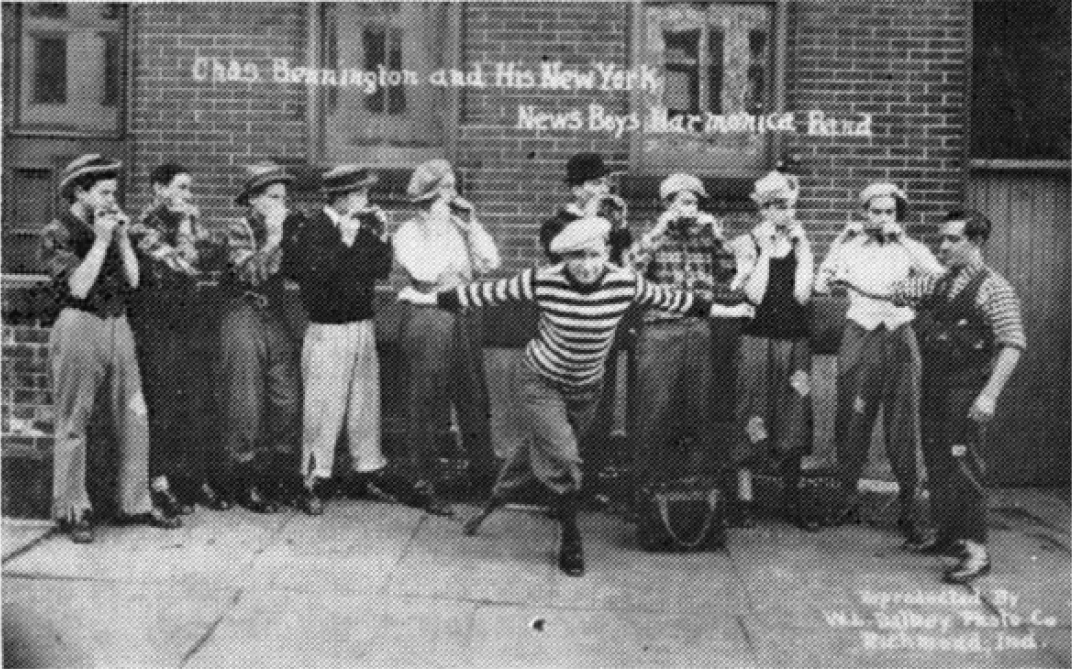
Charles Bennington and His New York Newsboys Harmonica band, c. 1928. HOA Harmonica band members were: 3rd & 4th from left—Barney Kriegman, Louis Delin; first in on the right—Charles Snow. No author. Harmonica Happenings (Spring 1972): 4. Reprinted by permission of the publisher.
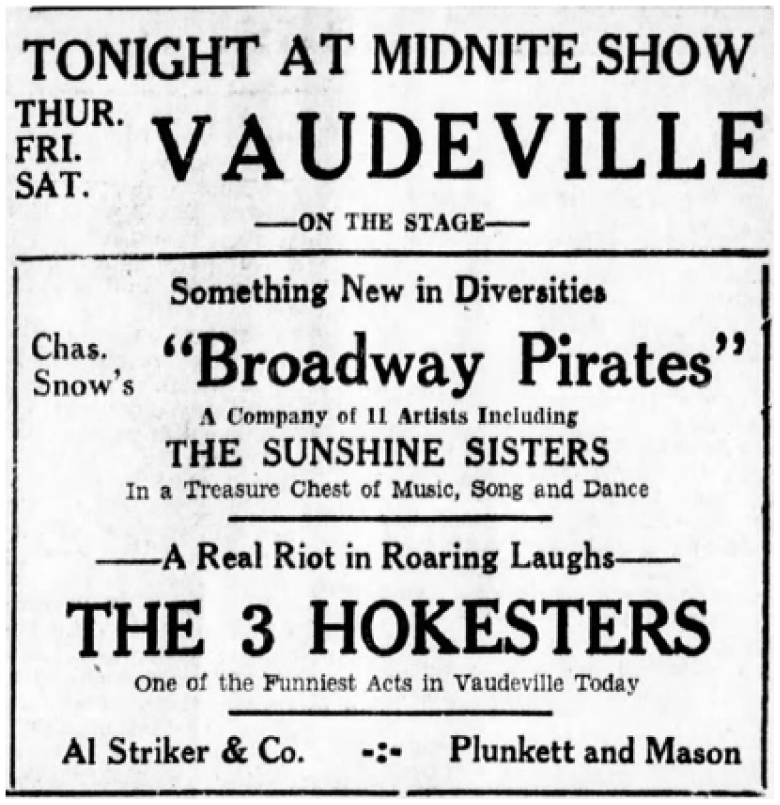
The boys that played with the Broadway Pirates toured outside and away from New York City as evidenced in this advertisement for their show in Shamokin, PA. Shamokin News Dispatch (Shamokin, PA), December 31, 1930, 9.
Charles Snow, Lou Delin, and Barney Kriegman were reported to be in each of the traveling groups, furthering the theory that the act names were somewhat interchangeable depending on the leader for the performance (Snow or Bennington). 105 In addition, other “newsboys” bands both harmonica and instrumental were appearing around the country, so competition in a given city may have inspired the use of one name or the other. 106 As referenced above, for a time The Broadway Pirates were subtitled the Original or Former (italics by author) New York Newsboys Harmonica Band, perhaps to cash in on the name or to differentiate it from a local group. Further support that these bands were one and the same was the announcement of their Reading, Pennsylvania, performance in January 1931: “‘A Treasure Chest of Music, Song and Dance,’ by Charles Snow’s Broadway Pirates, featuring the New York Newsboys’ [sic] Harmonica Band, is the classy headliner of the vaudeville bill at the Park theatre.” 107 The Broadway Pirates seemed to run out of steam after this splash of success and only reference to the New York Newsboys Harmonica Band remains through the 1930s.
The Final Years
The 1928 Parks-sponsored contest was another big winner for the HOA Harmonica band. Second, third, fourth, and fifth places were won by HOA boys, including a repeat win for Herbert Ryvicher. The band may have won but there is confusion as it is listed as the Hebrew Orphan Asylum of the Bronx, which did not exist. 108 The HOA was in upper Manhattan, which may have presented some confusion to the Music Trade Review writer.
The year clearly yielded positive responses from the contests, and in March 1929 the HOA President’s Report, which appeared as a publication titled The Twig, made particular mention of the harmonica band’s 1928 successes: “The Harmonica band, unique in itself, consisting of 30 boys is attracting considerable attention, and its proficiency has been marked. It is playing for you today.” 109 There is no mention of the HOA Harmonica band in any of the sources for the remainder of 1929. It may be because of some devastating changes in the music education of the students. Charles Snow had left to work on the national tour of the Broadway Pirates, and by late 1929, 110 Sam A. Perry had left for Hollywood. 111
It is unclear exactly how long there was a gap in instruction for these boys but in 1930, Jimmy Smith, a talented trumpet player in the concert/marching band who was studying at Juilliard, assumed directorship of the band. The wording of The Rising Bell entry in February 1930 suggests that the band members had lost some of their enthusiasm and needed the drive given by a director. Optimistic comments such as “We feel sure that if the fellows show the same spirit they did with Mr. Perry, the band will group up to be a permanent, musical factor in the Home” and “The Harmonica band is getting along fine right now and we expect big things of them soon,” 112 indicate that the band was not operating along the same level of excellence of just a year before. It is clear from The Rising Bell in April and June of 1930 that the band continued to perform both at the HOA and for outside organizations as they “look[ed] forward to a very busy playing season [that] summer,” including playing for a “women’s organization” 113 as well as a likely reference to the summer camp they all attended. A concert program in 1930 lists Al Godlis as co-director of the ensemble. 114 Godlis was a trombone player and, like Jimmy Smith, an HOA alumnus and student at Julliard. It is not clear how long Jimmy Smith or Al Godlis were the directors of the harmonica band. It may not have been the most successful directorship as Louis Delinsky recalls: “He [Jimmy Smith] was an expert musician but the arrangement did not work since he was one of the boys in the home and he was giving orders to the other boys.” 115 Even after having left the HOA and beginning his career as trumpet player in New York, 116 Smith maintained a relationship with the concert/marching band and took over directorship of that ensemble in 1935 upon the sudden death of beloved band director James F. Knox and remained with the band until its dissolution in 1941. 117
The HOA Harmonica band seems to have ceased after 1930. The most likely reason is the Great Depression. While not having a deleterious impact on the Asylum as a whole, due to the continued support by donors, the institution had to tighten its belt, and this may have resulted in no money for a harmonica band director. The Hebrew Orphan Asylum closed its doors in 1941, in large part due to changes in the style of care and housing of orphaned children.
While the HOA Harmonica band no longer existed to participate, harmonica contests continued through at least 1938, 118 and harmonica bands were part of the National Music Week in 1939. Harmonica contests and bands are listed among the available and attractive activities for New York residents in the city’s “A Key to New York” brochure of 1939. 119
It is not clear that there is a specific reason why the harmonica fell out of use both in and out of schools, beyond simply that fads end as tastes and interests change. World War II certainly serves as a “line in the sand” for the twentieth century as so much of our social and cultural history uses that period as a dividing line in the twentieth century. The emergence of Rock and Roll in the 1950s may have captured the interest of young people in terms of their desire to be involved with popular music. Certainly, though the harmonica afforded them some of that prior to this period, now there was a new option, although one that was not going to receive attention in the schools and recreation centers as before.
Implications for Music Education
Harmonica bands filled a niche in music education during their heyday in the 1920s-1930s. Given the relatively inexpensive cost of the instrument, it served as a means by which children who could not otherwise engage in music learning could do so. In addition, for many areas that did not have substantial or any music education programs, playgrounds were fertile areas for music education.
Another reason for its success may be student interest in instrumental music-making outside of the traditional large ensemble setting. While music educators see the value of bands and orchestras and perhaps view them as upwardly mobile forms of musical engagement, the numbers do not necessarily match that aspiration. Too many of our students either do not continue their instruments post–high school or do not choose to pursue music in high school at all as it does not appeal to their music sensibilities. While this is not a suggestion that young people in 2019 are interested in playing the harmonica, it does represent a parallel of sorts to encourage examination of what does interest them in terms of instrument or musical style. There were a substantial number of students that prepared for harmonica competitions and played in harmonica bands around the country. This was not a requirement of their school curriculum but most often a by-product of their extra-curricular experience. In examining the musical lives of students in Los Angeles, California, during their time away from school, Tindall observed that children are the most natural when they are playing, and in this spirit of naturalness wonderful lessons can be taught when they are absolutely unconscious of the molding environment. They play baseball or play in an orchestra . . . or the harmonica band. . . . All is recreation, and music should occupy a prominent portion of the recreation program.
120
To extrapolate to today, perhaps more emphasis ought to be placed on instruments of popular music and the ways of making music beyond traditional school ensembles. In investigating the music-learning processes of those in popular music, Lucy Green urges music educators to consider incorporating those techniques—and those students—into our curricula. Not to do so might mean that “we could continue to bypass those children and young people who are nonetheless highly musically motivated and committed in their lives outside the classroom; and we could ignore a potentially worthwhile, accessible, and inspiring repertoire of approaches to music learning.” 121 The past experience with the success of the harmonica translates to today’s recent interest in the ukulele, previously somewhat derided as a toy, or not a serious instrument. Its surge in popularity is seen in sales figures where “between 2010 and 2012, ukulele sales nationwide jumped from 581,000 to more than one million, according to the National Association of Music Merchants.” 122 Music programs are beginning to incorporate its use. Some of the popularity may be because of its ease of application outside of school. As John Kratus points out, “the ukulele is relatively easy to play, allowing for a quick path to a satisfying musical experience . . . it can provide a lifetime of enjoyment,” 123 comments that applied to the harmonica as well.
For those interested in building a more traditional program, Glenn M. Tindall and Ralph W. Wright’s observations of recreational music in Johnstown, Pennsylvania, where harmonica playing served as a stepping stone to orchestral or band instruments, are apt. He commented that “it satisfied an immediate desire to play some instrument. Many children, after learning to play harmonicas, became interested in an orchestral instrument.” 124
Implications for Further Research
This paper has only scratched the surface of the presence of harmonica bands, harmonica competitions, and harmonica performers in the United States. While a comparatively brief phenomenon, it is a rich area to explore both in terms of American music history generally and American music education history in particular. The lives of the most successful harmonicists hold interest as well, and further research into this particular area of performance is needed. Vaudeville had its place in music history, one that should not be ignored, especially as there is an increase in popular music studies and this deserves scholarly attention. Beyond their vaudevillian experience, the careers of harmonicists such as Larry Adler (Baltimore teen harmonica champion) and Leo Diamond (Brooklyn Hebrew Orphan Asylum alumnus) are particularly compelling as they gave the harmonica credibility as a concert instrument. They are the products of this niche area of music education and attention to their contributions would be revealing.
Footnotes
Declaration of Conflicting Interests
The author(s) declared no potential conflicts of interest with respect to the research, authorship, and/or publication of this article.
Funding
The author(s) received no financial support for the research, authorship, and/or publication of this article.
1
Used in this context, the historical terms lowbrow and highbrow will follow the definition in the Merriam-Webster Dictionary: lowbrow, “of, relating to, or suitable for, a person with little taste or intellectual interest”; and highbrow, “a person who possesses or has pretensions to superior learning or culture,”  (accessed May 11, 2018).
2
“Jim” Borland, “Mouth Organ Is Coming Back,” The News-Herald (Franklin, PA), June 11, 1923, 4.
3
“The Musical Merchandise Trade in 1926,” Music Trade Review, December 11, 1926, 33.
4
C. M. Tremaine, History of National Music Week (New York: National Bureau for the Advancement of Music, 1925), 11–13.
5
6
“Since Boys’ Week, Rotary Has Been Empowering Young Leaders,” Rotary.org, (accessed May 11, 2018).
7
Half-orphan is the term used to describe a child that has one living parent. It was not uncommon for children in this situation to be placed in an orphanage because their parents were unable to afford to care for them. A famous example for music education is Edwin Franko Goldman, whose mother placed him and his brother in the Hebrew Orphan Asylum, where Edwin received his introduction to and education in trumpet and band.
8
For a full and detailed history of the concert/parade band, see Carol L. Shansky, The Hebrew Orphan Asylum Band of New York City, 1874-1941: Community, Culture and Opportunity (Newcastle upon Tyne, UK: Cambridge Scholars Publishing), 2016.
9
“Boy Scouts Are Making Harmonicas Favorites,” The Music Trades 64, no. 10 (1922): 33.
10
“Harmonica Contest: Creates Public Interest—Should Increase Sales,” Northwest Druggist 3, no. 10 (1922): 32.
11
Hartmut Berghoff, “Marketing Diversity: The Making of a Global Consumer Product—Hohner’s Harmonica, 1857-1930,” Enterprise & Society 2, no. 2 (2001): 349.
12
A blurb in two Emporia, Kansas, newspapers that are probably from the same publisher, The Weekly News-Democrat and The Emporia Weekly News (both published May 29, 1884, pp. 1 and 2, respectively) refer to a harmonica craze. While it is impossible to pin-point the precise first use of the label, this is the earliest reference that can be found by this author.
13
Steven N. Kelly, “John Dewey and James Mursell: Progressive Educators for Contemporary Music Education,” Visions of Research in Music Education 21 (2012): 7.
14
Thomas W. Miller, “The Influence of Progressivism on Music Education, 1917-1947,” Journal of Research in Music Education 14, no. 1 (1966): 10–11.
15
Randall D. Warden, “Forty Years of Playgrounds,” Health and Physical Recreation 10, no. 2 (1939): 72.
16
Berghoff, “Marketing Diversity,” 365.
17
“Harmonica Contest,” Manhattan Department of Parks Annual Report (1927), 48.
18
E.g., “Thousands of Participants Take Part in Philadelphia’s Harmonica Contest,” Music Trade Review LXXX, no. 19 (May 9, 1925): 39; Thomas Bresnahan, “Fifth Harmonica Contest Held in New York,” Music Trade Review 84, no. 26 (1927): 29; Berghoff, “Marketing Diversity,” 367.
19
Peter Krampert, The Encyclopedia of the Harmonica, (Pacific, MO: Mel Bay Publications, 2002), 36.
20
Kim Field, Harmonicas, Harps, and Heavy Breathers: The Evolution of the People’s Instrument, (New York: Cooper Square Press, 2000), 47–48.
21
Richard Levine, “Harmonica Bands,” in St. James Encyclopedia of Popular Culture, 2nd edition, Thomas Riggs, ed. (Detroit, MI: St. James Press, 2013), 626. Hoxie had been a successful fabric manufacturer before he retired and devoted himself to teaching the harmonica, forming multiple boys’ harmonica bands, and leading the Philadelphia Harmonica band on tour; “Albert N. Hoxie,” The New York Times, August 21, 1942, 1.
22
“Hohner Harmonicas in Silver Jubilee Celebration,” The Music Trade Review, June 30, 1923, 42.
23
Thomas W. Bresnahan, “Second Annual Harmonica Contest Finals Held in Central Park, New York City,” Music Trade Review, May 17, 1924, 36.
24
“Harmonica Contest,” Variety, August 16, 1923, 19.
25
Peter W. Dykema, “Music as Recreation,” Playground 17 (January 1924): 533, abstract in Occupational Therapy and Rehabilitation 4, no. 4 (August 1925): 307.
26
“Harmonica Winners Play Operatic Airs,” The New York Times (New York, NY), May 17, 1925, 19.
27
Ibid.
28
Ibid.
29
National Bureau for the Advancement of Music, National Survey of Harmonica Bands and Classes (New York: National Bureau for the Advancement of Music, 1931).
30
Ibid., 46.
31
Jere Humphreys, “Instrumental Music in American Education: In Service of Many Masters,” Journal of Band Research 30, no. 2 (1995): 47.
32
Discharge records from the HOA indicate discharge in July 1914; however, that would have Snow at approximately thirteen to fourteen years old. It is unlikely that a teenager was discharged so it is most likely that a relative took him home. New York Hebrew Orphan Asylum Records, 1860-1934, for Charles Snow, (accessed June 28, 2016).
33
Hyman Bogen, The Luckiest Orphans: A History of the Hebrew Orphan Asylum of New York (Urbana: University of Illinois Press, 1992), 204.
34
Hebrew Orphan Asylum Annual Report, 1925, n.p.
35
A point of interest is that the first-place winner was Leo Jacobs, who would later change his name to Lee J. Cobb and become a well-known actor in Hollywood.
36
“The Harmonica Band,” The Rising Bell (June 1925), 40.
37
Hebrew Orphan Asylum Annual Report (June 1925), 131.
38
See Carol L. Shansky. The Hebrew Orphan Asylum Band of New York City, 1874-1941: Community, Culture and Opportunity (Newcastle upon Tyne, UK: Cambridge Scholars, 2016).
39
Among the examples are “Tuning in Tonight,” Poughkeepsie Eagle-News (Poughkeepsie, NY), June 25, 1925, 8; “Tune in on This Tonight,” Akron Beacon Journal (Akron, OH), June 25, 1925, 18; “Radio News,” Dayton Daily News (Dayton, OH), July 22, 1925, 11; “Radio Review,” New York Daily News (New York, NY), July 10, 1925, 10.
40
Thomas W. Bresnahan, “New Harmonica Band,” The Music Trade Review 81, no. 4 (1925): 39.
41
“Girls’ Harmonica Band,” The Rising Bell, April 1925, 18.
42
“Harmonica Champions for 1929 Crowned With Impressive Program in Philadelphia,” Music Trade Review, May 3, 1929, 50.
43
“Harmonica Band,” The Rising Sun, June 1925, 36.
44
President’s Report (New York: Hebrew Orphan Asylum, 1926), 23.
45
“Bronx Borough Sweeps Prizes in the Harmonica Contest of New York City,” The Music Trade Review 82, no. 22 (1926): 119.
46
The only evidence of this, beyond the memory of Seymour Siegel in his self-published memoir, Seymour Siegel, An Orphan in New York City: Life with a Thousand Brothers and Sisters (Charleston, SC: Xlibris Corporation, 2000), 179, is the labeling of Max Farage on bass harmonica on a YouTube video of the J. Walker Harmonica Quartet: “J. Walker Harmonica Quartet,” YouTube, uploaded February 18, 2010, (accessed October 12, 2018).
47
Elmira Star-Gazette (Elmira, NY), June 15, 1926, 2.
48
“Boy Receives Medal for Sportsmanship,” New York Times (New York, NY), July 28, 1937, 5.
49
50
Louis Delin, Backstage Harmonica: A Memoir (self-pub., no publisher, c. 1996), 273.
51
Peter Krampert, The Encyclopedia of the Harmonica (Pacific, MO: Mel Bay Publications, 2002), 36.
52
Bogen, The Luckiest Orphans, 205.
53
Seymour Siegel, An Orphan in New York City: Life with a Thousand Brothers and Sisters (Charleston, SC: Xlibris Corporation, 2000), 178–79.
54
Bogen, The Luckiest Orphans, 205.
55
Herbert Sydney, “Borrah Minevitch Has Lifted Harmonica to Respectability and Orchestra of Boys Prove It,” The Baltimore Sun (Baltimore, MD), December 12, 1926, 54.
56
Ibid.
57
“How Minevitch Got His Rascals,” The Reed, January 2006, 4–6; February 2006, 4.
58
Delin, Backstage Harmonica, 21–26.
59
Sydney, “Borrah Minevitch Has Lifted Harmonica,” 54.
60
“Harmonica Band,” Reading Times (Reading, PA), November 18, 1926, 23; no title, The Emporia Gazette (Emporia, KS), June 5, 1928, 8; “There’ll Be a Hot Time in the Old Town This Week,” Detroit Free Press (Detroit, MI), February 10, 1929, 62.
61
“‘Band’ Concert,” Daily News (New York, NY), February 3, 1929, 139.
62
“Illegitimate Music,” The Evening News (Harrisburg, PA), June 19, 1928, 10.
63
“There’ll Be a Hot Time in the Old Town This Week,” Detroit Free Press (Detroit, MI), February 10, 1929, 62.
64
Levine, “Harmonica Bands,” 625–26.
65
Peter Krampert, Encyclopedia of the Harmonica (Pacific, MO: Mel Bay Publications, 2000), 76.
66
“One in a Million,” Internet Movie Database, https://www.imdb.com/title/tt0028063/ (accessed October 16, 2018); “Where’s That Tiger?,” YouTube, https://www.youtube.com/watch?v=mESI_bER0v8 (accessed October 16, 2018); and Internet Movie Database, (accessed October 16, 2018).
67
Bogen, The Luckiest Orphans, 206.
68
“The Harmonica As It Was,” Harmonica Happenings 5, no. 4 (1972): 4.
70
There are four 1926 recordings on the Victor label by Sam H. Perry and his Harmonica Pals. It is not clear if this is a typo or a different group. Given the proximity of the date and that the recordings are for harmonica and piano, Perry’s performance instrument, there is a compelling argument that Sam Perry had produced recordings on harmonica. See “Sam Perry,” (accessed July 12, 2016).
71
Not to be confused with a “Harmonica Bill” that appeared as a clownlike character in movies of the 1940s-1950s.
72
Sam A. Perry, Fifty Famous Songs for the Harmonica (New York: Robbins Music, 1926).
73
Music Trades 58, no. 6 (August 9, 1919): 26.
74
Music Trades 62, no. 10 (September 3, 1921): 21.
75
Catalog of Copyright Entries 2, no. 1 (January–June 1957): 579, 590, 591, 595, 598, 606, 608, 662, 676.
77
“Harmonica Band,” The Rising Bell, November 1926, 15.
78
Charles Snow and His Broadway Pirates are discussed later in this article.
79
“Harmonica Band,” The Rising Bell, January 1927, 25.
80
It is also possible that Perry was an employee of Hohner, but this is not substantiated.
81
This donation was not a singular occurrence. According to the institution’s Annual Report (p. 131) in June 1925, Hohner donated a set of trap drums to the harmonica band.
82
“Harmonica Band,” The Rising Bell, June 1927, 41.
83
“Harmonica Band,” The Rising Bell, March 1927, 19.
84
“Klassay Harmonica Method Good Source of Sales,” The Music Trade Review 81, no. 12 (September 19, 1925): 58.
85
“Harmonica Band,” The Rising Bell, March 1927, 19.
86
Ibid.
87
“Elimination Trials Begin in City-wide Harmonica Contest in New York City,” The Music Trade Review 80, no. 18 (1925): 33.
88
“Amusements—Brooklyn,” The Brooklyn Daily Eagle (Brooklyn, NY), March 26, 1922, 43.
89
“Glynne’s Bay Shore,” The Long Islander (Huntington, NY), February 4, 1927, 12.
90
Thomas W. Bresnahan, “Fifth Harmonica Contest Held in New York,” The Music Trade Review 84, no. 26 (1927): 29–30; and Pierre Key, “Sharps and Flats,” The Hartford Courant (Hartford, CT), June 26, 1927, C1.
91
Ibid., 30.
92
Ibid.; “The Spanish Dance” is by Moskowski. It is unclear whether “Harlequin Serenade” is by Drigo or Leoncavallo and it is possible that “Gypsy Love Song” is by Herbert.
93
Ibid.
94
Paul Edmund Bierley, The Incredible Band of John Philip Sousa (Urbana: University of Illinois Press, 2006), 191.
95
“The Harmonica Band,” The Rising Bell, February 1928, 22.
96
“‘Man Power,’ With Richard Dix, at Brooklyn Strand,” The Brooklyn Daily Eagle (Brooklyn, NY), July 31, 1927, 50.
97
Advertisement, “Now Playing New Show at Poli’s Majestic,” The Bridgeport Telegram (Bridgeport, CT), November 5, 1927, 30.
98
“Harmonica on Stage—Vaudeville,” Harmonica Happenings 5, no. 4 (1972): 1. N.B.: There is no author attributed to this article, but it may have been written by Lou Delin, who performed with both the New York Newsboys Harmonica Band and the Broadway Pirates.
99
“Harmonica Band in Canton,” Music Trade Review 88, no. 12 (1929): 14.
100
“Spice of Life,” Times-Union (Albany, NY), December 8, 1929, 8-D.
101
“The Keeney Again Offers the Public Excellent Programs,” The Evening Leader (Corning, NY), February 22, 1930, 10; “Several Clever Acts Booked at Binghamton,” The Binghamton Press (Binghamton, NY), March 3, 1930, 8; Advertisement, “Fox Vaudeville,” The Niagara Falls Gazette (Niagara, NY), March 14, 1930, 24; Advertisement, “Vaudeville & Pictures,” The Evening Independent (Massillon, OH), May 29, 1930, 13.
102
For example, “Third Big Parade Will Open at Ritz,” The Scranton Republican (Scranton, PA), January 13, 1932, 9; “At Loew’s Theatre,” The Gazette (Montreal, CA), April 31, 1932, 10; Advertisement for the Cecil, “Another Glorious Big Time Vaudeville,” Globe-Gazette (Mason City, IO), 12.
103
Delin, “Harmonica Bands,” 30.
104
Hyman Bogen, 206; No author, “Harmonica on Stage—Vaudeville,” Harmonica Happenings 5, no. 4 (1972): 1.
105
Delin, “Harmonica Bands,” 30.
106
So-called “newsboys” Bands were popular during this period, so it is likely that they would encounter a concert or harmonica band with a similar label. While it is true that many newspapers supported a boys’ band, the appellation does not always indicate an affiliation with a periodical.
107
“Classy Vaudeville Act Head Park Bill: Three Other Acts and Film Feature,” Reading Times (Reading, PA), January 6, 1931, 9.
108
Thomas W. Bresnahan, “Eleven-Year-Old Boy Wins Sixth New York Harmonica Championship,” Music Trade Review 86, no. 25 (1928), 13.
109
“President’s Report,” The Twig in Hebrew Orphan Asylum 106th Annual Meeting Report (March 24, 1929): n.p.
110
There is no available firm date for the inception of the Broadway Pirates, although Lou Delin’s memory is that they formed in 1927. Given their success and tours in the late 1920s (referenced earlier in this paper), it is most likely that Snow was unable to continue to mentor the HOA ensemble.
112
“The Harmonica Band,” The Rising Bell (February 1930), 37.
113
“The Harmonica Band,” The Rising Bell (June 1930), 31.
114
Hebrew Orphan Asylum files, American Jewish Historical Society at the Center for Jewish Research, New York.
115
Delin, “Harmonica Bands,” 17–18.
116
Kurt Masur, Paul B. Guenther, and William Thomas, “Smith, James,” The New York Times (New York, NY), April 26, 2000, C25. Smith was a member of the New York Philharmonic for thirty-five years, from 1942 to 1977.
117
Carol L. Shansky, The Hebrew Orphan Asylum Band of New York City, 1874-1941: Community, Culture and Opportunity (Newcastle upon Tyne, UK: Cambridge Scholars Publishing, 2016).
118
New York City Department of Parks Press Releases, January-December 1938.
119
Rosalie Slocum and Ann Todd, A Key to New York (New York: Modern Age Books, 1939), 3, 86, 243, 297.
120
Glenn M. Tindall and Ralph W. Wright, “Music for Vacation Time,” Music Supervisors’ Journal 14, no. 4 (1928): 51.
121
Lucy Green, How Popular Musicians Learn: A Way Ahead for Music Education (Oxford, UK: Routledge, 2016), 17.
122
123
John Kratus, “Music Education at the Tipping Point,” Music Educators Journal 94, no. 2 (2007): 46.
124
Tindall and Wright, “Music for Vacation Time,” Music Supervisors’ Journal 14, no. 4 (1928): 51.