



Abstract
The purpose of this study was to examine the life and work of Frank William Westhoff (1863–1938), a leader in music education during the progressive era (circa 1890s–1950s). Research questions focused on his work as a music supervisor, teacher educator, pedagogue, and textbook author. I also explored Westhoff’s contributions to the profession and influence on music education.
Westhoff was born in St. Charles County, Missouri, in 1863. He moved to Decatur, Illinois, in 1884, and in 1893 he began supervising music in the city’s public schools. From 1901 to 1935, Westhoff served as music instructor at ISNU, where he taught methods classes, directed ensembles, and supervised music in the local public schools. He died in Normal, Illinois, in 1938. Although Westhoff was not as prominent a figure in music education as those who led the field on a national level during his time, he played an important role in sustaining, perpetuating, and expanding school music on a regional basis throughout much of the progressive era. He was a founding member of Music Supervisors’ National Conference at Keokuk, Iowa, in 1907, and published numerous compositions and didactic materials, including a statewide curriculum that helped standardize music instruction in Illinois.
Keywords
The pedagogical movement known as progressive education evolved around 1890 and lasted into the 1950s. Progressive educators strove to replace dogmatic practices of the previous era in favor of curricula focused on student interests, democratic ideals, active learning, problem solving, critical thinking, and cooperation. Broad and often competing goals sought to develop students’ health, citizenship, vocation, ethical character, minds, and bodies in schools that where efficient in their operation and dedicated to correcting the problems of society. 1
School music changed in response to progressive ideals. Music supervisors organized daily instruction for grade-level teachers, taught model lessons, provided professional development, and monitored student progress. 2 The “song method” replaced scales and exercises with interesting tunes related to the child’s world, and taught singing through imitation and solfege before associating pitch and rhythm with notation on the staff. 3 Technology, in the form of the player piano and the phonograph, transformed instruction by allowing students to experience a wide range of repertoire without the need of live performances. Educators used these devices to model instrumental and vocal repertoire and to add music history and culture to the curriculum. 4 Music study also entered high schools and included credited work in appreciation, harmony, applied study, and large ensembles. 5
Teacher preparation became more structured and regulated at the turn of the twentieth century. Whereas school music teachers of the previous generation honed their craft in singing schools and summer institutes, many supervisors and specialists working in K-12 education during the progressive era held a state teaching certificate, as well as a university degree or a normal school diploma signifying two to four years of coursework in general studies, education, and music. 6 Several teacher preparation programs began offering bachelor’s degrees in music education by the early 1920s including the Kansas State Normal School at Emporia (1916), Oberlin College (1922), and Indiana University (1922). A survey in 1937 indicated that 148 out of 150 colleges and universities offered a bachelor’s degree program in school music. 7
Researchers have documented the work of several prominent music supervisors and teacher educators of the progressive era including Julia Ettie Crane, Charles A. Fullerton, Peter W. Dykema, Thaddeus P. Giddings, and Philip Cady Haydn. 8 However, authors have not yet examined many of the lesser-known figures who promoted, sustained, and perpetuated the field on a regional basis. This gap in the literature might stem from a lack of source material or the perception that these individuals were not pioneers in school music. Regardless, these men and women played a vital role in leading the profession in their own time and place, making their stories necessary for a complete history of music education in the United States. 9
The purpose of this study was to examine the life of one such individual, Frank William Westhoff (1863–1938), an active leader in music education in the Midwest during the late nineteenth and early twentieth centuries. Research questions focused on his work as a music supervisor, teacher educator, pedagogue, and textbook author. I also explored Westhoff’s contributions to the profession and influence on music education.
Methods for this study involved the process of immersion and saturation, whereby the historian collects and examines everything possible to develop a complete understanding of the topic. 10 Immersion in this study involved searching archives located online and in physical spaces for primary sources including institutional reports and publications, newspaper articles, didactic materials, and various music periodicals. I determined saturation once these searches resulted in no new data. I also utilized secondary sources consisting of dissertations, journal articles, and histories of music education in the United States to establish historical context and provide additional information. When possible, I used multiple sources to triangulate information and establish the historical record. 11
Frank W. Westhoff
Frank (Franz) William Westhoff was born in Dardenne Township, St. Charles County, Missouri, on June 14, 1863. His parents, Theodore (1828–1902) and Mary Anna (Roderfeld) (1827–1876), emigrated from Germany in 1859 and operated a local farm. Frank, the fourth child of the family, had three brothers (Engelbert, Theodore, and John) and three sisters (Anna, Mary, and Mary A.). 12 He received an education from the district schools of St. Charles County and, at age eight, began vocal music lessons with Engelbert Roderfeld, his uncle and a professional musician who came to the United States with the Westhoff family. He entered private instruction on piano and organ at age 14, and eventually learned to play the cornet and the clarinet. Westhoff later studied vocal music under Emil Wolf at Lindenwood College in St. Charles and, beginning in 1882, the piano with Henry Wolf of Edwardsville, Illinois. He also attended summer music institutes to learn harmony and composition. Westhoff’s career began at age 16 when he served as the choir director at a Catholic church in St. Charles. 13
Westhoff moved to Decatur, Illinois, in 1884 and became an active participant in the musical life of the community. Decatur is located about 180 miles southwest of Chicago in the central region of the state and serves as the seat of government for Macon County. In 1890, the community was a major industrial center in the Midwest with a population of 16,841 citizens. 14 Westhoff taught private lessons in piano, organ, voice, and harmony. He also led singing classes, juvenile brass bands, and a professional orchestra; performed as a vocalist; served as choirmaster at the local Congregational Church; and directed music for various civic and social events. 15
Westhoff married Miss Apollonia Gaebler, a Decatur native, on October 9, 1889. 16 She gave birth to three sons, Frank Jr., Herbert, and Clarence, and a daughter, Margaret. Westhoff became music supervisor in the Decatur public schools in the fall of 1893. He resigned in 1901 to accept a faculty position at ISNU, where he taught methods classes for pre-service teachers, directed ensembles, and supervised music in the local public schools. 17
In addition to teaching, Westhoff contributed several compositions to the instrumental and vocal repertoire. Examples included “The Lord is My Shepherd” and other sacred compositions published in The Musical Visitor and The Choir, “Where the Violets Grow,” for mixed quartet, and “Defiance March” for piano or organ. 18 In 1908, he composed a song, “The Oak and the Violet,” to honor the naming of an official state tree and flower by the Illinois State Legislature. 19 Westhoff also wrote the music for “The Wonderful Story of Illinois,” a pageant written by ISNU reading instructor, Grace A. Owen, in celebration of the state’s centennial in 1918. 20
Westhoff retired from ISNU in the spring of 1935 but remained active in campus life. He died on October 3, 1938, following surgery for an abdominal obstruction. He was a member of Holy Trinity Catholic Church and is buried in St. Mary’s cemetery, both in Bloomington, Illinois. 21
School Music Supervisor
The Decatur Board of Education appointed Westhoff as Supervisor of Music beginning in the fall of 1893. 22 The school system included nine primary/grammar schools with a combined student population of about 3,300 in grades one through seven and a high school that served approximately 450 students. 23 The music curriculum as adopted in 1888 consisted of the charts and textbooks in the Normal Music Course by John W. Tufts and Hosea E. Holt. 24 This series systematically developed students’ aural skills and note reading ability through rhythmic and tonal exercises before introducing songs. The Normal Music Course became standard in American schools by the 1890s and served as a model for subsequent series based on the note-reading method. 25
Music educators during this time disagreed as to whether children should learn to sing by reading notation from the start—as dictated by the Normal Music Course—or through learning songs by rote. 26 Westhoff believed in a combined approach and utilized both simultaneously in the curriculum. In addition to work in the Normal Music readers, he required students in grades 1–3 to learn at least two rote songs per month. He prepared a collection of songs for this purpose, and insisted that teachers “sing for and not with the class” and conduct “much individual work.” He also directed staff to utilize a “swinging pendulum” (metronome) and a pitch pipe to accurately determine and maintain meter and tonality. 27
By 1900, the music curriculum for grades 1–7 had become quite detailed and consisted of the following topics: tune, time, technique, nomenclature, notation, voice training, and rote songs. The board of education recommended that students receive 120 minutes of music instruction per week over the course of seven years. 28 Westhoff taught in each schoolroom once per week for 20–25 minutes, but left responsibility for the bulk of music instruction to the classroom teachers. 29
Elementary students sometimes performed at public events under Westhoff’s direction. On Sunday, December 23, 1894, for example, a group of school children sang in a Christmas service at the local Congregational church, in which their singing was described as “clear, sweet and even.” 30 Each spring, Westhoff and the classroom teachers prepared students in several songs for Arbor Day and Memorial Day exercises in the schools. 31 A children’s chorus was also a regular feature of community Memorial Day ceremonies held at the Grand Opera House. 32
Westhoff succeeded in securing music’s place in the high school curriculum by 1896 “in spite of long opposition.” 33 All students participated in two classes per week and earned two credits each semester. 34 The four-year sequence built off the elementary curriculum and began with the third reader from the Normal Music Course. Sophomores worked from book four of the Cecilian Series of Study and Song by John W. Tufts, which included a continuation of the tonal and rhythm exercises found in the Normal Music Course and vocal selections in three and four parts. Juniors and seniors rehearsed selections from standard cantatas and oratorios as well as glees and songs for patriotic and other special occasions. 35 In March 1898, these students presented a cantata, The Ship of Life, by Thomas Mee Pattison (1845–1936). This program, held at the Grand Opera House, included student soloists, a chorus of 300 singers, a guest reader, and the opera house orchestra. 36 Performances the following years included The Lay of the Bell by Andreas Romberg (1767–1821) and May Day by George Alexander Macfarren (1813–1887). Proceeds from these events helped raise money for the high school library and athletic funds. 37
In addition to curricular music classes, high school students could participate in extra-curricular ensembles including boys’ and girls’ glee clubs, an orchestra, and a mandolin club. Westhoff organized the boys’ glee club with 16 singers in December 1896, and the girls’ glee club in September 1900. 38 The orchestra met for the first time on September 17, 1895, and quickly became a popular feature of school life. 39 Led by Westhoff, this ensemble performed frequently at graduations, teachers’ meetings, the Macon County Farmers’ Institute, literary contests, and other events. The group consisted of eight students the first year and played a repertoire of mostly dances, marches, and light overtures. 40 Like similar ensembles in the United States at this time, members learned to play though private instruction or other means, rather than as beginners within the school system. 41 The mandolin club began in 1895 with five members, including two alumni. Nonetheless, they performed an arrangement of Sousa’s “High School Cadets” for graduation in June 1896 and continued to appear in school and community events in subsequent years. 42 Mandolin ensembles were popular during this period because the instruments were inexpensive, easy to learn, and suited to popular music of the day. 43
The music curriculum in the Decatur public schools became more progressive during Westhoff’s eight-year tenure. An article by the Decatur Herald in 1899 reflected several progressive ideas regarding music instruction including the emphasis on developing moral character over performance skill: [I]t is remarked by Prof. Westhoff that for the last few years the attempt to make everyone a finished vocalist has been in part abandoned. There is a movement to use music as a means for helpful moral and ethical culture. When music was first tried in the schools there was an ill advised attempt to make music thinkers and rapid music readers out of all. It was in time found that this could not be done, so it was given up for something that could be done, and something, by the way, that is much better for all the pupils. There is a spirit in music, and this may be got independent of the fact that the pupil is not a rapid reader of the music sheet.
44
The article also illustrated efforts to correlate music with other subjects of the school curriculum, as advocated by progressive educators: 45
There is in the schools now the notion that music can be made a help in imparting the lessons there are in the textbooks. This notion is put to use, especially in the lower grades in the schools. The lessons in those grades will try to give certain information and to impress it on the mind of the pupil; and the music that is used in those grades may take up the same things, and does as far as it can well be done, and lend an ear in impressing them on the minds of the pupils.
46
Westhoff’s work at the elementary and high school levels reflected progressive educators’ emphasis on community and citizenship through public appearances, as well as a democratic spirit in encouraging popular music. The Decatur Herald summed up the benefits of school music, stating that, “[I]t may be said that from music all get some benefit[.]. . . Then we are laying the foundation for a musical nation, one that can sing, one in which the poorest people will have their music to drive away the hours that are now so dull for so many.” 47
Illinois State Normal University Professor
ISNU opened with two faculty and twenty-nine pupils on Monday, October 5, 1857, in the upper stories of Major’s Hall in Bloomington. A private elementary academy served as the model school for the institution. The university and the model school moved into a new three-story facility in September 1860 in an area known as “the Junction” or “North Bloomington.” A high school division became part of the model school in January 1862, by which time ISNU included 152 students in the normal school (80 males and 72 females) and 285 in the model school. Local officials renamed the territory “The Town of Normal” in 1858 and incorporated the municipality through the State of Illinois in 1865. 48
As with most state normal schools, many students at ISNU came from rural communities and had limited finances and social capital. 49 Admission standards required applicants to be at least 16 (females) or 17 (males) years old, commit to teaching in the public schools of the state for at least the amount of time spent at the institution, and to present either (a) a first-grade teacher’s certificate, (b) an appointment by a county superintendent of schools, (c) proof of attendance at another normal school or the University of Illinois, or (d) a high school diploma. All students except those with a second-grade teaching certificate also took an entrance exam in basic subjects. Students studied from two to four years, depending on their preparation. High school graduates could complete the program in two years. 50
Chauncy Marvin Cady (1824–1889) taught music to all students at ISNU from 1857 to 1861, followed by B. E. Messer in 1861–62. 51 Beginning in 1866–67, music became an elective subject taught by local musicians or members of the faculty with musical experience. 52 In 1899–1900, the University hired Miss Ida Grove, a student of the Peoria Conservatory of Music, as a full-time music instructor. She left after one year, however, when the administration chose not to continue funding the position. 53
Westhoff resigned from the Decatur Public Schools in the spring of 1901 when the Illinois State Board of Education—on the recommendation of university president David Felmey—offered him a position as instructor of music at ISNU. According to the Decatur Herald, the appointment was a surprise to Decatur Schools Superintendent, E. A. Gastman, who was a member of the board, and to Westhoff, who had not applied for the post. Regardless, the opportunity brought with it a salary increase from $900 to $1,300 per year, with incremental raises in the first three years of employment. Westhoff’s duties included teaching courses at the university (see Figure 1) and supervising music in the Normal Public Schools, which became affiliated with ISNU that same year. 54
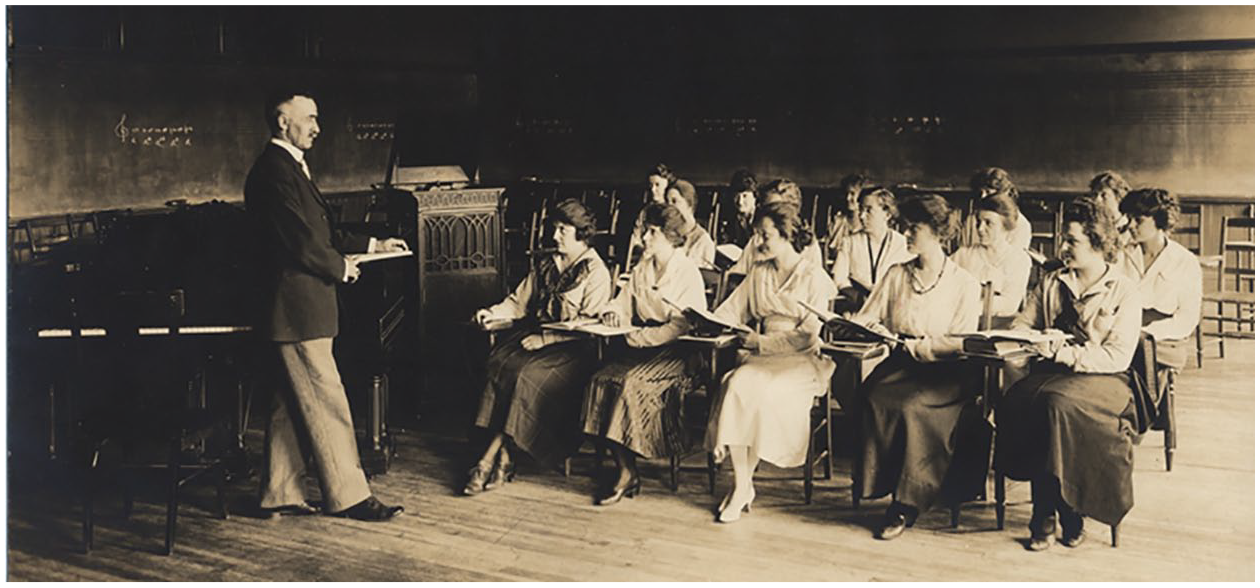
F. W. Westhoff teaching a music class at ISNU, 1920.
Westhoff held the title of “Teacher of Music” until 1916, when the institutional catalog listed him as “Professor of Music.” In 1930, his title became “Associate Professor of Music” and reflected ISNU’s move towards adopting faculty ranks like those used today. He probably did not retain the rank of professor due to his lack of university degrees. The institution reorganized into divisions the following year, at which time Westhoff also held the title of “Director of the Division of Music Education.” 55
Westhoff quickly became a popular instructor on campus. For the first several years, he led the entire student body in singing during the daily general session, which lasted 20 minutes and included announcements and devotional exercises.
56
An article in The Vidette, the ISNU newspaper, articulated students’ appreciation of Westhoff’s contribution, saying, When Mr. Westhoff was first secured to teach music. . .the feeling was almost universal that there was a marked improvement in the general exercise period. What had hitherto been a period for announcements, appeals, and addresses to the students and faculty, in addition to the devotional exercises, became a welcome period of relaxation for all, owing to the singing indulged in by the whole school. Coming in the middle of the morning, it was all the more enjoyable.
57
The ISNU annual, the Index, furthermore, stated in 1902, The response he gets from the student body is very complimentary to say the least. Not only does he get good results in the simple compositions, but also in the high class and difficult ones. Any one [sic] who has heard the school sing that inspiring anthem, “The Lord is Great,” from Mendelssohn’s “Athalie,” or “Damascus,” [from] Costa’s “Naaman” can more fully appreciate these words. Truly the man who can teach a body of untrained singers to sing this difficult music with the power that has been acquired is not commonplace as a director.
58
Westhoff began his tenure at ISNU teaching a beginning and an advanced course on the elements of music notation. Both classes met daily throughout the 12-week term. All students registered for one of these courses in their first year, depending on previous experience. 59
The music program developed extensively under Westhoff’s direction. In 1908, he added a course in song singing for those with little or no musical experience. The class taught the basics of singing through rote instruction and prepared inexperienced students for the required course in the curriculum. 60 Music for primary grades began in 1910 and focused on the song as a basis for the child’s music education. Topics included repertoire selection, the child voice, and methods of rote teaching. 61 This course became a requirement in 1912 for pre-service candidates pursing the two-year program for teachers in the primary grades. 62
Westhoff led efforts to establish a “Special Program in Music” for students who wanted to become music specialists or supervisors. The university implemented this curriculum in 1914 in response to new teacher certification laws that recognized licensure in music, art, and several vocational subjects. The two-year sequence required 24–26 credits including six music courses. Graduates earned a special teaching certificate in public school music valid at the elementary and high school levels for two years and renewable indefinitely. They also could attain a first-grade county elementary certificate renewable every three years. Beginning in 1916, ISNU offered a three-year program that certified graduates in both music and art. 63
The music department at ISNU expanded to accommodate the new program. Course offerings beginning in 1914–15 included (a) Song Singing, (b) Sight Reading, (c) Advanced Sight Reading, (d) Primary Music Methods, (e) Upper Grades Music Methods, (f) High School Music, and (g) Elementary Harmony and History. 64 Starting in 1929, students attending the summer term could also take a course in music appreciation. 65 The administration hired additional faculty in 1913 to assist Westhoff during the regular academic year and to teach music on an adjunct basis during the summer. 66
ISNU began offering a four-year Bachelor of Education in music beginning in the fall of 1931. 67 The program prepared music specialists for elementary, junior high, and high school teaching and supervision. Although students could still earn the two-year certificate to teach music in the elementary schools, candidates now had to complete the four-year curriculum to work in secondary schools and supervise music in the grades. The degree program emphasized the development of students’ musicianship, as well as studies in music theory, music history, ear training, and form “so as to insure breadth of musical culture.” Students also attended classes in methods and materials for elementary and secondary music, psychology of music, and music supervision, and participated in applied lessons and ensembles. 68
The degree program in music education reflected progressive changes in school music during the early twentieth century. In 1932, ISNU began offering classes in band and orchestra instruments in response to the increasing number of these programs in K-12 education.
69
In addition, several methods courses involved the integration of “creative music.”
70
This curricular trend developed in the late 1920s and referred to project-based learning that emphasized “the act of producing, not the product.”
71
The approach followed progressive educators’ philosophy that students should “learn by doing” and utilize critical thinking to solve problems.
72
Several courses incorporated creative music with vocal and instrumental methods. The following description illustrates how students engaged in creativity in two such courses: The course entitled Creative Music in the Field of Song. . .deals with the invention of melodies for suitable texts, provided for that purpose, as a part of a project in which the entire class participates. The completed song is sung and written. Song singing continues to be a feature of the work. Creative Music in the Instrumental Field emphasizes the invention of melodies suitable for strings, woodwind and brass instruments. This course affords students an outlet for a greater melodic and rhythmic range. Experience is gained in playing various instruments in connection with the course.
73
Multiple tracks existed for students preparing to be music specialists or supervisors. The full program consisted of 96 units of music. However, those who wanted to add a second or third subject to their certification could follow alternative course sequences of 60, 48, or 36 units. 74
Fourth-year students following the full music education curriculum spent half of each day during their first and second quarters engaged in student teaching in the model school connected with ISNU. Those pursuing a second teaching area divided student teaching between music and their other discipline. 75 Candidates for the Bachelor of Education degree in music had to show by examination the ability to (a) play piano repertoire of medium difficulty in an artistic manner, (b) sing art songs with acceptable tone, accurate intonation, and musical interpretation, and (c) sight read vocal and piano material comparable to ordinary hymn tunes. 76
Westhoff encouraged comradery and professional development within the music department. On September 27, 1922, he hosted a meeting at his home to organize the Lowell Mason Club. The purpose of this organization was to further the interests of music education and connect current students with alumni working in the public schools. The group included students and faculty of the music program, and honorary members elected by the club. The organization met twice per month on Wednesday evenings to discuss topics related to public school music and to study the lives of composers. They also provided entertainment for campus events and enjoyed social activities throughout the year. 77 The organization continued after Westhoff’s death and became a collegiate chapter of Music Educators National Conference in 1960-61. 78
Professor Westhoff organized several vocal and instrumental ensembles during his tenure at ISNU. These groups were extra-curricular and open to all qualified students. However, faculty expected candidates in the school music program to enroll and, beginning in the fall of 1922, awarded academic credit for participation in band, orchestra, or a choir, provided the group met at least 90 minutes per week. 79
The boys’ and girls’ glee clubs each rehearsed twice per week and often appeared on campus at society meetings, oratorical contests, debates, and the daily general session.
80
They performed off campus as well. A description of a program by the girls in late 1903, for example, stated that, It was in December, and the mercury was hovering about the zero mark. The occasion was a concert to be given in a rural school in which Miss May Marshall was the teacher. At Miss Marshall’s suggestion, the glee club agreed to furnish all the numbers for the evening’s entertainment. By pressing into service a rising young Paganini, a (male) member of the school, and by utilizing some of the talent for “reading,” of which several of the girls are so abundantly possessed, a well varied program could be carried out. That the audience enjoyed every number, was evidenced by the generous applause which followed. The trip to the school was made in part by electric car, and in part by hack [horse-drawn wagon]. It was by no means an unpleasant ride. The company rode home and voted the concert tour a successful one.
81
Westhoff established a mixed chorus separate from the glee clubs in 1903–04 to provide interested students additional choral experience apart from that afforded by the general curriculum. The group met two hours per week and studied selections from the Laurel Song Book, edited by William L. Tomlins, and glees and part-songs by well-known composers. The chorus participated in several musical programs and, with the assistance of the girls’ glee club, presented the cantata, A Garden of Singing Flowers, by Albert J. Holden at a reception for the Wisconsin State Normal School debate team. 82
In the spring of 1906, Westhoff organized a chorus composed of students at the University and the Normal High School. The chorus met two evenings each week in preparation for a program delivered on the final Sunday of the term. The concert included several sacred works and oratorio selections by Mendelssohn, Handel, and Hayden. This program was so successful that President Flemley and Professor Westhoff decided to create a choral society as a permanent organization of the school. The choir reorganized in the fall of 1906 and presented a concert of secular music at the end of the term. The group became an official campus organization in the winter of 1907 when, at the first meeting of the semester, Westhoff appointed a committee of three members to draw up a constitution and present it to the membership for approval. The new ensemble, known as the University Choral Club (see Figure 2), presented a concert each term (see Figure 3) and an operetta or cantata at the end of the academic year. 83
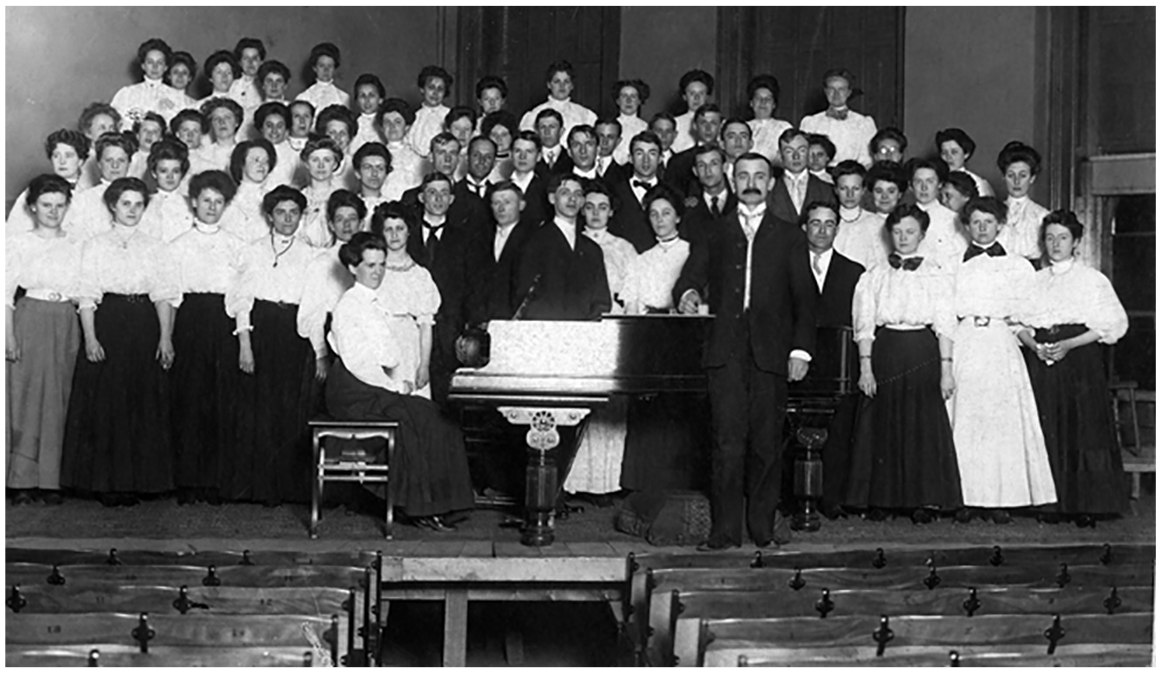
ISNU Choral Club, 1907–08.
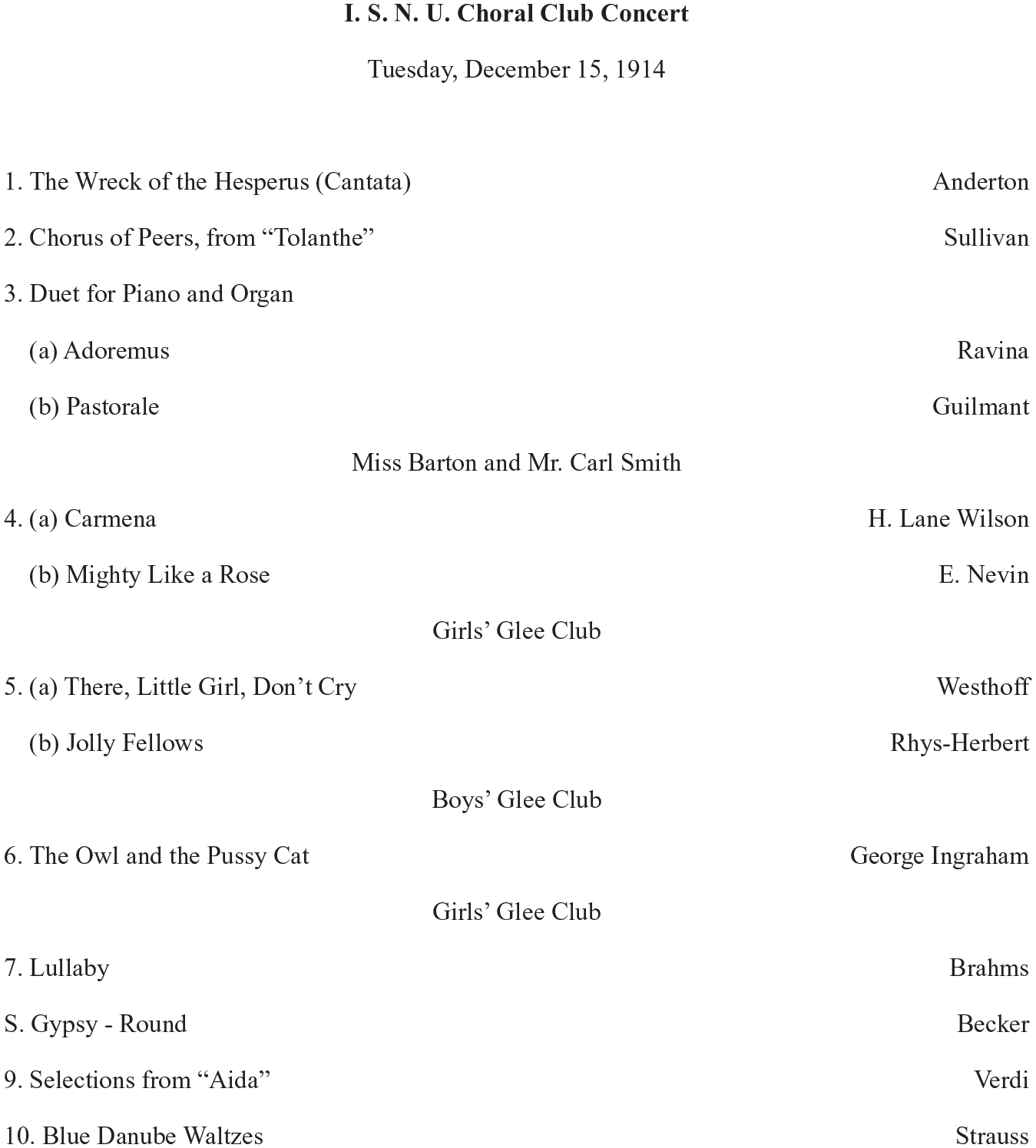
ISNU Choral Club Concert Program, 1914.
Westhoff also led a chorus during the first six-week term of the summer. This group rehearsed one hour per day and presented an extended work such as The Haymakers by George F. Root or the operetta, H. M. S. Pinafore, by W. S. Gilbert and Arthur Sullivan. 84
The ISNU Orchestra began in the fall of 1904 when a group of students approached Westhoff and asked to organize the ensemble. Ten musicians participated in 1906–07 including four violins, two mandolins, two clarinets, cornet, and piano. The group rehearsed every Wednesday and performed for receptions, dances, and other campus events.
85
In describing the repertoire of the orchestra in 1908, Westhoff stated that, Of the kind and class of music which the orchestra played, it cannot be said that it was ultra classical. Nor was it of that type which makes a strong appeal to the feet and sets them to pattering. Music of the two-step variety was tabooed at the beginning of the season, and I think I violate no confidence when I say that it was the intention of all members of the orchestra to furnish music which, while easy and simple, should appeal to the hearts and minds of the listeners.
86
The orchestra developed over time but varied in size and instrumentation from one year to the next. In 1916, the organization consisted of 33 members and included violin, cello, bass, flute, clarinet, piano, cornet, trombone, bells, and drums. According to the Index, “The quality of the work done may be realized more fully, when we notice that selections from Haydn, Beethoven, Mendelssohn, and Verdi, were skillfully rendered.” 87
Westhoff organized the ISNU Band in September 1914 after the state legislature appropriated $500 for the purchase of 15 instruments. Several students possessing their own instruments joined as well and increased the ensemble to 30 members. Unlike most bands of the time, which consisted entirely of males, the ISNU band welcomed female musicians and included seven in the first year. Westhoff arranged all the music for the group, based on the ability of the players on each part. 88
Ensembles continued to thrive on the ISNU campus throughout Westhoff’s tenure. By his retirement in the spring of 1935, the music department included men’s and women’s glee clubs, a women’s chorus, two concert bands, a marching/athletic band, and an orchestra. 89 Westhoff conducted the women’s chorus and the orchestra, while other faculty led the bands and other choirs. He continued directing the women’s chorus until his death in 1938. 90
Professional Leader
Westhoff was a leader in the field of music education throughout Illinois as well as in state and national organizations. He was a frequent instructor at teachers’ institutes, which provided professional development for in-service professionals during summer and winter breaks. These events were particularly important for teachers in rural schools who may only have earned a grammar school diploma and passed a county teachers’ examination.
91
Westhoff led his first institute in December 1893 for the teachers of Macon County.
92
He continued to provide musical leadership at these gatherings and in monthly meetings held throughout the year. Around 1900, Westhoff introduced a curriculum for the local country schools that he and County Superintendent, J. G. Keller, had developed.
93
The Decatur Herald described how he prepared teachers to implement the new curriculum during an institute in August 1900: F. W. Westhoff, who has charge of the music, has introduced a new method in his work which has been taken up by the teachers with a great deal of enthusiasm. With Mr. Keller’s assistance, Mr. Westhoff has selected 15 songs which are to be taught by the teachers in the county this winter. These songs were taken from several books and are the best of the entire collection. A certain number are put on the board each day and the teachers are required to copy them from the board. In this way they learn them thoroughly and the pupils will be taught by imitation. The songs are especially suited to the schoolroom and are songs that will attract the children. The method has the double advantage of securing in this way the choicest of songs and that the teachers learn to sing them here under Mr. Westhoff’s instruction. In addition to this, Mr. Westhoff has a short time to devote to methods of teaching, etc.
94
County superintendents called upon Westhoff to provide professional development at teachers’ institutes throughout his career. 95 In June 1895 and 1896 he taught music at the Sangamon County Institute in Springfield, Illinois, where he was described as “an accomplished musician and gifted in his sphere of work.” 96 An announcement for the Woodford County Institute in 1921 stated that, “[Westhoff] has directed the music so frequently that it is not necessary to say anything concerning the value of his work.” 97
Professor Westhoff was an active member and leader in state and national professional organizations. In July 1897, he presented a paper on “High-School Music” to the Department of Music Education at the annual meeting of the National Education Association, held in Milwaukee, Wisconsin.
98
At the Central Illinois Teachers Association meeting at Quincy, in 1899, Westhoff delivered a lecture on “The Proper Training of a Child’s Voice,” in which he utilized a fifth-grade class from the Decatur Public Schools as a demonstration group. According to a report published in School Music Monthly, His work with the class was very instructive and interesting. He tones voices from the highest note in the scale, down, rather than from the lowest, up. (I believe most special teachers of music use the same method now.) He drills in vowels and consonants and words, and holds that the term “thin, small voice” will give the children a better idea of tone than the words, “sing softly.” The class sang two songs very nicely and were heartily clapped.
99
Beginning in 1913, Westhoff served on the Illinois Music Teachers’ Association (IMTA) examining board for public school music. This body granted IMTA certification to candidates who passed the required assessments so that “the public [would] have a means of knowing what manner of teacher has applied for the privilege of instructing the children of tomorrow.” 100 Westhoff was a founding member of Music Supervisors National Conference and attended the first meeting in Keokuk, Iowa, in April 1907. 101 He also served as president of the music section of the Illinois State Teachers’ Association from 1918 to 1921, and as director of the Illinois State High School Music and Literary Association (ISHSMLA) from the 1920s to 1935. 102
Pedagogue and Textbook Author
Westhoff contributed several pedagogical materials to the field of music education. In 1894, he wrote the vocal music section for the revised Course of Study for the Common School of Illinois. This document resulted from work by a committee of county superintendents on behalf of the Illinois State Teachers’ Association and first appeared in 1889. The purpose of the Course was to standardize curriculum and improve efficiency in rural schools throughout the state. Music did not appear until the first revision, and then only as a set of general directions that occupied less than two pages. 103 The second revision of the Course of Study in 1897 included a more detailed sequence of instruction by M. W. Moore, the school music supervisor in Urbana, Illinois. 104 Westhoff wrote the music section for the third revision in 1903, and for all subsequent revisions thereafter. 105
The curriculum for the 1903 revision began with general directions for teaching children to sing, followed by an eight-month outline for the academic year. Each month included two or three rote songs, musical terms and concepts, and a progressive sequence of exercises to build tonal and rhythm skills. 106 After basic exercises in the first two months, students began reading short simple songs from a music reader by (a) speaking the numeral or solfege of each note, (b) observing the meter, accent, and rhythm, and then singing (c) in solfege, (d) on a neutral syllable, (e) and with the text. In month five, Westhoff recommended that older students write and perform simple rhythms using the notation they had learned so far. Students sang in a multiple keys (e.g., C, G, and D major) and meters (e.g., 2/4, 2/2, 3/8) by the sixth month, and began performing rounds, two-part songs, and with two notes in one beat (e.g., eighth notes in 2/4) in month seven. The Course concluded with 4/4 time and a review of previous material. 107
Subsequent editions of the Course of Study appeared in 1907, 1912, 1918, and 1925. 108 By the 1918 revision, additional content had reduced the music section to a general monthly outline of two pages. The proposed schedule provided 10 minutes of singing per day among the “general exercises” of the school and designated one period per week for instruction in the discipline. The curriculum each month included (a) rote singing to “arouse interest, develop musical feeling and expression, [and] enlarge and enrich the musical experience and vocabulary of the child,” (b) observation work (eye training), which involved identifying phrases, motives, and symbols within notation, and (c) sight reading through individual recitation and written exercises (i.e. tonal and rhythmic dictation). If time allowed, Westhoff recommended teaching the upper and lower grades separately to focus on age-appropriate content. 109
The effectiveness of the Course in supporting music instruction among rural teachers of Illinois is unknown. However, statements by Westhoff in 1919 indicated a persistent weakness in this branch of study in country schools due to:
A mistaken attitude toward music held by members of the school community.
The poorly or totally unprepared teacher.
The yearly migration of the teacher.
The already crowded curriculum.
Music, a non-essential element in the teacher’s examination.
The neutral or passive attitude of the county superintendent and the teacher. 110
Westhoff recommended solutions to these problems, saying,
Let the county superintendents, insofar as it lies within their power, require the teaching of music in the one-room school.
Let the teacher be examined in public school music and be given credit for the same on her certificate.
Give music the time and importance of an educational subject during the Annual Teachers’ Institute.
Let the teachers study, and follow the music outline in the State Course of Study, supplying themselves with a singing book whose price is at least above 10 cents. 111
Westhoff authored a variety of resources to support music instruction in K-12 schools. In 1903, he published Select Rote Songs and Elementary Music Reader to provide materials for the Course of Study. The book consisted of 76 pages and was affordable to rural schools at 20¢ to 35¢ per copy or $2.00 to $3.00 per dozen, depending on the type of binding. Part one of the book contained the 28 rote songs recommended in the Course of Study sequenced according to the monthly outline, as well as five patriotic selections for general use. Part two consisted of the exercises and song material prescribed in the Course for learning to read notation. Teachers implementing the yearlong curriculum taught from both sections of the text simultaneously. 112
In keeping with progressive ideas, Westhoff recommended that the lyrics and melodies of school songs “should be of good quality. The sentiments of the words should be, for the most part, childlike in character. Nature, season, and the home songs should predominate.” 113 The material in Select Rote Songs, therefore, included titles such as “Falling Leaves,” “Southward Fly the Birds,” Winter Life,” and “Spring Beauties.” Westhoff composed several of the songs himself and borrowed others from various sources. 114
The 1903–1905 volumes of the School News and Practical Educator featured a monthly column titled “Lessons in Vocal Music,” in which Westhoff provided guidance on teaching the Course of Study. Articles from September 1903 to May 1904 presented the rote songs from part one (see Figure 4) and basic exercises from part two of Select Rote Songs as recommended in the Course. Columns in 1904–05 focused on methods for teaching students to read notation by using song material from part two of Select Rote Songs. Every installment contained the appropriate sheet music so that schools without the book could implement the curriculum. 115
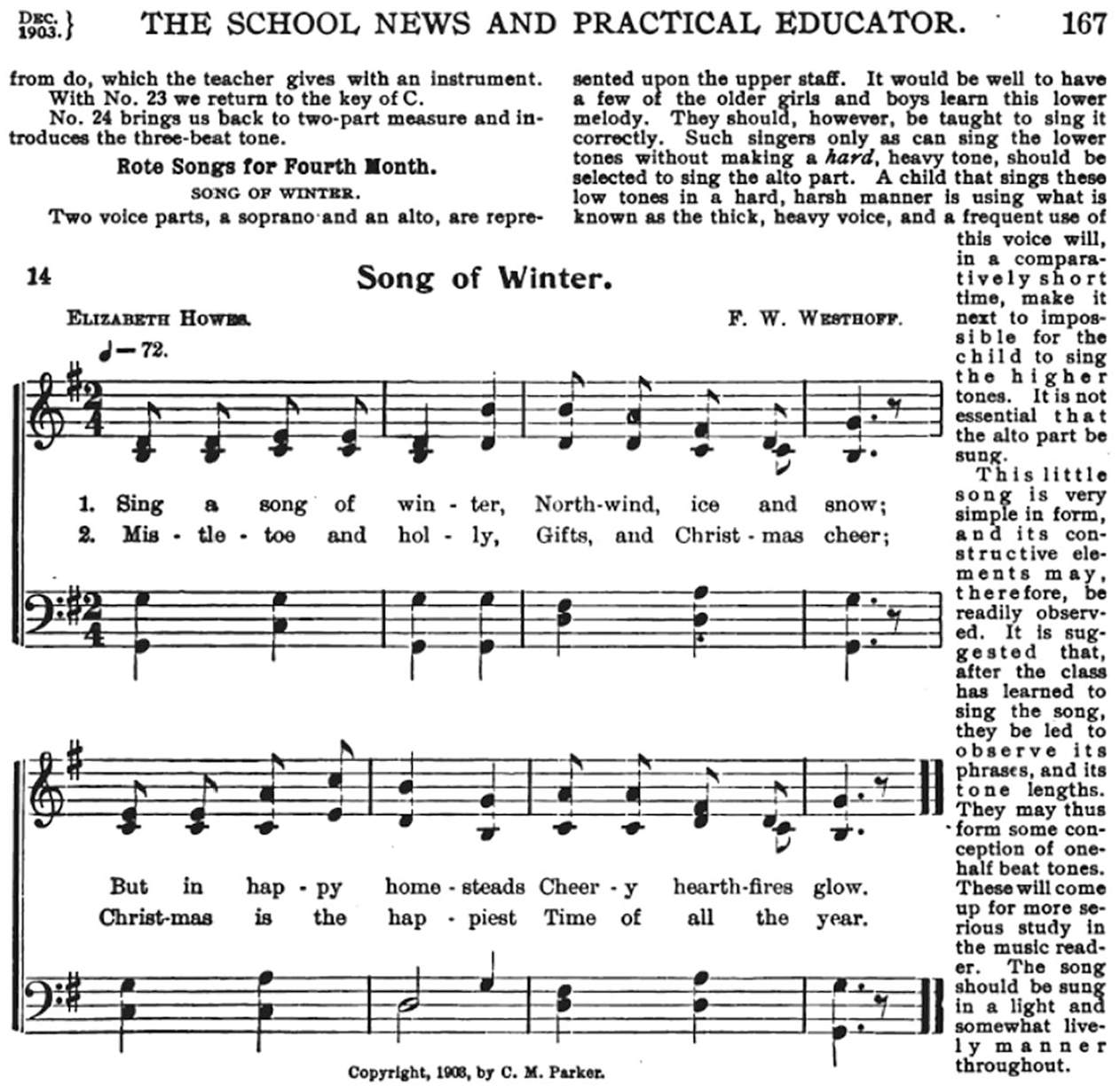
Excerpt from “Lessons in Vocal Music,” School News and Practical Educator, December 1903, p. 167.
Westhoff published Elements of Music in Song in 1911 for intermediate and upper level elementary students, as well as those in small high schools. This book also corresponded to the Course of Study and contained 200 pages of exercises, “folk songs, national melodies, adaptions from great composers, and many sweet and delightful songs that children will love[.]” 116 Unlike Select Rote Songs, this text provided enough material to prepare students for advanced choral work. In following the principles of the song method, Westhoff proposed an instructional sequence whereby students unconsciously experienced musical elements through rote singing, and then became aware of these concepts through aural and visual analysis of notation. To facilitate this process, some of the sight-reading exercises consisted of melodies learned by rote earlier in the book. The author recommended that students in second grade or above also engage in written work by copying or writing from memory parts of familiar songs, transcribing short patterns dictated or sung by the teacher, and composing original melodies. 117
Westhoff wrote additional textbooks during his career that were not associated with the Course of Study. In 1910, he published Elements of Music and Notation for use in public schools or the applied studio. This book sought to draw “a sharp line of distinction. . .between. . .the real things in music. . .i.e. ear concepts [e.g., pitch, volume, duration, melody, phrases]. . .and their signs. . .i.e. eye concepts [notation].” Twenty-four pages of staff paper embedded in the text facilitated written work assigned by the teacher. 118
Two book series were also part of Westfoff’s output. The Willis Music Company of Cincinnati, Ohio, published his four-volume series titled Songs for Sight Singing in 1916. 119 Between 1926 and 1929, he issued the Ideal Music Series consisting of four pupils’ books, two teachers’ editions, and an instructional guide. Repertoire included mostly European folk melodies, nursery rhymes, and original tunes by several composers including Westhoff’s daughter, Margaret. 120
Material in book one of the Ideal Music Series consisted of rote songs for first and second grades. Volumes two (grades three and four) and three (grades five and six) included reading songs for each grade level and a third section of familiar hymns, patriotic selections, and Christmas carols that could be learned by rote, if necessary. 121 Book four for junior high students in grades seven, eight, and nine contained music in unison, two, three, and four parts for changed and unchanged voices. This volume concluded with a section of standard songs for general use or community singing. 122
Westhoff sequenced material in all volumes to “make it possible to always have the songs in season.” 123 He provided separate piano accompaniments in the teacher’s editions and wrote the Teacher’s Guide to the Ideal Music Series to illustrate methods for implementing the course. This booklet contained pedagogical strategies and monthly outlines for nine years of instruction “modeled after the course of study prepared by the Educational Council of the Music Supervisors’ National Conference [MSNC].” 124
The Ideal Music Series enjoyed limited success compared to similar textbook courses popular at the time such as the Music Hour by Osbourne McConathy, W. Otto Miessner, Edward Bailey Birge, and Mabel E. Bray (Silver, Burdett & Company, publishers) and the Music Education Series, by Thaddeus P. Giddings, Will Earhart, Ralph L. Baldwin, and Elbridge W. Newton (Ginn & Company, publishers). Both series featured well-known authors and enjoyed aggressive nation-wide marketing by large publishing firms. 125 A review of the Ideal Music Series in Music Supervisors’ Journal stated that, “[t]he gradation of the material is educationally right for its intended use, but the material itself does not measure up, in musical quality, to the exacting standards set by modern practice.” 126
Conclusion
Frank William Westhoff led music education during a time of change. When he entered the field in 1893, school music consisted mostly of singing and reading notation in the elementary grades. When he retired in 1935, music curricula had expanded into the high school and included music appreciation, applied study, instrumental and choral ensembles, and composition. 127 Westhoff participated in these progressive developments in his own realm. In Decatur, he embraced the song method over learning music strictly by note, connected his students with the community through public appearances and programs, and implemented vocal and instrumental music at the high school. 128 At ISNU, he followed the tenets of the child study movement in developing courses in primary, upper elementary, and high school methods, and prepared pre-service teachers for the modern classroom through work in creative music, instrumental pedagogy, and music appreciation. 129
Music instruction at ISNU developed similarly to that offered at other normal schools during the late nineteenth and early twentieth centuries. 130 When Westhoff began his tenure as the department’s only instructor in 1901, the program consisted of two academic courses and boys’ and girls’ glee clubs. When he retired 35 years later, the Division of Music Education included five full-time faculty and offered twenty-seven courses, eight vocal and instrumental ensembles, and a four-year Bachelor of Education degree. 131
ISNU remained solely dedicated to the preparation of teachers and other school personnel until 1965 when the Board of Governors of State Colleges and Universities and the Board of Higher Education expanded the purpose of the institution to include bachelor’s degrees in the liberal arts and sciences. Today, Illinois State University houses one of the largest teacher education programs in the United States. In addition, the School of Music—initiated by Westhoff nearly 120 years ago—consists of approximately 400 students in multiple undergraduate and graduate programs. 132
Westhoff helped lead the profession through his work in state and national organizations. 133 He also advocated for quality music instruction in rural schools and prepared numerous country teachers in the subject. The music section for the Course of Study for the Common Schools of Illinois and the supporting didactic materials that he wrote provided a basis on which these professionals—often without a great deal of pre-service preparation or musical experience—could teach their students to sing and understand music. 134
Although Westhoff was not as prominent a figure in music education as those who led the field on a national level during his time, he played an important role in sustaining, perpetuating, and expanding school music in Illinois throughout much of the progressive era. Additional research is needed to identify individuals who filled similar roles throughout history including those who were female, African American, Hispanic, Asian, or from other underrepresented populations. 135 This ongoing line of research will add to the literature and increase our understanding of the development of school music and music teacher education in the United States.
Footnotes
Declaration of Conflicting Interests
The author declared no potential conflicts of interest with respect to the research, authorship, and/or publication of this article.
Funding
The author received no financial support for the research, authorship, and/or publication of this article.
