




Abstract
Male and female focus groups at a Hispanic Serving Institution (HSI) discussed mentoring of Hispanic graduate students. Using Thematic Analysis, investigators identified three main themes: Relationship Initiation and Development, Valued Relationship Qualities, and Context and Barriers. Relationship themes included mentor openness, trust, commitment, availability and grant assistance. Barrier themes subsumed gender roles, financial insecurity, social inequality, and language differences. Females noted one unique theme, and males emphasized work obligations’ negative impact on mentoring.
Driven by population changes, academic contexts are rapidly becoming bicultural or multicultural in the United States (Grieco & Cassidy, 2001). Mentoring in academic contexts is a ubiquitous and powerful developmental process (Ragins, 1997) and mentoring theory and research grow exponentially as academic environments become more diverse. Mentoring models emphasizing just one culture’s specific values are hard-pressed when applied to these increasingly prevalent bicultural and multicultural contexts. Investigation of an understudied group in a bicultural setting may provide useful insights into what factors influence diversified mentoring in these “mixed modern” contexts.
In this vein, the present study contributes to the meager literature on academic mentoring of Hispanic graduate students and investigates potential gender differences within this group at a Hispanic Serving Institution (HSI). Disproportionately low numbers of Hispanic students pursue graduate degrees, and Hispanic males enroll in graduate education much less than any other group (Fry, 2011). Study of academic mentoring with Hispanic males is important and lacking (Ceballo, 2004), and Crisp (2011) notes HSIs merit research attention due to the large number of Hispanics they enroll. Mentee gender may influence mentoring processes and outcomes (McKeen & Bujaki, 2007; Rose, 2005). Furthermore, social role theory (Eagly, 1997) proposes people generally behave in accordance with culturally defined gender roles, which could also influence mentoring experiences, especially among Mexican American youth, where divergent gender roles are often emphasized by parents (Raffaelli & Ontai, 2004).
Mentoring and Gender: Diverse and Complex
There is ample literature reporting the positive benefits of mentoring across a variety of contexts and mentees (Allen, Eby, Poteet, Lentz, & Lima, 2004). In a multidisciplinary review of mentoring outcomes, Eby, Allen, Evans, Ng, and DuBois (2008) reported a variety of positive outcomes across youth, workplace, and academic mentoring. Results suggested that mentoring is most useful in improving performance and attitudes toward school, and decreasing withdrawal behavior in academic areas. The authors also concluded that there is mixed evidence of moderators of some mentoring outcomes, such as organizational context, gender, and race/ethnicity.
McKeen and Bujaki (2007) emphasized the complexity of mentoring in a review of gender and mentoring, noting mentoring is influenced by the interaction of the organizational context, mentee, mentor, and dyadic characteristics. Obviously, gender is an essential characteristic of mentor and mentee and, conceptually, “gender” operates on multiple levels. For example, a basic distinction made between mentoring models is the traditional and the relational perspectives (Fletcher & Ragins, 2007). Traditional mentoring (Hunt & Michael, 1983; Kram, 1985) is often assumed to be one-directional and hierarchical, highlighting power in relationships (a masculine “agentic” model), and the relational model (McGowan, 2001; Ragins, 2004) focuses more on interdependent and mutual processes (a feminine “communal” model).
Perhaps related to the above, researchers often divide mentoring into two broad dimensions—psychosocial activities and instrumental activates. Exceptions to this include Cohen (1995) who suggested six mentoring dimensions and Rose (2005) who identified three dimensions within academic mentoring. Nora and Crisp (2009) recommended a model of academic mentoring including four components. So far, there is no agreement on the dimensions of academic mentoring.
Gender and mentoring were initially studied in reaction to the concern that women still experience limited advancement at the highest executive levels in the workplace (McKeen & Bujaki, 2007; Ragins, 1999). Most published research on gender and mentoring has come from the workplace, rather than from academia. Research on receipt of mentoring functions by mentee gender has yielded mixed results in workplace studies (Ragins, 1999). However, Ragins highlighted problems with social desirability responding and self-perceptions, as well as sex-role stereotypes. She recommended future research should assess gender, self-construals, reliance on gender-role stereotypes, and formal (arranged) versus informal (spontaneous) mentoring,
Jacobi (1991) reviewed mentoring literature in undergraduates and emphasized the need for a common definition of mentoring, distinction between formal and informal mentoring, and the need for more outcome studies. More recently, Crisp and Cruz (2009) reviewed mentoring among college students from 1990 to 2007, reporting only 50 undergraduate and graduate studies of academic mentoring. They noted many of the same definitional, theoretical, and methodological problems as Jacobi (1991). Without naming the distinction between traditional and relational mentoring models, the authors urged theorists to expand their models to include the basic tenants of race, ethnicity, and feminism. They recommended the model of undergraduate academic mentoring identified by Nora and Crisp (2007) including four components: (a) psychological and emotional support, (b) support for setting goals and choosing a career path, (c) academic subject knowledge support aimed at advancing a student’s knowledge relevant to their chosen field, and (d) specification of a role model.
Rose (2000) reviewed mentoring within doctoral education. She attempted to identify what doctoral students want in a mentor. She concluded that different aspects of mentoring might be preferred by different groups of graduate students (i.e., males and females). She created the Ideal Mentor Scale (IMS), which taps three domains—Integrity (exhibits principled action and can be emulated as a role model), Guidance (provides practical assistance with the tasks and activities typical of graduate study), and Relationship (facilitates formation of a personal relationship that might involve sharing personal concerns, social activities, and worldview). Definitional consensus of mentoring does not yet exist, but some progress has been made in creation of measures to assess varying definitions and mentoring dimensions.
Rose (2005) demonstrated group differences in how graduate students conceptualize mentoring. She found that age, gender, and citizenship status influenced preferences for different aspects of mentoring. However, Sedlacek, Benjamin, Schlosser, and Sheu (2007) reviewed mentoring in graduate education with diverse populations. They concluded that the limited studies of gender in graduate education did not find that gender influenced mentoring outcomes. They did, however, emphasize the impact of ethnicity on mentoring. O’Neill (2005) in a review of diversity and gender argues that diversity and gender may interact in influencing mentoring processes.
The study of gender roles and mentoring has been primarily influenced by gender inequities. The glass ceiling also exists for women in academe (Bain & Cummings, 2000). Most of the academic gender role research has focused on female faculty and female graduate students, especially on the impact of motherhood and home chores on academic careers (Mason, Goulden, & Frasch, 2009). Mentoring of female graduate students by female faculty has highlighted the problems with gender equality in academia (Armstrong, 2011).
To summarize, mentoring studies in academe mostly focus on undergraduate surveys that usually do not include significant numbers of Hispanic students and have rarely been conducted at HSIs. Results concerning impacts of gender on academic mentoring for students are mixed. Research on how gender roles influence academic mentoring notes the impact of a masculine work culture for men, women, and families. There is no agreement about the definition of academic mentoring, how best to measure it, or consensus concerning mentoring dimensions.
Hispanics/Latina/os and Academic Mentoring
Hispanics/Latina/os, including Mexican Americans, are the largest minority group in the United States (Fry, 2011), and more than 50% of the Hispanics who participate in higher education do so at HSIs (Santiago, 2013). Yet, there are a disproportionately low number of Hispanic students pursuing graduate degrees.
Hispanic females are more likely than males to earn an advanced degree (64% of those conferred in 2006; Fry, 2011). The disparity between academic achievement of Hispanic females and males is evident long before college enrollment. Hispanic males are more likely to repeat grades in elementary school and to drop out of high school (Saenz & Ponjuan, 2009). Many factors influence the difficulty Hispanic males experience as they attempt to successfully manage various educational transitions (low expectations, discrimination, lack of knowledge, negative school experiences, inadequate school facilities, tracking), but female Hispanics also experience these difficulties (Castellanos, Gloria, & Kamimura, 2006). Arbona and Nora (2007) cite lack of male mentors and male role models as being especially influential for male Hispanics. However, lack of role models also exists for Hispanic females.
There is little published research on Hispanics’ experiences with mentoring relationships (Crisp & Cruz, 2010). However, some literature suggests minority students, including Hispanics, pay a mentoring tax (Black-Beard, Murrell, & Thomas, 2007), that is, minorities have to exert additional effort and time to develop mentoring relationships in comparison with non-minority students. It is argued that members of minorities face challenges such as access to mentors, stereotypes, and the likelihood they will be mentored by a member of the majority, highlighting the varied power relationships between groups (Ragins, 1997). Santos and Reigadas (2002) did demonstrate that a faculty mentoring program produced multiple positive outcomes for Latino students. In sum, small numbers of Hispanics in college has lead to scant research, and the especially small number of Hispanic male graduate students has resulted in very little research on them.
The authors located five journal articles, one thesis, one edited book, and one dissertation reporting mentoring of graduate level Hispanics. Most studies used qualitative methods and studied only Hispanic females enrolled in or graduated from doctoral programs (Castillo, 2013; Espinoza, 2010; Gonzalez, 2007; Ibarra, 1996; Peña, Hernandez, Turner, & Dirks, 2007; Quezada, 1984; San Miguel, 2010). The majority documented mentoring barriers, such as stereotyping and inequitable distribution of resources. The Latina writers consistently reported alienation and isolation within academe and the need for cultural sensitivity on the part of mentors and conflict between values of individualism and task completion and their own cultural values of “familismo” and relationship focus over task focus. These studies did not detail the specific institutional or departmental context of the students, but it appeared that they occurred in Primarily White Institutions (PWI). Peña et al. (2007) studied Hispanic master’s students in schools of theology using both focus groups and surveys. Their results highlighted language barriers, alienation, and difficulties juggling both educational and social action pursuits.
Most relevant to the present study, Castillo (2013) studied graduate students and faculty at a HSI in South Texas using both focus groups and Rose’s IMS. He found that graduate students and faculty of European American ethnicity were significantly less likely to place importance on all three dimensions of mentoring tapped by Rose’s scale than were Mexican American graduate students and faculty. He reported that most of his student respondents did not have anyone in their family who had pursued an advanced degree, and thus lacked academic role and mentoring models. Unlike Rose, his quantitative data did not reveal significant gender differences, but Castillo concluded that Hispanic graduate students prefer an academic mentor with a strong professional ethic.
One edited book on graduate education of Latina/os (Castellanos et al., 2006) highlighted the societal barriers to Latino/a higher education in the United States. One chapter by Quijada (2006) described the experience of a Latino male in graduate school struggling to retain his ethnic identity in a hostile academic environment. He reported the isolation he experienced and reported changing his advisor/mentor to improve his level of academic and emotional support.
We conclude that there is a paucity of research on Hispanic graduate students and mentoring, only one study was quantitative in nature, and it included very few males. The one quantitative study (Castillo, 2013) found Mexican American graduate students placed more importance on all dimensions of mentoring than did non-Mexican American graduate students. The literature on Hispanic female graduate students reported cultural conflicts and a sense of alienation within academe.
Bicultural and Hispanic Serving University Context
The Hispanic Serving University where the study was conducted is located in a city bordering Mexico where 91% self-designate as Hispanic. Non-Hispanic Whites are a small minority (8%). Spanish is spoken by 91% of the population, and the city’s population is largely working class. Due to historical connections and current intense trade, people living here are exposed to the socialization processes of each culture. Cities such as this one can best be described as bicultural. Both Spanish and English are commonly spoken, travel and commerce between the two cultures are extensive, and customs from both nations abound. Very often, some members of an extended family live across the river in Mexico, while others live on the U.S. side. Bicultural theories assume that acculturation to the new culture does not require people to relinquish their culture of origin and that people can belong to two cultures and maintain their sense of ethnic identity (Rudolph, Chavez, Quintana, & Salinas, 2011). Most graduate students at this HSI are not in a formal mentoring program, although a Department of Education Grant funds six to seven students annually.
Further investigating Rose’s (2005) observation of gender differences in graduate student mentoring preferences, we wanted to know whether male and female Hispanic graduate students emphasized different aspects of mentoring in this bicultural context. There were three specific research questions for the qualitative data and one for the demographic data collected: (a) What mentoring themes are common to both graduate student Hispanic males and females in the focus groups? (b) Are there any mentoring themes unique to one gender? (c) Do male Hispanic graduate students emphasize different mentoring qualities or experiences than females? (d) Are any gender differences noted within the demographic data of participants?
Method
A multimethod approach, collecting quantitative and qualitative data, was used in the larger investigation from which this study is drawn. Focus groups were conducted before survey data collection. Only focus group results are reported here. Groups discussed their mentoring experiences, as well as mentoring programs and processes at this HSI. Each participant signed an informed consent and Institutional Review Board approval was obtained prior to the audio-recorded and, then, transcribed focus groups.
This regional HSI enrolled about 7,000 students, in 4 colleges offering undergraduate and graduate degrees. There were about 800 students (full- and part-time) registered for graduate classes, the greatest number coming from the colleges of Business, Education, and Arts and Sciences. The graduate student body was primarily of Hispanic origin (84%). To investigate the impact of gender on mentoring experience, the authors assigned males to one focus group and females to another.
Sample and Procedure
An email was sent to all graduate students at this HSI inviting them to voluntarily participate in a gender-specific focus group on mentoring. Twenty-five volunteers initially responded but four did not attend. There were 11 participants in the male focus group (10 Mexican Americans) and 10 Mexican American graduate students in the female focus group. Graduate students from the Colleges of Arts and Sciences, Education, and Business participated. Focus group participants were representative of the graduate student body in age and ethnicity. However, one graduate school, Nursing, was not represented in the focus groups.
Each focus group met for about 75 min. One of the authors welcomed participants and asked them to complete a demographic form and sign the consent for audiotaped participation. A handout with the purpose of the study and the definition of mentor was also distributed and read.
The focus groups were semi-structured. The authors generated a list of questions about mentoring, going from the superficial to the more personal, guided by a prior literature review. Some questions included were as follows: Tell me about your mentoring relationships. How did they begin? How would you describe the relationship with your mentor now? Were there any things that got in the way of mentoring for you?
Analysis
Thematic Analysis was used to investigate the focus group transcripts. Thematic Analysis is a method to identify, analyze, and report patterns (themes) within data (Braun & Clarke, 2006). It provides some organization to the data, describes data in detail, and is not tied to any particular theoretical framework. Emphasis was given to the first three steps of Thematic Analysis: familiarizing the analysts with the transcripts, coding of excerpts, and identification of themes. One graduate student from the male focus group and one graduate student from the female focus group transcribed the audio-recordings. They were then invited to analyze the transcripts for themes. One of the authors, familiar with Thematic Analysis, trained the raters in the use of Thematic Analysis and also rated each group’s transcript separately. At this point, the graduate students became co-researcher/participants. Thematic Analysis, like most qualitative methods, emphasizes the need for researchers to be reflexive. As multiple raters from different cultures and exact transcripts of the groups were used, the possibility of this reflexivity biasing results was minimized.
The male graduate student author analyzed the male focus group transcript and the female graduate student analyzed the female focus group transcript. Each analyst worked alone, coding excerpts until he or she completed theme and subtheme identification for that group. When each analyst was satisfied with his or her theme list, a meeting was held with the senior analyst and the analysts compared lists. There was strong agreement in theme identification for the raters of the male and female focus groups. Two final mentoring experience theme lists were thus generated, one for Hispanic males and one for Hispanic females. One male and one female focus group participant, not previously involved in transcribing or coding, then member checked the listing for each group.
Results
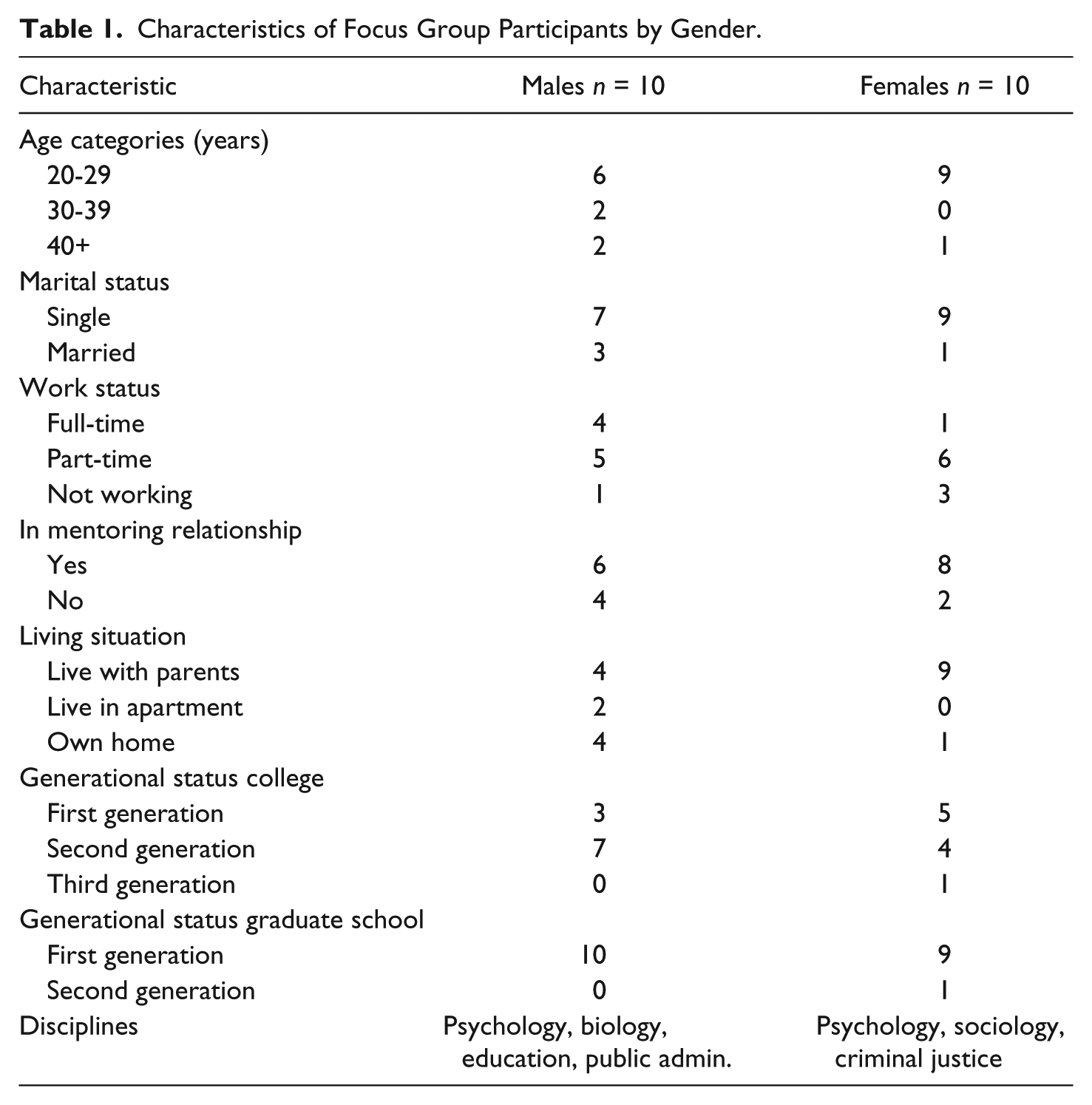
Demographic differences between male and female focus group students are depicted in Table 1. Most noteworthy is that 9 of 10 females had mentors and only 6 of 10 males did. One female worked full-time but four males did. Three females were not working at all, but only one male was unemployed. Three males were married, while only one female was married. Nine females lived with parents, but only four males lived with parents. Females were younger on average, and there were more first generation students among them. Men tended to be a little older, and some had returned to school after working. Overall, the demographics support the prevalence of the “provider” work role for male Mexican American graduate students. Participants were similar to graduate students at the university, although females predominate in the general graduate student population.
Characteristics of Focus Group Participants by Gender.
Both groups identified three broad themes: Relationship Initiation and Development, Valued Relationship Qualities, and Context and Barriers (Figure 1). Both groups noted that course work facilitated initiation of mentoring, and grants provided funds so that students did not have to work, freeing up more time to interact with mentors. Both groups reported it was usually the student who approached the faculty to initiate the relationship. Males and females reported that the relationship became increasingly reciprocal over time, and likewise, that the mentee took more initiative and developed greater self-efficacy.
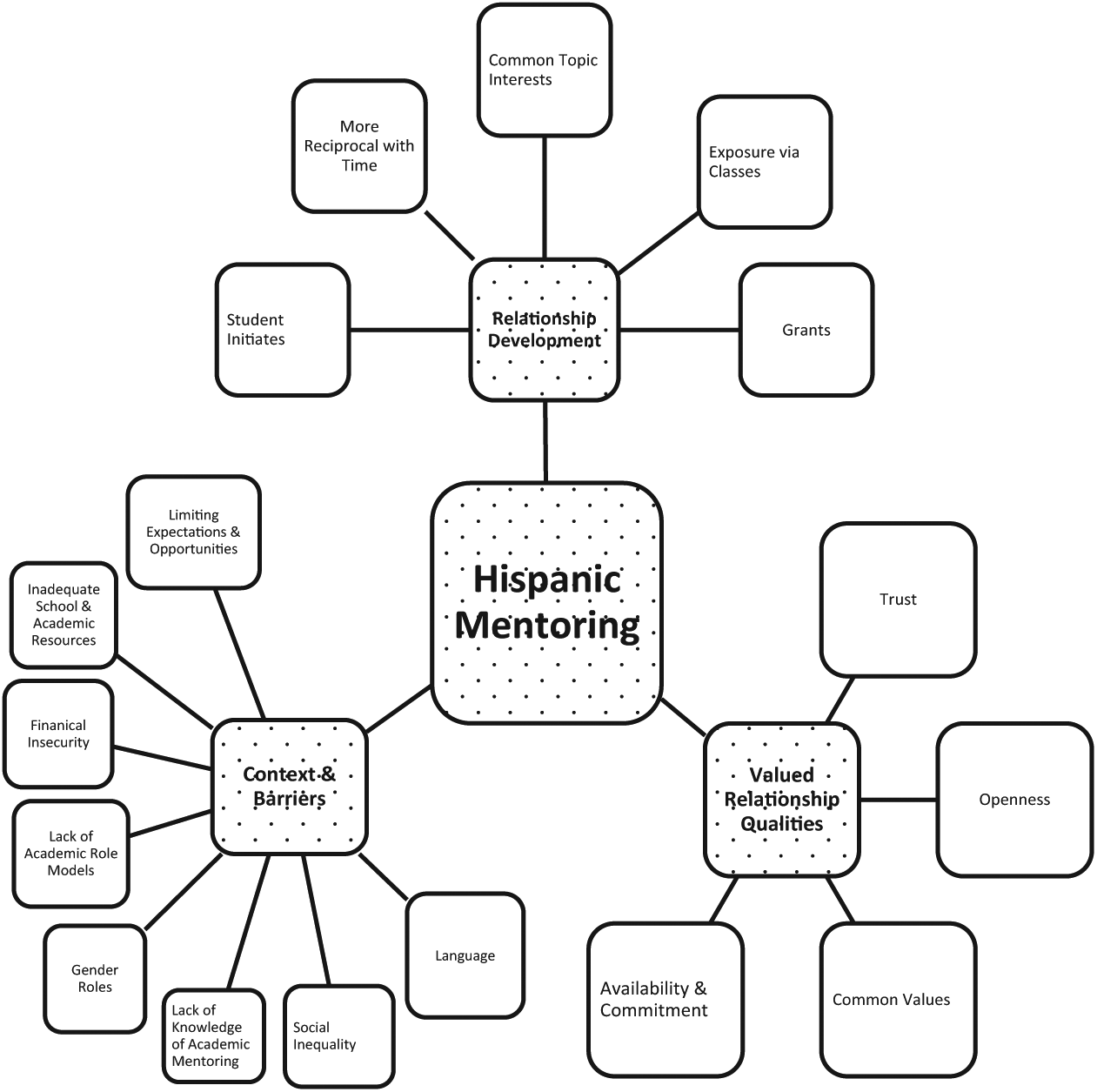
Thematic map.
The mentor qualities that graduate students reported were openness, common values, trust, availability, and commitment. There were differences in the emphasis given to relationship qualities desired by males and females. Males noted genuineness, knowledge, and expertise of the mentor, and females emphasized listening, guidance, and caring. Males also emphasized the confidential nature of communication with their mentors, and females stressed the mentor’s ability to relate to the mentee’s experience, and offering reassurance. Males particularly valued the availability of the mentor, similar interests, and a challenging attitude, and females valued support, collaboration, and friendship.
Both groups noted language differences as a barrier. They also identified lack of knowledge about academic mentoring as a barrier. Some members said they did not know what an academic mentor was until the focus group meeting. Analysis of both transcripts also produced gender roles as a common barrier theme. Mexican American males noted work as a major obstacle to mentoring, reducing time and availability for initiating or developing the relationship. Mexican American females did not report work as a barrier, but noted the feminine role as a barrier to graduate education and mentoring. They described their role as women in the Mexican American border culture as “staying at home and taking care of the house and family.” However, as most were not married, their mothers primarily carried that role.
Another barrier theme common to both males and females was social inequality. Both noted that grade school teachers’ messages about their educational futures were limited to “high-school graduation.” Likewise high school counselors rarely mentioned college as an option to these students. Another commonality was the underfunded and overburdened schools students typically attended, which further limited their opportunities to be mentored. Both groups also noted lack of educational resources and information along the academic pipeline. Financial insecurity and limited work opportunities for their families were also reported in the social inequality theme. Students also mentioned the limited number of family role models for advanced degrees and academic mentoring relationships. Both groups discussed their families’ experiences with discrimination and prejudice that interfered with pursuit of higher levels of education.
One unique theme was identified. Female graduate students reported that special care should be taken by male mentors to set clear boundaries about the professional nature of the mentor/mentee relationship so that those observing the relationship will not misinterpret it, and the mentor and mentee can avoid any behaviors that might be misread by each other. No similar theme resulted from analysis of the male focus group transcript concerning boundary setting with a female mentor and male mentee. Although the gender role theme was not unique to males, the extent to which the male provider/worker gender role impedes mentoring for these Mexican American males was emphasized by male graduate students. One student reported that he quit his full-time job to do freelance work so that he would have adequate time to meet with his mentor, and four others noted they did not have mentors due to the demands of their work schedules. The one male who was not working received a grant that provided financial support.
Discussion
Across genders, Hispanic graduate students produced three broad common themes. Two focused on the mentoring relationship, namely mentor qualities valued and initiation and development of the mentoring relationship. The third theme revolved around barriers to mentoring and context. At this broad thematic level of analysis, only one unique theme was identified, by females, namely clear boundary setting by male mentors with female mentees.
Within the theme of barriers and context, gender role demands for males as workers and providers for the family stood out as more impeding of mentoring for males than the gender role of family caregiver for females. Female graduate students typically lived at home with their parents, and were not married. Their mothers fulfilled many home demands of the Hispanic female, thus freeing up their daughters’ time to develop mentoring relationships. In this working-class community, the male is expected to provide and protect. It is a point of pride that males assure the family has adequate financial support. If this means the male graduate student has to work full-time and go to graduate school, then that is what most will do. When males receive financial aid through grants, they do not have to work off campus to assist their families and can invest more time in mentoring relationships.
This male gender role of working and providing for the family is supported by the demographic data. Four males worked full-time, while only one female did. This is not surprising given the predominance of Mexican norms in this Hispanic working-class city right across the river from Mexico. Three females were not working at all, whereas only one male was not employed, and that male had a GREAT grant that provided income. Furthermore, only 6 of 10 male graduate students actually reported having an academic mentor, whereas 9 of 10 females did. Economic status is noted as a barrier in much of the literature, (i.e., Tienda & Mitchell, 2006), but our findings also highlight gender role expectations particularly for males. This finding is consistent with Niemann, Romero, and Arbona (2000) who found that ethnic loyalty of Mexican American college students leads to the perception of conflict between relationship and educational goals.
The mentor relationship qualities valued by both Hispanic male and female graduate students were openness, trustworthiness, sharing common values, commitment to the mentee, and dedication of time to mentoring. These mentoring aspects appear to fit the psychological, emotional, and role model functions noted by Nora and Crisp (2009) with undergraduates and Rose (2005) with graduate students. These qualities are also consistent with the aspects of mentoring represented by the IMS used by Castillo (2013) with Hispanic graduate students. The IMS was most highly endorsed by Mexican American graduate students in his study. The students’ report of mentor openness is consistent with research by Bozionelos (2004) and Niehoff (2006) on mentor traits.
As longitudinal studies are lacking, there is little research to compare with the relationship initiation and development theme. Kram (1985) suggested four mentoring stages, which are not inconsistent with themes of student initiation and increasing reciprocity. The stages she identified with managers were initiation, cultivation, separation, and redefinition and typically range in time over several years. The finding that the relationship becomes more reciprocal over time also appears consistent with Ortiz-Walters and Gilson (2005) who found that comfort and commitment mediated mentor–mentee surface similarity. The American Psychological Association (2014) does suggest that mentees (students) take the initiative in starting mentoring relationships. Some might wonder whether initiating mentoring relationships is culturally inconsistent for Mexican Americans. However, it was not problematic for these graduate students, perhaps because of their prior undergraduate experiences with many of the faculty. Also, one of the grants available to students required students to choose their mentors. Further study of mentoring relationship development is needed.
The border context and its impact on their educational and mentoring experiences were important themes. Much of the respondents’ elementary and secondary education contained negative messages about their academic potential and insufficient academic resources. Learning English as a second language also presented challenges and threats to academic self-efficacy. These findings are very consistent with prior research (i.e., Lutz, 2007). Although the city’s vast majority is of Hispanic heritage, major social inequities based on economic standing, social class, and English language fluency were reported.
At the undergraduate level, respondents noted lack of knowledge of post-secondary education “culture.” This is consistent with literature highlighting lack of knowledge of U.S. academic processes and norms as a barrier (i.e., Schneider, Martinez, & Owens, 2006). For Hispanic graduate students, existence of grants and mentors who devoted time and care to development of mentees was noted as particularly important.
The main limitation of the study is data collection from one HSI. Including one participant from each group as one of the two transcript raters may be a limitation. This HSI’s location offered opportunity to study bicultural influences on mentoring where Hispanic culture and Mexican Spanish predominate.
The Hispanic male focus group offers a perspective lacking in the literature and highlights the influence of the Hispanic (Mexican) male gender role of provider on developing mentoring relationships in U.S. higher education. This suggests that Mexican male gender roles continue to substantially influence mentoring in U.S. graduate education along the border with Mexico. It may also exert influence at other educational levels where there is a substantial Mexican American population. Programs to facilitate mentoring may want to consider the importance of gender roles for Mexican American students. The authors recommend provision of financial aid for Hispanic graduate students within mentoring programs. This aid is especially important for Mexican American male graduate students and Mexican American females not living with parents. Acculturation to U.S. gender roles appeared modest with our sample and the role it plays in the development of mentoring relationships requires study. The impact of the male Mexican gender role of provider may help explain the low numbers of Mexican American males in higher education available for mentoring and merits investigation.
Footnotes
Declaration of Conflicting Interests
The author(s) declared no potential conflicts of interest with respect to the research, authorship, and/or publication of this article.
Funding
The author(s) disclosed receipt of the following financial support for the research, authorship, and/or publication of this article: This study was supported by Title V PPOHA Program of the U.S. Department of Education Award P031M105048.