



Abstract
This article reports on a comparative study of teacher and student perceptions on effective instructional practices in the Spanish heritage language classroom. The data were collected through an online questionnaire administered to 460 students in different Spanish courses and 9 instructors at a large university as well as focus groups. Based on the results, it is suggested that teachers work toward a mutual understanding with students about the main classroom pedagogical activities, methods, and tools to prevent student dissatisfaction and disengagement.
Introduction
The quest to find criteria for what constitutes effective language teaching has long been a major concern in the fields of language instruction and teacher development, but the lack of valid research on teaching effectiveness has hindered this endeavor (Schulz, 2001). Furthermore, existing research suggests that language teaching is “a complex, multi-dimensional process that means different things to different people” (Bell, 2005, p. 259), with the result that there is no consensus among professionals as to what constitutes “effective teaching practices.” Whereas certain teaching behaviors are believed to be effective across all subject areas, other teaching practices and attitudes appear to be relevant and effective only for specific disciplines (Bell, 2005). Research addressing discipline-specific teaching behaviors and teacher attitudes are however still lacking (Schulz, 2001). From the students’ perspective, recent research points to a mismatch between what foreign language (FL) students and their teachers see as effective in language teaching and learning (Brown, 2009; Green, 1993; Hedgcock & Lefkowitz, 1994; McCargar, 1993; Miley & Gonsalves, 2003; Noels, 2001; Peacock, 2001; Schulz, 1996, 2001).
The work of national professional teaching organizations has made significant contributions to the creation of a common core of teacher competencies essential for effective teaching. Over the last two decades, these professional organizations have drafted guidelines and standards aimed at improving the quality of language education in the United States, mostly at the primary and secondary levels (“National Board Professional Teaching Standards” [NBPTS], 2001; Interstate New Teacher Assessment and Support Consortium (InTASC), “Model Core Teaching Standards,” 2011; American Council on the Teaching of Foreign Languages (ACTFL), “Program Standards for the Preparation of Foreign Language Teachers,” 2002).
Teachers’ and learners’ perceptions are another central element in the measurement of teaching effectiveness, especially at the postsecondary level. Empirically, the strongest evidence of the importance of student perceptions comes from the fact that student course evaluations have become a mainstay at most colleges and universities throughout the world as the principal measure of teaching effectiveness (Chen & Hoshower, 2003). As Chen and Hoshower note, student evaluations are used for several purposes, including (a) formative evaluation to guide faculty in improving teaching, course content, and course structure; (b) summative evaluation of faculty teaching effectiveness for promotion and tenure decisions; and (c) information to aid students in selecting courses and teachers.
From a student learning perspective, Kern (1995), for example, noted that when FL students and teachers have different expectations for the language classroom, this can negatively affect learners’ satisfaction with language study, their motivation and interest in pursuing further language learning, and their level of achievement (Williams & Burden, 1997). In contrast, a close match between students’ and teachers’ perceptions as to what constitutes effective language instruction may result in greater student gains and motivation (Peacock, 2001). Despite the importance of achieving consensus between teachers and students, few studies have compared teachers’ and students’ perceptions of effective teaching (Brown, 2009).
The present study addresses this void in the literature by examining teaching effectiveness in Spanish as a heritage language (SHL) and comparing teachers’ and students’ perceptions regarding effective instructional practices. Although this topic has received some attention in the FL context, it has yet to be considered in the heritage language (HL) classroom. Given that HL is a new area of teaching and research, many pedagogical questions remain to be answered. A good starting point toward determining what constitutes quality SHL instruction is to find out what students and teachers find effective in language instruction and to what degree their views align.
Background: The SHL Context
The number of SHL programs is increasing in many regions of the United States as a growing number of Spanish-speaking students are seeking postsecondary education and are pursuing Spanish language studies. In fact, whereas in 2002, Ingold, Rivers, Tesser, and Ashby found that only 18% of the colleges and universities they surveyed offered SHL courses, almost 10 years later, Beaudrie (2012) found that 40% of universities nationwide did so. 1 Beaudrie also found that these programs were spread across 26 U.S. states and the District of Columbia, rather than continuing to be clustered in states with historically large populations of Hispanics.
Although this increase in the number of programs is a step forward for SHL education, there are still many unanswered questions regarding what constitutes effective SHL instruction. As Beaudrie (2012) commented, offering SHL courses is an important step, but it is not sufficient to ensure that students receive quality HL education. Some issues that still need to be examined in this regard are the role of English and Spanish in the SHL classroom, the role of corrective feedback, and the methods for teaching grammar, spelling, and culture, all of which will be explored in the current study. The present study is situated in the SHL classroom and seeks to determine (a) what teachers and students consider effective for optimal Spanish language learning and (b) to what extent teachers and students agree in their perceptions.
Teachers’ and Students’ Perceptions on Language Teaching Effectiveness
Interest in perceptions on effective language teaching has existed for quite some time. One line of research has examined this issue broadly from the point of view of either instructors or students. Bell (2005) has conducted the largest study to date on teachers’ perceptions, using a self-developed 80-item questionnaire. The instrument, which was based on current second language acquisition (SLA) theories and FL methods, contained nine different categories: (a) ACTFL’s Standards for FL Learning, (b) corrective feedback, (c) theories and teacher behaviors related to communicative approaches, (d) focus on form in classroom SLA, (e) individual learner differences in FL learning, (f) strategies for FL learning, (g) theories about SLA, (h) teacher qualifications, and (i) assessment in FL teaching. The 457 FL teachers who responded to the questionnaire (45.7% response rate) agreed with the majority of items related to the ACTFL standards, communicative language teaching, and strategies for FL learning. Disagreement surfaced with respect to instruction in grammar and assessment. Overall, 14 items on the questionnaire (17.5%) did not receive majority agreement or disagreement. The author suggests that teachers’ responses may indicate controversial areas in SLA and L2 instruction, such as error correction, grammar, Krashen’s monitor model, individual differences in learning, and assessment.
From the students’ perspective, studies have examined FL students’ opinions on language study in general and instructional activities in particular. Harlow and Muyskens (1994) surveyed approximately 1,300 university-level Spanish and French language students about their goals and preferences in their FL classrooms. Students selected speaking, listening, and self-confidence in use of the language as their top three goals. In terms of language activities, students chose speaking, vocabulary exercises, and pronunciation activities as the three most important. Tse’s (2000) qualitative study analyzed student autobiographies to probe their perceptions on several aspects of L2 study. The main findings were that students felt that instruction did not devote sufficient time to oral communication, they self-reported low levels of language proficiency and success, and they attributed failure to their own lack of effort in the L2 classroom.
More recently, research has begun to examine students’ perceptions of their SHL courses. Schwarzer and Petrón (2005) analyzed in depth three students’ opinions of and success in their language learning experiences in university SHL classes using oral interviews, analysis of student compositions, class observations, informal instructor interviews, and field notes. The three students concurred in a desire for (a) a stronger focus on relevant vocabulary (and less focus on grammar), (b) a stronger cultural component, and (c) an increased conversational component. Although limited in scope, this study points to a discrepancy between what the students expected from their SHL courses and what they were offered. Ducar (2008) surveyed 152 SHL learners in a large SHL program regarding their perceptions of the teaching and learning of standard and non-standard varieties of Spanish. The results suggested that students overwhelmingly welcomed their teachers’ corrections as a way to improve their Spanish, but they were not very interested in learning one-size-fits-all academic Spanish, although SHL educators emphasized expanding learners’ knowledge of formal and academic varieties of the language. Students, in contrast, preferred to learn a variety of Spanish that was more relevant to their personal goals, which often lay outside the university setting.
Beaudrie, Ducar, and Relaño-Pastor (2009) sought to assess whether various levels of courses in a large SHL program at a U.S. university were meeting students’ needs in the areas of culture and identity. They examined the kinds of cultural knowledge that students valued most and to what extent SHL classroom instruction fostered cross-cultural awareness. The results showed that SHL teachers were very sensitive to fostering intra-cultural awareness in the classroom and encouraged students to learn about their heritage culture in relation to other Latino cultures in the United States, but also revealed the need to assign a more crucial role to culture within the SHL curriculum. The authors recommended strengthening students’ connections with the surrounding Spanish-speaking community, because this is an integral part of their cultural identity formation process. According to students, SHL programs should focus on “little c” culture more frequently (i.e., knowledge of “what to do, when, and where”; Beaudrie et al., 2009, p. 161). The results also underscored the importance of promoting self-identity and cultural pride, which result from knowing the patterns of living and the everyday cultural practices that are salient within the students’ community. The authors concluded by recommending the incorporation of courses whose focus is specifically cultural.
Together, the aforementioned studies suggest that students are critical of the types of activities they undertake in the language classroom, and they do not always see any benefit in the content and activities presented to them. Considering how important it is to meet students’ expectations to motivate them to continue their language studies, it is crucial to continue uncovering students’ perceptions on different aspects of teaching effectiveness.
A second line of research has compared students’ and teachers’ perceptions on effective teaching. An important study was that of Moore (1996), who investigated the correlation between teachers’ and students’ perceptions of teaching effectiveness across disciplines. The study included 129 graduate teaching assistants and their 3,088 students from various departments in a large university in Southeastern United States, who were presented with essentially the same instrument excepting minor wording alterations to fit the two groups. Students consistently evaluated their graduate-student instructors lower than the instructors rated themselves. A positive correlation was also found between prior teaching preparation and experience and the perceptions of students and teachers. Although this study was not specific to the language classroom, it provides evidence that a disconnect may occur between teachers’ and students’ assessment of teaching.
In the FL context, Brown (2009) conducted a large study that examined teacher and student perceptions on several areas of FL pedagogy. Students in 83 first- and second-year courses in 9 languages, taught by 49 different instructors, all responded to the same 24-item questionnaire. The two groups were found to disagree in important areas. For example, whereas students favored a grammar-based approach, their teachers preferred more focus on communication. Other areas of disagreement related to target language use, error correction, and group work. The author concluded that FL teachers need to probe their students’ perspectives and explain the rationale behind classroom instructional strategies.
What does existing research on teachers’ and students’ perceptions tell us? The literature review suggests that there are important areas of disagreement both among teachers and between students and teachers. Continued research on perceptions is essential to identify patterns of agreement and disagreement and find ways to address them in the language classroom. The more teachers know about problems that may arise among their students, the more tools they will have to meet their students’ expectations, address their needs, improve their satisfaction levels, and ultimately produce greater learning gains. Most importantly, bringing students’ and teachers’ perceptions on instruction to the foreground both legitimizes their views and gives them a prominent role in establishing quality instruction.
Method
This study used a mixed-methods design with quantitative and qualitative components designed to answer the following research questions:
The first and primary method of data collection was quantitative and consisted of a 25-item online survey. The survey, administered during class time toward the end of the fall semester of 2011, took approximately 15 min to complete. The qualitative component consisted of in-depth follow-up interviews with 10 of the surveyed students and 2 instructors who volunteered to participate. These interviews were conducted a week after the online questionnaire and lasted 30 min on average.
Research Instruments
The primary research instrument, developed by the author, was an anonymous online survey examining students’ and teachers’ perceptions on effective instructional practices in the SHL classroom (see Appendix A). The two sections elicited demographic information and perceptions on how the SHL classroom should be structured. The latter section contained 25 items in either 6-point Likert-type scale or multiple-choice formats, presented in random order. In the Likert-type scale items, participants were asked to rate from 1 (strongly agree) to 6 (strongly disagree) what effective HL teaching should be like. An additional “unsure” option, which was excluded from the data analysis, eliminated forced choice. In the multiple-choice items, students were presented with a statement and three, four, or six response choices. A web-based survey software, SurveyMonkey, was used to design and administer the survey. The survey was field-tested with six instructors and with students not participating in the study to make sure that the items were clear and valid. The final instrument was modified based on their recommendations.
The follow-up interviews were organized around a set of predetermined questions based on the survey’s main content areas: (a) language use, (b) grammar and spelling, (c) reading and writing, (d) corrective feedback, (e) culture, and (f) instructional strategies and tools. These areas were selected because they are key issues (but not the only issues) in SHL teaching and learning and language teaching in general. Each interview was audiotaped and was transcribed verbatim after completion. The data were then coded for emerging themes, which were used to provide further insights into the quantitative results.
Participants
The 460 student participants in the online survey were enrolled in 5 courses (21 sections) of the SHL program in a large southwestern public university (see Appendix B for a description of program courses). The 9 teacher participants were current instructors in charge of 5 SHL courses (14 sections). Ten students and two instructors volunteered to participate in additional in-depth interviews. Depending on the level of the SHL course they were enrolled in, the students’ Spanish proficiency levels ranged from receptive to advanced.
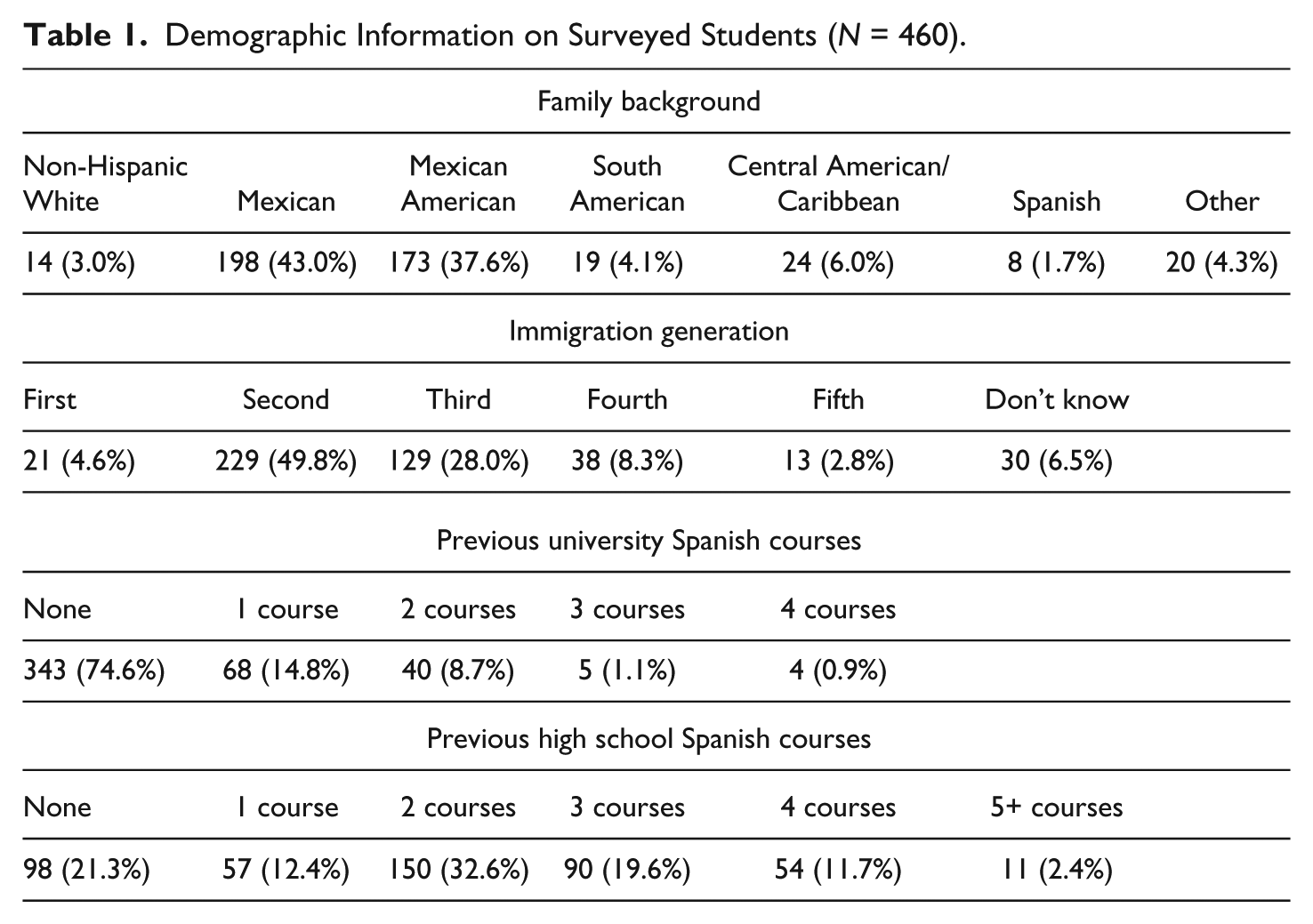
The first section of the survey requested demographic information. Among the instructors, there were seven females and two males. Seven of them were completing their PhD studies at the university, and two were master-level students. Students ranged in age from 18 to 43, with a mean of 19.6 years. A majority of the students were female (329, or 71.5%) and the rest male (131, or 28.5%). Most were born in the United States (393, or 85.4%). Only 67 (14.6%) were born in foreign countries, overwhelmingly México (56, or 83.6%). With regard to their dominant language (i.e., Spanish, English, or other), 312 students (67.8%) reported being English dominant, 133 (28.9%) were Spanish dominant, and 15 (3.3%) reported either equal fluency or another dominant language. Table 1 summarizes the students’ family backgrounds, immigration history, and previous high school and university Spanish courses.
Demographic Information on Surveyed Students (N = 460).
Results
The results are presented by topic, with priority given to the quantitative data and qualitative data being used to explicate or elaborate on the quantitative results. The data were analyzed using chi-squares (5 items), independent t tests (20 items), and one-way ANOVAs (student course-level comparisons).
Language Use in the Classroom
Participants were first asked which language they preferred for classroom instruction (Item 1) and which type of Spanish they would like to use for assignments and in the classroom (Item 2). Results for students by course level and instructor are presented in Table 2.
Student Preferences Regarding Language Use.

For Item 1, the results show that overall students strongly preferred the use of only Spanish in the classroom (chosen by 61.4%). In contrast, instructors tended to view the use of Spanish and Spanglish as most effective (55.6%). The second most preferred option for both groups was Spanish and English. To determine whether the differences in perception between students and instructors were significant, the results were subjected to a chi-square test. The results were significant, χ2(3, N = 469) = 14.96, p < .01. Perceptions among student cohorts also differed significantly depending on the course level, χ2(12, N = 460) = 143.4, p < .01. In Course Level 1, a majority of students considered both Spanish and Spanglish as preferable, but students in Course Level 2 and to a greater extent, Courses 3, 4, and 5 selected Spanish only as their choice for the classroom (49.2% vs. 71.8%, 82.4%, and 73.6%). The qualitative responses from the in-depth interviews revealed that students were eager to learn Spanish without relying on English to support their language gaps, as a student in Course Level 2 explained:
I think in terms of Spanish my biggest issue, and I find this kind of to be the issue with everyone who is a heritage learner within English and Spanish, is the tendency to either switch to just Spanglish, or to make up words . . . and I think in order to fix that, I’d say there has to be, I guess, more of an opportunity for formal discussion as well, where you can’t just sort of throw in an English word here or there; there has to be a setting where you have to speak Spanish itself, because I think that will help people to get a better comprehension of the language.
The instructors interviewed, however, spoke of the challenges in leaving English out of the classroom and requiring students to use Spanish only:
We have a lot of group work in class . . . but I think at this level there are still those students who don’t have the same, they don’t feel as comfortable speaking Spanish. . . . It’s difficult to get them to speak, and I’m not sure if I’ve actually been successful in doing that. Because even when I walk around and I see them speaking English, I ask them to speak in Spanish, but it’s difficult for them to actually maintain that, and often times they just kind of let other people who they assume speak better speak.
Results for Item 2 showed a higher level of agreement among students and instructors; a majority of students (56.1%) and instructors (88.9%) believe that using a combination of academic and informal Spanish is the more effective choice for instruction. Although instructors expressed a much greater preference than students, the chi-square test found no significant differences between the two groups, χ2(2, N = 469) = 3.87, p > .05. There were however significant differences among students according to course level, χ2(8, N = 460) = 37.84, p < .01. Whereas a majority of students in Course Level 1 preferred the use of both academic and informal Spanish (79.3%), the level of preference decreased as the course level increased, with a slight majority of students in Levels 4 (56.5%) and 5 (50.4%) preferring academic Spanish.
Grammar and Spelling in the SHL Classroom
Using a 6-point Likert-type scale that ranged from 1 (strongly agree) to 6 (strongly disagree), the next items on the questionnaire addressed perceptions on grammar and spelling and the type of practice that participants found most effective. Means, standard deviations, and mean differences were obtained for all students’ and teachers’ responses. One-sample t tests were calculated to identify any significant differences between students and instructors. Due to the large number of t tests (20), alpha levels were adjusted to .0025. The results appear in Table 3.
Student and Instructor Perceptions Regarding Spelling and Grammar.

Indicates significant results at .0025 p value.
Both students and teachers agreed that studying grammar and spelling was essential to becoming more proficient in the language: Their responses oscillated between “strongly agree” and “agree” with no significant differences between the two. Students assigned less importance than teachers to using language in real contexts, with students’ responses almost reaching the “somewhat agree” level (M = 2.83) and teachers’ answers reaching “agree” (M = 1.78). Both students and teachers disagreed with the statement that grammar should be presented by example only without explanations, with answers reaching or almost reaching the “somewhat disagree” level. Students overall lean toward disagreeing that teaching grammar by providing examples then letting them figure out the rules is effective, whereas teachers overall agree with it. These differences are only trends that lack statistical significance, but they support the finding for Item 8. Significant differences were found between students and instructors with respect to the value of explaining grammatical rules before giving examples. Whereas students agreed with this (M = 1.63), teachers tended to disagree (M = 3.67).
One-way ANOVA tests showed significant levels of disagreement among students for 3 of the 6 variables: importance of grammar, F(4, 460) = 9.16, p < .001, importance of spelling, F(4, 459) = 22.35, p < .001, and greater importance of communication than grammar or spelling, F(4, 453) = 14.36, p < .001. The differences for Variable 3 do not appear to be of practical significance, as students’ answers oscillate from “strongly agree” to “agree.” For Item 4, students in Course Level 1 do not agree that spelling is important to the same extent as their peers in Levels 3, 4, and 5 (C1 = 2.55 vs. C5 = 1.49). Regarding Item 5, learning to use language in real-life contexts is more important for students in Levels 1 and 2 than for students in higher course levels. There are no significant differences among students in the different levels with respect to the type of grammar presentation they favor (Variables 6, 7, and 8).
Corrective Feedback
The survey next asked students and teachers to express their opinions on the role of corrective feedback, or error correction, in the SHL classroom, with items presented on a 6-point Likert-type scale that ranged from 1 (strongly agree) to 6 (strongly disagree). The results appear in Table 4.
Student and Instructor Perceptions Regarding Corrective Feedback.

Indicates significant results at .0025 p value.
These results showed significant disagreement between teachers and students regarding error correction. Whereas students agreed or strongly agreed that all errors should be corrected in both writing and speaking (1.49 and 2.07, respectively), teachers somewhat agreed for writing and disagreed for speaking (3.44 and 4.67) that errors should be corrected. None of the groups agreed that only main errors should be corrected. Interestingly, there is a high level of agreement among students for the corrective feedback variables. One-way ANOVAs showed no significant differences for Variables 10, F(4, 456) = 2.80, p > .05, and 11, F(4, 458) = 0.34, p > .05. Variable 9 showed significant statistical differences—F(4, 460) = 12.35, p < .001—but no practical differences because student groups ranged between “agree” and “strongly agree.” The following comment captures students’ perceptions about error correction and highlights that students not only expect to be corrected but also prefer instant feedback: “I think that it’s essential, because if you don’t correct it, people go on thinking that it’s ok. So if you correct it at the moment, you get it and you realize it and you learn it.” Students’ qualitative comments also stressed their strong desire to receive extensive and detailed feedback on writing assignments, as this comment illustrates: “Within writing, I would definitely love to have more feedback, and let me know what’s going on and what I’m doing wrong, that way I can improve.”
Culture
The results for Items 12 through 16 show that students and teachers coincide in their perceptions of the different cultural aspects elicited in the survey, with no significant differences between the two (see Table 5). Teachers and students concurred that culture should be integrated into daily activities (1.22 and 2.36, respectively). Similar levels of agreement were also found for the statement that teachers should have extensive knowledge of Spanish-speaking countries and cultures (1.56 and 2.40). Similarly, both teachers and students somewhat disagreed or disagreed that teachers ought to be of the same cultural background as the students (4.22 and 4.13) or teach students only about their specific culture (5.33 and 4.77). On the contrary, they agree that readings should be drawn from all cultures (1.33 and 2.20). Agreement was also strong across course levels, because the one-way-ANOVA tests showed no significant differences among student groups. Student interviews further reinforced that students assigned high importance to culture as a component of their Spanish learning, because they felt strong connections to Hispanic cultures, as the following comment illustrates:
I think it makes it that much more interesting, because we’re not just learning about pronunciation or grammar or sentence structure or how to write an essay . . . we’re learning about us and, like, how our ancestors, well maybe not our ancestors, but how the different Hispanic peoples live in the United States and other Latin American countries, and it’s just so exciting, like I know, almost every day I have class, I go home and I tell my mom, “Mom, I learned this,” and “Oh my God, Mom, I didn’t know this.” And it’s so nice because now we have something to talk about and, I don’t know, it’s really cool.
Student and Instructor Perceptions Regarding Culture.

Indicates significant results at .0025 p value.
Materials, Instructional Strategies, and Tools
The same statistical analysis was repeated for Items 17 through 22. The results appear in Table 6.
Student and Instructor Perceptions Regarding Materials, Instructional Strategies, and Tools.

Significant result at .0025 p value.
The results show that students and teachers overall agree or strongly agree with respect to the use of certain materials and strategies, including the use of visual aids, technology, pair work, and activities that focus on all skills. Both groups also disagree with relying primarily on the textbook for classroom instruction. The only area where students and teachers’ perceptions differed significantly related to the use of lectures in classroom instruction with students agreeing (2.81) and teachers disagreeing (4.67). The one-way ANOVA results showed significant differences across student course levels only for Item 20 (lecture style), F(4, 460) = 5.02, p = .001. For most course levels, the most frequent answer was that students “somewhat agree” with the statement that lecture should be the mode of instruction most of the time, whereas students in Course 5 agreed with it.
Regarding the preferred focus for practice, presented in Table 7, a majority of both students and teachers agreed on “speaking” for in-class practice and “reading and writing” for practice outside class. Both groups also preferred to practice speaking with all types of others: family members, native Spanish speakers, and classmates. Student interviews reaffirmed the importance to students of this type of practice:
It was my first language, so for me, just practicing it with others . . . I manage two Cricket stores. A lot of Hispanics come in, so practicing it with them, I definitely have seen I’ve done better. I’ve expanded my Spanish a lot more after taking this course, because obviously I was brought up speaking Spanish, but you’re always in your circle, so if you practice a lot more the words that you learn here, or at work, and the more you speak the more you kind of try, I think that has a very positive effect on learning a language overall.
Student and Instructor Perceptions Regarding Focus of Practice.

Chi-square tests showed no significant differences between students and teachers for focuses of in-class practice, χ2(3, N = 469) = 2.31, p > .05, and out-of-class practice, χ2(3, N = 469) = 5.81, p > .05. There were significant group differences across student course levels for in-class activities, χ2(12, N = 460) = 48.66, p < .001, and for type of speaking practice, χ2(12, N = 460) = 21.34, p < .05, but not for out-of-class activities, χ2(12, N = 469) = 15.79, p > .05. A large majority of students in Course 1 preferred speaking practice for in-class activities (82.8%), whereas very few in this group preferred to focus on grammar and spelling (3.4%). For the rest of the course levels, students’ preferences are more evenly distributed among writing and reading practice, speaking, and grammar and spelling.
Discussion and Implications
The first question that guided this study related to students’ and teachers’ perceptions on effective HL instruction and whether the two groups’ perceptions differed. Although there were areas of agreement and disagreement between students and instructors, the areas of agreement far outnumbered the areas of disagreement (20 out of 25, or 80%). Overall, there was strong agreement on the majority of items related to culture, spelling and grammar, materials, instructional strategies and tools, and type of language practice. This result indicates that students’ and teachers’ perceptions match to a high degree, and SHL instructors are attuned to student needs and preferences.
Nevertheless, disagreement in key areas of instruction is likely to cause tension in the classroom. For example, students and teachers disagreed on language use in the classroom: Whereas a majority of students favor the use of Spanish only, instructors prefer using both Spanish and Spanglish. In other words, whereas teachers welcome a bilingual class and allow the use of Spanglish, students tend prefer a more formal, Spanish-only environment. At the same time, the students’ habit of using Spanglish may prove to be difficult for instructors to break.
Similar discrepancies are found in the type of grammar instruction that is deemed most effective. Students strongly prefer having grammar or spelling rules explained to them before they hear examples (i.e., a deductive approach), whereas teachers prefer to present students with examples and have them figure out the rules (i.e., inductive approach). Resolving this difference is crucial because it affects the daily delivery of instruction in the many SHL courses addressing grammar and spelling (see Beaudrie, 2011). The same is true for the disagreement over the style of lesson delivery, where students support lectures but teachers overall do not. Another key area of instruction that provoked disagreement was corrective feedback. Students would prefer to have both their oral and written language errors corrected, whereas teachers are more hesitant about error correction, especially in speaking. This result is consistent with Ducar’s (2008) findings in which as much as 96% of students surveyed indicated that they wanted to be corrected. Students have a clear desire to receive feedback on their language production, perhaps because of their lack of confidence in their Spanish ability or simply because they have benefited from error correction in prior courses. Regardless of the reason for the divergence, it is the teacher’s task to explain her or his instructional choices and find common ground with students. 2
Comparing the areas of disagreement identified in the present study with prior research shows interesting commonalities. In fact, the findings of this study exactly parallel the areas of teacher–student divergences found in Brown (2009) in his study of foreign language instruction. Thus, these findings represent strong evidence that the complex areas of grammar instruction, error correction, language use, and lecture- versus group-work-style instruction are areas where the perceptions of students and instructors diverge, and therefore, they should receive special consideration in classroom language instruction. These contradictions can lead to student disillusionment if they feel that their expectations of language study are not met in the classroom. I do not suggest that teachers should necessarily follow students’ preferences solely for the purpose of increasing their level of satisfaction. Rather, I advocate that teachers engage in open dialogue with students on their perspectives on effective practices and address any discrepancies that may arise (see also Brown, 2009; Peacock, 2001; Schulz, 2001).
The second research question addressed differences among the five levels of students who participated in this study. Results showed that for 18 out of 25 items (72%), there were no significant differences according to course level. Perceptions differed only for Items 1, 2, 4, 5, 20, 23, and 25. In five of these instances (71%), the lowest level of students expressed different perceptions than the more advanced groups; Course Level 4 had different perceptions on only two of the variables, and Course Level 2 for only one item. It is evident that Group 1, probably due to its low level of language proficiency, has different needs and expectations than the other groups in this sample, which led to their different perceptions on certain items. Teachers should be aware that learners of different levels may have different preferences and, therefore, should not assume that their experiences with students at a certain level will match students at different levels.
Limitations and Future Research
Some limitations of the study should be noted. First, the survey was conducted toward the end of the semester. Students’ perceptions may have been influenced by the type of instruction and teaching style of the teacher whose course they were enrolled in. Another consideration to bear in mind when interpreting results is that the SHL program in this study regularly surveys students and teachers and modifies the curriculum based on their needs and preferences. The high level of agreement between teachers and students may reflect this practice, which is particular to this program. Finally, students and teachers’ perceptions on instructional effectiveness are limited to the pedagogical areas presented in the survey. Other features not included in the survey may also contribute to the makeup of an effective classroom.
The present study represents only the beginning of research addressing perceptions on effective instructional practices. Future research on instruction in the SHL classroom should include, when appropriate, students’ perceptions on effectiveness. Also, expanding this study to other HLs would take us a step further in determining effective instructional practices. Further research to determine how students’ perceptions do or do not match with objective learning gains will be crucial to inform teachers of the role of student perceptions in their classroom practices. In addition, teachers need to undertake more action research studies to explore key areas of instruction in intact classroom settings, thus contributing to our understanding of effective practices in the HL classroom.
Conclusion
Although previous studies in the SHL context have examined students’ perspectives on multiple linguistic and cultural issues, the present study is the first to compare students’ and teachers’ perceptions on instructional effectiveness. This line of research is essential for a number of reasons. First, the U.S. university system assigns tremendous value to student evaluations, which are often the only measure of teaching effectiveness. Thus, teachers strive to achieve effective practices but may encounter obstacles when effectiveness is measured only by students who may not always agree with their teaching practices. Second, at a time when student-centered education is a centerpiece in education, students’ opinions should be a critical component in determining effective pedagogical practices. Third, a mismatch between teachers’ and students’ perceptions is likely to hinder students’ motivation for language learning, which in turn, can affect their learning (Kern, 1995; Williams & Burden, 1997). It is then essential to raise instructors’ awareness through research studies such as this one so that they can be more cognizant of potential matches and mismatches between their own and students’ perceptions.
In sum, what are the most common student and teacher perceptions of effective SHL instruction? Based on the results of this survey and follow-up interviews, teachers and students agree that in an effective SHL classroom, both academic and informal Spanish are used. Grammar and spelling instruction are essential in gaining linguistic proficiency. Culture also plays a fundamental role and is included in daily lesson plans. Cultural instruction is varied and includes content that reflects the diversity of Hispanic cultures. Instruction incorporates visual aids, technology, and pair work, rather than relying primarily on a textbook. In-class practice focuses on speaking, whereas out-of-class practice focuses on reading and writing. Students feel that an effective SHL classroom allows only Spanish during instruction, but instructors do not necessarily agree. Students also prefer to have grammatical rules explained to them before being given examples, and they appreciate error correction in both speaking and writing. They also value the inclusion of lectures during instruction. In contrast, teachers feel that an effective SHL classroom allows both Spanish and Spanglish during instruction. Grammar presentations consist of examples that give students the opportunity to have an active role in figuring out the rules. Also, communication is a higher priority than error correction in writing and particularly speaking.
Overall, these findings suggest that although educators can expect their students to agree with many of their instructional practices, not all of what educators believe to be important or effective may coincide with what the students expect and feel they need. This highlights the importance of discussions between teachers and students to reach consensus about effective instruction in the SHL classroom. It is imperative to determine what students expect at the beginning and throughout each semester and at the same time explain the main pedagogical activities, methods, and tools used in the classroom so as to prevent student dissatisfaction and disengagement. This study has also found that students with different levels of linguistic proficiency, especially those at the lower levels, may not completely agree on what is effective for their language learning. SHL teachers should be cognizant of these potential differences and be prepared to explore and address them when teaching different course levels within an SHL program.
Footnotes
Appendix A
Appendix B
Acknowledgements
My most sincere thanks to Bonnie Holmes for her assistance with the coding and transcription of this project and to all the Spanish as a heritage language (SHL) students and instructors who volunteered in the study.
Declaration of Conflicting Interests
The author(s) declared no potential conflicts of interest with respect to the research, authorship, and/or publication of this article.
Funding
The author(s) received no financial support for the research, authorship, and/or publication of this article.