



Abstract
Hispanic-Serving Institutions (HSIs) enroll the majority of Latina/o students in higher education; however, it is unclear how HSIs influence Latina/os’ postsecondary experiences. In this study, we examined how the Latina/o student experience differed between students who did and did not attend 4-year HSIs. The results suggest that HSIs generally have positive, but modest, effects on Latina/o’s student engagement and self-perceived gains. The differences were more pronounced for first-year students than seniors.
Over the next decade, the number of Latina/o high school graduates will likely increase by more than 40%, with many going on to college (Western Interstate Commission for Higher Education, 2012). Hispanic-Serving Institutions (HSIs) enroll about 60% of Latina/o undergraduates (Excelencia in Education, 2014), making HSIs critical to improving the educational attainment of Latina/os. Nearly every HSI began as majority-serving and evolved into an HSI as the demographics of their student body changed over time (Raines, 1998). Despite the growth in HSIs, it is unclear how HSIs influence the educational experiences of Latina/o students.
This article updates and expands upon previous research assessing the Latina/o undergraduate experience at 4-year HSIs. Nelson Laird, Bridges, Morelon-Quainoo, Williams, and Salinas Holmes (2007) asked whether campus demographic profile influenced student engagement, but did not find substantial differences by HSI status. Recognizing the rising enrollment of Latina/o students, many HSIs have increased programming and services designed for Latina/o undergraduates. Thus, this study revisits the issue and investigates whether the impact of attending an HSI has changed over the past decade.
HSIs
Overview
The HSI campus designation is a product of the advocacy of the Hispanic Association of Colleges and Universities (HACU; Laden, 2001). The designation recognizes postsecondary institutions where Hispanics comprise at least 25% of the student body at the urging of HACU (2014), the HSI moniker was later adopted by the federal government in 1992 and codified via amendments to the Higher Education Act of 1965 (2013). Thus, HSIs are distinct from Historically Black Colleges and Universities (HBCU) and Tribal colleges in that HSI designation is derived from their enrollment profile, not their founding mission. The Higher Education Act of 1965 (2013) allows non-profit HSIs with substantial enrollments of needy students to apply for grants under Title V to strengthen their educational offerings.
Nearly all HSIs have gained the designation over the last 30 years, due to the changing demography of American college students (Laden, 2004). HSIs are located in areas with high concentrations of Latina/os and are typically found in states adjacent to the Mexican border, plus Florida and Puerto Rico (Li, 2007). Compared with 4-year non-Minority Serving Institutions (MSIs), HSIs are more likely to have open admissions policies and less likely to offer doctorates than non-MSIs. Among baccalaureate-granting institutions, HSIs also have lower graduation rates than non-MSIs (Li, 2007). Due to these traits, HSIs generally have lower than average levels of institutional prestige in America’s stratified higher education system.
Of the Latina/o undergraduates enrolled in public 4-year institutions, a third attended HSI, one-half enrolled in non-MSIs, while the remainder attended other MSIs (Li, 2007). Latina/o undergraduates attending HSIs are more likely to be female, low income, and older than their peers at non-MSIs (Li, 2007). In addition, Latina/o students who attended larger high schools, had higher percentages of Hispanic K-12 teachers, and valued attending college close to home were more likely to attend an HSI (Núñez & Bowers, 2011).
The HSI Environment
Faculty attitudes and perceptions do not substantially differ between institutions with low and high Latina/o enrollment (Hubbard & Stage, 2009). However, Latina/o faculty and administrators are more common at HSIs (Laden, 2001), which can help to create an environment that can potentially aid and empower Latina/os (Arana, Castañeda-Sound, Blanchard, & Aguilar, 2011; Dayton, Gonzalez-Vasquez, Martinez, & Plum, 2004; Maestas, Vaquera, & Muñoz Zehr, 2007; Torres, 2006). Arana and colleagues (2011) showed that supportive family and peers and cultural connections to the institution helped Latina/os persist.
Garcia (2013) found that institutional selectivity and resources correlated to college completion for Latina/os. This suggests that institutional context is an important factor in Latina/os’ college success. This notion is supported by other research relating academic and social integration to students’ sense of belonging at HSIs (Maestas et al., 2007) and Latina/o’s cultural integration to their grades at Predominantly White Institutions (PWIs; Cerezo & Chang, 2013).
Impact of Enrollment at an HSI
Campus environment has a profound impact on a student’s experience, interactions, engagement, and satisfaction with the institution (Kuh, 2000; Musoba, Collazo, & Placide, 2013; Smart, Feldman, & Ethington, 2000). Students of color who feel supported in college are also more satisfied with their campus experience and more likely to be engaged in extra-curricular activities (Hurtado, Cuellar, & Guillermo-Wann, 2011). Yet, research on focusing on how differences between HSIs and non-HSIs influence student outcomes is mixed.
Nelson Laird et al. (2007) found positive and significant differences between Hispanic seniors who enrolled at HSIs and PWIs on Active and Collaborative Learning, Supportive Campus Environment, and Gains in Overall Development. However, the magnitude of the differences was small, leading them to conclude that “the average Hispanic senior at an HSI looks quite similar to the average Hispanic senior at a PWI in terms of engagement, satisfaction with college, and gains in overall development” (Nelson Laird et al., 2007, p. 39). Cuellar (2014) found that academic self-concept was lower for Latina/o first-year (FY) students at HSIs and emerging HSIs compared with non-HSIs. However, students attending institutions with substantial Latina/o populations had substantial gains in academic self-concept by their senior years, thus closing the gap between their peers attending non-HSI institutions.
There is mixed evidence on the relationship between attending an HSI and college completion at 4-year institutions. One study using administrative data from Texas found a negative correlation between attending an HSI and college completion (Flores & Park, 2013). However, the same authors subsequently analyzed the same data using a quasi-experimental method and found that HSI attendance was not related to college completion for Hispanic students (Flores & Park, 2015). A third study examining college completion found no association between the representation of Latina/o students and personnel and Latina/o degree completion (Garcia, 2013).
Theory
Student engagement theory guided this study. The theory combines Astin’s (1984) student involvement theory, Pace’s (1984) quality of student effort concept, and Kuh, Schuh, Whitt, and Associates’ (1991) research on the benefits of out-of-class activities. Despite their different approaches and terminology, these authors all essentially argue that students’ learning and development is a product of the time and effort spent purposefully engaged in educationally beneficial activities. Thus, the theory distinguishes between involvement through group membership and engagement through being an active participant of a group.
A distinguishing trait of student engagement theory, compared with the quality of effort concept and student involvement theory, is the emphasis on the role of institutions. While the theory acknowledges that engagement ultimately requires students to act, it highlights the role of institutions in creating an environment that provides opportunities for engagement and a climate that permits and expects students to become involved in educationally beneficial activities both in- and outside of the classroom. This requires having a multifaceted diverse student body, faculty, and staff that maximizes the probability that all students find a sub-community they can “identify with and receive support from people like themselves” (Kuh et al., 1991, p. 369). However, it also requires colleges to create an institutional culture that binds these diverse groups together. Therefore, student engagement theory holds both students and institutions responsible for students’ level of engagement on a campus.
Student engagement theory calls upon HSIs to create an educational environment that supports Latina/o students, despite their roots as PWIs. HSIs should recognize and integrate their Hispanic identity into their mission to educate students, as Latina/os form a substantial portion of the student body. As HSIs tend to enroll more low-income and older students (Li, 2007), they should have programming that facilitates the college transition for these non-traditional populations. In addition, HSIs need to ensure that Latina/os comprise a critical mass of the faculty and staff to serve as mentors and role models students. Furthermore, faculty and administrators should take affirmative steps to create culturally responsive and relevant curriculum for Latina/os that provides visibility for Latina/o scholars, viewpoints, and history (Garcia, 2015).
Research Questions
With the growth of the Latina/o college student population and rise of HSIs as a class of institutions, it is important to understand better how HSIs influence Latina/o undergraduates. Thus, guided by student engagement theory, we explored the following research questions:
Method
Data
To answer these questions, we utilized data from the 2013 and 2014 administrations of the National Survey of Student Engagement (NSSE). NSSE is a large, multi-institutional survey designed to assess how baccalaureate-seeking students engage in a variety of educationally beneficial activities. The survey is administered annually to FY and senior students from February to May. We limited our data analyses to randomly sampled FY and senior students identified as Hispanic or Latina/o by their institutions, and who took at least one course on campus. A total of 19,495 FY and 24,600 senior students at 782 institutions met our criteria and responded to NSSE, respectively. Our data contain respondents from 37 of the 95 (39%) baccalaureate-granting HSIs identified by the Carnegie classifications program (Carnegie Foundation for the Advancement of Teaching, 2014).
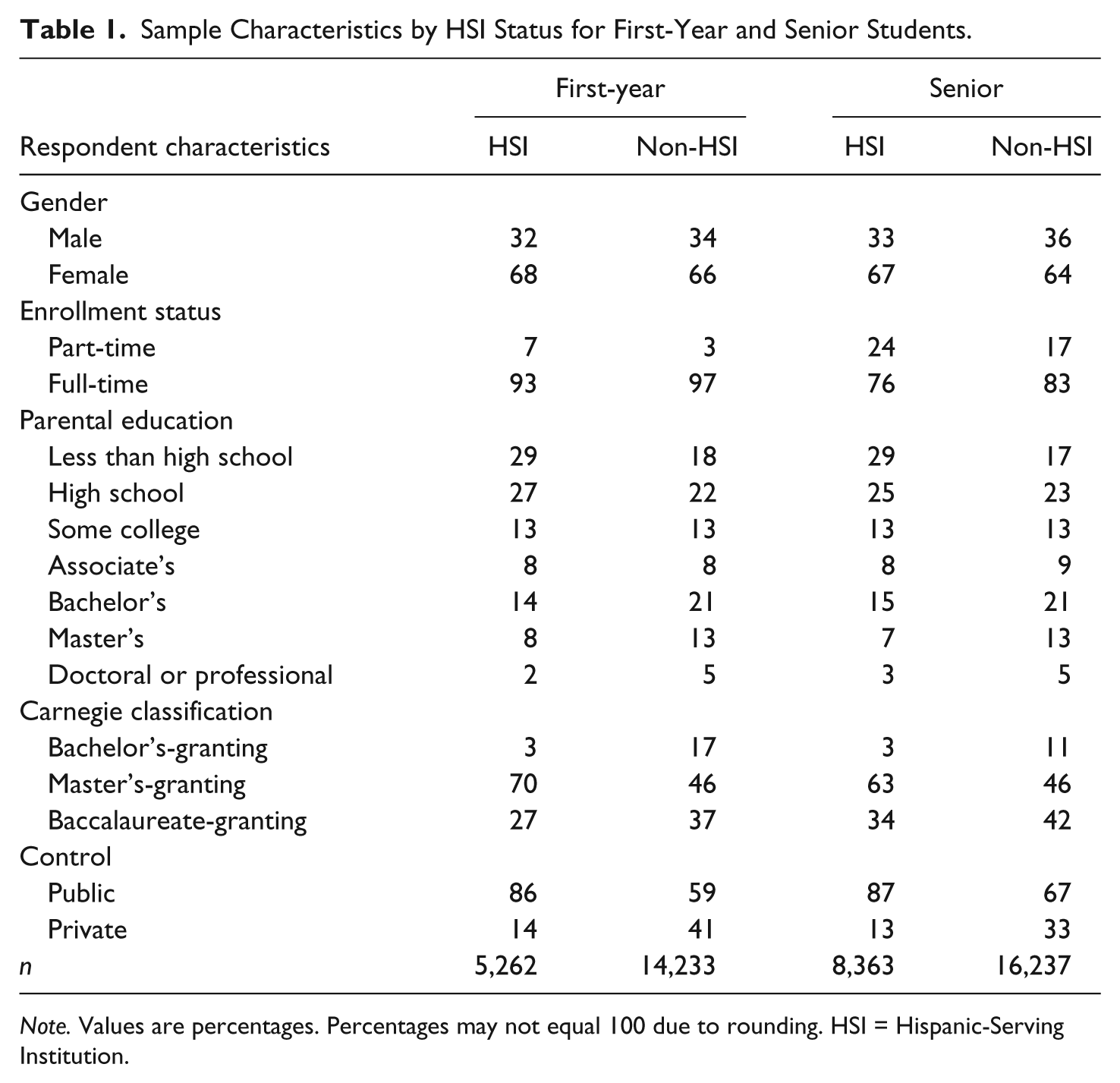
Table 1 contains the sample characteristics by HSI status for FY and senior students. About two thirds of the sample was female, with little variation by HSI status or class standing. The vast majority of FY students enrolled full-time, although students attending HSIs were slightly more likely to enroll part-time. Among the seniors, 24% and 17% of HSI and non-HSI students enrolled part-time. For both FY and senior students, students enrolled at HSIs on average had lower parental education levels than their peers at non-HSIs. Most of the HSIs had an aggregated Carnegie classification of master’s-granting, while the classifications at non-HSIs were more evenly distributed. Similarly, the HSI institutions were primarily publicly controlled (87%), while 59% and 67% of the FY and senior students at non-HSIs attended public institutions. The Hispanic enrollment proportion was 60% and 13% at HSIs and non-HSIs, respectively.
Sample Characteristics by HSI Status for First-Year and Senior Students.
Note. Values are percentages. Percentages may not equal 100 due to rounding. HSI = Hispanic-Serving Institution.
Due to the exploratory nature of the study, we examined the NSSE Engagement Indicators (EI) and students’ PG. The EIs are the successors to the NSSE Benchmarks and are valid measures of group-level behaviors and perceptions (NSSE, 2014). PG is a composite measure of 12 items asking students how their institution improved their knowledge, skills, and personal development. The survey items comprising these measures and their reliabilities are located in the appendix. The other core variable of interest was the HSI status of the respondents’ institution. This variable was merged into the data set from the Carnegie Classifications Data File (Carnegie Foundation for the Advancement of Teaching, 2014). In addition to these measures, we used data collected via the NSSE instrument or from institutions on students’ age, gender, parental education, major, residence, standardized test score, and time spent working. We also utilized data on the following institutional characteristics: Basic 2010 Carnegie Classification (aggregated), control, locale, enrollment size, and 25th percentile SAT/ACT score.
We used multiple imputation via chained equations (MICE) to impute missing data, as multiple imputation is a preferable method to work with missing data (Allison, 2001), and studies show that MICE outperforms alternative imputation techniques (van Buuren, 2007; Yu, Burton, & Rivero-Arias, 2007). A total of 20 imputations were created for each missing data value. Continuous variables were imputed using predictive mean matching, while binary, ordinal, and categorical variables used logistic, ordinal logistic, and multinomial logistic regression, respectively.
Analyses
We performed the following analyses for each of the 11 outcomes and for FY and senior students, separately. Our initial analyses compared the outcome means by HSI status using two-sample t tests. Next, we used the Blinder (1973)–Oaxaca (1973) counterfactual decomposition technique to investigate differences in the EIs by HSI status. The technique decomposes the mean difference between groups to an explained portion, attributable to differences in characteristics between HSIs and non-HSIs, and an unexplained portion. The latter portion is traditionally used as a measure of discrimination, as the method was developed to study discrimination between groups. However, in this study it represents differences in effectiveness of the two institution types in promoting student engagement.
To decompose the mean differences, we first estimated a pooled regression model with the observed student and institutional characteristics including HSI status. Then, we estimated separate regression models for students who did and did not attend HSIs. Next, we estimated the means for the observable characteristics by HSI status. We then used the above results to decompose the mean differences into an explained and unexplained portion. The explained component shows how much of the mean difference was explained by differences in observable characteristics between students who did and did not attend an HSI. In contrast, the unexplained component shows how much of the difference was attributable to differences in the regression coefficients between models for HSI and non-HSI students. It also quantifies the costs or benefits of attending an HSI over a non-HSI. We used this approach on the advice of Jann (2008) due to the exploratory nature of our study and because prior research does not suggest that the coefficients of one group are discriminatory in a single direction. We also normalized the categorical variables as the choice of the reference group influences the results of the unexplained component (Yun, 2005). We estimated the decomposition analyses using the OAXACA program for Stata (Jann, 2008). We adjusted the standard errors in all analyses to account for the clustered nature of our data and the uncertainty of the imputation.
Results
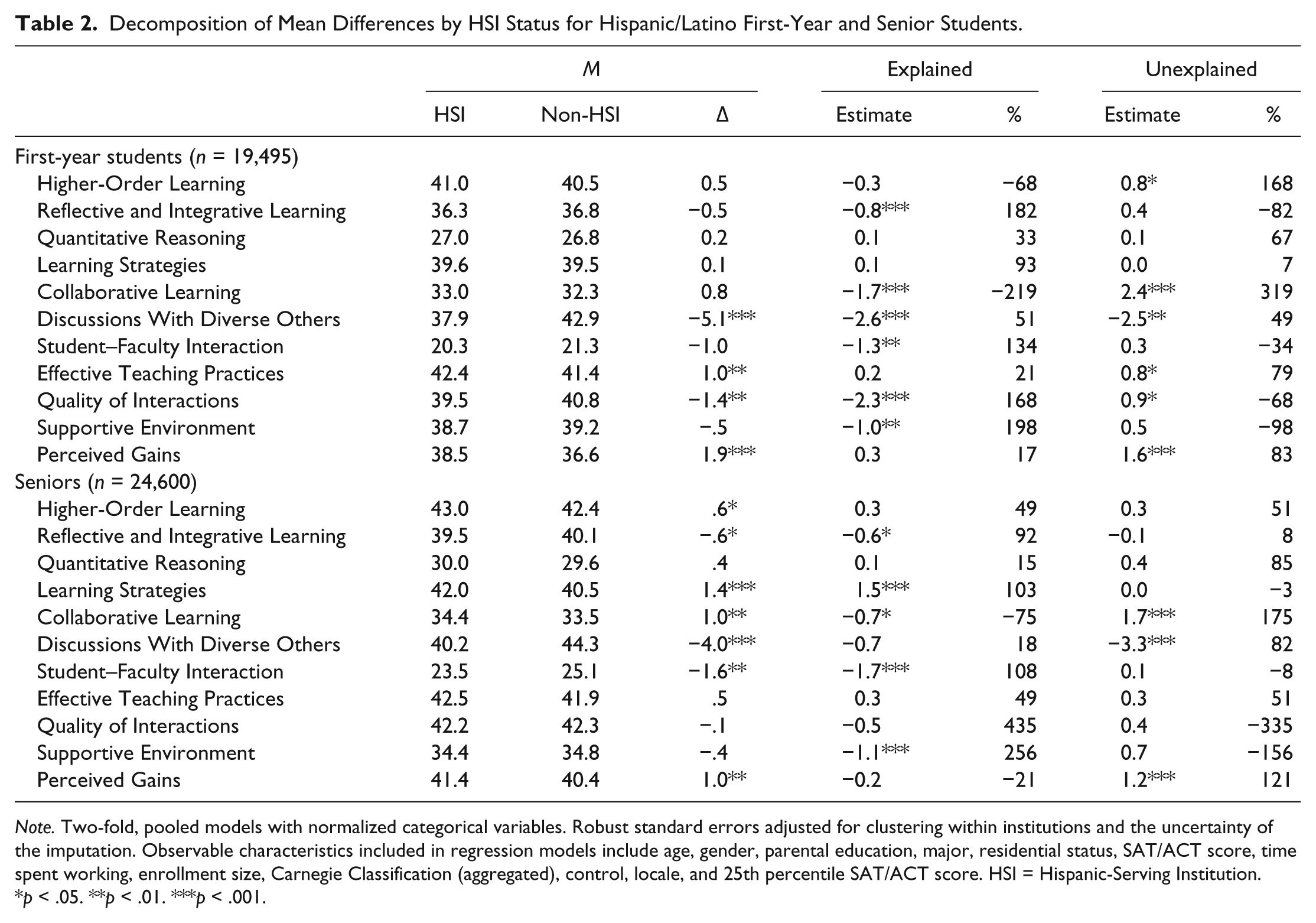
We present the study’s results in two sections, one each for FY and senior students. The sections begin by looking at descriptive mean differences between HSIs and non-HSIs and then presenting the Blinder (1973)–Oaxaca (1973) decomposition results. Table 2 contains the overall study results for both FY (Panel 1) and senior (Panel 2) students.
Decomposition of Mean Differences by HSI Status for Hispanic/Latino First-Year and Senior Students.
Note. Two-fold, pooled models with normalized categorical variables. Robust standard errors adjusted for clustering within institutions and the uncertainty of the imputation. Observable characteristics included in regression models include age, gender, parental education, major, residential status, SAT/ACT score, time spent working, enrollment size, Carnegie Classification (aggregated), control, locale, and 25th percentile SAT/ACT score. HSI = Hispanic-Serving Institution.
p < .05. **p < .01. ***p < .001.
FY Students
The first section under the mean heading contains the mean for students who did and did not attend a HSI for each of the EIs and the results from the two-sample t tests. For FY students, those attending HSIs on average had significantly fewer Discussions With Diverse Others (DDO) and poorer interactions with members of the campus community than their peers enrolled in a non-HSIs. However, students at HSIs reported that their instructors were more likely to use Effective Teaching Practices (ETP) and perceive greater gains in their personal and social development. We did not observe significant differences on the remaining outcomes.
Next, we used the Blinder (1973)–Oaxaca (1973) decomposition technique to investigate whether the mean differences are explained by observable characteristics or are function of the different student experience at HSIs and non-HSIs. The explained columns detail how much of the difference in means was explained by differences in observable characteristics between HSIs and non-HSIs. These differences could be attributable to institutional characteristics like selectivity or Carnegie Classification or student characteristics like gender or the amount of time spent working. In contrast, the unexplained columns show how much of the difference was unexplained and attributable to differences in the regression coefficients between models for HSI and non-HSI students. The unexplained difference estimate has historically been referred to as the discrimination parameter as it estimates the differences in the strength of the relationship between the observable characteristics and the outcome. In this study, the unexplained coefficients show whether HSIs were more or less effective in promoting the EIs and PG than non-HSIs. For DDO, about half the mean difference was a function of the difference in the student and institutional characteristics between HSIs and non-HSIs, while the remaining difference was unexplained. The explained difference for Quality of Interactions (QI) was larger than the observed difference. Thus, the unexplained QI estimate was significant and positive. If the students at HSIs and non-HSIs had the same profiles, we would expect HSIs to have higher QI means than non-HSIs, in contrast to the simple mean difference, which favored non-HSIs. For ETP and PG, about 20% of the observed mean differences could be explained due to differences in the observables. The unexplained portion of the difference for both outcomes remained positive and significant.
The decomposition results also provide additional context to the variables not found to be significantly different in the t tests. For Collaborative Learning (CL), the unexplained coefficient was 2.4, indicating that HSIs promote engagement in CL activities beyond what would be expected given the characteristics of HSIs. A similar, but smaller in magnitude, effect was observed for Higher-Order Learning (HOL). For Reflective and Integrative Learning (RIL), Student–Faculty Interaction (SFI), and Supportive Environment (SE), observable characteristics accounted for a significant portion of the unadjusted mean difference between the groups. However, the unexplained coefficients were not significant, indicating that HSI and non-HSI institutions would have statistically equivalent means on these measures if they contained the same student populations.
Seniors
The t-test results for seniors indicate that HSIs had higher means on HOL, Learning Strategies (LS), CL, and PG than non-HSIs. The opposite was observed for RIL, DDO, and SFI. The decomposition results indicated that virtually the entire mean differences for RIL, LS, and SFI were due to differences in observable characteristics. For HOL, characteristic differences explained about half of the simple mean difference, reducing the unexplained estimate to a non-significant .3. Thus, if HSIs and non-HSIs enrolled students with similar characteristics, we would expect the institution types to produce equivalent means for the outcomes above. Only a fifth of the mean difference for DDO could be explained by differences in observed characteristics. The unexplained difference suggests that non-HSIs have an unexplained advantage in promoting DDO over HSIs. For CL and PG, observable characteristics explained a negative percentage of the observed mean differences. Therefore, if both groups had the same characteristics, we would expect the magnitude of the observed mean difference between HSIs and non-HSI to increase.
Discussion
In the two decades since the federal recognition of HSIs as a class of institutions, a small but growing body of research has focused on how HSIs affect the educational experiences of Latina/os. The findings of the existing literature are mixed. Some studies found that HSI status or the percentage of Latina/o students has no appreciable relationship with Latina/o student engagement and college completion (Flores & Park, 2015; Garcia, 2013; Nelson Laird et al., 2007). In contrast, another study found a negative correlation between HSIs and college completion (Flores & Park, 2013). Yet, others have found that HSI and emerging HSI enrollment are correlated with greater gains in Latina/os’ academic self-confidence by the senior year (Cuellar, 2014).
Given these mixed findings, we examined how the Latina/o student experience differed between students who did and did not attend HSIs for both FY and senior students. Using the Oaxaca–Blinder decomposition technique, we generally found that HSI attendance either had no or a positive relationship with student engagement and PG after accounting for observable differences between HSI and non-HSI students. Among FY students, the results found significant and positive unexplained effects of HSI attendance for HOL, CL, ETP, QI, and PG. For seniors, the same was true of CL and PG. However, we observed negative unexplained differences for HSI enrollment on the DDO EI for both FY and senior students.
While the above results were significant, many of the unexplained differences were of a relatively small magnitude. NSSE researchers recommend classifying effect sizes less than .10 as trivial, .10 to .29 as small, .30 to .49 as medium, and .50 or above as large (Rocconi & Gonyea, 2015). None of the effect sizes in this study could be classified as medium or large, while the only differences falling into the small category were CL and DDO for both FY and senior students and PG for FY students. Thus, it appears that the unexplained effects of HSI attendance on student engagement and PG are relatively modest. Furthermore, our findings comport with Nelson Laird and colleagues’ (2007) study comparing Hispanic seniors of the 2003 graduating class at PWIs and HSIs, indicating that the effectiveness of HSIs on the senior experience has not appreciably changed over the past decade.
The most likely reason for the relatively modest impacts and their persistence over time is that unlike HBCUs and Tribal Colleges, HSIs are defined by their enrollment profile not their founding mission. Thus, HSIs generally have a tradition of serving and catering to the needs of primarily White, not Latina/o, students. It appears that many HSIs have not yet adopted their role in educating Latina/os into their mission or put their new mission into action. This structural inertia is troubling as we, informed by student engagement theory, believe that institutions need to respond to the students they serve and modify their educational environment to best suit the needs of their students. This includes changes to diversify the faculty, staff, and curriculum and create support systems aimed to assist Latina/os.
This is the first study that quantitatively compared the engagement of FY Latina/os enrolled in HSIs and non-HSIs on a large scale. We found significant and positive unexplained differences for HSI attendance on 5 of the 11 outcomes examined. However, only 2 of the senior outcomes met the same criteria. This suggests that HSIs have a greater impact on the FY than the senior experience. There are three primary rationales for this finding. First, the relative homogeneity of the first college year compared with the senior year, where students are distributed among multiple departments, may facilitate institutional efforts to implement a culturally responsive and relevant education for Latina/o students. Alternately, due to their higher than average attrition rates (Li, 2007), HSIs may devote extra resources to the first college year to promote persistence. A third, but less likely, rationale is that the growth of Latina/os recently reached a tipping point, altering the educational environment at HSIs for FY students, but not in time for seniors.
After accounting for observable differences, the only unexplained negative effect for HSIs occurred on DDO. The magnitude of these differences was the largest for seniors and second largest for FY students, indicating that Latina/os at HSIs have fewer discussions with people of another race/ethnicity, from a different economic background, and with different religious beliefs or political views than their peers at non-HSIs. This relationship may occur because Latina/os at non-HSIs are a substantial minority and are essentially forced to interact with peers from different backgrounds. In contrast, the higher prevalence of Latina/os at HSIs may allow Latina/os to self-segregate, which leads to fewer interactions with diverse peers, even in situations where Latina/os constitute a minority of students. The critical mass of Latina/os at HSIs may explain why CL was the other EI with effect sizes greater than .10 for both FY and senior students. Simply, the common backgrounds among students at HSIs may make Latina/os more likely to ask for help from another classmate or join a study group. If this rationale holds true, it highlights the importance of creating a critical mass of various student populations at all institutions.
Several limitations exist for this study. First, the data are drawn from institutions choosing to participate in NSSE. While it includes a large number and range of institutions, these campuses may not be representative of Latina/os seeking baccalaureate degrees. In addition, although we included a wide variety of student and institutional characteristics in our models, we may lack data, such as parental income and program offerings, that may explain part or all of the difference between HSI and non-HSI and thus potentially biasing our results. Third, our analyses treat HSIs as a homogeneous group. Some institutions may have just emerged as an HSI and recently introduced interventions to aid Latina/os. Consequently, our results may mask important variability within HSIs. Furthermore, our data only include students enrolled at 4-year institutions who seek to obtain a baccalaureate degree. Thus, our results are not directly generalizable to 2-year institutions, which are the majority of the HSIs. Finally, our measure of overall educational improvement, PG, is self-reported and is not a direct appraisal of students’ learning and development. However, previous research has correlated similar measures with direct assessments of changes in students’ educational improvement (Anaya, 1999; Astin, 1993).
Implications for Research
This study offers several implications for research. First, the decomposition analyses indicate that HSIs have generally positive, but small, effects on the Latina/o student experience after accounting for differences in student characteristics. However, the results do not suggest the cause of the effects. Possible rationales could include institutional culture, specialized programming, and the presence of a critical mass of Latina/o peers or mentors. This study combined all HSIs into a single category and did not account for the variability between HSIs (e.g., established vs. emerging). Thus, our results may mask important differences between HSIs that should be a focus of future research. While we examined outcomes at both the first and last year of undergraduate study, we were unable to examine long-term outcomes such as income and community involvement. As HSIs are frequently embedded into the Latina/o community, HSIs may influence some of these long-term outcomes.
Implications for Practice
While HSIs generally had positive effects on Latina/os’ engagement after accounting for student characteristics, the magnitude of these effects was relatively modest. Therefore, HSIs have room for improvement in creating an engaging educational environment for Latina/os, particularly when compared with HBCUs. HSIs must continue to integrate their designation into the institutional mission and practice intentionally. Institutions must also accept the responsibility to engage their students and incorporate their diverse interests (Harper & Quaye, 2015). As the presence of Latina/o students continues to build on-campus, the institutions should continue to address the needs and interests of this community. Latina/o students bring multiple identities to campus, which also require support (such as gender, socio-economic status [SES], academic ability). Institutions can support students’ varied identities through targeted programming and interventions. HSIs may also take into consideration the diversity, training, and skills of the faculty and staff (Quaye, Griffen, & Museus, 2015). Do these professionals relate with the changing demography of student body? Are they able to meet changing institutional needs and interests? Finally, community relationships are important for HSIs to build and maintain as majority of students attending HSIs grow up near the institution.
Conclusion
Due to the growth of the Latina/o undergraduate population, HSIs play an important role in educating this important student group. Using a decomposition approach, we found that HSIs generally have small, but generally positive effects on FY and senior Latina/o students’ engagement compared with non-HSIs. This finding comports with previous research on HSIs focusing on student engagement (Nelson Laird et al., 2007) and indicates that many HSIs have not created an educational environment that is especially effective for Latina/os.
Footnotes
Appendix
Declaration of Conflicting Interests
The author(s) declared no potential conflicts of interest with respect to the research, authorship, and/or publication of this article.
Funding
The author(s) received no financial support for the research, authorship, and/or publication of this article.