



Abstract
This study examined how Latina/o undergraduate students’ graduate and professional degree aspirations change during college. Using longitudinal data from the Cooperative Institutional Research Program, a multinomial logistic regression analysis was conducted to examine factors associated with aspiring to earn a degree beyond a baccalaureate. Findings show that many students change their initial aspirations and several college experiences, such as higher college GPA and faculty interactions, are associated with Latinas/os’ graduate and professional degree aspirations.
Latina/o undergraduate enrollment in higher education more than doubled between 2000 and 2015, leading to this racial/ethnic group constituting about 17.6% of the total undergraduate population (McFarland et al., 2017). Following a similar pattern, Latina/o graduate enrollments also more than doubled in this time frame; however, Latinas/os only comprised approximately 8.3% of graduate and professional school enrollments (McFarland et al., 2017). This underrepresentation in graduate and professional school subsequently affects Latina/o representation in professions requiring an advanced degree. For instance, in fall 2015, only 4% of full-time college faculty were Latina/o (McFarland et al., 2017). Similarly, only 4% of lawyers were Latina/o in 2015 (American Bar Association, 2018), whereas 4.4% were medical doctors in 2013 (Association of American Medical Colleges, 2014). As these positions requiring graduate degrees confer tremendous social and economic benefits to individuals and society (Baum, Kurose, & Ma, 2013), advancing Latinas/os’ access to graduate and professional school is essential.
An aspiration to earn an advanced degree is a necessary first step to promoting access to graduate and professional school enrollment. Several studies indicate that Latinas/os’ advanced degree aspirations are higher than their White counterparts (English & Umbach, 2016; Marlino & Wilson, 2006; Pascarella, Wolniak, Pierson, & Flowers, 2004). Although offering a positive outlook, these studies aggregate various types of advanced degrees in the analysis, perhaps masking important differences between aspirations for various graduate degrees. Since 1975, for example, the percent of Latina/o first year students aspiring to earn a master’s increased substantially, whereas aspirations for doctorates (PhD/EdD, JD, MD) declined slightly among Latinos, but increased slightly among Latinas (Hurtado, Sáenz, Santos, & Cabrera, 2008). How these initial degree aspirations among Latinas/os change throughout college, however, remains less explored.
Thus, the purpose of this study was to examine how graduate degree aspirations change among Latina/o undergraduate students during college. In particular, this study explored aspirations to earn a bachelor’s, master’s, PhD/EdD, or professional doctorate at the beginning of college and 4 years later. In addition, the study examined the precollege factors and college experiences associated with aspirations for different types of graduate degrees using a national data set. As Latinas/os are underrepresented across many professions requiring advanced degrees, it is imperative to understand the various factors that influence different types of graduate degree aspirations to better enhance access to these lucrative careers and promote Latina/o advancement.
Review of the Literature
Currently, most research focusing on Latinas/os in higher education centers around Latina/o undergraduate degree attainment (Berg & Tollefson, 2014). The few studies that examine the impact of college on the development of aspirations to attend graduate and professional school, taking into account potential differences between racial/ethnic groups, have found that precollege aspirations, individual and institutional characteristics, and college experiences affect graduate and professional degree aspirations (Berg & Tollefson, 2014; Carter, 2002). Much of the research on degree aspirations has considered precollege aspirations and postbaccalaureate enrollments, but has not fully examined how college experiences shape postbaccalaureate degree aspirations among Latinas/os.
Examining precollege aspirations, Kao and Tienda’s (1998) seminal study found that Latinas/os had the lowest educational aspirations overall among African American, White, and Asian American high school students. At the end of eighth grade, approximately 20% of Latinos expressed postcollege aspirations in contrast to 22.8% of White males (MA, PhD, or MD) and by 12th grade, these rose to 28% and 31.8%, respectively (Kao & Tienda, 1998). Similarly, in eighth grade, about 25% of Latinas expressed an interest in obtaining an advanced graduate degree and by the end of high school, these figures rose to approximately 33%, whereas for White females these figures were 26.4% in eighth grade and 36.7% by the end of high school (Kao & Tienda, 1998). National trends of entering college students in 2006 showed that about 40% of Latinas/os aspired to earn a master’s, but only 34.1% of Latinos aspired to earn a PhD, MD, JD compared with 39.6% of Latinas (Hurtado et al., 2008). Precollege aspirations are particularly important to consider as studies have shown the strong relationship between these initial goals and aspirations by the end of college (Hanson, Paulsen, & Pascarella, 2016; Pascarella et al., 2004).
When examining individual characteristics among undergraduate students, Millett (2003) found that race was a significant predictor of applying to graduate or professional schools. However, this was only the case for African American undergraduate students, identifying as Hispanic did not significantly change the odds of applying to graduate or professional school as compared with White students. Hanson et al. (2016) found a similar pattern in that undergraduate students whom identified as a Student of Color had a positive effect and increased the odds of having postbaccalaureate degree aspirations. In addition, gender differences have been observed when examining aspirations to pursue graduate education. Researchers have found that students identifying as males are less likely to have postbaccalaureate degree aspirations than female undergraduate students (Allison & Ralston, 2018; Hanson et al., 2016; Litzler & Lorah, 2018), whereas Pascarella et al. (2004) found that being female inhibited graduate degree aspirations. However, little research has examined the heterogeneity among Student of Color and the interaction with gender.
Institutional characteristics also influence aspirations as well as eventual graduate and professional school enrollment. For example, institutional selectivity increased the odds of having graduate degree aspirations among undergraduate students (Hanson et al., 2016; Weiler, 1993). Related to this point, English and Umbach (2016) found that attending specialized schools decreased the odds of aspiring to earn a graduate degree when compared with attending doctoral, master’s, and baccalaureate institutions. Moreover, African American and Latina/o students who received their bachelor’s degree from a research institution were more likely to pursue a professional or research doctorate, but not a MA compared with their White and Asian peers (Tienda & Zhao, 2017). However, this last study did not explore how institutional characteristics were associated with degree aspirations among different racial groups.
Some experiences during college have also been shown to influence enrollment in postbaccalaureate degree programs. Hanson et al. (2016) found that participation in undergraduate research programs and student faculty interactions affect postbaccalaureate degree aspirations. More specifically, the frequency of interactions with faculty and academic challenge and effort all had a significant effect on having more advanced postbaccalaureate degree aspirations 4 years after entry into college (Hanson et al., 2016).
In addition, other college factors influence advanced degree aspirations. College GPA, for example, has been a significant predictor of graduate degree aspirations (English & Umbach, 2016). Major selection also has been found to influence degree aspirations, specifically, majoring in a biological science, physical science, education, professional, or a social science field increased the odds of postbaccalaureate degree aspirations after 4 years of college (Hanson et al., 2016). Another study also found that students majoring in education were more likely to aspire to earn a graduate degree but those majoring in computer or information sciences, engineering, health-related fields were not significantly different in their aspirations compared with those in business (English & Umbach, 2016).
Although most studies have not explored the unique factors associated with advanced degree aspirations for different ethnic/racial groups, Pascarella et al. (2004) found that for Latina/o students, the amount of study time, exposure to arts and humanities, living on campus, and participation in intercollegiate sports were significant predictors of graduate degree plans. Although Pascarella et al.’s (2004) study provided disaggregated data between racial/ethnic groups, the data were not disaggregated by the type of degrees students aspired to attain. Disaggregating different types of graduate degrees can further provide a clearer understanding on how colleges can more effectively influence Latinas/os’ degree aspirations.
Conceptual Framework
This study draws from Carter’s (2002) theoretical and conceptual model of factors influencing degree aspirations. This comprehensive model highlights individual and institutional characteristics as well as social interactions in college that influence students’ aspirations. The model consists of four stages that build upon each other and interact to shape college students’ degree aspirations: precollege characteristics, initial degree aspirations and goals, institutional experiences and external-to-campus involvement, and academic achievement in college. The first two stages capture individual factors at the start of college. The precollege characteristics stage accounts for demographic factors that can affect degree aspirations, for example, socioeconomic status, race/ethnicity, gender, precollege achievement, and so on. Socioeconomic status, for example, strongly influences students’ educational opportunities for upward mobility. These demographic factors thus shape students’ initial degree aspirations and goals, which inform college choice. Also, students with strong academic self-concepts may hold higher degree aspirations and a student’s entering degree aspirations are a powerful predictor of future aspirations. Thus, students’ academic goals influence college choice given the direct impact of different institutions on degree completion and future educational and career trajectories.
Once a student enters college, the institutional experiences and external to college involvements stage accounts for institutional factors that can mediate or counter precollege characteristics and affect achievement and aspirations. Structural characteristics of the institution that are important to consider include selectivity, control (public/private), racial/ethnic enrollment, and so on. Students who attend more selective as well as private institutions, for instance, are more likely to attain a baccalaureate, which in turn can affect future aspirations. Institutional contexts, such as financial aid, campus climate, and student involvement, influence college experiences that can mold aspirations. For example, students’ perceptions of the campus climate can affect whether students feel a part of campus and how they engage on campus, which can influence future educational goals. Also, the more financial support students obtain can foster more on campus engagement, which in turn can affect achievement and aspirations. External factors, such as family and employers, can enhance or impede student engagement and subsequent aspirations. The final stage, academic achievement, is influenced by all the prior stages and also captures the strong relationship between academic performance and aspirations. In sum, degree aspirations are collectively shaped by the four stages as Carter (2002) outlines. Moreover, Carter (2002) emphasized disaggregating analyses for different racial groups because Latina/o, African American, and White students enter college with different backgrounds, attend different types of institutions, and have different college experiences.
Method
Employing a longitudinal quantitative design, this study examined the factors influencing graduate degree aspirations among Latina/o college students. Two research questions guided this study, which are as follows:
Research Question 1: To what extent do the graduate degree aspirations of Latinas/os change during college?
Research Question 2: What factors influence graduate degree aspirations of Latinas/os?
Data for this study were provided by the University of California Los Angeles’ (UCLA) Cooperative Institutional Research Program (CIRP). CIRP administers annual surveys in colleges and universities across the nation to gather longitudinal data on undergraduate students. Precollege information, such as students’ demographic and academic background, was collected on the 2004 Freshman Survey (TFS). That year, there was an intentional recruitment of institutions enrolling more diverse student populations, including those serving large Latina/o populations, such as Hispanic Serving Institutions (HSIs), making this an ideal data source for this study. Follow-up data were collected on the 2008 College Student Survey (CSS), including college experiences as well as postbaccalaureate plans.
Student Sample
Only Latina/o students who responded to both the 2004 TFS and the 2008 CSS were included. Students who self-identified as Latina/o at the beginning of college on the 2004 TFS were included, which resulted in a sample of 2,359 students across 268 institutions. Students were identified based on self-reported ethnic/racial background as Mexican American/Chicano, Puerto Rican, or Other Latina/o. As CIRP allows students to indicate more than one ethnic/racial category, a multiracial Latina/o category was created to account for students with multiple self-identified racial backgrounds to explore possible differences within this heterogeneous Latina/o sample. Five percent of the sample identified as Puerto Rican, 25% as Other Latina/o, 35% as Multiracial Latina/o, and 35% as Mexican American/Chicano.
Variables
The dependent variable was students’ self-reported degree aspirations. This categorical variable was derived from student responses to the question on the 2008 CSS, “Please indicate the highest degree you plan to complete eventually at any institution?” Possible responses were recoded into a four-response categorical variable: 1 = bachelor’s, 2 = master’s, 3 = PhD/EdD, 4 = professional doctorate (JD, MD, DVM, etc.). The bachelor’s degree category served as the referent group for the multivariate analysis.
The selection of independent variables was guided by Carter’s (2002) model of factors influencing educational aspirations. Table 1 shows a descriptive summary of all independent variables. The first set of variables consisted of individual characteristics, such as ethnic/racial background (Puerto Rican, Mexican American/Chicano, Other Latino, or Multiracial Latino), gender, first-generation status, language background, citizenship status, and a 14-point scale of parental income. Also included were precollege academic characteristics, such as high school GPA, a four-item construct of self-perceived academic self-concept as compared with their peers, and entering degree aspirations. Institutional characteristics, such as the level of selectivity based on average SAT scores and whether an institution was public or private, were also included.
Descriptive Summary of Independent Variables.
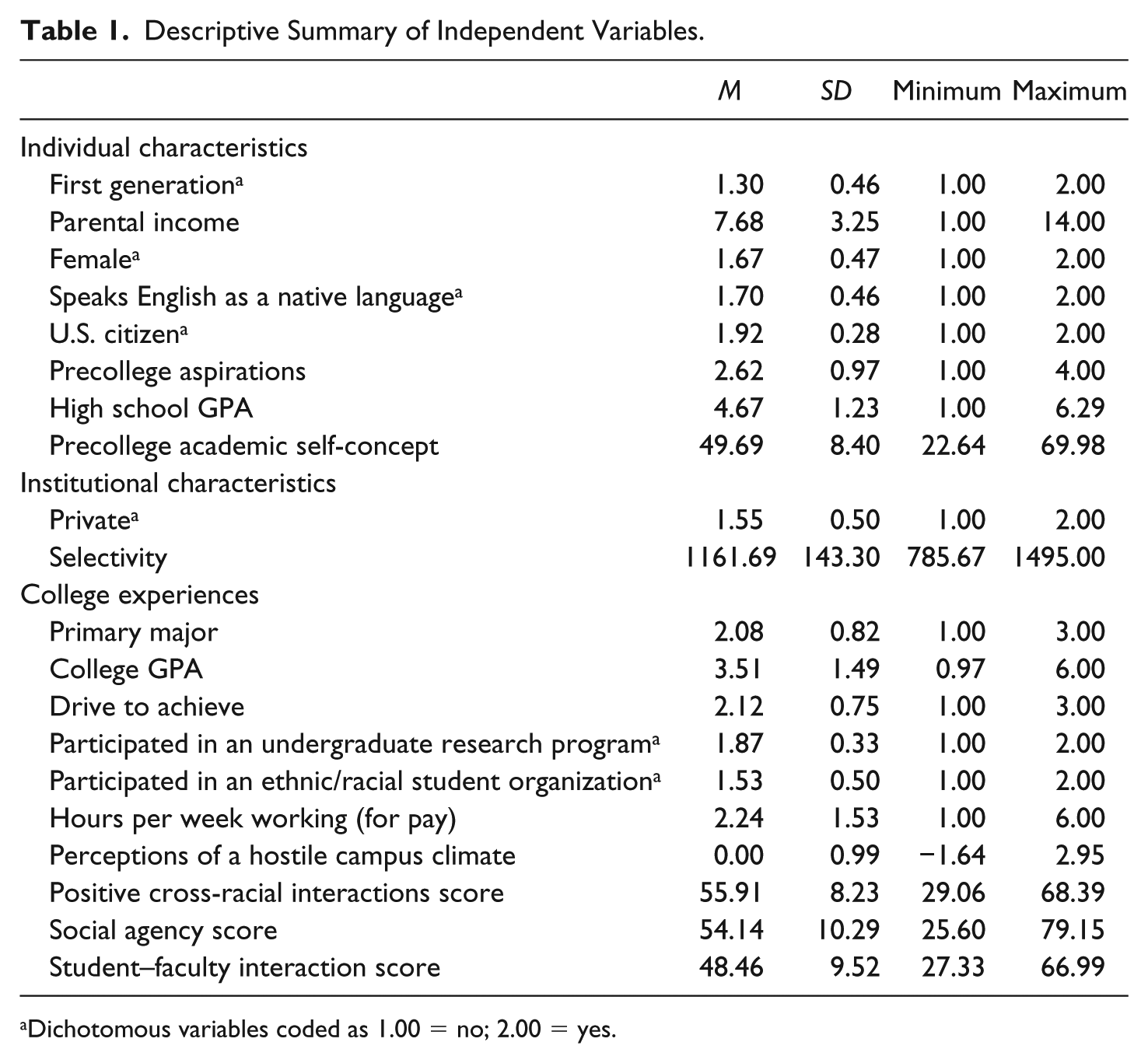
Dichotomous variables coded as 1.00 = no; 2.00 = yes.
The next set of variables represented college academic experiences, such as primary major (humanities, social sciences, or science, technology, engineering and mathematics [STEM]), whether a student had taken an ethnic studies course or participated in an undergraduate research program, college GPA, and a self-rating of how students compared their drive to achieve relative to their peers. Also, a nine-item faculty interactions construct was included, which measured the extent to which students received academic mentorship from faculty. Two campus climate variables were also entered in the model. The first, a three-item factor of student perceptions of a hostile climate (α = .685), included items gauging the frequency with which students felt racial tension on campus, heard faculty/staff express racial/ethnic stereotypes, and felt singled out due to their racial/ethnic background. The other, a five-item positive cross-racial interactions construct, captured the frequency through which students engaged with racially diverse peers, such as eating together or having meaningful conversations about race/ethnicity outside of class. Other variables included cocurricular and working experiences, such as whether a student participated in ethnic/racial student organizations and undergraduate research as well as hours spent working for pay on campus. A social agency construct was also included, which measured the extent to which students valued sociopolitical change.
Analysis
Descriptive analyses and a missing data analysis were first conducted. All variables were missing less than 15% of responses. Based on this missing data analysis, the probability of missing data on certain independent variables were associated with the dependent variable and a few independent variables, which can yield inaccurate estimates in logistic regression (Allison, 2001). As such, missing data were replaced using the expectations maximization (EM) algorithm (Allison, 2001).
A cross-tabulation was then employed to compare graduate degree aspirations at the beginning of college and 4 years later to identify the proportion of students who maintained or changed their aspirations between 2004 and 2008. Next, a multinomial logistic regression analysis was conducted to examine the factors associated with increased or decreased odds of aspiring to earn a degree beyond a baccalaureate. As the dependent variable was categorical in nature with more than one possibility, a multinomial logistic model was conducted to estimate the probability of falling into one category or another when accounting for various independent variables (Hosmer & Lemeshow, 2000).
Limitations
A limitation of the study was student responses on degree aspirations at both time points. Approximately 14% of respondents did not indicate degree aspirations at the beginning of college and approximately 9% in 2008. In addition, some students were more likely to be missing initial degree aspirations depending on other independent variables, such as major, high school GPA, and college selectivity. Students who responded to both questions might be well aware of their postcollege degree aspirations and have different college experiences from students who were not aware of such opportunities or did not feel comfortable responding. The results may thus not be representative of all Latina/o students. Also, several institutional characteristics were not considered that may also shape degree aspirations among Latina/o students. For instance, HSI and emerging HSI status or racial/ethnic composition were not included in the model given a strong correlation with selectivity in this sample. Despite these few limitations, the study still provides critical insights on the factors that increase the likelihood of Latinas/os aspiring to earn advanced degrees.
Results
Several changes were observed in the proportion of students aspiring to earn a graduate degree at college entry and 4 years later. Among students who initially indicated a bachelor’s as their highest intended degree, 35.5% maintained these same aspirations. Almost half (47.5%) changed their aspirations to a master’s degree, 11.5% to a PhD/EdD, and 5.5% to a professional doctorate. In contrast, more than half of the students (56.5%) who entered with aspirations for a master’s degree maintained these aspirations. About 18.8% changed their initial aspirations from a master’s to a bachelor’s, whereas 17.2% and 7.4% intended to, respectively, earn a PhD/EdD or professional doctorate. More than half of the students (58.3%) who initially aspired to earn a PhD/EdD or professional doctorate shifted their aspirations 4 years later. Among those indicating a PhD/EdD as their highest aspiration in 2004, 9.9% changed these aspirations to a bachelor’s, 34% to a master’s, and almost 15% to a professional doctorate. Similarly, those who aspired to earn a professional doctorate, about 11% changed aspirations to a bachelor’s, whereas a little less than half changed to either a master’s (21.4%) or a PhD/EdD (23%). Thus, several Latina/o students changed degree aspirations during college.
Table 2 shows the results for the multinomial logistic regression. Few individual characteristics were associated with predicting degree aspirations. Initial degree aspirations and several college experiences, however, were associated with increased odds of aspiring for different graduate degrees, particularly for PhD/EdDs and professional doctorates. Key findings are summarized for each advanced degree compared with the referent, bachelor’s degrees.
Multinomial Logistic Regression Results for Graduate Degree Aspirations Among Latinas/os.
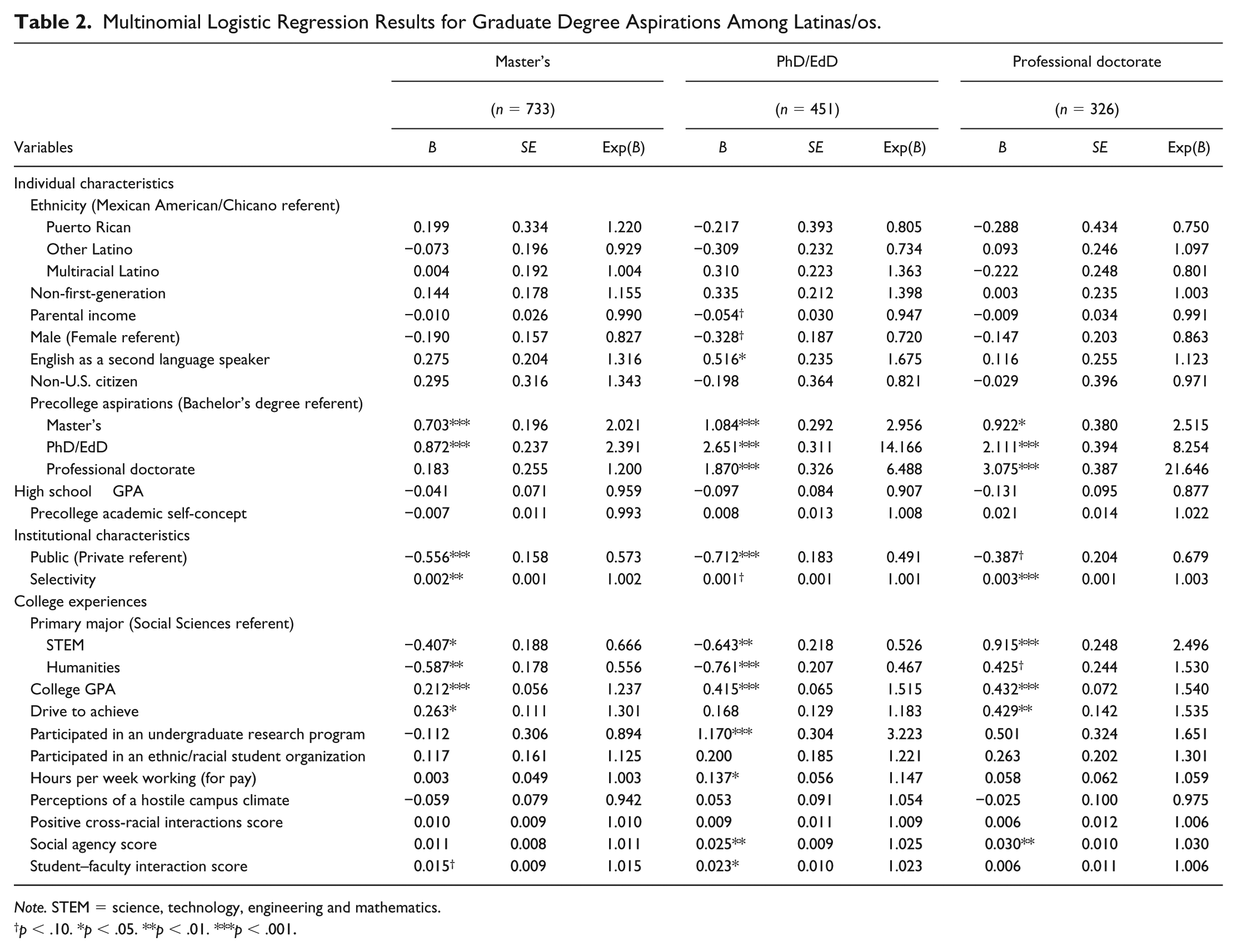
Note. STEM = science, technology, engineering and mathematics.
p < .10. *p < .05. **p < .01. ***p < .001.
Master’s Versus Bachelor’s
Initial degree aspirations beyond a bachelor’s in 2004 were associated with increased odds of aspiring to earn a master’s degree. Specifically, students who first indicated a master’s as their highest degree were more likely to report this goal 4 years later by a factor of 2.021. Those who indicated aspirations to earn a PhD/EdD in 2004 compared with a bachelor’s were more likely to express interest in a master’s degree in 2008 by a factor of 2.391. Students attending public institutions were 43% less likely, whereas those attending more selective institutions were more likely to aspire for a master’s degree. Students majoring in STEM or humanities were 36% and 24% less likely to aspire to earn a master’s degree as compared with those majoring in the social sciences. In contrast, students with a higher GPA were 24% more likely and those with a higher drive to achieve were 30% more likely to aspire to earn a master’s degree.
PhD/EdD Versus Bachelor’s
Latina/o students indicating English was not their first language were 68% more likely to report aspiring to earn a PhD/EdD as compared with a bachelor’s degree. Students who entered with more advanced educational aspirations than a bachelor’s were more likely to aspire to earn a PhD/EdD. The odds were particularly high at a factor of 14.166 among those initially indicating a PhD/EdD as their highest degree aspiration compared with those that indicated a bachelor’s. Similarly, high odds were observed among those who entered with aspirations for a master’s degree by a factor of 2.956 and a professional doctorate at a factor of 6.488.
Similar to the master’s degree model, students who attended public institutions were 51% less likely to report PhD/EdD aspirations compared with those attending private institutions. Students majoring in STEM or the humanities were also 48% and 54%, respectively, less likely to indicate an interest in a PhD/EdD as compared with social science majors. Students who participated in an undergraduate research program were more likely to indicate PhD/EdD degree aspirations by a factor of 3.223. Also, students with a higher college GPA were 51% more likely to express interest in a PhD/EdD. The odds were also increased by 14.7% for more hours working for pay on campus, by 2.5% for every unit increase in social agency score, and by 2.3% for every unit increase in the amount of mentorship received from interacting with faculty.
Professional Doctorate Versus Bachelor’s
Students who entered with aspirations to earn a professional doctorate were more likely than those who aspired to earn a bachelor’s to aspire for this advanced degree 4 years later by a factor of 21.646. Similarly, this factor was 2.515 for students who indicated a master’s as their highest degree objective in 2004. These odds were also high for those who started with a PhD/EdD aspiration by a factor of 8.254. Students attending more selective institutions were also more likely to indicate an interest in a professional doctorate. With regard to major, those in STEM disciplines were more likely to aspire to a professional doctorate by a factor of 2.5 compared with those majoring in a social science. In addition, a higher college GPA and drive to achieve increased the odds of aspiring to earn a professional doctorate by a little more than 50% for a unit increase in each. Similar to the PhD/EdD findings, with every unit increase in social agency, there was a 3% increased odds of aspirations toward a professional doctorate.
Discussion
The study examines how Latina/o students’ degree aspirations change during college and identifies factors associated with aspirations to pursue different types of advanced degrees. By focusing on Latina/o students, this study expands our understanding on the development of advanced degree aspirations among this historically underrepresented group, which in turn can lead to greater representation in graduate school and certain professions requiring postbaccalaureate degrees.
Generally, this study finds few demographic characteristics associated with aspirations to obtain a degree beyond a baccalaureate by the end of college. In fact, only Latina/o students who first speak a language other than English are more likely to aspire to earn a PhD/EdD over a bachelor’s degree compared with their counterparts. This finding differs from studies that either show no relationship between speaking English as a native language, a measure of cultural capital, and graduate degree aspirations (English & Umbach, 2016) or an increased odds of actually enrolling in certain postbaccalaureate programs, such as submaster’s or master’s degree (Perna, 2004). Speaking a language other than English, presumably Spanish among many Latina/o students, possibly serves as a form of cultural capital. Linguistic capital, including speaking multiple languages or styles, is an element of community cultural wealth and a useful skill Latinas/os use to succeed in systems not built with Communities of Color in mind (Yosso, 2005). As such, the linguistic capital Latina/o students possess may cultivate aspirations to pursue advanced degrees such as PhD/EdDs. Altogether, these findings suggest that Latina/o students hold advanced degree aspirations regardless of precollege achievement, socioeconomic status, or whether they are a first-generation college student.
On the contrary, the aspirations students enter college with are associated with advanced degree aspirations after 4 years of college. Students are more likely to aspire to earn a degree beyond a baccalaureate when they enter college with an initial aspiration to earn a master’s, PhD/EdD, or professional doctorate. This finding perhaps suggests that Latina/o students who aspire to earn advanced degrees are informed about college and career pathways when they enter college. Supporting this notion, our findings indicate that students majoring in certain fields of study are more likely to aspire to earn certain types of degrees. Consistent with previous research (Hanson et al., 2016), students majoring in a STEM discipline are more likely to aspire to a professional doctorate, likely a MD, whereas STEM and humanities majors are less likely to aspire to a PhD/EdD or master’s compared with students majoring in social science. Furthermore, a few occupations such as accountant and manager provide employment opportunities with a baccalaureate (Baum et al., 2013), meaning that students in different majors may be interested in positions that may not require an advanced degree or may not be familiar with how graduate school might contribute to their professional trajectory. Consequently, students who aspire to earn an advanced degree may possess a clear understanding that their eventual career goals require these degrees.
Nonetheless, the findings also show that several students who begin with an aspiration toward a baccalaureate change their degree aspirations during college. Although the study does not isolate the year in which these changes occur, a few college experiences strongly influence the likelihood of aspiring to earn a graduate degree. Students with higher college GPAs and drive to achieve are more likely to hold aspirations to earn degrees beyond a baccalaureate. In addition, our findings indicate that certain college experiences uniquely increase the odds of aspiring to earn a PhD/EdD that are consistent with prior research, such as participating in an undergraduate research program, interacting more frequently with faculty in mentoring activities, and working more hours on campus (Berg & Tollefson, 2014). Few college experiences in our models are associated with increased odds of aspiring to obtain a master’s or professional doctorate, suggesting a different set of factors and college experiences may be associated with fostering these types of degree aspirations.
Another important finding is the link between social agency and aspirations to earn a PhD/EdD or professional doctorate. As these advanced degrees provide greater access to positions of power and influence across various sectors, such as education, medicine, law, and so on, Latina/o students aspiring to earn these degrees may want to enter these professions to affect change. The relationship between social agency and advanced degree aspirations aligns with and generalizes qualitative research showing that Students of Color may pursue higher education as a way to resist inequities and transform society (Solórzano & Delgado Bernal, 2001; Yosso, 2005). Contrary to Carter’s (2002) model, our findings suggest that perceptions of the campus climate and cross-racial interactions are not directly associated with Latinas/os’ degree aspirations. However, indirect relationships between the campus climate and degree aspirations may exist through social agency. Perceptions of a hostile climate and positive cross-racial interactions are associated with an increased social agency among Latinas/os (Cuellar, 2015). Aspiring to earn a graduate degree may thus be linked to Latina/o students’ motivation to create change in society.
Finally, the findings confirm a strong relationship between attending more selective or private institutions and advanced degree aspirations among Latinas/os. These findings are consistent with Carter’s (2002) model, indicating that Latina/o students who hold higher degree aspirations may attend more selective institutions. Latina/o students at private or more selective institutions may be more likely to maintain or advance these initial higher aspirations as a result of the greater institutional resources supporting student success as compared with their peers at public institutions. Simultaneously, many Latinas/os increasingly attend HSIs, of which several are public or less selective, and often enter these institutional contexts with lower academic self-concepts (Cuellar, 2015), which collectively may lead to lower degree aspirations in these environments compared with their counterparts attending other institutional types.
Implications for Practice and Research
The findings from the study offer several implications for practice and future research. In terms of practice, consistent and clear information on college and careers are necessary to ensure that students are aware of pathways to their ultimate goals. Students may not be familiar with the need for an advanced degree for certain careers when they begin college, which in turn may impede their progress toward their goals. As several Latina/o students also lower their aspirations, it is critical to ensure that students are changing their goals with accurate knowledge about career paths and not as a result of negative experiences in college. In other words, students should be encouraged to maintain advanced degree aspirations, especially when these degrees are needed for students’ future careers. As such, students should be provided with information on graduate degrees and the careers that require this level of education in P-12 as well as throughout their undergraduate years. Similarly, students need to know about the various resources within a campus, such as the career center and academic advising, that can further help them develop their knowledge on graduate degrees and the types of experiences that will prepare them for these future opportunities.
In addition, institutions must continue to invest in and develop new programs that expose students to various graduate pathways. For instance, continued support of existing undergraduate research opportunities is critical as these types of opportunities help many Latina/o students aspire to obtain a PhD/EdD and also become more competitive for graduate admissions. Furthermore, developing new programs to foster the aspirations of Latina/o students to pursue master’s and professional degrees are necessary. The range of experiences and information students need to pursue these degrees likely differ from the PhD/EdD, which suggests the need for unique programs or at least a more concerted effort to expand the capacity of existing programs to further cultivate these aspirations. Such supports seem particularly essential at public and less selective institutions, including HSIs where many Latinas/os now pursue a postsecondary education. However, to develop these types of programs, future research must continue to examine aspirations to earn a master’s and professional degrees. Understanding what motivates students to pursue these degrees can help practitioners develop programs that foster those aspirations and also encourage students to engage in college experiences that further prepare them for these paths.
Footnotes
Declaration of Conflicting Interests
The author(s) declared no potential conflicts of interest with respect to the research, authorship, and/or publication of this article.
Funding
The author(s) disclosed receipt of the following financial support for the research, authorship, and/or publication of this article: This study was supported by a small grant from the University of California, Davis Academic Senate Committee on Research.
