




Abstract
This study analyzed student perceptions of diversity climate factors in a Hispanic Serving Institution (HSI). The climate of respect, perceived value of diversity on campus, and interracial interactions with faculty and staff were explored to determine their effects on institutional affiliation/pride and intentions to remain and graduate. Results indicated that the three factors of diversity climate affect institutional affiliation/pride and intentions to stay and graduate for Latinx students.
The Latinx 1 population has become the largest minority population in the United States (U.S. Census Bureau, 2014), and Latinxs are now the largest minority group on U.S. college campuses (Snyder et al., 2019). In fact, the number of Latinx college students more than tripled since 1993, and college enrollment rose by 1.7 million from 2006 to 2016. That said, 64% of Latinx students enroll in Hispanic Serving Institutions (HSIs; Excelencia in Education, 2016). Even with this significant growth in enrollment, the graduation rate for Latinx students continues to lag college completion rates when compared with the overall population and is significantly lower than White and Asian students (de Brey et al., 2019). In 2012, although 19% of students enrolled in college were Latinx, only 9% of bachelor’s degrees were awarded to Latinx students (Krogstad & Fry, 2014). This is in sharp contrast to non-Latinx White students who were awarded 69% of bachelor’s degrees, yet made up only 58% of college students. Unfortunately, the statistics are somewhat discouraging even in HSIs. Four-year HSIs report lower 6-year graduation rates than non-HSIs or emerging HSIs (Martin et al., 2017).
California and Texas, two states with the largest Latinx populations in the United States (both at 38%), report 16% college degree attainment for Latinx students as compared with 38% and 32%, respectively, for their total population (Santiago & Calderon-Galdeano, 2015). Colorado, the second most educated state in the United States, has a college attainment gap between White and Latinx residents that is the worst among the nine states with the largest Latinx population. Among those who attend a public college in Colorado, only 19% of Latinx students eventually earn a bachelor’s degree compared with 39% of White students. In a National Longitudinal Study of Freshman (NLSF) of eight selective colleges and universities, the mean grade point average (GPA) for Latinx students was one-quarter of a letter grade lower than that for White students (Charles et al., 2009). Moreover, Latinx students have lower grades, lower college attendance, and lower college graduation rates than nonminority students (Cabrera & Nora, 1994; Hurtado & Carter, 1997; Hurtado & Ponjuan, 2005; Nora, 2004; Núñez, 2009). This achievement gap continues to be one of the most challenging problems that persists in the U.S. educational system (Hemphill et al., 2011). Contreras and Contreras (2015) point to the criticality of this achievement gap and the danger of the Latinx community becoming “an expansive underclass with limited economic mobility and community sustainability options” (p. 152). Given the demographic shift of the U.S. population, the success of historically underrepresented minority groups, specifically Latinxs, is critical to our collective social and economic success (Hurtado et al., 2012). The Latinx population is projected to drive the growth of the labor force, and success in their education as they enter the labor market has significant implications to America’s economy.
The difference in academic outcomes that exists between Students of Color and White students continues to be a concern to educators and the American public (Rippeyoung, 2009; Roscigno, 1998). In addition, researchers have recognized the critical role that social and academic integration plays in student decisions to remain in college and persists through to graduation (Berger & Braxton, 1998; Hurtado et al., 2015; Núñez, 2009; Tinto, 1975, 1993, 1997; Wagner, 2015). Retention and graduation rates are the indicators used to measure institutional success by providing evidence of student achievement. The purpose of this study is to build on the diversity climate research and explore the connection between diversity climate factors and student intentions to stay and graduate, through the influence on institutional affiliation/pride. Specifically, our study explores climate of respect, perceived value of diversity on campus, and co-racial interactions with faculty and staff, and aims at uncovering how it is that these elements of the diversity climate affect important student outcomes such as retention and intention to graduate, to inform the achievement gap dilemma. The contribution of our study is to build on the body of research on diversity campus climate and its effects on Latinx students. In this study, we introduce institutional affiliation/pride as a mechanism to further explain how diversity climate factors impact intentions to remain and graduate. Given our interest in informing the achievement gap phenomena, we also examine differences in how diversity climate factors affect Latinx and non-Latinx White student development of institutional affiliation/pride. Specifically, we are interested in determining (a) whether diversity climate factors influence institutional affiliation/pride and intentions to remain and graduate for both student groups in the same way and (b) whether differences exist in their perceptions of the diversity climate, their institutional affiliation/pride, and intentions to remain and graduate in the context of an HSI.
Literature Review and Hypotheses
Diversity Learning Environment Model Review
Several models have been proposed for studying diversity in higher education. In this study, we draw on Hurtado and colleagues’ (2012) model for Diversity Learning Environments (DLEs) as our theoretical framework. It is composed of two dimensions: institutional and individual. The institutional dimension includes three subcategories: (a) historical focuses on the sociohistorical context of different identity groups within the institution including race, ethnicity, gender, and class; (b) organizational/structural refers to campus policies, decision-making processes, and procedures; and (c) compositional addresses the numerical representation of different identity groups within the university including students, faculty, and staff. More germane to our research, the individual dimension deals with (a) behavioral aspects such as cross-racial/ethnic interactions or intergroup contact experiences on campus and (b) psychological aspects of individual perceptions of discrimination, acceptance and belonging, and support received on campus. Hurtado and colleagues (2012) propose that the dimensions of the campus climate shape the dynamics in institutions, are in a dynamic relationship with one another, and affect the student outcomes for individual success. This study contributes to the literature by building on Hurtado et al.’s (2012) DLE model with particular focus on the effects of individual subdimensions of the campus climate. We study the behavioral aspect of co-racial interactions, as well as explore the psychological aspect by drawing from the sense of belonging research to introduce institutional affiliation/pride as a mediator of the diversity climate factors and intentions to stay and graduate.
Campus Climate
Although the conceptualization of campus climate varies across studies, most definitions stress the importance of perceptions and experiences of existing circumstances (Hurtado et al., 2008). Research suggests that Latinx student perceptions of a hostile climate most directly affect their sense of belonging, morale, adjustment, achievement, commitment to finishing college, and retention (Arana et al., 2011; Brown et al., 2005; Cabrera & Nora, 1994; Castillo et al., 2006; Hausmann et al., 2007; Hurtado & Carter, 1997; Hurtado & Ponjuan, 2005; Nora, 2004; Núñez, 2009), and that when institutions are committed to diversity awareness there is a greater impact on student diversity experience than location or resources (Kuh & Umbach, 2005). For example, Martin and colleagues (2017) report that the perceptions of campus climate are important factors in explaining racial/ethnic differences in GPA, whereas Ancis et al. (2000) report that campus climate is perceived differently depending on the race of the student. In summary, negative and hostile campus climate have consistently been found to have detrimental effects on sense of belonging, adjustment, achievement, and retention (Brown et al., 2005; Cabrera & Nora, 1994; Hurtado & Ponjuan, 2005). Furthermore, Hurtado et al. (2012) point out that the focus on diversity climate research tends to be primarily on the effects of a hostile climate. We anticipate that the commitment to enhancing the experience of Latinx students at an HSI would not be hostile; we therefore explore the positive impact of the diversity climate on institutional affiliation and pride that students develop, and ultimately on their intentions to remain and graduate from the institution. In this study, we also seek to examine these factors and determine whether the effects differ for Latinx and non-Latinx White students in the context of an HSI.
Co-racial interactions
Much of the research on interactions of students with faculty and staff has focused on cross-interactions with diverse others (Maestas et al., 2007; Núñez, 2009; Strayhorn, 2008). More recently, Ryabov (2013) examined co-racial and intra-racial interactions and found that co-racial peer friendships have positive academic outcomes. They argue that it is not bridging, but bonding, social capital that was beneficial to educational success. In fact, they found that immigrant youth benefited most from same-race peer networks with respect to chances of going to college. The findings challenge prior research that suggests interracial relationships have more impact on academic outcomes than intra- or co-racial relationships (Kao & Rutherford, 2007; Mouw & Entwisle, 2006). In a recent study, Fairlie et al. (2014) found that the performance gap such as class dropout rates and grade performance between White and underrepresented minority students falls by 20% to 50% when taught by an underrepresented minority instructor, and that their interactions affect outcomes including retention and degree completion.
As diversity of faculty and staff in higher education continues to be notably low (Taylor et al., 2010), specifically the number of underrepresented minority faculty and staff, Latinx students will by default experience more cross-racial interactions with faculty and staff than non-Latinx White students. Staff members have frequent contact with students, and their interactions affect the impressions that students have about the institution. Yet the role of interacting with staff of one’s ethnicity and race, or co-racial interactions, remains understudied (Hurtado et al., 2012). At an HSI, the frequency of Latinx student co-racial interactions with faculty and staff should be greater as the number of Latinx faculty and staff would be expected to be markedly higher than in Predominantly White Institutions (PWIs; Garcia, 2015). In their study of Texas universities, Vega and Martinez (2012) found that the more Latinx students are enrolled in an institution, the more one is likely to find Latinx faculty at such an institution and vice versa. Torres (2006) found that cultural affinity, conceptualized as the extent to which Latinx faculty, staff, and other students help Latinx students feel at home, predicted intentions to persist through encouragement and institutional commitment. Accordingly, we explore the impact of intragroup or co-racial interactions with faculty and staff in an HSI setting rather than the more often studied cross-racial interactions in a PWI.
Institutional Affiliation/Pride
In Hurtado et al.’s (2012) DLE model, one important psychological aspect of their individual dimension is sense of belonging. According to Hurtado and Carter (1997), sense of belonging focuses on student attachment to the campus community. Furthermore, sense of belonging has been defined as integration with community (Maestas et al., 2007; Strayhorn, 2008) perceived cohesion (Hausmann et al., 2007), and the extent to which group members feel stuck to a part of particular social groups (Bollen & Hoyle, 1990). According to Hurtado and Carter (1997), Students of Color are less likely to find the college environment to be supportive, or to feel a sense of belonging than White students. They measured sense of belonging as attachment to the college community and their level of participation in campus activities. In their 2007 study conducted in an HSI, Maestas and colleagues concluded that student level of belonging contributes to higher retention and to graduation.
We, therefore, build on the sense of belonging research and introduce institutional affiliation/pride. Similar to Hurtado and Carter’s (1997) sense of belonging, affiliation is defined as having “the state or relation of being closely associated with” (Merriam-Webster Dictionary, n.d.-a). We take affiliation one step further and integrate it with pride, which is defined as “delight or elation arising from . . . a relationship” (Merriam-Webster Dictionary, n.d.-b). According to Schloss et al. (2011), university affiliation can be evidenced by school pride behaviors such as wearing school colors and involvement with collegiate activities.
This sense of pride and being affiliated with their institution is often communicated through word of mouth. Drawing from the marketing discipline and research, word of mouth is described as a communication of excitement about a product to other consumers (Richins & Root-Shaffer, 1988). More contemporary conceptions of word of mouth include electronic word of mouth (eWOM) in which consumers utilize web-based consumer opinion platforms to share perceptions of goods and services to other consumers (Hennig-Thurau et al., 2004). Word of mouth applied to an educational institution was proposed by Alves and Raposo (2007). They suggest that positive student-to-student word of mouth indicates pride in the university and making recommendations to a friend. As such, student-to-student word of mouth has been described to be an important factor in the promotional mix of institutional recruitment.
We propose that institutional affiliation/pride is impacted positively by the perceptions of the diversity climate and that students will feel proud to be affiliated with an institution that values diversity, provides a climate of respect, and provides opportunities for co-racial interactions with faculty and staff. More importantly, we argue that the level of pride that students develop toward the institution will in turn influence their intentions to stay at the university and graduate. In fact, in a recent study in a tribal university, Motl et al. (2018) reported that school pride was a predictor of retention. Therefore, we propose that the diversity climate is a predictor of institutional/affiliation pride, which in turn affects intentions to stay and graduate.
At the core of the social identity theory (SIT) is the idea that people have a fundamental need to belong and identify with social groups. Consequently, individuals tend to classify themselves and others into social groups such as race, gender, and age (Stryker, 1968; Tajfel & Turner, 1985). One implication of this categorization process is that the social group individuals identify with may shape their perceptions and interpretations of the context. Thus, because race is a sociohistorical concept, differences in historical patterns in institutions of higher education may lead to variability in the frames of reference members of different racial groups use when evaluating and responding to the institution’s diversity climate (Williamson et al., 2008). For example, it is possible that students enter college having already encountered different levels of racial discrimination, thereby influencing their reaction to the campus diversity climate (Hurtado et al., 2015; Williamson et al., 2008). Indeed, previous studies demonstrate that Students of Color have racialized experiences, encounter higher levels of racial discrimination, and have divergent (more negative) perspectives of the campus climate (e.g., Cabrera et al., 1999; Fries-Britt & Turner, 2001; Hurtado & Carter, 1997; Hurtado & Ruiz, 2012; Nguyen et al., 2018; Rankin & Reason, 2005; Solorzano et al., 2000).
An HSI lends itself to be an ideal context to study the effect of what we would expect to be a more positive diversity climate on the development of institutional affiliation/pride and to determine whether differences exist between Latinx and non-Latinx students. We therefore investigate whether the proposed relationships are different for Latinx students versus non-Latinx White students at an HSI. Furthermore, because much of the research on diversity climate examines the direct effects of diversity factors on student outcomes, we know little about the underlying mechanisms. This research focuses on the mediating effect of institutional affiliation/pride as a process through which diversity climate factors impact student outcomes. To date, we know of no study that has examined any of the following: (a) the effect of the diversity climate on the development of institutional affiliation/pride; (b) Latinx students’ development of school pride as an antecedent of retention; or (c) whether these factors differ between Latinx and non-Latinx White students in the context of an HSI. Therefore, as depicted in Figure 1, we hypothesize the following:

The proposed model.
Method
The aim of this study is to build on research that investigates the effect of the diversity climate on student outcomes and to explore the development of affiliation and pride in the institution in the context of an HSI. Our research site is a 4-year private HSI in the Midwest with a student population of approximately 4,000. In this HSI, Latinx students represent 28% of the student body. HSIs in general share similar characteristics such as serving a large proportion of low-income, first-generation, and other minority students besides Latinx students and therefore encompass considerable diversity. According to Núñez et al. (2016), HSIs are classified into six different clusters based on various characteristics such as being a 2- or 4-year college, public or private, and/or recipient or nonrecipient of federal funding. This university is characteristic of a “Small Community Four-Years” HSI (Cluster 4) based on their typology. Compared with HSIs in the other clusters, institutions in Cluster 4 tend to be more selective with higher graduation rates (Núñez et al., 2016). Quantitative data for this study were collected as part of a broad school-wide survey administered online.
Sample
All students on campus were invited to participate in the online survey via their university e-mail address. The survey platform used was SurveyMonkey®. In the communication, they received a link and assurance of their anonymity. Two reminder emails were sent during a 3-week period, and faculty were asked to encourage students to complete the survey. A total of 734 students responded to the online survey, representing a participation rate of 18.5%. The respondents were 72% female and 28% male, 71.5% were between 18 and 24, 15.8% between 25 and 34, and 12.9% were older than 35 years. Surveys with incomplete demographic data were excluded leaving 534 for the analysis. Table 1 provides racial/ethnic information of students who participated in the survey.
Race/Ethnicity by Class Standing.

Note. N = 534. Numbers represent percentages.
Measures
The survey questions were adapted from sources provided by Excelencia in Education’s (2014) Latino Student Success (LSS) Inquiry Model. The sample questions provided were utilized by member institutions as part of their Title V Grant applications. For the purpose of this research, we used 14 questions for the five variables in our model. The Cronbach alphas were calculated for each scale, except for intentions to stay and graduate, where we used a single item to capture the likelihood that the student will remain and graduate. The alpha coefficients for the scales were all above .70: climate of respect (.92), perceptions of diversity being valued on campus (.87), co-racial interactions (.76), and institutional affiliation/pride (.92). Sample items include the following: climate of respect—“I am treated with respect and dignity regardless of my race/ethnicity”; perceptions of diversity being valued on campus—“Here at this university differences are valued and celebrated”; co-racial interactions—“When seeking advice about my academic career, I am able to consult with a counselor or faculty member of my own race/ethnicity”; institutional affiliation/pride—“I am proud to let others know that I am part of this university”; and intentions to remain and graduate—“I plan to be at this university until I graduate.” A Likert-type type scale (1 = strongly disagree to 7 = strongly agree) was used (see Appendix for all items). Table 2 displays the means, standard deviations, correlations, and Cronbach alphas for the study variables.
Descriptive Statistics.
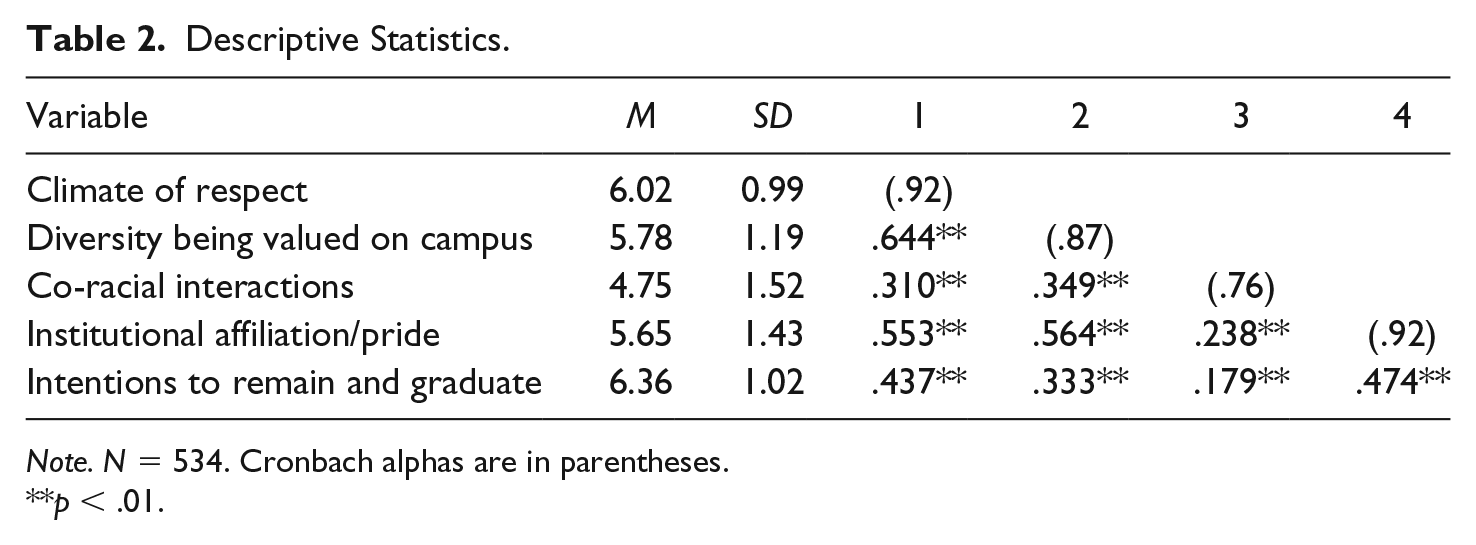
Note. N = 534. Cronbach alphas are in parentheses.
p < .01.
Analysis
We initially conducted a one-way analysis of variance (ANOVA) to test for differences between Latinx and non-Latinx White students, with each factor serving as the dependent variable. To test Hypotheses 1, 2, and 3, responses from all students were analyzed. For Hypothesis 4, we differentiated between Latinx and non-Latinx White students in the analyses. To test our proposed model, we followed nonparametric bootstrapping. Specifically, we used Hayes’s (2013) PROCESS SPSS macro Model 4 to assess the mediation hypotheses. The technique constructs confidence intervals (CIs) for the indirect effect(s), such that, if the interval does not include zero, then the indirect effect is statistically significant at the .05 level. The nonparametric bootstrapping resampling method has been validated in the extant literature. Moreover, it helps reduce the chances of committing a Type 2 error (Hayes, 2013; MacKinnon et al., 2000).
Results
When we analyzed the differences in means between Latinx and non-Latinx White students’ perceptions of the diversity climate in terms of climate of respect and diversity being valued on campus, the results from the ANOVA revealed no differences between the two groups of students. Our findings actually contradict research that suggests that Students of Color assess educational institutions as being a more hostile environment (Hurtado & Carter, 1997; Hurtado & Ponjuan, 2005; Nora, 2004; Núñez, 2009). However, on the third factor, Latinx students reported significantly lower (4.31) co-racial interactions than non-Latinx White students (5.67), meaning that the frequency of interactions with faculty and staff of the same race was much higher for non-Latinx White students than for Latinx students in this HSI. Still, Latinx students reported significantly higher institutional affiliation/pride in the university (5.81) than non-Latinx White students (5.47). The data did not reveal significant differences between Latinx and non-Latinx White students in their intentions to remain and graduate, which were considerably high for both groups (6.34 and 6.39 for Latinx and non-Latinx Whites, respectively). Table 3 summarizes the mean differences and effect sizes between the two racial groups for each variable in our model.
Mean Differences and Effect Sizes for Predictors and Outcomes by Racial Group.

p < .01.
The results for our proposed relationships are depicted in Table 4, which report the findings of the effects of the three diversity climate factors on intentions to stay and graduate through institutional affiliation/pride. Our results reveal that climate of respect (β = 0.12, p < .05) and diversity being valued on campus (β = 0.08, p < .05) positively influenced student institutional affiliation/pride and subsequently their intentions to remain and graduate, therefore supporting Hypotheses 1 and 2. We did not, however, find that institutional affiliation/pride mediated the relationship between co-racial interactions and intentions to stay and graduate; thus, Hypothesis 3 was not supported. Finally, to assess Hypothesis 4, we tested the model using (a) Latinx students only and (b) non-Latinx White students only (see Tables 5 and 6). For Latinx students, institutional affiliation/pride was found to fully mediate the relationship between all three diversity climate factors: climate of respect (β = 0.31, p < .05), diversity being valued on campus (β = 0.14, p < .05), and co-racial interactions (β = 0.09, p < .05), and their intentions to stay and graduate. In other words, how Latinx students perceived that they and other students were treated, the frequency of interactions with Latinx staff and faculty, and their perceptions of diversity being valued on campus all predicted how strongly they form their institutional affiliation/pride with the university. In addition, their pride in being affiliated with the university predicted their intentions to remain and graduate. In contrast to our findings for Latinx students, for non-Latinx White students none of the diversity climate factors predicted institutional affiliation/pride. None of the diversity climate factors, namely, their perceptions of how they and other students are treated, the frequency of interactions with non-Latinx White faculty and staff, or their perceptions of the diversity being valued on campus, affected their affiliation and level of pride in the institution. Interestingly, our analysis further showed that, for non-Latinx White students, climate of respect (β = 0.48, p < .05) was the one factor that was directly related to intention to stay and graduate.
All Students: Direct and Indirect Effects Model Coefficients.
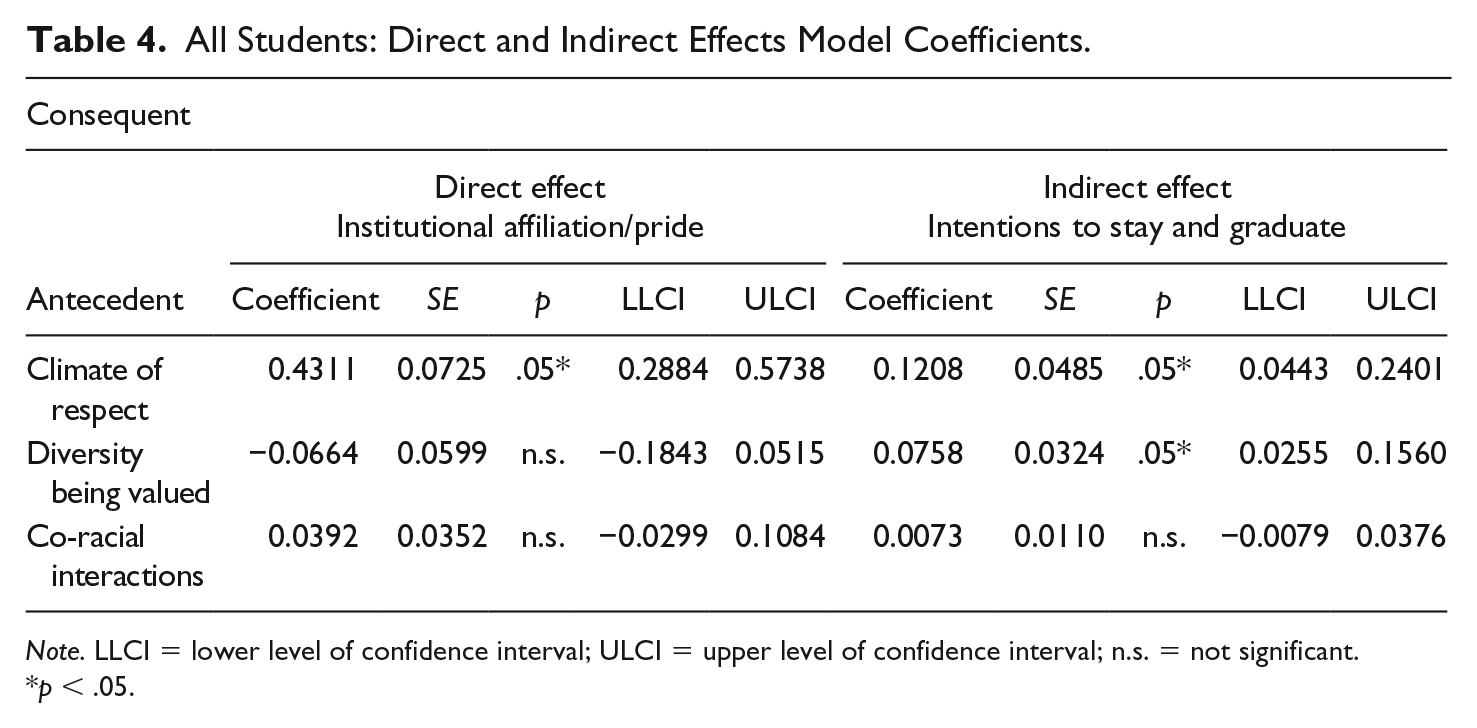
Note. LLCI = lower level of confidence interval; ULCI = upper level of confidence interval; n.s. = not significant.
p < .05.
Latinx Students Only: Direct and Indirect Effects Model Coefficients.
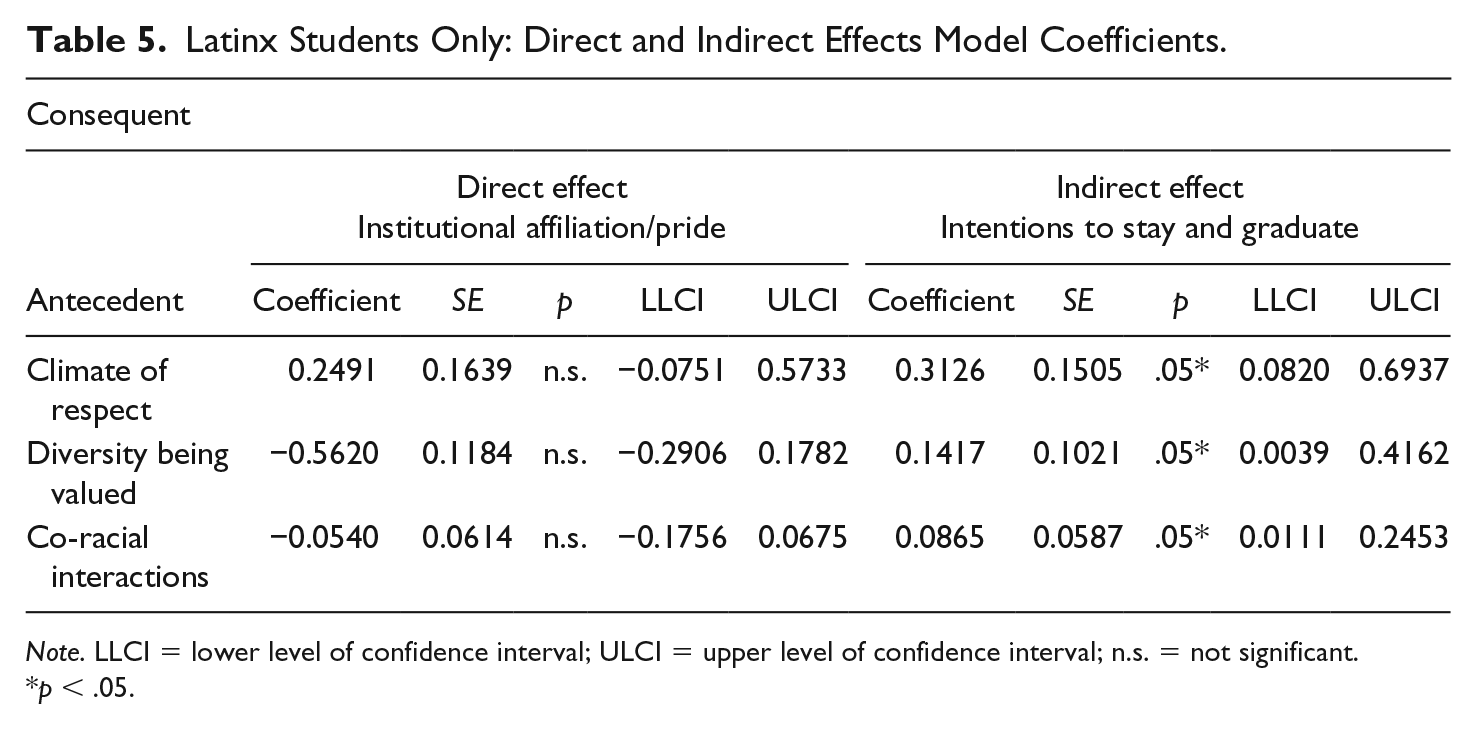
Note. LLCI = lower level of confidence interval; ULCI = upper level of confidence interval; n.s. = not significant.
p < .05.
Non-Latinx White Students Only: Direct and Indirect Effects Model Coefficients.

Note. LLCI = lower level of confidence interval; ULCI = upper level of confidence interval; n.s. = not significant.
p < .05.
Discussion
The findings of our research underscore the impact that creating a positive diversity climate has on students, and specifically Latinx students when compared with non-Latinx White students. An important aspect of this study is the contextual setting of an HSI. Specifically, our analysis revealed that ensuring a climate of respect and the extent to which diversity is valued positively influenced intentions to stay and graduate through the impact on institutional affiliation/pride. Our findings on the role of institutional affiliation build on prior research on the effects of the diversity climate on sense of belonging, adjustment, achievement, and retention (Brown et al., 2005; Cabrera & Nora, 1994; Hurtado & Ponjuan, 2005). Contrary to our predictions, we did not find support for the influence of co-racial interactions on institutional affiliation/pride and intentions to stay and graduate when analyzing the data for all students. However, as we will discuss further below, the relationship between the three diversity climate factors, institutional affiliation/pride, and intentions to remain and graduate differed for Latinx compared with non-Latinx White students. Given that research finds differences in views of the diversity climate between Latinx and non-Latinx White students (Hurtado & Carter, 1997; Hurtado & Ponjuan, 2005; Nora, 2004; Núñez, 2009), our findings suggest that those differences also exist at an HSI. This would explain why we found no significant effects when all the students were analyzed together, supporting research that campus climate is perceived differently depending on the race/ethnicity of students and pointing to the value of testing the model separately for Latinx and non-Latinx White students.
Specifically, we found that for Latinx students a positive climate of respect, one where diversity is valued on campus and where opportunities exist to interact with Latinx faculty and staff, leads to more positive affiliation and pride in their institution, which in turn impacts their intentions to stay and graduate from the institution. Indeed, our findings point to the significance of institutional affiliation/pride for Latinx students not only as an outcome of diversity climate but also as a predictor of intentions to stay and graduate. Drawing on the sense of belonging literature, our findings on institutional affiliation/pride underscore the importance of integration, affiliation, and belonging to higher retention and graduation (Hurtado & Carter, 1997; Maestas et al., 2007; Strayhorn, 2008). What is compelling with these findings is the role of developing pride in one’s institution as a predictor of intentions to remain and graduate.
Interestingly, the results indicate that, for non-Latinx White students, the diversity climate does not affect their development of institutional affiliation/pride as none of the three diversity factors impact their institutional affiliation/pride. This finding supports SIT and prior research that suggests that Latinx and non-Latinx White students, because they belong to different racial identity groups, may perceive the diversity climate differently, which in turn shapes their attitudes and outcomes. It is evident that the diversity climate is salient to Latinx students given their previous experience as minorities in majority-dominated environments and serves as an important cue in developing their institutional affiliation/pride. These same features are insignificant to non-Latinx White students, who are used to being members of the majority group, and therefore have no effect on developing their affiliation and pride in the institution. For non-Latinx White students, having co-racial interactions with faculty and staff is the norm and not unusual based on frequent co-racial interactions experienced in academic settings prior to joining the college. It is unlikely that co-racial interactions will have a significant impact on non-Latinx White students’ attitudes, including their institutional affiliation/pride. However, for Latinx students, many of whom may have had limited previous co-racial interactions in academic contexts, interacting with faculty and staff that are of the same race/ethnicity affects not only their affiliation but also their “delight and elation arising from the affiliation/relationship.”
Moreover, although climate of respect did not contribute to non-Latinx White student institutional affiliation/pride, it is the only diversity factor that directly affected their intentions to stay and graduate. Contrary to prevalent research (Ancis et al., 2000), we found that there was no difference in Latinx students and non-Latinx White students in their assessment of the climate of respect in this HSI. Clearly, this demonstrates the significance of creating a climate of respect for all students. We note that at this HSI the mean for climate of respect for both groups of students is notably high, 6.00 (non-Latinx) and 6.16 (Latinx) out of 7.00, thus supporting our expectation that HSIs provide a more positive and nonhostile environment. This suggests that creating a climate of respect for all students is important and indeed impacts their intentions to stay and graduate.
Although there are many factors that contribute to Latinx student success in higher education, our research found that the diversity climate is critical in developing affiliation and pride in being part of the institution that they can talk to their friends about. Universities should take note and leverage this pride as part of their brand when recruiting diverse students. As noted earlier, sense of pride and being affiliated with their institution is often communicated through word of mouth (Alves & Raposo, 2007). The implications of Latinx students sharing their institutional affiliation and pride on social media can play a major role in students not only choosing one university over another, but also staying and graduating. A recent Pew report found that Latinxs use certain social media platforms more than non-Latinxs (Krogstad, 2015). Universities should be mindful of and interested in the implications of these now powerful messaging forums as it relates to Latinx students and their sharing their views of the diversity climate and institutional pride and affiliation with other Latinx students both on their campus as well as to potential students.
One finding that is important to note is that Latinx students reported significantly higher institutional affiliation/pride than non-Latinx White students (5.81 and 5.47, respectively). This is good news for an HSI, given the prevalent findings that Students of Color assess educational institutions as historically being a more hostile environment (Hurtado & Carter, 1997; Hurtado & Ponjuan, 2005; Nora, 2004; Núñez, 2009). It appears that an HSI can create an environment that is positive for all students. Not only do Latinx students have a stronger affiliation and pride in the institution than non-Latinx White students, affiliation and pride is quite positive for both groups. This we feel suggests that HSIs are positive institutions for all students and builds the case for dedicating resources to efforts that support diversity programs at HSIs and all institutions.
On the other hand, what is also compelling is that in this institution where non-Latinx White students are the majority, not only is their institutional affiliation/pride significantly lower than Latinx students, but none of the diversity climate factors affect this group’s affiliation/pride in the institution. One possible explanation is reflected in a recent poll of 2,000 adults conducted by The Atlantic (Berman, 2015). The poll indicates that more than four of five Whites below the age of 30 surveyed said The American Dream is suffering. Surprisingly, despite the challenges and recent events involving minority populations, 43% of Black/African Americans and 36% of Latinxs said that they feel The American Dream is alive and well. According to the findings of the General Social Survey (GSS) conducted by the Associated Press, although the pessimism of Whites has increased, optimism among Black/African Americans and Latinxs has increased (Thompson & Benz, 2013). This may explain Latinx students having a more positive view of the institutional affiliation/pride even as an underrepresented minority group compared with non-Latinx White students who are the majority group.
We believe that this could also be attributed to creating an environment where diverse students can flourish and reach their potential, and that this commitment is recognized by Latinx students. Most importantly, their institutional affiliation/pride has a significant effect on their intentions to remain and graduate. This would suggest that both the diversity climate and the role of institutional/affiliation pride that is developed as a result of the diversity climate are critical factors in predicting success for Latinx students, and underscores the importance of providing a respectful climate, one that values diversity and is committed to hiring, retaining, and engaging diverse faculty and staff.
There was a significant difference in the level of co-racial interactions that students had with faculty and staff of their same race/ethnicity, as non-Latinx White students reported significantly higher co-racial interactions than Latinx students. This was not a surprising finding, given that faculty and staff are 70% and 68% non-Latinx White in this university, respectively. Only 1.5% of faculty and 8% of staff are Latinx. As Vega and Martinez note in their 2012 study based on 30 universities in Texas, there was less than one Latinx faculty member for every eight White faculty members, and on average 12 more Latinx students per Latinx faculty member reported at Texan universities than White students to White faculty. In fact, at Texas A&M International, there were 67 times as many Latinx students to the number of Latinx faculty compared with White students to White faculty (Vega & Martinez, 2012).
What is compelling about our findings is the fact that even the small number of co-racial interactions experienced by Latinx students has a significant effect on institutional affiliation/pride. This is a key finding that speaks to the importance of co-racial interactions for Latinx students and the call to action to address the lack of Faculty and Staff of Color in institutions of higher education, especially in minority-serving institutions such as an HSI. In particular, it emphasizes the need to purposefully attract and retain underrepresented minority faculty and staff. Latinx student co-racial interactions, while few, still have a significant effect on their development of institutional affiliation/pride and ultimately their intentions to remain and graduate from that institution.
The findings of our study have important implications given the trend in today’s workforce. According to the Georgetown University Center of Education and the Workforce, 55 million new jobs will be created in the United States by 2025 (Carnavale et al., 2015), and 65% of those jobs will require education beyond high school. The economic and social benefits of Latinx students being college educated cannot be overstated. The social, educational, and nonacademic benefits of a racially and ethnically diverse college experience have been well documented in the literature (Chang et al., 2004; Hurtado et al., 1998, 2003; Jayakumar, 2008). However, the mere presence of a racially diverse population does not translate to meaningful interactions and the potential academic benefits of diversity (Sáenz et al., 2007). Our study contributes to the literature by testing the effect of diversity climate factors at an HSI on intentions to remain and graduate, as well as examining the role of institutional affiliation and pride. According to Excelencia in Education (2016), the achievement gap in college attainment between Latinx and non-Latinx students stands at 11%, this indicates that more Latinxs are completing college degree and that positive change is happening. However, it is not happening fast enough. Our findings support the importance of creating a positive climate of diversity for all students as it leads to both institutional affiliation/pride and intentions to remain and graduate. Understanding those factors that contribute to retention and intentions to graduate for Latinx students relative to the diversity climate is the contribution of this research.
Limitations
One drawback of this research is that it is cross-sectional and there is a need to conduct a simultaneous examination of the relationships over time to make causal inferences relative to diversity climate factors and intentions to remain and graduate as well as actual graduation rates. Generalizability is another limitation, given that this is only one HSI and factors can vary across the more than 500 HSIs in the United States such as resources, time as an HSI, faculty and staff demographics, and enrollment (Hispanic Association of Colleges and Universities, 2019). Although participation was representative of Latinx students at this institution, the response rate for all students was limited in number.
Future Research
As we did not find that climate of respect, perceptions of diversity being valued on campus, or co-racial interactions affected institutional affiliation/pride for non-Latinx White students, one compelling area of future study would be to determine what factors influence institutional affiliation/pride for non-Latinx White students and how do those factors differ from diversity climate factors. Given that this study finds that institutional/affiliation pride is formed differently by Latinx and non-Latinx White students, more research should be conducted to explore why that is the case. Future studies should investigate other mechanisms that may be more important for non-Latinx White students. This study was conducted in an HSI setting, which would be useful to test this model in the other HSI cluster contexts to compare how the experience of students differ. This might offer additional insights as to factors that could enhance the experience and ultimately the success of Latinx and other minority students and continue to inform the achievement gap. In addition, studying institutional/affiliation pride in a PWI as well as comparing a large sample of HSIs with PWIs would be quite insightful.
Recent research found that although Latinx students reported less discrimination and bias on a survey, in a focus group they reported both positive and negative perceptions of the campus climate (Cuellar & Johnson-Ahorlu, 2016). Qualitative research could be utilized to better determine what other factors affect institutional affiliation/pride and explore other diversity-related factors that are important for both Latinx and non-Latinx students. Finally, another important area for future research is the role that social media such as use of Facebook and Instagram play and eWOM as the communication vehicle for sharing one’s institutional affiliation, both positive and negative. Finally, in this study, we had good participation for Latinx students, but non-Latinx students did not participate at the same level. Therefore, to ensure that data are representative of all students, exploring strategies aimed at increasing participation rates should be considered as a critical factor for diversity climate research.
Footnotes
Appendix
Declaration of Conflicting Interests
The author(s) declared no potential conflicts of interest with respect to the research, authorship, and/or publication of this article.
Funding
The author(s) received no financial support for the research, authorship, and/or publication of this article.
