




Abstract
Postsecondary co-enrollment, or simultaneous enrollment at multiple institutions, is becoming increasingly common among U.S. college students. This descriptive analysis documented the characteristics and co-enrollment patterns of Latinx/a/o students in the Beginning Postsecondary Students Longitudinal Study (12/17). Findings of the study revealed that Latinx/a/o students co-enrolled at multiple postsecondary institutions at greater rates than all students combined, and that persistence and bachelor’s degree completion rates were higher for co-enrolled Latinx/a/o students than for all Latinx/a/o students.
For the past 30 years, researchers have provided evidence that attendance patterns are changing for many college students, with fewer students earning all of their credit from just one university as opposed to earning credit from multiple universities in their pursuit of a bachelor’s degree (e.g., de los Santos & Wright, 1990; Katsinas et al., 2019; McCormick, 2003). Nearly two decades ago, the Association for American Colleges and Universities warned that multi-institution attendance was one of the major burdens facing higher education in the coming years (Bailey, 2003). In addition, scholars have noted that vertical transfer (i.e., transfer from one community college to one 4-year institution), which historically has been the most widely assumed and researched form of student mobility, does not acknowledge other patterns of student movement across institutions (e.g., Katsinas et al., 2019).
One form of student mobility is co-enrollment. There is a lack of consistency in the literature on the use of the term co-enrollment, having been variously deemed concurrent enrollment, simultaneous enrollment, double dipping, dual enrollment, and overlapping enrollment (Adelman, 2006; Crisp, 2013; de los Santos & Wright, 1990; McCormick, 2003; Peter & Forrest Cataldi, 2005; Taylor & Jain, 2017; Wang & Wickersham, 2014). Co-enrollment has also been included as part of the somewhat ambiguous concept of student “swirl” (e.g., Bach et al., 2000; Bailey, 2003). For the purpose of clarity, co-enrollment is defined in this study as “simultaneous enrollment at multiple postsecondary institutions during the same academic term” (Wang & McCready, 2013, p. 392). For example, one way that students co-enroll is by taking a course online at a community college while also being enrolled in additional in-person courses at another college or university. The purpose of this descriptive, quantitative study is to identify the prevalence of co-enrollment among the Latinx/a/o college student population, describe the characteristics of co-enrolled Latinx/a/o students, and understand the patterns of co-enrollment among a nationally representative sample of co-enrolled Latinx/a/o students.
The prevalence of newer attendance patterns such as co-enrollment is well documented (e.g., Soler, 2020; Wickersham, 2020). For instance, according to the findings of the Beginning College Survey of Student Engagement (2020), even among beginning first-year college students, 58% expected to transfer between one and 11 credits to their current institutions, and 6% of both transfer and older students planned to take at least one course from another college or university while attending their current institution. Studies that have focused on individual institutions also have shown that multi-institution attendance is increasingly common, with one study finding that only 30% to 31% of students at Auburn University and the University of Alabama earned all their credits at their respective institutions during 1 year, and other reports showing that 30% of undergraduates enrolled at the University of Nevada at Reno and Arizona State University simultaneously took courses at community colleges (Gose, 1995; McCormick, 2003).
Despite these data, empirical work on the patterns of student movement and the relationship between co-enrollment and educational outcomes remains limited (Bach et al., 2000; McCormick, 2003; Wang & Wickersham, 2014). There is also a dearth of research specific to co-enrollment among students of color, the exclusion of which may contribute to analytic samples that are different from the population of students under study and which may perpetuate an understanding of alternative attendance patterns from a race-neutral perspective (Soler, 2020). Without the inclusion of demographic variables like race in studies focused on attendance and enrollment patterns, institutions may not respond to the specific needs of students of color through their various policies and programs (Soler, 2020).
According to the U.S. Census Bureau (2019), nearly 19% of the population of the United States identifies as being of Hispanic or Latino origin, making this the largest racial/ethnic group in the country and accounting for just over half of the nation’s population growth in the last 20 years (Noe-Bustamante et al., 2020). In addition, college enrollment rates for Latinx/a/o students have increased by 134% in the 21st century (de Brey et al., 2019), though their bachelor’s degree attainment rates are lower than those for White and Black adults and almost half that of all adults in the nation (18% vs. 35%; Snyder et al., 2019). There is a critical need to close the equity gaps in college completion rates, which includes examining the new attendance patterns that are becoming increasingly common among postsecondary students. The following research questions guiding this descriptive, quantitative study focus on Latinx/a/o co-enrollment:
Review of the Literature
As previously noted, very little empirical work currently exists to understand experiences related to co-enrollment and almost none has been done to explore which factors contribute to co-enrollment for different racial groups, including for Latinx/a/o students. Therefore, this review of the literature will document the existing co-enrollment research for all students, not explicitly for Latinx/a/o students. Though minimal attention has been paid to identifying which college students co-enroll, single studies do shed some light on groups that are more or less likely to co-enroll. For instance, Wang and Wickersham (2014) studied nationally representative samples of college students and found that females were more likely to co-enroll than males, Latinx/a/o students were more likely to laterally co-enroll if they began their college careers at a community college rather than at a 4-year institution, and community college students from middle-income groups were more likely to co-enroll than students from other income groups. In addition, the National Student Clearinghouse Research Center (2011) found that the highest rate of co-enrollment was among students whose enrollment intensity combined full- and part-time statuses as opposed to students who maintained full-time enrollment and exhibited the lowest rate of co-enrollment. Concerning their college experiences, Wang (2012) found that co-enrolled students reported having higher grade point averages (GPAs) than students who were not co-enrolled.
Apart from research on the characteristics of students who co-enroll, there is a body of literature focused on the relationship between co-enrollment and student outcomes. For example, researchers utilizing nationally representative data sets have found that co-enrollment was positively related to persistence rates, defined as remaining enrolled in postsecondary education 6 years after first enrolling in college or having completed a bachelor’s degree during that time (Peter & Forrest Cataldi, 2005; Wang & McCready, 2013; Wang & Wickersham, 2014). However, research conducted at single institutions has shown conflicting results for persistence among co-enrolled students, with Herzog (2005) finding that co-enrollment increased the odds of persistence to the second year and Johnson and Muse (2012) finding that co-enrollment improved the odds of students not re-enrolling. It should be noted that Johnson and Muse included multi-institution attendance as only one factor in their study, while it was the focus of Herzog’s study. Research findings have also shown a positive relationship between co-enrollment and student transfer (Bahr, 2012; Carales, 2020), particularly for community college students who engaged in vertical transfer (Wang & Wickersham, 2014).
Although previous studies on the influence of co-enrollment on persistence have not shown consistent results, findings examining the relationship between co-enrollment and bachelor’s degree attainment have been more congruent (e.g., Peter & Forrest Cataldi, 2005; Wang & McCready, 2013), particularly for community college students (e.g., Carales, 2020; Crisp, 2013). For instance, Carales (2020) found that among a nationally representative sample of Latinx/a/o community college students, the odds of completing a 4-year degree were 2.64 times as large for co-enrolled students than for students who were not co-enrolled. Moreover, among both beginning 4-year and community college students, vertical co-enrollment was found to increase the likelihood of baccalaureate degree attainment (Wang & Wickersham, 2014). However, other research has shown that co-enrollment did not reduce the time it took students to earn a degree (Lam, 2007), and in one study co-enrollment was shown to increase time to degree (Peter & Forrest Cataldi, 2005). Nationally, the 6-year graduation rate for first-time, full-time undergraduate students who began at 4-year institutions is 52% for Latinx/a/o students and 72% for all students (National Center for Education Statistics, 2019).
Additional studies using nationally representative samples have shown that co-enrollment involved a combination of attendance at both community colleges and 4-year institutions (National Student Clearinghouse Research Center, 2011; National Survey of Student Engagement, 2005; Wang & McCready, 2013), with the majority of co-enrollees attending public institutions (National Student Clearinghouse Research Center, 2011). Furthermore, Wang and McCready (2013) found that, nationally, the greater part of co-enrollment took place in the fall and spring semesters, while a study conducted at Arizona State University showed that the highest number of co-enrollees at that institution were freshmen, followed by juniors, seniors, and sophomores (de los Santos & Sutton, 2012).
Finally, there is some work that has documented the factors that influence students’ decisions to co-enroll. The majority of these variables entailed ease and flexibility, including convenience of location and timing and availability of course offerings (e.g., de los Santos & Wright, 1990; National Survey of Student Engagement, 2005) or the ability to take a class in person rather than online (Wickersham, 2020). Some students also reported that they chose to co-enroll at a community college rather than at a 4-year institution because the teaching was more personal and help was more accessible (e.g., de los Santos & Wright, 1990). Moreover, Bailey (2003) described certain difficulties faced by students who attend multiple institutions, as well as by the organizations that serve these undergraduates. Student challenges included navigating travel between more than one college and negotiating issues of transferring courses and financial aid. Institutional ramifications involved the complications of assessment of student learning, curriculum coherence, and tracking problems with graduation and transfer rates.
Methods
The purpose of this descriptive, quantitative study was to identify the prevalence of co-enrollment among the Latinx/a/o college student population, describe the characteristics of co-enrolled Latinx/a/o students, and understand the patterns of co-enrollment among a nationally representative sample of Latinx/a/o students. Specifically, this study sought to better understand enrollment patterns by disaggregating data by students’ sociodemographic characteristics, precollege characteristics, environmental pull factors and motivations, early college experiences and supports, and outcomes. The study drew upon the most recent data from the Beginning Postsecondary Students Longitudinal Study (BPS: 12/17), sponsored by the National Center for Education Statistics (NCES). This nationally representative data set drew from all students who began postsecondary education at a Title IV-eligible institution in the United States for the first time during the 2011-2012 academic year and incorporated institutional administrative data as well as survey items from the 2011-2012 National Postsecondary Student Aid Study, including topics pertaining to student co-enrollment. Data were collected in three waves, during students’ first, third, and sixth years after entering college, and BPS 12:17 is the second and final follow-up study of these students (Bryan et al., 2019). Descriptive data were analyzed using PowerStats, which is part of a set of data analysis tools provided by NCES that allows researchers to analyze data without acquiring a restricted use license or having to utilize an outside statistical analysis program (National Center for Education Statistics, n.d.). The analytic sample used in this study was limited to co-enrolled students who identified as being of Hispanic or Latino origin. Of the 22,500 total students included in BPS: 12/17, 19% identified as Latinx/a/o and 32% of all Latinx/a/o students co-enrolled during at least one academic term between 2012 and June 2017. Note that this is higher than the 27% of the entire sample of students in the BPS data set who co-enrolled.
Descriptive data were computed to explore the characteristics, experiences, and achievement outcomes of Latinx/a/o students and the attributes of the postsecondary institutions they attended. Student variables included sociodemographic characteristics (i.e., gender, age, socioeconomic status [SES], primary language, generational status, and parent’s education level), precollege experiences (i.e., high school GPA, high school course-taking patterns), and motivational factors (i.e., highest level of education expected, self-efficacy). Variables concerning students’ early college experiences and institutional supports comprised students’ work commitments, financial aid, social capital, support services used, institutional engagement, sense of belonging, delayed entry to college, first-year college GPA, enrollment intensity, enrollment in developmental courses, in-state college attendance, institutional distance from a student’s home, and residency. Institutional characteristics included level, control, size, selectivity, price, urbanization, and region, as well as the student population disaggregated by race. The student outcomes examined were persistence 6 years after college entry and bachelor’s degree attainment during that same time period.
Findings
A descriptive analysis of Latinx/a/o college students who were co-enrolled revealed numerous findings about the students and the institutions they attended. These findings will be discussed in terms of the prevalence of co-enrollment among Latinx/a/o students, their characteristics, early college experiences, and institutional supports, the characteristics of the institutions they attended, and their persistence and degree outcomes.
Prevalence of Co-Enrollment and Student Characteristics
In answer to the first research question, which examines the prevalence of co-enrollment among the Latinx/a/o college student population, 32% of these students co-enrolled during at least one academic term. The second research question explores the characteristics of co-enrolled Latinx/a/o students and will be addressed in the following section. The large majority of Latinx/a/o students who co-enrolled (91%) were in the traditional college-going age group (i.e., 23 years old or younger). This figure compares to 88% of the full sample of Latinx/a/o students who were traditional age. Similarly, female-identifying Latinx/a/o students were shown to be more likely to co-enroll when compared with the national sample of Latinx/a/o students (65% of Latinas co-enrolled although they represented 60% of the sample). Two-thirds of Latinx/a/o co-enrolled students were classified as low or low-middle income (67%). Nearly half of the co-enrolled students spoke English as their primary language (49%) and 18% spoke English and Spanish equally, though Latinx/a/o co-enrolled students were less likely to primarily speak Spanish than the full sample of Latinx/a/o students (32% of co-enrolled students vs. 35% of the full sample). Latinx/a/o students who co-enrolled were likely to be born in the United States (85%), though only half had at least one parent also born in the United States. Furthermore, although 81% of Latinx/a/o co-enrolled students expected to earn at least a bachelor’s degree, only 22% had a parent who had done so. Close to half of Latinx/a/o co-enrolled students were enrolled in rigorous courses in high school (e.g., Advanced Placement courses [47%]; mathematics classes above Algebra 2 [46%]). In addition, co-enrolled Latinx/a/o students were more likely to report feeling confident in their abilities to succeed academically as compared with the full sample of Latinx/a/o students (88% vs. 84%). Table 1 describes the characteristics of the Latinx/a/o students in this study. The last research question seeks to understand the patterns of co-enrollment among Latinx/a/o college students and will be examined in the subsequent sections.
Characteristics of Latinx/a/o Students.

Note. SES = socioeconomic status; PR = Puerto Rico; GPA = grade point average; AP = Advanced Placement; IB = International Baccalaureate; BPS = Beginning Postsecondary Students Longitudinal Study.
Total BPS sample (n = 22,500); total Latinx/a/o students = 18.9%; co-enrolled Latinx/a/o students = 31.5%.
Early College Experiences and Institutional Supports
Over 80% of Latinx/a/o students who were co-enrolled did not delay their entry to college after high school graduation, and the majority of students did not work (63%) and were enrolled full-time (63%). This is higher than the full-time enrollment rate for the total Latinx/a/o student sample (63% vs. 57%). Over half of Latinx/a/o students had a first-year college GPA of 3.0 or higher (55%), and 29% took developmental courses in college. Students were most likely to attend college in-state (88%) and near their homes (78%), with fewer Latinx/a/o co-enrolled students living with their parents compared with the full sample of Latinx/a/o students (42% vs. 45%). Latinx/a/o co-enrolled students received nearly US$1,000 more in financial aid in comparison to the national sample of Latinx/a/o students (≈US$10,000 vs. ≈ US$9,000), and the majority of co-enrolled Latinx/a/o students did not receive financial support from family or friends to supplement their educational or living expenses (88%). Co-enrolled Latinx/a/o students reported high levels of social capital (i.e., friends from home were supportive of their postsecondary education [82%]) and sense of belonging (71%) at the first institution they attended. In addition, Latinx/a/o co-enrolled students reported greater levels of engagement at the first institution they attended than Latinx/a/o students who were not co-enrolled (75% vs. 71%). Table 2 displays the early college experiences and institutional supports of co-enrolled Latinx/a/o students compared with the overall sample of Latinx/a/o students.
Early College Experiences and Institutional Supports.
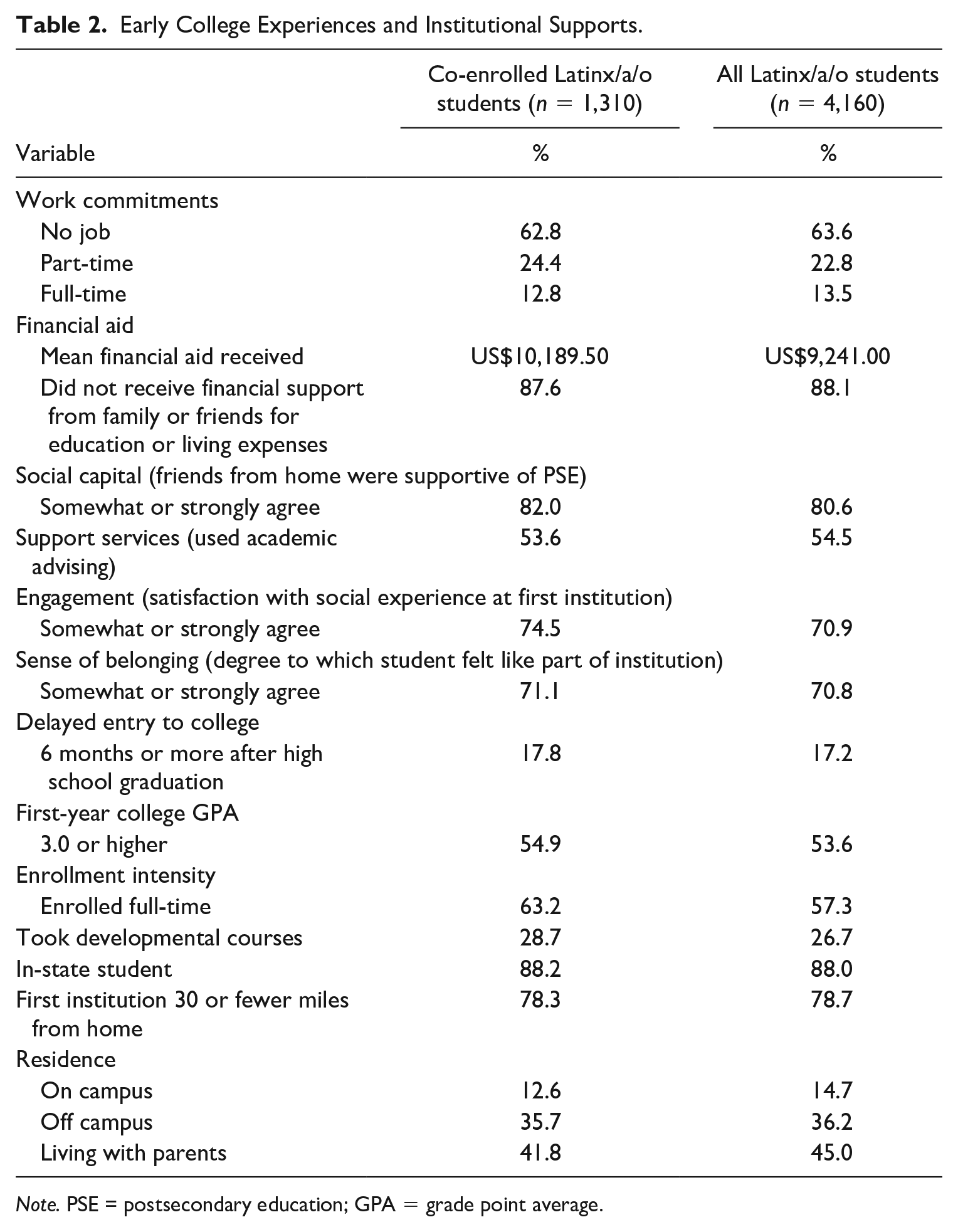
Note. PSE = postsecondary education; GPA = grade point average.
Institutional Characteristics
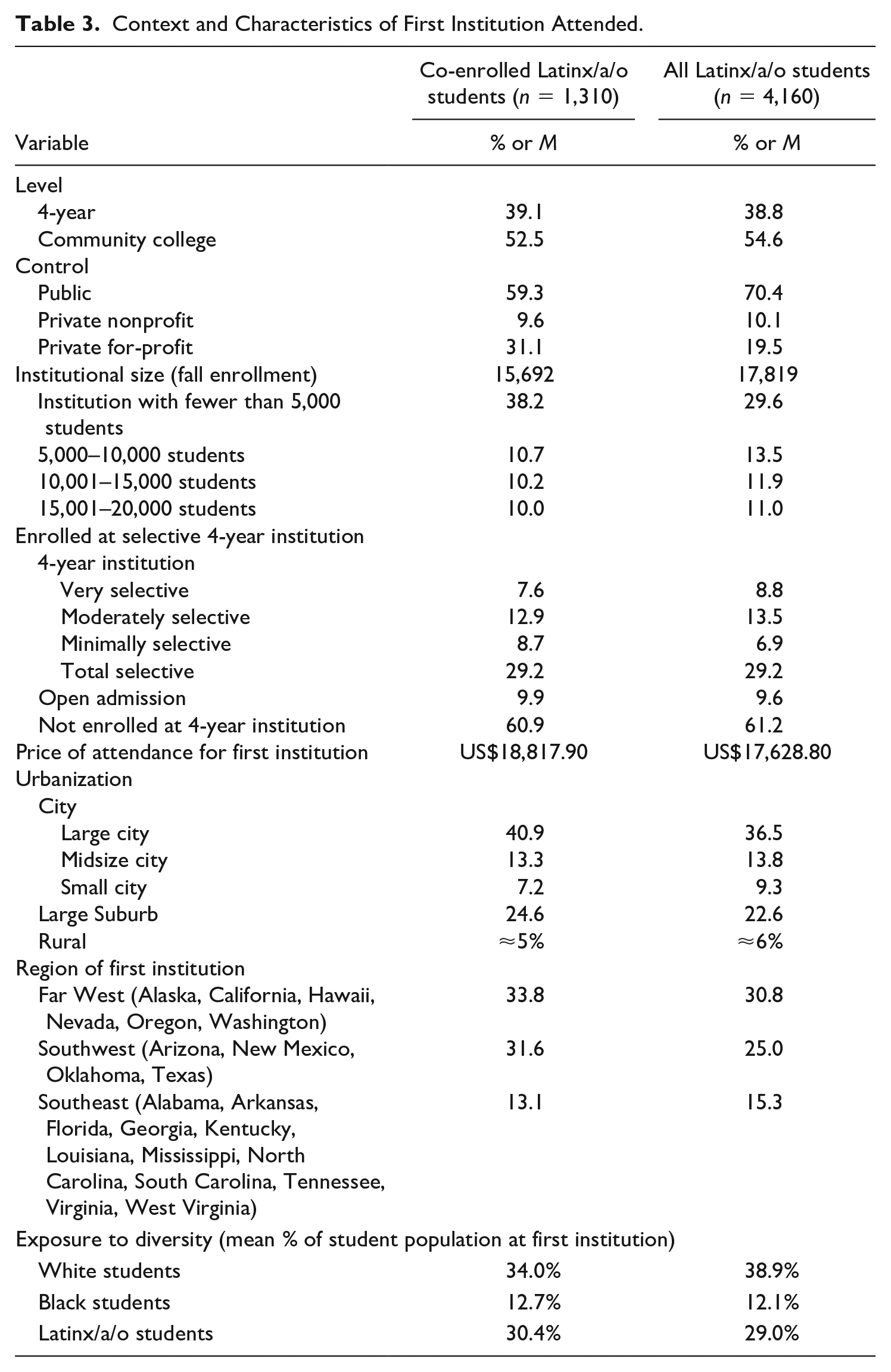
Although under half of co-enrolled Latinx/a/o students first enrolled at a 4-year institution (39%), 29% of those were enrolled at a selective institution compared with 10% who were enrolled in accessible institutions. These institutions were most likely to be located in cities (61%) in the western and southwestern United States (65%). Latinx/a/o co-enrolled students were more likely to enroll at small institutions with fewer than 5,000 students when compared with the national sample of Latinx/a/o students (38% vs. 30%). The mean price of attendance was around US$19,000. While nearly 60% of co-enrolled Latinx/a/o students attended public colleges, 31% attended private for-profit institutions. In comparison, more of the total sample of Latinx/a/o students attended public colleges (70%) and fewer of them attended for-profit institutions (20%). Moreover, fewer co-enrolled Latinx/a/o students initially enrolled at institutions with a higher average population of White students than Latinx/a/o students who were not co-enrolled (an average of 34% of White students at institutions where Latinx/a/o students were co-enrolled vs. an average of 39% of White students at institutions where all Latinx/a/o students were enrolled). In addition, approximately 30% of both groups of Latinx/a/o students initially enrolled at Hispanic-Serving Institutions (54% enrolled in 4-year institutions, 42% enrolled in 2-year institutions, 4% enrolled in less than 2-year institutions), which serve populations of at least 25% Latinx/a/o students (U.S. Department of Education, n.d.). Table 3 provides a description of the context and characteristics of the first institution students attended.
Context and Characteristics of First Institution Attended.
Student Outcomes
While 25% of co-enrolled students had graduated with a bachelor’s degree within 6 years, only 15% of those students earned the bachelor’s degree at the first institution they attended. In comparison, higher rates of Latinx/a/o co-enrolled students than all Latinx/a/o students attained a bachelor’s degree at an institution that was not the institution where they first enrolled (10% vs. 7%). Finally, among Latinx/a/o co-enrolled students who had not earned a bachelor’s degree within 6 years, 22% were still enrolled in college, compared with only 16% of the total sample of Latinx/a/o students. Table 4 displays success outcomes for co-enrolled Latinx/a/o students and the total Latinx/a/o student sample.
Student Outcomes.

Discussion
Findings from this study serve to identify the prevalence of co-enrollment among the Latinx/a/o college student population, describe the characteristics of co-enrolled Latinx/a/o students, and understand the patterns of co-enrollment among a nationally representative sample of co-enrolled Latinx/a/o students. The results add to the knowledge base of the variables related to Latinx/a/o college students’ patterns of co-enrollment. Descriptive results expose several salient characteristics and experiences of co-enrolled Latinx/a/o students. First, Latinx/a/o students co-enrolled at higher rates than the total number of co-enrolled students in the BPS data set (32% vs. 27%). Previous literature has detailed certain reasons why college students in general may co-enroll (e.g., convenience, flexibility, etc.), and the descriptive statistics utilized in the present study provide us with a strong understanding of the Latinx/a/o co-enrolled student sample. In addition, while the 6-year bachelor’s degree attainment rate at any institution (i.e., not necessarily the first institution) was less than 25% among co-enrolled Latinx/a/o students, this is actually slightly higher than the baccalaureate degree attainment rate of all Latinx/a/o students. This finding is supported by previous research that has shown co-enrollment to be positively related to bachelor’s degree completion, including for Latinx/a/o students (e.g., Carales, 2020). Furthermore, the present study upholds prior research findings on the positive relationship between co-enrollment and persistence (Peter & Forrest Cataldi, 2005; Wang & McCready, 2013; Wang & Wickersham, 2014), as the persistence rates of co-enrolled Latinx/a/o students who had not earned a degree after 6 years were higher than the persistence rates for all Latinx/a/o students. This finding reveals that co-enrolled Latinx/a/o students do seem to slightly accelerate their degree completion and college persistence by simultaneously completing coursework at more than one institution.
Another notable finding concerned institutional control. Previous studies have shown that the majority of co-enrolled college students attend public postsecondary institutions (National Student Clearinghouse Research Center, 2011), which is also the case in the present study. However, although the majority of co-enrolled Latinx/a/o students initially enrolled in public institutions (59%), 31% of them attended private for-profit postsecondary institutions. Interestingly, 11% fewer co-enrolled Latinx/a/o students attended public postsecondary institutions than the total number of Latinx/a/o students in this sample. This discrepancy is likely explained by the 11% more co-enrolled Latinx/a/o students who attended private for-profit institutions than the total Latinx/a/o sample. This may be problematic given that in 2019, the 6-year bachelor’s degree completion rate for first-time, full-time undergraduate students at 4-year institutions was only 25% at private for-profit institutions, compared with a 61% graduation rate at public institutions and 67% for private nonprofit institutions (Hussar et al., 2020). This suggests that nearly one-third of Latinx/a/o co-enrolled students initially enrolled at institutions with very low overall graduation rates, which would seem to contribute to their low overall 6-year graduation rates. It also most certainly affects their return on investment for the overall costs of attending college, especially considering that the bachelor’s degree completion rate at the first institution was slightly higher for all Latinx/a/o students than for co-enrolled Latinx/a/o students.
Though the results of this study do not provide reasons for why so many Latinx/a/o students enrolled in for-profit institutions, there is prior research that may provide some explanation. For example, in her qualitative study of Black and Latinx/a/o students’ high school-to-college transitions, Cox (2016) followed students across 3 years and found that students were given more assistance by for-profit colleges than by public institutions in overcoming the college access barriers they faced, including obtaining financial aid and registering for classes. As over three-quarters of co-enrolled Latinx/a/o students are first-generation college students, they likely have fewer informational networks to help them navigate the college-going process. Therefore, colleges and universities should investigate the operational practices employed by private for-profit institutions in smoothing the path for these students to access, enroll in, and afford college and work to improve their own practices to match. This includes providing enough accessible advising staff to allow students to easily connect with both academic and financial aid counselors (Acevedo, 2020).
Concerning early college experiences, Latinx/a/o co-enrolled students were more likely to report feeling socially engaged at the first institution they attended compared with Latinx/a/o students who were not co-enrolled. This finding appears to be counterintuitive because, although co-enrollment indicates simultaneous enrollment rather than transfer, it is possible that students who feel engaged on campus take courses from other institutions for a variety of reasons that do not impact their social engagement at their first institution. These reasons may include filling a hole in their course schedules or taking a course that better serves their work schedules.
Unlike prior research that found students who maintained full-time enrollment had the lowest rates of co-enrollment (National Student Clearinghouse Research Center, 2011), co-enrolled Latinx/a/o students were more likely to be enrolled full-time than all Latinx/a/o students (63% vs. 57%). A large body of previous research has shown that Latinx/a/o students disproportionately based their enrollment decisions on the cost of college attendance (Elliott et al., 2018) and considered financial barriers to be one of the most influential factors on college choice and enrollment (e.g., Acevedo, 2020; Cox, 2016; Martinez, 2018; Sáenz, 2020). In addition to the cost of tuition and fees, students also must weigh the costs of books, housing, food, and transportation to campus, as well as their need to work to pay for these costs. Furthermore, previous research has shown that the family members of students of color often encourage them to enroll at the institution with the best financial aid package, regardless of to which other institutions students may have been accepted (Cox, 2016; Elliott et al., 2018). Because more co-enrolled Latinx/a/o students in the present study were enrolled full-time than all Latinx/a/o students, meaning they likely did not have to work, or work as much, as students who were not enrolled full-time, and because co-enrolled Latinx/a/o students also had higher persistence and graduation rates, it is imperative that colleges and universities work to provide clear, accessible information to students and their families on the types of financial aid available to them and how to obtain it. Postsecondary institutions should also provide financial aid packages that include more than just tuition.
Findings regarding two institutional characteristics are also worthy of mention. First, Latinx/a/o co-enrolled students were more likely than Latinx/a/o students who were not co-enrolled to initially enroll at small institutions with fewer than 5,000 students. It is possible that small institutions are less likely to offer enough course options, therefore prompting more students to co-enroll. Next, more Latinx/a/o co-enrolled students attended institutions in large cities compared with non-co-enrolled Latinx/a/o students. It is likely that large cities have multiple postsecondary institutions in comparison to smaller areas, giving students in larger regions more opportunities to co-enroll.
As co-enrollment may affect student financial aid, student advisement, student assessment, curriculum planning at both the departmental and the institutional levels, institutional assessment and accountability, and institutional finances (McCormick, 2003), research on this topic can assist colleges and universities in making policies to track and assess student swirl. It can also help them plan programs for co-enrolled students to assist them in better assimilating to campus academic and social culture (Borden, 2004). Findings from the present study can help postsecondary institutions to improve success outcomes for co-enrolled Latinx/a/o students, including the development of pathways and policies for multi-institution attendance by these students.
Recommendations for Future Research
Though the results of this study showed that Latinx/a/o students co-enrolled at higher rates than the total number of Latinx/a/o college students, they do not provide clarity as to why this is so. Therefore, it is recommended that future qualitative work be conducted to understand more explicitly why Latinx/a/o students may be drawn to co-enrollment. In addition, because the use of PowerStats did not allow the explicit comparison of Latinx/a/o co-enrolled students with Latinx/a/o students who were not co-enrolled, it is recommended that future research be conducted to do so.
While the findings of this study also showed that the persistence and bachelor’s degree completion rates for co-enrolled Latinx/a/o students were higher than for all Latinx/a/o students, the particulars of how this is accomplished are unknown. For example, this research did not uncover how often and how many courses students took at multiple institutions nor how many credits they were able to transfer to the degree-granting institution. Future research should examine the specific factors that seem to make co-enrollment a better option for Latinx/a/o students in terms of degree completion in contrast to taking all their courses/credits at one institution, especially as this contradicts previous research findings not specific to Latinx/a/o students that showed co-enrollment did not reduce the time it took to attain a bachelor’s degree (Lam, 2007; Peter & Forrest Cataldi, 2005).
Finally, because this study focused only on Latinx/a/o college students, it is unknown whether or not co-enrolled students from other racial/ethnic backgrounds would experience the same outcomes. It is recommended that future research expand upon this work by examining the co-enrollment outcomes of students from other backgrounds.
Footnotes
Declaration of Conflicting Interests
The author(s) declared no potential conflicts of interest with respect to the research, authorship, and/or publication of this article.
Funding
The author(s) received no financial support for the research, authorship, and/or publication of this article.
