



Abstract
In 1968, the Federal Highway Administration allotted twenty-one additional Interstate Highway miles for a spur into Huntsville, Alabama. This article details the long subsequent battle to build the Huntsville spur. Such late additions to the Interstate System stood to be challenged on all fronts amid the nationwide Freeway Revolt and a shifting legislative environment in Congress. Federal highway policy changes during the 1960s and early 1970s gave freeway opponents opportunities to challenge controversial highways. However, decentralized metropolitan growth encouraged Huntsville leaders and city planners to support construction of the new urban expressway. Despite concerns about environmental damage and racial impacts, Huntsville’s freeway revolt faltered. Further, this article argues that, despite Huntsville’s late addition to the Interstate System, the local highway planning process mirrored the earlier national vision of expressway-driven redevelopment of declining central cities.
Keywords
When the original 41,000 miles of the United States Interstate Highway System were plotted in the early 1950s, highway planners overlooked the northern Alabama city of Huntsville. The Interstate Highway System was designed to connect most major cities with populations of 50,000 or more. Though Huntsville’s population was nearly 50,000 when Congress authorized funding for construction of the highway system in 1956, at the start of the decade it had stood at just over 16,000. 1 Over the next two decades, Huntsville’s population soared to nearly 140,000, largely due to the city’s key role in the nation’s burgeoning space program. 2 Thus, in 1968, when Congress voted to add more miles to the Interstate System, the Federal Highway Administration allotted twenty-one of those additional miles for an interstate spur to connect downtown Huntsville to Interstate 65 in northern Alabama. 3

Map of Interstate System in Alabama shortly after the completion of I-565. Source: 81st Annual Report, State of Alabama Highway Department, 1992.
The Interstate System was originally to be completed by 1972. But after the 1968 addition of 1,500 miles, alongside the growing freeway revolt and stricter federal highway policies, many late controversial segments would not be completed until the early 1990s, if they were completed at all. 4 In Huntsville, then, late addition to the Interstate System virtually guaranteed that the project would be delayed. Indeed, the interstate spur, or I-565 as it was later named, was finally completed in 1991, more than twenty years after federal officials first authorized the highway.
Local opposition to the freeway played a part in the long delay. Two Huntsville City Council members and many citizen activists across the two affected counties of Madison and Limestone opposed the road. Likewise, a handful of groups, including The Alabama Conservancy, the Greater Northwest Huntsville Civic Association, and the local chapter of the National Association for the Advancement of Colored People (NAACP), raised objections to the highway.
Many spur opponents, particularly those on the Huntsville City Council and within The Alabama Conservancy, primarily objected to the 3.5-mile section—the so-called urban route—that was set to cut directly through the city core. These opponents argued that the potential social and environmental consequences of slicing an expressway through downtown Huntsville outweighed whatever possible benefits the road held for the area. For the political and business leaders who supported the road, however, such consequences seemed a small price to pay for the potential benefits of the interstate connection. These leaders, including the majority of the City Council, the Huntsville Planning Commission, and the local Chamber of Commerce, envisioned the expressway as more than just a resource for providing efficient automobile transportation. They also perceived it as a vital means for economic growth and another tool for urban redevelopment in the declining central city. But City Council members Jane Mabry and Leon Crawford, along with members of the Alabama Conservancy and many northwest Huntsville residents, feared the urban route would divide the town along racial and class lines, or at least further reinforce divisions already facilitated by years of suburbanization, urban renewal projects, and housing assistance policies.
In a general sense, these disputes were not unique to Huntsville, despite the city’s delayed growth and late addition to the Interstate System. Instead, Huntsville’s freeway battle can be seen as part of the larger national pattern of, and response to, interstate highway building across the country. From its earliest conception, freeway promoters envisioned the Interstate Highway System as a double-edged sword that could both enhance automobile transportation and, like urban renewal programs, serve as a tool for redevelopment of blighted and declining downtown areas. Yet, the original interstate highway legislation did not require relocation assistance or a comprehensive planning approach. In the early years of construction, highway builders in each state were largely given free reign to cut these new highways straight through the hearts of cities with little consideration for the negative consequences. Highway engineers tended to route these urban expressways through low-income and minority neighborhoods. In turn, these routings often brought about what one historian has called a “racial restructuring” of many urban areas, as the expressways pushed poor black residents out from the central city to transitioning lower and middle-class white neighborhoods. 5
By the mid-1960s, strong opposition to urban expressways arose in many cities across the nation. This “Freeway Revolt,” and particularly the legislative responses to it during the 1960s and 1970s, forced highway planners and local leaders to adopt a far more sensitive approach to interstate highway construction. 6 The federal highway policy changes during the 1960s and early 1970s gave freeway opponents across the country opportunities to challenge highway plans. Antifreeway activists in cities such as Memphis, New Orleans, Baltimore, and Portland, Oregon, to name a few, successfully utilized new federal highway guidelines to delay, reroute, or cancel expressway routes over environmental, social, or preservation concerns. In some cases, funds from such cancelled interstate segments were then transferred to public transit projects instead. 7
However, despite the opposition and tougher political climate in this post Interstate era, state highway officials, local leaders, and city planners across the country often maintained a powerful preference for highways over alternatives. This was especially true in Huntsville, where low-density development around the personal automobile was a defining characteristic of the area’s late growth and where mass transit had little public support. Still, a small band of freeway fighters in the city rose up to fight the road on environmental and social grounds. These spur opponents ultimately failed to prevent the highway project, but they forced the Alabama State Highway Department to fully conform to new federal guidelines for highway construction, thus dramatically slowing down the process and pushing the project’s costs higher. The end result was a ten-year delay of federal approval for the interstate spur, as highway officials and local leaders attempted to navigate strict federal highway policies and fervent local opposition to the road.
Paving the Way: Huntsville’s Astronomical Growth and the Evolution of Federal Highway Policies
The decade of the 1950s was a crucial period for Huntsville. Though the city had not been included on the Interstate map, two other federal government decisions during the decade stimulated rapid growth in the Huntsville area and catapulted the city to national importance. In 1950, the Army decided to make Redstone Arsenal—the nearby former World War II era weapons plant—its new headquarters for missile and rocket research. Years later, as the space race gathered speed, the Army’s missile and rocket team working in Huntsville became an integral part of the National Aeronautics and Space Administration (NASA) after its creation in 1958. 8 As a result of the Army’s presence and later that of NASA, Huntsville’s population soared from little more than 16,000 in 1950 to nearly 140,000 by 1970. 9
When Huntsville’s rapid growth began in the 1950s, much of the nation was already being reshaped by automobile-driven suburban sprawl, resulting in devastating decline of central cities and urban transit systems. Key local factors further cemented such decentralized growth trends in the Huntsville area. The location of Redstone Arsenal, about seven miles west of downtown (along the future I-565 corridor), and the development of similarly positioned research and industrial parks encouraged expansion of and peripheral growth along arterial roads. The presence of high-tech aerospace industries brought in a highly educated, high-income workforce that was more likely to own private automobiles and live and work outside the central city. 10
In the early 1960s, in response to the area’s rapid metropolitan growth and to comply with requirements of the Federal-Aid Highway Act of 1962, Huntsville city and regional leaders began a cooperative transportation planning process in conjuction with the state highway department. In 1963, the city hired a consulting firm to conduct a technical transportation study for the area. The firm’s study, completed in 1966, recommended an east–west freeway connecting Interstate 65 with the downtown area. Shortly thereafter, Bob Jones, an influential congressman for north Alabama, promised to get approval for this interstate spur. 11
Well before Huntsville leaders and planners had begun to seek approval for an interstate highway connection, however, activists in other cities around the country began protesting such roads. Throughout the 1960s and early 1970s, the federal government responded to this freeway opposition with several important policy changes that represented a new direction in highway planning. These changes reflected a general “devolution of transportation decision-making” from highway engineers and top government officials down to the local level. 12
The first of these changes came with the Highway Act of 1962. The new law required local governments and state highway departments to engage in a “3-C,” or “continuing, comprehensive, and cooperative” transportation planning process. This law also mandated that highway departments provide displaced people and businesses with relocation assistance. These two provisions did not become fully effective until the summer of 1965. Yet, by linking comprehensive planning and relocation assistance to the highway building process, the law established the basis for metropolitan planning authority and signaled the beginning of a more sensitive shift in direction for future highway building. 13
The next key policy change came with the Highway Act of 1966, which served to protect historic sites and parks from federal highways if alternative routes could be found. In that same year, the National Historic Preservation Act similarly protected historic sites from federal construction projects. Also in 1966, Congress passed a bill creating the new US Department of Transportation (DOT). Beginning in 1967, the new DOT assumed the authority over interstate highway construction previously held by the US Bureau of Public Roads (BPR). In turn, BPR then became a subagency within the newly created Federal Highway Administration (FHWA) division of the DOT. The DOT legislation also took the preservation measures of the 1966 highway and historic preservation acts a step further, now including strong environmental protections. 14
More important steps came in 1968 and 1969. The Highway Act of 1968, the same act that authorized the interstate spur in Huntsville, also required the provision of “decent, safe, and sanitary housing” for those displaced by highways. In 1968, the FHWA also established a new policy requiring state highway departments to hold at least two public hearings, one for corridor location and another for design, for each proposed interstate highway. Then, in 1969, the National Environmental Policy Act (NEPA) required highway departments to draft environmental impact studies for all new proposed projects. By 1970, through further legislation, such as the Uniform Relocation Assistance Act, compliance with civil rights legislation became a prerequisite for highway building. 15
The policy changes of the 1960s affected the I-565 planning process in Huntsville for years to come. The early 1970s also saw important moves made at the federal level in favor of alternatives to freeway construction. For example, the Federal-Aid Highway Act of 1973 expanded local metropolitan planning authority and provided cities, for the first time, with the opportunity to delete urban freeway segments and use a portion of the funds for mass transit instead. 16 Thus, by the early 1970s, when Alabama state highway planners first proposed plans for I-565, federal officials had already put in place guidelines and requirements that Huntsville citizens could use to stop the road.
Roadblock: The Highway Planners Meet the Opposition
In 1969, the Alabama State Highway Department began its preliminary studies on Interstate 565. The new environmental impact study requirements under the NEPA of that year were completely foreign territory for the highway planners. The planned twenty-one-mile stretch of highway was a particularly complex project. Beyond the potentially controversial urban route, highway engineers routed the spur west of the city through a section of the Wheeler Wildlife Refuge. Beyond this to the east, the suggested route anticipated acquisition of a section of land on the northern border of the Army’s Redstone Arsenal property. In downtown Huntsville, a few historic sites near the proposed corridor, particularly the historic Huntsville Depot, were potentially threatened. Accordingly, in order to receive DOT approval, state highway planners had to carefully work to satisfy officials at concerned agencies, including the Department of the Interior, the Army at Redstone, and the Federal Advisory Council on Historic Preservation. 17
In 1972, in consultation with the FHWA, the state highway department completed the first Environmental Impact Statement (EIS) for I-565. Department officials distributed this EIS to local agencies and presented it at the first corridor public hearing in Huntsville in November of that year. 18 About 800 residents from around the city attended the hearing, and many of those present expressed opposition to the road. In the days that followed, letters to the editor in the local newspapers revealed a notable amount of antifreeway sentiment. But it also seemed clear that the road had the devout support of the business community. In a letter to the editor of Huntsville News, one attendee of the public hearing noted that, besides the highway department, the local Chamber of Commerce and the Industrial Expansion Committee seemed to be the only groups showing support for the road that night. 19
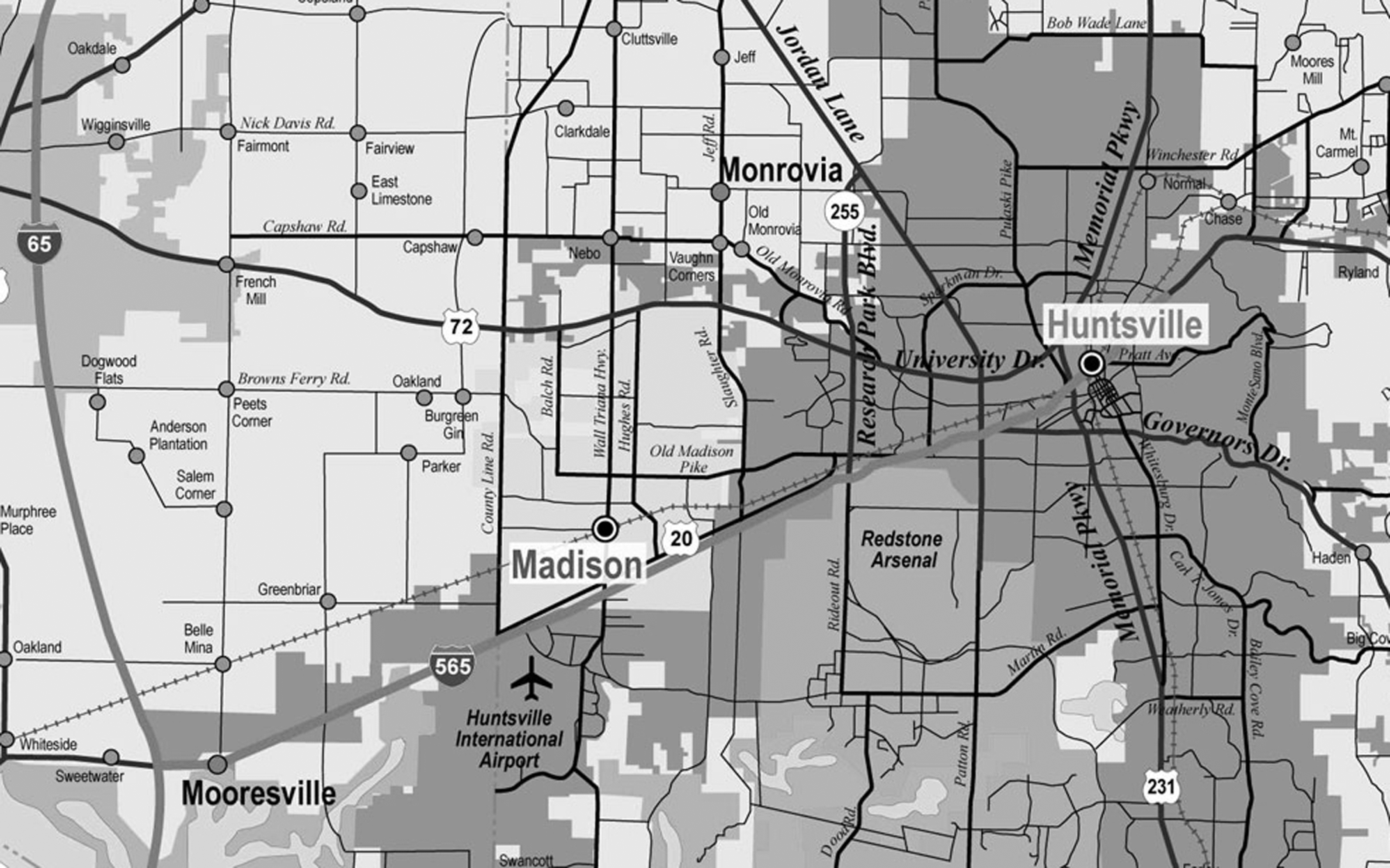
The completed I-565 route from I-65 to downtown Huntsville is shown in this map of the current Huntsville Metropolitan Area.
At that first public hearing, members of the Alabama Conservancy revealed their own EIS, produced with the help of volunteers within the local aerospace industry’s “high-tech community.” One state highway official later wrote that the Conservancy’s EIS was “very embarrassing” due to its superior preparation and detail compared to that of the highway department’s EIS. In response, the highway department then enlisted an interdisciplinary team at the University of Alabama in Huntsville to prepare a more thorough EIS. In October 1974, highway officials distributed this new statement and presented it at a second public hearing. 20
The new highway proposal was still controversial. Some members of the City Council were interested in the possibility for federally funded alternatives to building the 3.5-mile urban section. The 1973 Federal-Aid Highway Act had opened up the possibility for controversial urban interstate segments to be deleted and the funds transferred to mass transit projects. But in a meeting with Huntsville leaders regarding such alternatives, State Highway Director Ray Bass asserted that the state highway department would rather cancel the entire project and request to have all twenty-one miles allocated to another part of the state. Shortly after meeting with Bass, the Huntsville City Council passed a resolution, with just one dissenting vote, reaffirming their support for the entire project on Bass’s uncompromising terms. 21
The dissenting vote came from Councilwoman Jane Mabry. The editorial staff of The Huntsville Times later referred to Mabry as “that compulsive naysayer” and labeled her minority vote “irresponsible.” 22 Mabry, who remained a steadfast opponent of the highway project in the years to come, believed the proposed urban route was solely a political decision. Reflecting upon Highway Director Bass’s all-or-nothing stance on the road, Mabry later said, “the fact that he wouldn’t even pretend he had an open mind confirmed my opinion that [the route] was a payoff for political buddies.” 23 Mabry also resented what she called the “social engineering” behind much of the city’s urban planning. She originally ran for the City Council largely out of frustration with the city’s urban renewal policies. Years earlier, the city displaced her father’s business from a target area for urban redevelopment. According to her father, city officials determined that his building had to go not because of blight, but because it “didn’t conform with their plan.” 24
In 1976, Mabry sought to revive the idea of diverting interstate highway funds to other transportation projects, but the political will for supporting public transit in Huntsville had been steadily waning. A local 1976 public transportation feasibility study deemed Huntsville’s population and traffic demand too small to accommodate any form of passenger rail service and noted the ongoing decline in usage of the city’s minimal bus system. Huntsville’s established low-density growth patterns “around the flexibility of the private automobile” made it difficult to argue for publically funded mass transit at all, much less for diverting interstate funds for it. 25 However, the 1976 Federal-Aid Highway Act expanded upon the 1973 Highway Act’s provisions for transferring interstate funds. Now, funds from cancelled interstate segments could be used not only for mass transit projects but also for improving surface streets that were eligible for federal funding. 26
Cancelling the urban segment of the spur in favor of other transportation needs lacked necessary political support. Ray Bass remained as the highway director, and there was no sign his position on the road had changed. Further, such interstate cancellations and fund transfers had to be requested jointly by local officials and the state governor. Bass, the appointed highway director in three of Governor George Wallace’s four terms, told the City Council that he doubted Governor Wallace would approve such a transfer of interstate funds. Not willing to leave such a decision to chance, Bass said he would personally urge Wallace not to approve any such request. 27 Subsequently, with the exception of the supportive Councilman Crawford, the other members of the City Council expressed strong doubts that Mabry’s transfer proposal was politically feasible. 28
Yet, even as their interstate highway plans seemed safe from a fund transfer request, throughout the decade highway officials faced several other obstacles due to shifting federal highway policies. For example, in February 1976, the Huntsville Area Transportation Policy Committee, the designated regional Metropolitan Planning Organization (or MPO), of which Councilwoman Mabry was a part, voted to reject the right-of-way acquisition for the road. The Federal Aid Highway Act of 1973 established MPOs, as designated by the state governor, to be responsible for comprehensive planning in urban areas and for approving local federally funded transportation projects. The voting body of the Huntsville MPO consisted of four regional mayors, one member of the Huntsville city council, and a member of the Madison County Commission. The MPO’s “no” vote effectively halted the land acquisition process by preventing any right-of-way funds from being spent. Huntsville Mayor Joe Davis, who cast one of the two “yes” votes for the right-of-way acquisition, told the group, “Do you know what you’ve done? You killed the interstate.” 29
Davis had spoken too soon. Right-of-way acquisition may have been momentarily frozen, but the MPO’s three to two vote (the sixth member abstained from voting) could be reversed at any time. Later that year, Governor Wallace appointed a highway department division engineer to the Huntsville MPO. Highway Director Bass delivered the news to MPO members with a threat that if they did not accept the engineer’s appointment, Governor Wallace would use his authority to designate another agency as the MPO for Huntsville. The appointed highway engineer was the only nonelected official with voting power on the committee. 30
Several citizens and groups across the region organized to fight the freeway project. But the key spur opponent was the Huntsville chapter of the state environmental organization, The Alabama Conservancy. Conservancy members opposed the road largely over its high cost and presumed environmental and social impact. At public hearings and in letters, the group consistently voiced its opposition and concerns, complaining of severe flaws and oversights in the highway department’s EIS. Most of all, the Conservancy disagreed with and challenged the highway department’s conclusions, which tended to downplay environmental impact and costs while perhaps overstating the road’s economic and traffic benefits. 31
Still other obstacles for the highway planners came not just from local groups, activists, or area politicians, but from federal agencies and officials as well. For example, officials within the Department of the Interior and the Army Corps of Engineers commented that the highway department’s EIS needed greater acknowledgment of the possible environmental, cultural, and social impacts of the road. As the assistant secretary of the Department of the Interior wrote to state highway engineer, W. R. Glass, “it is difficult to adequately assess the impacts of the proposal upon natural and cultural values because the [EIS] tends to minimize such effects, countering them with a range of highly subjective ‘benefits.’” 32 Similarly, an official of the Army Corps of Engineers requested that the highway department “include a discussion concerning the possible cutting of social ties” within the communities set to face disruption from the road. 33 This echoed a particular concern of Leon Crawford, Jane Mabry, and other opponents that “an unnatural man-made barrier such as I-565 ripping through the middle of the city” would “cut off” north Huntsville from the south, primarily along racial and economic class lines. 34 Concerns over issues such as these led to the inclusion in the EIS of a social and cultural impact study conducted by a team of sociologists at the University of Alabama in Huntsville. 35
The sociological study only added to the controversy. In the summer of 1976, the assistant secretary for environment, safety, and consumer affairs at the DOT, Judith T. Connor, sent a letter to both the state highway department and the FHWA citing problems with the EIS and circumstances surrounding the proposed project. Connor listed several issues, such as Highway Director Bass’s all-or-nothing attitude concerning the controversial urban route and the highway department’s failure to adequately explain why an alternate beltway route around the central city, an alternative supported by many freeway opponents, would not be acceptable. But the findings of the social and cultural impact study sparked the greatest concern. Subsequently, the head of the DOT, Secretary of Transportation William T. Coleman, rejected the highway department’s EIS pending more extensive investigation concerning the road’s social impact. 36
These official concerns left the road’s future uncertain. Though the urban route favored by the highway department ran roughly adjacent to the Southern Railway corridor through the city, it marked over 200 homes and more than 100 businesses for displacement along this four-mile path. The majority of the residents, located on the far western and eastern ends of the route, were low- and moderate-income white homeowners. Yet, another section in between consisted of predominantly low-income black residential and neighborhood business areas. Beyond this, the route traversed a commercial and industrial area just north of the Central Business District. Of the three urban segment routes that highway engineers had proposed, this particular route was the most expensive, adding to the suspicion that political favoritism was involved. 37 However, despite the many controversies surrounding the highway department’s preferred urban route, the Federal Advisory Council on Historic Preservation also preferred the particular path, because it had the least impact on historic structures in the area. 38
The Road to Approval: Highway Supporters Strike Back
In August 1976, in the face of opposition and federal delays, political and business leaders in the Huntsville area organized an effort to promote the road and lobby for swift federal approval. Huntsville-Madison County Chamber of Commerce President Paul Thompson attacked opponents of the spur for “standing in the way of progress,” and he expressed assurance that local business leaders would not let the road be stopped. 39 The editorial staffs of both Huntsville major newspapers, The Huntsville Times and Huntsville News, joined in the chorus of support for the spur. An August 16th editorial in Huntsville News decried highway opponents as “the horse-and-buggy element” that “would bind” the area in industrial growth-preventing “shackles.” 40
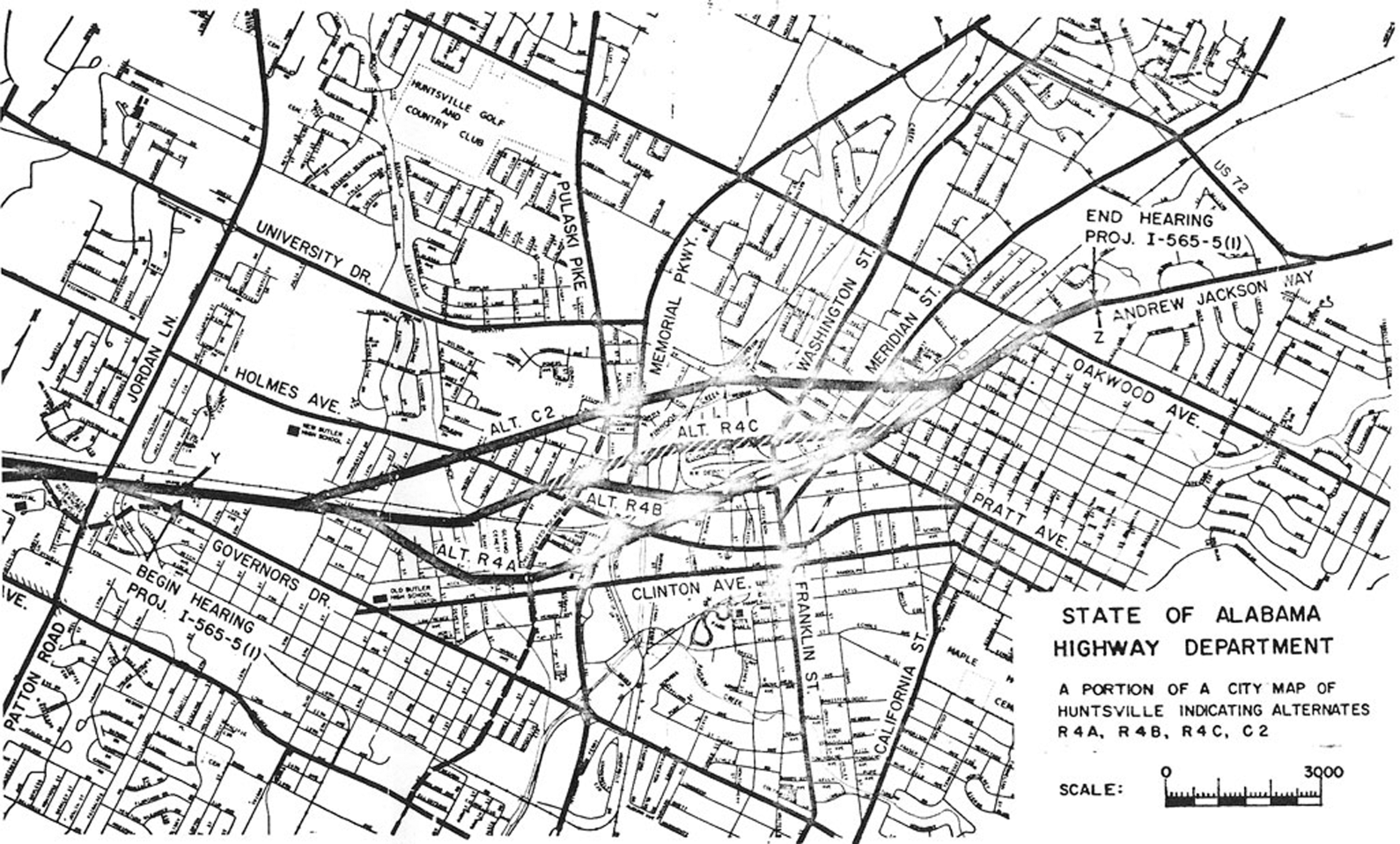
Alabama State Highway Department map illustrating the three proposed routes for the urban segment. The middle route (ALT. R4C) was the preferred and ultimately approved path.
Huntsville’s Mayor Joe Davis also strongly supported the road. Mayor Davis disputed claims that the urban route would disproportionately displace poor and elderly black residents. Thus, he looked on cynically when federal officials from the civil rights division of the DOT came to Huntsville in 1977 to investigate such concerns. According to Davis, the city had earlier been assured approval for the road, but as a result of the “change in national administrations since then” he argued, “the matter surfaced again as a new civil rights issue.” 41
During the next three years, the seemingly endless debate over the spur surrounded competing claims concerning the road’s potential social impact. As early as 1977, when federal civil rights investigators visited Huntsville, there were conflicting estimates of the number of people the road would displace. Huntsville’s Community Development Office conducted a study for the highway department’s forthcoming Relocation Plan—a document designed to assuage concerns surrounding the road’s social impact and the need for adequate relocation provisions. The authors of the relocation plan study concluded that “the number of displacees was greatly overestimated” in the sociological study for the highway department’s EIS. The community development office conducted their study with a narrower definition of impact, and, according to the text of the study at least, a greater knowledge of the actual urban section corridor. 42
Though the community development office downplayed the overall displacement, authors of the EIS sociological study emphasized the disproportionate number of low-income residents within the areas affected by the highway. 43 Authors of the Alabama Conservancy’s EIS reported and illustrated similar social impact findings. With accompanying census tract maps, the conservancy demonstrated that some of the affected areas, particularly tract 12 in lower northwest Huntsville, contained a very high concentration of minority and economically disadvantaged residents. All three of the proposed routes for the urban segment of the spur sliced through this sensitive census tract. 44

Two figures from the Alabama Conservancy EIS illustrating the distribution of low-income and minority population in the affected urban tracts.
Many residents in or near this section of northwest Huntsville made dire predictions about the urban route. By the late 1970s, the greater north and northwest portions of Huntsville had already undergone significant racial and socioeconomic transition as low-income black residents had steadily moved in, and many white residents had subsequently moved out to southeast Huntsville or farther west toward neighboring Madison. Throughout the 1960s and 1970s, urban renewal projects in the downtown area led to the relocation of hundreds of low-income black residents to northwest Huntsville, a district with affordable replacement housing. 45 Then, in the mid-1970s, northwest residents started accusing realtors of redlining and steering blacks only to the north part of town. Meanwhile, the city instituted a Housing Assistance Plan, which many argued was leading to a greater concentration of low-income residents, particularly in section 8 housing in the northwest. 46
In this context of what one resident described as “de facto segregation,” many northwest residents were especially wary of the spur’s potential impact. Much like other opponents, one northwest Huntsville teacher claimed the spur would cut off the northwest from the rest of city. 47 A professor at nearby Alabama A&M University went further, saying, “I-565 seeks to divide the northwest from the southeast by a barrier. I-565 will complete the segregating of southeast Huntsville.” 48
Yet, while northwest residents and other spur opponents objected to the urban route location, many Huntsville leaders actually preferred it for its trajectory through blighted central city areas already tagged for redevelopment. As with urban renewal, planning officials and city leaders saw the spur’s urban segment as an opportunity to redevelop distressed downtown areas. As City Councilman Jimmy Wall said of the urban segment, “we chose a route that would go into areas where redevelopment should occur.” 49
As debate over the spur continued to drag on in the late 1970s, the new DOT Secretary, Brock Adams, sought a quick resolution. Awaiting necessary completion and review of the highway department’s Relocation Plan, Secretary Adams granted full approval for the rural portion of the spur and conditional approval for the urban route in February 1978. The Community Development Office finally completed the Relocation Plan in the summer of 1980. In March 1981, the FHWA granted full approval for the urban route location. 50
Even after the FHWA granted location approval, state and local leaders lacked authority to immediately end the battle over the urban route. Federal highway policy required the state highway department to hold a public hearing on the road’s design. Further, federal highway officials had to give additional approval for design plans. 51 Meanwhile, the Alabama Conservancy engaged in a “stop-the-spur” letter-writing campaign. Members spent the spring and summer months of 1981 furiously writing letters of dissent to the governor, highway officials, local leaders, and local and regional newspapers. 52 However, state and local officials would not budge, and the spur’s steady march forward could not be stopped. In the fall of 1982, the FHWA granted the highway department full approval to begin the design and right-of-way acquisition phase for the road. Construction of the spur finally began in 1984, initiating a long seven years of construction-related traffic problems for the city. 53
Roads of Growth, Redevelopment, and City Reorganization: I-565 and Urban Renewal
Interstate 565 officially opened to traffic in late October 1991 to much fanfare from city and state officials and local businessmen. Huntsville leaders and city planners had anticipated the interstate spur for more than two decades as a key part of the city’s future growth and planning. Many Huntsville planners had long before conceded that Huntsville “is imbued with the ‘car culture,’” and sought to link development to this dominant transportation preference. 54 Many spur supporters, and even many opponents of the urban segment, believed a freeway was or at least eventually would be necessary simply to meet westerly growth trends and traffic demands in the area. But many political and business leaders, including the city’s planning officials, also promoted the road as an important instrument of economic growth and central city redevelopment. 55
The economic benefits of interstate highways had long been widely proclaimed by policy makers, road builders, and business groups across the nation. Such visions of highway-driven economic growth were directly connected, nationally and in Huntsville, to the choice of routing freeways directly through central cities. The assumption was that urban expressways would provide a convenient way to, as historian Raymond A. Mohl has written, “eliminate blighted neighborhoods and redevelop valuable inner-city land” toward “more acceptable or more productive uses.” 56 This idea was clearly reflected in Huntsville. As authors of the highway department’s EIS wrote: “One of the primary objectives of the Interstate Spur into Huntsville is to provide service to the Central Business District,” through an area where the majority “of the houses which would be relocated are blighted and/or substandard.” 57 Consequently, Huntsville planning officials favored routing the expressway through this particular area for redevelopment purposes. In a letter to the highway department’s impact study team, the Huntsville Planning Commission’s assistant director wrote, “Eighty percent of the residential houses to be removed along this route are blighted… Their removal [and] the construction of a well designed urban highway … would in our opinion enhance those neighborhoods the route crosses.” 58
Of course, the Huntsville interstate project came along fairly late relative to the bulk of interstate highway construction. To some degree, then, the I-565 spur simply followed in the trail blazed by previous urban renewal efforts in the central city of Huntsville, dating back to as early as 1956. As the Community Development Office relocation plan study pointed out, at least three central city areas lying along the urban path of I-565 were “transitional” and targets for new development. In this case, “transitional” meant that urban renewal and other development projects had relocated many low-income residents and removed their “substandard” housing so that these areas could be rezoned and redeveloped for industrial and commercial use. Thus, the Community Development Office considered such displacement that would result from the urban route of the road to be of “minimum impact,” because the affected areas were “declining neighborhoods … only marginally viable for residential use.” 59
This redevelopment approach that the Huntsville Planning Commission and the Community Development Office took toward the highway project mirrored earlier urban renewal efforts in downtown Huntsville. The Huntsville Housing Authority served as the urban renewal agency until the early 1980s, when the Community Development Office accepted that role. Major aims of urban renewal in Huntsville and across the country were redevelopment and reorganization of the central city and slum clearance. 60 While this renewal effort often did entail beneficial infrastructure improvements and upgrades in old, dilapidated neighborhoods, the Huntsville Housing Authority often preferred a policy of total “slum dispersal.” Under this dispersal policy, the housing authority “encouraged persons dwelling in substandard homes to use relocation assistance to move to single-family dwellings or apartment complexes under private ownership in good suburban neighborhoods.” 61 Highway department authors of the EIS for I-565 anticipated similar effects from interstate highway construction, writing that, “Displacement from the [highway] right-of-way permits displacees to upgrade living facilities.” 62
The civic elite, seeking to save the declining central business district through redevelopment of central city space, shared the urban renewal goals of the housing authority and highway promoters. A study published by the Huntsville-Madison County Chamber of Commerce in 1974 called for “removal of … unsuitable structures and the clearing of land” for the construction of “high quality contemporary buildings” downtown. It was up to local government to achieve these goals the Chamber study stated, “because private enterprise cannot accept this responsibility over the long range … illustrated by the present plight of the central business district.” 63
During their twenty-year mission, housing authority officials targeted several areas of downtown Huntsville for urban renewal projects. After declaring structures “substandard,” the authority would often purchase residential or small business property, clear and rezone the area, then sell the property to developers for commercial use. In the process, the housing authority relocated thousands of low- and even middle-income residents and businesses out of downtown black districts as well as white neighborhoods into outer areas in the north or west or into public housing projects elsewhere within the city. 64 Consequently, these urban renewal efforts served to hasten ongoing suburbanization in the area as well as facilitate racial and socioeconomic reorganization throughout Huntsville. 65
Highway engineers, in coordination with local leaders and planning officials, routed the Huntsville interstate spur corridor through multiple low-income community development areas. 66 As a result, like urban renewal projects had done before it, I-565 removed more low-income housing and people from the central city. Further, the highway reinforced ongoing patterns of suburban sprawl, central city population decline, peripheral growth, and easy commuting to and from outlying areas north and west of the city. Thus, the interstate spur continued, if not accelerated urban renewal trends and an ongoing pattern of suburbanization and racial reorganization in Huntsville. 67
Evaluating the Huntsville Freeway Revolt
During the 1970s, freeway opponents in Huntsville put to the test and demonstrated the federal government’s new approach to highway building. In the process, these activists were able to delay the interstate spur project for at least a decade, pushing its costs considerably higher. The long delay took the state highway department by surprise. In fact, a few years into the freeway fight, many highway engineers began to think the road would never get built. 68 But despite the many hurdles they put in front of state highway planners, the antifreeway activists in Huntsville failed to stop the road. This outcome was not necessarily guaranteed, however. A closer examination of the Huntsville freeway revolt may serve to illuminate key weaknesses, or sheer misfortune, that prevented its success. In the article, “Stop the Road: Freeway Revolts in American Cities,” historian Mohl identifies “four commonalities” of successful freeway revolts: persistent activism across neighborhoods, race, and class; strong support of local politicians and the media; legal action against freeways; and a “shut-down decision” from upper-level officials or the courts. 69
The Huntsville Freeway Revolt did contain some cross-county and cross-city activism. But there is little evidence to suggest that this activism was cross-race or cross-class on a large enough scale to gain the maximum amount of influence and sustained attention. Indeed, the revolt ultimately may have been too marginal to achieve its goals. For example, although civil rights groups, such as the NAACP, opposed the road, one civil rights activist living in northwest Huntsville later admitted to having no knowledge of the road controversy. Further, many of the freeway opponents were members of a relatively small environmental community. Still other antiexpressway activists resided in the affected residential areas but lacked political clout or savvy. 70 Finally, freeway opponents only had the support of two local politicians and rightly perceived the local press to be “hostile” to their cause. 71
The Alabama Conservancy had regularly threatened to file suit against the freeway if the corridor was approved. But the group failed to take legal action against the road. Upon reflection, Cathy Burns, Conservancy member and wife of the group’s spokesman, admitted that they never raised sufficient funds to litigate. Their only hope, she said, “was to get it killed administratively.” 72 By appealing to and getting the attention of federal highway officials and some local politicians, the group came close to achieving that goal. But after DOT and FHWA approval dashed the hopes of a shut-down decision in 1981, the opposition’s only hope was legal action based on environmental and social concerns. Without that litigation, the spur design was promptly approved, and the road was subsequently built largely as planned.
Opponents of the interstate spur in Huntsville found themselves in an urban environment that was unfavorable to freeway alternatives. In 1977, shortly after activists and political leaders sought to transfer interstate funds to public transit projects, Huntsville’s original public bus service came to an end. Until officials established a new limited bus service in 1990, Huntsville was the largest city in the nation without a fixed-route public transit system. Census data in the 1980s revealed that Huntsville had higher reliance on the private automobile than even other comparable high-tech urban areas. Frank Davis, author of a 1989 public transportation feasibility study for Huntsville, saw the “culture” of transit in the community as broken. Articulating the myopic local car culture preference instead, Davis called the city’s low-density growth pattern “a microcosm of what is going to be in the 21st century” wherein “a 19th century transportation system just won’t cut it.” 73
The story of the failed freeway revolt in Huntsville clearly demonstrates the tougher atmosphere in which highway planners suddenly found themselves in the late 1960s and 1970s. Furthermore, the freeway battle in Huntsville, along with prior city redevelopment schemes, provides a late glimpse into the dynamic forces of change American cities faced, from without and within, in the latter half of the twentieth century. On one hand, decline in the face of emerging suburban sprawl and metropolitan decentralization threatened aging central city cores. City leaders, urban planners, land developers, and business elites responded to these changes with revitalization and redevelopment schemes, from urban renewal to urban expressways, hoping to save the central city. On the other hand, over time central city residents resisted the planners’ schemes—particularly urban expressways, which served business interests and automobile movement to and from cities at the expense of urban dwellers and a healthy urban environment.
Having been left out of the original Interstate System, Huntsville leaned exclusively on urban renewal programs before the urban expressway to revitalize the decaying central city. Simultaneously, the city’s relatively late growth, marked by outlying aerospace and industrial development, served to further encourage low-density decentralization and the predominant desire for highway improvements and automobile-centric planning. But late addition to the Interstate System amid new federal highway policies in the late 1960s essentially ensured a drawn-out approval process and a freeway fight in the city. The new policy climate for highways in the late 1960s and early 1970s gave local leaders more decision-making authority and provided citizens with greater ability to challenge road plans and at least mitigate freeway impacts. But this new climate coexisted with continuing overriding and powerful preferences on the state and local level for expressways and a desire at the federal level to complete the Interstate Highway System in short order. As a result, despite controversy and opposition, city and highway planners persisted and successfully constructed some post Interstate era urban freeways, as the case in Huntsville illustrates. 74
Mirroring a common experience in other cities around the country, local leaders and planners ostensibly sought the I-565 route, in part, to provide efficient automobile access and revitalization to the Central Business District. However, the expressway also magnified peripheral growth, ironically accelerating suburban sprawl further away from the struggling city core. Thus, by the early years of the twenty-first century, downtown Huntsville was still beset by population decline, prompting local planners to continue seeking ways to revitalize the central city. 75 Still, urban expressway construction in Huntsville echoed the process of urban renewal by displacing low-income residents from the central city (or concentrating them in public housing), leveling undesirable facilities, and converting urban land to uses city planners deemed more productive. By penetrating the city core, the Huntsville expressway claimed a vast swath of urban space, literally and figuratively drawing a concrete dividing line in the city that underscored the ongoing pattern of racial and socioeconomic reorganization that came before it.
Footnotes
The author(s) declared no potential conflicts of interest with respect to the research, authorship, and/or publication of this article.
The author(s) received no financial support for the research, authorship, and/or publication of this article.