



Abstract
This article historicizes the contemporary urban development and governance strategies in Cape Town, South Africa, by focusing on two periods: the British colonial era (mid to turn of the nineteenth century) and the neoliberal postapartheid era (early twenty-first century). It reveals the keen affinity between a contemporary urban strategy known as Improvement Districts for the affluent and the old colonial practice of “location creation” for the native. Discussing the similarities and differences in the material and discursive practices by which urban privilege is produced and maintained in Cape Town across the two eras, the study brings to light the colonial legacies of the neoliberal municipal strategies for governance of urban inequalities. This insight is significant to the citizens' resistance against exclusionary redevelopment projects that claim “innovation” in urban management.
Keywords
The contemporary urban scholarship in South Africa has often focused on the postapartheid and the apartheid periods. The emergent policies for development and management of urban areas are frequently examined to understand continuities and changes with respect to apartheid practices. 1 Analysis of the postapartheid urban policies typically pays attention to links to the globalized urban strategies associated with the neoliberal framework. Usually, the assumption holds that these neoliberal urban strategies originated in the global North during the 1970s and were subsequently rolled out to the rest of the world by the contemporary institutions of global command in the 1980s through what is known as the Washington Consensus. This shallow historical account of contemporary postapartheid urban strategies fails to explore the colonial legacies of neoliberal urban development and governance strategies. This ahistorical approach risks accepting postapartheid strategies for development and governance of cities as “new” and “innovative” without any roots in earlier periods of South African history.
To address this shortcoming, the present essay focuses on two key moments in the urban and real estate development of Cape Town: the British colonial era and the postapartheid neoliberal era. It seeks to understand the municipal struggles over urban infrastructure development during the colonial period and how those might have influenced the contemporary strategies for urban governance and development. Connecting these moments serves to historicize seemingly new struggles and new practices of municipal governance. The essay is organized in three parts. Part 1 focuses on the colonial era 1840 to the turn of the twentieth century. It offers an account of the class, ethnic, and racial struggles involved in production and governance of Cape Town as a nineteenth-century capitalist city entering the twentieth century as the segregated city would become. This part is informed by a vast scholarship, including the published historical work by Bickford-Smith, Van Heyningen, and Worden, 2 Bickford-Smith, 3 Warren and Broodryk, 4 Mabin and Smit, 5 and Swanson 6 that document the contestations over urban development issues in Cape Town during this period. Part 2 concerns the first decade of the twenty-first century and a specific postapartheid urban redevelopment strategy implemented in this period called City Improvement Districts (CIDs) or Special Rate Areas (SRAs). This part draws on field work in Cape Town (2000–06) supplemented by current information gathered from newspapers and CIDs promotional material accessed online. Final section of the article offers a comparative historical analysis of the discourses and strategies used for development and management of urban privilege in Cape Town during the colonial and the contemporary periods. It highlights the Cape Town city center as a space that has been the site of fierce historical struggles for urban citizenship and inclusion and reveals the similarities and differences in strategies for development and urban governance across the two periods.
The main findings of this research are the following: Contemporary “zonification” strategies commonly referred to as business improvement districts (BIDs) and in Cape Town referred to as CIDs or SRAs have keen affinity with the old colonial practice of “location creation.” While colonial practices of location creation segregated those at the bottom of the social hierarchy (the non-Europeans) to secure access to cheap labor, the creation of BIDs, CIDs, or SRAs, construct special locations for those higher up in the social hierarchy to secure and promote spaces of consumption. In both eras, “fear” is mobilized to justify creation of special location and segregation. What fear of disease did at the turn of the previous century, the fear of crime has accomplished at the turn of the present century. In its neoliberal version however locations (CIDs and SRAs) are created through seemingly voluntary community-based decisions, unlike the colonial era where administrative orders from a Public Health Officer brought locations into existence. In line with Gillian Hart’s relational comparisons, this essay tries to reveal the “interconnected historical geographies” of Cape Town and forms of exclusion produced, to understand “how they feature in the present.” 7 This I hope furthers resistance to contemporary exclusionary projects of Cape Town redevelopment by exposing their advocates' claim of “innovation.”
A wealth of research on colonial urban governance and development informs this research. These investigations reveal how the colonial interests in establishing and reinforcing domination and social control were mediated through the built environment to achieve the imagery and materiality of superiority and privilege. 8 While colonial accounts of this process focused on notions of “hygiene,” more recent historical scholarship documents urban infrastructure and municipal services development as a highly contested terrain and center of political struggle. For example, McFarlane’s account of colonial Bombay contends that the “The biopolitics of sanitation [is]… about facilitating the production of… a capitalist city.” 9 His writing demonstrated how infrastructure development has been a highly politicized subject of debate not only in the metropole 10 but also in colonies and implicated—discursively and materially—in technologies of rule. To govern the colonies, McFarlane 11 describes how urban inequalities in Bombay were enrolled in the sanitary discourse; Gandy 12 echoes this view in his work on colonial Lagos, arguing that British colonial administrators sought to transform this Nigerian port into the “Liverpool of West Africa.” Similar perspectives emerge in Perera’s 13 work where he shows how British town planning aimed to modify colonial Colombo through means of legislative and design to produce the capitalist city over the colonial city. Urban services such as water, 14 garbage collection, and street sweeping 15 have also been the subject of this new research. For instance, Parnell 16 depicts how the Medical Officers of Health (MOH) in one British colony were often involved in the formation of Public Health Acts in another, while Swanson 17 homed in on the way in which the “sanitation syndrome” was instrumental in the colonial technologies of governance. A number of writers 18 have described how public health hazard and epidemic outbreaks often served as triggers for segregation projects that created a cordon sanitaire to spatially separate Europeans and non-Europeans. In some instances, colonial authorities referred to the living environment of the colonized as the “septic fringe” of the city and as a “medical menace.” Such dehumanizing discourse laid the groundwork for “segregation for sanitation” as a slogan to justify removal of non-Europeans to segregated zones called “locations”—a strategy that generally contributed to the Europeans' urban privilege and wealth creation. In fact, in South Africa, these locations created the bed rock for a full-blown apartheid urbanization. The contemporary urban struggles by residents for citizenship and urban services improvement are not divorced from past struggles that have shaped these physical and social landscapes. As Terence Ranger 19 reminds us, these struggles are confrontations between state and city that are not just the result of the present conjuncture but expression of extreme structural tensions which have operated for the last couple of centuries.
Part 1: Nineteenth-Century Colonial Period
The second half of the nineteenth century (1840–1900) was an important period for the urban development of Cape Town. Two decades were key in shaping the urban landscape and municipal politics in this period: the 1840s and the 1880s. Large injections of capital into the city at those times “greatly changed the nature of urban growth” and shaped not only the city’s physical infrastructure but also its class interests, ethnic, and racial identities, urban politics, and municipal governance. 20
The first wave of investment in the early 1840s, followed the abolition of slavery in the Cape Colony. Though the initial abolition of slave trade in the early 1808 freed slaves from trading ships and brought a new population of “prized Negros” 21 to Cape Town, it was not until 1838 that slavery was abolished in the Cape Colony sparking the new formation of urban landscape and politics. Capital to drive this process came primarily from large sums that the Queen paid to slave holders to compensate for property loss. These transfers supplied disposable cash for Cape Town’s real estate capital. 22 A large amount of this money went to construct the upscale buildings of the city center that are now Cape Town’s historic core. Much of the remainder helped build the residential tenements in the city’s outskirts, for which there was a growing demand from the emerging class of wage laborers and former slaves.
The second wave of large capital reached the city in the last two decades of the nineteenth century, following the 1869 discovery of diamonds in Kimberly. Cape Town and its harbor, where the colony’s extracted riches were exported to Europe, benefited from the prosperity of the Cape Colony. The city’s harbor was improved and the construction of a railroad terminus connected the Cape to the main road to Rhodesia and the interior. This massive development of infrastructure facilitated Cape Town’s geographical expansion and the building up of housing stock, while the value of properties and revenues soared. 23 Toward the end of the nineteenth century, Cape Town became the commercial center dominating the Western Cape, attracting the headquarters of banks, and land and insurance companies.
The large injections of capital into the city during these periods also catalyzed sharp class conflicts over production and control of urban space. The decisions about infrastructure that shaped the uneven development of Cape Town and its contentious politics both consolidated class interests and shaped the structure of its first municipal government. I will discuss these further below.
Abolition of Slavery in the Cape Colony and Development of Cape Town: 1830s–1850s
As the sudden delivery of cash to the former slave holders found its way to urban real estate and economic activities in Cape Town, the growing population and activities of the city created urban conditions that cried for attention and infrastructure development. Warren and Broodryk 24 describe the conditions of Cape Town in the late 1830s as so filthy that they were blamed for the outbreak of small pox in 1839. They write of slaughtering taking place in public areas, of a six-foot-wide open sewage channel that ran down the middle of the streets. They describe the city’s main sewer being as an open drain. In other words, the urban environment was a virtual catalyst for the promotion of disease. 25
To take care of the material welfare of its growing inhabitants and oversee provision of water, and cleaning and lighting of the streets, 26 the colonists pressed for creation of independent government in the Cape. They demanded widening the municipal franchise from the traditional urban merchant elite who had dominated the corporations to include the middle class. The 1836 Ordinance enabled towns in the colony to opt for self-government. 27 From 1836 to 1840, Cape Town saw an intense class struggle over criteria for inclusion in self-governance: who could vote and who could be elected. 28 This struggle was mobilized through Cape Town’s first municipal government and its constitution by two Municipal Boards: the Board of Commissioners and the Board of Wardmasters. The two municipal Boards articulated the class conflicts over the burgeoning real estate in Cape Town, and the uneven development of urban infrastructure and distribution of urban improvements that followed. 29
The Wardmasters Board represented the tenants and small landlords, the petit bourgeoisie. The Board of Commissioners, on the other hand, represented the elite merchants and the colonial government. This mercantile elite represented the interests of colonizers, with no long-term commitment to Cape Town. Home was England, where they would return once they retired from their businesses in the Cape. Because Cape Colony was far from sources of fuel, industry was minimal, and the Cape’s economy mostly relied on trade and export of agricultural goods. From 1840 to 1870, major political power lay with the British elite merchants who dominated colonial business interests. 30 Through the Board of Commissioners, the merchant elite exerted their power over municipal decisions. 31
The commissioners allocated municipal resources largely to advance the interest of the propertied and commercial classes with import–export links to the United Kingdom. Privileging the city center in the allocation services, the Commissioners acted not only in self-interest but also in the interest of the colonial government. The center of Cape Town, today referred to as the historic core or Business District, is where the main offices for the mercantile elite as well as the banks and insurance companies were located.
Using 1841 memos of residents' complaints, Warren and Broodryk 32 show how the town center always received priority, whether it was for police force, light, or other services. For example, city center streets like Short Market street 33 had gas lighting and were the first to benefit from paving in 1849, while peripheral roads were left in the dark and seldom paved. 34 Warren and Broodryk 35 also chronicle poor householders' complaints about nothing being spent for the poor quarters of town. They claimed that town carts failed to make their round to pick up trash, leaving filth and rubbish to take over their neighborhoods. These resident complaints suggest Cape Town’s uneven investments in improvement and development.
Public works expenditures further substantiate these inequalities. In 1840–41, for example, of the £6,178 spent on public works, £2,083 (one-third) went into the central district. 36 This included the Market Square and Caledon Square area or the commercial heart of the town bounded by main roads like the Heerengracht, Keisergracht and Buitengracht, Wale, Strand, Buitenkant, and (lower) Long Street, which were also the first roads in Cape Town to be repaired. 37 Wardmasters opposed such selective allocation of expenditure and asked for “gradual improvements in various parts of the municipality.” 38 But the conflict that arose in this period of heightened demand for urban services was not only between the Wardmasters Board and the Commissioners Board. It was also between municipal Boards and the colonial government over the definition of the responsibilities of the municipal and colonial governments and householders. Water supply, for example, was a contested issue that ultimately catalyzed the 1842–47 anticolonial struggles of the Cape Town Municipality and united the Wardmasters and Commissioners Boards. 39 At the time, municipal revenues were drawn half from the general rate on immovable property and half from occupiers of houses paying for water. 40 To recover the cost of water, the Municipal Boards proposed in 1841 making crown properties taxable and requiring the colonial government to pay for its use of water. 41 Wardmasters and commissioners voted in favor of the resolution, a move that the colonial government opposed. Since the colonial government adhered to the policy of indirect rule, their goal was to reduce the cost of colonial government. Paying extra taxes plus water tariffs flew in the face of colonial policy for reduced government costs. The British retaliated by threatening the town treasury 42 and making noncompliance with colonial policy punishable by cancelation of all financial aid to the municipality, thus crippling the municipality’s resources. The municipality gave in, not only lifting taxes on colonial properties, but exempting them from water payment. 43
The rising anticolonial sentiment of the Commissioners Board, as in the above controversies, contributed to a change in its composition that eliminated British elite members by 1848. The mercantile grouping among the Commissioners also left municipal office because they were disillusioned by the growing radicalism of a Cape Town municipality that promoted the interests of businesses and property, and the political strength of the burgeoning landlords and commercial class. 44 Also by mid-century, the composition of the two Boards had become similar. A number of Commissioners were among those who had become wealthy and landed proprietors later in life; some had even served as Wardmasters. This changing composition of the Commissioners Board meant that the two Boards started to line up together on several municipal issues. 45
Anticolonial sentiments and the push for independent, representative government, and “free institutions” in the Cape were allied with political processes in England that were going through their own process of endorsing liberal principles. 46 By the early 1850s, the struggle for representative government and independence from the colonial administration succeeded. 47
Cape Town took the lead among the municipalities of the Cape Colony in establishing a representative municipal government. Commissioners and Wardmasters united in calling for a town meeting of householders. In March 1853, the Constitution Ordinance was ratified and the Cape Colony was granted representative government independent of the colony. In 1854, the House of Assembly dominated by the commercial class was created. 48 Triumphant forces in the Colony celebrated a new era in Cape affairs as a victory of the commercial middle class defending the interests of the local business over the mercantile elite whose primary interest was not in the colony but their allied companies in the United Kingdom. 49
Discovery of Diamonds in Kimberly: 1870s to Turn of the Century
The temporary unity that the commercial middle class had found with the lower and middle proprietor class through anticolonial sentiments and interests was fractured during the last two decades of the nineteenth century. 50 This was due to an intense process of urbanization that followed the 1869 discovery of diamonds in Kimberly. Since the diamonds and profits of Kimberly were exported to United Kingdom through Cape Town, the Cape Colony shared Kimberly’s prosperity. A new set of conflicts then arose over infrastructure development and governance of Cape Town’s city center. New dynamics of class interests in urban space marked a second critical period in Cape Town’s uneven development and municipal governance.
The years 1870–1900 saw an injection of capital into Cape Town. The harbor was improved, and a new railroad terminus connected the main road to Rhodesia and the interior. The Cape Governor’s total revenue rose from £580,026 in 1869 to £1,1039,888 in 1872 and £6,317,574 in 1897–98. Cape Town thus became a commercial center dominating the Western Cape and attracting the headquarters of banks, land, and insurance companies; Cape Colony could raise loans on the London market. 51 The city also grew in area, the number of houses, and value of properties. The city revenues also expanded from £29,000 in 1865, to £37,000 in 1880; to £184,662 in 1898; and to £77,000 in 1904. 52
The development of the Cape Town city center in the 1870s came about largely due to the efforts of a relatively small (150 member) group of merchants who owned shops, warehouses, and insurance offices and who also controlled the local banks. 53 The mercantile elite who had invested in diamonds and insurance companies also had the security of bank loans not only for expanding their businesses but for investment in residential property. By late 1870s, Cape Town was witnessing a significant building boom dominated by a few families who owned the bulk of real estate. Beneficiaries of the big building boom of the late 1870s included families like the Wichts who owned 12 percent of the housing stock in the city. 54
Greater urbanization of Cape Town in the last two decades of the nineteenth century galvanized local politics. The Act of 1881–82 replaced the Municipal Boards with a Municipal Council which had enhanced powers. This transformation brought to the fore the question of who would control the municipal government and the Council. The section that follows explains how this power was tied to wealth and ethnicity and later to race. While the political citizenship and the right to elect and be elected was linked to property ownership, through a set of discursive means the urban hegemony of English as a superior European ethnicity was established and ultimately controlled municipal politics. This superiority led to resident segregation of Europeans and non-Europeans and the exclusion of the latter (a mixed black population) from urban center and enjoyment of urban infrastructure development. In the last two decades of the nineteenth century, the development of infrastructure and the discourse on sanitation was shaped by ethnicity, race, and class interests. Out of this came the urban inequalities of the twentieth century.
Property Ownership: Key to Urban Citizenship
The new ruling class in the late nineteenth century was intent on limiting the franchise. A Cape Times editorial on August 12, 1882, contended that universal municipal voting rights would flood the constituency “with an overwhelming tide of ignorance and besotted obstinacy.” 55 Fearing that landlords would influence the votes of “poor and ignorant” tenants, elites advocated one vote per building and limited even that to buildings of more than £100 in value. They took a Bill to the parliament that later became Municipal Act 28 of 1885, which deprived the owners or occupiers of cheap housing the right to vote. Fearing that in multitenant buildings' several votes would be influenced by their landlords, this Act was refined by clause 5, Act 26 of 1890 which further limited voting right as a privilege of “[e]very person who is owner of… property… assessed municipal value of not less than £100…and every occupier or tenant when there is not more than one occupier or tenant of such property… of one hundred pounds.” 56 At the time, only about 20 percent of municipal properties qualified.
In 1893, the municipality passed an even more exclusionary Act (Act 25, 1893), assigning multiple votes to citizens according to the value of their property: One vote for owner or occupier of property worth £100–£400. Two votes for property worth £500–£999. Three votes if value was more than £1,000.
This Act certainly aided the propertied class in the city. Each firm whose building was worth more than £1,000 could cast three votes—or even more if they also owned other property.
With the larger property owners in control of municipal governance, money was lavished in their neighborhoods in the center of the city while the outlying areas continued to be neglected. Elite merchants, as the majority of the City Council, could ensure that public works and urban improvement investments would be concentrated in the city center, where their business properties were located. They benefited from this bias both by added value to their property and business in the city center and as shareholders of the city’s Tramway. 57 This uneven infrastructure development of Cape Town institutionalized through municipal government meant that the city’s poor neighborhoods rarely saw improvement. One of the few such investments by Council was the 1895 undertaking to build laborers' barracks for single men. 58 In 1898, responding to a complaint by “working men of union” from District Six that the Council entirely neglected their area, the Council responded that they had spent £15,180 there in that year—a pittance given the Council’s total expenditures of £298,843. 59
Sanitation Discourse in Municipal Politics: Dirty and Clean Parties
Following Cape Town’s economic boom and rapid growth beginning in the 1870s, doctors, journalists, and engineers who came from Europe always looked to the “mother country” for advice on urbanization. 60 As other historians and geographers have documented, Municipal Commissioners who championed certain sanitary reforms in the cities of the colonies like Cape Town or Bombay, were deeply influenced by the public health movement in Victorian Britain. 61 In Cape Town, the English-speaking residents who had lived in British cities criticized the Cape Town Council for sanitary reform in 1875, demanding a thorough system of drainage, garbage collection, and paved streets. 62
One needs to keep in mind that in Cape Town of 1872, the population as a whole had grown to 45,000 and municipal population had reached 33,000 people. Sewage still ran in on open drains, water was not adequately supplied, and night soil was collected in buckets that poor households cleared themselves while affluent households paid private contractors for pick up. 63 These were conditions that by 1876 gave Cape Town its reputation as “city of stinks.” The smallpox epidemic of 1882 galvanized support for cleaning and modernizing the city infrastructure. A group of councilors among the elite mercantile class calling themselves reformers managed to introduce a Bill passed into law in 1882 amending the Municipal Act in favor of higher taxes, greater supply of free water by landlords to renters (from 50 gallons to 100 gallons per day per dwelling), and greater borrowing power for the municipality to invest in infrastructure. 64 Despite resistance mounted by ratepayers, the so-called reformers stayed in power in the City Council from 1882 to 1902. At the end of their rule in 1902, they claimed victory, declaring Cape Town “clean and modern!” 65
The bulk of Cape Town’s urban and sanitary development that took place in this period, indeed occurred through intense struggle over class interests, ethnic identity, and imperial hegemony. These struggles were mobilized through two political parties that the media labeled Dirty Party and Clean Party. 66
The Dirty Party was composed of the middle class, landed proprietors, and landlords who lived off renters, some of whom owned up to eleven houses. 67 They were mostly Afrikaners, with Malays making up their lower ranks. They opposed many of the municipal expenditures, advocating no change in tax, no change to water regulation, and no increase in the municipality’s debt/borrowing power, which they argued would lead to extravagance. They wanted the renters to pay the water cost, asserting that the poor would waste water if it was free. “The dry dirt is comparatively innocuous,” one opposition to the proposed reform stated. “It is the waste of water in all little lanes and alleys that has been the source of more annoyance than anything else can possibly be. When these people [i.e., the tenants] had to go to the public pumps they did not waste the water.” 68 The party that represented landlords and their interests was excoriated as slumlords, not caring for health of the city, accustomed to filth in the streets and overcrowded houses—“dirty.”
The Clean Party was composed of the merchant class and the business owners, mostly English-speaking Europeans with fluid capital from businesses in the United Kingdom. They lived in the suburbs but had stores or businesses in the center city. They advocated raising rate payers' taxes for sanitation and infrastructure development, as they were less affected by many of those charges. For example, the obligation of landlords to pay for tenants' water usage did not impose on the merchants, and the proposed increase in the property rate from 2d to 3d in the £ did not hurt them as much. 69 The mercantile elite and their business in Cape Town benefited from as much improvement in the central business area as the Municipal Council could afford. These improvements increased their property values, enhanced trade in the central city, and improved roads and thoroughfares. Moreover, they were shareholders of the tramway and made money from the projects in the downtown area.
The reformers, in short, were mostly British merchants and elites closely connected with global capital, whose orientation was toward the United Kingdom. While for British reformers home was England, for the Afrikaner landed proprietors, home was Cape Town. This came out in many aspects of life style, including the political conflict. Reformers, who looked to Britain for advice and inspiration were called elitist because they focused on the central city, were keen to take loans from Britain for municipal government, and more concerned with their relationships off shore than with those in the outskirts of their own city.
Newspapers were allied with the mercantile class who were the source of their advertisement revenues. Hence, through self-interest as well as the real horror of the smallpox epidemic of 1882, the media branded the opposition as the Dirty Party. 70 Newspapers campaigned effectively against Dirty Party with cartoons and poems, helping the Clean Party to win the 1882 Council elections and stay in power for two decades (Figure 1 ).
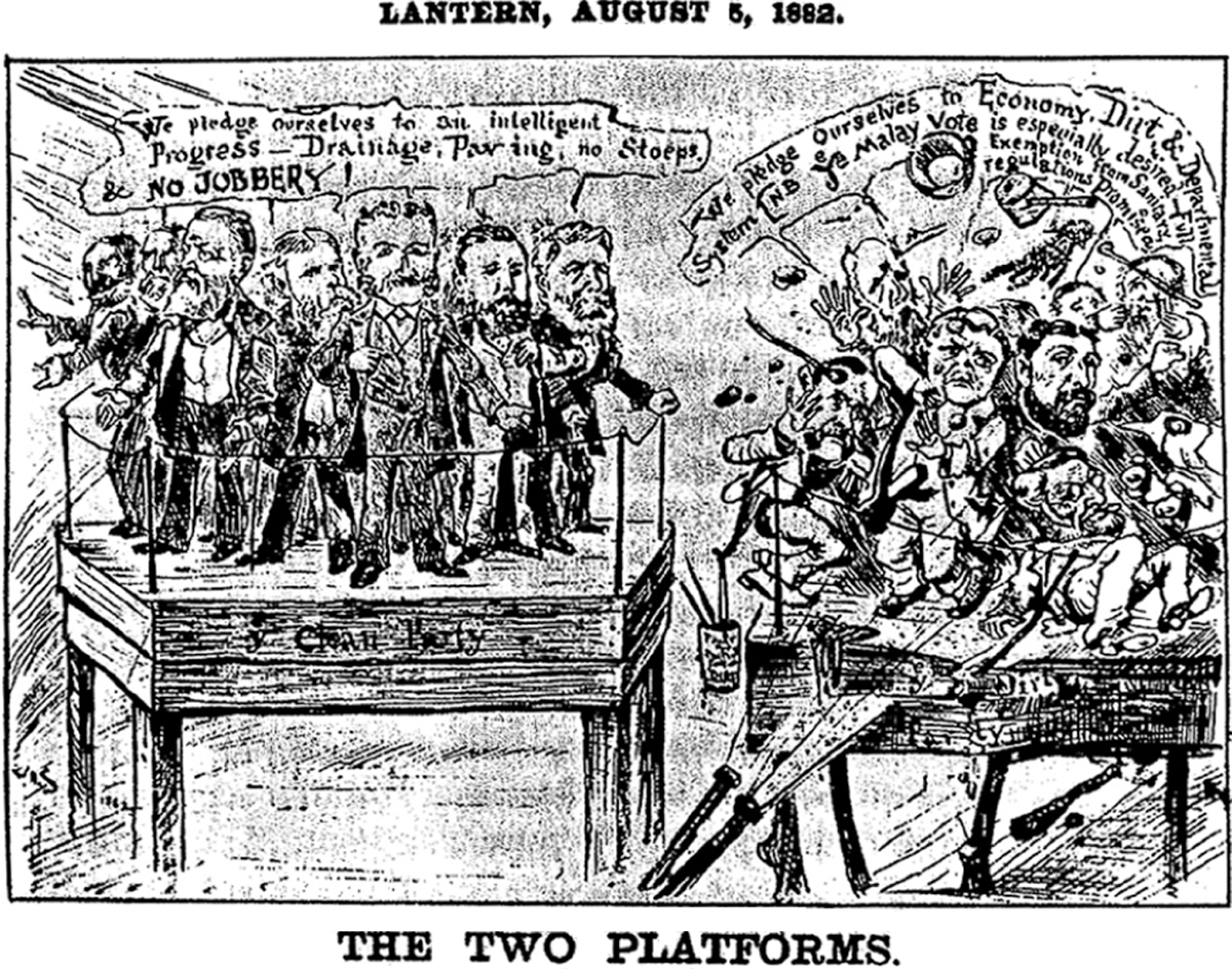
Cartoon published in Lantern magazine August 5, 1882. Printed in Vivian Bickford-Smith, Ethnic Pride and Racial Prejudice in Victorian Cape Town (London: Cambridge University Press, 1995), 57.
The late nineteenth-century politics of class and ethno racial conflicts were embroiled in controversy over which districts would receive sanitation infrastructure. Self-serving media of the time represented such conflicts as a clash between the values of clean and dirty, whereas at their core, this was a conflict over distribution/redistribution of public works investments. The Dirty Party was not against improved sanitation services; it opposed providing them selectively to only a few districts. But to make sure that opposition did not control urban governance, the colonial elite relied on a discourse of sanitation to construct an ethnicized and racialized “other.” 71 The municipal sanitary development discourse helped to establish British urban hegemony and construct the notion of the superiority of Englishness as an ethnicity: cleaner, more civilized, and more global (i.e., connected to Europe). 72 But late nineteenth-century sanitation discourse marked not only the hierarchical construction of ethnic identities among white Europeans (Afrikaner vs. British). It also hardened racial attitudes in Cape Town 73 to set up the bedrock for race-based segregated South Africa.
The Use of Sanitation Discourse for Urban Segregation
Two decades after the abolition of slavery, and following the opening of diamond mines in Kimberly and the economic boom of Cape Town, the number of Africans in the city was growing. As they spread across the city, journalists issued warnings about the danger of Africans along with the discourse of crime and sanitation.
74
Swanson
75
eloquently discusses turn of the century Cape Town and how the discourse of “segregation for sanitation” with each epidemic emergency helped to naturalize race-based segregation of Europeans and non-Europeans. He describes the turn of the century Cape Town as: an old, slum-ridden town composed of a colonial society in which, in general, whites existed in favoured circumstances surrounded and served by ‘coloured’, Malay, ‘Asiatic’ and ‘Kafir’ or ‘native servants'… with a rapidly increasing numbers of black rural migrants from the eastern Cape and Transkei…. left on their own to “pig it” where and how they could… Faced with the plague crisis, the first and most powerful anxieties of the medical officers and the emergency Plague Administration focused on the presence of the Africans (Kafirs), whom they associated directly and inherently with the social and sanitary conditions that harboured the plague. “Rest the blame where it may,” Cape Town’s Medical Officer, Barnard Fuller wrote later, these uncontrolled Kafir hordes were at the root of the aggravation of Cape Town slumdom brought to light when the plague broke out.
Swanson’s study of the turn of the century Cape colony reveals that the imagery of infectious disease served as a social metaphor to influence the urban policies and shape institutions of segregation. In much of the nineteenth-century colonial Africa, the MOH declared areas occupied by native dwellers as “the septic fringe” of the city and medical menace. These hygienic anxieties of the twentieth century that created the colonial pattern of African and European urban communities separated by a cordon sanitaire of uninhabited ground, were often associated with an epidemic emergency. For example, the Public Health Act, inspired by the devastating small pox epidemic of 1882–83 was used in 1901 when the first human cases of plague appeared in the city among Cape Colored and African dockworkers. The municipal and colonial MOH anxiously informed their governments that “the dreaded Bubonic Plague-the scourge of India-had at length made its appearance in our midst.” Following the rash of fear which galvanized the city in 1901, 6,000 or 7,000 Africans were relocated to Uitvlugt, a sewage farm on Cape Flats. 76
But the use of epidemic emergency and the building of locations such as Uitvlugt for blacks was not sufficient. As emergencies receded, blacks drifted back into the town and moved beyond the designated areas. Plus, these new black residential areas were not economically viable. In fact, the financial responsibilities toward these native locations were not clarified. Uitvlugt, for instance, was incurring £1,500 a year deficit. 77 In 1899, a special jurisdiction was provided access to cheap native labor and allowed employers to house their occupier the employer assumed financial responsibility for the location, but no statute dealt directly with areas under municipal authority.
Tossing back and forth, the ball of obligation regarding responsibility for poor urban Africans is an age old practice. At the turn of the twentieth century, the conflict was between the colonial government and the local administrators. The colonial Native Affairs Department did not wish to be responsible and argued that towns (local municipalities) should create and fund private locations as they were beneficiates of private location bill, not the colony as a whole. They also suggested that each location “should pay its way.” 78 They even went so far to ask Sea Point, a centrally located area within Cape Town, to become its own private location and hence be able to control and segregate natives within its jurisdiction. 79
The colonial project of social control through spatial segregation was not easy, writes Swanson (1977). It was frustrated not only by administrative and practical contradictions but also by resistance from the middle-class “black” emerging with property in the peri-urban settlements and also by both white employers and black laborers only marginally accepting the segregation proposition. This difficulty, however, was removed when the discourse of hygiene and health was mobilized and the black urban settlements were equated with a public health hazard or medical menace. 80
Swanson shows that sanitation discourse was key to the formation of racial ecology of Cape Town to segregate natives while allowing employers to access cheap labor. The official argument for segregation initially was not a racist but a medical one, he writes. 81 Segregation discourse changed over time from a hygiene based to one that was a sort of common sense naturalized in relation to race. 82 Tracing the intricacies in the trajectory of sanitation discourse, the outbreak of epidemic diseases in the colony played their role. The recurrent epidemic diseases helped reinforce a race-based segregationist discourse, pointing at higher rates of disease in impoverished, poorly serviced native quarters. For example, the Public Health Act of 1883 implemented after the 1901 plague was used after the 1918 influenza epidemic to lay the foundation for Union-wide segregation policy. The actual laws for segregation followed thereafter. 83
The nineteenth-century town planning obsession with hygiene also contributed to the segregation of Europeans and Africans. Colonial officers transferred the ideals shaped at home in fighting urban morbidity to the colonies. But the hygiene obsessions that were born in Europe, were implemented differently in the colony. While in the United Kingdom explicit race-based segregation or exclusion was condemned as contrary to the liberal values of the individual’s liberty and equality, those principles evaporated in the colonies. As scholars have documented, in the colonies liberalism was a product of its habitat, 84 meaning Europeans honored their liberal values in Europe not in the colonies. In Australia, for example, British liberal visionaries and settlers of the nineteenth century explicitly argued against Chinese immigration and stopped them from deboarding in harbor of its colony of Victoria. Lake 85 argues that this paradox of racial exclusion is because of, not in spite of, liberals' commitment to liberty and democracy.
In the Cape colony, the need for labor that brought Africans to Cape Town and the simultaneous fear of the “other” presented white liberals with a painful dilemma. Urban reform and the English discovery of the sanitation gospel handily offered segregation as a solution. As early as 1879, the government’s labor contractor, Mr. Stevens, suggested a segregated Cape Town location for Africans. Stevens proposed a cordon sanitaire both to protect whites from disease and to teach blacks about “the superiority of the European race.” 86 At first, segregation was promoted but not enforced. Africans could still live where they could afford to rent. 87 Soon enough, however, following the 1901 plague epidemic compulsory residence in a “location” for blacks was decreed. 88
The process of creating an elitist city and urban space historically has required both discursive and regulatory means. During apartheid, regulatory segregation was explicitly race-based and bureaucratized par excellence. But in the period prior to that, during the nineteenth and early twentieth centuries, British colonial liberalism achieved selective urban inclusion and exclusion through political distortions: a group’s say in municipal development and decisions was both tied to individuals' wealth and property ownership and manipulated through a stereotyped discourse of clean/dirty.
The account of the nineteenth century’s uneven infrastructure development in Cape Town and the social and political struggles around it, resonates with many aspects of postapartheid struggles. Understanding the space in Cape Town as socially and historically constituted, produced by the uneven and combined processes of capitalist development, contributes significantly to the analysis of contemporary urban redevelopment strategies there—the point to which I now turn.
Part 2: Twenty-First-Century Postapartheid Period
The uneven spatial and infrastructure development that underlies the late nineteenth century’s urban conflicts described above is instrumental in understanding production of Cape Town as a capitalist city in its contemporary era. Undoubtedly, the complex dynamics of the twentieth century’s urbanization of the Cape Colony is critical to the formation of Cape Town as an apartheid city and hence its postapartheid struggles for urban development and redevelopment today. However, in the interest of space, I refer the readers to the vast and eloquent literature 89 that exists on the topic and move the discussion to the early twenty-first century which constitutes the direct point of comparison in this research.
In the passage that follows, I focus on a specific urban redevelopment and governance strategy launched in Cape Town in 2000 called creation of CIDs. CIDs facilitate booming real estate and intense wealth accumulation through municipal legislation that moves the responsibility for location creation to the property owners' decisions in neighborhood or district levels. CIDs also known by their legal name, Special Rate Areas (SRAs), are selected zones or districts within the city where property owners pay additional fees to access superior services from the municipality with respect to policing, cleaning, and marketing.
Creation of CIDs in Cape Town business district or CBD in particular has brought wealth almost overnight to a few real estate capitalists holding property in almost the same historic quarters of the town discussed in the previous section (see Figures 2 and 3 ). 90 For example, in 2002, one property owner, Mr. Mark Tuckwell, bought three historic buildings in the old quarters of the Cape Town city center for R1.7 million. He put them up for sale within a year at R20 m after converting them to a boutique hotel, luxury apartments, and a restaurant/cocktail bar. 91 Another example is Cape Town’s nineteenth-century hub of elite mercantile capital which today includes streets such as Adderley, St. George’s, Short Market, and Long Market streets. These are now home to the businesses headquarters of global firms as well as luxury residential real estate. The properties in these areas that were the main recipient of urban infrastructure improvements in the colonial era are currently recipients of legislative municipal supports that can be likened to opening of modern gold mines right down town. What land was to the white colonizers in the colonial era, real estate properties have been to national and foreign investors like Mark Tuckwell in the postapartheid neoliberal era.

Cape Town Central City CIDs 2006. Source: Cape Town Partnership’s website http://capetownpartnership.co.za/ accessed August 1, 2011.

Cape Town c.1845. Source Cape Archives, M 2/41 printed in Digby Warren and M. Broodryk, Merchants, Commissioners, and Wardmasters: Municipal and Colonial Politics in Cape Town, 1840-1854, Volume 55 of Archives Year Book for South African History (Pretoria: The Government Printer, 1992).
The creation of CIDs and SRAs in contemporary urban redevelopment and management are typically marketed as innovative and new but have deep colonial roots. Many aspects of their operating principles parallel those of the nineteenth-century colonial municipal governance. The operating principles of the CIDs adopted not only in Cape Town but also in many cities around the world focus on two specific aspects of this contemporary urban redevelopment strategy, namely political citizenship and discursive justification. As in the colonial era, the elites' spatial interests were secured through regulatory means by making political citizenship contingent on wealth and property ownership, and through discursive means to justify creation of special location (call it districts or areas).
Creation of CIDs
Creation of Improvement Districts has advanced in Cape Town since 2000. This strategy was first marketed to the city authorities and to private business owners in Cape Town by an entrepreneur, Michael Faar, as a new strategy for urban business district redevelopment. Crediting New York City Rudy Giuliani and his success in “cleaning up” New York City as an inspiration for what he claimed to be an innovation in urban redevelopment and management, Faar promoted the creation of CIDs as a means to fight “crime and grime,” to bring in tourism, foreign investment and in short to turn Cape Town into “the Apple of Africa”—that is, a world class city (interview 2001). A stipulated in Municipal Property Rates Act (2004), the suburbs have also been able to create CIDs. Using the legal term Special Rate Areass, 92 their boundaries closely approximate the old apartheid fault lines. 93 As of July 2010, there were twenty-three CIDs in operation in the Cape Town metropolitan area and an additional forty-two prospective CIDs or SRAs listed by the City. 94 The total CID budget reached R83 million, with each District allocated between 2 and 4 million rand.
In the words of the CIDs promotional material, a CID/SRA is “initiated by communities and not the city… [It] refers to geographical areas… in which property owners can raise levies to fund additional services in their areas… The purpose of residential property owners establishing an SRA in their suburb would be to enjoy a broader service than rendered by the city,… [it] entails a comprehensive business plan compiled by a steering committee, presented to the community in a public meeting and approved by majority vote… Once written consent has been obtained from a majority of more than 50% of community members, the business plan, motivation report, and implementation plan is presented to the city… the city will not get involved in the daily running of it but will provide financial oversight and legal compliance. ….…. The city will collect levies on behalf of SRAs.…” 95 Extra property rates, usually adding some 10–30 percent to the standard rate, can only be used there.
It must be noted that in the creation of such locations, tenants, either (residential or commercial) have no say. The decision to join a district is made exclusively by the property owners. Once 50 percent +1 of the owners with more than half of the value of properties in an area adopt this strategy, all are subject to the additional fees. The zone has a private, nongovernmental governing entity to oversee the service delivery and to enforce bylaws about the zone’s use and the users of its public space. The Board of Directors for the managing body of the Improvement District comprises self-appointed members of the public and private sectors. The center city CID, for example, is directed by South African Property Owners Association, the City of Cape Town, provincial administration, the Cape Chamber of Commerce and Industry, and Business Against Crime.
CIDs create privileged urban districts and have therefore galvanized contentious municipal politics, which at one point seemed to threaten the partnership that was established between the municipal government and the private entities for its management. 96 At background to the CIDs, it is important to note that the postapartheid Cape Town politics have been marked by tension between the African National Congress (ANC) controlled provincial government and the Democratic Alliance (DA) controlled City government. 97 In 2004, at an interim moment when an ANC mayor, Nomaindia Mfeketo, weighed in on city politics, she aligned herself with the citizens' grievances against CIDs elitism which in its postapartheid reincarnation was not based on race but on ability to pay rate. 98 Mfeketo threatened withdrawal from the partnership that was headed by its Afrikaner founding director, Michael Faar, who was too untactful and insensitive to the postapartheid political taste of the moment—some might say politically incorrect in his use of language and discursive representation. 99 Faar was forced to step down and replaced by a charismatic former ANC activist, Andrew Boraine, who swiftly shifted the language of the CIDs publicity to make them propoor, and socially more sensitive and responsive to the political mood of the day. Boraine embarked on a massive media campaign which included a number of newspaper editorial entries that stressed how “being poor is not a crime” and that CIDs did not intend whitening their districts. These efforts served to foil the main criticisms of the CIDs. In this rather politically volatile moment Mayor Mfeketo called a halt to the creation of CIDs in residential areas, arguing that it might open a flood gate for former white suburbs desiring to recreate their exclusive enclaves. This momentary political turmoil and realignment, however, did not last long. The residential CIDs were shortly thereafter approved and have since been growing rapidly in number.
The fight against crime looms large in creation of CIDs and SRAs. 100 While the primary objective of the commercial CIDs is business improvement and creating spaces for unfettered consumption, the enhanced safety and security is always listed as the top strategy to achieve those objectives. In an editorial entitled “Citizen Kane determined to make city clean and safe,” the Sunday Times cites Robert Kane, the appointed chairman of the Central City Improvement District (CCCID), who credits the city center’s economic boost to ten years of CIDs operation and its fight against crime and grime. In Kane’s conception of the CID promotional discourse, poverty, and crime are collapsed into a single category. In explaining the CCCID’s success, Kane stresses one single campaign as the most effective one: the “give responsibly” campaign. “Leaflets are handed out at traffic lights asking drivers not to give money or food to beggars, but rather to give to one of the many city charities looking after them, or to the night shelter which offers them a free roof over their heads… You hardly ever see a street child in the city centre anymore,” explains Kane. “It's had a ‘dramatic’ effect on crime.” 101 Having equated presence of street kids with crime, when asked “What single improvement has bettered life in the Central City?” Kane responds “the emergence of our own Café society.” 102 The CCID annual report confirms his statement listing among other indicators of success “30% increase in number of coffee shops in central city from 2003-2010.” 103
Two often aspects of CIDs operation strikingly resemble those of the colonial era reviewed earlier. First, the contingency of urban citizenship on wealth, whereby only property owners have a say; and, second discursive justification of exclusionary urban practices. While one relies on the discourse of sanitation and hygiene to justify elitist urban development the other relies on the discourse of safety and fight against crime. These aspects of contemporary urban governance and development when brought in dialogue with the colonial aspects discussed earlier, offer illuminating insights into the contemporary construction of urban privilege and its management.
Wealth contingencies of urban citizenship
In South Africa’s postapartheid era, constitutional reforms sought to erase ethnicity and race as markers of citizens' position within the social hierarchy. At the same time, the CIDs have returned to an old colonial practice of the British. They tie political citizenship—the right to have a say in local development/redevelopment decisions—to property ownership. To join a CID, only property owners in the proposed Improvement District can vote on whether to establish it.
In colonial Cape Town, setting the bar for political citizenship was a decisive step by the newly instituted municipal government, allocating the right to a voice in urban matters. Under the colonial era’s principles of liberalism, the bar was movable, pushed ever higher by the elite, and pulled lower by the common householders. By pushing the bar higher, the elite were ensuring that their interests were served by municipal decisions especially about public works and other kinds of improvements.
The contemporary creation of Improvement Districts as zones of privilege in Cape Town mean the right to local decisions about development and governance is tied to property ownership—a condition with close affinity to the colonial practices. That familiar relationship gives the lie to claims of innovation by neoliberal approaches like New Public Management that have advocated CIDs as an innovative entrepreneurial solution to problems of urban management and redevelopment.
In short, neoliberal capitalism in the postapartheid Cape Town translates the means for uneven urban governance and development/redevelopment from the bureaucratic and racialized strategies of apartheid to the economic mechanisms, to achieve the same urban exclusion wielding wealth and the sanctity of property.
Safety is the new sanitation
The discourse of sanitation and public hygiene that marked the colonial urban hegemony within liberalism reemerges in the discourse of crime and public safety for postapartheid affluent groups within a neoliberal policy environment. The postapartheid era has perforce abandoned the political use of ethnicized and racialized discourse as the means of enforcing urban exclusion. In its place, a discourse of public safety justifies those urban exclusions.
The promotion of CIDs/SRAs relies heavily on the notion of safety. In the promotional material, social and physical sanitation are merged through the slogans such as “CIDs defeat crime and grime” or that “BIDs clean up!” These are accompanied by an image of waste collectors and police officers working hand-in-hand. 104
In the early years of Cape Town’s CIDs, this discursive merger had brutal social implications. Private waste collection contractors made their rounds during the day to pick up the District’s trash and then the private security forces made their rounds in the evening to clean up the District from perceived criminal elements, the street children and homeless. Under the aegis of police safety, CIDs made a concerted effort to socially sanitize the city center or indeed any Improvement District. 105 Not only were children and the homeless removed, so were informal traders and street vendors. An informal public parking system was eliminated in favor of formalized parking attendants and privatized management. All were seen as interventions facilitated by the municipality’s partnership with local businesses to undertake a complete makeover of downtown to improve the real or perceived experience of safety. Improving safety in downtown was linked to economic prosperity: the highest guiding principle of a neoliberal policy framework. 106
The discourse of public safety and crime prevention was also central to the justification of social exclusions that occurred with adoption of SRAs in residential areas. In a study of SRAs in Cape Town, Forslund found that 70–80 percent of the SRA budgets in Cape Town were devoted to additional security and surveillance. 107 A large number of Law Enforcement Officers were trained by the City and licensed to make arrests. They were hired by SRAs to patrol their area only—an approach also referd to as “Rent-A-Cop.” According to a City official, Forslund wrote, many of these law enforcement officers or “cops for rent” would have been unemployed if it was not for the SRAs.
The South African private security sector is one of the largest in the world, employing (formally) around 400,000 people. 108 The state police force employs another 140 000. Indeed, about 1 percent of the South African population is employed in the security business and in guarding private property. 109 While the employment in the country is in decline, the statistics of the last thirteen years indicate that employment by the private security business is a solid area of employment growth (see figure 4 ).

Registered Active Private Security Officers, 1997–2009 Source: Julie Berg, “The Accountability of South Africa';s Private Security Industry: Mechanisms of Control and Challenges to Effective Oversight,’ Criminal Justice Initiative Occasional Paper 2 (;Newlands: Open Society Foundation for South Africa, 2007); PSIRA (Private Security Industry Regulatory Authority) Annual Reports 2006/2007& 2008/2009; PSIRA (Private Security Industry Regulatory Authority). Courtesy of Dick Forslund at Alternative Development & Information Centre in Cape Town. Also Annual Report 2009/2010. Downloaded at http://www.psira.co.za/joomla/pdfs/PSIRAAnnualReport2009-2010.pdf.
Much has been published on how rationales about crime further the construction of elitist exclusionary cities and citizenship. 110 Caldeira eloquently exposes how the discourse of crime and the real or perceived fear of crime are used to privatize public space and erode the public realm. Given the historical analysis of how the original elitist and exclusionary urban development in Cape Town’s city center used the discourse of sanitation to foster segregation, it prompts one to question the conjunction of the physical and social sanitation issues in the CIDs' promotional literature. The contemporary conflation of “crime and grime” to justify means for exclusionary urban governance has an extended historical pedigree. By making public hygiene and public safety interchangeable, urban strategies such as CIDs achieve a social cleansing of urban public spaces. The territorially bound development strategies of CIDs concentrate urban services and infrastructure improvements in selected zones. Their localized improvements and enforcements displace crime to areas that cannot afford to purchase additional police services and eject street children and the homeless to other areas. The combined processes of selective inclusion and exclusion in the early twenty-first century continue the legacy of uneven urban development from the colonial era.
Just as the critique of the “Sanitation Syndrome” at the turn of the previous century was not to deny the scientific validity of disease and risk but to understand “the power of a metaphor to shape perceptions and influence or justify behaviour” 111 so the critique of “combating crime and grime” as the discursive engine of the elitist urban development at the turn of this century is not to deny existence of safety risk and high crime in the contemporary urban South Africa. It is rather to understand how the metaphor of “crime and grime” that associates crime and poverty plays a powerful role in justifying exclusionary and elitist strategies for city’s development and governance.
Part 3: Colonial Present
The dynamics of the social groups in the stories told here unfold the contentious colonial spatiality of Cape Town and the historical struggles that have shaped and been shaped by it. They bring to light the distinct yet similar processes by which the urban space and its development hierarchically structure/restructure social relations based on class, race, and ethnicity, in the two eras. They highlight three dimensions of the colonial development and governance of Cape Town that are closely echoed by its contemporary Improvement Districts: (1) uneven urban development/redevelopment to privilege the interest of the elite and global capital; (2) political citizenship made contingent on property ownership and wealth to secure an exclusive urban development and governance; and (3) use of discourse of sanitation and/or public safety to justify elitist urban development and governance.
The late nineteenth-century-colonial strategies and the early twenty-first-century neoliberal strategies for an elitist urban development/redevelopment resemble one another in several ways. Both privilege improvement of selected quarters of the city and promote territorially limited local development. They both privilege the city center or business district as the hub of foreign investment and global capital, at the expense of quarters of the city with less affluent businesses and residents. Both fantasize the metropole as the inspiration for their development/redevelopment. While one declares success by announcing Cape Town as clean and modern like London, the other claims success by declaring Cape Town to be a world class city like Giuliani’s New York City, or the “Apple of Africa.” The discursive means are used in both eras for justification of elitist developments. While one relies on the “fight against disease,” the other enrolls the “fight against crime” as the main rationale for its elitist development decisions. In both eras, creation of special locations or districts is used as a strategy to create urban privilege for some and exclusion for others. While in the colonial era “location creation” segregated those at the bottom of the social hierarchy (the non-Europeans) as cheap labor reservoirs (in its apartheid reiteration referred to as homelands); in the postapartheid neoliberal era, Improvement Districts create special locations for those higher up in the social hierarchy of the city. The latter creates special locations for the affluent as spaces of consumption. Moreover, in its neoliberal postapartheid version, segregation in Improvement Districts and SRAs is through seemingly voluntary community-based decisions justified discursively as means of exercising citizens' choice in realizing their wish to “combat crime and grime.”
Pointing at the similarities and differences in simultaneous production of urban privilege and disadvantage in the city through urban infrastructure investment, or lack thereof, across the two eras is not to imply that history repeats. The creation of elitist exclusionary urbanism is the ultimate objective of urban governance in both eras but their means for achieving this end differ. An important characteristic of neoliberalism lies in its illusive notion of participatory and inclusive governance. In the neoliberal era, the illusion is that the citizens have exercised choice and participated in making decisions that bind. Neoliberal governance implies inclusion, a process of governance, whereby decisions are arrived at by citizens and residents' consent. A case in point is the attachment of vote or political voice to wealth. In the colonial era, the elite through the municipal council determined how high the citizenship bar should be set to include and exclude common or disadvantaged urban householders' voice in decisions. The process of governance involved decrees that were determined from above and applied across the city. Today, however, under the neoliberal “sanctity of choice,” urban citizenship is fragmented and is tied to “choices” communities make. Here, the justification is that the citizens in an Improvement District have exercised their right to be able to pay more and receive more—they have exercised their right to have a choice. The inequality and privilege therefore is produced in this neoliberal scenario through creation of zones, and the fragmentation of urban experience that is presented as an outcome of democratic and inclusive governance—a process that respects citizens' right to determine the kind of urban experience they choose for themselves and their families. This is distinct from the top down bureaucratic creation of locations in the earlier era.
I have elsewhere discussed elusive inclusion as a key characteristic of the contemporary neoliberal urban governance. 112 There is a wealth of literature that discusses the fragmentation of urban experience as a characteristic of the neoliberal urbanism, for example, by splintering urban experience through urban infrastructure development, 113 or by participatory governance which symbolically includes the poor but materially excludes their interests. 114 Jessop 115 and Hart, 116 for example, write about the success of neoliberalism in “naturalizing” its policies. For that to happen, Jessop argues neoliberalism relies on new discourses and new subjectivities that establish “the legitimacy of the market economy, the disciplinary state, and enterprise culture.” 117 While neoliberalism as a political project, seeks to roll back “normal” (or routine) forms of state intervention, it selectively transfers state capacities “upward, downward, and sideway.” 118 In the historical case study of Cape Town, creating CIDs or SRAs is a clear example of moving the state’s role downward by moving the decision for urban infrastructure from city council to neighborhoods, specifically to the affluent property owners within the neighborhood. Here, the municipality does not have to take responsibility for production of privilege. Unlike its nineteenth-century counterpart, the city council does not need to vote for the higher level of sanitation development in one district over the other. It rather makes the colonial practices an “option” available to specific communities, call it districts, within the city. The state therefore can protect itself in the guise of democratic decisions made by citizens.
The connections this essay highlight between the contemporary neoliberal strategies for urban governance and the colonial practices of governance during the past century has conceptual and practical significance. Conceptually, shedding light on the colonial legacies of contemporary urban policies contributes to a better understanding of neoliberalism and its genealogy. It suggests that the contemporary neoliberal urban policies emerge from the paradox of liberalism that was first experienced in the colonies. In that sense, neoliberal urban policies may be presented as “the colonial chickens coming home to roost!” This insight helps debunk the common misconception about neoliberal policies as innovations conceived in the 1970s and 1980s in the global North and rolled out to the rest of the world through institutional means of the Washington Consensus. The historicized perspective presented here illuminates the contemporary global neoliberal policies not as linear one-way policy formations. The similarities and continuities observed in urban practices of the nineteenth- and twenty-first-century Cape Town and those of the late twentieth-century New York, for example, suggest the inadequacy in presenting and conceptualizing the contemporary CIDs as a mere “copy” of New York’s BIDs. In this case, the resemblance in strategies used in production and management of the uneven development of Cape Town during the colonial and neoliberal eras challenge the argument that creation of Improvement Districts is a noble idea and an “innovation” in urban management conceived in the global north. It reveals the truly transnational flows that shape contemporary neoliberalism through complex spatialities and temporalities that aim to resolve the paradox of liberalism.
On a practical level, the insights this historical analysis offers has important implications for anti-elitist struggles waged by the urban poor in neoliberal cities. An important force in globalizing CIDs and other means of capitalist urban redevelopment and management has been the packaging of these strategies as innovative, cutting edge inventions in urban governance, and management (e.g., New Public Management). In the words of Gillian Hart, “what is important about in-depth historical geographies and ethnographies grounded in relational conceptions of the production of space is their capacity to illuminate constitutive processes and interconnections, and thereby contribute to the production of concrete concepts” 119 and shape knowledges that disrupt “situated ignorances and forgettings.” 120 Revealing the continuities and similarities in elitist urban strategies used across the colonial and the postapartheid eras can give more force to the contemporary oppositional movements that fight against urban exclusion. By challenging the claims of innovation, a historicized critical perspective offers forceful resistance to the displacing, alienating, and marginalizing policies that are justified as “innovative solutions” to contemporary urban problems.
Footnotes
Notes
Acknowledgments
The author would like to thank many people for this article, some for inspirational conversations and others for actual help with collection of information. The author thanks Ken Salo for his intriguing question that inspired and started this article; Gillian Hart for reminding her what an important and difficult question she was about to ask; Jim Kilgore, Terry Barnes, David McDonald for feedback on earlier drafts of the essay; Chris Silver and the anonymous reviewers of JPH for their helpful comments and concise suggestions. The author is most grateful to superb research assistantship by Andrew Jensen to dig out from afar the historic accounts of the municipal governance in the Cape Colony. Responsibility for the shortcomings of the article of course rests with her.
Declaration of Conflicting Interests
The author declared no potential conflicts of interest with respect to the research, authorship, and/or publication of this article.
Funding
The author acknowledges financial support she received for this project through a Hewlett International Research Travel Grant; and a Campus Research Board grant at the University of Illinois Urbana Champaign.