



Abstract
There has been the criticism that urban design is increasingly being used as an entrepreneurial strategy for cities, transformed into a tool for attracting investment. This article examines the evolution of urban design plans in Los Angeles to understand the relationship between urban design practices and growth. Rather than a clear break in orientation, both early and later design strategies are explicit in promoting urban design as a tool to encourage development. While the broad “purposes” of urban design are similar over the period examined, the type of catalyst that would create growth has fewer public benefits in later years.
Keywords
Introduction: New Uses of Urban Design
When Los Angeles (L.A.) Live opened in 2008—adding a public plaza, 2,300-seat entertainment venue, and commercial space to the recently constructed Staples Center arena—the architecture critic for the Los Angeles Times was biting in his assessment. Critical not only of the bland architecture, mega-scale advertisements, and questionable public space, Christopher Hawthorne commented on the lost potential for future growth: For cities, the benefit of a gargantuan new development is not only the boost it gives to the tax base but also, in urban terms, its spillover effect—energy and people flowing into the surrounding area. The entirety of the AEG development downtown—Staples plus L.A. Live—is designed like an airtight cruise ship, turning not a welcoming face but the architectural equivalent of a massive hull to the neighbors. Its spillover effect may be measured not in gallons but in drops.
1
For many, the L.A. Live development is a representative urban design scheme for an era of entrepreneurial strategies. Certainly, the development fits within the many critiques of entrepreneurial design practices: the public plaza is contained on privately owned land, policed by security guards, and surrounded by flashing, multistory video displays. Despite decades of planning for the area, the resulting design plans are, arguably, an opportunistic response to private-sector interest in a new sports arena. But perhaps the more interesting aspect of Hawthorne’s criticism is that the effect the project would have on the surrounding neighborhood would be “measured not in gallons, but in drops.” The criticism assumes the potential for not only private-sector investment but also for the public urban design strategy to induce significant growth and investment in the area. While some scholars have argued that this is indicative of a new model of urban design shaped by the entrepreneurial turn, there remains the question of how this relates to earlier urban design strategies and whether it truly represents a break with previous forms of urban design practices.
There has been a strong interest in the relationship between urban design practices and strategies of entrepreneurial and growth-oriented governance. 2 The shift to an entrepreneurial model is seen as resulting in a form of urban design marked by a piecemeal and project-oriented approach, with the “proactive pursuit of real-estate investments through financial incentives, ‘deal-making’ and megaprojects.” 3 There is an explicit orientation toward increasing growth and investment, with the potential for economic development acting as a driver for urban design strategies. While this may seem to have similarities to the early civic boosters, one key difference is that rather than selling the city as it exists, entrepreneurial strategies seek to reinvent the city into one that is attractive for investment. 4 These strategies create a new urban image not only through marketing campaigns, for example, but also through the construction of an urban landscape designed to make sites appear attractive, safe, and suitable for investment. 5 This new orientation relates to urban design strategies and practices, with urban design seen as a tool for economic development, attracting increased investment and facilitating intercity competition. 6 Although some have argued that there may be shared objectives between attracting investment and improving urban design quality, these are more often posited as conflicting goals. 7
Fundamentally, understandings of the entrepreneurial turn for cities have been based on the idea of a shift: city governments that were once oriented toward providing services for residents are now focused on creating market-based strategies to attract investment. While the idea of a change in the orientation, goals, and outcomes of urban design processes is key to understandings of urban design in the entrepreneurial city, 8 there has been little empirical research demonstrating this shift over time in cities’ approach to urban design, especially as it relates to stimulating investment and development. Previous studies of the changing nature of urban design practices are often ahistorical or limited in their assessment of processes over time. 9 The idea of change over time is often implicit, although only evaluating strategies over time can demonstrate empirical support for this shift toward entrepreneurial governance. 10
This research situates the turn toward entrepreneurial design practices historically by analyzing the evolution of urban design strategies in an area of Los Angeles that has been the subject of several plans since the early 1960s. The focus on plans and policies offers insight into the motivations and intentions of the designers and planners of the time. Perhaps more so than the resulting built form, design plans, guidelines, and visions provide a way of understanding the evolution of urban design through the lens of professional practice. Plans and documents are the “apparatus” of planning that form the relationship between professional discourses, state power, and strategies. 11 Plans offer one way of recording the values and intentions of the profession as well as providing documentation of shifting strategies over time. 12 Importantly, as Brent Ryan has argued, plans not only provide direct recommendations but also function as “ideological artifacts” that give insight into the broader social and political values of the time. 13 The analysis presented here is informed by methods of “reading through” plans in a way that pays attention to both contextual and temporal meaning. 14
The South Park area of Los Angeles (Figure 1), south of the historic downtown core, has a varied history of design plans, proposals, and strategies, with differing degrees of implementation. While contemporary plans put forward a “sports and entertainment” district, earlier plans had a much different vision for the area. As detailed below, plans in the late 1960s and 1970s saw potential for significant residential and commercial intensification in the area, centered on the creation of a major park, giving the new neighborhood the moniker South Park. Despite these plans for the area, which evolved over the next forty years, little change materialized in the area until a private-sector proposal for the Staples Center, a major sports venue, in the 1990s and the intervention of the Community Redevelopment Agency of Los Angeles (CRA/LA). This research argues that despite the idea of a “turn” toward the entrepreneurial in urban design strategies, the earliest plans and designs for the area were heavily premised on encouraging growth, investment, and development, making it difficult to view later strategies as new orientations for urban design. However, there is a shift in the nature of the projects that would be used to encourage growth, shown by a move to opportunistic, reactive, and privately oriented projects with fewer discernible public benefits than those proposed in earlier eras.

South Park, in relation to historic core, Los Angeles.
Urban Design as Plan and Policy
The majority of planning attention for South Park occurred after the 1950s, a period marked by significant change in the orientation and form of many urban design practices. In reaction to the modernist schemes of the previous decades, widespread discontent with the “raze and rebuild” model of urban redevelopment was spreading. 15 In the face of this increasing criticism, Jonathan Barnett advocated for “urban design as public policy,” premised on achieving built form goals through the regulation of private development. 16 In contrast to urban design as master planning or “large-scale architecture,” this understanding sees urban designers not as the “authors of the built environment, rather they create a decision environment that enables others to author the built environment.” 17 In this model of practice, the urban design plan, with its policies, regulations, and occasionally incentives, is the primary tool through which to implement public-sector urban design visions.
In this context of urban design as public policy framework, many plans for the South Park area include substantial urban design guidance (alongside a more general physical planning framework) despite not being titled as such. For example, the 1972 General Plan is explicit in the importance of urban design standards: “By this device [urban design standards], the objective of making the whole development greater than the sum of its parts can be achieved. Without it, projects whose parts are designed by many architects and built by different developers lack continuity, coherence and overall quality.” The plans differ in their scale and level of detail, though all include a focus on South Park (Table 1). The most substantial urban design element of the plans is the design, quality, and nature of the public realm. All of the plans include some guidance on the design of civic spaces, parks, or streetscapes, and most include aspects of the pedestrian experience, connection to surrounding areas, and neighborhood identity (Table 2). 18 The majority of plans also include specific direction on the relationship between private development and public elements. The analysis here focuses on these plan elements, though some plans include other related aspects such as historic preservation and architectural character.
South Park Plans, 1960s–1990s.
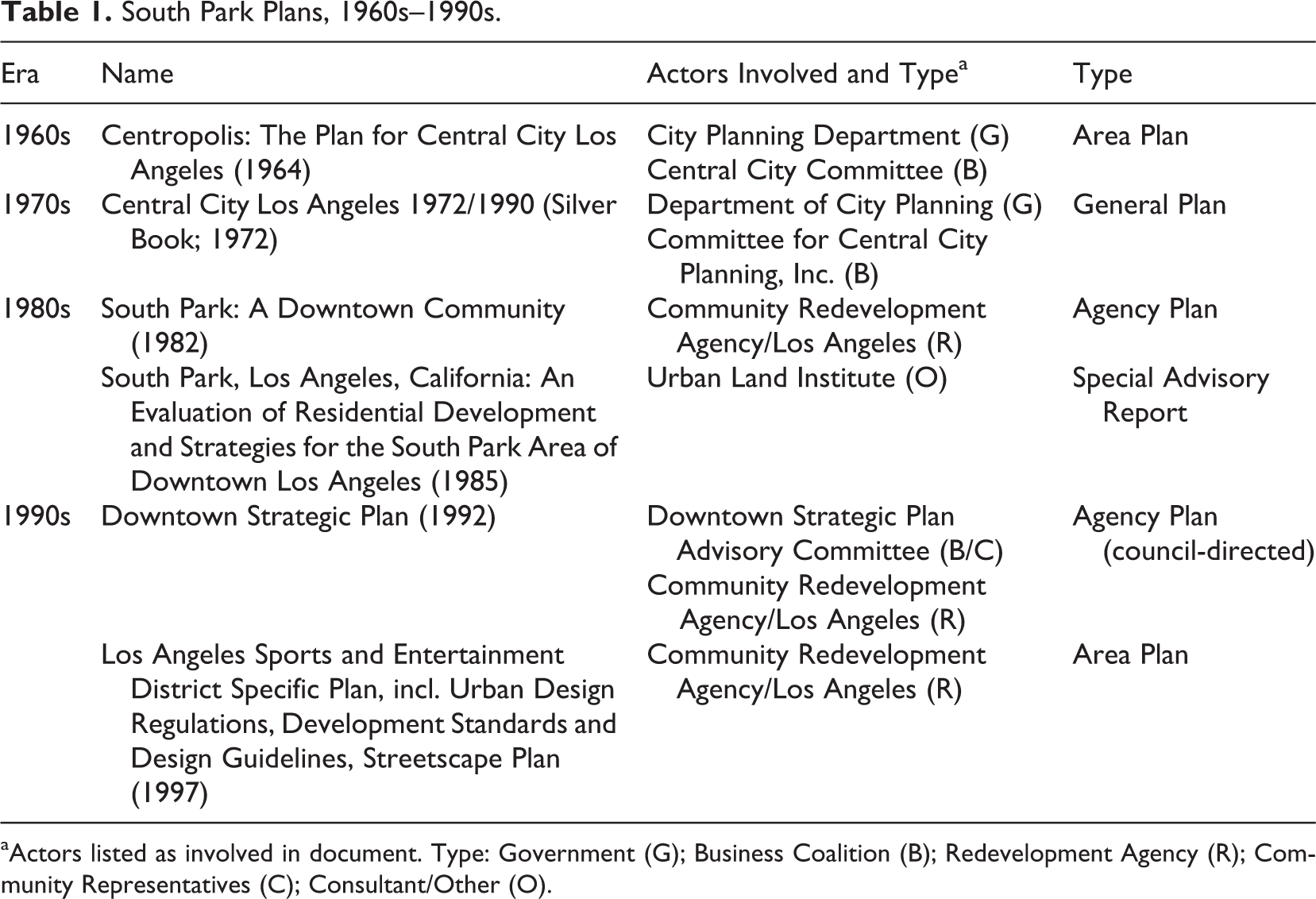
aActors listed as involved in document. Type: Government (G); Business Coalition (B); Redevelopment Agency (R); Community Representatives (C); Consultant/Other (O).
Urban Design Plan Content.

Note: ^ = noted in plan; • = detailed guidance or analysis; ULI = Urban Land Institute.
aSuggestions for future design controls.
bBuilding/site-specific, rather than districtwide.
Context: Planning, Growth, and Development
While the interest in entrepreneurial urban design strategies is relatively recent, the interactions between private capital, planning processes, and economic growth have long been noted. Local government actors have an interest in encouraging development and a bias toward capital, as they depend on private capital investment both as revenue source and to expand the urban fabric. 19 Planning itself has been seen as inextricably linked to state intervention in promoting growth and facilitating capital accumulation. 20 One way of understanding the struggles over urban development and the role of private interests is through the groups dedicated to encouraging and creating political consensus for growth. Rather than forming one aspect of local politics, Molotch argued that growth policy constitutes the guiding concern for municipal governments. 21 Land-based interests—in partnership with political actors and other groups—have transformed cities into “growth machines,” devoted to encouraging new development and creating the structural conditions to enhance the relative value of places such as through zoning, infrastructure investments, and subsidies. 22 These coalitions have been largely successful at creating political consensus, under the premise that growth is good for all. 23 Although the widespread benefits of growth have been questioned extensively, these coalitions largely remain stable, especially in the absence of coordinated opposition. 24
In Los Angeles, the relationship between private interests and public planning form an important part of the city’s history. Scholarship on the early development of the city shows that although the municipal authority levied real-estate taxes to fund some basic infrastructure, development was largely reliant on private enterprise. Development interests provided services such as extending water mains and constructing streetcar lines, thereby assuming a decisive role in directing urban expansion. 25 The reliance on private enterprise to provide public goods also extended to parks and open space. In the early 1920s, planners sought to address a critical shortage of park space by persuading developers to act in “enlightened self-interest” and create parks that would raise the value of their adjacent parcels, a strategy that resulted in few new open spaces. 26 Formal planning efforts increased after the turn of the century, with the introduction of the City Planning Commission and department in the 1920s. Emerging from concern over the negative impact of uncontrolled development, the Commission was charged with developing a vision for the physical development of the city. 27 Directed to develop a master plan by a 1941 city charter revision, planners in the postwar era undertook a series of comprehensive planning exercises, often focused on the central city area. Despite this, the efforts of planners succeeded only when they aligned with developer interests, where they “sanctioned the patterns already imposed by private enterprise far more often than they shaped the cast of future development.” 28 In both the downtown and in suburban communities, private interests—including developers, business associations, small-scale landowners, and realtors—were integral in shaping the planning framework for the city. 29
While the influence of the private sector in planning processes is clear in the pre- and postwar years of development in Los Angeles, changes in the taxation landscape had significant impact on municipal finances and the relationship between development interests and planning. In 1978, California voters passed Proposition 13, freezing property taxes at 1975 assessed values and limiting increases, which William Fulton refers to as ushering in an era of “financial desperation” for municipalities. 30 Whereas the postwar era was marked by public investment in the infrastructure and services to support growth, Proposition 13 meant that municipalities had a significant reduction in property tax revenue and needed to find new financing mechanisms including development charges, taxation districts, sales taxes, and user fees. 31 The much-reduced local tax base, combined with a change in federal funding for urban areas and requirements to have private-sector partners for projects, largely resulted in “project-led” planning and urban design strategies and an increasing role for entrepreneurial agencies, such as the CRA/LA, that were able to leverage private-sector investment. 32
Since the 1980s, there has also been a more complex landscape of interests, arguably weakening the consensus for growth in the region. At the local level, the rise of slow- or anti-growth activists has had influence on key reforms that limited development, while the internationalization of capital has changed the nature of local land-based elites. 33 In spite of a softening in the strength of a citywide growth regime, downtown largely retained its economic boosters. Mayor Tom Bradley was particularly successful in promoting pro-growth interests downtown and channeling federal funds to redevelopment projects. 34 The importance of downtown remained a concern throughout the 1980s and 1990s, and for those “who trace their roots back to the engineers of the Los Angeles growth machine, downtown still remains the center of civic life.” 35
The plans examined here are also situated in a shifting understanding of the role and stability of downtown cores in North American cities. While postwar downtown planning strategies sought to improve access to central business districts (CBDs)—assuming that “everyone still wanted to get downtown”—by the late 1950s, there was widespread understanding that downtowns were failing both as activity centers and real estate markets. 36 Reaction to the “clean slate” model of urban renewal and changes in federal support for urban projects resulted in plans and policies that were more focused on functional subdistricts and increasing density and uses in the core. 37 As cities across the United States were increasingly financially strained in the 1980s, tactics sought to transform CBDs into corporate centers for the global economy with high-profile skyscraper construction and an increasing focus on planning as negotiation and deal-making. 38 Downtown planning in Los Angeles echoed these eras of planning strategy, moving from the large-scale urban renewal clearance to comprehensive planning to project-led approaches. 39 The following section explores the discourses of growth and development in South Park through the lens of these major planning efforts.
Designing for Development: Plans and Visions
Centropolis: A New Employment Center, 1960s
By the early 1960s, the multiple factors signaling the decline of American downtowns were coming to a head in Los Angeles. 40 With high commercial and retail vacancies, local officials and businessmen saw the revitalization of downtown as a pressing issue. Significant infrastructure improvements that had promised to ease congestion and rebuild the importance of the central core had done little to slow the exodus of businesses and jobs, following the pattern of decentralization that had been present since the interwar period. 41 One strategy to reinvigorate downtown was the urban renewal model of clearance and redevelopment, facilitated by the CRA, such as in Bunker Hill. 42 In contrast, the original vision for the South Park area, still referred to as South Downtown in these early plans and extending south of the Santa Monica Freeway, was a much more modest proposal focused on concentrating industrial and commercial uses into a new employment center.
As part of the strategies aimed at stemming the flow of businesses, workers, and shoppers from downtown Los Angeles, plans in the early 1960s saw an interest in the area south of the historic downtown core as a potential location for largely employment uses. The Centropolis plan (1964), jointly developed by the City Planning Department and the Central City Committee, an organization of business owners and stakeholders, focused on restoring the centrality of downtown. South Downtown was identified as a priority project area, with the vision that it would evolve into an important employment and institutional center. While adjacent to the central city, at the time the area was largely a mix of light industrial and some commercial uses, with multiple parking lots, gas stations, and garages, bounded by the newly extended Harbor Freeway to the west. 43 This model of land use was not a new occurrence, with the pattern firmly established by the 1930s, and car-oriented uses dominating many of the major intersections in the area (Figure 2). 44 Even closer to the downtown core, between Fifth and Eighth Streets, there was little of the intense residential and commercial development found further north. For example, in the early 1950s, one block north of Fifth Street was mainly comprised of auto-related uses with five parking lots, four service and repair shops, and a 60-car covered garage (Figure 3).
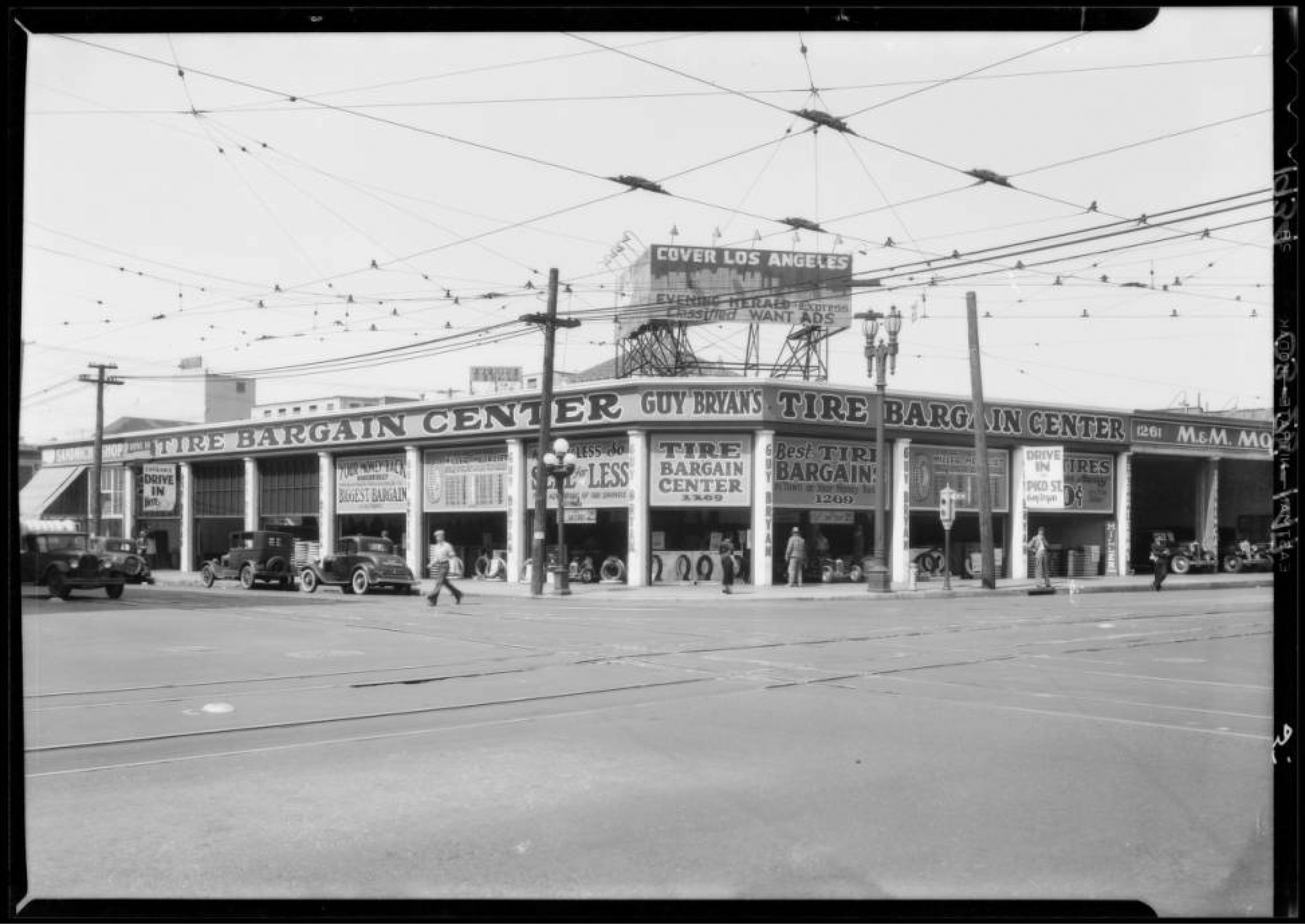
Auto-oriented uses at Pico and South Figueroa Streets, 1934. Source: USC Libraries Special Collections.
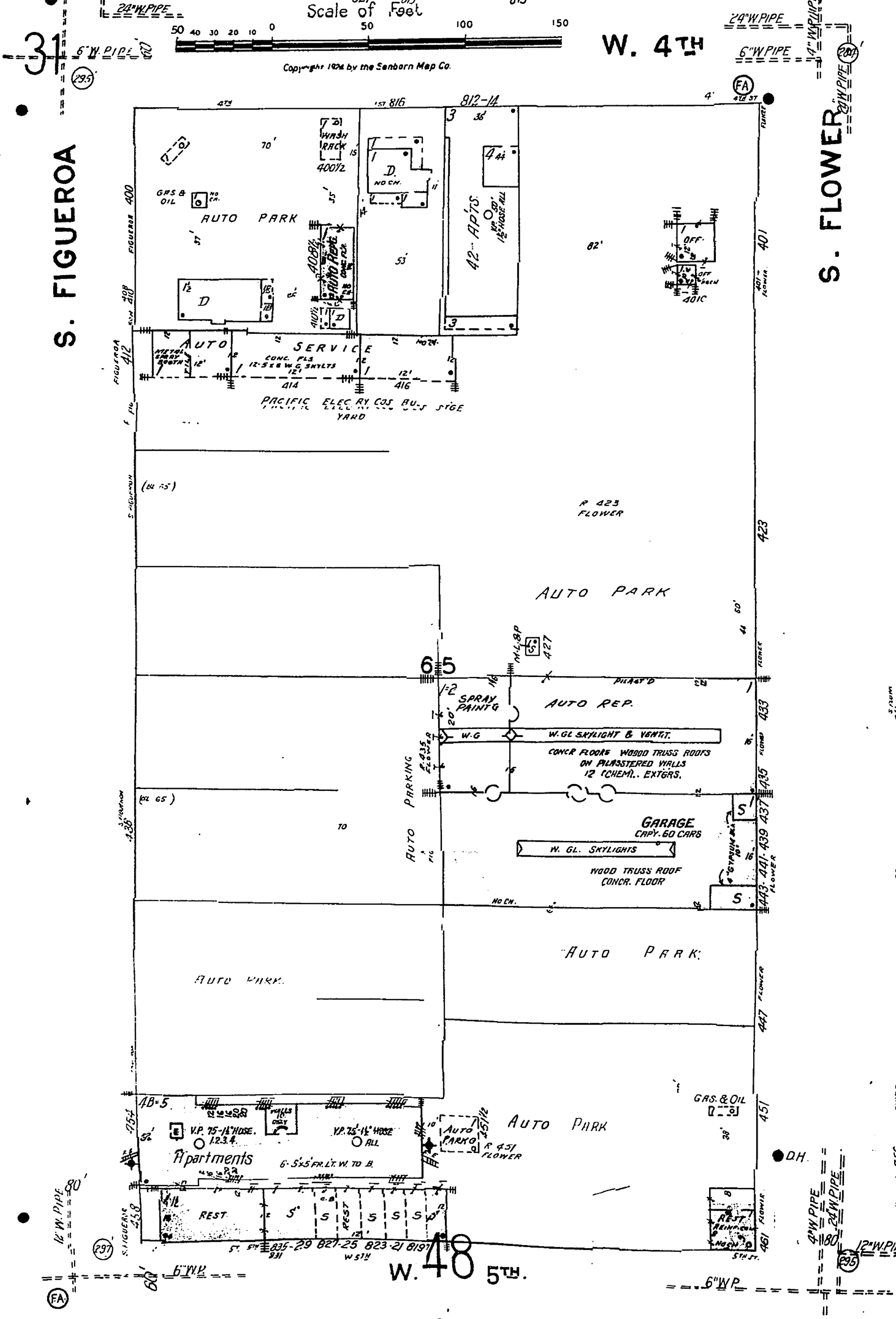
Land uses north of 5th Street, 1950. Source: Sanborn Insurance Company, Sheet 32.
Despite the low intensity of uses in the area, at the time of the plan the Occidental Life complex at Twelfth and Hill Streets was under construction including three towers ranging from 11 to 32 stories and potentially housing 4,500 employees and a heliport. This substantial investment for the area, given its location far from the established commercial center of downtown, showed “concrete proof of the viability of downtown Los Angeles.”
45
While the rest of the area had few other significant developments (Figure 4), the Centropolis plan uses these in-progress projects to sell the area as a major employment center. The suitability and potential for future development south of the downtown is proclaimed in the plan:
South Downtown: A strategic location with propitious signs of tremendous growth.
46

Occidental Center and surrounding development, 1960s. Source: USC Libraries Special Collections.
The plan uses private-sector investment as an indicator for future growth, perhaps not surprisingly given the membership of the Central City Committee.
47
To show the revitalization of the Central City, the Committee states: Self-assured investors have demonstrated their confidence. During the past six years they have poured more than $600 million into new construction and remodeling of buildings in the Central City area.
48
Centropolis relates Los Angeles, and specifically the central core, to a variety of different scales including the global (Figure 5). The plan describes the importance of the downtown core for Southern California, in relation to growth:
There is a mutuality of growth between the dynamic urban development of the Southern California Metropolis and the changing character of Central City, its focal center.
49
“Supersonic Transport Travel Time.” Source: Los Angeles Central City Committee, Centropolis: The Plan for Central City Los Angeles. (Los Angeles, CA: 1964), p. 34.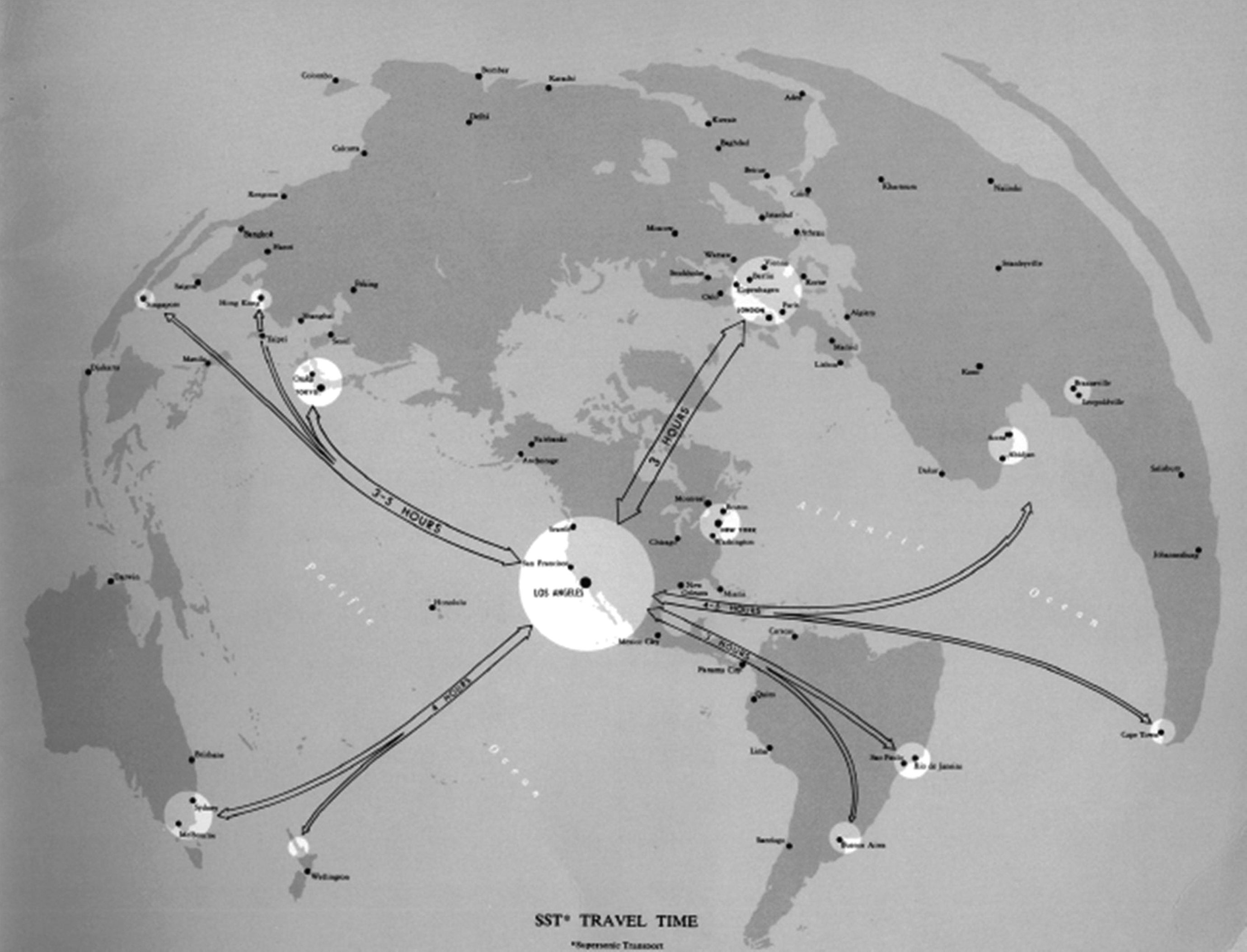
While the Centropolis plan lays out a link between the built form and growth, it is not until the 1970s that this relationship becomes explicitly focused on the potential of design to encourage private-sector investment.
New Urban Village, 1970s
While early plans such as Centropolis identified South Downtown as strategically located for employment and commercial growth, the 1972 General Plan (known as the Silver Book) envisioned the area as a site for a largely residential community—referred to as an urban village—focused on the addition of a major new community recreation space. The Silver Book, also created through a joint effort between the city planning department and a coalition of downtown businessmen (Committee for Central City Planning, Inc.) was similarly responding to the “urgency of the situation” facing downtown. 50 Little had changed in the intervening years, with approximately 30 percent of land in the area vacant or devoted to parking. 51 The cornerstone of the Silver Book plan for South Downtown was the creation of a new eighty-acre park, a concept incorporated in a variety of plans and with differing forms up to the early 1990s.
The plan envisions the proposed park, giving the neighborhood its South Park moniker, as both a regional destination and a local amenity for the future residents of the new “urban village” that would develop around it. The park would have a large lake in the center, as well as recreational and cultural facilities, and be ringed by a mix of residential and commercial uses (Figure 6). The role of the park is seen as critical for the future South Park neighborhood, with it proposed as the central organizing framework around which future growth, as well as infrastructural and transportation improvements, would coalesce. 52
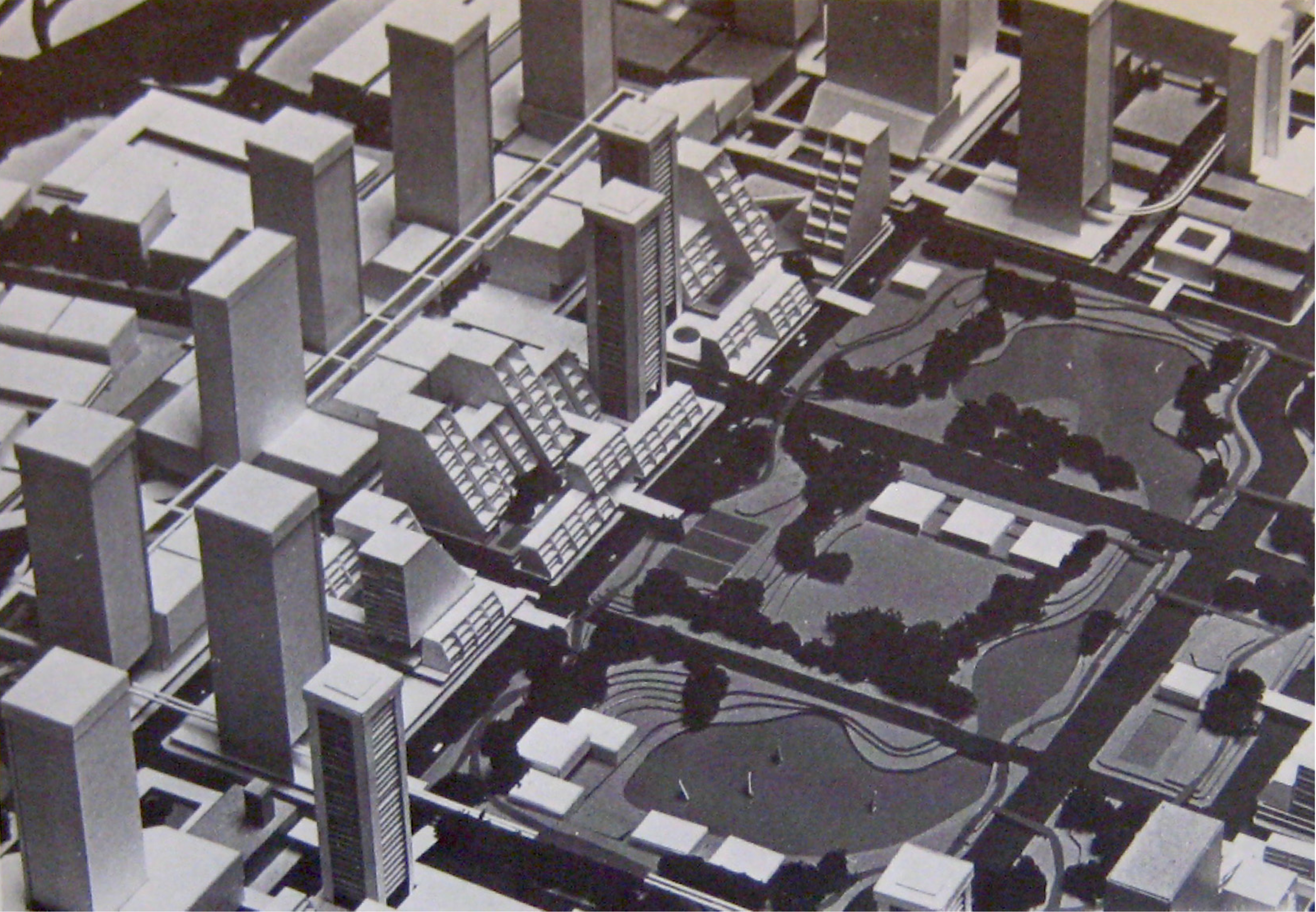
“South Park—Detail of Park’s edge: housing, commercial plazas, and office towers, arcade and people mover behind.” Source: Committee for Central City Planning, Central City Los Angeles 1972/1990: Preliminary General Development Plan (Los Angeles, CA: 1972), p. 26.
The potential of the park to stimulate growth is explicit throughout the 1972 General Plan and related studies. The plan uses the associated imagery of the new park as a way to change the perception of downtown Los Angeles, with the belief that the South Park project will be able to “create a new Downtown image and symbol of pride.”
53
The park specifically is depicted as having an important role in attracting development. The plan discusses the park’s function as a public amenity, though its impact in creating an environment for increased development is a similarly important aspect.
54
The plan describes one of the goals for the area as follows: Create a major new amenity to both attract new growth and provide a new environment for residential uses.
55
The park is also seen as being able to attract housing, “which might not locate in Downtown without the added attraction of a major amenity like the Park.”
56
While the park space is also seen as providing an amenity to an underserved area, its importance in spurring housing development is key. The balancing of these two goals is similarly echoed in other plans from the era: Another important feature is the provision of large quantities of open space—a regional park, park system or multiple open use space within the planning area. This vital amenity is the key to the success of the new housing as well as an important addition to the open space inventory of Central City.
57
Similarly, the text acknowledges that while development may occur in the area without intervention, the park will be used to leverage the sort of “grand” development detailed through the downtown goals. The proposed change to the immediate area is substantial while significant impacts for all of downtown—in terms of both the physical form and perception—are portrayed as emanating from the project. In contrast to the portrayal of the new community, the plan describes the growth that may occur without city involvement as: There is…no way to assure anything except a “mixed bag” of unrelated buildings [will develop]. There is no assurance of anything particularly grand occurring…. A beautiful, centrally located and landscaped Park and Lake is proposed as the catalytic element, to dramatically and rapidly change Downtown’s image.
58
The impacts are seen as not being limited to the local area but spread throughout the downtown: The South Park development would be an obvious “shot in the arm” to the Central Commercial Core, and would specifically benefit south Broadway, the garment district, and the Convention Center.
59
The plans from the 1970s operate from the same concerns as earlier ones—namely, the need for intervention in a downtown that had been experiencing decline for some years—but are largely premised on a major project to bring about the changes envisioned. The centerpiece of this plan—the large recreation space—would continue to evolve before being ultimately discarded.
Evolving Villages: 1980s–1990s
Ten years after the General Development Plan, South Park remained the focus of planning by the CRA/LA. Following the development of plans in the 1970s that sought interventions in South Park to spur private development, the CRA/LA committed funding for private-sector-led residential housing development and housing rehabilitation as well as for the acquisition of land for the central park, though reduced in size and scope. The notion of an urban village in South Park, with substantial residential development, was also incorporated into later proposals to differing degrees including those by the CRA/LA. A 1982 plan for South Park had similar goals for increased residential development in the area, though this iteration significantly reduces the size of the public amenity space.
60
In place of the large eighty-acre central park, this iteration of South Park focused on a three-acre Olympic Park (Figure 7). Similar to earlier plans, the park is shown as transformative, with a role in establishing the area’s residential image as well as contributing to its liveliness:
This new 3-acre park, located at the intersection of important South Park office, residential and retail activity, will become a lively meeting place and CBD landmark. Ground floor commercial tenants of the residential towers will enliven park use with accessible attractions and service—restaurants, shops, a pre-school and a daycare center.
61

Olympic Park, facing east from Hope Street, from CRA/LA planning documents (CRA/LA, 1982).
The relationship between these public investments and increased private development is made fairly explicit: Olympic Park establishes the special emphasis of this new community on the public realm and the resulting benefits to private development.
62
As with earlier plans, while there are associated public benefits with the proposal, such as the urban realm and recreation improvements, there is a parallel emphasis on how these improvements can spur private-sector investment.
In 1985, CRA commissioners requested that a panel from the Urban Land Institute (ULI) assist in assessing the plan for the South Park area. 63 In the context of a changing downtown real-estate market, the ULI advisory panel was charged with evaluating the feasibility of the South Park proposal, “with particular emphasis on whether the South Park concept could be realized given the current market conditions.” 64 The ULI report agreed with the broad strategy proposed by the City and CRA—a major new residential district for downtown—but suggested alterations to the implementation strategy as well as the nature of the public open space. Advocating that a critical mass of development was needed for the project, the report suggested that housing should be prioritized in certain key locations, with the park taking the form of an “an active public neighborhood square…a traditional urban open space, or ‘square’ such as Rittenhouse Square in Philadelphia,” a marked difference from earlier plans for the public open space. 65 The distinct identity for the area would be created through the development of the Hope Street Promenade, envisioned as an “urban activity spine” reinforced through streetscape, gateway, and landscaping elements, a strategy that would also serve to link South Park to the rest of downtown (Figure 8).

Olympic Park and streetscaping elements. Source: Urban Land Institute, South Park: An Evaluation of Residential Development Potential and Strategies for the South Park Area of Downtown Los Angeles, Panel Advisory Service Report (Washington, DC: 1985), p. 29.
While the ULI report conceives of the public space differently, it remains a consideration for the area. However, in contrast to previous plans, the ULI report questions the value of the proposed amenities and their role in encouraging development: The second primary planning and design question the panel was asked to address focused on whether efforts should first be concentrated on proposed amenities—such as Olympic Park, the Hope Street Promenade, neighborhood services/retailing, entry/exit identity, and the rehabilitation of existing housing—in order to change the public’s perception of the area and to attract people.
66
The quality of public space is partially seen as a planning and urban design issue but also as part of marketing and development concerns. The ULI report addresses four main areas: development potential, planning and urban design issues, marketing and development issues, and implementation. As part of the urban design concerns, the report questions whether the proposed amenities can change public perceptions of the area as well as the impact of design and development controls on hindering private-sector investment. However, the plan intrinsically links these amenities to development potential: Is it reasonable to assume that when Olympic Park, the 800 dwelling units, and the Fashion Institute of Design and Merchandising are completed, South Park would enjoy increased market appeal and a greater number of private initiatives for residential development?
67
The report concludes that in addition to targeting housing to specific “critical areas,”
68
the development of Olympic Park (along with a below-grade parking structure) and the Hope Street Promenade, where at-grade retail and pedestrian improvements would be concentrated, should be priorities. However, it also recommends that the housing product should have a focus on security and have their own recreational facilities.
69
While the ULI report maintains the broad goals of the original planning efforts undertaken in the 1970s, the development focus demonstrates an altering of the vision, focused even more so on increasing private-sector investment. To this end, the ULI report recommends that: Although it is important that the CRA continue to emphasize quality of the overall development, it should not dictate such project-specific market elements as the style and mix of units or the types of amenities. Rather the CRA’s efforts should focus on processing and accommodating development deals for available sites in short order.
70
The emphasis on a mix of units for different income and family groups as well as the importance of planning and design controls is lost in ULI’s recommendations in favor of a largely market-driven strategy. 71
The last major document prior to the shift to contemporary plans is the Downtown Strategic Plan in 1992. This conceptualization of South Park still sees a major civic space as the catalyzing factor to encourage residential development for both the district and downtown more broadly. Similar to earlier planning and design efforts from the 1970s, South Park is referred to as being Downtown’s “first new residential neighborhood” with the anticipation that it will “demonstrate how successful future Downtown residential communities can be.” 72 Like the earlier urban village concept, the area is envisioned as a mix of residential and commercial activities, creating an active, urban community, albeit at significantly lower densities than previously proposed to make South Park “an attractive alternative to living in the surrounding towns and suburbs.” 73
Similar to the recommendations put forth by ULI, the new public space, referred to as South Park Square, is reduced to the area of one block (Figure 9), although it remains a major strategic element.
74
While the plan does not provide extensive details about the square’s implementation, it is envisioned as a place for both passive and active recreation. The 1992 plan specifically confronts the quality of open space that is being developed, critiquing the abandonment of public spaces in other areas of the downtown. As stated in the strategies for the South Park Square:
…Los Angeles has experienced an abandonment of the public realm, marked by a fear of public open space as a locus of undesirable activity and behavior. Many see the solution as minimizing public spaces, and investing as little as possible in the streets beyond what is needed for automobile traffic safety. This Strategic Plan posits the belief that the public realm gives value to both private property and communal life. The answer lies not in eschewing public space but in supporting and democratizing it.
75

Proposed South Park Square. Source: Downtown Strategic Plan Advisory Committee, Downtown Strategic Plan Los Angeles (Los Angeles, CA: Community Redevelopment Agency, Los Angeles, 1992), p. 90.
The plan also sets out specific goals to ensure the spaces proposed in the plan function, as civic and communal amenities, such as requiring they are bounded on all four sides by public streets, are commonly accessible and form part of a pedestrian network connecting with the rest of downtown. 76 In contrast to the implemented forms of public space in the area, the 1992 plan explicitly states that civic spaces “should not be the ‘front lawns’ of any buildings.” 77 Although the ULI report and 1992 Downtown Strategic Plan recommend significant departures from the original vision for the South Park area, the broad goals of an urban residential district centered on public open space are largely maintained, as is the discourse of public amenities stimulating private-sector investment. In contrast, the next phase of planning and urban design strategies demonstrates a departure from the comprehensive approach seen by early plans and can be seen as largely marked by opportunistic interventions.
New Directions: Sports and Entertainment, 1990s–Present
The planning and urban design visions initiated in the 1970s for the South Park Urban Village change radically with a private-sector proposal for a new sports arena adjacent to the existing convention center. The possibility of a major new sports facility, purported to have a significant impact not only on the built form but also on the attractiveness to new development, resulted in major changes to how plans envisioned the area. Significantly, while original plans were for a large district with a comprehensive planning and urban design approach, the proposed arena led to the creation of a separate planning area, entitled the Los Angeles Sports and Entertainment District (LASED). While there was still a concern with increasing housing in the district, the reorientation toward the sports and entertainment complex demonstrated more interest in providing amenities in the form of commercial uses, rather than public open or civic spaces. Additionally, as recommended in the ULI assessment of planning for the area, the focus was on allowing largely unregulated private-sector investment, in contrast to the previous goals of ensuring a mixed-income residential community.
Like earlier plans, the orientation toward creating a sports and entertainment district included attracting residential development to the area, as well as to the more expansive CBD Redevelopment Area. There is an emphasis on enhancing downtown livability, and an explicit acknowledgment that the area is not currently seen as a desirable place to live. The sports and entertainment complex—like the public amenities proposed in previous plans—is depicted as being able to encourage private-sector development and fundamentally change the perception of downtown: …Make the CBD a more livable place and assist in the Agency’s effort to prevent residential flight from the CBD and encourage residents to move to the CBD.
78
However, while earlier plans, with the possible exception of the ULI advisory panel report, stressed public open space as the primary amenity to attract development, this generation of planning focused on entertainment and commercial space. These changing visions for the South Park area were occurring during a time of increasing importance for downtown Los Angeles, especially the financial district, largely as a result of the strategies pursued by the CRA to make the CBD a major office hub.
79
In addition to enhancing downtown livability and encouraging residential development, the goals for the project include a focus on commercial spaces. The plan envisions the project as being able to: Enhance livability within the CBD, and will attract families to live Downtown by providing entertainment and commercial facilities which will provide goods and services to residential areas of the CBD, and surrounding community.
80
And similarly, Directly provide, and indirectly enhance retention and growth of, commercial retail outlets to meet a variety of commercial demands within the CBD project area.
81
These broad goals of revitalizing the area were envisioned primarily through the new proposed sports and entertainment facility and secondarily through attracting increased commercial and entertainment amenities to the area. One aspect of the project development required public open space to be developed adjacent to the arena. The various agreements between the CRA and the development company (L.A. Arena Development Company LLC) include urban design guidelines that not only focus on the massing and external design of the arena itself but also on the provisioning of public space. The Disposition and Development Agreement between the CRA/LA, City of Los Angeles, and the developer outlined urban design objectives for the project, derived from the Downtown Strategic Plan and the South Park Development Strategies and Design Guidelines. 82 Although the majority of the urban design goals focus on the arena design, 83 there is an interest in the relationship between the project, the site, and the larger district. The urban design objectives focus on two main strategies: firstly, the connection between the site and surrounding neighborhood; and secondly, the design and nature of public open spaces. 84
For the open-space amenities in the Sports and Entertainment District era of planning, there are few explicit requirements in terms of size or type of space in early documents other than the stipulation to provide “publicly accessible open space.” Rather, one of the urban design objectives states: Design an attractive, active and secure pedestrian environment on the Site and adjacent public rights-of-way with consideration given to such factors as walkway configuration and widths, arrangement of building massing and accessible open area, lighting and landscape/hardscape design and materials.
85
One component of the public space strategy is a plaza, with the plan stating that the “reconfiguration of the Plaza shall be designed as a major open space element.” 86 Despite this projection of the plaza as a major open-space element, there are few guidelines in these early plans regulating or defining the public nature of this space including how it will relate to private buildings and maintain open access.
Later documents responding to the arena proposal offer more guidance on the public space requirements for the area, stating that the Central Plaza must be 30,000 square feet (approximately 0.69 acres) and a minimum of 150,000 square feet (3.4 acres) of open space be provided in the Specific Plan area. 87 The nature of this open space is significantly different from that proposed in the 1972 General Plan and even the amended version envisioned by the CRA in response to the ULI report. While the first versions of public space for the area treated it as a major community benefit, the Specific Plan has a much looser interpretation of civic space. Regulations for the Central Plaza state only that it should be open to the public during business hours (though it may be closed for private events) and may include associated commercial uses. For the general open-space requirements in the Specific Plan area, the regulations are permissive in allowing above-grade and rooftop space to be considered public open space as well as allowing privately owned spaces and setbacks to be considered as part of the requirement (Figure 10) in considerable contrast to the guidelines for public spaces put forth in the 1992 Strategic Plan. 88
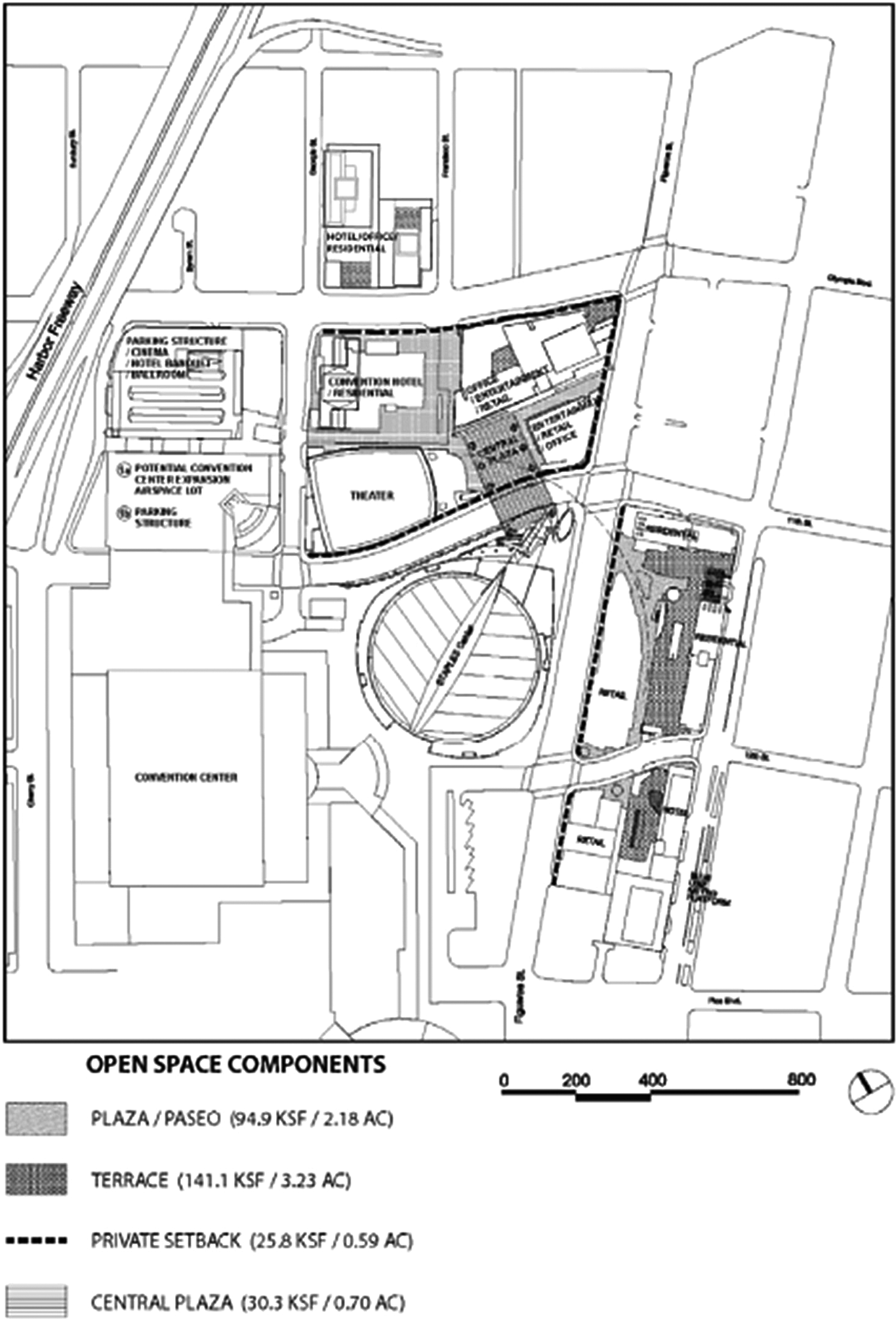
Open space components as outlined in the Los Angeles Sports and Entertainment District Specific Plan. Source: City of Los Angeles, Los Angeles Sports and Entertainment District Specific Plan (Los Angeles, CA: 2001).
Although this plan removes the Sports and Entertainment district from the larger South Park planning area, there are attempts to make connections to the surrounding district. It lists specific routes for pedestrian linkages between the district and surrounding neighborhoods including South Park and the CBD and includes requirements related to hardscape, landscape, lighting, and sidewalk widths (Figure 11). In contrast to earlier plans, the LASED Specific Plan promotes Eleventh Street, running east–west, as a pedestrian area, whereas all previous studies prioritized north–south Hope Street as both an important pedestrian zone and connector to the downtown core. This change in street hierarchy reflects increased attention to the needs of the sports arena and associated entertainment uses (allowing for the street to be closed to vehicular traffic for events) rather than for establishing connections to other areas of the downtown.
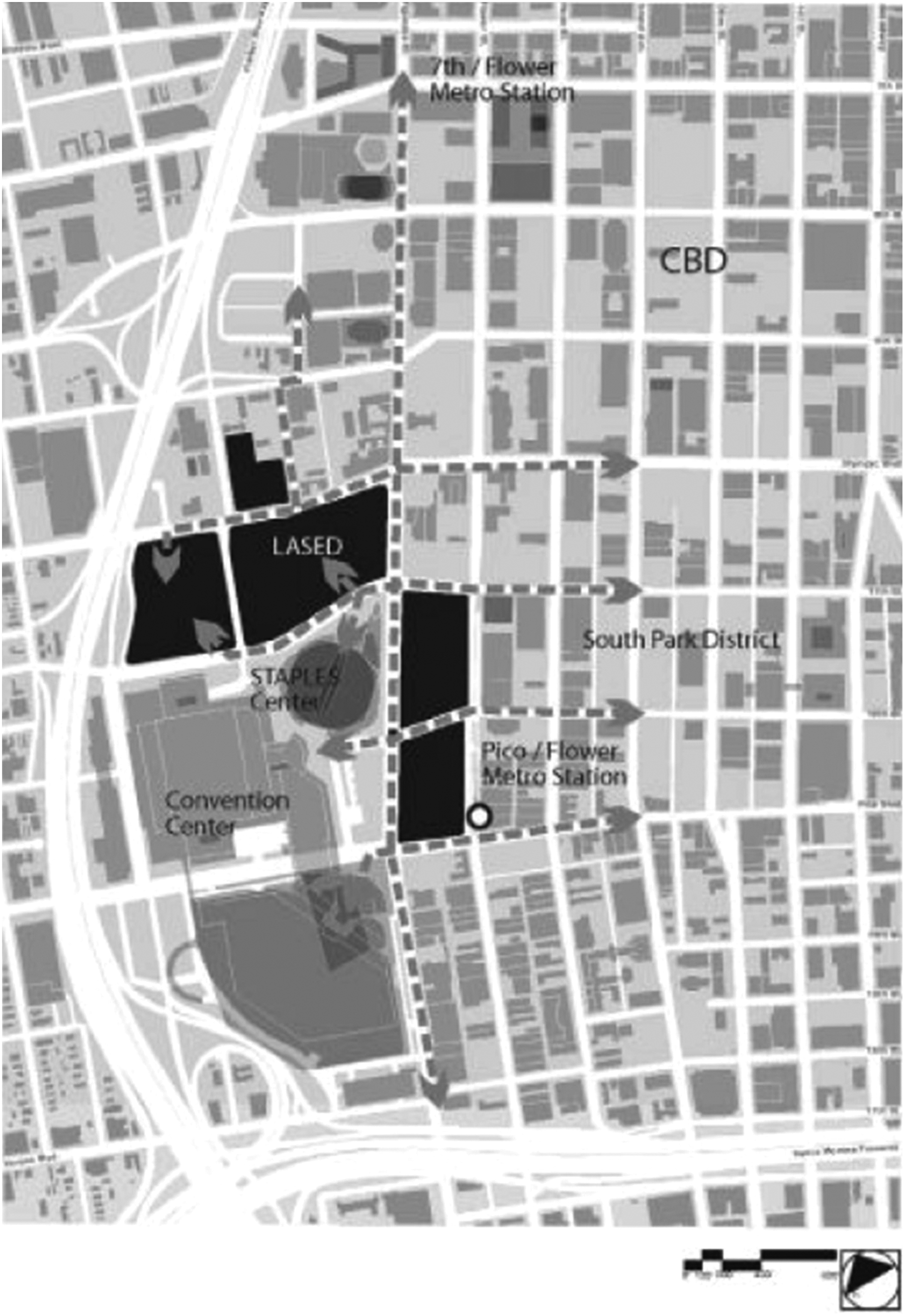
Diagram of pedestrian linkages between Los Angeles Sports and Entertainment District, South Park District and the Central Business District. Source: City of Los Angeles, Los Angeles Sports and Entertainment District Specific Plan (Los Angeles, CA: 2001).
Catalysts and a Shot-in-the Arm: Discourses of Growth
As the plans for South Park evolved over time, there is a clear move from a comprehensive, district-wide approach to one that is largely reactive to private-sector proposals, one clear indicator of this being the scale of the planning district, which shrank substantially over time (Figure 12). Despite this change—which is certainly a significant one—the broader “purpose” of urban design does not exhibit the same reorientation. Viewing these plans over time shows that many of the key concepts associated with the entrepreneurial era of urban design are not only observed in recent plans, and amid the change are also strands of continuity. One area of continuity is the relationship between urban design improvements and growth, with the assertion since the early 1960s that urban design strategies will stimulate, catalyze, or encourage development downtown.

Plan scope, 1964–present.
From the earliest plans for the area until the most recent ones, urban design improvements and amenities are closely tied to encouraging development, although there are differences in how this relationship is conceived and depicted as well as what types of urban design strategies would encourage investment and the scale of those benefits. The plans depict urban design strategies as either hastening (in the case of accelerating or catalyzing development in the 1960s and 1970s) or directing (reinforcing and revitalizing in the 1980s and on) growth (Table 3).
Catalyst Type and Scale of Benefits, by Era of Plan.

The role of a catalyst for development—a term found primarily in plans from the 1970s and observed to a lesser extent in the majority of plans—is particularly interesting. In the strict sense of the term, a catalyst affects the rate of change but does not change the final state of equilibrium, perhaps a questionable assumption for the South Park area. 89 Despite isolated developments such as the Occidental Tower, little concentrated development had occurred up until the major investment in the Staples Center, implying that the goals are to create development rather than catalyze or accelerate it. The 1972 plan even hints at this: “The physical design of the plan reflects the Goals set out by…. Creating CATALYSTS [sic] in presently deteriorated or blighted areas to both turn around blight and begin to attract positive, new action.” 90 While this may seem like a minor point, understanding urban design practices and priorities as focused on creating new development, rather than serving current residents, represents a differing perspective on the purposes of urban design.
Conclusions: Continuity and Change
While entrepreneurial policies have been largely discussed as a change from earlier models of governance and planning, the history of urban design guidance for South Park demonstrates that a more nuanced understanding may be required. The movement toward competitiveness and market-led strategies—using what Fainstein refers to as the vocabulary of investment bankers and property brokers—is seen much earlier than others have argued. 91 The earliest plans show an orientation toward “using” urban design as a strategy to encourage growth and development, a theme that continues up to the present day. While early generations of plans focus on the potential for urban design plans to stimulate growth, the nature of those catalysts changes substantially over time. The interest in increasing residential development in the area remained somewhat constant, while the nature of that development, and crucially, the factors that would encourage it, shifted.
While earlier plans focused on creating a significant community amenity in the form of a large park, and establishing connections to the downtown core, the possibility of a new sports and entertainment venue changed these planning and urban design goals both geographically and conceptually. Plans as late as 1992—just a few years before the sports and entertainment concepts emerged—still focused on the importance of creating public open areas as part of a network of downtown civic space. Later plans focus on the potential of the new arena to spur development, focusing on the western part of the South Park area, adjacent to the Harbor Freeway, and treating it as a potential amenity for the district. While these visions emerged in different points of times, with the latter ones amid a broader change in the success of downtown Los Angeles as a commercial and office hub, they reflect a differing conceptualization of the nature of public space and urban design. The changes in how the plans viewed amenity and public spaces as well as the different prioritization on connections to downtown and surrounding communities represent a restructuring of city priorities based on private-sector-led development. Despite this, urban design practices—as seen through the lens of plans from the 1960s until today—demonstrate the enduring relationship between design improvements and encouraging investment, a relationship that it would be difficult to view as a change or shift.
The relationship between urban design improvements and future growth is a fraught one. Teasing out the public benefits, intentions, and impacts of urban design projects is rarely straightforward. In particular, Biddulph argues that the desire for new growth does not necessarily drive urban design projects, stating that “…although there may be some alignment of objectives between wanting to attract investment with improving the urban design qualities of the city, this is not necessarily a dependent or deterministic relationship.” 92 Yet, the potential for urban design projects to drive growth is not only made explicit but is also often the primary justification in the plans for South Park. While there are shifts in how this relationship is portrayed, namely, in what form the catalyst for development should take, it remains one of the few constants from the earliest plans up to contemporary ones. This Los Angeles case study demonstrates that separating urban design from entrepreneurial strategies aimed at increasing growth cannot be seen strictly as a new phenomenon—especially if one looks beyond the resulting form—as plans stretching back to the early 1960s emphasize the role of urban design in stimulating growth, establishing global connections, and driving increased development.
Footnotes
Declaration of Conflicting Interests
The author(s) declared no potential conflicts of interest with respect to the research, authorship, and/or publication of this article.
Funding
The author(s) disclosed receipt of the following financial support for the research, authorship, and/or publication of this article: This research was supported by the Canada Social Sciences and Humanities Research Council (Award #752-2011-0762).