



Abstract
This paper investigates how the pedestrian mall concept evolved and was broadly replicated in the post-war period in North America, specifically positioning downtown pedestrian malls as a case study of urban renewal ideas and practices. This research describes how ideas of pedestrianization evolved from a modernist utopian concept, to a more constrained pragmatic approach that was widely implemented. Furthermore, this research links the proliferation of pedestrian malls to federal urban renewal funding in the US. Like many mid-century urban renewal projects however, only a few pedestrian malls remain intact today.
Keywords
Introduction
Much of the research addressing urban renewal is focused on highway and housing projects without fully understanding downtown redevelopment as a corresponding and often parallel strategy. This research addresses this gap and specifically examines post-war downtown pedestrian malls in the United States (US) as a case study of urban renewal ideas and practices. Over 160 pedestrian mall strategies 1 were built in cities and towns across America and Canada between 1959 and the 1980s, with many more considered or planned during this time. 2 As such, this is an important aspect of downtown planning and urban renewal history that deserves more attention. This research examines and analyzes academic literature, planning documents, shopping center directories, archival records, and historic newspaper articles in order to achieve a broader understanding of how the pedestrian mall concept evolved and was broadly implemented and replicated in the post-war period in North America.
As cities across North America experienced disruptive shifts toward suburban retail development during the mid-twentieth century, wavering tax revenues for downtown retail properties became an urgent and pressing issue for city officials. 3 The pedestrian mall concept was specifically promoted as a solution to address the decline of downtown retail districts. 4 At the time of their development, pedestrian malls were well understood as urban renewal strategies; however, as time progressed this clear connection became obscured. This research restores these ties by investigating evolution of ideas and proposals, the actors behind the construction of pedestrian malls, the planning rationales used, as well as the institutional structures and funding that enabled their broad application specifically across the US. Furthermore, this research clearly articulates pedestrian malls as a reaction to larger forces of suburban decentralization in North America following World War II, much like other urban renewal efforts.
To address the question of how the pedestrian mall concept evolved and was broadly implemented and replicated in the post-war period in North America, the following article begins with a review of academic literature highlighting the shifts in urbanization and society within the North American context following World War II. The section following the literature review then documents the broad speculation of ideas for pedestrian malls as a downtown renewal strategy through a review of newspaper reporting of pedestrian malls from the 1950s, prior to any permanent projects being realized. Next through several related sections, the article articulates—through a detailed discussion of proposed and built projects—how ideas of pedestrianization evolved from a high modernist utopian concept that required comprehensive planning to a more constrained pragmatic approach to implementation of the pedestrian mall concept. This concept was also supported and promoted in the US through federal urban renewal funding, thus further facilitating implementation. This discussion is followed by an analysis of the time difference between the building of pedestrian mall projects and the opening of their corresponding regional shopping centers. The concluding section reinforces these ideas and places the pedestrian mall within other urban renewal and pedestrian ideas, and it also briefly articulates how the concept and implementations failed to meet the intended outcomes of downtown retail revitalization and were ultimately dismissed.
Background and Review of Literature
Post-war Urban Decline and Renewal
Following World War II, cities across North America experienced a massive urban restructuring toward auto-oriented suburban development and away from investment in central cities. 5 With “the simultaneous decline of the industrial cities and the rise of the suburbs, Americans reimagined their country and what it meant to be an American . . . [as they became] the first suburban society.” 6 Along with these shifts, consumer retail spending was also encouraged as a means for economic stability and became a substitute for the production of wartime military goods in the post-war; for the first time consumer consumption surpassed industrial production. 7 Furthermore, consumerism was promoted as a form of participation in democratic society, especially in light of Cold War rhetoric against the Soviet regime. 8
The post-war economic boom in America was also propelled, in part, by the demand and consumption of suburban housing, a demand that had been suppressed since the Great Depression and throughout World War II. However, in contrast to the burgeoning suburbs and the overall prosperity of the US, central cities in the post-war continued to experience decline, disinvestment, and overall negative perceptions. 9 Tenuous race relations exaggerated the already negative perceptions of central cities, especially large northern industrial cities in the US. 10 Despite the unprecedented growth of wealth and prosperity in the post-war, economic and racial inequalities were reinforced by the suburbanization process and further propelled by deep-rooted insecurities among the newly established members of the white middle-class. 11
With the rapid rise of suburbanization and automobility in North America in the second half of the twentieth century, there were notable shifts in spaces where people gathered, shopped, and practiced public life in North America. 12 In this newly suburbanized society, the suburban shopping center became the de facto center of community and public life, at least for white middle-class consumers. 13 The influence of suburban shopping centers on urbanization and consumer culture in North America has been well documented. Richard Longstreth 14 underscored the suburban experience and development of shopping centers in the greater Los Angeles area between 1920 and 1950. Meredith Clausen 15 emphasized that regional shopping centers in the post-war became a driver of urbanization. Furthermore, David Smiley 16 highlighted how suburban shopping centers became a means of normalizing modern architecture for the masses.
While these aforementioned scholars focus on how the suburban shopping center influenced urbanization and architectural innovation, Lizabeth Cohen and Andrew Shanken described the social and cultural shifts in post-war America corresponding with the rise of consumer culture. 17 Chhen argued that planned shopping centers were viewed as a means of rationalizing consumption, just as highway development was a means of rationalizing and modernizing transportation Cohen and Shanken each explored the relationship between the proliferation of suburban shopping and the corresponding decline of downtown retail; they also briefly recognized the pedestrian mall as a response. However, little research has specifically addressed the proliferation and evolution of the pedestrian mall concept itself as a downtown redevelopment strategy or its widespread implementation in the post-war North American context.
While many began to question the meaning of the center city in this newly restructured and suburbanized society, it was the promises of modernist design that boldly operationalized this sense of urgency by proposing physical interventions to address the economic and social decline of central cities and downtowns. 18 Writing in 1957, Arthur McVoy, the Director of Planning for Baltimore, MD argued that “the decline of downtown property values, the lack of downtown cultural and social values, the ugliness, the deterioration, the unplanned appearance of most parts of our downtown areas are all eloquent proof that something must be done about downtown.” 19 McVoy also claimed that architect Victor Gruen’s Fort Worth, TX, downtown pedestrianization plan was the “brightest prospect on the American scene . . . for the achievement of downtown renewal.” 20
Many assumed that with proper planning, the prosperity and growth that the suburbs were experiencing could also be distributed within central cities. 21 Based on this belief, progressive politics mobilized in the form of urban renewal policy and began to shape modernist visions of downtown planning into a physical reality. 22 “Social reformers and modernist designers . . . clearly made common cause in the redevelopment of cities. They were united by a faith in environmental determinism.” 23 In the US, federal public housing initiatives responded directly to inadequate housing conditions and supply in central cities by building modernist housing towers. Likewise, downtown urban renewal programs including highway building, retail revitalization, and later, constructing civic centers were a response to the corresponding decline of commercial and retail properties. 24
Pedestrianization, Pedestrian Malls, and Urban Renewal
The reasons for the rise of the pedestrian mall concept as a specific downtown renewal strategy are multi-facetted. The prevailing reason, however, was the strong association of the concept with modernist design ideas and the promotion of consumer consumption in the post-war. 25 During World War II, Architectural Forum editors George Nelson and Henry Wright envisioned the post-war city in the May 1943 issue “New Buildings for 194X.” This influential issue introduced the post-war “Main Street” shopping district as a park-like “pedestrian area.” 26 Nelson and Wright claimed the plan was far from speculative or utopian as downtown merchants and tax officials were concerned about the competition from suburban retail development. 27
Interest in pedestrianization for downtown retail revitalization continued into the post-war years and was further propelled by the economic success of newly built suburban shopping centers which linked the pedestrian shopping experience to retail sales. 28 At an international seminar on urban renewal held in The Hague, the Netherlands in 1958, downtown pedestrianization was a seminal topic of discussion. 29 At the seminar, urban renewal ideas were shared from American proposals to pedestrianize entire downtown districts like the plans for Cincinnati, OH, as well as from existing examples of pedestrianization in Europe including the Lijnbaan in Rotterdam, the Netherlands. At the conclusion of the seminar, delegates from both Europe and North America nearly unanimously agreed “that pedestrian zones would play a pivotal role in attracting more people to downtown.” 30
The Early Rise and Cautious Optimism of the Pedestrian Mall Concept in the 1950s Newspaper Media
Throughout the 1950s, American and Canadian newspapers presented discussion of pedestrian malls with cautious optimism as a downtown revitalization strategy that was untested. The concept was promoted as the logical planning solution for retail revitalization to mitigate the effects of urban decline from decentralization. Prior to any built pedestrian malls, a 1953 downtown redevelopment proposal for the small community of Menlo Park, CA, highlighted the conflicting opinions between planners and merchants. Merchants “expressed feelings in public hearings that the landscaped mall would hinder business because it would discourage the ‘casual shopper’ who just happened to be driving by.” 31 In contrast, planning consultant Harold Wise, who studied the business district and prepared the plan, claimed that “such an area blocked to traffic would create and invite leisurely shopping free of noise, confusion and danger of heavy traffic.” 32
In Oxnard, CA, local architect Donald Miller felt so strongly about the pedestrian mall concept that he developed a plan for the downtown, pro bono. The plan was received by the city council and presented for public review. The overall tone of the newspaper article that reported on the plans for downtown revitalization was positive toward the pedestrian mall concept. However, the article noted Miller’s recognition “that it was natural for merchants and property owners to have misgivings about a project that would make such a change in the present downtown area. No one is sure what the results will actually be.” 33
In addition to the strong voices of architects, landscape architects, and planners who were promoting the concept, there was also some support by shoppers and local citizens. In a 1955 letter to the editor supporting the pedestrian plan for Fourth Street in Louisville, KY, resident M. Kiler wrote: If this noisy, congested street became a pleasant pedestrian mall, I think the downtown shopping district would be “saved.” Shopping in such beautiful surroundings would be a joy for local people and certainty this center would fast become a tourist attraction. Louisville has long been a progressive city and one willing to initiate new ideas. Let’s not stop now.
34
In response to the market share shifting toward the suburbs, the idea that the downtown retail needed to be saved became prevalent in newspaper discussion throughout the 1950s. One newspaper opinion piece from 1958 wrote of the concerns for the declining tax base in downtowns and that “these old giants have suddenly awakened to the fact that their once proud position as center of the city is threatened by new suburban development.” 35
An article reporting on the 1958 Conference on Metropolitan Growth held in Washington by the US Chamber of Commerce quoted the President of the American Institute of Architects, John Noble Richards, as saying “we are in mortal danger of drowning in a mess of ugliness, of suffocating in deadly fumes and vapors, and getting mangled and deadlocked in our traffic congestions.” 36 Richards continued, stating that “healthy downtown development—or redevelopment—requires a bold, imaginative and comprehensive plan.” 37 During the same conference, the role of the federal government in building revitalization projects was debated. Representatives from the US Chamber of Commerce favored leaving downtown redevelopment to cities and states while the President of the Institute of Public Administration, Dr. Luther Gulick, argued that urban renewal was a national interest and was needed everywhere and therefore should be supported by federal funding. 38
In addition to big plans and debates on how to fund them, some cities staged temporary pedestrian mall experiments to inexpensively test the concept. 39 Merchants remained the most cautious, as their livelihoods were at stake, while architects, landscape architects, and planners were eager to experiment with implementing the concept that had been widely debated and enthusiastically promoted amongst the professions’ elite.
The Evolution of
Post-
war
Pedestrianization from Modernist Utopia to Pragmatic Urban Renewal
The concept of pedestrianization began to evolve in North America following the end of World War II. The pedestrian mall plan presented in “New Buildings for 194X” during the war would have been considered quite measured when compared to the un-built plans that followed in the early post-war years. Gruen’s 1956 plan for Fort Worth, TX, “A Greater Fort Worth Tomorrow” was ambitious and speculative.
40
The proposal involved reordering the entire downtown district through the construction of a ring road that would limit automobile traffic and parking to the perimeter (shown in Figure 1) and provided underground access for service vehicles (shown in Figure 2). This significant investment in automobile infrastructure was intended to support a rich network of pedestrian space and plazas at street level throughout the entire urban core.
41
Perimeter automobile circulation and parking—Gruen’s plans for Fort Worth, TX.
42
Subterranean service circulation and loading docks—Gruen’s plans for Fort Worth, TX.
43
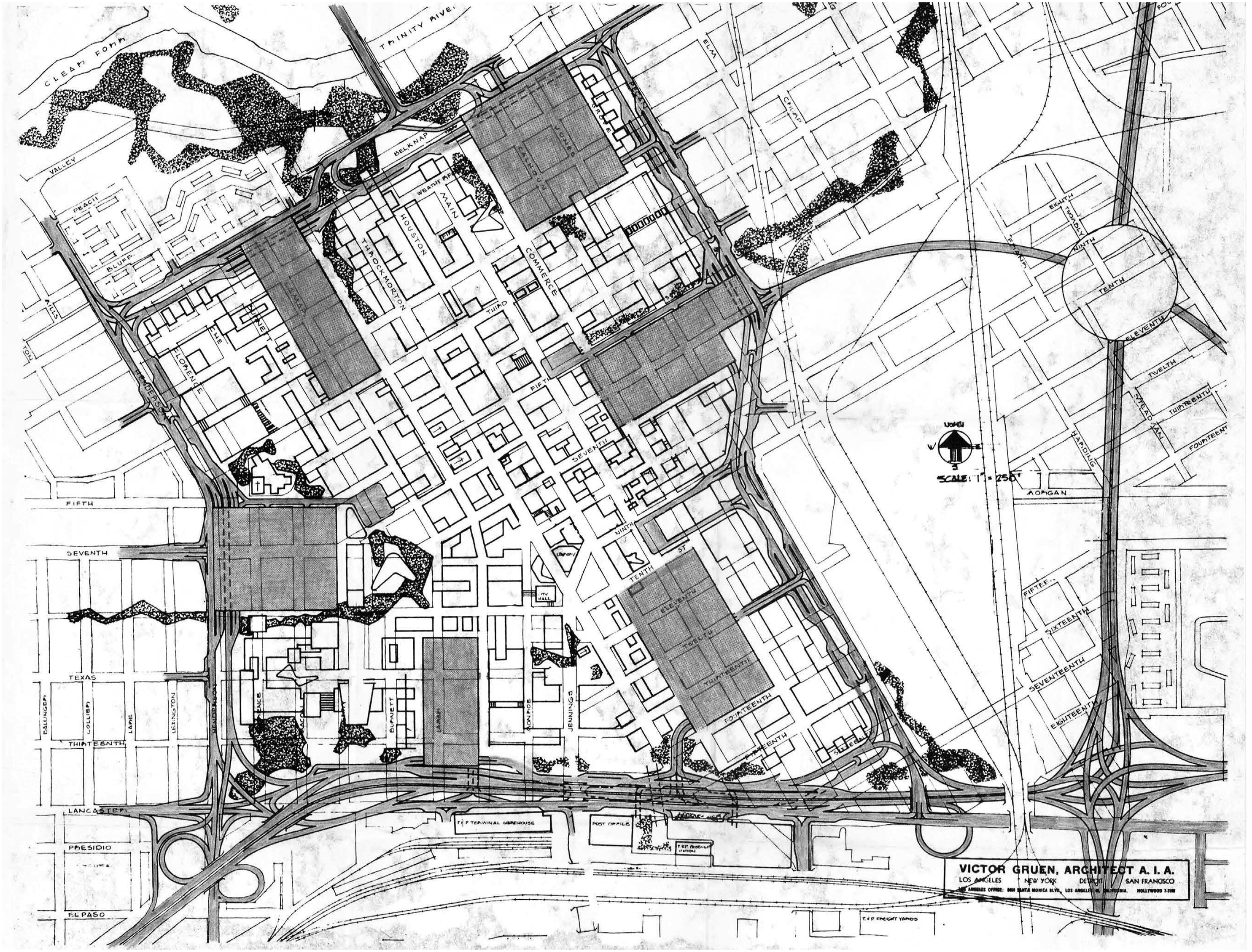

Gruen championed his “A Greater Fort Worth Tomorrow” proposal across the US, most notably presenting it at the 1956 Harvard Conference on Urban Design organized by José Luis Sert. The most influential architects, landscape architects, planners, urban designers, and intellectuals from across North America attended including Philadelphia’s head of planning Edmund Bacon; architecture and planning journalist Jane Jacobs; landscape architect Hideo Sasaki; and historian Lewis Mumford. 44 In addition to the conference, Gruen also promoted his plans and ideas across Europe through personal meetings, interviews, and speeches in the summer of 1956. 45 Aside from this active promotion, Gruen’s Fort Worth proposal was widely syndicated in newspapers, magazines, journals, and was also promoted by other architects, landscape architects, and planners. Speaking of Gruen’s plan for Fort Worth, TX, and other downtown pedestrianization plans around the US, one newspaper article exclaimed that “future downtown stands to make one of the greatest physical changes in our cities in years.” 46
The “A Greater Fort Worth Tomorrow” plan marked the height of ultra-modern utopian comprehensive planning for downtown revitalization. 47 By the 1950s and early 1960s, comprehensive planning proposals for downtown revitalization were prolific, and many mirrored or referenced Gruen’s Fort Worth plan. These proposals typically incorporated plans for traffic reorganization, increased parking, and retail recentralization. However, the reality of implementing such a comprehensive plan was much more complicated and arguably unattainable, due to the extensive cost for reconstruction and property reorganization. Even at the height of post-war prosperity and imagined possibility, the plan for Fort Worth was overreaching and utopian, unable to be realized.
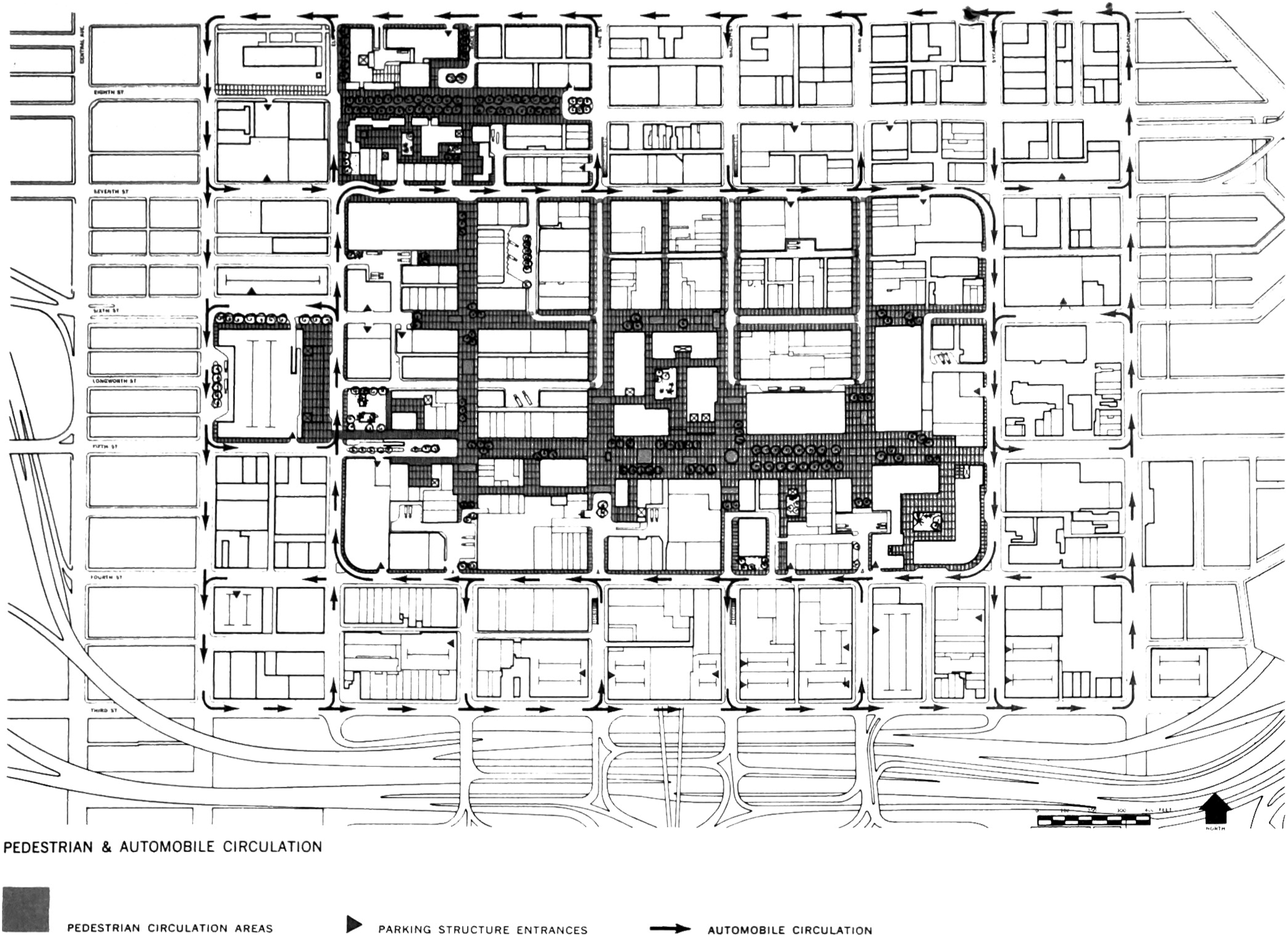
As the ideas for comprehensive reorganization and pedestrianization of downtowns continued to circulate, other more constrained plans emerged. Gruen’s 1962 downtown revitalization plan for Cincinnati, OH, is one such example of a simplified proposal. The plan (shown in Figure 3) illustrated the detailed thinking that went into organizing traffic circulation and planning underground parking entrances, all with the intent of supporting pedestrian density on the adjacent pedestrianized streets. Like Gruen’s Fort Worth plan, the proposal for Cincinnati was premised on creating a network of pedestrian streets in the downtown core by suppressing automobile traffic to the perimeter, and accommodating parking and service underground. Like the Fort Worth proposal however, it was also never realized. Pedestrian and automobile circulation plan from A Revitalization Plan for the Core of Cincinnati.
48
The Fort Worth plan, though never built, had significant influence in the initial visioning and replication of downtown revitalization ideas among architects, landscape architects, and planners especially as it linked pedestrianization and retail revitalization. 49 When pedestrianization ideas were translated into actual plans for construction, the modernist notions of comprehensive downtown redesign would be drastically simplified. Rather than comprehensive, the plans became pragmatic in order to fit the limitations of city budgets. Any downtown renewal plans that were realized resembled a tempered approach, more similar to the pedestrian mall plan for Syracuse, NY, presented in “New buildings for 194X,” than to Gruen’s grandiose Fort Worth, TX, proposal.
Testing the Pedestrian Mall Idea
In the years immediately following World War II, and prior to the broad implementation of permanent pedestrian malls, temporary pedestrian malls emerged beginning in the 1950s. While architects and planners were enthusiastically promoting and supporting comprehensive downtown pedestrian revitalization proposals like Gruen’s plans for Fort Worth, TX and Cincinnati, OH, merchants and city officials remained concerned with the costs of implementing these proposals and desired proof that the pedestrianization concept would deliver improved retail sales. The December 1959 issue of Chain Store Age featured interviews with executives of leading retail chains from around the country, asking them how they viewed downtown malls; the consensus was “one of healthy skepticism” with most of the doubts related to parking and financing issues. 50 Merchants had limited means of funding, and city officials were very reluctant to impose additional taxation on already struggling businesses. 51 Additionally, federal funding in the US was not broadly available for downtown renewal until the National Housing Act in 1954 and the Federal Highway Act in 1956; even after this legislation passed, the amount of funding available for non-residential downtown projects was limited to a small percentage of the total funds available. 52
In existing literature, temporary pedestrian projects are seldom discussed and are not recognized as a separate type of pedestrianization. 53 However, temporary pedestrian malls differ significantly as they were constructed and deconstructed rapidly with less planning and investment than their permanent counter parts. Furthermore, while the Fort Worth Plan and others promoted comprehensive planning strategies in addition to pedestrianizing the retail streets, temporary pedestrian mall instillations had none of the centralizing strategies, traffic reorganizing, or parking expansions that Gruen and others championed. These temporary projects only further simplified the pedestrian mall concept; they just eliminated automobile traffic on Main Streets without addressing the more permanent and difficult to implement strategies that were critical to the comprehensive planning ideas.
While Gruen adamantly opposed the tactical temporary approach for not addressing larger planning and circulation challenges, retailers and city officials often lauded the plans as a cost-effective approach to test the idea of pedestrianization, and as a means to better understand the potential impact of a permanent investment. 54 Merchants and city officials began to organize temporary interventions as a method to quickly and inexpensively test the widely debated pedestrian mall concept. This included a temporary installation in Toledo, OH, in the summer of 1959. 55
Some cities did go on to build permanent projects after piloting temporary pedestrian malls while others did not. Many of these temporary malls generated significant public interest as a novelty; however, merchants continued to have concerns that removing automobile traffic from Main Streets would negatively impact retail sales. 56 Oxnard, CA in 1957 and Waco, TX in 1958, both implemented 1-week pedestrian mall trials before going forward with permanent pedestrian mall plans that were implemented years later. 57 Likewise, Toledo, OH and Eugene, OR also piloted temporary pedestrian mall experiments during the summer of 1959. 58
Toledo’s temporary efforts were also widely publicized, as was the first permanent pedestrian mall that opened in 1959 in Kalamazoo, MI. 59 This publicity led hundreds of cities to write to Toledo and inquire about the mall; 70 cities from across the US and a few from Canada sent delegations to observe the mall experiment for themselves. 60 Of the many city officials that visited Kalamazoo’s newly opened Burdick Street Pedestrian Mall, some also visited the temporary pedestrian mall experiment in Toledo in tandem. This was due to Toledo’s relatively near proximity to Kalamazoo, and it allowed the visitors to compare both temporary and permanent approaches to the pedestrian mall strategy. 61
Between 1959 and the early 1960s Toledo, OH, Springfield, OR, Youngstown, OH, Nashville, TN, and Bridgeport, CT, among others were pursuing or considering temporary pedestrian street closures. 62 Toledo boasted that the temporary approach was desirable for its cost effective and reversible qualities. 63 Gruen, however, continued to support the pedestrian mall strategy as only one piece of a larger planning scheme to concentrate activity in the downtown. Speaking specifically about temporary pedestrianization Gruen observed that “this feeble, half-hearted solution usually provides no spectacular results, and the mall concept is then pronounced a failure.” 64 In newspaper interviews he frequently cautioned cities about building only a pedestrian mall without the supportive comprehensive planning behind it, including automobile traffic and land-use reorganization. 65 Though the 1959 pilot in Toledo initially claimed to be a success and was favored by the majority of merchants and the public, after a second trial in the summer of 1960 the city ultimately declined to develop a permanent pedestrian mall since increases in retail sales were reported to be negligible. 66
High Expectations and Optimism for the Pedestrian Mall Concept in the 1960s Newspaper Media
Overall, perceptions of the pedestrian mall strategy remained cautiously optimistic throughout the 1950s, prior to the building of many permanent installations. By the 1960s however, the predominant opinions of pedestrian mall strategies presented in newspaper articles were extremely optimistic! Writers expressed an expectant hope that the strategy, along with massive traffic reorganization and comprehensive planning, could solve all the challenges of downtown decline through modernizing outdated retail districts. Though there were few built examples in the early 1960s, many articles referred to the widely publicized pedestrian malls in Kalamazoo, MI and Fresno, CA. During the 1960s, pedestrian mall strategies also became strongly linked to downtown urban renewal ideas, as renewal agencies, specifically HUD in the US, actively promoted the pedestrian mall idea.
One 1960 article excitedly announced downtown revitalization plans for Victoria, BC, including a pedestrian mall. The project was expected and intended to “revitalize the city’s old-fashioned downtown shopping district [and] distract shoppers from modern, suburban shopping centers.” 67 With 48% of Victoria’s tax revenue coming from downtown merchants, the revitalization plans were considered critical. “If that section of the city loses in its battle with suburban shopping centers, assessments would have to drop and buildings would become vacant . . . City officials say the only alternative would be to raise homeowners’ taxes to offset the loss.” 68 The article also noted that the pedestrian mall was only the first part of a larger 20-year revitalization plan; the larger plan included extensive investment in parking facilities and suggestions to close several other streets to automobile traffic as well. 69
In Knoxville, TN, plans for revitalization focused on modernizing the aesthetic of the downtown. The reporter noted in the article that the “ancient market house” was removed to make way for an “ultra-modern pedestrian mall.” 70 The “ancient market house” was in fact a massive and stately Richardsonian Romanesque building that was three stories high and one block long. 71 By today’s standards, the building would be considered a historic treasure worthy of renovation and preservation. At the time however, it was dismissed as an ancient artifact impeding the modern progress of downtown. The proposed replacement for the so-called outdated building was rendered as a monolithic unornamented structure connected to adjacent buildings by skyways (above grade pedestrian structures) and a massive parking structure in the rear. The pedestrian mall itself was simple and not distinctly designed. 72 Similarly, a 1960 newspaper article reported that the City of Petaluma, CA, urban renewal office was promoting a pedestrian mall proposal to revitalize downtown. The article noted that “a hotel and three other buildings in Petaluma would be razed to make way for modern buildings and a pedestrian mall.” 73
An article reporting on extensive plans for a pedestrian mall in Mt Vernon, IL, stated that if the city received the federal urban renewal funding that it had applied for, it would be used to “transform the central business district into ‘an attractive, wonderful atmosphere for shoppers’.” 74 The plan included a major re-routing of traffic patterns to provide for “attractive pedestrian malls and ample and easily accessible off street parking” as well as developing one-way traffic loops around the downtown core. 75
Promoting the Concept for Downtown Retail Revitalization— The Influence of Kalamazoo, MI and Fresno, CA as Pedestrian Mall Precedents
Temporary pedestrian projects initially gained notable publicity. However, Gruen was clear in his vision that the pedestrian mall was the final move in a larger series of land-uses and circulation system reorganization. 76 Each of these moves, Gruen impressed, should be geared toward concentrating human activity in the downtown area. Expressing his frustration with this short-sighted approach cities were taking, Gruen wrote that “unfortunately, the specific idea of the pedestrian mall has caught the imagination of the public and the property owner, without them realizing that it is only one of several features that are essential for successful central area revitalization.” 77
The cases of Kalamazoo, MI and Fresno, CA were not only early prototypes that widely promoted ideas for pedestrianization, but they also demonstrated two contrasting approaches by city governments in implementing Gruen’s comprehensive downtown revitalization plans. Where the City of Kalamazoo, MI, utilized the pedestrian mall strategy as a singular move for retail renewal, the City of Fresno, CA, successfully carried out some of the more comprehensive recentralization strategies that were intended to support and concentrate activity in the downtown pedestrian mall. Gruen himself enthusiastically promoted Fresno’s planning achievements. So assured were they of Fresno’s success, in 1968 Victor Gruen & Associates produced a documentary film titled “Fresno: A City Reborn” to broadly promote the ideas behind the comprehensive planning and pedestrian mall. In a brochure produced to accompany the film screenings, the film was boldly presented as a “public service” from Victor Gruen Associates. 78
Kalamazoo, MI: The First Permanent Pedestrian Mall in North America
Like Kalamazoo, MI, many cities across North America would build pedestrian malls as a singular strategy for retail revitalization, disregarding more comprehensive approaches to downtown renewal. Most frequently, funding issues and the inability to unify and organize with adjacent suburban municipalities were the reasons that more comprehensive plans faltered in implementation. The City of Kalamazoo, with the support of the Downtown Kalamazoo Association, did attempt to further implement Gruen’s “Kalamazoo 1980” plan, including extending the pedestrian area; however, additional phases of implementation failed to gain widespread public support as they were to be funded through a city-wide income tax levy. 79 With the pedestrian mall already in place and the downtown retail area preforming reasonably well, Kalamazoo decided it was unnecessary to pursue alternative funding options to implement the larger plans.
Ironically, Gruen’s recommendations to follow the entire “Kalamazoo 1980” plan were simply eclipsed by the pedestrian mall’s initial, yet fleeting, success at bolstering the retail district. The initial success, however, may have been due to the novelty of the downtown mall and not a function of the overall planning and design itself. 80 Despite the truncated plan, the initial success of the Kalamazoo Mall was widely proclaimed and it quickly became the prototype for other North American cities, small and large. 81 Gruen openly criticized the abbreviated implementation of the plan, but after visiting the mall in May 1960, he showed more optimism. However, he continued to urge the city to develop the corresponding regional planning strategies, so the mall would be assured long-term success. 82
Ignoring Gruen’s caution about not fully implementing the plan, Kalamazoo’s municipal and business leaders were actively promoting the merits of the city’s pedestrian mall. City leaders presented their abbreviated implementation as an easy and cost-effective solution to downtown retail decline at national and international city leadership conferences. The US Congress of Mayors and the International City Mayors Association sponsored the Mayor of Kalamazoo to attend the 15th International Congress of Local Authorities in Tel Aviv, Israel, in November of 1960. There, the Mayor of Kalamazoo presented his city’s pedestrian mall to other municipal leaders from across the globe, emphasizing it as an exemplary downtown pedestrian intervention and furthering its influence as a prototype. 83
City officials in Kalamazoo were also hosting municipal leaders from across the US, from cities as far as Portland, ME, to as near as Jackson, MI. They all came to witness for themselves the success that Kalamazoo boasted. From the time the pedestrian mall opened in 1959 until 1961, representatives from over 45 cities across the US came to visit and learn from their observations in Kalamazoo. For Kalamazoo and other cities across the North America at the time, the pedestrian mall model was viewed as a viable revitalization tool that came just at the critical time when public and private stakeholders were beginning to realize the extent of decline in downtowns from post-war suburban development. 84
Fresno’s Fulton Mall: The Model for Downtown Urban Renewal
With much anticipation, the Fulton Pedestrian Mall opened in 1964 in Fresno, CA. 85 Where the City of Kalamazoo faltered in implementing the larger planning strategies proposed by the Gruen plan, the City of Fresno, CA, became the model that Gruen praised and promoted for its more successful implementation of the comprehensive planning strategies in addition to the pedestrian mall. Unlike Kalamazoo however, US federal urban renewal funding from the Department of Housing and Urban Development (HUD) backed the implementation of Fresno’s plans. The project became a celebrated prototype for HUD, and in 1968, Fresno’s Fulton Mall received the HUD Award for Design Excellence. 86 With great optimism, and in response to the rapid growth Fresno had been experiencing in the previous decades, the Gruen plan suggested that the greater Fresno metropolitan region could reasonably compete with the Los Angeles, CA and San Francisco, CA metro areas. 87
The planning process began in 1958 when the City of Fresno brought together the Downtown Association (formerly known as Fresno’s Hundred Percenters) and the newly formed Fresno Redevelopment Agency. This group then hired Victor Gruen Associates to develop a comprehensive planning approach for Fresno, which included a pedestrian mall for which modernist landscape architect Garrett Eckbo was hired to detail. Unlike Kalamazoo, that strayed from Gruen’s comprehensive planning proposal, the plan for Fresno positioned the Fulton Street Pedestrian Mall as an inseparable part of Gruen’s comprehensive strategy to enhance and strengthen the downtown area. The plan for implementation stated that “it was understood from the beginning and throughout the development . . . [that] all the planning activities were to represent a single coordinated effort on the part of both the planners and the community itself.”
88
Recognizing the shortcomings in the implementation of past downtown redevelopment plans, Victor Gruen Associates was wildly hopeful regarding the planning efforts undertaken in Fresno: It is probable that, as much as the “Gruen Plan” for Fort Worth (1956) served to formulate the fundamental planning principles for downtown renewal, as much as the plan the Victor Gruen Associates prepared for the city of Kalamazoo in 1958 formed the basis for the first, if limited, concrete achievement in terms of transformation of a central area; the plan for the City of Fresno . . . will pave the way for the first early and successful accomplishment of total central area renewal.
89
Fresno’s pedestrian mall appeared to be successful because it was initially busy with pedestrians. 90 By 1970 however, internal notes from Gruen’s office acknowledged underlying concerns with retail activity on the mall and recognized the challenges faced by the closure of the downtown Montgomery Ward Department Store and the opening of the suburban Fashion Fair Mall. 91 In September 1970, Montgomery Ward consolidated operations to a new suburban location, closing their long-standing downtown establishment. 92 After losing Wards, the City of Fresno amended the master plan in 1974, subsequently abandoning Gruen’s centrist concept in favor of a polycentric planning scheme. 93 Though the Fulton Street Mall remained pedestrian, the larger-scale planning concepts designed to support the mall by concentrating activity in the downtown and promoting pedestrian activity were discontinued.
The Proliferation of Post-war Pedestrian Malls in North American Downtowns
In the years before the first permanent pedestrian mall opened in Kalamazoo, MI in 1959, some cities continued to pursue comprehensive modernist proposals for downtown revitalization, while others tested the pedestrian mall concept with temporary strategies. Following many years of speculation however, it was the permanent pedestrian malls built in Kalamazoo, MI and Fresno, CA that became prototypes and emphasized for retailers and city officials that implementation was attainable. Despite their flaws, the proof of concept that the Kalamazoo, MI and Fresno, CA prototypes provided fueled the building boom of pedestrian malls throughout the 1960s and 1970s. Fortune magazine reported that by 1965 more than 50 American cities had developed pedestrian malls to revitalize retail areas that were plagued by “automobile paralysis.” 94
The post-war pedestrian mall concept peaked in popularity in the US and Canada between the mid-1960s and throughout the 1970s; during this time, many planners believed pedestrianization along with traffic management was a comprehensive solution to address downtown retail decline.
95
In addition to the numerous temporary pedestrian mall experiments beginning in the mid-1950s, over 160 permanent pedestrian malls, transit malls, and shared or semi-malls were built from the 1960s into the 1980s.
96
Figure 4 shows the number of permanent and temporary pedestrian malls built by year. Despite broad interest in pedestrianization as an urban renewal strategy through the 1950s and 1960s, and the experimentation with temporary pedestrian mall projects, the height of permanent pedestrian mall building in the post-war was predominantly in the 1970s, with a sharp drop in pedestrian mall building in the 1980s. Permanent and temporary downtown pedestrian malls in American and Canadian cities.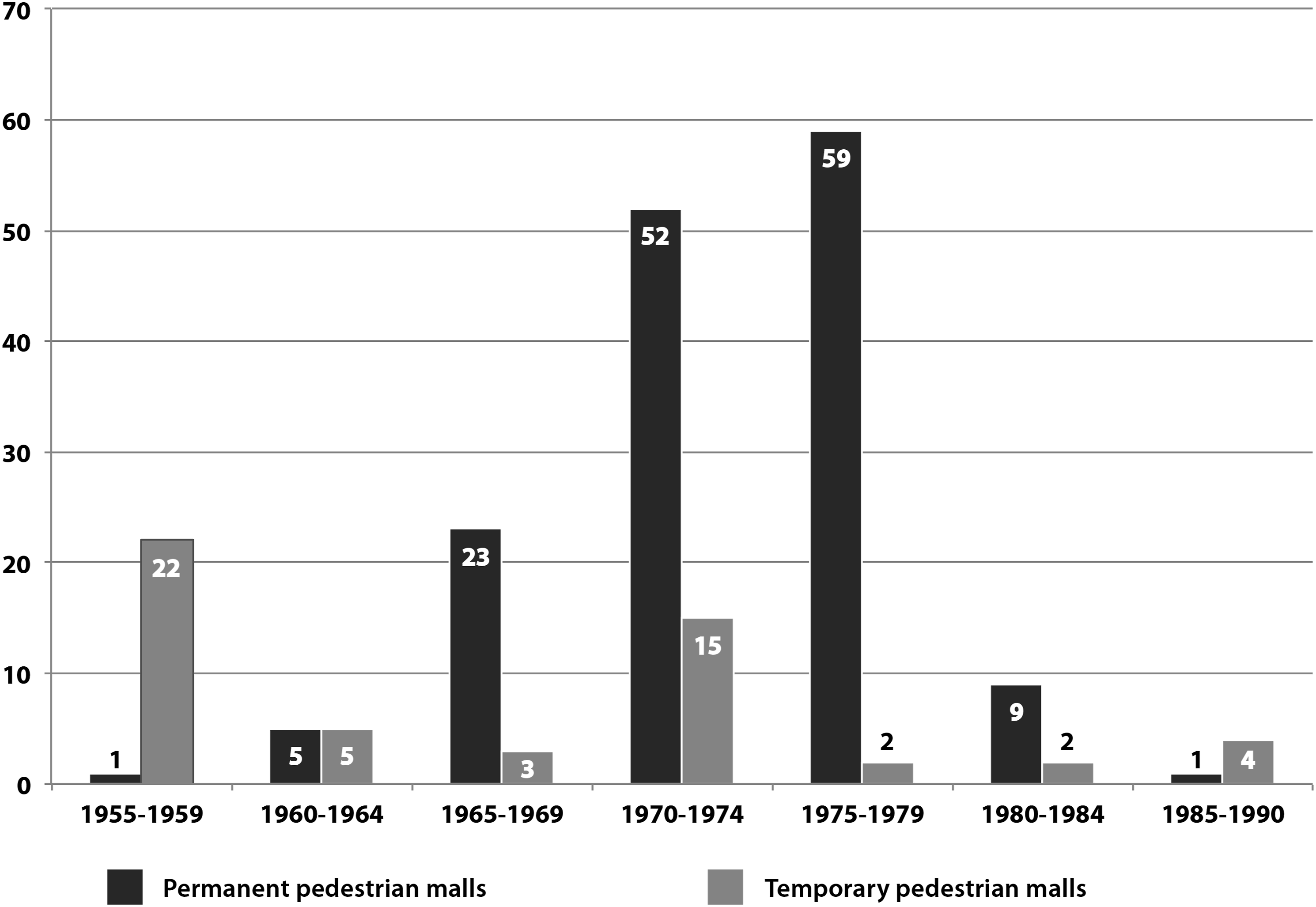
The geographic distribution of both temporary and permanent pedestrian mall buildings in the US and Canada is represented in Figure 5. The distribution shows a broad implementation of pedestrian malls across the US with the majority of the projects being built in the Mid-Atlantic and Midwest states and to a lesser extent in the Southern states. This clustering can be in part explained by population shifts toward the Southern states or Sun Belt. Furthermore, many Mid-Atlantic and Midwest states within the US have older urbanized industrial areas, exactly the type of spaces that were viewed as outdated, obsolete, and inconvenient for shopping especially when compared to the new suburban shopping centers that provided ample and free parking. Geographic distribution of permanent and temporary downtown pedestrian malls in American and Canadian cities.
97
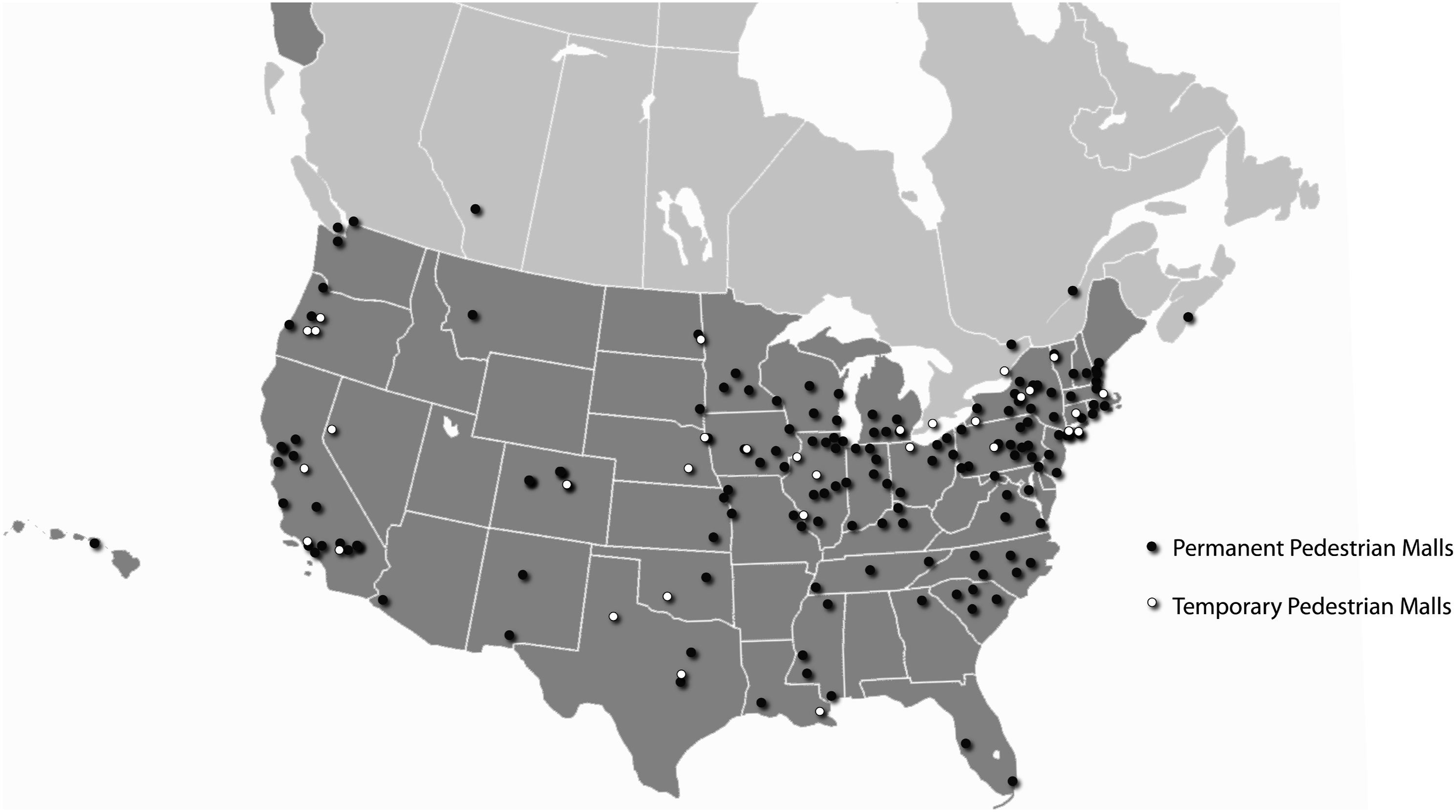
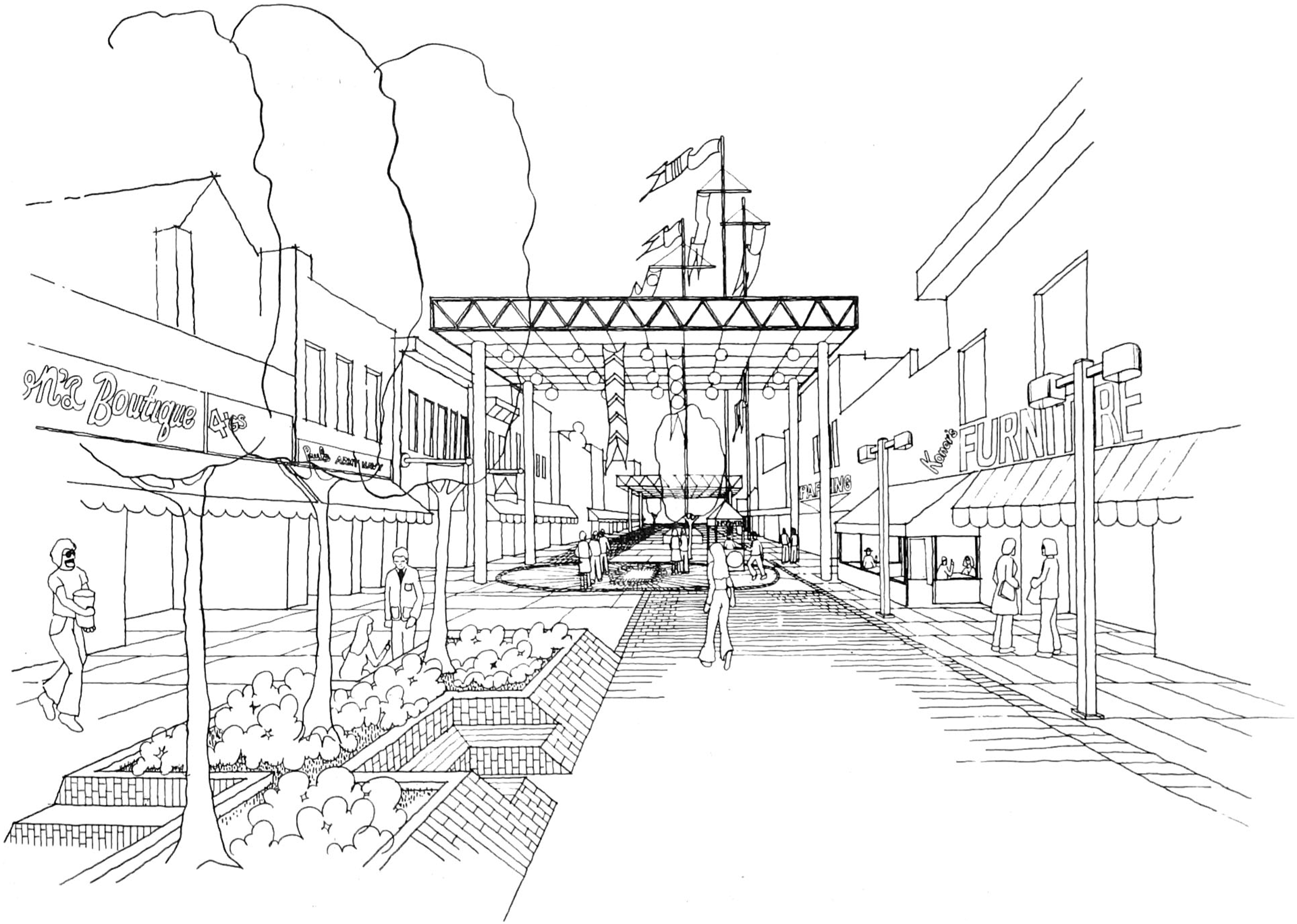
Figure 6 shows a typical pedestrian mall and downtown revitalization plan from the height of pedestrian mall implementation. This specific rendering is for Freeport, NY, an older Mid-Atlantic small town, but like many pedestrian malls the proposal includes planting, seating, and a focal point feature. Across the US, plans were forward looking, with titles such as Kalamazoo 1980 (1958); A Revitalization Plan for the Core of Cincinnati (1962); and A Way to Modernize Downtown Freeport (1974). They were inspired, in part, by Gruen’s 1956 plan A Greater Fort Worth Tomorrow aiming to revitalize and modernize the downtown core through pedestrianization and traffic management.
98
From larger cities like Cincinnati, OH and Baltimore, MD, to small towns like the Village of Freeport, NY, pedestrianization plans were sometimes presented as a critical part of city- or county-wide recentralization strategies. However, typically even when larger centralization plans were made, only the downtown revitalization and pedestrian mall would be implemented. References to the early success of the pedestrian mall in Kalamazoo, MI and other cities were common in many plans for downtown revitalization. Plans typically emphasized the contextual similarities regarding challenges with automobile congestion, retail decentralization, and suburban development while simultaneously ignoring any differences between the city proposing a pedestrian mall and the precedent example. Preliminary sketch for the Main Street Mall in Downtown Freeport, NY, 1974.
99
Though broadly unrecognized, questions of successful implementation of the mall strategies came early. An October 1966 issue of the Urban Land Institute newsletter notes that “some of these malls in downtown districts are going to disappoint the merchants they are supposed to benefit.”
100
In 1966, Gruen addressed the 8th International Study Week in Traffic Engineering, in Barcelona, Spain, stating: a pedestrian area should logically be one of the final stages of development, as part of a complete improvement plan of pedestrian, vehicular, and mass transportation circulation. It should follow, rather than precede, most of the other necessary steps in the development of a well-functioning town center.
101
From the 1960s through the 1970s, despite early concerns and warnings, pedestrian malls were initially quite popular as a singular strategy. By the early 1980s however, many professionals and scholars began to dismiss the North American post-war model of pedestrianization, as downtown districts continued to fade. 102
HUD Urban Renewal Funding and the Post-war Pedestrian Mall Model in the US
In the absence of a US national planning agenda to organize policy based on ideal urbanization patterns, federal funding and tax incentives in the post-war led to conflicting and competing strategies. US federal highway funding indirectly supported the development and success of regional shopping centers by providing the highway infrastructure and efficient automobile access to these suburban shopping centers. In addition, the suburban shopping centers benefited from the addition of “accelerated depreciation” deduction formulas for new construction in the 1954 US tax policy. 103 In direct contradiction to the federal policies that supported suburban development, downtown renewal efforts were directly funded by the Federal Housing Act of 1954, which was administered through HUD’s urban renewal division. This included funding to build many pedestrian malls across the US. 104
As downtowns struggled to compete with new suburban retail, the planning and building of pedestrian malls for downtown revitalization was widely enabled in the US by HUD and other federal funding sources. Pedestrian mall proposals were not the only type of downtown renewal projects that were funded under HUD and urban renewal. However, they were the only uniform concept for downtown revitalization that gained widespread acceptance and implementation. HUD’s requirements for funding projects under the Workable Program for Community Improvement and the Urban Planning Assistance Program (section 701) actively increased planning capacity, especially within small and more rural communities that had previously not established professional planning activities. 105 It was through HUD’s planning assistance and demonstration programs that the concept of pedestrian malls was actively promoted; this active promotion of the concept propelled the planning and implementation of pedestrian mall proposals across the US. Over 62% of pedestrian malls in the US were built with some amount of federal funding, primarily funding from HUD’s urban renewal division. 106 Following the elimination of HUD funding, transit malls were funded through US federal Urban Mass Transit (UMT) funding which covered implementation. This funding, and transit mall projects in general, was limited to larger cities with metropolitan transit organizations. 107
Optimistic of the impact from HUD funding, the director of urban renewal for Fulton, NY, Donald W. Bullard noted that: the face of downtown will change so rapidly in the next two years that residents may have a hard time recognizing it . . . Old, structurally unsound and unsightly buildings are rapidly coming down under the wrecker’s crane, and new modern retail stores, all one-story buildings, are under construction or in the planning stages.
108
Bullard also noted that a number of buildings would be razed to develop a 40-car parking lot, and each of the construction and demolition projects would be complementary to the pedestrian mall that acted as the primary urban renewal feature. In addition, he said that the project was fortunate to receive HUD funding in 1974, as there had been substantial cuts in urban renewal funding from HUD, this was just as funds were about to be discontinued under urban renewal. 109
Initially, the building of permanent pedestrian mall projects increased annually, corresponding with the incremental increases in federal funding allowances for non-residential urban renewal under HUD. As shown in Figure 7, the non-residential allowance for grants under the Federal Housing act of 1954 increased from 20% to 30% in 1961 and then again to 35% of total grant allowance in 1965.
110
While federal funding arguably enabled and accelerated pedestrian mall building across the US, there was also a corresponding decrease in pedestrian mall building as funding shifted from urban renewal under HUD to Community Development Block Grants (CDBGs) partially beginning in 1974 and then fully by 1977.
111
Even when cities did not receive the HUD money they had applied for to build a pedestrian mall project, many went through with building pedestrian malls. Through the HUD funding application process, many communities developed sophisticated professional downtown revitalization plans through the Urban Planning Assistance Program. Armed with HUD supported professional planning services, many communities continued forward with constructing the plans by utilizing other means of funding and sometimes reducing the scope of the revitalization proposal, or level of design for the pedestrian mall. Post-war permanent pedestrian mall building in the US and available US federal funding by year.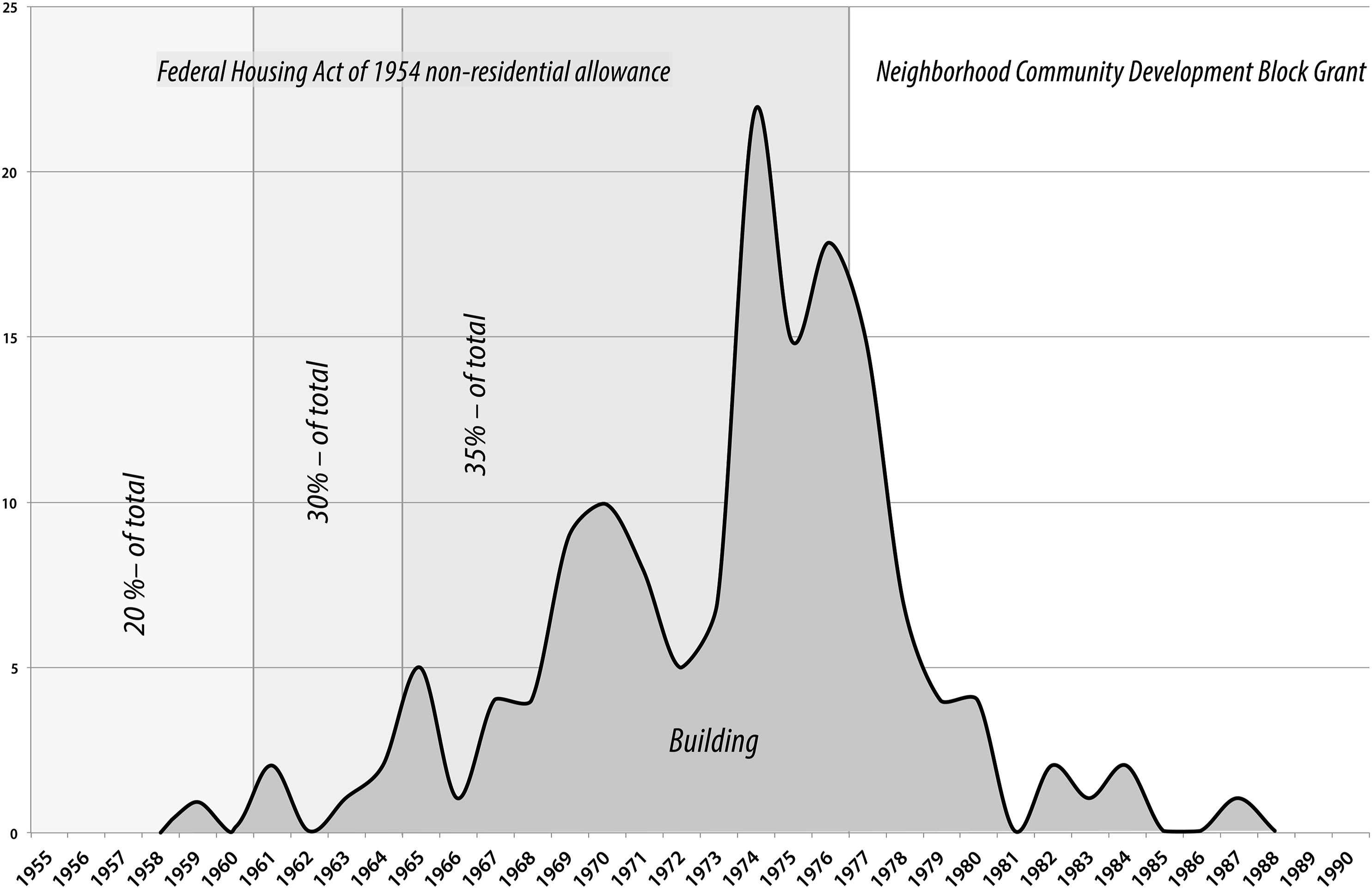
The Transit Mall, a Later Variation on the Post-war Pedestrian Mall Concept
Transit malls gained popularity beginning in the late 1960s with the opening of the Nicollet Mall in Minneapolis, MN, in 1967. 112 Transit malls were implemented as a variation of the pedestrian mall and combined the pedestrian mall concept with the then rising trend for building transit priority streets. 113 Some projects such as Philadelphia’s Chestnut Street Transitway were originally planned as fully pedestrian malls but shifted to a transit mall concept to align with shifting federal funding sources. 114 Once HUD urban renewal funding was fully discontinued by 1977, larger American cities utilized UMT funding to support the construction and implementation of transit malls. 115
From the study population of 167 cities that implemented pedestrian mall concepts, the majority of the strategies were fully pedestrianized; however, 15 transit malls were documented. Transit malls and shared malls or shared streets were included in the study population because they had similar goals of revitalizing downtown retail and in the planning process, they were often considered along with fully pedestrian mall schemes; they are also included with pedestrian mall literature. 116
State Pedestrian Mall Legislation
In contrast to the low investment in temporary experiments and the federal funding available through HUD and other organizations, state enabling legislation—beginning with California’s Pedestrian Mall Law of 1960—provided a legal structure for cities to develop and finance permanent pedestrian mall projects. This enabling legislation not only provided municipalities the legal rights to exclude vehicles from public streets, but it also provided a means of financing public space improvements, outside of federal funding. 117 The legislation was replicated across the US, further reinforcing the permanent pedestrian mall model as a tool for downtown retail revitalization. State enabling legislation was propelled by the widely held belief that the pedestrian mall concept was a solution for eliminating traffic congestion, modernizing building stock, producing off-street parking, and increasing tax revenues. 118 In California, pedestrian mall legislation was requested and promoted by 56 cities across the state. 119 California’s legislation passed unanimously with a 69 to 0 vote and is noteworthy for the extent of the rights it provided municipal governments. 120 The California legislation provided municipal governments the right and ability to close public streets to automobile traffic and to organize a structure for tax assessment to raise capital for initial construction and ongoing maintenance of the pedestrian mall. As well, it also provided the legal rights for businesses or property owners who claim they were economically hindered by the pedestrian mall to seek economic damages from the municipality. 121 While other types of state legislation did enable municipalities to develop special assessment taxation districts, pedestrian mall legislation specifically promoted and identified the pedestrian mall concept as an urban renewal strategy for retail districts.
Other states followed California and developed specific enabling legislation for pedestrian malls of their own; by 1966, eight states had specific enabling legislation on record that established the rights of municipal governments to prohibit automobile traffic on public streets and develop a pedestrian mall. 122 The trend continued in the 1970s to include Oregon, New Jersey, and Wisconsin, often referencing and to some extent replicating California’s legislation. 123
In states that did not establish enabling legislation specific to pedestrian malls, the rights of municipalities to manage automobile traffic on public streets, including its full exclusion (with the exception of emergency vehicles) in the case of pedestrian malls, were often upheld as a general rule of traffic management under police power. 124 These rights came under public safety concerns and cited that the established goals of the pedestrian mall concept “are to facilitate the flow of vehicular traffic by re-routing it around the main shopping area and to protect pedestrians.” 125 A second type of legal argument was also made and often upheld under municipal rights to make public improvements in public space, including street rights-of-way and management of the sidewalk. One case even likened the pedestrian mall concept to an expansive sidewalk. 126
The Rise of Suburban Shopping Centers and Decline of Downtown Shopping
Planned and regionally scaled suburban shopping centers were considered the largest and most salient threat to downtown retail districts. Though retail was decentralizing and suburbanizing since before World War II, leading to downtown decline, in the post-war, regionally scaled suburban shopping centers became a new force of urbanization and accelerated the decentralization of retail. 127 Preceding planned centers however, the development of department stores outside of downtowns had already began to normalize the idea of retail outside of downtown districts. 128
In conflict with urban renewal policies and US federal funding that focused on revitalizing central cities and towns, the 1954 addition of “accelerated depreciation” deduction formulas for new construction in US tax policy further incentivized investment in suburban retail and shopping center development by propelling new construction, and financially dis-incentivized remodeling of existing properties in downtowns. 129 The downtown retail districts of small and large cities alike struggled to compete with the regional draw of the newly developed planned suburban shopping centers. Many smaller towns within larger metropolitan regions, such as Oak Park, IL and Patterson, NJ, were in close proximity to more than one regionally scaled shopping center. 130 Like many cities across the US, Oak Park, IL and Patterson, NJ did build pedestrian malls in their downtown in response to the rise of suburban retailing. Some cities would debate the pedestrian mall strategy for years, while others acted decisively and built a pedestrian mall on their Main Street within a few years of the suburban shopping center opening.
Evaluating the time difference between a downtown pedestrian mall opening and the opening of its corresponding regional mall suggests that overall, the pedestrian mall strategy was reactionary. Figure 8 illustrates, for across the US and Canada, the time difference in years between a suburban shopping center opening and the opening of a downtown pedestrian mall. The majority of pedestrian malls within the study population (63%) opened in the years after their corresponding regional shopping center opened. Further emphasizing that pedestrian malls were often a reaction to suburban shopping centers, only 16% of the pedestrian malls in the study population opened in the same year or before their corresponding suburban shopping center opened. Time difference in years between pedestrian mall opening and corresponding regional shopping center opening.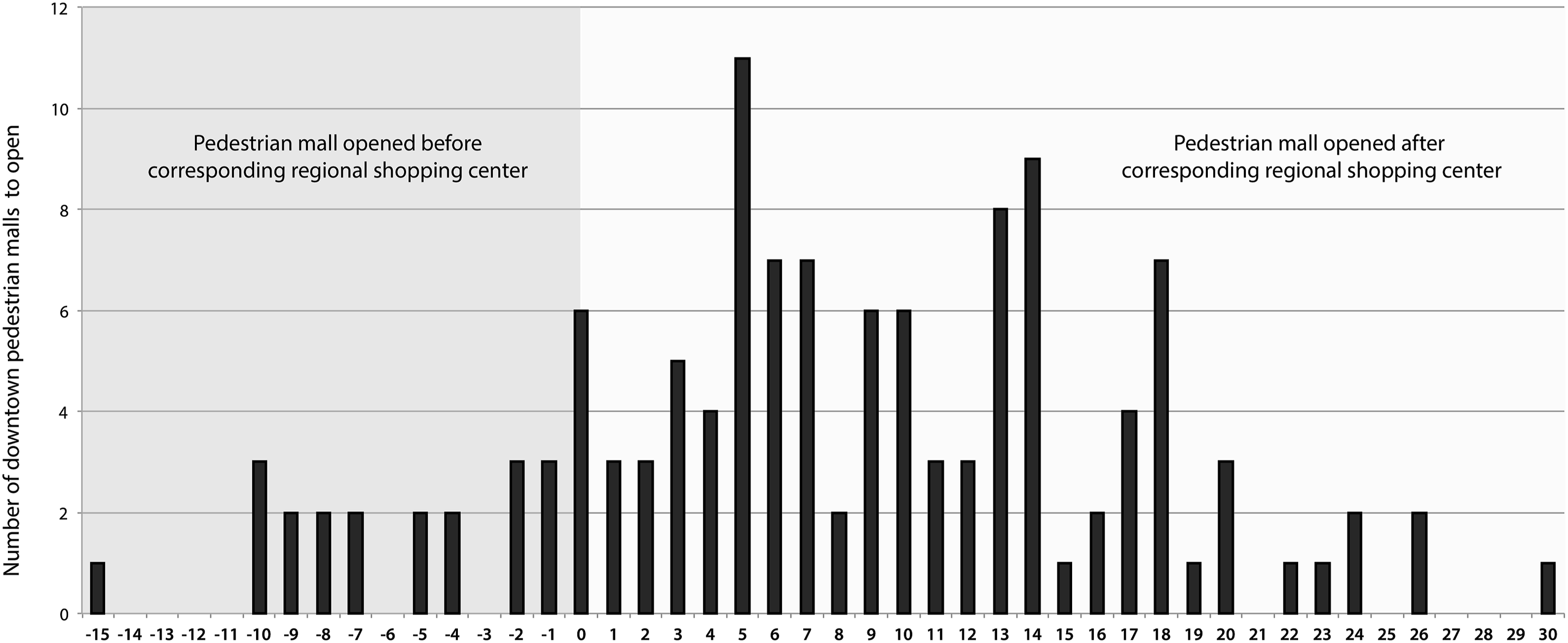
Evaluating a plan for the development of a pedestrian mall in the Village of Freeport, NY illustrates both how most plans reacted to the opening of shopping centers and how planners used precedents from other cities to justify implementation often without clearly recognizing the contextual differences. 131 In justifying the pedestrian mall, the Freeport plan cited data from the US Business Census, noting a decline in retail sales for Freeport while county sales increased during the same period. This trend was only further exaggerated, leading to more vacancies on Main Street, when the Sunrise Mall opened in 1973 in the nearby town of Massapequa, NY. 132 The plan cited examples of successful pedestrian mall development and noted that planners and consultants visited pedestrian mall projects in Salisbury, MD; Wilmington, DE; New London, CT; Poughkeepsie, NY; and Patterson, NY, to inform the plan for Freeport as “most were [also] suffering from suburban competition.” 133
Suburban retailing rapidly became an idealized, sanitized, and racially homogeneous version of the shabby and outdated downtown. The post-war suburban shopping center model aimed to completely control the customer experience, from one’s arrival, typically by personal automobile and parking, to the ornamented pedestrian spaces that shoppers leisurely moved among. The central management structure of shopping centers allowed control over the mix, type, and class of stores that rented space; this also curated the customer base, typically favoring white middle-class women. 134 This level of management and control even evolved to fully regulate the climate of the shopping experience with development of enclosed shopping centers such as Gruen’s design for Southdale Shopping Center in Edina, MN. 135
While suburban shopping centers had central management to completely control the customers experience, downtown retail districts in North America struggled to replicate the same model. Both temporary and permanent pedestrian malls were developed as a means of promoting downtown retailing with the limited tools available, often working within the constrained authority of downtown development organizations. Fully pedestrian malls, transit malls, and shared or semi-malls were all variations of the pedestrianization concept that were designed and built across the US and Canada in the post-war. 136 While concepts behind post-war strategies in the US and Canada were most certainly simplified from their comprehensive planning original visions, what unified post-war pedestrianization strategies in the US and Canada was the fact that they each limited automobile traffic in some way, and they also explicitly sought to revitalize downtown retail.
Conclusion
During World War II, ideas about pedestrianization remained broad and experimental. However, immediately after the war ideas reached new heights of utopian modernist visioning as represented by Gruen’s Fort Worth plan in 1956. The rise of urban renewal ideas was broadly linked to progressive politics and commonly incorporated modernist design ideas into urban renewal policy. 137 Thus, the modernist roots of pedestrianization ultimately propelled the pedestrian mall concept into widespread adoption and implementation as an urban renewal policy. 138
As pedestrianization ideas moved from an ultra-modern utopian concept into implementation however, out of necessity they became more pragmatic and simplified to be workable within limited municipal budgets and available federal funds. As a part of this simplification of the concept, some cities first explored pedestrian mall ideas through temporary installations, not unlike contemporary tactical and temporary pedestrianization projects in New York, NY and other cities across the globe. It was also this simplification during the post-war period that allowed the pedestrianization concepts to continue to fit into urban renewal narratives, as these narratives were also simplified and reduced, without fully recognizing the complexity of urban decline. 139
This conceptual simplification enabled the pedestrian mall strategy to be much more widely implemented, leading to over 160 permanent pedestrian mall projects, and many temporary instillations. If the comprehensive planning models like Gruen’s Fort Worth, TX, had been strictly adhered to, this wide spread implementation could not have been afforded due to the intensive costs of such a plan. Permanent pedestrian mall implementation was supported through federal urban renewal funding and capacity building, also in some states through state enabling legislation that provided opportunities for financing and tax assessments. These factors, along with the promotion of high-profile precedents like Kalamazoo, MI and Fresno, CA, propelled the broad replication of pedestrian malls as an urban renewal strategy across the US and Canada.
Pedestrian malls also fit into narratives of post-war retail revitalization and the promotion of consumer consumption. 140 Initially, ideas of pedestrianization as a means to promote retail were broadly explored during World War II for both suburban shopping centers and downtown pedestrian malls, simultaneously. 141 Downtown pedestrian malls, however, were ultimately developed as a reaction to the middle-class exodus from downtown public space. These malls aimed to emulate the publicly accessible privatized spaces of suburban shopping centers; pedestrian malls remained public spaces but were promoted as “suburban shopping downtown.” 142 These strategies hoped to bolster the use of downtown public spaces and not only renew them as spaces for pedestrians but also as spaces for middle-class consumption. Architects and planners came to broadly accept pedestrianizing Main Street as a solution for modernizing downtown retail and positioning it to be competitive against suburban shopping centers. 143
The reasons for the abandonment of the pedestrian mall concept as a strategy to address downtown retail revitalization are multi-faceted. Unfortunately in the US and Canada, the economic force of suburban decentralization in the post-war was stronger than the impact of downtown pedestrian malls, and the hopes of the malls maintaining let alone revitalizing downtown retail were never realized. These economic forces, however, were cultivated by the US federal government which indirectly supported decentralization through highway building; income tax credits for mortgages on single family homes; and accelerated tax depreciation on new shopping center developments. The federal urban renewal funding that directly subsidized the planning and implementation of downtown pedestrian malls and other downtown redevelopment was nominal by comparison.
Pedestrian malls were also broadly reactionary and often built only after downtown retail districts experienced further retail decline from the opening of nearby suburban shopping malls. Additionally, downtown pedestrian malls were public spaces and did not have the same controls over the shoppers experience, the retail mix, and parking to the same extent that suburban shopping malls exhibited as private developments. Furthermore, the implementation of comprehensive downtown plans that supported the pedestrian mall concept also required cooperation with neighboring municipalities to limit retail development outside of the urban core. In nearly all cases, this was politically untenable as the neighboring municipalities were profiting from the decline of the central city and unwilling to limit their growth in order to support retail centralization and the urban core. The simplification of the pedestrian mall concept and the abandonment of the comprehensive planning strategies also resulted in the elimination of the political aspirations for retail centralization and cooperation between municipalities. As a result of these unrealized expectations of improving retail sales, most pedestrian malls in the US and Canada were partially or fully removed and automobile traffic was reintroduced. 144
Pedestrian malls were an early experiment in remaking city centers for a middle-class audience. Subsequently, as urban renewal ideas were broadly abandoned so too was the downtown pedestrian mall concept as a means of retail revitalization. 145 However, the strategies that succeeded pedestrian malls followed a similar planning rationale of redesigning urban public space for economic development purposes, including festival marketplaces, waterfront redevelopment, and entertainment districts. 146 More recently, street and public space redesign has become associated with global economic competitiveness. 147 What unifies each of these strategies is the idealization of the pedestrian in the public space as a measure of success, and the persistent idea of redeveloping the urban core for economic competitiveness and to promote retail and/or entertainment consumption by a white middle-class audience. 148
Archives
Library of Congress (LOC), Victor Gruen Papers, Manuscript Division; Washington, DC.
The American Heritage Center (AHC), Victor Gruen Papers; Laramie, WY.
Kalamazoo Municipal Archive; Kalamazoo, MI.
The National Archives and Records Administration, Housing and Urban Development, Urban Renewal Archive; College Park, MD.
Footnotes
Author Note
This research investigates how the pedestrian mall concept evolved and was broadly replicated in post-war North America and positions pedestrian malls as a case study of urban renewal, parallel to highway and housing projects. From an examination of proposed and built projects, and a review of newspaper articles, this research articulates how ideas of pedestrianization evolved from a modernist concept requiring substantial capital, to a more constrained pragmatic approach, and links the proliferation of pedestrian malls to federal urban renewal funding in the US. Like many mid-century urban renewal projects however, only a few pedestrian malls remain intact today.
Declaration of Conflicting Interests
The author(s) declared no potential conflicts of interest with respect to the research, authorship, and/or publication of this article.
Funding
The author(s) received no financial support for the research, authorship, and/or publication of this article.
