



Abstract
Fathers of children with complex disabilities can play an important role in the development and learning of their children; however, very little is known about their school involvement experiences. We conducted semi-structured interviews with 15 fathers of children with complex disabilities to learn how these fathers perceived their involvement in their children’s education and schooling. Fathers constructed their school involvement with a consideration of their work and co-parenting experiences. Their employment was perceived as a form of indirect involvement in their children’s education, but could also be associated with barriers to more direct school involvement. Fathers also discussed the role of the co-parenting relationship in their school experiences and identified several factors that contributed to a greater involvement of mothers in school settings. Among these were a perceived unique expertise of mothers and school environments that were more welcoming to mothers. They also discussed some potentially negative ramifications of being less involved in school settings, compared with mothers.
Over the past several decades, there has been an increase in research on father involvement in children’s education and learning (Cabrera & Tamis-LeMonda, 2014; Lamb, 2010). Recent research has moved away from unidimensional characterizations of fathers that focused on father presence or absence to a broader consideration of the many roles fathers play in the developmental and educational experiences of their children (Lamb, 2010; Pancsofar, Vernon-Feagans, Odom, & The Family Life Project Investigators, 2013). However, this extant literature remains almost exclusively focused on fathers of typically developing children, while very few studies have considered the school involvement experiences of fathers of children with disabilities, and even fewer studies considering fathers of children with complex disabilities. For the purposes of this research, the term complex disability describes a set of developmental challenges that require highly specialized and unique supports. In addition, these individuals may present with an array of health-related challenges especially in the initial stages of human development. This population includes children assigned the label of deafblindness, severe-profound intellectual disabilities, and autism. Research on father involvement in the educational experiences of children with complex disabilities can inform the work of educators and related service personnel, highlighting avenues for intervention and collaborative family-centered partnerships. There is a critical need for research that considers not only how fathers of children with complex disabilities construct their involvement in their children’s educational experiences but also how the school involvement experiences relate to other aspects of parenting and family life.
Fathers’ School Involvement in Child Developmental and Educational Experiences
Parent–school involvement has long been heralded as a key component for student success (Olivos, Gallagher, & Aguilar, 2010). A focus on parent involvement and participation is consistently evidenced within educational policy and practice. In special education, parental involvement is a core concept within the Individuals with Disabilities Education Act (IDEA, 2004). IDEA requires local school districts provide opportunities for parents of students with disabilities to be equal partners in their children’s education. IDEA mandates districts create access for parental involvement in all facets of the special education process, including assessment, program planning, program implementation, and placement. In an attempt to meet that charge, a rich literature base has been developed that reveals the importance of strong home–school partnerships and identifies supports that enable families to be active participants in the education of their child (Blue-Banning, Summers, Frankland, Lord Nelson, & Beegle, 2004; Goldman & Burke, 2017; Keilty, 2016).
The extant literature on fathers’ school involvement has largely focused on the role of fathers of children without disabilities in general education settings. This research has shown that the benefits of fathers’ school involvement for child educational attainment and student achievement in the areas of math and reading are additive and above and beyond the positive contributions of mothers’ school involvement (Flouri & Buchanan, 2004; Kim & Hill, 2015; McBride, Schoppe-Sullivan, & Ho, 2005). Over the past few decades, research on fathers’ roles in early development has been particularly robust, and numerous studies have found that father–child interactions are positively related to children’s later development in areas such as language, literacy, math, social-emotional, and intellectual skills, as well as school achievement (Baker, 2013; Pancsofar & Vernon-Feagans, 2006; Pancsofar et al., 2013).
Although most of the research in this area has focused on children without disabilities, there has been some recent work examining how father–child interactions may positively influence the development of children with complex disabilities (Flippin & Crais, 2011). For example, Flippin and Watson (2015) found that fathers’ verbal responsiveness to their children with autism spectrum disorder was associated with more advanced child language development. They speculated that father involvement in intervention efforts with children with complex disabilities may have an important positive impact on their later development and learning.
In one of the few studies to consider school involvement for fathers of children with disabilities, Mueller and Buckley (2014) found that fathers played several important roles in their children’s education, as they partnered, advocated, and learned about the special education system. However, these fathers reported they often felt left out of the educational system and their child’s team. Mueller and Buckley found that possible contributing factors for this alienation included mothers spending more time in schools and teachers’ assumptions that mothers played dominant caregiving roles in the families. Fathers in this study also identified that most of their children’s teachers were women. They perceived differences in communication styles used by men and women, and these factors contributed to them feeling left out of their child’s educational team processes. Hart (2011) found similar barriers for fathers’ school involvement, as fathers in this study describe feeling somewhat excluded from the context of schools that they perceived as “female-dominated” environments where mothers were expected to be the most common conduits of information between home and school. These barriers made it difficult for fathers to feel like valued members of the educational team.
Although the importance of fathers’ involvement in the educational and learning experiences of children with disabilities is being increasingly recognized as a critical component of high-quality special education service delivery (Pancsofar, Petroff, & Lewis, 2017), the existing research on the school involvement experiences of fathers of children with disabilities suggests that communication and collaboration between home and school often occur primarily with students’ mothers, supplanting the equal participation of fathers (Carpenter & Towers, 2008; Hart, 2011; Mueller & Buckley, 2014). This focus on mothers as the first line of communication may result in fathers feeling excluded from their children’s educational experiences and their eventually ceasing to participate altogether. For fathers of children with complex disabilities, this trend may be more pronounced due to the elevated needs of their children and services from an array of professionals within a variety of settings that can include home, school, hospitals, and clinics.
The extant literature on facilitating the participation of fathers of children with complex disabilities in their children’s education identifies various barriers that fathers may face, including teacher assumptions of father disengagement and logistical challenges such as difficulty attending meetings and school events because of conflicts with work commitments (Carpenter & Towers, 2008; Mueller & Buckley, 2014). However, there is a need for a deeper understanding of how fathers of children with complex disabilities perceive their involvement in their children’s educational settings and how fathers’ school involvement is constructed within broader contexts of father work experiences and the mother-father co-parenting system. A better understanding of fathers’ experiences may lead to increased knowledge about additional barriers to fathers’ involvement in their children’s education and recommendations for changes that would facilitate fathers’ involvement.
Contextual Factors Shaping Father–School Involvement: Systems Theories
To fully understand the experiences of fathers of children with complex disabilities in their children’s education and learning, it is important to consider the ways in which fathers’ school involvement is situated within broader contexts and systems in which fathers live their lives. Ecological systems theory and family systems theory provide a basis for conceptualizing the nested and interrelated contexts in which father–school involvement can be understood (Bronfenbrenner, 1979; Minuchin, 1985). According to ecological systems theory, child development and learning occur within and is affected by a variety of contexts, which are organized as nested systems that include, from most proximal to most distal, the microsystem, mesosystem, exosystem, and macrosystem (Bronfenbrenner, 1986; Bronfenbrenner & Morris, 1998). The microsystem includes the settings within which children behave at given moments in their lives. Family and school contexts are important microsystems in understanding children’s development and learning. The mesosystem includes the interactions and influences between the principal settings (microsystems) in which child development occurs. Parent–school interactions are a mesosystem context for child development and learning, which is, in turn, shaped by other contexts within and outside of the settings of the family and the school (Bronfenbrenner, 1986; Bronfenbrenner & Morris, 1998). One such context includes father work settings and experiences (Cabrera, Fitzgerald, Bradley, & Roggman, 2014). The very limited research in this area suggests that fathers of children with disabilities may struggle in balancing their working lives and their caregiving responsibilities, and that fathers may very rarely receive formal support in negotiating these responsibilities (Carpenter & Towers, 2008). In addition, fathers may not be available to attend school meetings and events that conflict with their work hours and job commitments (Carpenter & Towers, 2008; Hart, 2011).
Family systems theory further deepens the consideration of fathers’ school involvement by highlighting the importance of the co-parenting system in shaping parenting experiences (Minuchin, 1985). According to this theory, families comprise smaller, independent subsystems, which influence one another. Characteristics of the co-parenting subsystem can support or stress the functioning of the parent-child subsystem (Pancsofar, Vernon-Feagans, Odom, & Roe, 2008). Fathers may construct their parenting roles, including their involvement in their child’s educational experiences, with a consideration of their co-parenting relationship and associated roles. Characteristics and dynamics of the co-parenting relationship may be important factors in understanding how fathers are involved in schools and construct their roles in educational settings. In many families, mothers may be the main source of communication and information regarding their child’s educational experiences (Pancsofar et al., 2017). Fathers may play an important support role for their wives in caregiving and their children’s education teams (Carpenter & Towers, 2008; Hart, 2011; Mueller & Buckley, 2014). Less is known about the ways in which fathers make sense of their role in their co-parenting partnership regarding school involvement and how characteristics of co-parenting relationships may shape this role for fathers.
This article describes research conducted to explore how fathers of children with complex disabilities construct their involvement in their children’s education within their broader experiences in their work and family lives. The study explored the following research question: How do fathers of children with complex disabilities perceive their involvement in their children’s education?
Method
This study used qualitative methodology to investigate fathers’ construction of their involvement in their children’s education. Qualitative interviews allowed for a focus on the fathers’ own frames of reference in their school involvement.
Participants
Fathers were recruited to participate in this study through staff at a local technical assistance and research center for families of children with complex disabilities. Through this center, there was direct outreach by email and telephone calls to collaborating state deafblind projects and other associated professional organizations within the field of special education to share information about this study with fathers within their networks. Fathers who were willing and available to be interviewed gave permission for staff to share their contact information with researchers, who then contacted fathers by email to schedule the interview. All fathers who indicated interest in participating in the study were included; there were no fathers excluded from participating.
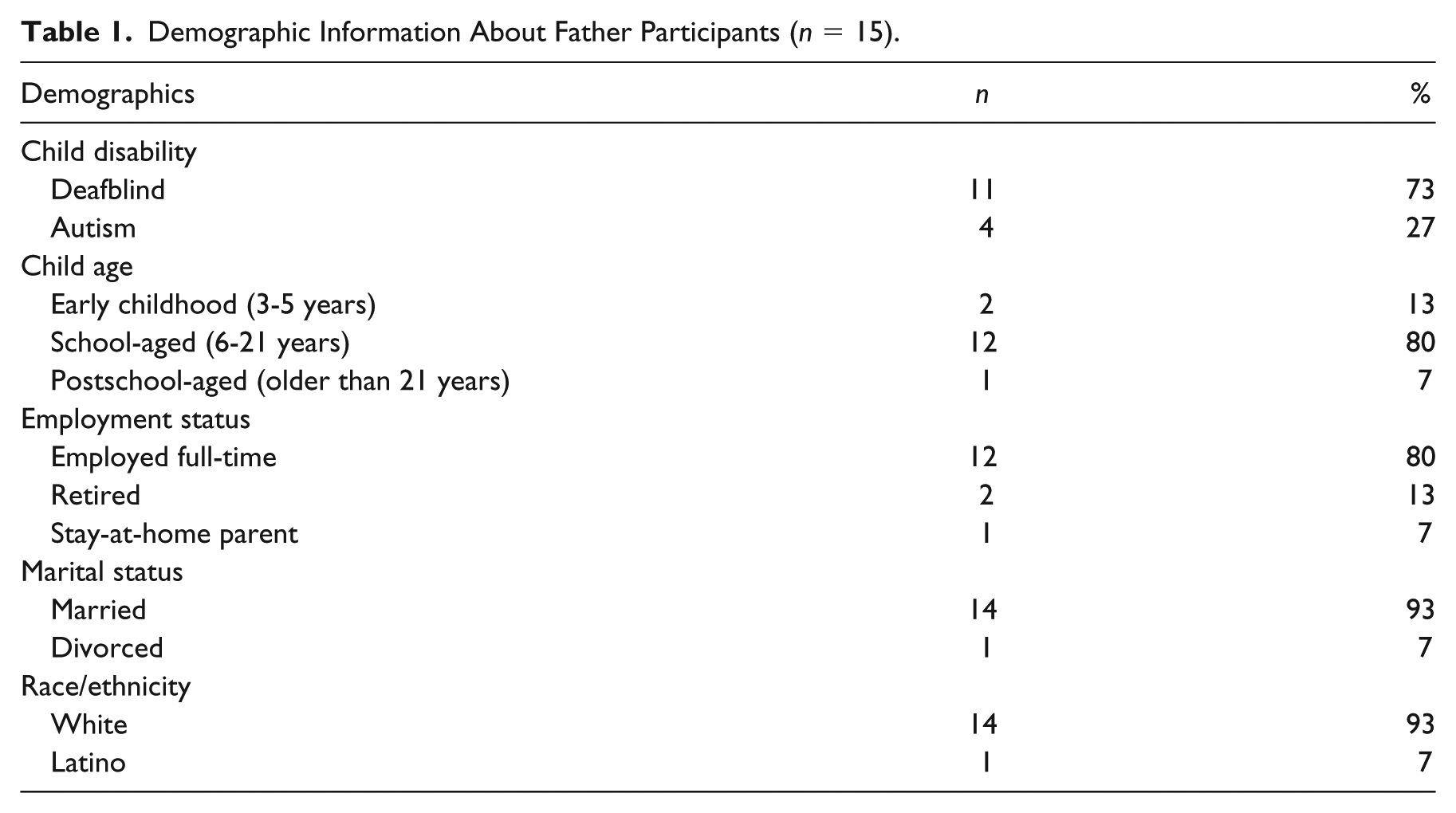
Table 1 presents demographic information about the 15 fathers who agreed to participate in the study. These fathers lived in several different states in the eastern part of the United States. The children of these fathers were primarily school age and had a range of disabilities that could be broadly categorized as complex and requiring extensive support needs. In total, 11 of the fathers had children with deafblindness, which for some was associated with Usher syndrome, Alström syndrome, or CHARGE syndrome. Most fathers were married, employed, and White. Fathers worked in different fields, including government, military, managerial, construction, and legal professions. Mothers stayed home as the primary caregiver in about half of the families; mothers who worked outside of the home were employed in fields such as education, law, and finance.
Demographic Information About Father Participants (n = 15).
Data Collection
Data were collected through individual semi-structured interviews with each father. Fathers were asked to provide oral consent prior to the commencement of their interview. Six of the interviews took place in person, and eight were conducted over the phone. In-person interviews were conducted at locations preferred by the fathers, which most often were the researchers’ offices. Interviews lasted between 30 and 90 min, with an average time of approximately 1 hr. Interview protocol questions were broad and open-ended to allow for fathers to identify the key issues of salience in their own fathering experience. Example questions included, “What are your main priorities for your child’s education?” and “What helps you to be involved in your child’s education in the way that you would like to be?” All interview protocol questions were asked during each interview; however, interviews were not limited in scope to just the protocol questions, and protocol questions were not always asked in the same order. The interviews were conducted as guided conversations (Rubin & Rubin, 1995) in which fathers were encouraged to branch out beyond the scope of the protocol questions, and follow-up questions were used that encouraged depth and detail to the interview. All interviews were audio-recorded.
Data Analysis
Interviews were transcribed verbatim, yielding 257 single-spaced pages of transcription. Interview data were analyzed using open coding methods (Flick, 2014). The first and fourth author independently read and assigned codes to the first two transcripts. Codes in the form of words or short phrases representing summative and/or salient thoughts were assigned throughout transcripts of the participants’ responses. One example of a participant-generated code was “A Different Picture,” which was eventually merged with other codes from the data in which fathers highlighted “difference” or “uniqueness” in their experience fathering their children with complex disabilities. Other codes that emerged from the participants themselves included the following: “Mommies are best,” “Tag team,” and “Mom does a lot.” After reviewing these open codes and discussing the procedures for coding the rest of the transcripts, six more transcripts were coded collaboratively by the first and fourth authors. Once agreement was reached on the meaning of the codes and coding process, the first author independently coded the last seven transcripts.
Coded data were analyzed using content analysis, which applied an inductive and iterative process in which codes were compared to identify conceptual categories and emerging themes (Glaser & Strauss, 1967; Hsiu-Fang & Shannon, 2005). In this iterative process, initial coding categories were compared and refined, and subcategories emerged that illustrated the factors involved in fathers’ construction of their school involvement. For example, codes such as “I wish I was at school today,” “You can’t always take off work,” and “70/30 meetings attended in person” were compared and combined with other similar codes to identify the conceptual category, “Work experiences as challenges to direct school involvement,” which was considered with other conceptual categories related to father work experiences to form an emerging theme of “Father work experiences and school involvement.” This iterative process yielded a set of final themes that are represented in the findings.
Member checks were conducted with one third of the participants. Member checks have been identified as one measure of quality and credibility of a qualitative study and the extent to which the analysis captures the perspectives of the participants (Brantlinger, Jimenez, Klingner, Pugach, & Richardson, 2005; Tracy, 2010). Similar to the approach used in other qualitative interview studies (see Mueller & Buckley, 2014), a subsample, including five of the interviewed fathers, was sent a summary of the findings and asked for feedback regarding the themes. These fathers lived in four different states and had children of different ages. All fathers agreed with the findings. Trustworthiness of data analysis was further addressed through an interpretive community that included the second and third authors, who helped to develop themes and reviewed the coded data. Two of the authors were parents of children who received services through Individualized Education Programs (IEPs) or 504 plans, and the first three authors had more than 15 years each of professional experience working with children with disabilities. The researchers engaged in reflexivity throughout the research process by meeting frequently and reflecting on how the interview data and analysis intersected with their own professional and personal experiences.
Findings
Findings from this study show the following main themes related to the construction of school involvement for fathers of children with complex disabilities: (a) It’s different than with your other kids: Constructing fathering of children with complex disabilities, (b) How do you balance that? Fathers’ work experiences and school involvement, and (c) Tag team: Co-parenting relationships and fathers’ school involvement. A fourth theme was identified that explored the intersections between fathers’ work experiences and co-parenting relationships in their school involvement experiences.
It’s Different Than with Your Other Kids: Constructing Fathering of Children with Complex Disabilities
Fathers who were interviewed situated their roles in their child’s education within the framework of parenting a child with complex disabilities. Many fathers articulated that there may be something unique about the stress felt by fathers of children with complex disabilities, and as Jeremy said, “It takes a while to deal with because it’s different than with your other kids.” Fathers suggested that it would be important for professionals to understand this perspective. For example, Owen, whose daughter has CHARGE syndrome, described the complex medical needs his daughter experienced during her first years of life, including issues with her kidney, reflux, cardiac abnormalities, and difficulties breathing and swallowing, which were addressed through early surgeries. He stated, Everybody is asking, and I guess it’s more of a selfish type of question: “How’s the mother? How’s the kid doing?” The two main components of the situation, knowing that the father is still there dealing with all the same situations, maybe not involved as much, but, “How are you doing? Do you need anything,” type of thing. “Are you coping with everything okay?”
Dylan, whose child had Fragile X syndrome, articulated a similar sentiment: There’s a lot of things that go on from the standpoint from a father when you have a child with a disability. You know, traditionally, we’re raised to be the breadwinners, the person that takes care of the household as far as, you know, financially, security wise. We’re the father. We’re the male figure. And our society dictates that. But we also have to start understanding that, you know, fathers are also affected by this, emotionally, and that emotional effect that occurs from having a child with a disability is something that needs to be recognized. It needs to be understood, not just from the vantage point of the school, but also for the father, that it’s okay to feel some of the sadness, some of the emotional turbulence that you may be feeling as a result of having a child with disabilities.
Fathers also explored the unique emotional response that may be experienced when learning that their child’s disability is genetic. While none of the fathers interviewed articulated this as their own experience, some hypothesized that other fathers may feel responsible for their child’s disability and, at times, might disconnect from their fathering role and experience. Kenneth described, “It may be more difficult for men—fathers, in general—to channel, improve, address, remediate their shame, and a response to that may be a lack of inclination or a hiding away.” Kenneth went on to link a father’s possible feelings of shame to school involvement, saying, “There may be lack of engagement if their embarrassment is their lead factor.”
How Do You Balance That? Fathers’ Work Experiences and School Involvement
Fathers in this study described how work experiences were inextricably linked to their constructions of what it meant to be a father, particularly in their specific context of fathering children with complex disabilities. Connections between work and father involvement in child care and educational settings were identified by both fathers who were currently working, as well as those who were retired or stay-at-home dads. Fathers’ work was implicated in both their indirect and direct school involvement, and the tensions in negotiating responsibilities between work and home life were often powerful for these fathers.
My income feeds the family: Fathers’ work as indirect educational involvement
Fathers identified that their families experienced more extensive and long-term financial demands related to their children’s complex learning and developmental needs. Aaron stated, For a lot of typical kids, they go to college. They grow up. They move out. They get their own thing, you know, their own job. They’re out of the house. My kids are never going to be emancipated that they can move on without us.
Fathers’ work was one way through which families could meet these unique financial needs. Aaron continued, “We will never retire. They will carry us out of here dead because I can never put enough savings away for my kid who can’t care for himself or herself.” Other fathers explained that their job allowed them to financially support the myriad of therapies and related services their children required. Kenneth stated that he was the “secondary parent” when it came to “time devoted to the children,” but the “primary parent” in providing financially for the family. He elaborated, “It is my income which feeds the family and provides the benefits by which [my son] derives his therapy.” Work allowed fathers to provide for not only the immediate needs of their children, but also for the long-term educational and personal needs of their children with complex disabilities.
I wish I was at school today: Father’s work and direct educational involvement
Fathers described several aspects of their work experiences that made direct school involvement challenging. The most widely discussed aspect was the incompatibility of their work schedule and school events, meetings, and therapeutic services. This was especially true for fathers who worked nonstandard hours. Ivan decided to become a stay-at-home father a year after his daughter was born when he and his wife realized that “both of us working full-time wasn’t going to work.” Ivan described how his prior work schedule intersected with his parenting experiences during the first year of his daughter’s life: I worked swing shift, and then I would watch [my daughter] at night. Basically when I got home, from midnight till 6:00 AM; and then the nurse would watch her during the day; [My wife] would watch her kind of during swing shift, and then so on. So there was kind of a period there where although I watched [my daughter] for a few more hours than my wife, it was when she was sleeping, and that wasn’t when we would have people [therapists] coming to the house. So often I was sleeping when we had [therapists] come.
Ernie also described the unique challenges of working nonstandard hours: It’s extremely hard when you work full time and different hours. For example, I work two o’clock in the afternoon till ten o’clock at night now, so I’m able to help my daughter in the morning with her schooling and getting off to school, but as far as being there for any kind of meetings or parent conferences, and after school activities, as of now, it’s very challenging for me. I have to take off work, and you can’t always do that. So, that’s a little frustrating when you want to be involved and physically can’t be there.
This difficulty in taking off time from work was shared by other fathers who described constraints regarding which school events and activities they could attend. Owen said, “I wish I was at school today, but her birthday was on Friday, so I took Friday off. So, I didn’t want to take Friday and Monday.” These fathers appreciated home–school communication books and teacher emails that kept them informed when their work schedule made it difficult for them to come into the school. Technology also played an important role in mitigating the constraints that work sometimes placed on fathers’ school involvement. Kenneth described the importance of technology in facilitating his involvement in IEP meetings: I’ve attended every IEP [meeting]. I’ve attended every teacher meeting. I’ve attended every parent-teacher conference. However, owing to my work schedule, some of those have been attended by me telephonically when I’m unable to get to the office. So I would say I go 70/30 on how many I can attend in person and how many I will dial into.
In addition to conflicts with school schedules, limited available time due to work made it challenging for fathers to engage in educational pursuits that would support their children’s learning and communication. For example, Owen discussed the difficulty he had in learning American Sign Language (ASL) to communicate with his daughter with deafblindness. He stated, “With my time constraints, I try to take in as much as I can and my wife tries to teach me as much as she can. It’s just tough.”
While fathers often identified characteristics of their work experiences that inhibited their involvement in their children’s education, fathers sometimes described how the location of their work site supported their school involvement with short commutes or being close to their child’s school. For example, Brandon described how working in an office very close to his sons’ school provided him with the opportunity to visit the school frequently. He said, With [sons’] school, I eat lunch there. My office is right there, in the same complex, so when I, if I’m in the area to have lunch, because I’m usually out on the road, I’ll stop in and the teachers will come up “Oh, [son] is doing wonderful.” The teachers know me real well. They know who I am.
There were also instances in which fathers identified ways in which the skills and expertise they gained through their jobs supported their advocacy for their children’s educational needs. For example, Calvin’s knowledge as a lawyer helped in understanding his daughter’s IEP and educational rights. Jeremy spoke of how his managerial skills helped him to negotiate the “bureaucracy” of schools and in managing the conflict he experienced with educational professionals during an IEP meeting.
You just don’t have enough time or energy: Juggling multiple responsibilities
Regardless of whether their work experiences inhibited or supported their school involvement, fathers articulated emotional stress in managing the multiple responsibilities they felt at work and as a parent. They experienced challenging emotional demands, along with more practical demands on their time. As Ivan stated about parenting a child with complex disabilities, “It doesn’t ever feel like there’s enough time in the day because there’s so much to learn.” He elaborated, “You just don’t have enough time and energy, especially with CHARGE. It’s not just the deafblindness. There’s all the physical and eating issues, and the list goes on.”
Calvin described the challenge of balancing employment with these multiple parenting responsibilities as he negotiated his school involvement: My daughter needs a lot of different things. She needs a lot of different services and things like that. But at the same time, in order to give her those things, I have to work. But I always feel like, I’d rather be home, working with her, than doing something, you know, at work. But it’s not always feasible because I need to go to work.
He continued, If you’re working, how do you balance that with, you know, working with your job, but also working with your child? That’s probably, at least for me, that’s been the toughest thing. Just because it’s tough sometimes to balance different responsibilities.
These sentiments were shared by Ernie, who stated, It’s hard. Being there is my biggest thing, and it’s always what I want to do as a father is be there. And emotionally you always are very concerned and want to know what’s going on at all times. And sometimes you can’t be.
The emotional toll of balancing responsibilities was further complicated for some fathers who had difficulties in communicating with their children. Aaron, who has two children with multiple complex disabilities, said, “I feel so guilty that I can’t spend the time that I should be spending with these kids, especially when it’s real important to see how they’re going to communicate, help them communicate with me.” Calvin shared these concerns, stating, Sometimes it can be tough. You can sometimes feel like, “I’m not doing enough for my kid. I’m doing too much work and I’m not giving her all the attention that she needs for all these different academic goals and these different therapeutic goals.” And it’s not that you’re really doing that, but you can feel that way.
Tag Team: Co-parenting Relationships and Fathers’ School Involvement
Fathers’ descriptions of their involvement in their children’s educational settings included a consideration of their co-parenting relationships and the roles played by their children’s mothers. Two thirds of the interviewed fathers identified their child’s mother as being the primary parent involved in their child’s education, whereas five fathers identified a more even split. Fathers hypothesized that several factors contributed to a greater school involvement of mothers, including a perceived unique expertise of mothers, as well as school environments that were more welcoming to mothers. Fathers also discussed some potentially negative ramifications of fathers being less involved in school settings, as compared with mothers.
The bulk of it: Mothers as the main source of information
The majority of fathers credited their wives in supporting them through navigating this unique context of fathering children with complex disabilities and in taking the lead in their children’s school involvement. Jeremy stated, “I give my wife a lot of credit for part of that too where I was having trouble after [my daughter] was born or pulling back a little bit.” Most of the fathers identified their wives as their main source of information about what was going on in their children’s education. In these families, it was the mother’s role to keep the father up-to-date on school occurrences. Fathers acknowledged the important work that their wives did in this area, which included communicating with teachers and therapists, making sure the child had access to educational materials, checking up with the school to be sure that they were implementing the IEP, being the “standard bearer” for schools, finding family advocates, and, in one instance, starting a local parent advocacy group. Fathers also recognized the work that mothers did in planning Parent Teacher Association (PTA) events and, in two families, serving on the local school board. In families of children with deafblindness, mothers sometimes served as the primary person to investigate communication methods.
For Marco’s family, the approach of primary and secondary roles for parents in school settings made the most sense. As Marco articulated, “Well, I think it’s engrained that Mom is number one and the question is does that really need to change?” Leo echoed this statement, saying, That’s kind of how I feel with the parent one and parent two, and maybe that’s not the right thing to do so much, but just how the way life—it’s kind of the way you get through it sometimes. Fastest. It’s just trying to keep our head down and keep the train moving.
In Ivan’s family, limited time dictated the need for roles to be split between parents: There’s only so much time in a day. We’re okay with, there’s sometimes where you just have a day you split responsibilities a little bit just because there isn’t enough time in the day. But then you try to come back and connect on what needs to happen for this stuff.
Some fathers also identified their wives’ unique characteristics as reasons that made them better suited to interact with the school. For example, Dylan spoke about how his wife was a teacher and with the advantage of “professional understanding,” while Nathan said that his wife had more “medical training,” which helped her to have a better grasp on their child’s needs. Marco identified the “bond between mother and child” as the primary reason he was not as involved in his son’s education.
Fathers talked about the experiences of parenting a child with a complex disability as uniquely challenging for fathers and falling outside of their perceived areas of expertise. Kenneth stated, “A disproportionate amount of men want their sons to excel at sports, but there’s not going to be a lot of autistic kids who are going to excel at sports.” Owen, whose child has deafblindness, described feeling intimidated as he worked to learn a new mode of communication. He said, [I’m] not as good [in signing] as I’d like to be. My wife is good. Not great, but she can communicate with other deaf people. We had a birthday party Saturday. We had a few deaf people over from [the school], and there was a lot of signing going on, and I was very intimidated, and it’s a lot to take in.
Leo expressed similar sentiments in supporting his child to do homework in braille: I have enough trouble with the English language to learn braille. It’s difficult. So I can braille all the words with them [his kids], and let them braille their words and all that, but then she [mother] comes home and makes sure that we did it right.
While parenting challenges may affect mothers as well as fathers, fathers seemed to defer to their wives, whom they perceived as better equipped to successfully guide their child through their complex educational and learning contexts. As Dylan stated, The majority of fathers want to be involved but a lot of times, the fathers will feel that they may be treading on a topic or a subject matter that they’re not really familiar with. Sometimes men, we do not feel comfortable with things that we don’t understand, ok? Or, we feel that we’re out of our level of expertise. So, a lot of times, we’ll defer, traditionally, to the wife or the mother, for those things.
I make sure I’m here so she can fight: Fathers’ support roles
Even within families in which mothers may be doing “the bulk of it” in terms of day-to-day school communication and advocacy, fathers articulated the important support role they played in this process. Leo said, “My role is to make sure that she’s available to do those things and I take care of the other stuff.” Leo also described how he would follow her lead on parenting activities or actions related to their child’s education: “If she says to go and do it then I have [our daughter] go and do it, and if she says, ‘We need to work on this thing,’ that’s what I work on.” Ernie expressed a similar sentiment: “I make sure I’m here so she can fight and do everything she has to do for our daughter.”
Although Brandon expressed support for his wife’s primary role in school involvement, he still wanted to stay informed and aware of what was happening at school. He stated, I’ll say, “Honey, you know what you’re doing.” You know? “Go ahead,” you know? But she always asks my opinion even if I can’t be there at the IEP meetings, she’s always telling me what happened, what’s going on, because I want to know. I mean, I’ll read the IEP word for word. I mean, you know the IEPs can be pretty thick. And I read it word for word to make sure that everything is in there.
Fathers’ co-parenting support also included doing parenting activities that were not preferred by the mother, and giving her a break in the process. Fathers described the process of acting like a “tag team” to support each other through frustrating parenting moments. Brandon states, “If she’s frustrated, you know, she’ll do ‘Tag you’re out. I’m out. I’m done’. And I’ll go in.”
Mommies are best: Professionals’ attitudes
The deferral to the mother can be reinforced in school settings, which fathers identified as, at times, “prejudicial.” Fathers conveyed the feeling that mothers were privileged in school settings by teachers and other school personnel. Ivan stated, “The therapists do tend to look at mom, and talk to her, and don’t necessarily interact with the other parent, the father.” Brandon sometimes perceived teacher attitudes that “Mommies are the best.” Jeremy stated, “The number one thing is that [fathers] feel like they’re a non-factor. They’re a secondary factor and they’re not taken seriously by their wife, professionals, the others.” This caused some frustration for some fathers who felt left out of the process. Aaron, who was divorced, said, “I’ve had to go back and say ‘I’m a part of this too. I get the right to know about my kids’. I shouldn’t have to remind them of that. I shouldn’t have to fight for that.”
Kenneth pointed out that “some distinct gender differences [exist] in how men will typically interact with the world and how women will typically interact with the world” that may be difficult for fathers to adjust to within schools. He elaborated that it can be challenging for fathers interacting with educational professionals who are “overwhelmingly female” and may have a different approach to communication and interpersonal interactions. It is important to note that not all interviewed fathers felt marginalized in their family–school partnerships; some felt that they were equal partners in their communication with educators. Calvin articulated this experience, stating, When I go into a meeting, IEP meetings or just parent-teacher conferences, they’ve always been pretty good about letting me know what’s happening and I don’t feel like my wife’s being the one that’s told everything and I’m just there along for the ride. I feel like they, you know, they talk to us both and I’m happy with that.
It’s kind of a cyclical thing: Ramifications for fathers
Fathers suggested that those who play more of a secondary role to their wives in school involvement and collaboration with educational professionals may not be receiving all of the information regarding their child’s educational and developmental progress and that, consequently, may affect their ability to participate as fully as they wish. As Aaron stated, We get to some of these parts of the meetings and I feel like, “I don’t know what the hell anybody is talking about any more,” and they just plow ahead. And you feel stupid to say, “You know, let’s slow the meeting down so I understand.”
Ivan shared these sentiments within the context of related services for his young child. Because he had not been present during his daughter’s physical therapy sessions, he was not aware of the recommendations for how to support her development. Ivan articulated the co-parenting tension caused by this situation: I remember when me and my wife kind of had an argument because I felt like I didn’t know what was going on. At first I think she was criticizing me because I wasn’t following through with what the PT [physical therapist] wanted us to do. And I got critical because I was like “I don’t even know what I’m supposed to do.” It’s like “You need to teach me what I need to do because I’m not there.” I think that’s kind of an eye opening moment for us to just realize that that’s what was happening was I wasn’t there, so I didn’t know what I was supposed to do.
Fathers suggested that over time, this lack of understanding can have a snowball effect, in which some fathers may grow more and more distanced from the educational experiences of their children. Ivan articulated, “If you don’t know what’s going on, then you tend to have a hard time asking questions. Where it’s kind of a cyclical thing, like you get further and further away from involved.” This situation may be especially challenging for fathers of children who are deaf or deafblind. For some of these fathers, being “out of the loop” in working with educational professionals can make it difficult for them to communicate with their own child, and these difficulties may be magnified over time. Ivan articulated this experience: When we were taking the sign language classes, there was like three or four dads in there, and the wife’s already taken that—it was kind of like the second level class or whatever . . . So their wives had already taken it on their own, and now they’re there trying to catch up. But then they would still miss half a session because of work, and a lot of their stuff. As their kid gets older, you get further and further away from that communication part.
Fathers’ Work Experiences and Co-Parenting Relationships
It is important to note that the contexts of work and the co-parenting relationship overlap and intersect in important ways in the lives of fathers. In particular, the work configurations in the household seemed to be associated with parenting roles for several of these fathers. For example, some fathers, who worked more hours than their wives, felt that their wives simply had more time available to be in contact with their children’s schools. As Kenneth said, “Typically my wife, the mother, does that [pick up, drop off, homework]. She’s a work-from-home mother, so she has much more flexibility in her part-time job to interact.” Owen concurred, I go to work, two jobs, whereas I’m kind of on the outside of the doctors’ appointments, the homecare, the normal day-to-day stuff that my wife sees, and she stays home all day and takes care of her. So you’re on the outside a little bit.
Some fathers who worked full-time felt that because it was difficult for them to physically be present at the school, it was best for their wife to be the most involved in their child’s education. However, this did not mean that the fathers cared less about their children’s education and learning. Aaron pointed out, Most of the time, the father is the one at work, the mother staying home with the special needs kids. Just because we are not on the front lines of communication, we’re not always there dropping off the kids and so forth, does not mean we do not care.
While there were fathers in dual-earner families who articulated that their wife still took a lead role in school involvement, other fathers identified unique constraints to their lives as dual-earner families that facilitated their involvement in their children’s education. Calvin explained that in his dual-earner family, everyone, including extended family members, had roles that might include school drop-off, school pickup, transportation to therapy appointments, and getting ready for school in the morning. He said, My wife works too, so you know, she’s just as busy as me at work, if not busier sometimes. So a lot of the different responsibilities at our house and responsibilities for our kids, we’re sharing this stuff. I mean, she’s probably, at the end of the day, doing more than me, but we try to share this stuff. So, I feel like ever since my daughter was born, I’ve been pretty involved with her, whether it was through early intervention or the school process. So, I never really felt like I was not having the same kind of role that my wife was in things, and it just might be a function of the fact that since we’re both working, we’re both kind of sharing some of these responsibilities.
Also in a dual-earner family, Hector said, “We don’t really discriminate at home by gender. Mom and Dad, same thing, do the same stuff.” He elaborated, “We try to share everything with him, and I’m the one going around, attending meetings, talking to professionals, and finding resources and things that he can do.” Frank, whose wife worked full-time, described, “My wife and I would go in there [to IEP meetings] as a united front. Not just her all the time.”
Discussion
The findings from this study reflect the collective experiences and perceptions of 15 fathers of children with complex disabilities, and illuminate the ways in which these fathers construct their school involvement within the nuanced systems of work and co-parenting. Data from this study indicate that fathers have complex emotions that call for support from professionals. Although there were no direct inquiries made regarding work experiences or co-parenting, nearly every father in this study identified his job and/or career and co-parenting relationship as factors that affect their participation in guiding their child’s development and in their education.
Reflecting Bronfenbrenner’s (1986) conceptualization of work as an exosystem influence on home–school mesosystem interactions, working fathers conceptualized their work as a sort of indirect involvement in their children’s education, as their employment provided financial support for educational opportunities and therapeutic services. Exosystem-level characteristics of fathers’ work were identified by fathers as either inhibiting or supporting their direct school involvement. Fathers pointed out emotional stress in managing the complex demands of work and parenting, and that they were looking for more insight and support from educators into their needs and their emotional well-being as parents.
These father interviews also addressed how family systems such as co-parenting (Minuchin, 1985) related to fathers’ involvement in their children’s development and education. Mothers and fathers often assumed different roles and responsibilities regarding school involvement activities. While some fathers reported feeling equally as involved as their wives, more often, fathers identified playing a secondary, supportive role to mothers. This secondary role did not mean that fathers were any less concerned about their children’s education or that they cared any less than mothers. However, this secondary supportive role, combined with their perception of schools that may not have been as welcoming to fathers as they are to mothers, may have contributed to some fathers feeling disconnected from critical educational and developmental information. Fathers articulated frustration with this disconnect and a struggle to “catch up” with their co-parent. Fathers also expressed concern that once they are “left behind” in home–school partnerships, they have little chance to recover.
These fathers’ interviews suggest that fathers often construct their school involvement with an overlapping consideration of their work and co-parenting contexts. Fathers who worked more hours than their wives often felt that this allowed mothers more time to be more directly involved in school activities than fathers. For some dual-earner families, in which mothers’ and fathers’ work commitments were more comparable, fathers expressed the need to share responsibilities more equally in terms of school involvement. It is important that educational professionals recognize the complexity of these co-parenting and work dynamics in shaping fathers’ school involvement experiences, as families of children with complex disabilities often work out arrangements that are the most conducive and in the best interests of their families’ dynamic needs.
This study builds upon a growing body of research examining fathers’ school involvement (Kim & Hill, 2015; McBride et al., 2005), and helps to expand the focus of the extant literature to more fully consider fathers of children with complex disabilities. Congruent with the few previous studies of school involvement of fathers of children with disabilities (Carpenter & Towers, 2008; Mueller & Buckley, 2014), fathers in this study also identified feeling excluded from their children’s educational experiences, although this was not an experience shared by all of the fathers in this study. This study extends previous work by highlighting the complex nuances of fathers’ lives outside of schools and begins to identify some of the ways through which fathers’ school involvement is situated within the exosystem context of father work (Bronfenbrenner, 1979) and the mother–father co-parenting family subsystem (Minuchin, 1985).
Implications for Practice
These findings highlight several implications for practice in schools and therapeutic settings. Professionals should consider fathers as equally important caregivers. Whatever the arrangements that each family might work out regarding their roles and responsibilities, teachers and other professionals should invite fathers to participate in the education of their child and consider them as primary caregivers. They may need targeted and sustained authentic outreach efforts to be sure that they stay “in the loop” in terms of their child’s development and education. These efforts may be especially important with regard to children who are learning to communicate through alternative and augmentative modalities, including ASL, assistive technology, and braille. Fathers expressed preference for specific, ongoing, and flexible training opportunities around these communication modes and tools. For example, school personnel, especially those that lead the special education process, should create opportunities for fathers to access information and assume that some parents require review and “catch-up.” These opportunities may require developing alternative methods for parent participation such as meetings about a child that embed short trainings/review, use of online meetings with video capability, and scheduling meetings in evenings or other times outside of the school day.
It is important that teachers and other professionals understand that even when fathers are not as visible in schools, they often still want to stay informed. Frequent direct communication with fathers through communication books, emails, or other methods can help to supplement information that fathers may be receiving through their co-parents. Professionals should develop competency in using technology in their communication efforts with families, offering parents the opportunity to participate in team meetings through video conferencing, for example. There also needs to be a consideration by educators and therapists of the unique stress that fathers may experience as parents of children with complex disabilities. Professionals should consider how they can directly support fathers as they process their emotions regarding their child’s disability and juggle multiple, sometimes conflicting, responsibilities. Periodically “checking in” with fathers through emails or phone calls could be a way to begin to develop a support system for these fathers. It may also be helpful to connect fathers with other fathers of children with complex disabilities, or to larger family support groups that target specific disability communities.
Limitations and Future Research
This study was limited by the small, relatively homogeneous sample of fathers interviewed. A further limitation was that co-parenting in the context of this study was situated within mother–father relationships. Future work in this area should address the diversity of father experiences from different family compositions. A broader consideration of co-parenting is needed that considers same-sex couples, single fathers, and co-parenting within the context of divorced and separated parents. A more complete understanding of fathers’ school involvement must consider the experiences of fathers of children with complex disabilities from culturally and linguistically diverse groups, who may experience unique challenges and biases within the special education system. Gaining a better understanding of how culturally and linguistically diverse fathers of children with disabilities construct their school involvement would help to identify avenues for teacher training to better optimize the educational experiences of all students with disabilities and their families.
Findings from this study suggest that some fathers feel ignored and alienated in school settings, whereas others feel that they are seen as equal partners with mothers. Future research needs to more deeply explore the diversity in fathers’ experiences and identify factors that contribute to fathers’ full involvement in the educational experiences of their children. Research on fathers’ experiences in schools should address what it means for a school climate to be “father-friendly.” In addition, future work in this area should specifically address fathers who have felt alienated in their child’s education and identify practices or experiences that would be effective in reengaging them in their children’s development and education.
Footnotes
Declaration of Conflicting Interests
The author(s) declared no potential conflicts of interest with respect to the research, authorship, and/or publication of this article.
Funding
The author(s) received no financial support for the research, authorship, and/or publication of this article.
Editor-in-Charge: Donna Lehr