




Abstract
Replication research provides evidence to establish, refute, or support evidence-based practices. Systematic replications are also necessary to determine “what works for whom when.” The purpose of this study was to conduct a conceptual systematic replication to evaluate the effectiveness of a multicomponent treatment package on multiplicative problem solving for middle school students with extensive support needs. Using a modified schema-based instructional strategy, three participants were taught to solve percent of change problems contextualized in real-world scenarios and a purchasing strategy (i.e., next-dollar strategy) to help them determine how much money was needed to pay for services/products. In addition, goal-setting and self-graphing activities supported development of self-determination skills. Findings from the multiple probe across participant design demonstrate a functional relation between the intervention and independent problem-solving behaviors of all three participants. Students also generalized problem-solving behaviors when presented with real-world stimuli of coupons and receipts. Implications for practice and future research are discussed.
Keywords
The current era of evidence-based education emphasizes instructional approaches that are supported by a sufficient quantity of high-quality research (Courtade et al., 2014). A driver for this movement has been determining “what works, for whom, under what conditions” (Rao et al., 2017). This inquiry is particularly relevant for individuals with extensive support needs who require ongoing pervasive support across all domains of life functioning, participate in their state’s alternate assessment aligned with alternate achievement standards (AA-AAS), and may be eligible for special education services under the categories of intellectual disability, autism, and multiple disabilities (Taub et al., 2017). Their significant and variable learning needs require intensive supports to access the general education curriculum (Courtade et al., 2014).
The quantity and specificity of evidence-based practices for learners with extensive support needs is expanding (Spooner et al., 2017); yet, operationalizing what “works” for a given population cannot be accomplished through isolated investigations. Travers and colleagues (2016) argued examining prior findings through repetitions (exact or approximate) is a means for converging findings over a larger body of evidence. Results of these systematic replications then identify which contexts are favorable versus those that present barriers, as well as the conditions under which positive outcomes occur.
Evidence-based practices can be both established and refined through replication studies by understanding more deeply what works, for whom, under what conditions (Therrien et al., 2016; Travers et al., 2016). The modification of procedures, populations, and measurement across replications allow for the accumulation of findings necessary to address generality (Jones, 1978). Unfortunately, replication studies are limited in the field of special education, particularly those that self-identify as such (Coyne et al., 2016). There is value in using a replication framework to design collections of intervention studies to meet the needs of diverse populations, particularly in areas with a dearth of empirical attention (Coyne et al., 2016). Increasing post-secondary expectations and opportunities for learners with extensive support needs warrants a renewed focus on the academic instruction they receive in secondary settings. As noted in several recent reviews (e.g., Bowman et al., 2019; Spooner et al., 2019), mathematics for students with extensive support needs is an area that begs continued focus, as these skills build quality of life through employment, leisure, and daily living opportunities (Spooner & Browder, 2015; Taber-Doughty, 2015).
High-quality mathematics instruction provides students with enhanced opportunities for independence and inclusion in an increasingly technological society by giving them knowledge and skills necessary for success and independence in many school-based and real-world activities. Access to the general curriculum is one in-school predictor of post-school success for students with disabilities (Mazzotti et al., 2016; Test et al., 2009). Research-based interventions and supports that embed academic skills within transition programming can give individuals foundational skills necessary for postschool success (Root, Knight, Mims, 2017). To provide access to the general education curriculum that is academically rigorous, inclusive, and supported by universal design for learning (UDL) principles, a program of study should include an individualized set of courses, experiences, and curriculum designed to develop students’ academic and functional achievement (Rowe et al., 2015).
Contextualizing grade-aligned mathematics instruction is one way to target multiple instructional priorities for secondary students with extensive support needs. Saunders et al. (2018) contrasted a contextualized approach from the more traditional functional approach, describing the former to be concept driven and the later to be task driven. In contextualized mathematics instruction, learning targets are derived from a student’s grade-level standards but taught within real-life activities. Several strategies can be used to contextualize mathematics instruction, including using natural stimuli, videos of real-world contexts for the skill, and thematic word problems that anchor the concept within the real-world context. Contextualized instruction provides an opportunity to address multiple instructional priorities (e.g., general curriculum access and functional applications). Prior research that has used a contextualized approach to teach mathematics to secondary students with extensive support needs targeted purchasing skills such as computing sales tax for items in newspaper ads (Collins et al., 2011), solving video-based problems requiring addition and subtraction (Saunders et al., 2018), and calculating the final cost when leaving a tip or using a coupon (Root, Saunders et al., 2017).
Other researchers have used a variety of instructional strategies to teach purchasing skills to students with extensive support needs (e.g., modeling, faded prompt procedure, next-dollar strategy) with a variety of success (Xin et al., 2005). In a meta-analysis of purchasing skill instruction for students with developmental disabilities, Xin and colleagues (2005) noted differences in participant’s knowledge about money and exposure to community purchasing affected the treatment effects observed. Specifically, students who entered the study with money counting skills experienced higher treatment effects than participants who only had community experience, and those who entered without prior exposure to purchasing. Adapting the purchasing requirements was recommended as an effective way to address pre-existing difficulties or lack of exposure with the routines of purchasing. The next-dollar strategy simplifies the routine and was effective in teaching students with disabilities to engage in a variety of purchasing tasks (Xin et al., 2005). Colyer and Collins (1996) used a system of least prompts to teach four students with mild to moderate intellectual disability to use the next-dollar strategy when making purchases. While three of the four participants successfully learned the strategy, all three participants required procedural modifications to address individual difficulties. Two participants received discrete trial training for the specific errors (i.e., even prices and prices less than one dollar). The third participant needed a more specific procedure to remind her to complete all required steps. These findings further support the need for a contextualized approach that is responsive to individual differences.
Most recently, Root et al. (2018) evaluated the effects of this contextualized approach to teach secondary students with extensive support needs to solve percent of change problems within the context of finding the total cost of an item or activity when using a coupon (e.g., 20% off a US$8 car wash). The multicomponent intervention included modified schema-based instruction (MSBI), an iPad calculator, video anchors of the skill being used in community locations, and goal setting with self-graphing of progress. After following the steps of a task analysis to find the final cost of the item or activity, participants were then asked to determine whether a given amount of money was enough to make the purchase (e.g., if US$6 would be enough to cover the final cost of the car wash). Participants were taught to use the following “enough money” rule: you have enough money when the total cost is the same as or more than how much money you have. This rule helped them to compare the money they had (e.g., US$6) to the total cost after the discount (e.g., US$6.40). In this example, they would not have “enough money” because the total cost was not the same as or more than the amount of money they had. Although this study made a novel attempt to address both a grade-aligned mathematics skill and a functional personal finance skill (comparing cost of an item to an amount of money), its measurement as a dichotomous yes/no response was problematic. Participants demonstrated success with gaining this comparison skill, yet questions remain regarding the participants’ conceptual understanding.
A systematic replication of Root et al. (2018) could provide further information about generalization of previous findings while also addressing limitations with the previously dichotomous measurement that was not sensitive enough to detect students’ conceptual understanding of payment. Therefore, the purpose of this study was to conduct a conceptual systematic replication of Root et al. to answer these remaining questions by refining the dependent variable and corresponding instructional strategy (e.g., next-dollar instead of “enough money rule”) pertaining to conceptual understanding of the quantity of money required to make a purchase. Specifically, we evaluated the effects of a multicomponent treatment package that included MSBI and the next-dollar strategy on problem-solving skills of secondary students with extensive support needs. To this aim, we asked the following research question: What is the effect of a multicomponent treatment package that includes MSBI and the next-dollar strategy on problem-solving skills of students with extensive support needs?
Method
A single-case, multiple probe across participants design was used to evaluate the effect of the multicomponent treatment package on problem-solving skills.
Participants
Researchers obtained approval from university and school district human subjects committees prior to recruitment. Inclusion criteria matched that of Root et al. (2018), requiring individuals to be (a) enrolled in a secondary grade (i.e., middle or high school), (b) identified as having extensive support needs (i.e., receiving special education services under the Individuals with Disabilities Education Act [IDEA, 2004] categories of intellectual disability or autism and participation in the state’s AA-AAS), (c) parent consent and student assent, (d) English proficiency, and (e) satisfactory score on researcher-created screening measure (see Root et al., 2018). Three middle school students with extensive support needs participated in the study. Standardized diagnosis or eligibility information was not available from the school, though eligibility category and prior performance on AA-AAS were shared with researchers.
Gill was a 12-year-old Black male who received special education services under the IDEA (2004) categories of autism and language impairment and was deemed by his Individualized Education Program (IEP) team to have a significant cognitive disability that warranted participation in his state’s AA-AAS. Gill’s previous AA-AAS scores demonstrated a relatively even academic performance, scoring proficient (level 4) in both language arts and mathematics the previous school year. Gill’s teacher reported his dislike of being incorrect was a barrier in his mathematics instruction. During the screening, Gill was able to receptively and expressively identify two- and three-digit whole numbers along with numbers containing quantities in the hundredths. Gill could also add, subtract, and multiply quantities with a calculator (e.g., 3.21 × 4 = 12.84). Gill recognized the dollar symbol, multiplication symbol, and could read word problems out loud. Gill did not recognize what a receipt nor coupon were and could not explain what they were used for. He was unable to solve any word problems regarding tip or sale. Gill was able to verbally answer questions and read word problems out loud.
Wes was a 13-year-old Black male who received special education services under the IDEA (2004) categories of autism and language impairment and was deemed by his IEP team to have a significant cognitive disability that warranted participation in the state’s AA-AAS. Wes scored higher in mathematics (level 3, satisfactory) than in language arts (level 2, below satisfactory) on the prior year’s AA-AAS. Wes was a shy young man, and his teacher reported he did not have a lot of self-confidence, but that he was able to solve basic mathematics problems. During the screening, he could identify whole numbers as well as monetary values. He was able to use the calculator to add, subtract, multiply, and divide all quantities where the value was between 0 and 999, including decimals. Wes also knew what a receipt was and described it as “what you got when you bought something,” but he did not know what a coupon was. When solving tip and sale word problems in prescreening, Wes added all quantities. Wes responded to questions verbally with one or two words, he asked for problems to be read to him, and spoke softly.
Ava was a 15-year-old Black female who received special education services under the IDEA (2004) category of intellectual disability and was deemed by her IEP team to have a significant cognitive disability that warranted participation in the state’s AA-AAS. Ava displayed relative strengths in reading on the prior year’s AA-AAS, with scores higher in language arts (level 3, satisfactory) than mathematics (level 1, inadequate). Ava’s teacher reported her difficulties in maintaining focus and controlling her emotions negatively affected her mathematical performance. During the screening, Ava was able to receptively and expressively identify whole digit numbers and monetary amounts containing decimals. When given a calculator to solve addition, subtraction, and multiplication equations containing whole numbers, Ava was very successful. She was able to use the calculator to solve some equations containing decimals, but would make errors when transferring the numbers into the calculator or from the calculator onto her paper. Ava did not know what a receipt or a coupon was, and she was unable to solve any tip or sale word problems. Ava frequently shared information about events in her life and asked the researchers questions about themselves.
Setting and Interventionists
The study took place at a public middle school in a suburban town in the southeastern United States. All sessions took place in the teacher’s office, which was an enclosed room connected to the classroom with a window. All sessions were delivered in a one-on-one format lasting 10 to 20 min during the participants’ regularly scheduled mathematics block. All three students received mathematics instruction from a special education teacher in a special education classroom 3 to 4 days per week. Classroom mathematics instruction during the time of the study was focused on fractions and the coordinate plane. Two interventionists alternated meeting with the students. The first interventionist (third author) was a student in a local university’s combined bachelor’s/master’s special education teacher certification program. She had completed coursework on evidence-based practices for teaching academics to students with extensive support needs and was a Registered Behavior Technician (RBT). The second interventionist (second author) was a doctoral candidate in special education, with previous experience teaching middle school mathematics. A model video and scripted lessons were used by the first author to train the interventionists in procedures to 100% fidelity via role play.
Materials
Given the replication nature of this study, materials were based on those used by Root et al. (2018). Student materials during baseline and intervention sessions included (a) a 3 × 5 grid displaying photographs of 15 community locations (i.e., theme grid); (b) laminated worksheets that each displayed one word problem, the graphic organizer, and a task analysis with a dry erase marker (see Figure 1); (c) anchor videos viewed on an iPad; (d) calculator on an iPad; (e) an Excel workbook on the iPad for goal setting and self-graphing of progress during intervention sessions; and (f) paper dollar bills of similar size to real money. See Root et al. (2018) for a full description of how the themes, anchor videos, and word problems were developed. Figure 1 displays an example worksheet with one word problem, task analysis, and graphic organizer. During generalization sessions, students were given (a) coupons and corresponding receipts, (b) the graphic organizer on a sheet of paper, (c) access to the calculator app on the iPad, and (d) paper dollar bills. In these generalization sessions, students solved problems based on information on real coupons and receipts (i.e., real-world materials) rather than word problems.
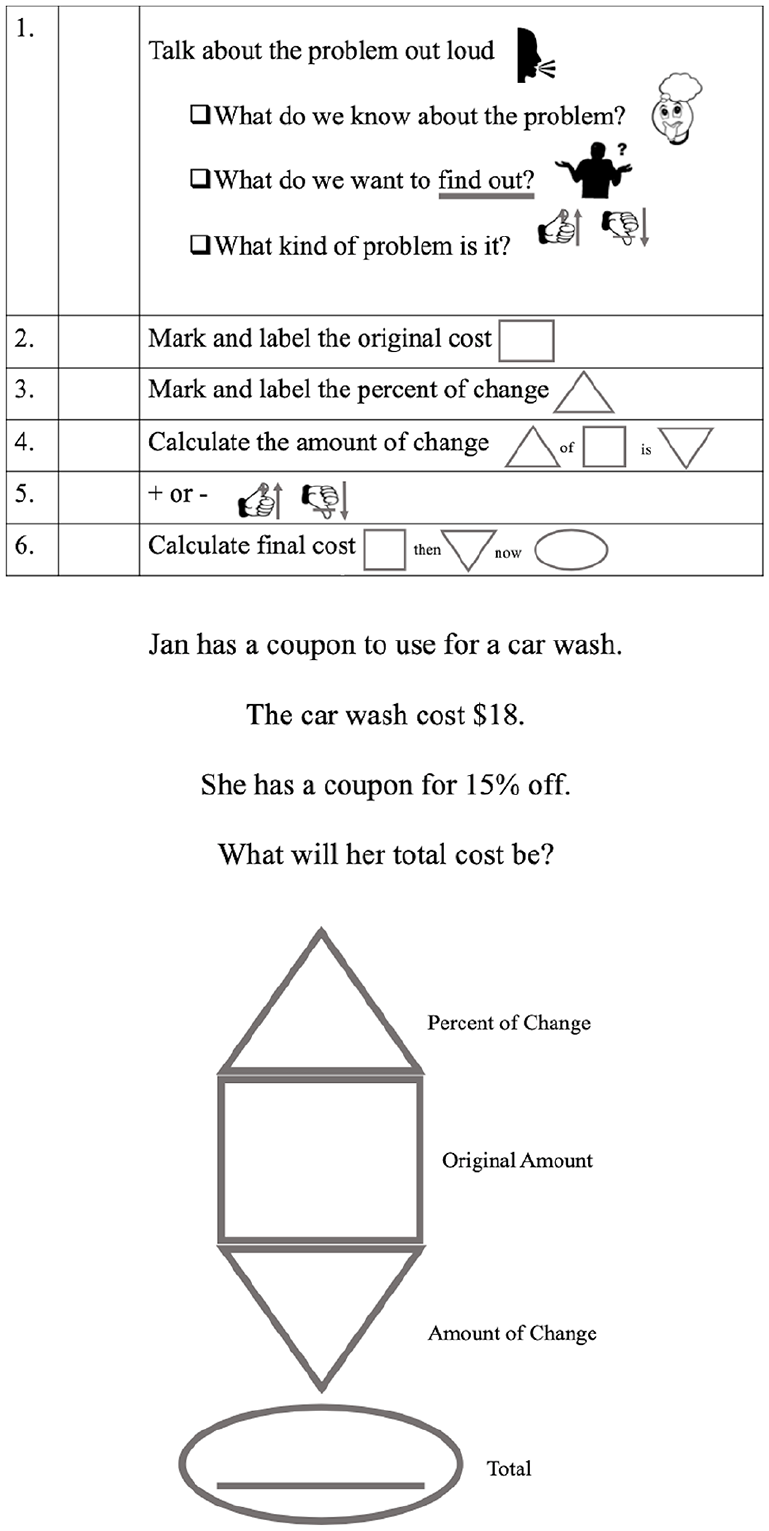
Example worksheet.
Design and Measurement
Researchers employed a multiple probe across participants design (Ledford & Gast, 2018) in this systematic replication. The treatment effects were evaluated by comparing the participants’ ability to independently demonstrate problem-solving behaviors prior to and following intervention (MSBI and the next-dollar strategy). What Works Clearinghouse (WWC) guidelines for single case research were followed (Kratochwill et al., 2013). There were three experimental conditions used including: (a) baseline, (b) intervention, and (c) generalization. Baseline sessions began for all participants simultaneously and three overlapping data points were obtained before researchers gained teacher input to determine Gill would be the first to begin. Once the first participant demonstrated a clear change in trend and level, three consecutive baseline probes were conducted with Wes before he was introduced to intervention. This procedure was repeated for Ava’s introduction to intervention. Generalization to real-world materials was assessed once in baseline and once after participants met mastery criteria of 80% (10/12) of problem-solving behaviors completed independently correct for both problems for two sessions with at least five data points.
Dependent variable
The dependent variable was the number of points received for independently completing problem-solving behaviors. The interventionists measured 12 separate behaviors for each problem: (a) talk about the problem out loud (i.e., identify original cost and percent of change, underline the question, show the rule for the problem type), (b) underline the question, (c) show the rule for the problem, (d) write original cost on graphic organizer (including $ symbol), (e) write percent of change on graphic organizer (including % symbol), (f) multiply percent of change by original amount using the calculator, (g) write amount of change onto graphic organizer (including $ symbol), (h) say or show rule/think aloud for problem type, (i) write correct operation (subtraction sign), (j) subtract amount of change from original cost, (k) write correct final cost on graphic organizer, and (l) give more dollar bills than the final cost. Participants had the opportunity to earn 24 points in each session across the two word problems.
Reliability and fidelity
Consistency of measuring the dependent variable among two independent observers was evaluated using point-by-point agreement for a minimum of 30% of all sessions across all phases and all participants. This interobserver agreement (IOA) served as an evaluative tool to ensure adherence to the measure without observer bias or drift (Ledford & Gast, 2018). IOA was calculated for 40% of Gill’s baseline sessions (2/5), 30% of his intervention sessions (3/10), and 50% of his generalization sessions (1/2). Similarly, for Wes two independent observers coded 43% of the baseline videos (3/7), 33% of the intervention sessions (4/12), and 50% of the generalization sessions (1/2). Baseline, intervention, and generalization sessions were also compared for Ava for 33% (3/7), 30% (3/10), and 50% (1/2) respectively.
Procedures
At the beginning of every session, the interventionist told the participants they would be completing two problems. First, participants selected a community location from the theme menu. Students kept track of previously completed themes by writing an X over the theme selected each day, which served both as randomization and to ensure students did not complete the same problems twice. Next, participants watched a brief anchor video about making purchases and using a coupon in the chosen community location. After participants watched the video, the interventionist asked the participant to “show me how to solve this problem” and offered to read the problem if asked. After the participant arrived at an answer for each problem, the interventionist would ask the student to provide the correct dollar amount with paper money (e.g., “Use these bills to show me how Sonia could pay for the haircut”).
Baseline
In baseline probes, participants were asked to complete the problems independently, and to “just do their best.” Praise was given for effort (e.g., thank you for working hard), but no corrective feedback was provided. Pacing prompts were also used (e.g., “what’s next?”) to refocus students on the task as needed.
Pre-teaching
Prior to intervention, the interventionist reviewed prerequisite skills for approximately 15 min. This 1-day pre-teaching lesson focused on vocabulary and symbols ($, %, +, −, and X), reading and writing dollar amounts, reading and writing percentages, and money identification. All skills were taught using constant time delay procedure. No data were collected during the pre-teaching lesson.
Intervention
Intervention began with three modeled lessons, consistent with previous MSBI research (e.g., Root et al., 2018). Participants were given multiple opportunities to actively respond, but no data were collected as they did not have the opportunity for an independent response. The first model lesson introduced participants to the problem type and the concept of percent. During the second model lesson, the interventionist introduced the graphic organizer and led the participant through solving the problem by completing the graphic organizer and using the next-dollar strategy to use the correct bills to pay. During the third model lesson, the interventionist taught participants to use the task analysis to self-monitor the steps of solving the problem with the graphic organizer and reviewed the next-dollar strategy. Copies of model lessons are available from the author on request.
After the three modeled lessons were completed, each subsequent session began by having the participant state the type of problem they were working on (i.e., percent of change), and reviewing their goal for the number of “points” they wanted to earn (i.e., behaviors performed independently correct), and giving participants an opportunity to solve two problems. The interventionist provided students with materials and stated “Show me how to solve this problem.” The interventionist gave specific praise when participants completed a behavior independently (e.g., “yes, the original cost of __ was $__”). A system of least prompts was used when behaviors were not initiated within 5 s using a four-level hierarchy: (a) pacing prompt (“what’s next?”), (b) general verbal prompt (“Let’s see what the checklist says”), (c) specific verbal prompt (e.g., “Find the original cost of ___ in the problem and label it on your graphic organizer”), and (d) model prompt (e.g., “In this problem we know the original cost of __ is $__. Mark the cost of __ with a square. Now label $__ on your graphic organizer.”) The interventionist immediately corrected any error using a model-retest (e.g., “My turn, I know the original cost of __ is $__. Your turn, what is the original cost of ___?)
Following procedures from Root et al. (2018), each intervention session concluded with goal setting for the next session. Together, the interventionist and participant reviewed the type of problems that were solved (i.e., percent of change), the goal they had set for the number of “points they had earned” (i.e., behaviors performed independently correct), and how many behaviors they completed independently correct by reviewing the data sheet together. Participants then self-graphed their progress on an excel sheet on the iPad. This information was used to set and record their goal for the next day. Participants continued in intervention until they met the mastery criteria of 80% (10/12) of problem-solving behaviors completed independently correct for both problems for two sessions with at least five data points in the phase.
Generalization probe
Generalization was assessed once in baseline and once after participants met mastery criteria to measure the degree to which students could generalize skills when provided natural stimuli (receipts and coupons) instead of word problems. Generalization probes followed similar procedures to baseline, with the exception of how the problem was presented (e.g., verbally and on receipt/coupon instead of in a word problem). In generalization probes, students watched an anchor video and were then given a calculator, the graphic organizer, a laminated coupon, and laminated receipt. The interventionist then asked the participant “If you purchased (item) (pointing to receipt) and you wanted to use this coupon (pointing to coupon), what would your final cost be?” After students were finished, the interventionist asked “Show me the bills you would use to pay for (item)” and provided a stack of paper dollar bills.
Social validity
Single case research can be used to identify effective instructional practices that are socially important, feasible, and produce meaningful change (Horner et al., 2005). Researchers used open-ended questionnaires to evaluate the importance of the dependent variable (teacher), user enjoyment of the learning opportunity (participant), and observation of a meaningful change (teacher and participant). To measure the student’s feelings about math, the Test of Mathematical Achievement (Brown et al., 2012) subtest How I Feel About Math was adapted. The original four-response ordinal rating scale of, “Yes, definitely!, Closer to Yes, Closer to No, No definitely!” was adapted to a three-response ordinal scale of a cartoon face smiling indicating “yes,” cartoon face with a straight line indicating “unsure,” and a cartoon face with a frown indicating “no.”
Results
Figure 2 displays the level of independence in problem-solving behaviors of the three participants. In each session, participants had the opportunity to independently display 12 behaviors per problem, for a total of 24 in each session across the two problems. With three demonstrations of effect at three different points in time, visual analysis of data established a functional relation between MSBI with the next-dollar strategy and an increase in mathematical problem-solving behaviors. Student performance during the baseline and post-intervention generalization sessions is narratively described.
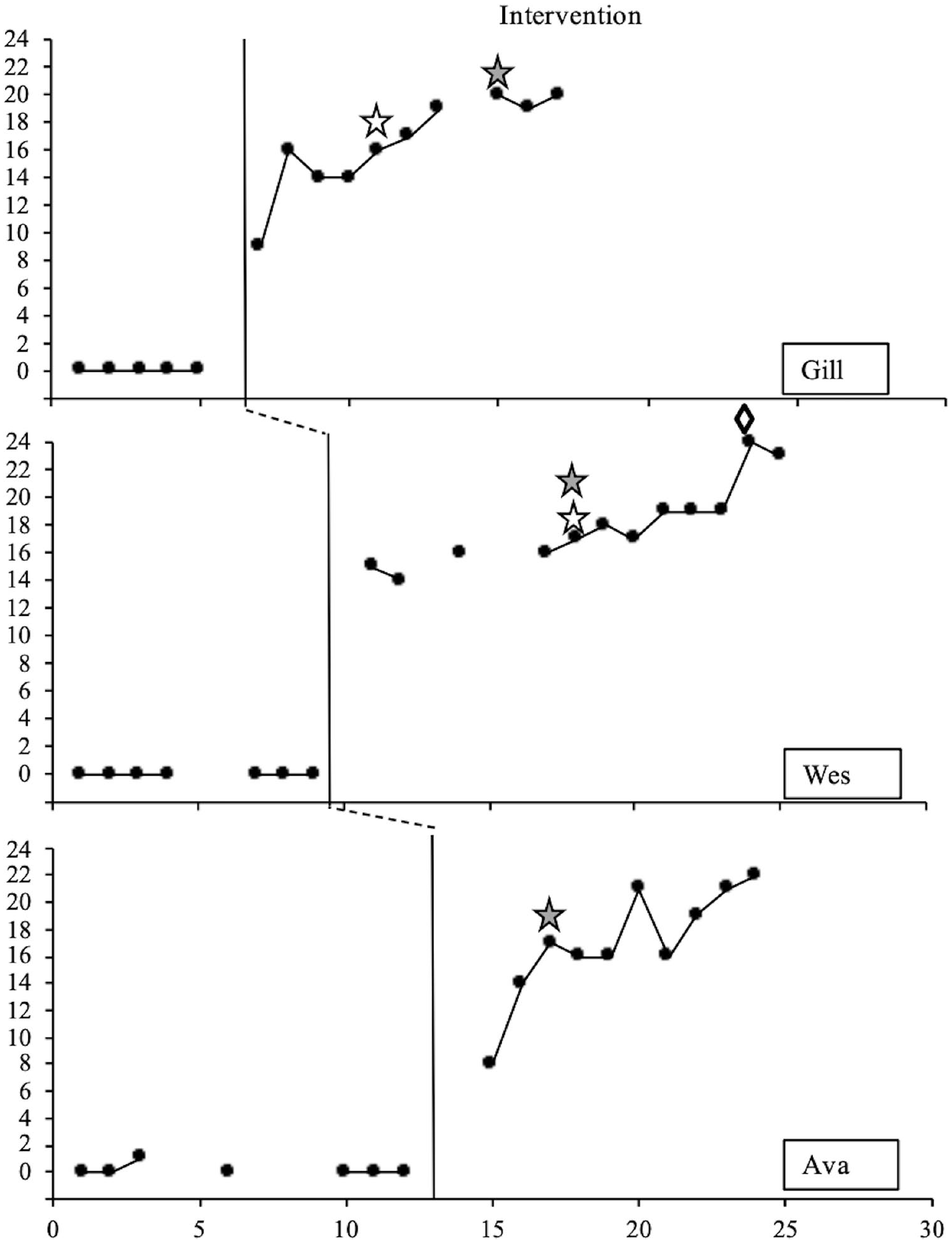
Problem-solving behaviors performed independently correct.
Gill
During baseline sessions, Gill was unable to correctly perform any of the problem-solving behaviors for the percent decrease word problems. After intervention, Gill’s performance immediately jumped from floor level to nine independent correct behaviors. His performance continued to improve, with an upward trend (M = 16, range = 9–20). The interventionists observed Gill have fine motor difficulties with the dry erase marker and laminated worksheets. To address this barrier, Gill was given printed worksheets and a pencil from the fifth intervention session forward (indicated with the open star in Figure 2). The two behaviors Gill missed most frequently were due to his difficulty in correctly writing dollar amounts. For example, if the answer was four dollars and thirty cents, Gill might write US$4.3 or directly transfer 4.3 from the calculator. Gill also struggled to complete all behaviors of the first step of his task analysis (talk about the problem out loud). To support his communication about the problem, researchers gave him a more explicit task analysis that broke step one (talk about the problem out loud) into three distinct behaviors (see Figure 3) from the eighth intervention session forward (marked by closed star in Figure 2). Gill met mastery criteria after 10 intervention sessions. During the first generalization session in the baseline phase, Gill did not make any attempts to solve the generalization problem. In the post-intervention generalization session, Gill was able to identify the correct operation to use (subtraction) once the percent of change (amount of the discount) was obtained. He was also able to give the exact (or one more than the exact) amount in dollar bills to pay for the item.

Task analyses.
Wes
Throughout his seven baseline probes, Wes was unable to independently complete any of behaviors required to solve a percent of change word problem. After intervention, Wes’s performance jumped to 15, and remained at a stable, increasing trend over 12 intervention sessions (M = 18, range = 14–24). Similar to Gill, Wes struggled with the first behavior of the task analysis (“talk about the problem out-loud”). Wes frequently skipped substeps (i.e., identify original cost and percent of change, underline the question, show the rule for the problem type) and would immediately begin using the graphic organizer to solve the problem. The research team then gave Wes the more explicit task analysis (Figure 3) given to Gill as well as paper worksheets with pencil (as opposed to laminated worksheets with a dry erase marker) from the sixth intervention session forward (indicated by the open and closed stars on Figure 2). The more explicit task analysis was not effective in supporting Wes’s success in communicating about the problem, as he continued to immediately begin using the graphic organizer to solve the problem. The researchers began using a blank sheet of paper to cover the graphic organizer from session 11 forward (indicated with a diamond in Figure 3) until after he had completed Step 1. Wes then met mastery criteria following a total of 12 intervention sessions. During the first generalization session in the baseline phase, Wes did not make any productive attempts to solve the problem and was unable to give the interventionist the appropriate amount of money for the item. In the post-intervention generalization session, Wes was able to correctly calculate the final cost.
Ava
During baseline probes, Ava completed one behavior (write the original amount on the graphic organizer) independently correct during the third probe. She did not complete any other behaviors independently correct across the seven baseline sessions. After intervention, Ava immediately jumped in performance to eight independently correct behaviors with her performance following an increasing trend over 10 intervention sessions (M = 17, range = 8–22). Ava verbally expressed confusion with the first step of the task analysis, indicating she didn’t understand what we wanted her to do, so the decision was made to give her the more explicit analysis used for the other two participants from session three forward (indicated with a closed star on Figure 2). Ava used the marker and laminated sheets without any expressed difficulty and monitored her own progress by wiping the sheet off when she wanted to change a response. Therefore, she did not receive paper copies. In the first generalization assessment during the baseline phase, Ava did not know how to find the discounted cost or correctly give the interventionist the correct amount of money to pay for the item. In the postintervention generalization session, Ava was able to use the next-dollar strategy to give the interventionist the correct amount of money to pay for the item.
Reliability and Fidelity
IOA was measured for a minimum of 30% of all conditions and all participants. IOA met minimum quality standards, indicating the dependent variable was measured reliably in accordance with the coding manual. Baseline and generalization probes for Gill were measured at 100% agreement, while intervention probes averaged 92% agreement (range = 83–96). Baseline and generalization probes for Wes were also measured at 100% agreement with intervention probes averaging 84% agreement (range = 75–100). IOA for Ava averaged 98% in baseline (range = 96–100), 95% for intervention (range = 92–100), and 100% for generalization.
Procedural fidelity captured through adherence to the checklist to ensure the interventionist followed instructional procedures. Procedural fidelity was similar in baseline with an overall average of 96% (Gill M = 100%, range = 100–100; Wes M = 100%, range = 100–100; Ava M = 87.5%, range 75%–100%) and generalization with an overall average of 100% (Gill M = 100%; Wes M = 100%; Ava M = 100%) compared to intervention with an overall average of 95% (Gill M = 92%, range = 75–100; Wes M = 94%, range = 75–100; Ava M = 100%, range 100%–100%).
Social Validity
Students and their teacher gave feedback on the appropriateness, feasibility, and effectiveness of the intervention. During an open-ended questionnaire, the teacher indicated she believed it is “extremely important” for students to be able to solve percent of change word problems (i.e., tip and sale). She also reported an observed boost of confidence in all three student’s perception of their own mathematical abilities. When asked if she would recommend students to participate in similar research in the future, the teacher responded “yes, every student deserved the opportunity to excel.”
All participants indicated on the open-ended questionnaire that the time with the interventionalist helped them to learn something new. All participants were able to state what they had learned, including “multiplication,” “percent of change,” and “percent.” On the visual scale, two of the three participants circled a big smiley face indicating math is fun and one participant indicating math is just okay. All three participants indicated math was interesting and exciting by circling the big smiley face.
Discussion
The purpose of this study was to conduct a conceptual systematic replication of Root et al. (2018) to evaluate the effectiveness of a multicomponent intervention on multiplicative problem solving for middle school students with extensive support needs. The grade-aligned mathematics skill of solving percent of change problems was contextualized within a natural application: using a coupon to find the final cost of an item or activity. Addressing stated limitations of Root et al., this study taught participants to show how much money would be necessary to cover the cost of each item or activity using the next-dollar strategy, rather than just stating whether a given amount of money was “enough” to cover the purchase. While visual analysis of the multiple probe across participants design indicates a functional relation between MSBI and problem-solving skills, and participants were able to successfully employ the next-dollar strategy, performance of all three participants indicated a need for more supports than those required by the participants in Root et al. This difference in learning patterns highlights the importance of replication studies in understanding variables that may influence level of supports students with extensive support needs may require for independence in problem solving. This process is similar to that used by special education teachers when monitoring student progress.
Coyne and colleagues (2016) argued that identifying intervention studies as replications is more than semantics, but rather a vehicle for validating prior findings and systematically accumulating evidence about interventions. The desire for this outcome has been echoed across several recent systematic literature reviews, with researchers emphasizing the need for researchers to explicitly address the variable and extensive learning needs of these students (Bowman et al., 2019; Spooner et al., 2019). Replication studies such as this one can be used to expand the field’s understanding of the conditions surrounding effective practices for given populations, or “what works for whom” by explicitly indicating which elements were maintained between studies and which were systematically manipulated, and for what reason.
The design of this study was intended to address procedural and measurement limitations of Root et al. (2018). Table 1 displays the variables held constant and those systematically manipulated between the two studies. The focus was on addressing the practice (“what”) and measurement (“works”) specific to the final step of problem solving whereby participants made judgments regarding the amount of money required to pay for the item or activity. As such, all other aspects of the intervention were initially the same as those employed by Root et al., yet the participants responding indicated both performance and skill deficits were inhibiting progress.
Study Dimensions Held Constant and Intentionally Varied Between Studies.

Note. Italics indicates items intentionally varied. ID = intellectual disability; ASD = autism spectrum disorder.
Root and colleagues (2018) aimed to teach their participants to not only find the correct mathematical solution (i.e., final cost when using a coupon) but to apply reasoning skills to determine whether a given amount of money was sufficient to pay for the item or activity. Using recommendations from previous research (i.e., Xin et al., 2005), we taught participants to use the next-dollar strategy to account for minimal previous experience with money. Similar to previous findings (i.e., Colyer & Collins, 1996), some participants needed procedural modifications to reach mastery. While this work expanded research on teaching price comparison to students with extensive support needs, participants were only required to give a response of yes or no when determining if they had enough money to make a purchase. This study determined the next-dollar strategy was effective in achieving the same goal of assessing whether participants would be able to apply the grade-aligned skill in a meaningful way yet with a more accurate and conservative measure.
Limitations and Areas for Future Research
While this study aimed to address stated limitations in Root et al. (2018), there remain several areas that should be considered when determining the impact of this study and directions for future research. First, both this study and the study by Root et al. used graduate research assistants to teach students in a one-on-one school setting, thereby impacting under “what conditions” this intervention may be effective. Critical to the establishment of evidence-based practices and their uptake by practitioners is research on their use in naturalistic settings, within and outside school. It is unknown whether this intervention would be feasible or effective when taught in a small or whole group setting by a special education teacher, paraprofessional, or peer or if students can generalize skills to natural community settings. These would be logical next steps for research in this area, as there is evidence that MSBI can be implemented by both teachers (e.g., Browder et al., 2018) and peers (Ley Davis, 2016).
As with the majority of research on teaching mathematics to students with extensive support needs (Spooner et al., 2019), this study used a multicomponent treatment package. Several established evidence-based practices were incorporated, including systematic instruction, task analysis, technology, explicit instruction, and graphic organizers (Bowman et al., 2019; Spooner et al., 2019), as well as self-monitoring with self-graphing and the next-dollar strategy. Furthermore, participants in this study needed a more explicit task analysis to make progress in independent problem solving than those in Root et al. (2018). A limitation of these complex treatment packages is that researchers and practitioners do not have evidence of the additive effects of various components, how each does or does not contribute to overall outcomes, or which individuals may need more intensive supports. The answers likely vary based on targeted outcomes and student characteristics, though without empirical evidence of such this remains unknown.
Implications for Practice
Mathematics education describes the need for students to engage in productive struggle to develop a deep understanding of mathematical concepts (i.e., Hiebert & Grouws, 2007). Researchers suggest students who enter problem-solving processes with the opportunity to explore, analyze, correct, and reconstruct their mathematical knowledge are engaging in productive struggle (e.g., Granberg, 2016). What is less known, however, is how to engage students with extensive support needs in mathematical problem solving that incorporates productive struggle. Using MSBI, we supported students with extensive support needs to engage in a productive problem-solving process by providing them with necessary supports that allowed them to successfully think through word problems, challenging them to apply what they knew about math along with functional skills (e.g., counting out money) while providing opportunities for success. In this way, students could use the task analysis to engage in the problem-solving process independently by talking through their reasoning in step one. Researchers could then provide corrective feedback, only as needed, after the students had the opportunity to engage in productive struggle. For example, Gus once explained his reasoning and then said “wait, that can’t be right” and then corrected his answer. Results from this study along with previous studies (e.g., Browder et al., 2018; Root et al., 2018) provide evidence that students with extensive support needs can and do engage in a productive struggle when solving mathematical word problems when appropriate supports are provided.
There is mounting evidence that students with extensive support needs can learn both the conceptual and procedural skills necessary to solve mathematical word problems when provided explicit instruction using established evidence-based practices. However, given the variability in learning needs, some students may require additional or more intensive supports. By measuring problem-solving performance using a task analysis, teachers can readily conduct an error analysis to determine if a consistent pattern is present and change instruction accordingly. Errors may be due to skill deficits, such as converting the quantities displayed on a calculator to American monetary values (e.g., 4.3 to $4.30), or performance deficits such as response mode preferences (e.g., point rather than say an answer). Prioritizing errors by importance can help teachers think through which steps of the task analysis to first intervene on to increase independence. For example, in this study, Wes demonstrated a skill deficit when he consistently did not talk about the problem out loud; therefore, researchers provided a more specific task analysis that broke this larger step down into discrete steps to support Wes as he engaged in this difficult task. When Wes improved in his ability to complete this first step, it was then noted that he consistently skipped the step and began to solve the word problem with the graphic organizer (i.e., performance deficit) and researchers then covered the graphic organizer until Wes completed step one. For students who may need additional supports, teachers can provide more detailed or explicit instruction, as illustrated by the more explicit task analysis in Figure 3.
Summary
Researchers need to engage in programs of research that systematically tease out the answers to “what works, for whom, under what conditions” (Rao et al., 2017). A replication framework may facilitate this outcome. Findings from this replication study add to the evidence that a contextualized mathematics approach with a multicomponent treatment package may be effective for teaching students with extensive support needs mathematical problem-solving skills. Findings also highlight the value of flexible research designs when examining how much support is needed for a variety of individual participants.
Footnotes
Declaration of Conflicting Interests
The author(s) declared no potential conflicts of interest with respect to the research, authorship, and/or publication of this article.
Funding
The author(s) received no financial support for the research, authorship, and/or publication of this article.

Editor in Charge: Susan R. Copeland