



Abstract
The purpose of this study was to investigate the effects of an augmentative and alternative communication (AAC) app with transition to literacy (T2L) software features (i.e., dynamic text and speech output upon selection of a graphic symbol within the grid display) on the acquisition of 12 personally relevant single words for individuals with severe autism spectrum disorder (ASD) who had minimal or no speech. The study implemented a single-subject, multiple-probe, across word sets design with four participants. All four participants in this study demonstrated increased accuracy reading targeted single words and results from this study provide preliminary evidence that the T2L features can positively affect the single-word learning of individuals with ASD who have minimal speech and limited literacy skills.
Keywords
Communication impairments are inherent with an autism spectrum disorder (ASD) diagnosis (Kasari et al., 2014). As many as 30% to 50% of individuals with ASD do not develop functional speech (Shane et al., 2015). These individuals have significant communication impairments characterized by having a very small repertoire of spoken words or fixed phrases that are used communicatively (Kasari et al., 2013). In addition, the spoken words or phrases are often restricted within contexts and functions and likely include scripted phrases that have been highly trained. For example, the individual may only use spoken words for requesting preferred food items with a familiar adult (e.g., I want X; Kasari et al., 2013).
To support communication and increase opportunities for participation, augmentative and alternative communication (AAC; for example, sign language, picture communication boards, AAC apps on mobile technology) may be required for individuals with ASD who have minimal speech. Currently, AAC systems are used with these individuals with the purpose to decrease challenging behaviors, increase social participation (e.g., turn-taking, social initiations), make requests, and participate in academic activities (e.g., spelling). More specifically, research demonstrates that aided, graphics-based AAC systems are successfully and frequently used with individuals with ASD and complex communication needs (Ganz, 2015; Ganz et al., 2012; Holyfield et al., 2017; Mirenda & Erickson, 2000). Individuals with ASD who require AAC often select high-tech devices when offered choices among high-tech speech-generating devices, low-tech picture exchange-based systems, or manual sign language (Ganz, 2015).
More students are being diagnosed with ASD, and subsequently, more students with severe ASD who have minimal speech are entering school than ever before. These learners must have access to, be involved in, and progress in the general curriculum. Therefore, instruction must be adapted to meet their needs (Knight et al., 2010; Light & McNaughton, 2013). Assistive technology and use of an AAC system become critical components to full educational participation, including participation in literacy instruction.
Research indicates only one in five students with extensive support needs acquires basic literacy skills upon leaving secondary education (Allor et al., 2010). One critical component of skilled reading is the ability to read individual words. When approaching a written word, an individual may either decode the word or recognize the word by sight. If decoding, the individual looks at the letters, retrieves the sound of each letter, blends the sounds, and thus determines the word. Alternatively, an individual may focus primarily on the orthography of the word and associate it with its referent by sight (Ehri, 2005). Sight word reading instruction alone is not sufficient for students to meet high literacy standards. Yet, in the absence of developed phonic skills, it can assist individuals in navigating their environments to support everyday independent functioning (e.g., grocery or community words; Mechling et al., 2002), help individuals increase confidence (Light & McNaughton, 2013), support meaningful reading experiences (Mandak et al., 2019), and assist students with limited literacy skills in seeing a relationship between words and meaning (Broun, 2004).
Sight words are generally taught through the systematic presentation of words, prompts, and contingent feedback for correct and incorrect responses (Browder et al., 2006). Sight word intervention components and stimuli have included matching tasks (Fossett & Mirenda, 2006), computer-based instruction (Hetzroni & Shalem, 2005), flashcards and games (Crowley et al., 2013), and tablet technology (Caron et al., 2018; van der Meer et al., 2014). Browder and colleagues (2006) conducted a meta-analysis of 128 studies of reading instruction for students with significant cognitive disabilities and found that 75% addressed sight word instruction. Analyses yielded strong evidence of effectiveness for sight word instruction that used massed trials and systematic prompting. In a review of sight word studies for individuals with ASD, Spector (2011) found similar results with strong effectiveness for interventions with massed trials and systematic prompting. Studies that included visual supports and task modifications also yielded high effectiveness. In the previously mentioned reviews, many of the participants were able to use speech to participate in interventions and sight word–related assessments. Spector found only nine single-subject sight word studies for individuals with ASD. Of the nine, six of these studies included individuals with ASD who used speech and therefore instructional and/or assessment tasks that required spoken responses.
Although explicit literacy instruction is vital, current AAC technologies and features within high-tech speech-generating devices could also be used to complement more robust literacy instruction and possibly even incorporate literacy into everyday communication opportunities. Individuals with ASD who have minimal speech and use AAC typically have systems with graphic symbols (i.e., photographs, line drawings) to represent words or concepts for communication. These graphic symbols are often paired with a static text label located above the image; however, this static pairing of text and graphic symbols may interfere with sight word learning (Erickson et al., 2010; Fossett & Mirenda, 2006). Emerging research has begun to explore redesigning AAC systems to better support literacy, with Light et al. (2014) proposing the incorporation of a transition to literacy (T2L) feature into AAC technologies. The T2L feature pairs voice output messages with corresponding orthographic output, upon selection of a graphic symbol within an AAC display (Light et al., 2014; see https://tinyurl.com/rerc-on-aac-T2L for a video example of the feature).
The T2L feature has been incorporated into both visual scene display applications (hereafter referred to as an “app”) and AAC systems that use grid-based displays. Mandak et al. (2019) investigated the effects of the T2L features in a visual scene display app with preschoolers with ASD and some speech. All participants demonstrated successful acquisition of the 10 target single words (range: 77%–100% accuracy) during the shared reading of the book Brown Bear Brown Bear. In a study by Caron et al. (2018), the T2L app feature was investigated using a grid-based display within an AAC application. All five participants with ASD demonstrated increased accuracy reading 12 single words through exposure to the T2L feature during a structured matching task. These participants, who were described as minimally verbal with some literacy skills (e.g., could not decode, yet were able to identify more than 100 sight words), were also able to transition from a 15 location graphics-based grid display to a 15 location text-only grid display during generalization tasks.
The purpose of this study was to further investigate the effects of dynamically displaying text along with speech output (T2L feature) within a graphics-based grid display AAC app, to support the acquisition of targeted single words with individuals who have severe ASD and minimal speech. In previous studies using the T2L feature, the participants had an ASD diagnosis, minimal speech, and more literacy skills (e.g., over 100 sight words; Caron et al., 2018), or the participants had diagnoses of moderate ASD, were young, and primarily used speech (e.g., Mandak et al., 2019). Although gains were observed with both studies, the researchers speculated that intrinsic factors including speech abilities, age, severity of diagnosis, and prior literacy skills may have played a role in the rate of acquisition, as well as the positive benefits of the T2L feature. Additional research with individuals who have severe ASD, minimal speech, and more minimal literacy would expand understanding of who the T2L feature could benefit. Subsequently, the research questions for the proposed study were as follows: (a) What is the effect of the AAC app with the T2L software feature on the acquisition of 12 single words, during a structured matching task, by individuals with severe ASD who are minimally verbal and have very limited literacy skills? (b) Are the effects maintained once exposure to the AAC app with the T2L feature is terminated? (c) Do the participants generalize the single-word reading skills to different stimuli?
Method
Participants
Participants for this study were recruited through outreach to teachers and speech-language pathologists in Pennsylvania schools who worked with students with severe ASD. The inclusion criteria used to select participants required that individuals: (a) had an ASD diagnosis based on the Diagnostic and Statistical Manual of Mental Disorders (5th ed.; DSM-5) criteria and a rating of severe on the Childhood Autism Rating Scale (second edition; CARS-2; Schopler et al., 2010), per teacher report; (b) were aged 5 to 21 years old; (c) were unable to meet daily communication needs through speech per teacher report, parent report, and classroom observation; (d) were able to follow one-step directions per teacher report and classroom observation; (e) could communicate symbolically with a minimum of 10 spoken words, signs, or graphic symbols, per teacher report and classroom observation; (f) had English as the primary language used at home; (g) had hearing and vision that were unimpaired or corrected per teacher or parent report; and (h) were not decoding and recognized less than 50 sight words, per teacher report.
Four boys with ASD ranging in age from 9;7 (years; months) to 18;7 (M = 14;0) participated in the study (see Table 1). All of the individuals scored below the first percentile on the Peabody Picture Vocabulary Test Version 5 (i.e., they received a Standard Score of 42 or below, corresponding to an age equivalent of 3.2 years or below). Three out of four participants had very limited to no speech and used AAC apps with grid-based systems on the iPad. The fourth participant also used physical communication and gestures; however, he primarily used 20 spoken word approximations and rote phrases (e.g., “I want that”) to communicate. They all attended educational programs with substantially separate ASD support services. No participants had specific literacy goals (e.g., letter-sound knowledge, sight word learning) as part of their education plans. In previous classroom settings, participants did have exposure to letters and words of the week. Participants did have access to a variety of iPad applications that had reading-related activities (e.g., BitsBoard). Refer to Table 1 for literacy screening results regarding participants’ letter-sound correspondence, sound blending, and sight word knowledge prior to the start of the study.
Participant Demographics.

Note. ASD = autism spectrum disorders; CARS-2 = Childhood Autism Rating Scale (2nd edition); PPVT-4 = Peabody Picture Vocabulary Test (4th edition); LSC = letter-sound correspondences.
CARS-2 helps to identify and distinguish severity of Autism. bPPVT-4 is an assessment of understanding of spoken language. No test modifications or adaptations were provided. cLSC were assessed by presenting four-letter tiles and the researcher stating the target letter sound. Each letter-sound was targeted three times. If the participant identified the letter-sound correctly in two out of three trials (or more), then the sound was considered known. Scores are presented as total correct out of 26. dNumber correct out of 40, based on pre-primer word list. Written words were presented in groups of four and words were read aloud. The participants pointed to a word. eSight word inventory is estimated based on (a) screening of Dolch words (N = 40) and (b) teacher report. The total includes the Dolch words read successfully plus personally relevant words like names, places, foods, movies, and so on.
Research Design
This study implemented a single-case multiple-probe, across word sets design with four participants. The acquisition of the 12 single words was evaluated across four phases for each of the three-word sets including baseline, intervention, generalization, and maintenance.
Measures and Data Analysis
The dependent variable for the study was the percentage correct during the single-word reading probes. Specifically, the correct identification of a graphic symbol selected from a field of four, when provided with a target written word, across eight trials (each target word presented twice). Probes were conducted across all study phases. A correct response during the probe tasks was defined as an independent selection of the correct graphic symbol within 5 s of the researcher’s presentation of the word. An incorrect response was defined as the selection of the wrong graphic symbol or lack of response within 5 s of the researcher’s presentation of the written word.
Data on the accuracy of reading the target words were graphed separately for each individual across the four phases and three word sets. The level, slope, and variability of the data in the intervention condition were compared to those at baseline to determine the effectiveness and efficiency of the introduction of an AAC app with T2L software features. In addition, Tau-U effect size was calculated (Parker et al., 2011). A Tau-U score ranges from 0 to 1 and can be interpreted using the following criteria: .20 or lower is a small effect; between .20 and .60 is a moderate effect; between .60 and .80 is a large effect; and between .80 and 1 is a very large effect (Vannest & Ninci, 2015).
All sessions were videotaped, and probe data were recorded live. To ensure the reliability of the data, coding from the videotaped sessions by the graduate student was compared to the data sheets collected live by the researcher. The graduate student coded a randomly selected sample of 30% of the baseline and intervention sessions and all of the generalization and maintenance sessions, for each of the participants, across each word set. Interrater agreement was calculated by determining the number of agreements divided by the number of agreements plus disagreements plus omissions. The mean interrater reliability per participant, per phase, was 100%.
Materials
Target words
Twelve personally relevant motivating single words were selected for each participant. To identify personally relevant and motivating words, teachers, para-educators, and family members were provided a questionnaire and asked several questions about the participants, including (but not limited to): general likes and dislikes, places they visit frequently, common leisure activities, objects, and items they request or talk about with frequency. Available high-tech and low-tech AAC supports were reviewed to gather additional information regarding words that were communicated frequently or rewards that the individuals selected for task completion or engagement (e.g., juice, lego pieces). After a corpus of 20 words was gathered per participant, the words were discussed with relevant stakeholders, including the individual with ASD. A final list of 12 words was grouped into three sets of four words, for each participant. Words had to be three to nine letters in length; imagable (e.g., pizza, legos); and contain, within a set, at least two words that shared the same initial letter (e.g., jeep, juice, bike, mickey). All target words were presented with lower case letters.
Probe materials
Assessment probes were used throughout the study to evaluate the participants’ accuracy in recognizing the target words. The materials for the assessment probes included laminated graphic and orthographic representations of the target words. The graphic representations included SymbolStix icons (see https://www.n2y.com/symbolstix-prime/). Screenshots of the AAC application were taken to obtain these graphic symbols. The graphic symbols were printed in color and cut into 2″ × 2″ squares. Assessment probes for generalization included photographs of the target words. The photographs selected for the probe were not seen during instruction. For the orthographic representations, laminated text cards were created by printing the word in black, 72 point Arial font on yellow paper.
AAC hardware and software
During the intervention phase, the AAC technology with the T2L feature was introduced to the participants. The T2L software feature was used on a NOVA Chat 12TM device (see https://saltillo.com/products/print/nova-chat-12). A 15-button display was programmed with graphic symbols (i.e., symbols for the 12 target words and three words for models). The T2L feature occurred sequentially. First, the dynamic presentation of the text appears. It emerges from the selected graphic symbol. Then, the grid display is slowly replaced by a black background and the word. The word stays on the screen for 3 s. While the text is on the screen, it is paired with speech output (matching the text exactly). After 3 s is over, the text shrinks back into the graphic symbol and disappears. Refer to https://tinyurl.com/rerc-on-aac-T2L for a video demonstration of the T2L feature.
Individualized photo books
Three books were created for each target word set using Microsoft Powerpoint and then printed for intervention. Each of the books included one photograph or AAC symbol without text per page. Participants were prompted to match the picture from the book to the symbol in the device. The first picture book used the SymbolStix icons from the device, creating an “exact match.” The second book used photographs, representative of the same concepts as the AAC symbols on the device (and the target words), but no longer a direct match to the AAC symbols on the device. These photographs were different from the photographs used during generalization. The third picture book also used photographs, representative of the same concepts as the AAC symbols on the device and the target words. However, these photographs were combined with characters or other objects of interest (e.g., SpongeBob with the target sight word jeep). Each book included three pages of photograph symbols for each target word. The photobooks did not include any written words.
Procedures
All of the sessions were conducted by the first author and took place in a classroom. Three to four sessions occurred each week, with each session lasting approximately 20 to 30 min. Due to scheduling challenges, two sessions were sometimes scheduled on the same day, yet a break including completing other tasks occurred between each session. The procedures for each of the study phases are outlined in more detail next.
Symbol training
Before the start of the study, all participants were assessed on their accuracy in symbol identification of the target words and foils. They were presented with four graphic symbols and the spoken instruction, “point to_____.” Matching picture-to-text probe tasks were used to eliminate the need for the participants to respond verbally during assessments (Fossett & Mirenda, 2006). If errors were made in symbol identification and training was required, the researcher completed the following procedures, per concept: First, the researcher placed four graphic symbols in front of the participant and stated “show me” and verbally labeled the target concept (e.g., swim). If training was required for a symbol, the researcher implemented a most-to-least prompting procedure, similar to strategies currently used in their classrooms. First, the researcher identified the correct image for the participant and had the participant touch that image, stating “point to ___ with me.” Then the researcher said, “point to ______” and provided a gestural prompt after 3 s time delay. If the participant was correct, the researcher provided additional trials with the same target symbol until two consecutive trials did not need gestural prompts. Corrective feedback (i.e., showing the correct response) was provided and graphic icons were rearranged per trial. Once participants consistently identified all the symbols with greater than 90% accuracy over two consecutive sessions, the study began (i.e., baseline for all sets).
Baseline
During baseline probes, the participant was presented with one text card and four SymbolStix picture cards. The researcher pointed to each picture card and labeled the picture aloud. Then, the researcher stated, “Read the word, find the picture that goes with this word.” To demonstrate the probe task, two models were provided using words not targeted within this study. After the models, the four target words were each probed twice, for a total of eight trials per target word set. No feedback was provided during the eight trials per set. Probes of all three word sets began on the same day. Once a stable baseline was established for Word Set 1, the participant began intervention for Set 1, while Word Sets 2 and 3 were held in baseline. Due to the severity of ASD diagnoses and reported challenges with task participation in academics, participants worked on one word set at a time. Intervention for each subsequent set began once the participants reached the minimum treatment criterion for the previous set (i.e., six out of eight on probes for three consecutive sessions).
Intervention
Each instructional session included two parts: (a) probes to measure the participants’ accuracy of reading the targeted single words and (b) structured matching tasks with photo books (described previously) and the AAC device with the T2L features. The probes followed the same procedure as the probes during the baseline phase. The probes were completed as the first task in every session to measure word learning from previous instructional sessions.
After the probes, the participants chose two of the three picture books to use for the matching task with the AAC app and T2L feature. Following stimulus equivalence principles and match-to-sample procedures (Sidman, 1971), the participants matched the image representation of the target word in the book to the SymbolStix on the AAC device. Upon selection of the SymbolStix within the AAC system, the T2L features were activated (i.e., dynamic text appeared on the screen for 3 s, paired with speech output). The researcher modeled the task for two words that were designated as models. The researcher stated, “match the picture and read your word.” During the two models, the researcher pointed to the photo book, then pointed to the correct symbol on the device, and then stated the word verbally with the voice output on the device while moving their finger left to right under the word on the screen. After the models, the researcher did not label the target words (letting the speech output on the device be the only auditory output the participant received) nor point to the text when it appeared (letting the dynamic nature of the text attract the visual attention). The researcher assisted in activation of the graphic symbol on the device if the participant did not make a selection on the device after 3 s, or if the participants selected the wrong icon. The focus of the intervention was on the activation of the T2L and not whether the participant was able to successfully match the book to the device. If a wrong icon was selected, the researcher put their hand over the screen. The participants were instructed to select the same SymbolStix icon from the AAC device twice in a row, per page of the book. The researcher provided general feedback to keep the session moving and the participants engaged. For example, “you are working hard,” “we only have 10 pictures left,” “great job.” Overall, the participants had 12 exposures to each of the target words per session, six from each matching photo book. No classroom instruction was provided on these words.
Generalization
Generalization data were also collected during baseline and after the intervention ended to determine whether participants generalized their word reading skills to different graphic representations of the target words. The single word assessment probes for generalization followed the same procedures used for all other probes. However, new photographs (not seen during intervention) were used to represent the target words.
Maintenance
The probes for maintenance followed the same procedures used for all probes. Maintenance occurred at different times across sets and participants, due to constraints related to school schedules and time of acquisition. Maintenance data ranged from 2 to 10 weeks from the last intervention session. Because of the nature of the research project, participants did not have access to the tablet and app after the intervention concluded. Yet, at the end of the study, the app and commercially available options (e.g., NOVAChat, SnapScene) were discussed with each participant’s team.
Procedural reliability
To ensure consistency of the procedures, all probes and instructional sessions were video recorded. Procedural reliability was completed for the probe and intervention procedures across all phases. To assess procedural fidelity, a graduate student in Communication Sciences and Disorders was trained in the use of two checklists: one for probe and one for intervention sessions. First, the first author and graduate student watched and scored a video (using the checklists) per phase together, discussing scoring while watching. The researcher and the graduate student then watched an additional video from each phase independently, compared their checklist scoring, and then discussed any discrepancies. Once the researcher and graduate student agreed on >90% of the completed steps for three consecutive videos, the graduate student began coding independently. The graduate student then reviewed a random sample of 20% of the probe and intervention sessions for each participant, per set. For both the probes and the intervention sessions, steps in the procedures correctly implemented were divided by the total number of procedural steps then multiplied by 100 to yield a percentage of fidelity. The fidelity means of probe sessions and the intervention procedures for each of the participants were calculated across sets and ranged from 85% to 100%.
Social validity
The first author developed a 10-item questionnaire to assess the acceptability of the intervention and T2L features. The questionnaire included two open-ended questions and eight items to be answered using the following 5-point Likert-type scale: 1 (strongly disagree), 2 (disagree), 3 (neutral), 4 (agree), and 5 (strongly agree).
Results
Results for participants’ correct responses on the three word sets (total of 12 words) are represented in Figures 1 (Nick and Jake) and 2 (Cole and Curt). The results are presented, per participant, according to (a) the effect of the T2L feature (dynamically presenting text, paired with speech output, upon selection of a specific graphic symbol in the device) on the acquisition of 12 personally relevant single words; (b) the rate of acquisition (e.g., number of exposures); (c) the generalization to different graphic representations of the targeted single words; and (d) the maintenance of these effects. Overall, all participants demonstrated low and stable baseline performance, across word sets. Once the T2L feature was introduced, increases in correct responses were observed for all participants. Generalization and maintenance of skills were observed for three out of four participants and were not completed for one of the participants because he left the study early due to health issues.
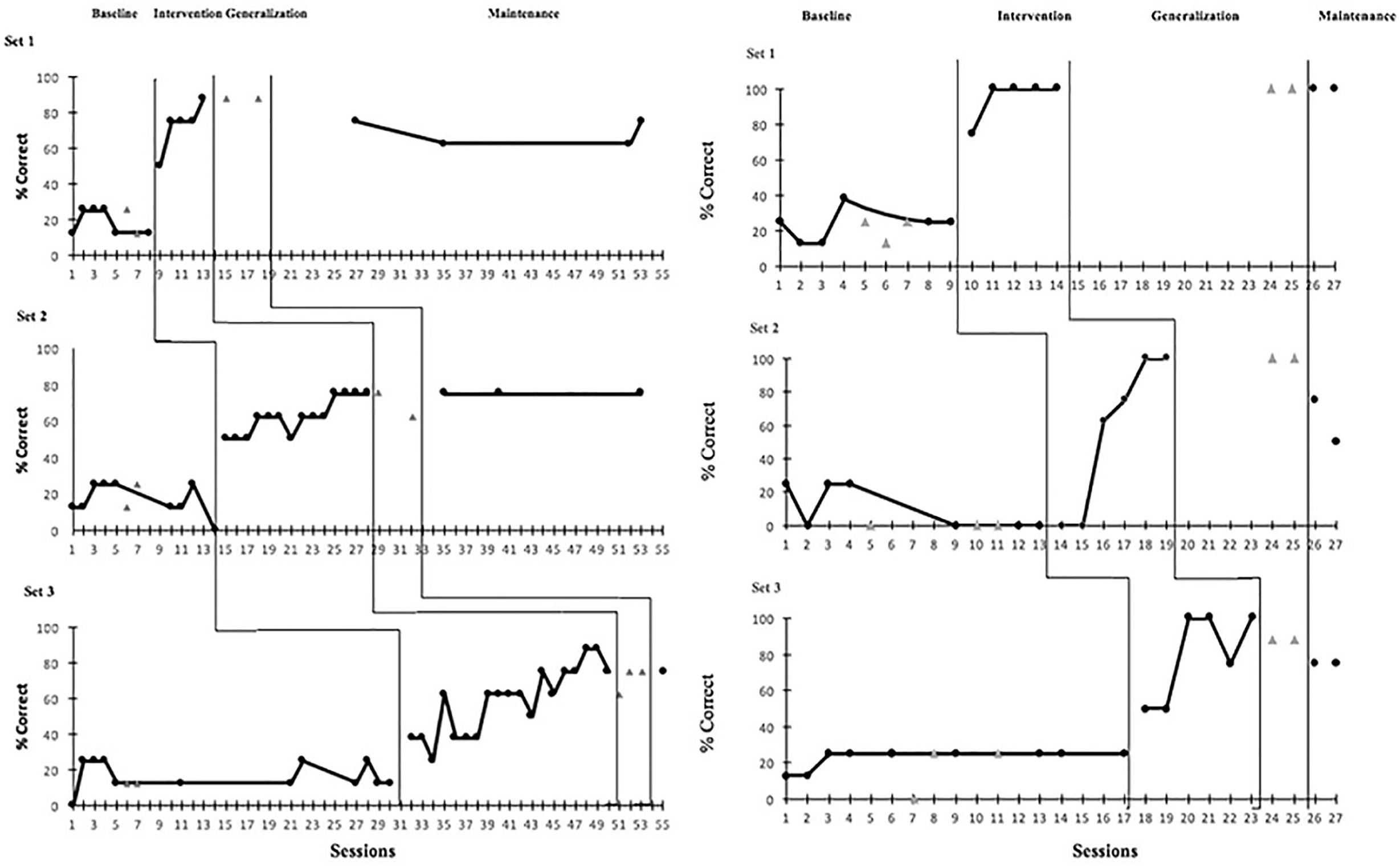
Percentage of single-words read correctly, by Nick (left) and Jake (right), out of eight trials, in the probes during baseline, intervention, generalization (the triangles on the graph), and maintenance.

Percentage of single-words read correctly, by Cole (left) and Curt (right), out of eight trials, in the probes at baseline, during intervention, and during generalization and maintenance.
Acquisition of Single Words
Nick demonstrated considerable improvement as a result of intervention across all three word sets (Figure 1). Gains were calculated by comparing the average of baseline to the average of the last three intervention sessions. Gains across sets included +59% for Set 1 (almonds, crackers, swim, stop), +58% for Set 2 (bird, read, run, gym), and +63% for Set 3 (scooter, help, computer, horse). According to Tau-U calculations, the size of the effects was very large, with a Tau-U value of 1.0 for Set 1 (p = .006), 1.0 for Set 2 (p = .000), and .97 for Set 3 (p = .000).
Jake also demonstrated significant improvements across all three word sets, as a result of the intervention (Figure 1). Gains across sets included +77% for Set 1 (washer, wrench, baler, shovel), +81% for Set 2 (harrow, hose, pliers, litter), and +72% for Set 3 (camping, camo, pager, lure). According to Tau-U calculations, the size of the effects was medium to very large, with a Tau-U value of 1.0 for Set 1 (p = .006), .52 for Set 2 (p = .116), and 1.0 for Set 3 (p = .000).
Similar results were seen for Cole, with improvements from baseline across all three word sets as a result of participating in the intervention (Figure 2). Gains across sets included +79% for Set 1 (frito, bunny, potty, pizza), +73% for Set 2 (pool, pretzel, cars, ipad), and +54% for Set 3 (jeep, juice, bike, mickey). According to Tau-U calculations, the size of the effects was very large, with a Tau-U value of 1.0 for Set 1 (p = .002), 1.0 for Set 2 (p = .002), and .88 for Set 3 (p = .007).
Figure 2 displays the percentage of targeted single words in each set identified correctly by Curt during the baseline, intervention, and generalization conditions. The participant experienced medical issues (including seizures) during the study and subsequently left school. Due to this, intervention probes were completed for word Sets 1 and 2, and generalization probes were completed for word Set 1 only. No maintenance probes were completed. For word Set 1 (cheetos, minecraft, computer, water), Curt demonstrated a notable gain of +52% (calculated by comparing the average of baseline to the average of the last three intervention sessions). According to Tau-U calculations, the size of the effects was large, with a Tau-U value of .79 for Set 1 (p = .000). For Set 2 (marker, milk, legos, eraser), an improvement was seen as a result of the intervention. Baseline mean percent accuracy was 16% (range, 0%–25%), with improvement to a mean accuracy of 50% for the last three interventions that Curt participated in. A stable baseline was established for Set 3 (spin, run, candy, cut) with a mean percent accuracy of 21% (range, 0%–38%); however, intervention probes were not completed due to illness.
Rate of Acquisition
Participants ranged in exposures per word from 60 to 348. More specifically per participant, Nick averaged 152 exposures (range, 60–228) or approximately 7 mins. per word. Jake averaged 68 exposures or approximately 3 mins. per word (range, 60–72). Cole averaged 68 exposures or approximately 3 mins. per word (range, 60–84). Curt only met the criterion for Set 1 words. He participated in 29 sessions, for a total number of 348 exposures, per word.
Generalization
Generalization data were also collected during baseline and after the intervention ended to determine whether participants generalized their word reading skills to different graphic representations of the target words. Generalization occurred immediately after criterion was reached for Nick, Cole, and Curt. Due to school breaks and some health issues, Jake’s generalization occurred right before maintenance. During generalization new photographs (not seen during intervention) were used to represent the target words. Nick demonstrated notable gains of +69% (Set 1), +50% (Set 2), and +58% (Set 3) for pre- and post-intervention generalization measures. Like Nick, Jake demonstrated notable gains of +79% (Set 1), +100% (Set 2), and +63% (Set 3) for pre- and post-intervention generalization measures. Cole demonstrated similar generalization results, with pre-intervention generalization scores at low levels (range, 6%–25%) and scores were significantly increased (range, 94%–100%). These changes from pre- to post-intervention resulted in large gains: +75% (Set 1), +75% (Set 2), and +88% (Set 3).
Maintenance
Maintenance data ranged from 2 to 12 weeks from the last intervention session of the Set, with Set 3 having the least amount of time between intervention and the final maintenance measure. Maintenance probes were conducted at different times across the Sets and will be reported per participant’s data. No maintenance measures are available for Curt, as he left the study early due to illness.
Nick’s mean percent accuracy for maintenance was 69% (Set 1), 75% (Set 2), and 75% (Set 3). Set 1 was measured at 8 and 12 weeks from the last intervention session; Set 2, 4 and 8 weeks; and as previously stated Set 3 was measured at 2 weeks from the last intervention session. Jake’s mean percent accuracy for maintenance was 100% (Set 1), 63% (Set 2), and 75% (Set 3). Set 1 was measured at 8 and 12 weeks from the last intervention session; Set 2, 4 and 8 weeks; and Set 3 was measured at 4 and 6 weeks from the last intervention session. Cole demonstrated the strongest maintenance means. His percent accuracy for maintenance was 94% (Set 1), 100% (Set 2), and 100% (Set 3). Set 1 was measured 4 and 12 weeks from the last intervention session; Set 2 4 and 12 weeks; and Set 3 was measured at 2 and 8 weeks from the last intervention session.
Social Validity
A total of four educational professionals provided written and/or oral responses to the questions, including the three paraprofessionals and one classroom teacher. All professionals who completed the social validity questionnaire worked closely with the participants and had observed some sessions during the course of the study. After the study, each professional either strongly agreed or agreed that the goals of literacy were important for the participant with whom they worked; that they see a place for technology to help support literacy; that they struggle to find literacy instruction that allows adaptations for minimally verbal students; and that AAC systems could be used to support literacy learning.
In response to the two open-ended questions, all of the education professionals stated they believed the participants enjoyed the task and that they would like to continue to implement the intervention with the students and other students they work with in the future. For example, one paraprofessional shared, “I think the software is practical and easy to use.” A teacher shared, “It was great to see the progress they made. This is something we can keep doing every day. I am always looking for more structured ways to use their AAC systems.”
Discussion
Students with severe ASD and minimal speech are likely to require specialized instruction for literacy and communication to experience better post-school outcomes (Caron et al., 2018; Tager-Flusberg & Kasari, 2013). With federal mandates that schools achieve improved outcomes in reading for all students (Knight et al., 2010), including those with severe disabilities, research to support access to literacy instruction for individuals with minimal or no speech who require or benefit from AAC is vital to accomplish this goal. This study aimed to improve literacy outcomes, specifically single-word reading, with four individuals who had severe ASD and minimal or no speech through the use of AAC technology.
Results from this study provide preliminary evidence that redesigning AAC apps with literacy support features (i.e., T2L feature) can positively affect single-word learning. The four participants in this study demonstrated increased accuracy reading as many as 12 words, with the introduction of an AAC app with T2L features. The gains were observed after a range of 60 to 348 exposures to the target words. Although no research to date has evaluated the impact of AAC apps with the T2L feature with older individuals with severe ASD who have minimal speech and very limited literacy skills, the results from this study are notable given the participant’s challenges and previous literacy history. Also, the results contribute to the growing body of research that demonstrates the effectiveness of the T2L feature in AAC apps to support literacy learning for individuals with complex communication needs (e.g., Caron et al., 2018; Caron et al., 2020; Holyfield et al., 2020; Mandak et al., 2019). Extrinsic and intrinsic factors may have contributed to the effectiveness of the intervention and positive gains made by the participants.
Extrinsic Factors
The T2L literacy feature was likely a contributing factor to the positive gains made by the participants. For example, first, the individual selects a graphic symbol using his or her AAC system, ensuring the learner’s knowledge of the concepts and supporting literacy learning driven by the individual’s interests and needs (Light & McNaughton, 2013). After the selection of the graphic symbol, the text is dynamically presented on the screen and uses movement to attract the learner’s visual attention to the text (cf., Wilkinson & Jagaroo, 2004). In addition to the dynamic presentation of the text, the text is paired with speech output upon selection. After the text appears on the screen for 3 s, the text disappears back into the graphic symbol that was selected. The active pairing (both between the text and graphic symbol and text and speech output) is designed to support the learning of the association between the written word and its referent (picture symbol and/or spoken word; cf. Browder & Xin, 1998; Fossett & Mirenda, 2006). Integrating literacy supports into communication systems has the potential to provide increased opportunities for functional learning and exposure to text throughout the day (Light et al., 2014).
In addition to the design of the T2L features of the AAC app, the effectiveness and the efficiency of the intervention may have also been impacted by the task and the words selected. The participants matched the image representation of the target word in the book to an icon on the AAC device. The match-to-sample procedures (Sidman, 1971) were tasks with which the participants were familiar; these procedures allowed for multiple exposures to the word in a small amount of time. In addition, personally relevant and motivating words were selected for each participant. Individuals learn single words more rapidly when the words are more familiar, real (vs. nonsense, like “fim” or “bol”), and appear more frequently (e.g., cake vs. sake; Roberts et al., 2011). Also, using words with meaning to the individual has a greater potential of fostering intrinsic motivation and increasing engagement in literacy activities (Caron et al., 2020; Light & McNaughton, 2013). Thus, the selection of personally relevant and highly motivating words may have been an important factor in positive gains.
Despite the gains demonstrated in this study, the individuals previously experienced very limited literacy success. Low expectations and inadequate instruction have contributed to poor literacy outcomes for individuals with severe disabilities (Ruppar, 2017; Spooner et al., 2006). None of the individuals included in the study had specific literacy goals in their educational plans (e.g., no goals for sight words or letter sounds). These issues may be due to service providers’ training experiences; training may not have emphasized the means for adapting instruction when individuals have minimal or no speech (Spooner et al., 2006). Limited to no training for providers is required for use of the T2L feature, as the feature presents words to the individual through AAC system activation. All four service providers that completed the social validity questionnaires stated that the intervention was something that they could do. Although parallel instruction in literacy is recommended (e.g., direct instruction in phonological awareness like letter-sound knowledge or decoding), the T2L feature may have the potential to provide a means for access to some literacy instruction.
Intrinsic Factors
Three studies, including this study, have investigated the use of the T2L feature with participants with ASD. The participant’s age, diagnosis, and current literacy skills likely played a part in the different outcomes observed. Caron et al. (2018) introduced the T2L feature in the same AAC app used in this study, to five school-aged students with ASD (aged 6–14), in structured one-on-one sessions targeting 12 single words. Mandak et al. (2019) investigated the effects of the T2L feature within a visual scene AAC application, targeting 10 single words, during a shared reading of the storybook Brown Bear Brown Bear with three preliterate preschoolers with ASD (ages 3–4). Each of these studies offers promising results for use of the T2L feature with individuals with ASD, with all three studies showing positive gains for the participants and moderate to very large effects. Yet, there are differences across the three studies.
All individuals with ASD, across the studies, have made some progress with word acquisition after exposure to the T2L feature. Although caution should be taken when comparing these findings, the number of exposures required to support acquisition varied; this provides potentially important considerations for future interventions. The preschoolers in the study by Mandak and colleagues (2019) acquired single words with 55 to 135 exposures. In the study by Caron and colleagues (2018), the participants learned to recognize the single words in 20 to 32 exposures. The participants who completed this study learned the single words in 60 to 228 exposures. The participants in the study by Caron and colleagues required considerably fewer exposures. The participants in that study had acquired 26 letter-sound correspondences and demonstrated greater knowledge of sight words. With this level of phonemic awareness and more literacy success, these individuals were likely able to use partial visual and phonetic connections to help identify sight words (Ehri, 2005).
Ehri’s phase theory (2005) has application to the study differences. This theory portrays the emergence of skills and strategies that support sight word reading. During the pre-alphabetic phase, individuals mainly rely on salient visual or contextual features to read words. The individuals in this phase may not know letters and lack phonemic awareness skills (Ehri, 2014). Also, their sight word skills may be described as unreliable and having several guessing errors. Nate and Curt fit this description, and therefore, it is not surprising that these two individuals needed the most exposures to acquire the target words.
Once individuals learn letter sounds, they can begin to apply this knowledge to remember how to read a word. Ehri (2005) describes individuals with this knowledge as partial alphabetic. The connections in this partial alphabetic phase are still incomplete, as individuals still have no use of decoding skills, and rely on predicting and memorizing words from initial letters and context cues (Ehri, 2014). In this phase, an individual’s sight word reading is developing yet will often include errors when presented with similar spelled words (e.g., words with similar initial and final constants, like swim and stem; Ehri, 2014). Jake and Cole, as well as the participants in Caron et al. (2018), fit the description of this phase. These individuals needed half the number of exposures (or less) to acquire their target sight words, in comparison to Nate and Curt, and some of the individuals from Mandak et al. (2019). Although letter sounds seem to help in terms of rate of acquisition, and these individuals may need fewer exposures or repetition to acquire words, this knowledge is not a prerequisite for use of the T2L feature as demonstrated by gains made in Mandak et al. and Nate and Curt in this study.
Limitations and Future Directions
There are a number of limitations that should be considered when interpreting the results. First, the study included only a small number of participants (i.e., four). Future research should investigate the effects of the T2L feature with a larger number of participants, as well as individuals across ages and communication needs. In addition, the study targeted a small, closed set of choices that included only symbols for words targeted within the study, only one other word with the same initial letter as the targeted word, varied word lengths, and a limited array of response options (i.e., a choice from four photographs). The closed set of responses may have simplified the reading task (Barker et al., 2012); future research is required to investigate varied sets of words, the impact of foil choices, and larger word sets to determine the effectiveness of T2L features.
The words selected for the study were primarily nouns and they were words often described as high-frequency words (e.g., want, yes, no, like). Additional research is needed to understand the implications of the app on the learning of these types of words that are often communicated and read in connected text. This study isolated the introduction of the AAC app with T2L features as the independent variable in the study. The study design does not allow comparison of the effectiveness of AAC apps with and without T2L features, as well as the relative effectiveness or efficiency of different design considerations (e.g., animation speech, size of text, the color of the word). Future research and development are required to investigate these considerations, as well as the effects of traditional AAC apps (i.e., the static pairing of symbols and text) on single word learning as compared with the effects of the AAC app with dynamic T2L features.
Furthermore, to investigate the effects of the AAC app as the independent variable, no additional literacy instruction with these words was provided. This is not best practice but was required as the first step in a research line to isolate the effects of the T2L feature. The use of the T2L feature does not provide the same benefits of explicit literacy instruction, including teaching the participants to decode and encode. Therefore, the AAC app with T2L features is designed to supplement, not replace, literacy instruction, and future research is required to determine the effects of the AAC app with T2L features when used in this manner. In addition, the app was also introduced in a highly structured task. The app contributed to the acquisition of the target words in this structured implementation, but future research is required to investigate the effects of the T2L feature on literacy acquisition when utilized in daily communication interactions; the feature may be best to support literacy during use in a more structure learning task.
This study also focused on an isolated skill, single-word reading. Single-word reading is a skill that is important to literacy development; however, learning to read and write requires a complex process of integrating and applying a wide range of component skills and knowledge, as well as integrating background experience, knowledge, and language understanding (Mirenda & Erickson, 2000). Therefore, future research and development are required to investigate the effects of the T2L feature on other literacy skills, like letter-sound knowledge and decoding (Light et al., 2019).
In this study, the symbols were not faded and generalization measures were not collected on if the participants could communicate with text-only grid displays. Future research and development are required to investigate how to support the transition to traditional orthography from symbol-based AAC displays. This may include investigating the number of exposures required for acquisition and the total number of words to target during instruction. With built-in system features, the AAC system could prompt service providers to test the acquisition of the word and offer the option for removal of the graphic icon, thus slowly fading graphic icons and supporting the transition to more of an orthographic system.
Finally, limited social validity data were collected for the study. Consent was not given to use videotapes of sessions beyond the research team and questionnaires only were completed by four professionals who worked closely with the participants. Future research should include more robust social validity measures and investigate some implementation variables related to the use of the T2L feature. These variables might include the likelihood of adoption, acceptability of application and procedures, and feasibility of the intervention. Social validity information could also contribute to a better understanding of how this feature could be used to be a part of a larger literacy intervention.
Conclusion
Literacy skills are vital for all individuals. Many individuals who have minimal or no speech have been viewed as incapable of developing literacy skills (Morgan et al., 2011), thus contributing to poor literacy outcomes. Yet once an individual can read even a few words, this skill can open doors to more meaningful communication, education, and literacy experiences. Once a set of single words are mastered, these words can serve as a foundation for further literacy development and can support the beginning of a transition from an AAC system that utilizes mainly graphic symbols to orthography (Caron et al., 2018). This study provides preliminary evidence that redesigning AAC apps with T2L features (i.e., dynamic text with speech output upon selection of graphic symbol) results in improvements in single-word reading for individuals with severe ASD who have minimal or no speech and who have had limited literacy opportunities or success. With mandates that schools improve outcomes in reading for all students, including those with severe disabilities and minimal or no speech, research with innovative solutions like the T2L feature provides one potential solution to contribute toward accomplishing this important goal.
Footnotes
Acknowledgements
The authors would like to offer their gratitude and thanks to the participants who contributed their time. The authors would like to thank Saltillo for the realization of the T2L software features for evaluation and for the loan of the AAC equipment. The authors would like to acknowledge Emily Curtin and Clark Knudtson for their contributions to the project.
Declaration of Conflicting Interests
The author(s) declared no potential conflicts of interest with respect to the research, authorship, and/or publication of this article.
Funding
The author(s) disclosed receipt of the following financial support for the research, authorship, and/or publication of this article: The contents of this paper were developed under a grant from the National Institute on Disability, Independent Living, and Rehabilitation Research (NIDILRR grant # 90RE5017). NIDILRR is a Center within the Administration for Community Living (ACL), Department of Health and Human Services (HHS). The contents of this paper do not necessarily represent the policy of NIDILRR, ACL, HHS, and you should not assume endorsement by the Federal Government.
Editor in Charge: Robert E. O’Neill
