



Abstract
A growing body of literature supports the effectiveness of Modified Schema-Based Instruction (MSBI) to improve mathematical problem-solving for students with autism spectrum disorder (ASD) and intellectual disability (ID). MSBI is an intervention package that teaches students to identify the problem structure and use a problem-solving heuristic to solve mathematical word problems. Previous research has primarily implemented MSBI in a one-on-one setting with a researcher as the interventionist. This study aimed to investigate the effects of a teacher-delivered MSBI in a small group format on the multiplicative word problem-solving skills of six middle school students with ASD/ID as well as their ability to generalize from word problems to video-based problems. Results of the multiple probe across participants design indicate a functional relation between MSBI and word problem-solving, but generalization varied across participants and maintenance was limited to two participants due to the coronavirus disease 2019 pandemic school closures. Implications for practice and future research are discussed.
All students are entitled to an equitable education that does not leave them victims of low expectations in mathematics (National Council for Teachers of Mathematics, 2000). The recent Endrew v. Douglas County School District (2017) ruling reinforced federal mandates for educators to use scientifically based practices to assist all students, including those with autism spectrum disorder (ASD) and intellectual disability (ID), to reach appropriately ambitious goals. Drawing from Brown et al.'s (1976) criterion of ultimate functioning, mathematics instruction for students with ASD/ID should maximize instructional time by supporting students to not only acquire, but also become fluent in, and generalize meaningful skills they can apply in current and future environments. Therefore, reasoning and problem-solving make mathematics “functional.”
To solve mathematics problems, students must be able to not only complete the arithmetic procedures but also reason about the relationships between quantities (Nunes et al., 2015). The level of difficulty of a mathematical problem is not determined by the arithmetic required to arrive at a solution, but rather the quantitative reasoning necessary to model the problem and select appropriate arithmetic procedures (Nunes & Bryant, 2015). Quantitative reasoning emphasizes relationships between quantities (Thompson, 1993), which are either additive (i.e., quantities connected with part–part–whole relations) or multiplicative (i.e., quantities connected by one to many or ratios; Nunes & Bryant, 2015). Additive problem structures can be categorized as combine (i.e., total or group; parts combined for a sum), compare (i.e., difference; sets compared for a difference), or change (i.e., join or separate; amount increases or decreases). Multiplicative problem structures can be categorized as equal groups (i.e., vary; number of equal sets or units), comparison (i.e., one set as a multiple or part of another set), or proportions (i.e., percentages, unit rates; relationships among quantities). Interventions focused on identifying the problem structure can support the appropriate use of quantitative reasoning (Dooren et al., 2010).
Although mathematical problem-solving includes more than solving word problems (Woodward et al., 2012), it is generally measured via word or story problem tasks that target specific mathematical structures (Jitendra et al., 2014). Word problems present a mathematical situation using text and represent the application of mathematical concepts to everyday life situations (Lein et al., 2020), often serving as a proxy measure of a student’s ability to solve problems occurring in the “real world” (Peltier & Vannest, 2017). Word problems give students the opportunity to use mathematical terminology and notations. Solving mathematical word problems requires interpreting linguistic information to identify corresponding schematic content (i.e., problem structure), translating it into a symbolic representation using mathematical notation (i.e., equation), then selecting and applying an appropriate strategy to solve the problem (Montague et al., 2011). Students can learn to demonstrate quantitative reasoning through representational tools that help them “mathematize” situations (Nunes et al., 2015). Schematic diagrams (see Figure 1) provide support for this mathematizing by providing a concrete framework for modeling the problem based on the identified problem structure (i.e., schema) and then executing appropriate strategies to solve it (Jitendra et al., 2002).
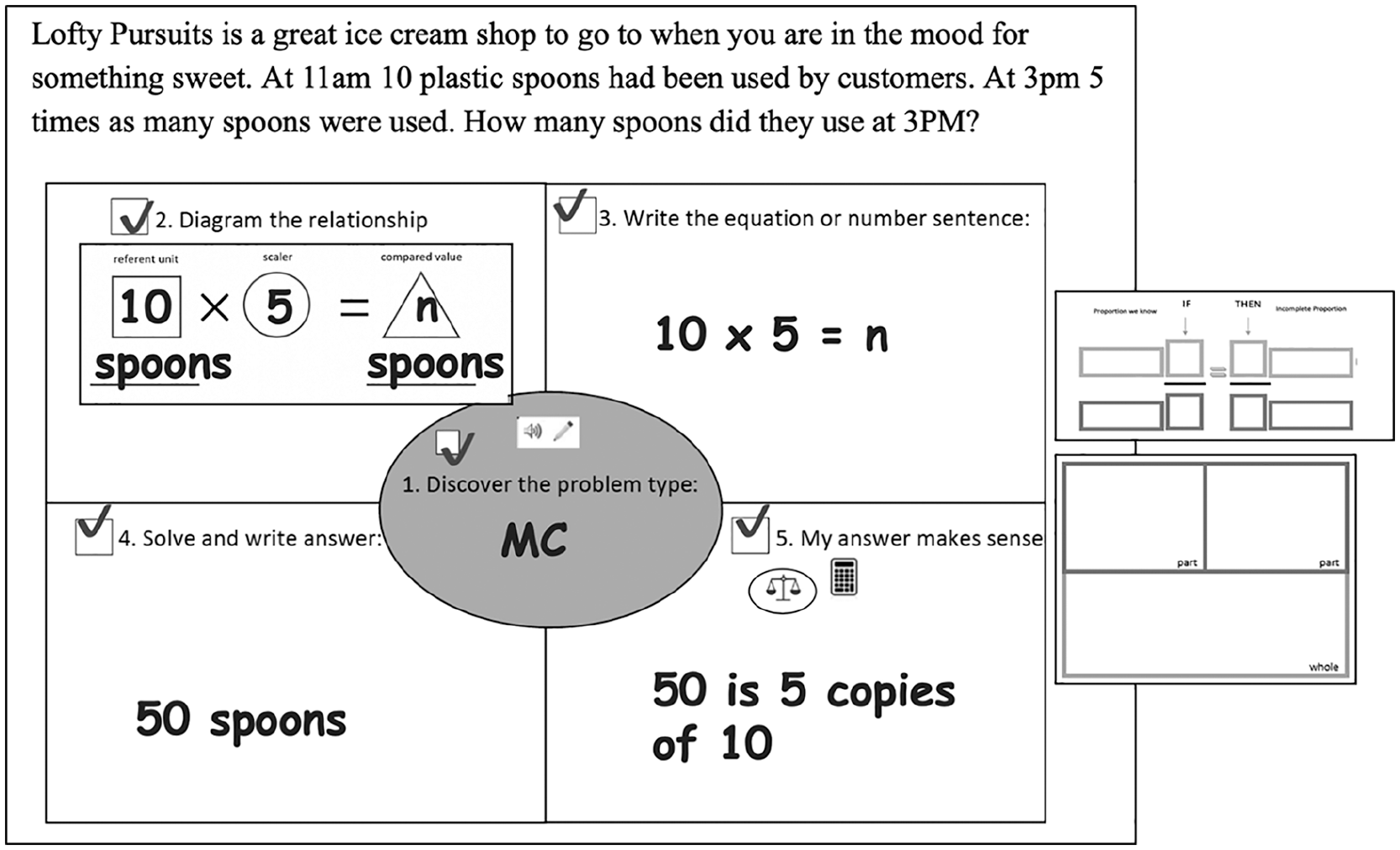
Example completed worksheet (The multiplicative compare schema in this figure is from Xin, 2008, p.540).
Instruction that helps students to develop schemas will support the conceptual understanding needed for quantitative reasoning and problem-solving while also supporting working memory (Kalyuga, 2006). Schematic representations can take different forms, including diagrams, bar models, graphic organizers, tables, and charts (Hwang & Riccomini, 2016). According to Hegarty and Kozhevnikov (1999), schematic representations explicitly illustrate “the spatial relationships between objects and imagining spatial transformations” (p. 685). They require students to apply conceptual understanding to depict the schema (problem type) and apply it to the situation presented in the problem (Cook et al., 2020). Students with ASD/ID can develop and act on these schemas to acquire, maintain, and generalize mathematical problem-solving when provided with explicit instruction on how to do so (Clausen et al., 2021).
Marshall’s (1995) initial work on applying schema theory to mathematical problem-solving has been extended and refined in the subsequent 25 years, with multiple systematic reviews and meta-analyses identifying teaching the underlying schemas of word problems as an effective strategy for students with disabilities (e.g., Cook et al., 2020; Jitendra et al., 2015; Peltier et al., 2018; Peltier & Vannest, 2017). Although there are several approaches that include the use of schemas, the most prevalent in the literature is schema-based instruction (SBI), which explicitly teaches students to: (a) identify the schema (problem type), (b) use a schematic diagram to represent quantities from the problem, (c) identify a plan for solving the problem, and (d) carry out the plan and check for reasonableness (Peltier & Vannest, 2017).
Although the evidence-base for SBI includes two decades of work, research on teaching mathematical word problem-solving to students with ASD/ID was minimal until 2015 (Spooner et al., 2019). Expanding on the schema research with students who have learning disabilities or mathematical difficulties, Spooner et al. (2017) put forward a conceptual model for modified SBI (MSBI), which layers evidence-based practices for teaching mathematics to students with ASD/ID (Spooner et al., 2019) on the aforementioned foundational components of SBI. The aim of MSBI is to ensure students are able to: (a) access the problem, (b) conceptually comprehend and model the problem, (c) procedurally solve the problem, and (d) generalize skills. Clausen et al. (2021) and Root, Ingelin, et al. (2021) found over a dozen methodologically sound studies that used MSBI to teach mathematical problem-solving to students with ASD/ID in their respective systematic reviews. Although the majority focused on additive schemas (e.g., combine, compare, and change), recent experimental studies made important contributions to understanding how MSBI can support students with ASD/ID to solve multiplicative problems.
The first attempt to teach multiplicative problem-solving using MSBI focused on personal finance skills, specifically percent of change problems in the context of finding the final price after a discount (Root et al., 2018). Middle and high school students with ASD and ID were taught to solve multiple step problems by following steps of a task analysis. Results of the single-case multiple probes across participants design found participants were able to acquire and generalize skills from word problems to natural stimuli (e.g., actual receipts, coupons, menus). Subsequent studies provide converging evidence of the effectiveness of MSBI for teaching secondary students with ASD/ID to solve multiplicative word problems (Gilley et al., 2021; Root, Cox, Davis, et al., 2020; Root, Cox, Saunders, et al., 2020). Although the work of Root and colleagues using MSBI to teach multiplicative problem structures to students with ASD/ID is promising, all studies thus far have taken place in a one-on-one format with members of a research team (e.g., graduate students) serving as interventionists.
The prevalence of researcher-implemented interventions is echoed in the general SBI literature. Peltier et al. (2018) conducted a meta-analysis of single-case research design studies published between 1993 and 2017 that used schema instruction to teach word problem-solving to students with disabilities, finding 15 out of 16 studies were implemented by researchers. Group experimental research has shown teachers could implement SBI to teach students with learning disabilities with a high level of fidelity (e.g., Griffin & Jitendra, 2009; Jitendra et al., 2002). Meta-analyses have found larger effects for researcher-delivered, or researcher and teacher combined versus teacher-delivered interventions (e.g., de Boer et al., 2014; Lein et al., 2020; Peltier & Vannest, 2017).
Peltier and colleagues have studied the effectiveness of teacher-implemented SBI in small groups of students with high-incidence disabilities using single-case research design, with two similarly structured studies providing divergent findings. Peltier, Lingo, et al. (2020) examined the effects of SBI to solve additive problem structures for five elementary students with disabilities in a resource setting. An elementary special education teacher provided all instruction in small groups of two to three students. The multiple probe across participants design established a functional relation, but student performance was variable and researchers did not feel it met socially significant levels and fidelity frequently dipped below 80%. In contrast, Peltier, Sinclair, et al. (2020) aimed to evaluate the efficacy and feasibility of teacher-implemented SBI on combined problem structures for elementary students in a resource setting. Twelve elementary students with disabilities (two with ASD) were taught in small groups by their special education teacher in short lessons that averaged 18 min. The multiple probe across participants design established a functional relation, with comparable findings to researcher-implemented studies in terms of acquisition and generalization of skills as well as fidelity of implementation.
To date, only one published study has evaluated teacher implementation of MSBI. Browder et al. (2018) trained special education teachers in procedures for additive word problem-solving using MSBI with student dyads of elementary and middle schoolers with moderate intellectual disability. Results of the multiple probe across student dyads design found a functional relation between MSBI and steps of a task analysis completed independently correct. Furthermore, students were able to maintain and generalize skills to video-based problems.
This study aimed to evaluate the effects of teacher-implemented MSBI in instructional dyads on acquisition and generalization of multiplicative problem-solving skills for middle school students with ASD/ID. Prior research has shown students with ASD/ID can learn multiplicative problem-solving when taught in one-on-one settings with researchers, but there is a critical deficit of research supporting the practice when implemented by special education teachers. We asked the following research questions:
Method
Setting
After receiving human subjects approval from the university and local school district, researchers recruited special education teachers by contacting all middle school principals of one school district in the southeastern United States. Three teachers from two schools within the same district participated in the study. School A was located in a suburban area and had 1,013 students enrolled in Grades 6 to 8 (70% White, 15% Black, 7% Hispanic), and 10.8% were identified as students with disabilities. School B was located in an urban area in the same city and met federal requirements for designation as Title 1. School B had 956 students enrolled in Grades 6 to 8 (30% White, 55% Black, 6% Hispanic), and 15.5% of the school population were identified as students with disabilities. All sessions, to the extent possible, were completed in a workroom attached to the teachers’ main classrooms during regularly scheduled math instruction.
Participants
Table 1 contains demographic information on teacher and student participants. Three special education teachers expressed interest and consented. The first teacher, Mr. Gibbs, was a White male with a bachelor’s degree in elementary education, 10 years of special education teaching experience, and no prior experience with MSBI. When asked about his current math instruction, Mr. Gibbs reported that his priority was for his students to think through problems and solve them independently, beginning with a focus on addition and subtraction. He discussed individualizing instruction based on student needs and being an “experimenter” who would try different things with students to see what helped them to understand concepts. Researchers observed students completing worksheets with a variety of mathematical content that Mr. Gibbs had downloaded from the internet, selected based on their Individualized Education Program (IEP) goals. The second teacher, Ms. Gonzo, was a Latinx female with a bachelor’s degree in special education. She was finishing requirements for her master’s degree in special education and was completing her student teaching under the supervision of Mr. Gibbs. Ms. Gonzo had research experience with the authors and had implemented MSBI to teach a different problem type to older students with ASD in a prior single-case study. Both Mr. Gibbs and Ms. Gonzo taught at school A.
Participant Demographics.
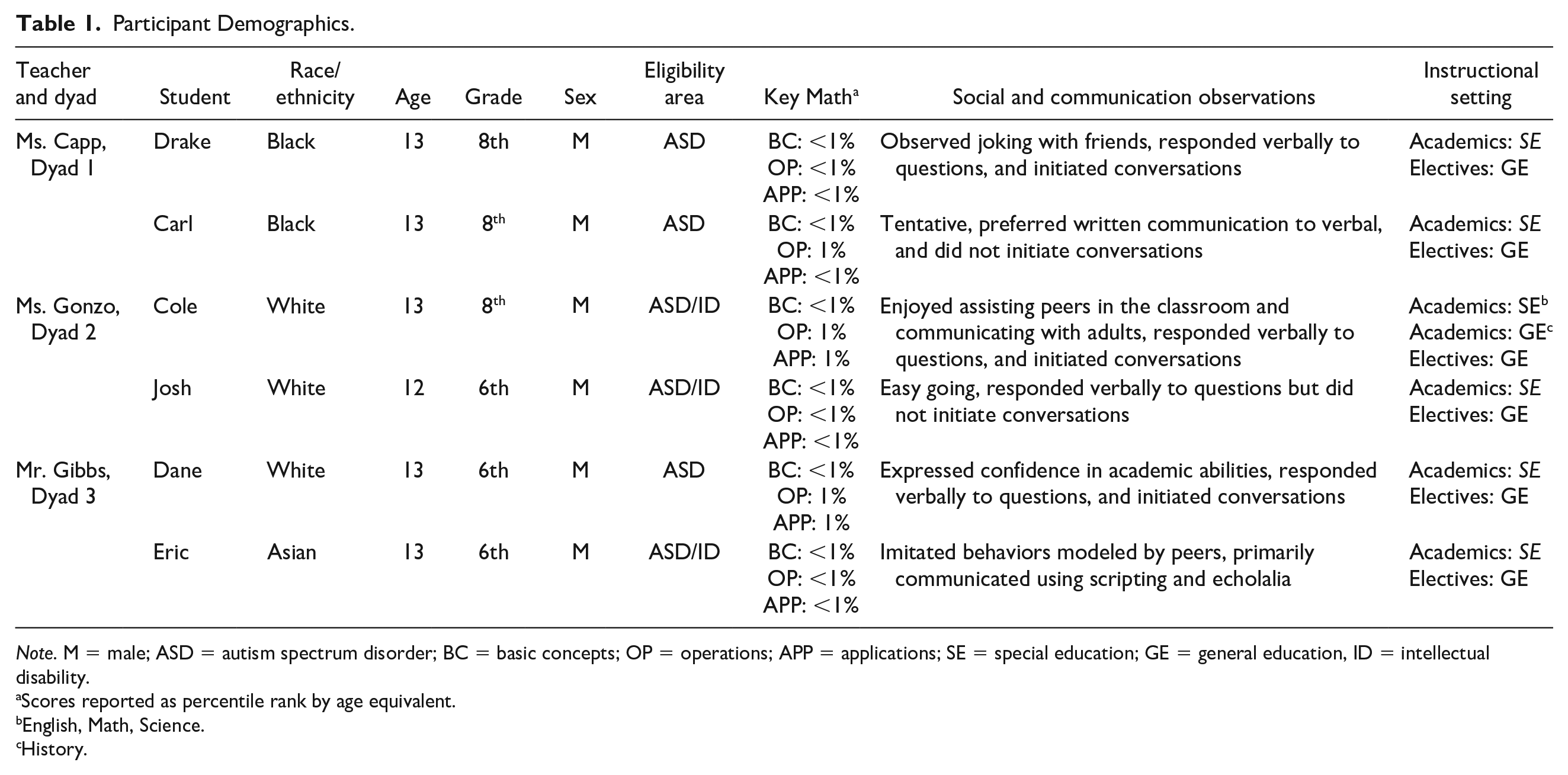
Note. M = male; ASD = autism spectrum disorder; BC = basic concepts; OP = operations; APP = applications; SE = special education; GE = general education, ID = intellectual disability.
Scores reported as percentile rank by age equivalent.
English, Math, Science.
History.
The third teacher, Ms. Capp, was a White female with a bachelor’s degree in psychology and 3 years of experience in special education; she was enrolled in a master’s degree program in special education. She did not have prior experience implementing MSBI. When asked about her current math instruction, Ms. Capp reported she focused on functional skills and real-world applications such as time and money, but that a lack of resources and training was a barrier to her effectiveness in mathematics instruction. She reported that she had access to Unique Learning System curriculum (n2y, 2021) and sometimes used those materials but supplemented frequently based on her students’ IEP goals and current needs.
Student participants were recruited from these two classrooms. The special education teachers sent home recruitment fliers and consent forms to all students enrolled in the class who took the state’s alternate assessment aligned with alternate achievement standards. All students who returned consent forms and assented to participation were screened for inclusion. Student participants were screened by researchers to determine whether they had the prerequisite skills, including: (a) using one-to-one correspondence to count 1 to 20 objects, and (b) receptive and expressive identification of numerals up to 99. Details on the screening are provided in the procedures of this manuscript. A total of seven participants met inclusion criteria. Due to the coronavirus disease 2019 (COVID-19) pandemic, schools were closed before the seventh participant entered intervention; therefore, only six participants are reported in this manuscript. Standardized and diagnostic test information were not provided by the school to researchers. To obtain a standardized measure of students’ math performance, the second author administered the Key Math-3 (Connolly, 2007), a diagnostic assessment that provides details about a student’s current mathematics abilities, and is appropriate to use with students with disabilities, as they were included in the normative sample (Connolly, 2007). Heterogenous student dyads were created based on researcher observation.
Materials
Student participant materials for baseline and intervention sessions included: (a) researcher-created anchor videos; (b) worksheets displaying a problem-solving heuristic, multiplicative comparison word problem, and schematic diagrams; (c) manipulatives (i.e., unifix cubes); (d) calculators; and (e) writing utensils. During generalization sessions, materials included: (a) anchor videos, (b) generalization worksheets displaying a problem-solving heuristic and schematic diagrams, (c) researcher-created generalization problem videos, (d) manipulatives (i.e., unifix cubes), (e) calculators, and (f) writing utensils.
Anchor videos were 20 to 30 videos that depicted real-life multiplicative comparison scenarios in community locations (e.g., local lake, food trucks, plant nursery). All videos were created by student members of the research team in the local community and used locations participants would be familiar with. For example, one video featured a local lake and had voice-over narration stating the lake was home to ducks and turtles; another video showed two people in exercise apparel walking and had voice-over narration stating that visiting the lake with friends was a fun activity.
Worksheets used during baseline and intervention sessions displayed a heuristic for solving the problem and one word problem printed at the top of the page. Researchers wrote six multiplicative comparison word problems for the 12 community locations following guidelines by Spooner et al. (2017). The first line gave the context of the problem (e.g., “Eric went to the park to feed ducks.”). The second line gave the referent unit (e.g., “Eric saw a family of 3 people under one picnic shelter.”). The third sentence stated the compared value or scalar (e.g., “At another picnic shelter he saw 8 times as many people for a family reunion.”). The final sentence contained the problem statement (e.g., “How many people did he see at the family reunion under the second picnic shelter?). Once students selected a theme, that theme was crossed out. Therefore, problems were never repeated. Three schematic diagrams were given as choices to students (multiplicative comparison and two distractors). See Figure 1 for an example worksheet, problem, and schematic diagram.
Worksheets used during generalization sessions mirrored those used in intervention except they did not display a word problem at the top. Generalization problem videos aligned with the community locations from the anchors and word problems. For example, the generalization video aligned with the gardening theme depicting two young adults shopping at a local plant nursery and asked a question comparing the number of cacti purchased to the number of herbs purchased. Participants were able to pause and re-watch the video as needed.
Materials and procedures were reviewed for content validity. Specifically, the word problem guidelines, heuristic, teaching procedures, and schematic diagrams were reviewed by an expert in SBI who was not a member of the research team. Minor suggestions were made and followed regarding teaching procedures. An expert in middle-grade mathematics reviewed all word problems to ensure they met the guidelines and represented realistic multiplicative comparison scenarios. Problems were deemed similar in difficulty (i.e., followed the same four-sentence structure and used quantities between 0 and 100).
Procedures
Similar to prior MSBI research, participants that assented were given a screening to determine whether participants would benefit from the intervention (i.e., had prerequisite skills but could not already solve the targeted word problems). Screening tasks included: (a) counting with one-to-one correspondence; (b) receptive and expressive identification of single- and double-digit numbers; (c) receptive and expressive identification of mathematics symbols (i.e., percent, fraction, multiplication); (d) using a calculator to complete addition, subtraction, multiplication, and division calculations and write solutions; and (e) solving word problems.
Teacher training
To prepare teacher participants to use MSBI to teach their students to solve multiplicative comparison word problems, researchers created a two-part teacher training that followed a behavioral skills training (BST; Miltenberger, 2015) model. First, teachers were asked to watch a video that provided background information on the research timeline, MSBI, and the specific goals and process of the study. Next the researchers provided individual 1-hr trainings in person, during which they explained the specific procedures, including: (a) teaching sequence; (b) research sequence (e.g., baseline, intervention, generalization, maintenance); (c) the model, guided, independent practice format of lessons; (d) how to collect data on student responding; and (e) coaching and support the research team would provide. Once teachers had been provided with the instructions and modeling, they had the opportunity to rehearse through role-play and receive feedback from the researchers. Training sessions took place after school on the same days baseline sessions occurred for the sake of time. Researchers taught the first lesson to model it for teachers, then continued to provide assistance and feedback as requested.
Baseline
Researchers conducted baseline sessions because they took place during regularly scheduled math instruction when teachers were providing instruction to other students. Baseline sessions began with students choosing a theme for the word problems they would solve that day and watching the corresponding anchor video. They were then provided with the worksheet that displayed one word problem, three schema options, manipulatives, calculator, and writing utensils. The researcher read the problem aloud to both participants and then said “Solve this problem. Set the pencil down when you are done.” Participants were then given a second worksheet with a second problem, which was read aloud and solved independently by participants. Researchers provided pacing prompts (e.g., “What’s next?” and “You’re working hard, keep it up!”) but no behavior-specific praise or corrective feedback.
Intervention
After completing baseline sessions, students moved to instructional sessions. Similar to prior MSBI studies (e.g., Browder et al., 2018; Root, Cox, Saunders, et al., 2020), intervention began with 3 days of introductory lessons that each used the same music theme. The first introductory lesson included: (a) reviewing the concept of multiplication using manipulatives, (b) using manipulatives to model multiplicative comparison situations using the targeted academic language (i.e., referent, scalar [copies], compared value), and (c) engaging student participants to model multiplicative comparison situations with all quantities known using the manipulatives. The second introductory lesson included: (a) reviewing vocabulary and concepts from the first lesson, (b) teaching a chant with hand motion for multiplicative comparison problems, and (c) using the schematic diagram and heuristic to model problems with all quantities known. The chant was “Referent unit (tips of index fingers and thumbs together forming a square) scales up (move both hands out to form a large circle) to the compared value (tilt palms toward each other and wave back and forth).” The third introductory lesson was modeled using the heuristic, schematic diagram, and chant together to solve problems with the product unknown.
Following these three introductory lessons, intervention sessions used a model, guided practice, independent practice format. Similar to baseline, student participants chose a theme for the word problems they would solve that day and watched the corresponding anchor video. Teachers then modeled using the heuristic to solve one problem while students followed along on their own worksheets. Next, students worked with the teacher to complete a second problem for guided practice, with the teacher providing behavior-specific praise (e.g., “Yes, this is a multiplicative comparison problem because we have a referent unit”) and immediate corrective feedback (e.g., “Equations need to have two equal sides. Write the equals sign and our variable ‘x’ at the end of the equation to show that there are two equal sides in the equation”). Finally, participants independently completed two problems. Teachers provided pacing prompts (e.g., “what’s next?”) but no behavior-specific praise or corrective feedback. Teachers collected data while the participants completed their independent work. After both students in the dyad completed both independent problems, the group reviewed their work. The teacher supported students to make corrections to their worksheets with a different color writing utensil.
Generalization
Similar to baseline and intervention sessions, student participants selected a theme and watched the corresponding anchor video. Next participants were shown two researcher-created videos that depicted a multiplicative comparison math problem and told they could request to watch the video again if they wanted to, as the problem was not printed on the worksheet but only presented via the video scenario. The students then completed the problems using the same materials from the intervention sessions (e.g., heuristic on worksheet, manipulatives, calculator).
Maintenance
This study took place during the spring semester of 2020. The research team anticipated collecting maintenance data during April and May. Due to the COVID-19 pandemic, students did not return to school following spring break in March of 2020. As a result, maintenance data were only collected for student participants in Dyad 1 (Carl and Drake). Maintenance sessions followed baseline procedures and were conducted 1 and 2 weeks after intervention.
Experimental Design and Measurement
A multiple probe across participants (dyads) design (Horner & Baer, 1978; Ledford & Gast, 2018) was used to evaluate the effects of teacher-implemented MSBI on word problem-solving. There were four experimental conditions: baseline, intervention, generalization, and maintenance. All student dyads began baseline simultaneously and three consecutive baseline data points were collected before researchers determined Ms. Capp’s students (Carl and Drake) would be the first student dyad to begin intervention due to scheduling needs among the three teachers. Once the first student dyad demonstrated a clear change in level in the primary dependent variable, the second student dyad was introduced to intervention. This procedure was repeated for the third student dyad. A minimum of five baseline data points were collected in the primary dependent variable for all participants in all phases in adherence to the What Works Clearinghouse (WWC) standards for single-case research designs (What Works Clearinghouse [WWC], 2020). Generalization was assessed once in baseline and once in intervention for each participant. Mastery criteria were 11 out of 12 problem-solving behaviors independently correct across the two independent practice problems (6 behaviors measured per problem) for two sessions. Maintenance data were intended to be collected 1 and 2 weeks after intervention. Data collection ended prematurely due to the COVID-19 pandemic’s closure of schools and cessation of research with human subjects.
The primary dependent variable was independence in solving word problems, measured by the number of problem-solving behaviors completed independently correct across two independent practice problems. Six behaviors were measured for each problem, giving students an opportunity to demonstrate 12 behaviors in each session. The operational definitions for each of the six measured behaviors are displayed in Table 2. The second dependent variable was cumulative problems solved, measured by the cumulative number of problems that had a correct numerical answer with a label (e.g., 12 pizzas). The third dependent variable was the generalization of problem-solving, measured in the same way as the primary dependent variable.
Operational Definitions for Each Measured Behavior of the Task Analysis.

Behavior must be completed independently correct for the problem to be considered “solved correctly.”
Data Analysis
Visual analysis was the primary method for analyzing data. The first and second authors independently followed the following four-step process outlined by the WWC (2020) guidelines: (a) document predictable baseline pattern of data, (b) examine data within each phase to assess within-phase patterns (i.e., level, trend, variability), (c) compare data from each phase with data from adjacent phase to assess for presence of an effect (i.e., overlap, immediacy of effect, and consistency of patterns in similar phases), and (d) integrate all information to determine if there are at least three demonstrations of effect at three different points in time. In addition, an effect size measure (i.e., between-case standardized mean difference [BC-SMD]; Hedges et al., 2012) was used to evaluate the effect of the intervention. The online BC-SMD application (Gierut et al., 2015; Pustejovsky et al., 2021) was used to calculate an estimated effect size. BC-SMD is a method to estimate the magnitude of effect in a way that is comparable to a group-design Cohen’s d by comparing participant mean performance in adjacent comparable conditions (e.g., baseline to intervention). Effects can be interpreted as small (1.4), medium (3.6), or large (10.1).
Reliability and Fidelity
Interobserver agreement (IOA) was assessed for a minimum of 30% of sessions for each participant in each condition, exceeding WWC (2020) standards for single-case research designs. IOA was calculated using the item-by-item method by dividing the number of agreed items by the total number of agreements plus disagreements and multiplying by 100. During researcher-administered baseline probes, IOA was collected for an average of 52% of sessions across dyads and agreement was 100%. During teacher-led intervention lessons, IOA was collected for an average of 64% of sessions across dyads and mean agreement was 98.52% (range, 96%–100%) for Dyad 1, 97% (range 90%–100%) for Dyad 2, and 100% for Dyad 3.
Researchers assessed fidelity during baseline for the same sessions as IOA using a 10-item checklist to assess whether participants were provided with materials they needed, procedures were followed, and students were not provided with confirmatory or corrective feedback. After teachers completed or observed a session, they were provided an opportunity to debrief with a researcher. The teacher and researcher discussed any errors in fidelity, individual student strengths and any patterns evident in data collection. Fidelity was assessed for an average of 39% of baseline sessions across tiers and with a mean of 93%. Researchers assessed treatment integrity during intervention for the same sessions as IOA using a checklist to assess the degree to which the intervention was implemented as intended. The checklist included a total of 24 behaviors divided between the model (n = 7), guided practice (n = 8), and independent practice (n = 9) segments of the lessons (see Supplementary File 1). Errors were primarily a result of teachers not following the script closely and omitting steps. Coaching and feedback were provided to address fidelity errors, most frequently including reading the problem, reviewing X as a variable, and reviewing the vocabulary for each shape in the schema. Treatment integrity was assessed for an average of 68% of sessions across dyads and mean integrity was 97% (range, 88%–100%) for Dyad 1, 96% (range, 88%–100) for Dyad 2, and 100% for Dyad 3.
Results
Word Problem-Solving
Figure 2 contains a graph of student problem-solving behaviors completed correctly during the two independent practice problems (closed circles) and generalization problems (open circles) across the three student dyads (tiers). The three sessions with no data following introduction of the intervention for each participant represent the 3 days of introduction lessons during which no data were taken as students did not have an opportunity to independently solve problems. Using procedures described above for visual analysis of the data shown in the graph in Figure 2, we concluded there was a functional relation between MSBI and participants’ independent problem-solving behaviors. Researchers further evaluated the effectiveness of the intervention using BC-SMD. Researchers used the restricted maximum likelihood (REML) model on the online calculator to allow for a more flexible analysis. BC-SMD calculates an average estimated effect of the magnitude of observed changes across participants. Mean differences between baseline and intervention performance estimate a medium effect (BC-SMD = 3.5, 95% confidence interval [CI] = [1.9, 5.1]).
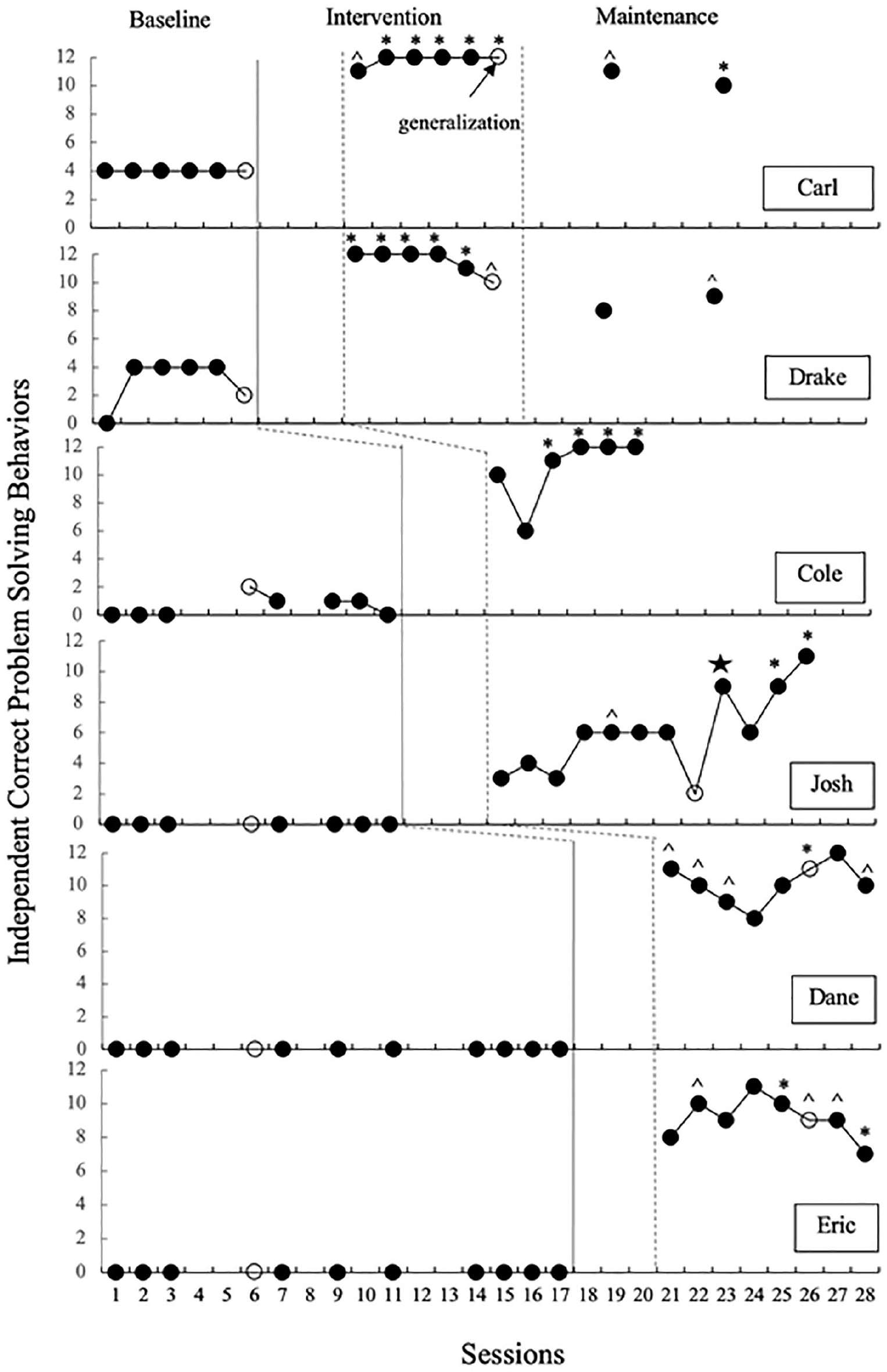
Graph of student problem-solving behaviors.
No participants were able to correctly solve problems in baseline, defined as the correct numerical answer and label. All participants were able to correctly solve problems during intervention. Sessions in which one problem was solved correctly are marked with a carrot (^) in Figure 2, and an asterisk (*) is above data points for sessions in which participants solved both problems. Given that each participant had a different number of opportunities to solve problems depending on how quickly they reached mastery criteria, cumulative totals are reported by participant below. The percent of total problems solved ranged from 22% to 90% (mean 56%) in intervention, 25% to 75% (mean 50%) in maintenance, and 0% to 100% (mean 70%) in generalization.
Baseline data demonstrate participants across all three student dyads were unable to independently solve the multiplicative comparison word problems with the materials alone (i.e., heuristic, schematic diagram, manipulatives, and calculator). Participants in the first student dyad participated in a research study on the effects of the virtual-representation-abstract (VRA) framework to teach word problem-solving in the prior school year (Root, Cox, et al., 2021), which may be the reason that their performance in baseline was slightly higher than their peers. With the exception of Drake, participants had stable patterns of behavior with no trend or counter-therapeutic trend in baseline. Drake did immediately improve after his first baseline session, when he observed his partner using the schema and calculator to multiply the numbers in the word problem, with his performance stabilizing after the second session. After introduction to MSBI, both participants in Dyad 1 demonstrated an immediate jump in level of performance, and minimal variability (within one point difference) and no overlap between baseline and intervention conditions. Neither Drake nor Carl solved any problems in baseline. Drake solved a cumulative total of 9/10 problems in intervention and 1/4 problems in maintenance. Cole solved a cumulative total of 9/10 problems in intervention and 3/4 problems in maintenance.
Dyad 2 also exhibited no overlap in performance between baseline and intervention, with Cole demonstrating an immediate jump in level, while Josh followed an increasing trend in performance. Josh needed the greatest number of intervention sessions (dosage) at 13. The teacher and researchers observed Josh was rushing through the problem-solving process (e.g., watching peer as he completed, then tossing his marker down and shouting “done”), and therefore, we decided to implement a positive reinforcement system contingent on behaviors completed independently correct. He earned 5 min of leisure time (e.g., playing basketball with researcher or independent tablet time) based on the number of boxes of the heuristic completed correctly on his independent practice problem. Josh’s performance immediately increased thereafter (10/12 steps), and while his performance dropped for one session (6/12), he then increased and maintained performance for the final four intervention sessions (range = 11–12 points). Josh solved a cumulative total of 5/22 problems in intervention. Cole solved a cumulative total of 8/12 problems in intervention.
Similar performance was demonstrated by both student participants in Dyad 3, with an immediate level change after introduction of MSBI. Although these participants demonstrated slightly higher levels of variability than the other two dyads, their ability to independently complete the problem-solving steps remained higher in intervention than baseline. Researchers and Mr. Gibbs observed both Dane and Eric in Dyad 3 were eager to complete the task but raced each other through the problems. Mr. Gibbs and researchers agreed to implement the contingent reinforcement system for both participants after spring break but were unable to do so due to COVID-19 school cancellations. Neither Dane nor Eric solved any problems in baseline. Dane solved a cumulative total of 4/14 problems in intervention. Eric solved a cumulative total of 6/14 problems in intervention.
Generalization to Video-Based Problems
Participants had two opportunities to demonstrate generalization to video-based problems, once during baseline and once during intervention, as shown by open circles in Figure 2. In baseline, Drake’s performance was consistent when presented with typed word problems or video word problems, and then increased to ceiling performance after intervention and he correctly solved both problems. Carl’s performance during baseline generalization was slightly lower but improved after intervention and he correctly solved both problems. Unfortunately, due to a school trip and then COVID-19, generalization data were not able to be collected for Cole after intervention. Josh had less success generalizing problem-solving from word problems to video problems, increasing from 0 correct in baseline to 2 after intervention but not solving the problem correctly. Dyad 3 student participants also exhibited similar performance for generalization probes during both conditions. During baseline, both Eric and Dane completed 0/12 independently correct for the video generalization word problems. After intervention, Eric was able to correctly solve one of the two problems and Dane solved both problems.
Social Validity
At the conclusion of the study, the three teachers were sent an electronic survey and had the opportunity to participate in interviews via Zoom with the second author who was their primary point of contact throughout the study. The teachers reported positive experiences with the intervention, and all would recommend involvement in similar studies to future students and other teachers. Two teachers stated the most beneficial aspect of participating in the research was the ongoing coaching sessions with the research team, where they were able to ask specific questions and were given immediate feedback. Teachers expressed continued insecurity with their pedagogical and content knowledge related to mathematics and felt they would benefit from additional professional development in this area. Finally, two teachers (Ms. Gonzo and Ms. Capp) shared realizations that their students were capable of more than they had imagined. Both teachers were unsurprised by the performance of one of the two students in each of the dyads they worked with (Carl and Cole), as they had high expectations for both of these students at the onset of the study. Yet they both expressed feelings of amazement with the performance of the other students in the dyads (Drake and Josh) as they had each been initially doubtful of the appropriateness of the intervention for these students given that they lacked fluency in addition and subtraction. Postintervention surveys and interviews were planned for student participants but could not take place due to sudden COVID-19 school closures.
Discussion
This study aimed to evaluate the effects of teacher-implemented MSBI on acquisition and generalization of multiplicative problem-solving skills for middle school students with ASD/ID in a natural classroom setting. Results of the multiple probe across participants design indicate a functional relation between MSBI and an increase in problem-solving skills, although all participants did not have the opportunity to reach mastery criteria due to COVID-19 pandemic school closures. Some participants demonstrated generalization of problem-solving skills to video-based problems, and the two participants who were assessed for maintenance demonstrated they had maintained problem-solving skills 1 and 2 weeks after intervention.
These findings are consistent with the limited prior evaluations of teacher-implemented mathematical problem-solving interventions that used single-case research design methodology. Following Browder et al.’s (2018) procedures, researchers in the current study modeled for teachers during the first lesson and teachers taught the second and subsequent lessons with researchers providing feedback and assistance as necessary. Researchers did fill in for teachers on sessions when the teacher participants were called away for other duties such as attending a week-long out of town field trip with eighth graders (Mr. Gibbs), completing mandatory professional development (Ms. Gonzo), and administering the alternate assessment (Ms. Capp). Teachers in both Browder et al. (2018) and the current study reported the ongoing coaching and feedback from researchers as beneficial on social validity questionnaires. Although teachers in both studies were able to implement the intervention with a high degree of fidelity, this intensity of support is not feasible for scaled-up use outside of a research context. In their investigation of the effects of teacher-implemented SBI under routine conditions, Peltier, Lingo, et al. (2020) did not provide coaching and feedback in this way, acknowledging most districts cannot implement classroom coaching models. Although the elementary students with learning disabilities benefited from the intervention, they did not demonstrate the same level of proficiency as participants in prior studies with similar routine conditions (e.g., Peltier, Sinclair, et al., 2020). The authors felt one factor that may have contributed to student responsiveness was the fidelity of implementation, which was below 80%. The routine conditions under which both the Peltier, Lingo, et al. (2020) and Peltier, Sinclair, et al. (2020) studies took place differ from the current study’s aim for a natural setting in terms of the amount of autonomy the teacher had and support provided by researchers. Contrasting findings of this small body of work indicate that attention is still needed to developing training and implementation procedures that can result in the use of SBI and MSBI in natural contexts or under routine conditions with high degrees of fidelity. Given that students with ASD/ID will likely require more systematic instruction at increased dosages than students with high-incidence disabilities, realistic and sustainable methods for teachers to incorporate SBI and MSBI into their own practice need to be empirically identified (Spooner et al., 2017).
The current study adds to the body of literature on the effectiveness of MSBI to teach word problem-solving to students with ASD/ID (Clausen et al., 2021; Root, Ingelin, et al., 2021). Although each student increased in independence in mathematical problem-solving and answered word problems correctly, there was between-participant variability that warrants discussion. Although all problems were written with a standard format and used realistic quantities, problems that compared different nouns (e.g., trees to bushes) were more difficult than problems that compared similar items (e.g., plants to plants) in terms of identifying the correct label (what was being solved for). The complexity was due to the level of reasoning problems required (Nunes et al., 2015), not the arithmetic demands as they were consistent. Quantitative reasoning was targeted via this problem-solving intervention aimed by teaching identification of problem structure (i.e., multiplicative comparison). After their development, word problems were randomly assigned as being designated for baseline or intervention and within intervention as being for the model, guided, or independent practice. As a result, model and guided practice problems may not have had the same level of cognitive demand (i.e., number of nouns being compared) as those used in independent practice. Participants were provided with schematic diagrams as representational tools to “mathematize” word problems (Nunes et al., 2015) and encouraged, but not required, to label each quantity on the diagram to support comprehension. Two potential solutions based on the procedures of Browder et al. (2018) include: (a) requiring students to write labels on the schematic diagram, and (b) teaching students to retell the problem in their own words using the quantities and labels from the problem through the multiplicative comparison rule.
Limitations and Suggestions for Future Research
Several limitations of the current study should be kept in mind when interpreting the results and can serve as avenues of exploration for future research. This study took place in the student and teacher participants’ natural classroom context, within which the teachers had multiple demands on their time over the course of the study. As a result, researchers led math instruction on days that the teacher had to fulfill other duties. As a result, the aim of evaluating a fully teacher-implemented intervention was sacrificed to maintain a 3-day per week dosage and complete the study prior to what researchers saw as an impending shut down of schools as the COVID-19 virus spread. Future research teams should make feasibility of teacher implementation a focal point, as it is a critical component of social validity. Prior research has found that middle-grade peers can deliver MSBI with fidelity to teach additive problems (Ley Davis, 2016). Future research evaluating the effects of peer-mediated instruction may increase the utility of MSBI as an intervention, expanding its use beyond one-to-one or small group settings with teachers, enabling instruction to continue when teachers’ time must be diverted.
The second limitation relates to generalization, which was only assessed once in baseline and once in intervention. Frequent measures of generalization would have provided data on whether this growth is concurrent or lags word problem-solving. This information would benefit teachers as they support student development of problem-solving across phases of learning (i.e., acquisition, fluency, maintenance, generalization). This leads to the final consideration for future investigation we will discuss here, and that is the issue of the pre-service training and in-service professional development in the area of mathematics for students with ASD/ID. Teacher participants made multiple comments to researchers before, during, and after the study regarding how little training they had in his area. Discussions about current practices reflected a developmental approach. They did not think students were “ready for” multiplication because they had not yet mastered addition or subtraction. Additional research is needed to formally explore and document teachers’ preparation, priorities, and beliefs related to mathematics for students with ASD/ID, as this developmental paradigm is likely (but unknowingly) detrimental to meaningful access to the general curriculum and inclusive opportunities.
Implications for Practice
Teachers do not need to wait for middle-grade students with ASD/ID to be “ready for” multiplication or division, as this limits inclusive opportunities and progress in grade-level standards. Instead, teachers can use MSBI to explicitly teach students with ASD/ID to identify multiplicative problem structures. Students benefit from using both the calculator and manipulatives to solve problems. Manipulatives assist in developing a conceptual understanding of multiplication through concrete representations of the problem. Calculators are more efficient, especially with large quantities (Spooner et al., 2017). Teachers can intentionally sequence the quantities in problems so that manipulatives are used for smaller quantities when initial concept development is taking place, and as they demonstrate conceptual understanding of multiplication, calculators can be used as larger quantities are introduced. This would maximize instructional time and ensure students develop functionally meaningful problem-solving skills.
Supplemental Material
sj-docx-1-rps-10.1177_15407969221076147 – Supplemental material for Teacher-Implemented Modified Schema-Based Instruction with Middle-Grade Students with Autism and Intellectual Disability
Supplemental material, sj-docx-1-rps-10.1177_15407969221076147 for Teacher-Implemented Modified Schema-Based Instruction with Middle-Grade Students with Autism and Intellectual Disability by Jenny R. Root, Sarah K. Cox and M. Addie McConomy in Research and Practice for Persons with Severe Disabilities
Footnotes
Correction (August 2024):
The citation for Figure 1 is provided both below the figure and in the reference list.
Declaration of Conflicting Interests
The author(s) declared no potential conflicts of interest with respect to the research, authorship, and/or publication of this article.
Funding
The author(s) disclosed receipt of the following financial support for the research, authorship, and/or publication of this article: Research reported in this publication was supported by the Institute for Education Sciences under award number R324B190019 and the Office of Special Education Programs under award number H325D190024. The content is solely the responsibility of the authors and does not necessarily represent the official views of the U.S. Department of Education.

Supplemental Material
Supplemental material for this article is available online.
Editor-in-Charge: Robert E. O’Neill
Author Biographies
References
Supplementary Material
Please find the following supplemental material available below.
For Open Access articles published under a Creative Commons License, all supplemental material carries the same license as the article it is associated with.
For non-Open Access articles published, all supplemental material carries a non-exclusive license, and permission requests for re-use of supplemental material or any part of supplemental material shall be sent directly to the copyright owner as specified in the copyright notice associated with the article.
