



Abstract
Objective:
Unequal treatment of patients based on race or ethnicity still exists in reproductive health. One possible reason is clinician bias. While explicit bias has been studied in relation to contraception, the influence of a clinician’s implicit bias on contraceptive recommendations has not been examined. We sought to assess the degree of implicit racial bias among reproductive health clinicians and to determine whether bias correlates with recommendations for contraception.
Methods:
Clinicians were approached in-person at multiple hospitals in New York City and one national conference over a 7-month period. The computer-based study included a demographic survey, clinical vignettes about contraception, and a racial Implicit Association Test. The clinical vignettes were randomized 1:1 to describe either all white patients or all Black patients for each provider. We assessed the likelihood that patient race would factor into contraceptive counseling, looking separately at white and Black clinicians.
Results:
Of 500 clinicians invited to participate, 426 completed the survey and were analyzed. They were mostly non-Hispanic, white female attending physicians working in urban areas. White clinicians showed a pro-white bias (p < 0.001), while Black clinicians did not show racial bias in either direction (p = 0.637). White clinicians with pro-white bias were significantly more likely to recommend sterilization to Black patients than to white patients.
Conclusions:
Implicit racial bias differed based on clinician race, and contraceptive recommendations differed based on their level of bias. It is important for all reproductive health professionals to understand their own implicit bias and how it may affect their contraceptive counseling.
Introduction
Disparities stand on the three-legged plinth of structural racism, social determinants of health, and interpersonal bias. Bias, in turn, can be explicit (defined as bias that “people deliberately think about and can make conscious reports on”) or implicit (defined as “bias that exists outside of conscious awareness, and thus is difficult to consciously acknowledge and control”). 1 While examples of bias in medicine are prevalent, it has been particularly nefarious in regard to reproductive health. As societal mores have evolved, explicit bias has receded. However, the degree to which implicit bias may continue to flavor the manner in which care is differentially rendered dependent on the race of the patient has not been fully explored.
What is known is that the unequal treatment of patients based on race, ethnicity, or socioeconomic status (SES) has existed in medicine, 2 and more specifically reproductive health, for centuries. 3 Well-known atrocities include Dr. Marion Sims performing multiple surgeries without anesthesia on enslaved women (Anarcha, Lucy, Betsey, and others) and the many decades of documented forced sterilizations in the United States. 4
A possible reason for inequality in care is clinician biases and how they guide behavior. Doctors in one qualitative study admitted multiple assumptions and biases based on patients’ race/ethnicity, SES, and age in encounters involving contraceptive counseling. 5 Another study showed that clinicians were more likely to recommend long-acting reversible contraceptives (LARCs) to low-SES Black and Latinx women than to low-SES white women. 6 Black women also have reported feeling pressured to continue their LARC and limit their family size.7–9
While explicit bias is conscious and able to be voiced, implicit bias is a discriminatory bias based on instinctive attitudes that are unrecognized consciously by the individual. Although there have been hundreds of studies in health care to address implicit bias and its effect on the clinical decision-making of medical professionals, 1 there have not been studies attempting to quantitatively measure clinician racial bias and link that bias to its effect on their contraceptive counseling.
Therefore, we sought to quantitatively measure clinician implicit racial biases using the Implicit Association Test (IAT) in conjunction with patient vignettes. Given this research showing Black women feel pressured to use LARCs and the history of forced sterilization in the United States, we hoped to determine whether patient race contributes to clinician recommendations of contraceptive method. Our hypotheses were that implicit racial bias exists among reproductive health care clinicians, and that clinicians found to have implicit pro-white bias in the IAT will be more likely to recommend an intrauterine device (IUD) over oral contraceptive pills (OCPs) and a permanent form of contraception over a reversible method for their Black patients.
Methods
We recruited a convenience sample of reproductive health care clinicians (physicians, nurse practitioners, midwives, and physician assistants) who counsel patients on contraception to participate in a computer-based, cross-sectional survey. Data were collected from attendees at a national meeting of a professional society for obstetrics and gynecology, as well as clinicians at hospitals in New York City when potential participants were not involved in clinical activities (e.g., while waiting for Grand Rounds to begin) over a 7-month period of time. Maimonides Medical Center’s institutional review board approved the study as exempt.
All clinicians were approached in-person to participate in a survey on contraceptive counseling; the fact that we were researching racial implicit bias was not explicitly stated. After being consented, they either filled out the survey themselves immediately using an electronic tablet in front of the study personnel or provided their electronic mail address and completed it later. Each survey included (in the order of appearance): consent page, demographic questions, patient vignettes, and a racial IAT. Clinicians had to complete the whole survey to be included in analysis. The demographic questions included age, race, ethnicity, religious upbringing, professional status, practice setting, and location. Clinicians received six contraceptive vignettes and were randomized to receive vignettes that described either all Black patients or all white patients. The use of vignettes has been established as a standard approach to soliciting clinician approaches to medical decision-making.10,11 Our vignettes were piloted prior to the start of the study and their fictional content created by the research team differed in terms of the patient’s parity and medical history. We pilot tested the study instrument using five clinician colleagues who were unaware of the nature of the study. The pilot revealed that the participants understood the scenarios and questions, the duration of the interview was not onerous, and ultimately no changes were made for the final study version. A patient scenario was presented, and the respondent was asked “How likely are you to recommend X for this patient?” for three separate contraceptive options. For example, one vignette was a 27-year-old (Black or white) female with a history of five uncomplicated vaginal deliveries and no significant medical history who presented to the office for postpartum visit and contraceptive counseling. The three options for “X” included OCPs, IUD, or sterilization. Answers ranged from “extremely likely” to “extremely unlikely” on a modified five-point Likert scale (Fig. 1).

Contraceptive vignettes.
The IAT is a validated, computer-based tool used to assess the underlying attitudes or biases that might not be consciously recognized. 12 This test measures the strength of an association between a target idea (race in this example) and a value type (good or bad). Participants are required to sort using either the right or left computer key and categorize two pairs of images and words as quickly as they can when they appear on the computer screen. For instance, a participant may be asked to associate an image with either “Black/Good” or “White/Bad” (Fig. 2). The IAT assumes that participants sort concepts that are easily associated together more quickly than concepts that are thought to be opposite or have no association. For example, if a pre-existing association exists for the participant where “White/Good” is easier to pair together, the opposite association “White/Bad” leads to a longer time to make the association. The IAT D-score is the measure of implicit bias based on reaction time in separate blocks of the IAT. The score is the averaged difference in response time for each comparison. This score is calculated on a scale of −3 to +3 with most values falling between −1 and +1. For the racial IAT, a more positive number would suggest a more pro-white bias. 13
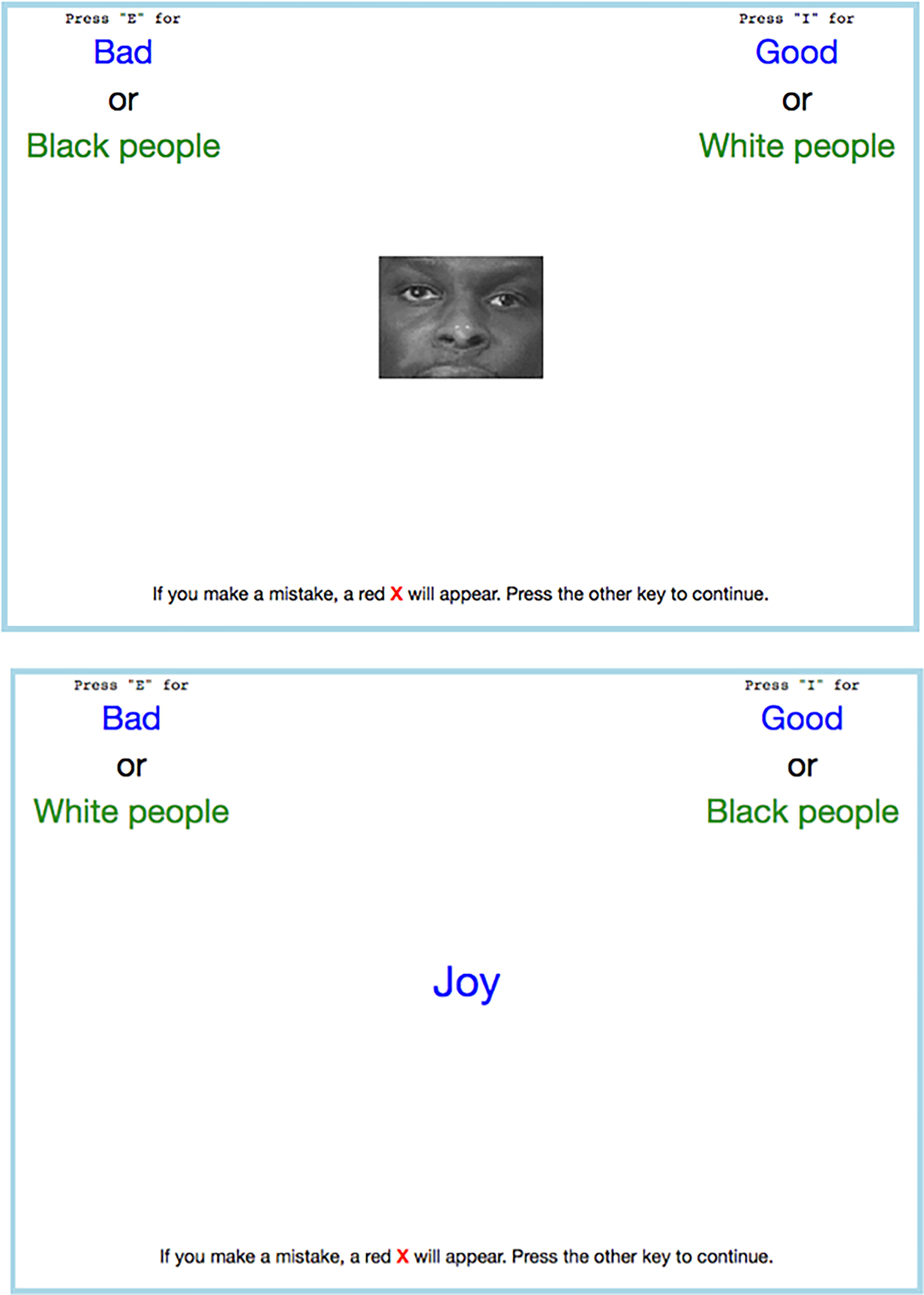
Example screens of racial IAT. IAT, Implicit Association Test.
Project Implicit is a nonprofit organization that involves an international collaborative network of researchers who have extensive experience investigating implicit social cognition and in utilizing the IAT. Project Implicit allowed the use of their IAT, built the computer-based survey, set up the randomization, stored data, and assisted with data analysis.
Based on previous behavioral science research, 200 clinicians in each group would allow us to have 80% power to detect a preference for one race over another (0.2 on the D-score) in either of the two groups. 14 We then estimated that 20% of clinicians would refuse to either participate or not complete the survey. We assumed a 20% refusal rate, so we approached 500 clinicians. We used a one-sample t test to determine if an individual clinician’s IAT score was different from zero. We assessed whether demographic differences correlated with recommending different contraceptive methods using chi-squared and t tests. We performed multivariable linear regression to determine whether IAT scores, patient race, or clinician age and race were associated with the strength of recommendation for a given contraceptive method.
Results
Five hundred clinicians were approached to participate in the study. Thirty-six of those invited in-person refused to participate, and an additional 38 did not complete the entire survey. This left 426 clinicians who completed the entire survey and were included in analysis. Of the total 426, 56 were approached in-person but completed after an electronic mail link was sent; the rest were approached and completed in-person. Participants were mostly non-Hispanic, white female attending physicians working in urban areas; the demographics of the two groups (those receiving white patient vignettes and those receiving Black vignettes) were similar (Table 1).
Demographic Characteristics and IAT Scores of Providers
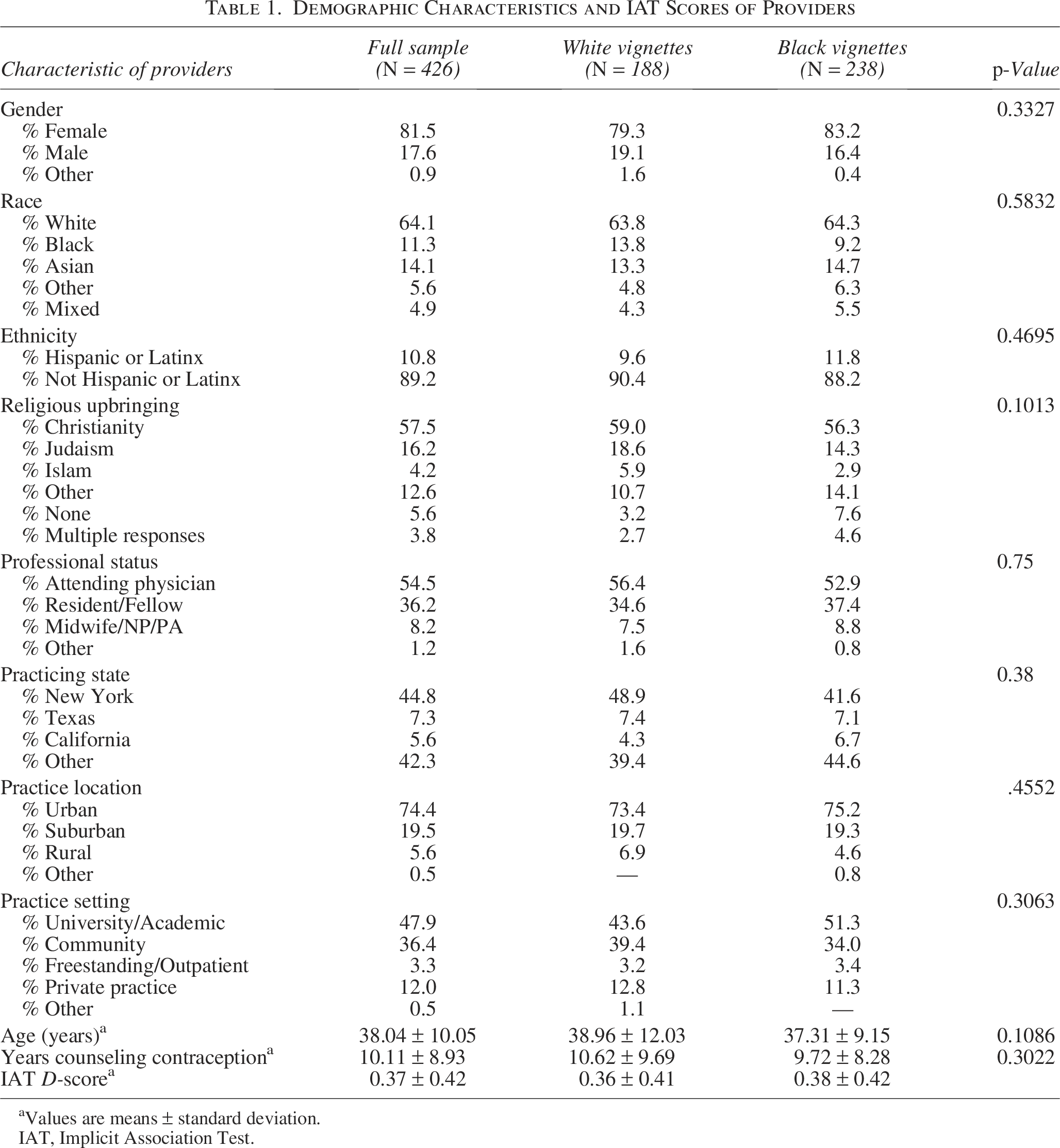
Values are means ± standard deviation.
IAT, Implicit Association Test.
Provider IAT scores as a whole were significantly above zero, indicating a more positive association with white versus Black people (D = 0.37 ± 0.42, p < 0.001; Table 2). White clinicians’ IAT scores (D = 0.45 ± 0.4) had significantly more pro-white bias than Black clinicians’ IAT scores (D = 0.02 ± 0.35; p < 0.001). Black clinicians showed no statistically significant racial bias (p = 0.637; Table 2).
IAT D-Scores for Study Participants by Randomization and Race

Values are the score ± standard deviation.
This analysis included only those who self-reported as Black.
IAT, Implicit Association Test.
Clinician age was negatively correlated with recommending sterilization versus a reversible method (IUD or OCP; r = −0.14, p = 0.004); older clinicians were less likely to recommend sterilization than younger clinicians were (Table 3). However, our multivariable linear regression model did not find that age interacted with IAT scores or was a predictor of differences in contraceptive method recommendations; older clinicians were no more likely than younger participants to have their recommendations predicted by their racial bias score (r = 0.09, p = 0.14).
Linear Regression of Age of Clinician Participants with Recommendation for Sterilization over Reversible Methods (IUD + OCP)
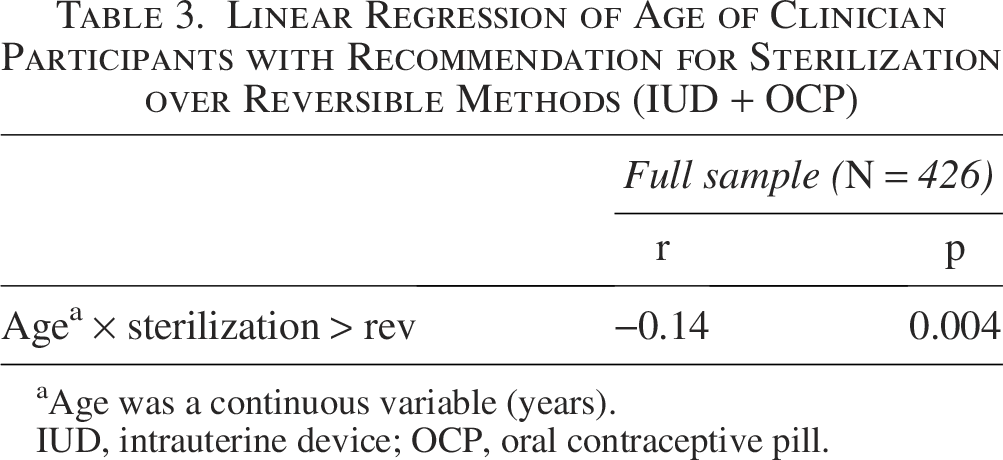
Age was a continuous variable (years).
IUD, intrauterine device; OCP, oral contraceptive pill.
White clinicians were no more likely than non-white clinicians to recommend IUD over OCPs (r = 0.35, p = 0.729) or sterilization over reversible methods (r = 0.18, p = 0.269). However, our linear regression model found that clinician race interacted with IAT scores in predicting sterilization recommendations by patient race; white clinicians with more pro-white bias were less likely to recommend sterilization for white patients (r = −0.21, p = 0.025) but more likely to do so for Black patients (r = 0.19, p = 0.021).
Discussion
We found that implicit bias exists among reproductive health care clinicians; specifically, white clinicians displayed a pro-white bias. Black clinicians showed no significant bias; this pattern is consistent with studies using similar measures.15,16 Both a clinically important and statistically significant finding from our study was that white clinicians with pro-white bias were significantly more likely to recommend sterilization to Black patients than to white patients.
Despite an overall improvement in health care quality, racial and ethnic disparities remain. Unequal reproductive health care is one well-known disparity. Racial bias likely exists in contraceptive methods counseling and practices in the United States due to a complex interplay of historical factors, implicit biases held by health care providers, societal stereotypes, and a lack of cultural competency, often leading to disparities in the type of contraceptive methods offered and discussed with patients of different racial backgrounds, potentially limiting their reproductive autonomy and access to optimal care.4,17 LARC, by definition, is reversible; sterilization is not intended to be. Hence, evidence that racial bias may increase the likelihood that a clinician will recommend sterilization is worrisome.
That is not to suggest that any racial group should be denied access to the full array of contraceptive options. One of the Institute of Medicine’s Healthy People 2030 goals is to increase the rate of intended pregnancies, but Black women in the United States still have higher rates of unintended pregnancy than white women regardless of income level.18,19 Over the past few decades, improved access, decreased patient cost, expanded provider training, and awareness have all contributed to the increased use of LARC; however, despite these advances, concern rightfully exists that clinicians’ racial biases may subconsciously affect their contraceptive counseling and recommendations. 18 And many other factors such as cost of contraception, adequacy of prenatal care, and clinicians assumptions about a person’s ability to pay may factor into clinician bias. 20 Here, we have shown a difference in the recommendations for both reversible and nonreversible methods, based on clinician’s implicit racial bias.
Clinician age was negatively correlated with recommending a permanent form of contraception in our study. One possibility is that older clinicians may be more hesitant to recommend permanent methods because of the fear of, or their own personal experience with, patient regret.
Our study aimed to explore the presence of implicit bias and its possible impact on contraceptive counseling. One of the strengths of our study was that it is the first study to attempt to quantitatively measure bias and link it to clinician practices. Project Implicit’s IAT is a longer-standing, well-studied, generally accepted, and validated tool for measuring racial implicit bias, and its use strengthens our findings. Clinicians were also blinded to the fact that the study was about implicit bias until the end, which enabled them to answer the vignettes without priming on the topic.
One limitation of our study is that this was a convenience sample of clinicians who were collected mostly from hospitals in New York City and one national conference, so is not representative of all reproductive health clinicians throughout the country. Another limitation is that our sample of clinicians, although balanced between groups, was mostly white females; however, it is representative of the current demographics in the field of OBGyn. 21 Also, the use of clinical vignettes might not represent how clinicians would respond in real clinical scenarios. It is also possible that some clinicians might have deduced the study’s intent to look at bias, causing them to be more measured in their recommendations than they would usually be.
It is also unknown whether the racial IAT predicts interpersonal social behaviors in real life, whether subtle or overt. However, despite these criticisms there have been decades of validity studies of the racial IAT showing that it could predict the reason behind persistent racial disparities. 22
Implicit biases affect clinician judgment and are thought to be one of the underlying reasons for the persistence of health care racial inequality in the United States. Since we found that implicit bias is also present among reproductive health clinicians, similar to studies of other health care professionals, it is important to recognize these biases and take steps to mitigate their effect on clinician practice. Social scientists suggest that implicit biases, such as all forms of motivated reasoning, are not easily corrected, but the first step as reproductive health clinicians is to recognize them specifically within ourselves and the harm that they cause before we can move forward to create real change. Some concrete steps that can be taken suggested for those in clinical OBGyn Departments are to set up a Division of Equity that is formal, multifaceted, and addresses inequity at multiple levels. 23 This could be a place for all of us in medicine to start breaking down the bias that clearly exists.
Authors’ Contributions
K.M.M.: Methodology (equal); investigation (equal); supervision (lead); writing—original draft and review and editing (lead); project administration (lead); and funding acquisition (equal). J.L.R.: Conceptualization (lead); methodology (equal); investigation (lead); writing—original draft (equal); and funding acquisition (lead). S.J.-R.: Visualization; writing—review and editing (equal); and investigation (equal). H.M.: Methodology (equal); writing—review and editing (equal); and supervision (equal).
Footnotes
Author Disclosure Statement
K.M.M. is a trainer for Nexplanon through Organon.
Funding Information
This research was possible with funding from the Maimonides Research Development Foundation, grant number IMPLICIT 49854.