



Abstract
Introduction:
Black American women suffer from disproportionately high rates of cardiovascular disease (CVD). This disparity may be related to psychosocial stress and cardiometabolic risk factors. Therefore, the objective of this trial was to evaluate the efficacy of a stress-reducing meditation technique compared with health education on cardiometabolic disease endpoints in high CVD risk Black women.
Methods:
The participants were Black women with documented CVD or with high CVD risk scores. They were randomly allocated to either Transcendental Meditation (TM) or health education (HE) for one year. Cardiometabolic endpoints were tested at baseline and after 12 months. Outcomes were carotid intima-media thickness (cIMT), hemoglobin A1c (HbA1c), insulin resistance (homeostatic model assessment [HOMA] IR), blood lipids, blood pressure (BP), weight, and physical activity.
Results:
A total of 201 participants enrolled (average age 64.6). After 1 year, the TM and HE groups showed decreases in cIMT with no significant difference between groups. In a post hoc exploratory analysis, both TM and HE demonstrated reductions in cIMT compared with historical controls (p = 0.006). The TM group showed reductions in HbA1c (p = 0.0030) and HOMA IR compared with HE (p = 0.03) and increased HDL (p = 0.01). Systolic and diastolic BP decreased in both groups without significant difference. In the overweight/obese subgroup, there was nearly 5% weight loss in the TM compared to the HE group.
Discussion:
In high-risk Black women, TM or HE participation was associated with prevention of progression of cIMT, while the TM group showed improvements in cardiometabolic disease endpoints of HbA1c, IR, and HDL cholesterol and weight loss in overweight/obese participants.
Introduction
Cardiovascular disease (CVD) remains the leading cause of mortality among women in the United States, with Black women experiencing disproportionately higher rates of morbidity and mortality compared with their non-Black counterparts. 1,2 This disparity is partly attributable to the higher prevalence of cardiometabolic disease risk factors, including carotid intima-media thickness (cIMT), hemoglobin A1c (HbA1c), insulin resistance (IR), dyslipidemia, and obesity. These biological pathways are further amplified by chronic psychosocial stress, which is a key social determinant of health that disproportionately affects Black women. 3,4
IR, a central feature of metabolic syndrome, contributes significantly to the pathophysiology of CVD through mechanisms including endothelial dysfunction, systemic inflammation, and arterial stiffness. 5 –7 Its strong association with increased cIMT—a validated surrogate marker of subclinical atherosclerosis and future cardiovascular events—is particularly concerning given the elevated rates of both conditions among Black women. 6 –8
Despite the heavy burden of cardiometabolic disease, Black women remain underrepresented in clinical trials, resulting in a persistent gap in evidence-based preventive strategies tailored to this population. 1,2 Addressing this inequity is critical to achieving health equity in CVD outcomes.
Based on available evidence, we and others proposed a model of meditation as a behavioral intervention in cardiometabolic disease. 9 To further test this model, the present study evaluated the effects of two behavioral interventions—Transcendental Meditation (TM), a previously standardized and validated mind-body, stress-reducing technique, and a health education (HE) program based on national guidelines—on surrogate endpoints and risk factors for cardiometabolic disease, including cIMT, HbA1c, IR, lipids, blood pressure (BP), and weight. By targeting neurophysiological and cardiometabolic pathways, this trial aimed to assess the efficacy of culturally relevant, scalable interventions for reducing cardiometabolic risk in Black women at high risk for CVD. 10,11
Methods
Design
This was a multicenter randomized controlled single-blind trial of two behavioral interventions—TM and HE—in Black women at high risk for CVD. The trial design, conduct, and reporting reflect the CONSORT 2010 statement for randomized controlled trials. 12 The selection and reporting of surrogate endpoints are consistent with the CONSORT-Surrogate 2024 extension guidelines. 13 The surrogate endpoints were chosen for their validation as predictors of CVD, diabetes, and major adverse cardiovascular events (MACE), thus offering clinically meaningful insights while enabling a feasible study duration and sample size. 13
The trial enrolled Black women, 55 years and older, with either documented CVD or at least two established risk factors for CVD, using the Framingham risk scale, including age. 14 Participants were enrolled at two clinical sites: (1) Morehouse Medical Associates in Atlanta, Georgia, and (2) Howard University Hospital Heart Center in Washington, DC. After baseline testing, patients were randomized to either stress reduction with TM or the matched HE comparison group and posttested at 12 months. The primary outcome was cIMT measured by quantitative B-mode ultrasonography. The main secondary outcomes were HbA1c and IR defined by the homeostatic model assessment insulin resistance (HOMA IR) index. Other secondary outcomes were serum lipids, weight, BMI, BP, and physical activity.
All participants continued their usual medical care during the trial. The study was approved by the Institutional Review Boards of Morehouse School of Medicine, Howard University Hospital, and Maharishi International University. All participants gave written informed consent. The clinical phase of the trial was conducted from July 2001 to July 2006. Due to a lapse in resources and personnel availability, data analysis was completed in April 2025.
Participants
Inclusion criteria were female sex, Black or African American by self-identification, age 55 years or greater, documented coronary artery disease defined by either documented history of myocardial infarction or a revascularization procedure (coronary artery bypass grafting [CABG] or percutaneous coronary intervention [PCI]) or coronary angiography with at least one coronary artery with >50 percent stenosis or high risk for CVD defined as at least 2 risk points on the categorical risk factor assessment from the Framingham group based on diabetes, smoking, BP, total cholesterol, and LDL/HDL cholesterol. 15
Exclusion criteria were (1) myocardial infarction, unstable angina, CABG, PCI, or stroke within the preceding 3 months; (2) carotid artery endarterectomy; (3) atrial fibrillation, second or third degree AV block; (4) heart failure—Class III or IV or ejection fraction <30%; (5) clinically significant valvular heart disease, hepatic, or renal failure; (6) a major psychiatric disorder, current alcohol/dependency disorder, or other drug abuse dependency disorder; (7) a noncardiac life-threatening illness; or (8) participating in a formal stress management program.
Randomization and blinding
After completion of three baseline visits conducted over a 3-week period, participants were randomly assigned to one of two intervention groups—TM or HE programs. Stratification was performed for age, CVD medication status, arterial pressure, and LDL cholesterol. Allocation concealment was assured by the biostatistician who performed the computerized randomizations. The biostatistician then contacted the project manager with the participant’s treatment assignment, who, in turn, directly contacted the participants to notify them of their treatment group. All investigators and clinic staff were blinded to treatment assignment, except the project manager, who did not collect data from participants. Clinical care physicians were also blinded to the treatment assignments of their patients. Since participants were necessarily aware of their treatment status, this behavioral intervention trial followed a single-blind, randomized controlled design. 16
Interventions
The TM program was employed in this trial because of its standardization, reproducibility, and validity. 9,17 –19 The TM technique is described as a simple, natural procedure that promotes the quiet settling of mental activity to a state of inner quiescence or transcendence. 19 –21 During TM practice, it is reported that ordinary thinking processes settle down, and a distinctive “wakeful hypometabolic” state characterized by neural coherence and physiological rest is gained. 22,23 This state is associated with a range of neurophysiologic, neuroendocrine, metabolic, and cardiovascular changes. These include changes in metabolic activity in the prefrontal cortex, cingulate cortex and anterior and mid-cingulate cortex and limbic system. 24 –27 These brain centers are involved in the stress response associated with activation of the sympathetic nervous system (SNS) and hypothalamic-pituitary-adrenal axis (HPA). 28 Overall, these study findings suggest that TM may downregulate the activation of the SNS and HPA axis controlled, at least in part, by cognitive and emotional processing units in the CNS. 9,25,29
The TM technique was taught in a course of instruction consisting of six 90-minute individual and group meetings by an instructor certified by Maharishi Foundation-USA. 20 Thereafter, 90-minute follow-up and maintenance meetings were held weekly for the first month, biweekly for the next 2 months, and monthly for the remainder of the 1 year study period.
The comparison intervention was a cardiovascular HE program designed to match the format of the TM intervention for instructional time, instructor attention, participant expectancy, social support, and other nonspecific factors. 30,31 The content reflected clinical practice guidelines consistent with current lifestyle modification recommendations. 32,33 The HE subjects were advised to spend at least 20 minutes a day at home practicing heart-healthy behaviors, e.g., exercise, healthy meal preparation, and nonspecific relaxation. The HE instructors were professional health educators from the two clinical sites.
Care was taken to separate the intervention groups in terms of class time and location to minimize contact and communication. The intervention period was 12 months. All treatment sessions were held at the clinical site medical centers. The courses for the two behavioral interventions were based on standard teaching materials that were adapted for cultural sensitivity by local instructors who were also Black women, in coordination with the local investigator teams at Howard and Morehouse clinical sites and the administrative and data coordinating center at the Center for Natural Medicine and Prevention at MIU.
Outcomes
Carotid intima-media thickness
The rationale for using cIMT is based on its validation as a surrogate endpoint for atherosclerotic CVD, including myocardial infarction and stroke. Numerous longitudinal studies and meta-analyses have demonstrated that progression of cIMT predicts future cardiovascular events, supporting its relevance as a surrogate marker. 8,32,33 Ultrasound measurement of cIMT offers advantages over angiography for tracking atherosclerosis for several reasons: it is noninvasive, assesses the early stages of atherosclerosis in a continuous measure, and requires a smaller sample size.
The cIMT methods have been previously described. 34 In brief, B-mode carotid ultrasonography was performed with a real-time scanner where both the near and far walls of the right common carotid artery were examined. Images of the carotid wall were recorded on video and subsequently digitized. To minimize variability, a fully automated, computerized, edge-detection tracking method was used. This method, which can detect early stages of atherosclerosis, was more precise and reliable than manually traced measurements. 35,36
Hemoglobin A1c
HbA1c was selected as a surrogate endpoint based on its established role as a predictor of type 2 diabetes onset and its association with increased risk of macrovascular complications, including CVD. This relationship has been consistently demonstrated in prospective cohort studies and clinical trials, supporting its validity as a surrogate marker. 37
Samples of venous blood were assayed by standard laboratory methods in line with the National Glycohemoglobin Standardization Program and the Diabetes Control and Complications Trial reference assay. 37
Homeostatic model assessment for insulin resistance
Although not routinely used as a clinical endpoint, HOMA-IR is a widely accepted surrogate marker of IR and a strong predictor of progression to diabetes and atherosclerotic disease.
38
For HOMA-IR measurement, fasting serum insulin was measured by radioimmunoassay using commercially available kits (Cambridge Medical Diagnostics, Baillerica, MA) with a lower limit of sensitivity of 2 µU/mL test-retest (within-subject) correlation for samples taken 2 weeks apart was 0.81. Fasting serum glucose was measured by standard methods in the central clinical laboratory.
39
The HOMA index (homeostatic model assessment) was calculated as follows:
40
Serum lipids
Lipid profiles for total cholesterol LDL, HDL, and triglycerides were measured in serum using standard clinical methods during the fasting state. 41 These lipids are widely recognized predictors of cardiovascular events and are routinely employed as risk factors in cardiometabolic research and clinical practice. 42
Blood pressure
BP was measured three times manually with a mercury sphygmomanometer after 5 minutes with the patient sitting quietly without practicing any formal relaxation technique. The three readings were taken 1 minute apart. The last two readings of each visit were averaged to minimize possible “white-coat hypertension” effects. 43 Systolic and diastolic BP were included as CVD risk factors given their predictive value for cardiovascular events. 43
Weight and body mass index
Weight and BMI were measured and calculated by standard clinical methods at months 0, 4, and 12. BMI was computed as weight in kilograms divided by the square of height in meters (kg/m2). Both weight and BMI were included as cardiometabolic risk factors due to their established associations with incident type 2 diabetes, CVD, and overall cardiometabolic risk. 42
Physical activity
Physical activity was assessed using a standardized questionnaire modified from the TOHP Phase II clinical trial to capture the duration, frequency, and intensity of various physical activities. 44 Responses reflected total daily activity, including\leisure-time and occupational or routine activities (e.g., occupational movement, walking for errands, housework, and caregiving), and were expressed as hours per day. 45 This lifestyle measure was included as a behavioral cardiometabolic outcome given its established relationship with weight regulation, IR, and CVD risk. 45,46
Treatment compliance
As described above, the TM and HE groups were offered the same number of group meetings and instructional attention. Meeting attendance was recorded for both groups as a proxy for compliance with the two behavioral interventions.
Statistical analysis
All outcomes were analyzed according to the modified intention-to-treat principle. 47 That is, all participants with outcome data at both baseline and 12 months were included in the analyses, regardless of treatment status or compliance. Baseline variables were compared between the two groups using a two-sample t test or Wilcoxon rank-sum test for continuous variables, and Pearson’s chi-square test for categorical variables. The outcomes of cIMT and HbA1c were analyzed as surrogate endpoints based on their established predictive validity for cardiovascular events and diabetes risk, respectively. 8,37 Secondary outcomes, including HOMA-IR, serum lipids, BP, weight, BMI, and physical activity, were treated as cardiometabolic disease risk factors. 41,42,46 Each outcome was assessed using analysis of covariance, with the 12-month value as the dependent variable, the baseline value as the covariate, and the treatment group as the independent variable. Beta coefficients were also calculated. Two-sided p-values <0.05 were regarded as statistically significant.
Based on previous findings, we hypothesized that both behavioral intervention groups might be active in their effects on cIMT but might differ from placebo controls. 34 Therefore, we conducted a post hoc exploratory analysis of cIMT changes comparing the TM and HE interventions to historical placebo controls. The historical control comparison was guided by recommendations outlined by Marion and Althouse, 48 FDA regulatory guidance 49 and the European Medicines Agency scientific guidelines on the choice of control groups in clinical trials. 50 The historical control for cIMT change was derived from a systematic review and meta-analysis of 23 randomized placebo-controlled trials with 2,693 placebo control subjects. 51 These RCTs were conducted during a period contemporaneous with the current trial (1993–2001). The meta-analysis included two all-women studies, which had similar findings to the overall sample. 52,53 Carotid IMT progression rates in the TM and HE groups were compared to each other and to the historical controls using ANOVA. The Bonferroni adjusted multiple comparisons were calculated for each behavioral intervention compared to historical controls. To investigate effects of the interventions in overweight and obese women specifically, we conducted post hoc analyses of changes in weight and BMI in the overweight and obese subgroup of participants with BMI >25.
Data analyses were conducted with Statistica and JASP v0.19.3 statistical software and ChatGPT 4.0 (for beta coefficients only). Generative AI with ChatGPT 4.0 assisted with language editing of the article. The authors take full responsibility for all statistical data and text.
Results
A total of 201 participants were enrolled. Sixty-two participants were recruited from the Morehouse Medical Associates and 139 from the Howard University Hospital Heart Center. Figure 1 shows the participant flow diagram from eligibility through to final analysis. 13 Table 1 displays the participant demographics and characteristics.

Participants Flow Diagram.
Participant Characteristics
BMI, body mass index; HbA1c, hemoglobin A1c; HOMA, homeostatic model assessment.
No significant difference between the TM and HE groups was observed in change in cIMT over 1 year (−0.004 mm ±0.008 for TM group and−0.009 mm ± 0.009 for HE group, p = 0.19) In the exploratory analysis, the reductions in the TM and HE groups were greater than the progression seen in historical placebo controls over 1 year (−0.004 mm ± 0.008 TM and −0.009 mm + 0.009 HE versus HPC +0.015 mm ± 0.053; p = 0.006) (Fig. 2). Bonferroni-corrected multiple comparison tests showed significance of both TM and HE groups compared to historical placebo controls (p = 0.0001 for TM versus HPC and p = 0.0001 for HE versus HPC).
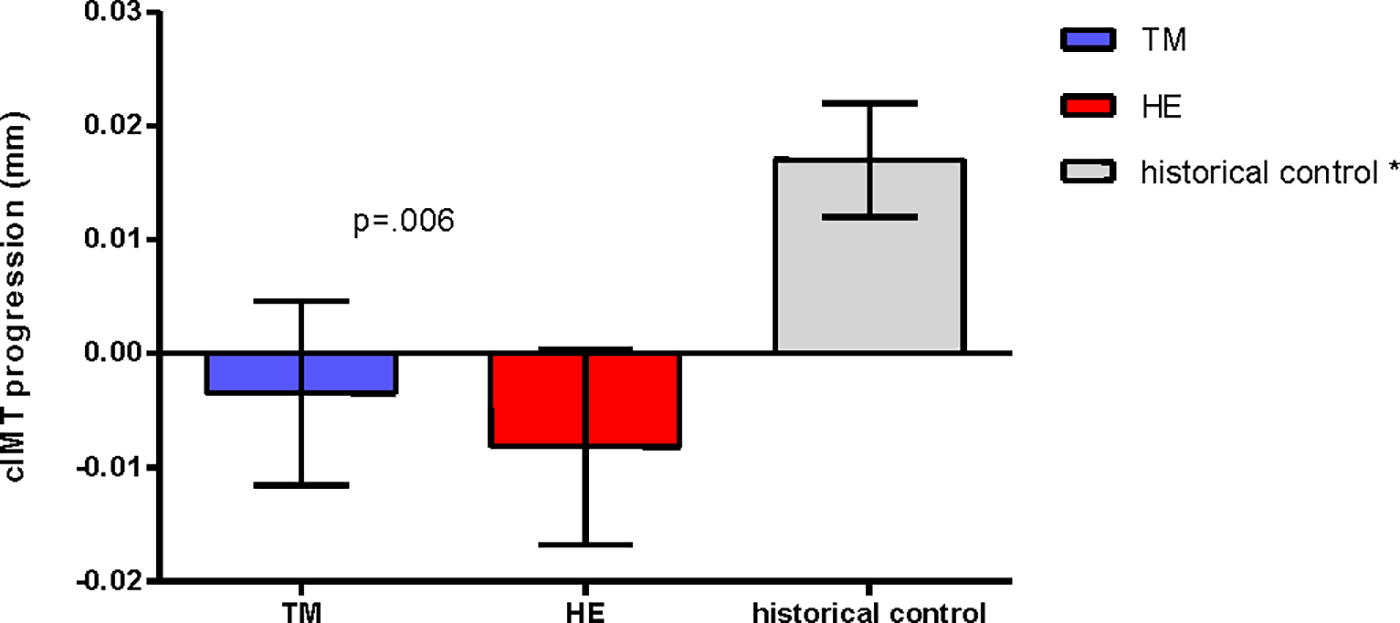
Carotid IMT Changes in TM and HE groups compared to historical placebo controls. *p values indicate differences in change between TM, HE and historical controls. TM, Transcendental Meditation.
HbA1c decreased by 0.64% ± 0.33% in the TM group compared with the HE group increase of 0.27% ± 0.08 (p = 0.003) (Fig. 3). IR from the HOMA decreased in the TM group (−0.97 ± 0.36) compared with HE +0.26 ± 0.37 (p = 0.03) (Fig. 4). Fasting glucose levels were lower in the TM group (−9.69 mg/dL ± 5.85 compared with the HE group (+1.56 mg/dL ± 2.71; p = 0.01) (Table 2)
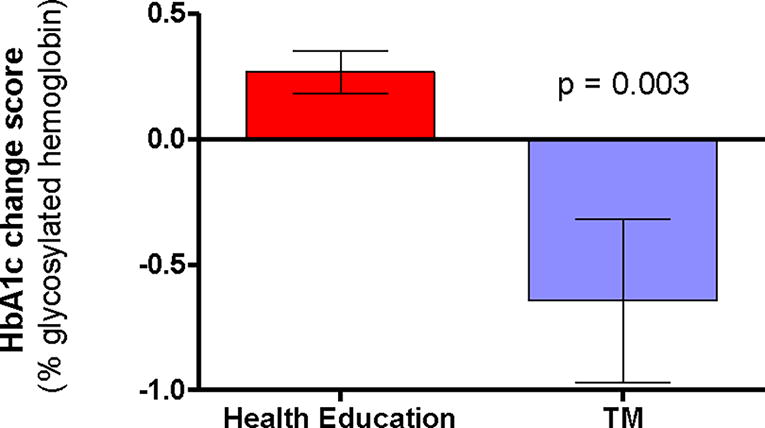
Changes in HbA1c levels. HbA1c, hemoglobin A1c.
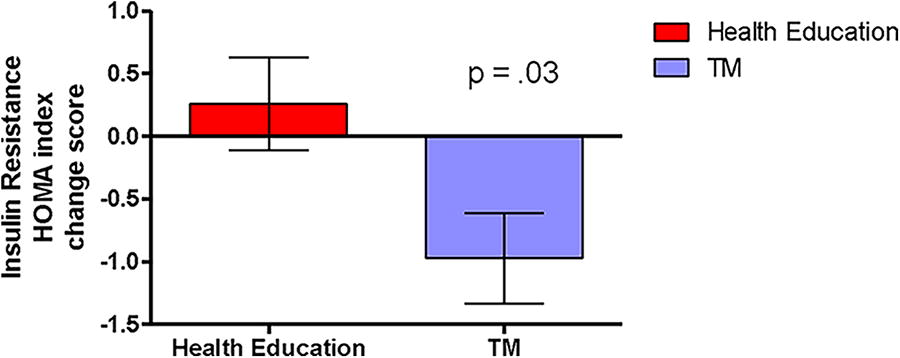
Changes in insulin resistance using HOMA IR index. HOMA IR, homeostatic model assessment insulin resistance.
Effects of Transcendental Meditation and Health Education on Outcome Variables
hours/day includes all physical activities both from leisure and work activities from moving or walking for any purpose for mild (e.g., walking to store) to vigorous (e.g., running on treadmill) as opposed to sedentary.
HOMA IR, homeostatic model assessment insulin resistance.
As Table 2 shows, total cholesterol decreased similarly in both groups (TM, −3.31; HE −0.2.23 mg/dL) with no between group differences. For HDL, the TM group increased +1.72 mg/dL ± 1.1 and HE decreased −2.92 mg/dL ± 1.27 (p = 0.01). There were no significant changes observed between groups for LDL or triglyceride levels. Both groups showed decreases in systolic BP (−3.5 mm Hg ± 2.4 versus −7.9 mm Hg ± 2.2) although the difference in change scores between groups was not significant.
Weight and BMI did not change significantly between the two treatment groups for the whole sample (Table 2). The post hoc subgroup analyses in overweight/obese women with BMI ≥25 (n = 146) showed a significant between group change for weight of 4.6% (TM −1.35 kg ±0.53 versus HE +2.16 kg ±0.84; p = 0.015 (Fig. 5). Both groups increased their reported physical activity although the between group differences were not significant.
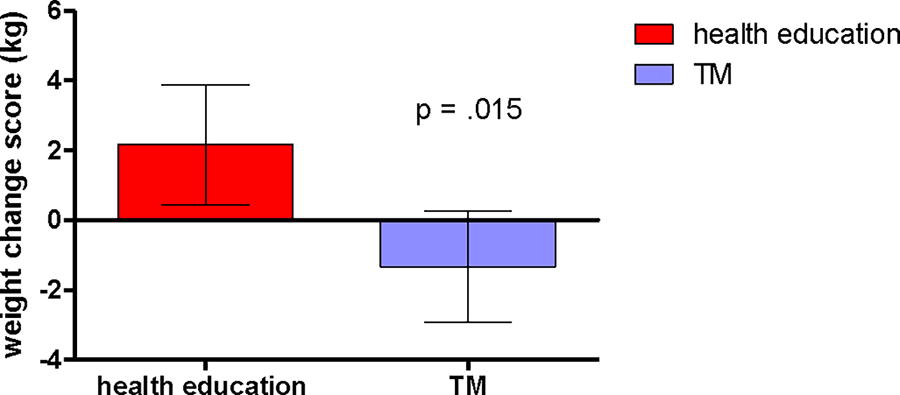
Weight changes in the overweight/obese subgroup. *Inclusive of women with BMI ≥ 25. BMI, body mass index.
The average attrition rate from this 1 year trial was 21% based on a 79% posttesting rate. The trial attrition rates were similar in TM and HE groups (20% versus 22% respectively). Both groups demonstrated reasonable compliance with the intervention protocols indicated by the median meeting attendance rates of 78% in the TM group and 76% in the HE group.
There were seven serious adverse events during the 1-year study period including four in the HE group, including one fatal, and three in the TM group, all nonfatal. None of the adverse events reported during the trial period were related to the interventions.
Discussion
This multicenter randomized controlled trial evaluated the effects of two behavioral interventions—TM and HE—on surrogate markers and risk factors for cardiometabolic disease among Black women with documented CVD or elevated CVD risk. Both groups exhibited modest reductions in cIMT over 1 year, with no statistically significant differences between them. Post hoc comparisons with historical placebo controls suggest that both interventions may have attenuated disease progression. 51 Importantly, only the TM group demonstrated significant reductions in HbA1c and IR, as measured by HOMA-IR and increases in HDL cholesterol. In addition, there was modest weight reduction in the TM group in the overweight/obese subgroup analysis. These changes suggesting a broader impact on cardiometabolic and CVD risk. 5,6,34
Insulin resistance and cardiometabolic health
The TM group showed significant improvements in HbA1c levels and insulin sensitivity reflected in reductions in HOMA-IR. HbA1c is considered a surrogate endpoint for diabetes. 37 IR is a central feature of metabolic syndrome and type II diabetes. It is well-established contributor to hyperglycemia, endothelial dysfunction, arterial stiffness, and systemic inflammation, all of which accelerate the development of diabetes and atherosclerotic CVD. 5 –7 The observed improvements suggest that TM may beneficially modulate metabolic and neuroendocrine mechanisms associated with chronic stress and cardiometabolic disease. 9,29 These findings align with prior research reporting reductions in IR and cardiometabolic risk with TM practice in a racially diverse population. 10,54
In terms of molecular biological mechanisms, preliminary evidence suggests that long-term TM practice may influence gene expression associated with inflammatory and insulin signaling pathways, such as downregulation of SOCS3, which mediates IL-6-induced IR. 55,56 Although these molecular mechanisms were not directly assessed in this study, they offer plausible biological pathways through which TM may exert cardiometabolic effects.
Lipid profiles and weight outcomes
Both groups demonstrated modest reductions in total cholesterol and triglycerides; however, only the TM group exhibited a significant increase in HDL cholesterol. In post hoc subgroup analyses of overweight and obese participants (BMI ≥25), the TM group experienced modest weight reductions compared with the HE group of nearly 5%. While dietary intake was not available for this study, it is possible that reductions in stress reactivity and improvements in metabolic function contributed to healthier behaviors and weight outcomes. 9,18 These findings warrant further investigation but suggest that TM may support weight management and lipid regulation through physiological and/or behavioral mechanisms. 5,9,55,57
Carotid intima-media thickness
While no significant differences in cIMT changes were observed between groups, both TM and HE participants showed cIMT stabilization compared with historical controls, which generally exhibit progressive cIMT increases over time. 8,51 These findings are consistent with previous trials of TM showing attenuation of atherosclerotic progression 58 and support the utility of behavioral interventions in vascular disease prevention. Nonetheless, short-term changes in cIMT may not fully reflect the potential long-term effects of these interventions on MACE, which require extended follow-up to assess. 10,34,59
Clinical implications
These findings underscore the potential role of TM as a lifestyle strategy for cardiometabolic risk reduction, particularly in populations disproportionately burdened by CVD. 1,2,11 This meditation practice may offer benefits by targeting cardiometabolic and neuroendocrine mechanisms not addressed by conventional HE alone. 3,9,60 Integration of such nonpharmacologic approaches into clinical practice and public health settings, particularly in high risk populations, could enhance the effectiveness of comprehensive prevention strategies. 9,11,18
Limitations
This study has several limitations that should be considered when interpreting the results. The generalizability of the findings is limited by the study population, which included only older Black women. While this population is disproportionately affected by cardiometabolic disease and is underrepresented in clinical research, the results may not extend to other demographic groups. Nonetheless, focusing on this high-risk and underserved population is an important strength of the study and addresses a critical gap in the literature.
The 21% attrition rate over 1 year, although not uncommon in long-term behavioral trials, could potentially introduce bias. However, baseline characteristics were similar between completers and noncompleters, and this rate compares favorably with a recent meta-analysis of mindfulness-based interventions in randomized controlled trials, which reported an average attrition rate of 24.7%. 61
The use of historical controls for comparison of cIMT changes, while pragmatic and supported by published guidelines, 48 introduces potential limitations due to differences in study context and participant characteristics. The historical data were derived from trials with comparable demographics, risk factor profiles, and ultrasonographic methods, including studies enrolling women only. 52,53 However, future trials should incorporate contemporaneous control groups to strengthen comparability and causal interpretation.
The study employed the HOMA-IR, which is not widely used in routine clinical care, though it is a validated research tool and highly correlated with HbA1c. 38 In addition, cIMT was assessed using two-dimensional ultrasound imaging, which may not capture atherosclerotic burden as comprehensively as newer three-dimensional or multiterritorial imaging modalities. Future studies may benefit from including these advanced vascular imaging techniques and mechanistic biomarkers to further elucidate the physiological effects of meditation-based interventions. 38,62
Finally, while the study demonstrated metabolic improvements in the TM group, dietary intake was not formally measured. Future investigations may consider integrating dietary assessment to better understand potential behavioral mediators of the observed outcomes.
Conclusion
In this multicenter randomized controlled trial, both TM and HE interventions were associated with prevention of progression of cIMT in Black women at risk for CVD. TM was uniquely associated with improvements in HbA1c, IR, and HDL cholesterol, with modest weight reduction among overweight and obese participants. These findings suggest that TM may be a lifestyle modification strategy for cardiometabolic risk management, warranting further investigation in larger, longer-term trials.
Footnotes
Acknowledgments
The authors are grateful to Dr. Charles Alexander (deceased) for his long-term contributions to the development of this research program, Dr. OT Randall (deceased) for his co-principal investigator leadership at Howard University, Dr. Maxwell Rainforth statistical input, Lora Whitfield and Anne Shircore for ultrasound cIMT testing protocol, imaging and data acquisition, Laura Valls for data management, Dr. Diane Prather-Huff for project coordination, Jean Symington Craig for administrative assistance, Linda Heaton for financial management, and Candace Martin for TM instruction. Preliminary findings of this study were presented at the annual meetings of the American Psychosomatic Society, March 10–13, 2010, Portland, OR, and the EPI/Lifestyle Scientific Sessions, March 7, 2019, Houston, TX.
Authors’ Contributions
All authors qualify for authorship and take responsibility for all aspects of reliability and freedom from bias of the data presented and their discussed interpretations. R.H.S. and N.B.-M. conceived the original design of the study, oversaw all aspects of the methodology, and were involved in funding acquisition. K.G.W. and J.W.S. performed statistical analyses. C.L.H. oversaw the trial investigation, resources, and coordination at the Morehouse School of Medicine field site; S.X. oversaw the trial investigation, resources, and coordination at Howard University Hospital field site; J.W.S. drafted and edited the article and participated in site coordination; N.B.-M. oversaw the collection and interpretation of the primary outcome data and critiqued the article. S.N. participated in trial administration, assisted in the data analysis, and edited the article, C.G.-K. oversaw the quality of delivery of the intervention protocol, supervised the intervention instructors at each field site, and critiqued the article.
Author Disclosure Statement
No competing financial interests exist.
Funding Information
This study was supported by a specialized center of research (SCOR) grant from the National Institutes of Health—National Center for Complementary and Integrative Health (NIH-NCCIH), P50-AT00082.