



Abstract
Background:
An average time to diagnosis of 7 years is commonly described for endometriosis; diagnostic delay for adenomyosis is unknown. This cross-sectional study aimed to describe diagnostic delay for endometriosis and adenomyosis and to investigate the factors associated with this delay.
Methods:
Community of Patients for Research (ComPaRe)-Endometriosis is a prospective e-cohort of women with endometriosis and/or adenomyosis in France. About 6,949 participants were included. We used linear regression modeling to assess factors associated with diagnostic delay, after adjustment for age, education level, body mass index, number of comorbidities, and family history of the disease or of chronic pelvic pain (CPP).
Results:
The average diagnostic delay was 10 years for endometriosis and 11 years for adenomyosis. Factors associated with a significantly longer diagnostic delay were year of diagnosis (+0.34 years, p < 0.0001), unemployment (+0.7 years, p = 0.01), number of comorbidities (+0.3 years, p < 0.0001), family history of the disease or of CPP (+1.1 years, p < 0.0001), severe dysmenorrhea before diagnosis (numeric-rating scale: +0.8 years, p < 0.0001), number of health professionals consulted before diagnosis (+0.3 years, p < 0.0001), and presence of multiple symptoms leading to first consultation (+1.6 years, p < 0.0001). In contrast, factors associated with a shorter delay were a financial position perceived as comfortable (−1.4 years, p < 0.0001), age at menarche (−0.6 years, p < 0.0001), and age at first symptoms (−0.8 years, p < 0.0001).
Conclusions:
This study highlights several factors associated with diagnostic delay among women with self-reported endometriosis and/or adenomyosis and provides new insights to improve care by informing both clinicians and patients. Attention to these profiles may improve disease management.
Introduction
Endometriosis is an inflammatory disease defined as the presence of endometrium-like lesions outside the uterus. It is estimated to affect 10% of reproductive-age women, thus 190 million women worldwide. 1 Endometriosis is typically classified into four surgical stages according to the revised criteria of the American Fertility Society and the American Society of Reproductive Medicine, minimal (stage I) to severe (stage IV). Three types of pelvic endometriosis are described: superficial peritoneal endometriosis (SPE), ovarian endometriosis or endometrioma (OMA), and deep endometriosis. Adenomyosis, characterized by the presence of endometrium-like lesions within the myometrium, has long been defined as a form of endometriosis; however, endometriosis and adenomyosis are now described as two distinct conditions in terms of clinical presentation and pathogenesis. 2 However, their similarities and frequent co-occurrence make it pertinent to study them alongside each other.
Despite debilitating symptoms strongly impacting quality-of-life, 3 endometriosis remains difficult to diagnose. Surgical diagnosis through laparoscopy remains the gold standard in many countries; however, in Europe, current recommendations now prioritize imaging, along with clinical examination and patient history, as a broader and less invasive diagnostic approach. 4 A multicenter study of 1,400 women from 16 clinics in 10 countries reported a mean delay of 6.7 years between symptom onset and surgical diagnosis. 5 However, the mean diagnostic delay varied greatly across centers, from 3.3 years in Guangzhou, China, to 10.7 years in Siena, Italy. A similar range was observed across recent studies,6–14 from 3.8 years in a Brazilian retrospective study of 310 endometriosis patients, to 13.0 years in a clinical study of 400 patients in Beijing, China.
Studies exploring the factors associated with endometriosis diagnostic delay are scarce. Overall, available studies have reported positive associations between diagnostic delay and a younger age at symptom onset,7,11,13,15–18 normalization of symptoms (both on the part of patients and health professionals),18–22 a longer time to first consultation,14,18 repeated consultations with negative investigations,18,23 a high number of pelvic symptoms (chronic pelvic pain [CPP], dysmenorrhea, dyspareunia, heavy periods), 5 cyclic symptoms, 15 advanced age, 24 being single, 12 a high body mass index (BMI), 5 and a poor health-related quality of life. 12 In contrast, inverse associations were reported with infertility,15,16 severe dysmenorrhea (as compared with stable or tolerable dysmenorrhea) 7 or when a gynecologist was consulted first (versus a general practitioner [GP]). 17 Nnoaham et al. also showed a shorter time to diagnosis among centers with individual or private insurance-funded health care as compared with government-funded health care. 5
Several important gaps remain in our knowledge of this issue. Except for a few studies based on 1,000–4,000 patients,6,12,17,24,25 most studies were based on limited samples, or included women undergoing surgical treatment for endometriosis—thus possibly cases with more severe disease. In addition, the sets of explored factors were limited in previous research, and no data exist on diagnostic delay for adenomyosis. Addressing these limitations is critical to have a clear picture of the patients’ profile associated with diagnostic delay, which will ultimately help to reduce time to diagnosis, better target public policy actions, and improve management of endometriosis and adenomyosis.
Here, we sought to describe diagnostic delay for endometriosis and adenomyosis and to investigate the factors associated with this delay in a large patient sample in France.
Material and Methods
Participants
Community of Patients for Research (ComPaRe)-Endometriosis is a sub-cohort of ComPaRe, a participatory research platform initiated in 2017. ComPaRe is an ongoing prospective e-cohort of over 55,000 chronic disease patients volunteering to help advance research on chronic diseases. 26 Participants are French-speaking adults aged 18 or older reporting at least one chronic illness, defined as an illness requiring care for at least 6 months. Patients register through the online platform (http://compare.aphp.fr) and regularly reply to self-administered questionnaires, which allow the collection of patient-reported outcome measurements (PROMs) and patient-reported experience measurements (PREMs). ComPaRe participants are recruited through invitation by the researchers and physicians involved in ComPaRe, patient associations, media campaigns, and social media. All participants provide electronic consent before participating in the e-cohort. The cohort was approved by the Institutional Review Board of the Hôtel-Dieu Hospital in Paris (IRB: 0008367) and the French National Commission for Data Protection and Privacy (CNIL: 916397). ComPaRe-Endometriosis was initiated in 2018–2019 and includes ComPaRe participants with self-reported endometriosis, adenomyosis, or both diseases. In this cross-sectional study, we use the term “women”; however, it is important to acknowledge that endometriosis can affect anyone assigned female at birth.
Data collection
All ComPaRe participants reply to an inclusion questionnaire on their health and sociodemographic background. Subsequent monthly questionnaires regularly update this information and record data on various factors, including lifestyle, anthropometric measures, reproductive health, and several PROMs and PREMs. ComPaRe-Endometriosis participants additionally reply to endometriosis-specific questionnaires, which are based on expanded versions of the World Endometriosis Research Foundation Endometriosis Phenome and Biobanking Harmonization Project (WERF-EPHect) standard clinical 27 and surgical 28 questionnaires. Among these, the initial ComPaRe-Endometriosis questionnaire collected data on age at symptom onset and age at diagnosis, circumstances of and medical path to diagnosis, self-reported stage and type of disease, and family history of endometriosis, adenomyosis, and CPP. Two questionnaires collected data on intensity of symptoms across the life course, evaluating the worst pain levels on a numeric-rating scale from 0 (no pain) to 10 (worst pain imaginable) for several types of pain: dysmenorrhea, dyspareunia, dyschezia, dysuria, and pelvic or abdominal pain, and across five age ranges (≤15, 16–20, 21–30, 31–40, and 41+ years). To assess the associations between level of pre-diagnostic pain and diagnostic delay, we considered the maximum pain level reported up to the same age range as age at diagnosis (e.g., the pain level at age range 21–30 was retained if age at diagnosis was 25 years and pain level between 21 and 30 years was higher than in age ranges ≤15 and 16–20). The data used in the present analysis were extracted on June 22, 2023.
Study population
Of the 7,306 participants who completed the initial endometriosis questionnaire, we excluded those reporting no symptoms (e.g., pain or discomfort) or signs (e.g., infertility) (n = 248) before the diagnosis to calculate diagnostic delay, those reporting no medical diagnosis—either surgery, imaging, or clinical symptoms based (n = 93), and those with missing age at symptom/sign onset and/or at diagnosis (n = 16), leaving a final dataset of 6,949 participants.
Statistical analysis
Diagnostic delay was calculated by subtracting reported age at symptom onset from reported age at diagnosis. We used linear regression models to estimate β coefficients of diagnostic delay in years and 95% confidence intervals. Three models for each predictor variable were tested. Models were first adjusted for age (M1), then additionally for BMI, number of comorbidities, and family history of endometriosis, adenomyosis, or CPP (M2). A third model (M3) further adjusted for education level. Adjustment variables were selected based on the univariate analysis and on their confounding potential for the studied associations. Model adequacy was tested with the adjusted R2; we verified that there was no correlation higher than |0.8| between adjustment variables and that the variance inflation factor was less than 4 to control for collinearity. We first analyzed the data globally, then according to the first disease diagnosed for factors where the interaction test was statistically significant for at least one modality (endometriosis (n = 5,173), adenomyosis (n = 520), or concurrent diagnosis of endometriosis and adenomyosis (n = 1,256)). Tests for linear trend were performed using an ordinal score across categories for each factor. Missing values in covariates were imputed to the modal category if occurring in <5% of observations, otherwise a “missing” modality was created. Analyses were performed using the SAS statistical software package (version 9.4; SAS Institute).
We designed maps describing diagnostic delay according to participants’ department of residence at cohort inclusion and linked the number of gynecologists per 100,000 women aged 15–49 years in each French department. For this, we used population data from the National Institute of Statistics and Economic Studies (INSEE, geoportail.gouv.fr), data on the number of gynecologists in French departments from the Directorate for Research, Studies, Evaluation and Statistics (Drees, www.ecosante.fr), and the QGIS software (version 3.26.3).
Results
Participant characteristics
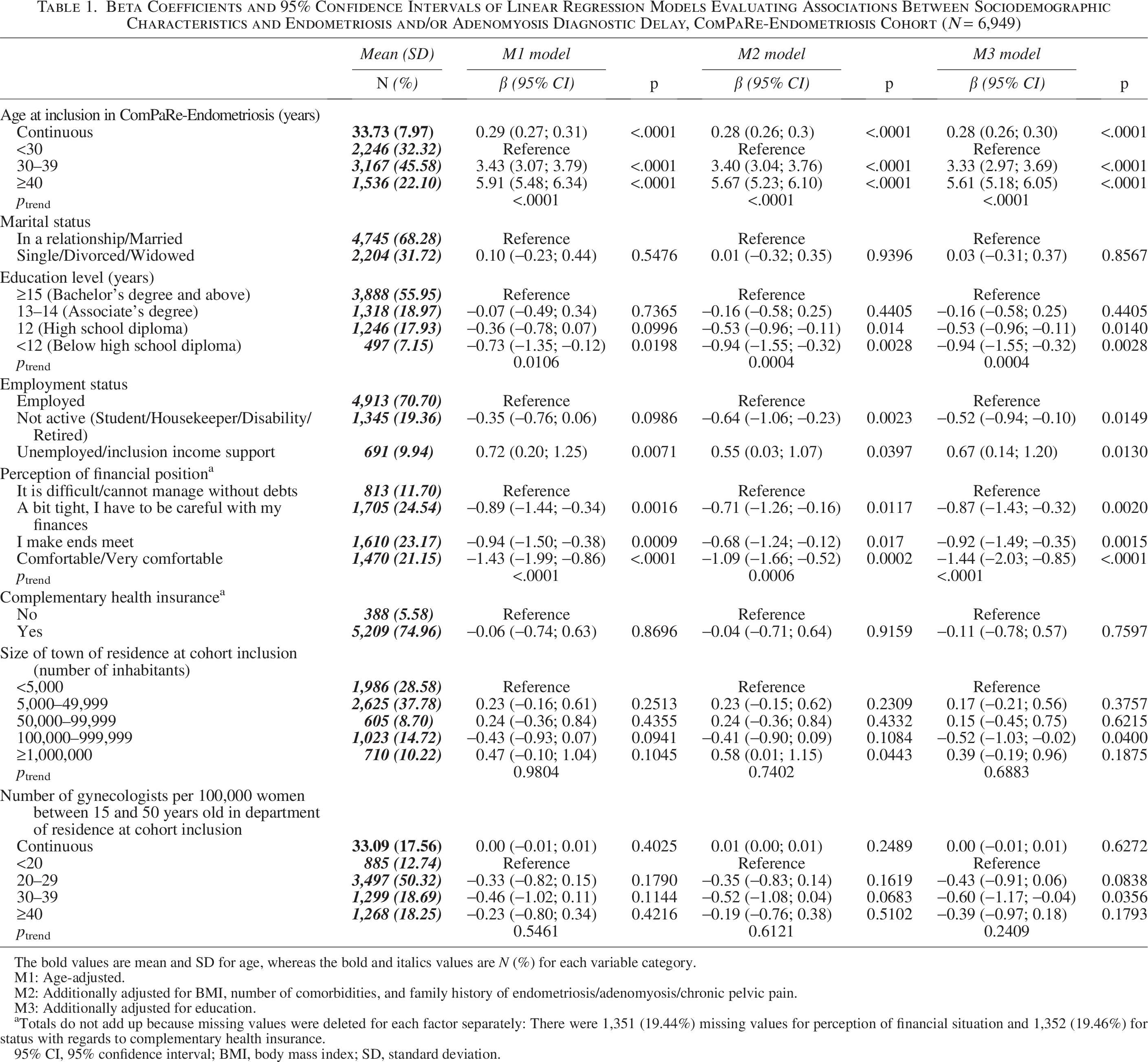
Participants were aged 34 years on average at cohort inclusion (Table 1). Most were married or in a relationship (68.3%), had at least 15 years of education (Bachelor’s degree and above) (56.0%), or were employed (70.7%). Over a third of participants (36.2%) reported perceiving their financial situation as tight or difficult, while 21.2% reported being financially “comfortable.” Most (75.0%) had complementary health insurance. A third of participants lived in a town of over 50,000 inhabitants (33.7%; 8% lived in Paris). While most participants lived in mainland France, 1.8% lived in overseas departments and 3.2% abroad. Additional characteristics are described in Tables 2–3.
Beta Coefficients and 95% Confidence Intervals of Linear Regression Models Evaluating Associations Between Sociodemographic Characteristics and Endometriosis and/or Adenomyosis Diagnostic Delay, ComPaRe-Endometriosis Cohort (N = 6,949)
The bold values are mean and SD for age, whereas the bold and italics values are N (%) for each variable category.
M1: Age-adjusted.
M2: Additionally adjusted for BMI, number of comorbidities, and family history of endometriosis/adenomyosis/chronic pelvic pain.
M3: Additionally adjusted for education.
Totals do not add up because missing values were deleted for each factor separately: There were 1,351 (19.44%) missing values for perception of financial situation and 1,352 (19.46%) for status with regards to complementary health insurance.
95% CI, 95% confidence interval; BMI, body mass index; SD, standard deviation.
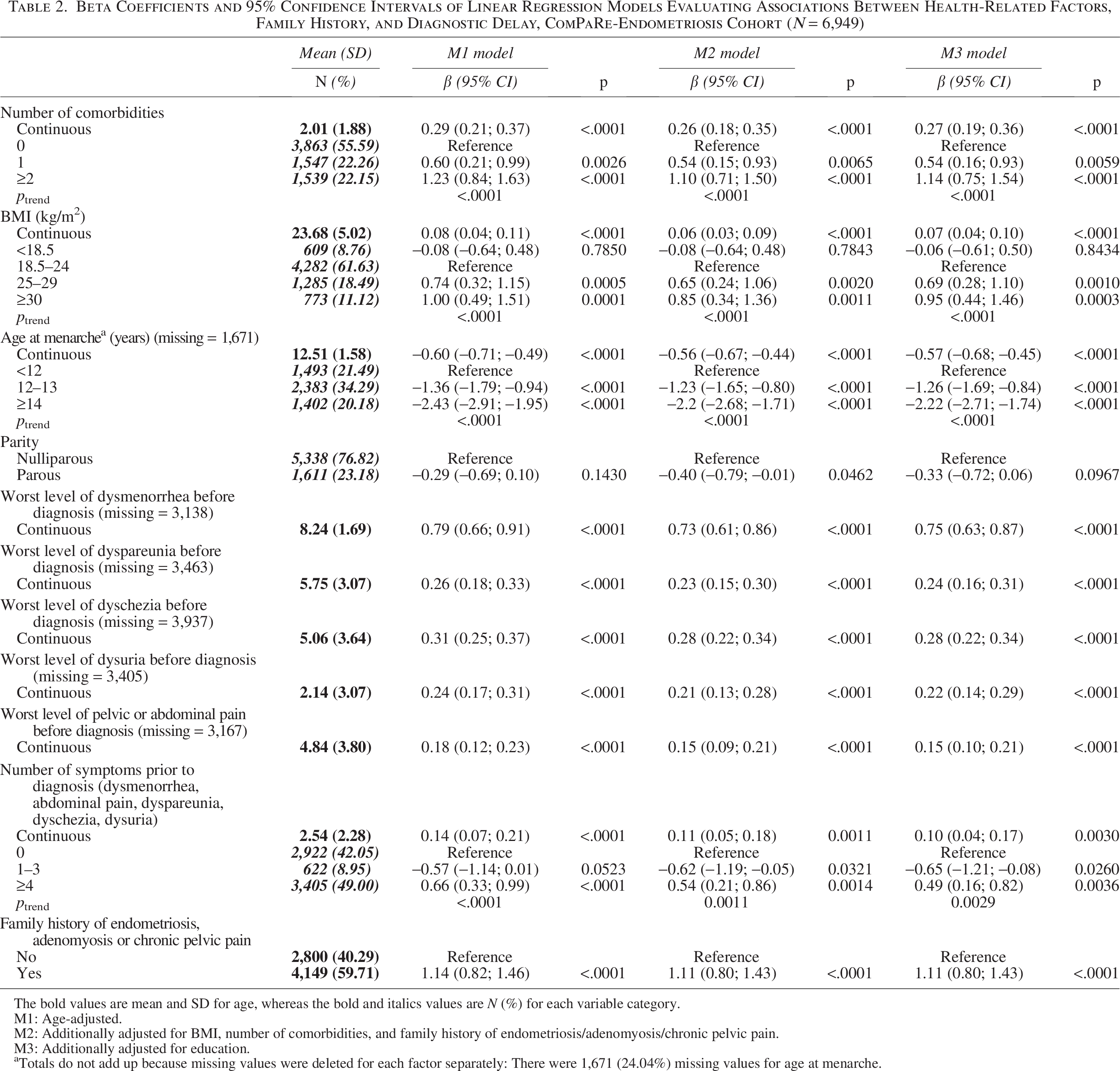
Beta Coefficients and 95% Confidence Intervals of Linear Regression Models Evaluating Associations Between Health-Related Factors, Family History, and Diagnostic Delay, ComPaRe-Endometriosis Cohort (N = 6,949)
The bold values are mean and SD for age, whereas the bold and italics values are N (%) for each variable category.
M1: Age-adjusted.
M2: Additionally adjusted for BMI, number of comorbidities, and family history of endometriosis/adenomyosis/chronic pelvic pain.
M3: Additionally adjusted for education.
aTotals do not add up because missing values were deleted for each factor separately: There were 1,671 (24.04%) missing values for age at menarche.
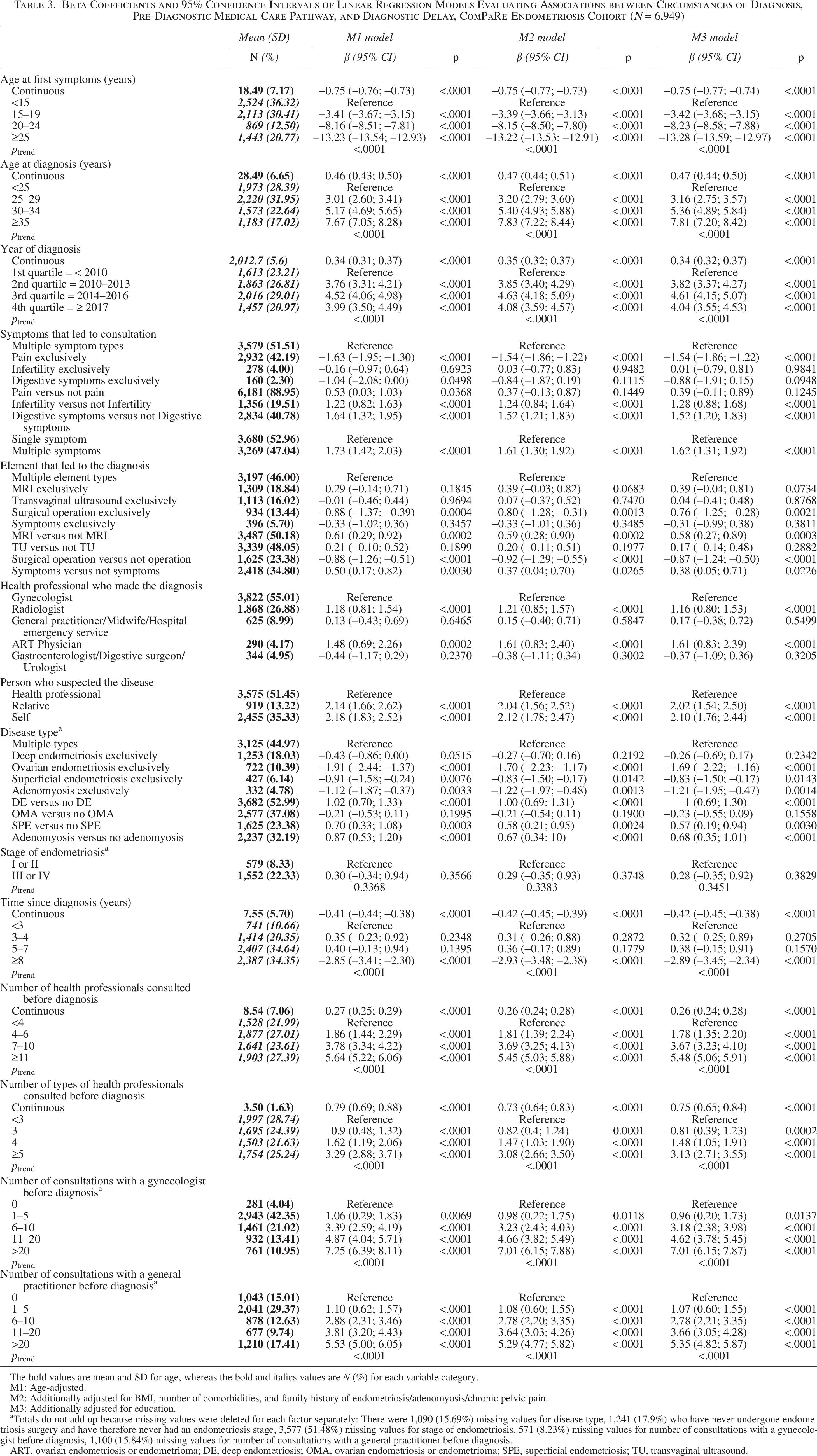
Beta Coefficients and 95% Confidence Intervals of Linear Regression Models Evaluating Associations between Circumstances of Diagnosis, Pre-Diagnostic Medical Care Pathway, and Diagnostic Delay, ComPaRe-Endometriosis Cohort (N = 6,949)
The bold values are mean and SD for age, whereas the bold and italics values are N (%) for each variable category.
M1: Age-adjusted.
M2: Additionally adjusted for BMI, number of comorbidities, and family history of endometriosis/adenomyosis/chronic pelvic pain.
M3: Additionally adjusted for education.
Totals do not add up because missing values were deleted for each factor separately: There were 1,090 (15.69%) missing values for disease type, 1,241 (17.9%) who have never undergone endometriosis surgery and have therefore never had an endometriosis stage, 3,577 (51.48%) missing values for stage of endometriosis, 571 (8.23%) missing values for number of consultations with a gynecologist before diagnosis, 1,100 (15.84%) missing values for number of consultations with a general practitioner before diagnosis.
ART, ovarian endometriosis or endometrioma; DE, deep endometriosis; OMA, ovarian endometriosis or endometrioma; SPE, superficial endometriosis; TU, transvaginal ultrasound.
Diagnostic delay
In the overall population, we observed a mean diagnostic delay of 10.0 years (standard deviation [SD] = 7 years), ranging from 0 to 42 years (Fig. 1). This delay was higher when endometriosis and adenomyosis were diagnosed concurrently (mean = 11.1, SD = 7.6) than when adenomyosis (mean = 10.6, SD = 8.4) or endometriosis was diagnosed first (mean = 9.7, SD = 6.6).

Diagnostic delay in the ComPaRe-Endometriosis cohort (from bottom-up: minimum, 1st quartile, median, 3rd quartile, maximum).
Mean time to diagnosis varied from 9.6 years in those reporting SPE to 10.7 years in those reporting adenomyosis (nonexclusive type groups) (Fig. 2). In addition, diagnostic delay was positively associated with self-reported stage (from 8.0 years for stage I to 10.9 years for stage IV) and BMI (from 8.6 years for underweight to 11.5 years for obesity). Average endometriosis diagnostic delay varied over time: it was 8.6 years before 2005, then increased to 10.2–10.3 years between 2005 and 2017 (years of release of updates to European and French guidelines),29,30 and slightly decreased to 9.7 years since the French guideline release in 2017.
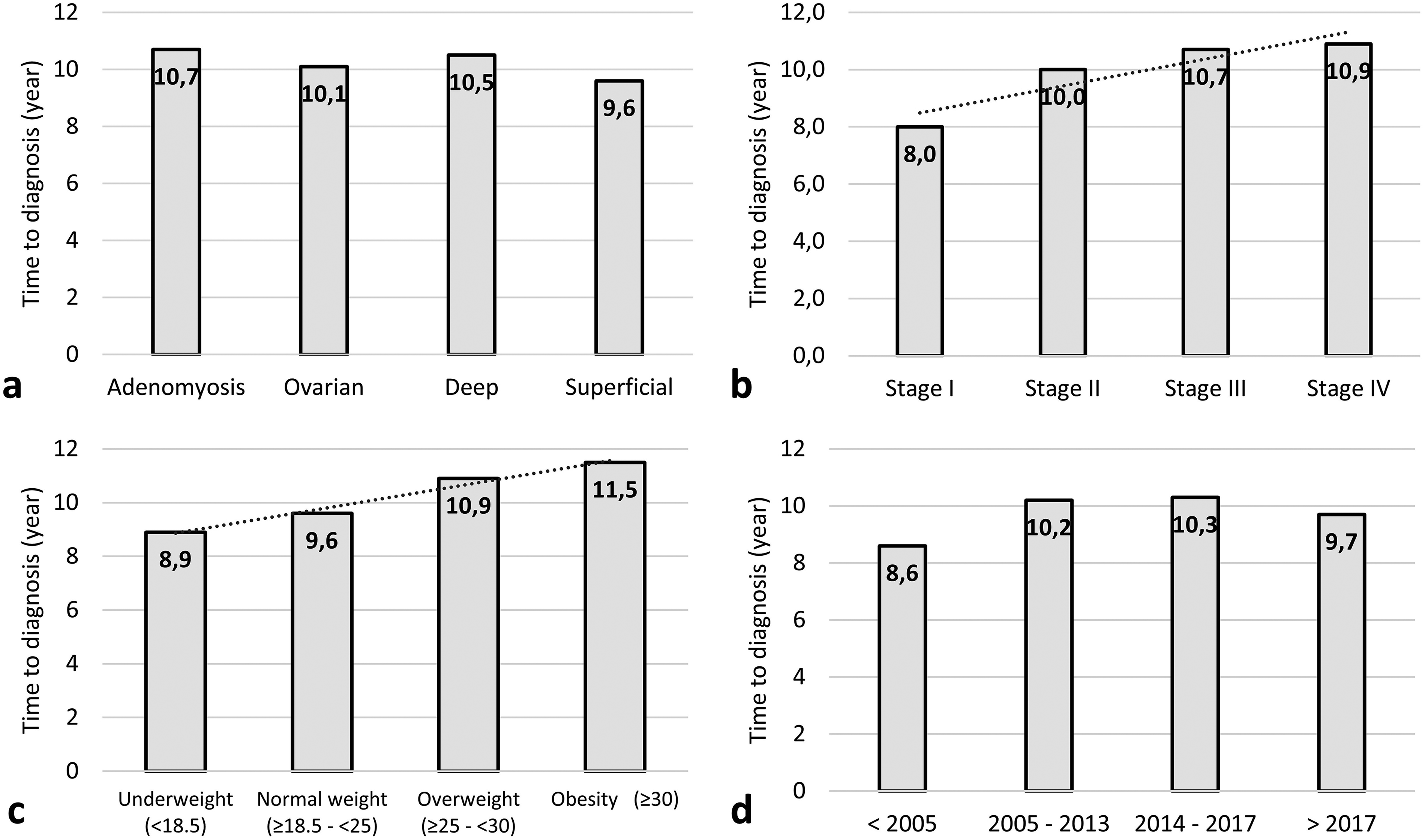
Average time to diagnosis by type* (
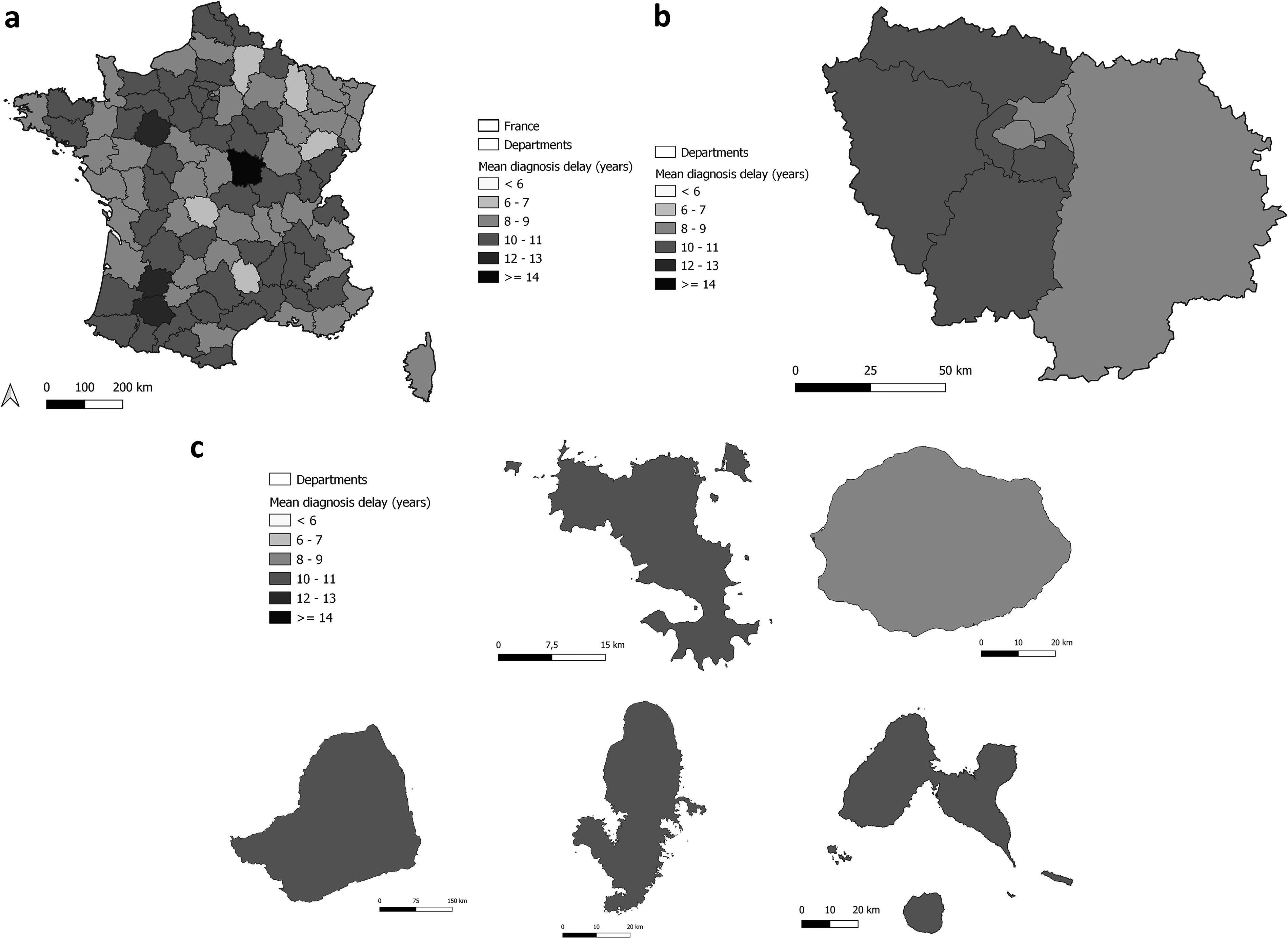
Diagnostic delay in participants living in mainland France (mean = 9.99, SD = 7.02) was slightly shorter than that of participants living abroad (mean = 10.04, SD = 6.75) or in overseas departments (mean = 10.18, SD = 6.78). Figure 3 presents geographical maps of mean diagnostic delay according to participants’ department of residence at cohort inclusion. It was 10.1 years across French departments, the longest (≥14 years) among women living in the Nièvre department at inclusion, which has less than 25 gynecologists per 100,000 women, and the shortest in the Meurthe-et-Moselle department (6 years), which has over 30 gynecologists per 100,000 women.
Factors associated with diagnostic delay
In fully adjusted models (M3), a longer diagnostic delay for endometriosis and/or adenomyosis was associated with age (β = 0.28 years for each additional year of age) and unemployment (β = 0.67 years versus employed) (Table 1). However, a shorter diagnostic delay was associated with lower educational level (ptrend = 0.0004), a financial position perceived as comfortable (ptrend < 0.0001), and being professionally inactive (β = −0.52 versus employed). An intermediate size of town of residence (100,000–999,999 inhabitants versus <5,000) and a high density of gynecologists in the department of residence at inclusion (30–39 versus <20) were also inversely associated with diagnostic delay, albeit with nonsignificant linear trends. Diagnostic delay was not associated with marital status or complementary health insurance.
Regarding health-related factors (Table 2), diagnostic delay was positively associated with number of comorbidities (β = 0.27 years), a family history of endometriosis, adenomyosis, or CPP (β = 1.11 years), BMI (β = 0.07 years), number of symptoms before diagnosis (β = 0.1 years), and the worst pain levels reported before diagnosis (β from 0.15 for pelvic or abdominal pain to 0.75 years for dysmenorrhea, all p < 0.0001). However, it was inversely associated with age at menarche (β = −0.57 years) but not significantly associated with parity. Average BMI did not decrease with the number of health professionals or number of types of professionals consulted (mean BMI per number of professionals consulted before diagnosis: <4 = 23.5; 4–6 = 23.7; 7–10 = 23.5; ≥11 = 23.9).
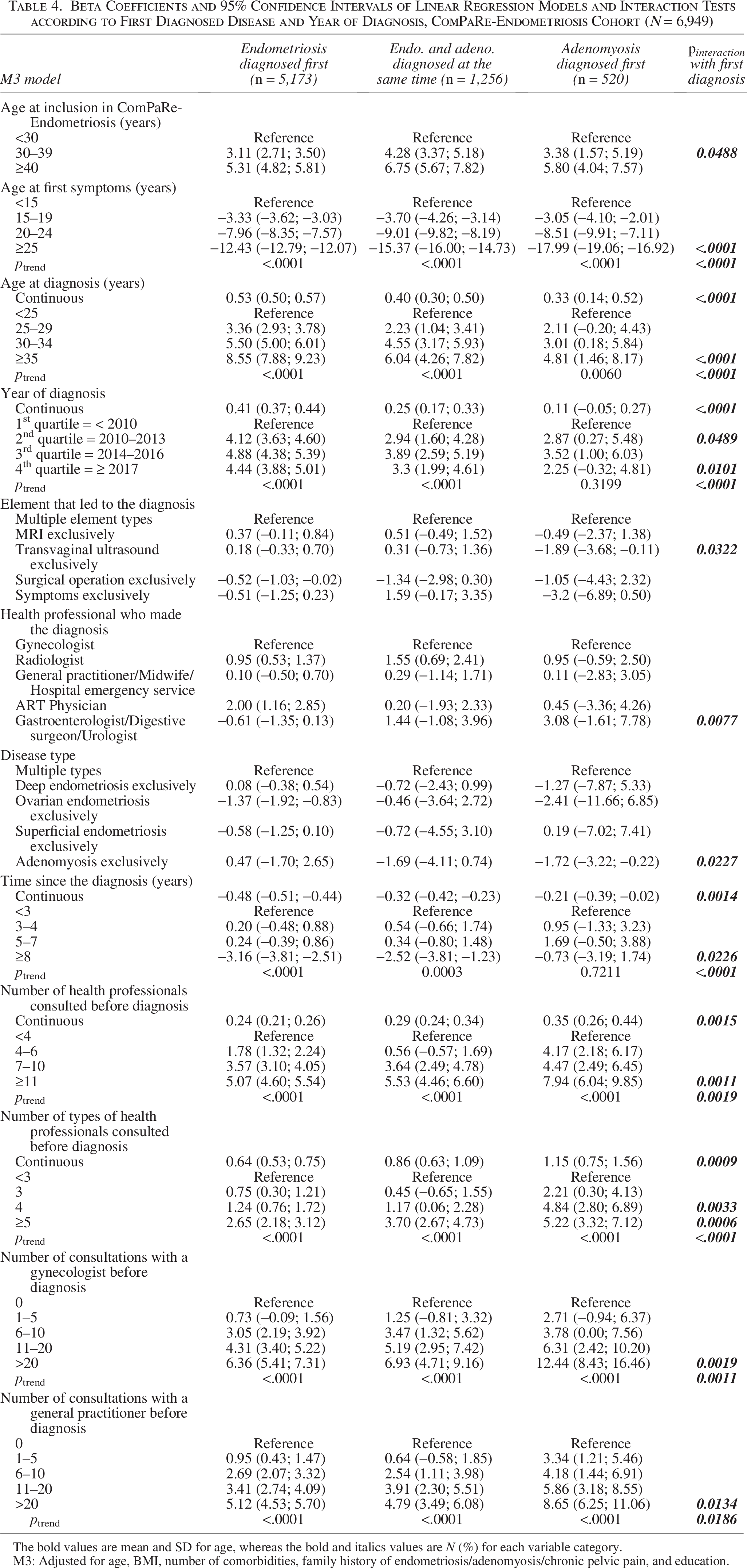
Regarding circumstances of diagnosis (Table 3), there was a strong inverse relation between age at first symptoms and diagnostic delay (symptom onset after age 25: β = −13.3 years versus <15), which was even stronger when adenomyosis was diagnosed first: β = −17.99; pinteraction ≤0.0001 (Table 4). However, delay was positively associated with age at diagnosis (β = 0.47 years) and year of diagnosis (β = 0.34 years), particularly when endometriosis was diagnosed first (β = 0.53 and 0.41, respectively; pinteraction ≤0.0001). It was also positively associated with number of health professionals consulted before diagnosis (β = 0.26 years), number of types of health professionals consulted (β = 0.75), and number of consultations with a gynecologist (>20 versus 0: β = 7.01; ptrend <0.0001) or a GP (>20 versus 0: β = 5.35; ptrend <0.0001) before diagnosis. These associations were stronger when adenomyosis was diagnosed first (pinteraction ≤0.0001). Diagnostic delay was longer when a relative (β = 2.02) or the participant herself (β = 2.10) first suspected the disease than when a health professional did, and when digestive symptoms (β = 1.52) or infertility (β = 1.28) led to the first consultation. In a sensitivity analysis, diagnostic delay was particularly high for women presenting with pain without infertility (β = 6.79, p < 0.0001) (data not shown). It was also longer when patients consulted for several symptoms (β = 1.62 versus a single symptom); when an assisted reproductive technique (ART) physician (β = 1.61 years) or a radiologist (β = 1.16 years) made the diagnosis compared with a gynecologist; and when the diagnosis was based on MRI (β = 1.61 years, versus not) or on clinical symptoms (β = 0.38 years, versus not).
Beta Coefficients and 95% Confidence Intervals of Linear Regression Models and Interaction Tests according to First Diagnosed Disease and Year of Diagnosis, ComPaRe-Endometriosis Cohort (N = 6,949)
The bold values are mean and SD for age, whereas the bold and italics values are N (%) for each variable category.
M3: Adjusted for age, BMI, number of comorbidities, family history of endometriosis/adenomyosis/chronic pelvic pain, and education.
However, compared with participants reporting multiple macro-phenotypes of diseases, those reporting exclusive macro-phenotypes had a shorter diagnostic delay (OMA: β = −1.69; adenomyosis: β = −1.21; SPE: β = −0.83 years). Diagnostic delay was inversely associated with time between diagnosis and questionnaire response (β = −0.42; particularly when endometriosis was diagnosed first: β = −0.48 years; pinteraction = 0.001), and according to the elements that led to the first consultation (surgery: β = −0.87 versus not, β = −0.76 versus several elements; pain exclusively: β = −1.54 versus several symptoms). There was no significant association between diagnostic delay and endometriosis stage, diagnosis by first-line health care professionals, or diagnosis through transvaginal ultrasound.
Discussion
In this cross-sectional analysis of a large sample of women with endometriosis and/or adenomyosis, the mean time to diagnosis was 10 years. Diagnostic delay was positively associated with age, an unfavorable economic situation, number of comorbidities, BMI, high levels of pain before diagnosis, experiencing multiple symptoms before diagnosis, a family history of endometriosis, adenomyosis, or CPP, having multiple types of disease or of symptoms that led to the first consultation, year of diagnosis, and numerous consultations before diagnosis. Diagnostic delay was also longer when an ART physician or radiologist diagnosed the disease, and when the patient or her relatives suspected the disease. In contrast, delay was inversely associated with a low education level, age at menarche, and age at first symptoms.
Strengths and limitations
This study is the largest ever conducted to date on endometriosis diagnostic delay. Study strengths also include access to a wide variety of potential correlations of diagnostic delay, and the participatory research setting, rather than clinical, which involves mostly surgical cases and may reflect more homogenous and severe disease profiles. It was also the first study to estimate the diagnostic delay of adenomyosis. Among limitations, the cross-sectional design did not allow us to interpret the direction of the associations; also, associations may be indirect and mediated by other factors, even factors representing events before diagnosis. Although more diverse than clinical samples, our study population was still selected based on voluntary participation online and may not be representative of all women with endometriosis. Thus, our reported diagnostic delay may be underestimated because most participants had favorable sociodemographic characteristics compared with the general population and are thus more likely to have well-established and easily accessible care; on the other hand, it could also be overestimated as cohort participants were volunteers, likely with specific motivations for participating—potentially due to challenging medical experiences, such as a long diagnostic delay. Another limitation is that separate analyses on adenomyosis may have lacked statistical power given the smaller sample size. Moreover, we lacked data on age at first medical consultation following symptoms, and our results on geographical area should be interpreted with caution, given that women may have moved since experiencing first symptoms or through their pre-diagnostic years. Finally, since the studied outcomes and factors were collected retrospectively, recall bias cannot be ruled out, although retrospective pain data in the cohort have shown good reliability. 31 Another limitation is that, while we assessed pelvic and abdominal pain symptoms over the life course after cohort inclusion, we did not have data on abnormal uterine bleeding (AUB) in the cohort. Since AUB is a hallmark symptom of adenomyosis, 32 the lack of data on this symptom hampered our ability to explore the association between AUB and diagnostic delay for adenomyosis.
While our study provides valuable insights into diagnostic delay for both endometriosis and adenomyosis, dedicated prospective research is necessary to further explore the specific diagnostic pathways of adenomyosis, including the role of key symptoms such as AUB. Given the historical conflation of both diseases, our joint analysis offers a valuable overview; however, future studies should treat adenomyosis as a distinct clinical entity.
Diagnostic delay
Our observed 10-year overall diagnostic delay falls within the 3–13-year range reported in various countries.5–7,21,33–37 In France, a recent hospital-based study among 57 patients reported a mean delay of 12 years, with a mean delay of 4 years between symptom onset and first medical consultation, and of 8 years between first consultation and diagnosis. 9 Another French study among 1,557 women highlighted a mean delay of 7 years, including 6 years between first consultation and diagnosis. 25 Other studies reported a mean delay of 7 months 15 to 6 years 12 between symptom onset and first consultation, and an average of 2.3 6 to 8 years 9 between consultation and diagnosis. Since our study did not include information on age at first consultation, we were unable to break down diagnostic delay between symptom onset and consultation, and between consultation and diagnosis. However, our finding that patients consulted on average 8 health care professionals and 3.5 different types of health care providers before diagnosis suggests a significant delay between first consultation and final diagnosis. Previous research indeed suggested that both patients and medical professionals may normalize symptoms.6–9,11,13,19–22,35,38
Factors associated with diagnostic delay
Since our study was cross-sectional, it includes factors that occurred both before and after diagnosis. As a result, it was not possible to clearly determine the direction of the associations. Thus, we considered both possible directions of findings in most cases.
Consistent with our findings, previous studies reported longer diagnostic delays with a poor financial situation and unemployment, likely due to reduced access to information and expert care, and high pre-diagnosis health care costs.39,40 Higher delays were also associated with employment instability, potentially reflecting either limited access to experts or the impact of endometriosis on educational attainment.3,41 However, we observed longer delays with higher education levels, which could reflect a higher potential to self-manage symptoms before diagnosis through lifestyle and coping strategies.
Previous studies showed a longer delay in patients with a higher number of comorbidities, in concordance with our findings. On the one hand, comorbid conditions may hamper endometriosis diagnosis, potentially overshadowing symptoms or leading to a differential diagnosis;42–44 on the other hand, delayed care may also contribute to developing other chronic conditions. These findings highlight the critical importance for nonexpert clinicians to consider patients’ symptoms and refer them to specialists early.
Our observed positive association between diagnostic delay and BMI, consistent with Nnoaham et al., 5 could indicate that overweight/obese women may be less likely/comfortable to seek care, more likely to be dismissed by doctors, or to face particular clinical diagnostic difficulties, or that diagnostic delay may impact women’s lifestyle/BMI. While all hypotheses are valid, it is interesting to note that average BMI did not decrease with the number of health professionals or types of professionals consulted, which could be consistent with a higher likelihood of dismissals in overweight/obese women. Treatment and management bias by weight are not specific to endometriosis 45 and may be due to stigma against obese people. 46
Surprisingly, severe pre-diagnosis pain levels were associated with longer delays in our study. Medical wandering and untreated symptoms may lead to increased pain due to the stigma and normalization of menstrual pain.11,19–22,38,47 In contrast, severe dysmenorrhea was associated with a shorter delay in a Chinese clinical study of 400 patients, 7 suggesting possible cultural differences in pain expression.19,48,49 Alternatively, a long diagnostic delay could lead to the intensification of pain. 50
While we expected an inverse association between family history of endometriosis/adenomyosis/CPP, we found a positive relation. This association, which was not investigated in previous research, may suggest symptom normalization within families, 38 which could lead to a delay in first consultation and thus to a higher overall diagnostic delay. This finding underscores the crucial need to raise awareness among families with one or more affected women.
Older age at symptom onset was associated with a shorter delay in our and previous research,7,8,13,15–18 possibly because women were more likely to consider symptoms abnormal, especially in the case of infertility. 16 Additionally, endometriosis lesions are more visible at an older age than in young girls, facilitating diagnosis.
Diagnosis through surgery alone was associated with a shorter delay compared to diagnosis based on several exams. While French and European guidelines recommend diagnosis through imaging and clinical examination since 2017 and 2022, respectively, surgical diagnoses may reflect pre-diagnosis pathways leading directly to experts. Nevertheless, it has been suggested that symptoms, signs, and clinical findings of endometriosis must drive diagnosis for early intervention. 51 However, quality imaging diagnosis needs skilled examiners, and qualified physicians are lacking.
When endometriosis was self-suspected or suspected by a relative, diagnostic delay was higher, potentially because self-diagnosis often precedes medical recognition. 6
When a diagnosis was made by an ART professional, the delay was longer. This may be because women reaching diagnosis when investigating infertility are often asymptomatic; however, it is also possible that ART specialists treat endometriosis as unexplained infertility.
The number of health care professionals consulted was positively associated with diagnostic delay, consistent with recent research, 40 as well as a high number of different types of health care professionals consulted, indicating significant medical wandering before finding endometriosis expertise.17,18
Diagnostic delay has slightly increased over time in our study, possibly due to a catch-up effect, as previously undiagnosed women have been receiving diagnoses due to improved awareness and physician training. However, our sensitivity analyses showed that diagnostic delay was particularly high for women presenting with pain without infertility, consistent with the reported lack of consideration towards women’s pain.20 Findings from our and other studies contribute to completing the “barriers to a timely diagnosis of endometriosis” determined in a recent qualitative systematic review. 52
Taken together, our findings highlight a long diagnostic delay for endometriosis and adenomyosis that remains unacceptable. A global call to action is necessary—health care professionals are still mostly not adequately trained to recognize the disease and to listen adequately to patients’ symptoms and pain, and often fail to suspect endometriosis in the presence of suggestive symptoms and to refer patients to specialists.
Similar factors were associated with diagnostic delay in other chronic diseases, such as lower education level, younger age at symptom onset, older age at diagnosis, and comorbidities.53,54 However, our study provides new insights specific to endometriosis, identifying factors linked to longer delays, such as severe pain and a family history of the disease. This highlights the persistent taboo and stigma surrounding menstrual pain.
Conclusions
In conclusion, this large cross-sectional survey reports an average diagnostic delay of 10 years among symptomatic self-reported endometriosis patients. Overall, an unfavorable socioeconomic situation, a higher number of comorbidities, higher pre-diagnosis pain levels, or a family history of endometriosis, adenomyosis, or CPP, were associated with a longer diagnostic delay, while a low education level, older age at menarche, and older age at first symptoms were associated with a shorter delay. Particular attention to these patient profiles may contribute to reducing time to diagnosis and improving endometriosis care.
Authors’ Contributions
Z.B. and M.K. conceived and designed the study. Z.B. performed the data management, statistical analysis, and drafted the original article. M.K. has raised funds for the study. Z.B., M.K., S.G., E.I., M.G., V.-T.T., N.A., B.B., E.P., H.R., A.-C.M., and M.N.M. contributed to the interpretation of data discussed in the article, revised the article, and approved its final version. M.K. supervised the study and had primary responsibility for final content.
Footnotes
Acknowledgments
The authors are grateful to all participants of the ComPaRe-Endometriosis cohort for their invaluable time and dedication to research. The authors also thank the members of the ComPaRe-Endometriosis Scientific Committee: Nizar Aflak, Bruno Borghese, Marie Gabillet, Emma Galland, Juliette Gautier, Émilie Indersie, Delphine Lhuillery, Anne-Charlotte Millepied, Margaux Neve De Mevergnies, Erick Petit, Stéphane Ploteau, Myriam Poulain, Horace Roman, Alice Romerio, Éric Sauvanet, Sylvain Tassy; all the patient societies involved; members of the ComPaRe team; and members of the Exposome and Heredity Team at Inserm U1018/CESP, particularly Fanny Artaud and Pauline Frenoy, for their methodological advice.
Author Disclosure Statement
Z.B.’s PhD was partly funded by the French National Association for Research and Technology (ANRT) and by Lyv Healthcare. All other authors have no conflict to declare.
Funding Information
The authors are grateful to the associations ENDOmind, EndoFrance, EndoAction, Les Joyeux Boulomanes Farledois, La Belle & l’Endo, and Les Chroniques Endométriques for their financial support of the ComPaRe-Endometriosis cohort. The ComPaRe cohort was funded by the Assistance Publique-Hôpitaux de Paris (APHP) and the Université Paris Cité. Z.B.’s PhD was partly funded by the French National Association for Research and Technology (ANRT) and by Lyv Healthcare. Z.B. is also grateful to the EndoFrance association for its financial support during her Master’s.
Data Availability Statement
The data collected in this study are partly available for research purposes, in accordance with the rules of the ComPaRe e-cohort (https://compare.aphp.fr/).