



Abstract
Background:
Obtaining a National Institutes of Health (NIH) career development (K) award is a pivotal milestone for early-career faculty, contributing not only to individual career progression but also to the diversity of the biomedical sciences workforce. Despite the critical importance of these awards, disparities in access may perpetuate inequities within academic biomedical disciplines.
Methods:
In this large, retrospective cohort study, we investigated how sex, race, and ethnicity were associated with submission and success rates for NIH K-award applications among 2455 early-career faculty affiliated with a large medical school and life sciences departments at a leading public research university over 20 years (2001–2021).
Results:
This cohort had 59% men, 58% White, and 35% Asian faculty. Faculty members from underrepresented groups (Black and Hispanic) represented 7% of the sample. Our findings indicated that women were more likely than men to submit a K award application (adjusted odds ratio [aOR]: 1.45; 95% confidence intervals [CIs]: 1.16, 1.82), whereas Asian faculty were less likely than their White counterparts to apply (aOR: 0.55; 95% CI: 0.43, 0.72). Submission rates did not differ between underrepresented groups and White faculty (aOR: 0.95; 95% CI: 0.61, 1.47). Importantly, we observed no differences in award receipt by sex (aOR: 1.11, 95% CI: 0.60, 2.03) or by race/ethnicity, with aORs of 0.55 (95% CI: 0.21, 1.46) for underrepresented groups versus White faculty and 0.79 (95% CI: 0.39, 1.57) for Asian versus White faculty.
Conclusions:
While sex, race, and ethnicity influence the likelihood of applying for NIH K awards, these factors did not affect the likelihood of receiving career awards once submitted. The observed disparities in application rates underscore a critical need for targeted outreach, mentorship, and support to enhance awareness and encourage applications among all early-career faculty, ultimately promoting greater equity in access to these vital career development opportunities.
Introduction
A successful academic career in biomedical and population health sciences depends on extramural funding and peer-reviewed publications in high-impact journals.1–2 Early-career faculty on the tenure track dedicate the early years of their first faculty appointment to establish an independent research program concurrent with teaching and service responsibilities. To support these faculty, the National Institutes of Health (NIH) offer mentored career development awards that cover up to 75% of faculty salary for 3–5 years. These awards provide additional training funds for the development of research skills necessary for early-career faculty members to become successful independent investigators.
The career development award is a strong predictor of obtaining subsequent independent grants, and it plays a key role in promotions and tenure appointments among early-career investigators. 1 The career awards offered by the NIH, also called K awards, are designed to support investigators with diverse career development goals, that is, researcher–investigators, teacher–investigators, and clinician–scientists. Eligibility for a career award varies among sponsoring institutes but typically requires a doctoral degree (PhD or MD), U.S. citizenship or permanent residency, some research experience, and an institutional commitment to the applicant.
Career development awards have been utilized by the NIH not only to support promising investigators but also as a tool to enhance diversity in biomedical research.3–5 However, access to career awards is not equitable and may contribute to downstream disparities in research independence by sex and race or ethnicity.6,7 In prior studies, these differences were not explained by research productivity or publication history and were particularly acute for Asian and Black women.8,9 Indeed, recent data from 2010 to 2022 have demonstrated that substantially fewer faculty who are Black or Hispanic submitted a career development award than faculty who are White, and they were also less likely to obtain funding in most years from 2010 to 2018, despite significant improvements since 2019. 10 Similarly, descriptive analyses of all K awardees from medical schools and 2012 to 2021 identified reductions in the average share of women awardees from 42.54% during 1997–2011 to 33.91% during 2012–2021. 11
However, an important gap remains in understanding how sex and race/ethnicity influence the likelihood of (1) submission of K award applications and (2) receipt of a K award among early-career investigators who apply. Prior work has relied on (1) cross-sectional, discipline-specific analyses over limited time periods and disciplines, (2) self-reported measures rather than objective, NIH-confirmed application and award data, or (3) NIH-confirmed, postaward information that centers on successful applicants, limiting the ability to assess gender and sex differences in the full applicant pool, including unsuccessful submissions. To address this gap, we conducted a retrospective analysis using institutional-level data of objective, administrative records of K submission and award information spanning an extended time period and multiple disciplines across medical school and life sciences academic units at a large, public research university. We examined whether sex, race, and ethnicity play a role in the submission of and receipt of NIH career development awards to distinguish disparities arising from barriers to submission versus differences in success once an application was submitted.
Materials and Methods
Data source
We obtained data from the University of Michigan Office of Research and Sponsored Projects (ORSP) on December 8, 2022, and the University of Michigan Office of Human Resources (HR) on October 4, 2022. The ORSP records information on all submitted and awarded grants among all faculty members across faculty tracks and ranks. Grant data were linked with demographic information (sex, race, and ethnicity); campus and departmental affiliations; and appointment details, including rank (assistant, associate, or full professor), track (tenure or research), and number of months in their current appointment, as recorded in HR files. Information that could identify individual faculty during or after data collection was available. This study uses identifiable data; however, the research falls under quality assurance and quality improvement and has been determined to be exempt by the University of Michigan Institutional Research Board (nonregulated status determination HUM00209352).
Study population
We utilized data on grant applications submitted to federal, foundation, and private funding between 2001 and 2021. The demographic sample was restricted to faculty affiliated with schools, colleges, or divisions within the health sciences, including the Medical School, School of Dentistry, College of Pharmacy, Life Sciences Institute, and Schools of Kinesiology, Nursing, and Public Health.
To create the analytic sample, we first restricted the data to federal K awards submitted between 2001 and 2021 by university-affiliated, early-career faculty members on the tenure track (Assistant Professors) and on the research (nontenure) track (Research Assistant Professors, Assistant Research Scientists, and Research Investigators). Data from HR included faculty records for academic years 2001–2021 (July 1 to June 30 cycle) who were junior faculty during the years of analysis (see Fig. 1 for inclusion–exclusion criteria).
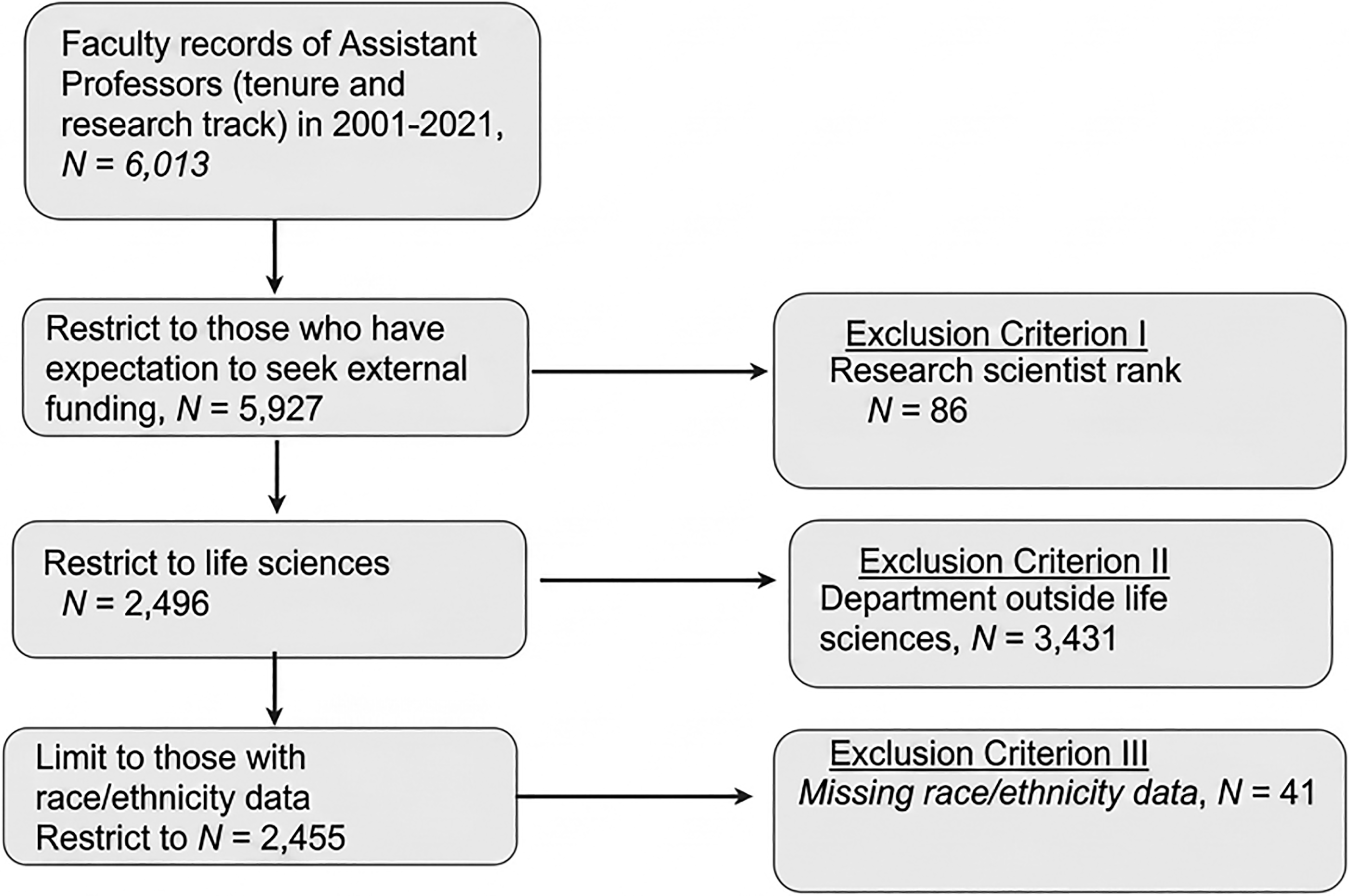
Inclusion–exclusion criteria flow chart for analytic sample creation. N denotes the number of observations.
Demographic variables
To examine potential disparities by sex, race, and ethnicity in career development awards, we assessed faculty sex and race and ethnicity information based on HR data. Sex was self-reported biological sex. Race and ethnicity were self-reported and included the following categories: American Indian or Alaska Native, Asian, Black or African American, Hispanic, Native Hawaiian or Other Pacific Islander, Race/Ethnicity Unknown, two or more, and White, not of Hispanic origin. We classified early-career faculty into three groups based on race and ethnicity: Asian, underrepresented groups (American Indian or Alaska Native, Black or African American, and Hispanic), and non-Hispanic White. We collapsed American Indian or Alaska Native (n <10), Black or African American (n = 60), and Hispanic (n = 96) faculty into the underrepresented group because small sample sizes would preclude meaningful statistical analysis in the absence of statistical power. Our dataset did not identify any individuals as Native Hawaiian or other Pacific Islander, race/ethnicity unknown, or two or more races.
Outcomes
Using data from ORSP, we considered two outcomes of career awards. The first outcome was submission of a K award application; the second outcome was receipt of a funded K award among those who applied.
Covariates
Several variables were considered as covariates in the analysis. The academic rank of early-career faculty was grouped into two categories: (1) Assistant Professors and Research Assistant Professors, and (2) Research Investigators and Assistant Research Scientists. The first represents an independent track, whereas the second corresponds to team scientists. School affiliation was grouped into two categories: (1) Medical School and School of Dentistry and (2) College of Pharmacy, School of Kinesiology, School of Nursing, School of Public Health, and Life Sciences Institute. The former is a single, large, independently operated medical institution, whereas the latter includes life sciences colleges and schools of the university with relatively fewer faculty. Years in rank at the time of K award submission represent the total years since the start of the faculty appointment, either as a continuous variable or in the following categories: 1–2 years, 3–4 years, 5–6 years, or 6+ years. All covariates were obtained from the University of Michigan HR. These covariates account for differences in expectations for external funding, criteria for evaluation and promotion, mentorship support, and resource availability among faculty across ranks, tracks, and schools.6,9–10 The starting year of faculty appointment was also used to reflect any changes over time in overall K funding rates.
Statistical analysis
We utilized absolute counts and percentages to summarize the number of K award applications that have been submitted and awarded and to illustrate rates of grant submission and awards of all eligible faculty. Logistic regression models were applied to examine (1) the odds of submitting a career development award application and (2) the odds of receiving funding among those who submitted an application. Both models looked at outcomes by sex, race, and ethnicity, adjusting for school affiliation, faculty track, faculty rank, and years in rank.
Results
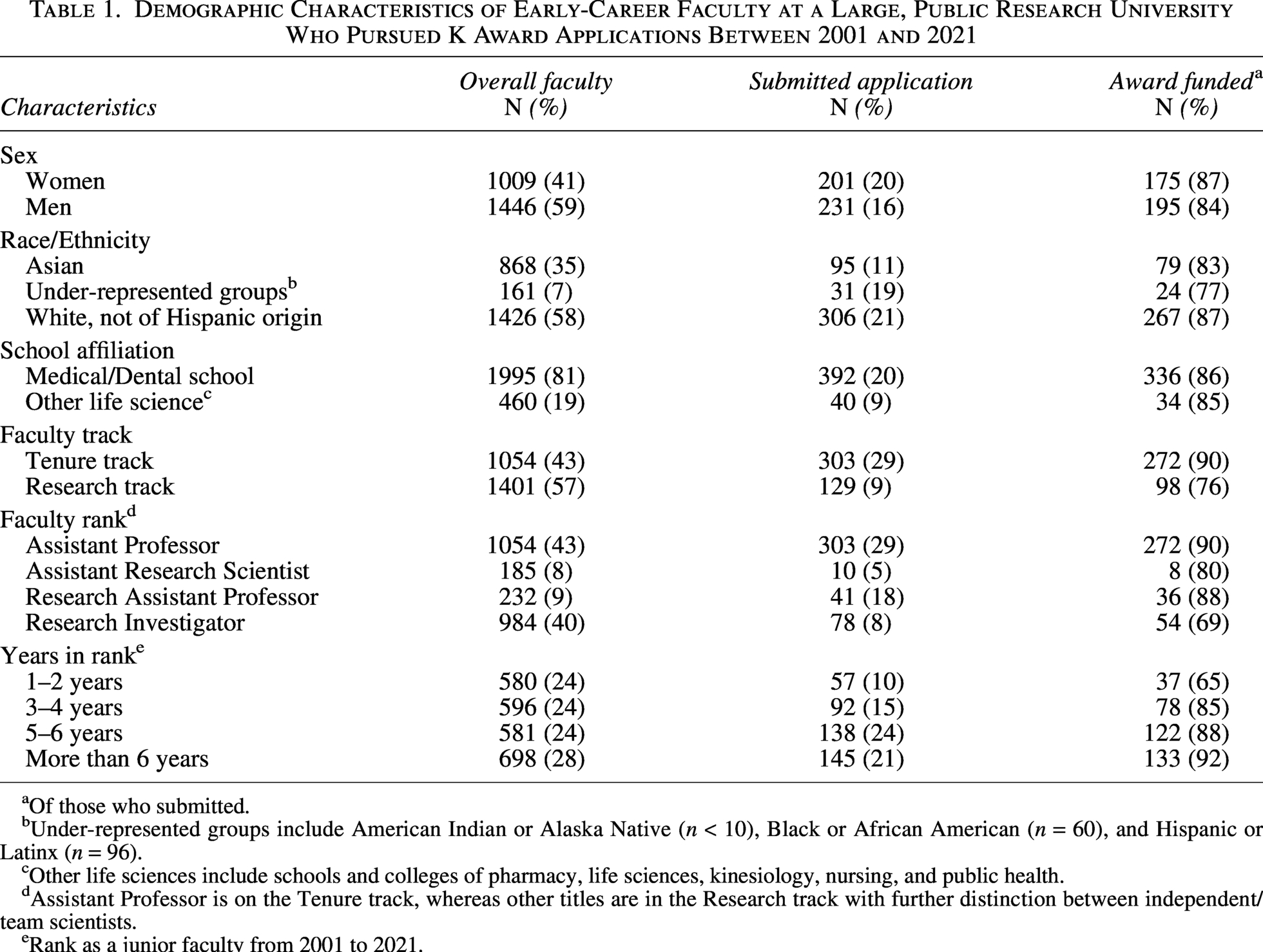
The analytic sample included a total of 2455 early-career faculty members, at the rank of an assistant professor (on the tenure or research track), assistant research scientists, or research investigators, between 2001 and 2021 (Table 1). Of these, 59% were men, 35% were Asian, 7% were from underrepresented groups, and 58% were White. Most faculty members were affiliated with the Medical School (81%), and fewer than half (43%) had an appointment on the tenure track. While only 20% of women submitted a K award, most women who submitted an application obtained this award (87%). Similarly, only 16% of all men submitted an award, and 84% of men who submitted an application obtained a career development award.
Demographic Characteristics of Early-Career Faculty at a Large, Public Research University Who Pursued K Award Applications Between 2001 and 2021
Of those who submitted.
Under-represented groups include American Indian or Alaska Native (n < 10), Black or African American (n = 60), and Hispanic or Latinx (n = 96).
Other life sciences include schools and colleges of pharmacy, life sciences, kinesiology, nursing, and public health.
Assistant Professor is on the Tenure track, whereas other titles are in the Research track with further distinction between independent/team scientists.
Rank as a junior faculty from 2001 to 2021.
Asian faculty members were the least likely to submit an award application (11%) compared with under-represented groups (19%) and non-Hispanic White faculty (21%). The success rate of a K award was 87% for White faculty members, 83% for Asian faculty members, and 77% for faculty from underrepresented groups. Tenure track faculty were more likely to submit (29%) and obtain (90%) their career award applications than their research track counterparts (9% submission, 76% success). An increasing proportion of K applications were submitted and awarded by junior faculty with more years in rank.
Sex differences were apparent in the submission of a career development award, as women had higher adjusted odds of K award submission than men: adjusted odds ratio (aOR): 1.45 (95% confidence interval [CI]: 1.16, 1.82), adjusted for race and ethnicity, school affiliation, faculty track, faculty rank, and years in rank. Asian faculty had lower odds of a career award submission compared with non-Hispanic White faculty: aOR: 0.55 (95% CI: 0.43, 0.72), adjusted for sex, school affiliation, faculty track, faculty rank, and years in rank. There was no statistical difference in odds of career award submission between faculty from underrepresented groups and non-Hispanic White faculty (Table 2). Among early-career faculty who submitted a K award, we found no sex or racial and ethnic differences in odds of obtaining the award. Specifically, the odds ratio for obtaining a K award among women relative to men was 1.11 (95% CI: 0.60, 2.03). Compared with White early-career faculty, the odds ratios of obtaining a K award were 0.55 (95% CI: 0.21, 1.46) and 0.79 (95% CI: 0.39, 1.57) for those for underrepresented minority (URM) or Asian faculty, respectively.
Associations among Sex, Race, and Ethnicity and Submission of a Career Development Award among All (n = 2,455) Early-Career Faculty in Biomedical and Life Sciences at the University of Michigan (2001–2021)
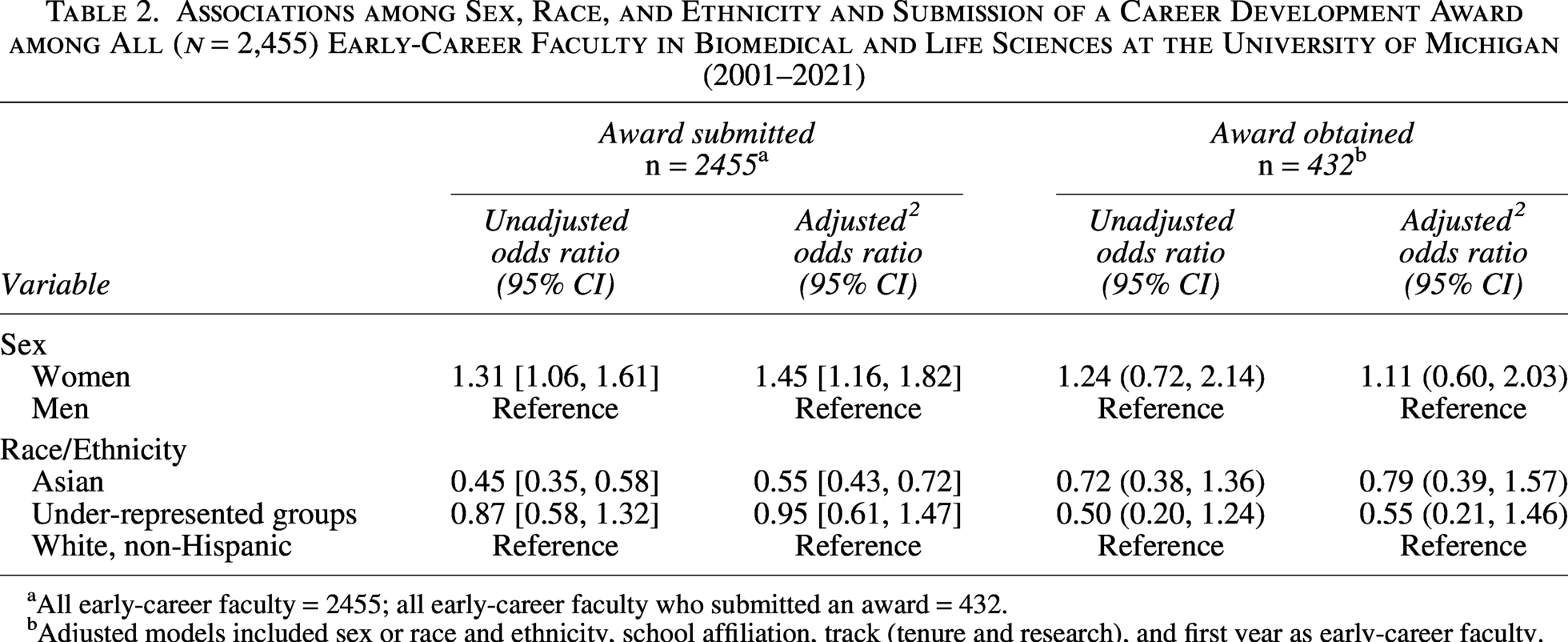
All early-career faculty = 2455; all early-career faculty who submitted an award = 432.
Adjusted models included sex or race and ethnicity, school affiliation, track (tenure and research), and first year as early-career faculty.
Discussion
In this retrospective investigation over a two-decade period involving a cohort of early-career faculty at a leading public research university, our findings indicate pronounced differences in the submission of NIH career development awards by sex, race, and ethnicity. Specifically, women were more likely than men, whereas Asian faculty were less likely than White faculty to submit K awards. Importantly, however, once an application was submitted, the odds of obtaining a career development award did not differ by sex or racial and ethnic group. Differences in K award attainment at the institutional level may be driven by barriers to application submission, rather than differential success rates once an application is submitted. From a practical standpoint, our results point toward interventions targeted at the front end of the pipeline, such as mentorship matching, protected time, grant writing support, and targeted outreach to groups with lower submission rates. They may inform early-career scholars and their mentors as they navigate the initial stages of their academic careers. As our study setting is representative of other top-funded biomedical research institutions, these findings may be generalizable to similar academic medical centers that collectively receive a substantial proportion of NIH K awards.
Career development awards (K awards) offered by the NIH aim to foster robust research skills among early-career faculty and create a pipeline of successful and independent scientists. This program supports the effort of faculty members who embark on a path to research independence guided by a team of mentors with relevant expertise. Moreover, K awards are utilized to enhance diversity among young scholars and support training in new fields. Thus, it may indirectly serve as a particularly effective mechanism to ameliorate sex disparities in external federal funding support arising from parenting and family caregiving responsibilities. 12
Sex differences
Data on sex differences in submission of and obtaining a K award are scant. In a survey of 1719 K08 and K23 early-career awardees during 2006–2009 with 1066 responders at follow-up (493 women and 573 men), women were 20% less likely to achieve success (54% versus 67%) compared with men. 13 Despite controlling for work hours and environment, significant gender disparities in funding and publication persisted. Analyzing nationwide trends of K awards from 1990 to 2019 listed on the NIH RePORTER, there was a 28% increase in the proportion of women among K awardees, the largest among all funding mechanisms considered. 14 For example, a nationwide study examined trends among clinician-scientists specializing in obstetrics and gynecology who received K08, K12, and K23 awards from 1988 through 2015. This study found that of the 388 career awards, 66% were awarded to women and 34% to men, a trend that persisted throughout the study period. However, no information on sex differences in the applicant pool was available for a credible assessment of the presence of disparities in proportional funding rates by sex. 15 A study of NIH RePORTER 1997–2021 data of K awardees from all medical school departments found that the annual percent increase in women K awardees was significantly lower than the annual percent increase in women faculty representation. 11
Differences in patterns of submission or obtaining of a K award application by sex may operate through multiple pathways. Survey evidence among a large, national sample of K awardees in 2006–2009 suggests that men experience greater support in various areas. 13 The increased odds of K submission we observe in our study among women may be a compensatory response to less adequate access to human resources, such as administrative and grant administrative support and access to research resources.
Racial and ethnic differences
Studies that focused on race and ethnicity have shown that medical school graduates who are not from URM groups are more likely than URM graduates to be K award recipients. Analysis of data from the NIH’s Office of Extramural Research indicated an increase in the number of Black and Hispanic K award applicants and awardees over time, from 94 (3.9%) Black and 153 (6.3%) Hispanic applicants in FY 2010 to 195 (5.4%) Black and 284 (7.8%) Hispanic applicants in FY 2022, although the total number remained low. Black applicants showed lower rates for K08 and K23 applications compared with White applicants, though funding rates for underrepresented groups have improved in recent years, particularly among Black and Hispanic faculty. 10 A nationwide study that analyzed K01, K08, and K23 career development awards among 27,521 U.S. medical school graduates from 1997 to 2004 aiming for research-related careers revealed racial and ethnic differences in K award receipt. Specifically, 4.4% of non-URM graduates received K awards compared with only 2.4% of URM graduates. 16 In contrast and congruent with our findings, a survey of 1270 faculty participants (1019 White faculty, 88 non-URM faculty, and 163 URM faculty) found no differences in federal grant acquisition among URM relative to White faculty. 17
Strengths and limitations
Studies using NIH RePORTER data accurately describe the composition of awardees and patterns of transitions from K to R mechanisms.11,15–16,18 However, because this data reflects post-award information, it cannot determine whether observed disparities stem from barriers to submission versus differences in funding success once an application has been submitted. To address this gap, we linked institutional grant submission and funding records by the University ORSP, capturing both successful and unsuccessful K applications, with data from the Office of HR, including demographics, rank, track, school affiliations, and years in rank information for 2455 early-career faculty across the Medical School and other life sciences units at a large public research university for over two decades. To our knowledge, this study reports the longest assessment of K submission and award rates by sex, race and ethnicity within a single institution to date. The University of Michigan is a relevant study setting because it offers numerous early-career faculty seed funding opportunities as well as K award writing workshops, which may narrow funding gaps by sex, race, and ethnicity. Moreover, the public nature of the University of Michigan enables us to draw novel inferences regarding the effectiveness of public institutions in ameliorating structural roadblocks to federal funding success.
However, this study has some limitations. First, we are not using measures of faculty productivity such as the number of publications that has been found to be correlated with the probability of K award funding. 18 By virtue of using a sample from a single institution, we indirectly account for differences in productivity, as early-career faculty are subject to annual reviews and have comparable levels of institutional support. Future research may consider using time-to-event analytical methods, such as survival analysis, to examine the timing of K award submission and receipt for additional insights into critical time windows during the early-career period. Additionally, longitudinal analyses with repeated cross-sections over time could examine the association of mentorship quality, institutional support, and research infrastructure with K award pursuit and success or NIH funding longevity. Second, we did not account for variation in the NIH budget over time that has substantially influenced K award rates. 19 However, we adjusted for the first year that investigators became faculty members. Third, the focus on a large, public research university institution with a robust research infrastructure, including grant writing workshops and mentorship, may limit the generalizability of the findings to smaller public or private research universities. 5 Still, this setting offers the opportunity for future investigations evaluating the impact of institutional support programs on K-award submission and funding rates, highlighting mechanisms underlying observed disparities and offering policy recommendations to strengthen K-award pipelines across institutions. Finally, faculty from URM groups represent <7% of faculty in the United States, which is congruent with the present data. Among the 360 faculty who received K awards in our study cohort, only 24 faculty from underrepresented groups and 79 Asian faculty received these awards, so our study had limited statistical power to assess whether their success rates differed from non-Hispanic White faculty members.
Conclusions
In this retrospective study of early-career faculty members, we found differential patterns of submission of NIH career development awards by sex, race, and ethnicity. There were no differences in the likelihood of obtaining an award among those who submitted an application. These data highlight disproportionate patterns in the pursuit of career development funding, a major driver of becoming independent investigators. Strategies to alleviate barriers encountered by early-career faculty members in submitting and obtaining career development awards would improve equitable opportunities for career development among all biomedical researchers.
Footnotes
Acknowledgments
The authors wish to thank John Z. Ayanian, MD, MPP, for invaluable input on the analysis and interpretation of the study findings.
Authors’ Contributions
AM.K.: Conceptualization (equal), formal analysis (supporting), funding acquisition (lead), investigation (equal), supervision (supporting), methodology (equal), writing—original draft preparation (lead), and writing—review and editing (supporting). M.K.: Data curation (lead), formal analysis (lead), software (lead), visualization (lead), and writing—review and editing (supporting). E.S. and E.C.-T.: Project administration (equal) and resources (equal). G.L.D.: Conceptualization (equal), investigation (equal), supervision (lead), methodology (equal), writing—original draft preparation (supporting), and writing—review and editing (lead).
Author Disclosure Statement
No competing financial interests exist.
Funding Information
A.M.K. received funding from the Institute for Healthcare Policy and Innovation at the University of Michigan for this work.