



Abstract
Though ties between having psychopathic attributes and criminality are strong, only recently has the criminological community appreciated that the characteristic traits of psychopathy are emergent in youth and are variably distributed in the population. In recognition, this study evaluates the value of psychopathic callous–unemotional (CU) traits in youth alongside key criminological variables in explaining violence. Results show that CU traits remain robust among traditional criminological variables in explaining juvenile violence. Further, CU traits are observed to interact with key criminological covariates such that at higher levels of one construct, the impact of other correlates on violence is weakened.
In the field of psychiatry, the construct of psychopathy carries a long empirical history, with the first recognized description being published in 1801 (Vaughn & Howard, 2005). Yet, only recently are scholars incorporating and advancing the concept within the realm of criminological thought (e.g., da Silva, Rijo, & Salekin, 2012; DeLisi, 2009; Vaughn & Howard, 2005). Specifically, the concept of psychopathy has been furnished as an explanation for criminal career trajectories because of the stability and prevalence of psychopathic features among high frequency offenders (e.g., Vaughn & DeLisi, 2008). Traditionally conceived as a psychiatric disorder, as opposed to fitting into the framework of criminological theory, psychopathic individuals share several notable characteristics, including being callous, self-centered, interpersonally exploitive, socially inappropriate in attempts to satisfy needs, deficient in being able to secure affectional bonds with others, among other characteristics (Vaughn & Howard, 2005, p. 236). Though scholars are recognizing the promise of incorporating psychopathic characteristics into the study of delinquency and crime (Vaughn, Howard, & DeLisi, 2008), these studies most often are limited to predicting career offending (e.g., DeLisi, 2009; Salekin, 2008; Vaughn & DeLisi, 2008; Weibe, 2003). Very few studies have examined psychopathy alongside other consistent and traditional correlates of adolescent delinquency in noninstitutionalized populations (but see Vaughn, Litschge, DeLisi, Beaver, & McMillen, 2008).
Importantly, scholars are appreciating that the collective domains that make up the construct of psychopathy are largely normally distributed in the population (DeLisi, 2009; Edens, Marcus, & Vaughn, 2011; Murrie et al., 2007). At the subclinical level, the composite characteristics of psychopathy may be important to the study of general delinquency or, more pointedly, youth violence and can serve to improve our understanding of delinquent, antisocial behaviors beyond that accounted for by traditional criminological theories. As noted above, though the study of psychopathic traits in criminal populations has focused on examining criminal trajectories among serious, chronic offenders, far less is known about the value of these qualities in predicting delinquency in the general population of youth. In addition, little is known about how psychopathic traits may interact with criminological constructs to increase or diminish the probability of delinquency. Protective and vulnerability factors known to affect psychopathology symptoms have been taken for granted in other disciplines (e.g., Muris, Mayer, Reinders, & Wesenhagen, 2011). It is reasonable to assume other individual-level characteristics in the presence of psychopathic symptoms might mollify or exacerbate the effect these antisocial traits have on juvenile antisocial behavior. For instance, might possessing high levels of callous and unemotional psychopathic traits modify the antisocial consequences of associating with delinquent peers?
Using data drawn from the National Institute of Child Health and Human Development’s (NICHD) Study of Early Child Care and Youth Development (SECCYD), this study seeks to examine the predictive quality that psychopathic traits have alongside traditionally recognized correlates of delinquency which may serve to modify violent youth behavior. While much is known about the role of psychopathy in populations of chronic adult offenders and confined youth, few have investigated the role of psychopathic traits in nonconfined youth or the manner in which such traits might moderate the influence of traditional criminological covariates in predicting delinquency. Toward this end, the Youth Psychopathic Traits Inventory’s (YPTI) subscales of remorselessness, unemotionality, and callousness (CU traits) are used to determine the viability and merit of examining psychopathic characteristics in concert with other theoretically germane variables to examine additive and nonadditive effects on violent behavior among youth. Prior to presenting the methods and findings, the literature on youth psychopathy is reviewed in greater detail. Next, the status of key criminological variables is discussed prior to them being examined alongside psychopathic traits in the current study. Then, consideration is given to the possible conditional nature of the relationship between psychopathic traits and these principal variables in the prediction of violent delinquency.
Psychopathy
Most often identified in males (Vaughn & Howard, 2005), individuals suffering from psychopathy are known to have a constellation of problematic characteristics. The work of Hare, Hart, and Harpur (1991) has been of particular import in isolating the measurement structure of psychopathy. In particular, psychopathic features are observed to fall within a two factor composition. The first factor contains the characteristics of being glib and superficial, having an inflated and arrogant self-appraisal, lacking remorse, lacking empathy, and being deceitful and manipulative; The second factor identifies early behavior problems, adult antisocial behavior, impulsivity, poor behavioral controls, and being irresponsible (Hare, Hart, & Harpur, 1991). These traits collectively tap into the affective interpersonal (Factor 1) and the socially deviant lifestyles and behaviors (Factor 2) features of psychopathy (see Bezdjian, Raine, Baker, & Lynam, 2011). 1
In attempts to better understand psychopathy, scholars have turned attention to juveniles and preadolescents for clues in understanding renascent psychopathy with aims toward intervention and treatment. Observations of youth have led researchers to several conclusions that guide the present work. In particular, adult psychopathic features are present in youth, are stable over time, and, like adults, are associated with poor behavioral outcomes (e.g., Lynam & Gudonis, 2005; Lynam, Loeber, & Stouthamer-Loeber, 2008).
Youth Psychopathy
The notion of fledgling psychopathy, that is, the presence of psychopathic traits in youth, is the recognition of a constellation of characteristics closely mirroring those identified in adults (Lynam, 1996, 1998). Strong empirical evidence supports the existence of childhood psychopathy (Lynam et al., 2008) having effectively isolated psychopathic traits among adolescents and younger individuals (for review see Lynam & Gudonis, 2005). Further, studies have shown that psychopathy is relatively stable from childhood through adolescent years (Lynam & Gudonis, 2005) and from adolescence into adulthood (Lynam et al., 2007, 2008; Robins, 1966). In a recent review, Lynam and Gudonis (2005, p. 381) explored the developmental aspects of psychopathy and report that most research supports the notion that childhood psychopathy looks much like adult psychopathy. Of particular import to youthful psychopathy, however, is the presence of callous–unemotional (CU) traits (Barry et al., 2000; see also for discussion da Silva, Rijo, & Salekin, 2012). Other aspects of the CU dimension include lack of guilt (or remorselessness) and lack of empathy (Kimonis, Frick, & Barry, 2004).
Work exploring the etiology of psychopathy using twin studies in identifying genetic and environmental contributions (e.g., Larsson, Andershed, & Lichtenstein, 2006) has found that the CU dimension of psychopathy has a strong heritable component. For example, the work of Viding and colleagues (2005) demonstrated a considerable amount of genetic influence on the presence of CU traits and antisocial–social behavior in 7-year-olds. Similar work, looking at dimensions of psychopathy in addition to CU, has also found strong genetic influence for the traits making up the personality construct. In particular, Bezdjian, Raine, Baker, and Lynam (2011) found that genetic predisposition and unique (as opposed to shared) environmental influences are important to the development of psychopathy. Hence, the personality features making up psychopathy appear largely inherited, and research demonstrates that these characteristics are normally distributed in the population (DeLisi, 2009; Edens et al., 2011; Murrie et al., 2007).
Subtypes of psychopathy, however, have also been theorized that bear on the discussion of etiology. Karpman (1941) is credited as the first to theorize about primary and secondary variants of psychopathy, which represent different causal pathways and manifestations. Observation of these subtypes also compliments the different factors identified by Hare, Hart, and Harpur (1991) and others, further suggesting the multidimensional and complex nature of psychopathy. As theorized, primary psychopathy is seemingly representative of those with heritable psychopathic traits, as discussed above and represents those having severe affective deficit (Karpman, 1941). The term secondary psychopathy represents individuals theorized to meet the criteria for psychopathy, which is a consequence of unique environmental factors that can lead to the emergence of psychopathic characteristics. Unfortunately, research exploring this delineation in development is scant (for discussion see Vaughn, Edens, Howard, & Smith, 2009). Yet, while studies on these two distinct etiological pathways are scarce, scholars have observed characteristically different subtypes of psychopathy paralleling this notion of primary and secondary psychopathy in adults (e.g., Skeem, Johansson, Andershed, Kerr, & Louden, 2007) and adolescents (Vaughn et al., 2009). With respect to youth, research by Vaughn and colleagues (2009) examining subtypes in juvenile offenders has isolated a group having lower levels of psychological distress, which is in concert with the theorized primary subtype as having low affect. Those mirroring the secondary variant were more likely to have a history of trauma, be diagnosed with attention-deficit hyperactivity disorder, present with higher delinquency and drug use, and were also more likely to suffer from higher affective distress and emotional turmoil; these findings are theoretically consistent with the secondary variant as being more prone to anxiety, reactance, hostility, and impulsivity as well as being influenced by environmental factors (Vaughn et al., 2009, p. 182).
Despite the growing body of research investigating psychopathic traits among youth, it has not come without controversy (for discussion see Lynam & Gudonis, 2005). Part of the concern stems from the derogatory nature of the label, and how its application might impact a developing youth. Moreover, many researchers have lamented that psychopathy, in large part, lacks effective treatment. Trepidation also surrounds trying to measure psychopathic traits when confounding by normal development is possible, and perhaps, probable. Scholars recognizing the virtue in looking at youth psychopathy, however, suggest that concerns are perhaps exaggerated (Lynam & Gudonis, 2005), and assert normal developmental characteristics can be distinguished from youth who are at risk for psychopathy (Michonski & Sharp, 2010, p. 6). Yet, there are times when these normal, youthful characteristics become maladaptive to normal prosocial functioning, and it appears that it is in the presence of a constellation of risk factors that these traits yield problems.
The Fledgling Psychopath and Delinquency
The research demonstrating the predictive strength of adolescent psychopathy for delinquent behavior is plentiful (e.g., Frick, Cornell, Barry, Bodin, & Dane, 2003; Frick, Stickle, Dandreaux, Farrell, & Kimonis, 2005). Though much research deals with confined populations or youth already identified as having conduct problems and/or delinquency, it is illustrative of the robust connection between psychopathic traits and antisocial behaviors. In one seminal study, Frick, Stickle, Dandreaux, Farrell, and Kimonis (2005) evaluated CU traits among children with conduct problems and delinquency. The researchers found that youth having CU psychopathic traits along with conduct problems had the highest rates of conduct problems across the 4-year study period, constituting at least 50% of all police contacts during the final three waves of data collection. Similar associations between psychopathic traits and delinquency are observed across research (e.g., Brandt, Kennedy, Patrick, & Curtin, 1997; Frick et al., 2003; Forth, Hart, & Hare, 1990; Salekin, Neumann, Leistico, DiCicco, & Duro, 2004). And in particular, studies find that those youth having psychopathic characteristics have a more severe and aggressive pattern of antisocial behavior than other antisocial youth (Kimonis et al., 2004). Thus, the salience of psychopathy, and in particular the CU dimension, as a risk factor for delinquency is well evinced.
Traditional Delinquency Correlates
While research provides evidence of the importance of psychopathy, and in particular the CU dimension, as a predictor of delinquent and violent behavior, what has been inadequately addressed is the relative influence of psychopathic traits on delinquent behavior in conjunction with other key, more traditionally researched criminological variables. Moreover, the recognition that moderation may occur in the presence of additional risk factors has long been observed in the criminological research, prompting further theoretical development and empirical understanding. 2 As recognized by Hay and colleagues (2006), “ … co-occurring causes of crime likely amplify the effects of one another” (p. 328). This research is nested within the core of this understanding.
Several variables from within the criminological literature have emerged as consistent predictors of juvenile delinquency and violent behavior, in particular. Among them, the role of school bonding is frequently seen in delinquency theory and research, as the relationship is a central premise of control theories of delinquency (e.g., Hirschi, 1969). For illustration, in relying on traditional control theory, Thornberry (1987, p. 866) describes its relevance in his presentation of interactional theory. Here, commitment to school is seen as symbolic of a youth’s conformity to prosocial activities and convention and “represents the granting of legitimacy to such middle-class values as education, personal industry, financial success, deferral of gratification, and the like”. Thus when commitment to school is high, delinquency is low as an artifact of effective social bonding to one of the most important socializing agents of youth. Research has repeatedly evinced this association (e.g., Cernkovich & Giordano, 1992; Kelly & Pink, 1973; Thornberry, Lizotte, Krohn, Farnworth, & Joon Jang, 1991).
In addition, the link between inept parenting practices and delinquency has one of the longest empirical histories in criminological research. Since the late 1930s, the work of Sheldon and Eleanor Glueck highlighted a number of factors associated with delinquents, chief among them was the role of ineffective parenting (Glueck & Glueck, 1950). In fact, the prevailing theory in criminology, the general theory of crime (GTC), builds upon these findings. The balance of current research continues to show that ineffective parenting including the lack of effective monitoring, supervision, and discipline as well as parental rejection place youth at risk for delinquency (for a recent meta-analysis of 161 studies on parenting and delinquency research, see Hoeve et al., 2009).
Self-control is also one of the most studied correlates of delinquency following the advent of Gottfredson and Hirschi’s (1990) work. 3 In the GTC, the failure of self-control to develop in a youth by age 10 as a result of ineffective parenting is postulated to explain the balance of crime and delinquency. In extensive reviews of the research on self-control, Pratt and Cullen (2000) and de Ridder, Lensvelt-Mulders, Finkenauer, Stok, and Baumeister (2012) report that self-control has a consistent, but modest relationship with delinquency across a variety of studies. Frequently studied in tandem with low self-control is the influence of peer delinquency on youth crime. Delinquent peer affiliation is perhaps one of the most robust correlates of delinquency studied in criminology, withstanding scrutiny when tested among other germane delinquency correlates (see Akers & Jensen, 2006; Pratt et al., 2010). Delinquent peer association is linked with a myriad of delinquent behaviors including violence. Hence, the body of research implicates the above correlates as important in the etiology of adolescent antisocial behaviors.
Given the research providing strong evidence that psychopathic CU traits, in addition to variables considered to be central to theories of delinquency just discussed, predict a wide range of adolescent antisocial behavior, an important consideration that has not received much attention is how these common correlates operate to explain delinquency when accounting for CU psychopathic traits. The failure to consider whether key criminological variables continue to predict violent juvenile behavior amidst psychopathic traits runs the risk of model misspecification. It is possible that psychopathic traits explain much of the variation seen in violent juvenile behavior traditionally accounted for by other correlates of delinquency. This possibility has yet to receive adequate attention in the literature.
Also needing consideration is whether and to what extent psychopathic traits might interact with such constructs to the extent that they remain robust predictors of delinquency after accounting for psychopathic traits. Few studies have addressed this issue directly. 4 In considering how such interactions might manifest themselves, different outcomes are possible. One possible result is guided by the principle that in the presence of multiple causes of crime, there will be an amplification effect on negative behavioral outcomes. This understanding is borrowed from prominent criminological theories, that is, general strain theory and social bonding theory, and research (see e.g. Hay, Fortson, Hollist, Altheimer, & Schaible, 2006). It is plausible that the presence of psychopathic CU traits and other risk factors for violence (i.e., low self-control and frequent delinquent peer affiliation) could result in an amplification effect. For example, an individual possessing strong psychopathic traits might be more likely to engage in violence in the presence of delinquent peers as opposed to an individual who associates with delinquent peers but lacks psychopathic traits. For example, Kimonis, Frick, and Barry (2004) evaluated whether delinquent peer association differed between antisocial youth with and without CU traits. Their findings suggested that youth having a CU interpersonal style have the greatest level of delinquent peer involvement (p. 263). It was suggestive that amplification in delinquency may result from this association. Beyond this, however, there appears to be a paucity of research considering the conditional nature of psychopathic traits, and in particular the CU dimension, and germane criminological variables to predict delinquency. As such, the possibilities discussed above require empirical scrutiny, and bring attention to the focus of the current study.
The Current Study
Research demonstrates that psychopathic traits are useful in explaining and predicting life course trajectories in serious delinquency and crime. However, the impact of psychopathic traits in the general population has been understudied. On this point, the findings of Frick et al. (2005) are telling in a number of ways. Such research speaks to the import of psychopathy in understanding serious, chronic offending in a population responsible for very high formal contact with criminal justice and its agencies. Yet, an equally high number of contacts are not accounted for by these serious, chronic criminals, but by the more general population of youthful offenders. Further, in recognizing that psychopathic traits are normally distributed in the population, focusing study on the institutionalized leaves much left to investigate in the population of youth at large. There are also limits involved with isolating the construct to a disorder, which limits its usefulness in understanding the associated criminological consequences. As recognized by Hirschi (1969, p. 17), the limitation of the construct of psychopathy as “a syndrome or type” seriously reduces its “value as an exploratory concept”. Hence, this research attempts to answer whether dimensions of psychopathy may be expanded beyond the utility of isolating a personality type and further contribute to the criminological understanding of behavior.
The current study seeks to vet some of the most recognized criminological correlates of delinquency with the psychopathy construct of CU traits. While adult psychopathy is well studied and evaluations of confined youth are emerging, less is known about youth having psychopathic features in the general population or the manner in which psychopathic traits, and in particular CU traits, operate to condition traditionally recognized correlates of delinquency when predicting youth antisocial behaviors. Given the above considerations, this study seeks to answer two questions. First, what virtue do psychopathic traits have alongside traditionally recognized correlates of delinquency in predicting violent behavior? Second, do psychopathic traits play a role in conditioning the effect of traditional correlates of delinquency on violent behavior in the general population of youth?
Hypotheses
The research reviewed suggests that psychopathic CU traits and several variables in the criminological literature are robust correlates of delinquency. Yet, few studies have considered the effects of each of the constructs together alongside psychopathy. Subsequently, two hypotheses are tested in the current study. The first hypothesis states that, within a nonconfined population of youth, the construct of psychopathy as measured in this study will remain a robust predictor of violent behavior even after accounting for the influence of several traditional correlates of delinquency, and vice versa. Should such results emerge, this would add to the body of research citing CU traits as an important factor to consider in not just explaining career criminality but also youth violence generally.
The second hypothesis pertains to the possible interactive effects between psychopathic traits and traditional criminological variables. Specifically, the effect of several traditional correlates of delinquency will be conditioned by psychopathic traits. One key possibility is that in the presence of psychopathic CU traits, the effects on delinquency seen with other traditional criminological constructs (i.e., poor school attachment, poor parenting, low self-control, delinquent peer affiliations) will be amplified. This mirrors the previously discussed idea (i.e., amplification thesis) that others have relied upon that assumes that in the presence of more causes, amplification is expected. Alternatively, it may be that a weakening effect is seen, wherein the presence of having high CU traits the influence of key criminological variables may be diminished. Of course, it is always possible that is no conditioning exists in this context.
Data
The data used in this study come from the NICHD’s SECCYD, which was conducted from 1991 through 2007. The main purpose of the SECCYD was to examine how variations in early child care are related to developmental outcomes. As the study progressed, a significant amount of attention was also given to the collection of data on child and adolescent development, family dynamics, personality characteristics, and delinquency. Study families were recruited for inclusion in the SECCYD at hospitals in 10 cities that were selected after the lead investigators reviewed applications submitted by researchers at major universities across the continental United States. The sites were selected on the basis of the quality of the applications received and not as a part of a random sampling procedure. Although the data cannot be considered nationally representative, the selected sites represent a diverse set of cities: Little Rock, AR; Irvine, CA; Lawrence, KS; Wellesley, MA; Philadelphia, PA; Pittsburgh, PA; Morganton, NC; Charlottesville, VA; Seattle, WA; and Madison, WI.
Recruitment of the study families in 1991 focused on roughly 5,400 eligible families who were identified based on recent births at hospitals in the 10 cities. Of the families eligible for inclusion in the study, 3,015 were conditionally randomly sampled and contacted for an interview 2 weeks after the birth of the child. 5 However, some families could not be reached or refused to participate, and others experienced circumstances that interfered with their ability to participate in the study (e.g., the child remained in the hospital for an extended period). Thus, the total number of families eligible for inclusion and willing to participate in the study was 1,526. One month after the birth of the child, these families were contacted for the first major interview. Of the 1,526 families, 1,364 (89%) completed the one-month interview and were enrolled in the long-term study. The resulting sample was relatively diverse: 20 percent of the children were non-White, 10 percent had mothers who had not completed high school, and 13 percent of the mothers were not married at the time of the child’s birth.
Data were then collected from the study child, their family, and other individuals, such as child care workers and teachers, a total of 12 times in the ensuing years, with the final assessment occurring when the study children were 15 years old. The current study is limited to the final assessment at age 15, as this was the only assessment when items measuring constructs central the current investigation, particularly CU traits, were available. Thus, our analysis examines cross-sectional associations between the variables of interest. Although this is somewhat limiting, our study is strong in other respects, as it includes validated, multiple item indicators of each of the variables that are central to the analyses.
Of the 1,364 study families that completed the initial one-month interview, complete data for the variables utilized in the current study were available for 921 adolescents at the age of 15. To consider whether sample attrition was selective, the current sample’s composition was examined with respect to five demographic/social status variables—sex, race, mother’s education, family structure, and family income—for which data were collected during the first interview. No evidence of selective sample attrition was uncovered. For each variable, the composition of the entire sample at the one-month assessment was not significantly different than the sample composition for those study families who remained at the age 15 assessment. Additional information about the SECCYD is available from the National Institute of Child Health and Human Development (NICHD) Early Child Care Research Network (2001).
Measures
Violent behavior
The study data contained information on a variety of violent behaviors reported on by study adolescents, adapted from Conger and Elder (1994). In reference to eight different acts, adolescents were asked, “How many times in the past year have you … [act]?” “Never” (= 0), “once or twice” (= 1), and “more than twice” (=2) were offered as response categories. Items included threatening to beat someone up, engaging in a serious fight, beating someone with a weapon, and attacking someone with the intent of hurting them. Each of the items were recoded to reflect whether the respondent did or did not report engaging in each act at least once. The dichotomized items were then summed together for the analyses (α = .71). This type of coding is often referred to as a Variety scale because it measures the number of different acts that an individual has engaged in over a time period. Variety scales are often compared with Frequency scales which index the number of times that a specific act occurred. For this study, a variety scale was used in light of research indicating that variety scales are more internally consistent and more stable (Bendixen, Endresen, & Olweus, 2003).
Psychopathic traits (CU)
The body of evidence suggests that isolating psychopathic characteristics in youth is achievable and desirable. Several instruments have been developed to measure childhood and adolescent psychopathy. The structure of these instruments takes advantage of current tools used to assess adult psychopathy, predominantly Hare’s (2003) Psychopathy Checklist Revised (PCL-R), which has been modified to bring items more in line with youth development (Lynam & Gudonis, 2005). Instruments relying on the PCL-R include the Antisocial Process Screening Device (APSD; Frick & Hare, 2001), the Childhood Psychopathy scale (CPS; Lynam, 1997), and the Hare Psychopathy Checklist-Youth Version (PCL-YV; Forth, Kosson, & Hare, 2003).
A reasonable amount of research has been consistent in verifying the reliability and validity of these tools (for discussion see Lynam & Gudonis, 2005). Still other tools have shown validity in measuring the construct, such as the YPTI. In a study of the convergent validity between the YPTI and the PCL-YV, Andershed, Hodgins, and Tengström (2007) find that the YPTI is an adequate measure for assessing psychopathy in youth. Further, in a recent analysis comparing the YPTI and APSD, the YPTI was found to be a better measure for investigating youth psychopathy (Poythress, Dembo, Wareham, & Greenbaum, 2006). Thus, the body of evidence suggests that the tools to measure youth psychopathy are suitable and reliable.
The measure of psychopathic CU traits used for this study comes from the YPTI developed by Andershed, Kerr, Stattin, and Levander (2002). The complete YPTI consists of 10 subscales totaling 50 items (with each subscale containing 5 items): dishonest charm, grandiosity, lying, manipulation, remorselessness, unemotionality, callousness, thrill seeking, impulsiveness, and irresponsibility. The SECCYD data contain the three subscales of remorselessness (e.g., To feel guilt and regret when you have done something wrong is a waste of time), unemotionality (e.g., I usually feel calm when other people are scared), and callousness (e.g., I think that crying is a sign of weakness, even if no one sees you) in light of research indicating that these subscales are most consistently related to antisocial behavior in youth (see e.g. Barry et al., 2000). Together these items compose the CU dimension of psychopathy. Each of the items is measured on a 4-point Likert-type scale ranging from “Does not apply at all” (=1) to “Applies very well” (=4). Some items in the scale were reverse coded so that higher scores for each of the 15 items indicate more psychopathic characteristics, and the items were then averaged together. A preliminary factor analysis revealed a single factor with an eigenvalue greater than one (3.81), with a second factor having an eigenvalue lower than one (.81). Together, the 15 items demonstrated good internal consistency (α = .82).
Poor school bonding
Poor school bonding is measured with a 19-item scale using items found in Cernkovich and Giordano (1992) and Johnson, Crosnoe, and Elder (2001). Study adolescents responded to statements regarding how much they enjoy school and are committed to doing well. Items included such statements as “I feel close to others at school,” “I work hard in school so I will be able to go to college,” and “I care about what my teachers think of me.” The response categories for the 19 items ranged from “not at all true” (=1) to “very true” (=4). For the analyses, all items were recoded so the higher scores reflect lower quality bonding to school, and the items were then averaged together (α = .86). 6
Ineffective parenting
Adolescents were asked to respond to a series of questions adapted from Stattin and Kerr (2000) and Conger and colleagues (2002) measuring dimensions of parental monitoring, hostility, and warmth. A 23-item measure of ineffective parenting was constructed based on items such as “How much does your mother know about whom you spend free time with?” (monitoring), “How often does your mother act loving and affectionate toward you?” (warmth), and “How often does your mother threaten to hurt you physically?” (hostility). Before constructing the scale for the analyses, the monitoring and warmth items were recoded so that higher scores for each of the 23 items represent lower quality parenting. The items were then averaged together and demonstrated strong internal consistency (α = .91).
Low self-control
Dialogue on the measurement of self-control has long focused on the distinction between two types of measures: Attitudinal measures, in which respondents rate themselves on indicators of self-control (Grasmick, Tittle, Bursik, & Arneklev, 1993) and behavioral measures, which assess involvement in noncriminal acts thought to be manifestations of low self-control. Hirschi and Gottfredson (1993, p. 48) argued for the latter, emphasizing that self-reported self-control may have significant measurement error. However, prior research indicates that the two types of measures often have similar effects (Pratt & Cullen, 2000; Tittle, Ward, & Grasmick, 2003). Moreover, Hirschi and Gottfredson (2008, p. 230) recently pointed to the expected overlap between the two types of measures, given that responses to attitudinal items likely reflect one’s behavior. In light of this, both types appear to be valid measures of self-control. 7
The measure of low self-control for this study consists of five behavioral indicators drawn from survey items answered by study adolescents. These items come from the Child Behavior Checklist (Achenbach, 1991), which is the basis for the shorter behavior problem index from which identical indicators of self-control have been used in other studies (e.g., Chapple, 2005). Adolescents were asked to respond to various statements by indicating whether it was “not true” (= 0), “somewhat true” (= 1), or “very” or “often” true (= 2) of themselves. The list of statements included such things as “is impulsive or acts without thinking,” “cannot sit still, is restless, or is hyperactive,” and “throws temper tantrums or is hot-tempered.” All items were coded to reflect low self-control, and the items were then averaged together for the analyses (α = .73). 8
Violent peer behavior
A growing issue in the literature surrounding the measurement of peer behavior is whether perceptual measures of peer behavior (where adolescents provide information on the behavior of their friends rather than obtaining information directly from their friends) are valid or whether they are mere reflections of respondent delinquency (Gottfredson & Hirschi, 1990). Related to this, recent research also finds that individuals often misperceive the behavior of their peers (Young, Barnes, Meldrum, & Weerman, 2011). The current study was naturally limited to perceptual measures of peer behavior because the design of the study did not allow for the collection of social-networking data. While this may be somewhat limiting given the issues noted above, failure to include a measure of peer behavior in models predicting delinquent and criminal behavior runs the risk of model misspecification (Pratt et al., 2010), and possible interaction between CU traits and peer delinquency was of particular interest. The measure of violent peer behavior consists of 3 items adapted from Conger and Elder (1994) where adolescents were asked to report, “How many of the kids you play with or hang out with have ever [act]?” The three acts referenced were threatened to beat someone up, took part in a gang fight, and engaged in fist fight with another person. The response categories for each of the items were “None of them” (=1), “One or a few of them” (=2), and “Almost all of them” (=3). The measure was created by taking the average of the 3 items. The scale demonstrated adequate internal reliability (α = .71).
Demographic variables
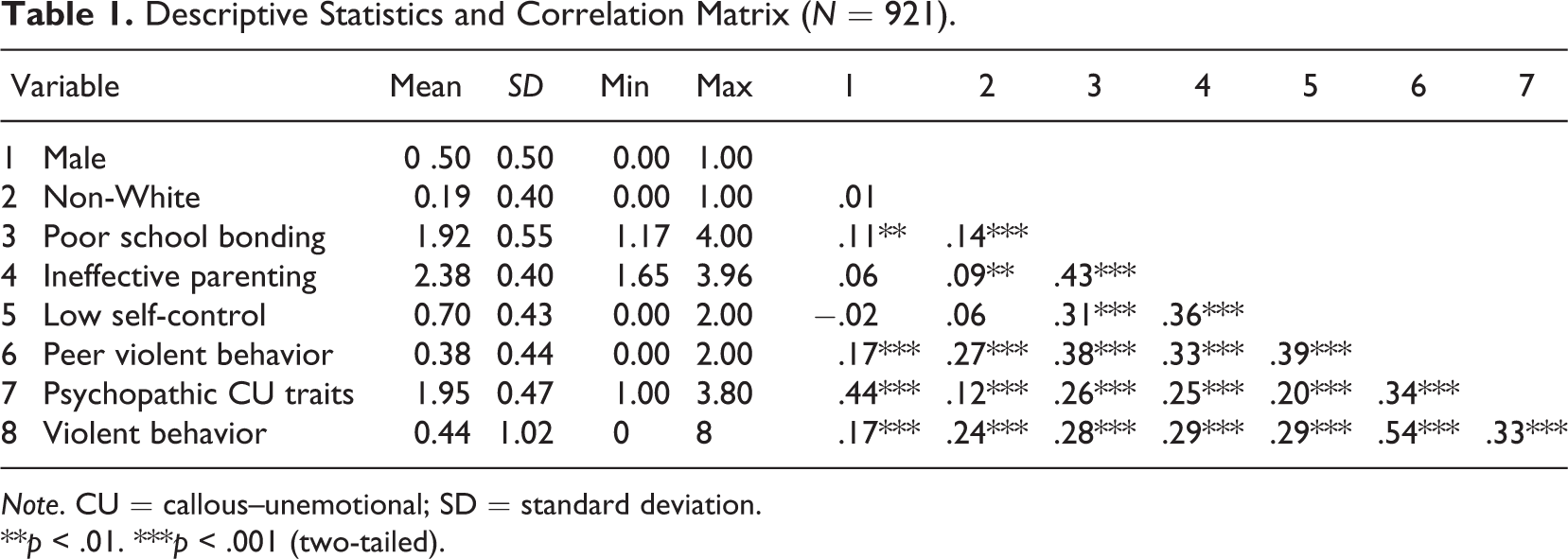
In addition to the main variables of interest, the race (Non-White = 1; White = 0) and sex (male = 1; female = 0) of respondents are also accounted for in the analyses. Given the birth cohort design of the study, age is treated as a constant. Table 1 provides the descriptive statistics and correlations for the sample analyzed.
Descriptive Statistics and Correlation Matrix (N = 921).
Note. CU = callous–unemotional; SD = standard deviation.
**p < .01. ***p < .001 (two-tailed).
Analytical Method
To consider the additive and nonadditive effects of psychopathic traits and the criminological variables of interest on violent behavior, negative binomial regression is employed with product term interactions. 9 Two features of the dependent variable drove this decision. First, the measure of violent behavior is a count measure rather than a continuous measure. Second, the distribution of scores for the dependent variable is marked by positive skew and many zero values (76% of individuals reported no violent behavior within the prior 12 months). Under such circumstances, the assumptions of ordinary least squares regression are violated, and negative binomial regression is more appropriate.
For the portion of the analysis that considers the additive effects of psychopathic traits and the criminological variables of interest on violent behavior, the results are discussed in terms of incidence rate ratios (IRRs), with an IRR greater than one indicative of a positive effect of a given independent variable on the rate at which the count of violent acts takes place. Given that each of the analysis variables have been coded in such a manner that they reflect a greater risk of violence, the likelihood of, and actual occurrence of, IRRs below one were nonexistent. For the portion of the analysis that considers the nonadditive, interactive effects between psychopathy and the other variables of interest, all predictor variables are first standardized and the results discussed in terms of the negative binomial β coefficients rather than the IRRs. This was done to ease the interpretation of the interaction term coefficients.
Results
The bivariate correlations are reported in Table 1. Providing evidence of strong construct validity, each of the analysis variables are positively correlated (p < .001) with violent behavior, ranging in magnitude from a low of .17 to a high of .54. Of further interest, an initial comparison of the magnitude of the bivariate correlations with violent behavior shows that the correlation between the CU dimension of psychopathy and violent behavior (r = .33) is comparable to many of the well-established correlates of youth violence (poor school bonding r = .28; ineffective parenting r = .29; low self-control r = .29). Only the bivariate correlation between peer violence and respondent violence (r = .54) is stronger than the correlation between CU traits and violent behavior. This provides initial insight into the potential importance of psychopathic characteristics as a predictor of youth violence in the general population.
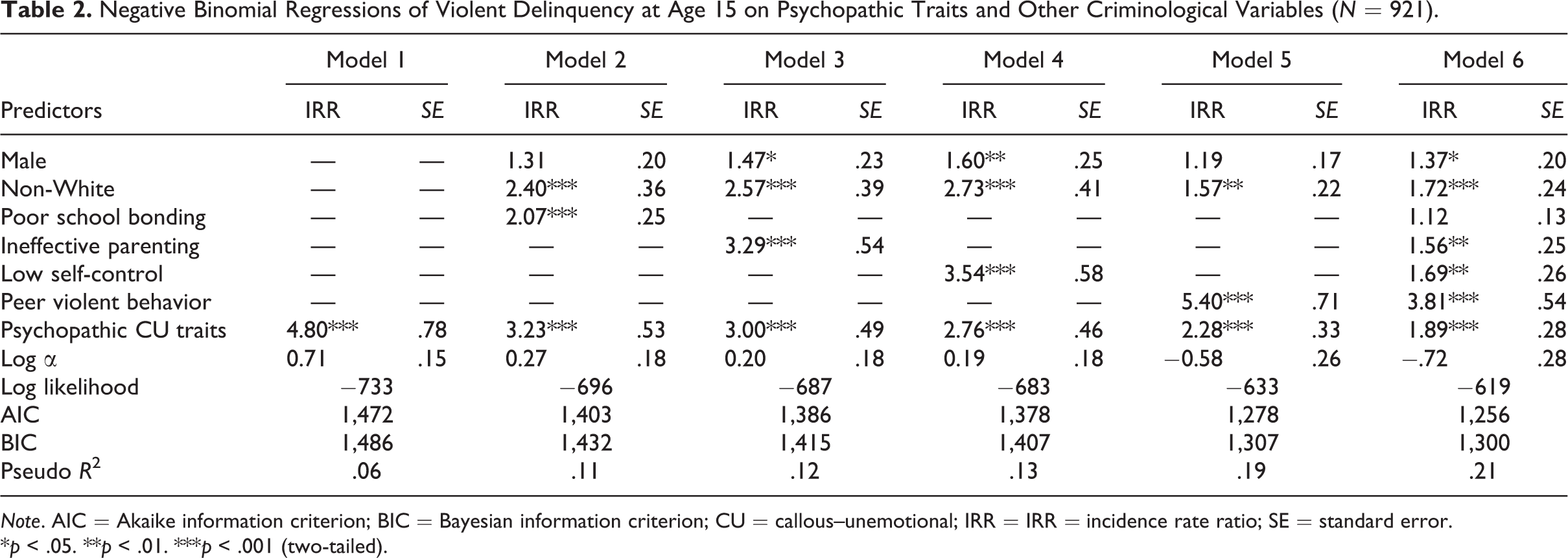
Having found preliminary evidence suggesting that the CU dimension is as strong a predictor of violent behavior as many traditional criminological variables, a series of negative binomial regression models were estimated. The results of the models are shown in Table 2. Analysis proceeded in a stepwise manner where model one estimated the effect of CU traits alone on violent behavior. Following this, models two through five estimated the effect of sex, race, CU traits, and each one of the variables established in the criminological literature as substantive predictors of violent behavior. Consistent with the results of the bivariate analysis, model one reveals that CU traits significantly predict violent behavior (IRR = 4.80; Pseudo R2 = .06).
Negative Binomial Regressions of Violent Delinquency at Age 15 on Psychopathic Traits and Other Criminological Variables (N = 921).
Note. AIC = Akaike information criterion; BIC = Bayesian information criterion; CU = callous–unemotional; IRR = IRR = incidence rate ratio; SE = standard error.
*p < .05. **p < .01. ***p < .001 (two-tailed).
Informatively, Models 2–5 provide consistent evidence that the CU interpersonal style is not only significantly related to violent behavior, but that in many instances the relative influence of CU is comparable to or stronger that many standard criminological variables. For example, Model 2 shows that while the IRR for poor school bonding is 2.07, the IRR for CU traits is 3.23. Likewise, Model 3 shows that the IRRs for ineffective parenting (IRR = 3.29) and CU traits (IRR = 3.00) are similar in magnitude. For Models 4 and 5, the influence of self-control (IRR = 3.54, Model 4) and peer violence (IRR = 5.40, Model 5) are shown to be stronger than the influence of CU traits (IRR = 2.76, Model 4; IRR = 2.28, Model 5), yet the construct remains a significant and substantive predictor of violence.
The final model in Table 2 (Model 6) provides the most conservative estimate of the influence of CU traits on violent behavior by controlling for all of the standard criminological variables examined in Models 2–5. While it is beyond the scope of this article to give detailed consideration to the possibility that some of these variables may mediate the effects of others or that they might be reciprocally related, it is clear from Model 6 that adolescent psychopathy is a significant predictor of violent behavior in the general population: Controlling for the influence of both demographic characteristics and standard criminological variables, the measure for CU traits is significantly and substantively related to violent behavior (IRR = 1.89; p < .001). Moreover, consistent with what was revealed by both the bivariate correlations and stepwise models, the magnitude of the influence of psychopathic features is as strong as or stronger than many of the established criminological predictor variables. Thus, in these data, the importance of accounting for psychopathic traits in addition to more traditional criminological variables is evinced.
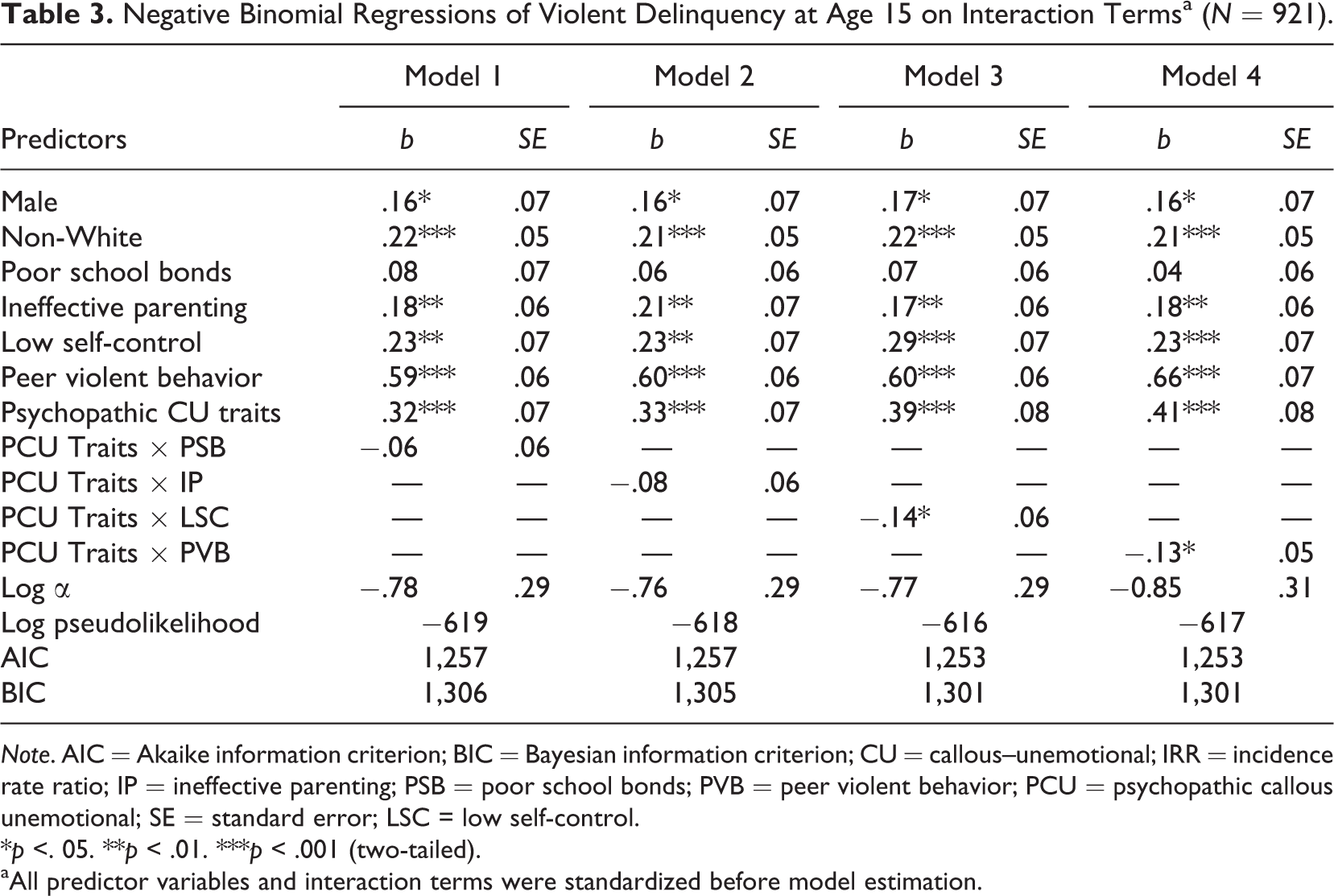
Consideration was then given to examining the possible interactive effects between CU traits and each of the established criminological variables. To consider this possibility, four models were estimated where each model contains the standardized predictor variables and a multiplicative interaction term (which was also standardized). The results of these interactions are shown in Table 3 and provide evidence of moderation between some of the standard criminological variables and CU traits. While each of the interaction terms are consistently negative across each of the models, only the interactions between CU traits and low self-control (b = −.14; p < .02; Model 3) and peer violence (b = −.13; p < .02; Model 4) reach statistical significance. The negative interaction term coefficients reveal something quite interesting: at higher values for CU traits, the influence of having low self-control and associating with peers who engage in violence is weakened. 10 Thus, this portion of the analysis reveals that, in some instances, there is a complex interplay between psychopathic traits and key criminological variables implicated in youth violence, whereby the presence of multiple risk factors weakens the overall influence of such risk factors individually.
Negative Binomial Regressions of Violent Delinquency at Age 15 on Interaction Termsa (N = 921).
Note. AIC = Akaike information criterion; BIC = Bayesian information criterion; CU = callous–unemotional; IRR = incidence rate ratio; IP = ineffective parenting; PSB = poor school bonds; PVB = peer violent behavior; PCU = psychopathic callous unemotional; SE = standard error; LSC = low self-control.
*p <. 05. **p < .01. ***p < .001 (two-tailed).
aAll predictor variables and interaction terms were standardized before model estimation.
Discussion and Conclusion
Though the relationship between the clinically recognized construct of adolescent psychopathy and antisocial behavior is well established in the psychological literature, only recently are attempts being made to merge these findings with criminological research. Some scholars have lamented that psychopathy needs to be given more attention and be integrated into the criminological understanding of delinquent and criminal careers (Vaughn, Howard, & DeLisi, 2008). DeLisi (2009), in particular, suggests that criminologists acknowledge the robust findings associated with psychopathy and career criminality compared to that of the leading criminological theory, self-control theory (DeLisi, 2009; see also Pratt & Cullen, 2000). In his article, DeLisi further gives attention to significant research identifying the import of psychopathy as a robust predictor of explicitly career criminality. Yet, as with other known correlates of delinquency, with the recognition that psychopathic traits are normally distributed in the population of youth, it is important to further evaluate this association in nonconfined samples while incorporating what is known about problematic adolescent behavior. At the subclinical level, it is important to recognize how these traits behave amid other known predictors of delinquency.
In observation of DeLisi’s (2009) argument, the emergence of psychopathy or more specifically, the psychopathic traits of callousness, unemotionality, and remorselessness, as predictors of adolescent antisocial behavior were evaluated in this study. Importantly, a nonconfined sample of youth was appraised, and the findings of this study evince several things. First, among the correlates of juvenile violence evaluated in this study, only peer violence had a stronger correlation than the psychopathic features of callousness, unemotionality, and remorselessness (CU traits) combined. Second, in multivariate models, adolescent psychopathic CU traits were important predictors of violent juvenile behavior among the general population of youth, net of other germane delinquency predictors. Moreover, these traits demonstrated a relatively clear association with violent youth behavior that was comparable or stronger than many other known correlates of delinquency included in this study. At the same time, it is of equal import to note that, in large part, the traditional criminological correlates of delinquency maintained significance alongside CU traits, speaking to the well-established finding that no one single variable explains all of delinquency.
Third, conditional effects were observed in the analysis for violent peer association and psychopathic traits as well as low self-control and psychopathic traits. The interactions suggest complimentary possibilities. It appears that in the presence of high callousness, unemotional, and remorseless traits, the effects of having low self-control or affiliating with violent peers is diminished. The alternatives are also true. These findings suggest that when one characteristic is prevailing to the other risk factors in the same individual, the dominant characteristic has the greatest influence on violent delinquency. In other words, some of these major risk factors, namely CU traits, low self-control, and delinquent peer affiliation, are somewhat interchangeable or transposable for one another. Hence, in opposition to the amplification thesis, this finding suggests the opposite is true; violence increases in the presence of one risk factor (e.g., CU traits, low self-control, or delinquent peers), but the addition of other risk factors, violence increases only by diminishing margins.
For illustration, consider two individuals who have the same level of peer delinquency, but one is more callous and unemotional than the other. The negative interaction term reported suggests that the effect of delinquent peers will be weaker for the individual with more psychopathic traits. Thus, in the context of high psychopathy, delinquent peers play a less prominent role. Informatively, such dynamics are not without precedent. For example, Meldrum, Young, and Weerman (2009) found the effect of peer delinquency on respondent delinquency is weaker for those who are lower in self-control. Similar conditioning was displayed in the work of Lynam, Loeber, and Stouthamer-Loeber (2008) when examining the stability of psychopathy. Specifically, these authors found that the influence of such factors as peer delinquency, socioeconomic status (SES) and physical punishments is weaker in the prediction of future psychopathy for individuals who already possess high psychopathy. Although their focus was not on delinquency, this research is consistent with the nature of conditional effects reported in this study.
With these findings in mind, the present study suggests several directions and improvements for further research. Though research shows that CU traits, in particular, are important to assessments looking at juvenile psychopathy and delinquency, future research should seek to include the full scales of the various dimensions of the construct in the YPTI (i.e., dishonest charm, grandiosity, lying, etc.) in concert with traditional criminological delinquency correlates to determine the value of other dimensions of psychopathy to general delinquency and, as such, criminological thought.
Further research should also seek to evaluate the presence of time order among the variables used in this study. Unfortunately, the available data were prohibitive to employing a longitudinal design to further evaluate of the role of psychopathic CU traits among the other traditional delinquency correlates toward understanding juvenile violence. However, studies are suggestive of such dynamics. Instructive is research establishing that psychopathic traits may influence the presence of self-control. In recent work, Vaughn and colleagues (2007) incorporated psychopathology and self-control in their study of 723 youth confined under the supervision of the Missouri Division of Youth Services. The purpose of their study was to assess the value of using mental health, psychopathic, and substance abuse variables to predict self-control (p. 809). The researchers found a significant connection between psychopathy and self-control, and, in particular, their research demonstrates the consequence of the psychopathic feature of narcissism in driving low self-control. Though distinct from the present approach, their study illustrates the interplay between these significant constructs as delinquency precursors as well as highlighting the import of considering numerous individual level characteristics in the study of problematic behaviors.
It also must be recognized that there may be mediation among the variables used in this study. Though evaluating this was beyond the scope of the current research, future efforts should evaluate this possibility. In particular, recent research suggests that influencers such as parenting may play an important role in the psychopathy–violence relationship. Further, evidence suggests that neighborhood context might influence the effects of psychopathic traits on behavior (Meier, Slutske, Arndt, & Cadoret, 2008). Meier and colleagues findings suggest that various contextual features attributable to neighborhood environments influence the association between psychopathy and behavior. Specifically, the researchers found that the association between impulsive and callous traits and delinquency was stronger in at risk neighborhoods. The role of such contextual forces was beyond the scope of the present study. Hence, future efforts should take the impact of neighborhood risk factors and variation into account.
Policy considerations surrounding psychopathy in youth also flow from the findings reported in the present work, which can inform interventions for personality features more generally, such as low self-control. Given the high costs of criminal offending (see DeLisi & Piquero, 2011 for discussion), early intervention efforts seem most promising. This research highlights the prominence of certain risk factors that have independent and seemingly interchangeable power in explaining youthful violence. Hence, screening tools for risk assessment should include aspects of peer affiliation, but particularly self-control and psychopathic CU trait measures for treatment and placement. A similar approach is offered by scholars examining risk factors in early childhood (Vaughn, DeLisi, Beaver, & Wright, 2008). Though some have cautioned against the nonclinical use of the term psychopathy, particularly in reference to youth, there is reason to include measures for CU traits (and low self-control) at the earliest point of access to troubled youth for intervention purposes.
Contrary to accepted sentiment that psychopathy, or other inherent personality difficulties, is resistant to treatment, some have cautioned against making such dividing lines regarding treatability (Salekin, 2002; Salekin, Worley, & Grimes, 2010). In Salekin and colleagues (2010) review of programs involving the treatment of adults and youth having psychopathic traits, several studies showed promise, particularly those aimed at youth. More specifically, six of the eight studies dealing with youth showed that psychotherapy was either beneficial or at least psychopathic youth did no worse than nonpsychopathic youth, suggesting that progress can be made or has potential to make a difference (p. 255). Interestingly, none of the programs were designed to specifically deal with youth diagnosed with psychopathy. The authors recognized the concerns that certain psychopathic characteristics may inhibit treatment, but lamented that these features do not need to preclude treatment, but rather become part of the treatment plan.
Mirroring this sentiment, in yet another recent study, Salekin and colleagues (2012) evaluated a treatment program (mental models intervention) aimed at increasing motivation, raising positive emotion, and decreasing interpersonal callousness in youth having psychopathic CU traits. The program evinced promising results such that positive emotion increased through the treatment period, CU traits were reduced, and treatment amenability increased (Salekin, Tippey, & Allen, 2012). Evidence from recent research also suggests that limiting exposure to witnessed violence may diminish violence among those with CU traits (Howard, Kimonis, Muñoz, & Frick, 2012). Hence, further direction for practitioners concerned with youth having risk factors for violence and delinquency may come from this mental models approach and limiting exposure to violence among those with CU traits specifically. Even more encouraging results from programs seem forthcoming.
The present research recognizes the virtue of psychopathic traits as variable properties of the population that may be useful in understanding criminal and violent behavior alongside traditional criminological constructs. Given the robust nature of specifically psychopathic CU traits in predicting violence in concert with the more traditional covariates of youth antisocial behavior found in this study, the prospects for further development in this area of research are promising. Moreover, it is critical to unite what is known about other robust predictors of delinquency. This research strongly suggests that adolescent CU psychopathic traits should be integrated into criminological thought and research.
Footnotes
Acknowledgments
We would like to thank Carter Hay and the anonymous reviewers for their assistance in the preparation of this article.
Authors’ Note
The SECCYD was conducted by the NICHD Early Child Care Research Network, supported by NICHD through a cooperative agreement that calls for scientific collaboration between the grantees and the NICHD staff. The content is solely the responsibility of the authors and does not necessarily represent the official views of the NICHD or the National Institutes of Health. (U. S. Department of Health and Human Services. National Institutes of Health. Eunice Kennedy Shriver NICHD SECCYD: Phases I–IV, 1991–2008 [United States] [Computer files]. ICPSR21940-v1; ICPSR21941-v1; ICPSR21942-v1; ICPSR22361-v1. Ann Arbor, MI: Inter-university Consortium for Political and Social Research [distributor]).
Declaration of Conflicting Interests
The author(s) declared no potential conflicts of interest with respect to the research, authorship, and/or publication of this article.
Funding
The author(s) received no financial support for the research, authorship, and/or publication of this article.