



Abstract
Institutional anomie theory (IAT) argues that crime results from a value complex that elevates the economy over other institutions. Though most assessments of IAT have been conducted at the macro level, the key relationships can also be evaluated among individuals. Using a national survey of high school seniors, we examine whether violence, theft, and substance use are related to individual commitments to economic and noneconomic institutions. Results show that adherence to economic values is positively related to certain forms of delinquency and that commitments to noneconomic institutions reduce delinquent behavior. Moreover, commitment to noneconomic institutions often reduces the effect of economic commitment on delinquency.
Introduction
Though institutional anomie theory (IAT) is explicitly cast as a macro-level theory, recent theoretical and empirical work has begun to directly link the broad structural and cultural forces implicated in the theory to the attitudes and behaviors of individuals (Baumer, 2007; Cullen, Parboteeah, & Hoegl, 2004; Karstedt & Farrall, 2006; Messner, Thome, & Rosenfeld, 2008; Muftić, 2006). Much of this work builds on the premise that the institutional balance of power that has developed in the United States, and the cultural values that result from and reinforce that balance, are both manifest and rooted in individual human action. As Messner, Thome, and Rosenfeld (2008) explain, a Parsonian view of social institutions presupposes a certain social order that can only exist when individuals collectively adhere, more or less, to a common set of values and regulatory norms. This collective value system provides the foundation for social institutions which, in turn, further regulate behavior by serving as a moral authority that individuals confront when evaluating alternative goals and when choosing from a set of available means.
This view of institutions does not require an assumption of complete consensus about institutional norms, nor does it assume full agreement on the relative weight given to economic and noneconomic institutions. In fact, as Baumer (2007) notes while developing a multilevel explication of Merton’s theoretical model, even within a highly anomic society, commitment to culturally prescribed values and norms can vary across individuals. The potential for variability in individual orientations to the societal level institutional balance of power underscores the importance of assessing the validity of IAT’s implications at the individual level.
The current study builds on recent theoretical elaborations of IAT to examine whether variation in adherence to the values associated with major social institutions influences the criminal and delinquent behavior of individuals. Using a nationally representative survey of high school seniors, we measure adherence to the values associated with the economy, family, education, polity, and religion, and evaluate their association with involvement in violence, theft, and substance use. Consistent with IAT, we expect that those with strong adherence to the values of a capitalistic economy will be more likely to engage in these delinquent acts and that those who are more committed to the values of noneconomic institutions will be less delinquent. Moreover, we assess whether the influence of capitalistic economic value commitments on criminal and delinquent behavior is conditioned by adherence to noneconomic institutional values.
In addition to providing an individual-level assessment of IAT, we contribute to the existing research on IAT in two important ways. First, the use of a high school sample allows us to assess the relevance of IAT for explaining the behavior of juveniles, in contrast to most prior studies that have examined only adult crime. We see this as an important contribution given that the peak crime-prone years often fall in late adolescence or early adulthood, and because by the final year of high school, juveniles have developed many meaningful attitudes and value orientations toward social institutions as they are about to embark on their adult life. We build upon prior research by examining substance use in addition to theft and violence. Though empirical research on IAT most often uses violent and instrumental crimes as outcomes, recent research suggests that IAT may also serve as an effective explanation of other, noncriminal forms of rule breaking (Cullen et al., 2004; Karstedt & Farrall, 2006; Muftić, 2006). This argument is consistent with Messner and Rosenfeld’s (2001) statement that unbalanced institutional power will influence behavior directed toward goals of any type, not just material goals. We evaluate this possibility by including substance use as an outcome.
Theoretical Framework
Classic and Contemporary Articulations of Anomie
The concept of “anomie” has received varied treatments in the theoretical and empirical literature in sociology and criminology. According to Durkheim (1897), the condition of anomie is characterized as a normlessness of goals, resulting from a system of trade and industry that is chronically deregulated. He argued that when the economy is detached from, and thus unregulated by, other social institutions, economic desires are no longer subject to the normative boundaries that these institutions impose. Without the regulatory force of institutional social norms, the economy becomes self-regulating, yielding limitless economic ambition and unchecked materialism that ultimately weakens the social bond between the individual and society (Polanyi, 1957).
In his influential paper “Social Structure and Anomie,” Merton (1938) described a different conceptualization of anomie that focused on both the cultural and social structural aspects of society. Merton characterized American culture as placing disproportionate emphasis on the realization of success goals, and especially the goal of monetary success, with much less emphasis on utilizing socially acceptable means for achieving those goals. This produces a cultural ethos of “anything goes,” where the means of achieving economic goals are limited mostly by concerns of technical expediency rather than institutionalized conduct norms. Moreover, the universality of economic goals, paired with the cultural values of individualism and equality, suggests that all members of American society should aspire to the same goals, despite the fact that the socially prescribed means may not be equally available to all (Merton, 1949). The resulting social system is characterized by excessive competition, where the reality of socially structured opportunities creates a constant strain that breaks down the organizational structure of society and leads to anomie.
Messner and Rosenfeld (2001) adopt Merton’s dual focus on culture and social structure in their development of IAT. With regard to culture, they draw upon Merton (1949) in characterizing the American Dream as a false promise, describing it as a “broad cultural ethos that entails a commitment to the goal of material success to be pursued by everyone in society, under conditions of open, individual competition” (Messner & Rosenfeld, 2001, p. 62), while at the same time recognizing that not all people are equally situated to succeed in that pursuit. In this way, the American Dream is a mixed blessing, emphasizing the importance of having goals, but placing little emphasis on the appropriate means to achieve those goals, and ultimately producing an anomic environment. Messner and Rosenfeld devote particular attention to the cultural value foundations of the American Dream, including achievement, individualism, universalism, and fetishism of money, and the contributions of these value orientations to the anomic nature of the American Dream.
However, Messner and Rosenfeld (2001) depart from Merton by placing extended emphasis on the relevance of social institutions, or the social structure of society, and particularly the balance of power between these institutions. Their focus on the detachment of the economy from other social institutions relates more closely to the writings of Polanyi (1957), and their discussion of the social deregulation that results from this market disembededness is based squarely on Durkheim’s (1897) notion of anomie (Bernburg, 2002). Combining the cultural and institutional theoretical arguments, Messner and Rosenfeld explain that cultural anomie is sustained by an institutional balance of power where the economy reigns supreme, prevailing through devaluation, accommodation, and penetration of noneconomic institutions such as family, education, polity, and religion. This sustained economic dominance, along with the subjugation of noneconomic institutions, results in an anomic culture characterized by high levels of crime.
Institutional Anomie and Individual Behavior
Again, in its original formulation, IAT was cast explicitly as a macro-level theory. Its core concepts of social institutions, the American Dream, and serious crime, are described as emergent properties of a distinctively American culture and social structure. However, theoretical and empirical research, some conducted by the original authors of IAT, has begun to derive and test implications from IAT at the individual level. For example, the current article builds directly on a recent theoretical elaboration of IAT by Messner et al. (2008) in which the authors explicitly identify linkages between the macrosocial processes discussed in IAT and the individual-level behaviors and processes that the theory implies. The authors explain that the view of institutions advanced in IAT was derived from the conceptualization employed by Parsons (1934/1991), which differentiates between a “subjective” and “objective” approach to institutions (Messner et al., 2008). The objective approach, which has been most prevalent in the development of IAT, views institutions from a societal level and examines specific configurations of institutional balance and their contribution to the social order. In contrast, the subjective approach takes the viewpoint of individuals and examines institutions as systems of regulatory norms that individual actors must confront as they choose from a set of means in their pursuit of a desired goal.
Through this dual approach, it can be seen that social institutions operate at multiple levels, neither of which can be reduced to the other. Institutions may be seen as emergent properties of the social system that are more than simple aggregations of individual values and behavior, but their influence is also manifest in individual adherence to a particular balance of cultural values, which in turn affects individual behavior. Along these same lines, in a recent explication of Merton’s theory of anomie and subsequent extensions of it, Baumer (2007) explicitly argues that anomie theory is best described as a multilevel theory that links broad cultural and structural features of social collectivities to variability in individual behavior.
Prior Research
Given the emphasis of IAT on culture, social structure, and institutional dynamics, it is not surprising that nearly all prior empirical studies have tested it solely at the macro level. Most tests analyze the additive effects of both economic and noneconomic institutions, as well as the conditioning effect that noneconomic institutions may have on the relationship between economic dominance and criminal and delinquent behavior. The institutions evaluated in these studies include the economy, polity, family, education, and religion, but the specific set of institutions and methods of measurement vary across studies.
Nearly all prior studies incorporate a measure of the economy, but draw from a variety of different operationalizations such as the Gini index of income inequality, concentrated disadvantage, the poverty rate, economic freedom, gross domestic product, and the unemployment rate (Bjerregaard & Cochran, 2008; Cancino, Varano, Schafer, & Enriquez, 2007; Chamlin & Cochran, 1995; Kim & Pridemore, 2005b; Maume & Lee, 2003; Savolainen, 2000; Schoepfer & Piquero, 2006). Despite this inconsistent set of measures, nearly all studies have found a significant positive effect of economic measures on crime rates (for a thorough review of the empirical research, see Messner & Rosenfeld, 2006). 1 However, it is difficult to interpret these findings as direct support for IAT, since each of the measures captures a somewhat different concept, and none of them seem to align closely with the concept of the economy as described by Messner and Rosenfeld (2001). Perhaps, the most conceptually valid measure comes from a multilevel study by Cullen, Parboteeah, and Hoegl (2004), which includes a survey-based measure of pecuniary materialism. They found that this measure was positively associated with the willingness of managers to justify ethically suspect behavior.
Measures of noneconomic institutions have also varied considerably across prior studies, and the results have been somewhat inconsistent. Polity is conceptualized as a means of mobilizing and distributing power to provide safety and attain the goals of mass society (Messner & Rosenfeld, 2001). This has typically been measured with voter participation rates, with some studies finding that higher rates of voting are associated with significantly lower rates of violent crime and white-collar crime (Kim & Pridemore, 2005a, 2005b; Maume & Lee, 2003; Schoepfer & Piquero, 2006). The expected negative effect of education as an institution has received occasional support using measures such as rates of educational attainment, educational expenditures, students per teacher, and teacher salaries relative to other occupations (Baumer & Gustafson, 2007; Cullen et al., 2004; Piquero & Piquero, 1998; Schoepfer & Piquero, 2006; Stults & Baumer, 2008). The hypothesized inverse effect of the institution of family—typically measured with the divorce marriage ratio or with aggregated survey-based indicators of time spent with family and commitment to marriage—has also received some support (Baumer & Gustafson, 2007; Chamlin & Cochran, 1995; Kim & Pridemore, 2005b; Maume & Lee, 2003; Stults & Baumer, 2008). Finally, although Messner and Rosenfeld (2001) do not discuss religion to the same degree as polity, education, and family, some studies have tested whether the strength of religion as an institution significantly influences crime rates. In these studies, religion is typically measured by levels of church membership and adherence rates, and results have often supported the expectations of IAT (Baumer & Gustafson, 2007; Cancino et al., 2007; Chamlin & Cochran, 1995).
Another emphasis in empirical tests of IAT has been the conditioning influence of noneconomic institutions, with the prediction that institutions such as polity, family, education, and religion can counterbalance the positive effect of the economy on crime rates. Chamlin and Cochran (1995) were the first to provide an empirical test of the moderation thesis by examining interaction effects between the Gini coefficient of income inequality as a measure of the economy, and measures of polity, family, and religion. Results from their study, as well as several subsequent tests, provide at least partial support for the moderation expectations of IAT (Baumer & Gustafson, 2007; Cancino et al., 2007; Piquero & Piquero, 1998; Schoepfer & Piquero, 2006; Stults & Baumer, 2008).
Individual and Multilevel Assessments of IAT
In addition to these macro-level studies, researchers have begun to examine ways in which the institutional balance of power might influence individual outcomes. For example, Muftić (2006) uses survey data for a sample of American and international undergraduate students to examine how individual commitments to institutional values influence the likelihood of cheating. She found that students who strongly adhere to the cultural values of individualism and fetishism of money, both of which are often associated with the American Dream, are more likely to engage in cheating. Moreover, cheating was less prevalent among students who were more bonded to family members and more involved in politics, thus providing support at the individual level for the argument that a commitment to noneconomic institutions reduces deviant behavior. However, no support was found for interaction effects between economic and noneconomic value commitments.
Though not directly testing IAT, Karstedt and Farrall (2006) were interested in a related question of whether persons in regions undergoing economic change were more likely to express an intention to engage in delinquent behaviors due to a perception of market anomie. They define anomic markets as characterized by unrestrained profit motives, an imbalance of power between businesses and consumers, domination of the pursuit of self-interest over noneconomic institutions, and a decreased sense of the legitimacy of markets. They found that perceptions of unrestrained profit motives and lower levels of perceived legitimacy both led to increased levels of anomie about law, which in turn increased intentions to offend. While recognizing that they do not provide a direct test of IAT, Karstedt and Farrall note that their results demonstrate the importance of applying this approach at the individual level. They also argue that the sense of anomie resulting from an institutional imbalance of power leads to a reduced willingness among individuals to comply with rules in general. This suggests that IAT may be a viable explanation of not just serious instrumental crimes, but also a wide range of other criminal and delinquent behaviors, as well as common, everyday rule breaking.
Finally, in their critique of the core assumptions of IAT, Chamlin and Cochran (2007) use individual-level data for over 60 countries from the World Values Survey to assess whether the United States is unique in placing primary emphasis on money as the metric of success. Using survey items indicating whether income is the most important feature of work and whether less emphasis on money and material things would be a good thing, they find that Americans appear to be less obsessed with the pursuit of material success than citizens of most other countries. In an analysis of the full sample of nations, they also find no empirical support for the expected positive effect of acceptance of material success goals on homicide and robbery rates, though this analysis is based only on bivariate correlations. However, when they restrict their analysis to the subsample of economically developed nations that Messner and Rosenfeld (2001) evaluate, these simple correlations do provide limited support for IAT with regard to homicide.
Analytic Methods
Data and Sample
The analysis for the current article draws on data from the 2008 Monitoring the Future study (Johnston, Bachman, O’Malley, & Schulenberg, 2009). Each year, a nationally representative sample of about 14,000–18,000 seniors in about 120–140 public and private high schools are asked a core set of questions about demographics, drug use, and attitudes about drugs. A large and diverse set of additional questions are spread across surveys administered to six different subsamples within the national sample, covering topics such as attitudes toward religion, educational aspirations, parental influence, and criminal behavior. The current study uses items from the core data set, as well as items from the Form 2 subsample. The core questions are asked of the full sample of 14,577, but questions from the Form 2 subsample were asked of 2,423. After removing cases with missing values, the final sample size was 1,312. 2
Our use of a sample of juveniles is a departure from prior assessments of IAT. Though empirical tests of Merton’s anomie theory have often employed samples of high school students (Brezina, 1996; Farnworth & Leiber, 1989; Hoffmann & Ireland, 2004), all prior tests of IAT have examined either adult crime rates at the macro level, or in the case of the three individual or multilevel studies, samples of persons aged 25–65, college students, or business firm managers (Baumer & Gustafson, 2007; Cancino et al., 2007; Chamlin & Cochran, 1995; Cullen et al., 2004; Karstedt & Farrall, 2006; Kim & Pridemore, 2005; Maume & Lee, 2003; Muftić, 2006; Schoepfer & Piquero, 2006). Given that IAT is concerned with characteristics of broad societies, such as culturally prescribed goals, structural inequalities, and the relative strength of social institutions, it seems reasonable to assume that the scope of IAT would include the behaviors of a wide range of groups within a given society. More importantly, we believe that the attitudes and behaviors of high school seniors, measured in the final months before graduation, are particularly relevant for evaluating the empirical validity of IAT. Graduation from high school represents a highly salient developmental stage in American society, as it signals the end of compulsory education, and is typically followed by a dramatic reduction in reliance on parents for meeting daily needs (Bachman, Johnston, O’Malley, & Schulenberg, 2006). By this time, individuals have developed a set of attitudes, values, and cumulative experiences that will influence their behavior as they enter the new environments that surround the workplace, college, marriage, and civic life. Indeed, longitudinal analysis of Monitoring the Future data finds considerable stability in how high school seniors rank the importance of life goals such as making money, raising a family, and being civically engaged, though the absolute importance of these goals does appear to change over time (Easterlin & Crimmins, 1991). Thus, while most of these youths have not, yet, directly engaged in institutional behaviors such as marriage and child rearing, public service and civic participation, higher education, and even participation in the market economy, they have developed meaningful attitudes and value orientations toward these institutions. As such, we believe that IAT can be highly relevant for explaining the attitudes and behaviors of young people who are about to embark on their adult life.
Variables
In describing the scope conditions of their theory, Messner and Rosenfeld (2001) propose IAT as an explanation of serious forms of crime, including any “violations of criminal law involving significant bodily injury, the threat of bodily injury, or, in the case of nonviolent offenses, significant economic harm to victims, both individual and collective” (p. 42). Accordingly, their own research and that of several others has examined perhaps the most serious form of crime—homicide (Kim & Pridemore, 2005; Maume & Lee, 2003; Messner & Rosenfeld, 1997, 2001; Savolainen, 2000). However, IAT is also proposed more generally as an explanation of “instrumental crimes” that are in some way motivated, at least in part, by a desire for economic gain. Thus, other researchers have tested IAT using outcomes such as property crime, white-collar crime, and even managers’ willingness to justify ethically suspect behavior (Baumer & Gustafson, 2007; Cancino et al., 2007; Chamlin & Cochran, 1995; Cullen et al., 2004; Schoepfer & Piquero, 2006). We follow the lead of this theoretical and empirical literature by examining both violence and theft.
We also assess the possibility that the scope conditions of IAT can be expanded to include less serious forms of offending. We believe this approach is viable for three reasons. First, as Messner and Rosenfeld (2001) note, what constitutes a serious harm or threat is inherently arbitrary, and it is possible that attributions of seriousness vary across groups and subgroups. Though much of the literature on crime seriousness has emphasized consensus (Sellin & Wolfgang, 1964), others have argued that there may be less agreement on what constitutes a serious crime than was previously thought (Cullen, Link, Travis, & Wozniak, 1985; Hawkins, 1980; Kwan, Chiu, Ip, & Kwan, 2002; Miethe, 1982; Piquero, Carmichael, & Piquero, 2007). Second, given that IAT is rooted in Merton’s classic theory of anomie, we believe it is important to consider additional responses to the imbalance of institutional values other than just the “innovation” of engaging in serious instrumental crime. Merton (1938) specifically identified illicit substance users as retreatists who adhere to neither the culturally prescribed goals nor the socially accepted means to achieve those goals. Extending this to an institutional view, those who perceive the economy as a dominant institution, and who do not adhere strongly to the values of noneconomic institutions, may feel compelled, and find it easier, to abandon their goals and resort to drug use. Third, as noted earlier, Karstedt and Farrall (2006) argue that an institutional imbalance of power can affect not just the likelihood of engaging in crime, but the willingness to comply with rules in general. Similarly, Messner and Rosenfeld note that the anomic nature of American culture and social structure serves to “neutralize and overpower normative restraints generally, and the selection of the means for realizing goals of any type, not simply monetary goals, tends to be guided mainly by considerations of technical expediency” (p. 86). Thus, rule breaking as a result of imbalanced institutional values may come in the form of serious violence, but it could also take less serious forms of delinquent behavior such as fighting at school, shoplifting, or using drugs.
We assess this empirically by evaluating three delinquency outcomes—violence, theft, and substance use. Each of these dependent variables is constructed as a multiple-item standardized index. 3 The violence index is constructed from 4 items asking about the number of times over the past 12 months that the respondent has been in a fight at school or work, taken part in a fight with friends against another group, hurt someone bad enough to need bandages or a doctor, and used a weapon to get something from a person. The theft index is constructed from 3 items asking the number of times over the past year that the respondent has stolen something worth less than $50, stolen something worth more than $50, and taken something from a store without paying for it. Finally, the substance use index is comprised of 3 items asking the number of times over the past 30 days that the respondent has smoked cigarettes, drank alcohol, or smoked marijuana. Higher values on each of these indices indicate greater involvement in violent crime, property crime, and substance abuse, respectively.
The key independent variables are indicators of the degree to which respondents adhere to the values of social institutions including the economy, family, education, religion, and polity. Since only one prior study has explicitly tested IAT at the individual level, we also look to prior macro-level research in deciding how to measure these institutional commitments. Unfortunately, there has been a great deal of variability across studies in the operationalization of these concepts, with many of the measures only loosely related to the conceptualization provided in IAT. It is also important to note that Messner and Rosenfeld (2001) make a distinction between cultural values and institutions, arguing that an institutional imbalance in favor of the economy fosters cultural values conducive to the American Dream, thus creating a syndrome of anomie. As we will describe below, our individual-level institutional measures represent commitments to the cultural values associated with the institutions of the economy, polity, family, education, and religion, and not necessarily involvement in these institutions. We consider this to be a unique feature of our study, as nearly all prior tests of IAT have involved only an examination of institutions, with little direct attention to their impact on cultural values.
As noted above, the measures of economy used in prior macro-level studies tend to capture levels of disadvantage and inequality rather than the dominance of the economy in the institutional balance of power. Likewise, the use of “currently employed” in the individual-level study by Muftić (2006) also fails to address the key economic concepts described by Messner and Rosenfeld (2001), such as materialism, unrestrained profit motives, and competition. We expand on prior research by measuring economic dominance at the individual level using survey-based measures that capture the extent to which individuals adhere to the cultural values of the market economy, with particular emphasis on the ideals of profit motivation, materialism, and competition.
Specifically, we use a 3-item standardized index comprised of items indicating how much the respondent agrees that “In the United States, we put too much emphasis on making profits and not enough on human well-being,” “People are too much concerned with material things these days,” and “There is too much competition in this society.” By including the reference “too much,” these items ask the respondent to simultaneously assess the degree to which society emphasizes profit motives, material things, and competition, and also provide their personal evaluation of whether this emphasis is a good thing or a bad thing. Agreement with these statements indicates disapproval of a perceived high degree of societal emphasis placed on these values, thus indicating less adherence to values associated with the market economy. Therefore, we have reverse coded the five response categories, resulting in values ranging from 1 for agree to 5 for disagree. Under this recoding, low values of this variable now indicate a weaker adherence to the cultural values associated with the economy, while higher values suggest a stronger adherence to such values. We recognize that these questions may not provide an ideal measure of adherence to market values since they ask about the respondents’ perceptions of, and orientation toward, the current state of American society rather than measuring their values more directly. However, we believe that individuals who strongly adhere to cultural values such as individualism and the fetishism of money will be likely to disagree that there is too much emphasis on competition, making profits, and acquiring material things.
We also include measures of noneconomic institutions that are expected to reduce involvement in crime, as well as condition the effect of strong adherence to economic values on crime. Prior macro-level research has typically measured commitment to family using the divorce rate or the divorce/marriage ratio. However, some argue that the divorce rate does not necessarily indicate a weak commitment to the institutions of marriage and family (Schoepfer & Piquero, 2006). We measure commitment to the institution of family at the individual level with a 2-item standardized index indicating whether the respondent thinks he or she will get married (3 = will marry, 2 = don’t know, 1 = will not marry) and the likelihood of him or her staying married (5 = very likely … 1 = very unlikely). Higher levels of this index represent greater commitment to the family institution. Though still based on marriage and divorce, this measure indicates a general commitment to the institution, rather than measuring the success or failure rate for a given set of marriages.
Commitment to education has been measured in prior research with indicators such as educational attainment, educational expenditures, students per teacher, and comparative teacher salaries. The use of these measures is predicated on the notion that the institution of education is stronger where education is more sought after, or where it is more strongly supported by government funding. We measure individual commitment to the value of education using a dummy variable constructed from the question “Suppose you could do just what you’d like and nothing stood in your way. Would you want to graduate from a four year college?” Respondents answered yes (1) or no (0), with a yes response representing a greater commitment to the value of education. Rather than measuring aspirations or expectations of obtaining higher education, our measure more directly reflects a desire for education that is not contingent upon perceptions of opportunity or necessity. 4
The institution of religion is measured in prior macro-level research with rates of church membership and adherence to civically engaged religious denominations. We measure commitment to the institution of religion with a dummy variable constructed from the question “How important is religion in your life?” with responses including very important (1) and not important, a little important, or pretty important (0). Those who indicated that religion is very important in their life were designated as having a greater commitment to the institution of religion. While aggregate church membership and adherence measure involvement in religion, our measure provides a more direct indicator of the general importance of religion to the individual.
Finally, as noted earlier, polity is typically measured using voter participation rates, with the assumption that a higher rate of civic involvement is indicative of the capacity of citizens to use government as a noneconomic means of mobilizing and distributing power. We use the individual-level corollary of this measure—a dummy variable indicating the respondent’s self-reported likelihood of voting in a public election (1 = already have or probably will and 0 = probably won’t or don’t know). Willingness to vote in a public election indicates a greater commitment to the polity.
We also include a number of control variables that are identified in prior research and by other theoretical perspectives, and which may yield spurious findings if not accounted for in our model specification. The alternative theory that is perhaps most closely aligned with the arguments made in the current study is social bond theory. Put simply, it argues that a strong attachment to family, a commitment to conventional pursuits such as education and employment, involvement in activities, and a belief in the importance of these bonds, all serve to reduce involvement in crime and delinquency (Hirschi, 1969). To control for the possibility that any observed effect of commitment to the institution of family is actually due to attachment to parents, we include a measure of the number of times the respondent fought with his or her parents in the past year. To account for a potential confounding effect of involvement in activities, which might also be seen as controlling for a lifestyle or routine activities effect, we include a 5-item standardized index indicating the number of times in the average week that the respondent goes out for fun and recreation, goes on a date, rides around in a car just for fun, gets together with friends, or goes to a shopping mall.
Theories of differential association and social learning argue that crime is a learned behavior, and peer attitudes and delinquency have been consistently identified as predictors of crime and delinquent behavior (Akers, 2001; Akers & Jensen, 2006; Pratt et al., 2010). It is possible that any association between institutional commitments and delinquent behavior may be due to shared attitudes, rationalizations, and neutralizations of crime that have been implicated in the social learning literature (Akers & Jenson, 2006; Sykes & Matza, 1957). To account for the effect of delinquent peers, and its potential to yield confounding effects of institutional commitments on delinquency, we include a control variable measuring substance use among the respondent’s friends. Specifically, following prior research (Beaver et al., 2009; Bellair, Roscigno, & McNulty, 2003), we include a standardized index comprised of self-reported items indicating how many of the respondent’s friends smoke cigarettes, smoke marijuana or hashish, or drink alcoholic beverages. 5
To control for the possibility that any effect of commitment to the institution of education is actually due to differential levels of educational aptitude, we include a perceptual measure of school ability relative to others, where respondents rated their school ability in comparison to others using a 7-item scale ranging from far below to far above. As measures of economic status, we include controls for whether or not both parents have a college degree and the respondent’s income from working, though, not surprisingly, the majority of these high school seniors do not have significant income from work. Finally, we include controls for the demographic characteristics of gender (1 = male, 0 = female), race (1 = Black, 0 = non-Black), Hispanic origin (1 = Hispanic, 0 = non-Hispanic), and living in a very large city (1 = over 500,000 population). 6
Analytic Plan
The analysis will consist of a series of ordinary least squares (OLS) regressions for each of the three dependent variables. It is expected that a stronger adherence to values associated with the market economy will yield more involvement with all three delinquent acts and that a commitment to each of the noneconomic institutions will reduce delinquent behavior. Multiplicative interaction terms will be used in a stepwise fashion to assess whether any positive effect of commitment to a capitalistic economy is conditioned by adherence to values associated with the institutions of polity, family, education, and religion, as expected by IAT. 7
Results
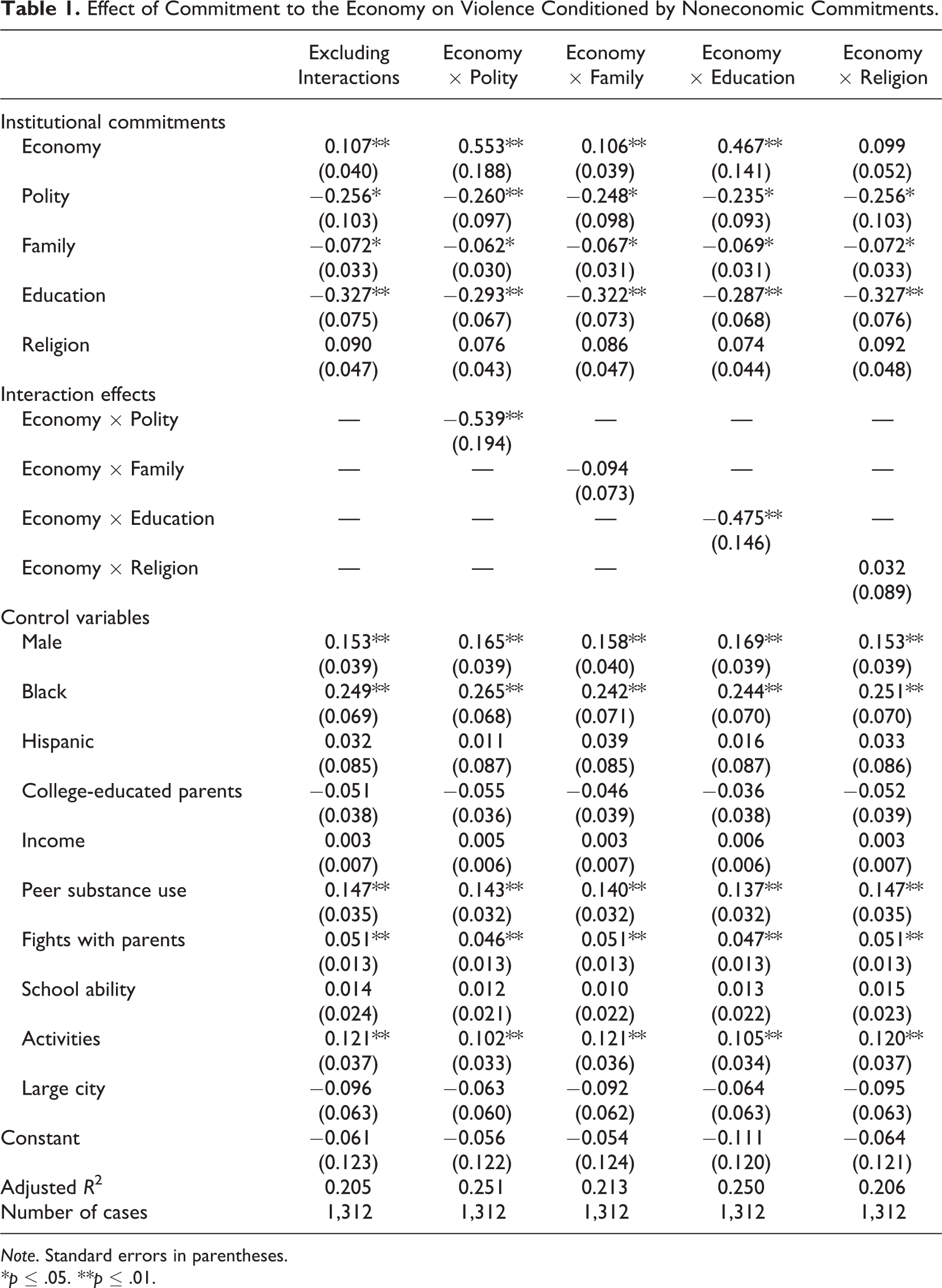
The results for violence are presented in Table 1. The first model provides a baseline that includes only the institutional commitment variables and the controls, while the remaining four models each include a multiplicative interaction term to show the effect of capitalistic economic values on the use of violence, as conditioned by one of the four noneconomic institutions. 8 Starting with the control variables, the baseline model shows that male and Black respondents engage in more violence than female and White students, as do those who fight with their parents more frequently and who are engaged in more activities outside of school. Peer substance use is also positively associated with violence, while the other control variables did not have statistically significant effects.
Effect of Commitment to the Economy on Violence Conditioned by Noneconomic Commitments.
Note. Standard errors in parentheses.
*p ≤ .05. **p ≤ .01.
Of primary interest to this study are the effects of the institutional commitment measures, and especially the extent to which the effect of commitment to a capitalistic economy on crime and delinquency is moderated by commitment to noneconomic institutions. Looking at the effects across the models, it is clear that commitments to economic and noneconomic institutions influence involvement in violence in directions that are consistent with the expectations of IAT. For example, the baseline model shows a significant, positive effect of economic commitment (b = .107, p ≤ .01), indicating that respondents with stronger adherence to values associated with the economy tend to have higher levels of involvement in violent acts. Also in support of IAT, the coefficients for all of the noneconomic institutions are negative and significant except for commitment to religion. This suggests that those who adhere more to the cultural values associated with these noneconomic institutions tend to be less involved in violent acts.
The remaining models each include a multiplicative interaction term between the economy variable and one of the noneconomic institution variables. In these models, the coefficients for economy indicate that respondents who adhere more strongly to cultural values consistent with the economy are significantly more likely to engage in violence (b = .553, .106, .456, p ≤ .01) when the polity, family, and education institutional variables have values of 0. Again, because these are modeled as interactions, and because the economic measure is a standardized index with a mean of 0, the coefficients for the noneconomic institutions indicate that at average levels of economic commitment, respondents with stronger commitments to the institutions of polity, family, and education, engage in significantly less violence. Moreover, the interaction effects for polity and education are both significant and negative (−.539 and −.475, respectively), indicating that these institutions moderate the positive effect of commitment to the economy on violence. More specifically, for respondents who are more involved in the polity, and who place a greater value on education, the positive effect of commitment to market values is reduced to near 0.
Figure 1a and b illustrates these conditional effects more clearly. Figure 1a shows the predicted effect of economic commitment on violent acts at different levels of the polity variable. As suggested by the regression results, the figure shows a positive effect of economic commitment on violence for those who have not voted and have no expectation of voting, while there is virtually no effect for those who have voted or expect to in the future. Very similar results are shown for the moderating effect of educational value commitments in Figure 1b. Here again, a greater commitment to economic values is associated with greater involvement in violence, but only for those who would not choose to go to college if they could do whatever they like.
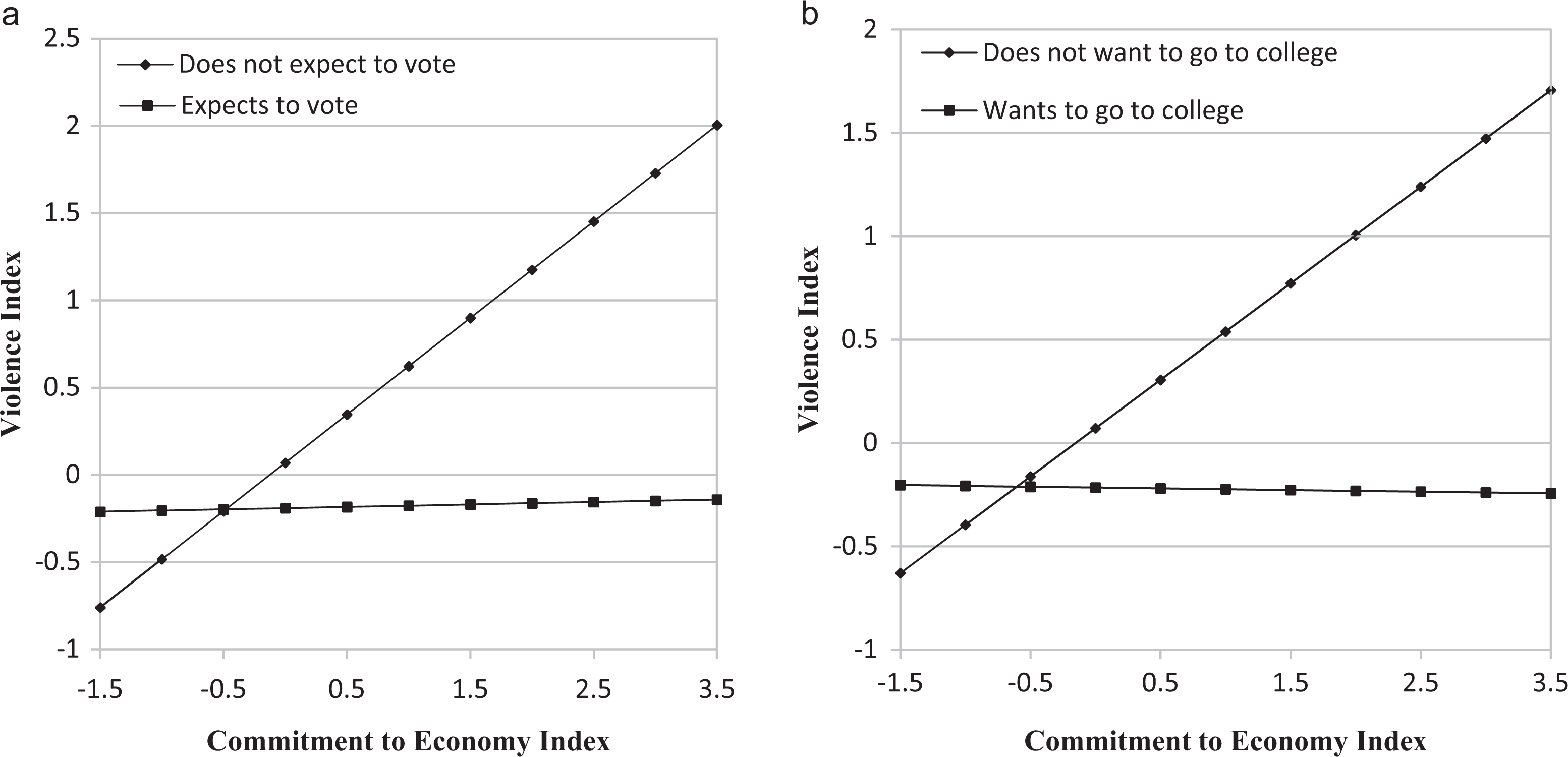
a. Effect of economy on violence conditioned by polity. b. Effect of economy on violence conditioned by education.
Table 2 presents a set of regression models similar to those seen in Table 1, but with the theft index as the dependent variable. Here we see a somewhat different pattern of effects for the institutional commitment variables. First, none of the interaction terms are statistically significant, and commitment to the economy is not significantly related to theft in any of the models. However, similar to the results for violence, commitment to the institution of family is predictive of lower involvement in theft (b = −.098, p ≤ .05 in the baseline model). Likewise, those with a stronger adherence to religion also engage in less theft (b = −.129, p ≤ .01 in the baseline model). The negative effects of these noneconomic institutions on theft provide partial support for IAT, but the moderation thesis is not supported for this form of delinquency.
Effect of Commitment to the Economy on Theft Conditioned by Noneconomic Commitments.

Note. Standard errors in parentheses.
*p ≤ .05. **p ≤ .01.
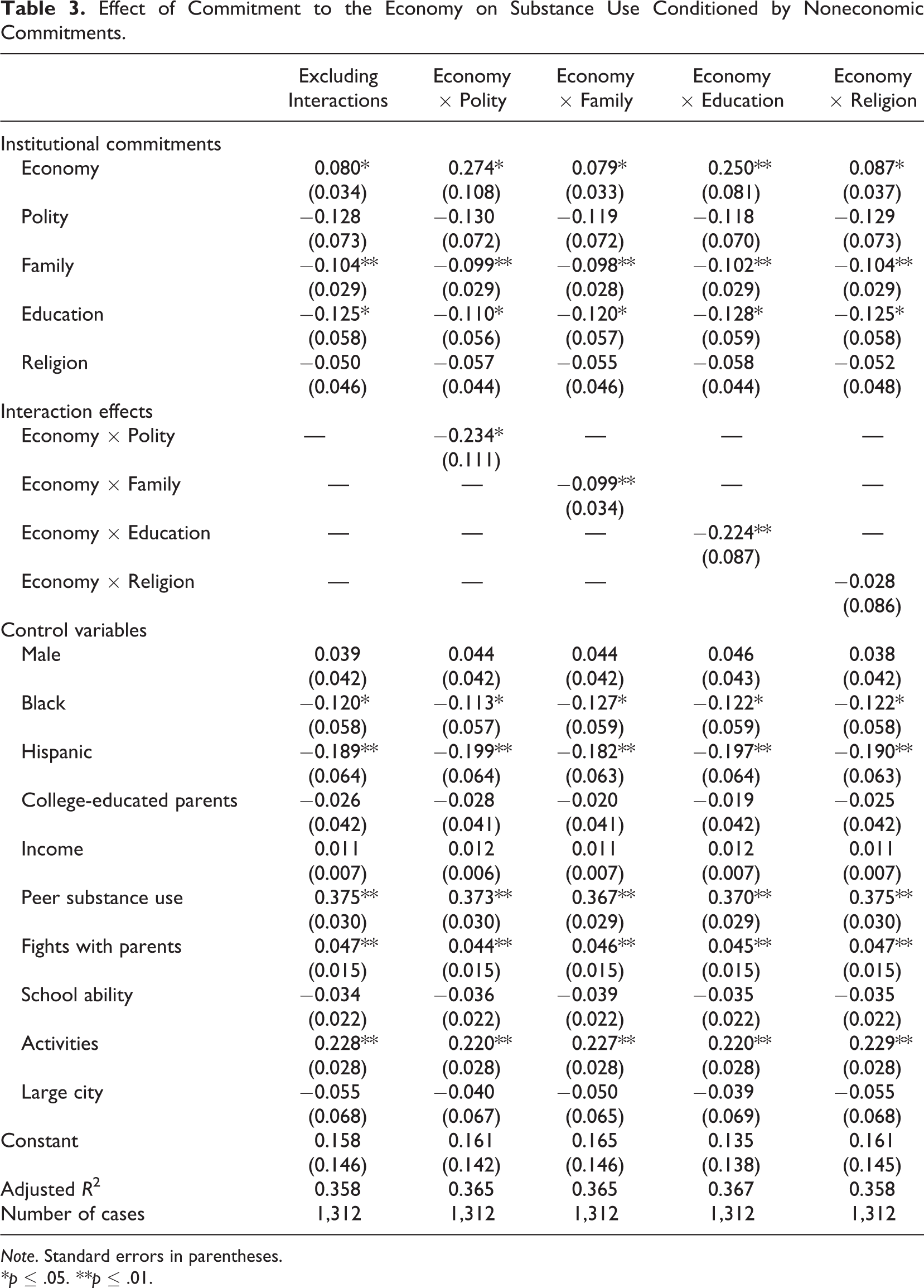
The last set of results is reported in Table 3, which presents regression models predicting levels of drug use. As with violence, the results in the baseline model indicate that respondents with a greater commitment to the economy are more likely to engage in drug use (b = .80, p ≤ .05). Also as expected, stronger adherence to the values of the noneconomic institutions of family and education are associated with lower levels of drug use. The results of the conditional effect models show significant, negative interaction terms for polity (−.234), family (−.099), and education (−.224), suggesting that the positive effect of economic commitment is reduced by stronger adherence to these noneconomic institutions. Though the negative effect of polity is not statistically significant, it is important to bear in mind that this coefficient must be interpreted along with the interaction effect between economy and polity. Since the economy measure is mean centered, the nonsignificant effect of polity listed in Table 3 (b = −.130) is specifically with regard to respondents with an average level of commitment to the economy. Supplemental analysis (not shown) indicates that the negative effect of polity is significant for those with low levels of adherence to the market values (1 standard deviation [SD] below the mean).
Effect of Commitment to the Economy on Substance Use Conditioned by Noneconomic Commitments.
Note. Standard errors in parentheses.
*p ≤ .05. **p ≤ .01.
Figure 2a–c provides a visual illustration of the conditional effects found for polity, family, and education. Figure 2a shows the predicted effect of commitment to the economy on substance use for those who do expect to vote compared with those who do not. The virtually flat line for those who expect to vote shows that there is no effect of economic commitment on substance use for those who show a commitment to polity, whereas the steep slope for those who do not expect to vote mirrors the finding of a significant positive effect of economic commitment in the regression results.
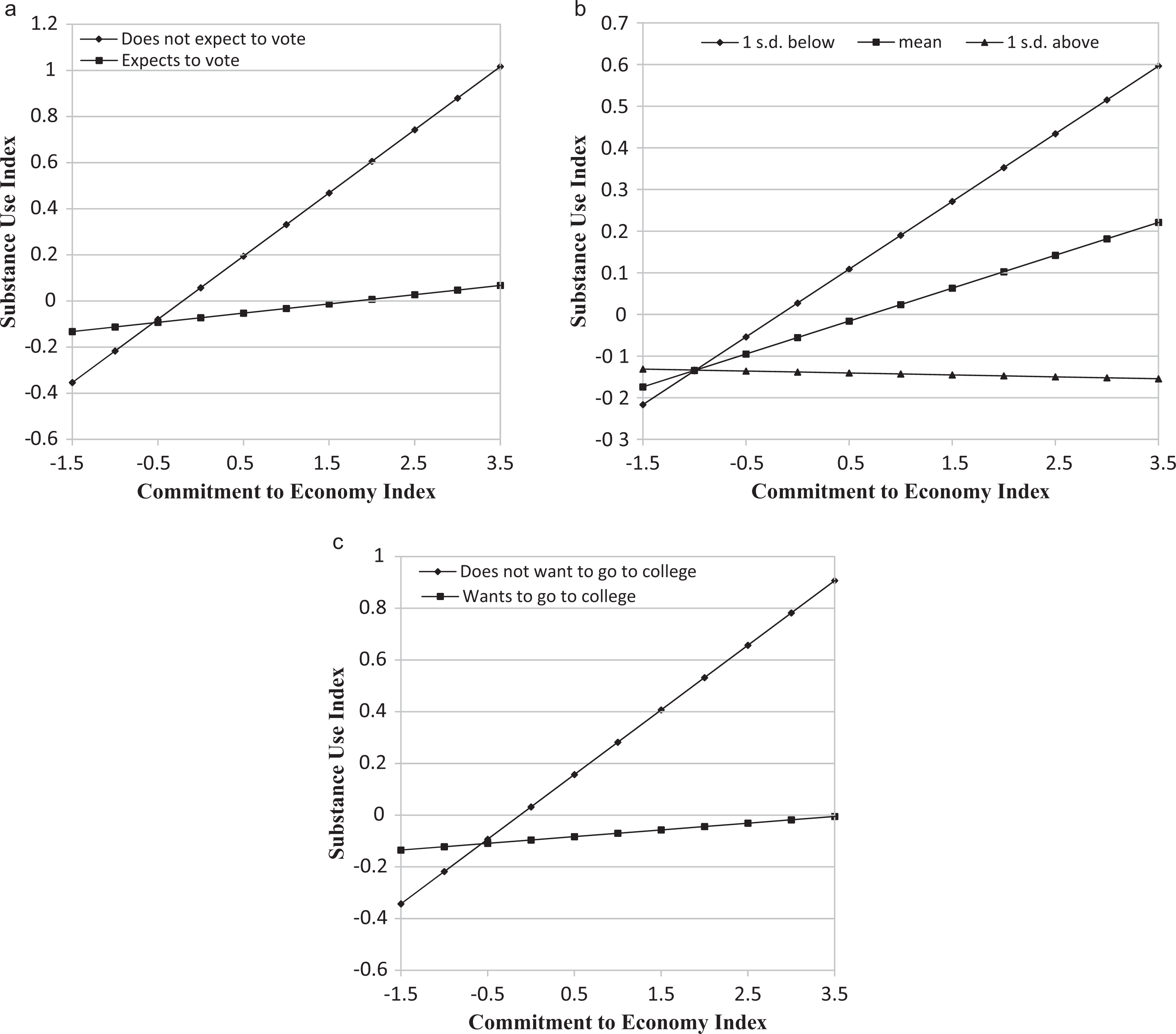
a. Effect of economy on substance use conditioned by polity. b. Effect of economy on substance use conditioned by family. c. Effect of economy on substance use conditioned by education.
Figure 2b shows the predicted effect of commitment to the economy on substance use for respondents with average commitment to family, as well as 1 SD above and below the mean. The negative slope for respondents 1 SD above the mean indicates that for those with high levels of commitment to family, higher levels of commitment to the economy are actually associated with lower levels of substance use, and supplemental analysis indicates that this is a statistically significant effect. However, for those with an average level of commitment to family as an institution, the effect of commitment to the economy is positive, as well as for those with high levels of commitment to family.
Finally, Figure 2c shows the effect of commitment to the economy conditioned by commitment to the institution of education. These results look very similar to the figure for polity. For those who would want to go to college if they could do whatever they want, there is no effect of commitment to the economy on substance use, but there is a positive effect for those who would not choose to go to college.
Discussion and Conclusion
Building on the anomie perspectives of Durkheim and Merton, IAT argues that crime rates will be higher in societies characterized by an imbalance of institutional power where the economy dominates other social institutions such as the family, polity, religion, and education. Nearly all prior tests of IAT have been conducted using large aggregate units of analysis such as nations, states, or counties, and virtually all of those have examined serious forms of violence or property crime as outcomes. The results of these studies often support the expectations of IAT, finding that a strong cultural emphasis on the economy is associated with higher crime rates, while strong noneconomic institutions appear to reduce crime rates as well as moderate the criminogenic effect of the dominant economy.
The current article contributes to this literature by empirically evaluating important potential expansions of the scope conditions of IAT. We test the expectations of IAT at the individual level using survey data from a representative sample of high school seniors in the United States. Though the theory was originally formulated at the societal level, more recent elaborations by the original authors of IAT have recognized that the institutional dynamics that are central to its propositions are implicitly based on individual-level processes (Messner et al., 2008). Extending the macro-level hypotheses to the individual level, we were also able to incorporate the cultural commitments of the economy identified by Messner and Rosenfeld (2001), including and fetishism of money, competition, and materialism, and the cultural commitments embodied within noneconomic institutions. This integration of cultural values expands prior research that focuses only on involvement in the institutions themselves.
In accordance with previous macro-level studies, we expected that offending would be higher among those who express an adherence to values associated with the market economy and lower among those who adhere to the values of noneconomic institutions. Though the results varied somewhat across offense types, these expectations were often supported. For both violence and substance use, there was a consistent positive effect of market values on offending, while for theft the positive effects were not statistically significant. Likewise, in many cases, adherence to the values of noneconomic institutions was associated with lower levels of offending. This was true for all institutions except religion in the models for violence and substance use, and it was true for family and religion in the theft models. In other words, each of the noneconomic institutions was negatively associated with at least one of the delinquent acts, and more than one for all but religion. However, only commitment to family as an institution reduced involvement in all three forms of delinquency.
In addition to the expectation of independent effects for economic and noneconomic institutions, IAT argues that the crime-producing effect of a culturally dominant capitalistic economy can be counterbalanced by strong noneconomic institutions. This has typically been tested using interaction effects, with the expectation that the positive effect of the economy will be attenuated where noneconomic institutions are stronger. Again adapting this to the level of individuals, we expected that the positive effect of adherence to market values would be lessened by adherence to the values of other social institutions. We found support for this expectation, with significant interactions with economic values for polity and education when predicting violence, and for all institutional variables except religion when predicting substance use. However, none of the interaction effects were significant in the theft models.
Overall, we find considerable support for IAT when conceptualized and modeled at the individual level. While model fit varies across delinquency types, explained variation is as high as 36% in models of drug use, and reaches about 16% even in the least supportive models of theft. This degree of support is particularly interesting with regard to substance use, given that the theory was proposed as an explanation of crimes involving serious bodily injury or economic harm, and nearly all previous tests of IAT have examined serious forms of crime such as homicide, robbery, and burglary. Even where other forms of crime and delinquent behavior are examined, those behaviors have still been economically motivated, such as white-collar crime and unethical behavior among business firm managers. Our findings for substance use suggest that the scope of IAT can be extended not just to the individual level but also to less serious forms of offending that do not necessarily involve economic gain.
That anomie could lead to substance use is not a new idea. Indeed, Merton (1938) raised this possibility when describing the “retreatist” adaptation to anomie. He argued that the strain of failing to achieve culturally defined success through conventional means, combined with moral or practical constraints against the use of illegitimate means, can result in the individual dropping out of society and, in some cases, retreating into substance use. Thus, cultural goals, institutionalized means, and criminal means are all rejected, and substance use becomes an escape from the anomic pressures of organized society. But there are apparent contradictions, both empirical and theoretical, in this interpretation of the observed effects for substance use in the current article. The typical interpretation of Merton’s notion of retreatism seems to suggest that substance users should exhibit lower levels of adherence to market values, since those values would have been rejected in response to the anomic pressure of culturally and structurally imbalanced institutional commitments. Yet, we find positive effects of adherence to market values in all of the substance use models, and these effects are especially strong when adherence to noneconomic institutional values is low. While these findings fit with the general expectations of the anomie perspective, they are at least partly inconsistent with what we might expect to find for a retreatist mode of adaptation.
A closer inspection of Merton’s discussion of retreatism reveals a more complex set of expectations regarding the rejection of culturally emphasized goals. Though individuals following this adaptation may have relinquished their commitment to culturally defined goals by the time their retreat from conventional society is complete, that very retreat is precipitated by their initial assimilation of, and high regard for, conventional goals. Moreover, Merton (1938) points out that the rejection of cultural goals among retreatists may only apply to “certain spheres of activity” and that escapist behavior may emerge even when “the supreme value of the success-goal has as yet not been renounced” (pp. 677–678). Thus, it is possible to characterize substance users as retreatists despite the fact that they still seem to maintain some degree of adherence to culturally emphasized market values. This is an especially relevant point for young illicit substance users, such as those in our sample of high school seniors, since we may be witnessing the early stages of their retreat from conventional goals and values. A more definitive evaluation of this explanation of the results for substance use requires longitudinal data, and is a worthwhile goal for future research.
Though this interpretation of the results for substance use may be compelling, at least in part because it seems to fit well with both the societal level arguments of IAT and the individual-level implications of Merton’s classic anomie theory, it is also possible that substance use simply represents a broader category of rule-breaking behavior that can be placed within an expanded scope of anomie theory. The linkage between unbalanced institutional commitments and substance use may stem from a cultural ethos that emphasizes competition and achievement and is characterized by an “anything goes” attitude that encourages the use of any means necessary to succeed (Messner & Rosenfeld, 2001). As Karstedt and Farrall (2006) explain, such market anomie creates “a mood of lawlessness and cynical attitudes toward rules and regulations” (p. 1017). Among individuals who experience anomie, this mood may result in greater involvement in serious forms of crime and delinquency, or it may manifest itself more generally in less serious forms of rule breaking such as cheating (Muftić, 2006), avoiding taxes (Karstedt & Farrall, 2006), or using illicit substances, as we find in the current study.
We believe that the preceding analysis contributes in important ways to the literature on IAT and classical anomie theory. However, there are limitations to this study that suggest potential avenues for future research. First, while model fit is relatively strong in some models—particularly for drug use—a considerable portion of variability in all three forms of delinquency remains unexplained. A valid test of IAT at the individual level requires careful attention to alternative criminological theories, and would ideally include controls for the hypothesized predictors that are most similar to those implied by IAT. The theory that perhaps provides the strongest alternative explanation to those provided here is social bond theory (Hirschi, 1969). For instance, one might argue that our concept of adherence to the values of the family as an institution is simply a proxy for parental or family attachment. Likewise, adherence to the institution of education could be capturing the bonding concept of educational commitment, and our measure of polity could be capturing the bonding concept of involvement.
As noted earlier, we have attempted to account for some of these alternative explanations by including independent measures of parental bonds, school ability, and general involvement in activities. We find that in many cases these characteristics are associated with offending in a manner predicted by social bond theory; yet, our results in support of IAT obtain even after controlling for them. This is particularly noteworthy, given that the effect of economic institutional dominance on crime that is hypothesized by IAT may be partly indirect to the extent that it affects social bonds such as parental attachment which, in turn, affect involvement in crime. If this is the case, then the effect of adherence to market values on crime and delinquency may be even greater than our results suggest. However, our operationalizations of these social bonding concepts are not ideal. For example, our measure of parental attachment is based on a single item asking about the frequency of fighting with parents, and our proxy for school commitment is comprised of a single item asking about school ability relative to others. With regard to education, we believe there is minimal overlap between the concept of commitment to education as proposed by social bond theory and the IAT concept of adherence to the values of the institution of education since our measure specifically asks whether the student would attend college if they could do whatever they want. Still, a more valid measure of the bonding concept of investment in education would provide a stronger distinction between social bond theory and IAT.
Future research should also take into account variation in the availability of conventional means, as this may further condition the relationship between adherence to market values and criminal and rule-breaking behavior. It is possible that unbalanced institutional commitments may lead to increased involvement in crime and delinquency, regardless of whether conventional means for attaining economic success are available. Since the broad, cultural ethos of the American Dream emphasizes the use of the most efficient means for achieving valued goals, individuals may choose criminal means even when they have access to conventional means, such as employment and higher education. However, both classic and contemporary anomie theories argue that inequalities in the American social structure result in blocked opportunities for some members of society, which may amplify individual levels of anomie. This suggests the modeling of a three-way interaction between market values, noneconomic institutional values, and blocked conventional opportunities, with the expectation that an imbalance between market values and noneconomic institutional values may be particularly likely to increase criminal and delinquent behavior when conventional opportunities are blocked. Given that the current analysis already finds significant two-way interaction effects of economic and noneconomic values on violence and substance use, accounting for blocked opportunities is likely to only bolster our findings rather than invalidate them. However, it is possible that the null effects that we find for theft could emerge as statistically significant when including blocked opportunities either as an independent or conditioning effect.
Because Messner and Rosenfeld (2001) make a distinction between the cultural and institutional aspects of their theory, future research may want to consider alternate methods for incorporating both of these concepts into the measures used. In the current study, we measure each of the institutions in the form of cultural value commitments, placing greater emphasis on the cultural component of IAT. It might be useful to have two separate measures for each institution—commitment to the value of the institution and actual involvement in the institution. Given the available data, we are limited to the former, but considering the propositions of IAT, the latter should be taken into consideration as well. Expanding on this operationalization issue, the incorporation of multiple indicators for each institution would provide for better measures in future studies of IAT at the individual level as well. Unfortunately, we were sometimes limited to single-item measures of the institutional variables.
Finally, we believe future research should continue to build on recent multilevel explications of Merton’s strain theory and IAT (Baumer, 2007; Messner et al., 2008). An important next step would be to expand the current study by introducing contextual characteristics such as neighborhood, city, or county-level measures of institutional strength. While these could consist of the proxy measures typically used in prior macro-level research such as economic inequality, educational resources, and divorce rates, a more valid assessment would include direct indicators of cultural and structural conditions such as the aggregate emphasis on monetary and nonmonetary success goals and the distribution of legitimate opportunities. In a multilevel assessment such as this, it would be possible to determine whether the individual-level variability in the balance of institutional commitments, and its influence on individual delinquent behavior as observed in the current study, is at least partly explained by variation in the balance of institutional power across social collectivities.
In conclusion, we argue that despite being initially cast as a macro-level theory, IAT can be effectively employed as an explanation of variation in offending behavior among individuals. Likewise, we believe that it should be explored as an explanation of a wide variety of behaviors, including often studied serious forms of violence and theft, but also less serious forms of offending such as smoking, drug use, and even noncriminal forms of rule breaking. These arguments may be particularly important when attempting to extract policy implications from IAT, and especially with regard to juveniles. Messner and Rosenfeld (2001) acknowledge that the seemingly implicit recommendation of a radical transformation of American culture is a “fanciful” notion, but they do recommend a number of policies aimed at rebalancing the relative power of social institutions (p. 108). However, even the more viable options, such as strengthening social welfare programs, expanding paid family leave, and employer-provided child care, seem unfeasible in a period of economic austerity and social conservativism when such initiatives are being dismantled rather than developed.
Given our supportive results at the individual level, and our focus on juveniles rather than adults, we believe measures aimed at influencing individuals more directly, rather than through broad social programs and institutional changes, may be more viable. These could include such practical recommendations as modifying high school civics courses to emphasize the noneconomic value of community involvement and public service. Even as early as middle school, students could be required to log a minimum number of public service hours as a requirement for grade advancement. These policies would hopefully instill in students an early appreciation of public service, but at the very least they would demonstrate an institutional valuation of polity that serves as a counterbalance to the institutional value placed on economic gain and material forms of success. Likewise, parents could be educated on the importance of rewarding good grades or behavior with warm praise or a family night out, rather than with money or other material rewards. By decoupling educational success from economic reward, and particularly when pairing it with a form of reinforcement rooted in another noneconomic institution such as the family, parents can alter the institutional balance in a way that diminishes the societal-level emphasis on economic success by any means necessary. In general, while significantly reducing the supremacy of economic success as a culturally valued goal may be implausible, our results suggest that enhancing the perceived value of noneconomic goals among juveniles can at least reduce the likelihood that dominant market values will lead to delinquency and crime.
Footnotes
Appendix A
Appendix B
Acknowledgments
The authors wish to thank the anonymous reviewers, as well as Steven Messner and Eric Baumer, for their insightful comments and suggestions.
Declaration of Conflicting Interests
The author(s) declared no potential conflicts of interest with respect to the research, authorship, and/or publication of this article.
Funding
The author(s) received no financial support for the research, authorship, and/or publication of this article.