



Abstract
Variants in the profile of youth with callous–emotional traits have been observed in juvenile and adult populations, and the presence of such traits has been repeatedly linked with violence. Although data on this issue are often culled from institutionalized populations, little is known about the heterogeneous nature of these psychopathic features in the population of youth at large. This research evaluates these variants in a national sample of youth while examining the intersection of violence–crime between those resembling the two subsets of primary and secondary psychopathy. Distinctions based on variant type and promise for more targeted intervention are also discussed.
Keywords
Research examining renascent psychopathy has isolated the presence of callous–unemotional traits (CU traits) in youth as a precursor to adult psychopathy. Concomitantly, a growing body of research has demonstrated heterogeneous contours among those scoring high on the psychopathy construct, particularly CU traits, which offer guidance to scholars studying the pathways to juvenile violence. Specifically, research has demonstrated the presence of a lower anxious primary variant of psychopathy and a high-anxious secondary group (e.g., Fanti, Demetriou, & Kimonis, 2013), whereas the secondary group is most often identified with hostile, callous behavior among other problematic traits (e.g., Dean et al., 2013; Skeem, Johansson, Andershed, Kerr, & Louden, 2007). Heterogeneity observed in psychopathy has been theorized to reflect different etiological pathways that arguably contribute to divergent expression of affect, impulsivity, and other malignant behaviors observed between subtypes (Hicks et al., 2012; Skeem et al., 2007).
Importantly, many of the findings related to these variant groups come with a caveat; a reasonable amount of research has isolated these variant types in institutionalized populations of adolescents (e.g., Kimonis, Fanti, Isoma, & Donoghue, 2013; Salekin, Worley, & Grimes, 2010). Yet, little is known about variant types in the general population of youth. This is significant as research suggests that the features comprising psychopathy represent multidimensional and normally dispersed sets of characteristics in the population at large (DeLisi, 2009; Edens, Marcus, & Vaughn, 2011; Flexon & Meldrum, 2013; Murrie et al., 2007). Research has also shown merit in using the psychopathy construct for explaining youth violence in a national sample alongside traditional criminological correlates (Flexon & Meldrum, 2013), while other studies have been successful in isolating variants in a community sample (Fanti et al., 2013). Such initial findings hold promise and may serve as more general explanations for crime and violence.
Explorations into variant, renascent psychopathy is beginning to reveal theoretical and empirical overlap between what can be understood as traditional criminological theory (e.g., self-control theory) and other approaches relying on psychological constructs to explain violence. 1 Research evaluating these general traits often involves cluster analysis of those high on traits of callousness, remorselessness, and low emotional attachment (CU traits), collective traits repeatedly implicated in the expression of juvenile psychopathy (e.g., Barry et al., 2000), with other characteristics, such as impulsivity, narcissism, or conduct problems in efforts toward further delineating the features between groups (Skeem et al., 2007). For example, research has demonstrated that impulsivity is a factor related to the variant expression of CU traits, though it is not neatly united with the primary subtype, rather belonging to the high-anxious secondary group (Dean et al., 2013; Kimonis, Frick, Cauffman, Goldweber, & Skeem, 2012). Since impulsivity, also conceived of as low self-control (Gottfredson & Hirschi, 1990), is frequently seen with problem behavior in youth and linked with parenting, examination of these variants on common criminological correlates may serve to inform our understanding of violence and potential for treatment and intervention. Given the variability and the notion that some scoring high on CU traits are theoretical products of their environment, additional research is also needed, which explores how juvenile variants might differ with important covariates, such as parental investment (e.g., monitoring and supervision) or hostility from one or both parents, with other criminological covariates (e.g., impulsivity/low self-control), and outcomes (e.g., the presence or absence of violence per variant) specific to the noninstitutionalized. Such an understanding may also be informative to and help specify individual-level models aimed at explaining problem behavior generally (e.g., Gottfredson & Hirschi, 1990).
In short, although much is known about the role of psychopathy generally in populations of chronic adult offenders and confined youth, few have investigated the constellation of traits that mirror these variant subtypes in noninstitutionalized youth or the manner in which such traits might inform current criminological investigation of juvenile violence. Hence, this study seeks to evaluate these variants in a national sample of youth while examining potential covariates to violence between those resembling the two theoretical subsets, primary (high CU, low anxious) and secondary (high CU, anxious) psychopathy. Toward this end, data for the study are culled from the National Institute of Child Health and Human Development (NICHD)’s Study of Early Child Care and Youth Development (SECCYD). The Youth Psychopathic Traits Inventory's (YPTI) subscales of remorselessness, unemotionality, and callousness (CU Traits) are used in concert with an anxiety/depression scale to identify these two groups of youth in the general population. Then, variables important to youth development (i.e., parenting) are evaluated for differential association between these subgroups. For example, primary types are postulated to be idiopathic and caused by genetic factors and the secondary influenced by environmental forces (Karpman, 1941). 2 Might we expect to see poorer parenting practices associated with the presence of the secondary variant but not necessarily the primary type among the noninstitutionalized? Next, are other known correlates of delinquency and psychopathy (i.e., impulsivity) differentially linked to the two types and might this be associated with violent behavior? Finally, is one group more implicated with violence than the other? Prior to presenting the methods and findings of a series of regression analyses (linear, logistic, and negative binomial), the literature on renascent psychopathy and its proposed variants is reviewed in greater detail. Distinctions based on variant type and promise for more targeted intervention are also discussed.
Juvenile Psychopathy
In attempts to better understand emergent adult psychopathy, scholars turned to examining the construct in youth (i.e., fledgling psychopathy), with aims toward intervention and treatment (Lynam, 1996;1998). This research has led researchers to several, general conclusions about juvenile psychopathy. Psychopathy has a higher prevalence in males (Vaughn & Howard, 2005). The presence of CU traits in youth is important and thought to predicate adult psychopathy (Barry et al., 2000; Fanti et al., 2013; Ribeiro da Silva, Rijo, & Salekin, 2012). These traits exhibit stability over time and are associated with poor behavioral outcomes (e.g., Lynam & Gudonis, 2005; Lynam, Loeber, & Stouthamer-Loeber, 2008). Further, research investigating the etiology of psychopathy has found that CU traits has a strong heritable component and environmental contributions (e.g., Bezdjian, Raine, Baker, & Lynam, 2011; Larsson, Andershed, & Lichtenstein, 2006; Viding, Blair, Moffit, & Plomin, 2005). Hence, CU traits are heritable and/or environmentally driven as well as normally distributed in the population (DeLisi, 2009; Edens et al., 2011; Murrie et al., 2007). Such findings are in concert with theorized demarcations concerning the presentation of and in etiology between variant types; however, research on this point is still needed, focusing explicitly on the heterogeneous contours of CU traits among the noninstitutionalized. The discussion now turns to examining the contours of variable psychopathy expression, with particular attention given to the secondary variant, the group most concerning from a criminological perspective.
Toward Isolating Variants
The contours of those scoring high on CU traits have been observed clinically and in more recent evaluations. Initially, measurement research exploring the factor structure of the construct revealed that there was at least a two-factor presentation. The first factor, affective interpersonal (factor 1), refers to those lacking empathy and remorse but having characteristics of being superficial, glib, narcissistic, and being deceitful and manipulative; The second factor, socially deviant lifestyles and behaviors (factor 2), is connected to impulsivity, irresponsibility, low self-regulation, early conduct problems, and adult antisocial behavior (Bezdjian et al., 2011; Hare, Hart, & Harpur, 1991; Harpur, Hare, & Hakstian, 1989). Yet, other investigators have found three-factor—arrogant and deceitful interpersonal style, deficient affective experience, and impulsive and irresponsible behavior (Cook & Michie, 2001)—and four-factor solutions when examining the construct—interpersonal, affective, lifestyle, and antisocial (Hare & Neumann, 2005). Such explorations highlight ongoing controversies in the literature.
One very pertinent area of disagreement among scholars comes along with the competing models discussed earlier and rests on whether or not deviant and/or criminal behavior should be included as an indicator or dimension of psychopathy (e.g., Hare & Neumann, 2010; Skeem & Cooke, 2010a, 2010b). One side of the debate considers criminal and problem behavior central to the construct (Hare & Neumann, 2005), while others contend that deviant and “criminal behavior is an epiphenomenon that is neither diagnostic of psychopathy nor specific to personality deviation”—rather, violent behavior, in particular, is viewed as a later, downstream correlate of psychopathy (Skeem & Cooke, 2010a, p. 433). This later position strongly echoes early theorizing about the character of psychopathy.
Over 70 years ago, Cleckley (1941) conceived of successful and unsuccessful psychopaths by examining noninstitutionalized subjects, whereas those meeting the criteria of being egocentric, irresponsible, and using superficial charm were not necessarily criminal or institutionalized and were considered high functioning (Gao & Raine, 2010). At the same time, Karpman (1941, 1948) argued that many being labeled with psychopathy were being ascribed so inappropriately. In essence, by including deviant/criminal behavior within the construct (as well as a number of other traits he dismisses), the label of psychopathy was being inappropriately applied since any number of psychic disturbances could manifest with problem, abhorrent behavior. Thus, virtually any condition that comanifested with violence or behavioral outbursts could result in misapplying psychopathy, leading to a great amount of overinclusion. Hence, it was through such a lens that Karpman (1948) further clarified his discussion of heterogeneity in psychopathy, which will be discussed shortly.
Investigating psychopathy through a measurement lens, then, as with many constructs, has often involved sorting out the associated factor structure. However, this line of research has also led investigators to the conclusion that not all scoring high on psychopathy or CU traits are comparable across a variety of domains and that these competing factor solutions may be specific to and accentuate the heterogeneous contours of psychopathy (Fanti et al., 2013; Salekin et al., 2010; Skeem et al., 2007, p. 396; Skeem, Poythress, Edens, Lilienfeld, & Cale, 2003). It seems quite plausible that these competing models are really tapping into subtypes of psychopathy expression. Thus, it was and is in sorting out the measurement structure of psychopathy that the promise of examining variant subtypes is further realized, and we see that some controversy echoing positions from the past can inform current investigations of problem behavior as well as offer clues about intervention. In consideration of the above-mentioned fact, the following discussion explores the variants of psychopathy in further detail.
Psychopathy: Primary and Secondary Variants
Historically, Karpman’s (1941) observations led to an understanding of psychopathy as a heterogeneous concept. Primary psychopathy referred to those with idiopathic, seemingly heritable psychopathic traits (e.g., callousness, remorselessness, unemotional toward others, etc.) and lacking demonstration of normal affect, which is compared to a different observed group having psychopathic qualities that were the result of, or secondary to, environmental influences. Hence, secondary variants represented those having environmentally induced psychopathic characteristics. The secondary variant, theoretically, can be understood as one who is not born with necessary personal deficits as the primary type but rather one who has adapted or is reacting to such external stimulus as emotional rejection and other abuses and who develops a facade of psychopathy (Blonigen, Hicks, Krueger, Patrick, & Iacono, 2005; Karpman, 1948, p. 424; Skeem et al., 2007). 3 Hence, as noted by Karpman (1948), one starting place to examine these variants is to look at factors related to psychogenesis. Research connecting parental abuse with delinquent outcomes may offer direction on this point. Given that environmental stressors, including abuse, may precede expression of particularly the secondary variant and has been linked to delinquency through other mechanisms (e.g., low self-control) in institutionalized populations (Evans, Simons, & Simons, 2012), it is reasonable to look at distinct parenting qualities between the variants as the crucial environmental forces to noninstitutionalized youth. Yet, empirical research precisely on this point among the general populous is limited (Salekin et al., 2010). Further, much of what we understand about renascent psychopathy lacks appreciation of the heterogeneous contours of CU traits in youth of particularly noninstitutionalized adolescents.
Variants: Differentially expressed covariates
Contemporary research has been instrumental in beginning to understand the heterogeneous contours of psychopathy, providing support for differentiations based on subtypes as those noted earlier (e.g., Fanti et al., 2013; Skeem et al., 2007; Skeem et al., 2003; Vaughn, DeLisi, Beaver, & Wright, 2009). For example and in concert with Karpman’s descriptions, a group consistent with the secondary variant were more likely to have a history of trauma, be diagnosed with attention-deficit hyperactivity disorder, present with higher delinquency and drug use, and were also more likely to suffer from higher affective distress and emotional turmoil (Vaughn et al., 2009, p. 182). Anxiousness, in particular, has been treated as a hallmark feature of the secondary variant, often being used in concert with CU traits to discriminate between subtypes in research (e.g., Fanti et al., 2013; Skeem et al., 2007; Vaughn et al., 2009).
Recently, Fanti, Demetriou, and Kimonis (2013) examined whether variants could be isolated in a community sample of Greek-Cypriot youth, finding that, importantly, these subtypes could be identified among the noninstitutionalized as well as varied in many ways that mirrored Karpman’s early observations. Specifically, the researchers found that it was reasonable to differentiate those scoring high on psychopathy (CU traits) by the presence of anxiety, which is similar to other scholars (e.g., Skeem et al., 2007). Further demarcations could also be drawn based on social correlates known to heighten risks of deviance, such as susceptibility to peer pressure (Fanti et al., 2013; Meldrum, Miller, & Flexon, 2013; Miller, 2010; Steinberg & Monahan, 2007) and impulsivity, which is also linked to variant expression of psychopathy (Kimonis et al., 2012) as well as delinquency (Flexon & Meldrum, 2013). It is important to note that scholars had historically considered impulsivity important to the general construct of psychopathy, particularly among the noninstitutionalized (Skeem et al., 2007). However, contemporary research refutes this point. Rather, it has been found an important correlate of what could be considered the secondary group (Poythress & Hall, 2011). Such findings further demonstrate the need to evaluate the contours of high CU trait youth in the general, nonconfined population.
Variants and violence
Separate from motivation, behavioral outcomes are yet another place to examine the differences between the proposed subtypes. The contention in the literature about behavior and measuring the construct is noted (e.g., Skeem & Cooke, 2010), yet most studies of psychopathy problematically examine the institutionalized, with a distinguishing feature of psychopathy in general being antisocial behavior (Frick, Cornell, Barry, Bodin, & Dane, 2003; Frick, Stickle, Dandreaux, Farrell, & Kimonis, 2005). Although not necessarily disaggregating the population by type, plentiful is research linking antisocial behavior with adolescent psychopathy and/or CU traits, in general, among the institutionalized with those already expressing early conduct problems. 4 Yet, there is a question of whether such behavior is a feature of psychopathy generally, an artifact of studies relying on the institutionalized, or differential expression of behavior common to motivational features of variant subtypes. Such inquiry is not without precedence in the literature. Fanti and colleagues (2013) very recently illuminated the problem when trying to isolate variants in a community sample in Cyprus (noted earlier). These researchers considered quite reasonably the problems raised by dependence upon institutionalized samples when drawing conclusions about problem behavior and psychopathy generally and with variants. Their work offered support for the notion that those high on CU traits also demonstrated co-occurring conduct problems irrespective of variant types among the noninstitutionalized. However, secondary variants were more implicated than the primary subtype in their research. These findings are in concert with research examining the institutionalized, which found secondary variants were more violent under confinement than the primary subtype (e.g., Kimonis, Skeem, Cauffman, & Dmitrieva, 2011), and secondary variants reported more delinquency involvement (Vaughn et al., 2009), given that further exploration is warranted and also informs the current study.
The Current Study
Primary (high CU traits, low anxious) and secondary (high CU traits, anxious) variants in the profile of psychopathy have been observed in juvenile and adult populations, and the presence of psychopathy, irrespective of its variant type, has been repeatedly linked with violence. Although data on this issue are most often culled from institutionalized populations, little is known about the variants of important psychopathy indicators and variants in the population of youth at large. Evaluating such differences in the general population of youth is important, particularly since research suggests psychopathy is dimensional and these features are normally distributed in the general population.
Although much is known about the role of psychopathy in populations of chronic adult offenders and confined youth, few have investigated the constellation of traits that mirror these variant subtypes in noninstitutionalized youth or the manner in which such traits might inform current criminological investigation of juvenile violence. Hence, this study sought to evaluate several things. First, the ability to identify these variants in the general population of youth was assessed by using the YPTI subscales of remorselessness, unemotionality, and callousness (CU traits) in concert with an anxiety/depression scale to identify these two groups of youth in the general population. Next, covariates (psychogenesis) that might help explain the observed heterogeneity in psychopathy were assessed by looking at the association between the variants and quality of parenting characteristics (i.e., supervision, monitoring, parental hostility from one or both parents). Recall, those resembling the primary type are hypothesized to be idiopathic, and research has found a strong heritable component to CU traits (e.g., Hicks et al., 2012; Skeem et al., 2007; Viding et al., 2010; Viding & McCrory, 2012). Given prior theory and research, no direct association between parenting and the primary variant type is expected but is anticipated between parenting quality and the secondary variant. This is further presumed as parenting is consistently used in criminological research as an important and significant exogenous variable in theory (e.g., the general theory of crime, Gottfredson & Hirschi, 1990) and research (de Ridder, Lensvelt-Mulders, Finkenauer, Stok, & Baumeister, 2012; Flexon & Meldrum, 2013; Pratt & Cullen, 2000). For example, when children and parents report investment through parental monitoring, lower delinquent peer association is reported, better school achievement is realized (Dishion et al., 1991), and youth are less likely to be ensnared in delinquency (Dishion & McMahon, 1998; Patterson & Stouthamer-Loeber, 1984). Apart from showing physical control over children, high levels of monitoring and supervision likely indicate a general pattern of high parental investment. In turn, maladaptive parenting can also create a stressful environment during important formative years for adolescents. Hostile, abusive parenting practices have been repeatedly linked with violence, but evidence strongly suggests that this relationship is mediated through other developmental processes specific to the child (Evans et al., 2012; Gold, Sullivan, & Lewis, 2011). Perhaps, in this context, parenting contributes to the expression of CU traits as it does with other criminological covariates, and in particular, the secondary variant. It is important to note that causality cannot be established here; however, the presence of these associations in the general population would be important to the development of theory and research.
Known correlates of delinquency and psychopathy, such as impulsivity and susceptibility to peer influence, are also evaluated for differential association with the two variant types. Such factors as impulsivity have been linked to subtypes of psychopathy in institutionalized populations, particularly among the secondary variant (Kimonis et al., 2011; Poythress & Hall, 2011) and in a preliminary investigation looking at community youth (Fanti et al., 2013). Since impulsivity, otherwise known as low self-control (i.e., the general theory of crime) in the criminological literature, is repeatedly connected to delinquent behavior (de Ridder et al., 2012; Pratt & Cullen, 2000), might it be connected to the secondary variants’ propensity toward violence? Further, research examining variants has found that susceptibility to peer influence is a feature of particularly the secondary variant (Fanti et al., 2013). Such vulnerability to peers is also a correlate of delinquent behavior and is included in the analysis to better understand the observed link between high CU traits, anxious youth, and violence (Meldrum, Miller, & Flexon, 2013; Miller, 2010).
Then, ultimately, is one group more implicated with violence, overall, than the other? Current research has found that secondary variants are, perhaps, more implicated than primary variants (Fanti et al., 2013; Kimonis et al., 2012). Will such findings hold up to further scrutiny among the noninstitutionalized? Hence, another purpose of this research was in exploring the connection between those scoring high on CU traits, the youth proxy for psychopathy, with variable anxiety (high anxious and low anxious) and the expression of violent behavior. Given earlier findings, it is expected that there will be a connection with the secondary variant to violent behavior that is stronger than the primary variant in the noninstitutionalized population. However, it is also reasonable to assume that there will be no necessary connection between the primary variant and violent behavior based on early theory (e.g., Cleckley, 1941) independent of other known correlates of antisocial behavior, such as impulsivity or susceptibility to peer influence. Clearly, connections between violence and the primary type are observed in institutionalized populations of youth. Examining the noninstitutionalized will shed light on whether violence is necessarily connected to those high on CU traits.
Data
The data used in this study come from the NICHD’s SECCYD. The main goal of the SECCYD was to determine how variation in child care experiences might impact multiple areas of child development. As such, the SECCYD collects data covering multiple domains, including family dynamics, child and adolescent development (emotional, mental, social, intellectual, and physical), personality characteristics, social characteristics, and behaviors. The majority of measures included in the SECCYD are well documented and validated. Hence, these data are well suited for an investigation of this type.
The NICHD’s SECCYD data were collected from 1991 through 2007 (four waves) from families recruited at hospitals in 10 diverse cities across the continental United States; Little Rock, AR; Irvine, CA; Lawrence, KS; Wellesley, MA; Philadelphia, PA; Pittsburgh, PA; Morganton, NC; Charlottesville, VA; Seattle, WA; and Madison, WI. The sites were selected on the basis of applicant quality and represent a reasonable cross section of cities, though not formally a nationally representative sample. Recruitment efforts for the project began in 1991 (Wave 1), whereas NICHD affiliate researchers from major U.S. universities collected applications from potential study families having experienced a recent birth at hospitals in 1 of the 10 study cities. Of the 5,400 eligible families, 3,015 were conditionally randomly sampled (at least 10% marginally of single-parent households, mothers with less than a high school education, and ethnic minority mothers) to ensure representation and were contacted 2 weeks postbirth of the child. Final determinations about study inclusion, however, came from lead investigators after careful review. Because of attrition related to refusals, contact issues, health reasons, among other rationales, the total number of families included was 1,526. The first major interview happened 1 month later with 1,362 (89%) families who were then enrolled in the long-term study, which yielded a sample that included 20% non-Whites, 10% of the study mothers not completing high school, and 13% unmarried mothers at the time of the child’s birth. In total, data were collected 12 times through the subsequent years from study families and others (e.g., teachers, child care workers, etc.). Collection ended when the study child reached the age of 15 or Grade 9. 5
Although some measures were evaluated at every data collection interval, others were excluded. The measure making up CU traits was one that only appeared in the Wave 4 data (age 15 or Grade 9). However, evaluation of youth during the fourth wave of data collection is reasonable for studies looking at variant adolescent psychopathy among the noninstitutionalized and the potential connection to violent behavior. Further, the additional characteristics evaluated in the current study are expected to be most relevant to the period of adolescence (e.g., susceptibility to peer influence) and violent behavior. Given, although this study is cross-sectional in nature, the measures of interest come from the targeted age group of adolescence. The descriptive statistics of the measures used in this study and correlations are reported in Table 1.
Descriptive Statistics and Correlation Matrix (N = 877).
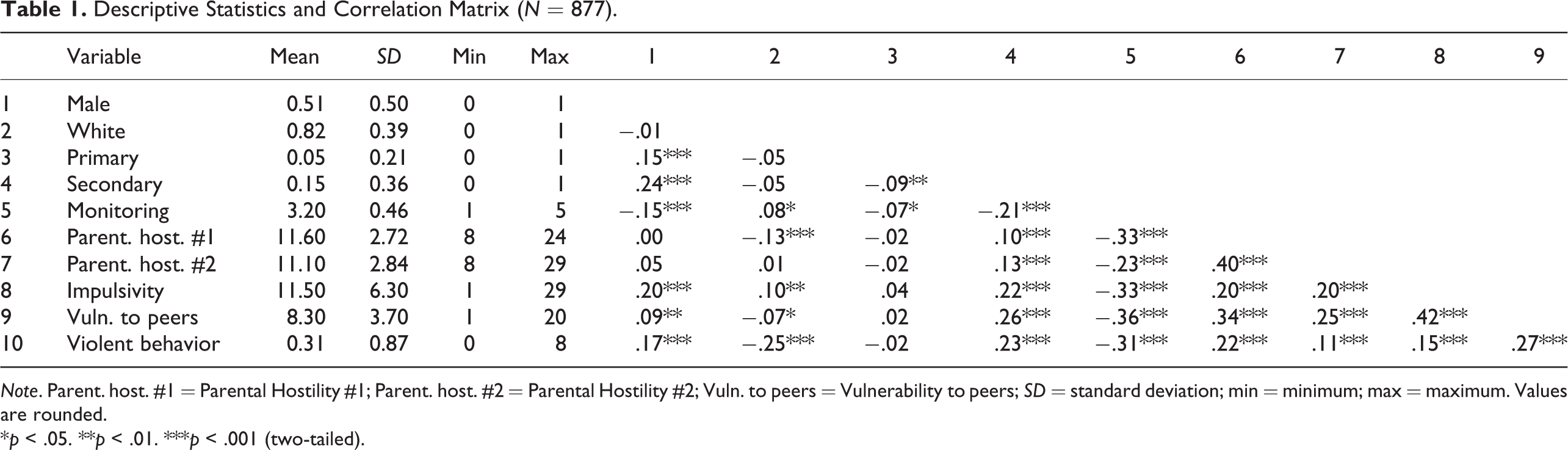
Note. Parent. host. #1 = Parental Hostility #1; Parent. host. #2 = Parental Hostility #2; Vuln. to peers = Vulnerability to peers; SD = standard deviation; min = minimum; max = maximum. Values are rounded.
*p < .05. **p < .01. ***p < .001 (two-tailed).
Measures
Violent behavior
The measure for violent behavior came from self-reported violent acts, adapted from Conger and Elder (1994). Items included whether the youth had taken part in a gang fight, attacked someone, been in a fight between kids, used a weapon to threaten someone, stolen something with the use of a weapon, threatened to attack someone with a weapon, beat someone without a weapon, beat someone with a weapon, and hurt an animal on purpose. The response scale allowed for replies to each item of never (= 0), 1–2 times (= 1), and more than once (= 2). Each item was then dichotomized into a measure reflecting the presence (= 1) or absence of violent behavior (= 0). A variety scale of violent behavior was then constructed by summing together the items; such scales are considered to be more stable and internally consistent (Bendixen, Endresen, & Olweus, 2003). The Cronbach’s α for the items was .76, which exceeded the threshold for sound internal consistency (Nunnally & Bernstein, 1994).
Psychopathic variants (primary and secondary)
A variety of tools, including the Antisocial Process Screening Device (APSD; Frick & Hare, 2001), the Childhood Psychopathy Scale (Lynam, 1997), and the Hare’s Psychopathy Checklist (PCL)-Youth Version (Forth, Kosson, & Hare, 2003) have been developed to measure psychopathic traits in youth, predominantly through the modification of Hare’s (2003) PCL-Revised (Lynam & Gudonis, 2005). Research has consistently verified the reliability and validity of these tools (Lynam & Gudonis, 2005). Other tools, such as the YPTI, have also proven to be valid (Andershed et al., 2007). However, recent comparative work examining the YPTI and the APSD found that the YPTI was a better measure of adolescent psychopathy (Poythress, Dembo, Wareham, & Greenbaum, 2006). Thus, a variety of measures for investigating youth psychopathy have appreciable success, with some measures demonstrating better measurement qualities over others.
In efforts to capture the variants of psychopathy used for this study, the YPTI developed by Andershed, Kerr, Stattin, and Levander (2002) was used to isolate CU traits that have been particularly implicated in the expression of renascent psychopathy (Barry et al., 2000; Fanti et al., 2013; Ribeiro da Silva, et al., 2012). CU traits also encompass remorselessness and lack of empathy (Kimonis, Frick, & Barry, 2004). As such, three subscales of the YPTI were used to capture the CU dimension using 15 items. Remorselessness was embodied by asking subjects to respond to questions as, “To feel guilt and regret when you have done something wrong is a waste of time.” Unemotionality was captured with response items as, “I usually feel calm when other people are scared,” and callousness was demonstrated with items including, “I think that crying is a sign of weakness, even if no one sees you.” The dimension of CU traits is the collective of these items. Individual items were measured on a 4-point Likert-type scale ranging from Does not apply at all (= 1) to Applies very well (= 4). Polarity was made consistent across each of the 15 items when constructing the measure, with higher values on the construct indicating higher levels of psychopathy (CU traits). The items produced a Cronbach’s α of .82. After the measure was constructed, values scoring higher than 1 standard deviation above the mean for CU traits were separated out as indicating youth who were higher than average on CU traits. In this case, youth scoring 36 and above were coded as high on CU traits (= 1) and youth falling below the noted criteria were coded as 0.
To identify youth resembling the (low anxious) primary and (high anxious) secondary variants of psychopathy, an anxiety scale was constructed from the Youth Self-Report (Achenbach, 2001). Then, anxious/depressed items were constructed into a dichotomized measure and united with the CU traits binary measure. This scheme was devised to complement other theory and research using anxiety to distinguish between primary and secondary variants (Fanti et al., 2013; Karpman, 1941; Skeem et al., 2007). Here, eight questions were used to isolate anxiety, including items such as, “I’m afraid I might think or do something bad,” “I am too nervous or fearful,” and “I am nervous or tense.” Response scales ranged from not true (= 0), somewhat or sometimes true (= 1), and very true or often true (= 2). Items produced a Cronbach’s α of .79. Once the items were summed, the measure was dichotomized into the presence (= 1) or absence (= 0) of anxiety. Those scoring high on CU traits but lacking anxiety were treated as resembling the primary subtype of psychopathy (CU traits = 1 and Anxiety = 0). Those scoring high on CU traits and high on anxiety (CU traits = 1 and Anxiety = 1) were treated as the secondary variant for the purposes of this study. Only about 5% of the subjects qualified as primary and 15% as secondary variants in the noninstitutionalized sample.
Impulsivity
Impulsivity has been repeatedly linked with antisocial behavior and psychopathy (e.g., DeLisi, 2009; Flexon & Meldrum, 2013). Recent attempts to parcel out its place among the dimensions of psychopathic variants have shown that the high-anxious secondary subtype seems much more implicated than with the primary group in diverse samples (Fanti et al., 2013; Kimonis et al., 2012; Poythress & Hall, 2011). However, more scrutiny among the nonincarcerated is also needed as impulsivity is greatly relied upon in theory and research as a criminogenic variable (i.e., the general theory of crime). For this study, impulsivity was measured using 8 items from the Weinberger Adjustment Inventory (Weinberger & Schwartz, 1990), which had an associated Cronbach’s α of .82. Items were measured on a 5-point scale ranging from 1 = false through 5 = true. However, questions were coded so that high values indicated low impulse control, which is the reverse of the original measure. This was done so that the measure could be interpreted as impulsivity rather than well controlled in the analyses. Items asked youth such questions as, “I do things without giving much thought,” “I say the first thing that comes to mind without thinking,” “I’m the kind of person that will try anything even if it is not safe,” and “when I do something fun, I tend to go too far.” Items were united into a summative scale for the analyses.
Vulnerability to peer pressure
Recent work has indicated that susceptibility to peer pressure differs by variant type (Fanti et al., 2013), as well as being implicated in abhorrent behaviors in adolescence (Meldrum et al., 2013; Miller, 2010), and as such is considered in the present study. Vulnerability (susceptibility) to peer influence was measured using an 8-item scale adapted from Steinberg and Monahan (2007). However, the instrument used by the SECCYD worded questions in the first-person format using a 4-point scale ranging from not true at all (= 0) through very true (= 4), whereas Steinberg and Monahan (2007) used the third-person format. The instrument included both neutral and conceivably antisocial items (e.g., Meldrum et al., 2013; Miller, 2010), such as “I would do something that I know is wrong just to stay on my friends' good side,” “I go along with my friends just to keep them happy,” “I would break the law if my friends said they would,” “I will say my true opinion in front of my friends even if I know they will make fun of me because of it (reverse coded),” and “I take more risks when I am with my friends than when I am alone,” among other questions. Cronbach’s α for these items was .69. A summative measure was created.
Parenting measures. Monitoring and supervision and parental hostility
Parental monitoring was measured by a series of questions adapted by the SECCYD from Stattin and Kerr (2000). The measure holds reasonable reliability with a Cronbach’s α of .83 for the child items (9 questions) and .77 and .84 for mother and father items (11 questions), respectively. The response scheme ranges from Doesn’t know at all (= 1) through Knows everything (= 4). This measure is constructed using the mean score for the study child and parental items, giving the possible range of means of 1 through 4. The instrument asked child subjects questions as, “How much does a parent or other adult in your home know about where you go right after school,” and “When you are home without a parent or other adult, do you know how to get in touch with them.” Parent items also included questions about setting time to be home on school and week nights.
Parental hostility is measured for each parent independently and relies on “The Getting Along With My Parent” questionnaire used by the SECCYD (Conger & Ge, 1999; Conger, Wallace, Sun, McLoyd, & Brody, 2002). The 8 items used to construct the maternal hostility measure (Parent #1) have a Cronbach’s α of .79 and for the father (Parent #2) measure, .80. Items included in the measures asked child subjects whether each separate parent, “gets angry with you,” “criticize your ideas,” “shout or yells at you because they are mad,” “threaten to hurt you physically,” “push, grab, hit, or shove you,” “strike or hit you with hands or object,” and “insult or swear at you,” among others. The response scheme for the questions was on a 4-point Likert-type scale ranging from never (= 1) to always (= 4). Each measure for parental hostility represents separate summative scales of the 8 items for each parent.
Demographic variables
Supplementing the main variables of interest are the demographic variables of sex (Male = 1, Female = 0) and race (White = 1, Non-White = 0). All respondents in the analysis are from Wave 4 data (age 15 or in ninth grade), which effectively hold age constant in the analyses. As noted earlier, descriptive statistics and correlations for all study variables used in the analyses are reported in Table 1.
Analytic Method
The first stage of analysis unites a series of logistic and linear regression equations to identify any association between parental variables (monitoring/supervision and parental rejection) and those resembling the primary and secondary variants, impulsivity, and vulnerability to peer influence, in addition to determining whether and how impulsivity and vulnerability to peer influence is linked to either primary or secondary psychopathy in models examining nonincarcerated youth. Four models are produced and are reported in Tables 2 and 3. The logistic and linear regressions were separated into two tables, Tables 2 and 3, for the sake of clarity. The type of regression used varied by measurement scheme of the associated dependent variable among other criteria. The first logistic model examined the primary variant, and in the second logistic equation, those resembling the secondary variant were regressed on demographic variables and the parenting variables (monitoring/supervision, parental hostility from Parent #1 and Parent #2), with results reported in Table 2. Logistic results are reported in the tables. However, the results for both models were further scrutinized using a more penalized likelihood estimation procedure designed to accommodate rare events (Firth, 1993), which is the case for the presence of those resembling the primary and secondary variants. Results from the more penalized approach were substantively the same as the logistic regression.
Logistic Regression Equations Examining Correlates of CU Trait Variants (N = 877).
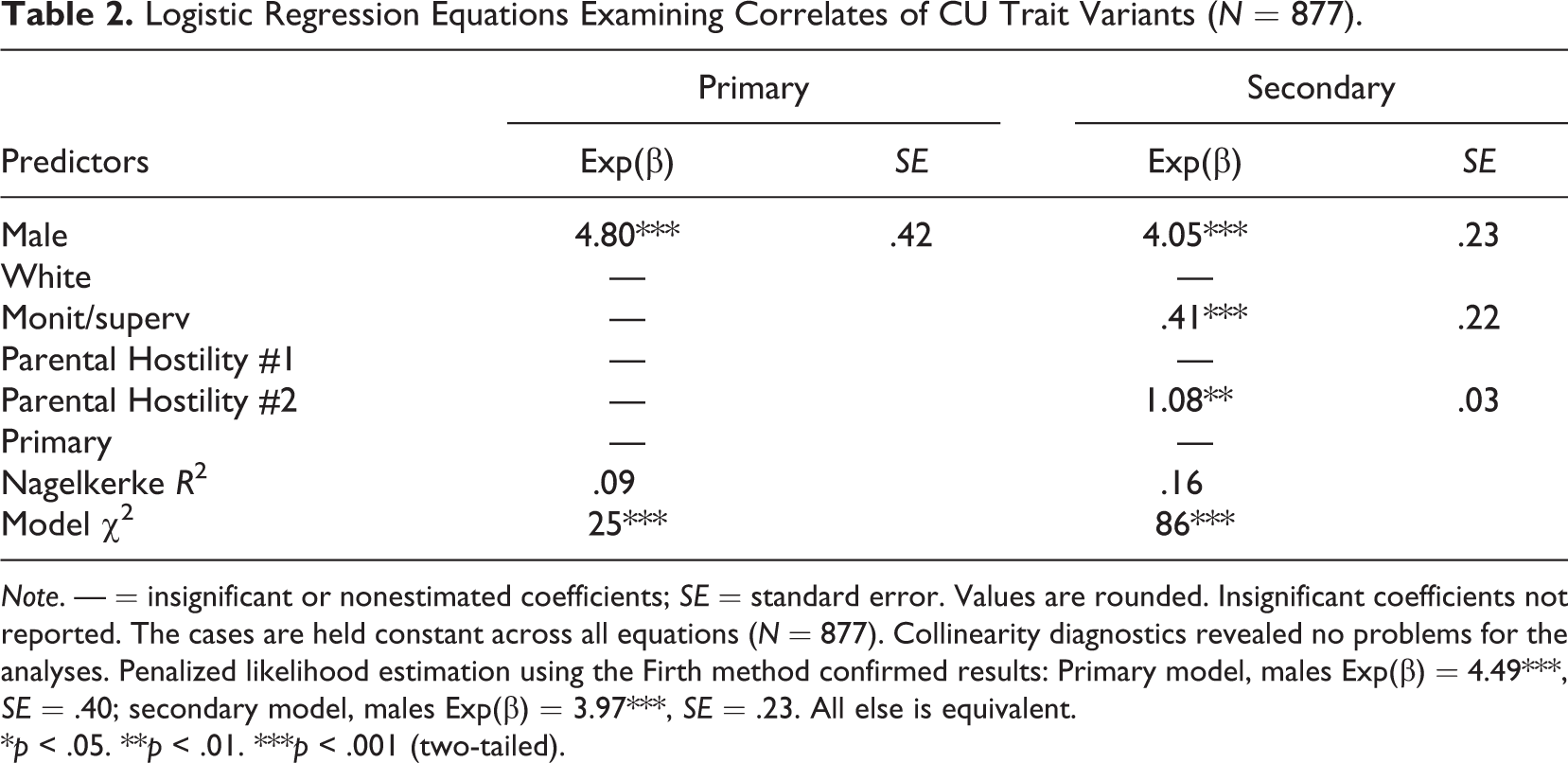
Note. — = insignificant or nonestimated coefficients; SE = standard error. Values are rounded. Insignificant coefficients not reported. The cases are held constant across all equations (N = 877). Collinearity diagnostics revealed no problems for the analyses. Penalized likelihood estimation using the Firth method confirmed results: Primary model, males Exp(β) = 4.49***, SE = .40; secondary model, males Exp(β) = 3.97***, SE = .23. All else is equivalent.
*p < .05. **p < .01. ***p < .001 (two-tailed).
Linear Regression Equations Examining Correlates of CU Trait Variants (N = 877).
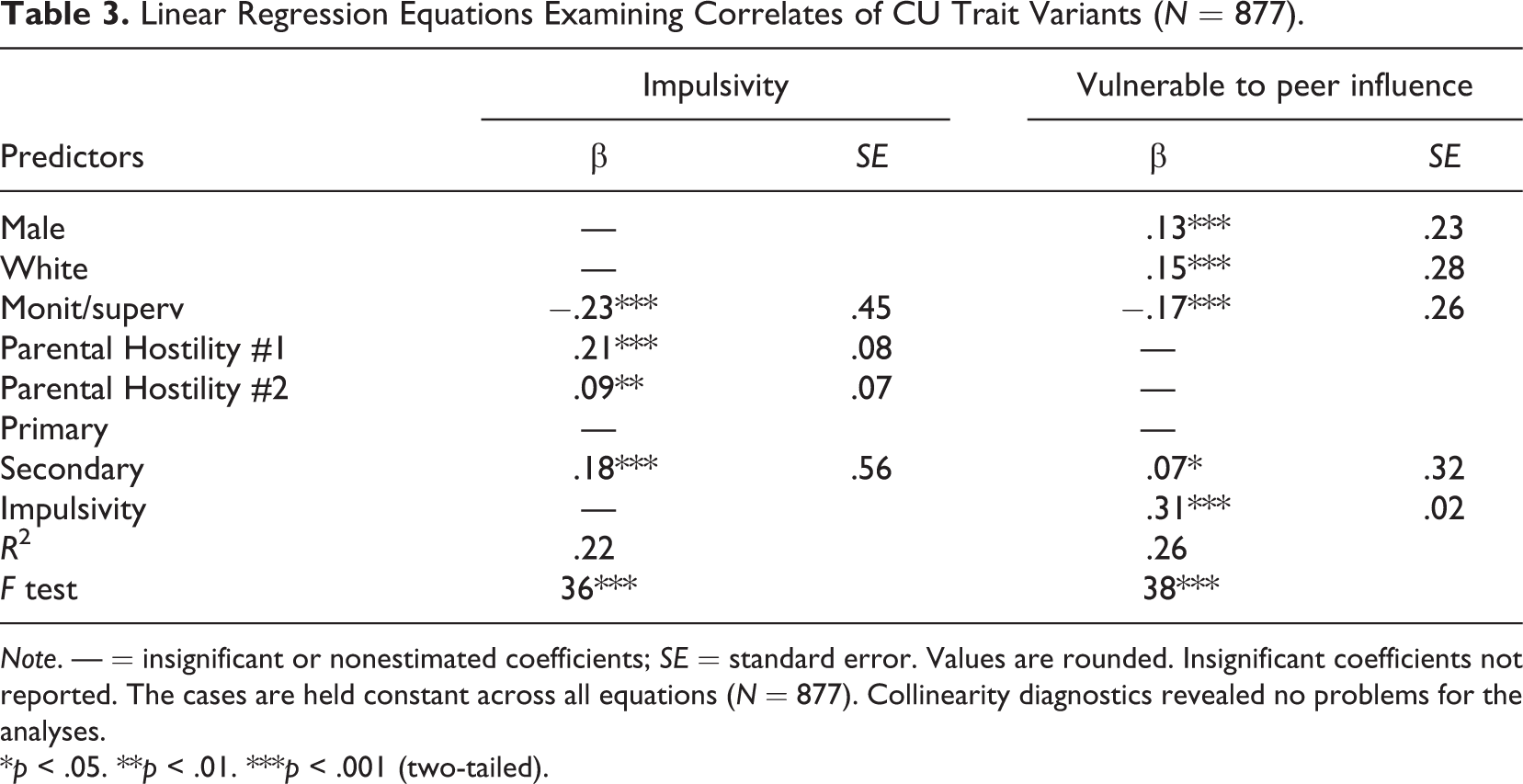
Note. — = insignificant or nonestimated coefficients; SE = standard error. Values are rounded. Insignificant coefficients not reported. The cases are held constant across all equations (N = 877). Collinearity diagnostics revealed no problems for the analyses.
*p < .05. **p < .01. ***p < .001 (two-tailed).
The third model, reported in Table 3, used linear regression to evaluate associations between the dependent variable, impulsivity, and the demographic variables, parenting, and those resembling the primary and secondary variants. The final model in this first stage of the analyses also used a linear equation to regress vulnerability to peer influence on demographics, parenting variables, psychopathy variants, and impulsivity. Cases are held constant across all equations (N = 877). Results are reported in Table 3.
Violent youth behavior is used as the endogenous variable for the second stage of the analyses. The variable is a count variable. After evaluating appropriate methods for this analysis, negative binomial regression was chosen as it best satisfies the distribution of having many zeros, positive skew, and satisfying other criteria as seen with the violent behavior measure. Results of the regression equations are reported in standardized form (incident rate ratios [IRRs]). As with the stage one analysis, the cases are held constant (N = 877) and the same cases are examined in the prior equations. Table 4 houses the results for the second stage of analyses.
Negative Binomial Regression Equations Examining Correlates of Adolescent Violence (N = 877).
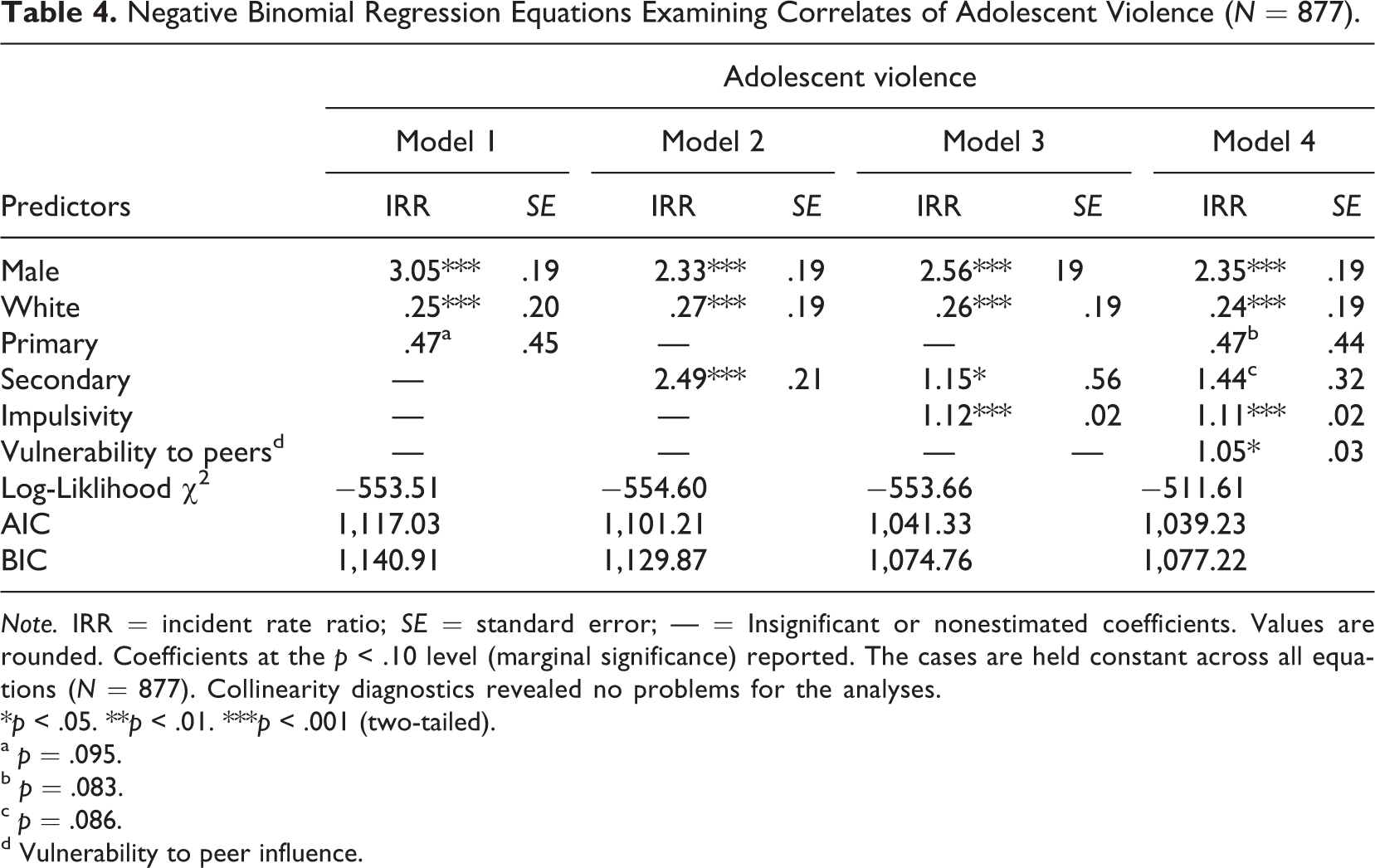
Note. IRR = incident rate ratio; SE = standard error; — = Insignificant or nonestimated coefficients. Values are rounded. Coefficients at the p < .10 level (marginal significance) reported. The cases are held constant across all equations (N = 877). Collinearity diagnostics revealed no problems for the analyses.
*p < .05. **p < .01. ***p < .001 (two-tailed).
a p = .095.
b p = .083.
c p = .086.
d Vulnerability to peer influence.
Results
Examining Correlates of CU Variants
The first equation, which examines those resembling the primary subtype of psychopathy (Primary) using logistic regression, looked at the relationship between parenting variables (monitoring/supervision and parental hostility from both, the mother, Parent #1, and the father, Parent #2) along with the control variables of sex and race. The findings were validated using a more penalized estimation procedure (Firth, 1993). Presentation of the logistic regression results focused on the percentage change in the odds of the dependent variable, which is based on the following formula: percentage change in the odds ratio = (eβ − 1) × 100. The exponential values of β are presented in Table 2, see exp(β). In concert with theory, the parenting variables were not associated with the primary variant type. The only significant variable in the model examining the primary variant was sex. Specifically, males showed a 380% increased log odds of resembling a primary type psychopath compared to females. This is consistent with Karpman (1941), as no parenting variables significantly covaried with those resembling the primary variant.
The second equation used logistic regression, which was also verified using a more penalized estimation approach (Firth, 1993), and examined those resembling the secondary psychopath (secondary) and the same independent variables as the model examining the primary subtype. The model coefficients were interpreted using the same formula as noted earlier. As with the model for the primary variant, the control variable, sex, was similarly associated with the secondary group (205% increased log odds compared to females). However, unlike the primary variant, parenting variables were associated with those resembling the secondary group. Having parents invested by showing high levels of monitoring and supervision was associated with an almost 60% reduction in the log odds of being in the secondary group. To the contrary, parental hostility from the father (or father figure, Parent #2) was associated with being included in the secondary subtype (see Table 2). This is consistent with the predictions discussed earlier.
For the third model examining the correlates of CU traits (Table 3), impulsivity was regressed in a linear model on the control variables, sex and race, the parenting variables as well as the two variants of psychopathy, primary and secondary. The standardized β coefficients are reported and interpreted in terms of standard deviation units. Neither control was significant in the model. Lower levels of monitoring and supervision were associated with impulsivity (β = −.23), net other controls in the model. Hostility from both parents independently predicted increased levels of impulsivity. However, hostility from the mother (β = .21) toward the child was a stronger predictor of impulsivity than that from the father (β = .09), controlling for other factors. In fact, maternal hostility (Parental Hostility #1) was the strongest predictor in the model explaining impulsivity such that a standard deviation increase in maternal hostility was associated with a 0.21 standard deviation increase in impulsivity. Those resembling the secondary variant were also associated with impulsivity (β = .18), but, importantly, the primary type was not. The model explained 22% of the variance in impulsivity.
In the final model in Table 3, a linear regression equation was used to regress vulnerability to peer influence on the controls, parenting variables, those resembling the psychopathy variants, and impulsivity. As with the model for impulsivity, findings are reported in the form of standardized β coefficients. Both controls, sex (Male β = .13) and race (White β = .15), were similarly associated with increases in vulnerability to peer influence. For the paternal variable, monitoring and supervision, a 1 standard deviation increase in parental monitoring and supervision were related to .17 standard deviation decrease in vulnerability to peers. Simply stated, more paternal investment through monitoring and supervision resulted in a decrease in youth’s vulnerability to peer influence. Associated, but weaker in magnitude, was the secondary variant type (β = .07). In fact, those resembling the secondary group had the weakest albeit positive relationship in the model explaining vulnerability compared to the other variables. Impulsivity had the strongest association with vulnerability to peers such that a 1 standard deviation increase in impulsivity had a related 0.31 standard deviation increase in vulnerability to peers. Overall, the model explained 26% of the variation in vulnerability to peer influence.
Given the above-mentioned findings, the focus turned to how these variables related to adolescent violent behavior among the noninstitutionalized sample. Attention to this point drove the next stage of the analysis. In the following models, the parenting variables were omitted under the premise that environmental qualities, such as parental abuse, operate on behavior via mediation. 6
Examining covariates of violence
Negative binomial regression was used to generate results for four models examining covariates of adolescent violence (see Table 4). For review, the first model examined whether there was any association between those resembling the primary variant and violent behavior. Model 2, Table 4, regressed violence on the controls, males, and White subjects as well as those resembling the primary and secondary variants of psychopathy. The third model introduces impulsivity to the equation, and Model 4 adds vulnerability to peers with the rest of the covariates. Results are reported in the form of IRRs for ease of interpretation and can be found in Table 4.
Findings related to Model 1, Table 4, show that males engaged in violence at a rate of about 3.1 more than that of females. In addition, the equation showed that Whites were less implicated with violent behavior at a rate that is .25 times the incident rate of non-Whites. With marginal significance (p = .095), those meeting the criteria for being included in the primary subgroup of psychopathy engaged in violence at a rate of .47 compared to those not resembling this variant, net other controls. This finding seems to suggest that having higher than average CU traits alone is insufficient to produce violence among the noninstitutionalized.
Model 2, Table 4, continues the theme with the control variables; however, the rates are slightly modified when entering the variable for those resembling the secondary psychopathy variant into the equation. Again, males showed a higher involvement in violence than females, with a rate of 2.33, and Whites showed less involvement in violent behavior, with a rate of .27. The variable for the primary variant fell out of the range for marginal significance. Those resembling the secondary variant, however, are engaging in violence at a rate of about 2.49 compared to those not meeting the criteria, net other controls.
In Model 3, Table 4, adolescent violent behavior was regressed on the controls, psychopathy variants, and impulsivity. The results for males is consistent with the prior models (IRRs = 2.56) as was the result for white subjects (IRRs = .24). The secondary subtype is associated with a significantly higher rate of violence than those failing to meet the inclusion criteria for the variant. Specifically, those resembling the secondary variant engaged in violence at about a 15% (IRRs = 1.15) increased rate compared to others, net controls. However, there was no such association seen with those resembling the primary subtype. In addition, impulsivity was significantly related to a 12% (IRR = 1.12) increase in the rate of violent behavior. It is of note that once impulsivity was added to the model, the significance of secondary psychopathy declined.
In the final equation, Model 4, Table 4, associations between the control variables (male, White), those resembling the two variants of psychopathy, impulsivity, vulnerability to peers (independent variables), and adolescent violence (dependent variable), were examined. Again, the controls remained significant in a similar fashion as in the previous models (see Table 4). 7 However, the psychopathy variants were at marginal significance and are only interpreted with that in mind. 8 Specifically, the primary variant was at .47 the rate (p = .083) of those not resembling the subtype among the nonincarcerated sample. The secondary subtype is associated with a 44% higher rate (p = .086) of violence than those failing to meet the inclusion criteria for the variant. Impulsivity was significantly linked to an 11% increased rate of violence, net other variables in the model. Vulnerability to peers was also associated with adolescent violence, however modestly, with a 5% increased rate. Strikingly, the relationship seen between the secondary variant and violence in Models 2 and 3 (Table 4) became weaker and dissipated to marginal significance or no significance using the conventional standard once impulsivity and vulnerability to peers were added to the equation. This result suggests mediation.
Discussion
Although not longitudinal in nature, the findings generated from the first stage of the analysis appear to have demonstrated that those resembling the low-anxious, primary and high-anxious, secondary variants differ with regard to the influence of parenting. Those resembling the low-anxious primary variant showed no demonstrable relationship with parenting—only with being male. In essence, this is what one would expect to see for Karpman’s (1941) idiopathic, primary variant. However, making declarations about etiology from this finding alone would be naive. At most, from this research it appears that parenting is not linked with noninstitutionalized youth in this sample having high CU traits, low anxiousness. Parenting may play a role for this group once they have been institutionalized, perhaps contributing to incarceration (Kimonis et al., 2013). Importantly, parental investment shown through monitoring and supervision had a negative relationship with those resembling the secondary variant. This suggests that there may be a buffering from prosocial parenting on the expression of secondary psychopathy. In addition, parental hostility, which can be considered abusive, from the father or those playing the paternal role mattered for youth resembling the secondary variant. Such a finding was in concert with Karpman’s early ideas that the secondary variant becomes so as an adaptation to environmental stressors, including abuse. Longitudinal research is needed to sort out such questions; however, these findings indicate that future research examining these potential pathways appears warranted, particularly among the noninstitutionalized.
In addition, it appears as though the characteristics that manifest with those resembling the secondary variant share common covariates. Recall, parental investment through monitoring and supervision was negatively associated with the presence of the secondary variant, which was also the case with impulsivity and vulnerability to peers. Such parental investment was not associated with the primary variant. Also in common with the secondary variant, parental abuse (verbal and physical) as measured by the parental hostility measures influenced the presence of impulsivity. However, abuse from both parents influenced the presence of impulsivity, whereas hostility from the father alone was associated with the secondary variant. Parental abuse was not associated with vulnerability to peers.
Interestingly, those resembling the low-anxious primary variant were not implicated in either impulsivity or vulnerability to peers among the noninstitutionalized youth in the sample. Given, it appears as though these constructs are independent of those with high CU traits and low anxiousness (resembling primary type). This is important as both of these constructs, impulsivity and vulnerability to peers, have been found to predict delinquency and adolescent violence as noted earlier. Yet, impulsivity and vulnerability to peers are positively associated with the secondary subtype. This is consistent with prior research (Fanti et al., 2013; Kimonis et al., 2012). Hence, these findings present potential pathways, whereas parental abuse may create adolescent traits that have been linked to malignant outcomes.
The results generated from the second stage of the analysis are telling. Taken as a whole, it appears that the relationship initially observed between those resembling the secondary variant and psychopathy in Model 2 was, essentially, operating through the other covariates of violence, impulsivity, and vulnerability to peer influence. The eminence of these other risk factors is consistent with prior research (e.g., DeLisi et al., 2013; Flexon & Meldrum, 2013). It is important to note that interactions were examined in models not presented here but were not significant. Thus, a story is emerging, which warrants further investigation. It appears that other troublesome components are necessary to elicit violent behavior from the secondary subtype, and from the earlier analyses, these components share common associations with variables that may be antecedents. Just as noteworthy is that those resembling the primary variant are not necessarily liked with violence. In fact, when interpreted at marginal significance, those included in the primary subtype are less likely to engage in violence than others among the nonconfined sample, perhaps owning to a tendency to be nonemotional.
In consideration of those mentioned earlier, this research comes with some deficits. First, since ideally, developmental processes are at the core of examining etiology, longitudinal research is needed to fully examine the relationships demonstrated by this research. This research presented cross-sectional relationships in adolescence. Although many of the relationships examined are ongoing in adolescence and cross-sectional research can offer a snapshot view, many of these features, for example, impulsivity, parenting practices, CU traits, likely manifest at earlier ages. As such, further research on this point is warranted. Second, some may argue that a structural equation should have been utilized. However, the method was avoided to allow consideration of potential risk factors and buffers to the psychopathy variants and other violence correlates as well as to determine the nature of the relationship between the variants and violence when other risk factors were progressively added to models. Third, there is room to argue that the measurement scheme used to create the variant variables in this research was crude. However, for secondary analyses of this type, the construction of measures often relies on the imagination of the researcher in concert with prior research. Here, the foundational constructs used to create the variant variables were based on sound, validated measures and behaved in ways that are in concert with previous research. Finally, motivation for violence is thought to differ by variant subtypes (e.g., Kimonis et al., 2011; Skeem et al., 2007). Since the violence measure used in this research was not disaggregated by motivation, the present research is also limited. Such inquiry is beyond the scope of the current study. 9
Conclusion
The appreciation that psychopathy as a construct represents a collective of traits that emerge in adolescents and are normally distributed in the population (DeLisi, 2009; Edens et al., 2011; Murrie et al., 2007) is important to criminologists for a number of reasons. Such an understanding diminishes the aura of some psychiatric disorder repeatedly linked with violence and having a reputation that is ill suited for treatment. In fact, the majority of those having higher than average CU traits in this study were of the secondary variety, whereas those resembling the primary variant showed a weak to no relationship with violence among the noninstitutionalized sample. Given the environment is implicated in the emergence of secondary psychopathy, there is optimism, particularly since the covariates most implicated with violence in this study seem also to be influenced by environmental forces (Poythress & Hall, 2011). In particular, impulsivity has been repeatedly linked with adolescent abhorrent behavior in research as one of the most studied criminological correlates, that is, low self-control, owning to the general theory of crime (de Ridder et al., 2012; Gottfredson & Hirschi, 1990; Pratt & Cullen, 2000), whereas impulsivity is an important dimension of low self-control. From this research, it is reasonable to speculate that for some, secondary psychopathy and impulsivity may emerge from some of the same parenting processes, that is, abuse, while parental investment through monitoring and supervision appear to buffer against the covariates of violence used in this study. Although longitudinal research is required to come to more definitive answers, this research has shed light on some important associations to target future research and guide policy.
In line with early observations and theory, those resembling the psychopath, that is, the secondary variant, appear to be created through disturbances in early developmental processes and as such, interventions addressing specifically parental abuses may offer mitigation to harmful outcomes with far-reaching implications to the individual and society (DeLisi & Piquero, 2011). 10 It is reasonable, then, to assume that parental behavior influences youth behavior, and modifications at the point of the parent–child relationship is worthy of targeted intervention. Since many youth come into contact with authorities at no fault of their own, but rather through the failings of their caregivers, many adolescents are brought into a system that could link them to intervention. On that point, risk assessment could occur earlier and include an evaluation for being high in CU traits as well as on characteristics that would differentiate youth by variant type to inform treatment and prevention. Taken alone, there may be nothing necessarily inherent with those resembling the primary subtype that would connect them to violent behavior. However, it is the other associated risks that may covary with high CU traits that may render youth exposed, which are potentially linked to parenting practices and environment.
Other research concerning treatment for those scoring high on CU traits seems further promising. In recent research evaluating a treatment program (Mental Models Intervention; Salekin et al., 2010), which is aimed at decreasing interpersonal callousness in youth, raising positive emotion, and increasing motivation among those having high CU traits, promising results were evinced (Salekin, Tippey, & Allen, 2012). In yet another study, limiting exposure to witnessed violence appears to lower violent behavior among those with CU traits (Howard, Kimonis, Munoz, & Frick, 2012). Hence, contrary to research indicating that psychopathy and other personality deficits are poorly modified through treatment (Salekin, 2002), scholars are making gains with youth at risk for renascent psychopathy (Salekin et al., 2010). The present research is promising for refining efforts toward more targeted intervention as well as informing further theoretical development and research.
Footnotes
Author’s Note
The Study of Early Child Care and Youth Development (SECCYD)was conducted by the National Institute of Child Health and Human Development (NICHD)’s Early Child Care Research Network, supported by NICHD through a cooperative agreement that calls for scientific collaboration between grantees and the NICHD staff. The content is solely the responsibility of the authors and does not necessarily represent the official views of the NICHD or the National Institutes of Health (U.S. Department of Health and Human Services. National Institutes of Health. Eunice Kennedy Shriver NICHD SECCYD: Phases I–IV, 1991–2008 [United States] [Computer files]. ICPSR21940-v1; ICPSR21941-v1; ICPSR21942-v1; ICPSR22361-v1. Ann Arbor, MI: Inter-university Consortium for Political and Social Research [distributor]).
Declaration of Conflicting Interests
The author declared no potential conflicts of interest with respect to the research, authorship, and/or publication of this article.
Funding
The author received no financial support for the research, authorship, and/or publication of this article.