



Abstract
Contrary to popular opinion, scholarly research has documented that immigrant communities are some of the safest places around. Studies repeatedly find that neighborhood immigrant concentration is either negatively associated with crime and delinquency or not related to crime and delinquency at all. Less well understood, however, is why this is the case. A critical limitation of existing research is the exclusion of measures that capture the intervening processes by which immigrant concentration influences crime and delinquency. The current study begins to address this gap in the literature. We use data from the National Longitudinal Study of Adolescent Health to examine the relationship between neighborhood immigrant concentration and adolescent violence and to assess the extent to which social capital and personal and vicarious victimization may account for this relationship. Contrary to our expectations, social capital and personal and vicarious victimization do not mediate the relationship between neighborhood immigrant concentration and adolescent violence.
Scholarly interest in the connection between immigration and crime goes back more than a century but has reemerged as a popular topic among criminologists. A quick review of the literature reveals two key questions of interest to scholars: First, at the individual level, are immigrants more likely than the native born to commit crime? And second, at the macro level, does immigration adversely affect the crime rate? Not surprisingly, these questions are also of interest to the public and to policy makers, especially in light of recent waves of immigration to the United States.
Concerning the first question, over a century of research reveals that criminal involvement among immigrants is lower than for the native born, despite the long-held stereotypical view that the “immigrant has a serious adjustment problem—that he therefore should be more criminal than the native” (Taft, 1933, p. 71). In the 1930s, the National Commission on Law Observance and Enforcement, commonly known as the Wickersham Commission, published a report on “Crime and the Foreign Born,” analyzing the extent of their criminal involvement, their relations with the criminal justice system, and public attitudes toward immigrants and crime. The Commission found that the popular view of immigrant criminality is grossly exaggerated—if not altogether erroneous—and concluded that, in proportion to their numbers, the foreign born commit considerably fewer crimes than the native born (National Commission on Law Observance and Enforcement, 1931).
This finding remains as true today as it was then; contemporary studies continue to document that crime, arrest, and incarceration levels are lower among immigrants than among the native born (Butcher & Piehl, 1998a, p. 654; Hagan & Palloni, 1999, p. 629; MacDonald & Saunders, 2012; Martinez & Lee, 2000; McCord, 1995; Olson, Laurikkala, Huff-Corzine, & Corzine, 2009; Tonry, 1997). A related observation from this research, however, is that the individual-level link between immigrants and crime appears to wane across generations, as scholars repeatedly discover that the children of immigrants (i.e., the second generation) have much higher crime rates than their parents (Morenoff & Astor, 2006, p. 36; Rumbaut, Gonzales, Komaie, Morgan, & Tafoya-Estrada, 2006, p. 72; Taft, 1933; Tonry, 1997, p. 20). 1 One explanation for this finding is downward or segmented assimilation (Morenoff & Astor, 2006; Rumbaut et al., 2006, p. 73). Assimilation often entails incorporation into “minority” status in the United States, particularly among poor immigrants from non-European countries. As a result, the children and grandchildren of many immigrants, as well as many immigrants themselves, become subject to economic and social forces that increase the likelihood of criminal behavior the longer they live in the United States (Rumbaut & Ewing, 2007, p. 11). Rumbaut, Gonzales, Komaie, Morgan, and Tafoya-Estrada (2006, p. 65) suggest that “Born or raised in the United States, they inherit their immigrant parents’ customs and circumstances but come of age with a distinctively American outlook and frame of reference and face the often-daunting task of fitting into the American mainstream while meeting their parents’ expectations, learning the new language, doing well in school, and finding decent jobs” (see also Zhou & Bankston, 2006). Thus, a firmly established finding in the literature is that although immigrants are less crime prone than their native-born counterparts, first-generation immigrants are typically more law abiding than their children and grandchildren.
What is less well established, however, is an answer to the second question on how immigration impacts crime rates across different spatial units, including neighborhoods, cities, and metropolitan areas. As argued elsewhere, immigration is a macro-level phenomenon and is therefore likely to affect “demographic, economic, and social structures in ways that will impact overall crime rates, net of any differences in the individual-level offending of immigrants and natives” (Ousey & Kubrin, 2009, p. 448; see also Mears, 2002; Reid, Weiss, Adelman, & Jaret, 2005; Taft, 1933). Despite this reality, the vast majority of research on the immigration–crime nexus has been conducted at the individual level, leading some scholars to argue that “Research on the relationship between immigration and crime must take into account the ecological impacts of immigrants that may influence rates of criminal offending. Thus, while individual-level studies of immigrant criminality tend to show that immigrants typically engage in less crime than their native-born counterparts, the effect of macro-level aspects of immigration on rates of criminal offending is unclear” (Reid et al., 2005, p. 758; see also Mears, 2002; Ousey & Kubrin, 2009).
Recently, however, this gap in the literature has been closing. In just a few short years, the number of studies that examine the immigration–crime relationship across various levels of aggregation has grown immensely. Although these studies include investigations of metropolitan areas and cities, most common are neighborhood-level studies that examine whether, and to what extent, immigration and crime are associated. This literature has produced one of the most robust and consistent findings in criminology: Neighborhoods with greater concentrations of immigrants have lower rates of crime, all else being equal (Akins, Rumbaut, & Stansfield, 2009; Chavez & Griffiths, 2009; Desmond & Kubrin, 2009; Feldmeyer & Steffensmeier, 2009; Graif & Sampson, 2009; Kubrin & Ishizawa, 2012; Lee & Martinez, 2002; Lee, Martinez, & Rosenfeld, 2001; MacDonald, Hipp, & Gill, 2013; Martinez, Lee, & Nielsen, 2004; Martinez, Stowell, & Cancino, 2008; Martinez, Stowell, & Lee, 2010; Nielsen, Lee, & Martinez, 2005; Nielsen & Martinez, 2009; Stowell & Martinez, 2007, 2009; Velez, 2009). Unfortunately, next to no research has accounted for this finding; thus, the critical question remains: Why are immigrant neighborhoods less likely to produce crime and delinquency?
In the current study, we begin to address this limitation. We build on the growing neighborhood-level immigration and crime literature by explicitly investigating the intervening mechanisms that may account for less crime and delinquency in immigrant neighborhoods. More specifically, we examine two frequently referenced mediators—community social capital and violent victimization—and determine their relevance for understanding the immigration–crime nexus. In our investigation, we build on our previously published study using data from the National Longitudinal Study of Adolescent Health (Desmond & Kubrin, 2009). The main finding of our earlier study is that immigrant concentration, or the “tendency of immigrants to concentrate geographically by ethnicity or country of origin within the host country” (Chiswick & Miller, 2005, p. 5), in a community reduces adolescent violence, controlling for a variety of individual-level and neighborhood predictors. In the current study, we consider whether, and to what extent, community social capital and violent victimization may account for this finding. In other words, do these two factors mediate the relationship between neighborhood immigrant concentration and adolescent violence?
Theorizing the Immigration–Crime Nexus
In 2009, noted immigration scholar Ramiro Martinez guest edited a special issue of the journal Homicide Studies, highlighting research on “empirical topics related to immigration and homicide” (Martinez, 2009, p. 207). It is noteworthy that every neighborhood-level study published in the special issue arrived at the same general conclusion—immigrant concentration has null or negative effects on homicide rates across neighborhoods. Here are the conclusions of these studies: Our key findings are as follows. First, net of controls, we find that immigration has negligible or trivial effects on overall levels of homicide offending across census place in California. (Feldmeyer & Steffensmeier, 2009, p. 221) In general…immigrant concentration is either unrelated or inversely related to homicide; (Graif & Sampson, 2009, p. 242) The results show that stable and consistent growth in foreign born is not associated with neighborhood trends in violence, whereas growth in recent arrivals occurs almost exclusively within the safest neighborhoods of the city; (Chavez & Griffiths, 2009, p. 261) Relatively consistent findings were evident for the relationship between violent deaths and immigration. More immigration means less Black and Latino homicide, suggesting that newcomers are not disrupting communities or undermining social integration; (Nielsen & Martinez, 2009, p. 284) Our findings indicate that recent immigration is not a meaningful predictor of homicide in Austin, which is entirely consistent with previous research on immigration and crime; (Akins et al., 2009, p. 311) These findings offer general support for the notion that the communities into which many Latino immigrants settle are buffered against violence, despite their relatively high levels of structural disadvantage; (Stowell & Martinez, 2009, p. 322) The article finds that recently arrived immigrants are associated with reductions of lethal violence in disadvantaged neighborhoods. It suggests that the influx of recent immigrants in disadvantaged neighborhoods reinvigorates local economic opportunity structures and social networks, and revitalizes neighborhood organizations and institutions. (Velez, 2009, p. 325)
The consistency with which these studies report similar findings is stunning. And the research presented in this special issue reflects only a small portion of the ballooning literature on immigration and crime and delinquency. In fact, one recent review of the empirical literature on immigration and crime throughout the 20th century concluded, “Recent research has become substantially more sophisticated in terms of analytical methods, including multivariate modeling and statistically grounded mapping techniques. But the conclusion remains largely the same. Contrary to the predictions of classic criminological theories and popular stereotypes, immigration generally does not increase crime and often suppresses it” (Lee & Martinez, 2009, p. 3). The finding that immigrant communities have less crime and violence, according to the collective literature, holds true for various measures of immigrant concentration (e.g., percentage of foreign born, percentage of recent foreign born, and percentage of linguistic isolation) as well as for different outcomes (e.g., violent crime, property crime, and delinquency). The finding also holds true in cross-sectional as well as longitudinal analyses of the immigration–crime nexus.
The largely unanswered question is what accounts for this finding? Why are immigrant neighborhoods less likely to produce crime and delinquency? Unfortunately, although criminologists have been successful at identifying, documenting, and measuring the “immigrant paradox” with respect to crime (Lee & Martinez, 2006, p. 90; Peterson & Krivo, 2005, p. 346; Taft, 1933, p. 76), they have yet to explain it. 2 Yet a lack of empirical verification has not deterred criminologists from theorizing the mechanisms by which immigrant neighborhoods produce less crime. Numerous arguments have been advanced, most of which draw heavily on explanations posited in the neighborhoods and crime literature more broadly (see Kubrin & Ishizawa, 2012, pp. 150–154 for a review of these explanations). These explanations range from immigrant selection effects to formal social control to immigration revitalization to employment and ethnic entrepreneurship. Among these arguments, two of the most commonly cited include community social capital and violent victimization.
Community Social Capital
Immigrants and immigrant communities constitute a central part of social disorganization theory dating back to the work of Shaw and McKay and other Chicago school theorists. Along with industrialization and urbanization, early scholars viewed the rapid influx of immigrants into cities as causing disorganization, arguing that such demographic changes greatly impacted social ties among neighbors, with implications for informal social control and crime. Beyond the fact that immigration to an area is associated with residential turnover—itself a disorganizing force—theorists have suggested that in communities with diverse racial groups living in close proximity, interaction between members is likely to be lower than in racially homogeneous neighborhoods (Gans, 1968). Moreover, heterogeneity can undermine ties between neighbors, limiting their ability to agree on a common set of values or to “solve commonly experienced problems” (Bursik, 1988, p. 521; Kornhauser, 1978). This occurs due to cultural differences between racial groups, language incompatibility, and because residents prefer members of their own race (Blau & Schwartz, 1984, p. 14; Gans, 1968). As a result, it was argued, individuals will be less likely to look out for one another and will take less of an interest in their neighbors’ activities. Informal social control will be reduced and crime and delinquency are expected to be higher.
Recently, scholars have challenged these claims, arguing instead that immigration can revitalize communities and strengthen informal social control (Kubrin & Ishizawa, 2012, p. 152). In the words of Lee and Martinez (2002, p. 376), “Contemporary immigration may encourage new forms of social organization that mediate potentially crime-producing effects of the deleterious social and economic conditions found in urban neighborhoods. These new forms of social organization may include ethnically situated informal mechanisms of social control and enclave economies that provide stable jobs to co-ethnics.”
These arguments are consistent with the immigration revitalization thesis, which maintains that due to strong familial and neighborhood institutions, as well as enhanced job opportunities associated with enclave economies in immigrant neighborhoods, immigration revitalizes poor areas and strengthens social control, thereby decreasing crime (Lee & Martinez, 2002, p. 366). As such, far from being a disorganizing and criminogenic force, immigration constitutes an essential ingredient to the viability of urban areas, especially in those communities that have witnessed population decline and decay in previous decades (Lee et al., 2001, p. 564; Reid et al., 2005, p. 762).
According to this perspective, neighborhoods with greater concentrations of immigrants are likely to experience less crime and delinquency in large part because they have a greater density of positive social networks and more social support (Portes, 1995), both of which are critical in the development of community social capital. Social capital, defined as “the investment in social relations with expected returns” (Lin, 1999, p. 30), is the expected collective benefits derived from the preferential treatment and cooperation between individuals and groups (Coleman, 1988). The distinguishing feature of social capital lies in the structure of relations between and among persons. Social capital is created when the relations among persons change in ways that facilitate action; in other words, social networks have value and social contacts affect the productivity of individuals and groups. Community social capital is critical for preventing crime.
So what facilitates community social capital? An essential component, according to Coleman (1990), is the “closure” or connectedness of social networks among families and children in a community (pp. 318–320). Communities characterized by an extensive set of obligations, expectations, and social networks connecting the adults are better able to facilitate the control and supervision of children. As Sampson (1992, p. 78) suggests, this notion helps to understand parent–child relations that are not simply “under the roof”: “… when closure is present through the relationship of a child to two adults whose relationship transcends the household (e.g., friendship, work-related acquaintanceship, etc.) the adults have the potential to observe the child’s actions in different circumstances, talk to each other about the child, compare notes, and establish norms. This form of relation can also provide reinforcement for disciplining the child, as found when parents in communities with dense social networks and high stability assume responsibility for the supervision of youth that are not their own.” Thus, the closure of the network can provide children with norms and sanctions that could not be brought about by a single adult alone or even married-couple families in isolation.
Research suggests that immigrant communities generally have stronger informal social networks and are more oriented toward family and community, despite higher levels of poverty (Wilson, 1998). Moreover, greater levels of civic participation and involvement in local institutions conducive to pro-social interaction, such as churches, youth groups, charities, civic associations, and political groups, characterize many immigrant communities, with implications for community stabilization. Portes and Stepick (1993), for example, find that rather than disorganizing communities, immigrants stabilized and revitalized Miami’s economic and cultural institutions.
Civic participation and investment in local organizations are critical as they can enhance neighborhood social capital and informal social control. This is because civic and social organizations facilitate the sharing of common values and goals among residents, thereby increasing the collective ability to disseminate information, mobilize resources, and utilize social networks toward combating crime and delinquency (Peterson, Krivo, & Harris, 2000; Triplett, Gainey, & Sun, 2003). Civically engaged communities with high levels of social capital are expected to have lower levels of crime. As such, community social capital may be one mechanism by which immigrant neighborhoods produce less crime and delinquency.
Victimization
A second explanation focuses on the prevalence of violent victimization in immigrant communities and the implications for juvenile offending in those communities. It is well established in the literature that the experience of being victimized increases the propensity for subsequent offending (Fagan, Piper, & Cheng, 1987). This finding has surfaced again and again in studies that consider the extent of overlap between victimization and offending. In fact, a recent meta-analysis reveals that 31 (of the 37) studies sampled find support for significant victimization–offending overlap, with only 6 studies providing mixed or limited support (Jennings, Piquero, & Reingle, 2012).
Much of the victimization–offending overlap literature focuses explicitly on juveniles. Among this population, victimization appears to discriminate chronically violent offenders from general youth (Fagan, Piper, & Moore, 1986). In their study of urban youth drawn from four inner-city high-crime neighborhoods, Fagan, Piper, and Cheng (1987) report that youth who had been victimized were more likely to have engaged in delinquency. This relationship is not limited to urban youth. Chang, Chen, and Brownson (2003), for example, find that repeat victimization is significantly associated with delinquency in their study of a large, nationally based sample of high school seniors. And Maldonado-Molina, Jennings, Tobler, Piquero, and Canino (2010) reveal that exposure to violence, including victimization, predicted membership in trajectories of violent behavior in two samples of Puerto Rican adolescents living in the Bronx, NY, and in Puerto Rico. Notably, research finds the victim–offender overlap is remarkably consistent across “historical, contemporary, cross-cultural, and international assessments” (Jennings et al., 2012, p. 16).
The rationale for this overlap remains a subject of debate. The causal mechanisms linking victimization and subsequent offending derive from competing theories, as well as from separate disciplines. Contemporary explanations include routine activities approaches, subcultural theory, and theories of aggression. While a discussion of these theoretical approaches is beyond the scope of the current study, a key fact remains, that is, it is not possible to fully understand juvenile offending without understanding its linkages with patterns of juvenile victimization (Lauritsen, Sampson, & Laub, 1991; see also Peguero, 2013, p. 1761).
In the context of the current study, research on the impact of violent victimization and the victim–offender overlap is relevant in large part because of where immigrants traditionally settle upon arriving in the United States. Many areas of high immigrant concentration are segregated from mainstream society and plagued with poverty, joblessness, and other social ills (MacDonald & Saunders, 2012, p. 126; Martinez & Lee, 2000; Peguero, 2013; Velez, 2009). As Glaser, Parker, and Li (2003, p. 526) argue, these neighborhoods do not represent “communities of choice or refuge” but instead constitute “ghettos of last resort” for immigrants and other residents. Based on these structural conditions, one might expect immigrant communities to be plagued with crime and violence and for residents of such communities to experience heightened victimization.
Yet, paradoxically, even disadvantaged neighborhoods with high concentrations of immigrants have relatively low rates of crime and victimization, as we discussed in detail at the outset of the study. Recall research repeatedly finds that immigrant concentration is negatively associated with crime rates across neighborhoods. Correspondingly, at the individual level, there is little evidence that immigrants have higher victimization rates than similarly situated nonimmigrants, and studies also show that immigrant households have a reduced probability of violent victimization (MacDonald & Saunders, 2012). 3
As a result, we argue that youth—both immigrants and nonimmigrants alike—residing in immigrant communities are much less likely both to be a victim of violence and to witness serious violence against family members, friends, and neighbors—thus, lessening their own likelihood of subsequent offending. For this reason, we posit that lower levels of personal and vicarious victimization may be yet another mechanism by which immigrant neighborhoods produce less crime and delinquency.
Current Study
Although the theoretical arguments discussed earlier are convincing, it is noteworthy that to date no neighborhood-level study has empirically tested their relevance for understanding the immigration–crime nexus. One exception, however, is a study conducted by MacDonald and Saunders (2012), which focuses on the theoretical connection between immigrant households and the prevalence of crime. Consistent with the literature discussed earlier, their analyses show a persistent lower rate of violence exposure for immigrant youth compared to similarly situated nonimmigrant youth. But perhaps more importantly, they also find that these differences are not meaningfully understood by observed social control or social learning mechanisms—raising questions about what factors may account for the immigrant paradox.
In the current study, we contribute to the neighborhood-level immigration–crime literature by examining community social capital and violent victimization and determining their relevance for understanding the immigration–crime nexus. In so doing, we build upon our prior study (Desmond & Kubrin, 2009), which measured only the direct effect of immigrant concentration on adolescent violence. In that study, we theorized several mechanisms that might help explain why adolescents in immigrant communities are less violent, but we did not empirically test any of those mechanisms. We do so in the current study.
Data and Method
Sample
We used data from the National Longitudinal Study of Adolescent Health (Add Health). The primary sampling frame for Add Health was a list of schools with an 11th grade and an enrollment of more than 30 students. Schools were stratified (by region of the country, urbanicity, percentage White, size, and school type) and a sample of 80 high schools was selected with unequal probability. Fifty-two middle schools that supplied students to the high schools were also included in the sample, for a total of 132 schools.
Based on enrollment lists, which were stratified by sex and grade, approximately 200 students were randomly selected from each school to complete an in-home questionnaire. The Wave 1 in-home questionnaire was administered in 1995, followed by a second in-home questionnaire in 1996. For each adolescent who completed the first in-home questionnaire, Add Health researchers also attempted to interview one of the adolescent’s parents. Parent questionnaires can thus be linked to the in-home adolescent questionnaires. In addition to these surveys, the Add Health data contain numerous contextual variables, most taken from the 1990 Census of Population and Housing, which Add Health researchers linked to respondents’ identification numbers. The contextual data supply information on the neighborhood context in which adolescents reside. After accounting for missing data and attrition between Wave 1 and Wave 2, the sample size for our analysis is roughly 9,500. See Harris (2012) for a more complete description of the Add Health data.
Because of the survey’s complex sample design, it is necessary to correct for unequal probability of selection and the “clustering” of students within schools. The analyses were conducted using STATA (we used the “survey commands”), which can adjust the results to compensate for the school-based sampling design of Add Health (i.e., the survey commands adjust the standard errors to account for stratification, clustering, and sample weights). See Chantala and Tabor (1999) for a discussion of the Add Health sample “design effects” and how corrections are made for purposes of analysis.
Dependent Variable: Adolescent Violence
We combined 5 items from the Wave 2 survey to create a measure of adolescent violence: (1) “Use or threaten to use a weapon to get something from someone,” (2) “Take part in a fight where a group of your friends was against another group,” (3) “Gotten into a serious physical fight,” (4) “Pulled a knife or gun on someone,” and (5) “Shot or stabbed someone.” The original format for the first 3 items is 0 = never, 1 = 1 or 2 times, 2 = 3 or 4 times, and 3 = 5 or more times, whereas the format for the last 2 items is 0 = never, 1 = once, and 2 = more than once. Following previous research that has used the Add Health data to study delinquent behavior (Bellair, Roscigno, & McNulty, 2003; Haynie, 2001), we converted each item into a dichotomous variable (1 = adolescent had engaged in the behavior). The items were then combined to form an index (Kuder–Richardson 20 = .700). As such, our dependent variable reflects the number of different violent acts an adolescent had committed, rather than the “frequency” of violence.
Individual-Level Control Variables
Since previous research suggests that sex, age, race, and social class are significantly associated with violence (Maimon, Antonaccio, & French, 2012; Salas-wright, Vaughn, & Maynard, 2014; Vaughn, Salas-wright, DeLisi, & Maynard, 2014), we included these variables as controls in our analyses. We coded sex as a dichotomous variable (1 = male). Age was computed by subtracting the interview date from the adolescent’s date of birth. We coded race (African American, Asian, Native American, and other race) as a set of dummy variables with White adolescents as the contrast category. We also coded Hispanic ethnicity as a separate dummy variable (1 = Hispanic). Therefore, race and ethnicity are not mutually exclusive.
We included two measures of social class—welfare status and parents’ education. We constructed welfare status using a series of items from the parent survey. Welfare was coded 1 if the family received any form of welfare (i.e., Supplemental Security Income, Aid to Families with Dependent Children, food stamps, and/or a housing subsidy) and 0 if they did not receive public assistance. As part of the in-home questionnaire, adolescents were asked to report how far their mothers and fathers went to school. Because many adolescents live in single-parent homes, we use the parent with the highest level of education. When no father is present father’s education is listed as missing, so parent’s education is equal to mother’s education. In rare cases, when there is no mother present, parent’s education is equal to father’s education. Finally, when both parents are present, parent’s education reflects the parent with the highest education.
Previous research finds that acculturated youth are more likely to engage in delinquency (Bui & Thongniramol, 2005). Therefore, we included a series of variables that indicate the extent to which an adolescent and his or her family are acculturated. First, we included a dichotomous variable that indicates whether or not the adolescent was born outside the United States (1 = foreign born). Second, in order to distinguish between first- and second-generation youth, we included a dichotomous variable that reflects whether or not an adolescent’s parent was born outside the United States (1 = parent is foreign born). Third, we included a series of dummy variables that indicate the language that is primarily spoken in the home. Three categories, English, Spanish, and other languages were used, with English as the contrast category.
In order to further isolate the effect of neighborhood immigrant concentration on adolescent violence, we also included additional control variables for residential mobility, family structure and process, school attachment and grades, delinquent peer associations, urbanicity, and region, all of which have been shown to have significant effects on adolescent violence (Baier, 2014; Berg, Stewart, Brunson, & Simons, 2012; De Coster, Heimer, & Wittrock, 2006; Estrada-Martinez, Caldwell, Schulz, Diez-Roux, & Pedraza, 2011; Karriker-Jaffe, Foshee, Ennett, & Suchindran, 2013; Maimon et al., 2012; Vaughn et al., 2014). Residential mobility is a dichotomous variable coded 1 if the adolescent moved between Wave 1 and Wave 2 of the survey. We used four variables to control for family structure and process. The first, biological family, was coded 1 if the adolescent lived with both biological parents. Second, we combined 4 items (α = .731) to form a measure of parent’s attachment to the child (e.g., parent gets along well with child and parent trusts the child). Third, 5 items were used to compute a measure of attachment to mother and attachment to father (e.g., how close do adolescents feel to their mom/dad, how much do adolescents feel their mom/dad cares about them). We combined the items to form an index of attachment to mother and attachment to father (α for mother attachment = .941 and α for father attachment = .980). We then averaged the attachment indices to form a single measure of parental attachment. Finally, we used 7 items (α = .641) to create a measure of supervision, based on whether or not adolescents were allowed to make their own decisions about what they could wear, what they could eat, what time they had to be home, who they could hang around with, and so on.
We assessed grades using a computed grade point average. Adolescents reported the grades they received in four subjects during “the most recent grading period”: English or language arts, math, history or social studies, and science (α = .982). We also used 5 items (α = .761) to construct a measure of school attachment (e.g., feel happy to be at school, feel close to people at school). We measured delinquent peers using 3 items (α = .756): “Of your three best friends, how many …” “smoke at least one cigarette a day?” “drink alcohol at least once a month?” and “use marijuana at least once a month?” All variables use the same response format: 0 = no friends, 1 = one friend, 2 = two friends, and 3 = three friends.
Finally, because immigrants tend to settle in certain regions of the country, and particular cities and communities within those regions, we included control variables for urbanicity and region. Urbanicity indicates the proportion of the population that lives in an urban area. Region is represented by a series of dummy variables: Northeast, Midwest, and West (South is the contrast category).
Mediating Variables: Community Social Capital and Victimization
We included three variables that measure community social capital: network closure, parents’ participation in neighborhood organizations, and collective supervision. These items were taken from the parent survey that was administered during Wave 1 of the Add Health study. First, we measured network closure using a single item from the parent survey, “How many parents of your child’s friends have you talked to in the last 4 weeks?” (responses ranged from 0 = none to 6 = six or more). Second, we captured parents’ participation in neighborhood organizations by combining 4 items from the parent survey. Parents were asked (1 = yes) if they participated in (1) parent–teacher organizations, (2) hobby or sport groups, (3) civic or social organizations, and (4) if they volunteered at their child’s school (α = .423). Since all of the items are dichotomous, parents’ participation in neighborhood organizations ranged from 0 (don’t participate in any organizations) to 4 (participate in all four types of organizations). Third, we measured collective supervision by combining 2 items (α = .593): “If you saw a neighbor’s child getting into trouble, would you tell your neighbor about it?” and “If a neighbor saw your child getting into trouble, would your neighbor tell you about it?” Both questions have the same response format, which ranged from 1 = definitely would not to 5 = definitely would. We included two variables that reflect adolescents’ experience with violent victimization: witnessing serious violence and being a victim of violence. First, adolescents were asked whether they had ever seen someone “shoot or stab another person” (1 = yes). Second, adolescents were victims of violence (coded 1) if they reported being either shot by someone or cut or stabbed by someone.
Neighborhood-Level Variables
Given that patterns of immigration can influence other neighborhood dynamics, such as stability and racial/ethnic diversity, in order to isolate the effect of neighborhood immigrant concentration on adolescent violence, we control for the effects of neighborhood economic disadvantage, residential stability, and racial heterogeneity. Our index of disadvantage combined 5 items, measured at the block group level, that reflect the economic well-being of the neighborhood: (1) proportion of female-headed households, (2) the proportion of households receiving public assistance, (3) the proportion of persons living below the poverty level, (4) the proportion of persons aged 18 and over, with no high school diploma, and (5) the proportion of unemployed residents (α = .879). We measured residential stability as the proportion of housing units within a block group that was moved into in the last 5 years. A large proportion would indicate many recent tenants or a lot of turnover in the population of a neighborhood. Finally, we measured racial heterogeneity with a single item that captures the level of racial dispersion in a block group. The measure ranges from 0 (completely homogenous) to 1 (completely heterogeneous).
For our main variable of interest, we combined 2 items to measure neighborhood immigrant concentration. The first is the proportion of the population in a block group that is foreign born. The second is the proportion of persons aged 5 and over in a block group who do not speak English well or do not speak English at all (α = .862). This measure is consistent with other neighborhood studies that examine immigrant concentration (Sampson, Morenoff, & Raudenbush, 2005, p. 228; see also Silver & Miller, 2004, p. 562). Descriptives for all of the variables included in the analyses can be found in the Appendix.
Analytic Strategy
As our dependent variable represents an ordinal scale, for the analysis we used ordered logistic regression (see Bellair et al., 2003, p. 14). We conducted the analysis in a series of steps (or models). First, we predict adolescent violence using all of the individual-level controls and the neighborhood-level measures. After establishing a baseline effect for immigrant concentration on adolescent violence, we then include our mediating variables (stepped in one at a time) to determine whether neighborhood social capital and victimization mediate the effect of immigrant concentration on adolescent violence. If the effect of immigrant concentration on adolescent violence is reduced when social capital and victimization are added to the models (compared to the baseline model), this would provide evidence for a mediation effect.
Results
Community Social Capital
The purpose of our study is to determine whether community social capital and/or victimization mediate the effect of immigrant concentration on adolescent violence. Certain conditions must be met in order to establish mediation or an indirect effect (Baron & Kenny, 1986). One important condition is the independent variable (immigrant concentration) must have a significant effect on the dependent variable (adolescent violence) when the mediating variables (community social capital and victimization) are not included in the model.
The results for the analysis of immigrant concentration, community social capital, and adolescent violence are shown in Table 1. In order to establish a baseline effect for immigrant concentration on adolescent violence, our first model (Model 1) included all of the individual-level control variables, additional neighborhood variables (disadvantage, residential mobility, and racial heterogeneity), and immigrant concentration but did not include community social capital or victimization. Consistent with previous research, immigrant concentration has a significant, negative effect on adolescent violence (coefficient = −.679). The effect of immigrant concentration on adolescent violence in the baseline model provides a point of comparison for subsequent models that include our potential mediators, community social capital and victimization.
Ordered Logistic Regression Results for Immigrant Concentration, Community Social Capital, and Adolescent Violence (Adjusted Standard Errors in Parentheses).

Note. Although many individual-level variables were included in the analysis (see the Data and Method section for a complete list of control variables), only significant individual-level effects are included in the table.
*p < .05. **p < .01.
Many of the individual-level variables in the baseline model (Model 1, Table 1) are significantly associated with adolescent violence. Given the substantial number of individual-level control variables included in our models, only variables with significant effects on adolescent violence are reported in the tables. Consistent with previous research, boys are more likely to engage in violence than girls, violence decreases with age, and racial minorities are more likely to report violent behavior than White youth. Family, school, and peers also matter for violence. Adolescents who live with both of their biological parents are less likely to report violence. Parents’ attachment to their child, and the child’s attachment to parents, also reduces violence. Adolescents who get good grades in school and youth who report feeling attached to school are less likely to report violent behavior, while adolescents who associate with delinquent peers are more likely to report having committed violent acts.
In addition to the individual-level variables, Model 1 (Table 1) included several neighborhood-level variables. The results suggest that neighborhood disadvantage, residential mobility, and racial heterogeneity do not have significant effects on violence. The lack of significant effects for these neighborhood characteristics is a bit surprising, especially for neighborhood disadvantage, which is consistently linked with violent behavior. Given the large number of individual-level variables that we include in our models, however, many of which mediate the effect of neighborhood disadvantage on violence (e.g., family process and associating with delinquent peers), the nonsignificant effect for neighborhood disadvantage, as well as residential mobility and racial heterogeneity, is not entirely unexpected.
We examined three measures of community social capital that could potentially mediate the effect of immigrant concentration on adolescent violence: network closure, parents’ participation in neighborhood organizations, and collective supervision. In Model 2 (Table 1), we added the first measure of community social capital, network closure. If the effect of immigrant concentration on adolescent violence is reduced when network closure is included in the model, this would indicate that network closure mediates the relationship between immigrant concentration and violence. Including network closure in the model, however, does very little to reduce the effect of immigrant concentration on adolescent violence (from −.679 to −.661, or 2.7%). Moreover, network closure does not have a significant effect on adolescent violence. Baron and Kenny (1986) suggest that another condition for mediation is the mediating variable (network closure) must have a significant effect on the dependent variable (adolescent violence). Accounting for this, we find that network closure does not mediate the effect of immigrant concentration on adolescent violence because (1) including network closure in the model does very little to influence the relationship between immigrant concentration and adolescent violence and (2) network closure itself does not have a significant effect on violence.
In Model 3 (Table 1), we added the second measure of community social capital, that is, parents’ participation in community organizations. Including parents’ participation in community organizations in the model reduces the effect of immigrant concentration on adolescent violence by 8% (from −.679 to −.625). Similar to the results for network closure, however, parents’ participation in community organizations does not have a significant effect on adolescent violence. Therefore, although including parents’ participation in community organizations in the model leads to a slight decrease in the effect of immigrant concentration on adolescent violence, suggesting a potential indirect effect, since parents’ participation in community organizations does not have an effect on adolescent violence, it is unlikely that parents’ participation in community organizations mediates the effect of immigrant concentration on adolescent violence.
Model 4 (Table 1) includes collective supervision, the final measure of community social capital. When collective supervision is included in the model, the effect of immigrant concentration on adolescent violence increases (from −.679 to −.700). Whereas a decrease in the effect of immigrant concentration on adolescent violence when collective supervision is included in the model would suggest mediation, an increase in the effect of immigrant concentration on adolescent violence suggests a suppression effect. Yet similar to the results for network closure and parents’ participation in community organizations, collective supervision does not have a significant effect on adolescent violence. Once again the results suggest that collective supervision does not mediate the effect of immigrant concentration on adolescent violence.
In the final model (Model 5, Table 1), we included all three measures of community social capital. Even with all three variables included, there is very little evidence to support the hypothesis that community social capital mediates the effect of immigrant concentration on adolescent violence. Simultaneously incorporating network closure, parents’ participation in community organizations, and collective supervision in the model only reduces the effect of immigrant concentration on adolescent violence slightly (about 8%), and none of these measures has a significant effect on adolescent violence. Although the effect of immigrant concentration on adolescent violence is no longer significant when the three measures of community social capital are included in the model, this is mainly because of an increase in the standard error for immigrant concentration, rather than a decrease in the coefficient. We therefore conclude that community social capital does not account for why immigrant neighborhoods have less adolescent violence.
Victimization
The results for the analysis of immigrant concentration, victimization, and adolescent violence are displayed in Table 2. We examined two different measures of victimization: witnessing violence and being a victim of violence. For ease of interpretation, we reproduced the baseline model without any mediating variables in Table 2 (Model 1). In Model 2 (Table 2), we included our first measure of victimization, witnessing violence. Consistent with previous research, witnessing violence is significantly related to engaging in violence (coefficient = .976). Contrary to our mediation hypothesis, however, including witnessing violence in the model increases the effect of immigrant concentration on adolescent violence (from −.679 to −.840, or 23.7%). An increase in the size of the effect of immigrant concentration on adolescent violence, when witnessing violence is included in the model, suggests a suppression effect, rather than a mediation effect. 4
Ordered Logistic Regression Results for Immigrant Concentration, Victimization, and Adolescent Violence (Adjusted Standard Errors in Parentheses).
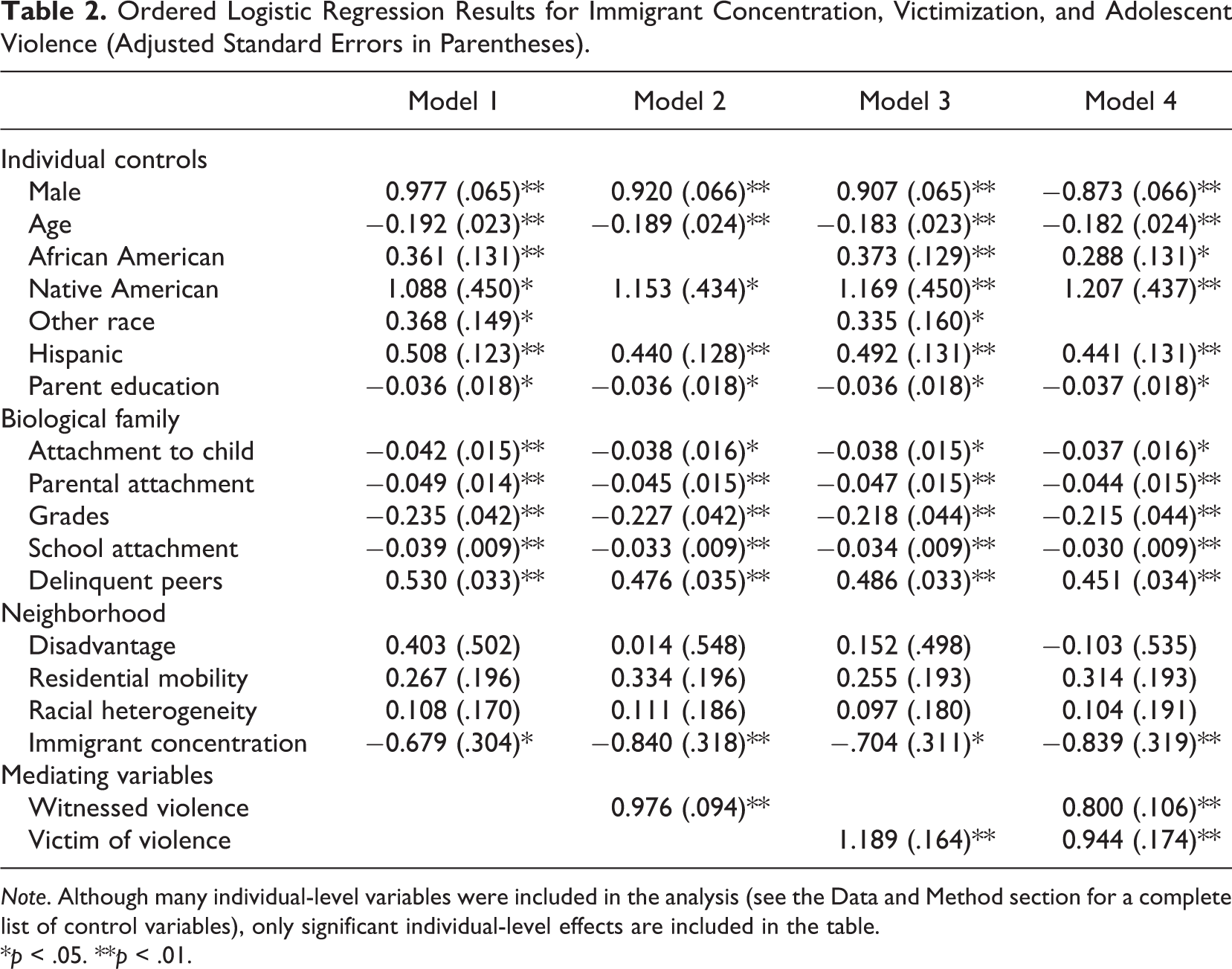
Note. Although many individual-level variables were included in the analysis (see the Data and Method section for a complete list of control variables), only significant individual-level effects are included in the table.
*p < .05. **p < .01.
In Model 3 (Table 2), we included the second measure of victimization, being a victim of violence. Similar to the results for witnessing violence, being a victim of violence has a significant, positive effect on adolescent violence (coefficient = 1.189). Once again, however, the effect of immigrant concentration on adolescent violence increases when violent victimization is included in the model (from −.679 to −.704), though not as much as it does when witnessing violence is added to the model (Model 2, Table 2).
In the final model (Model 4, Table 2), we included both measures of victimization. Consistent with earlier models, the effect of immigrant concentration on adolescent violence increases considerably when both measures of victimization are added to the model (from −.679 to −.839). Although these measures have significant, positive effects on adolescent violence, since the effect of immigrant concentration increases when victimization is added to the model, victimization does not appear to mediate the effect of immigrant concentration on adolescent violence.
Discussion
Previous research suggests that foreign-born youth are less likely to commit violent acts than their native-born counterparts. Also, as the concentration of immigrants in a neighborhood increases, the rate of violence tends to decrease. Despite these consistent findings, the mechanisms by which immigrant concentration reduces crime rates and, for the few multilevel studies that have been conducted (e.g., Desmond & Kubrin, 2009), why adolescents who live in neighborhoods with large numbers of immigrants are less likely to commit violent acts, are not well understood.
In an effort to help understand why immigrant concentration reduces adolescent violence, we used data from Add Health to test two potential intervening mechanisms that might mediate the effect of immigrant concentration on adolescent violence: community social capital and victimization. We theorized that immigrant neighborhoods might foster several forms of community social capital: network closure, parents’ participation in community organizations, and collective supervision, which should reduce adolescent violence. Similarly, given that macro-level studies have shown that immigrant neighborhoods have lower rates of violence, we theorized that adolescents who live in immigrant neighborhoods would be less likely to witness violence and be victims of violence. Less victimization would, in turn, contribute to less adolescent violence.
Contrary to our expectations, we found very little evidence to support our hypotheses that community social capital and victimization mediate the association between neighborhood immigrant concentration and adolescent violence. With regard to community social capital, the results are fairly straightforward. In order for social capital to mediate the relationship between immigrant concentration and adolescent violence: (1) the relationship between immigrant concentration and adolescent violence should be reduced when network closure, parents’ participation in community organizations, and collective supervision are included in our models and (2) these aspects of community social capital should themselves be significantly related to adolescent violence (Baron & Kenny, 1986). Our results do not meet either of these conditions. Instead, we find that including community social capital in our models does very little to reduce the effect of immigrant concentration on adolescent violence. Moreover, none of the items we used to measure community social capital are significantly related to adolescent violence.
Interestingly, and contrary to our expectations, supplemental analysis suggests that immigrant concentration is negatively correlated with all three measures of community social capital. Therefore, as the concentration of immigrants in a neighborhood increases, parents report they know fewer of the parents of their child’s friends, participate in fewer neighborhood organizations, and report fewer efforts to collectively supervise children. The negative association between immigrant concentration and community social capital holds even when the data are restricted to foreign-born parents (i.e., as immigrant concentration increases, even foreign-born parents report less community social capital). These additional findings provide further evidence that community social capital does not explain the violence-reducing effects of neighborhood immigrant concentration.
The results for our analysis of victimization are more ambiguous. Instead of reducing the effect of immigrant concentration on adolescent violence, we consistently find that victimization, especially witnessing violence, leads to an increase in the effect of immigrant concentration on adolescent violence. This pattern of results suggests a suppression effect (Conger, 1974; Jose, 2013) rather than a mediation effect. There are several types of suppressor variables (see Gaylord-Harden, Cunningham, Holmbeck, & Grant, 2010; Krus & Wilkinson, 1986). Although suppression effects are always difficult to decipher, our results may suggest what Krus and Wilkinson (1986) call “negative classical suppression.” The bivariate correlation between immigrant concentration in a neighborhood and adolescent violence is not significant. In contrast, the bivariate correlations between immigrant concentration and victimization (both witnessing violence and being a victim of violence) are both significant and positive, especially among foreign-born youth. Victimization is also positively associated with adolescent violence. It is only when immigrant concentration is included in a multivariate regression model with victimization (analysis not shown) that immigrant concentration has a significant negative effect on adolescent violence. 5
Although not completely comparable to our study, the results of MacDonald and Saunders (2012), who also attempt to explain the immigrant paradox, are largely consistent with our study. MacDonald and Saunders find that adolescents from immigrant households (i.e., parent was not born in the United States) are less likely to be victims of violence. Similar to our findings, MacDonald and Saunders were unable to eliminate (or “explain away”) the effect of immigrant households on violent victimization. Even after controlling for neighborhood-related processes of collective efficacy and disorder, they still find that immigrant households have significantly lower youth violence exposure, suggesting other, as yet to be identified, mechanisms are operating. They note, “In this article, the informal social controls exerted by family and neighborhoods do not account for all of the observed differences in violent victimization outcomes between immigrant and nonimmigrant households. It is quite possible that a more extensive list of variables could capture the differences” (p. 143).
Limitations
The Add Health study has several strengths, including national data on youth in a variety of diverse contexts and numerous measures of interest to researchers working in this area, but it also has its share of limitations. Unfortunately, since the Add Health study used a school-based sampling design, high school dropouts are unlikely to be included in the sample. Particularly important for our study, Latinos are more likely to drop out of school, as are the most violent adolescents. Thus, although these data have many advantages, the school-based sampling design is a limitation of our study that we are unable to address.
Another limitation of the current study is our inability to examine other potential mediating processes that may account for less adolescent violence in immigrant communities. A review of the literature reveals a wide range of hypothesized—and as-yet-untested—theoretical processes potentially at work in immigrant communities. Understanding why immigrant communities are some of the safest places around is critical for discussing policy recommendations related to this body of literature.
Policy Implications
Zatz and Smith (2012) argue that “the moral panic about immigration has contributed to unprecedented levels of new legislation and intensified enforcement practices” (p. 141). The results of our study suggest that neither restrictive legislation nor an emphasis on deporting illegal immigrants is likely to reduce crime. Although we find no evidence to suggest that social capital and personal and vicarious victimization mediate the relationship between neighborhood immigrant concentration and adolescent violence, the results of our study nonetheless suggest, consistent with many previous studies, that neighborhood immigrant concentration is negatively related to adolescent violence. That is, immigrant neighborhoods are relatively safe places, even if not for the reasons that we hypothesized. Given that immigrants are less likely than the native born to engage in crime and delinquency, restrictive legislation designed to reduce the number of immigrants entering the United States is unlikely to reduce the amount of crime and delinquency. Furthermore, research suggests that, depending on the local context (e.g., border or non-border communities), the deportation of illegal immigrants may actually contribute to an increase in violent crime (Stowell, Messner, Barton, & Raffalovich, 2013). Aggressive deportation might contribute to greater suspicion of law enforcement in immigrant communities, or breakup otherwise stable family and community social networks, both of which might contribute to an increase, rather than the desired reduction, in violent crime.
Conclusion and Future Research
The findings from this study raise more questions than they answer, which suggests several future directions researchers should consider. First, and perhaps most important, researchers should not abandon the idea that community social capital is relevant for understanding less adolescent violence in immigrant communities. Although the findings of our study suggest that community social capital does not play a critical role, such findings, of course, do not constitute a definitive statement. Replication using other data sets and measures of community social capital is needed before we are to rule out this explanation.
Second, and related to this, researchers must continue to try and identify the mechanisms that account for lower rates of adolescent violence in immigrant communities. Due to data limitations, we were only able to examine two potential mediators—community social capital and victimization. But as just noted a review of the literature suggests there are many other potential explanations theorized to account for this relationship. These explanations range from immigrant selection effects to formal social control to employment and ethnic entrepreneurship. Future research should begin to empirically ascertain whether these explanations help us to understand why immigrant neighborhoods are less likely to produce crime and delinquency.
And finally, future research must begin to unpack and contextualize the findings regarding both the relationship between immigrant concentration and crime/delinquency and the mechanisms that account for this relationship, by more carefully accounting for the true diversity that exists among immigrants. Clearly, there are cultural differences between immigrants coming from, for example, the Caribbean, South America, Asia, Africa, and Eastern Europe, let alone differences in reasons for emigrating in the first place. The extent to which these differences translate into varied impacts on levels of crime and delinquency, as well as intervening demographic, economic, and family structures, remains unclear.
Footnotes
Appendix
Descriptive Statistics for Independent and Dependent Variables.

| M | SD | Minimum | Maximum | |
|---|---|---|---|---|
| Sex | 0.49 | 0.50 | 0 | 1.00 |
| Age | 16.16 | 1.72 | 11.42 | 21.42 |
| African American | 0.21 | 0.41 | 0 | 1.00 |
| Asian | 0.06 | 0.24 | 0 | 1.00 |
| Native American | 0.01 | 0.07 | 0 | 1.00 |
| Other race | 0.05 | 0.21 | 0 | 1.00 |
| Hispanic | 0.17 | 0.38 | 0 | 1.00 |
| Welfare | 0.19 | 0.39 | 0 | 1.00 |
| Parent education | 13.73 | 2.69 | 0 | 18.00 |
| Foreign born | 0.09 | 0.29 | 0 | 1.00 |
| Parent foreign born | 0.17 | 0.38 | 0 | 1.00 |
| Language Spanish | 0.08 | 0.27 | 0 | 1.00 |
| Language other | .03 | 0.18 | 0 | 1.00 |
| Moved | 0.06 | 0.24 | 0 | 1.00 |
| Biological family | 0.51 | 0.50 | 0 | 1.00 |
| Attachment to child | 12.76 | 2.55 | 0 | 16.00 |
| Parental attachment | 16.67 | 3.11 | 0 | 20.00 |
| Supervision | 1.84 | 1.58 | 0 | 7.00 |
| Grades | 2.58 | 0.99 | 0 | 4.00 |
| School attachment | 13.42 | 3.76 | 0 | 20.00 |
| Delinquent peers | 0.85 | 0.89 | 0 | 3.00 |
| Urban | 0.61 | 0.48 | 0 | 1.00 |
| Northeast | 0.24 | 0.43 | 0 | 1.00 |
| Midwest | 0.25 | 0.43 | 0 | 1.00 |
| West | 0.14 | 0.35 | 0 | 1.00 |
| Disadvantage | 0.15 | 0.10 | 0 | 0.70 |
| Residential mobility | 0.46 | 0.16 | 0 | 1.00 |
| Racial heterogeneity | 0.29 | 0.28 | 0 | 0.93 |
| Immigrant concentration | 0.07 | 0.12 | 0 | 0.86 |
| Network closure | 2.03 | 1.89 | 0 | 6.00 |
| Neighborhood organizations | 0.76 | 0.93 | 0 | 4.00 |
| Collective supervision | 8.23 | 1.58 | 2 | 10.00 |
| Witness violence | 0.13 | 0.34 | 0 | 1.00 |
| Victim of violence | 0.06 | 0.24 | 0 | 1.00 |
| Adolescent violence | 0.48 | 0.90 | 0 | 5.00 |
Acknowledgment
Special acknowledgment is due Ronald R. Rindfuss and Barbara Entwisle for assistance in the original design.
Authors’ Note
Persons interested in obtaining data files from Add Health should contact Add Health, Carolina Population Center, 123 W. Franklin Street, Chapel Hill, NC 27516-2524.
Declaration of Conflicting Interests
The author(s) declared no potential conflicts of interest with respect to the research, authorship, and/or publication of this article.
Funding
The author(s) disclosed receipt of the following financial support for the research, authorship, and/or publication of this article: We use data from the National Longitudinal Study of Adolescent Health (Add Health), a project designed by J. Richard Udry, Peter S. Bearman, and Kathleen Mullan Harris, and funded by a grant (P01-HD31921) from the National Institute of Child Health and Human Development, with cooperative funding from 17 other agencies.