



Abstract
There is a growing literature suggesting that childhood-onset behavioral problems have negative long-term effects on multiple life domains, including poor physical and mental health, substance use, interpersonal conflict, and domestic violence. The current study extends this line of research by assessing the association between childhood-onset behavioral problems and later violent victimization. Using a sample of serious juvenile offenders, the study shows that individuals with childhood-onset behavioral problems are at an elevated risk of encountering violent victimization during adolescence and early adulthood. Results suggest that childhood-onset does not directly lead to later victimization; instead, a mediating process that involves children’s continuing involvement in delinquency/criminal activities and association with deviant peers ultimately put these youth into high-risk situations.
Longitudinal studies have consistently found that behavioral problems during childhood are associated with continuing antisocial behavior and psychopathology during adolescence and adulthood. Compared with youth with adolescence onset, those with childhood behavioral problems are characterized by inadequate parenting (Moffitt & Caspi, 2001), association with antisocial peers (Giordano, Millhollin, Cernkovich, & Rudolph, 1999; Moffitt, 1993, 2006; van Lier, Vitaro, Wanner, Vuijik, & Crijnen, 2005), and continuing engagement in delinquent activities (Hodgins, Cree, Alderton, & Mak, 2007; Lahey & Waldman, 2008; Moffitt & Caspi, 2001;). As suggested by several excellent reviews (Farrington, 2000; Lipsey & Derzon, 1998), early onset of behavioral problems is the best predictor of persistent and serious crime during adolescence and adulthood, although not all children with behavioral problems become antisocial adults.
In addition, increasing evidence suggests that people with childhood onset of behavioral problems encounter pervasive social difficulties during later life stages, including mental (Fergusson, Horwood, & Ridder, 2005; Moffitt, Caspi, Harrington, & Milne, 2002), physical (Fergusson et al., 2005; Piquero, Daigle, Gibson, Piquero, & Tibbetts, 2007), and interpersonal problems (Fergusson et al., 2005; Odgers et al., 2007; Raudino, Woodward, Fergusson, & Horwood, 2012). However, to date, little attention has been given to long-term effect of childhood-onset behavioral problems on exposure to victimization. Although it is logical to hypothesize that those with childhood-onset behavioral problems have higher risk of victimization across their life span (e.g., influence of persistent individual traits or negative societal reactions from early disruptive behavior), this hypothesis is not empirically tested. It is not clear whether a longitudinal link exists or not; and if it does, what social processes lead to such an association. It is particularly important to explore this association among serious adolescent offenders, as they are frequently victims of crime (Chen, 2009b; Sampson & Lauritsen, 1990), which in turn, leads to a high level of crime, and physical and mental health problems (Wright, Fagan, & Pinchevsky; 2013; Zgoba, Jennings, Maschi, & Reingle, 2010) .
This study addresses this gap by estimating direct and indirect effects of childhood-onset behavioral problems on exposure to violent victimization during late adolescence and early adulthood. More specifically, using a sample of serious adolescent offenders, this study explores (a) whether a longitudinal association exists between childhood-onset behavioral problems and later violent victimization and (b) potential social mechanism that links childhood onset and violent victimization among this high-risk population.
Theoretical Background and Literature Review
A large body of research has theoretically addressed long-term effect of childhood onset of behavioral problems for developmental outcomes (Moffitt & Caspi, 2001; Patterson &Yoerger, 1997; Piquero & Moffitt, 2008). Moffitt (1993), for example, suggests that there are at least two types of offenders, life-course-persistent offenders, and adolescence-limited offenders, each with a unique set of factors leading to criminal and antisocial activities and a different pattern of antisocial behavior over the life course. Age of onset of behavioral problems is a deciding factor in differentiating these two groups, with life-course-persistent offenders starting their physical aggression and delinquency/criminal trajectory from childhood, whereas adolescence-limited offenders engaging in these types of behavior as a normative adaptational response only during adolescence. Moffitt (2006, p. 279) argues that childhood onset of behavioral problems, when interacted with environmental risk factors such as inadequate parenting, disrupted family bonds, and poverty, sets in motion a downhill snowball of cumulative disadvantage, which leads to later social difficulties including “illegal activities, problems with employment and victimization of intimate partners and children.” These social difficulties also include “high risk in mid-life for poor physical health, cardiovascular disease, and early disease morbidity and mortality” (Moffitt, 2006, p. 302). In other words, it is hypothesized that individuals with childhood-onset behavioral problems tend to encounter many future social difficulties in multiple life domains.
Whereas most empirical studies focus on continuing antisocial trajectories among people with childhood behavioral problems, a growing body of research has provided empirical support for the pervasive social difficulties hypothesis (Fergusson et al., 2005; Odgers et al., 2007; Raudino et al., 2012). Empirical studies have demonstrated the linkage between childhood onset of behavioral problems and physical and mental illness, accident, injury, and relationship problems during early and middle adulthood. Previous work by Piquero and his colleagues (2007) showed that life-course-persistent offenders, who manifested their behavioral problems early in life, experienced at least one adverse physical health outcomes and psychological distress during adulthood. Similarly, Odgers et al. (2007) found that children with early behavioral problems tended to experience worse health burden and victimization of others during early adulthood. In a more comprehensive study, Fergusson, Horwood, and Ridder (2005) found that childhood behavioral problems measured at 7–9 years old were significantly associated with risks of adverse outcomes across all domains during early adulthood. These risks include crime, substance abuse, mental health problems, and sexual/partner relationship difficulties. Overall, empirical studies have demonstrated a prospective link between childhood onset of behavioral problems and negative life outcomes such as interpersonal conflict, physical health, and violence during adolescence and early adulthood.
Childhood Onset of Behavioral Problems and Victimization
The current research extends this line of research and proposes that victimization is one of the many social difficulties that childhood-onset offenders experience during late adolescence and early adulthood. Based on key ideas from life-course criminology and victimization theories, it is hypothesized that variation in childhood behavioral problems leads directly and indirectly to violent victimization later in life (Figure 1). First, it is hypothesized that childhood onset leads directly to future encounter of violent victimization. This hypothesis is based on the fact that childhood-onset problems are widely considered as behavioral indicators measuring persistent traits such as “inherited or acquired neuropsychological variation” (Moffitt & Caspi, 2001, p. 356). Individuals with these stable cognitive or personality deficits are vulnerable to becoming targets of violent victimization, especially during adolescence when victimization rate peaks (Beaver, Boutwell, Barnes, & Cooper, 2009).
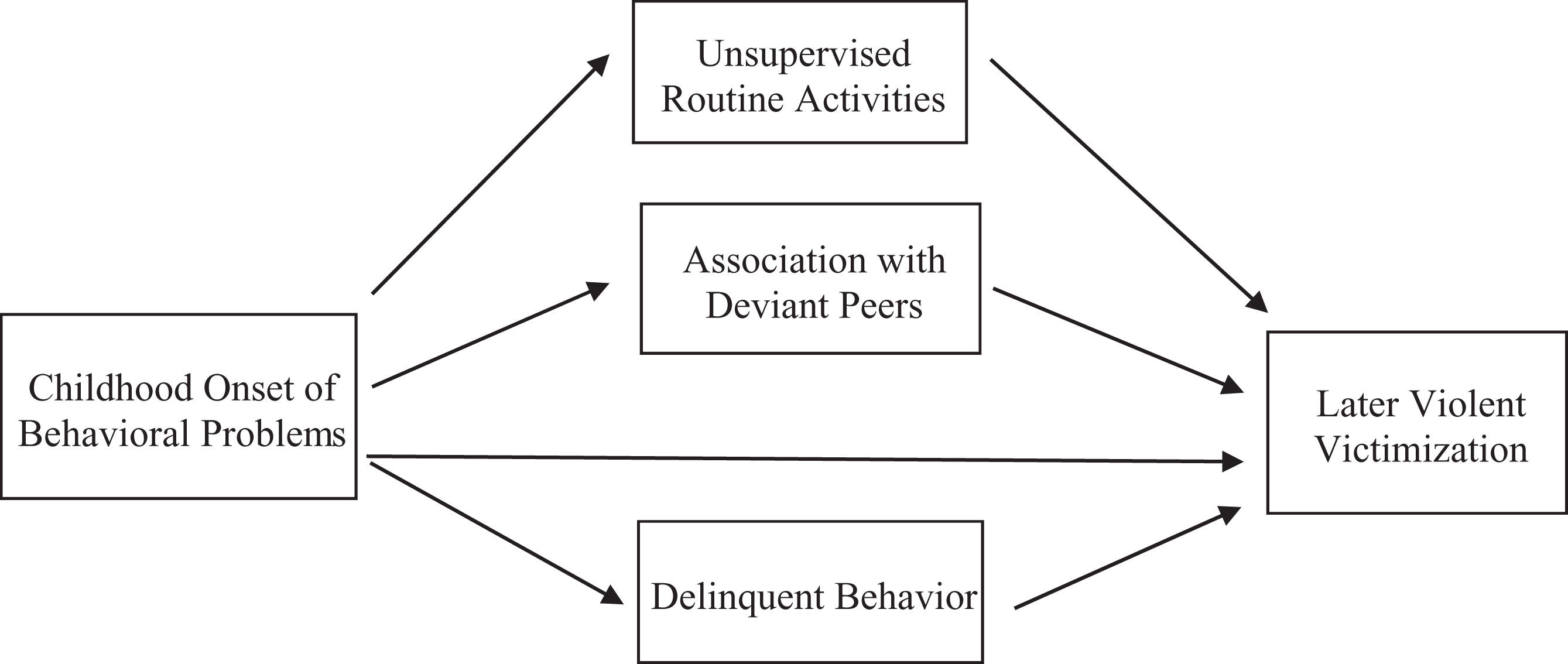
Theoretical model: Direct and indirect effects of childhood onset of behavioral problems on violent victimization.
The alternative hypothesis is that the effect of childhood behavioral problems on later victimization is indirect through exposure to adverse social context in which youth with early behavioral problems are embedded and are increasingly trapped across their life spans. The most dominant theories on victimization, the lifestyle-routine activity theories, argue that victimization is more likely to occur when motivated offenders, suitable targets, and a lack of capable guardians converge in time and space (Mustaine & Tewksbury, 1998; Osgood, Wilson, O'Malley, Bachman, & Johnston, 1996). As a number of writers have pointed out (Moffitt & Caspi, 2001; Patterson, 1995), youth with childhood behavioral problems are more likely to be exposed to these situations. First, youths with childhood behavioral problems are at higher risk to be exposed to potential offenders through affiliation with deviant peers (Moffitt, Caspi, Rutter, & Silva, 2001; Wiesner, Kim, & Capaldi, 2005). Problem behavior during childhood may promote what Patterson (1995) refers to as the “coercion cycle” between children and parents, which is then extended to other social contexts (e.g., schools and peers). The coercive interaction style leads to strained parent–child relationship, peer rejection, and ultimately, associating with deviant peers for companionship, comfort, and emotional support (Simons, Wu, Conger, & Lorenz, 1994; van Lier et al., 2005). Children with behavioral problems may also actively seek peers who are like themselves (Gottfredson & Hirschi, 1990). The delinquent peers constitute a large pool of potential offenders who can be hazardous to one’s safety.
Second, youth with childhood-onset behavioral problems come disproportionally from disadvantaged families and neighborhoods that lack necessary resources to supervise and protect them from victimization. Activities away from informal authority figures, including partying and truancy, increase victimization risk (Mustaine & Tewksbury, 1998; Osgood et al., 1996). Simply spending time outside of home, for example, increases an individual’s risk of being exposed to potential offenders. When these activities occur without watching from capable guardians, they may escalate into deviant events and ultimately lead to violence and victimization (Osgood et al., 1996).
Finally, youth with childhood behavioral problems are more likely to engage in delinquent behavior/crime later in life, which increases their chances of exposure to potential offenders and the likelihood of retaliation. It is well documented that early onset of behavioral problems predicts continuing antisocial behavior during adolescence and adulthood (Moffitt & Caspi, 2001; Lahey & Waldman, 2008). Delinquent behavior, in turn, leads to victimization. This finding appears to remain robust across different types of victimization, and when major demographic and individual-level correlates are controlled (Chen, 2009a; Sampson & Lauritsen, 1990). Delinquent youth may also become suitable targets of victimization given their reluctance to report these incidents to police, owing to their distrust of the criminal justice system or their concerns about exposure of their own delinquent activities.
Figure 1 summarizes these hypotheses and proposes that childhood onset of behavioral problems directly and indirectly leads to violent victimization during later life stages. Although the model appears to be theoretically sound, these hypotheses are not fully examined. Previous literature focuses almost exclusively on the overlap between delinquency and victimization measured during adolescence, and few have explored long-term effect of childhood disruptive behavior on later victimization. Indeed, only one study that directly addresses this linkage is located. In a study of homeless and runaway adolescents, Chen, Thrane, Whitbeck, Hoyt, and Johnson (2007) found that adolescents with childhood-onset behavioral problems were more likely to be physically and sexually victimized while on the street. The effects were indirect through homeless and runaway adolescents’ participation in deviant and nondeviant survival strategies. Whether this prospective link can be replicated in the general population or in other high-risk populations, however, needs to be further examined.
Data and Measurement
Sample and Procedure
The subjects of this study were 1,354 participants in the Pathway to Desistance Study, a longitudinal project on serious adolescent offenders aged 14 to 18 years old when first interviewed. Between November 2000 and January 2003, the project recruited these adolescents from two locations, Philadelphia, PA, and Phoenix, AZ, and followed them until the end of 2010. The purpose of this study was to map these offenders’ criminal trajectories and to assess the influence of social context and the criminal justice system on longitudinal pattern of these individual trajectories.
Youth were recruited based on variation of age, gender, and type of offenses at the time. Only those who were between 14 and 17 years old at the time of their offenses and who had been adjudicated delinquent or found guilty of serious offenses in juvenile or adult court systems were deemed eligible. Serious offenses are defined as all felony offenses—with the exception of less serious property crimes—and misdemeanor weapons and sexual assault charges. In addition, to increase sample heterogeneity, all female juveniles who met the age and adjudicated crime requirements and all youth considered for trial in the adult system were eligible for enrollment. Finally, due to the existence of a large amount of drug offenders in this age-group, the proportion of male juveniles with drug offenses at both sites was capped to 15%.
A total of 10,461 individuals who met the criteria in the enrollment period were processed in the Philadelphia and Phoenix court systems. This number decreased significantly when many charges were reduced below a felony-level offense at adjudication (n = 5,382) or the court data were not clear enough to determine eligibility status (n = 1,272). Among those who were deemed as eligible, slightly more than half of them were randomly approached for enrollment, with 67% (n = 1,354) agreed to participate in the study. These 1,354 participants were extensively interviewed in the first wave and then took part in follow-up interviews at 6-month intervals for 3 years. After this 3-year period, they then took part in yearly interviews until data collection concluded in 2010 (For additional study and participant details, see Schubert et al. [2004]).
The current study uses the first two waves of data, that is, the baseline (Wave 1) and the 6-month follow-up (Wave 2). To establish temporal order in the analysis, the key dependent variable, violent victimization, was assessed at Wave 2, and all other variables were derived from baseline data.
Measures
Endogenous variable
The key endogenous variable, violent victimization, was an index adapted from the Exposure to Violence Inventory (Selner-O’Hagan, Kindlon, Buka, Raudenbush, & Earls, 1998) measured at Wave 2. The index assessed whether these delinquent youth had been victims of six types of violence in the last 6 months. Respondents reported that they were beaten up, mugged, or seriously threatened by another person (7.5%); were chased and thought they might be seriously hurt (6.5%); were attacked with a weapon (5.6%); were shot (0.5%); were shot at but missed (6.5%); and were raped or sexually assaulted (0.6%). Response categories for each individual item are 1 for yes and 0 for no. The index was created by summing the responses of these 6 items.
Exogenous variable
The exogenous variable, childhood onset of behavior problems, was an index adapted from the Psychopathy Checklist–Youth Version (Forth, Kosson, & Hare, 2003). The index was a retrospective account that asked subjects at Wave 1 whether they engaged in some deviant/delinquent behavior before 11 years old. A high level of deviant/delinquent behavior was reported, including getting in trouble for cheating (13.9%), disturbing class (60.5%), being drunk or under the influence of alcohol or drugs (4.1%), stealing (17.1%), and fighting (56.6%). The index was then created by summing the responses of the 5 items.
Many previous studies used a dichotomous variable to measure childhood onset of behavioral problems (e.g., Simons et al., 1994). We chose an index measure because, unlike general population samples, there was much variation in childhood behavioral problems among high-risk populations. In our sample, less than one quarter had no behavioral problems during childhood (24.2%), a similar number reported one type of problem behavior (26%), 30.4% reported two of them, 13.1% reported three, and 6.2% reported four or five. A dichotomized measure would not be able to capture all the variation in this population.
Intervening variables
Three scales, peer delinquency, unsupervised activities, and delinquent/criminal behavior, were used as intervening variables linking early onset of behavior problems and violent victimization. All these scales were measured at Wave 1. Drawn from items used by the Rochester Youth Study (Thornberry, Lizotte, Krohn, Farnworth, & Jang, 1994), the peer delinquency scale asked respondents whether their friends had engaged in 12 deviant behaviors in the last 6 months (e.g., “During the last six months how many of your friends have sold drugs?”). The response categories were 5-point Likert-type scale ranging from none of them to all of them. The mean rating of the prevalence of friends who engaged in these 12 behaviors were computed to create a composite score (α = .92).
The unsupervised activities scale was drawn from the “Monitoring the Future Questionnaire” (Osgood et al., 1996) and was used to assess the frequency of activities that occurred in the absence of an authority figure (e.g., “how often did you get together with friends informally?”). The scale contained 3 items to which participants responded on a 5-point Likert-type scale ranging from never to almost every day and a 4th item asking the number of evenings in a typical week the participant spent on “fun” activities. A composite score was created by standardizing and averaging the 4 items (α = .62).
The final intervening variable, delinquent/criminal behavior, was measured by using items from the Self-Report of Offending inventory developed by Huizinga, Esbensen, and Weihar (1991). Respondents were asked whether they had engaged in any of 22 different types of antisocial and illegal activities, including car–motorcycle theft, prostitution, aggravated assault, arson, murder, and armed robbery in the last 6 months. A variety score, that was the count of different antisocial acts endorsed by subjects divided by the number of questions asked, was used to assess respondents’ involvement in antisocial and illegal activities. The closer the proportion score is to 1, the greater the variety of offenses the youth has committed. Previous research has shown that this scale has adequate reliability and validity in the general population (see Thornberry & Krohn, 2000) and in the population of serious offenders (Knight, Little, Losoya, & Mulvey, 2004).
Control variables
Finally, demographic factors such as age, gender (male = 1, female = 0), race (White, Black, Hispanic, and other), and family structure (dual parents = 1, others = 0) were controlled in the analysis, which were straightforward measures similar to those used in previous studies.
Analytic Strategy
We began by examining bivariate associations between childhood behavioral problems and key intervening variables and violent victimization. Path analysis was then used to examine whether the association between childhood onset of behavioral problems and victimization remained when intervening and control variables were included and whether this association was mediated by hypothesized intervening variables.
Missing data were not a serious issue in this analysis. Ninety-three percent of the original 1,354 cases interviewed in Wave 1 were reinterviewed 6 months later (N = 1,261) and 36 more cases would be lost if listwise method was used in multivariate data analysis. To account for missing data, we applied full information maximum likelihood (FIML) approach, which computes maximum likelihood estimates and standard errors for path models using observed data points (Enders, 2006; Little & Rubin, 1987). Previous studies have shown that compared with traditional techniques, FIML provides efficient estimation of statistical parameters and less biased estimates of standard errors (Schafer, 1997). Mplus 5.0 was used to perform the path analysis (Muthen & Muthen, 1998–2007).
Results
Bivariate Analysis
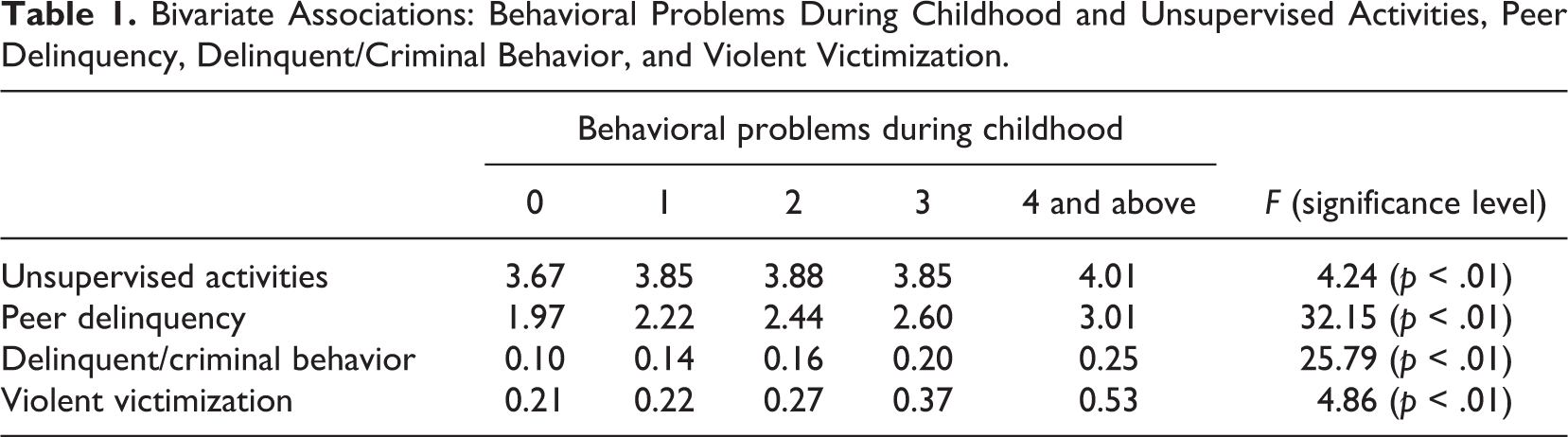
Bivariate analysis was first performed to examine the associations between childhood behavioral problems and key intervening variables and violent victimization (Table 1). Results from analysis of variance showed that all associations were statistically significant and were in the hypothesized directions. The associations between numbers of childhood behavioral problems and involvement in unsupervised activities, F(4, 1345) = 4.24, p < .01; delinquent peer association, F(4, 1311) = 32.15, p < .01; and self-reported delinquency/crime, F(4, 1346) = 25.79, p < .01, were positive and almost linear. Youth with less than three childhood behavioral problems were exposed to similar levels of violent victimization, but those with four or more than four reported much higher levels of such an experience, F(4, 1256) = 4.86, p < .01).
Bivariate Associations: Behavioral Problems During Childhood and Unsupervised Activities, Peer Delinquency, Delinquent/Criminal Behavior, and Violent Victimization.
Additional univariate and bivariate analysis (mean, standard deviation, and Pearson correlation coefficients) is presented in Table 2. Similar to Table 1, almost all of the expected relationships were found to be statistically significant and in the posited direction. Pearson correlations indicated small to medium correlations between childhood onset of behavior problems and intervening variables, including involvement in unsupervised activities (r = .10), adolescent’s association with delinquent peers (r = .30), and engagement in delinquent/criminal activities (r = .29). In addition, positive correlation was found between childhood onset and violent victimization during late adolescence (r = .12). Finally, as expected, violent victimization was positively correlated with proximate risk factors, including unsupervised activities (r = .06), association with delinquent peers (r = .19), and involvement in delinquent/criminal activities (r = .19).
Correlation Matrix for the Study Variables.
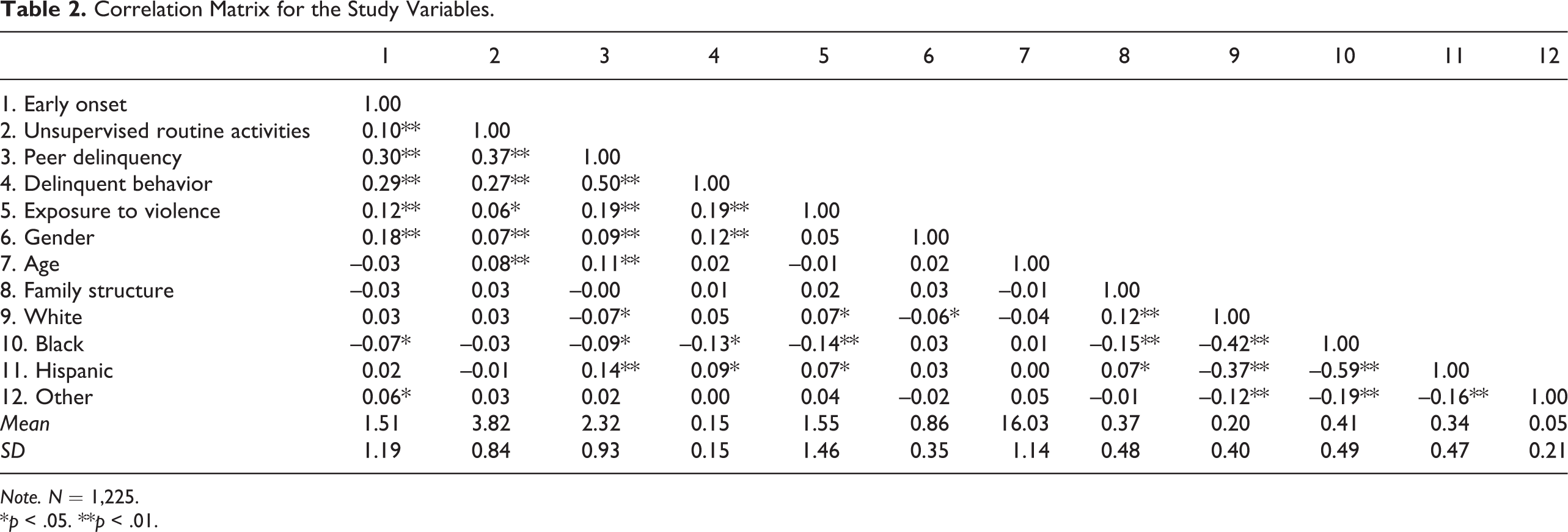
Note. N = 1,225.
*p < .05. **p < .01.
Path Analysis
Path analysis allows researchers to evaluate the hypothesized model by simultaneously assessing direct and indirect effects through proximate risk factors. Based on the theoretical model (Figure 1), fully recursive models are fitted to the data. Because fully recursive models are saturated and fit the observed data perfectly, no model fit indices such as χ2 or other goodness-of-fit indices are necessary and thus are not presented in the results (Kline, 2005).
Childhood onset of behavior problems and victimization: Baseline model
A baseline model (Figure 2) consisting only of childhood onset of behavior problems and violent victimization was first run to establish the relationship between the two variables. The baseline model controlled for age, gender, family structure, and race. Consistent with bivariate analysis, there was a positive association between childhood onset of behavior problems and exposure to violent victimization (β = .10, p < .01). Race was the only control variable that was statistically significant, with African Americans less likely to be victimized compared with the “other” group, although there were no significant differences among White, Hispanic, and the “other” group in the baseline model.

Model 1: Baseline model.
Childhood onset of behavior problems and victimization: Full model
In the full model (Figure 3), individual’s risky lifestyles such as unsupervised activities, association with deviant peers, and delinquent behavior were introduced as intervening variables. As in the baseline model, age, gender, family structure, and race were controlled.
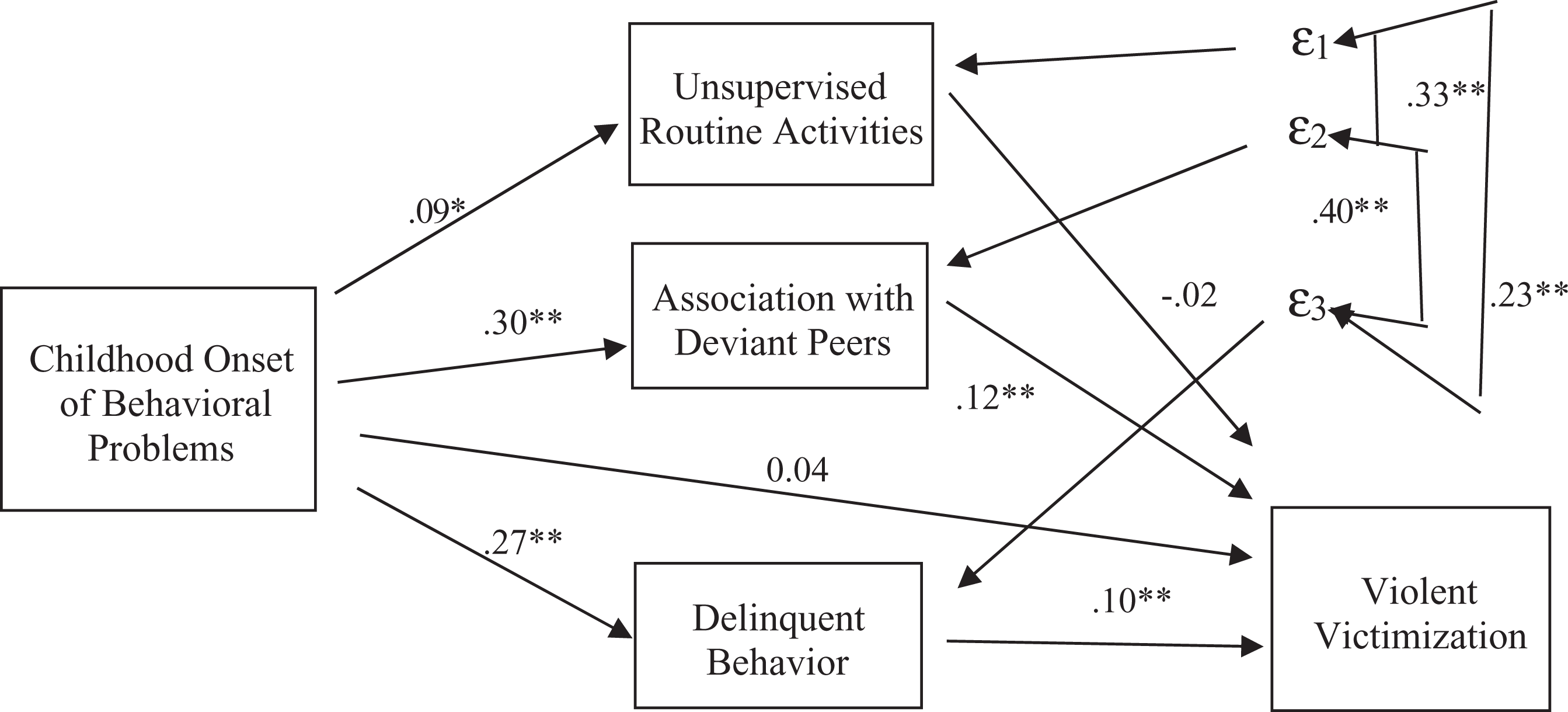
Model 2: Full model.
Compared with the baseline model, the results in the full model showed that the direct effect of childhood onset on violent victimization decreased to nonsignificance. It appears that the long-term effect went indirectly through adolescents’ engagement in risky lifestyles. First, early onset was significantly and positively associated with all 3 intervening variables. Youth with childhood-onset behavioral problems were more likely to be involved into unsupervised activities (β = .09, p <.01), associating with deviant peers (β = .30, p < .01), and engaging in delinquent/criminal activities during adolescence and early adulthood (β = .27, p < .01). Second, two of the three intervening variables were significantly correlated with violent victimization. Youths’ association with deviant peers and delinquent activities led to an elevated level of violent victimization, with standardized regression coefficients of .12 (p < .01) and .10 (p < .01), respectively. Adolescent’s unsupervised activities, however, were not associated with violent victimization. Finally, as expected, the residuals of the three proximate factors were strongly correlated with each other, with participation in unsupervised activities significantly correlated with deviant peers (r = .33, p < .01) and delinquent behavior (r = .23, p < .01), and association with deviant peers significantly correlated with delinquency (r = .40, p < .01). As expected, older adolescents had more opportunities to spend time with their friends and to associate with deviant peers compared with younger ones, and male adolescents were more likely than females to engage in delinquent/criminal activities. No other control variables were statistically significant in the full model.
Bootstrapping approach (Shrout & Bolger, 2002) was used to formally assess the significance of the indirect effect (results not shown). The indirect effect of childhood onset of behavioral problems on violent victimization was statistically significant (β = .06, p < .01), accounting for 60% of the total effect. The indirect effect went mostly through youths’ association with deviant peers (β = .04, p < .01) and their own delinquent/criminal behavior (β = .03, p < .01), but not through their involvement in unsupervised activities (β = –.00, p > .05).
Discussion and Conclusion
Age of onset of behavioral problems has become the focus of careful study in developmental criminology in the last several decades. As discussed previously, research has consistently shown that childhood-onset problem behavior leads to further offending, and the effect spills over to other life domains, including increased risk for physical and mental health problems, suicidal behavior, substance use, teen pregnancy, and domestic violence (Fergusson et al., 2005; Odgers et al., 2007; Raudino et al., 2012; Wiesner et al., 2005). Extending this line of research, the current study utilized a sample of serious juvenile offenders to explore two research questions: (a) Is there a longitudinal association between childhood onset of behavioral problems and later victimization and (b) what is the mechanism that explains such a relationship?
This study shows that there is a significant association between childhood onset of behavioral problems and later victimization. In particular, among serious juvenile offenders, those with childhood onset were at an elevated risk of exposure to violent victimization during adolescence and early adulthood. The results provide further empirical support for the line of research that highlights pervasive negative long-term consequences of childhood disruptive behavior. Combined with previous literature, it appears that childhood onset of behavioral problems leads to further physical and mental health problems, substance use, and exposure to violent victimization.
Results from this study also provide insight on the mechanism linking childhood-onset behavioral problems and later victimization. Childhood-onset behavioral problems do not directly lead to later victimization; instead, an indirect process that involves children’s continuing involvement in delinquent/criminal activities and increased association with deviant peers is supported. First, consistent with previous literature, the model shows strong continuity between childhood behavioral problems and engagement in antisocial behavior and other risky activities during adolescence and early adulthood (Moffitt, 2006). Adolescents with a history of childhood-onset behavioral problems are more likely to spend unstructured time to socialize with peers, associate more frequently with deviant peers, and continue to engage in delinquent/criminal activities during late adolescence and early adulthood. Second, participation in these activities, in turn, shapes the opportunity structure that influences adolescent’s exposure to violent victimization. Associating with deviant peers or engaging in delinquent/criminal activities in particular increases adolescent’s time spent in proximity to potential offenders and invites retaliation from other peer groups (Schreck, Wright, & Miller, 2002). Interestingly, although participation in unsupervised routine activities is documented as a risk factor leading to violent victimization (e.g., Chen, 2009a), the association is not significant in this study. The lack of significance may be due to large common variance shared by the three intermediate variables and/or that much of the effect of unstructured time to socialize with peers is absorbed by theoretically more proximal factors (i.e., deviant peer association and engagement in delinquent/criminal activities).
The lack of direct effect observed in this study may be due to limitations related to the empirical measure of the childhood-onset behavioral problems construct. Although conceptually defined as a measure of persistent propensities that captures children’s inherited or acquired neuropsychological variation, the empirical measure mainly taps into children’s poor self-control and maladaptive behavior, and less into children’s social competence and self-related cognition, which are the two strongest predictors of victimization during childhood (Cook, Williams, Guerra, Kim, & Sadek, 2010). Future research that employs a latent construct approach, that is, incorporating multiple dimensions of behavioral problems into the construct, is needed to explore whether long-term direct effect on victimization can be observed. Studies using measures such as self-control or genetic traits may be another direction to test whether persistent traits have long-term effect on victimization (e.g., see Beaver et al., 2009).
It should be noticed that these findings are derived from analysis of a sample of serious offenders. Previous research has already reported high rates of victimization among serious offenders (Huizinga & Jacob-Chen, 1998). This study shows that even in this highly antisocial population, those with childhood onset are exposed to increased risk of violent victimization during their later life stages. Traumatic victimization is documented to lead to further life difficulties in the general population, including prolonged antisocial career (Chen, 2009a; Sampson & Lauritsen, 1990), physical illness and mental health problems (MacMillan, 2001), and repeat victimization (Wittebrood & Nieuwbeerta, 2000). For serious young offenders with childhood behavioral problems, the effect of violent victimization may be further amplified. Because of lack of resources, anger, frustration, and psychological distress resulting from violent victimization may be coped with by abusing alcohol, drugs, or using violent retaliation. Violent victimization thus put these youth more trapped into a cycle of cumulative disadvantage, further diminishing their prosocial opportunities and gaining momentum in their trajectories of antisocial behavior. Although the dynamic interplay between early antisocial behavior, victimization, and other life difficulties needs to be further examined, social service agencies should pay special attention to the role of traumatic victimization in shaping other life-course outcomes in this population. Prevention and intervention programs need to better recognize the heterogeneity of victimization and identify potential risk factors as well as lasting effect of violent victimization for this high-risk group.
Overall, the current study highlights the long-term consequences of childhood onset of behavioral problems and the social process that underlines the longitudinal association between childhood onset and later violent victimization. A number of caveats, however, should be imposed on the conclusion. First, the measure of childhood behavioral problems is from retrospective self-reports, which may suffer from low reliability and validity of memory bias (Brewin, Andrews, & Gotlib, 1993). A person’s childhood experience such as problem behavior or victimization may also be discussed and reinterpreted by family members or peers in his or her later life, leading to further distortion and bias (Brewin et al., 1993). However, in general, the available evidence suggests that when adverse childhood experiences are retrospectively reported, these positive reports are reasonably accurate, especially when individuals are questioned about the occurrence of specific events or facts that they were sufficiently old and well placed to know about (Brewin et al., 1993; Hardt & Rutter, 2004). Nevertheless, further studies employing longitudinal data tracing children before middle childhood are needed. In addition, the findings are derived from analysis of a special population, that is, the serious juvenile offenders. Although understanding this high-risk population is important for devising specific prevention and treatment programs, further replication is needed to address the extent to which these results could be generalized to the general population or other special groups.
Despite these limitations, findings of this study show that children with behavioral problems are an “at-risk” population for later violent victimization, due to continuing influence of children’s early behavioral problems on immediate environment such as peer affiliation, unstructured time to socialize with peers, and children’s own behavioral trajectories. These findings, coupled with previous research suggesting that childhood-onset behavioral problems are associated with pervasive mental, physical, economic, and interpersonal problems in later lives, underscore the pressing need for prevention and intervention programs focusing on this population’s multiple life difficulties, instead of exclusively on their antisocial behavior.
Footnotes
Declaration of Conflicting Interests
The author(s) declared no potential conflicts of interest with respect to the research, authorship, and/or publication of this article.
Funding
The author(s) received no financial support for the research, authorship, and/or publication of this article.