




Abstract
Previous research has demonstrated beneficial outcomes of using restorative justice techniques, rather than traditional punitive approaches, in response to student misbehavior. As with the use of restorative justice in criminal justice contexts, restorative discipline shifts the focus from punishment and isolation to reconciliation and reintegration. Although the use of restorative justice techniques has decreased student delinquency, resulted in better academic outcomes, and improved school climate, many schools today continue to implement punitive practices to control student behavior. The current research uses data from a nationally representative sample of schools to examine school conditions that influence the use of restorative responses to violence and misbehavior. Identifying the characteristics of a school that affect the likelihood that specific restorative justice techniques will be implemented can reveal opportunities for diminishing disparities, improving outcomes for students, and reducing the odds that students will subsequently become involved in the juvenile justice system.
Student discipline in American schools has grown increasingly harsh, as evidenced by the greater use of exclusionary punishments like expulsion and suspension, despite clear indications that student delinquency, violence, and victimization have been declining (Gregory, Bell, & Pollock, 2014; Kupchik & Monahan, 2006; Payne & Welch, 2010; Skiba & Rausch, 2006; Welch & Payne, 2010). The use of exclusionary discipline in K–12 public schools increased sharply from the early 1970s to the early 2000s, at which time it grew more gradually. Although the last few years have seen these increases level off, the rates of expulsion and suspension are still remarkably high. The most recent statistics available from the U.S. Department of Education indicate that in the 2011–2012 school year, of the 49 million students enrolled in public schools, an astounding 3.5 million students were suspended in school, another 3.5 million students were suspended out of school, and 130,000 were expelled (U.S. Department of Education Office of Civil Rights, 2014). Much of this exclusionary discipline (in fact, nearly 30,000 of the expulsions in the 2011–2012 academic year) has been the result of government-mandated zero tolerance policies that were developed in the wake of high-profile school-based offenses (U.S. Department of Education Office of Civil Rights, 2014). Thus, zero tolerance policies that suspend or expel students for the possession of contraband like guns, drugs, knives, and even some prescription medications, as well as for certain behaviors, may be partially responsible for expanding school punitiveness (Beger, 2002).
Schools are now responding to student violations—even minor ones—as if they are criminal infractions, with various punishments and banishments that can be likened to those experienced in the criminal justice system (Giroux, 2003; Kupchik & Monahan, 2006). The negative consequences of exclusionary responses to misbehavior can be harmful in a number of ways. Students who experience punitive discipline are more likely to experience poor school performance, grade retention, negative attitudes toward schools, and dropping out (Gardella, 2015; Skiba & Rausch, 2006). Their graduation rates are lower and subsequent professional opportunities are limited (Lasnover, 2015; Vincent & Tobin, 2011). These students are also more likely to engage in physical fighting, weapon-carrying, smoking, alcohol and drug use, and other delinquent acts (Lasnover, 2015; Nichols, 2004; Skiba & Rausch, 2006), and ultimately more likely to end up in the school-to-prison pipeline and eventually experience punishment by the juvenile and/or criminal justice system (Fabelo et al., 2011; Wald & Losen, 2003). Regardless of school-based misbehavior, research shows that these effects are even more pronounced for Black and Hispanic students in schools with proportionally more minority students (Beger, 2002; Gregory & Weinstein, 2008; Welch & Payne, 2012). Statistics show that Black and Hispanic students are much more likely than White students to receive every type of discipline—from minor office referrals to suspension and expulsions—for the same or lesser offenses (Anyon et al., 2014; Gregory & Weinstein, 2008; Schollenberger, 2015; U.S. Department of Education, 2013). And minority students are less likely to receive mild disciplinary alternatives than White students (Skiba, Michael, Nardo, & Peterson, 2002). Thus, punitive and exclusionary discipline not only fails to reduce school violence and misbehavior, but it may actually increase the frequency and intensity of these incidents.
Alternately, research has shown many promising outcomes in schools that use a restorative justice rather than punitive approach to student violations, including reduced recidivism and higher academic achievement (Gardella, 2015; Morrison & Vaandering, 2012). Yet, very little is known about what influences the implementation of a restorative disciplinary framework and under what conditions it is most likely to be applied. Given the substantial positive opportunity that restorative justice may represent for both students and schools, this information could be critically valuable. This study is the first to examine how various school structural factors, student and faculty characteristics, and community traits affect the likelihood that a restorative justice approach, which can include restitution, peer mediation, community service, and student conferences, will be adopted.
Restorative Justice in Schools
Given these negative consequences for both students and schools, it is clear that schools need to reconsider their responses to student misbehavior. Restorative justice approaches have been identified by many as a successful alternative to punitive discipline (Gardella, 2015; Morrison & Vaandering, 2012; Payne & Welch, 2015; Skiba &Rausch, 2006; Stinchcomb, Bazemore, & Riestenberg, 2006). Restorative justice is rooted in the practices of many premodern native cultures of the South Pacific and Americas, as well as the community-based Mennonite initiatives that emerged in Canada in the early 1970s (Morrison & Vaandering, 2012). Originally used in the criminal justice system, restorative practices strive to repair the harm caused by an offense while preventing further offenses from occurring, generally through reconciliation conferences involving offenders, victims, and community members (Karp & Frank, 2015; Sherman, 2003). As opposed to student exclusion, restorative approaches focus on relationships, shifting from the objectives of punishment and isolation to reconciliation and community. Restorative practices were first implemented in schools in Australia in the early 1990s, and in fact, some proponents argue that restorative justice is best applied to the school context because of the structure of these institutions, where community members see each other day after day and situations can turn dangerous if not adequately addressed (Gonzalez, 2012; Morrison, Blood, & Thorsborne, 2005; Morrison & Vaandering, 2012). Within the United States, schools in California, Colorado, Georgia, Illinois, Maine, Maryland, Michigan, Minnesota, Missouri, New York, Texas, Pennsylvania, and Connecticut are currently using restorative practices (Schiff, 2013). However, complete information is unknown, as many district and school data systems do not track restorative justice efforts (Hurley, Guckenburg, Persson, Fronius, & Petrosino, 2015).
The underlying thesis of restorative practices is that “human beings are happier, more cooperative and productive, and more likely to make positive changes in their behavior when those in positions of authority do things with them, rather than to or for them” (Watchel et al., 2010, p. 156). Ultimately, humans are focused on relationships and are far more successful in environments of social engagement rather than social control (Morrison, 2011). Thus, the goal of restorative justice is to build positive emotions, such as empathy and excitement, and rid the community of negative emotions, such as anger and humiliation. This is in contrast to a more punitive orientation, in which the goal is fact building and punishment (Gardella, 2015). A restorative approach to discipline is more responsive to the needs of the school community, by focusing on restitution, resolution, and reconciliation: “Through restitution the harm is repaired; through resolution the community reduces the risk of the harm reoccurring; through reconciliation comes emotional healing” (Morrison & Vaandering, 2012, p. 140).
Zehr (2002), often considered the “grandfather” of restorative justice in schools (Morrison, 2011), suggests that this approach “moves school discipline away from ‘offend, suspend, and reoffend’ by instead engaging in dialogue that helps people to understand why the incident occurred, how to resolve the conflict, and teach alternatives to violence and aggression” (p. 5). Within the restorative justice model, student misbehavior is viewed as a violation of a relationship, either between the offender and a victim or between the offender and the overall school community (Drewey, 2004; Gonzalez, 2012). In order to restore the harm caused, the offending student and those individuals whose trust was violated must reconcile, thereby mending this relationship (Gardella, 2015; Pavelka, 2013). The importance of building and maintaining positive relationships among all members of the school community is continually stressed; community members will adhere to school rules and norms so as to avoid violating these valued relationships (Hendry, 2009; Riestenberg, 2013). Importantly, rather than punishing students for wrongdoings, a restorative justice approach works with these students, helping them understand how their behavior impacts others (McClusky et al., 2008).
Lockhart, Zammit, Charboneau, Owens, & Ross (2005) identified five key objectives of restorative practices. The first objective is for the school community to understand the injury that occurred and express empathy for both the person harmed and the person who harmed. This is followed by the community listening and responding to the needs of both the harmed and the harmer. Next, accountability and responsibility through both personal reflection and collaboration is encouraged. Once responsibility and remorse are expressed, the harmer, and the harmed if needed, is reintegrated into the community. The last two objectives are more focused on the macro level: Caring and supportive school communities should be created and issues in the educational system that may contribute to harm should be identified and addressed. As these objectives demonstrate, the ultimate benefit of restorative justice is that it is strong on both accountability and support (Morrison & Vaandering, 2012).
Specific techniques that exemplify restorative goals include restorative circles, in which all members take turns speaking and listening in a safe environment; student conferences that include those who are harmed and those who have done the harming; and peer mediation, which allows students to guide other students through a restorative process. All of these practices allow for the victim, offender, and members of the school community to understand the harm that occurred, focus on what is needed to address this harm, accept accountability and take responsibility, and reintegrate all parties back into the school community. These techniques often lead to solutions such as restitution, which requires the offending student to repay the school or a victim for damages or injury done, or community service, which allows students to simultaneously repair the harm done to the community while observing the negative consequences of this harm (Pavelka, 2013; Morrison & Vaandering, 2012). Restorative practices are generally preferred by students over the traditional sanctions of detention, suspension, and expulsion and have had high satisfaction rates among all school community members (Drewey, 2004; Fields, 2003; Karp & Frank, 2015).
Research since the initial implementation has illustrated the effectiveness of restorative approaches as a response to student misbehavior (Gregory et al., 2014; Karp & Frank, 2015; Schiff, 2013). Schools that use these practices have experienced a decrease in the use of suspensions and expulsions (Campbell, McCord, Chapman, & Wilson, 2013; Gregory et al., 2014; McClusky et al., 2008; Schiff, 2013; Sumnet et al., 2010). Students in these schools experience fewer disciplinary infractions and office referrals (Gregory et al., 2014; Rideout, Roland, Salinitri, & Frey, 2010; Schiff, 2013) and demonstrate lower levels of misbehavior and deviance (Penny, 2015; Rideout, Roland, Salinitri, & Frey, 2010). These students also experience fewer incidents of victimization, including bullying victimization (Morrison, 2007), and display a decrease in absenteeism (Rideout, Roland, Salinitri, & Frey, 2010) and an increase in academic achievement (Rideout, Roland, Salinitri, & Frey, 2010; Schiff, 2013).
Several studies have found these results remain strong across different racial and ethnic student groups (Gregory et al., 2014), which is an important finding, given the well-established disparities in school discipline (Payne & Welch, 2015). This research also indicates that morale and climate in these schools improve as a result of these restorative approaches (Campbell et al., 2013; McClusky et al., 2008; Sumner, Silverman, & Frampton, 2010). Students report more positive relationships with their teachers and perceive them as more respectful and supportive (Gregory et al., 2014). Thus, creating a “humanistic school culture focused on restoration and student engagement” shows enormous potential as an alternative to the current state of punitive discipline (Rideout, Roland, Salinitri, & Frey, 2010, p. 35) and would likely reduce school-based violence.
The Current Study
Identifying the influences on whether and in what ways restorative justice is implemented in schools would be valuable, as it would allow for schools and communities to promote the structural conditions that will be most supportive of this beneficial approach to addressing delinquency and violence in schools. Yet, surprisingly few studies have examined the factors that affect the implementation of school-based restorative justice, and none that explore the effects of school structure, student and faculty characteristics, and community traits. This study endeavors to address this deficit.
Using a nationally representative sample of schools, the current research examines the possible effects of several school characteristics. We first assess the effect of exogenous school structural conditions on individual restorative practices and techniques often used within a restorative justice framework with the following hypotheses:
Next, we test whether student and faculty characteristics affect schools’ use of restorative practices and overall disciplinary orientation:
Finally, we examine the extent to which community traits influence the implementation of restorative school discipline:
Method
Data and Sample
The National Study of Delinquency Prevention in Schools (Gottfredson et al., 2000) was intended to describe existing school-based prevention programs and practices and to examine factors related to successful implementation of these programs and practices. It also provided national estimates of the amount of crime and violence occurring in and around schools. The study was designed to describe schools in the United States as well as characterize schools by level and location. A nationally representative probability sample of 1,287 public, private, and Catholic schools, stratified by location (urban, suburban, and rural) and level (elementary, middle, and high) was drawn from a mailing list maintained by Market Data Retrieval, a commercial mailing list vendor which compiles and maintains the most comprehensive list of schools available. The first survey was administered to school principals in 1997; 848 schools (66.3%) responded. A second survey, containing different questions from those asked in the first survey, was administered to these principals in 1998; 635 schools (74.9% of the 848) responded. Questionnaires were also administered to students and teachers in middle and high schools in 1998; 310 schools (55.6% of the 558 secondary schools involved in Phase 2) participated in the student survey and 403 schools (72.2%) participated in the teacher survey.
When we examined the correlations between school and community characteristics and survey participation, we found that schools located in small towns or rural areas were more likely to have participated. Schools were less likely to have participated if they were located in communities with more female-headed households with children, a larger urban population, and more households that received public assistance. The implications of the low response rates and the nonrandom attrition from the study are addressed in the Discussion section.
Certain categories of schools are excluded from these analyses. Elementary schools are not included, because the student and teacher surveys were only administered in secondary schools. Alternative schools for disruptive students are also excluded, because these schools include a large number of outliers on several of variables of interest. Finally, private and religious schools are not included because disciplinary policies and norms in public schools vary widely from these schools; thus, assessing private and religious schools would require different analyses. In addition, past discipline research focuses almost solely on public schools, leading this study to fit better within established empirical frameworks. The final sample includes 263 public, nonalternative secondary schools. Therefore, the results of this study are most applicable to the nation’s public, secondary, nonalternative schools.
Measures
The measures and scales used in this study are described below and descriptive statistics are provided in Table 1.
Descriptive Statistics for Study Measures.
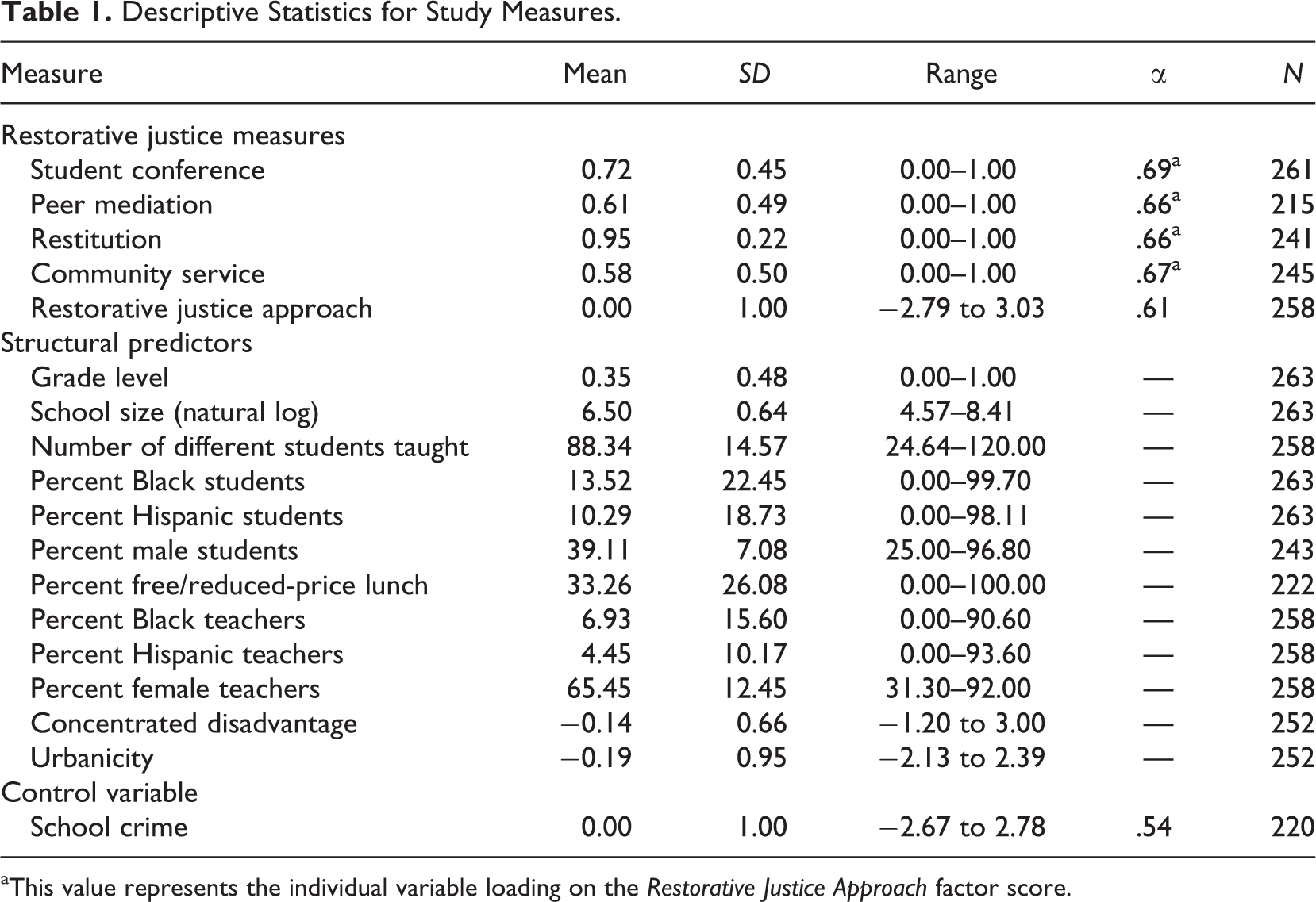
aThis value represents the individual variable loading on the Restorative Justice Approach factor score.
Dependent variables
Four specific restorative justice practices are operationalized with questions from the second principal survey regarding the use of restitution, peer mediation, community service, and student conferences. Each question asks principals whether their schools use the particular practice, beginning with the following introduction: “Different schools make use of different responses to student misconduct. Following is a list of possible responses to student misconduct school administrators might use. Please indicate if your school uses these responses.” Possible answers to the questions are “not used,” “used,” and “used often.” After an examination of frequency distributions, these variables were collapsed into binary measures to allow for more meaningful categories (Bernard, 2000). We split the variables peer mediation, restitution, and community service according to whether they were “used” (=1, which includes the responses “used often” and “used”) or “not used” (=0). Because the frequency distribution indicated that all schools used student conferences, this variable was split according to whether it was “used often” (=1) or “not used often” (=0). In addition, we created a Restorative Justice Approach Scale by producing a weighted factor score based on these four variables.
Independent variables
Going beyond what previous research has explored, we examine 12 school-level structural factors that are possible predictors of the use of restorative justice discipline. Grade level is a binary variable indicating whether the school is a middle/junior high school (=0) or a vocational/senior high school (=1) and is included because of the possibility that restorative discipline is used more often in a particular level of school. School size is included to examine whether the size of the student body influences the use of restorative discipline. This variable measures principal reports of the number of students enrolled in the school from the first principal questionnaire. These principal reports were compared with data from the Common Core of Data and Market Data Retrieval. We used the natural log of the enrollment to reduce skewness. Number of different students taught is calculated from a question in the teacher questionnaire and is included in order to examine whether the use of restorative discipline is dependent upon the number of students each faculty member teaches. Teachers were asked to report how many different students they taught within an average week; responses were “Fewer than 35,” “35 to 70,” “71 to 100,” and “More than 100.” Responses were then coded as follows: “Fewer than 35” was coded as 17.5, “35 to 70” was coded as 52.5, “71 to 100” was coded as 85.5, and “More than 100” was coded as 120.
Several compositional traits of the student- and faculty bodies were also included in these analyses, because past research has found they have some significant impact on school discipline. Percent Black students is based on data from the Common Core of Data from the National Center for Education Statistics. Percent Hispanic students and percent male students are aggregated from responses to the student questionnaire. Percent students receiving free/reduced-price lunch is an item from the first principal questionnaire. To describe the faculty, percent Black teachers and percent female teachers are aggregated from responses to the teacher questionnaire.
Finally, characteristics of the surrounding community were examined, because communities may influence how schools address student violence and misbehavior. Concentrated Disadvantage is a factor score based on measures obtained from the 1990 Census for the zip code areas in which the school is located. The following census variables are established components of the factor: welfare (the average household public assistance income), female-headed household (the rate of single females with children under 18 to married couples with children under 18), median income (the proportion of households with income below $27,499), poverty (rate of persons below the 1.24 poverty level to persons above), divorce rate (the rate of persons over 15 years who are married to those who are separated, divorced, or have a spouse absent), and male and female unemployment (proportion of unemployed males/females in the labor force). In addition, Urbanicity is a factor score based on 1990 Census data for the school’s zip code area and includes population size (total population), urban level (city-level type), and urbanicity (the proportion of people living within an urban area).
Control variable
In addition to the structural predictors examined in these analyses, we include a measure of the crime and victimization occurring in schools, because it seems reasonable to expect that the nature of school delinquency and violence may influence schools’ approaches to discipline. School Crime is an index based on a factor analysis of three scales. The first scale, teacher victimization, is measured by 8 items from the teacher questionnaire counting the number of different crimes or acts of incivility experienced by the teacher at school during the current school year. Student victimization is measured by 7 items from the student questionnaire counting the number of different crimes, ranging from thefts to physical attacks, experienced by the student at school during the current school year. Finally, student delinquency is measured by four delinquency items from the student questionnaire counting the number of different crimes and acts of violence committed by the student in school during the current school year, including hitting or threatening to hit a student or teacher, damaging or destroying property, and stealing or trying to steal something at school. For all three scales, a school’s score is the mean across respondents of the proportion of items endorsed.
Analytical Strategy
Means and standard deviations were calculated and are reported in Table 1. Then, the distributional characteristics of the measures to be included in the study were examined. Concentrated Disadvantage and Urbanicity were trimmed to address three extreme outliers and resulting skewness. Due to the dichotomous nature of the individual restorative justice items, four sets of binary logistic regression models were estimated; each binary restorative justice outcome was regressed on all the structural predictors as well as the School Crime control variable. In each analysis, the Hosmer and Lemeshow χ2 test examines the overall fit of the model; well-fitting models result in nonsignificant χ2, indicating that the estimated model does not differ significantly from the observed values. Additionally, the Wald χ2 test determines the significance of individual parameter estimates.
Finally, an ordinary least squares regression model was estimated in which the Restorative Justice Approach factor score was regressed on all structural predictors as well as the School Crime control variable. Tolerance values and variance inflation factors (VIFs) were examined to test for multicollinearity. No tolerance values were smaller than 0.1, and no VIFs were larger than 2.5; thus, multicollinearity is not an apparent problem (Freund & Little, 2000). In this model, the R2 shows the amount of variance in the Restorative Justice Approach Scale that is explained by the predictors and the F statistic determines the overall fit of the model.
Results
The results of the four binary logistic regression models for the four individual restorative justice outcomes is presented in Table 2. The use of restitution is significantly predicted by the number of different students taught (b = –.102, p < .05). The odds ratio of this parameter estimate shows that for each additional student taught, the odds of a school using restitution (vs. not using restitution) as a response to student misbehavior decreases by a factor of .903. Percent Black students is also a significant predictor (b = –.080, p < .05) of the use of restitution by schools. The odds ratio of this parameter estimate shows that for each 1% increase in the percentage of black students, the odds of a school using restitution decreases by a factor of .923. The Hosmer and Lemeshow test suggests that the model provides a good fit to the data.
Binary Logistic Regression Results for Restorative Justice Techniques on School Structural Characteristics.
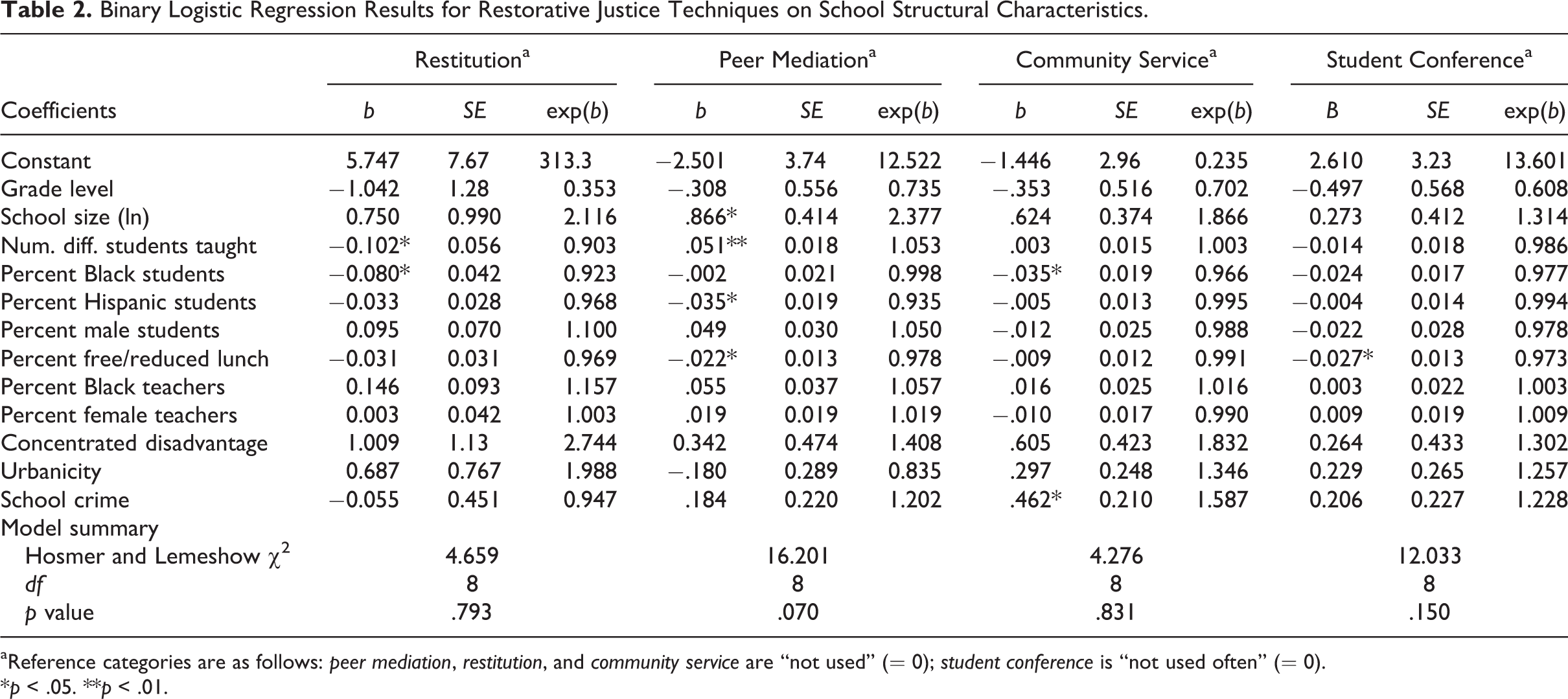
aReference categories are as follows: peer mediation, restitution, and community service are “not used” (= 0); student conference is “not used often” (= 0).
*p < .05. **p < .01.
The use of peer mediation is also significantly predicted by the number of different students taught (b = .051, p < .01), although in the positive direction. The odds ratio of this parameter estimate shows that for each additional student taught, the odds of a school using peer mediation in response to student misbehavior (vs. not using peer mediation) increases by a factor of 1.053. School size also increases the use of peer mediation (b = .866, p < .05); the odds ratio shows that a one-unit increase in the natural log of student enrollment increases peer mediation use by a factor of 2.377. By contrast, the variables percent students receiving free/reduced-price lunch and percent Hispanic students are negatively related to the use of peer mediation (b = –.022 and –.035, p < .05, respectively). For each 1% increase in the percentage of students receiving free or reduced-price lunches, the odds ratio shows the use of peer mediation decreases by a factor of .978. Similarly, for each 1% increase in the percentage of Hispanic students, the odds ratio shows the use of peer mediation decreases by a factor of .935. Again, the Hosmer and Lemeshow test suggests that the model provides a good fit to the data.
The use of community service as a response to misbehavior is significantly predicted by percent Black students (b = –.035, p < .05); the odds ratio of this parameter estimate shows that for each 1% increase in the percentage of black students, the odds of a school using community service as a response to student misbehavior (vs. not using community service) decreases by a factor of .966. The use of community service is also significantly predicted by the amount of School Crime (b = .462, p < .05); the odds ratio shows that for each unit increase, community service use increases by a factor of 1.587. As before, the Hosmer and Lemeshow test shows that the model provides a good fit to the data.
Finally, the use of student conference is predicted by percent students receiving free/reduced-price lunch (b = –.027, p < .05). The odds ratio of this parameter estimate shows that the percentage of students receiving free or reduced-price lunches decreases the odds of a school using student conferences often in response to student misbehavior (vs. not using them often) by a factor of .973. As with the other three models, the Hosmer and Lemeshow test indicates that the model provides a good fit to the data.
The results of the ordinary least squares regression model in which the Restorative Justice Approach Scale are regressed on the structural predictors and the control variables are shown in Table 3. As with several of the models assessing the influences on individual restorative justice techniques, percent Black students, percent Hispanic students, and percent students receiving free/reduced-price lunch are significantly predictive of the scale representing Restorative Justice Approach, such that schools with greater percentages of black students, Hispanic students, and students who receive free or reduced-price lunches are less likely to respond to student misbehavior with an overall restorative justice framework for addressing harm (b = –.400, p < .01; b = –.322, p < .05; and b = –.380, p < .01, respectively). In fact, the β values indicate that these three characteristics contribute substantially to whether restorative justice is used by schools. The R2 in this model demonstrates that 24.5% of the variance in the use of restorative justice practices is explained by the structural predictors and the F statistic indicates a good fit to the data.
Ordinary Least Squares Regression Results for Restorative Justice Approach Scale on School Structural Characteristics.
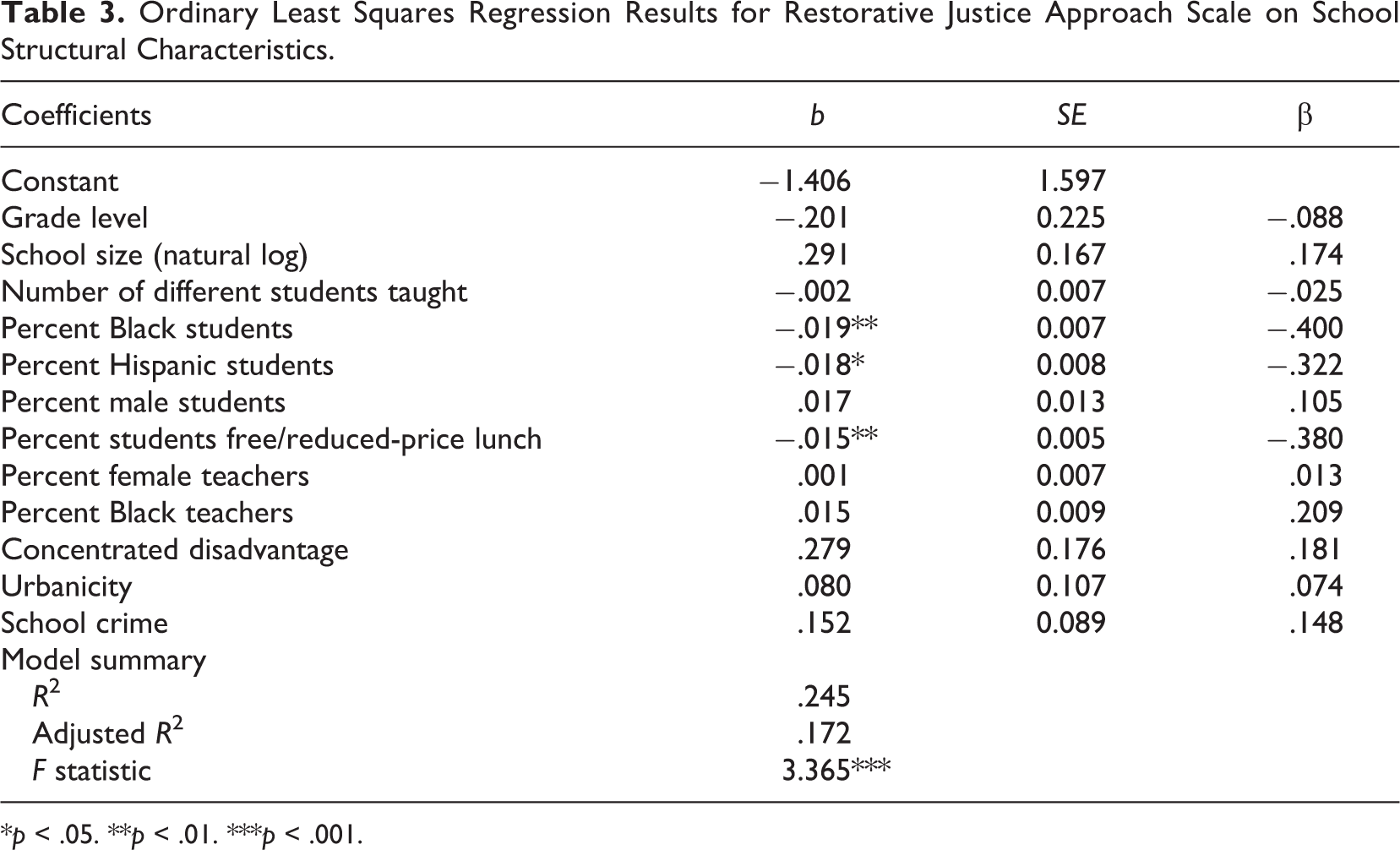
*p < .05. **p < .01. ***p < .001.
Discussion
Previous research has demonstrated the considerable benefits of using a restorative justice framework to address corrosive and harmful behaviors as well as direct and indirect victimizations in a number of social settings, including juvenile and criminal justice systems and educational institutions. In recognition of this, the current study used a nationally representative sample of schools to explore whether and in what ways school structure, student and faculty characteristics, and community traits influence the implementation of reparative approaches to violence, delinquency, and misbehavior among students. Our analyses produce a number of important findings worth reviewing, particularly since there is some inconsistency across the various techniques that often comprise restorative justice.
School structure predicts the use of some individual restorative techniques, only partially supporting Hypothesis 1. While the grade level taught in schools does not affect the use of restorative practices, larger schools are more likely to use peer mediation, but not more likely to use the other techniques. Interestingly, schools in which teachers deal with a larger number of students are more likely to offer peer mediation, but less likely to endorse restitution. This may be because larger schools seek to use many different disciplinary responses in order to handle a large student body. Hypothesis 2 is not supported here, as school structure does not impact the adoption of a comprehensive restorative justice approach to discipline. The reasons for these inconsistencies across technique are certainly worthy of future exploration.
The analyses examining the influences on the individual restorative techniques, partially supporting Hypothesis 3, suggest that this effect is only present with regard to certain techniques. Schools with proportionally more Black students are less likely than schools with more White students to require student violators to provide restitution or community service, but Black student composition appears to have no impact on whether peer mediation or student conferences are used. Similarly, schools with disproportionately more Hispanic students are less likely to implement peer mediation but are not significantly different from other schools with their use of other restorative techniques. Schools with proportionally more students from low-income households who are provided free or reduced-price lunches are less likely to offer the benefits of peer mediation and student conferences but are not substantially different from other schools in their seeking restitution or community service from students that break rules or cause harm. It is notable that the percentage of students who receive free and reduced-price lunches is the only school characteristic that predicts the use of student conferences. Despite these inconsistencies with regard to specific restorative justice techniques, it is important to recognize that no other potential predictor significantly affects the likelihood that a comprehensive restorative justice program will be used by schools.
Hypothesis 4 is also partially supported by the present analysis, with regard to student race, ethnicity, and economic disadvantage. Corroborating the findings of prior research showing that punitive discipline is more likely in schools with proportionally more minority students (Kupchik, 2009; Peguero, Popp, & Shekarkhar, 2015; Peguero & Shekarkhar, 2011; Welch & Payne, 2010), the present study finds that an overall restorative response to student discipline is less likely to be implemented in schools with larger percentages of Black students, Hispanic students, and economically disadvantaged students. This suggests that the disparities evident here may be the result of discriminatory policies that disproportionately disadvantage students in schools with more racial and ethnic minority and lower-income students. Given that previous research has found that schools with more Black, Hispanic, and poor students are likelier to use punitive discipline, it is not surprising that these same school characteristics influence the use of restorative discipline in the opposite direction; schools with these student characteristics favor harsh approaches over restorative ones.
Our results do not support Hypotheses 5 and 6; community characteristics do not seem to impact the degree to which schools implement restorative practices or a more complete restorative justice program. Perhaps equally as important is the finding that most of the school conditions assessed here have no impact whatsoever on schools’ use of restorative justice techniques or overall framework. It does not appear to matter whether a school is a middle/junior high school or whether it is a vocational or high school; grade level of the school does not influence the likelihood of restorative justice being used. Similarly, the percentage of the schools’ students who are male does not increase or decrease the prevalence of restorative justice. Furthermore, the demographic characteristics of schools’ teachers also do not influence the use of these restorative approaches. Schools in urban settings and those characterized by concentrated disadvantage are not less likely to use less restorative discipline, contrary to what might be expected. It is possible that the effects of the racial and ethnic composition of schools’ students and the proportion of poor students in schools are so strong (as evidenced by the β scores) that the effects of other structural influences are negated; perhaps the urbanicity and concentrated disadvantage of the community or the other predictors are inconsequential when the effects of these other influences are already so robust.
Study Limitations and Future Research
The cross-sectional nature of the data precludes us from determining the causal direction of the associations found in this study’s analyses. For instance, while the associations between certain school structural characteristics and restorative justice techniques and overall framework indicate that these contexts predict the use of restorative responses to misbehavior and violence, it is also possible that these relationships are the result of a shift in some of these exogenous structural characteristics after these restorative justice policies were adopted. Although this seems unlikely, future research would benefit from using a longitudinal methodology in order to assess proper temporal ordering.
The relationship between survey participation and community characteristics presents another potential limitation, because schools in areas with more female-headed households, greater urban populations, and more households that receive public assistance were significantly less likely to have participated in the original study. It is doubtful, however, that the basic conclusions of our study would have changed had these schools been included. In order to investigate possible nonrandom attrition bias, we conducted exploratory analyses that examined schools located in communities similar to the nonparticipating schools and found that these schools had greater percentages of Black students, Hispanic students, and students who received free or reduced-price lunches and were also less likely to use restorative techniques or frameworks. Therefore, this study’s results would have most likely been intensified had nonparticipating schools been included, suggesting that the findings reported here may actually represent a conservative estimate of the relationships between structural characteristics of schools and restorative justice. Another possibility is that the relationships examined here are not linear in the distribution region of the nonparticipating schools. However, the linear relationship between community characteristics and nonparticipation, externally determined school characteristics, and restorative justice practices suggests otherwise. Nevertheless, we would benefit from future research that replicates this study with more representative samples.
The operationalization of the individual restorative justice techniques poses another potential limitation for this study. As discussed in the Methods section, the principal survey does not specify whether the specific restorative practices were part of an overall restorative approach in the school or merely individual techniques unassociated with an overall restorative framework. We have no way of knowing whether an individual restorative practice was used in a school that promotes a primarily punitive disciplinary orientation. In addition, the data do not include information on how each principal actually implemented these practices or for what types of student offenses they were used. The inability to address this matter may be one explanation for the inconsistencies observed across the different restorative justice categories. Given the findings surrounding these restorative practices, it is likely that the results would be intensified had this study been able to measure the nature and implementation quality of the specific practices and the existence of a comprehensive restorative model within the school. Even so, it would be useful for future research to attempt to measure whether schools have adopted an overall restorative model to guide relationships within the school.
Policy Reform and Recommendations for the Use of Restorative Justice in Schools
Support for school-based restorative justice appears to be strengthening. Although a large portion of the public is not familiar with this approach, those who are aware strongly favor it (Karp & Frank, 2015). With the recent national focus on criminal justice reform, many lawmakers from both political parties are also supportive of it as an alternative to the costly and harmful methods that have been used to punish rule breakers over the last 30 years. This mirrors the growing use of restorative techniques in the juvenile justice system, which has become quite commonplace in the United States; research has shown these practices, such as direct offender–victim dialogue and sentencing circles, to be effective in reducing juvenile offenders’ recidivism, particularly with minor delinquency (Bergseth & Bouffard, 2013). Within schools, federal mandates and state legislation are increasingly supportive of restorative approaches to discipline, although this has not yet led to widespread implementation. President Obama has brought the negative consequences of harsh zero tolerance policies to the attention of the public and policymakers, and the U.S. Department of Education now specifically encourages the implementation of restorative justice practices in schools. Further, the federal government is spending millions of dollars to evaluate the effectiveness of restorative justice programs in schools (National Institute of Justice, 2014). The popularity of these policies appears to be growing at the state level as well, although there are inconsistencies with regard to which elements are implemented and how they are used. These are all promising developments.
Proponents of school-based restorative justice do caution, however, that the implementation of a comprehensive restorative approach to discipline requires a fundamental shift in thinking, one that addresses not just school discipline and student delinquency and violence but the entire school climate and community as well (Bazemore & Schiff, 2010; Cremin, 2010; Gregory et al., 2014; Morrison, 2010). This significant paradigm change is “characterized by a shift away from being a rule-based institution to a relationship-based institution, or from being an institution whose purpose is social control to being an institution that nurtures social engagement” (Elliott, 2011; Morrison, 2011; Morrison & Vaandering, 2012, p. 145; Zehr, 2005). This kind of transformation can be dramatic, but given the myriad benefits of using a restorative rather than punitive framework, schools and school districts have every incentive to encourage policy reform.
It is important for members of a school community to realize that this change will not happen quickly and that a long-term implementation plan should be created (Gonzalez, 2012). This shift from “authoritarian and punitive to democratic and responsive” (Bazemore & Schiff, 2010, p. 8) must take into account the complicated nature of education as an institution, acknowledging schools’ focus on teaching and learning along with safety (Cremin, 2010). Thus, in order for restorative practices to be successful, schools must alter how they conceptualize discipline, viewing it not as a function of a student’s ability to follow a set of rules, but rather as a student’s capacity to consider how his or her behavior is impacting the greater school community and to grow from the experience after a harm occurs (Gardella, 2015; Morrison et al., 2005).
Further, schools and districts should recognize that restorative justice is not simply a set of disciplinary responses to misbehavior, delinquency, or violence, but rather a philosophical framework that should be adopted not just in schools but at all levels of the educational system (Penny, 2015). Along these lines, studies have demonstrated that restorative policies will only continue to produce positive results when restorative justice values are adopted as a philosophy by the entire school community rather than implemented as one practice or program in one classroom or at one level of administration (Fields, 2003; Gonzalez, 2012; Morrison et al., 2005).
There are many reasons for supporting an increase in the implementation of restorative policies within educational institutions, and because of the findings of the present research, we know that restorative techniques and overall framework are used more often in some types of schools than others. Thus, attempts to promote policy reform would benefit from addressing school conditions that may make it less likely that restorative approaches will be used. And, policies that appear to disparately disadvantage schools with certain types of students should not be permitted. Restorative justice has the potential to offer positive solutions for all students and should not be restricted according to school structure, student-body or faculty characteristic, or community trait. Our research may help policymakers and school administrators be more aware of the factors that can have an unjust impact on students so that they may avoid exacerbating what may already be difficult conditions.
Conclusion
The school-to-prison pipeline is producing collateral consequences for students akin to those resulting from mass incarceration for adults. In addition, it is now well established that harsh discipline policies do not reduce school-based violence or misbehavior, and may even increase it. Given the negative consequences of punitive punishment for individual students and for the overall school climate, it is clear that schools need to reconsider their traditional responses to student misbehavior. In spite of the enormity of the transformative shift that restorative practices would require, it represents a powerful and productive response to student delinquency—one that has been tentatively embraced by the federal government, some states, and much of the public (Karp & Frank, 2015).
This study measured the possibility that a number of school-level factors influence the likelihood that restorative justice measures would be used in schools. Because we found that certain school-level traits influence whether restorative practices are used, it would be important for policymakers, school administrators, and districts that intend to adopt more restorative measures to actively guard against differential implementation strategies according to those traits. Restorative justice has consistently produced positive effects, regardless of school characteristics, so any disparate use of these approaches would be unjust. If implemented more broadly within schools, restorative justice may substantially reduce student offending, increase perceptions of safety, enhance learning, promote positive school climate, and destroy the school-to-prison pipeline that is exacerbating inequality and disadvantage for certain students.
Footnotes
Declaration of Conflicting Interests
The author(s) declared no potential conflicts of interest with respect to the research, authorship, and/or publication of this article.
Funding
The author(s) received no financial support for the research, authorship, and/or publication of this article.