



Abstract
Handgun carrying is associated with a wide range of delinquent behaviors, but very little is known about sex differences in this behavior and current trends in handgun carrying in the United States. Using data from the 2002 to 2015 National Study of Drug Use and Health surveys, we found that the prevalence of handgun carrying among girls nearly doubled from 0.9% to 1.7% with most of this increase seen among non-Hispanic White and Hispanic girls. Although boys are more likely to carry handguns, approximately 20% of the total handgun carrying by adolescents in the United States occurs among girls. Both male and female adolescents who have carried a handgun in the past year evince a behavioral profile that is characterized by substance use, versatile delinquency, elevated risk propensity, and substantial school and family problems. However, adjusted odds ratios are consistently higher for females, suggesting that girls who engage in handgun carrying represent an important subgroup of potentially pernicious offenders that should be targeted for primary and tertiary prevention and juvenile justice system oversight.
One of the leading causes of mortality among youth in the United States is deaths attributable to firearms (Centers for Disease Control and Prevention, 2016). Given the lethality of interpersonal disputes when handguns are present (Braga, 2012; Caudill & Trulson, 2016; DeLisi, Piquero, & Cardwell, 2016; Farrington, Loeber, Stallings, & Homish, 2012; Reich, Culross, & Behrman, 2002) coupled with the diminished maturation of executive decision-making common in young people, handgun carrying among adolescents is a serious public health and policy concern (Barry, McGinty, Vernick, & Webster, 2015; Blum, 2001; Braga, 2012; Fowler, Dahlberg, Haileyesus, & Annest, 2015; Kleck, 2015; Muula, Rudatsikira, & Siziya, 2008; O’Toole & Fondacaro, 2017; Siegel et al., 2014; Welsh, Braga, & Sullivan, 2014; Wintemute, 2015a, 2015b). While it is well established that male adolescents are more likely to carry handguns (Vaughn, Perron, Abdon, Olate, & Wu, 2012) and engage in antisocial behavior generally (Eme, 2010), relatively less is known regarding the prevalence and correlates of handgun carrying among female adolescents. This is an important oversight as girls who carry handguns may also be at increased risk for a host of other developmental problems besides serious delinquency, such as early pregnancy and motherhood, that may serve to increase the probability for intergenerational transmission of problem behaviors (Loughran, Reid, Collins, & Mulvey, 2016). As such, careful examination of sex differences in handgun carrying using nationally representative data is badly needed.
Research Context
Multiple surveys at both the local and national level have measured the prevalence of handgun carrying/ownership in female adolescents. Nationally, the prevalence rates for female youths range from 1.1% to 2% (Argys, Rees, Averett, & Witoonchart, 2006; Kann et al., 2016; Springer, Kelder, Orpinas, & Baumler, 2007; Vaughn et al., 2012). The divergence observed in these ranges reflects variation in how surveys measure handgun prevalence. Community-based studies many of which focus on students attending inner-city schools reveal higher rates of handgun carrying compared to rates identified in available national-level data. In a sample of students from inner-city high schools, 11% of females reported carrying a gun outside of school (Sheley, McGee, & Wright, 1992), and 8% of 7th graders from another of set of inner-city schools reported carrying a concealed gun (Hemenway, Prothrow-Stith, Bergstein, Ander, & Kennedy, 1996). Additional prevalence studies that have focused on African American youth (Durant, Getts, Cadenhead, & Woods, 1995; Lane, Cunningham, & Ellen, 2004; Steinman & Zimmerman, 2003) finding that 2% of females report persistent past-year gun carrying (Steinman & Zimmerman, 2003), with 9% reporting intention to carry a gun in the next 3 months (Lane et al., 2004). Despite several surveys conducted at the national and local levels measuring handgun carrying in youths, it is difficult to compare their results and identify trends given differences in questions used to measure prevalence. Depending on the survey, participants may be asked about handgun carrying over different periods of time including lifetime, past year, and past 30 days. Further, many surveys ask about weapons in general and do not provide results on handgun carrying alone. A recent study used General Social Survey data from 1973 to 2010 to examine trends of handgun carrying among adult females revealing a decline in female gun ownership (Koeppel & Nobles, 2017). Without similar studies conducted at the national level for younger adults, it is unknown whether this trend also exists among female youths. In addition to the importance of prevalence studies, identifying correlates of handgun carrying among adolescent females is critical. In general, several externalizing spectrum behaviors, such as alcohol, marijuana or other drug use, selling drugs, aggression, fighting, and gang affiliation, and peer misbehavior have been found to be correlates of handgun carrying among adolescents (Braga, 2012; Dong & Krohn, 2016; Kulig, Valentine, Griffith, & Ruthazer, 1998; Lizotte, Krohn, Howell, Tobin, & Howard, 2000; Salas-Wright, Nelson, Vaughn, Reingle Gonzalez, & Córdova, 2017; Tigri, Reid, Turner, & Devinney, 2016; Vaughn et al., 2012; Vaughn, Salas-Wright, Boutwell, DeLisi, & Curtis, 2017). The co-occurrence of handgun-carrying and externalizing behaviors is consistent with prominent theoretical explanations that emphasize the importance of overarching antisocial propensity, diminished impulse control, and emotional dysregulation (Salas-Wright, Vaughn, & Reingle Gonzalez, 2016). More specifically, these theoretical constructs are expressed as low self-control (Gottfredson & Hirschi, 1990), neuropsychological deficits that serve to inhibit executive functions (Moffitt, 1993), or low effortful control as a central feature of a temperament-based theory of crime and criminal justice (DeLisi & Vaughn, 2014; Wolff, Baglivio, Piquero, Vaughn, & DeLisi, 2016). The inability to engage in functional self-regulation coupled with exposures to antisocial peers is associated with a broad array problem behaviors including handgun carrying. This may be especially true for girls who are carrying a handgun.
What is not clear, however, is whether the pattern of correlations found in previous studies is the same among boys and girls. There are theoretical reasons why the effects may be different for boys and girls. For example, girls may be more sensitive to their environments, less likely to be exposed to risk and are generally more risk averse (McAra & McVie, 2016; Rebellon, Manasse, Agnew, Van Gundy, & Cohn, 2016; Steketee, Junger, & Junger-Tas, 2013). Extant findings, though few in number, indicate that older age, engaging in physical fights, selling drugs, and gang membership are positively associated with handgun carrying, while living with both parents is associated with reduced likelihood to carry handguns (Argys et al., 2006; Callahan & Rivara, 1992; Durant et al., 1995; Shook, Vaughn, & Salas-Wright, 2013; Wallace, 2017). Among rural adolescents, hunting experience is associated with firearm ownership for both males and females; however, race, socioeconomic status, and school enrollment are more salient correlates among adolescent males (Sadowski, Cairns, & Earp, 1989). With regard to mental health, a longitudinal study conducted with over 2,000 students in San Diego found that higher levels of depression, stress, and a quick temper along with risk-taking and drug use in 9th grade predicted handgun carrying in 12th grade for both males and females (Simon, Richardson, Dent, Chou, & Flay, 1998). While these studies are instructive, they also paint an incomplete portrait of the correlates of handgun carrying among girls. Importantly, there are a dearth of studies that have provided national-level data on the sex-stratified correlates permitting direct comparisons of handgun carrying among boys and girls. Any sex-specific public policies and juvenile justice practices are hampered by this lack of knowledge.
Current Study
The aim of the present study is 2-fold. First, we examine the prevalence of handgun carrying among girls in the United States vis-à-vis boys from 2002 to 2015, the most recent available data. In addition to prevalence estimates, we ask whether there are changes over time in these estimates. More specifically, are there increases in handgun carrying among girls relative to boys? Second, we directly compare the pattern of correlates associated with handgun carrying among girls and boys. Given that girls are generally less likely to engage in handgun carrying and are more risk-averse than boys, we hypothesize that among those girls that do carry handguns, the magnitude in behavioral risk variables will be larger (relative to other girls who report not carrying a handgun) compared to boys (relative to other boys who do not report carrying a handgun). Thus, handgun carrying among girls may be a marker for an especially deviant and risk-immersed group of girls.
Method
Data
This study used data from the 2002 to 2015 National Study of Drug Use and Health (NSDUH), administered by the Substance Abuse and Mental Health services Administration (SAMHSA). The NSDUH provides nationally representative cross-sectional estimates of substance use and behavioral health outcomes in the U.S. civilian, noninstitutionalized population of ages 12 and older. The samples were recruited by employing the multistage area probability sampling method. In the first stage, 48 census tracts were selected within each sampling strata, called state sampling regions (SSRs), a total of 900 SSRs across the nation (i.e., 48 SSRs in each 8 large state and 12 SSRs in the remaining states; SAMHSA, 2014). After selecting combined contiguous census blocks (called “segments”) within each census tracks, dwelling units within the segments were selected (SAMHSA, 2014). Lastly, respondents were selected within the dwelling units by ensuring approximately equal numbers of individuals across three age ranges: 12–17 years, 18–25 years, and 25 years or older (SAMHSA, 2014).
With respect to the NSDUH, all 50 states and the District of Columbia were employed. Study participants include household residents; residents of shelters, rooming houses, and group homes; and civilians residing on military bases. NSDUH study participants were interviewed in private at their places of residence. Potential participants were assured that their names would not be recorded and that their responses would be kept strictly confidential. Participants were paid US$30 for their participation. The NSDUH interview utilizes a computer-assisted interviewing (CAI) methodology to increase the likelihood of valid respondent reports of illicit drug use behaviors (SAMHSA, 2014). The CAI methodology includes a combination of computer-assisted personal interviewing and audio computer–assisted self-interviewing methodologies.
Data from year 2002 to year 2015 provide comparable estimates of past-year handgun carrying as well as self-reported substance use, delinquency, and involvement in criminal justice system among adolescents aged 12–17. To examine handgun carrying and behavioral correlates among the three largest racial/ethnic groups in the United States (i.e., African American, Hispanic, and White female adolescents), 98,090 female adolescents of ages 12–17 from year 2002 to 2015 were included as the analytic sample in this study. Of the analytic sample, the composition of each racial/ethnic group was as follows: African American (14.5%), Hispanic (18.4%), and non-Hispanic White (67.1%). For comparisons, data on male adolescents from the same racial/ethnic groups (n = 101,570) from the same time period were also examined. A more detailed description of NSDUH study design is available elsewhere (SAHMSA, 2014).
Measures
Handgun carrying
We examined past-year handgun carry (0 = never, 1 = one or more carries) based on respondent’s self-reports to the question, “During the past 12 months, how many times have you carried a handgun?” 1
Substance use
We examined self-reported past-year (0 = no use, 1 = one or more use) alcohol, marijuana, and any other illicit drug use (e.g., hallucinogens, opiates, etc.).
Criminal justice involvement and delinquent behaviors
To measure involvement in criminal justice system (0 = no arrests, 1 = one or more arrests), we examined self-reported lifetime arrest/booking history, excluding criminal justice system contact related to minor traffic violations. To examine youth involvement in criminal/delinquent behaviors (0 = no involvement, 1 = one or more instances), we examined past-year reports of involvement in theft (i.e., stolen anything worth more than US$50), violent attacks (attacked with the intent to seriously hurt someone), serious fighting (gotten into a serious fight at school or work), and group fighting (taken part in a fight where a group of youth fights another group).
Psychosocial Factors
Individual factors
We examined two individual-level factors: risk propensity and religiosity. Risk propensity was based on 2 items (α = .74) measuring adolescent enjoyment of risky behavior. These items include “How often do you like to test yourself by doing something a little risky?” and “How often do you get a real kick out of doing things that are a little dangerous?” For each item, youth who responded sometimes/always were coded as 1 and youth who responded never/seldom were coded as 0. These two variables were, in turn, summed and treated as an ordinal (0 = low, 1 = medium, 2 = high) variable in all statistical analyses. Religiosity was examined on the basis of a 4-item scale (α = .77) tapping both public religious engagement (i.e., religious service attendance and participation in religious groups) and private religious importance (i.e., importance and influence of religious beliefs). These public and private religiosity questions have been widely used and are described in greater detail elsewhere (Salas-Wright, Vaughn, Maynard, Clark, & Snyder, 2017).
School-related factors
We examined adolescent self-reports of usual grades, academic engagement, and peer-student substance use. To measure usual grades, youth were asked to report their average grades for the last semester or grading period that they completed. Response options included (1) “An A average,” (2) “A B average,” (3) “A C average,” and (4) “A D average or lower.” Academic engagement was based on a 5-item scale (α = .77) measuring perceived importance and interest in learning and school activities. Sample items include “During the past 12 months, how often did you feel that the schoolwork you were assigned to do was meaningful and important?” and “How important do you think the things you have learned in school during the past 12 months are going to be for you later in life?” Numerous NSDUH-based studies have utilized these variables and describe them in greater detail (Salas-Wright, Hernandez, Maynard, Saltzman, & Vaughn, 2014; Vaughn, Maynard, Salas-Wright, Perron, & Abdon, 2013). We also examined perceived peer-student substance use. Specifically, participants were asked to report “how many of the students in your grade at school” smoke cigarettes, drink alcohol, or use marijuana or hashish. Youth who reported that most or all of their peers use the aforementioned substances were coded as 1 and those who reported that few or none use were coded as 0.
Parental factors
We examined three parental factors: parental conflict, parental control, and parental affirmation. Parental conflict was based on the following question: “During the past 12 months, how many times have you argued or had a fight with at least one of your parents?” Youth reporting 10 or more conflicts were coded as 1 and all other youth coded as 0. Parental control was based on the following question: “During the past 12 months, how often did your parents limit the amount of time you went out with friends on school nights?” Responses of always/sometimes were coded as 1 and seldom/never were coded as 0. Parental affirmation was based on a 2-item index (α = .86) comprised of variables reflecting youth perceptions of parental support and encouragement. These items include “During the past 12 months, how often did your parents let you know when you’d done a good job?” and “During the past 12 months, how often did your parents tell you they were proud of you for something you had done?” For each item, youth who responded sometimes/always were coded as 1 and youth who responded never/seldom were coded as 0. These two variables were, in turn, summed and treated as an ordinal (0 = low, 1 = medium, 2 = high) variable in all statistical analyses.
Sociodemographic factors
The following sociodemographic variables were used: age, gender (0 = female, 1 = male), race/ethnicity (1 = non-Hispanic White, 2 = African American, 3 = Hispanic), and total annual family income (1 = less than US$20,000; 2 = US$20,000 to US$49,999; 3 = US$50,000 to US$74,999; and 4 = US$75,000 or more), and urbanicity (0 = nonurban, 1 = urban).
Statistical Analysis
Statistical analyses were conducted in several phases. We first examined demographic characteristics of female adolescents while stratifying by past-year handgun-carrying experience (handgun carrying vs. nonhandgun carrying). Second, we assessed the prevalence of past-year handgun carrying among female adolescents from 2002 through 2015. To provide more reliable estimates, respondents from two contiguous years (e.g., 2002/2003, 2004/2005, etc.) were combined. As supplementary analyses, we tested the significance of trend increases/decreases by including survey year as a continuous variable in multivariate logistic regression models predicting handgun carrying as consistent with the guidelines outlined by the Centers for Disease Control and Prevention (2016). Third, logistic regression analyses were conducted to examine associations between handgun carrying and behavioral (substance use and involvement in criminal/delinquent behaviors) as well as psychosocial correlates (individual, parental, and school-related factors). To allow comparisons, the same analyses were conducted for the male counterpart sample. All estimates were weighted to account for the NSDUH’s stratified cluster sample design (Substance Abuse and Mental Health Data Archive, 2014).
Results
Demographic Characteristics of Handgun-Carrying Female Adolescents
Table 1 shows demographic characteristics of handgun-carrying female adolescents in comparison to their noncarrying counterparts. The respondents reporting past-year handgun-carrying experience were more likely to be older adolescents of ages 15–17 (adjusted odds ratio [AOR] = 1.43, 95% confidence interval [CI] = [1.19, 1.71]). With respect to race/ethnicity, African American female adolescents (AOR = 0.76, 95% CI [0.61, 0.94]) were less likely to carry handgun than their White counterpart, but no significant difference was found between Hispanic and non-Hispanic White youth. Female adolescents from all lower household income groups than the highest income group (i.e., annual income of US$75,000 or higher) were more likely to be handgun carriers. Lastly, females living in rural areas were more likely to report past-year handgun carrying (AOR = 1.36, 95% CI [1.08, 1.70]).
Demographic Characteristics of Adolescent Female Handgun Carriers Compared to Nonhandgun Carrying Female Adolescents.
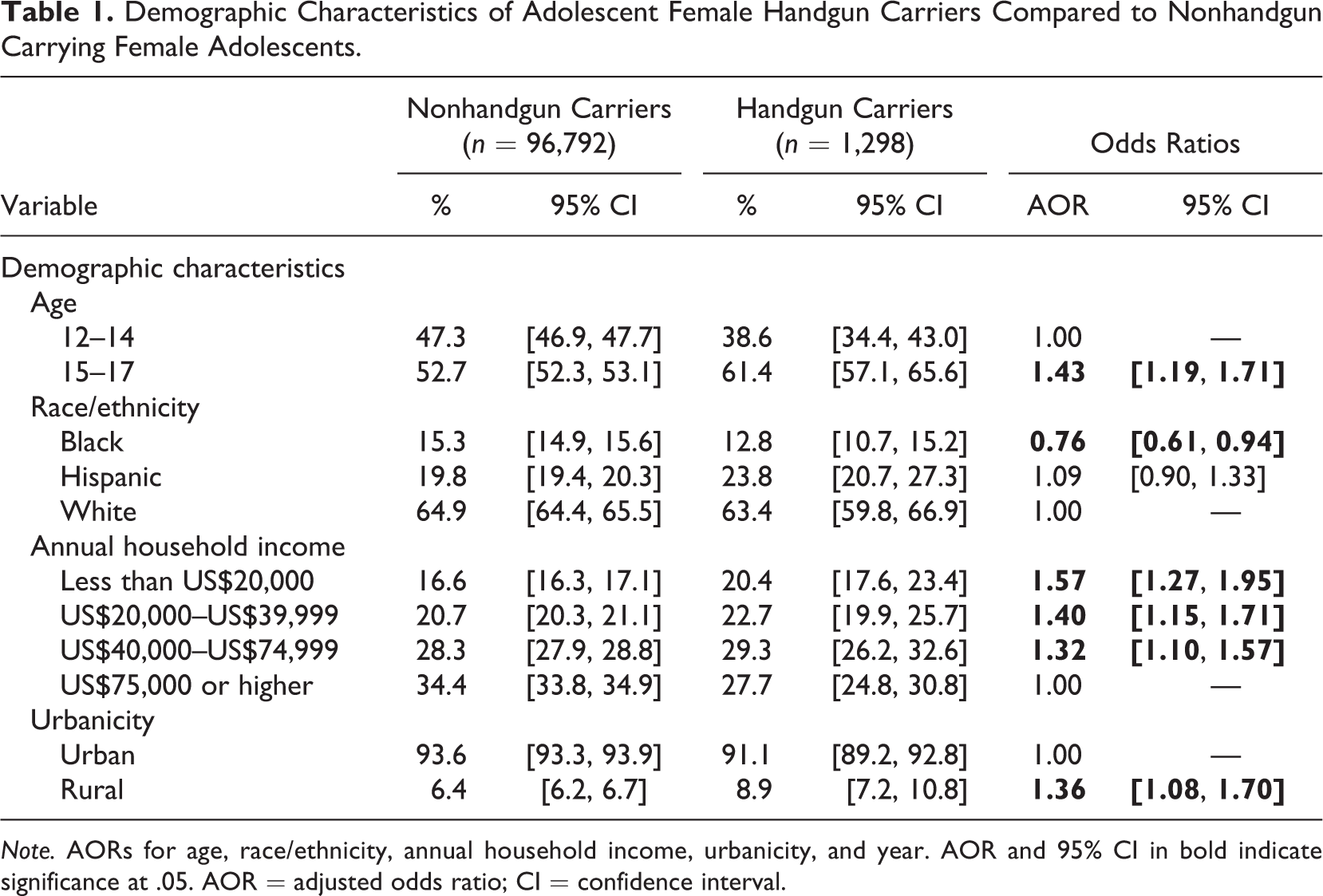
Note. AORs for age, race/ethnicity, annual household income, urbanicity, and year. AOR and 95% CI in bold indicate significance at .05. AOR = adjusted odds ratio; CI = confidence interval.
Prevalence of Handgun Carrying Among Female Adolescents
Table 2 presents prevalence estimates of past-year handgun carrying among all female adolescents as well as among the three largest racial/ethnic groups. The prevalence among female adolescents in general ranged between 0.9% (2004/2005) and 1.7% (2014/2015), increasing at an average rate of 8% over the entire time period (AOR = 1.08, 95% CI [1.04, 1.13]). Although the prevalence overall was much higher among male adolescents during the entire study period, the overall increasing trend was more gradual (AOR = 1.03, 95% CI [1.01, 1.05]). When specifically examined while stratifying by race/ethnicity, significant trend increases were also observed among non-Hispanic White female youth (AOR = 1.17, 95% CI [1.11, 1.23]), whose prevalence of carrying handgun became the highest among the subgroups in 2014/2015.
Prevalence of Handgun Carrying Among Female Adolescents: National Study on Drug Use and Health, United States, 2002–2015.
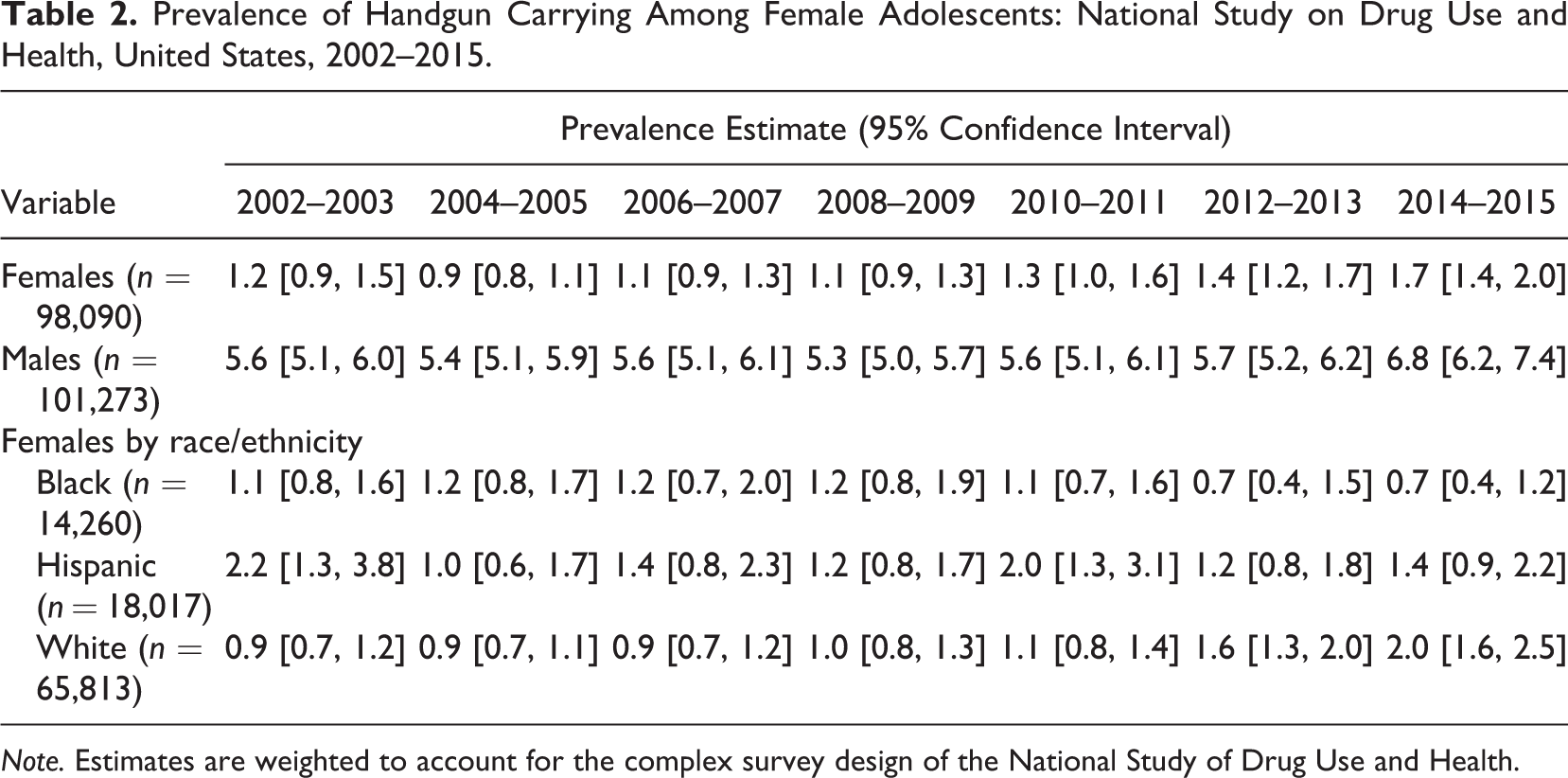
Note. Estimates are weighted to account for the complex survey design of the National Study of Drug Use and Health.
Behavioral and Psychosocial Predictors of Handgun Carrying Among Female Adolescents
Table 3 displays survey logistic regression analysis results that examined associations between handgun-carrying and behavioral/psychosocial correlates among female adolescents. For purposes of comparison, the same associations among male adolescents were also tested and reported in the table. Across gender, youth reporting handgun carrying were significantly more likely to report having used alcohol and other drugs in the past year and report criminal/delinquent behaviors and justice system involvement. We identified—for all correlates examined—larger AORs for the association between handgun carrying and other externalizing behaviors for female adolescents as compared to their male adolescent counterparts. Notably, gender differences were greater for crime/delinquency than for substance use. The nonoverlapping CIs for drug selling, theft, violent attacks, serious fights, and group fights indicate that the magnitude of the association between handgun carrying and other externalizing is significantly greater among female youth. 2
Predictors of Past-Year Handgun Carrying Among Adolescents.

Note. AOR for age, race/ethnicity, annual household income, urbanicity, and year. AORs and 95% confidence intervals in bold are statistically significant (p < .05). AOR = adjusted odds ratio; CI = confidence interval.
Similar to the patterns observed between handgun carrying and behavioral health correlates, consistent and significant relationships between handgun-carrying and psychosocial correlates were observed for both male and female adolescents. Female youth reporting higher risk propensity and conflicts with parents were more likely to have carried a handgun in the past year. Also, female youth exposed to higher peer substance use were associated with the greater rates of handgun carrying. On the other hand, female respondents associated with higher religiosity, parental, and school-related protective factors (e.g., parental control and affirmation, higher academic achievement and engagement) were less likely to have carried a handgun.
Urban–Rural Differences
Given that girls from rural areas were more likely to report carrying a handgun in the past year, we explored the differential predictors in a separate regression model (see Table 4). Although large standard errors for the estimates of those living in rural areas limit our precision to some degree, there were a unique array of correlates found for urban and rural girls. The urban sample was more likely to be represented by older adolescents (i.e., ages of 15–17), African American, and lower household incomes than respective reference groups while no significant demographic differences were observed among the rural sample. With respect to behavioral correlates, marijuana use was significant for urban but not rural girls. Although both urban and rural adolescent female handgun carriers were engaged in crime and delinquency, the overall pattern was more pronounced for urban girls. Girls from urban areas were less likely to report parental supervision or being religious. Academically, both rural and urban girls were equally less likely to be engaged in school, but urban girls reported lower grade achievement. Finally, peer substance use was similar for both urban and rural girls. Overall, patterns do not support the notion that rural girls are simply reporting carrying a handgun in the context of recreational use with a parent or guardian.
Predictors of Past-Year Handgun Carrying Among Female Adolescents by Urban and Rural Residence.

Note. AOR for age, race/ethnicity, annual household income, and year. AORs and 95% CIs in bold are statistically significant (p < .05). AOR = adjusted odds ratio.
Discussion
Using a long-running and well-characterized population-level survey, we sought to uncover the prevalence of handgun carrying over time among girls in the United States vis-à-vis boys. In conjunction with these prevalence figures, we also examined sex differences in the pattern of handgun-carrying correlates. In doing so, we address a critical gap in our understanding of the overall empirical contours of handgun carrying among adolescent females in the United States. With respect to trends in the prevalence of handgun carrying, we found a significant increase in the number of girls reporting carrying a handgun from 2004 to the most recently available data in 2015 nearly doubling from 0.9% to 1.7%, which is on the high end of the range reported in previous research (Argys et al., 2006; Kann et al., 2016; Springer et al., 2007; Vaughn et al., 2012; Vaughn, Nelson, Salas-Wright, DeLisi, & Qian, 2016). This increase was substantially greater than the increase reported by boys during this same time period. Moreover, this trend change was significant even when accounting for a wide array of sociodemographic, psychosocial, substance use, and violent and nonviolent behavioral confounds. Interestingly, these rates were driven by increases among non-Hispanic White and Hispanic girls, as there was a decline among African American girls. Findings suggest that we may be seeing an increased number of risk immersed White adolescent females. While it is certainly the case that boys are more likely to carry a handgun and be involved in the use of handguns-based violent encounters, it is noteworthy that currently girls account for an estimated 20% of the total handgun carrying reported by adolescents. Theories of adolescent violence and antisocial behavior that leave girls out are at risk of losing generality in their explanatory power (see Zimmerman, 2016).
We also hypothesized that among those girls that do carry handguns, the magnitude in behavioral risk variables will be larger (relative to other girls who report not carrying a handgun) compared to boys (relative to other boys who do not report carrying a handgun). We found support for this hypothesis revealing that girls who reported carrying a handgun were distinctly more likely to engage in a wide array of externalizing and aggressive behaviors with many such girl to girl comparative effects dwarfing the boy to boy effects. There is also extensive handgun problem behavior comorbidity as girls who carried handguns tended to be academically disengaged and lacked many of the social controls that girls often experience at greater levels than boys such as religiosity and parental affirmation. As such, handgun carrying among girls may be a marker for an especially deviant and risk immersed group of girls. To be sure, these findings are consistent with research on severe juvenile offenders possessing pronounced temperamental and behavioral difficulties (DeLisi & Vaughn, 2014; Moffitt, 1993; Vaughn et al., 2011; Vaughn, Salas-Wright, DeLisi, Maynard, & Boutwell, 2015). Follow-up studies regarding the screening capacity of asking girls whether they have carried a handgun in the past year could prove useful for opening the door to additional assessment and referrals for prevention services (Lochman, 1995).
Although it is well accepted that male sex is universally one of the most robust correlates of crime (DeLisi & Vaughn, 2016; Eme, 2010), 3 there are substantial numbers of females who contribute to serious crime (Blackburn & Trulson, 2010; DeLisi, 2002). For example, Odgers and colleagues (2007) found that nearly half had used a weapon while fighting and 41% attacked a victim with the purpose of injuring or killing them, and 27% had shot another person. Vaughn and colleagues (2014) identified a severe 5% subgroup of adolescents, which approximately one third was female. Further, their analyses of the externalizing behavior ratios for the severe group relative to the full sample indicated that females, though a little less severe in their patterns of antisocial and criminal behavior overall, were still competitive with their male counterpart five-percenters in accounting for relatively large proportions of problem behaviors. These adolescent severe 5% females were responsible for reporting large proportions of the drug selling (69.74%), theft (49.13%), and hallucinogen use (43.16%). Importantly, findings from this study revealed that within-sex patterns of the severe 5% are similar for girls as they are for boys. Thus, although males are general more antisocial overall, there are forms of problem behavior where girls could be equal to boys for the dubious honor of most antisocial.
Findings from the present study may possess a number of implications for youth violence prevention and policy. For one, the overall increase in the prevalence of handgun carrying and its associations with a severe risk profile underscores the importance of developing and implementing prevention efforts focused on girls who are struggling academically and/or are engaged in drug use and aggressive behavior. Given the intertwined nature of these behaviors, it may be the case that multiple component interventions that are informed by prior research may be particularly useful and efficient (Ickovics, 2008). Such an approach is not only cost-effective but is also consistent with research and theorizing, highlighting the multidimensional nature of violence and other health-risk behaviors (DeLisi, Vaughn, Salas-Wright, & Jennings, 2015; Salas-Wright, Olate, & Vaughn, 2015; Vaughn, Salas-Wright, DeLisi, & Larson, 2015; Vaughn, Salas-Wright, DeLisi, & Piquero, 2014).
Limitations
Findings from the present study should be interpreted in light of several limitations. First, all variables used in the present analysis were derived exclusively from youth self-reports. As such, it is possible that some youth may have under- or overreported handgun carrying as well as their involvement in other illegal or sensitive behaviors. Second, while we examine a wide array of sociodemographic, psychosocial, and behavioral correlates of handgun carrying, the NSDUH does not include important contextual and situational variables such as access, availability, and type of handgun, carrying for fear and self-defense reasons or merely had carried at a shooting range with a parent or guardian present. Greater details regarding the reasons why girls had carried handguns would be illuminating. Moreover, similar to other large epidemiologic data sources, the NSDUH is composed of categorical variables, which serves to limit variation surrounding handgun carrying and its correlates. Finally, while the NSDUH surveys youth in a variety on noninstitutional settings—including homeless shelters and other temporary residences—it does not include youth in juvenile detention or other institutional facilities. It is possible that the trends in handgun would be altered by including institutionalized youth in the sampling frame.
Conclusions
Handgun violence is an ongoing problem, especially in major cities across the United States. Although much attention has been paid to the volume of gun violence in cities such as Chicago, other cities are experiencing even greater per capita levels of handgun violence. While much of this violence involves young males, as this article points out, it also includes adolescent females. Given the significant trends identified in the present study occurring among girls, greater research and policy awareness should be paid to this population. In recent years, the National Institutes of Health and political leaders across the nation have made calls to social and behavioral scientists to conduct research that can advance our understanding and, in turn, the prevention of youth violence. The present study responds to this call. Future research should attempt to include deeper measurement of the situational determinants of handgun carrying among girls including the kinds of mechanisms that might serve to escalate conflict. Findings also suggest that future research might usefully consider rural girls in youth violence prevention and handgun-carrying research. Moving forward, youth violence researchers would do well to further explore the origins of these patterns and design programs for girls most at risk.
Footnotes
Declaration of Conflicting Interests
The author(s) declared no potential conflicts of interest with respect to the research, authorship, and/or publication of this article.
Funding
The author(s) received no financial support for the research, authorship, and/or publication of this article.