



Abstract
The purpose of this study was to evaluate the nature and direction of the relationship between parenting and peer effects in predicting early delinquency. The parenting–peer relationship was evaluated in 1,734 (811 male, 923 female) early adolescent members (mean age = 12.10 years) of the Gang Resistance Education and Training (GREAT) study. A seven-equation path analysis was performed across three waves of data. The statistical significance of 16 indirect effects was evaluated using the Monte Carlo Method for Assessing Mediation. Two of the three pathways predicted to be significant were, in fact, significant (i.e., parental support to gang affiliation to participant delinquency; parental support to peer delinquency to participant delinquency), and all 13 pathways projected to be nonsignificant were, in fact, nonsignificant. Consistent with the research hypothesis for this study, prior parental support acted as a buffer against the delinquency-promoting effects of negative peer associations in early adolescent children.
Keywords
Parenting and peers figure prominently in several major theories of crime. Control theories, for instance, accentuate the role of parenting in providing a child with the skills required to avoid future delinquent involvement (Gottfredson & Hirschi, 1990; Hirschi, 1969; Reiss, 1951), whereas peers are of cardinal significance to theorists operating out of a social learning framework (Akers, 1998; Sutherland, 1947; Warr, 2002). Parenting and peers are also two of the strongest predictors of future antisocial behavior (Bernard, Snipes, & Gerould, 2016; Day & Wanklyn, 2012; Shader, 2004). Questions arise, however, when it comes to explaining the parenting–peer relationship. Three of these questions formed the foundation of current study: (1) Is it parental support or control that is most effective in shielding a child from early delinquency? (2) Is it positive or negative peer associations that are most strongly predictive of early delinquency? And (3) Does parenting precede peer associations in predicting early delinquency? This article begins with a brief review of parental support and control and positive and negative peer effects as risk and protective factors for delinquency, followed by a review of studies on the direction of the parenting–peer relationship as it pertains to early delinquency.
Parenting
Parenting factors are often divided into categories of parental support and control. Whereas parental social support means encouraging positive behavior by developing a robust emotional bond with the child, parental control entails disciplining the child, setting reasonable limits on behavior, and providing the child with proper guidance, supervision, and monitoring. Although parental monitoring is one of the more commonly cited elements of parental control, there are disagreements between researchers as to the nature of monitoring and its relationship to delinquency. Kerr and Stattin (2000), for instance, note that most measures of parental monitoring assess parental knowledge of a child’s whereabout and friendship networks rather than active parental supervision and surveillance of the child’s behavior; they also report that parental knowledge items correlate more consistently with delinquency than parental supervision/surveillance items. In a review of the literature on parenting and delinquency, Hoeve et al. (2009) determined that parental support and control correlated equally well with offspring delinquency, although certain forms of support and control were more powerful correlates of delinquency than other forms of support and control. Confirming the results of an earlier review by Loeber and Stouthamer-Loeber (1986), Hoeve and colleagues disclosed that parental rejection and poor supervision were among the strongest correlates and predictors of child delinquency.
The conclusion reached by Hoeve and colleagues (2009) was that support and control are equally effective in managing the behavior of children. Research conducted since the Hoeve et al. (2009) meta-analysis, however, suggests that parental social support may present certain advantages over parental control when it comes to reducing future delinquent behavior via peer deviance. In a large sample of Caucasian and African-American youth, Deutsch, Crockett, Wolff, and Russell (2012) discovered that maternal support predicted lower levels of delinquency whereas parental control did not and that poor maternal support correlated twice as well with concurrent peer deviance as parental control. More recently, Melotti, Poti, Gianesini, and Brighi (2018) surmised that while parental control correlated inversely with violent behavior, its association with delinquency was substantially weaker than the social support dimensions of trust and willingness to disclose. These findings suggest that parental support may outperform parental control as a predictor of participant delinquency, but only when paired with peer deviance. In a study conducted prior to the Hoeve et al. (2009) meta-analysis, Wright and Cullen (2001) observed that while control and support were intertwined in their association with delinquency, parental social support produced an effect independent of parental control. Cullen’s (1994) social support paradigm, which holds that social support, particularly from the parents, protects youth against future offending, served as the guiding theoretical framework in the current study.
Peers
Whereas parenting effects can be grouped into categories of parental support and control, peer effects are more often grouped into categories of positive and negative peer influence and association. Having positive or prosocial peer and friend relations, it has been argued, could reduce the likelihood of future criminal involvement. In line with this viewpoint, several studies have shown that prosocial relationships inhibit future offending (Choukas-Bradley, Giletta, Cohen, & Prinstein, 2015; Lonardo, Giordano, Longmore, & Manning, 2009). The negative peer influence effect, on the other hand, postulates that associating with antisocial peers increases the likelihood of future criminal involvement. Support for this assertion is strong, regardless of whether the peer influence effect is measured with peer delinquency (Gifford-Smith, Dodge, Dishion, & McCord, 2005; Hoeben, Meldrum, Walker, & Young, 2016), unsupervised routine activities with friends (Hoeben & Weerman, 2016; McGloin & Shermer, 2009), or affiliation with a youth gang (Dong & Krohn, 2016; Pyrooz, Turanovic, Decker, & Wu, 2016).
Studies comparing the effects of positive and negative peer associations on subsequent antisocial attitudes and behavior have shown that negative peer associations are often a better indicator of antisocial behavior in youth than positive peer associations are of prosocial behavior. Carson (2013), for instance, determined that while perceived prosocial and antisocial peer behavior correlated with concurrent and prospective measures of neutralization beliefs, an increase in perceived antisocial peer behavior was twice as likely to produce a change in neutralization beliefs as perceived prosocial peer behavior. Comparing self-report and teacher ratings of problem and prosocial behavior in a large sample of early adolescents, Farrell, Thompson, and Mehari (2017) discovered that friend prosocial behavior correlated with participant prosocial behavior, but that friend antisocial behavior was more closely linked to participant antisocial behavior than lack of friend prosocial behavior. For those who would argue that prosocial peer associations are simply the flip side of antisocial peer associations, a study by Goodearl, Salzinger, and Rosario (2014) presents a challenge. Surveying a group of several hundred middle school students, Goodearl et al. discerned that friend antisocial behavior mediated the relationship between violence exposure and later aggressive behavior. Friend prosocial behavior, on the other hand, failed to moderate the nexus between exposure and later aggressive behavior, though it did moderate the association between exposure and later anxiety.
Direction of the Parenting–Peer Relationship
Scholars in both the child development (Brown & Bakken, 2010; Galambos, Barker, & Almedia, 2003) and criminology (Goldstein, Davis-Kean, & Eccles, 2005; Warr, 1993) fields have proposed that parenting factors precede peer factors in the formation of youth antisocial behavior. Several life-course and developmental theories of crime, in fact, propose distinct roles for parents and peers in the evolution of a delinquent lifestyle. In his interactional theory of crime, Thornberry (1987) highlights parental attachment as a cause of delinquency during early adolescence but places greater emphasis on peers during middle and later adolescence. Farrington (2005) is even more explicit, stating that parenting and family factors set the stage for later delinquency by determining the degree to which negative peer associations affect the child. If true, this suggests that parenting’s authority over offspring delinquency may be more indirect, by way of peer associations, than direct, from parenting to delinquency. Warr (1993), in fact, observed that attachment to parents did not directly impact on delinquency but still played a role in reducing future delinquency by inhibiting the initial formation of delinquent peer associations. Timing, it would seem, is crucial in verifying some of the relationships outlined in this article, such that the childhood-to-adolescence transition may be the optimal period for studying the role of parenting and peers in delinquency development.
Thornberry (1987) contends that the relationship between delinquency and crime-related social variables is reciprocal or bidirectional in nature. By extension, it could be argued that the relationship between parenting and peer association is also bidirectional. In a study testing this possibility, Keijsers et al. (2012) concluded that parent-reported prohibition of certain child friendships predicted future delinquency by increasing contact with delinquent peers, although delinquent peer associations had no effect on parental prohibition of friendships. Alternately, Forgatch, Snyder, Patterson Pauldine, Chaw and Richardson (2016) discovered that treatment-related improvements in parental effectiveness predicted reductions in subsequent peer deviance, whereas early delinquency on the part of the child predicted an increase in subsequent peer deviance. Because early antisocial behavior not only predicts peer deviance but also correlates with precriminal thinking styles like cognitive insensitivity and cognitive impulsivity (Walters & Espelage, 2018), it may be advisable to control precriminal thinking when conducting research on the parenting–peer relationship. Studying a group of serious delinquents, Walters (2018b) noted that while involvement in unsupervised routine activities with friends mediated the relationship between parental knowledge and later delinquency, parental knowledge did not mediate the relationship between unsupervised routine activities and delinquency. This provides further support for the notion that parenting effects precede peer effects and that parenting fulfills its counterdelinquency function by protecting or buffering the child against negative peer influence.
Current Study
The purpose of the present study was to test the direction of the relationship between parenting and peer associations as predictors of early delinquent behavior and determine the form each effect takes. Based on prior research and the social support paradigm (Cullen, 1994), it was predicted that the direction of effect would proceed from parenting to peer associations rather than from peer associations to parenting, that the parenting effect would take the form of support rather than control/knowledge, and that the peer effect would take the form of negative peer associations rather than prosocial peer associations. It was consequently hypothesized that three parental support–negative peer association pathways (1) from parental social support to gang affiliation to participant delinquency, (2) from parental social support to unsupervised routine activities to participant delinquency, and (3) from parental social support to peer delinquency to participant delinquency) would achieve significance and that 13 other pathways involving parental control/knowledge, prosocial peer associations, or where peer associations precede parenting would prove nonsignificant. Data for this study came from Waves 2–4 of the Gang Resistance Education and Training (GREAT) study, with most participants in the child-to-adolescence transition period (ages 10–13) at the beginning of the study.
Method
Participants
The sample for the current study consisted of 1,734 (811 male, 923 female) youth from the longitudinal portion of the Gang Resistance Education and Training (GREAT; Esbensen, 2002) study, a national and international gang and violence prevention program delivered in middle school. Children for the GREAT longitudinal study were included in the current investigation if they had complete data on 7 or more of the 13 independent/dependent/mediating variables from this study. The present sample represents 48.6% of all students who participated in the GREAT longitudinal study (Total N = 3,568). When current participants were compared to members of the GREAT sample who had been excluded from the present study because they were missing data on 7 or more core variables, it was determined that nonparticipants were significantly older, had more gang affiliations, engaged in more unsupervised routine activities, reported more peer delinquency, and had fewer prosocial friends at baseline (p < .01). Accordingly, a supplemental analysis was performed on the full GREAT sample (N = 3,568).
The GREAT longitudinal study was conducted between 1995 and 1999 in six U.S. cities: Philadelphia, PA (n = 465); Portland, OR (n = 584); Phoenix, AZ (n = 569); Omaha, NE (n = 671); Lincoln, NE (n = 653); and Las Cruces, NM (n = 626). All participants for the current study were enrolled in the sixth or seventh grades at the start of the investigation and were in eighth or ninth grade by the end of the study, which occurred at Wave 4 of the GREAT project. The average age of participants at the start of the study was 12.10 years (SD = 0.60, range = 10–14), and the racial distribution was 54.0% White, 18.1% Hispanic, 15.3% African American, 4.0% Asian/Pacific Islander, 2.4% Native American, and 6.2% other or mixed.
Measures
Parenting measures
Two parenting measures were included in the current investigation as independent and mediator variables. One measure assessed parental control/knowledge, and the other measure assessed parental social support. Participants were instructed to rate their parents/guardians, mothers/mother figures, and fathers/father figures using both instruments. If the child was living in a one-parent home, their entire score was based on the child’s views of that one parent.
The parental knowledge measure used in this study consisted of 2 items (“parents know where I am”; “parents know who I am with”), each of which was rated on a 5-point Likert-type scale (1 = strongly disagree, 2 = disagree, 3 = neither agree nor disagree, 4 = agree, 5 = strongly agree). Scores on these 2 items were then combined to create a scale that could range from 2 to 10. On this scale, higher scores reflect greater parental knowledge and control. The internal consistency of this 2-item scale in the current sample of participants was good (α = .75).
Parental social support was assessed with an 8-item scale in which participants were asked to rate the following statements: “can talk to mother,” “mother understands me,” “ask mother’s advice,” “mother praises me,” “can talk to father,” “father understands me,” “ask father’s advice,” and “father praises me.” Each item on the parent social support scale was rated on a 7-point scale (1 = none of the time, 7 = all of the time), and the item scores were summed to produce a total score that could range from 8 to 56. On this scale, higher scores indicate greater parental support. This 8-item scale achieved good internal consistency in the current sample of participants (α = .86).
Peer measures
Four peer measures were included in the current investigation. Like the two parenting measures, these four peer measures served as both independent and mediator variables. The first of these indicators assessed gang affiliation by asking the participant to denote whether he or she was currently in a gang (1 = yes, 0 = no). Forty-three participants (27 boys and 16 girls) reported being part of a gang at Wave 2 and 61 participants (39 boys and 22 girls) reported being part of a gang at Wave 3. Given that gang affiliation tends to be fluid (Pyrooz et al., 2016), it was expected that gang affiliation would be less stable than the other measures. Although this was found to be true in the current sample of participants, gang affiliation achieved moderate test–retest reliability between Waves 2 and 3 of the GREAT study (r = .31).
A second peer-related variable asked participants to estimate how many hours per week they spent in unsupervised routine activities with friends. The raw number of hours provided by the child was converted to a 7-point scale (0 = no hours, 1 = 1 or 2 hr per week, 2 = 3–5 hr per week, 3 = 6–10 hr per week, 4 = 11–15 hr per week, 5 = 16–20 hr per week, 6 = more than 20 hr per week). Although unsupervised routine activities have obvious ties to parental control (Walters, 2018b), they represent the actions of the child rather than the actions of the parents and so were classified as a peer-related variable for the purposes of the current investigation.
Perceived peer delinquency was a third peer-related variable included in the present study. In completing the peer delinquency measure, respondents were asked to estimate the proportion of friends (1 = none of them, 2 = a few of them, 3 = about half of them, 4 = most of them, 5 = all of them) who had been involved in 10 different delinquent acts (e.g., destroyed property, stole > US$50, sold illegal drugs) over the past year. These scores were then summed to produce a total score that could range from 10 to 50. The peer delinquency measure used in this study achieved excellent internal consistency (α = .92).
The fourth and final peer-related measure was friend involvement in prosocial activities. The prosocial scale contained 8 items (e.g., “how many friends involved in community activities;” “how many friends involved in family activities;” “how many friends obey school rules”), each of which was rated on a 5-point Likert-type scale (1 = none of them, 2 = a few of them, 3 = about half of them, 4 = most of them, 5 = all of them). Scores on the friend prosocial involvement scale (referred to from this point forward as Prosocial) ranged from 8 to 40, with higher scores indicating more prosocial involvement on the part of friends. The Prosocial scale achieved adequate internal consistency in the current sample of participants (α = .76).
Dependent variable
The dependent variable for this study was participant early delinquent involvement assessed at Wave 4. To appraise this variable, participants were asked to indicate how often they engaged in the following 13 delinquent acts over the past 6 months: destroyed property, carried a weapon, spray painted a building, stole < US$50, stole > US$50, went into building to steal, stole a motor vehicle, hit someone, attacked someone with a weapon, committed armed robbery, shot someone, sold marijuana, and sold other drugs. The frequency counts were then organized into a 7-point scale (0 = no times, 1 = 1 or 2 times, 2 = 3–5 times, 3 = 6–10 times, 4 = 11–15 times, 5 = 16–20 times, 6 = more than 20 times) and the item scores summed to create a total score that could range from 0 to 78. The 1-year test–retest reliability of the delinquency score between Waves 2 and 4 ranged from .41 to .47.
Control variables
There were seven control variables included in the current investigation. Three of these variables were demographic measures—age (in years), sex (1 = male, 2 = female), and race (1 = White, 2 = Non-White)—and one indicated whether the child’s classroom received the GREAT program (1 = non-GREAT classroom, 2 = GREAT classroom). A fifth control variable was preexisting delinquency (Wave 2 delinquency). Delinquency-2 was included as a covariate in each of the seven regression equations based on research showing that it can increase future delinquent peer associations (Forgatch et al., 2016).
The last two control variables were measures of precriminal thinking: cognitive insensitivity and cognitive impulsivity. Cognitive insensitivity and cognitive impulsivity were controlled because they are antecedents to proactive and reactive criminal thinking, respectively, two thinking styles that might not only affect delinquent peer associations but future delinquency as well (Walters & Espelage, 2018). Cognitive insensitivity was assessed with 9 items (e.g., “a small lie is okay if no one is hurt;” “it is okay to steal from the rich who can replace the item”) and cognitive impulsivity with 8 items (e.g., “I make no effort to prepare for the future;” “I act on the spur of the moment”), all rated on a 5-point Likert-type scale (1 = strongly disagree, 2 = disagree, 3 = neither agree nor disagree, 4 = agree, 5 = strongly agree). The cognitive insensitivity and impulsivity scales achieved α coefficients of .88 and .75, respectively, in the GREAT sample.
Cole and Maxwell (2003) recommend controlling for prior levels of a predicted variable when conducting mediation analysis. Because there were seven predicted variables in the current study (Wave 3 gang affiliation, Wave 3 routine activities, Wave 3 peer delinquency, Wave 3 friend prosocial involvement, Wave 3 parental knowledge, Wave 3 parental support, and Wave 4 early delinquency), there was one precursor measure for each of the seven equations. Hence, the Wave 2 gang affiliation score was included as a precursor measure in the equation predicting Wave 3 gang affiliation, Wave 2 routine activities was included as a precursor measure in the equation predicting Wave 3 routine activities, and so on.
Research Design and Procedure
A seven-wave longitudinal fixed panel design was employed to evaluate 16 indirect effects organized by direction (parenting–peer vs. peer–parenting) and type of effect (parental support vs. knowledge/control; positive vs. negative peer associations) into three target pathways (predicted to be significant) and 13 control pathways (predicted not to be significant). The present study used the first four waves of the GREAT longitudinal project. There was an 11-week gap between Waves 1 and 2, a 1-year gap between Waves 2 and 3, and a 1-year gap between Waves 3 and 4. There was no overlap between variables in Waves 2–4 of the GREAT study. Control variables were assessed at Wave 1, independent variables were assessed at Wave 2, mediator variables were assessed at Wave 3, and the dependent variable was assessed at Wave 4. Because data from the GREAT study were nested by classroom, the classroom variable served as a cluster variable in a complex model multiple regression analysis.
Data Analytic Plan
The structural equation modeling program MPlus 8.1 (Muthén & Muthén, 2017) was used to perform a causal mediation path analysis (Hayes, 2013) of data from the GREAT study. A maximum likelihood with robust parameters and standard errors estimator was used to accommodate the cluster option employed in this study. The significance of the two indirect effects was evaluated using Preacher and Selig’s (2012) Monte Carlo Method for Assessing Mediation (MCMAM). A MCMAM 95% confidence interval (CI) that did not include zero was considered statistically significant. MCMAM was conducted with 20,000 repetitions.
Sensitivity testing was performed on all significant indirect effects. This was accomplished with the aid of Kenny’s (2013) “failsafe ef” procedure: (rmy.x ) × (sdm.x ) × (sdy.x )/(sdm ) × (sdy ). The failsafe ef produces a coefficient that signifies how well an unobserved covariate confounder would need to correlate with both the mediating and dependent variables, after controlling for the mediator and independent variables in the case of the dependent variable, to eliminate the significant coefficient on the b path of the indirect effect. Given that conditioning on the precursor to an outcome variable may create a collider effect and inflate path coefficients by way of endogenous selection bias (Elwert & Winship, 2014), a second sensitivity analysis was conducted whereby the precursor measures for the seven regression equations were removed from the analysis.
Missing Data
A little more than half the sample had complete data on all 20 study variables (52.1%), whereas 20.2% of participants were missing data on one variable, 11.4% were missing data on 2 or 3 variables, 7.7% were missing data on 4–6 variables, and 8.6% were missing data on 7–10 variables. Individual variables with more than 10% missing data included: Wave 2 gang affiliation (12.3%), Wave 2 routine activities (17.2%), Wave 3 routine activities (10.6%), Wave 2 peer delinquency (10.6%), and Wave 4 participant early delinquency (15.7%). Missing data were handled with full information maximum likelihood (FIML). The FIML procedure estimates model parameters and standard errors for the entire sample based on analyses performed on all nonmissing data.
FIML is robust to violations of its basic assumptions (Collins, Schafer, & Kam, 2001; Young & Johnson, 2013) and produces significantly less biased results than traditional missing data procedures like simple imputation and listwise deletion (Allison, 2012; Peyre, Leplége, & Coste, 2011). To further enhance the precision of FIML (Collins et al., 2001), 28 auxiliary variables (Knowledge-Wave 1, Knowledge-Wave 4, Knowledge-Wave 5, Knowledge-Wave 6, Support-Wave 1, Support-Wave 4, Support-Wave 5, Support-Wave 6, Gang-Wave 1, Gang-Wave 4, Gang-Wave 5, Gang-Wave 6, Routine-Wave 1, Routine-Wave 4, Routine-Wave 5, Routine-Wave 6, Peer-Wave 1, Peer-Wave 4, Peer-Wave 5, Peer-Wave 6, Prosocial-Wave 1, Prosocial-Wave 4, Prosocial-Wave 5, Prosocial-Wave 6, Delinquency-Wave 1, Delinquency-Wave 3, Delinquency-Wave 5, and Delinquency-Wave 6) were added to the procedure. It should be noted that auxiliary variables are used to calculate parameters and standard errors with FIML but are not included in the actual analysis.
Results
Preliminary Analyses
Descriptive statistics and correlations for the 13 independent, dependent, and mediator variables used to create the 16 indirect effects for this study are listed in Table 1. All but three of the 78 intercorrelations were statistically significant using a Bonferroni-corrected α (p) level of .00064. Collinearity diagnostics showed no evidence of multicollinearity in any of the regression equations included in the present study: tolerance = .400–.991; variance inflation factor = 1.009–2.499.
Descriptive Statistics and Correlations for the 13 Variables Included in the 16 Target and Control Pathways.

Note. Parental Knowledge-2 = parental knowledge of child’s activities and associations at Wave 2; Parental Knowledge-3 = parental knowledge of child’s activities and associations at Wave 3; Parental Support-2 = degree of perceived parental social support at Wave 2; Parental Support-3 = degree of perceived parental social support at Wave 3; Gang Affiliation-2 = self-reported affiliation with a gang at Wave 2; Gang Affiliation-3 = self-reported affiliation with a gang at Wave 3; Routine Activities-2 = child participation in unsupervised routine activities with friends at Wave 2; Routine Activities-3 = child participation in unsupervised routine activities with friends at Wave 3; Peer Delinquency-2 = perceived friend involvement in delinquent activity at Wave 2; Peer Delinquency-3 = perceived friend involvement in delinquent activity at Wave 3; Prosocial Friends-2 = degree to which friends involved in various prosocial activities at Wave 2; Prosocial Friends-3 = degree to which friends involved in various prosocial activities at Wave 3; Early Delinquency-4 = participant early delinquency at Wave 4; n = number of nonmissing cases; M = mean, SD = standard deviation; Range = range of scores in current sample.
† p < .00064 (Bonferroni-corrected α: .05/78 correlations).
Main Analysis
The results of the seven-equation path analysis are summarized in Table 2 (see also Figures 1 and 2), 1 and the MCMAM results for each indirect effect are presented in Table 3. As the results from these two tables indicate, 2 of the 3 target pathways achieved significant a and b paths as well as significant overall indirect effects, whereas only 5 of the 26 control paths and none of the 13 control pathways proved significant. Hence, two of the three pathways in which parental social support predicted negative peer associations, before predicting delinquency (support–gang affiliation–early delinquency and support–peer delinquency–early delinquency, but not support–unsupervised routine activities–early delinquency) were significant, whereas none of the parental knowledge- or peer-initiated pathways, or the pathway mediated by prosocial peer associations were significant.
Robust Maximum Likelihood Path Analysis of the Parenting–Delinquency and Peer–Delinquency Relationships as Mediated by Peer Associations and Parenting, Respectively.

Note. N = 1,734. Outcome = outcome measure for that particular equation; with = covariance; Group = classroom did not receive GREAT curriculum (1) versus classroom received GREAT curriculum (2); Age = age in years at Wave 1; Sex = male (1) vs. female (2); race = White (1) versus non-White (2); cognitive insensitivity = cognitive insensitivity at Wave 1; cognitive impulsivity = cognitive impulsivity at Wave 1; Parental Knowledge-2 = parental knowledge of child’s activities and associations at Wave 2; Parental Knowledge-3 = parental knowledge of child’s activities and associations at Wave 3; Parental Support-2 = degree of perceived parental social support at Wave 2; Parental Support-3 = degree of perceived parental social support at Wave 3; Gang Affiliation-2 = self-reported affiliation with a gang at Wave 2; Gang Affiliation-3 = self-reported affiliation with a gang at Wave 3; Routine Activities-2 = child participation in unsupervised routine activities with friends at Wave 2; Routine Activities-3 = child participation in unsupervised routine activities with friends at Wave 3; Peer Delinquency-2 = perceived friend involvement in delinquent activity at Wave 2; Peer Delinquency-3 = perceived friend involvement in delinquent activity at Wave 3; Prosocial Friends-2 = degree to which friends involved in various prosocial activities at Wave 2; Prosocial Friends-3 = degree to which friends involved in various prosocial activities at Wave 3; Early Delinquency-2 = participant early delinquency at Wave 2; Early Delinquency-4 = participant early delinquency at Wave 4; b (95% CI) = unstandardized coefficient and the lower and upper limits of the 95% confidence interval for the unstandardized coefficient (in parentheses); β = standardized coefficient; z = Wald Z test; p = significance level of the Wald Z test.
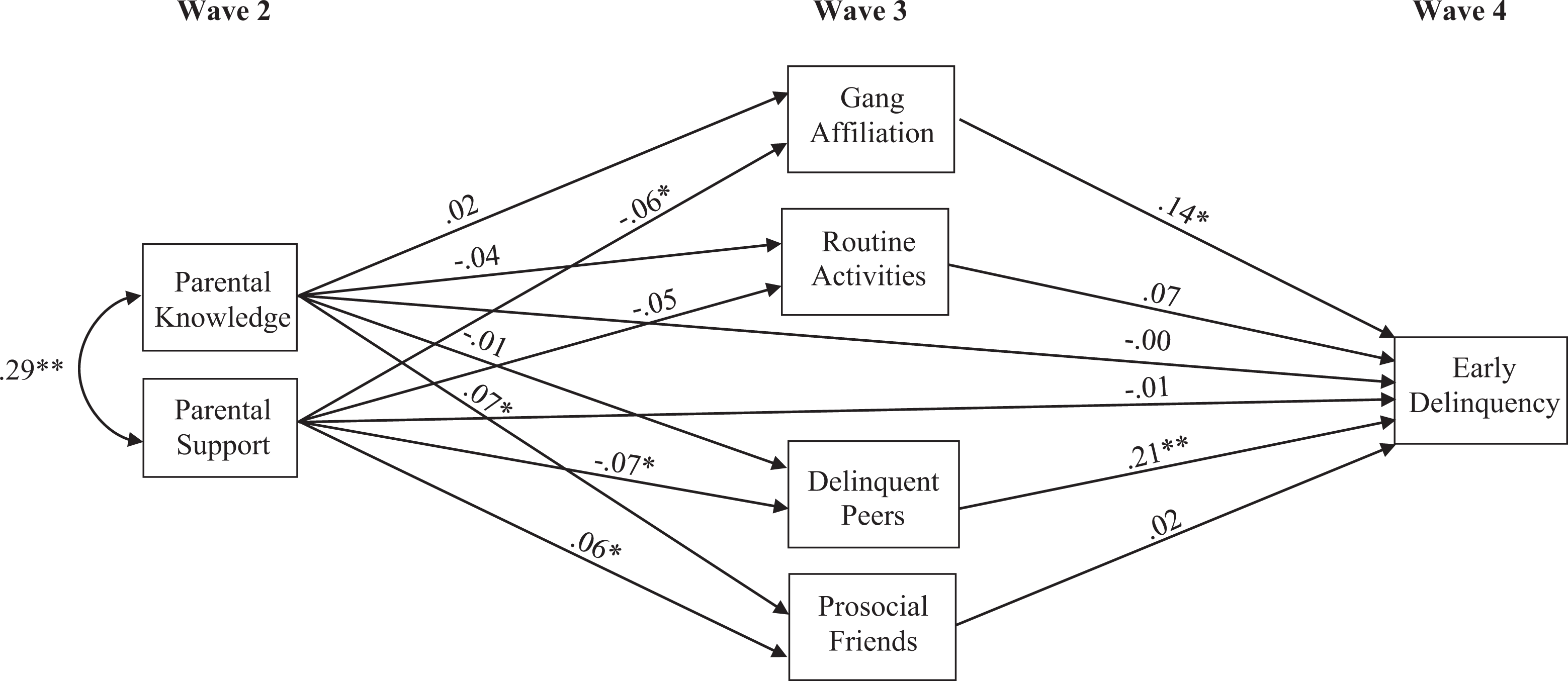
Maximum likelihood with robust standard errors path analysis of the mediation of the parenting–early delinquency relationship by gang affiliation, routine activities, delinquent peers, and prosocial friends. Standardized β coefficients are reported; curved solid double-arrowed line = exogenous covariance between parental knowledge and parental social support at Wave 2; residual (endogenous) covariances at Wave 3 were .10* between gang and RA, .25** between gang and peers, −.10** between gang and prosocial, .26** between RA and peers, −.17** between RA and prosocial, and −.28** between peers and prosocial; control and precursor variables are not shown; N = 1,734. *p < .05, **p < .001.

Maximum likelihood with robust standard errors path analysis of the mediation of the peer–early delinquency relationship by parental knowledge and parental support. Standardized β coefficients are reported; curved dashed double-arrowed line = residual (endogenous) covariance between parental knowledge and parental social support at Wave 3; exogenous covariances at Wave 2 were .19** between gang and RA, .36** between gang and peers, −.14** between gang and prosocial, .39** between RA and peers, −.26** between RA and prosocial, and −.40** between peers and prosocial; control and precursor variables are not shown; N = 1,734. *p < .05, **p < .001.
The 16 Indirect Effects From Wave 2 Parenting/Peers to Wave 4 Early Delinquency.

Note. N = 1,734. The three target pathways are highlighted in bold italics. Parental Knowledge-2 = parental knowledge of child’s activities and associations at Wave 2; Parental Knowledge-3 = parental knowledge of child’s activities and associations at Wave 3; Parental Support-2 = degree of perceived parental social support at Wave 2; Parental Support-3 = degree of perceived parental social support at Wave 3; Gang Affiliation-2 = self-reported affiliation with a gang at Wave 2; Gang Affiliation-3 = self-reported affiliation with a gang at Wave 3; Routine Activities-2 = child participation in unsupervised routine activities with friends at Wave 2; Routine Activities-3 = child participation in unsupervised routine activities with friends at Wave 3; Peer Delinquency-2 = perceived friend involvement in delinquent activity at Wave 2; Peer Delinquency-3 = perceived friend involvement in delinquent activity at Wave 3; Prosocial-2 = degree to which friends involved in various prosocial activities at Wave 2; Prosocial-3 = degree to which friends involved in various prosocial activities at Wave 3; Early Delinquency-4 = participant early delinquency at Wave 4; MCMAM = Monte Carlo Method for Assessing Mediation; Lower = lower boundary of the 95% confidence interval; Upper = upper boundary of the 95% confidence interval.
Sensitivity Testing
The failsafe ef revealed that an unobserved covariate confounder would need to correlate .23 with Gang-3 and .23 with Delinquency-4, controlling for Support-2 and Gang-3 in the case of early delinquency, to eliminate the significant indirect effect proceeding from parental social support to gang affiliation to early delinquency. More so, an unobserved covariate confounder would need to correlate .33 with Peer-3 and .33 with Delinquency-4, controlling for Support-2 and Peer-3, to erase the significant indirect effect linking parental social support, peer delinquency, and early participant delinquency. These findings indicate that the current results were moderately to strongly robust to the effects of omitted variable bias.
In addition to testing for omitted variable bias, it is also important to rule out the possibility of endogenous selection bias or a collider effect. The possibility of a collider effect was evaluated by removing the precursor measures from each of the seven regression equations included in the current path analysis. When precursor measures were removed from the path analysis, all significant a and b paths from the main analyses remained significant, with slight to moderate increases in the path coefficients. Both outcomes are inconsistent with the presence of endogenous selection bias or a collider effect.
Supplemental Analysis
When data from all 3,568 members of the GREAT longitudinal study were analyzed, the results changed very little over what was observed in the main analysis. The same two target pathways achieved significant a and b path coefficients and total indirect effects—Support-2 to Gang-3 to Delinquency-4 (MCMAM 95% CI [−0.14820, −0.0145]) and Support-2 to Peer-3 to Delinquency-4 (MCMAM 95% CI [−0.0196, −0.00179])—whereas the third target pathway (Support-2 to Routine-3 to Delinquency-4) and 13 control pathways all failed to achieve significant total indirect effects.
Discussion
Congruent with the research hypothesis tested in this study, parental social support rather than parental control/knowledge preceded negative peer associations in models predicting early delinquent behavior, and there was no evidence of a reverse order of variables where negative peer associations preceded parental social support. Realization that parental support but not parental control initiated the only two significant pathways found in the current investigation confirms the results of several prior studies (Deutsch et al., 2012; Melotti, Poti, Gianesini, & Brighi, 2018; Wright & Cullen, 2001) and supports Cullen’s (1994) social support paradigm. Moreover, the fact that negative peer associations but not positive peer associations mediated the relationship between parental social support and early delinquency is congruent with findings from several other studies (Carson, 2013; Farrell, Thompson, & Mehari, 2017; Goodearl, Salzinger, & Rosario, 2014). Furthermore, confirmation that the order of variables flowed from parental social support to negative peer associations rather than from negative peer associations to parental social support was consistent with a growing body of literature in psychology and criminology showing that positive parenting may serve as a buffer against the later delinquency-promoting effects of negative peer associations (Brown & Bakken, 2010; Galambos et al., 2003; Goldstein et al., 2005; Keijsers et al., 2012; Warr, 1993).
Implications
One of the principal takeaways from this study is that parental social support interfaces with negative peer associations (i.e., gang affiliation and peer delinquency) to inhibit early delinquency. Parents who develop a positive, supportive relationship with their offspring appear to serve as a protective influence that may block or impede the risk presented by exposure to negative peer associations. Parental support preceding negative peer effects is consistent with both theory (Brown & Bakken, 2010; Farrington, 2005) and research (Forgatch et al., 2016; Walters, 2018b) and is fully consonant with Warr’s (1993) observation that parental social support affects early delinquency indirectly, by limiting, constraining, or buffering the impact of peer delinquency on the child. Moreover, it suggests that causal mediation analysis is one way of achieving greater theoretical integration in criminology, a field that has been criticized for an excess number of single variable theories (Ericson & Carriere, 1994). In the current study, for instance, social control theory, a paradigm that focuses heavily on parenting, and social learning theory, a paradigm that places substantial emphasis on peer delinquency, were effectively integrated with the aid of the causal mediation method.
Another theoretical implication of the current results is that reciprocity between parenting and peer associations failed to receive support. Thornberry (1987) has argued that greater attention need be paid to reciprocal relationships between early delinquency and various social variables. This same argument could be made for the relationship between different crime-relevant social variables like parenting and peer relations. Whereas Thornberry and colleagues have uncovered evidence of reciprocity in the relationship between early delinquency and such social/cognitive variables as attachment to parents, commitment to school (Thornberry, Lizotte, Krohn, Farnworth, & Jang, 1991), delinquent peers, and antisocial beliefs (Thornberry, Lizotte, Krohn, Farnworth, & Jang, 1994), there is, as of yet, no evidence of reciprocity in the relationship between parenting and peers as predictors of delinquency (Forgatch et al., 2016; Walters, 2018b). When testing for reciprocity, it is imperative that researchers take the lag length or the interval between waves into account. If the lag is too short, then there may not be sufficient opportunity to observe a bidirectional effect. If the lag is too long, then opposing unrelated unidirectional effects can give a false impression of reciprocity. The most parsimonious conclusion that can be drawn at this point is that reciprocity occurs between some variables but not others. What little evidence exists on the parenting–peer relationship suggests that it may be unidirectional.
Assessing the individual parenting and peer effects, it was determined that parental social support, but not parental knowledge, was instrumental in initiating verified pathways from parenting to peer associations to early delinquency. Negative peer effects (gang and delinquent associations), on the other hand, were more likely to be the mediating variable in the parenting–peer–delinquency pathway than positive peer effects like prosocial friends. A great deal more research is required, however, before a definitive conclusion can be reached on the types of parenting and peer effects that are most likely to lead to early delinquency. Considering the prominent role parental control plays in currently popular theories of crime and antisocial behavior (Gottfredson & Hirschi, 1990; Patterson, Reid, & Dishion, 1992), it is critically important that this aspect of parenting be further evaluated as a potential initiator of pathways to crime persistence and desistance. Unfortunately, the GREAT study was limited to a single parental control variable (i.e., parental knowledge). In the future, researchers might want to consider investigating other manifestations of parental control, such as discipline, punishment, and direct monitoring, in their studies on parenting, peers, and early delinquency.
The current results suggest that delinquency can be prevented, through either increased parental social support or decreased negative peer associations. Parenting skills training has been found to be effective in preventing delinquency and reducing early antisocial behavior (Piquero et al., 2016). Whereas parenting skills training is designed to improve parental control by teaching the parents of delinquent and predelinquent youth basic disciplinary and child management skills, these skills may indirectly boost the parent–child relationship as well. Even so, parenting, school, and community programs that directly address the child’s relationship with his or her parents and other authority figures are required and, in fact, have been found effective in reducing delinquency (Welsh & Farrington, 2007). Another way early delinquency can be prevented, according to the results of the current study, is to discourage the individual’s involvement with gangs and delinquent peers. Although peer resistance skills have been found to promote desistance in serious offenders (Walters, 2018a) and programs capable of teaching resistance skills to youth are available (Botvin, Griffin, & Nichols, 2006), the most prudent strategy may still be encouraging parental support as a means of buffering against negative peer associations.
Limitations
There are several noteworthy limitations to this study that should be considered when interpreting the results. First, most of the variables in the GREAT database, and all but the treatment variable from the current investigation, were based on participant self-report. Exclusive use of any one method, as was the case in the current investigation, can lead to mono-operational bias and inflation of the path coefficients through shared method variance (Shadish, Cook, & Campbell, 2002). The 1-year lag or gap between waves of longitudinal data, while commonly found in research in criminology, can be considered a second potential limitation of this study. As previously mentioned, if the interval between waves is too short then variable relationships do not have sufficient time and opportunity to form and if the time frame is too long then separate unidirectional relationships can become merged. Third, participants averaged 14 years of age when delinquency outcome was assessed. Because of right censoring in the delinquency measure, the current study should be considered a study of early delinquency rather than delinquency in general. Fourth, there was only one parental support, one parental control, and one positive peer measure included in this study. It would have been preferable to use multiple measures of parental support, parental control, and positive peer effects. Especially lacking, was a measure of parental disciplinary style or skill. Increasing the range of parenting and positive peer association measures included in the analyses should be a priority for future research in this area.
Conclusion
There is a great deal to be learned from studying the parenting–peer connection as it pertains to future delinquent behavior. Lessons learned in the current study include the realization that parental social support protects or insulates a child against the types of negative peer associations that can lead to early delinquency and that the best defense against peer-motivated delinquency may be a strong parent–child bond. Although parental social support appeared to provide a significant protective effect in the current investigation, more research is required to determine whether parental control can exert a similar effect because the only measure of parental control included in the present study was parental knowledge. Additional measures of positive peer associations also need to be examined before it is concluded that parenting’s primary function is to block negative peer effects rather than encourage positive peer relations. The preliminary observations from the current study need to be replicated and extended if we are to take full advantage of the potentially important associations that appear to exist between parenting and peer effects.
Footnotes
Declaration of Conflicting Interests
The author(s) declared no potential conflicts of interest with respect to the research, authorship, and/or publication of this article.
Funding
The author(s) received no financial support for the research, authorship, and/or publication of this article.
