




Abstract
A growing body of research has demonstrated the deleterious effects of adverse childhood experiences (ACEs). Less understood is the role of ACEs in gang involvement among juvenile offenders. The current longitudinal study employs a sample of 104,267 juvenile offenders (mean age of 16, 76% male, 46% Black non-Hispanic, 15.7% Hispanic) to examine the effect of ACE exposure on two different measures of gang involvement by age 18. We use structural equation modeling to test whether higher ACE exposure at Time 1 predicts gang involvement and whether current substance use and/or difficult temperament mediates the ACE-gang involvement relationship. Results indicate ACE exposure at Time 1 predicts gang involvement by age 18, but that much of the effect of ACEs on later gang involvement can be explained by their impact on current substance abuse and difficult temperament. Implications for juvenile justice systems are discussed.
Keywords
What children experience in the first few years of life helps to set the stage for many life course domains including education, employment, physical and mental health, interpersonal relationships, and prosocial (or antisocial) behavior. To the extent that children experience positive parenting within a prosocial environment, they will be more amenable to being effectively socialized, with self-control being one of the most important individual characteristics developed in the first decade of life (see, e.g., Augimeri, Walsh, Donato, Blackman, & Piquero, 2018; Gottfredson & Hirschi, 1990; Moffitt, 1993; Piquero, Jennings, & Farrington, 2010; Tremblay & Craig, 1995).
On the other hand, to the extent that children experience adverse parenting and disadvantaged environments, the chances of effective and prosocial socialization are hampered. Children who find themselves in this negative residential situation are at increased risk of abuse, neglect, and more general household dysfunction—all of which place the child at risk of adverse childhood experiences (ACEs; see e.g., Anda et al., 2006; Felitti et al., 1998). Although there are a great many type of these experiences—not to mention the variability that children may have when they experience and react to these experiences—they tend to involve negative behaviors either aimed at the youth or problems in the home that make socialization more difficult, such as household violence, parental substance abuse, and parental incarceration. Not surprisingly, the literature has investigated the extent to which experiencing ACEs increases the risk of many adverse outcomes including, for example, smoking, heavy drinking, incarceration, various forms of adverse health problems (obesity, heart disease, early death), and poor educational and employment outcomes (see, e.g., Anda et al., 1999; Dube, Anda, Felitti, Edwards, & Croft, 2002; Dube et al., 2003; Felitti et al., 1998).
In this study, we examine the extent to which these experiences are related to gang involvement in adolescence, a pressing social and policy issue (see Decker & Pyrooz, 2015). Further, we consider whether this relationship is not as direct as presumed in large part because ACEs may lead to compromised socialization, which in turn leads to other types of behaviors that then serve to increase the likelihood of gang involvement. Two of these prominent mediators include temperament and substance abuse, both of which are inextricably linked to various sorts of antisocial involvement (Loeber, Farrington, Stouthamer-Loeber, Moffitt, & Caspi, 1998), including gang involvement (Hill, Howell, Hawkins, & Battin-Pearson, 1999; Thornberry, Krohn, Lizotte, Smith, & Tobin, 2003). In order to investigate this issue, we use a database of over 100,000 juvenile offenders throughout the state of Florida. Prior to presenting the results of our study, relevant literature on each of our key constructs is reviewed with a focus on potential pathways between childhood maltreatment and later gang involvement.
Predictors of Gang Involvement
Prior research has found numerous risk factors associated with a youth’s probability of joining a gang (Dmitrieva, Gibson, Steinberg, Piquero, & Fagan, 2014; Howell & Egley, 2005; Pyrooz, Sweeten, & Piquero, 2013), revealing that the process of entering a gang begins in childhood and progresses through distinct developmental stages. The life-course perspective emphasizes how these trajectories are intertwined so that a development in one trajectory will influence another (Krohn & Howell, 2017). Howell and Egley (2005) identified 46 risk factors for gang joining that were drawn exclusively from prospective longitudinal studies. These factors were then grouped within sequential child and adolescent developmental domains (preschool, school entry, childhood, and adolescence) and used to generate a general developmental theory of gang involvement. Raby and Jones (2016) found strong evidence across 102 studies supporting the salience of the four developmental age periods that Howell and Egley identified.
It has been noted that the commonly identified risk factors fit into larger domains (Decker, Melde, & Pyrooz, 2013; Glesmann, Krisberg, & Marchionna, 2009; Howell & Egley, 2005; Klein & Maxon, 2006; O’Brien, Daffern, Chu, & Thomas, 2013). At the individual level, many of the risk factors relate to biological/psychological factors such as hyperactivity and early-onset behavioral issues. Beyond these factors, life stressors and violent victimization are highlighted as key risk factors (Howell & Egley, 2005). From the peer domain, low prosocial peer association/commitment (Esbensen et al., 2001; Hill et al., 1999; Thornberry et al., 2003) and early initiation into delinquent behavior were consistent predictors of joining a gang (Esbensen et al., 2001; Thornberry et al., 2003). More generally, negative life events and fear or experiences of victimization have been linked to joining a gang (Maxson & Whitlock, 2002; Maxson, Whitlock, & Klein, 1998; Melde, Taylor, & Esbensen, 2009).
In a recent prospective study, Howell, Braun, and Bellatty (2017) set out to identify early indicators of who would likely become actively involved in juvenile delinquency and subsequently court-referred to the Oregon Youth Authority (OYA). To inform this mission, researchers extracted data on the juvenile offender group and their families in “feeder” systems (i.e., welfare, mental health treatment, alcohol and drug treatment, foster care, child protective services, and education). This project also permitted an examination of the practical utility of the Howell–Egley theory for early intervention among early adolescents, while using feeder system’s data from various child and family agencies in Oregon. Findings showed that the strongest predictors of gang involvement were at the individual level (i.e., individual attitudes, such as the belief in physical aggression to resolve disagreements, and violent tendencies, such as deliberately inflicting pain and weapons use) and within the peer domain (i.e., leading peers in antisocial behavior and committing crimes for peer status or revenge).
The family-level risk factor domain for gang joining comprises several aspects related to family life including family composition, parenting style, and having parents who possess favorable attitudes toward antisocial behavior (Hill et al., 1999; Vuk, 2017). More central to the current study, certain family circumstances have been shown to significantly predict gang involvement, including a lack of health insurance, the jailing or imprisonment of a household member, and foster care placement—all of which are considered “adverse childhood experiences” (Howell & Griffiths, 2019). A number of longitudinal studies have further elucidated the causal relationship between family-level risk factors and gang membership. Gordon et al. (2014) found that families involved in the Pittsburgh Youth Study who had moved during the previous year and were not in a consistent housing situation were more likely to join a gang at a later point in time. The oldest cohort of the Pittsburgh Youth Study was analyzed to elucidate how abuse and neglect directly impacted delinquency, finding that youth who had been referred to the child welfare system and accepted for services with substantiated cases had higher rates of aggressive behavior, fighting, and violence (Stouthamer-Loeber, Loeber, Homish, & Wei, 2001).
Although there is evidence that family-level risk factors increase the odds of gang membership and gang-involved youth have experienced higher rates of family-level risk factors (Esbensen, Peterson, Taylor, & Freng, 2009; Howell & Griffiths, 2019; Thornberry et al., 2003), there are still gaps in testing the relationship directly between ACEs, the cumulative effects of these specific experiences, and gang membership. We review prior research on ACEs, highlighting the potential for them to contribute to gang membership either directly, or indirectly, through their impact on a number of developmental and intermediate outcomes.
Deleterious Effects of ACEs’ Exposure
ACEs commonly refer to 10 specific abuse, neglect, and household dysfunction exposures prior to age 18, including physical neglect, emotional neglect, physical abuse, emotional abuse, sexual abuse, violent treatment toward mother, household substance abuse, household mental illness, parental separation/divorce, and having a household member with an incarceration history (Centers for Disease Control and Prevention [CDC], 2018). Each exposure is captured as a binary yes/no experience and combined in an additive index ACE score ranging from 0 (no exposure to any of the 10 ACE) to 10 (exposure to each of the 10 ACE). ACEs and the ACE score were first defined and examined in a collaborative two-wave study where the CDC and the San Diego Department of Preventive Medicine at Kaiser Permanente (an integrated managed care consortium) assessed the relationship of ACEs to adult health. Examining retrospective reporting of ACEs among 17,421 well-educated, middle-class patients and their current health conditions, Felitti and colleagues (1998) demonstrated ACEs are common, highly interrelated, and exert a powerful cumulative effect on human development (Anda, Butchart, Felitti, & Brown, 2010; Baglivio, 2018; Baglivio & Epps, 2016; Dong et al., 2004; Scott, Burke, Weems, Hellman, & Carrion, 2013). With respect to interrelatedness, among the Wave 1 ACE Study adults, exposure to any given ACE increased the odds of exposure to at least one other ACE 2–17.7 times (Dong et al., 2004), while among juvenile offenders, the odds of having another ACE exposure given one exposure were on average of 2.3 times and up to 1,286 times those of a youth without that exposure (Baglivio & Epps, 2016). Given ACEs co-occur in a nonrandom fashion, it is argued that ACEs should be examined as a collective rather than in isolation.
Negative health outcomes, including ischemic heart disease to morbid obesity, have been well supported in the literature (see Anda et al., 2006; Chartier, Walker, & Naimark, 2010; Felitti et al., 1998; Flaherty et al., 2013), especially for those with ACE scores of 4 or more. Dramatically, those with six or more ACEs died nearly 20 years earlier, on average, than individuals reporting no exposures (Brown et al., 2009). While the negative health implications of childhood maltreatment and traumatic exposure found among adults are certainly cause for concern, decades of research has also revealed the deleterious effects of maltreatment on delinquency and offending. For instance, among a retrospective cross-sectional study of 1,500 U.K. residents aged 18–70, those with four or more ACEs were at increased risk of involvement in violence with an adjusted odds ratio of 8.83 for incarceration (Bellis, Lowey, Leckenby, Hughes, & Harrison, 2014). After controlling for prior delinquency, experiencing childhood physical abuse and other maltreatment was associated with higher self-reported total, violent, and property offending (Teague, Mazerolle, Legosz, & Sanderson, 2008). Child abuse and neglect exposure were shown to double female youth’s risk for arrest of a violent offense (Maxfield & Widom, 1996). Smith and Thornberry’s (1995) longitudinal analysis demonstrated childhood maltreatment increased the odds of both self-reported and official delinquency, risk and frequency of being arrested, and even more serious and violent forms of delinquency. Maxfield and Widom’s (1996) seminal work found the odds of juvenile violent behavior increased by over 200% for those exposed to abuse during childhood, a pattern that continues into adulthood (Widom, Fisher, Nagin, & Piquero, 2018).
Similar findings related to associations with crime and delinquency have been found for other childhood traumatic exposures such as witnessing domestic abuse at home (Evans, Davies, & DiLillo, 2008; Herrera & McCloskey, 2001; Moylan et al., 2010), parental divorce (Amato, 2001; D’Onofrio et al., 2005), and parental incarceration (Geller, Garfinkel, Cooper, & Mincy, 2009; Murray & Farrington, 2008; Parke & Clarke-Stewart, 2002). A recent meta-analysis of 33 prospective studies, including nearly 24,000 individuals, confirmed that maltreatment is associated with higher rates of both general and aggressive antisocial behaviors (Braga, Goncalves, Basto-Perpeira, & Maia, 2017).
The negative repercussions of childhood maltreatment and traumatic exposure extend beyond antisocial behavior. A recent meta-analysis found a significant relationship between traumatic exposure as a child or adolescent and the development of post-traumatic stress disorder, especially among those exposed to interpersonal violence and among girls (Alisic et al., 2014; see also Levendosky, Bogat, & Martinez-Torteya, 2013). These findings echo prior work indicating up to 30% of justice system–involved juveniles meet clinical criteria for post-traumatic stress disorder (Dierkhising et al., 2013).
Further, it has been established that exposure to childhood maltreatment is higher among justice system–involved youth (Costello, Erkanli, Fairbank, & Angold, 2002; Vitopoulos, Peterson-Badali, Brown, & Skilling, 2018; Trulson, Haerle, Caudill, & DeLisi, 2016). Prior work has consistently indicated justice-involved adolescents had substantially higher prevalence of childhood maltreatment and multiple forms of trauma than general population studies (Abram et al., 2004; Dierkhising et al., 2013). Recent studies using the ACE score have found the same, such that juvenile offenders were found 13 times less likely to report 0 ACEs and 4 times more likely to report ACE scores of 4 or more compared with the ACE study’s private-insured population of mostly college-educated adults (Baglivio et al., 2014).
Additionally, it appears the deeper an adolescent penetrates the juvenile justice system, the higher the prevalence of ACE and multiple ACE exposure (e.g., Cannon, Davis, Hsi, & Bochte, 2016; Espinosa, Sorensen, & Lopez, 2013; Sedlak & McPherson, 2010; Trulson et al., 2016). Examining over 64,000 juvenile offenders, Baglivio & Epps (2014) [demonstrated low risk to reoffend youth was more likely to report 0 ACE exposures than high-risk youth, with 22% of the variance in risk to reoffend category (as per a validated tool) explained by the ACE score. Among 4,733 juvenile offenders, each additional ACE exposure, captured by age 12, increased the likelihood that a youth would be committed to a juvenile justice residential facility by age 18 by 20%, though the ACE-residential placement effect did not hold for White males or females or Hispanic females (Zettler, Wolff, Baglivio, Craig, & Epps, 2018).
ACE-specific studies related to antisocial behavior and offending are equally as stunning as those found across the broader childhood maltreatment literature. For example, Duke, Pettingell, McMorris, & Borowsky (2010) demonstrated that each additional type of ACE exposure increased the risk of violence perpetration by 35–144%, including both interpersonal violence (delinquency, weapon carrying, fighting, bullying, and dating violence) and self-directed violence (attempted suicide, self-mutilation). A prospective analysis of ∼28,000 juvenile offenders completing community-based placements in Florida demonstrated higher ACE scores increased the risk of, and led to shorter time to, recidivism (Wolff, Baglivio, & Piquero, 2015). Importantly, this dose–response effect of ACEs held across gender and race. Using semi-parametric group-based modeling, higher ACE scores increased the likelihood of having an early onset (age 12 or under), chronic offending prevalence trajectory (Baglivio, Wolff, Piquero, & Epps, 2015), with those having greater than five ACEs experiencing dramatically greater odds of early onset, persistent offending (with an average of 18 arrests prior to age 18). Lastly, Fox, Perez, Cass, Baglivio, and Epps (2015) demonstrated each additional ACE exposure equated to a 35% increase in the likelihood of serious, violent, chronic offending (at least five arrests, one of which must have been violent against person felony or weapon offense) by age 18 compared to those adjudicated for only one nonviolent felony (see also Perez, Jennings, and Baglivio, 2018).
ACEs and Gang Membership
As described above, adversity during childhood can have cumulative effects on negative health and behavioral outcomes. Although these studies did not directly examine the association between ACEs and gang involvement, findings do relate to serious violence and delinquent/criminal behavior, which is often linked with gang membership (Esbensen et al., 2009). In addition, many of the risk factors identified in past research on gang membership represent ACEs, although they were not described or measured as such. Importantly, the logic underlying the dose–response relationship associated with research on ACEs is similar to the notion that cumulative effects of risk factors increase the odds of gang membership and violent offending (Esbensen et al., 2009; Thornberry et al., 2003).
To our knowledge, a very limited number of studies have examined the relationship between ACEs and gang membership. First, Miller et al. (2012) found that exposure to domestic violence, childhood physical and sexual abuse, and community violence was prominent and closely associated with poor reproductive health among 20 gang-involved Latina girls. Secondly, examining a sample of American youth aging out of foster care, latent class analysis techniques identified three latent groups of ACEs, one of which was a “complex class” that included a sample of youth where neglect, physical abuse, and substance abuse were highly likely, while another one of the latent classes. The “environmental group” had more experiences of witnessing violence or killing, being involved in physical fights, and experiencing a life-threatening accident (Rebbe, Nurius, Ahrens, & Courtney, 2017). These authors also found that odds of gang membership were different across the groups, with the highest rates of gang membership for the youth in the environmental group as compared to the other two classes.
Howell et al. (2017) examined juvenile offenders who were under supervision of the OYA, utilizing data on this offender group and their families drawn from multiple administrative sources (i.e., welfare, mental health treatment, alcohol and drug treatment, foster care, Child Protective Services, and education). While the strongest predictors of gang involvement among this statewide sample of young offenders were at the individual level, and within the peer domain, certain family circumstances also significantly predicted gang involvement. These findings suggest pathways by which ACE exerts indirect effects on the outcomes of interest through a number of mediating factors. Building off of the research base, we consider whether the relationship between ACEs and gang membership is not as direct as may be presumed in large part because ACEs may lead to other conditions/behaviors that serve to increase the likelihood of gang involvement. As such, the current study builds on prior work by examining the potential for substance use and difficult temperament to mediate the ACE–gang association relationship. Next, we briefly review past research on the relationship between ACEs and our mediators as well their relationship with gang membership.
ACE Exposure, Substance Use, and Gang Membership
Increased traumatic exposure and childhood maltreatment have been demonstrated to be associated with higher likelihood of substance use and substance use disorder (Afifi, Brownridge, Cox, & Sareen, 2006; Anda et al., 2006; Brown & Shillington, 2017; Ding, Lin, Zhou, Yan, & He, 2014; Dube et al., 2003; LeTendre & Reed, 2017; Shin, McDonald, & Conley, 2017; Vaughn et al., 2017). Additional literature has indicated that ACE exposure increases the risk of drug and alcohol use/abuse among juveniles and adults (Anda et al., 1999; Dube et al., 2002; Dube et al., 2003; Mersky, Topitzes, & Reynolds, 2013; Schilling, Aseltine, & Gore, 2007; Young, Hansen, Gibson, & Ryan, 2006). In comparison to those without any ACEs, those with at least five such exposures were 7–10 times more likely to be addicted to illegal drugs and to experience some problem associated with their drug use (Dube et al., 2003). Additionally, ACEs have been linked to early initiation of marijuana and alcohol use (Dube et al., 2002; Forster, Gower, Borowsky, & McMorris, 2017). Examining the pathways by which this relationship manifests, Chatterjee et al. (2018) found internal assets such as social competency and positive identity moderate the abuse and household dysfunction, early initiation of marijuana and alcohol use relationship for females, though not for males. Additional work showed in comparison to those who reported no ACE exposures, adults with an ACE score of 6 were 46 times more likely to be intravenous drug users (Reavis, Looman, Franco, & Rojas, 2013).
A recent study examining juvenile offenders in Florida investigated whether the co-occurrence of mental health problems, drug use, and alcohol use mediated the effect of ACEs on recidivism (Craig, Zettler, Wolff, & Baglivio, 2018). Those results demonstrated a partial mediation effect of current drug use (as well as the co-occurrence of drug use and mental health problems) on the ACE–recidivism relationship for the full sample, while the direct effect of ACEs on recidivism remained significant across all gender and race/ethnic subgroups (Craig et al., 2018).
This line of research suggests that ACEs contribute to substance use problems, a risk factor shown in past research to contribute to gang membership (Beyers, Toumbourou, Catalano, Arthur, & Hawkins, 2004; Hill et al., 1999; Walker-Barnes & Mason, 2004), and thus represents a plausible mediator in the ACE-gang association relationship.
ACEs, Temperament, and Gangs
The association between ACEs and temperament is multifaceted but contains two important features. On one hand, various forms of abuse and neglect are significantly associated with conduct problems relating to poor self-regulation and affective problems relating to deficits in emotional regulation (Haapasalo & Pokela, 1999; van Goozen, Fairchild, Snoek, & Harold, 2007), and these effects are often enduring. For instance, in their 12-year longitudinal study, Lansford (2002) reported that preschool physical maltreatment was linked to elevated aggression, negative emotionality, anxiety and depression, and social problems stemming from low self-regulation. Importantly, one of the social problems relating to low self-regulation was gang membership. On the other hand, existing evidence suggests temperament is moderately-to-strongly heritable and thus present in the earliest years of life (Plomin et al., 1993). Youth with difficult temperaments, particularly those relating to self-regulation difficulties, oppositionality, and negative emotional displays are more likely to evoke or elicit corporal punishment and other forms of negative parenting including those congruent with ACEs. For example, a meta-analysis of 84 studies found that children with more difficult temperaments are more vulnerable to negative parenting due to reduced self regulation and increased negative emotionality (Slagt, Dubas, Deković, & van Aken, 2016). Thus, a circular dilemma characterizes the ACE–temperament relationship whereby abuse and neglect contribute to negative temperamental features and temperamental deficits especially when embodied in youth with clinical conduct problems are more likely to elicit coercive and abusive responses from adults, namely parents.
Because the study of temperament overwhelmingly focuses on early childhood development, there has not been much explicit study of associations with gang membership, gang activity, and gang delinquency. Yet clear connections can be drawn between ACEs, temperamental features, and involvement in risky, dangerous behaviors including gang activity. For example, van Goozen, Fairchild, Snoek, and Harold’s (2007) neurobiological model suggests that the stress regulating system such as the hypothalamic–pituitary–adrenal axis and the autonomic nervous system interact with early childhood adverse environments to increase susceptibility to severe, persistent antisocial behavior. Children with these deficits do not understand dangerous settings nor do they display appropriate emotional response to these settings. As a result, they do not physiologically experience the threat of dangerous settings via autonomic or endocrine stress response. This leads to a cycle of selection of dangerous settings and a muted response to the dangers therein, not unlike the selection into gang activity.
From another perspective, criminologists identified early-emerging self-regulation deficits and emotional dysregulation as important stepping-stones. To illustrate, in their developmental model of gang involvement, Howell and Egley (2005) suggested that aggressive and disruptive behaviors such as those consistent with difficult temperament were an important developmental piece in the etiology of gang delinquency. Specifically, they theorized that core self-regulation problems present upon school entry contributed to conduct problems, school problems, peer rejection, antisocial peer selection, and delinquency on the way toward gang membership.
Empirically, studies using diverse data sources have shown that youth involved in gang activity exhibit psychosocial characteristics that are consistent with temperament research. Similarly, analysis of data from the National Longitudinal Survey of Children and Youth found that youth with psychopathic features characterized by high hyperactivity, low anxiety, and low prosociality were susceptible to joining gangs during adolescence (Dupere, Lacourse, Willms, Vitaro, & Tremblay, 2007). In the Seattle Social Development Project, gang members had more antisocial beliefs, greater hyperactivity, greater oppositional tendencies, and more externalizing behaviors (Gilman, Hill, & Hawkins, 2014)—features that are similar to the low effortful control and higher negative emotionality in DeLisi and Vaughn’s (2014) theory. In their study using longitudinal data of youth from Montreal, Craig, Vitaro, Gagnon, and Tremblay (2002) reported robust evidence of rank-order stability involving stable gang members, unstable gang members, and nongang members. Stable gang members had the most severe profiles including aggression/fighting, hyperactivity, inattention, and oppositionality. In sum, gang members evince a high-risk profile based on their adverse backgrounds and difficult temperament characteristics.
Current Study
While a growing body of research has demonstrated the deleterious effects of ACEs, less understood is the role of ACEs in gang involvement among juvenile offenders. The current longitudinal study employs a sample of 104,998 juvenile offenders from the state of Florida. We test whether greater ACE exposure at Time 1 (measured at time of first full assessment) predicts gang involvement by age 18, net of a host of commonly established juvenile offending risk factors for both male and female juveniles using two different measures of gang association. Finally, we also assess the potential for current drug use and difficult temperament to mediate the ACE-gang membership relationship.
Data and Methods
Sample
The current study leverages official data from the Florida Department of Juvenile Justice. Data are inclusive of all demographic, arrest, placement, and risk assessment information captured in the state’s centralized information system. In addition, the juvenile justice agency uses specialized critical and special alert “flags” within the information system to call attention to physical health, mental health, or security issues that may require individual attention or closer supervision related to each juvenile. Such “flags” include escape risk, special diets/allergies/medical alerts, suicide alerts, and, central to the current study, gang-involvement alerts of “verified” and “suspected” (described in detail below).
Specifically, in the current study, we examine 104,996 youth that aged out of the juvenile justice system (turned 18 years of age) between January 1, 2007, and December 31, 2017. Juveniles with gang involvement at Time 1 were excluded (as the current study uses Time 1 ACE, substance use, and temperament to prospectively predict who will become gang involved by age 18), as well as 49 youth for which their race/ethnicity was classified as “unknown.”
The Community Positive Achievement Change Tool (CPACT) is a validated risk/needs tool used to classify all youth referred to the state’s juvenile justice agency (all youth “arrested” under the age of 18) in terms of overall risk to reoffend (low, moderate, mod–high, or high risk to reoffend). The tool has both a Prescreen (46 items) and a Full Assessment (126 items) version. Both versions produce identical risk to reoffend classifications; however, the Full Assessment groups items into 12 domains and produces domain risk and protective scores as well (except for criminal history, which only has a risk score). All youth are then reassessed every 180 days (if low or moderate risk) or 90 days (if mod–high or high risk) during their dispositions/placements, and at each subsequent rearrest (if applicable). Juvenile probation officers (with a bachelor’s degree, at minimum) conduct the PACT assessments after successfully completing a 3-day PACT and case planning training (inclusive of interrater reliability exercises) and a 2-day standardized Motivational Interviewing training. All nondemographic independent variables used in the current study are derived from PACT items.
As we are examining ACE scores, following the methodology of prior work, as mentioned, only the Full Assessment contains requisite items to create the 10-item ACE score (see ACE Score section below on ACE score creation). This criterion of a Full Assessment necessarily oversamples higher risk juvenile offenders, as only moderate–high and high risk to reoffend youth are administered the Full Assessment, as are any youth considered for placement in residential facilities, day treatment programs, or intensive family therapy programs. Prior work has indicated this process samples roughly 32% of all juvenile offenders across the state (Baglivio et al., 2014), with the Full Assessment youth being higher proportion male and Black, and a lower proportion Hispanic (Craig, Baglivio, Wolff, Piquero, & Epps, 2017). The exclusion criteria (Full Assessment, race/ethnicity data, no gang involvement at Time 1) resulted in a final sample of 104,266 juvenile offenders (mean age of 16, 76% male, 46% Black non-Hispanic, 15.7% Hispanic).
Measures
Gang Involvement
As a sensitivity check, the current study employs two distinct dependent measures of gang involvement: verified gang member/associate and self-reported gang involvement.
Verified gang member/associate
Only law enforcement can verify a youth as gang involved (gang member or associate) in the study state. Youth whom juvenile justice probation officers or contract private provider staff suspect (see below) as gang involved send a referral for suspected gang involvement, after review by a juvenile justice judicial circuit gang liaison, to local law enforcement. Law enforcement then “verify” the youth’s involvement, if a number of statutory criteria are met. 1 Only youth for whom the juvenile justice agency has received written documentation from law enforcement certifying a youth as gang involved (as per state statute) were classified as “verified” for the purposes of the current study. The documentation from law enforcement is indicated to have been received and placed in the juvenile’s case file prior to the alert being entered into the information system. In the analysis of official gang association, those youth who were verified gang associates at the time of their first arrest were removed from the analysis as this measure is static in nature and would thus perfectly predict later gang involvement.
Self-reported gang involvement
In our analysis, we also assess the impact of ACEs on a second measure of gang involvement drawn from PACT data that are collected through a semistructured interview conducted by a juvenile probation officer, a case file review, and a review of official records. Specifically, the PACT assessment contains an item addressing self-reported gang involvement along with delinquent peer associations. The history of antisocial peer associations item response of “been a gang member/associate” was used to determine youth who reported being gang involved at any point prior to age 18 (again, youth with self-reported gang involvement at Time 1 on this item were excluded from the sample, ensuing appropriate time order). There were a total of 6,875 youth (6.9%) that self-reported gang involvement by age 18 (after excluding those who reported gang involvement at Time 1). 2 While certainly an imperfect measure of gang involvement, prior work has used a single self-report item for gang association (e.g., Melde & Esbensen, 2011) and has indicated the validity of self-reported gang-involvement items (e.g., Krohn, Ward, Thornberry, Lizotte, & Chu, 2011).
ACE Exposure at Time 1
The youth’s extent of exposure to the 10 traumatic exposures encompassed by the ACE score at first Full Assessment was derived from the PACT assessment. In keeping with the prior ACE-specific work discussed above, we include binary (yes/no) indications for the 10 indicators, then summing exposures for a 0 (no exposures) to 10 (exposure to each of the 10 indicators) ACE score. A brief description of each ACE and responses indicating affirmative exposure are as follows:
Emotional abuse: Parents/caretakers were hostile, berating, and/or belittling to youth.
Physical abuse: The youth reported being victimized or physically abused by a family member.
Sexual abuse: The youth reported being the victim of sexual abuse/rape.
Emotional neglect: Family has little or no willingness to support youth, and/or youth do not feel close to any family member.
Physical neglect: The youth have a history of being the victim of neglect (includes a negligent or dangerous act or omission that constitutes a clear and present danger to the child’s health, welfare, or safety, such as failure to provide food, shelter, clothing, nurturing, or health care).
Family violence: Domestic violence or sexual abuse in the home (not against the youth him/herself), or if the youth have witnessed violence in either their home, or in a foster/group home.
Household substance abuse: Problem history of parents and/or siblings in the household includes alcohol or drug problems.
Household mental illness: Problem history of parents and/or siblings in the household includes mental health problems.
Parental separation/divorce: Youth do not live with both mother and father.
Incarceration of household member: There is a jail/prison history of family members
The 10 exposures were summed, resulting in an average ACE score for the sample of 2.8 (SD = 1.86).
Potential Mediator: Current Drug Use
Whether the youth had used drugs in the 4 weeks prior to the first Full Assessment was captured by an item assessing the youth’s drug use. The variable distinguished youth not currently using drugs from those currently using and those whose current use causes problems across life domains such as school, family, health, peer associations, or criminal behavior (coded 0–2, respectively). Of note, alcohol use was not included in this item as there was no association observed between ACEs and alcohol use among this sample of juvenile offenders.
Potential Mediator: Difficult Temperament
A “difficult temperament” measure was created through combination of 10 PACT items (measured at Time 1) using a confirmatory factor analysis. The temperament scale evidenced a satisfactory fit to the data (root mean square error of approximation [RMSEA] < .05, comparative fit index [CFI] = .941, tucker lewis index [TLI] = .903) with each of the observed measures loading significantly on the latent variable. The resulting temperament construct encapsulated both effortful control and negative emotionality items (DeLisi & Vaughn, 2014), coded such that lower effortful control and higher negative emotionality equated to a more difficult temperament. Items included impulsivity, belief in the ability to control one’s own antisocial behavior, empathy, respect for property, respect for authority, attitude toward law-abiding behavior, frustration tolerance, hostile interpretation of other’s intent/actions, belief in using verbal aggression, and belief in using physical aggression.
Impulsivity distinguished youth who usually think before acting, those exhibiting some self-control, impulsive youth, and highly impulsive youth, coded 1–4, respectively, with higher values indicating greater impulsivity. Belief in the ability to control one’s own antisocial behavior distinguished those who believe he/she can avoid/stop antisocial behavior, those who somewhat believe so, and those who believe his/her antisocial behavior is out of his/her control (coded 1–3, respectively, with higher values indicating less control of antisocial behavior). Empathy separated those with empathy for his/her victims, those with some empathy, and those that do not have/express empathy for victims of his/her criminal behavior (coded 1–3, respectively, with higher values indicating less empathy for victims). Respect for property distinguished those who respect other’s property, those who respect personal but not public property, those with conditional respect (“if they are stupid enough to leave it out, they deserve losing it”), and those who have no respect for others property (coded 1–4, respectively, with higher values indicating less respect for property). The respect for authority item contains options for respecting most authority figures, does not respect, resents most authority, and those that defy or are hostile toward most authority figures (coded 1–4, respectively, with higher values indicating less respect for authority). Attitude toward law-abiding behavior distinguishes youth who abide by conventions/values, those that believe such values sometimes apply, those that do not believe in conventions/values, and those that resent or are hostile to responsible behavior (coded 1–4, respectively, with higher values indicated a less positive attitude toward law-abiding behavior). The frustration tolerance PACT item distinguishes among those that rarely get upset over small things, those that sometimes get upset, and those that often get upset over small things or have temper tantrums (coded 1–3, respectively, with higher values indicating less tolerance for frustration). Hostile interpretation of others’ intent/actions separates primarily positive view of the intentions of others, primarily negative view, or primarily hostile view of the intentions of others (coded 1–3, respectively, with higher values indicating a more hostile interpretation). Verbal aggression agreement distinguishes those that believe such aggression is rarely appropriate, sometimes appropriate, or often appropriate (coded 1–3, respectively, with higher values indicating more appropriateness attributed to using verbal aggression). Similarly, physical aggression agreement captures belief such aggression is never appropriate, rarely appropriate, sometimes appropriate, or often appropriate (coded 1–4, respectively, with higher values indicating greater belief physical aggression is appropriate to resolve disagreements).
Control Measures
Demographics
Age, sex, and race/ethnicity were included as control measures. Age was captured as a continuous indicator, with an average age of just over 16 years (ranging from 7.46 to 21.7, SD = 1.46). Sex distinguished males (=1) from females (=0). Race/ethnicity included dichotomous indicators for Black (=1), White (=1), Hispanic (=1), and “Other” (=1). Of note, in keeping with the business rules of the juvenile justice agency, Hispanic youth may be Black or White, while classifications of race are non-Hispanic (Black non-Hispanic, White non-Hispanic).
Risk factors
Several prominent risk factors shown to be associated with gang involvement discussed above were included as controls, all assessed at first PACT Full Assessment (Time 1). Given the relationship between early initiation into delinquent behavior and gang membership shown in past research (Esbensen et al., 2001), age at first offense included categories captured by the PACT as 12 years and under, 13–14 years, 15, 16, and over 16 years of age at first arrest (coded 1–5, respectively). Age at first school suspension/expulsion used PACT categories of 5–9 years old, 10–13 years, 14–15 yeas, 16–18 years, or no expulsions, coded 1–5, respectively, with higher values indicating older age at first suspension/expulsion (or no suspensions/expulsions). School attendance captures the youth’s attendance in the most recent school term (most recent to the Time 1 Full Assessment) and includes the following categories: graduated, good attendance/few excused absences, no unexcused absences, some partial-day unexcused, some full-day unexcused, habitual truant (15 or more unexcused in a 90-day period), and dropped out or expelled. This measure was coded 0–6, with higher values indicating more attendance problems. A measure capturing the PACT assessor’s assessment of the likelihood the youth would stay in school and graduate, distinguishing those who were very likely to stay and graduate, uncertain, and those not very likely to stay and graduate (coded 0–4, respectively, with higher values indicating less likelihood of staying in school or to have dropped out).
Given recent findings related to protective factors such as a prosocial environment and prosocial involvement, we include a number of related measures in the current analysis (Nuño & Katz, 2018). The youth’s current participation in structured activities assessed whether the youth participates in structured and supervised prosocial community activities such as athletics, clubs, or religious groups. This item distinguished those involved in the last 6 months in two or more activities, one structured activity, those interested but not involved, and those not interested in any structured activity (coded 1–4, respectively, with higher values indicating less involvement). Prosocial relationships captures youth that have positive adult nonfamily relationships not connected to school or employment (adults who can provide support and model prosocial behavior). The item distinguishes those with no positive adult relationships, one, two, and three or more positive adult relationships (coded 1–4, respectively, with higher values indicating more positive relationships with prosocial adults). Prosocial community ties item assesses whether the youth has no prosocial community ties, some, or strong prosocial community ties (coded 1–3, respectively, with higher values indicating stronger prosocial community ties). Table 1 displays the descriptive statistics for all measures used in the current analysis.
Descriptive Statistics for the Analysis of Adverse Childhood Experiences and Gang Involvement.
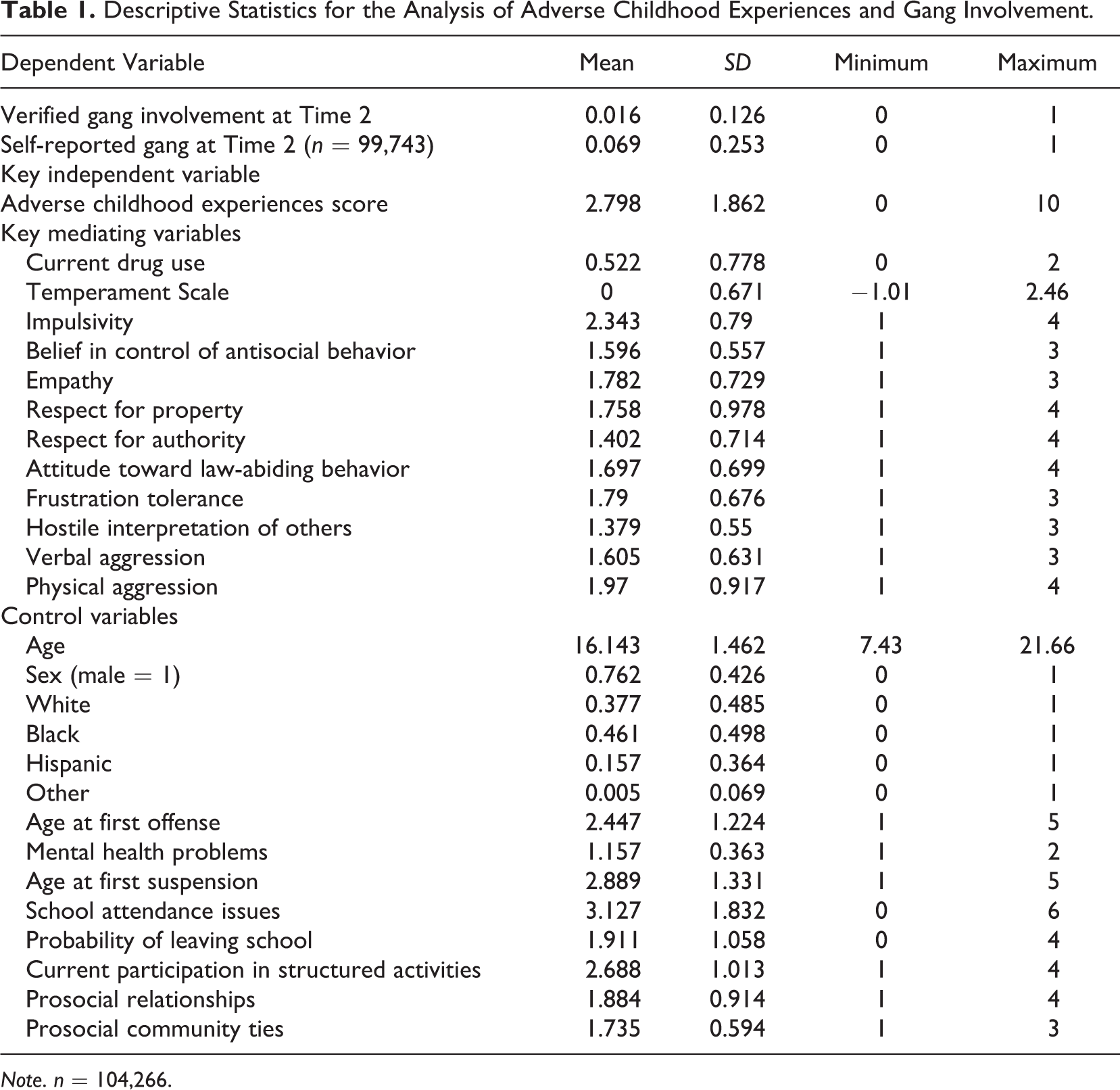
Note. n = 104,266.
Finally, a history of mental health problems was a dichotomous indicator for youth with no history of mental health problems (=1) and those with mental health problems (=2). Mental health problems included schizophrenia, bipolar, mood, thought, personality, and adjustment disorders. Conduct disorder, oppositional defiant, attention deficit disorder/attention deficit hyperactivity disorder, and substance abuse disorders were excluded. All mental health problems must have been confirmed by a professional qualified to do so (e.g., psychologist, licensed mental health counselor).
Analytic Strategy
Our analysis unfolded in a number of stages. First, Spearman’s rank correlations were utilized to explore the relationships present between the key variables used in the analysis for the current sample of justice-involved youth. In addition to assessing for the possibility of collinearity issues, these bivariate relationships provide preliminary evidence related to the proposed model in which a portion of the effect of ACEs on gang involvement can be explained by its effect on temperament and substance abuse. Importantly, Spearman’s ρ is a nonparametric measure of correlation, which represents a more appropriate statistical measure of association than the traditional Pearson’s correlation coefficient given the categorical nature of many of our measures.
After establishing bivariate relationship between our key independent variable (ACEs), mediating variables, and gang association before the age of 18, these measures were included in a more complex multivariate model to examine the key relationships between them, while controlling for several variables related to gang membership. Specifically, given the relative rarity of gang association, even among this sample of justice system–involved youth, we use rare events logistic regression, which is more appropriate than traditional logistic regression when the outcomes of interest have a prevalence of less than 5% (King & Zeng, 2001). These models have been used in previous research devoted to other rare criminological outcomes, such as violent offending and homicide (Piquero, MacDonald, Dobrin, Daigle, & Cullen, 2005), as well animal cruelty and fire setting behavior (Baglivio et al., 2016).
Finally, the current study employs a multiple mediation structural equation model (SEM) that utilizes bootstrapping to test for an indirect effect of ACEs on gang association by the age of 18 through our measures of temperament and current substance abuse. Developed by Hayes and Preacher (2010), bootstrapping is a nonparametric resampling procedure and involves repeatedly sampling from the full data set in order to generate a sampling distribution for each of obtained results. From this sampling distribution, created by extracting a number of bootstrap draws, the confidence interval (CI) for the indirect effect can be obtained. Past research has demonstrated this method is superior to Baron and Kenny’s (1986) mediation tests when analyzing a dichotomous outcome because it does not assume that the sampling distribution of the indirect effect is normally distributed. As recommended by Hayes (2009), the current analysis employs 5,000 bootstrap draws to generate bias corrected 95% CIs around each estimate. A CI that does not include zero provides evidence of a significant indirect effect (Hayes, 2009).
A small number of multivariate outliers (approximately 1% of the sample) were identified using Mahalanobis distance scores. Supplemental analyses were estimated without these outliers, and the results were found to be substantially similar, so these cases were retained. There was no evidence of heteroscedasticity present within the regression models estimated. As a sensitivity analysis, each of the multivariate analyses described above are repeated twice, using the two measures of gang involvement included in the current study. In both cases, youth who were gang associated at the time of the first arrest were removed from the analysis, leading to slightly different samples analyzed for each outcome. 3
Results
Bivariate Analysis
Table 2 displays the bivariate correlations present between the key variables included in the current study. The ACE score measured at Time 1 was significantly and positively correlated with gang association before the age of 18 (r = .023, p < .001). ACEs were also significantly related to many of the other youth-level characteristics including current drug use (r = .175, p < .001), and our measure of difficult temperament (r = .472, p < .001). In turn, both current drug use and having a difficult temperament were significantly and positively associated with gang association before the age of 18 as were many of the demographic and control measures. These findings are consistent with the idea that a complex relationship exists between ACEs, substance abuse, temperament, and gang association among this sample of juvenile offenders. It is this relationship, which was explored further in the multivariate analyses presented below.
Spearman’s Correlation Coefficients for the Analysis of Adverse Childhood Experiences and Gang Involvement.
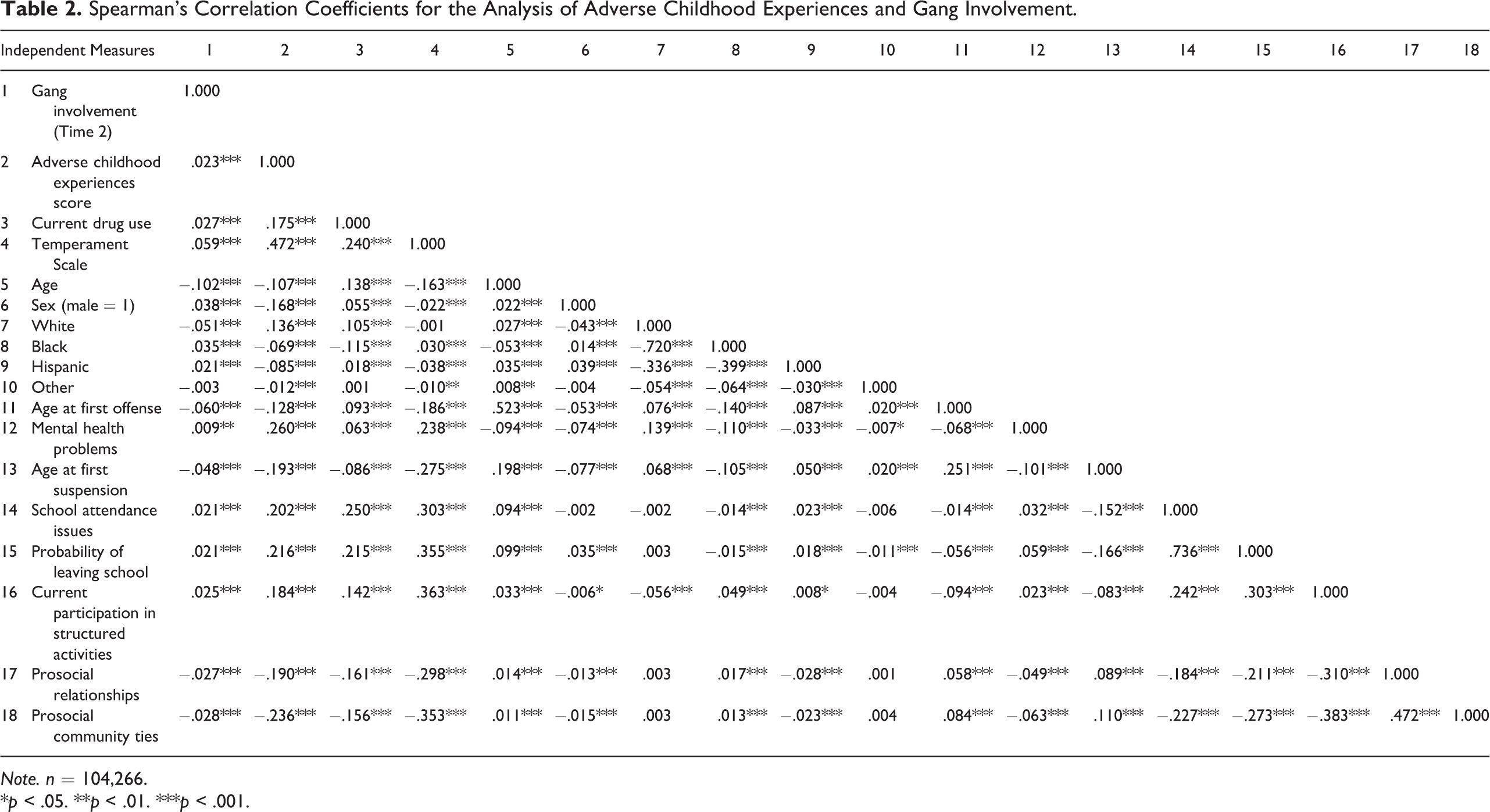
Note. n = 104,266.
*p < .05. **p < .01. ***p < .001.
Rare Events Logistic Regression Analysis
Table 3 presents the results of a series of multivariate rare event logistic regression models. Models 1–3 assess the relationship between official gang association and the ACE score along with demographic characteristics (Model 1), other risk factors shown to be related to gang association (Model 2), and our proposed mediators (Model 3). Each of these models was repeated using the self-reported measure of gang association, results of which are shown in Models 4–6.
Rare Event Logistic Regression Analysis of Adverse Childhood Experiences Predicting Gang Association.
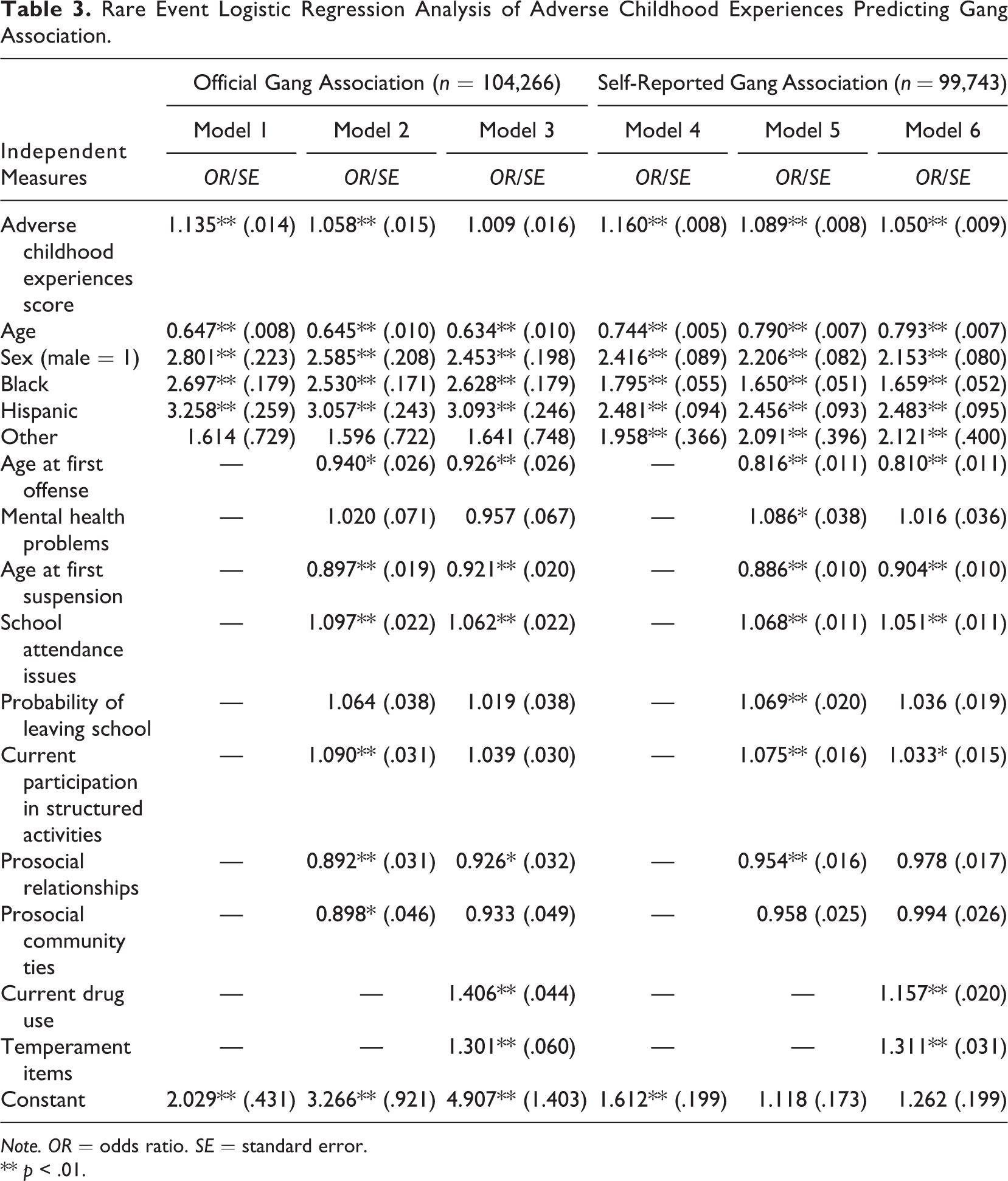
Note. OR = odds ratio. SE = standard error.
** p < .01.
Results shown in Models 1 and 4 of Table 3 suggest that ACEs have a significant and positive effect on gang association among this sample of youth, independent of which measure of gang association used. Further, after controlling for a number of youth risk factors, the effect of ACEs remains significant in the anticipated direction (Models 2 and 5). However, once our temperament scale and current drug use are included, the effect of the ACE score is reduced to the point of being nonsignificant in Model 3 (official gang association) and is greatly reduced in Model 6 (self-reported gang affiliation). As a whole, the results presented in Table 3 suggest that ACEs are significantly associated to gang affiliation, regardless of the measure used (official vs. self-report).
As noted earlier, however, this relationship may not be as straightforward as presumed, in large part because ACEs may lead to compromised socialization, which in turn leads to other types of behaviors (i.e., poor temperament and substance use) that may then serve to increase the likelihood of gang involvement. 4 It is these relationships we explored below using a more sophisticated SEM designed to test for indirect effects.
Bootstrapped SEM Mediation Model
Figure 1 displays the relationships present between the focal variables analyzed, where temperament and drug use mediated the relationship between ACEs and official gang involvement by the age of 18, while the full set of results are shown in Table 4. Table 4 includes two models, one for each operationalization of gang association. The first model of Table 4 displays the standardized estimates obtained from the multiple mediation model predicting official gang association at Time 2. The fit statistics suggest this model fits the data adequately (RMSEA < .05, CFI = .934, TLI = .913). Results suggest that net of the controls included, ACEs have a significant and positive effect on both temperament (B = .355, CI [.347, .360]) and current drug use (B = .148, CI [.141, 155]). Also observed are the significant and positive effects of temperament (B = .058, CI [.020, .078]) and current drug use (B = .134, CI [.198, .215]) on gang involvement by the age of 18. Along with our key mediating variables, several of the control variables were significantly associated with official gang association. In terms of demographic correlates, males were more likely than females, and Black and Hispanic youth were more likely than White youth to be verified gang associates by the age of 18. Youth who began offending at a younger age were more likely to be gang associated (B = −.032, CI [−.054, −.011]), as were those that were suspended at an earlier age (B = −.054, CI [−.071, −.035]). Each of the education/school measures were significantly related to later gang association, as were prosocial relationships and community ties. However, the results shown in Model 1 suggest the direct effect of ACEs on gang involvement by the age of 18 is not statistically significant (B = .001, CI [−.027, .020]).

Multiple mediation results.
Results of a Multiple Mediation Model Assessing the Effect of Adverse Childhood Experiences on Gang Involvement.

Note. A multiple mediation model with 5,000 bootstrapped resamples. Standardized effects shown. Measurement portion of the model not shown.
*p < .05.
Model 2 of Table 4 displays the results of a second model that examines the same set of relationships using the self-report measure of gang association. This model also utilizes a slightly smaller sample of youth as all youth who reported being associated with a gang at the time of their first assessment were excluded. The results seen in the second model are remarkably consistent with those described above, with one important difference: the positive direct effect of ACEs on later gang association was statistically significant (B = .043, CI [.024, .055]) net of all controls included in the model.
Table 5 presents the specified indirect effects of ACEs on gang association through temperament and current drug use. The results suggest that for the analysis of official gang involvement, temperament (a1b1 = .021, CI [.010, .029]) and current drug problems (a2b2 = .020, CI [.016, .024]) significantly mediated the relationship between ACEs and later gang involvement. The total effect of the ACE score on gang association by the age of 18 was (b = .042, CI [.019, .064]). The results suggest the proposed mediators account for roughly 97.6% of the effect of ACEs on official gang involvement (.041/.042 = .976). For the second model that assessed self-reported gang involvement, results were substantively similar. However, as shown in the bottom panel of Table 5, results indicated that the specified mediators only accounted for roughly half of the effect of ACEs on later gang association (.035/.078 = .449).
Results of a Path Analysis of the Adverse Childhood Experience–Gang Involvement Relationship as Mediated by Temperament and Drug Use.
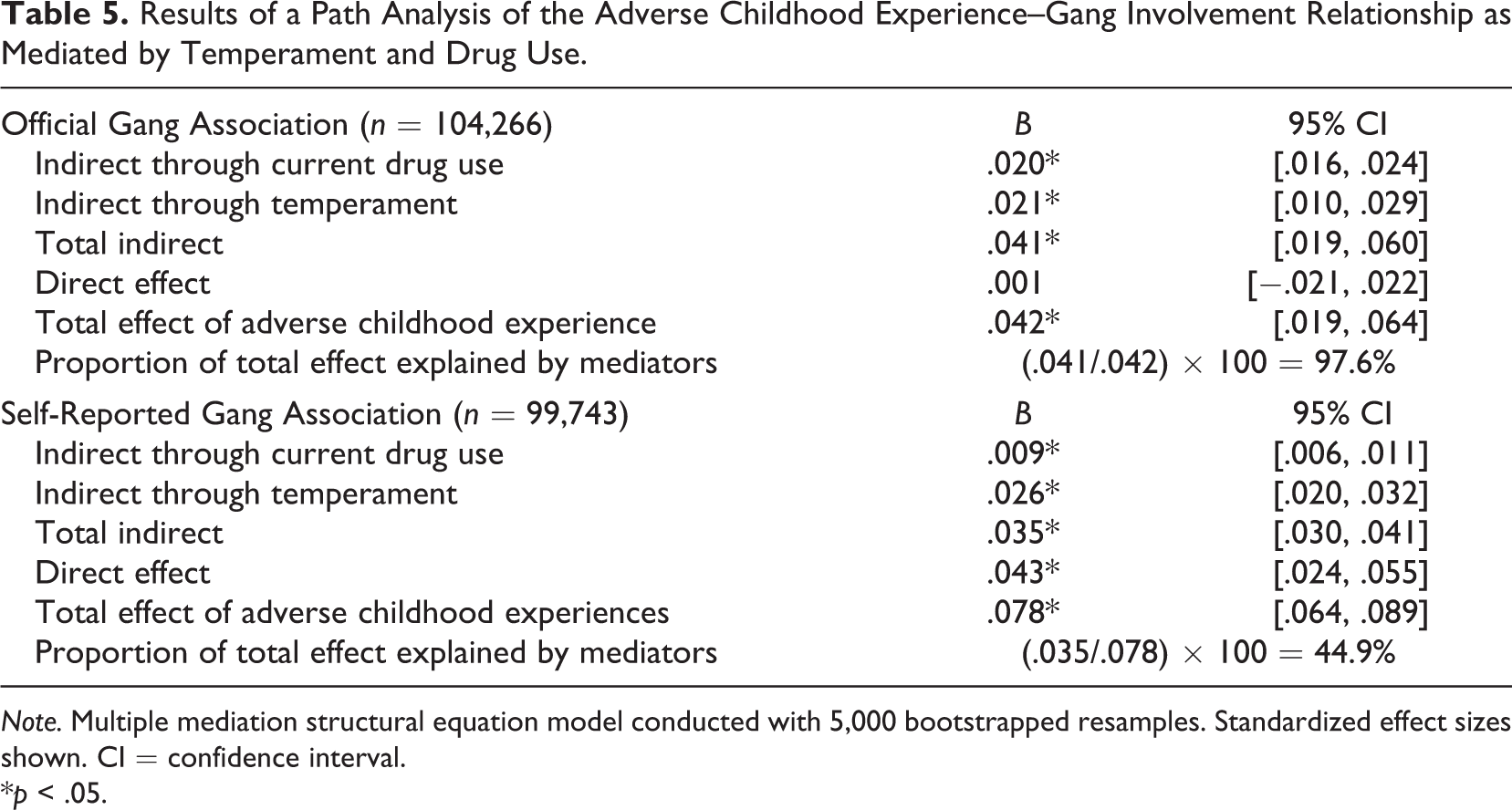
Note. Multiple mediation structural equation model conducted with 5,000 bootstrapped resamples. Standardized effect sizes shown. CI = confidence interval.
*p < .05.
Discussion
Although a vast array of negative outcomes has been linked to ACE exposure, there still remain research and policy-relevant measures which have been left unexplored. In this study, we concerned ourselves with one such outcome, gang involvement, which by itself is associated with many problematic behaviors and outcomes. Using a sample of over 100,000 juvenile offenders, we examined, using time-ordered data, the extent to which greater ACE exposure was associated with gang involvement by age 18. Not only do we investigate this relationship with a strong set of commonly established juvenile offending risk factors, but we also used two different measures of gang association, one official and another self-reported. Finally, we also tested whether the effect of ACEs on gang involvement is direct or potentially indirect as it leads to other problems which are predictive of gang involvement, including current drug use and difficult temperament. Three key findings emerged from our study.
First, we observed a positive and significant association between ACE scores and gang involvement, a finding which held using both official and self-reported measures of gang involvement and with a strong set of control variables. We went on to suggest that two possible mechanisms may individually or collectively operate to explain why youth who had experienced a greater number of ACEs would be more likely to be gang involved. We observed that ACE scores were positively and significantly associated with both difficult temperament and current drug use, but in the full model, we found that ACE scores were no longer predictive of gang involvement using the official gang association measure but remained significant—though not of great magnitude—with the self-reported gang involvement measure, while both temperament and current drug use were positively and significantly predictive of gang involvement. Finally, a large portion of the effect of ACE scores on gang involvement was accounted for by the two mediating variables, with the proportion explained at over 97% using the official gang measure and 45% using the self-report measure. It is likely that official gang measures are capturing youth with clear evidence of antisocial features, such as the core self-regulation problems inherent in difficult temperaments and the multiple problems that active drug use creates. These findings contribute to the growing literature focused on the deleterious impact of ACEs as well as the research which examine how past trauma may be related to delinquent behavior more generally.
It is important to note several limitations. First, the data depict juvenile offenders in a single state. Thus, the findings cannot be attributed to all youth, or even youth from outside the state under study. Secondly, the data did not include other potentially important risk factors such as community disadvantage or violence which have been shown to increase the probability of joining a gang (Nuño & Katz, 2018). Relatedly, the current data do not allow for us to parse out potential genetic influences given the lack of family or sibling indicators (Connolly & Kavish, 2019). Additionally, related to the measurement of our key construct, there has been some critique of the ACE childhood maltreatment measure, with some arguing for the use of official and substantiated reports of abuse and neglect from child welfare agencies (e.g., Barrett, Katsiyannis, Zhang, & Zhang, 2014; Widom, 1989a; 1989b; Widom & Maxfield, 2001). We note, however, that arguments exist that relying on only official records such as child protective services or foster care placements may underestimate maltreatment prevalence based on cultural differences in reporting and substantiating investigations or contextual variance in access to services (see Ards, Myers, Malkis Erin, & Zhou, 2003; Drake, Lee, & Jonson-Reid, 2009).
Further, scholars argue whether the 10 ACEs, originally noticed among well-educated, privately insured patients might benefit from expansion, especially with respect to lower income and minority populations (Cronholm et al., 2015). While the ACE score is composed exclusively of household indicators, community-level indicators such as exposure to racism, witnessing violence in the community, living in an unsafe neighborhood, bullying, peer rejection, and peer victimization have also been proposed (Cronholm et al., 2015; Finkelhor, Shattuck, Turner, & Hamby, 2013; Pachter et al., 2014; Wade, Shea, Rubin, & Wood, 2014). Lastly, there has been critique of the ACEs measure as it equally weights one instance of neglect with multiple cases of physical abuse. Scholars have critiqued the ACE score’s binary construction, arguing it neglects the frequency, severity, and duration of exposure to each ACE (e.g., Nofzinger & Kurtz, 2005; Smith & Thornberry, 1995).
Lastly, given the static nature of both of our dependent variables, our analysis is limited in a number of ways. Unfortunately, the available data do not allow us to explore the dynamic nature of gang membership (Pyrooz, 2014; Pyrooz et al., 2013). Although we use data on ACEs measured at the time the first PACT assessment was administered to predict gang membership by the age of 18, we can only do this prospectively as the two measures of gang membership used are static in nature and would perfectly predict latter gang involvement. However, results of an ancillary analysis indicate that ACEs are also positively related to gang involvement at Time 1 net of all included risk factors, which is consistent with our key findings that suggest a complex relationship between childhood adversity and gang involvement among this sample of juvenile offenders. Future studies using true panel data should assess this relationship more thoroughly using dynamic indicators of gang involvement.
Despite these limitations, there are clear implications for policy and practice as well as for theories of gang involvement. Some researchers have noted that validated theories of gang involvement have been relatively slow in developing (Curry, Decker, & Pyrooz, 2014; Wood & Alleyne, 2010). However, most of the research-supported risk factors were substantiated well before these works were published. Virtually all of the codified risk factors in Howell and Egley’s (2005) literature review came from prospective studies of juvenile delinquency that also examined gang involvement—particularly in Seattle, WA (Hill et al., 1999), and Rochester, NY (Thornberry et al., 2003). Thornberry, Krohn, Lizotte, Smith, and Tobin (2003) established that the interaction of risk factors across domains produces the greatest risk of gang membership. Howell and Egley’s (2005) work highlighted disruptive and aggressive behavior, which is embodied in the concept of a difficult temperament (e.g., DeLisi and Vaughn, 2014), in gang involvement. Additionally, Howell and Egley (2005) and others (e.g., Maxson & Whitlock, 2002; Maxson et al., 1998; Melde et al., 2009) posited both negative life events and violent victimization are key risk factors for gang association. Additional work has demonstrated substance abuse as a risk for gang involvement (e.g., Hill et al., 1999). The current study supports these prior findings, yet advances the discourse by elucidating distinct pathways by which these relationships develop (see Wolff and Baglivio, 2017). Our findings add to this knowledge base by suggesting that cumulative trauma, as measured by the ACE score, represent a meaningful risk factor when it comes to gang involvement and that this trauma propels temperament deficits and substance use, which, in turn, lead to gang involvement.
Our findings are consistent with those seen in the statewide study of gang membership (Howell et al., 2017), in describing how many of the ACEs occur in family settings in the absence of nourishing child–parent relationships and other social supports. To illustrate, household members’ incarceration history and foster care involvement were all statistically related to gang involvement among the Oregon youth. It should also be noted that other ACEs were independently associated with poor educational outcomes in that study. The number of days a youth was absent from school during the academic year immediately preceding commitment to state custody was also associated with gang involvement. Hence, there is no doubt that likelihood of gang membership is boosted by ACEs as well as other risk factors.
Looking at the larger picture, gang members are well represented among life course–persistent juvenile offenders and thus represent an important population on which to focus. In North Carolina, 7% of all juveniles against whom delinquent complaints are filed, 13% of juveniles adjudicated delinquent, 21% of juveniles admitted to short-term detention, and 38% of juveniles committed to secure residential facilities reported gang membership (Howell & Lassiter, 2011). In statewide multiyear samples of adjudicated serious and violent juvenile offenders in North Carolina and Florida, gang members were about 3 times more likely than other offenders to be chronic serious property and violent juvenile delinquents (Baglivio, Jackowski, Greenwald, & Howell, 2014; Howell & Lassiter, 2011). Given the relationship between gang membership and chronic offending, programs devoted to gang prevention that are well designed and well implemented might be able to make a bigger difference in these areas.
Thus, a concerted effort should be undertaken to prevent gang involvement as well as mitigation of ACEs. Gang Resistance Education and Training (G.R.E.A.T.) is the only program specifically focused on preventing initial gang membership that has been rigorously evaluated and demonstrated to be effective (Esbensen, Osgood, Peterson, Taylor, & Carson, 2013; Howell & Griffiths, 2019). In addition to improvements in several risk factors—such as having less anger, more use of refusal skills, and less risk-seeking among elementary and middle school students—G.R.E.A.T. generated positive attitudes toward police and less positive attitudes about gangs, and it reduced the odds of gang joining among racially/ethnically diverse groups of youths by 24%. Remarkably, these results held up over a 4-year follow-up.
It should be noted that one program has been found to be effective in reducing gang involvement among young offenders in juvenile justice systems. An experiment with young offenders on probation with a gang-adapted version of functional family therapy (FFT) provided encouraging results (Thornberry et al., 2018). The study randomly assigned adjudicated youth from a single courtroom in the Philadelphia Juvenile and Family Court to FFT-G or a “treatment as usual” condition. Examination of official records revealed that most of the recidivism measures favored the FFT-G group, and the magnitude of some of the differences was large. For example, the percentage adjudicated delinquent was approximately 2.5 times greater for the control group than the FFT-G cases (6% vs. 15%). The study also found that the cost per youth served was lower for treatment than control youth, primarily because control youth were more often placed in residential facilities.
Our findings indicate that youth referred to the juvenile justice system through arrest who have experienced many adverse experiences, especially those with more forms of traumatic events, are more likely to identify themselves, or be identified by officials, as gang members, use drugs, and have temperament issues. The juvenile justice system is not equipped to limit the risk of these experiences during childhood, but with universal screenings, these youth can be provided with evidence-based programs to limit the impact of the toxic stress on their behaviors. Certainly, prevention efforts should focus on reducing exposure to childhood trauma within households. Promising programs include the famed nurse–family partnership (e.g., Olds, 2007) as well as evidence-based parent-training programs (Piquero, Farrington, Welsh, Tremblay, & Jennings, 2009). As ACE exposure is higher in disadvantaged neighborhoods (Baglivio, Wolff, Epps, & Nelson, 2015), these socioeconomically deprived areas are prime candidates to such prevention efforts. More targeted prevention in the form of substance use prevention programs can be leveraged among those who have already endured childhood trauma and maltreatment. This would require universal screening in schools, perhaps, or at minimum vigilant teachers and school administrators, but efficacious programs such as LifeSkills Training (e.g., Botvin & Griffin, 2004) may be viable selections among the ACE-exposed students. While temperament deficits may be found more stable, there is evidence of effective intervention enhancing self-regulation (Piquero, Jennings, Farrington, Diamon, & Reingle Gonzalez, 2016), as well as cognitive behavioral interventions focused on cognitive restructuring to address negative emotionality (such as combined Cognitive Beahvioral Therapy and Functional Family Therapy). These temperament deficit–focused interventions coupled with substance abuse treatment appear suitable services for justice-involved youth to deter them from future gang involvement. With the estimated cost of childhood maltreatment, based on 2015 substantiated incidents, at US$428 billion, representing lifetime costs incurred annually (Peterson, Florence, & Klevens, 2018), the study of ACE exposure is both policy relevant and germane to adolescent development and the study of antisocial behavior. The pathways by which ACEs led to damaging outcomes are of critical concern.
Footnotes
Author's Note
Alex R. Piquero is also affiliated with Monash University, Melbourne, Australia.
Declaration of Conflicting Interests
The author(s) declared no potential conflicts of interest with respect to the research, authorship, and/or publication of this article.
Funding
The author(s) received no financial support for the research, authorship, and/or publication of this article.
