



Abstract
An abundance of research has established Adverse Childhood Experiences’ (ACEs’) contributions to deviant behavior. Recently, studies have demonstrated the importance of Positive Childhood Experiences (PCEs). Yet, the PCE establishment as a predictive scale is needed. In a multistate, robust sample (N = 254,874) of justice-involved youth, we examined PCE scale effects and ACE-PCE combinations on recidivism using mixed effects logistic regression while adjusting for the impact of state. Presence of PCEs was associated with lower reoffending likelihood, and ACEs were related to increased recidivism odds. Further, PCEs demonstrated a protective impact on ACEs. A ceiling effect on the ACE-PCE composite score was also identified, where an increase in scale items presented a curvilinear recidivism association. Findings provide an examination of PCE influence across multiple youth populations and their ability to counteract ACE effects. Policy implications discuss the utility of PCEs as case management goals and intermediate outcomes.
Keywords
Juvenile justice system-involved adolescents evidence significantly greater traumatic exposure than non-adjudicated youth (Baglivio et al., 2014; Dierkhising et al., 2013). The relevance of this heightened exposure is clear, as extensive evidence demonstrates the negative health, developmental, behavioral (including crime and delinquency), and even shortened life expectancy implications of cumulative adverse childhood experiences (ACEs) (Craig et al., 2017; Felitti et al., 1998). A smaller, yet growing body of work, indicates the promise of positive childhood experiences (PCEs) in improving outcomes across similar domains (e.g., Baglivio & Wolff, 2021; Bethell et al., 2019; Crandall et al., 2020). To date, this limited work has shown that PCEs mitigate the effects of exposure to ACEs. Contrary to theories detailing the effect of trauma contributing to criminal behavior and recidivism, these findings suggest that certain protective experiences may moderate the detrimental effect of adversity.
However, the impact and prevalence of PCEs among justice-involved youth remains relatively novel and is underexplored. As such, the current study examines the prevalence of ACE and PCE indicators and their combined association with future offending using a large sample of youth drawn from multiple jurisdictions. Further, we assess the independent effects of these experiences and the association between a combined scale of ACEs and PCEs and the incidence of recidivism. Through this examination, we assess whether exposure to these events provides important case management and policy implications for justice-involved youth.
Adverse Childhood Experiences
Maltreatment experienced during childhood is a serious concern and presents as one of the most damaging effects on adolescent development (Kilpatrick et al., 2003). Moreover, although many children are subjected to adversity (Copeland et al., 2007), justice-involved youth are at a higher risk for experiencing these events (Cronholm et al., 2015). Identified by Felitti et al. (1998), ACEs consist of 10 childhood experiences indicated as risk factors for later socioemotional and physical deleterious outcomes. The experiences include three measures of abuse, two types of neglect, and five indicators of household dysfunction.
While each of these events on their own can affect a person’s development, ACEs often co-occur (Baglivio & Epps, 2016; Finkelhor et al., 2007). Exposure to multiple events has an exponential impact, resulting in greater likelihood of negative outcomes as the number of ACEs increases (Cronholm et al., 2015; Felitti et al., 1998). Thus, a dose-response effect of ACEs is indicated, reflecting a cumulative impact on development. Extensive prior work demonstrating the cumulative impact of exposures (dose-response) and the non-random interrelatedness of exposures necessitates examining cumulative exposures as a composite ACE score in contrast to individual ACE indicators independently (Baglivio & Epps, 2016; Anda et al., 2010; Dong et al., 2004).
Consequences of ACE Exposure: Offending & Recidivism
Early exposure to ACEs is related to developmental problems during adolescence and into adulthood and is related to physical, mental, and behavioral health outcomes (Felitti et al., 1998; McLaughlin et al., 2012). As described, severity of consequences is further related to the amount of adverse exposure. For example, Finkelhor et al. (2007) found exposure to multiple events was associated with more trauma symptoms, such as anger, anxiety, depressive symptoms, and posttraumatic stress disorder (PTSD). Additionally, children with a cumulative score of four or more ACEs display higher odds of negative outcomes as adults (Felitti et al., 1998). These negative effects have strong implications for justice-system involvement.
The maltreatment-delinquency link is now well elucidated (e.g., Braga et al., 2017). Among justice-involved youth, those with maltreatment histories evidence higher rates of self-reported offending, property offending, and violent offending (Teague et al., 2008), as well as official offending (Trulson et al., 2016; see also Barrett et al., 2014; Fagan & Novak, 2018). Further, implications of traumatic exposure in childhood and adolescence continue exerting influence on offending well into adulthood (Widom et al., 2018). Recently, cumulative adverse exposure measured using the ACE score has been employed in examining justice system outcomes (Baglivio et al., 2014; Kowalski, 2019). Implementing the ACE concept in juvenile justice research has since found adjudicated youth with higher ACE scores have increased odds of recidivism (and increased likelihoods of reoffending earlier during their term of supervision), with studies examining the ACE-antisocial behavior relationship rapidly increasing in recent years (see Malvaso et al. [2021] for a systematic review). Implementing the ACE concept in juvenile justice research has since found adjudicated youth with higher ACE scores have increased odds of recidivism (and increased likelihoods of reoffending earlier during their term of supervision; Wolff et al., 2017). Likelihood of deeper penetration into the justice system is affected as well with each additional ACE exposure by age 12 leading to a 20% increase in odds of residential facility placement by age 18 among adjudicated youth in Florida (Zettler et al., 2018).
Additional work has examined the ACE-offending relationship beyond a single subsequent recidivism event, linking cumulative traumatic exposure to early-onset (by age 12) of initial offending, as well as serious, violent, and chronic offending, and adult criminality (Kerridge et al., 2020; Perez et al., 2018). Findings include increased odds of offending up to age 56 (Craig et al., 2017). However, other findings have not replicated the significance of ACEs in predicting recidivism. For instance, cumulative ACEs failed to predict general or felony rearrest up to three years post-release for youth from Texas correctional facilities (Craig et al., 2020). Relatedly, examining youth placed in Florida juvenile justice residential facilities, Zettler and Craig (2022) found ACEs failed to predict reoffending among some racial- and sex-specific subgroups. Moreover, van Duin et al. (2021) found extensive criminal history and age at first offense, but not a cumulative ACE score, were related to conviction. One notable limitation of prior ACE-recidivism research has been the overrepresentation of studies employing Florida Department of Juvenile Justice samples. Contradictory findings across samples illuminate the need for examining the predictive ability of cumulative ACEs on reoffending, relying on the same measurement of each ACE indicator, leveraging a large multijurisdictional sample to enhance the field’s understanding of ACE score relevance with respect to subsequent justice system involvement among adjudicated youth.
Positive Childhood Experiences
Growing cross-discipline research illuminating the harmful implications of childhood adversity has led to both the obvious calls for prevention and recent attempts to identify factors that may mitigate negative effects. This is in keeping with the long-standing line of inquiry examining individual promotive factors (variables that predict a low probability of offending) and protective factors (variables that interact with risk factors to nullify their effect; variables that predict a low probability of offending among a high-risk group) espoused by Farrington, Loeber, and colleagues (e.g., Farrington et al., 2016; Loeber et al., 2008). Craig, Piquero and colleagues (2017) have demonstrated the importance of several individual (low neuroticism and low hyperactivity), community/school (enhanced social support, commitment to school), peer (prosocial peer associations), and family-level factors (strong parental supervision, small family size) that decrease offending risk among at-risk youth. Similarly, and in keeping with the cumulative ACEs framework, recent work has argued for investigating positive factors across multiple domains, rather than individual indicators, that may serve to mitigate the negative effects of ACE exposure. PCEs have included constructs such as relationships with mentors, supportive peers, attachment, positive family communication, sense of belonging and engagement in school, responsiveness to health needs, love among family members, and participation in organized activities (e.g., Baglivio & Wolff, 2021; Bethell et al., 2019; Crandall et al., 2020; Karatzias et al., 2020). Essentially, PCEs involve a sense of safety in one’s environment whether that involves a child’s family, friends, and/or community.
To reiterate, while ACEs and their influence on health, psychological, and offending/criminal justice outcomes have received much attention, more recent research has focused on the impact of PCEs, their co-occurrence, and the potential for a dose-response relationship. These studies have largely been conducted with young adult or adult samples. As an example, Crandall et al. (2020) examined the independent effect of ACEs and what they call “counter-ACEs” (Advantageous Childhood Experiences) on young adults’ behavioral and mental health outcomes. Although ACEs did not influence health indicators, positive experiences were related to decreased negative outcomes, especially when there was a higher ratio of positive experiences to negative experiences. Additionally, in a comparison of adults reporting a high level of PCE exposure to those with low or no exposure, adults in the former exhibited 72% lower levels of depression and were 3.5 times more likely to have emotional and social support as an adult (Bethell et al., 2019). This research demonstrated that PCEs, like ACEs, exhibit a dose-response association with harmful outcomes as well as a cumulative effect, even when accounting for ACEs. In short, PCEs mitigated the effects of ACEs.
To date, one study has examined the relationship between cumulative PCEs and reoffending among adjudicated youth. Baglivio and Wolff (2021) created PCE indicators from risk/needs assessment (RNA) items using a Florida sample of youth (N = 28,048) who completed a community-based placement between July 1, 2009 and June 30, 2012 and were assessed using the Positive Achievement Change Tool (PACT). Further, the authors explored the relationship between ACEs and PCEs, and their combined effects, on youth reoffending. Specifically, they explored the independent effect of ACE and PCE exposure as well as how ACEs were related to recidivism for youth with greater PCE exposure (six or more) compared to those with less exposure (fewer than six). The threshold of six PCEs was determined by following Aiken and West’s (1991) suggestion for determining a cut point, which involves a value near the mean plus one standard deviation.
Baglivio and Wolff (2021) operationalized 11 binary (0/1) PCE items, with a cumulative score summarizing the exposure indicators. Responses from PACT assessment items include: (1) belief that school provides an encouraging environment; (2) youth likes or feels comfortable talking with two or more teachers, education staff, or coaches; (3) youth is involved in one or more school activities; (4) youth is involved in one or more prosocial, structured recreational activities; (5) youth has a history of and/or currently has two or more relationships with positive adults (adults who are not family or teachers but who can provide support and/or model prosocial behavior); (6) youth has only prosocial friends; (7) youth has strong prosocial community ties; (8) youth’s family has a strong support network; (9) youth’s family is consistently willing to support him/her; (10) youth’s family provides opportunities for involvement or participation in family activities and decisions affecting the youth; and (11) youth indicates he/she is close to or has a good relationship with both mother/female caretaker and father/male caretaker or with both mother/female caretaker and extended family members. These items were summed to create a PCE score with a mean of 4.4 PCEs for their sample.
Baglivio and Wolff (2021) demonstrated justice-involved adolescents with six or more PCEs were 20% less likely to be rearrested. More importantly, results indicated higher PCEs negated the impact of ACEs on reoffending, meaning high PCEs serve as a protective factor among at-risk youth (those with high ACEs), in keeping with Farrington and Loeber’s concept of a measure that interacts with risk factors to nullify their effect, or, differently stated, a measure that predicts a low probability of offending among a high-risk group. However, despite the demonstrated effects, replication and expansion of PCE effects are needed using a larger, and more representative sample of youth involved in juvenile justice systems across the United States (US). The current study aims to address this need in addition to examining whether all PCE items established in Baglivio and Wolff’s (2021) study are predictive of reoffending in a larger sample of justice-involved youth. Additionally, while previous studies have treated the relationship between PCEs and negative outcomes as linear, we explore this association for non-linear effects.
Jurisdictional and Regional Distinctions
We expand upon the Florida research via examination of a robust, multistate sample of US youth under different types of justice-system supervision. As with the Florida sample, these youth were also administered the PACT or a similar, state-specific version of that tool. This dataset was collected as part of a larger Office of Juvenile Justice and Delinquency Prevention (OJJDP) project (see Hamilton et al., 2022) and includes youth assessed between 2003 and 2019 across 10 states. 1 All agencies include statewide jurisdictions with supervision at a variety of stages, including diversion, probation, detention, and parole/release from residential facilities. Although both initial and reassessments were captured (N = 494,050), the dataset was narrowed to one assessment per youth, with the assessment randomly selected for study inclusion. Moreover, assessments with less than a 12-month follow-up for reoffending were excluded.
This dataset provides a fuller picture of jurisdictional and regional differences and can be leveraged to ascertain variations in ACE and PCE exposure in justice-involved youth across the US. This type of exploration is necessary as research with this sample has shown that adoption or development of RNAs in any jurisdiction should consider the population of justice-involved youth within that region for best optimization of predictive efforts (Hamilton et al., 2022). More specifically, the size of a youth population can drive methods used to develop or alter an RNA for a given jurisdiction.
A discussion of jurisdiction and regional differences is further relevant as the RNA used in much of the ACE and PCE work derives from the PACT, which was originally developed for one state. The assessment, originally called the Washington State Juvenile Court Assessment (WSJCA), was developed in Washington State in 1997 to identify risk and needs among probation youth and includes protective and responsivity factors (Barnoski, 1999; 2004). The WSJCA was rebranded by private vendors, disseminated across the country (Baird et al., 2013), and is now most commonly known as the PACT and the Youth Assessment and Screening Instrument (YASI). The instrument is used in additional states under different, state-specific names. However, the assessment has not been modified in all states to cater to jurisdictional or region-specific variations that occur across states’ populations of justice-involved youth. For instance, the instrument is now used for detained youth or youth on parole. These types of supervision are qualitatively different from probation (the supervision type for the original development sample) and are likely representative of a more severe crime for which a youth was adjudicated. Other jurisdictional differences include the size of the state’s justice-involved youth population, proportion of racial/ethnic minority and female youth (both of which may affect predictive accuracy of the RNA), and operationalization differences in what is, legally, criminal behavior (e.g., age of consent for sex offenses).
While a truncated prescreen version of the tool is provided in several states, the full version of the instrument, consisting of 126 items (see Barnoski, 2004) was used for the current study. For each assessment, a semi-structured interview is completed by trained staff in addition to a review of the youth’s case file, and corroboration with official child abuse and education records from other state agencies when available. Although the assessment does not have specific ACE and PCE scales, these scores are constructed using prior research as a guide. Baglivio and colleagues (2014) originally outlined the items in the Florida version of the PACT, and this research has been conducted in a similar fashion using the PACT (see Kowalski, 2019) or YASI (see Belisle, 2021) for states outside of Florida.
Current Study
Building on the work of Karatzias et al. (2020), we examine the impact of a composite ACE and PCE combined effects score on youth reoffending using a large sample of youth drawn from multiple jurisdictions. Furthering the work of Baglivio and Wolff (2021), we also investigate if cumulative PCE exposure is directly associated to youth recidivism and whether PCE exposure may moderate the association between ACE exposure and continued delinquency. Study findings sought to examine and confirm the utility of PCEs for case management and delinquency prevention.
Methods
To address the study aims, we examine a large, nine-state sample of youth assessment and reoffending data. The study’s primary research question concerns the combined effect of ACEs and PCEs on justice-involved youths’ recidivism. To address this research question, we first investigate ACE and PCE exposure in isolation, and their combined effect on youth reoffending. Then, we examine the effect of varying ACE and PCE thresholds on youth reconviction. We also explore whether a modified ACE-PCE scale is related to justice-involved youths’ recidivism. Again, the inclusion of both ACEs and PCEs is pertinent as past research has shown that PCEs mitigate the damaging effects of ACEs. However, there are nuances in testing the combined effects of ACEs and PCEs as cumulative exposure may not possess a strictly linear effect on recidivism. ACEs and PCEs can also be combined into one score – a composite score – that considers a scale of both damaging and protective factors on a youth’s recidivism likelihood. Alternatively, ACE and PCE cut-off scores can be used to predict recidivism and to examine potential thresholds where either ACEs or PCEs will result in a greater negative effect compared to lower exposure. Considering recent studies have shown the negative impact of ACEs, but positive effect of PCEs, on youth recidivism and the mitigating effect of PCEs on ACEs (Baglivio & Wolff, 2021; Kerridge et al., 2020; Perez et al., 2018; Wolff et al., 2017) as well as the likely indirect relationship between trauma or adverse exposure and criminal behavior (Salisbury & Van Voorhis, 2009) in addition to the unknown influence of PCEs on this relationship, the following hypotheses were tested:
ACE threshold scores will predict recidivism.
PCE threshold scores will predict recidivism.
Sample
This work was part of a collection of data for a larger OJJDP study. Data consists of agency records and includes assessments and reoffending outcomes. To assess the study hypotheses, we merged the assessment and recidivism measures across the jurisdictions, reconciling differences in operationalizations and variations in data collection, to create a single analyzable dataset. As a part of this reconciliation process, responses were collapsed and/or adjusted to develop a harmonized, aggregate dataset (see Hamilton et al., 2022). While this process ensured uniformity for each response across the sites, there were some instances of missingness for a portion of youth responses for some sites. 2 To counteract disadvantages of list-wise deletion (Roth, 1994), we utilized random forest imputation from the “missForest” R package (see Hamilton et al., 2022). This method has outperformed other imputation methods, particularly with data used in complex statistical procedures (Shah et al., 2014; Stekhoven & Bühlmann, 2012). Additionally, and unlike other imputation methods, there is evidence that the proportion of falsely classified categories is adequate in all settings (Stekhoven & Bühlmann, 2012).
Readers should note that, depending on the duration of supervision and agency policy, youth may have received an initial assessment and one or multiple reassessments. In selecting an assessment to include for each youth, we sought to maximize their exposure in the community in which to assess recidivism. Therefore, for residential and detention youth, we selected their last assessment prior to community reentry. For the remaining sample, we selected their initial assessment. Following aggregation of the nine state samples and limitation to the initial assessment, the final sample consisted of 254,874 youths from across nine states.
Measures
ACEs and PCEs
For ACEs, we followed Baglivio and colleagues (2014) methods, operationalizing PACT assessment responses as ACEs. Similarly, we followed Baglivio and Wolff’s (2021) operationalization methods for creating PCE items and scales from the PACT assessment. The ACE score represents a youth’s cumulative exposure to 10 indicators, where 10 dichotomous (no/yes) items were summed to create an ACE score. Scores range from none (0) to exposure to all ACE items (10). The 10 experiences include: (1) emotional abuse; (2) physical abuse; (3) sexual abuse; (4) emotional neglect; (5) physical neglect; (6) family violence; (7) household substance abuse; (8) household mental illness; (9) parental separation/divorce; and (10) incarceration of a household member, with each item coded dichotomously (0/1). As per Baglivio and Wolff (2021)’s operationalization, a threshold of four or more was used to distinguish ‘Low’ versus ‘High’ ACE exposure. The lowest reported ACE was physical neglect (11.1%) while the most commonly reported ACE was parental separation or divorce (91.5%).
Descriptive Statistics of the Total Sample, Non-Recidivists, & Recidivists.
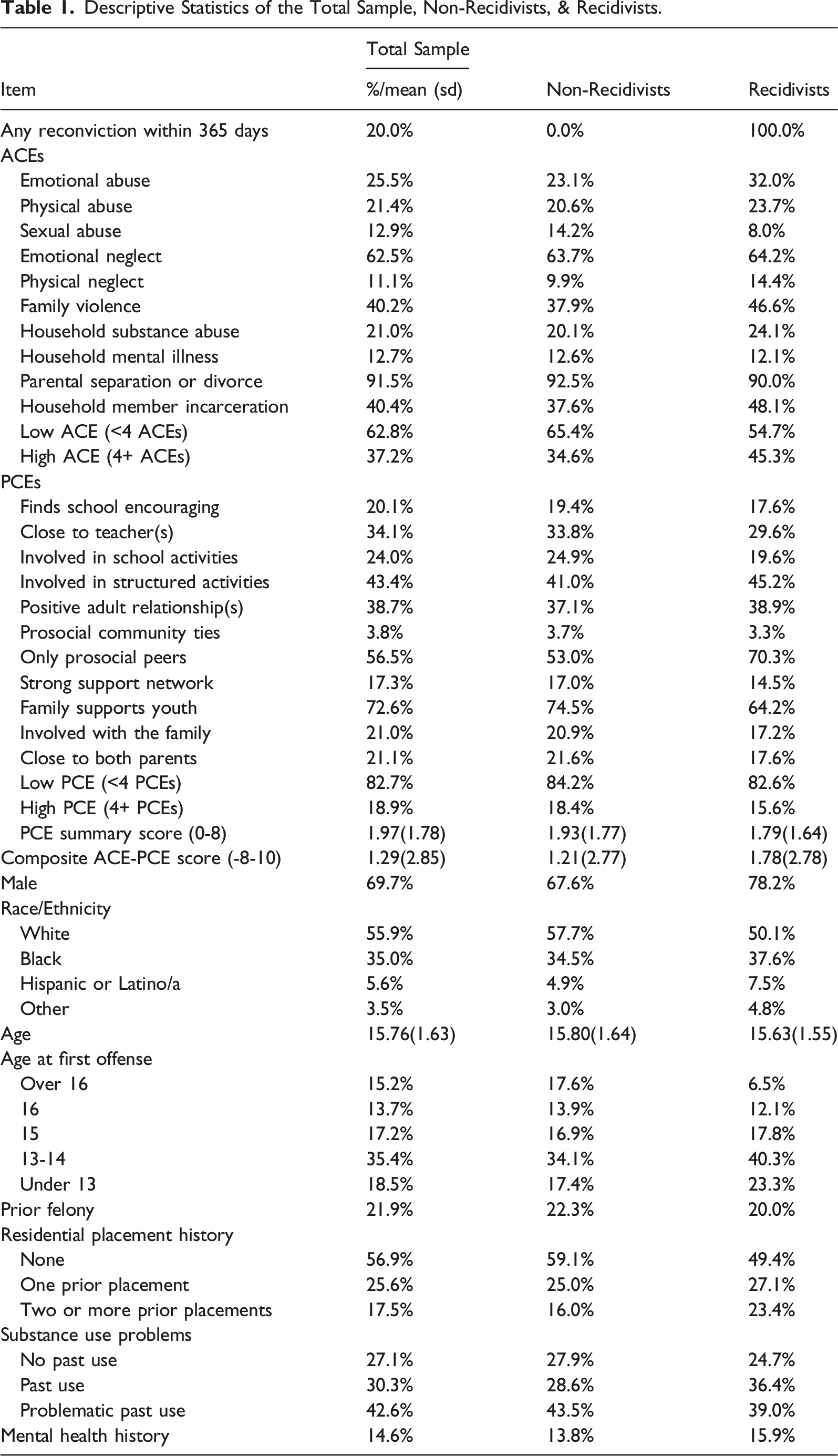
Finally, to assess the spectrum of childhood exposure, we created an ACE-PCE composite score. For this scale, PCE items were reverse coded (no = 0, yes = -1) and added to the ACE items to create a score from -11 to 10, allowing PCEs to cancel out ACEs, methodologically speaking (mean = -0.13, SD = 3.34). Details regarding the sample demographics are displayed in Table 1, including information related to the ‘High PCE’ indicator, continuous PCE score, and ACE-PCE summary scale. While nearly 40% of the sample indicated a High ACE score, approximately 19% reported a High PCE score. The average reported number of PCEs was roughly 2. For the composite ACE-PCE scale, the average tipped toward greater ACE exposure (1.29).
Outcome – Recidivism
The dependent measure used in the current study was ‘any’ reconviction. This consists of any charge (misdemeanor or felony) that resulted in adjudication within 365 days of a youth’s reentry from detention or the community supervision start date. 3 Although many researchers utilize a new rearrest as a measure of recidivism (Harris et al., 2011), there is no consensus regarding the best definition for recidivism or length of the follow-up period (Deal et al., 2015; Robertson et al., 2020). One commonly used operationalization of recidivism within the juvenile justice system is also a new adjudication (Cottle et al., 2001; Harris et al., 2009). The advantage of using a new adjudication is that the certainty of the outcome provides better prediction stability and has been argued to contain less bias as a result. As demonstrated in Table 1, approximately 20% of youth were re-adjudicated/reconvicted within one year.
Control variables
To better ensure the observation of true study effects, the following control variables were also included in study analyses. Demographic measures involved: youth sex (0 = female, 1 = male); race/ethnicity (0 = White [reference], 1 = Black, 2 = Hispanic or Latino/a, and 3 = Other); and age (measured continuously, mean = 15.88, SD = 1.55). Measures related to criminal history included age at first arrest (0 = over 16, 1 = 16, 2 = 15, 3 = 13 to 14, or 4 = under 13), prior felony arrests (0 = no, 1 = yes), and history of a prior residential placement (0 = none, 1 = one, or 2 = two or more). A measure pertaining to mental health was also included (0 = no history or 1 = history of mental health problems as per a formal mental health diagnosis by a qualified mental health professional) as well as a measure of past substance use (0 = no past use, 1 = past use that did not result in problems, or 2 = past use that caused problems for the youth in school, family, health, peer associations, or criminal behavior). Of note, the mental health problem measure distinguishes between youth with a formal diagnosis such as schizophrenia, bipolar, mood, thought, personality, and adjustment disorders, while conduct disorder, oppositional defiant disorder, substance use, and attention deficit hyperactivity disorder are not included (as per the PACT protocol). The diagnosis must have been formally made by a credentialed mental health practitioner and not merely the opinion of a juvenile justice professional. Descriptive statistics for these variables are shown in Table 1. The majority of the sample (70%) was male. Regarding race, approximately 56% of the sample was White, 35% Black, nearly 6% Hispanic or Latino/a, and about 3% of youth were identified as a different race. The average age was about 16 years, and most youth (35%) committed their first offense between 13 and 14 years of age. About 22% of the sample had a previous felony while the majority of youth (57%) had no history of a residential placement. However, 43% of youth reported a history of problematic substance use while 85% did not have a history of mental health issues. 4
Analytic Plan
Prior to testing the study hypotheses, we first examined the placement of the PCE threshold. We used a series of logistic mixed model regressions to examine the main effects of ACE and PCE exposure on youth recidivism within a multilevel (MLM) framework. Given differences across jurisdictions, a MLM is relevant to examining the effects of the PACT ACE and PCE items across sites. A burgeoning field of research has argued for the necessity of MLMs in examining variations in juvenile justice systems across state lines (Zane et al., 2020). MLM is utilized when data clusters into groups, and multilevel techniques permit a simultaneous estimation of effects at multiple levels that may affect outcomes (Bryk & Raudenbush, 1992). Research has demonstrated the impact of individual- and jurisdictional-level differences on sentencing, specifically, for justice-involved individuals (Britt, 2000; Ulmer, 1997). This method is appealing for the present study as it offers a direct test of the degree to which reoffending varies across the jurisdictions included. Additionally, MLM will allow individual-level youth characteristics to vary across states and permits for an assessment of whether jurisdictional-level characteristics are associated with this variance (Sampson et al., 1997).
Further, a notable strength of the present study is the use of a large, multistate sample. This study is consequential to the understanding of ACE and PCE concepts without the need to accumulate evidence from nine separate studies over time. While many have pointed to the impact of meta-analyses in determining a consensus of effects in a given area of study, most meta-analyses would be unnecessary if similar, representative samples were constructed. With this in mind, the sample is large, and some aspects of statistical significance should not be suggested as substantive. To appropriately frame the results, we therefore provide effect sizes for all MLM model estimates to aid readers in the determination of substantive importance.
As mentioned, Baglivio and Wolff (2021) developed a PCE threshold to indicate a ‘High’ level of exposure. Using their Florida-based sample, the PCE threshold was set at a value of six, which was roughly one standard deviation above the mean. Given the current study’s larger, and conceivably more representative sample, we made notable adjustments to the PCE scale. First, we assessed that only eight of the 11 PCE indicators significantly predicted recidivism and hence, removed three indicators from the PCE scale. These eight retained PCEs included youth who: found school encouraging (OR = 0.89, p < .001), were close to a teacher (OR = 0.82, p < .001), were involved in school activities (OR = 0.73, p < .001), had prosocial community ties (OR = 0.89, p < .001), had a strong support network (OR = 0.83, p < .001), had a supportive family (OR = 0.61, p < .001), had involvement with the family (OR = 0.79, p < .001), and were close to both parents (OR = 0.78, p < .001). This new PCE summary score (mean = 1.97, SD = 1.78) was then used to revise the ACE-PCE composite score consisting of a range of -8 to 10 (mean = 1.29, SD = 2.85). Next, we created a new threshold following Baglivio and Wolff’s (2021) threshold operationalization method. Specifically, with our reduced, significant item-only scale and using the nine-site sample, we identified a PCE mean of 1.97 with a standard deviation of 1.78. Thus, we set the ‘High’ PCE threshold at roughly two points above the mean, at the value of four, which coincidently mirrors the established ACE threshold. This newly constructed threshold was dichotomously coded (0/1) and was used to test study hypotheses H1-3.
Next, mixed regression models were selected to account for site-level variations. While no study hypotheses tested state-level fixed effects, adjusted interclass correlation coefficients (ICC) values indicated substantial variance across sites. A random intercept-only model also revealed significant site-level variance compared to a null model (variance = 5.09, p < .001), suggesting the inclusion of random effects was warranted. Therefore, we included a random effect via mixed models to account for variations, as a ‘nuance effect’, removing site-level impacts in the examination of youth-level fixed effects. For all models, coefficient estimates are provided as logits (SE), odds ratios (OR), and standardized (z) values. Statistical significance indicators are also provided; however, given the size of the sample, readers should be hesitant in conveying significance as substantively meaningful. Model variance estimates are provided, where the ICC measures the correlation of cases within the same state and the variability between states. The marginal R2 is also provided and represents the percentage of the variation explained by the fixed effects only, whereas the conditional R2 indicates the combined explanatory power of the entire model consisting of both fixed and random effects.
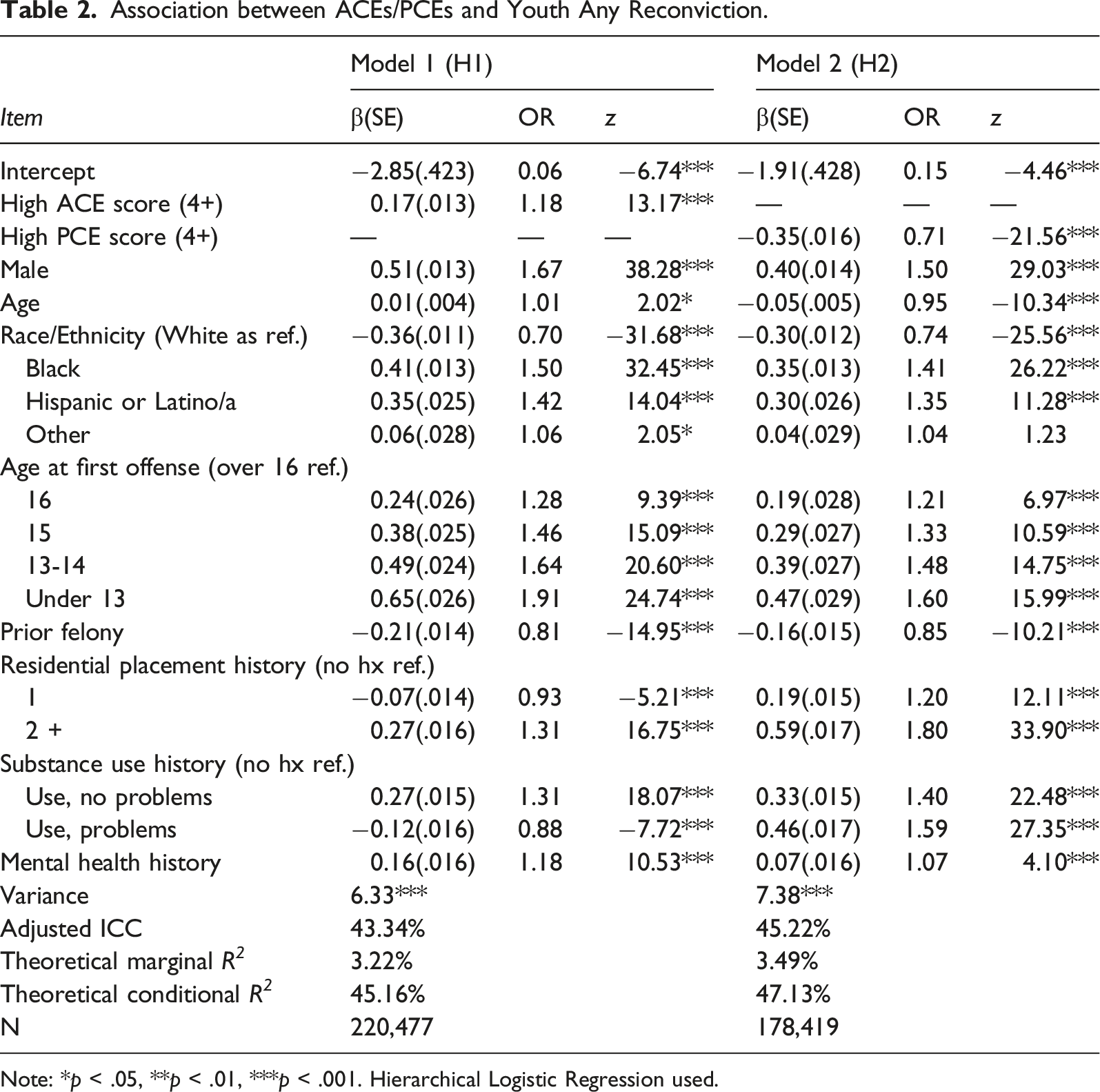
To test H1 and H2, we computed six binary logistic mixed regression models. The first model includes the ‘High ACE’ indicator (plus control measures), and the second model includes the ‘High PCE’ indicator (plus control measures) to assess scale effects on recidivism. These analyses were used to assess the effect of ACEs on the developed PCE threshold.
Next, we tested H3 – whether youth with high levels of PCEs and low levels of ACEs possess lower recidivism odds. We examined this effect with an ordinal categorization using the two ACE and PCE threshold indicators, measured as High PCE, Low ACE (reference); High ACE, High PCE; High ACE, Low PCE; Low ACE, Low PCE. Included as a categorical predictor (plus controls), we compared category variations on youth recidivism. 5
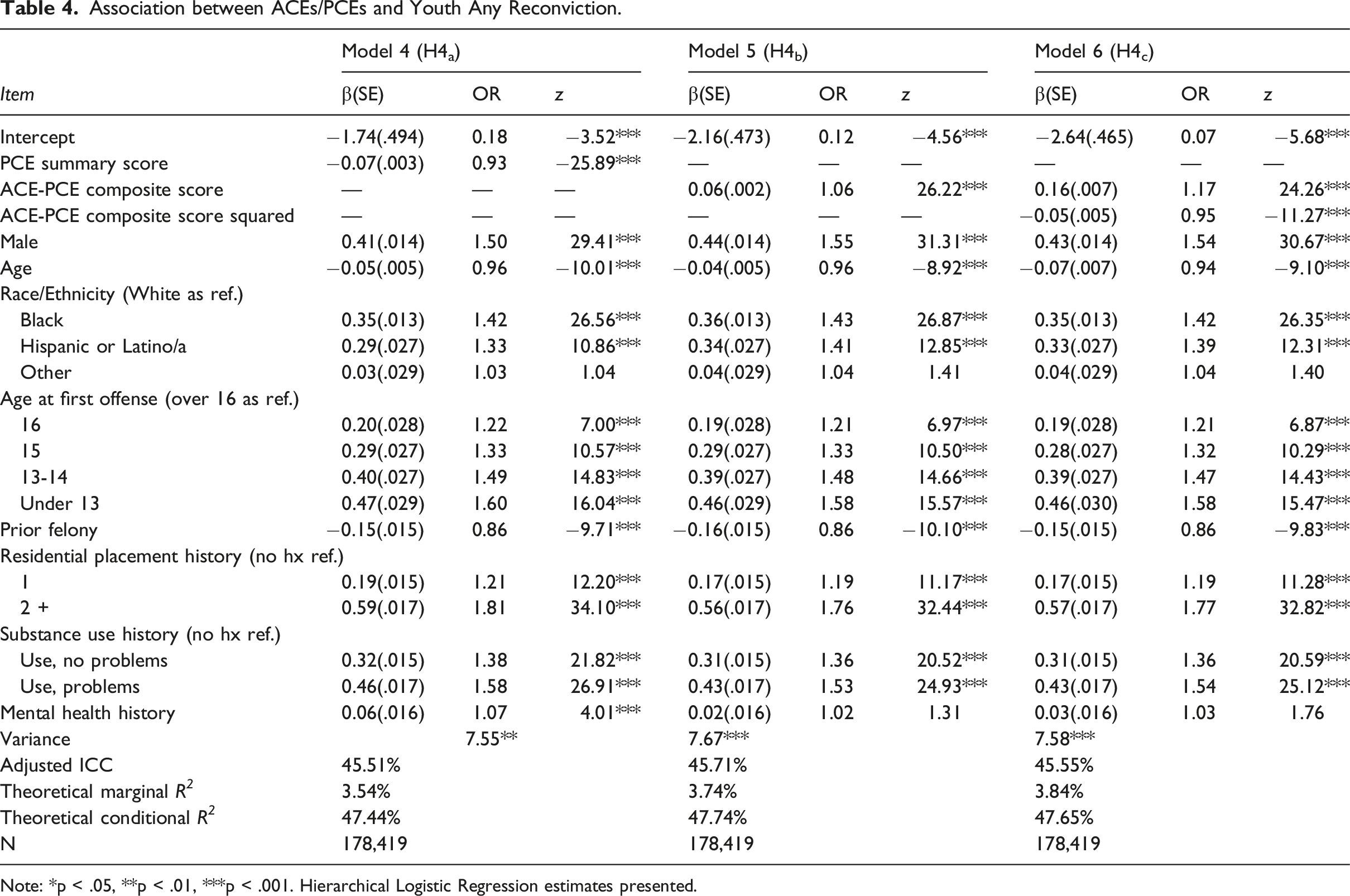
We then examined the PCE continuous (summary) scale and modeled the relationship between each PCE item and youth reconviction individually for H4 and its sub-hypotheses. This final set of analyses included three logistic mixed model regressions examining: the continuous PCE score (plus control measures), the effect of the ACE-PCE composite scale (plus control measures), 6 and the ACE-PCE composite scale as a quadratic term (plus control measures), to assess if the predictor possessed a curvilinear relationship with recidivism. To further examine the presence of any curvilinear relationship, a conditional plot was created to visually depict the shape of the relationship of the composite scale score and the probability of re-offense with increasing scale score values.
Results
All models demonstrated an adjusted ICC of roughly 43 to 46%, indicating that an MLM analysis was relevant as a substantial percentage of the variance was related to level two (the sites). All chi-squared analysis of deviance tests comparing models with and without random effects were significant, suggesting inclusion of random effects to be superior to a model with only fixed effects. Further, about 6 to 7% of the variance across models was explained by fixed effects while approximately 45 to 48% of the variance was explained by random effects. In other words, much of the data variability resided in random effects.
Effect of Control Variables
The effect of many of the controls was uniform across all models. Boys evidenced greater odds of reconviction (OR = 1.50 to 1.67) across all models. The influence of age was also consistent, where older youth demonstrated decreased recidivism odds in most models (OR = 0.94 to 1.01). The effect of race/ethnicity was also consistent, where Black (OR = 1.41 to 1.50) and Hispanic or Latino/a (OR = 1.33 to 1.42) youth displayed significantly increased odds of reconviction as compared to White youth. Although youth from the Other category also demonstrated greater odds of reconviction (OR = 1.03 to 1.06) compared to White youth, this effect was non-significant for most models. Further, the impact of age of first offense was similar across models. Compared to youth who were older than 16, all other age groups evidenced greater recidivism odds: 16 (OR = 1.21 to 1.28); 15 (OR = 1.32 to 1.46); 13 to 14 (OR = 1.47 to 1.64); and 13 and under (OR = 1.58 to 1.91). Additionally, youth who had a prior felony demonstrated lowered reconviction odds (OR = 0.81 to 0.85). Lastly, the effect of mental health history was consistent, where youth with a previous history of mental illness displayed slightly greater recidivism odds (OR = 1.02 to 1.18). Despite all of these effects being statistically significant, with age and mental health history as an exception in a few of the models, the results of the control variables were all small in terms of effect size (ORs less than 2.5). Some of these statistically significant results are likely due to the large sample size.
There were two controls that were not consistent across models: residential placement and substance use. However, both of these variables had the greatest difference when tested in the ACEs-only model (Model 1). While youth with a history of one residential placement, compared to youth with no history, showed greater reconviction odds for models involving PCEs (OR = 1.19 to 1.21), they demonstrated decreased recidivism odds when only ACEs were included in Model 1 (OR = 0.93). However, youth with two or more past residential placements, when compared to youth with no history, evidenced greater reconviction odds (OR = 1.31 to 1.81). Similarly, compared to youth with no history of substance use, those with past use that did not result in problems displayed heightened recidivism odds (OR = 1.31 to 1.40). Yet, there was, again, a divergence in the ACEs-only model (Model 1) when comparing youth with no substance use history to those with a history that resulted in social, psychological, or health problems. Those in the latter group evidenced decreased odds of reconviction (OR = 0.88). In all models that included PCEs, youth with a history of substance use resulting in problems demonstrated greater odds of recidivism (OR = 1.53 to 1.59). Again, while these effects were statistically significant, they were all small effects. Given the consistency in the effect of the control variables and only one substantial difference for a history of one residential placement and substance use resulting in problems, these findings are not described with each model’s results.
H1 & H2: Effect of ACE & PCE Thresholds on Recidivism
Association between ACEs/PCEs and Youth Any Reconviction.
Note: *p < .05, **p < .01, ***p < .001. Hierarchical Logistic Regression used.
H3: Impact of ACE-PCE Specifications on Recidivism
Association between ACE and PCE Thresholds on Youth Reconviction.

Note: *p < .05, **p < .01, ***p < .001. Hierarchical Logistic Regression estimates presented.
H4: Effect of ACE-PCE Composite Scores on Recidivism
Association between ACEs/PCEs and Youth Any Reconviction.
Note: *p < .05, **p < .01, ***p < .001. Hierarchical Logistic Regression estimates presented.
Figure 1 shows a conditional plot for the test of the ACE-PCE quadratic, composite score (see Model 6). When examining the final model, adding the polynomial term provided a significant contribution to the model, where the main effect identified a 17% increased/decreased reconviction likelihood for each 1-point increase/decrease in the combined ACE-PCE score (p < .001). For the squared score, there was a concave shape, reflecting a ceiling effect of ACEs. When examining Figure 1, predicted probabilities are observed to increase with decreasing PCEs/increasing ACEs, where the increasing trend begins to plateau near the scale value of plus four. ACE-PCE composite score – conditional plot.
Discussion
The ACE and PCE concepts outline a dose-response relationship (Felitti et al., 1998; Baglivio et al., 2014; Bethell et al., 2019) to best predict various outcomes rather than assessing each of these events in isolation. While previous research has examined the effect of cumulative ACE exposure as well as the influence of singular protective factors, only one study has investigated the effect of cumulative exposure of PCEs and the interaction of ACEs and PCEs on youthful recidivism in a single southeastern state. This is a burgeoning area of research, and the current study contributes to the field’s knowledge by exploring the combined effect of ACEs and PCEs on the incidence of youth recidivism across nine states. Baglivio and Wolff’s (2021) study can be conceived as a proof of concept whereas the present study takes ‘the concept to scale’ by demonstrating the overarching effects of ACEs and PCEs across a wide variety of youth and justice stages. Additionally, the present study does more than replicate the Florida study by confirming consistency and removing all doubt that the effects of ACEs and PCEs exist only within Florida. Unlike the 2021 study, we also explore whether associations of ACEs, PCEs, and recidivism are sensitive to operationalization of the key independent variables in order to assess the robustness of these associations in a large and representative sample. This study also examines potential non-linearity in the relationship between ACEs and PCEs.
Our research is also unique in that we did not examine the primary predictors of crime and recidivism explicated in the Risk-Needs-Responsivity (RNR) framework (Andrews & Bonta, 2010). Instead, we focused on non-criminogenic factors that can impact recidivism likelihood as gaps emerge when justice-involved youth are managed primarily on their risk of recidivism. Moreover, as risk is an actuarial representation, additional context of how someone becomes involved in and subsequently responds to the juvenile justice system and its interventions is needed. The present study offers a contribution to the field’s understanding of how certain non-criminogenic experiences – ACEs and PCEs – affect reoffending likelihood. In other terms, consideration of needs, responsivity, and/or destabilizing factors can be a useful strategy in enhancing outcomes for justice-involved youth as consideration of these factors can improve a person’s ability to change their life-course trajectory. Relevant to the current study, a history of trauma or adversity constitutes one type of destabilizing factor (Taxman & Caudy, 2015). However, provision of services or programs centered on trauma or adversity tends to be secondary to criminogenic interventions.
It is therefore important to remove barriers that may affect justice-involved youths’ success because of the noted factors. Our results show that ACEs may constitute a need and/or responsivity factor not recognized in prior research as a central or robust predictor of recidivism. Yet, the current findings and results from other studies examining ACEs indicate that multiple exposures to adversity significantly impact justice-involved youths’ recidivism. In line with this past research, greater ACE exposure yielded a heightened reoffending likelihood. We observed a nearly 20% greater odds of reconviction for youth with four or more ACEs. Notably, our study sample also demonstrated a greater level of ACE exposure than other studies involving community-based justice-involved youth. While 37% of youth in the current study reported four or more ACEs, 29% of youth in Baglivio and Wolff’s (2021) study, and 27% of youth in Belisle’s (2021) work indicated four or more. However, Kowalski (2019) found that about 69% of her total sample of youth reported four or more ACEs. These findings further demonstrate a need for analysis at the jurisdictional level, as the samples from these three studies were derived from different states and evidenced significant variability.
Additionally, as with Baglivio and Wolff’s (2021) study, we found that youth with higher PCE exposure demonstrated a roughly 30% decreased reconviction odds. Further, exposure to PCEs was much lower in our study sample (about 19%) while approximately 32% of youth in Baglivio and Wolff’s (2021) study indicated six or more PCEs. 7 Importantly Baglivio and Wolff (2021) utilized a cut-off score of six PCEs due to the nature of their study sample while we used a threshold of four or more PCEs based on our sample. Despite these different operationalizations, there is evidence that PCEs are negatively associated with youth recidivism after controlling for a host of factors. Even without considering the impact of ACEs, PCEs appear to be a responsivity or protective factor that, if fostered, could substantially influence justice-involved youth’s success. Yet, because the RNR model has focused primarily on risk factors, much less is known about the influence of protective factors on deviant or criminal behavior. Our findings reveal that this is a critical avenue of future research in justice-involved youth samples.
Moreover, findings showed that youth with High ACE/High PCE, High ACE/Low PCE, or Low ACE/Low PCE exposure (22%, 59%, and 43% increased recidivism odds, respectively) differed from youth with High PCE but Low ACE exposure. As far as we know, this is the first test of these variations on ACE-PCE exposure in tandem. However, Baglivio and Wolff (2021) conducted a similar test in which they explored the effect of High ACEs on reconviction for youth with Low PCEs and youth with High PCEs. Youth with Low PCEs but High ACEs demonstrated 11% heightened odds of reconviction while youth with High PCEs and High ACEs displayed 6% decreased odds. Again, these findings are not directly comparable as we utilized four PCEs as the PCE cut-off; yet, our findings are consistent with the idea that there is an interactive effect between ACE and PCE exposure when it comes to predicting future offending. These results further suggest that PCEs can mitigate the influence of ACEs. Consequently, screening for PCEs can help lessen the influence of ACEs on youth’s recidivism. More specifically, identified cumulative PCEs can serve as an effective case management strategy. Therefore, case managers can potentially negate ACEs by engaging and building upon justice-involved youths’ strengths. This focus would rely more on a strengths-based approach that does not fully align with the RNR model. This tactic does not require that the field ignore criminogenic needs; instead, needs could be addressed while also building upon identified strengths, which would involve addressing a person as a whole rather than focusing on only one aspect of their life experience. This study is also one of the strongest supporting pieces of the strengths-based cause insofar that we examined the influence of PCEs on ACEs in a multistate sample of justice-involved youth representative of the US.
Notably, not all experiences are the same. Arguably, an experience of sexual abuse is quite different than being a child of divorce, and these experiences likely have dissimilar effects on recidivism. Although there is the potential for disparate effects if ACEs and PCEs were to be considered separately (e.g., modeling the effect of one ACE or PCE at a time), the body of literature regarding these experiences suggests there is substantial utility in exploring the effect of cumulative maltreatment and protective childhood experiences, particularly in light of prior work demonstrating the interrelatedness of exposures, their non-random occurrence, and evidence of the cumulative impact of exposures (dose-response) across outcomes (e.g., Baglivio & Epps, 2016; Anda et al., 2010; Dong et al., 2004). Our findings of the distinctive effects of ACE-PCE specifications add substantially to this body of research. These ACE-PCE pairings also provide a guide for triaging youth with these destabilizing (ACEs) and protective (PCEs) factors, where youth with high PCE and low ACE scores may require the least amount of intervention. A focus on ACE-PCE pairs can also aid in diverting youth away from the juvenile justice system and into the health or mental health systems depending on their respective needs as some deviant or criminal behaviors are trauma reactions following certain events. Rather than receiving care in a different system, youth with these reactions may instead be placed in the juvenile justice system and are punished for these reactions instead of having their experiences of adversity addressed (Chesney-Lind, 1989).
Regarding our final hypothesis, cumulative PCE and ACE-PCE composite scores were associated with justice-involved youths’ reconviction. As described previously, a higher PCE score yielded decreased reconviction odds while each additional ACE/PCE significantly predicted an increase/decrease in recidivism odds. Approximately 12% of youth had an ACE-PCE composite score of five or more while about 7% had a score of six or more. Although this appears to be a small percentage of youth on its face, these frequencies translate to thousands of youths – 24,895 and 14,030, respectively. The average cost to confine just one justice-involved youth is around $214,620 per year (Justice Policy Institute, 2020), meaning billions of dollars are spent on youth with what can be considered severely adverse childhoods. Not only is this cost high, but these are also youth who demonstrate greater reoffending likelihoods. Said otherwise, the juvenile justice system will continue to incur costs related to these youth if their needs and/or destabilizing factors are not addressed.
Lastly, we found a ceiling effect of ACEs, further demonstrating a curvilinear relationship between the ACE-PCE composite score and youth reconviction. The ceiling effect of ACEs is informative and advances understanding from prior research. Potentially heightened exposure to negative events (ACEs) leads to increased odds of externalizing behaviors and criminal offending, though at some point excessive ACE exposure may be crippling to daily functioning and perhaps drive internalizing, negative coping behaviors (e.g., substance abuse, self-cutting/mutilation) but not affect offending (likely even less apt to affect violent offending). Future work would lend value to theory and practice alike through untangling the types of behaviors exacerbated at varying levels of ACE exposure, and whether PCEs mitigate each of those behavior types.
These findings, particularly the last set of findings, greatly expand upon the understanding of ACE and PCE exposure among justice-involved youth. With our more representative sample of youth drawn from nine states, we were able to show that the effect of ACEs and PCEs is similar across multiple jurisdictions. Our findings also revealed that PCEs provide a protective effect, especially for youth with High ACEs. The strongest likelihood of reconviction resulted for youth with High ACEs but Low PCEs, highlighting the influence PCEs can have on mitigating the deleterious effects of ACEs. Demonstrating the effects of ACEs and PCEs on recidivism, the non-linear aspect of the ACE-PCE scale, and the description of the tipping point are large gains for this area of research that can help move the field forward and will provide practical information for case management within and outside the state of Florida as this is the largest assessment to date involving the effects of ACEs and PCEs on justice-involved youths’ recidivism.
Limitations
Although the current study provides a significant contribution to our knowledge of ACEs and PCEs and youth justice-system involvement, there are limitations worthy of mention. A primary concern is the limited number of PCEs that can be derived from the PACT. We are restricted to the items that currently exist in the assessment, and there are likely more positive experiences that help negate the effect of ACEs. These other experiences should be explored. Similarly, there are other ACEs that could be included that are not available in the PACT, such as experiences of racial/ethnic discrimination and homelessness (Finkelhor et al., 2015; Mersky et al., 2017). Additionally, the outcome measure – any reconviction – does not represent all types of recidivism that could occur, such as arrests, new dispositions, revocation, or variations in the crime type associated with a reoffending event, including felonies, misdemeanors, violent, or non-violent crimes. It was not feasible in the current study to include various recidivism types due to space restrictions. However, we plan to examine multiple outcomes in future research. Moreover, while use of adjudications as our outcome may have led to lower recidivism rates when compared to other studies that examine rearrest rates, given the range of populations and justice stages, it was selected to provide a more stable indication of youth behavior. Future studies should compare outcomes to identify the incremental benefit of using one outcome type over another.
Furthermore, a critique that has been well-articulated in the ACE literature generalizes to PCEs and how they are measured here. Like the ACEs measures, our threshold and cumulative PCE variables do not account for the severity or frequency of each exposure, nor do they consider the developmental period in which exposure occurred (Jaffee & Maikovich-Fong, 2011) or changes over time. The data did not permit for an examination of how many times ACEs or PCEs occurred, how severe youth perceived them to be, or how old youth were when they experienced the event(s). Consequently, more developmental research is needed to explore how these experiences influence justice-involved youths’ outcomes. Similarly, more work is necessary to examine the effect of timing between ACEs and PCEs – which occurred first and how the effect of PCEs differentially impacts ACEs as a result of PCEs occurring before or after ACE exposure. These limitations also indicate that we may have underestimated the effect of certain ACEs or PCEs.
Additionally, there has been a pervasive blurring of exposure to potentially traumatic experiences (ACEs) with referring to such exposures as trauma (e.g., Finkelhor, 2018). While exposure to many types of abuse, neglect, and household dysfunctions as per a screening of ACEs has been associated with many negative implications, trauma symptomology requires additional assessment as whether an experience/event is traumatic is highly individualized. ACEs may be a useful, even considered a critical and universal screening need for youth entering the justice system, yet additional assessment for the extent to which the youth experiences trauma or PTSD-related symptoms (e.g., flashbacks, difficulty sleeping, arousal, negative cognition or avoidance) is warranted. Such assessments for children/adolescents are widely available (e.g., UCLA Child/Adolescent PTSD Reaction Index for the DSM-5; Elhai et al., 2013).
Also, the current study as well as much of the ACEs work concerning youth involves a sample that is already high-risk for deviant behavior when compared to youth without justice system involvement. These experiences are likely to have a larger impact in justice-involved samples than what would be evidenced in the general population. Therefore, it is possible that different outcomes not examined here (e.g., mental illness and physical ailments) may be equally likely in justice-involved and general community samples. A matching technique, such as propensity score matching, comparing justice-involved and general community individuals could better reveal the effects of these experiences on other outcomes, including those that may be considered behavioral or psychological (e.g., substance use and abuse).
Specific to data limitations, we note the importance of future work in examining specific mental health diagnoses independently (or groups of disorders), in contrast to the dichotomous indicator of a formal diagnosis history. A generalized “mental health problems” measure is a larger problem in the study of offending more broadly, as specific studies have demonstrated a relationship with recidivism (e.g., Prins & Draper, 2009; Skeem et al., 2013), yet mental health problems, like adverse experiences, do not rise to the level of being classified as a criminogenic need as per the RNR model (Andrews & Bonta, 2010). This is most likely due to the non-specified aspect in that some diagnoses may increase delinquency likelihood while others may not, or may decrease odds of offending. Unfortunately, the multistate aspect of this study means specific diagnoses for each youth were not available, as not all states/jurisdictions capture that level of detail outside of hardcopy files. Additionally, while prior work has used PACT assessment items to code externalizing (e.g., aggression, school suspensions, school conduct) and internalizing (e.g., suicidal ideation/attempts, substance use/abuse) measures (see Perez et al., 2016), that distinction was not the focus of the current project in examining reoffending.
Policy Implications/Recommendations
As indicated, the findings demonstrate a protective effect of PCEs on youth reconviction. These results suggest that efforts could be directed toward bolstering protective factors, especially for justice-involved youth who have reached the ceiling for the combined ACE-PCE composite score evidenced herein (those with substantially greater ACEs than PCEs). The findings provide greater information about the interaction between ACEs and PCEs and can help direct resources to youth who may need them most. Prioritizing juvenile justice system resources to those youth with a higher ACE-to-PCE balance would assist with decreasing youth recidivism and improving public safety. A strengths-based focus toward developing opportunities for PCE exposure seems paramount. Enhancing PCEs could range dramatically with respect to costs, implementation of evidence-based family therapy models (e.g., Functional Family Therapy, Multisystemic Therapy) and proven prevention models (e.g., Nurse-Family Partnerships) at the higher end through less expensive mentoring programs down to structured community recreational opportunities for youth.
Additional research is needed regarding prevalence differences in ACEs and PCEs in youth as a precursor to justice-system involvement for multisystem youth (consecutive and/or concurrent juvenile justice and child welfare involvement), as well as by supervision type (e.g., community supervision, residential placement, and detained youth). Our sample included youth under different types of supervision, but we did not explore how ACEs, PCEs, and the ACE-PCE composite score affected reconviction across these groups. More research is also needed to explore differences with respect to race/ethnicity, sex, and risk/needs level. Past work has identified prevalence differences across these groups in justice-involved youth samples regarding ACE exposure (Baglivio et al., 2014; Belisle, 2021; Kowalski, 2019). It is likely that there are also differences across these groups in PCE exposure.
Moreover, research could investigate mediating factors between the ACE/PCE relationship and recidivism. Other studies have shown that substance use may mediate this relationship (Craig et al., 2019). Similarly, Craig, and colleagues (2017a) explored whether social bonds buffered the relationship between ACEs and justice-involved youth recidivism. These studies could be replicated with PCEs included (or PCEs in isolation) to assess whether any mediating effects change. Additional research is also needed to more fully investigate the mediating effect of PCEs on ACEs in terms of programming. As an example, interventions could introduce PCEs for youth exposed to interpersonal adversity (Karatzias et al., 2020).
It would also be pertinent to universally screen for both ACEs and PCEs as a best practice (Merrick & Narayan, 2020). This approach could involve a shift of RNAs more toward needs and responsivity rather than focusing so much attention on risks. This recommendation, generally, has implications for RNA practice and what items should be included in assessments. In other words, it could change the focus of an RNA from that of risk to one that pays greater attention to needs and responsivity factors. This is in line with further identifying whether adversity is a risk and/or need. Moreover, youth with a history of adversity likely have higher mental health and substance use needs. These latter issues would indicate shifting youth to non-justice agencies as they may be better served outside of the criminal justice system.
Conclusion
Policy implications surrounding attempts at successful rehabilitation of system-involved youth are enormous. Given the growing evidence elucidating negative outcomes for justice-involved youth with high ACE exposure, more information is needed regarding protective factors that may help people exposed to ACEs to prevent them from initial entry into the justice system or from further justice-system involvement. The current study demonstrated the ability of PCE exposure to buffer the negative influence of ACEs on youth reconviction. We also found a ceiling effect of ACEs when combined with PCEs, which could enhance efforts to provide programming and case management to justice-involved youth. We remain optimistic regarding a continued paradigm shift toward the importance of a strengths-based focus on addressing juvenile delinquency through fostering positive experiences among youth as a prevention and intervention strategy.
Footnotes
Declaration of Conflicting Interests
The author(s) declared no potential conflicts of interest with respect to the research, authorship, and/or publication of this article.
Funding
The author(s) disclosed receipt of the following financial support for the research, authorship, and/or publication of this article: Office of Juvenile Justice and Delinquency Prevention (OJJDP), Office of Justice Programs (OJP), U.S. Department of Justice (DOJ); CFDA #16.540 [OJJDP FY 2017 Field-Initiated Research.
