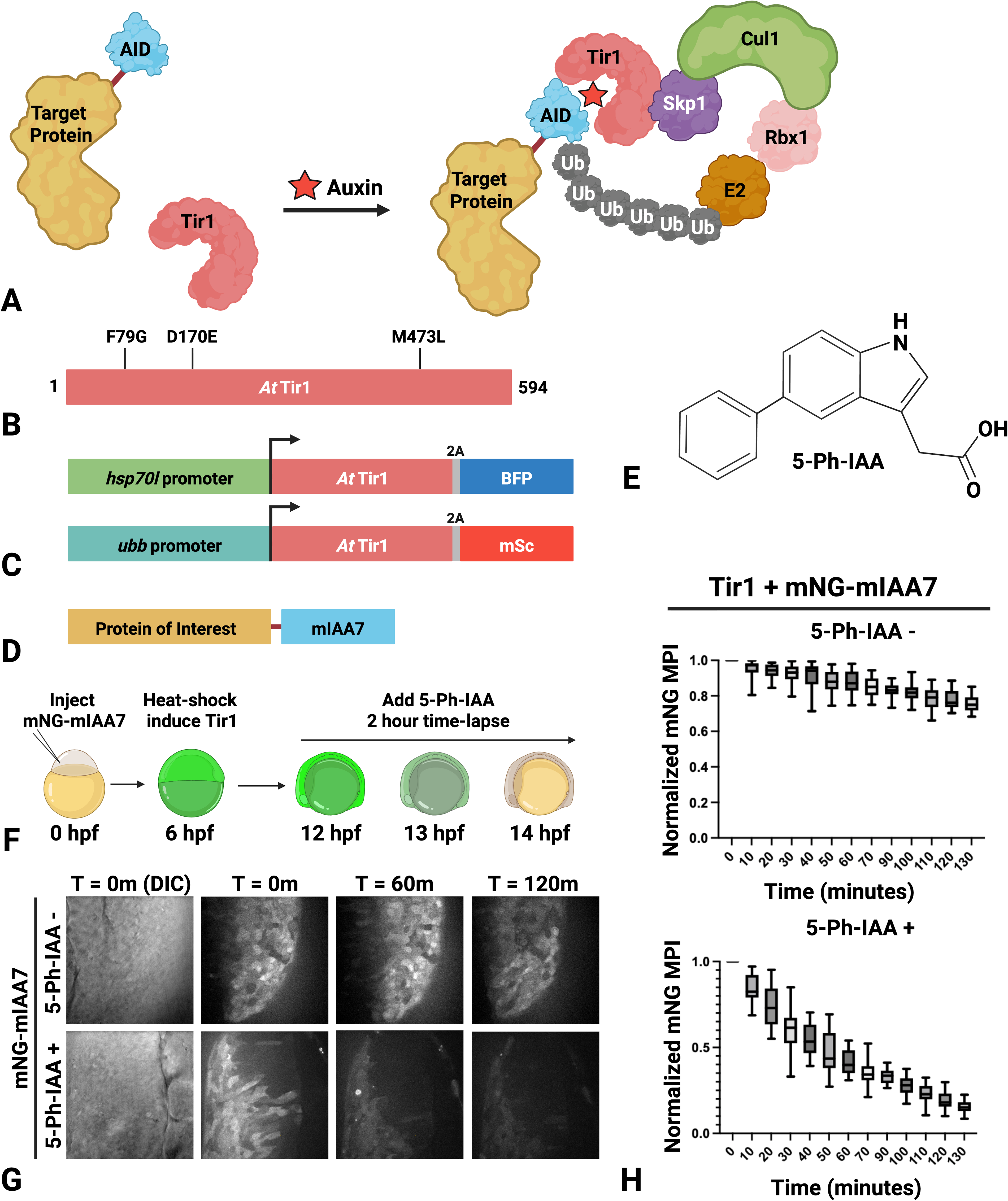
Morabito et al. described the successful use of the auxin-inducible degron (AID) system in zebrafish.1 The AID is native to plants and has been used as an inducible protein degradation method in nonplant cells, including several animal models.2,3 Proteins of interest are tagged with an AID, and, in the presence of the plant-specific F-box protein Tir1, are rapidly degraded in zebrafish embryos when the plant hormone auxin is added. The authors tested many variations of the system to find conditions optimal for rapid depletion of AID-tagged proteins in zebrafish (Fig. 1). They also described the generation of ubiquitous Tir1-expressing transgenic zebrafish lines. The AID system was used to transiently degrade over-expressed Sox2 protein at somite stages, which allowed the authors to better understand the role that Sox2 plays in dorsal midline neuromesodermal progenitor cells that generate the floor plate of the spinal cord and the mesodermal notochord.
Optimization of the auxin-inducible degron system for use in zebrafish. (A) The auxin-inducible degron pathway. AID containing proteins co-expressed with the Tir1 F-box protein will be degraded in the presence of the plant hormone auxin. (B) Optimized AID-mediated protein degradation in zebrafish uses the Arabidopsis thaliana Tir1 protein and the F79G mutation from the AID2 system.3 The mutation modifies the auxin binding pocket and pairs with a modified auxin molecule to prevent leaky degradation and reduce the amount of modified auxin required. The Tir1 protein also includes the D170E and M473L mutations that improve binding of Tir1 to AID domains.4(C) Transgenes are integrated into the zebrafish genome for ubiquitous expression of the Tir1 protein from (B), using either the heat shock inducible promoter (hsp70l) or the ubiquitin B promoter (ubb).5,6 The transgenes also contain a fluorescent marker (blue fluorescent protein or mScarlet) separated from the Tir1 sequence by a viral 2a peptide. (D) The alternative AID mIAA7 shows improved degradation kinetics in zebrafish compared with the more commonly utilized miniAID from the IAA17 protein.7(E) The modified auxin molecule 5-Ph-IAA is used in combination with the mutant Tir1 protein to induce degradation of mIAA7-tagged proteins. (F) Workflow for testing the depletion of mIAA7-tagged mNeonGreen using the optimal conditions. (G) Still images of mNeonGreen fluorescence from time-lapse movies of an embryo without (top) and with (bottom) 5-Ph-IAA. (H) Quantification of mNeonGreen fluorescence from time-lapse movies. The top graph shows embryos treated with vehicle control, and the bottom graph shows 5-Ph-IAA treatment. Images were captured every 10 min over a 130-min duration (X-axis), and the normalized mean pixel intensity of mNeonGreen fluorescence was calculated (Y-axis). Images in G and H are reproduced from Morabito et al.1 This figure was generated using bioRender.
Footnotes
Author Disclosure Statement
The authors have no interests to disclose.
Funding Information
This work was supported by NIH grant R35GM150290 to B.L.M.
References
1.
MorabitoRM, TatarakisD, SwickR, et al.The ratio of Wnt signaling activity to Sox2 transcription factor levels predicts neuromesodermal fate potential. Development2025;152(22):dev204661; doi: 10.1242/dev.204661
2.
NishimuraK, FukagawaT, TakisawaH, KakimotoT, KanemakiM. An auxin-based degron system for the rapid depletion of proteins in nonplant cells. Nat Methods2009;6(12):917–922; doi: 10.1038/nmeth.1401
3.
YesbolatovaA, SaitoY, KitamotoN, et al.The auxin-inducible degron 2 technology provides sharp degradation control in yeast, mammalian cells, and mice. Nat Commun2020;11(1):5701; doi: 10.1038/s41467-020-19532-z
4.
YuH, MossBL, JangSS, et al.Mutations in the TIR1 auxin receptor that increase affinity for auxin/indole-3-acetic acid proteins result in auxin hypersensitivity. Plant Physiol2013;162(1):295–303; doi: 10.1104/pp.113.215582
5.
HalloranMC, Sato-MaedaM, WarrenJT, et al.Laser-induced gene expression in specific cells of transgenic zebrafish. Development2000;127(9):1953–1960.
6.
MosimannC, KaufmanCK, LiP, et al.Ubiquitous transgene expression and Cre-based recombination driven by the ubiquitin promoter in zebrafish. Development2011;138(1):169–177; doi: 10.1242/dev.059345
7.
LiS, PrasannaX, SaloVT, VattulainenI, IkonenE. An efficient auxin-inducible degron system with low basal degradation in human cells. Nat Methods2019;16(9):866–869; doi: 10.1038/s41592-019-0512-x