




Abstract
The effects of transformational leadership are contingent on the complexity of the context in which the leadership is executed. This study examined transformational leadership in the context of international project teams and its relationship to team performance, work adjustment, and job satisfaction. The mediating influence of trust in the team was investigated. Data were collected from 286 international assignees in multinational project teams in an oil and gas corporation. Results revealed a positive relationship between transformational leadership and the outcomes. Trust in the team partially mediated the relationship between transformational leadership and team performance, and environmental dynamism moderated the direct effect between transformational leadership and team performance. Our results provide support for the applicability of transformational leader behaviors in contexts with varying degree of complexity.
The globalized, fast paced knowledge era creates new challenges for leaders in multinational corporations establishing international projects around the world (Barkema, Baum, & Mannix, 2002). In these international project organizations, leaders often have to navigate in ambiguous, volatile, and unpredictable work environments. Parallel to this development, researchers have for a long time been encouraged to explore contextual influences on leadership (Pawar & Eastman, 1997). This request is yet to be met (Porter & McLaughlin, 2006) and research on leadership in specific contexts is still needed (Liden & Antonakis, 2009). The present study is conducted in an international project context, and builds on three premises. First, many researchers have stated that the suitability of transformational leadership varies according to the context (De Hoogh, Den Hartog, & Koopman, 2005; Ensley, Pearce, & Hmieleski, 2006). The relevance of transformational leader behaviors in a wide range of contexts has been supported during several decades (Bass & Riggio, 2006; Den Hartog, House, Hanges, Ruiz-Quintanilla, & Dorfman, 1999). Although research has indicated a high relevance of transformational leadership in project-intensive organizations (Keegan & Den Hartog, 2004), studies investigating transformational leadership in project contexts have been scarce. One objective of this study is to contribute to an increased understanding of how transformational leadership interacts with contextual characteristics in an international project environment and its impact on team performance. Second, although the relationship between transformational leadership and positive individual outcomes has been supported in numerous studies, we concur with researchers highlighting the necessity of more empirical research on the relationship between transformational leadership and team outcomes (Dionne, Yammarino, Atwater, & Spangler, 2004). One way of attaining increased knowledge about this relationship is through the use of mediators representing team processes or characteristics of the team. Our study thus investigates how transformational leadership affects team performance, and the potential mediating role of team trust. Third, according to a recent critical examination of leadership effectiveness criteria (Hiller, DeChurch, Murase, & Doty, 2011), work adjustment on international assignments is yet to be investigated as an outcome of leader behavior. This is surprising since low levels of work adjustment are argued to be one of the main reasons for premature termination of international assignments (Black & Gregersen, 1999). Considering the costs of international assignment failure and the increasing rates in the international assignee population, as stated by the Graduate Management Admission Council (GMAC; 2008), we claim findings from this study to be highly relevant for leadership development practitioners working in multinational corporations. We therefore investigate the relationship between transformational leadership and work adjustment as suggested by Kraimer, Wayne, and Jaworski (2001).
Transformational Leadership
Transformational leadership has been an extraordinary popular research topic during the past decades. Transformational leadership theory (Bass, 1999) was presented as a wider theory about specific leadership behaviors and their influence on performance. Today transformational leadership theory includes three specific leadership behaviors: idealized influence/inspirational motivation, individualized consideration, and intellectual stimulation (Avolio, Bass, & Jung, 1999; Bass, 1999). Transformational leadership behaviors extend transactional leadership, the mutual exchange process between a leader and a follower, by expressing high performance expectations, articulating an exciting vision, and providing individualized support (see Podsakoff, MacKenzie, Moorman, & Fetter, 1990). Through these behaviors, transformational leaders align team members’ goals and values, and foster collective optimism, team efficacy, and identification with the team (Bass & Riggio, 2006), which in turn leads to increased performance among employees and organizations (see Wang, Oh, Courtright, & Colbert, 2011).
Research has shown that transformational leadership correlates with a wide range of positive outcomes for employees, work teams, and organizations. For example, transformational leadership is connected to subordinates’ satisfaction with the leader and job satisfaction (e.g., Nemanich & Keller, 2007), follower motivation and leader effectiveness (Judge & Piccolo, 2004), performance (Dvir, Eden, Avolio, & Shamir, 2002), and organizational citizenship behavior (Podsakoff et al., 1990). Altogether, these findings provide support for the effects of transformational leadership on a range of positive outcomes.
Some scholars have suggested that transformational leadership behaviors should be ideal in any setting, industry, or culture (e.g., Bass & Riggio, 2006). Based on data collected in 62 different countries, the Global Leadership and Organizational Behavior Effectiveness research program (GLOBE; House, Hanges, Javidan, Dorfman, & Gupta, 2004) found that the charismatic/value-based leadership and the team-oriented leadership dimensions were contributing to a leaders’ success in nearly all cultural contexts. These two leadership dimensions are now regarded as universally endorsed, suggesting that managers around the world generally presume these behaviors to contribute to being an outstanding leader (Den Hartog et al., 1999). These dimensions have strong similarities with the transformational leadership theory (e.g., Bass & Riggio, 2006), and the present study (Figure 1) aims to elaborate on assumptions about universality by examining the effectiveness of transformational leadership in an international project context. This allows us to provide valuable input on the variation of the effectiveness of transformational leadership according to the context in which it is examined.

Research model
Team Performance
Leadership characteristics such as individualized consideration, intellectual stimulation, and vision provide teams with direction and motivation toward high performance (e.g., Dionne et al., 2004). Research on team leadership indicated that transformational leadership has a direct effect on team performance (e.g., Bass, Avolio, Jung, & Berson, 2003; Burke et al., 2006). A recent meta-analysis showed that the effects of transformational leadership on team performance were consistent across different performance criteria (Wang et al., 2011). In line with this meta-analysis pointing out stronger effects of transformational leadership on team performance compared with individual performance, we argue that transformational leadership behaviors (i.e., fostering the acceptance of group goals, providing an appropriate model, articulating a vision) have a positive effect on team performance.
Hypothesis 1: Transformational leadership is positively related to team performance.
Dynamic Work Environment
Studies involving potential moderators and mediators have received increasing attention in research on transformational leadership and team performance (Dionne et al., 2004; Gupta, Huang, & Niranjan, 2010). Exploring how leadership interacts with the context, several authors have suggested that transformational leadership would be more prevalent and more effective when the environment is unstable, uncertain, and turbulent (e.g., Waldman & Yammarino, 1999). Research from Waldman, Ramírez, House, and Puranam (2001) showed that leader charisma predicted financial performance under conditions of perceived environmental uncertainty, but not under conditions of certainty. Furthermore, De Hoogh, Den Hartog, Koopman, et al. (2004), and De Hoogh et al. (2005) found that charismatic leadership was positively related to perceived effectiveness in highly dynamic contexts. We argue that in low dynamic work environments the respective leader can easily provide clarity and describe appropriate response patterns for the team. However, in highly dynamic work environments, expectations about appropriate response patterns are unclear, because few cues in the environment can be associated with specific actions; this causes team members to search for cues in the environment to guide their behavior. In these contexts, transformational leaders are more able to influence followers through their charisma, vision, and inspirational motivation (Shamir & Howell, 1999). Consistent with research mentioned above (e.g., Bass & Riggio, 2006), we expect that the effects of transformational leadership behaviors on team performance are stronger when the work environment is perceived as highly dynamic. Hence, the following hypothesis is tested:
Hypothesis 2: The relationship between transformational leadership and team performance is positively moderated by dynamic work environment.
Trust in the Team
Considerable research has investigated the link between transformational leadership and performance, and trust in the leader operates as a mediator in this relationship (e.g., Jung & Avolio, 2000). Trust can however have several referents, being directed at a designated team leader and at the team as a whole (Gillespie, 2003). It is reasonable to believe that trust in the leader may be necessary, but not sufficient for high team performance; team members also need to trust each other to achieve maximum performance. Several recent research findings have supported this inference. Investigating cross-functional teams, Webber (2002) emphasized the team leader’s mission to develop a climate for team trust as a means to achieve high effectiveness. Despite research indicating the importance of leadership on team trust, the relationship has received little empirical attention (Lee, Gillespie, Mann, & Wearing, 2010). In an international project context, team trust is of high importance as one depends on the open exchange of knowledge and information to ensure effective team functioning.
We argue that project team members have a higher confidence in the team’s competence when the team is governed by transformational leadership principles such as inspiring vision and the provision of support, and that this leads to a heightened level of trust in the team. Furthermore, we argue that the effect of transformational leadership on team trust will be contingent on the context in which the team is operating. Lastly, we propose that a heightened level of trust in the team will be positively related to team performance. Hence, we assume that trust in the team acts as a mediator between transformational leadership and team performance and that dynamic work environment serves as a moderator. Thus, the following hypothesis is tested in an international project context:
Hypothesis 3: Trust in the team acts as a mediator in the relationship between transformational leadership and team performance, and dynamic work environment moderates the indirect effect of transformational leadership on team performance through trust in the team.
Work Adjustment and Job Satisfaction
International project staff is required to adjust to life in a different culture, to interact with new colleagues and host nationals, and to adapt to a new position with corresponding tasks and responsibilities (Black & Stephens, 1989). This can cause significant strain on the individual, and it is argued that multinational corporations often underestimate the challenges related to global staffing and expatriation (Collings, Scullion, & Morley, 2007). Previous research literature has focused on required individual characteristics of the international assignee and their impact on job performance (e.g., Mol, Born, Willemsen, & Van Der Molen, 2005). We concur with Kraimer et al. (2001) who claimed that it is too early to dismiss the leader as a facilitator toward followers’ work adjustment on international assignments. We purpose that one of the main responsibilities of a leader on international assignments is to clarify work procedures and performance standards. In support of this, Black (1988) reported that role ambiguity among international assignees negatively influenced work adjustment. Also, as transformational leader behaviors have been found to reduce levels of employee job stress (Podsakoff, MacKenzie, & Bommer, 1996), we expect the potential impact of transformational leadership to be especially relevant to the assignees’ work adjustment due to the increased complexity in international assignments. As previously mentioned, insights into the mechanisms of work adjustment are highly important for international project organizations due to the high costs associated with premature termination of the assignment. We propose that transformational leaders provide support on issues related to openness and cooperation with employees from different cultural backgrounds, and that transformational leadership facilitates the assignees’ adjustment to their supervisor, their colleagues, and their job responsibilities. Thus, we postulate the following:
Hypothesis 4: Transformational leadership is positively related to work adjustment in an international project context.
Most studies have found clear support for the existence of a positive relationship between transformational leadership and job satisfaction (Dumdum, Lowe, & Avolio, 2002; Judge & Piccolo, 2004). Studies have considered diverse organizational settings, ranging from business to governmental to nonprofit sectors (Bono & Judge, 2003). To our knowledge, this relationship is yet to be investigated in an international project context. Thus, we expect to find support for the following hypothesis:
Hypothesis 5: Transformational leadership is positively related to job satisfaction in an international project context.
Method
Sample
The survey was distributed to 544 employees working in international projects in a Norwegian company in the oil and gas industry with an extensive portfolio of projects around the world. In total, 309 employees completed the survey (57% response rate). To make sure only international assignees were included in our sample, we excluded host nationals working in their home country (e.g., Norwegians working in Norway), which reduced the sample size from 309 to 286. Of the remaining participants (N = 286), 251 (87%) were male and 35 (13%) were female. Their age ranged from 26 to 64 years (M = 47, SD = 8.8). Organizational tenure ranged from less than 1 to 36 years (M = 9.7, SD = 9.4), whereas international work experience varied from 2 months to more than 20 years (M = 3.7, SD = 3.7). Nearly all respondents (98%) worked in teams with more than one nationality represented (M = 4.4, SD = 2.2). The participants were located in 28 different countries and represented 18 different nationalities, but a large majority (87%) was of Norwegian nationality. The survey was administered in English, the official working language in the corporation, to all team members and team leaders in expatriate positions through a web-based solution. Respondents were told that the information they provided was collected anonymously, and that the survey was not evaluating the individual, project, or company performance. The data were collected as un-nested responses (i.e., not grouped and analyzed in teams) to ensure complete anonymity for the teams and the team leaders. No questions that could identify the team leaders’ identity were included in the survey.
Measures
Transformational leadership
We measured transformational leadership with the transformational leader behaviors inventory (TLI) developed by Podsakoff et al. (1990), dividing transformational leadership into six key behavioral subdimensions: articulating a vision, providing an appropriate model, fostering the acceptance of group goals, high performance expectations, individualized support, and intellectual stimulation. In line with Avolio et al. (1999) and Nemanich and Keller (2007), transformational leadership was treated as one higher order construct in this study. A sample item for transformational leadership was “My team leader insists on only the best performance” (high performance expectations). Respondents were asked to provide an appropriate number on a Likert-type scale ranging from 1 (strongly disagree) to 7 (strongly agree), with their nearest team leader in mind. The internal consistency of this scale was .96.
Dynamic work environment
We measured dynamic work environment with De Hoogh et al.’s (2005) scale of perceived dynamic work environment consisting of three items. The item “To what extent does your work environment offer great opportunities for change” was reworded to “To what extent does your work environment frequently change” to better capture the study context of international project teams. To clarify interpretations of the work environment concept to respondents, we also included an introductory text adopted from Waldman et al.’s (2001) measure of perceived environmental uncertainty encouraging respondents to consider economic, social, political, and technological aspects of the environment. A sample item was “What is the extent of challenge in your work environment”. Likert-type scale anchors ranged from 1 (not at all) to 7 (very much so). The internal consistency in our study was acceptable (α = .75; DeVellis, 2003) and is in line with previous measures of similar constructs (Waldman et al., 2001).
Trust in the team
The level of reliance between team members was measured using the five-item reliance scale from the Behavioral Trust Inventory developed by Gillespie (2003). A sample item was “How willing are you to rely on your team’s task-related skills and abilities.” Respondents were asked to provide an appropriate number on a Likert-type scale from 1 (completely unwilling) to 6 (completely willing). The internal consistency amounted to .84.
Team performance
Team performance was measured with the scale developed by Bain, Mann, and Pirola-Merlo (2001), a measurement previously used in project management research. The scale measures team process and team outcome, reported as a prerequisite in any comprehensive measure of team performance (Brannick & Prince, 1997). A sample item was “My team has chosen appropriate courses of action to meet project objectives”. Respondents were asked to provide Likert-type ratings from 1 (strongly disagree) to 5 (strongly agree). Cronbach’s alpha was .82.
Work adjustment. The three-item work adjustment scale from the expatriate adjustment scale developed by Black (1988) was used to measure work adjustment. A sample item reads as follows: “How adjusted are you to performance standards and expectations in your job.” Respondents were asked to rate their adjustment on a Likert-type scale from 1 (not at all adjusted) to 7 (very well adjusted). Cronbach’s alpha was .79.
Job satisfaction
The Job Satisfaction Index developed by Schriesheim and Tsui (1980) was used to measure job satisfaction. One item was removed because it negatively affected Cronbach’s alpha. Finally, the internal consistency amounted to .70, a respectable level (DeVellis, 2003). A sample item was “How satisfied are you with the person who supervises you (your organizational superior).” Likert-type scale anchors ranged from 1 (not at all satisfied) to 5 (very satisfied).
Control variables
The respondents were asked to provide their organizational tenure, their international work experience, and the number of nationalities represented in their respective work team. To control for the potential effect of proximity (Antonakis & Atwater, 2002), we asked participants whether they were located in the same area/building/floor as their respective team leader. We also asked respondents to indicate how long they have been working with their current team leader in order to control for tenure as a variable potentially affecting subordinate ratings of their leader.
Results
Statistical Procedures
Hierarchical regression analysis was used to investigate the relationship between leader behaviors and team performance, and the moderating effect of dynamic work environment and the mediating effect of team trust on the relationship between transformational leadership and team performance. To test the combination of moderation and mediation, we followed the procedures as outlined by Muller, Judd, and Yzerbyt (2005) and Edwards and Lambert (2007). First, to test the path between independent and dependent variable, we regressed the interaction of transformational leadership and dynamic work environment on team performance (Step 3). Second, to test the path between independent variable and mediator, we regressed the interaction of transformational leadership and dynamic work environment on team trust. This analysis required that trust in the team was included as an outcome variable in a separate model. Third, to test the path between the mediator and the dependent variable, we regressed the interaction of dynamic work environment and team trust on team performance (Steps 4 and 5). Hierarchical regression analysis was also used to explore the relationship between transformational leadership on work adjustment and job satisfaction. With respect to data aggregation, we calculated the intraclass correlation (ICC1) between assignees located in different countries and criteria variables. The ICC1 was .02 for job satisfaction, .01 for team performance, and .02 for work adjustment. The low ICCs indicated that the location clusters did not need further investigation, and that hierarchical linear regression could be applied instead of multilevel regression.
Table 1 presents the means, standard deviations, and correlations of all study variables. Of the control variables, organizational tenure was positively related to job satisfaction. Tenure with the leader was negatively related to job satisfaction and positively related to work adjustment. International work experience was positively related to work adjustment.
Means, Standard Deviations, Correlations, and Reliabilities

NOTE: Cronbach’s alphas are presented in parentheses on the diagonal.
p < .05. **p < .01. ***p < .001.
In Hypothesis 1 we stated that transformational leadership would be positively related to team performance. Transformational leadership was associated with team performance with a standardized regression coefficient of .50 (Table 2) indicating a medium to large effect size (Cohen, 1988). Hence, this hypothesis was supported.
Results of Hierarchical Regression Analysis Combining Mediation and Moderation
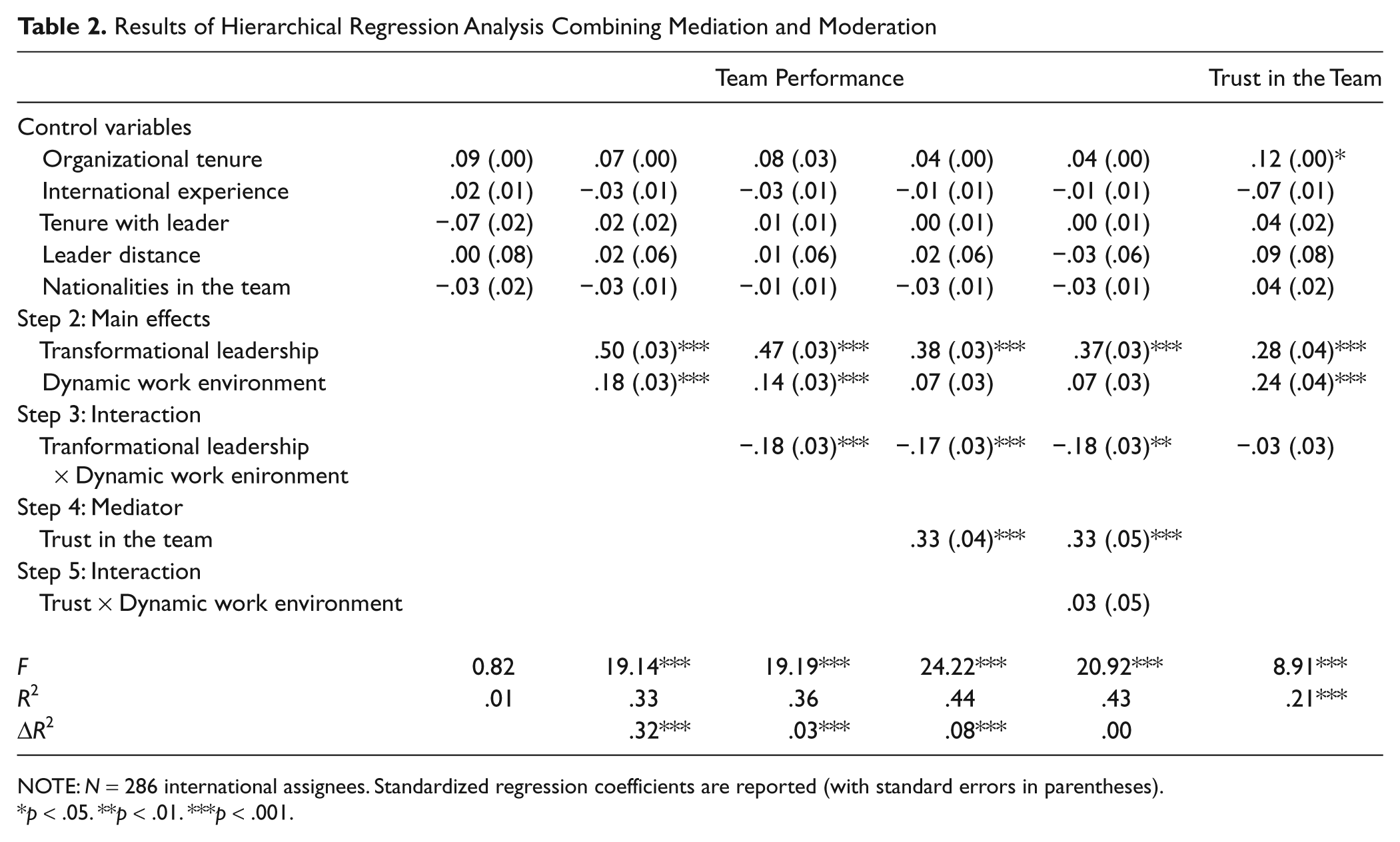
NOTE: N = 286 international assignees. Standardized regression coefficients are reported (with standard errors in parentheses).
p < .05. **p < .01. ***p < .001.
Hypothesis 2 stated that dynamic work environment would positively moderate the relationship between transformational leadership and team performance. Results from the third step (Table 2) showed a significant, but negative interaction effect of transformational leadership and dynamic work environment on team performance. The inclusion of the interaction term resulted in a small, but significant contribution to the model (ΔR2 = .03, p < .001). Investigating the negative interaction term more closely, results show that transformational leadership was associated with higher levels of team performance across all levels of dynamic work environment (see Figure 2). Simple slope analyses revealed that the steepest slope was found in low dynamic work environments (simple slope = .37, t = 8.3, p < .001), followed by moderate (simple slope = .28, t = 8.2, p < .001), and highly dynamic work environments (simple slope = .18, t = 4.0, p < .001). Hence, transformational leadership was more strongly associated with higher team performance in less dynamic work environments than in highly dynamic work environments, leading us to reject Hypothesis 2.
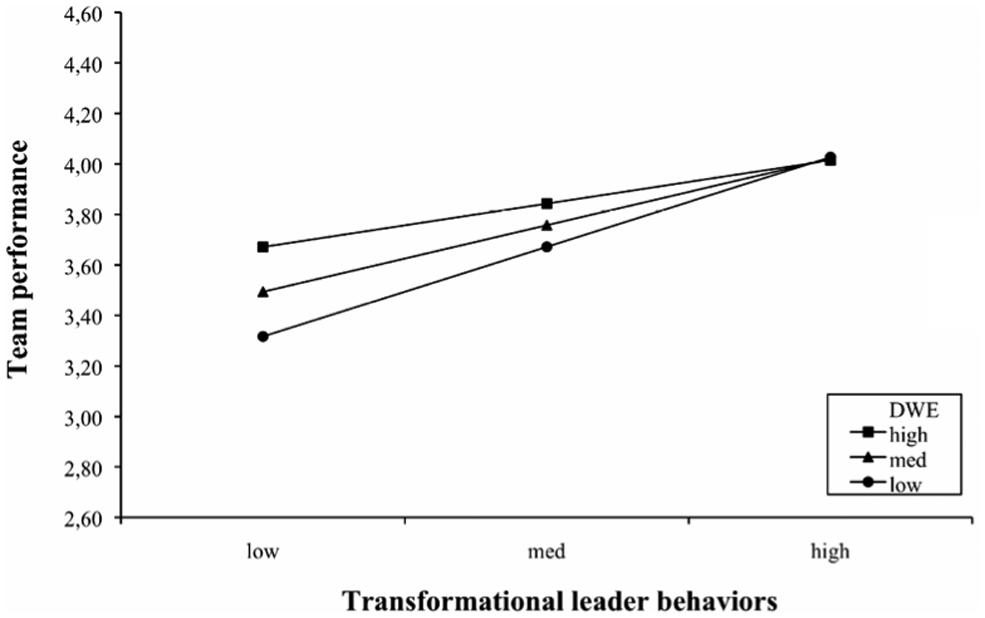
Dynamic work environment (DWE) as a moderator on the relationship between transformational leadership and team performance
Hypothesis 3 stated that dynamic work environment moderates the mediated effect of trust in the team on the relationship between transformational leadership and team performance. Transformational leadership was positively related to trust in the team, but dynamic work environment did not moderate this relationship (Table 2). Trust in the team had a significant effect on team performance (Step 4, Table 2). The inclusion of trust in the team as a mediator resulted in a significant contribution to the model (ΔR2 = .08, p < .001). The inclusion of trust in the team slightly reduced the effect of transformational leadership, but the main effect of transformational leadership remained highly significant, providing support for trust in team partly mediating the relationship between transformational leadership and team performance. The interaction term of team trust and dynamic work environment was not significantly associated with team performance (Step 5, Table 2). Overall, we found a partial mediation of team trust in the relationship between transformational leadership and team performance and a moderation of the direct effect linking transformational leadership and team performance. Edwards and Lambert (2007) refer to such a model as direct effect moderation model. Hence, we consider Hypothesis 3 as being partly supported.
In Hypothesis 4, we expected transformational leadership to act as a predictor on work adjustment. As transformational leadership was related to work adjustment (see Table 3), this hypothesis was supported. Transformational leadership, which was included in Step 2, explained an additional 11% of the variance in the model (ΔR2 = .11, p < .001). Hypothesis 5 stated that transformational leader behaviors would be positively related to job satisfaction. In support of Hypothesis 5, transformational leader behaviors significantly predicted job satisfaction (see Table 3). After transformational leadership was added, the model explained 42% of the variance.
Results of Hierarchical Regression Analysis predicting Work Adjustment and Job Satisfaction

NOTE: N = 286 international assignees. Standardized regression coefficients are reported (with standard errors in parentheses).
p < .05. **p < .01. ***p < .001.
Discussion
The present study aimed to identify the effectiveness of transformational leader behaviors in a complex, international project setting. Transformational leadership had a medium to strong effect on team performance, and a medium effect on trust in the team. Team trust also had a moderately strong, positive relationship with team performance, and was a weak, partial mediator on the relationship between transformational leadership and team performance. Our study found that transformational leadership was most positively related to team performance in less dynamic work contexts. Dynamism in the work environment did not moderate the effect of trust in the team on the relationship between transformational leadership and team performance. Transformational leadership also facilitated work adjustment, and was strongly associated with job satisfaction. Visionary, team-oriented leaders who provided positive feedback on performance developed satisfied and better adjusted employees and contributed to higher team performance. Altogether, these findings not only provide support for the positive impact of transformational leadership but they also reveal that context does interact with leadership effectiveness.
Of the control variables, working with a specific leader over time facilitated team members’ work adjustment. On the contrary, employees were slightly more satisfied when they had worked with their leader for a short time period. This latter finding is somewhat surprising, but might be attributed to unmet expectations among team members when a new leader has been filling his or her position for some time. If these expectations are not met, job satisfaction will possibly decrease.
Our results show that when international project leaders express a clear understanding of where the team is going, and personally compliment outstanding work, team members report higher team trust and greater team performance. We have thereby contributed to further understand the relationship between specific leadership behaviors and their relation to team trust, as postulated by Lee et al. (2010). As our results also revealed that teams with an internal climate of trust clearly facilitated the delivery of project objectives, we argue that team trust is an important team process (Costa, 2003). However, our results showed that trust in the team was a partial mediator, indicating that there are other more critical processes through which transformational leaders affect performance. For example, ensuring common goals in the team could affect performance through mobilizing effort, guiding attention toward task relevant information, fostering of persistence, and facilitating task relevant knowledge (see Locke & Latham, 1990). Recent research has also found that team members with transformational leaders exchanged advice more extensively than teams with less transformational leaders (Zhang & Peterson, 2011). Leaders who can facilitate these processes are important assets in international project teams.
Transformational leader behaviors had a positive effect on team performance in work contexts with different levels of dynamism. Contrary to the findings of De Hoogh et al. (2004), this form of leadership was most effective on team performance in low dynamic work environments (see Figure 2). Neither De Hoogh et al. (2004) nor Waldman et al. (2001) explored leadership and dynamic work environment in project organizations. One possible reason for this finding is that in projects operating in predictable contexts (low dynamic work environments) being transformational is less challenging than in a highly volatile work context. Providing team members with the motivation and inspiration they need to maximize performance may be easier when necessary actions are salient and detectable. In volatile contexts (highly dynamic environments), working conditions frequently change and team performance is contingent on many factors beyond a leader’s control (Kaulio, 2008). As a result, the leader has a more limited impact on performance.
Although other studies also found support for a strong relation between transformational leadership and job satisfaction (e.g., Dumdum et al., 2002; Judge & Piccolo, 2004), they did not examine this relationship in an international project context. There are several reasons as to why transformational leaders are strongly associated with more satisfied project team members, as found in this study. Through the articulation of a compelling vision, the team leader describes the future as interesting and appealing for team members. Furthermore, team leaders who provide coaching and support, and praise outstanding work (individualized consideration), show a genuine interest in their employees.
Our results also show that transformational leaders can significantly aid the adjustment process. This is in line with Kraimer et al. (2001), who emphasized the leader as a facilitator of adjustment. We argue that transformational team leaders provide clarity about performance standards and decrease role ambiguity in international assignments, as stressed by Caligiuri et al. (2009). A supportive leader with local project knowledge is of obvious importance among employees in international projects, and our findings indicate that transformational leadership can act as a stress buffer in the adjustment toward working in an international project environment.
Limitations
We acknowledge the limitations of our study. This study is based on team members’ self-reports on several different concepts. Self-report ratings of team performance may not be objective. Common method bias is considered a widespread challenge in studies involving use of single sources (Avolio, Yammarino, & Bass, 1991). Following the advice of Podsakoff, MacKenzie, Lee, and Podsakoff (2003), we could have asked external supervisors to evaluate team performance. As mentioned earlier this was not done to provide all respondents, including team leaders, with complete anonymity. Therefore, data could not be aggregated at team level, and team measures, such as team performance, were only captured individually.
Earlier conceptualizations of the environmental dynamism construct have met considerable challenges (Duncan, 1972), as seen in the minimally acceptable alpha value of our context measure (dynamic work environment). We acknowledge the possibility that our context measure did not capture the variety of the construct in the intended quality. Specifically, it might be difficult for the team members to accurately evaluate social, political, and environmental issues, because of limited knowledge about these issues. When measuring environmental constructs, leaders in the upper echelon of the organization might represent a more valid source of information.
Despite of limitations in our study, research has shown that subordinate ratings of leader performance correlate highly with external ratings of leader performance (Bain, Mann, Atkins, & Dunning, 2005). In favor of using subordinate ratings on team performance, team members are the most commonly used source, partly because they are best positioned to provide certain kinds of information, such as internal team processes (Tesluk, Mathieu, Zaccaro, & Marks, 1997).
Suggestions for Future Research
To better capture contextual issues, we propose future leadership studies should measure multiple contextual variables, for example societal and organizational context, project type, size, and complexity. The choice of measures should be based on relevant contextual variables that are likely to moderate team performance, in line with Mathieu et al. (2008). This would also be consistent with recent research on complexity leadership theory (Uhl-Bien, Marion, & McKelvey, 2007), and transcendence leadership (Crossan, Vera, & Nanjad, 2008), as leadership and team performance are located in a multifaceted context. The investigation of contextual moderators and mediators will contribute to further develop the leadership research field.
Future studies could also consider the sample structure consisting of teams and cluster data on team performance accordingly. Doing so, the effectiveness of transformational leadership could be compared between teams.
Suggestions for additional data collection methods include qualitative methods, such as the critical incident technique (e.g., Kaulio, 2008), to establish in-depth knowledge of emergent and challenging areas for leaders and employees in international project contexts. As tenure with the leader had opposite effects on work adjustment and job satisfaction, it points to a potential development in time. Hence, we propose that future studies of international projects should adopt longitudinal designs, as this approach has given useful insights into the relationship between transformational leadership and long-term project success (Keller, 2006).
Practical Implications
Increased knowledge about drivers of performance is of great value to multinational corporations. This study shows that transformational leadership behaviors (i.e., articulating a vision and foster acceptance of group goals, and aiding team members’ personal and professional development through performance feedback) have a great impact on performance on international assignments. This study also strongly supports the impact of transformational leadership on job satisfaction. This finding is important, as the retention of talented project personnel can be critical for the delivery of project objectives. Furthermore, transformational leaders will be effective in a variety of project environments and could be assigned to projects of varying complexity. The present study also revealed that transformational leaders contribute to work adjustment and positive experiences on international assignments, which are highly valuable for international organizations and crucial for individual career development.
Research has supported the trainability of transformational leadership skills (e.g., Parry & Sinha, 2005), and findings from this study can be applied for strategic leadership training prior to international assignments. Recent research on learning methods has suggested action learning as a highly effective method for the development of specific leadership skills (e.g., Skipton Leonard & Lang, 2010). Also, mentoring can be a particularly effective measure to ensure a contextual approach to leadership development (Day, 2000). As many projects differ in complexity and location, the mentor and mentee should be matched according to specific characteristics of the project, and the mentor should have extensive knowledge about local project issues. Our findings could also be a source for practical guidance on the selection of leaders and employees. A review of the talent pool in the organization could help identify leaders with transformational qualities and potential.
Conclusion
Because of increased environmental complexity and team diversity on international assignments, it is highly important for multinational corporations to identify effective team leader behaviors. Based on our findings, transformational project managers have more satisfied and better adjusted team members, and higher performing teams. Furthermore, this study contributes to an increased understanding of whether the effectiveness of leader behaviors differs according to the context in which it is executed. Findings support that transformational leaders are effective in work environments with varying complexity. However, followers performed best under transformational project managers in less dynamic contexts, where events were of a more predictable nature. Also, team trust appeared to be in closer relation to actual team performance than to behaviors of the project manager. In sum, our results clearly support the selection and development of transformational team leaders in project-intensive organizations.
Footnotes
Gøran Gundersen is now at Aspiranza AS, Oslo, Norway. Bjørn Tore Hellesøy is now at Det Norske Veritas, Norway.
The authors declared no potential conflicts of interest with respect to the research, authorship, and/or publication of this article.
The authors disclosed receipt of the following financial support for the research, authorship, and/or publication of this article: Gøran Gundersen and Bjørn Tore Hellesøy received a research grant from the University of Oslo for the publication of this article.