



Abstract
The authors tested an integrated model of transformational leadership consisting of leader personal values, follower beliefs in corporate social responsibility, and leadership performance outcomes. Data from 110 managers and 472 of their direct reports demonstrated strong support for the integrated model. As predicted, leader openness to change, self-transcendent, and collectivistic work values were positively associated with transformational leadership, whereas self-enhancement values were negatively associated with transformational leadership. Follower beliefs in corporate social responsibility partially mediated the relationship between transformational leadership and follower extra effort, which was strongly associated with leadership effectiveness. Implications for leadership theory, practice, and future research are discussed.
Scholarly interest in personal values as key determinants of leadership behavior and associated follower and organizational outcomes has grown in the context of ongoing ethical lapses by today’s business leaders. The steady stream of unethical leadership behavior and examples of corporate irresponsibility have brought calls to better understand the central role of personal values in the leadership process, and specifically how leaders influence their followers’ beliefs concerning the importance of socially responsible business practices and their instrumentality for business performance outcomes (Waldman, Siegel, & Javidan, 2006). Although leadership scholars have discussed personal values as key drivers of leadership behavior, particularly values-based models such as transformational leadership (Bass & Steidlmeier, 1999), there are very few studies that empirically link leader personal values, leadership style, and follower attitudes. Leadership scholars assert that far more empirical studies are needed to better understand the role of values in the transformational leadership process (Sankar, 2003; Sosik, 2005; Yukl, 2006) as well as the key mediating processes through which transformational leaders achieve their powerful outcomes (Wang & Zhu, 2011). Indeed, despite numerous studies and meta-analytic reviews that demonstrate the powerful direct effects of transformational leadership on a range of follower-, team-, and organization-level outcomes (e.g., Groves, 2005; Judge & Piccolo, 2004; Lowe, Kroeck, & Sivasubramaniam, 1996), leadership research to date lacks support for the specific values that facilitate transformational leadership and how such behaviors may generate important follower beliefs concerning socially responsible business practices.
This article seeks to accomplish three goals. First, we set out to empirically examine leader personal values as key antecedents to transformational leadership, which in turn facilitate follower extra effort and follower ratings of leadership effectiveness. Specifically, we investigate openness to change, collectivism, self-transcendent, self-enhancement, and traditional values as key predictors of transformational leadership. Next, we assess the potential mediating influence of follower attitudes toward corporate social responsibility (CSR) on the relationship between transformational leadership and follower extra effort. We test whether the established link between transformational leadership and leadership performance outcomes can be explained by follower beliefs in the importance of CSR. Finally, this study employs multisource data collection and split-sample analyses (Rousseau, 1985) to address monomethod bias concerns in studies examining performance outcomes associated with transformational leadership (Dvir, Eden, Avolio, & Shamir, 2002; Judge & Piccolo, 2004; Lowe et al., 1996). This article is organized as follows. First, we briefly review the nature of extant research on leader values, transformational leadership, and the mediating role of follower attitudes toward CSR. Based on our review, we offer a series of hypotheses that address some current limitations in transformational leadership research. Next, we describe an empirical study of 110 organizational leaders and 472 of their direct reports and work team members. Finally, we discuss theoretical and practical implications and offer several suggestions for future research on leader values and transformational leadership.
Transformational Leadership and Personal Values
Based on the seminal work of Burns (1978), Bass (1985), and Bass and Avolio (2000), transformational leadership has dominated the study of leadership for more than 30 years (Bass & Riggio, 2006). Defined as a set of behaviors that motivates followers to exceed expectations in pursuit of the organization’s vision and sacrifice their self-interests for the collective good (Bass & Avolio, 2000), transformational leadership is characterized by leaders who hold personal values that facilitate the common good. The most recent model of transformational leadership, based on continuing empirical development by Bass, Avolio, and other scholars (Bass, Avolio, & Atwater, 1996; Dvir et al., 2002), includes the following five leadership dimensions as measured by the Multifactor Leadership Questionnaire (MLQ; Bass & Avolio, 2000): idealized attributes, idealized behaviors, inspirational motivation, intellectual stimulation, and individualized consideration. Leaders who demonstrate idealized attributes and idealized behaviors (formerly the “charisma” dimension) earn credit and respect from their followers by carefully considering their followers’ needs above their own needs, talking about their most important values and beliefs, and emphasizing the importance of the moral and ethical consequences of key decisions (Bass, 1985). Inspirational motivation is characterized by leaders who provide meaning and challenge to their followers’ work and encourage followers to envision attractive future states for their work units and the organization. Intellectual stimulation is defined as behaviors that encourage followers to be innovative and creative by questioning assumptions, reframing problems, and approaching old problems in new ways. Finally, individualized consideration involves behaviors that emphasize paying close attention to followers’ individual needs for achievement and growth, including teaching, coaching, and creating new learning opportunities.
Personal values serve an important role for transformational leaders in that they represent desirable end states, goals, or behavioral modes (instrumental values) that strongly influence the types and intensity of behaviors that such leaders choose to demonstrate. According to Schwartz (1992), values are “desirable states, objects, goals, or behaviors, transcending specific situations and applied as normative situations to judge and to choose among alternative modes of behavior” (p. 2). More broadly, personal values directly influence behavior through several mechanisms, including the justification of one’s past behavior (Williams, 1979) and encouragement to act according to one’s values (Rokeach, 1973). Although values are one of several factors that affect behavior, they influence general behavior modes across situations and over time (Epstein, 1979). Values may be distinguished from attitudes in that attitudes are people’s beliefs about specific objects or situations (Hollander, 1971), whereas values are more generalized. Moreover, values differ from motives in that values are enduring and transcend situations (Lord & Brown, 2001). Furthermore, values are distinguishable from traits. Although traits are “dimensions in individual differences in tendencies to show consistent patterns of thought, feelings, and actions” (McCrae & Costa, 1990, p. 23), values are cognitive representations of desirable, abstract, transsituational goals that serve as guiding principles in life (Schwartz, 1992). In the following sections, we review the leadership literature and expand on the associations between personal values and transformational leadership.
A review of the major transformational leadership theories, including those suggested by Bass and Avolio (2000), Conger and Kanungo (1987), and Lord and Brown (2001), suggests that that transformational leadership process is strongly influenced by the leader’s personal values. Bass and Avolio’s (2000) model postulates that transformational leaders broaden the interests and values of followers from self-interest to the good of the team and organization while encouraging followers to envision attractive future states that significantly differ from the status quo (Bass, Jung, Avolio, & Berson, 2003). Transformational leaders demonstrate idealized attributes and behaviors by engaging in actions that sacrifice self-gain for the betterment of the team and organization. Such selfless attributes reflect the personal value of self-transcendence (Kanungo & Mendonca, 1996), in which leaders look beyond self-interest for a greater good. Moreover, a transformational leader’s willingness to depart from the status quo is consistent with the personal value of openness to change whereby individuals think creatively about more appealing future situations (Sosik, 2005). Bass and Avolio’s (2000) model also includes the intellectual stimulation dimension, which postulates that a transformational leader solicits new ideas and creative solutions from followers by encouraging followers to adopt divergent perspectives and examine problems from new angles whereas discouraging followers from thinking like him or her. Similar to the inspirational motivation dimension, intellectual stimulation behaviors stem from personal values of openness to change, particularly because of leaders’ willingness to challenge existing assumptions.
Similar to Bass and Avolio’s (2000) transformational leadership model, Conger and Kanungo’s (1987) theory of charismatic leadership postulates several leader behaviors grounded in the leader’s personal values. The model defines charismatic leadership as a process of transforming followers from an existing present state to an improved future state through several behavioral dimensions, including by sensitivity to member needs, environmental sensitivity, vision and articulation, personal risk, and unconventional behavior (Conger & Kanungo, 1994). Such leaders demonstrate a strong desire to challenge and change the status quo through heightened sensitivity to business environmental opportunities and constraints, as well as their followers’ personal needs. The model also theorizes that charismatic leaders engage in exemplary acts that involve significant personal risk and sacrifice, while also using innovative and unconventional approaches for achieving a shared and idealized vision. As we will argue in more detail below, the behaviors comprising the Conger and Kanungo model are conceptually associated with personal values concerning altruism, self-sacrifice, self-transcendence, and openness to change.
Finally, Lord and Brown’s (2001) values-centered model proposes that the leadership influence process is driven by the leader’s positive effects on follower self-concepts. Research on self-concept and leadership theory (Lord & Brown, 2001; Lord, Brown, & Freiberg, 1999; Shamir, House, & Arthur, 1993) postulates that follower self-concepts comprise self-views, current goals, and possible selves that interact across individual, interpersonal, and group levels of self-identity. Defined as who followers could be, the possible selves component of self-concept includes group-level identities that suggest future collective selves (Lord et al., 1999; Markus & Nurius, 1986; Mitchell & Beach, 1990). Lord et al. (1999) assert that group-level identities are powerful mechanisms for influencing followers because “the development of an organization or a society thus becomes a rationale for current activities that ultimately transcends one’s individual mortality” (pp. 179-180). The core influence processes of transformational leadership activate the possible selves component of followers’ self-concepts at the group level of self-identity. Transformational leaders’ visionary messages include explicit references to values closely aligned with openness to change, altruism, and self-transcendence. Such leaders also emphasize moral justifications and a sense of collective purpose, thereby motivating followers by linking self-concept to values and the collective mission (Lord & Brown, 2001). Overall, our review suggests that altruism, self-sacrifice, self-transcendence, and openness to change are personal values closely aligned with the change-oriented behaviors of transformational leadership.
Although most leadership scholars have articulated the importance of values to the transformational leadership process, there exists a striking lack of empirical studies that address leader values as active components of the influence process (Fu, Tsui, Liu, & Li, 2010). Personal values are particularly important for transformational leaders given the fundamental role of value-laden visions that inspire follower effort and performance. Given the collective nature of organizational visions, transformational leaders must hold personal values that are properly aligned with vision to inspire exceptional follower effort. Despite the central role of leader values in this influence process, leadership studies “continue to treat [transformational leadership] as a set of behaviors without incorporating values (Bass & Riggio, 2006; p. 223). Only recently have researchers begun to consider the role of values in leadership, including transformational leadership” (Fu et al., 2010).
Given the preceding discussion of the associations between transformational leadership and leader personal values, namely, openness to change, altruism, self-sacrifice, and self-transcendence, we adopted the Schwartz model of personal values for purpose of the present study. Schwartz and Bilsky’s (1987, 1990) model posits that values are structured into 10 value types that can be further categorized into four higher order value clusters existing along the axes of a single two-dimensional values space. One axis contains the value clusters conservation (value types include tradition, conformity, and security) and openness to change (self-direction and stimulation) whereas the second axis contains the value clusters self-transcendence (universalism and benevolence) and self-enhancement (power and achievement). Although the Schwartz model originally posits the value clusters as existing at opposite ends of orthogonal axes, subsequent empirical research (Lan, Gowing, McMahon, Rieger, & King, 2008; Schwartz & Boehnke, 2004; Sosik, 2005; Stern, Dietz, & Guagnano, 1998) suggests that the four value clusters are four separate but correlated dimensions. Stern et al. (1998) conclude that
we think it useful to have separate measures of the four value clusters . . . it also makes it easy to conduct further research on the dimensionality of the value structure in large samples, where it might be impractical to collect data with the full 56-item instrument. (pp. 998-999).
Indeed, based on this recent empirical research supporting the measurement of four separate but related value dimensions, in concert with survey length concerns given the nature of our sample of senior organizational leaders, we adopted Stern et al.’s (1998) shortened version of Schwartz’s human values instrument for the present study. Described in more detail in the Method section, this instrument includes three-item scales for each of the four higher order value clusters. In the following sections, we offer a targeted review of prior research and hypothesis development concerning the relationships between transformational leadership and each of the Schwartz higher order value clusters (openness to change, traditional, self-transcendence, and self-enhancement).
Openness to change
As reviewed above, prior theoretical and empirical research suggests that openness to change is a personal value associated with transformational leadership. Openness to change, which reflects values concerning self-direction, stimulation, and interests in challenge, novelty, and change, may be instrumental in facilitating transformational leaders’ desire to change the status quo by articulating a vision of a better future for their followers and their organizations (Lan et al., 2008; Sosik, 2005). Transformational leaders challenge the status quo and win the admiration of their followers through envisioning strategies that achieve organizational change (Conger & Kanungo, 1987). Moreover, these leaders add credibility to their vision by displaying symbolic behaviors to emphasize a desired future state that differs markedly from the status quo (Conger & Kanungo, 1998). In an empirical study of leadership in the environmental sector, Egri and Herman (2000) found that leaders promoting a vision of long-term ecological sustainability were more open to change than less visionary leaders. Based on transformational leadership theory and the research reviewed above, we propose the following:
Hypothesis 1a: Leader openness to change values will be positively related to transformational leadership.
Traditional values
Traditional values reflect the conservation of group or national unity and include historically valued characteristics such as conformity, family security, collective safety, self-discipline, and resistance to temptation (Schwartz & Boehnke, 2004; Sosik, 2005). In a self-concept-based theory of charismatic leadership, Shamir et al. (1993) note that leaders are self-expressive of their values and beliefs and that followers seek continuity between the past, present, and future. Traditional values represent time-honored values of the collective identity that provide a meaningful link between the past, present, and future. Bligh’s qualitative analyses of presidential and social movement leaders suggests that India’s Mahatma Gandhi and U.S. presidents Theodore Roosevelt, Franklin D. Roosevelt, and John F. Kennedy are examples of leaders who appeal to values as a means of influencing followers (Bligh & Robinson, 2010; Seyranian & Bligh, 2008). In an empirical study of leader values and charismatic leadership, Sosik (2005) found that traditional values intensity was positively related to three transformational leadership components (inspirational motivation, idealized influence, and idealized behavior). However, most theoretical accounts suggest that challenging the status quo, an integral component of transformational leadership, runs counter to the precepts of traditional values. Conger and Kanungo’s (1998) behavioral model of charismatic leadership postulates that such leaders demonstrate to their followers a great desire to change the status quo and a heightened sensitivity to environmental opportunities, constraints, and followers’ needs. As such, charismatic leaders are more likely to be perceived both as critics of the status quo and as agents of radical reform. Given the research reviewed above, we predict the following relationship between traditional values and transformational leadership:
Hypothesis 1b: Leaders’ traditional values will be negatively related to transformational leadership.
Self-transcendent values
Kanungo and Mendonca (1996) characterize self-transcendent values as rooted in the altruistic motive. These values are based on focusing one’s attention away from oneself and toward helping others, recognizing one’s natural connectedness with others. Examples of self-transcendent values include altruism, self-sacrifice, universalism, benevolence, and social justice (Schwartz & Boehnke, 2004). Conger, Kanungo, and Menon (2000) argue that leaders who exhibit idealized attributes and idealized behaviors are willing to take on high personal risks and incur high personal costs in order to achieve a shared vision with their followers. Personal risk may include self-sacrifices such as loss of financial gains or career success, risk of being fired or demoted, and loss of formal or informal status or authority (Conger & Kanungo, 1987). Personal risk is central to the value of self-transcendence, whereby an individual focuses attention away from himself or herself and toward helping others. By carefully considering followers’ needs above personal needs, these leaders earn the respect and loyalty of their followers (Bass, 1985).
Transformational leaders may also demonstrate self-transcendent values through self-sacrificial behaviors such as building trust (both in the organization and in the greater community), serving as a role model, and seeking organizational commitment over self-interest. Several authors (e.g., Kanungo & Mendonca, 1996; Shamir et al., 1993) have suggested that a leader’s self-transcendence is perceived by followers as inspirational and idealized behavior, which is especially important when exceptional follower effort and performance is necessary (e.g., during large-scale organizational change). Moreover, Sosik (2005) found that the intensity of managers’ self-transcendent values was positively related to the inspirational motivation, idealized influence, and idealized behavior dimensions of transformational leadership. Most recently, Groves and LaRocca’s (2010) empirical study found that leaders with deontological ethical values were rated by followers as demonstrating transformational leadership, suggesting that a leader’s beliefs in selflessness, altruism, and universal rights lay the groundwork for enacting the key motivational and inspirational behaviors of transformational leadership. As such, we propose the following:
Hypothesis 2a: Leaders’ self-transcendent values will be positively related to transformational leadership.
Self-enhancement values
The pursuit of personal interests stems from the self-enhancement values of wealth, material possessions, personal pleasure, and influence over other people (Schwartz, 1992). Individuals who embrace these values are motivated by a desire for power and seek positions of authority to expand their power bases and exert greater influence and control of followers (House, 1977; Peterson & Seligman, 2004). Although a self-enhancing mode of conduct may elicit attributes of charisma from followers in some contexts (Sosik, 2005; Sosik, Avolio, & Jung, 2002), leaders with intense self-enhancement values are prone to self-preoccupation and the potential for using positions of authority and influence to achieve personal goals rather than organizational or social goals (Conger, 1990; Judge, Piccolo, & Kosalka, 2009). Leaders with predominant self-enhancement values are unlikely to demonstrate numerous transformational behaviors that are grounded in self-transcendent values, such as influencing followers to place organizational and community interests above self-interests, facilitating a collective visioning and organizational change process that genuinely empowers, and publicly commending followers for their roles in driving successful organizational change (as opposed to publicly claiming personal credit to enhance perceptions of power and influence). Most recently, Groves and LaRocca (2010) found that transformational leadership was strongly associated with leader deontological values, suggesting that a leader’s beliefs in selflessness, treating followers and teammates as ends rather than means, and viewing leadership practices as having ethical significance regardless of their consequences facilitate an authentic demonstration of transformational behaviors as rated by the leader’s direct reports and work colleagues. Based on the preceding discussion, we predict the following:
Hypothesis 2b: Leaders’ self-enhancement values will be negatively related to transformational leadership.
Transformational Leadership and Follower Outcomes
Consistent with the preceding discussion concerning leader values associated with the common good and transformational leadership, we propose that the values-laden influence process of such leaders will facilitate both followers’ beliefs in CSR and followers’ willingness to put forth extra effort. Although numerous meta-analyses document the powerful direct effects of transformational leadership (Dundum, Lowe, & Avolio, 2002; Judge & Piccolo, 2004; Lowe et al., 1996), it remains unclear whether transformational leadership engenders follower CSR beliefs or how such beliefs may explain the robust relationship between transformational leadership and follower extra effort. A fundamental antecedent to follower engagement in socially responsible behavior and devoting effort to responsible business practices are followers’ beliefs that such actions are critical to organizational effectiveness (Groves & LaRocca, 2010). We define and measure follower CSR beliefs according to Singhapakdi, Vitell, Rallapalli, and Kraft’s (1996) model and Perceived Role of Ethics and Social Responsibility (PRESOR) scale, which postulate the shareholder and stakeholder views of social responsibility. The shareholder view reflects the narrower belief that an organization’s obligations are principally to maximize profitability and returns to shareholders. This view reflects Friedman’s (1962) argument that a business’s sole responsibility is to generate a profit. The stakeholder view, in contrast, emphasizes the centrality of ethics and social responsibility to organizational effectiveness through engagement of multiple stakeholder groups and the obligations of businesses beyond profitability and shareholder returns.
A review of the research literature on employee CSR perceptions, and specifically leadership studies that examine the impact of various leadership styles and behaviors on follower CSR beliefs, reveals competing perceptual measures of CSR. Waldman, de Luque, Washburn, and House’s (2006) study of GLOBE project data used a model and a three-dimensional (shareholder/owner, stakeholder, community/state welfare) self-report measure of CSR beliefs. However, this measure was developed for the purposes of measuring the CSR beliefs of CEOs, whereas the study excluded measurement of follower (top management team members) CSR beliefs. Carmeli, Gilat, and Waldman (2007) used a perceived organizational performance measure that included two factors: perceived social responsibility and development and perceived market and financial performance. However, this four-item measure is focused on aspects of product/service development and employee relations, as opposed to a respondent’s beliefs in the relationship between CSR and organizational effectiveness. For the purpose of the present study, and specifically our interest in understanding how transformational leadership elicits extraordinary follower effort, Singhapakdi et al.’s (1996) PRESOR scale clearly taps a respondent’s beliefs in the compatibility between CSR and profitability and the how the stakeholder CSR perspective facilitates long-term organizational effectiveness. Based on our review of the transformational leadership influence process and on the existing perceptual CSR measures, we adopted the PRESOR scale for the present study.
The predicted relationship between transformational leadership and follower CSR beliefs is supported by self-concept leadership theory (Lord & Brown, 2001; Lord et al., 1999; Shamir et al., 1993), which asserts that follower self-concepts comprise self-views, current goals, and possible selves that interact across individual, interpersonal, and group levels of self-identity. The core influence processes of transformational leadership activate the possible selves component of followers’ self-concepts at the group level of self-identity. The visionary messages of transformational leaders include explicit references to values and a sense of collective purpose, which have motivational effects on sustained follower effort as follower self-concept becomes linked to values and the collective mission (Lord & Brown, 2001). When leaders motivate followers by promoting visions and goals that represent core values, such as stakeholder CSR beliefs, the intrinsic value and significance of followers’ effort, goals, and followers’ self-concepts become linked to these values. The resulting internalization of values by followers may help explain the robust relationship between transformational leadership and followers’ willingness to exert extra effort for the leader and the organization (Lord & Brown, 2001; Lord et al., 1999). Waldman, de Luque, et al. (2006) extend this argument by proposing that the visionary behavior of transformational leaders
will indeed enhance the social responsibility values of followers, especially pertaining to shareholders and other stakeholders. Such leaders may excite followers by engaging their self-concepts based on a vision stressing responsibility both to shareholders or owners, and to other relevant and identifiable stakeholder groups. (p. 828)
A review of the empirical research on transformational leadership and follower CSR beliefs yields only one published study of direct effects by Waldman, de Luque, et al. (2006), and no studies of the potential mediating effects on the relationship between transformational leadership and follower outcomes. Waldman, de Luque, et al. found that CEO visionary leadership was related to top management team members’ reported stakeholder and shareholder CSR values. The study’s hypothesized model of cultural and leadership variables demonstrated the strongest predictive power for follower stakeholder values (R2 = .45, F = 45.21, p < .01) rather than shareholder values (R2 = .22, F = 15.06, p < .01). Concluding that visionary leadership may be an essential driver of how followers view the importance of CSR in decision making, particularly concerning the prediction of follower stakeholder values, Waldman, de Luque, et al. (2006) stated that “our model appears to work best for stakeholder CSR values” (p. 834). Overall, the theoretical arguments and limited empirical evidence presented here suggest that transformational leaders engender follower stakeholder CSR views, which has a potentially mediating effect on the relationship between transformational leadership and follower extra effort. Thus, the following hypotheses are presented:
Hypothesis 3: Transformational leadership will be positively related to follower stakeholder CSR beliefs.
Hypothesis 4: Follower stakeholder CSR beliefs will partially mediate the relationship between transformational leadership and follower extra effort.
Follower extra effort and leadership effectiveness
Extra effort reflects the extent to which employees are willing to exert their effort more than they originally expected as a result of the leader’s style (de Luque, Washburn, Waldman, & House, 2008). Leadership effectiveness reflects the perceived ratings of employees on how effectively their leader contributes to organizational effectiveness and the group. Numerous qualitative and meta-analytic reviews (e.g., Judge & Piccolo, 2004; Lowe et al., 1996) have demonstrated a powerful positive relationship between transformational leadership and follower extra effort, which is strongly associated with leadership effectiveness (Judge & Piccolo, 2004; Lowe et al., 1996). Overall, the empirical research suggests that connecting follower self-concepts to the vision of the work unit is essential in generating follower willingness to exceed the “call of duty” and put forth extraordinary effort (de Luque et al., 2008). Based on these findings, we hypothesize the following:
Hypothesis 5: Follower extra effort will be positively related to leadership effectiveness.
Method
Participants, Sample Organizations, and Procedures
Participants
A total of 582 respondents, including both team leaders (“leaders” hereafter; n = 110) and their direct reports and work unit colleagues (“teammates” hereafter; n = 472), from 110 organizations participated in this study. Fifty-eight (53%) of the leaders were male, and the mean age was 42.4 years (SD = 7.58). The ethnic background of the leaders was as follows: Asian American (n = 11, 10%), African American (n = 6, 6%), Hispanic/Latin American (n = 14, 13%), Caucasian (n = 73, 66%), and Other (n = 6, 5%). The most common industries from which the leaders were drawn included aerospace (n = 18), government services (n = 18), professional services/consulting (n = 14), and education services (n = 13). The aforementioned industry categories were inductively created based on the qualitative responses provided by the leader sample. Sixty-six (60%) of the sample organizations were for-profit, while their private/public status was as follows: publicly traded (n = 30, 27%), private (n = 61, 56%), and government (n = 19, 17%). The leaders reported their position title as department supervisors or frontline managers (n = 31, 28.2%); regional, district, and/or middle managers (n = 34, 30.9%); and executive-level managers (n = 45, 40.9%). The leaders had a mean of 4.29 teammates (SD = 1.23) and a range of 2 to 7 teammates. Overall, the teammates had worked with their respective team leaders for a mean of 4.37 years (SD = 2.23).
Sample organizations
The leaders’ and their respective teammates’ participation in the study was completely voluntary. The leader participants were drawn from four community-based leadership programs that each represented a large city in Southern California. The four leadership programs were delivered concurrently over the course of a 1-year period. Each leadership development program comprises a cohort of leaders who represent a range of organizations in their local community, including for-profit businesses, governmental agencies, and nonprofit organizations. A typical cohort for such community leadership programs would include 30 leaders who represent a cross-section of organizations that comprise the community, including city government agencies, higher education institutions, health care organizations, large for-profit businesses, nonprofit and community-based organizations, and small businesses. The four leadership programs included 35 (29.5%), 18 (11.5%), 20 (13.1%), and 37 (31.1%) leaders, respectively. Each program consists of a cohort of leaders who participate in monthly sessions that take place over the course of 1 year. The leadership development programs did not provide any training or seminars in personal values, transformational leadership, or any of the other leader skills or behaviors in this study.
Procedures
For each of the community leadership programs, the leader participants were sent an e-mail with instructions for participation, an informed consent form, and a link to the leader questionnaire. Each leader was asked to submit via e-mail the names and e-mail addresses of all direct reports and teammates to the first author. Each of the leader’s direct reports and teammates were sent a separate, confidential e-mail with instructions for their participation, an informed consent form, and a link to the teammate questionnaire. Of the 140 leaders across the four programs who were asked to participate, 110 agreed to participate, a 78.6% response rate. The overall response rate for the teammates nominated by their leaders to participate across all sample organizations was 65%.
Measures
Leader personal values
Leader personal values were measured using Stern et al.’s (1998) shortened version of Schwartz’s (1992) human values instrument. The following four major value clusters were assessed: self-transcendent values (three items; social justice, correcting injustice, care for the weak; α = .88), traditional values (three items; self-discipline, self-restraint, resistance to temptation; α = .79), and openness to change values (three items; a varied life, filled with challenge, novelty, and change; α = .73), and self-enhancement values (three items; wealth, material possessions, money; α = .74). In line with previous research on personal values (Stern et al., 1998) and Schwartz’s (1992) conceptualization of personal values, leaders in the present study were asked to rate the importance of each value statement according to the degree to which each value served “as a guiding principle of my life” according to a 7-point scale (−1 = opposed to my values, 0 = not important, 1 = somewhat important, 5 = of supreme importance).
Transformational leadership
The MLQ Form 5X (Bass & Avolio, 2000) was used to measure transformational leadership. Each leader’s direct reports were asked to report how frequently a list of 20 behaviors characterized their leader’s behavior (0 = not at all, 4 = frequently, if not always). The MLQ includes four-item scales for five transformational leadership dimensions. Cronbach’s alpha reliability estimates and sample items for the transformational dimensions include the following: idealized influence (α = .80; “I go beyond self-interest for the good of the group”), idealized behavior (α = .81; “I consider the moral and ethical consequences of decisions”), inspirational motivation (α = .87; “I articulate a compelling vision of the future”), intellectual stimulation (α = .85; “I seek differing perspectives when solving problems”), and individualized consideration (α = .80; “I spend time teaching and coaching”). Cronbach’s α for transformational leadership overall was .84.
Follower CSR beliefs
Followers’ beliefs concerning the importance of ethics and CSR were measured with Singhapakdi et al.’s (1996) 13-item PRESOR scale. On a Likert-type scale ranging from 0 (strongly disagree) to 7 (strongly agree), followers were asked to rate the extent to which each item accurately represents their views on the importance of ethics and CSR for organizational effectiveness. Five reverse-scored items represent a shareholder view of the importance of ethics and CSR, including the following sample items: “The most important concern for a firm is making a profit, even if it means bending or breaking the rules” and “Efficiency is much more important to a firm than whether or not the firm is seen as ethical or socially responsible.” The remaining 8 items represent a broader stakeholder view of the importance of ethics and CSR, including the following sample items: “Business has a social responsibility beyond making a profit” and “Social responsibility and profitability can be compatible.” Cronbach’s α for follower CSR beliefs was .83.
Follower extra effort
Followers’ extra effort was assessed using de Luque et al.’s (2008) modified, four-item version of Bass’s (1985) original Extra Effort scale, which was part of the original MLQ. On a Likert-type scale ranging from 0 (not at all) to 4 (frequently, if not always), followers were asked to rate the extent to which they exert extra effort in support of the work unit’s goals. A sample item includes “I am willing to make serious personal sacrifices to contribute to the success of my work unit.” Cronbach’s α reliability was .89.
Leadership effectiveness
Leadership effectiveness was assessed using the MLQ’s four-item measure that addresses leadership performance in terms of goal attainment. On a Likert-type scale ranging from 0 (not at all) to 4 (frequently, if not always), followers were asked to rate the extent to which their leader accomplished the goals of their work units. A sample item includes “is effective in meeting organizational requirements.” Cronbach’s α reliability was .88.
Control variables
Leader gender, leader tenure at current position, and leader management level were used as control variables for hypothesis testing. Empirical research indicates that gender may be associated with transformational leadership (e.g., Bass et al., 1996; Carless, 1998) and leader personal values (e.g., Premeaux, 2004; Sosik, 2005). Simple t-test analyses revealed significant differences between male and female leaders across traditional and self-transcendent values. Therefore, leader gender (1 = male, 2 = female) was included as a control variable. Because a manager’s prior work experience is often strongly associated with leadership effectiveness, number of years at current position (leader tenure) was also used as a control variable. Also, prior research (Schwartz, 1992; Sosik, 2005) suggests that management level may be associated with leaders’ self-reported personal values and follower ratings of leadership style and extra effort. Results of Tukey’s honestly significant difference (HSD) test indicated significant between group (management level) effects for leadership effectiveness; therefore, management level was also used as a control variable. Given the range of industries from which the leaders and followers were drawn, industry was coded into the following primary industries represented by leaders’ respective organizations: aerospace (n = 14), consulting/professional services (n = 12), telecommunications (n = 11), financial services (n = 11), education/academia (n = 11), government (n = 10), health care (n = 8), social services (n = 8), energy/utilities (n = 8), entertainment (n = 7), hospitality (n = 5), and other (n = 5). Tukey’s HSD test was carried out to determine any significant differences in the study’s variables across the industries. No significant between-industry differences were found. Independent HSD tests across public/private status (publicly traded, private, and government) also identified no significant differences across the study’s variables. Finally, simple t tests comparing differences in the study’s variables for nonprofit and for-profit organizations revealed no significant differences for the study variables. Overall, leader gender, leader tenure, and leader management level were retained as control variables.
Analyses
Level of analysis
The leader was chosen as the unit of analysis for the present study such that items measuring personal values were averaged to create scale scores for each leader. Follower ratings of transformational leadership, CSR beliefs, extra effort, and leadership effectiveness were averaged and aggregated. To justify the aggregation of follower ratings to create group-level measures, we calculated interrater agreement (rwg(j); James, Demaree, & Wolf, 1984), intraclass correlations (ICC1), and overall sample-mean reliability estimates (ICC2). The rwg coefficients for transformational leadership, CSR beliefs, extra effort, and leadership effectiveness were .87, .79, .88, and .86, respectively. The range of ICC1 (.28-.40) and ICC2 (.73-.81) estimates for these variables were also more than the standard cutoff scores. These results provide support for the aggregation of follower ratings to create group-level measures.
Control for common method variance
Prior research (e.g., Dvir et al., 2002) indicates that monomethod bias is especially problematic when assessing the relationship between follower ratings of transformational leadership and leadership outcomes. To mitigate these problems in the present study, Rousseau’s (1985) split-sample method was used to control for common-method variance. To split the follower sample in this study, half of the follower surveys (n = 236) for a given leader were used to measure transformational leadership, whereas the other half (n = 236) were used to measure follower CSR beliefs, follower extra effort, and leadership effectiveness. All follower surveys for each leader were randomly assigned a number (e.g., 1-6 for a leader with six followers). For leaders with an even number of followers, odd-number follower surveys were used to measure transformational leadership (Follower Survey A; n = 236), and even-numbered surveys were used to measure follower CSR beliefs and the outcome measures (Follower Survey B; n = 236). For leaders with an odd number of followers, the “extra” follower survey was assigned to the leadership style sample or the CSR values/leadership outcomes sample on an alternating basis.
Results
Table 1 presents the means, standard deviations, and correlations of the leader and follower variables. Leader gender was associated with self-transcendent values (r = .24, p < .05) and follower CSR beliefs (r = .19, p < .05). Transformational leadership demonstrated expected relationships with openness to change values (r = .45, p < .01), self-transcendent values (r = .52, p < .01), and self-enhancement values (r = −.22, p < .05) but was not significantly associated with traditional values (r = −.10, ns). As expected, transformational leadership was positively related to follower CSR beliefs (r = .46, p < .01), follower extra effort (r = .45, p < .01), and leadership effectiveness (r = .33, p < .01). Interestingly, follower CSR beliefs were associated with leader self-transcendent values (r = .32, p < .01) and leader self-enhancement values (r = −.36, p < .01).
Descriptive Statistics and Correlations of the Study’s Variables

NOTE: CSR = corporate social responsibility. Leader gender (1 = male, 2 = female), leader management level (1 = supervisor/frontline manager, 2 = middle manager, 3 = executive manager). The values in italics represent Cronbach’s alpha.
Leader Survey (n = 110).
Split-Sample Follower Survey A (n = 236).
Split-Sample Follower Survey B (n = 236).
p < .05. **p < .01.
Preliminary Analyses
Prior to testing the values-centered leadership model and the associated hypotheses, confirmatory factor analyses were conducted with full leader and follower samples to demonstrate the construct validity of the leader and follower variables. Specifically, two measurement models were tested using Amos software (Arbuckle & Wothke, 1999) and the following conventional indicators of model fit: chi-square, comparative fit index (CFI), incremental fit index (IFI), Tucker–Lewis index (TLI), root mean square error of approximation (RMSEA), and Akaike information criterion (AIC). The first measurement model tested the leader survey variables (n = 110), which included leader personal values. On the basis on these conventional fit indices (e.g., Bentler & Dudgeon, 1996; Hu & Bentler, 1998, 1999), the model demonstrated acceptable fit: CFI = .93, IFI = .95, TLI = .95, RMSEA = .04, and AIC = 96.38. The second measurement model tested the follower-report variables across the full follower sample (n = 472), including transformational leadership (five subscales), follower CSR beliefs (13 items), follower extra effort (4 items), and leadership effectiveness (4 items). Standard fit indices showed that the model demonstrated an acceptable level of fit: CFI = .93, IFI = .94, TLI = .94, RMSEA = .08, and AIC = 108.61. Thus, the final measurement model for the follower report variables retained for hypothesis testing included transformational leadership (all five subscales), follower CSR beliefs, follower extra effort, and leadership effectiveness.
Comparing the Hypothesized and Alternative Models
The overall fit of the hypothesized transformational leadership model was tested using AMOS software for structural equation modeling (SEM; Arbuckle & Wothke, 1999). Using traditional indices of model fit, the values-centered model demonstrated an adequate degree of fit: χ2 = 47.77 (degrees of freedom [df] = 25, p < .01), CFI = .93, IFI = .95, TLI = .95, RMSEA = .06, and AIC = 108.42. Analysis of the structural model and path coefficients, which represent standardized regression weights, yielded results that mostly support the model’s hypotheses. Figure 1 presents the fit estimates and path coefficients for the transformational leadership model.
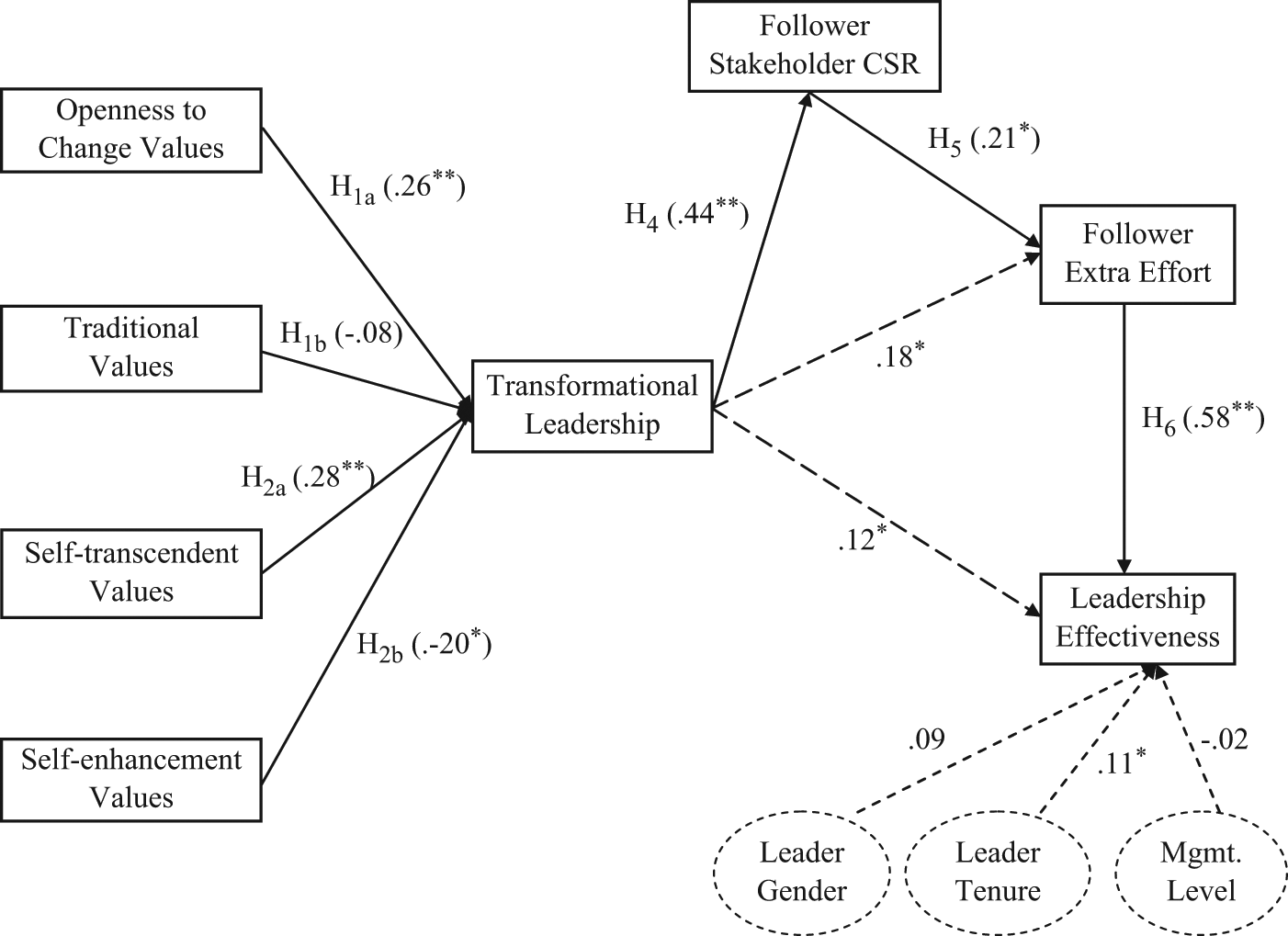
Hypothesized model of transformational leadership
Several plausible conceptual models of the study’s variables were tested using SEM to offer comparative support for the hypothesized model. The results of these tests are listed in Table 2. The alternative models were developed to compare the hypothesized model to more parsimonious descriptions of the data. Specifically, the hypothesized model (Model 1) was compared with a model without follower CSR values as a mediating variable (Model 2) and a model that omits leader personal values as antecedents to transformational leadership (Model 3). The hypothesized model was also tested against a model that postulates follower CSR beliefs as mediating the relationship between leader personal values and follower extra effort, which was modeled to predict leadership effectiveness. Finally, the hypothesized model was compared with a direct effects model (Model 5) in which leader personal values, follower CSR beliefs, follower extra effort, and leadership effectiveness were all postulated to predict transformational leadership. The direct effects model is consistent with the view that follower perceptions of leadership performance outcomes influence how followers rate leadership style (e.g., Meindl & Ehrlich, 1987). As illustrated in Table 2, each of the competing models demonstrated significantly poorer fit to the data than the hypothesized model.
Results of Competing Models Tested Against the Hypothesized Transformational Leadership Model

NOTE: CSR = corporate social responsibility; df = degrees of freedom; CFI = comparative fit index; IFI = incremental fit index; TLI = Tucker–Lewis index; RMSEA = root mean square error of approximation; AIC = Akaike information criterion.
p < .05. **p < .01. ***p < .001.
Follow-up SEM analyses were conducted to further test the hypothesized model. To assess the mediating role of follower CSR beliefs on the relationship between transformational leadership and follower extra effort, we constrained the direct effect between transformational leadership and follower extra effort to zero and conducted SEM analyses on the hypothesized and alternate models described above. The results support the pattern of findings summarized in Table 2. The hypothesized model demonstrated the strongest fit, χ2 = 51.67 (df = 26, p < .01), CFI = .93, IFI = .94, TLI = .93, RMSEA = .05, and AIC = 113.09. Across the alternate models, Model 3 (transformational leadership → follower CSR beliefs → follower extra effort→ leadership effectiveness) demonstrated the strongest fit to the data, χ2 = 76.43 (df = 10, p < .001), CFI = .82, IFI = .85, TLI = .82, RMSEA = .07, and AIC = 113.09. Overall, these results offer further support for the hypothesized model of transformational leadership.
Hypothesis Testing
Hypotheses 1 and 2
As expected, leader openness to change (β = .26, p < .01), self-transcendence (β = .28, p < .01), and self-enhancement (β = −.20, p < .05) were strongly associated with transformational leadership. Unexpectedly, leader traditional values were not associated with transformational leadership (β = −.08, ns). Overall, Hypotheses 1a, 2a, and 2b were supported, whereas Hypothesis 1b was rejected.
Hypotheses 3 and 4
The hypothesized role of follower CSR beliefs as partially mediating the relationship between transformational leadership and follower extra effort was assessed by comparing the SEM paths in Figure 1. As predicted by Hypothesis 3, transformational leadership was strongly associated with follower CSR beliefs (β = .44, p < .01), which was predictive of follower extra effort (β = .21, p < .05). By comparison, transformational leadership demonstrated a weaker direct relationship with follower extra effort (β = .18, p < .05) in the hypothesized model. Using methods described by Preacher and Hayes (2008), a direct test of the indirect effect of transformational leadership on follower extra effort demonstrated a nonsignificant indirect effect (b = .12, ns). Using 95% bias-corrected bootstrapping confidence intervals (z = 1,000 bootstrap samples), the mean indirect effect estimate calculated across all bootstrap samples was .1087 (standard error = .064). The lower and upper endpoints of the bootstrap confidence interval for the indirect effect were .003 and .253, respectively. The presence of follower CSR beliefs in the model considerably reduced the strength of the relationship between transformational leadership and follower extra effort. These results provide support for follower CSR beliefs as partially mediating the relationship between transformational leadership and follower extra effort. Baron and Kenny’s (1986) mediation analyses also demonstrated that follower CSR beliefs satisfied all three conditions for partial mediation: (a) transformational leadership strongly predicted follower CSR beliefs (β = .40, p < .01), (b) transformational leadership strongly predicted follower extra effort (β = .44, p < .05), and (c) the relationship between transformational leadership and follower extra effort lessened significantly (from β = .44, p < .01, to β = .20, p < .05) when follower CSR beliefs was entered into the model. According to Sobel’s (1982) method, which assesses the significance and stability of such changes, results showed that the beta weight change for transformational leadership was statistically significant (z = 3.23, p < .01). Thus, Hypotheses 3 and 4 were supported.
Hypothesis 5
As expected, follower extra effort was strongly associated with leadership effectiveness (β =.58, p < .01). Thus, there was strong support for Hypothesis 5.
Discussion
The purpose of this study was to empirically examine an integrated model of transformational leadership that includes key leader values and the mediating role of follower CSR beliefs. In an effort to address both conceptual and methodological limitations in the transformational leadership literature (Dvir et al., 2002; Judge & Piccolo, 2004; Yukl, 2006), this study found mostly strong support for the hypothesized relationships among leader values, leadership behavior, and the mediating role of follower CSR beliefs on leadership performance outcomes. As predicted, leader openness to change, self-transcendent, and collectivistic work values were positively associated with transformational leadership, whereas self-enhancement values were negatively associated with transformational leadership. Follower stakeholder CSR beliefs significantly mediated the relationship between transformational leadership and follower extra effort, which was strongly associated with follower ratings of leadership effectiveness. The strength of these findings is supported by the study’s split-sample methodology whereby ratings of transformational leadership were obtained from half of a given leader’s followers, whereas ratings of follower CSR attitudes, follower extra effort, and leadership effectiveness were taken from the other half of a given leader’s followers. Furthermore, the hypothesized model of transformational leadership demonstrated the greatest fit to the data compared with a series of competing models that tested different configurations of the study’s variables.
Implications for Theory and Research
The findings from this study present several implications for transformational leadership theory and research. Our findings offer empirical support for the relationships between leader personal values and the transformational leadership influence process. Despite the dominant role of leader values as a central mechanism of influencing followers in models of transformational leadership (e.g., Bass & Steidlmeier, 1999; Burns, 1978), there are very few empirical studies linking personal leader values and transformational leadership (Sosik, 2005) and no published studies that model follower CSR beliefs as mediating leadership performance outcomes. Our results both extend and refute Sosik’s findings on the relationships among personal leader values and transformational leadership behavior. In contrast to Sosik’s findings, our results suggest that leader traditional values and leader self-enhancement values are not associated with transformational leadership. Future empirical examination of these leader values and others is clearly needed to clarify the dominant personal values that characterize transformational leaders, particularly given the central role of values in the follower influence process (Bass & Steidlmeier, 1999).
Addressing the limited support for the active mediating influence processes of transformational leadership, our findings suggest that a potentially powerful explanation for the robust effects on leadership performance outcomes stems from follower beliefs in the stakeholder CSR perspective. Transformational leaders, driven by their fundamental beliefs in openness to change and collectivistic and self-transcendent values such as altruism, self-sacrifice, and social justice, influence their followers to believe that socially responsible business practices are critical to organizational effectiveness. Aided by transformational leaders’ collective vision that inspires followers to look beyond self-interests for the good of their organization and community, followers’ stakeholder CSR beliefs and internalization of such values generate willingness to exert extra effort for the leader and organization (Lord & Brown, 2001; Lord et al., 1999). Future research is needed to corroborate and extend our finding that follower CSR beliefs partially explain the robust effects of transformational leadership on follower extra effort and leadership effectiveness.
Implications for Practice
Our results offer several potentially useful implications for organizations. First, organizations should conduct more formal assessment of the personal values of their leaders and develop a safe feedback mechanism to enhance manager self-awareness of these key antecedents to effective leadership. Similarly, organizations should devote more attention to formal assessment of followers’ values, as emerging research demonstrates the importance of understanding multiple follower characteristics for optimizing leadership performance outcomes (Avolio, Walumbwa, & Weber, 2009; Sy, 2010). For example, a more rigorous matching process concerning leader–follower values congruence can help improve leader placement decisions for key assignments. As organizations continue offering leadership assessment and feedback through multisource/360-degree tools, human resource practitioners should place greater emphasis on personal values as an important dimension for leadership assessment. To address a fundamental developmental challenge for many emerging leaders, enhancing self-awareness concerning the key operating assumptions and norms that drive effective leadership practices, organizations should offer emerging leaders the opportunity to safely surface key personal values through assessment and development activities. Our findings also suggest that organizations attempting to enhance employee engagement in CSR initiatives should revise leader selection and promotion criteria to reflect candidates’ ability to articulate the complexities of CSR and develop strategies that balance the needs of multiple stakeholder groups. The numerous professionals and bodies charged with making leader selection and promotion decisions, including boards of directors, executive search committees, and human resource professionals, would benefit from assessment tools and measures (e.g., multistage interview processes, assessment center exercises, job samples, simulations, etc.) that measure a prospective leader’s ability to conceptualize CSR issues and persuasively engage multiple stakeholders.
Limitations and Future Research Directions
Although the multiple data sources and follower subgroups used to assess the study’s variables represent important methodological advantages, several limitations to this study should be noted. Given the cross-sectional nature of the research design, the data and findings presented here cannot support causal conclusions regarding leader values and behavior, follower beliefs, and leader performance outcomes. Future research would greatly benefit from longitudinal research designs that allow causal conclusions concerning the key leader value antecedents, mediating follower variables, and performance outcomes of transformational leadership. However, consistent with best practices for determining causal inferences when randomized field experiments are impractical (Antonakis, Bendahan, Jacquart, & Lalive, 2010), the present study adopted a split-sample methodology for neutralizing concerns of monomethod variance, a noted limitation in leadership studies (Dvir et al., 2002). Another potential limitation is follower response bias due to leaders being allowed to identify the direct reports who participated in the study. Leader participants may have selected only those direct reports most likely to offer positive ratings of leadership behavior and performance. However, this concern is at least partially mitigated by the fact that the leaders were clearly instructed and repeatedly reminded to submit the names and e-mail addresses of all direct reports and teammates for participation in the study. Because leader participants were recruited through community development programs, as opposed to their employers, the leaders had no incentive to selectively include some direct reports and exclude others based on likelihood of positive ratings. Contrary to leaders in organizations that tie leadership assessment ratings to merit pay, bonus allocations, promotion decisions, and other rewards, the leaders in the present study did not perceive such consequences as outcomes of their leadership assessment results. Overall, the study of transformational leadership stands much to gain from continuing empirical efforts to better understand how leader personal values are linked to specific behavioral styles that engender ethical, socially responsible beliefs and behavior in our organizations and communities.
Footnotes
The authors declared no potential conflicts of interest with respect to the research, authorship, and/or publication of this article.
The authors disclosed receipt of the following financial support for the research, authorship, and/or publication of this article: The authors gratefully acknowledge the funding support provided by the Graziadio School of Business and Management’s Julian Virtue Professorship.